




Abstract
This paper presents a data user's perspective on how recent changes in statistical standards have successfully addressed challenges to improving statistics on workers in informal employment, and making these statistics accessible. The findings are based on recent work of the Statistics Programe of Women in Informal Employment: Globalizing and Organizing (WIEGO), using data from several national labour force surveys. WIEGO is a global research and policy network focused on empowering the working poor, especially women in the informal economy, to improve their livelihood. The paper focuses on measurement challenges in identifying key groups of informal workers, alongside related developments in international statistical standards, including improvements in the classification and identification of dependent contractors and contributing family workers through the new International Classification of Status in Employment (ICSE-18). The importance of a well-defined cross-cutting variable on place of work in identifying street vendors, market traders, home-based workers and domestic workers is also discussed. The paper highlights the need to measure emerging forms of non-standard employment in high income countries that display characteristics of informal employment. Finally, the paper raises the importance of disseminating data following the recommendations of the Informal Economy Indicator Framework, approved at the 21st International Conference of Labour Statisticians in 2023.
Keywords
Introduction
WIEGO (Women in Informal Employment: Globalizing and Organizing) is a global research and policy network focused on empowering the working poor, especially women, in the informal economy to secure their livelihoods through equal economic opportunities, rights, protection, and voice. WIEGO works with member based organizations (MBOs) and networks of specific groups of workers in informal employment — including domestic workers, home-based workers, market traders, street vendors, and waste pickers. These groups need and request data in their efforts to seek identification as workers — an essential first step in making unrecognized workers visible. Further, data on the characteristics, working conditions and households of these workers provide the basis for the implementation of their rights as workers. However, with the exception of domestic workers, compiled data are not readily available for these worker groups in official statistics. Historically, labour policies have focused on workers in the formal sector and on employes, rather than the large shares of informal employment and self-employed in developing countries. Since its beginning in 1997, WIEGO has placed priority on improving the availability and use of data on informal employment and specific groups of mainly informal workers. Through on-the-ground experience with workers in informal employment and their organizations, WIEGO has information on the data they require, the limitations of the statistical standards in use and their implementation as well as areas of needed improvements. The WIEGO Statistics Programe has used this information to be a voice for informal workers, representing their reality and perspective in the discussions of the international statistical system on improving statistical standards. The Programe has also disseminated statistics in formats that were easily accessible to the advocates for these workers as well as researchers and policy-makers.
Since the adoption of the definition of employment in the informal sector by the 15th International Conference of Labour Statisticians in 1993, subsequent Conferences have broadened and further refined the informality framework. The guidelines recommended by the 17th ICLS in 2003 included all employment not covered by formal arrangements, through work whether in enterprises of the formal or informal sectors, or households in the concept of informal employment, and highlighted the need to apply the concept to both agricultural and nonagricultural activities.
This paper takes up two major changes in international standards related to informality statistics from more recent sessions of the ICLS. It presents a user's perspective on how these revisions together address challenges faced by WIEGO and its member organizations in identifying informal jobs and working conditions. The first change relates to the revised International Classification of Status in Employment (ICSE-18), approved by the 20th ICLS meeting in 2018. ICSE-18 now better reflects the economic risks and autonomy of informal workers. The second is the revision of statistical standards for informality, approved at the 21st ICLS in 2023, that includes revised measurement criteria for the concepts of informal sector and informal employment. To support implementation of these criteria, the 21st ICLS gave priority to a set of variables that are essential in accurately identifying groups of workers in the informal economy and the employment status of women. The 21st ICLS also recommended a comprehensive indicator framework for statistics on the informal economy that links the use of data to policy issues at the individual, job, and household levels (Frosch; Walsh; this issue).
These significant revisions rely upon fundamental changes in the definition of work and employment brought by the 19th ICLS resolution I concerning statistics of work, employment and labour underutilization (2013) which, as Frosch (this issue) states, “changed the very foundation of labour statistical standards.“ These changes also formulated a more circumscribed definition of employment (for pay or profit only) and a broader concept of forms of work to characterize and measure all forms of work (paid and unpaid) including own-use production work, unpaid trainee work, volunteer work and other work activities.
This paper discusses these changes in the context of WIEGO's efforts to make statistics available to groups of workers who are the focus of the organization's work, as well as to policy makers. One set of challenges has involved identifying these groups — particularly women workers — their characteristics, and working conditions in official statistics. A second set of challenges has involved preparing data in formats that are easily accessible to researchers, policy makers and advocates. The new ICSE-18, and the revised statistical standards for informality, where implemented, are expected to improve data on worker groups of concern to WIEGO. First, issues of classification that are directly addressed by the revised statistical standards are discussed in the cases of dependent contractors and contributing family workers (CFWs). Second, challenges in the identification of worker groups are discussed through a cross cutting variable on place of work, highlighted in the recommendations of the two recent ICLS sessions. A third section deals with the importance of the measurement of informal employment in developed country labour markets. Efforts to prepare statistics on waste pickers, a worker group of policy interest but one that is not well measured in official statistics, are reviewed, including how these groups, sometimes in cooperation with national governments, have initiated efforts to obtain data on their numbers. Finally, the paper takes up the dissemination of statistics on informality and its workers—an objective of the WIEGO Statistics Programe from its beginning and an important component of the recent Resolution concerning Statistics on the Informal Economy.
Dependent contractors
Measurement challenges: Identifying dependent contractors
Now that the status of dependent contractor is a key category in ICSE-18, the implementation of this classification system in countries will provide for a more accurate classification of many workers in several of the groups of focus to WIEGO. For example, in many countries of the developing world, the majority of home-based workers have been classified as independent own-account workers. Based on data from 85 developing and emerging countries in ILOSTAT, 58 percent of women and 69 percent of men in home-based work have been classified as independent, own-account workers. 1 Home-based workers often operate as producers who are part of domestic or international garment production chains but are not on an employer's payroll so they have not been classified as employes. Nor are they fully independent. Home-based workers who are engaged in such production chains (referred to as “homeworkers”) as well as industrial outworkers more generally are economically dependent on another economic entity and do not exercise control over many of the decisions involved in their activities—such as how much to charge for their production, or what to produce and how. They receive orders through an intermediary and must produce products on specification. This organization of production also takes place for other light manufacturing industries in many countries. The range of activity is wide and can include small scale production chains, as with preparing and rolling local cigaretes, as well as components for larger processes. Cases such as these called attention to the need for updating ICSE and informed the creation of the ICSE-18 sub-category of dependent contractors.
The classification of the status in employment of domestic workers will also be more accurate with the implementation of the dependent contractor status in national surveys. The 20th ICLS, in its resolution concerning statistics on work relationships, clarified the statistical definition of domestic workers to capture not only those employed by household but also those who work for a service provider. A substantial and growing share of domestic workers are employed through service providers or job brokers, including public and private agencies and digital platforms. Of the 61 countries with data in ILOSTAT in 2019, 27 percent of domestic workers globally were hired indirectly by or through a service provider. 2 a Domestic workers hired through service agencies might be treated by the agency as payroll employes, or as independent workers accessing jobs with client households through it. The latter group of workers should be classified as dependent contractors when they are compensated through a commercial agreement but receive specific instructions on the services they are to provide from the agency and the household. For many, the only way to access potential clients is through an agency. This supports the importance of having appropriate statistical categories to reflect accurately the employment relationships of many domestic workers given the likely contrasts in working conditions between employe status and brokered job placement entailing little or no access to formal arrangements such as job-related social protection.
In high income countries, where wage employment has dominated, certain categories of workers are similarly performing work under commercial agreements—rather than wage or salary compensation— and have been treated as self-employed by those using their labour. Yet, the nature of their arrangement entails dependance in access to customers and to the market (as is also the case of many digital platform workers) and major decisions about the work itself (as with publishing freelancers, for example, or contract farmers raising chicks under specifications for major poultry companies or retailers). Statistics in most countries have historically classified these workers as self-employed/ independent own-account, for lack of a better option within the older, bifurcated, ICSE-93 structure of “employe” or “self-employed.” It is precisely this bifurcation, and the presumption it entailed that persons in employment for profit uniformly have authority in the running of their activity, that has been addressed by ICSE-18 in order to better capture workers whose employment status falls in a grey area between employe and self-employment.
Changes achieved with the 20th ICLS adoption of ICSE-18 will result in a more realistic classification of workers in between the two statuses. With its implementation by countries, many such workers will be classified as dependent contractors, as distinct from both “employe” and “own-account self-employed” They will no longer be classified as “independent workers without employes” as they have been but, rather, in the general category of “dependent workers” as are employes and CFWs. The status of dependent contractor is determined by applying additional criteria according to the status in employment that survey respondents initially report. Separate paths of questions are recommended to apply to “self-declared own-account workers” and to “self-declared employes.” 3
Some countries have begun including questions to allow the identification of dependent contractors. An analysis of the Uganda 2021 Labour Force Survey, for example, carried out by the ILO and WIEGO, provides data on dependent contractors. The criteria for identifying dependent contractors were applied to the respondents who initially reported as self-employed, as employes, as well as the CFWs who report they make decisions in the family business (applying the same criteria as for the self-declared self-employed). The data show that dependent contractors account for 7.2 percent of total employment, 6.4 percent of women's employment, and 7.8 percent of men's employment. Women dependent contractors are identified primarily through the “self-declared self-employed” path (3.9 percent of women's employment) and to a small degree among decision making CFWs (0.68 percent) rather than the “self-declared employe” path (1.9 percent). Conversely, men dependent contractors are identified to nearly equal degree among the “self-declared self-employed” (3.6 percent of men's employment) and the “self-declared employes” (4 percent) and to a very small degree among decision making CFWs (0.15 percent).
The identification of dependent contractors in Uganda was based on questions developed as a result of 2022 ILO testing in the country. 4 Specific questions assessed the worker's 1) dependency on another economic unit for access to clients, or dependency on one client (general access to the market) and 2) on the degree of control, or lack thereof, over decisions regarding their activity, for example about how to carry out the work tasks and/or pricing. Both conditions of dependency and lack of control must be met in order for the worker to be classified as a dependent contractor.
Mexico's national statistics office, INEGI, has also carried out the measurement of dependent contractors. Preliminary data from the 2023 Labour Force Survey, shows that the share of dependent contractors in three Mexican cities (Saltillo, Toluca, and Oaxaca) reaches 3.1 percent of total employment, 3.5 percent and 6.1 percent respectively; a three-city average of 3.9 percent of all employed. 5
Formal/informal status of dependent contractors
The 21st ICLS recommended a set of unique criteria for determining the informal/formal status of dependent contractors. During the preparatory discussions, dependent contractors were recognized to have unique characteristics that distinguish them from other main status in employment categories. Criteria for being informal or formal cannot simply replicate those used for independent workers (self-employed), or those used for employes. Therefore, dependent contractors’ jobs are classified as formal/ informal following unique criteria that recognize the importance of the worker's access to formal arrangements, particularly access to statutory social protection, as a main criterion of formal employment.
The informal/formal status of a job is determined by, first, the formal/informal status of the worker's economic unit (the sector), rather than the unit on which the worker depends and, second, the characteristics of the job itself (Frosch, this issue). As noted earlier, dependent contractors are derived starting from two paths — self-declared self-employed status or self-declared employe status — and then for each status their degree of autonomy in interaction with the market and control in carrying out of their work. In addition, questions are used to determine the formal/informal status of the job itself. Those dependent contractors who do not own and operate a formal economic unit for example are not a registered business and are not registered for tax are in the informal sector. Those whose unit is in the informal sector have an informal job by default.
For dependent contractors who have registered their unit and/or are registered for tax (formal sector), further criteria determine whether their job is formal or informal. These criteria rely upon effective access to statutory social protection to determine the formal/informal status of the dependent contractor's job. Dependent contractors who are in the formal sector (through registration of their unit/activity or registration for tax) operate in diverse regulatory environments. To address these differences, the 21st ICLS informality standards provide criteria according to which the informal/formal classification of the job itself relies both on the type of national/local registration system with which the dependent contractor's economic unit/activity is registered and the worker's effective access to statutory social protection. These guidelines take into account cross-national institutional differences and their implications for determining that a dependent contractor has a formal or informal job.
Mexico's INEGI has implemented the 21st ICLS guidelines and reported on the informality status of dependent contractors. Preliminary results on three cities from the 2023 Labour Force Survey, mentioned above, 5 indicate an average rate of informal employment of 88 percent among dependent contractors. Dependent contractors accounted for an average of 8.1 percent of total informal employment in these cities; a range of 6.2 percent to 11.2 percent across the cities. A notable finding is that, across all three cities, over 70 percent of dependent contractors with an informal job were identified through the self-declared employe path.
The implementation by countries of ICSE-18 as well as the revised statistical standards on informality, and specific informality criteria for dependent workers will be especially important in identifying the informality of two groups of workers of special concern to WIEGO—home-based workers, and as discussed earlier, domestic workers. A major share of these workers are likely to be dependent contractors whose informality status can be determined with the new standards. Absent the application of the ICSE-18 revised categorization (20th ICLS Resolution I) and the Revised Standards for Statistics on Informality (21st ICLS Resolution I), the jobs of such workers would be subsumed into other status in employment categories (likely as independent worker without employe) that do not reflect the reality of their working arrangements. Consequently, the formal/informal status of their job likely would be inaccurately determined because the criteria applied depend on each category of status in employment; in effect, the job's informality status would be based on incorrect criteria.
Contributing family workers
CFWs represent 16 percent of global informal employment, according to 2019 benchmark estimates of the ILO 6 ; are mainly women (63 percent) 7 ; and by default, are classified as informal by the standards prior to the 21st ICLS. All of these characteristics have made CFWs a key focus for WIEGO. The measurement of contributing family work has received new consideration in the international statistical community, with the recognition that data collection on these workers often reflects gender bias. For example, workers identified as CFWs have generally not been asked whether they are involved in the major decisions of the family business or farm. Similarly, women who have ownership or management roles in a business may be underreported or misclassified as CFWs in lower-income contexts, where operations often tend to be smaller-scale, conducted within the home, and managed alongside other household responsibilities. 8 Moreover, the common practice of proxy response in labour force surveys further contributes to measurement error. 9 In some lower-income settings proxy reporting has been shown to have statistically significant effects on women's reported employment (whether they are employed, as well as hours), and often to a greater extent than for men. 10
Labour force survey data from Bangladesh underscore some of the measurement problems in identifying CFWs. Based on the 2009, 2013 and 2016 Bangladesh LFS rounds, wide swings were found in the share of employed women across different status categories, with a 21 percentage point reduction between 2013 and 2016 in CFWs, a 26 percentage point increase in own-account workers, and a 4 percentage point decrease in employes (Figure 1). As we are not aware of any change in survey methodology related to respondent selection (including selection of proxies), this suggests misclassification occurred across these status categories over time, particularly related to CFWs and own-account workers between 2013 and 2016. Among employed men, on the other hand, there was a less than one percentage point decrease in the share of CFWs between 2013 and 2016. Among employed men as well, trends over time are generally much flatter, with the largest change over time a 5 percentage point decrease in own account workers between 2013 and 2016, and a similar increase in employers. Misclassification of status categories, particularly among CFWs, has therefore affected women's reported status in employment to a greater extent than men's in Bangladesh.
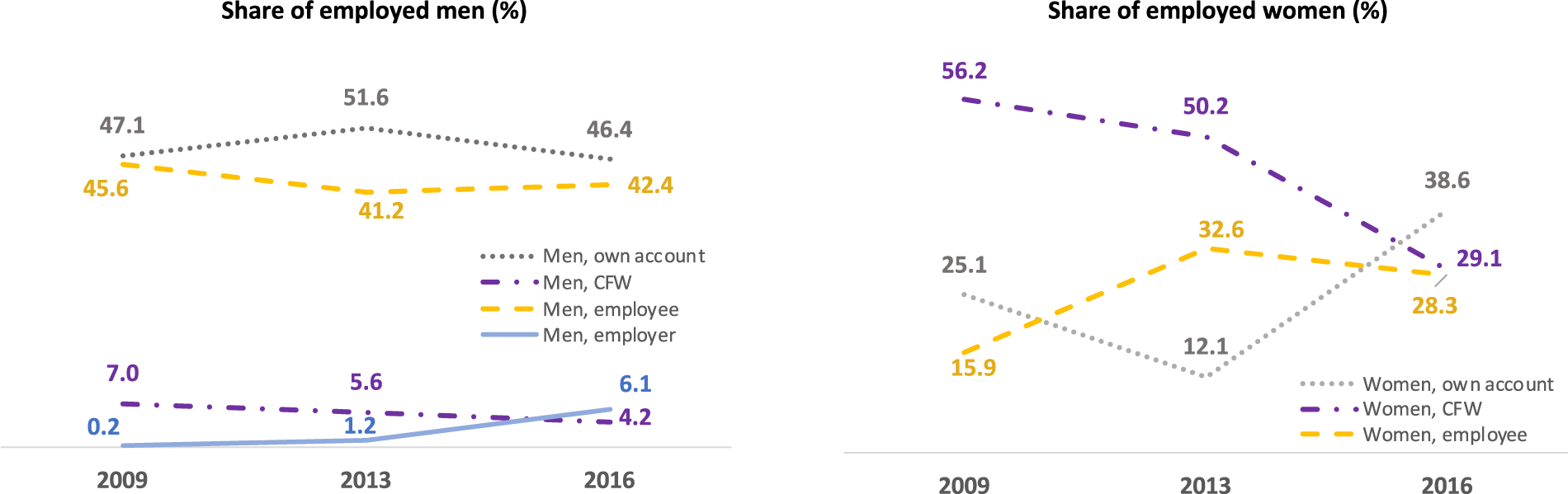
Share of employed men and women self-reporting as own-account or contributing family worker: Bangladesh LFS, 2009–2016. Notes: (1) Less than one percent of employed women reported their status as employers over the period.
ICSE-18 provided for improved measurement of CFWs with the following definition: CFWs provide assistance in the household farm or business without receiving regular payment, and who do not make critical decisions in the household enterprise. 11 With this definition, it is no longer sufficient to have a single question to determine the status of CFWs; additional information on decision making and remuneration are now recommended. The 21st ICLS opened the possibility of formal status for CFWs by assigning formal status to CFWs in those countries where CFWs who work with a registered economic unit can access job-related statutory social protection schemes, and contributions are paid (from household market enterprises, for example) on behalf of the CFW to such schemes (Frosch, this issue). While this is admittedly an exceptional circumstance, in countries where this is possible, the standards reflect this possibility.
The 2021 Uganda LFS also provides Insight on the extent of misclassification of CFWs. The survey included a follow-up question on decision-making asked of all respondents who self-classified as CFWs: who usually makes the decisions about the running of the family business with four response categories, including “yourself” and “yourself with others.” The results show that about 40 percent of men and 56 percent of women who were identified as CFWs in the status in employment question made major decisions in the family enterprise as reflected in their responses to the above two categories (Figure 2), and should therefore be reclassified as own-account independent workers. This implies, again, that women are affected more by this misclassification. Earlier approaches that did not examine this additional criterion, as a result, were misrepresenting women's working conditions. CFWs who receive payment, on the other hand, and therefore should be classified as employes could not be identified/reclassified because the survey question on earnings was only asked of self-declared employes. Going forward, asking all status in employment categories about remuneration would improve the identification of the CFWs who should be reclassified as employes if they were receiving regular payment.
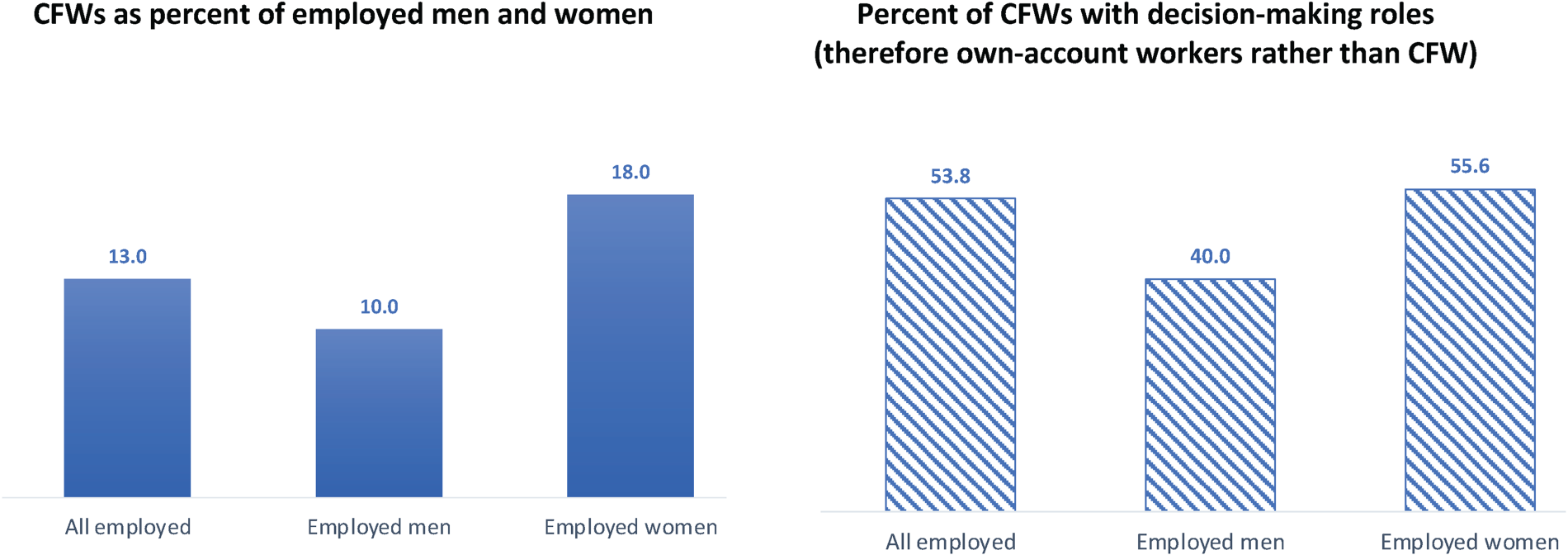
CFWs as a percent of employed men and women, and percent of CFWs with decision-making roles in the family enterprise, by sex: 2021 Uganda Labor Force Survey.
Information on place of work is the key variable to identifying home-based workers, but it is also important for identifying other key groups, including street vendors, market traders, and domestic workers. Indeed, On Measuring Place of Work was an early publication prepared by WIEGO with the United Nations Statistics Division and the ILO to provide methodological guidance on the design of a “place of work” variable to identify home-based workers and street vendors as well as on the use of the variable more generally. 12
With the 20th ICLS, and specifically the Resolution concerning statistics on work relationships, “type of workplace” was highlighted as a cross-cutting variable to provide complete and coherent statistics on work relationships. Response categories have generally included work in one's own home or a structure attached to the home; a client or employer's home; at a farm or agricultural site; a business, office, factory; other types of fixed premises such as a shop or stall; on the street or another public space without a fixed structure; or in a vehicle.
Figure 3 presents data collected from the place of work question in the labour force surveys of Bangladesh (2016/17), Nepal (2020/21), Senegal (2019), and Türkiye (2023). The specific categories are somewhat different across the countries and create problems in identifying specific groups of informal workers. 6 To identify market traders, for example, ideally the place of work question would have a response category “an open market or built space.” However as shown in Figure 3, the Bangladesh and Türkiye surveys do not have this response category broken out separately from “fixed spaces.” This is true also for the 2021 Uganda LFS.
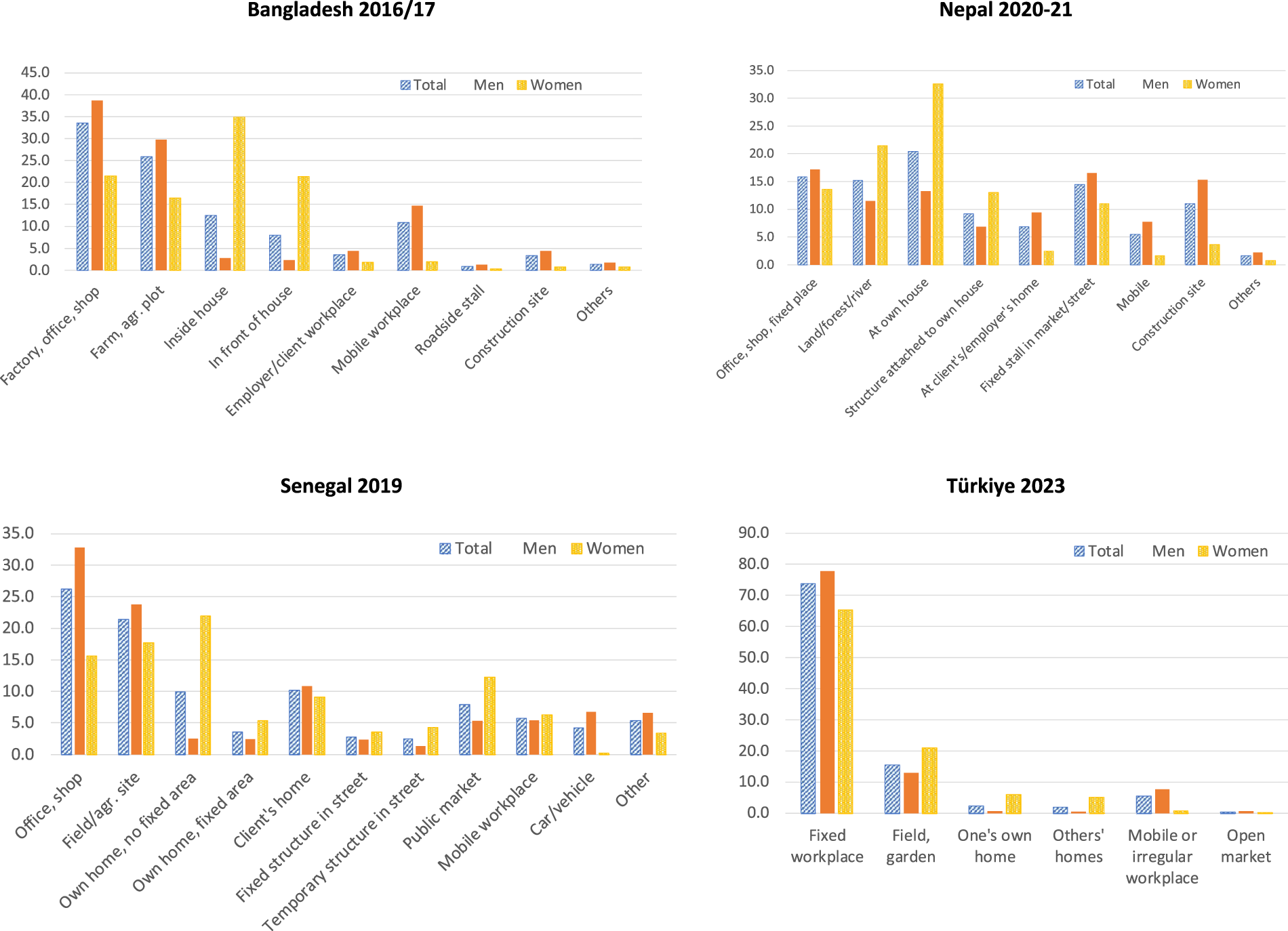
Percent of employed (total, men and women) across different place of work categories (%): Bangladesh, Nepal, Senegal and Türkiye Labor Force Surveys.
Figure 3 shows that women are much more likely than men across countries to report home as a place of work. It is important, particularly for identifying domestic workers, that the response categories distinguish own home from the home of others. The Senegal, Nepal, and Türkiye LFS allow for this distinction (with an extra step needed for Türkiye, as discussed below). Bangladesh, however, does not.
This can contribute to a misclassification of workers indicating “home” as their place of work when the work was in the home of others. About 20 percent of women in the 2016/17 Bangladesh LFS, for example, who responded that they worked in the home were actually domestic workers in others’ homes or facilities, based on a separate occupation variable that provided a more detailed description of their activities. 13 Given these measurement issues, cross-checking the place of work question with disaggregated industry and occupation codes was needed to more accurately identify women home-based workers in the country.
In the 2016/17 Bangladesh survey, another issue occurred with identifying home based workers — a large number of women in agriculture (mainly in livestock rearing) reported home as a place of work. 14 Since the place of work question focused on plot farming, many women reported their place of work as the home or area in front of it where tending animals generally occurred. However, agricultural work is not included in the WIEGO and HomeNet International's definition of home-based work, so parsing out these workers is important.
Another issue is that in some national labour force surveys, the place of work question is not asked of all employment status categories. In some Latin American countries, for example, the place of work question is asked only of employers and own account workers (see Bouvier and Vanek, 15 for El Salvador; and Ramírez, et al., 16 for Peru). Excluding employes leads to substantial underestimates of key groups of workers and this measurement issue has particular implications following the COVID-19 pandemic, since home-based work has increased among different employment status categories, including employes.
Finally, making the place of work questions more efficient and effective is also important. The Türkiye LFS, for example, had two different place of work questions, each asked of all employment status categories: (Q1) The type of workplace, and (Q2) Are you performing all or a portion of your business at your home (1 = Usually; 2 = Sometimes; 3 = Never). A main challenge was that, with (Q1), the response category relevant to identifying home-based work also included “others’ homes” along with “one's own home,” so it was difficult to extricate those who were working in their own home from those working in the homes of others. Including separate response categories for own versus others’ homes would be more efficient and clearer.
Figure 4 shows, over successive rounds of the Türkiye LFS, the share of employed women who reported working in their own home rose from 4.4 percent in 2017 to 6.1 percent in 2023, with most of the increase occurring after the onset of COVID-19 in 2020–21. But importantly, the share working in others’ homes also increased over time. Again, this was particularly true for women and as discussed in the next section on domestic workers, likely due to some degree to an increase in personal care work in others’ homes post-pandemic. A separate category for each of these types of workplaces is therefore important in identifying worker groups more accurately, and for understanding how work environments are shifting over time for different groups of workers – especially for women workers.
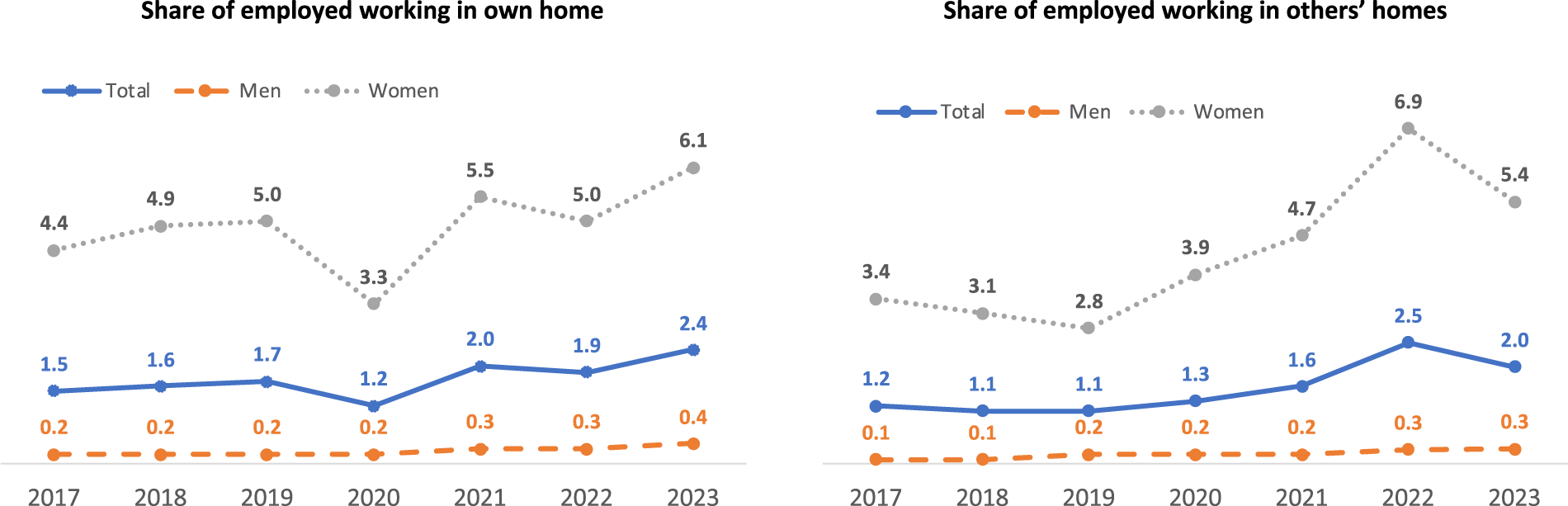
Share of employed working in one's own home, and others’ homes, over time: Türkiye LFS.
In summary, there are significant measurement issues around the design and implementation of the cross-cutting variable, place of work. The 20th and 21st sessions of the ICLS have given priority to this variable and specified the detailed response categories that the question should include. National surveys should give new focus to this question as it is a critical to understanding the working environment of women and men as well as for the identification of worker groups, especially low income workers in informal employment.
There are around 76 million domestic workers globally, according to estimates benchmarked in 2019, and three-fourths of these workers are women. 2 Although domestic workers were hit particularly hard during the COVID-19 crisis, 17 their numbers have rebounded since 2021, to a large extent through increasing demand for personal care services. However, domestic work remains a vulnerable occupation. Recruitment and working conditions are generally not regulated and implementation of any regulations is difficult given that work takes place in private households. Moreover, a high share of domestic workers are migrants.18,19
Domestic workers are defined in the 20th ICLS as “workers of any sex employed for pay or profit, including in-kind payment, who perform work in or for a household or households to provide services mainly for consumption by the household”. 20 They are engaged in a wide range of tasks in the households of others, including cleaning, shopping, cooking, and care, as well as other services such as gardening and security. Domestic workers are the one worker group of focus to WIEGO with a major category in the International Classification of Industries (ISIC) (industry code 97) and in the International Classification of Occupations (ISCO) (occupation codes 53 and 81, as discussed below). Nevertheless, there are measurement issues in identifying these workers in national surveys. Because of the range of activities included as domestic work and the diverse working arrangements, identifying these workers involves a multi-layered approach based on (a) industry and/or occupation classification; (b) status in employment; and (c) the relationship to the household head- the latter to identify live-in domestic workers. 2 In addition, information on a well detailed place of work question is also important in confirming whether domestic workers are engaged in services in households other than their own. For example, as in the 2016/17 survey in Bangladesh, about 20 percent of women reporting domestic work as their employment status while also reporting home as their place of work. Further analysis of the occupational codes of these respondents in Bangladesh showed that almost all were working as domestic workers.
The main approach typically used to identify domestic workers is industry code 97, activities of households as employers of domestic staff. However, this often needs to be supplemented by an occupation code for personal care services (code 53) while ensuring that there is no duplication of respondents. Employment in care work is often underreported by respondents in household surveys. 21
Türkiye provides an example of some of these measurement issues. In the Türkiye LFS, the standard practice of relying on industry code 97 would lead to an underestimate of domestic workers, because industry code 97 was applied only to employes. 22 As a result, additional steps needed to be taken to identify —among own-account workers — those who were engaged in activities that are considered as domestic work. Such workers in Türkiye may be employed through service agencies to perform activities such as gardening or care work. This issue was addressed in an analysis of the LFS by including additional individuals who work outside the home, as own account workers in industry category 81 (building related services) and those outside of industry code 97 who were in occupation code 53 (personal care services). These categories related to domestic work are presented in Figure 5, and are constructed to be mutually exclusive. The share of personal care services included as domestic work increased between 2017–2023 — from 54.5 percent to 59.4 percent for women, and 73.2 percent to 77 percent for men (Figure 5). For both men and women, the greatest increase in the share of personal care workers occurred between 2021–22. The national statistical office (Türkstat) explained this increase resulted from greater efforts after 2021 to capture information on paid care workers in the labour force survey, and hence resulting at least in part from changes in survey methodology.
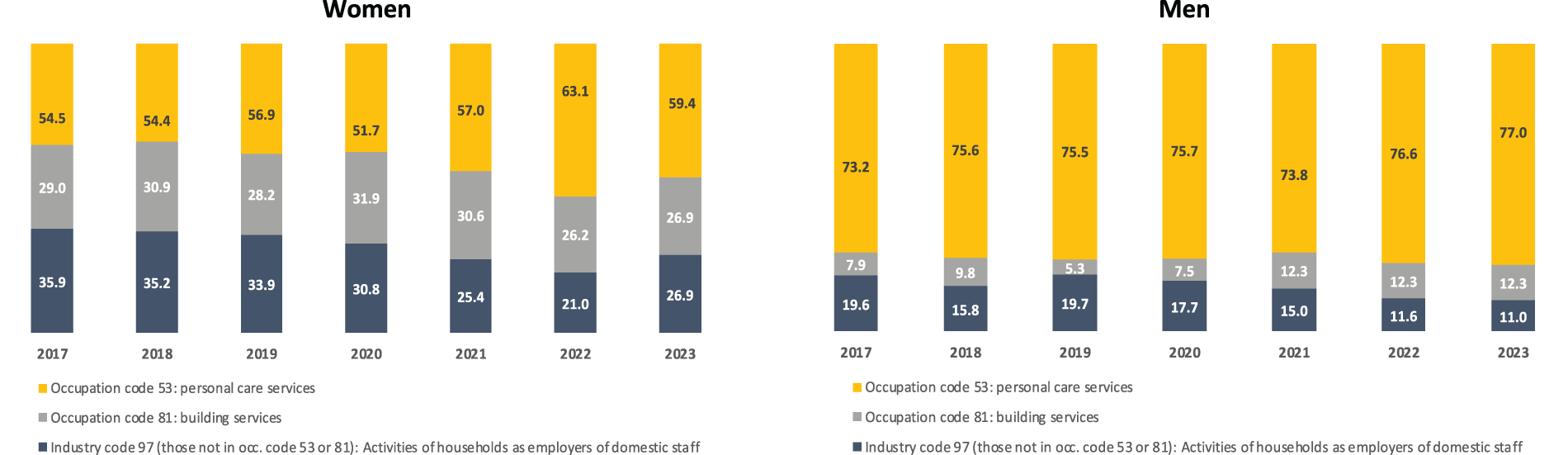
Composition of domestic work (percent): Türkiye, 2017–23 LFS rounds.
The data on changes in activities that comprise domestic work need to be considered in the context of the overall numbers of women and men in domestic work. As Figure 6 shows, there are around five times as many women employed in domestic service as men in Türkiye. Further, it is striking that little change has taken place in the numbers of men in domestic work in contrast to the patterns for women. The number of women domestic workers dipped sharply in 2020 with the impact of COVID-19 and began to increase steadily from 2021 to 2022 — dropping somewhat again in 2023, but remaining relatively high compared to pre-2021. However, the degree to which these patterns reflect the actual change in numbers of women in domestic work or further measurement-related issues is not clear. As Figure 6 indicates, the increase in numbers reflects an increase in domestic workers providing personal care services.
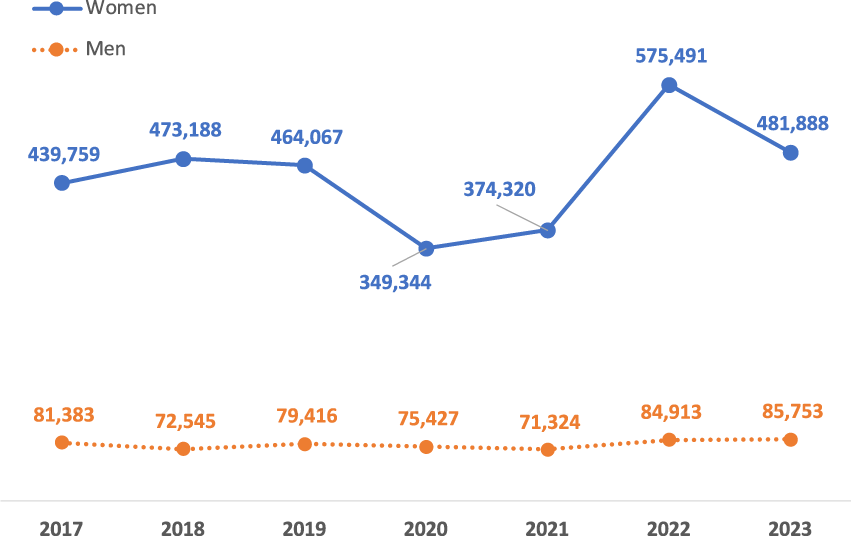
Number of domestic workers: Türkiye, 2017–23 LFS rounds.
There has been a government policy in Türkiye to provide a small (below minimum wage) care allowance, to provide care for family members living elsewhere; however, this is not a group that should be included in the domestic worker category. A closer examination showed that about 70 percent of those in personal care services reported finding their job through advertisements or their employer (as opposed to through the government or family members). It is unlikely, then, that individuals receiving the government care allowance comprise a large share of this group. This was separately confirmed with administrative records on those receiving the care allowance in Türkiye.
The nature of domestic work is changing in many ways—in the increasing share of personal care, in its recruitment through service agencies rather than households and in the government support related to this work. These changes need to be reflected in the approaches to identifying these workers in the questionnaires of national surveys and in the implementation of the questions in the field.
Until recently, the measurement of informal employment has not been common in developed/high income countries. This general pattern has reflected the belief that informal employment is unique to developing countries and does not exist in developed economies. The latter are, indeed, characterized by the dominance of formal employment and within that of the employe relationship and predominant occupational groups differing from those in developing economies. However, the concept is relevant to both developed and developing countries.
In 2008 WIEGO convened the Workshop on Measuring Informal Employment in Developed Countries to explore the possibilities and challenges involved in capturing in official statistics the varied forms of informal or non-standard employment across developed countries. Following the meeting, a WIEGO Working Paper was published in 2009, Toward a Common Framework for Informal Employment across Developed and Developing Countries. 23 This paper addresses the importance of developing a common framework covering both developed and developing countries, highlights issues that arise when applying the ICLS definition of informal employment to developed countries and describes what is needed to facilitate the collection of comparable data across countries. This would allow for a more reliable measurement of informal employment worldwide.
The recognition of the importance of informal employment to developed countries was a key step in the development of the framework of informal employment (the 21st ICLS) and the preparation of global indicators on informality, in particular Sustainable Development Goal 8.3.1. In developed countries, the measurement of categories of “non-standard” forms of employment (e.g. limited duration hires; intermediated temporary employment; casual or seasonal work arrangements) and their characteristics (e.g. short or unpredictable job duration, limited social protection coverage) have taken precedence over that of informal employment, the former being perceived as closer to labour market realities. Also, particularly in countries with highly regulated employment arrangements, measurements, legal standards and policies have focused on diverse types of non-standard arrangements, most visibly short-term or limited duration hires, temporary staffing, and occasionally casual or seasonal work arrangements 24 but less on the cross-cutting characteristics shared by many of these employment arrangements and their similarity to informal employment.
Policy interest in measurement of non-standard employment has stemmed from concerns about employment instability (short duration of employment arrangement or contract, consequences of intermediation/job brokering), but also about limited (de jure or de facto) access to statutory social protection for workers in some non-standard arrangements, also a key marker of informality. Nevertheless, historically, there was limited interest in developed countries in measuring the full share of the workforce whose job is informal, that is, with employment arrangements that sever the job holder from access to formal arrangements (labour rights, social protection). Further, research and policy concerns about employment changes focused on non-standard arrangements that mostly retained some of the basic premises of wage employment, that is dependent employe jobs. Although non-standard arrangements carry risk and vulnerability, they do not thoroughly diverge from basic characteristics of dependent employment, and have been subject to regulations of minimal employment conditions (although lesser ones than in regular wage employment) in many countries, for example in several European Union countries.
However, over the last decade, several types of employment have emerged across developed economies that entail a more drastic departure from formal wage/salary employment; this has led to growing interest in the measurement of informal employment. Most visible are varied forms of digital platform employment which sever workers from the employe status (and related core social protection and labour rights) yet do not entail the autonomy of independent workers that would enable them to better manage opportunities for gains and sustain economic risk . Also, continuous experimentation with varied forms of work arrangements—for example “zero hour” contracts, or employe leasing—has become more common across economies, compelling an interest in assessing the share of total employment that entails limited or no access to formal arrangements, in existence in national labour markets.
Varied forms of employment that entail casual, rather than formal, arrangements and tend to be associated with little or no access to social protection have grown. In transition economies, particularly in Eastern Europe, the growth of such casual employment (for example, day labour in agriculture or manufacturing, seasonal service jobs, industrial outworking) became more noticeable as the region's economies underwent significant change. ILO estimates that informal employment accounted for 19.8 percent of Eastern Europe's employment in 2019. 6 A different, but related, issue is the greater interest across regions in measuring the consequences of violations of labour and social regulations of employment that is de facto informal employment. This is a growing concern in services industries where corporations are large but workplaces are small and constitute settings where enforcement is difficult.
Given the increase in and the diversity of employment relationships that depart from formal (primarily) wage employment, the measurement of informal employment and the statistical standards on informality approved by the 21st ICLS now have greater appeal and relevance in high income economies. In fact, the 21st ICLS standards related to determining the informality of dependent contractors were of special interest and policy relevance to high income countries. In addition, the possibility for CFWs to be formal in the new standards is most useful to high income countries with highly developed social insurance systems. Moreover the indicator framework included in the 21st ICLS resolution is highly relevant to the types of analysis that high income countries need, and often use, to inform policy design — given that it recommends the collection and reporting of contextual variables on job characteristics and households of informal workers. b
Waste pickers
Waste pickers are informal workers involved in the collection, segregation, sorting, and sale of recyclables (paper, plastic, metal, glass, etc.). They are a focus of WIEGO's work. Through their recovery of recyclable material they are also a focus of the environmental sustainability movement. This occupational group is increasingly recognized as an important component of a city's waste collection system, although they are not hired or paid by the city. Due to waste pickers’ living arrangements and the seasonality and flexibility of their work, a labour force survey is an inadequate source for data on the number of waste pickers and their characteristics.
In several cities, organizations of waste pickers have taken the lead in the development of data needed for receipt of social protection and advocacy. These efforts are an example of the Collaborative on Citizen Data, a new initiative led by the United Nations Statistics Division and the United Nations Entity for Gender Equality and the Empowerment of Women, that involves the engagement of citizens – broadly defined — in the data production process.
The challenges faced by waste pickers in their efforts to produce data include gaining the trust of waste pickers, developing methods that enumerate only and all waste pickers, and putting in place plans to update, store and access the data. The WIEGO Statistics Programe has worked with waste picker leaders to document examples of the successful efforts of organizations of waste pickers to produce statistics. These are published in the WIEGO Statistical Brief series: “The Collection of Data on Waste Pickers in Colombia, 2012–2022” 25 and “Statistics on Waste Pickers: A Case Study Guide”. 26
WIEGO Statistical Briefs Series 2019–2024.
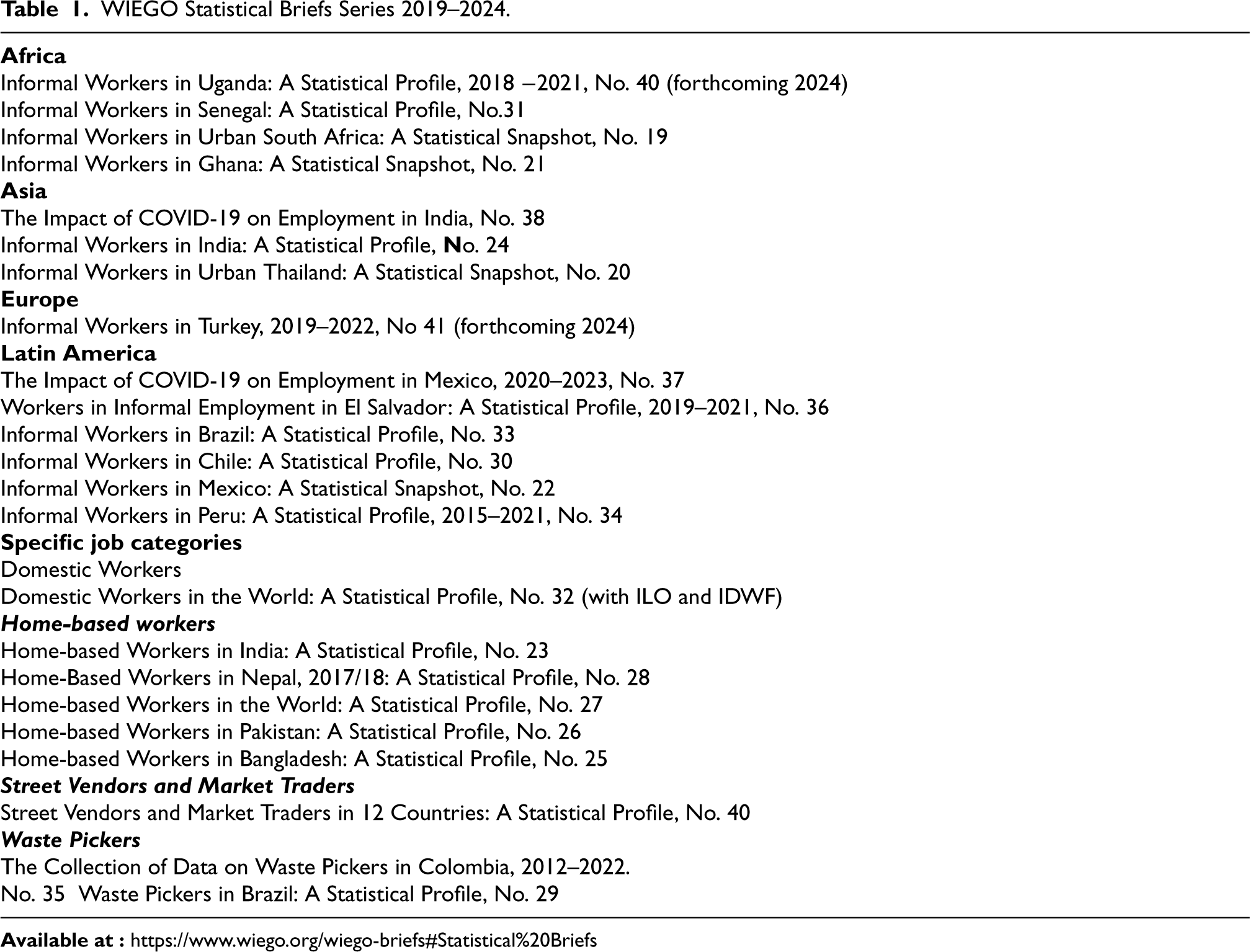
WIEGO Statistical Briefs Series 2019–2024.
Putting statistics in the hands of users — ranging from researchers, policy-makers, officials and the media—has been the second main challenge of the WIEGO Statistics Programe, a challenge that WIEGO has undertaken in collaboration with the ILO. WIEGO and the ILO prepared a series of publications on women and men in the informal economy.27–30 These publications present the available statistics in an easily accessible format. In 2018, ILO presented global data on the size and characteristics of informal employment in the 3rd edition of Women and Men in the Informal Economy, 31 following an expansion of national data on informal employment and the development of the ILOSTAT database. This first set of harmonized global estimates of informal employment (2 billion workers in 2018) based on national surveys, and its share of total employment (61 percent) underscore the importance of informal employment worldwide and have been widely quoted and used. Having a global indicator that includes both high and low income countries is important in bringing informal employment into the mainstream of labor statistics. For example, the share of informal employment by sex and across non-agriculture and agriculture was selected as an indicator for Sustainable Development Goal 8 (Promote sustained, inclusive and sustainable economic growth, full and productive employment and decent work for all).
Since 2019, WIEGO has also prepared a series of Statistical Briefs on the informal economy and groups of workers most exposed to informality (domestic workers, home-based workers, market traders, street vendors and waste pickers) in countries where WIEGO has or is developing active programs with organizations of these workers (see Table 1). The briefs present data at the national, urban and major city levels in formats accessible to a wide set of users for 12 countries in Africa, Asia, Europe and Latin America; statistical briefs were also prepared on home based workers for four countries in Asia at the request of HomeNet South Asia, the regional network of MBOs of home-based workers. Briefs with global data based on the national data files in ILOSTAT were prepared with the ILO on domestic workers and on home-based workers. It was not possible to use ILOSTAT to prepare global statistics on street vendors and market traders, so a separate brief was prepared by compiling data on the two worker groups in the 12 country studies. As the Statistical Institute of Brazil (IBGE) has taken special steps to improve the measurement of waste pickers in the National Survey of Households, a Statistical Brief was prepared on waste pickers in Brazil in 2021. Another brief on waste pickers was prepared for Colombia; it documents the process of collecting data—initially a citizen data initiative—as well as the resulting statistics (Table 1).
The WIEGO Statistical Briefs are an example of the application of the Informal Economy Indicator Framework recommended by the 21st ICLS. The Briefs and the Indicator Framework have the same general objectives: 1) a description of the numbers and the situation of these workers in the context of other workers in order to 2) support to the development of policies, particularly formalization policies, to improve the situation of these workers and assess their impacts. Moreover, the indicators included in the WIEGO briefs answer the main questions specified in the ICLS Framework document
32
at the national level but also for urban areas and a major city:
What is the extent of informality of jobs…and how does it evolve over time? What is the composition of the informal economy and what are the prevalent forms of informality of jobs..in the country? Which workers…are the most exposed to informality? What are the working conditions…in the informal economy compared to the formal economy…? What is the relative situation of women compared to men?
The WIEGO Statistical Brief series has been important to organizations of informal workers and their advocates. Information on the numbers for example, of waste picker and home based workers, have strengthened the advocacy of these workers and their organizations. Statistics in the briefs have also shown the impact of legislation on formalizing these workers’ employment. In Chile, for example, a labor law that regulates the work of private household workers has resulted in significantly lower rates of informality among domestic workers. A little more than half of domestic workers in Chile are formally employed and in Santiago the share increases to 80 percent.
33
WIEGO's experience in its Statistical Brief Series demonstrates the relevance and usefulness of the Informal Economy Indicator Framework. Providing guidance to countries on key indicators related to informality, the new Framework contributes to promoting greater use of the data produced as well as key information for improving the employment and livelihoods of workers.
Conclusion
This article has reviewed challenges WIEGO has encountered in preparing data on groups of mainly informal workers, and how they have been addressed by the standards recommended by the recent sessions of the ICLS. The 2023 statistical standards on informality, the classification of status in employment (ICSE 18) and the related recommendations improve the measurement of informality as a whole and its major categories of workers. The worker groups covered in this paper are a major source of employment especially for women in lower and middle-income countries, as discussed in the WIEGO statistical briefs. For example, in Senegal, 44 percent of women workers nationally and 87 percent in Dakar are employed in the five worker groups discussed in this paper. In India, 35 percent of women's employment is in four of the groups (domestic work, home-based work, street vending and market trade). Even in Mexico, these four groups comprise 25 percent of women's employment nationally. The significance of these jobs for women, particularly those in low income countries and households, has initiated organized activism by member–based organizations (MBOs) and networks as well as research and policy analysis by organizations such as WIEGO.
The challenge now is the implementation of the revised standards in countries and carrying it out in the face of budgetary constraints and increasing demands on national statistical offices that are a problem everywhere. However, as this issue of the journal has shown, there is demand for these data by groups that need to be reflected in government policies and, for this, reliable statistics are required.
Footnotes

Funding
The authors received no financial support for the research, authorship, and/or publication of this article.
Declaration of conflicting interests
The authors declared no potential conflicts of interest with respect to the research, authorship, and/or publication of this article.