



Abstract
Though scholarship on Philippine politics has focused on either structures or elites, political participation and inaction have become equally pertinent issues, especially in times of political change. The Philippines shows a curious juxtaposition between high levels of electoral participation in the general citizenry and mass political inaction among the majority of Filipinos outside the ballot. For this reason, we would try to make sense of this paradox by analyzing political disempowerment itself and how it is linked to political participation. Hence, we raise and address the question, what challenges do political disempowerment as political powerlessness and cynicism posit against democratization in the Philippines? The trends captured in the 2nd–5th waves of the Asia Barometer Survey suggest that political disempowerment is a vicious cycle driven by perceived dis/incentives to political participation without depoliticizing citizens. Political spectatorship is the key to understanding the virtuousness or viciousness of this cycle.
Keywords
Introduction
The political activity, status, and overall agency of ordinary citizens are important components of any democratic project (c.f. Barber, 2009; Bermeo, 2003; Dacombe, 2018; O’Donnell, 2010; Pateman, 2000; Schneider and Schmitter, 2004; Teorell, 2006). The nature and direction of democratization depends not only on the consolidation of liberal democratic institutions but it is also based on the kind of citizens it creates and the kind of citizenship it perpetuates. Furthermore, political empowerment as confidence both in oneself as a political actor and in the government as a responsive entity lies at the heart of democratization, at least for the participatory and deliberative democratic traditions (Barber, 2009; Dahl, 2006, 2008; Schneider and Schmitter, 2004). From this perspective, calls for structural, institutional, and systemic reform are essentially empty or, worse, duplicitously elitist if they don’t confront the issues of political disempowerment. In other words, democratization is doomed to fail without an active and empowered citizenry who can effectively participate in formal and informal policy processes.
Why do citizens participate in politics? Should they even participate in politics? The literature on these questions is massive, and we will not provide an extensive review (for reviews of the extant literature, see Fox, 2014; Halder and Campbell-Phillips, 2020; Kaim, 2021; Van Stekelenburg and Klandermans, 2013). Nonetheless, we note the following points. First, political attitudes toward oneself, the government, and other citizens can be considered as the primary determinants of political participation vis-à-vis the lacklustre impact of sociodemographic factors (Berinsky and Lenz, 2011; Lilleker and Koc-Michalska, 2017; Persson, 2014; Quintelier and Hooghe, 2012). In other words, if ordinary citizens see themselves and others as capable of influencing a responsive government, they are more likely to participate in politics.
Second, there is growing interest in the issues of political disengagement and inaction, especially among Western cases suffering from a decline in political interest and participation (Craig, 1979; Gray, 2015; Snell, 2010; Stoker, 2006; Stoker et al., 2011; Stoker and Evans, 2014; Van Bezouw et al., 2019; Wolfsfeld, 1986). Third, even if we take a Schumpeterian approach to defining democratic systems (i.e., the participation of ordinary citizens, situated within representative politics, must only contribute to the circulation of elites), the issue of political participation remains relevant in terms of how the character and extent of their involvement can regulate or reinforce the centralization of power among the elected. In other words, if participation becomes a mere legitimating component for an incumbent oligarchy, then a system becomes undemocratic or vulnerable to de-democratization.
Finally, if we assume that the question of political participation—who should participate and to what extent—lies at the heart of democratic theorizing, then participation can be used as another yardstick in examining the quality of democratic regimes, Teorell (2006) illustrates that different models of political participation coincide with different models of democracies. Consequently, a democratic project can then be judged and categorized based on its dominant modes of political participation: activities enjoying the greatest number of participants compared to others.
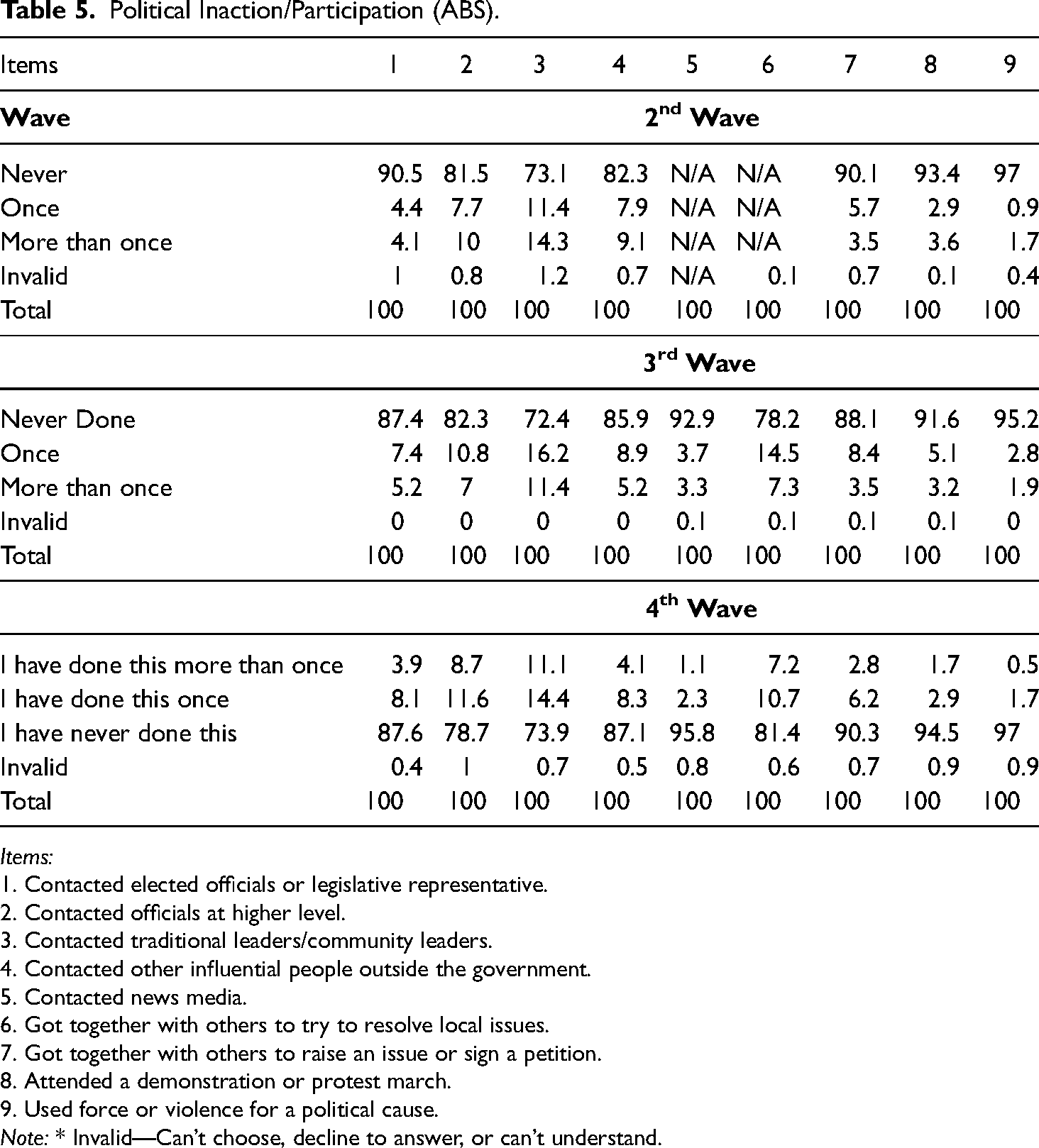
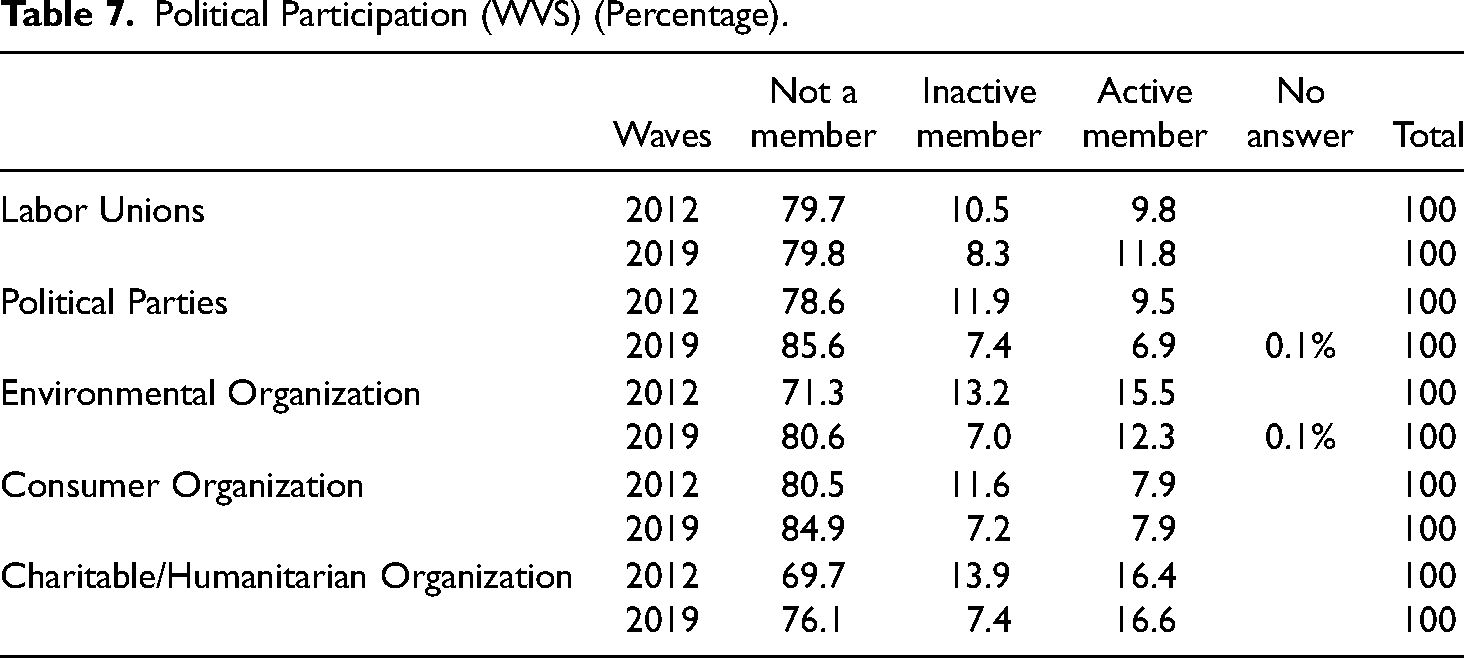
From these insights, the Philippines can provide an interesting case. Specifically, the country is characterized by both high electoral turnouts in national elections—regularly exceeding 75% of registered voters—and a politically vibrant, large, and densely networked civil society sector that has historically participated in significant national sociopolitical issues in the country through mass mobilization, electoral monitoring, advocacy in policymaking, and participation in governance (Wurfel, 2004; Clarke, 2013; Turner, 2011). Despite these, nonelectoral political participation of citizens is generally low and highly limited to a narrow segment of Philippine society. For example, the World Values Surveys (WVS) show that only 7.9%–16.6% of Filipinos indicate active membership in civil society organizations (e.g., labor unions, political parties, environmental organizations, consumer organizations, charitable/humanitarian organizations) while 7.0% and 13.2% are inactive members. Moreover, the 2nd to the 4th waves of the Asian Barometer Surveys (ABS) show that 72.4%–95.8% of respondents have never participated in political activities such as attending a demonstration or protest, signing a petition, contacting community leaders, or elective officials.
In a recent diagnosis of political development in the Philippines, Buendia (2021) notes that structural limits on political participation qualify the supposed vibrancy of Filipino civil society; that is, patronage politics undermines political inclusion beyond elections. Rather than serving as a space for broadening political participation, it has been observed that the elites have used Philippine civil society as a vehicle and conduit for political jockeying, brokering, destabilization, arbitrage, and partisanship (Hedman, 2006; Clarke, 2013). In more recent works, Philippine civil society's capacity to foster nonelectoral participation, such as mobilizing protest (“people power fatigue”), has waned and weakened not only because of shrinking civic spaces but also of the sector's structural weaknesses, such as lack of legitimacy, involvement in corruption, internal factionalism, elite cooptation, “NGO”-ization, lack of internal accountability, and incapacity to hold powerful elites accountable (Arugay and Baquisal, 2023; Africa, 2013; Hedman, 2006). On the one hand, nonelectoral political participation is largely within the realm of the Filipino middle class, who, though characterized by higher levels of education and political engagement, only comprise 20%–40.5% of the Philippine population (Albert et al., 2018). 1 Conversely, the lower socioeconomic classes that constitute the majority are generally depicted to have lower levels of education and are limited to electoral mobilizations founded upon patron–client relations (Kusaka, 2017). Overall, nonelectoral political participation is structurally limited to a small segment of Philippine society, while most remain politically inactive and disempowered, if not alienated outright (Borja, 2015, 2017; Holmes, 2016).
One can easily attribute this to a flawed democratic system characterized as an oligarchy legitimized through elections (Dressel, 2011; Teehankee and Calimbahin, 2020). This conclusion can be drawn from an approach focusing on political structures, elite competition, and electoral politics—an approach that remains predominant in scholarship on Philippine politics. The problem, however, is that it gives marginal consideration to the issues of political disempowerment and participation, the former being assumed away while the latter is more or less exclusive to voter preference and behavior. If we reduce democratic citizenship to voting as liberal democrats have done (Barber, 2009), then the systemic-structural explanation to the question of Philippine democratization can stand on its own, with political participation serving as a mere dependent variable to the mobilizational activities of elites (e.g., patronage, clientelism, political marketing etc.). However, if we consider the quality and extent of political participation and the psychopolitical factors underpinning the behavior of ordinary citizens, then political participation becomes a core issue along with the consolidation of liberal democratic institutions. In other words, we can take the problems of democratization and the threats facing it to the level of ordinary citizens.
Why analyze democratization from the perspective of political participation and not from those of structures and elites? This approach is justified on two accounts. First, exploring participatory tendencies allows a more holistic appraisal of Philippine democratization so that analysis can move from the level of structures and institutions to the level of the individual citizen and their relationships with each other and with elites (c.f. Kerkvliet, 1995; Kusaka, 2017). Second, if we consider the participatory and deliberative traditions that locate active citizenship as the center of democratization (c.f. Curato, 2015), then we must first understand the reluctance of citizens to participate in public affairs. Why should they even bother? This question remains crucial for democratization, though it can be assumed away by those focusing on anything but political empowerment.
Recent efforts have been made to address these questions in the case of the Philippines. Jaca and Torneo (2021) illustrate that low electoral participation among overseas Filipinos is not a manifestation of either loss of allegiance or political disinterest. Instead, they do not see voting as an urgent matter or responsibility for an overseas national, even if they recognize it as a duty. The perceived high opportunity cost of registering for and casting votes in Philippine consulates is a major factor in low electoral participation. Despite this, overseas Filipinos are politically and socially active in various community and sectoral organizations, advocacies, development initiatives, charitable causes, and even “diaspora diplomacy” (Gonzalez and Torneo, 2021). Since participating in these organizations and activities has costs, it is paradoxical that overseas Filipinos are politically active outside elections while having low rates of overseas voting.
In another study, Ugaddan and Calata (2018) assert that their trust influences the willingness of Filipino citizens to participate in government politics. The last two Philippine presidents, Benigno Simeon Aquino III and Rodrigo Duterte, generally enjoyed high trust ratings throughout their administrations. The former ended his term with a 49% trust rating in March 2016, and the latter with a 72% trust rating in the December 2021 Pulse Asia Survey. Trust in public officials is a major component of political trust, and trust in the head of state is a major component of trust in government. The question then is, if trust in presidents and, by extension, the government is high, why do the ABS surveys conducted during the Aquino and Duterte administrations show very low levels of political participation and political action?
Lastly, Borja (2015, 2017) points to political engagement (interest in politics) and efficacy (attitudes on the effectiveness of political actions, including one's own and those by other actors) as key determinants of political participation. His studies illustrate that citizens’ interest in political affairs and attitudes toward themselves as political actors are consistent predictors through all the last three waves of the ABS surveys. The puzzle, however, is that Filipino citizens remain interested in politics without being active in politics. As predictors, political interest and political efficacy need not be in harmony vis-à-vis political participation.
From the works above, we note that the seeming contradictions and unanswered questions regarding political participation among Filipinos necessitate further inquiries. This is especially true concerning the impact of political disempowerment as a citizen's lack of confidence in oneself as a political actor and in the government's responsiveness. In response, we ask, what challenges does political disempowerment as political powerlessness and cynicism posit against democratization in the Philippines?
This study will take a psychopolitical perspective in addressing this seemingly simple question. We aim to (1) contribute to the fledgling political and psychological literature in the Philippines; (2) balance out current tendencies to either focus on political structures and dynamics (c.f. Teehankee and Calimbahin, 2020) or give marginal consideration to citizenship and civic empowerment in evaluating the state of democratization in the Philippines (c.f. Rivera, 2016), and; (3) analyze the psychopolitical dimension of participation or inaction outside elections, especially through participatory governance (c.f. Dhungana and Curato, 2021; Gera, 2016; Gurstein and Angeles, 2007).
Moreover, we give special attention to political disempowerment by responding to current works on political disengagement and disenchantment (Snell, 2010; Stoker, 2006; Stoker et al., 2011; Stoker and Evans, 2014), political inaction (Van Bezouw et al., 2019), and silent citizenship (Berry and Junn, 2015; Gray, 2015). Through an analysis of data from the Asia Barometer Surveys (ABS) and the World Values Survey (WVS) (Inglehart et al., 2020), we argue that political disempowerment in the Philippines is a vicious cycle driven by perceived dis/incentives to political participation without it depoliticizing citizens. For this reason, the participatory dimension of democratization in the Philippines faces this vicious cycle wherein huge swathes of the citizenry are trapped.
The first section of this paper provides a review of the extant literature on political inaction. The second elaborates on a processual conceptualization of political alienation and spectatorship, and the third shows the Philippine case. The final section contains concluding remarks on challenges to civic empowerment and democratization. We also posit points for future inquiry concerning political alienation, participatory governance, and civic education.
The Question of Political Participation
For Grugel (2002), democratization, broadly defined to encompass conflicting specific definitions, refers to both the establishment and consolidation of democratic institutions as well as the struggle to make such structures meaningful for ordinary citizens. Moreover, O’Donnell (2010: p. 4) states that democracy is “grounded on the idea that the citizen is an agent, a being endowed with practical reason and capable of moral judgment.” Though his analysis remains within the confines of legality, rights, and elections, his insights on political agency as a core component of democratic states necessitate further inquiry into how and why citizens act within a certain legal space and through the political rights they hold. What are the contours or contents of their decision-making as political agents? What are the attitudes shaping their political behavior? Sharing these concerns, Welzel et al. (2019) see democratization as the establishment of a system that can serve as “a tool of human empowerment whose key purpose is to enable people to self-determine their personal lives and to help shape their societies’ policies” (p. 2). Overall, analyzing democratization requires looking at the political life of an ordinary citizen, a life made manifest in the public sphere through political participation.
Despite its importance, analyzing political participation faces lingering issues of conceptualization and measurement (Ekman and Amnå, 2012; Hooghe et al., 2014; Van Deth, 2014). This is tied to the emergence of new forms of supposedly political modes of participation, ranging from lifestyle choices to social media activities (Flinders and Wood, 2018; Kaim, 2021; Lilleker and Koc-Michalska, 2017). We would not engage in this debate since our focus is not surveying participatory tendencies but exposing their roots—the attitudes underpinning them—and their relationship with how citizens identify themselves as political actors. Instead, due to the framework tied to it that can be used for future inquiries, 2 we have adopted Van Deth's (2014) minimal definition of political participation as voluntary activities of ordinary citizens located in the sphere of government/politics/state or meant to express political aims and intentions. The advantage of this definition lies in its deviation from output-based conceptualizations for the sake of focusing on the intention and content behind such activities. Consequently, our analysis can turn to perceived dis/incentives as linchpins for the various factors affecting a citizen's decision to participate in politics. The succeeding subsections elaborate on the possible determinants of political participation, namely, political efficacy and spectatorship.
On Political Efficacy and Inaction
Rarely analyzed but still as important, political inaction is a shadow looming over the literature on political participation. Van Bezouw et al. (2019), in a qualitative analysis of cases from Brazil, Hungary, and the Netherlands, note the following observations. First, low political efficacy is the primary cause of political inaction. As a form of attitude (i.e., an evaluation of an object) (Fishbein and Ajzen, 1975, 2010; Schuman and Johnson, 1976), low political efficacy refers to (1) a citizen's distrust of the capacity of the political system and the actors in it to address their interests and (2) their lack of confidence in their capacity to participate effectively in politics (Craig, 1979; Wolfsfeld, 1986). Simply put, it is a negative attitude toward the responsiveness of other political actors and one's capacity to participate in politics effectively.
Second, the cases manifest a sustained cycle of inaction wherein low political efficacy is in a self-reinforcing relationship with their inaction despite recognizing the importance of political participation. This is probably due to a sustained process of resolving cognitive dissonance that reinforces set attitudes in favor of a chosen behavioral option (see Harmon-Jones and Harmon-Jones, 2002). For the study of Van Bezouw et al. (2019), that option is political inaction. Consequently, citizens can admit the importance of activism and the problem of inaction before reconciling it with their inaction through sustained distrust toward the government and by categorizing themselves as politically powerless. They have accepted their disempowerment and have slipped into silence.
From a psychopolitical perspective, political silence need not be outright disengagement. Gray (2015) maps out the possible attitudinal tendencies behind this. First is an active decision to remain silent over a specific political object (e.g., an issue or an action). Second is awareness, wherein a citizen, despite being conscious of their options, choose to remain silent due to a lack of interest or general satisfaction over the activities of their representatives. Third is ambivalence, wherein silence is due to a citizen's deep uncertainties rooted in changing opinions (lack of priorities), ignorance, and/or insufficient exposure to politics. Fourth is aversion or an antipolitical stance (i.e., distrust and suspicion toward politics in general) founded upon a negative exposure to politics and a subsequent lack of intention to participate in politics. Last is disaffection, wherein silence manifests a complete rejection of political life, leading to alienation and self-exclusion from the system.
Though Gray (2015) situates these tendencies on a continuum, we note some nuances regarding disaffection that other works have fleshed out through the notions of disengagement-disenchantment. For one, disengagement is not tantamount to a complete withdrawal from politics. Snell (2010) illustrates through the case of young adults that the politically disengaged can remain informed and interested in politics. Instead, their disengagement is based on low political efficacy tied with individualistic and relativistic morals that give primacy to their notions of right and good. In other words, the politically disengaged could be construed as still attached to politics, at least in terms of sustained political interest.
Furthermore, Stoker (2006) and Stoker et al. (2011) traces political disenchantment back to the alignment of external (structural/supply) and internal (psychopolitical/demand) factors. From a supply-structural perspective, he observes that in the case of the United States: (1) politicians are driven more by marketing and an emphasis on developing personal image than any clear civic ideal, (2) politics is becoming more complex, professionalized, and exclusive due to technical language and government transparency, and (3) mass media now has a tendency to cultivate cynicism among citizens. From the side of citizens, these tendencies have taken the form of individualism at the expense of collective decision-making, silence, and an aversion to the inherently messy nature of democratic politics and public discourse. The result is mass withdrawal from public affairs that aggravates the legitimacy crisis of a system as a whole.
Overall, the works above redirect our attention toward the shadow of political disempowerment, with low political efficacy playing a crucial role in shaping political participatory tendencies. However, between Gray's (2015) theory of silent citizenship and the findings of Van Bezouw et al. (2019) and Snell (2010) lies the problem of continued interest in politics. Though Stoker (2006) posits a growing depoliticization of citizens, we note an important nuance.
Citizens can remain attached to politics as spectators even if they descend into inaction and silence (Borja, 2015, 2017). Sustained interest in politics allows citizens to provide more materials on their attitudes toward themselves, others, and politics as a whole. For this reason, we assert that though disengagement is rarely absolute, political inaction can be a sustained condition. To flesh this out, we grapple with the issue of political spectatorship while going down to the case of the Philippines.
Making Sense of Politicized Inaction: On Political Spectatorship
Splitting political participation into two basic forms, namely, electoral and nonelectoral participation, a majority of the Filipino citizenry can be characterized as a mass of enthusiastic but disempowered voters. In his examination of the linkages between civil society organizations and the citizenry in the Philippines, Holmes (2016: p. 123) argues that there is a need “to reflect on the reasons for the unwillingness of the public, in general, to engage in politics beyond participation in elections, or to associate themselves with social organisations rather than political organisations.”
Why is this so? We can first assume that in relation to political efficacy, citizens judge themselves based on what they see in politics (Borja 2015, 2017). Moreover, “seeing” politics requires a measure of interest in and exposure to it. Citizens can then deem politics as important—or in negative terms, they could not brush it off as a nonissue in their lives. They could also do otherwise and slip into depoliticization (De Nardis, 2015; Flinders and Wood, 2015). Based on these premises, we can ask if watching politics informs our self-identification as political actors. To flesh this out, we turn to political spectatorship as a cyclical psychopolitical condition.
In operational terms, political spectatorship as a psychopolitical condition refers to the interest in and exposure to politics, which can take the form of keeping an eye on the news and discussing politics in social circles. Political spectators recognize that certain values, needs, and interests have a political/public dimension, which frames how we see and evaluate ourselves in relation to public affairs (Borja, 2015, 2017). They are also imbued with the capacity to creatively evaluate a projection, consequently opening ground for empowerment (Borja, 2015, 2017; Rancière, 2009). However, for the inactive spectator, pursuing these interests is limited to the realm of everyday life (i.e., in the private sphere). In other words, political spectatorship entails political inaction because the public sphere appears impenetrable and beyond control. 3
What they see—the discourses, performances, and information—is something that we leave for future studies. Nonetheless, it is plausible to assume that other than fake news, which is in itself a complex topic (see Ong and Cabañes, 2018), spectators are exposed to two things, namely, political affairs that are more or less exclusive to those inside the government (from scandals to legislation), and public activities conducted by other ordinary citizens that they did not participate in. These are projections of both a real separation between inactive spectators and the politically active and structural disempowerment that reduces ordinary citizens into silence after voting. This reflects Debord's (1994) recognition that a political spectacle is a projection of real disempowerment back to the disempowered, a projection that can help keep the powerless where they are.
In more operational terms, the perceived viability of behavioral choices, including political participation, is based on a citizen's judgments of (1) himself as a political actor and (2) other political actors in and outside the public sphere. Within cycles and struggles for control, a political spectacle can be understood as something that varies over time and under different circumstances. What we highlight is that political spectators evaluate (1) the efficacy of such political acts, (2) our role in public affairs, and (3) our capacity to influence politics (Borja, 2015, 2017; Rancière, 2009). Through these, they can deem themselves powerless in the face of the political expression and pursuit of our needs and values. Nonetheless, the contrary can also happen. They can judge themselves as empowered if public performances and invitations to act align with their understanding of themselves as political actors. Construed further as a repeated and reinforcing cycle, it then becomes a question of whether it is vicious or virtuous. 4
It's a Vicious Cycle
Taking the discussion to the realm of elections, we note that comparatively high and sustained voter turnout suggests that most Filipinos have formed a habit of voting that, in turn, reduces the perceived costs of this activity (Aldrich et al., 2011; Borja, 2017). The contrary is true for nonelectoral political participation, wherein the habit is to remain politically inactive.
How did these habits form? For Aldrich et al. (2011), habits are due to a repetition of behavior within relatively stable or similar contexts. This, in turn, can provide set choices while sustaining perceived costs and benefits. Thus, it is plausible that citizens prefer to vote than participate in other forms of political activities because they deem it as the more viable option. It is viable in that they deem it capable of giving them a more effective voice in public affairs that are otherwise impenetrable and uncontrollable outside the elections.
But why do they deem other modes of political participation as nonviable options? We answer that the politically disempowered are exposed to projections that establish and reinforce a negative attitude toward such activities. Relating it to cyclicality and the question of power, we can further construe political spectatorship as a process of sustained attachment to politics wherein we watch projections of our powerlessness and/or opportunities to be empowered. It is constituted by constant acts of watching, processing, and evaluating such projections, the results of which inform our political behavior.
Facing the problem of perceiving a realm that citizens deem as both important yet impenetrable outside elections, the perceived viability of political behavioral options can be established through cognitive dissonance resolution. For Harmon-Jones and Harmon-Jones (2002), cognitive dissonance resolution entails devaluing the rejected courses of action to maintain and enhance commitment to the chosen one. Thus, for political spectators (i.e., those whose participation is more or less exclusive to voting while being cognitively attached to politics), the decision to vote regularly is tied to devaluing other modes of participation. What facilitates this devaluation is the interaction between their consistent gaze on politics and their judgment of themselves as politically powerless.
The works of Gastardo-Conaco and Quiñones (2015) and Liu and Gastardo-Conaco (2011) point to the latter's importance as a form of self-identification. We note further that the postauthoritarian history of political resistance, repression, and sustained oligarchic rule form the general contours of a dissonant political spectacle that pits behavioral options against one another in the context of political hope and disappointments. The efforts to institutionalize the legacy of the People Power Revolution of 1986 that toppled Ferdinand Marcos Sr. bore some fruits (Pinches, 1997). For one, elections in the Philippines are now regular events alongside acts of public protest and various forms of opposition within legal boundaries.
However, as early as the first Aquino administration, oligarchic rule and repression have returned. For one, the 1987 Mendiola Massacre against protesting farmers vying for effective land reform is a watershed event for resistance and state repression after Marcos’ authoritarian regime that established limitations on political movements and acts of resistance. Moreover and as was mentioned earlier, given the general ineffectiveness of public protests vis-à-vis government affairs, as well as the return of oligarchic rule after the 1986 Revolution, it also appears that many Filipino citizens are suffering from fatigue toward protest and the idea of People Power revolution (Abinales and Amoroso, 2006; Thompson, 2010).
Regarding oligarchic rule, the spectacle of elite politics is a cacophony of shifting alliances, weak political parties, factionalism, and circulating dynasties. These render elite Filipino politics into an anarchy of families and parties (Kasuya and Teehankee, 2020; Teehankee, 2020; Teehankee and Calimbahin, 2020; Teehankee and Kasuya, 2020). With these considerations, an ordinary Filipino spectator is trying to make sense of being powerless to control and completely understand something of relative importance (i.e., politics and the policy process) that was supposed to be under popular control given the promises of two successful People Power revolts.
Overall, political spectators vote because they want to alleviate their disempowerment. Nevertheless, since they find other nonelectoral modes of participation unviable, they feel unable to control political affairs after voting, thus renewing the cycle. As the succeeding sections will further illustrate, it is a vicious cycle at a psychopolitical level.
Measuring Political Disempowerment: Framework and Methodology
To reiterate, we ask, what challenges do political disempowerment as political powerlessness and cynicism posit against democratization in the Philippines? In line with previous works on political inaction (Snell, 2010; Van Bezouw et al., 2019) and in response to the limits of Gray (2015), Stoker (2006), and Stoker et al. (2011), we argue that political disempowerment in the Philippines is a vicious cycle driven by perceived dis/incentives to political participation without depoliticizing citizens. In operational terms and reflected in our study's choice of questionnaire items (see Tables 1, 2, and 3), we adapt the concepts of internal and external political efficacy (Craig, 1979; Wolfsfeld, 1986) into political powerlessness and political cynicism, respectively. 5 Political powerlessness refers to negative attitudes toward oneself as a political actor (i.e., a perceived incapacity to affect and understand politics). Political cynicism, in turn, refers to negative attitudes toward government responsiveness (i.e., a perceived incapacity of government to address the needs of the public).
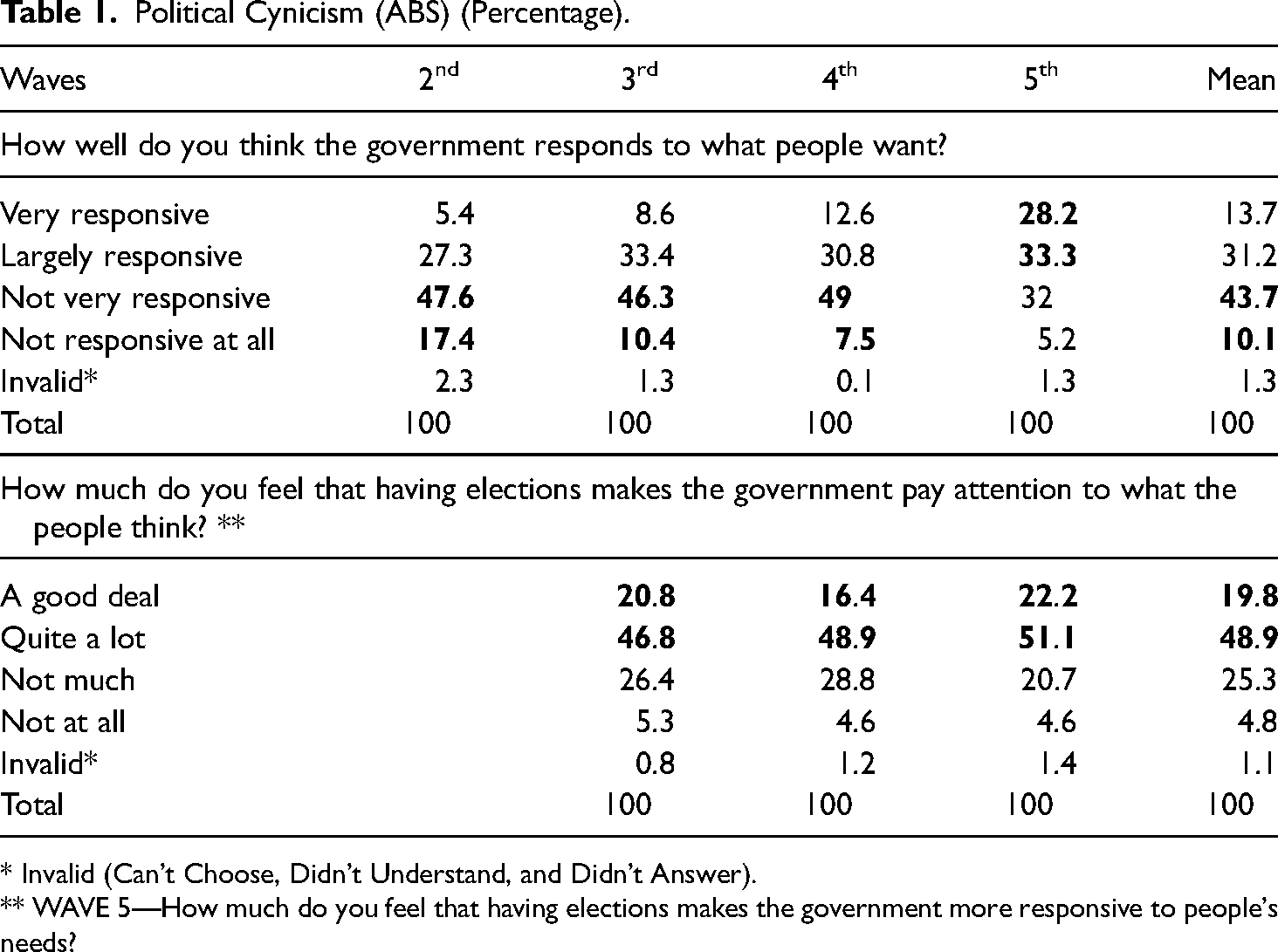
Political Cynicism (ABS) (Percentage).
* Invalid (Can’t Choose, Didn’t Understand, and Didn’t Answer).
** WAVE 5—How much do you feel that having elections makes the government more responsive to people's needs?
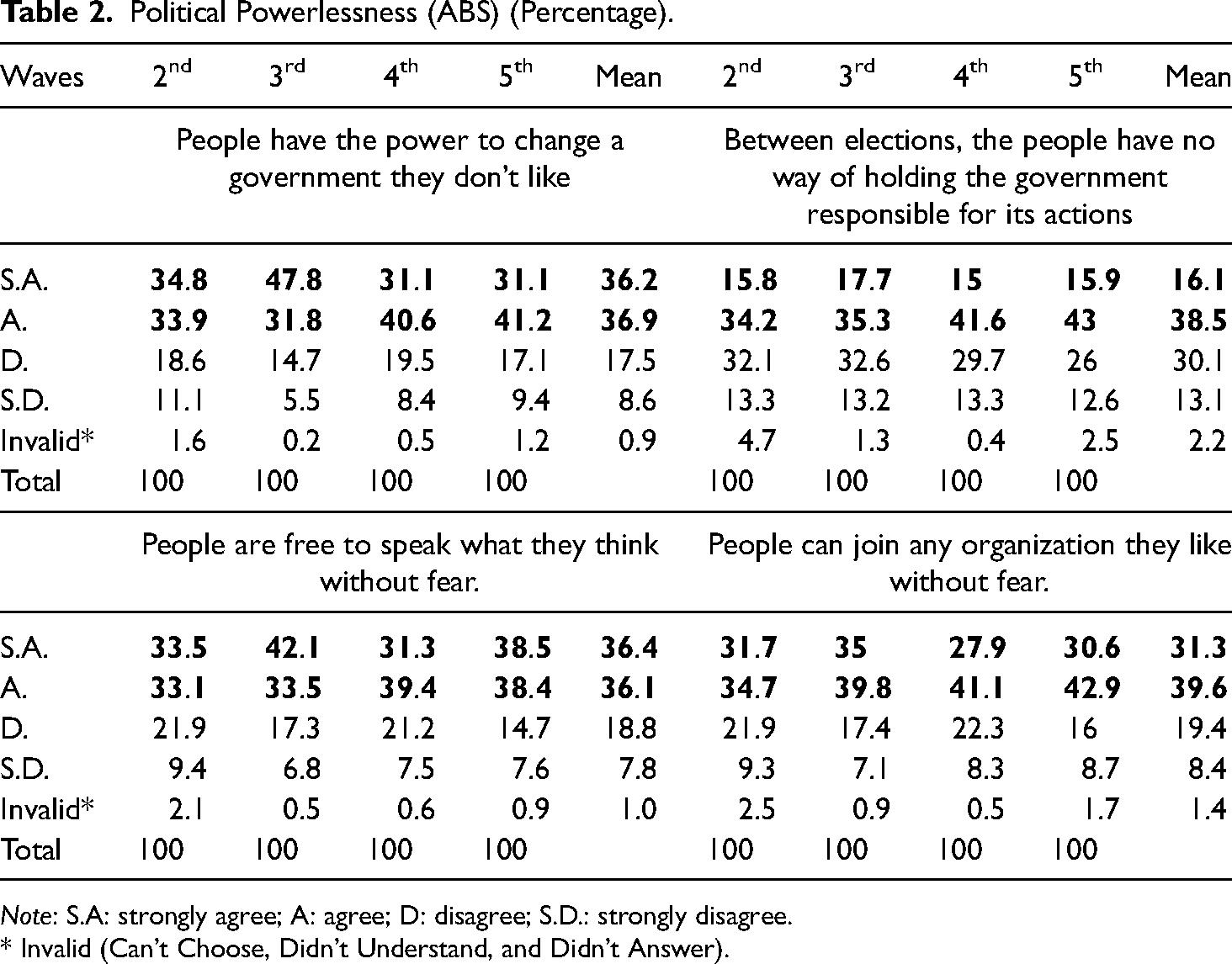
Political Powerlessness (ABS) (Percentage).
Note: S.A: strongly agree; A: agree; D: disagree; S.D.: strongly disagree.
* Invalid (Can’t Choose, Didn’t Understand, and Didn’t Answer).
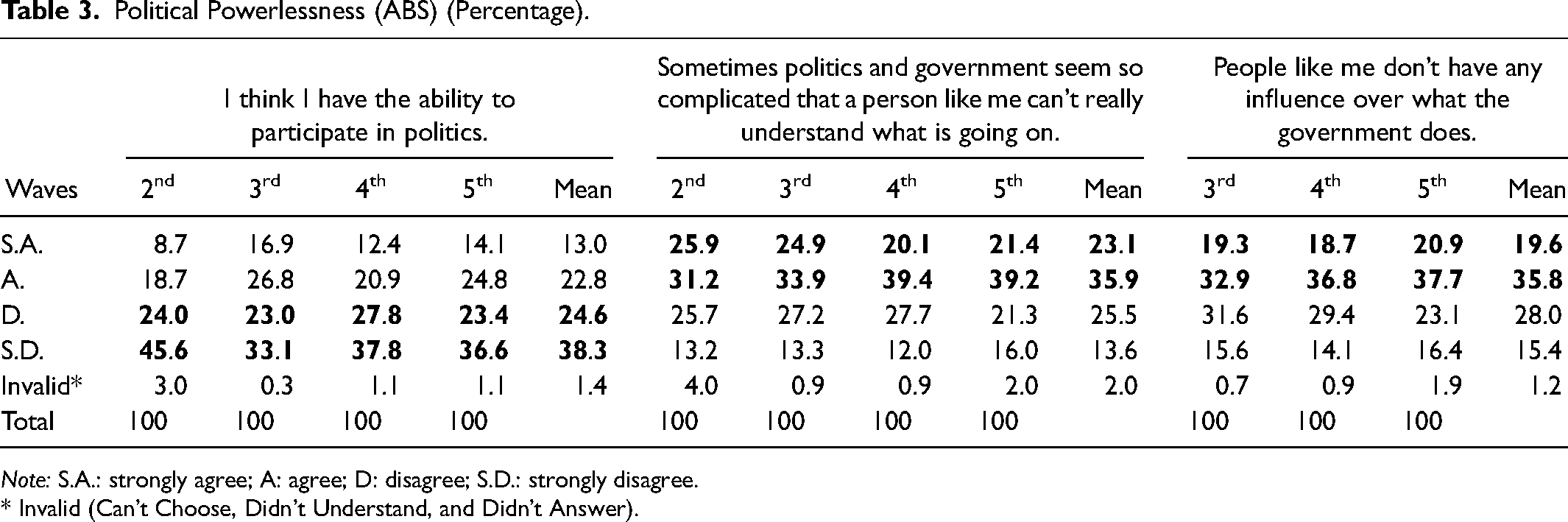
Political Powerlessness (ABS) (Percentage).
Note: S.A.: strongly agree; A: agree; D: disagree; S.D.: strongly disagree.
* Invalid (Can’t Choose, Didn’t Understand, and Didn’t Answer).
Why do citizens participate in politics? To address this question, we deploy the following psychopolitical concepts. The first and most general of which is attitude or a person's evaluation of an object. Our study considers political objects ranging from participatory activities, the politically active, and oneself as a political actor. But why focus on attitudes? This is because sociodemographic factors like educational status are questionable determinants of political participation (Berinsky and Lenz, 2011; Persson, 2014, 2015), while political attitude remains a crucial factor (Lilleker and Koc-Michalska, 2017; Quintelier and Hooghe, 2012).
Second, a behavioral choice refers to a plethora of recognized actions that a person weighs as either viable or not. 6 For this study, we are focusing on the following behavioral choices: (1) political participation—voluntary activities of ordinary citizens located in the sphere of government/politics/state or meant to express political aims and intentions (Van Deth, 2014), (2) political inaction—abstaining from political participation, (3) electoral participation—act of voting, and (4) nonelectoral participation—participation in political activities outside of voting. This set, though not exhaustive, is enough to draw the general characteristics of participatory tendencies among Filipinos.
Lastly, habits are due to a repetition of behavior within relatively stable or similar contexts (Aldrich et al., 2011). They can provide set choices while sustaining perceived dis/incentives. Thus, citizens can prefer a political activity because they deem it as the more viable and effective option through repeated and comparatively similar circumstances (e.g., regular elections).
To elaborate, we turn to political spectatorship, conceptualized here as both a psychopolitical condition and a sustained process. The former refers to the interest in and exposure to politics. Through their interest and exposure, political spectators evaluate (1) the efficacy of such political acts, (2) our role in public affairs, and (3) our capacity to influence politics (Borja, 2015, 2017; Rancière, 2009). As a sustained process, it allows us to keep an eye on a constant flow of projections (e.g., publicized political activities ranging from government work to acts of protest) that show our powerlessness and/or opportunities to be empowered. The results of which inform our attitudes and expectations toward political behavioral choices.
To measure these tendencies and reconstruct their flow and nature as a cycle, we employ a basic descriptive quantitative analysis of data, primarily from the Asia Barometer Survey Waves 2 (2005), 3 (2010), 4 (2014), and 5 (2018). 7 These span the late EDSA and early post-EDSA periods in Philippine politics. From our analysis, we further argue that though it is widely accepted that Philippine politics is generally an affair of competing oligarchs at the expense of incumbent liberal democratic institutions (see Rivera, 2016; Teehankee and Calimbahin, 2020 for reviews of the extant literature), this structural condition is tied to the psyche of citizen-spectators who are bound to watch their welfare becoming a near-exclusive affair of those in office. Simply put, political disempowerment is not only structural but also psychopolitical. The next section shows the results of our analysis.
Political Disempowerment in the Philippines
Are Filipinos willing to participate in politics? We illustrate that Filipinos are generally inactive outside elections while being reluctant to participate in some forms of political activities and willing to participate in others. Moreover, they are attached and exposed to politics in a way that makes them politicized while simultaneously disempowered. To elaborate, we tackle the following in order: (1) general tendencies in political participation, (2) political spectatorship, (3) political cynicism, and (4) political powerlessness.
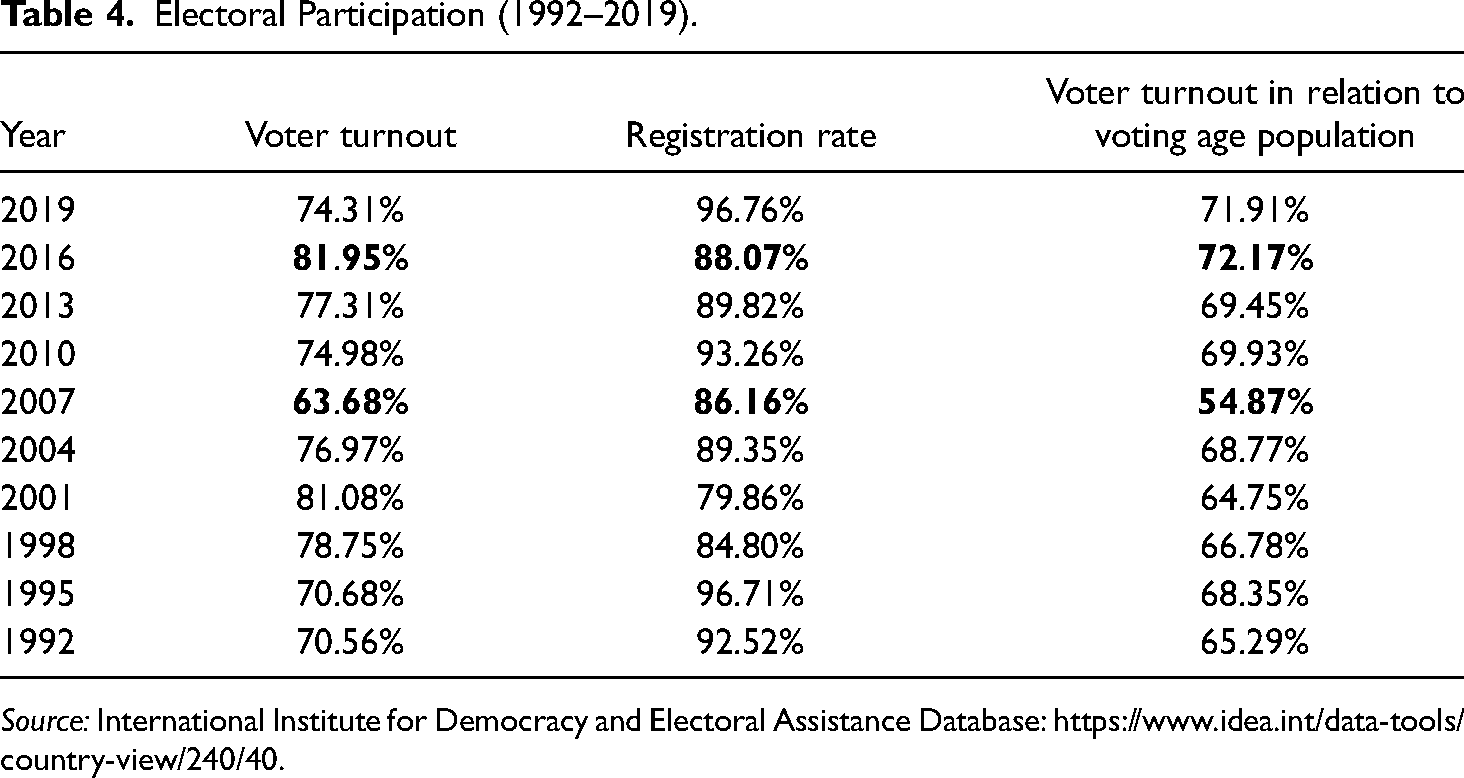
Concerning political participation, Table 4 below shows sustained high voter turnout and registration rates during the post-Marcos period from 1992 to 2019. However, juxtaposed to this, Table 5 below shows most respondents’ sustained political inaction outside elections. Results suggest a general and sustained lack of willingness to participate in nonelectoral political activities. This is pretty straightforward if one assumes that behavior immediately corresponds to set attitudes (i.e., political inaction is due to a lack of willingness) (Table 4; Table 5).
Electoral Participation (1992–2019).
Source: International Institute for Democracy and Electoral Assistance Database: https://www.idea.int/data-tools/country-view/240/40.
Political Inaction/Participation (ABS).
Items:
1. Contacted elected officials or legislative representative.
2. Contacted officials at higher level.
3. Contacted traditional leaders/community leaders.
4. Contacted other influential people outside the government.
5. Contacted news media.
6. Got together with others to try to resolve local issues.
7. Got together with others to raise an issue or sign a petition.
8. Attended a demonstration or protest march.
9. Used force or violence for a political cause.
Note: * Invalid—Can’t choose, decline to answer, or can’t understand.
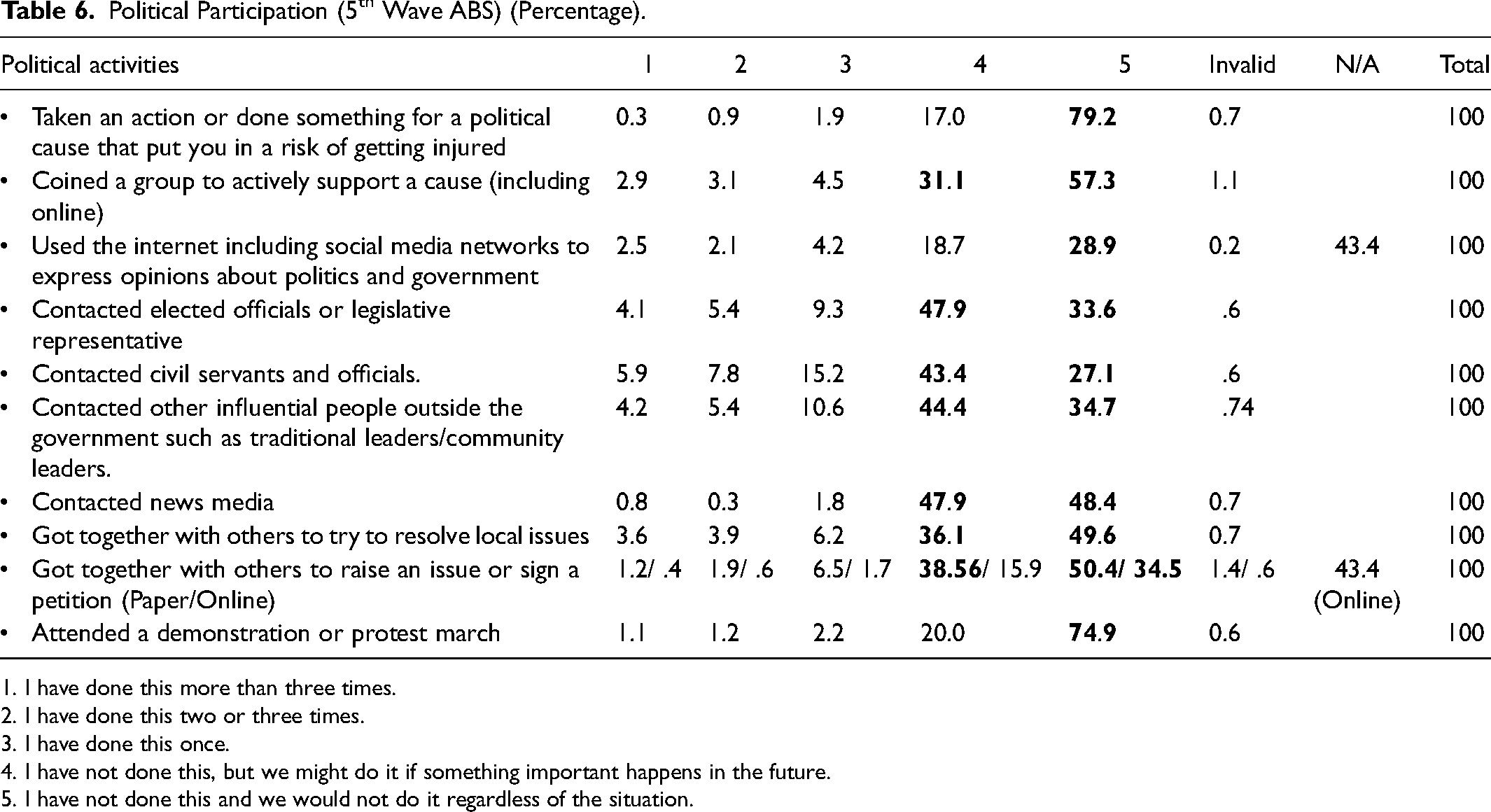
However, changes in the instruments of the 5th wave show a more nuanced understanding of attitudes to nonelectoral participation. Table 6 below shows that respondents may participate in some forms of political action if they deem some future event “important.” What “important” means is something we will leave for future inquiries, but for now, we note the following observations.
Political Participation (5th Wave ABS) (Percentage).
1. I have done this more than three times.
2. I have done this two or three times.
3. I have done this once.
4. I have not done this, but we might do it if something important happens in the future.
5. I have not done this and we would not do it regardless of the situation.
First, citizens are consistently averse to acts of public protests and the use of violence. These political activities register high levels of inaction (Waves 2–3), and most respondents still prefer not to participate regardless of the situation (Wave 5). Second, though emerging forms of participation, online political activities still ranked low. Nevertheless, we must note that accessing these activities is encumbered by limitations on internet connectivity, entailing high costs for consumers (see Salac and Kim, 2016). Third, reflective of personality-based politics in the Philippines, citizens are more likely to contact political and social leaders that they deem as influential (Wave 5). Lastly, other than signing a petition, most of the respondents are least likely to participate in collective action (i.e., protests, joining an advocacy group, and forming groups to resolve local issues) in comparison to more individualistic activities such as contacting leaders and news media. This tendency shows itself in the rate of membership in civil society and political organizations. Table 7 shows that as far as the WVS is concerned, large swathes of the population are not members of organizations, from labor unions and political parties to civil society organizations such as environmental, charitable, and consumer organizations (Table 6; Table 7).
Political Participation (WVS) (Percentage).
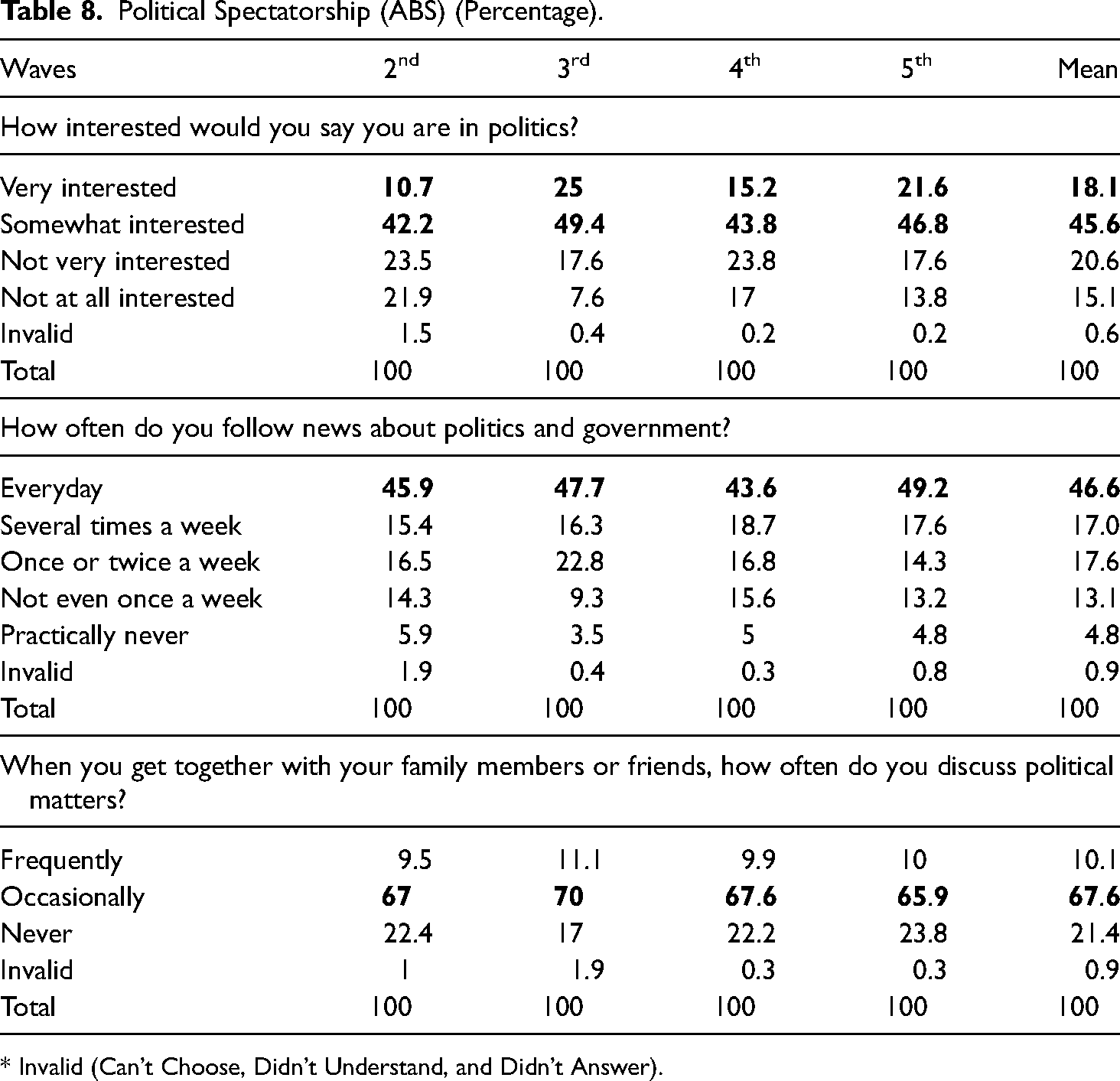
What is the psychopolitical context of these observations? What are the political attitudes and behavioral tendencies that these respondents have? We now turn to political spectatorship, and Table 8 below shows sustained political interest and exposure to politics. Most respondents express moderate interest in politics while keeping an eye on the news and discussing politics it in close social circles (Table 8).
Political Spectatorship (ABS) (Percentage).
* Invalid (Can’t Choose, Didn’t Understand, and Didn’t Answer).
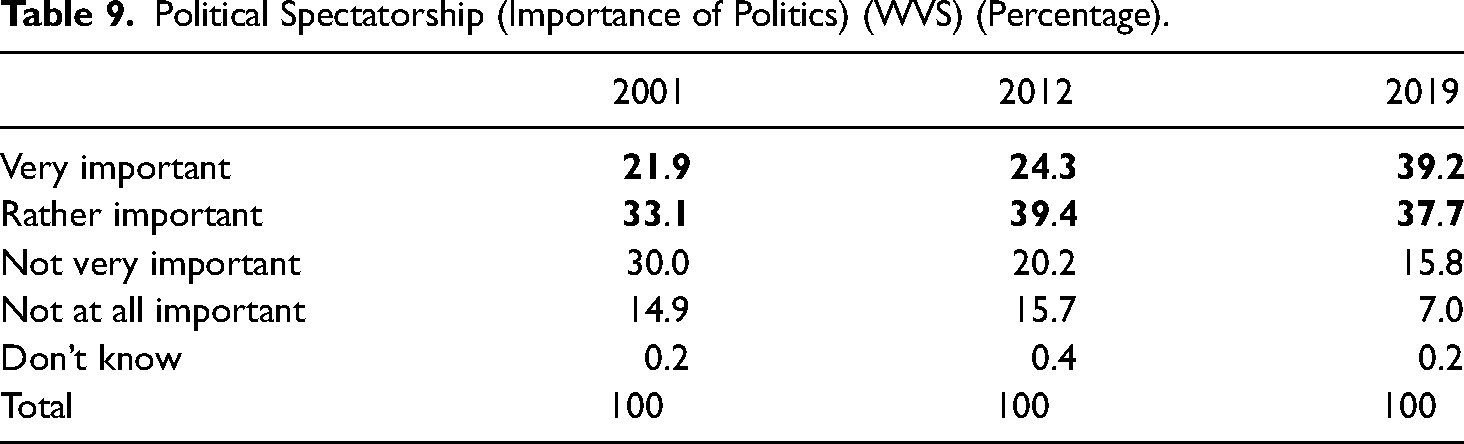
Furthermore, this coincides with a growing sense that politics is important. Table 9 below shows that from 2000 to 2020, many citizens have deemed politics important. This trend supports the observation that Filipinos have a sustained and strong attachment to politics; they are, for the longest time, not susceptible to the depoliticization that Stoker (2006) observes in Western cases. Thus, we have a contradiction between a sustained attachment to politics in terms of interest, perceived importance, social discussion, and electoral participation and a sustained practical detachment outside of elections qualified by a general willingness to perform more individualistic political activities (Table 9).
Political Spectatorship (Importance of Politics) (WVS) (Percentage).
What binds these two contradictory conditions into a coherent whole? We posit that the answer lies with political disempowerment as powerlessness and cynicism. Concerning the latter, if one construes it as attitudes toward government responsiveness to the public's interests, then most Filipinos exhibit political cynicism qualified by their belief in the efficacy of elections. Table 1 shows that while most Filipinos express a sustained distrust over the government's responsiveness (except during Duterte's administration, which the 5th wave captures), most still believe that elections can make the government pay attention to the interests of the public. Such can explain the relatively high rates of electoral political participation (Table 1).
However, this trust in the supposed effects of elections on the government is itself qualified by a sustained attitude that ordinary citizens have no control over their actions after elections. Table 2 shows a more nuanced picture of why citizens are willing to participate in elections, or better yet, why civic energies are focused on elections and not on nonelectoral political participation. Confounding the matter, we note further that most respondents believe that citizens are free to speak and organize without fear of repression. Why do they remain politically inactive outside of elections if this is so? (Table 2).
The answer lies in how citizens judge themselves as political actors. Political cynicism is only partial and leans in favor of electoral participation. Juxtaposed with this, most of the respondents deem themselves politically powerless. To illustrate, we note the following observations from Table 3. First, most respondents have a negative attitude toward their capacity to participate in politics effectively. They don’t believe that they can participate in politics or even influence the government's activities. Second, this is confounded by a perceived inability to understand political affairs. This is the other side of Stoker's (2006) observation of the growing complexity of political affairs that pose an obstacle for the ordinary citizen. Third, these attitudes are generally sustained. This suggests that electoral participation entails little to no effect on a citizen's sense of political empowerment. Lastly, we note that though they feel more capable of participating in politics, they are still skeptical about their actual effect on government and their ability to understand public affairs (Table 3).
Overall, citizens are reluctant to participate in collective political action, though they are more willing to perform individualistic activities. Moreover, there is an apparent lack of incentives for political participation outside of elections. Even if most think they can organize and speak freely, such beliefs (perceived lack of disincentives) still fail to translate into political activism. Why is this so? The data above suggest political disempowerment is a pervasive and sustained psychopolitical condition for many Filipinos. However, this is defined by several seemingly contradictory tendencies. One is between a sustained cognitive attachment to politics and a sustained practical detachment outside elections that constitute political inaction. Another is between perceived powerlessness and the persistent belief in the efficacy of elections in making a government respond to the interests of the public. The result is political inaction outside elections tied to high levels of participation in elections. The next section fleshes this out by returning to the cyclical nature of political disempowerment before providing some concluding remarks and points for future inquiries on democratizing citizenship.
An Up-Hill Battle for Democratization: Concluding Remarks
Citizen-spectators vote and go home. This is the essence of political disempowerment for many in the Philippines. It is a vicious cycle constituted by the following contradictions. First, citizens who deem themselves as already powerless outside of the elections will keep an eye on political affairs. These projections are not only about the machinations and/or scandals coming from the elite but they also show the participation of other ordinary citizens. What we highlight is that these projections can reinforce or dissipate the preexisting disempowerment. Identifying which projections and public events contribute to or alleviate shared disempowerment is something we leave for future inquiries.
Second, bearing whatever sense of hope and discontent, ideals, and trauma they have toward politics, citizens face the ballot as the only means that they deem effective in making a government respond to the needs of the public. Such a level of trust in the electoral process can be the subject of future inquiries. What we note is the probability that reliance on electoral participation is inversely proportional to nonelectoral modes of participation, especially the more drastic and risky ones. It also appears that the primacy of electoral participation funnels civic energies toward a gravely limited form of active citizenship (Barber, 2009; Dacombe, 2018; Dressel, 2011; Pateman, 2000). This leads us to the structural design of an electoralist or minimalist democratic regime that limits empowerment to the ballot while facilitating the concentration of power at the hands of a few. What makes such a schema democratic is the presupposition that power circulates among the elite, thus rendering their competition for votes and legitimacy as beneficial to the interests of the ordinary citizenry (for a review of the minimalist notion of democracy, see Pateman, 2000). The problem, however, at least in the case of the Philippines, is that power can easily coagulate at the hands of an oligarchy (Dressel, 2011; Rivera, 2016; Teehankee and Calimbahin, 2020).
Consequently, telling citizens that “voting is not the end of political participation” is insufficient in breaking a deep-seated and sustained cycle of disempowered spectatorship. Such an appeal falls not on deaf ears but on solid attitudes and habits; it falls on how they identify themselves as political actors and how they see politics itself. This is the challenge facing political participation not only in the Philippines but in other democracies, especially in Southeast Asia, where similar tendencies of high voter turnout during elections but low political participation in between elections have been observed. 8 Concerning democratization, this poses a challenge to civic education and participatory governance. Leaving these issues for future inquiries, we posit two concluding points.
First, the formation of habit is crucial to civic education, and this is based on the processing of experience (Dewey, 1997, 2015). Students of democratic citizenship must be exposed to experiences wherein their political actions have concrete effects that are measurable and close to their values, interests, and everyday lives. Such an endeavor must face preexisting habits driven and constituted by political disempowerment. Thus, any attempt to develop civic education in the Philippines faces the problem of building new civic habits while breaking old ones. Moreover, this necessitates changes in political structures and practices, specifically creating spaces for effective political participation.
Second, creating spaces for effective political participation through various modes of participatory governance must make such activities appear “worth it” and “important.” But what is “important” for them? Though not within the purview of this study, we suggest that the responses of certain sectors to the effects of the COVID-19 pandemic indicate that “important” means a direct threat to one's immediate welfare. One example is the protest by public utility vehicle drivers whose very livelihood is threatened by both the pandemic lockdown and the lack of financial support from the government (Aspinwall, 2020). Another is the rise of community pantries around the country as a response to severe limitations in government assistance to impoverished households affected by the suspension of economic activities during the height of the pandemic (Gozum, 2021; Villavecer, 2021). These pantries, driven by donations and the principles of “giving what you can” and “taking what you need,” are a practice of mutual aid that entails pooling resources from different sectors, including impoverished households themselves (Garcia, 2021). From these two examples, we ask the following: (1) how can participatory governance be framed as an activity that directly affects the everyday lives of ordinary citizens?; (2) what are the other aspects of a citizen's life that can be deemed as both important and have a public dimension?
In the end, the question of democratization is also a question of political empowerment. Are ordinary citizens empowered? Do they deem themselves empowered despite surrendering power to their representatives? Is voting part of a virtuous or a vicious cycle? Is the promotion of political participation part of democratization in general or a component of consolidation in particular? Future studies, policies, and practices on Philippine democratization must confront political disempowerment.
Footnotes
Acknowledgements
This is a collaborative research project with and supported by the De La Salle University's Jesse M. Robredo Institute of Governance with the support of the Political Participation for Greater Electoral Integrity (PARTICIPATE) project. Data analyzed in this article were collected by the Asian Barometer Project (Waves 2, 3, 4, and 5), which was co-directed by Professors Fu Hu and Yun-han Chu and received major funding support from Taiwan's Ministry of Education, Academia Sinica, and National Taiwan University. The Asian Barometer Project Office ( ) is solely responsible for the data distribution. The authors appreciate the assistance in providing data by the institutes and individuals aforementioned. The views expressed herein are our own.
Declaration of Conflicting Interests
The author(s) declared no potential conflicts of interest with respect to the research, authorship, and/or publication of this article.
Funding
The author(s) acknowledges the support of the Political Participation for Greater Electoral Integrity (PARTICIPATE) project to this study.