



Abstract
This article shows how the Indonesian new developmental state addresses gender equality and women's empowerment in its effort to institutionalise a participatory approach in the state bureaucracy. It pays attention to the way the new developmental ideology has shaped participatory governance policy as an instrument of village development instead of deepening democracy and reworking the structure of traditional gender relations. Utilising qualitative data and a longitudinal monitoring study, this article argues that the new policy of participatory village governance has a narrow focus on village economy and infrastructure and ignores more sensitive issues, such as transforming the traditional gender structures.
Introduction
Indonesia under Joko Widodo (Jokowi) administration (2014–2019 and 2019–2024) has embraced a New Developmentalism, an ideology that has a narrow focus on economic growth with pragmatic policy options (Warburton 2016). According to some authors, such as Kovacs (2013), in developmental regime, gender equality initiatives tend to be used as instruments to achieve regime's developmental goals and ignore a more progressive gender equality policy. Put it in a different perspective, gender equality policy in this type of regime is geared more towards fulfilling what Molyneux calls gender practical interests (1985) instead of gender strategic interests.
At the same time, the Jokowi regime implements the participatory village governance policy based on the Law No. 6/2014 on Village (hereafter the Village Law). This policy is the institutionalisation of participatory approach used in various participatory development programmes such as The National Program for Community Empowerment (PNPM-Mandiri), into village governance. The PNPM, which was terminated in 2014 to make way for the implementation of the Village Law, has fairly strong commitment to gender equality and women's empowerment by employing a range of gender-based affirmative action strategies in its design, as will be discussed in Gender Governance in Indonesian Old Participatory Initiatives section (Azarbaijani-Moghaddam, 2014; Jakimow, 2017, Joint Donor and Government Mission, 2007; Scanlon, 2012; Wong, 2002). The Village Law, despite accommodating some affirmative action policies, employs a gender mainstreaming approach, through what it calls “gender justice”, in the governance steps and cycles. However, gender mainstreaming has often been seen as an unsuccessful strategy, because it tends to be a fashionable semantics co-opted by politicians and policymakers (Clisby, 2005, Filho et al., 2021). Hence, the shifting approach of gender equality policy from affirmative action employed by PNPM to mainstreaming approach used by the Village Law in the context of regime that has to embrace New Developmental ideology alarms a challenging situation for gender equality agenda in Indonesia. The main argument of this article is that the new participatory village governance has endeavoured to improve the quality of village governance in Indonesia, but it has a substantial limitation regarding gender equality and women's empowerment. The government's conviction about the need to accelerate village infrastructure and economic development has left other issues, including gender equality, neglected.
To understand the issue, several cases have been selected from the implementation of the new Indonesian participatory village governance policy. The data for this article were collected through fieldwork in the period of April to September 2018 and July to September 2019, in three villages, namely Angrek in Merangin district (Province of Jambi), Mawar in Wonogiri district (province of Central Java), and Melati in Ngada district (province of East Nusa Tenggara) (all of village names are pseudonym). In addition to the case study, the research also employs qualitative content analysis of participatory village governance regulations. The analysis is importance to understand how the policymakers have addressed the issues of gender equality in the article. The objects of the analysis were the Village Law and its technical regulations. 1 This article also uses data from a longitudinal “sentinel village” study conducted by The SMERU Research Institute, supported by The World Bank, which has also monitored the implementation of the new participatory village governance policy in Indonesia.
In the following pages, the discussion will focus on the concept of participatory governance and women's empowerment policies and how neoliberalism and New Developmentalism have shaped them in the last couple of decades. The discussion will be followed by an account of Indonesian experiences implementing different gender governance initiatives, and what they have achieved. The last section will elaborate on the findings from the fieldwork on gender policies in participatory village governance in Indonesia, and their contribution to the current debate on neoliberal and new developmental gender governance in the global context.
Participatory Governance and Gender Policies in the new Developmental State
Participatory governance is defined as the involvement of people in the decision-making process on matters that are relevant to their lives, which involves deliberation, either in formal or non-formal decision-making processes (Fung and Wright, 2003). As a practice it has been around since the 1970s, and many studies have been conducted to evaluate its impact on different aspects of human life. Based on many evaluations, scholars have concluded that the approach has contributed to promote an inclusive and cohesive society, construct strong citizenship, strengthen the practice of participation, and develop a responsive and accountable state (Bandeira and Ferraro, 2017; Gaventa and Barrett, 2012; Mansuri and Rao, 2013; Speer, 2012). With regards to the impact on women's empowerment in Indonesia, some studies have shown that the approach has had a positive impact on women's practical interest, mostly their well-being (women's health, education, and income) (Akatiga, 2010; Beard & Cartmill, 2007; Jakimow, 2017; Scanlon, 2012; Wong, 2002).
The participatory governance does not exist in a void. The fact that it is a participatory approach does not mean that it is identical to democratic tradition. Non-democratic countries like China also have participatory programmes with a special tuning to make it in line with its country's ideological features (Almen, 2018, He and Thogersen 2010). With this in mind, it is necessary to understand the ideology of a country that employs participatory approach to find out how the state ideology contributes to shaping participatory design and implementation. And in the context of Indonesia, the case in point is the new developmentalism.
As a concept, the New Developmentalism has a recent history. It was introduced by Brazilian economists in 2010 to refer to an alternative economic governing strategy to neoliberal orthodoxy and the Old Developmentalism (Brasser-Pereira, 2009). The main ideas of New developmentalism are documented in “Ten theses of New Developmentalism”, 2 emphasising the role of the state in the economy, enhancement of the “national economy”, and economic stability and sustainability. As evident in the policy recipe, New Developmentalism in many ways shares the characteristics of the Old Developmentalism (Ban, 2013). Old Developmentalism is characterised by many features that focus on the strong presence of the state in the development and economy (Brasser-Pereira, 2009, 21). The main exemplary policy of the Old Developmentalism is the import substitution industrialisation (ISI), a policy to replace foreign import with local production. According to Luiz Carlos Bresser-Pereira, as an alternative to neoliberal orthodoxy, as well as to Old Developmentalism, (Bresser-Pereira, 2011; 2017), the New Developmentalism aims to “…ensure growth with price stability and financial stability…. and a reduction in social inequalities and an improvement in the living standards of the population” (Bresser-Pereira, 2017: 375). With such a focus, it emphasises hybridity and pragmatism as characteristics, that is, in order to achieve the main goals of high economic growth and fast infrastructure development, the regime will make whatever policy that can facilitate achieving the goals, as can be seen from policies in Brazil (Ban, 2013), Argentina (Gezmiş, 2018; Wylde, 2018), and in Asian countries (Dent, 2018; Kim, 2019).
Such hybrid and pragmatic policies have also been implemented by the Indonesian government under President Joko Widodo. Developmentalism has long been an orientation in Indonesia (Feith, 1981; Vu, 2007; 2010). The developmental state has been in the making since the early period of Indonesian independence in 1945 but was never successful until the New Order regime took control (1966–1998) (Vu, 2007; 2010). According to Warburton, Indonesia under Joko Wododo (2014–2019) shows an “uncanny parallel” with the New Order's Developmental state orientation towards technocratic development and statist and nationalist economic planning (Warburton, 2016: 306). While the new developmental state policy is pragmatic, in Indonesia, it is also very conservative in its social and political agenda. It normally avoids sensitive issues, such as law reform and corruption. What is more, the Indonesian New Developmental state also tends to avoid a progressive approach to dealing with issues of civil and political rights (Warburton, 2016: 307). Warburton did not speak to gender issues. But, as we shall see below, the approach of Jokowi regime to gender inequality issues reflects the New Developmental ideology where the regime, at best, addresses gender practical interests as long as they are congruent with the regime's developmental goals. While for gender strategic interests, the regime applies the same attitude as it does to other sensitive issues such as issues of civil and political right above.
If the New Developmental states tend to be conservative and avoid the strategic but sensitive policy moves, they also refrain from making groundbreaking policy with regards to gender equality and women's empowerment in places where there are deeply ingrained gender inequities. Some studies on gender equality policies in countries of Latin America that have embraced New Developmentalism (Boesten, 2012; Došek et al. 2017; Franzoni and Voorend, 2012; Friedman, 2009; Gideon and Molyneux, 2012; Gideon, 2012) have found a tendency towards socially conservative policies with regard to gender. For example, Staab (2012), in the case of Chilian social policy, and Franzoni and Voorend (2012) in the case of the impact of Conditional Cash Transfer (CCT) programmes in Chile, Costa Rica, and El Salvador, show that while governments have done much to improve women's well-being, women are absent from the policymaking process, and gender inequality remains unchanged.
Although those studies found that the governments have done much to improve the well-being of women (practical gender needs), they avoid touching policy interventions in “… areas of social policy that challenge conservative conceptions of the family, and issues of sexuality and reproductive rights…” (Gideon and Molyneux, 2012: 297). The pattern of prioritising women’s practical needs and ignoring their strategic ones to some extent remains the same as it was first found by Maxine Molyneux in Nicaragua almost four decades ago (Molyneux, 1985). According to Molyneux, if practical interests are those that “arise from the concrete condition of women's positioning within the gender division of labor”, strategic interests arise from “the analysis of women's subordination and from the formulation of an alternative, more satisfactory set of arrangements to those which exist” (Molyneux 1985: 232–233). While the former is formulated by women based on their experience, the latter needs external intervention to understand the situation and to formulate alternatives.
Such focus on the practical interests of individual women, instead of the structural discrimination that maintains gender inequality unchanged, persists until today. The prioritisation of gender practical interests over the strategic interests has been the inclination of many states the since 1970s as discovered by Molyneux (1985). Such a focus has been subjected to much criticism. Through the series of approaches to the position of women vis-a-vis development – the women in development (WID), women and development (WAD), and gender and development (GAD) approaches – the critique on the policies of women's empowerment and gender equality policies, in general, has focused upon how women have been “used” to achieve different development purposes (Benería et al. 2016; Calkin, 2015; Molyneux, 2007). Women have been used either by the state or by the market. In some cases, the state has used women to undertake the jobs that used to be the state's responsibility, such as taking care of the poor and marginalised (Eisenstein, 2017). The market uses women as its passive consumers and cheap labour (Benería et al. 2016; Eisenstein 2009). To overcome such an exploitation of women, WID advocates call for recognition of women's role in economy and encouraging them to fully participate in economy and development. WAD advocates are a bit anxious about women's participation in market economy because of the exploitative nature of capitalism, so it focuses its efforts to do a deeper analysis of the market economy and calls for decent employment for women and adequate social development policy to protect women’s rights and conditions. For the GAD supporters, the problem lays behind unequal gender relation, so it shifts its emphasises from women to gender relation and advocates for the need of restructuring traditional gender relation embedded in economic and social institutions (Calkin, 2015). Although endeavour to overcome the exploitation and co-optation, WID and WAD perspectives, according to Calkin (2015), have been subject of co-optation too. The co-optation happens when the policymakers have equated women and gender and conflating two distinct lenses, and when the progressive power of GAD has been domesticated by reducing it to mere policy language, as a re-labelling WID, or institutional gender mainstreaming approaches (Calkin, 2015).
In the most recent discourse, the exploitation of women has become more explicit in the dominant neoliberal approach to women's participation in a market economy through the slogan “gender equality as the smart economy” (World Bank, 2006; 2012). Investing in women (and girls), that is, to empower them so they can participate in the market economy, is regarded as a smart policy because it will increase productivity, and they will use their income more prudently than men for their children to create a better next generation (World Bank, 2012: xx). The general approach to “empower” women in order to be able to enter and contribute to the market economy has been criticised by feminists as “feminism seduced” (Eisenstein, 2009), as “instrumentalizing gender equality” (Wilson, 2015), as “international business feminism”, (Roberts, 2012; 2015), and as “neoliberalising feminism” (Prügl, 2015; 2017). While to some extent those efforts have benefited women, they are more about improving women's condition and not so much addressing issues of women's “position” relative to men in society. For all these critics, neoliberal approaches to women's empowerment and gender equality leave women trapped in even deeper exploitation.
Gender Governance in Indonesian old Participatory Initiatives
Historically speaking, Indonesia has had a very diverse pattern of gender relations, and gender diversity had its place in some local traditions, such as in Bugis (Bennett and Davies, 2015, Blackburn, 2004; Robinson, 2008; Davies, 2010, Oetomo, 1996). However, the New Order regime, an authoritarian regime led by the Suharto who was in office from 1966 to 1998, introduced its formal state gender ideology (Blackburn, 2004; Robinson, 2008; Suryakusuma, 1996). In this new regime, the plural pattern of gender relations was homogenised (Robinson, 2008), and subsumed under the general “national interest”, namely pembangunan (development) (Suryakusuma, 1996). In this homogenous conceptualisation of gender relations, women were defined as an ibu rumah tangga (housewife), that is, a good wife and mother who will support her spouse and raise her children; a man was the head of the household. This gender ideology was formalised in regulations, such as in Marriage Law No. 1, 1974. This represents a gender ideology with “a moral view about the ideal division of tasks between men and women within family pointing at a male provider role and a female caring role” (Stam et al. 2014: 594). These roles were then institutionalised into various state-ordained organisations, such as Dharma Wanita, a state-initiated organisation for civil servant's wives, and Peningkatan Kesejahteraan Keluarga/PKK (Household Welfare Improvement), an organisation for improving household welfare. These organisations aimed to co-opt women into a development project from the national to the village level (Blackburn, 2004; Wieringa, 2015).
When the New Order finally collapsed in 1998, the Reformasi (reform) era began. The Reformasi has brought many changes to gender politics in Indonesia and democracy has opened various opportunities for women’s movements to redefine women’s identities and to advocate gender equality policies (Budianta, 2002). In this article, gender equality is defined in accordance with the United Nation’s definition where it refers to “the equal rights, responsibilities and opportunities of women and men and girls and boys… Gender equality implies that the interests, needs and priorities of both women and men are taken into consideration, recognizing the diversity of different groups of women and men”. 3 In that context, women's empowerment is understood as a strategy to pursue such a gender equality goals by improving the condition (the practical interests) and position of women (their strategic interests). And, indeed, there were some policies introduced by the government to boost gender equality and women's empowerment, including the establishment of a National Commission on Violence Against Women in 1998; the issuing of a regulation on gender mainstreaming in the national development (Presidential Instruction No. 9/2000); the introduction of a new election law (Law No. 12/2003) that stipulated an affirmative action policy for women's participation in politics by legislating that 30 percent of a political party's candidates for parliament should be women; the Law on the Eradication of Domestic Violence (Law No. 23/2004), and the passing of the Penal Law of Sexual Violence (Law No. 12/2022). At the village level the Law No. 06/2014 on village governance has introduced some important changes in the village institutions. The most important of them with regards to gender equality policy is the decree that at least one out of five to nine (depending on the village size) members of the Village Council must be a woman that represents women's interests and is directly elected by women in the village.
The increase in women's participation, in particular, and better gender equality efforts in general in Indonesian villages were supported partly by the Kecamatan Development Project (KDP). The programme was launched in 1998 with full support of the World Bank loan; in 2007, it was transformed into the National Program for Community Empowerment (or Program Nasional Pemberdayaan Masyarakat/PNPM); and by 2009 it already covered almost every Indonesian village. The project was terminated in 2014 to make way for the new village participatory governance policy analysed in this article.
The KDP and PNPM had strong affirmative action policies that advocated for more participation of women in public decision-making, entrepreneurship, capacity building, and networking. The affirmative policies can be found in the following aspects (Azarbaijani-Moghaddam, 2014; Joint Donor and Government Mission, 2007; Scanlon, 2012; Wong, 2002):
The project affirmed that there must be an equal number of male and female programme staff; There was a special meeting for women in the process of village development planning; In village development planning, there should be a specific proposal from women group; In sub-district meetings, a women's representative had to be involved; The presence of women in proposal planning, verification, and selection stages was required; There was a special module of training on gender for all consultants and facilitators; The data collected by the project were gender-disaggregated; and There was a special component of the project for widows and orphans.
As the largest project of its kind, PNPM has been widely evaluated. From the research that specifically looked at the gender aspects of the programme (Akatiga, 2010; Azarbaijani-Moghaddam, 2014; Beard and Cartmill, 2007; Jakimow, 2017; Scanlon, 2012; Wong, 2002), it can be seen that the picture was not always as positive as it could have been. The general conclusion of those studies is that, although women's participation increased significantly in decision-making in meetings, entrepreneurship, and (paid) public works, the gender components of the programme were not yet intentionally designed and implemented to transform the structure of unequal gender relations. Women's participation in general decision-making fora and women's specific meetings in many cases was largely symbolic to meet the programme's conditions, instead of being a voluntary initiative (Akatiga, 2010; Syukri et al. 2012). The domination of the elite was also apparent. In general fora, female participants were more likely to be silent, and meetings were dominated by elite men. Even in meetings open only to women, elite women dominated the process, and programme benefits, such as microcredit funds or working opportunities, were mostly taken by the elites and people in their circles (Akatiga, 2010; McCarthy et al. 2017). However, it must be admitted that to transform such traditional gender relations cannot be done overnight. And what the programmes, and other initiatives in the period of New Order, have done have been a good starting point.
Women's Empowerment in the new Village Participatory Governance
As noted, the PNPM programme was terminated in 2014 to make way for the new policy on participatory village governance. In many ways, the new Law is the continuation of the previous participatory development policies in Indonesia. The difference between them is that the former was a project-based initiative, implemented by non-state actors (consultants, facilitators, and community groups) and established outside the bureaucratic apparatus of the state, while the latter is institutionalised into the bureaucracy, implemented by bureaucrats, and is part of the normal activity of the bureaucracy. The new policy retains participatory decision-making in an open village meeting for every strategic issue in the village. The meeting must be organised by the Village Deliberative Body (Badan Permusyawaratan Desa /BPD), a village council with five to nine directly elected members, depending on the size of a village, which at least one of them must be women. The new policy has also secured a huge budget from the national as well as from district governments for village development. If on average village budget in 2014 right before the implementation of the Village Law was Rp. 329 million, in 2021, the average has been Rp. 1.6 billion. 4 Last but not least is the availability of facilitators that help with programme implementation. However, there is a big difference between PNPM facilitator and Village Law facilitator. In PNPM, the facilitator organised and facilitated the community, especially the marginalised people, in order to empower them through programme activities. In the Village Law, the facilitators mostly focus on assisting the village government to deal with administrative requirements from the supra village governments.
One differentiator of the new participatory village governance from PNPM is the way it addresses marginality issues, such as poverty and gender inequality. Especially on gender equality and women's empowerment, PNPM's approach was more progressive in that it utilised gender mainstreaming policies, as well as numerous components of gender affirmative action policies, as described above. The new form of participatory village governance, on the other hand, uses a fairly weak gender mainstreaming strategy with very limited affirmative action components, as can be seen from the result of the content analysis of regulations from national to district levels which will be discussed shortly. The Law uses the terminology “gender justice” every time it mentions gender. There is no clarification as to what it means by the concept of gender justice. However, in another document, namely the 2015–2019 Rencana Pembangunan Jangka Menengah (RPJMN) 5 – National Medium-Term Development Plan – the government does adequately clarify that the gender justice concept covers both the practical and the strategic needs of women. However, this is the general conception in an abstract document. How does it translate the concept of gender justice into more specific policies?
The ways gender justice is being operationalised in Indonesia can be seen from how it is translated into the technical policies in participatory village governance. In doing so, an analysis needs to be done on the relevant rules at the national level, which amount to forty-five regulations up to 2018. Since Indonesia requires local regulations to implement a decentralised government system, it is also necessary to know how local governments translate those national regulations into their local context. For this purpose, forty-seven local-level regulations in the three districts where the fieldwork have been conducted were scrutinised. It is the set of regulation of the Village Law and its technical regulations that is referred to here as participatory village governance (PVG) policy.
To understand how the policy addresses gender issues, a qualitative content analysis has been undertaken. The analysis has been conducted to look at whether or not PVG policy has a gender awareness, namely a straightforward statement to address the gender inequality; the gender affirmative policies; and the occurrence of words referring to women. Although the national government claims that gender is mainstreamed in the national government's programmes and policies, Table 1 shows the result of the content analysis that no single regulation manifests straightforward gender awareness, and a very limited number of them have gender affirmative action policies. A gender programmatic statement, a clear expression on how to address gender issues strategically and systematically, is not included in the preamble nor in the principal articles of the regulations. Affirmative policies are also limited. Only about 23 percent of the regulations on village governance affirm women's participation in village governance-related activities or as the beneficiaries of village development programmes.
Gender Matrix of Participatory Village Governance's Regulations.
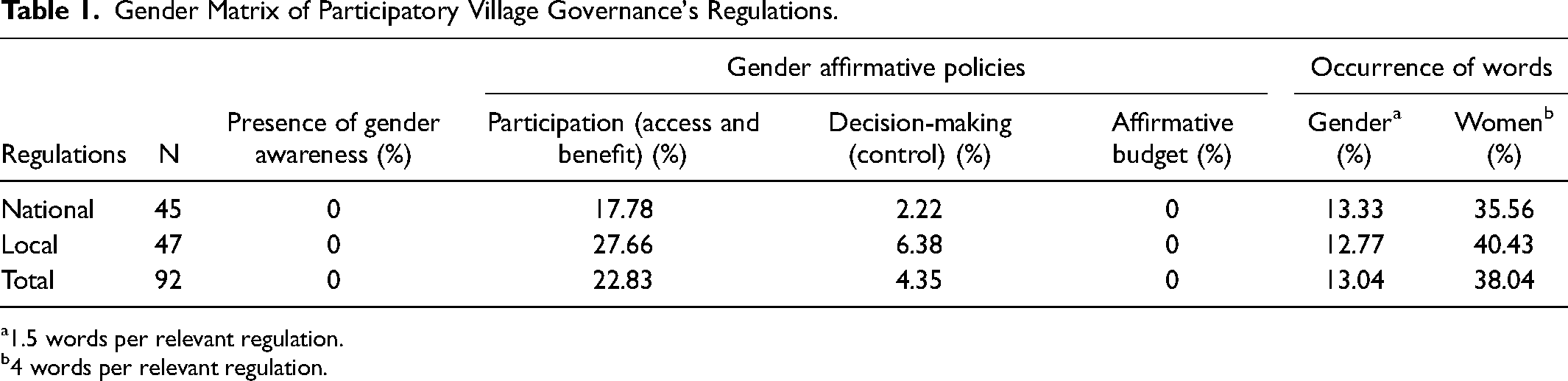
1.5 words per relevant regulation.
4 words per relevant regulation.
When it comes to the support of PVG policies for women to be in the decision-making positions (i.e. the occupation of different positions in the village organisations that make the decisions), the percentage of regulations that have affirmative action policies is even lower – only about 4 percent. The most important affirmative action policy made by the Law is to guarantee that one out of five or nine members of the village council (depending on the size of the village) is a female who represents women's interests and is elected only by women in the village.
Furthermore, looking at the number of words related to gender equality and women's empowerment, 40 percent of regulations contain on average four occurrences of the word “perempuan” (women), and 12 percent of regulations contain on average 1.5 occurrences of the word “gender”. These numbers show that some regulations do mention gender and women, but they do not discuss it. As each regulation contains about 10 to 30,000 words, and gender and women only appear 1.5–4 times, we can see how gender has been underrepresented in the discussion by the lawmakers. And the regulations that do mention gender issues only do so in the section on community empowerment (as the beneficiaries), or in village meetings (as participants). Another aspect worth mentioning is that in some regulations that contain the word “gender”, the concept has been misunderstood as being about women, or, even worse, as a replacement word for sex. Many times, in the regulation documents and in conversations the researcher had with informants, they implied sex whenever they mentioned gender. Lack of understanding of the concept of gender is common among members of parliament and bureaucrats and is ubiquitous at the local level (Calkin, 2015, 297).
To respond to the district government regulations, the village government must develop the village development plan, and the village budget. To understand how village governments respond to the supra-village policies, we have to scrutinise the village development plans and budgets overtime, covering at least two or three years, and the process of decision-making that produces such policies. However, the three village samples did not produce the document at comparable times and formats, so it was difficult to make a comparison between them. However, almost all the villages have produced the budget documents in the same format, as shown in Table 2.
Comparison of Village Budget Components, 2015, 2016, and 2017 in Mawar, Melati, and Anggrek.
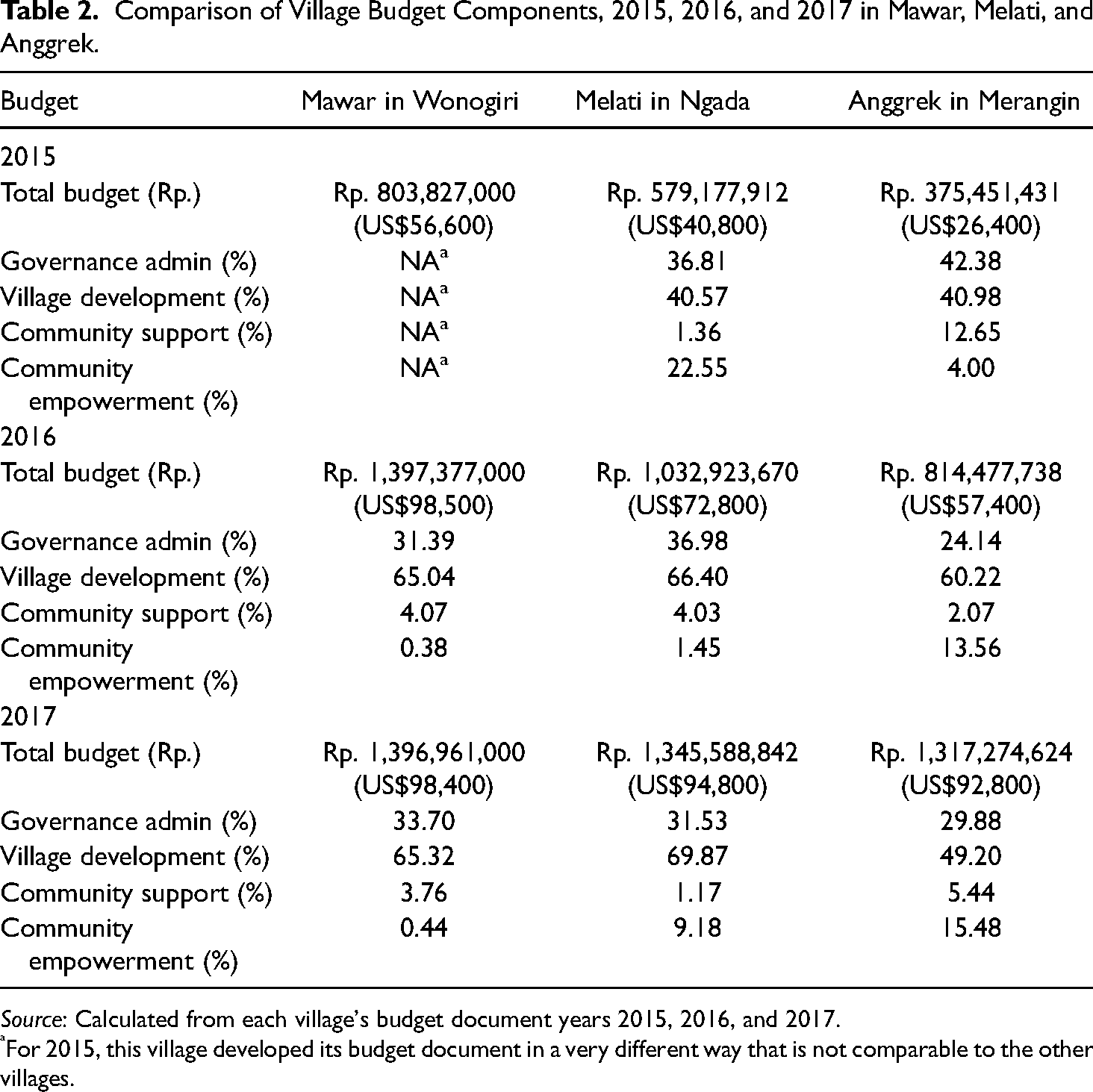
Source: Calculated from each village's budget document years 2015, 2016, and 2017.
For 2015, this village developed its budget document in a very different way that is not comparable to the other villages.
In the budget document, it is clearly seen that the focus of village activities is village (infrastructure) development and governance administration (mostly staff salary). Other aspects of village activities, namely community support and community empowerment (to which women's empowerment activities belong in the budget nomenclature) received significantly smaller budget allocation. Although some villages allocated quite significant amount of budget for the last two categories of budget, in reality, the fund was still used for infrastructure.
Analysis of the village development plan documents shows that the only activity that has something to do with “women” or “women's empowerment” was support to a programme for empowerment and household welfare (PKK). This programme was created by the New Order, and particularly targets the housewives. The main activities are teaching programme members everything about being good wives and supporting their families (Suryakusuma, 1985, Wieringa, 1993). A PKK group in Melati village, for example, has the following activities: routine monthly meeting; monthly health check for children under the age of five years; training for making tofu and tempeh (soybean dishes); training in making traditional sleeping mattresses; and arisan (weekly revolving funds). Although support to PKK activities is listed in all village development plans and village budgets, in the real world in the three sample villages, there was no real activity to empower women in a sense of touching women's strategic interests. Instead, what PKK programme means with pemberdayaan (empowerment) is more about improving women's knowledge and skills to be able to fulfil their practical interests.
The very limited number of activities related to gender and women's empowerment in the village was, among others, due to a lack of proposals from the participants in the village development plan meetings. Under the regime of participatory village governance, the process of formulating the village development plan is a very participatory effort that involves a series of community meetings on many levels. The process sometimes starts from rukun tetangga/RT level (the small neighbourhood), goes up through the rukun warga/RW (larger neighbourhood), then the hamlet, and is finalised at the village level. At every level of meetings, the participants are free to voice their concerns and make proposals based on their needs. The proposals will be ranked at the village level meeting by the whole participants to get the list of priority proposals that will be implemented the next year. The budgeting process will follow and match the priority list.
The crucial issues, of course, concern how the meetings are held, who attends, who speaks, and how the decisions are made, because different settings and different dynamics will make different outcomes. Studies from other countries, such as India (Sanyal and Rao, 2019) have shown that there is a dynamic of participation where the participant with different gender, age, and background can bring about different outputs to the participatory mechanisms. However, as we can see shortly, such a dynamic does not appear in Indonesian participatory governance. The missing of the dynamic in participatory arena helps explaining the rather homogenous results of participatory process, especially in the form of village meeting to plan village development.
Table 3 shows that the meetings in sample villages are dominated by the participation and voices of male participants. There is no significant difference in the pattern between the level of the meetings (village, sub-district, or district). The average number of female participants is less than a quarter of the total participants. Most of the female participants are quiet, and those who speak are normally the female elites. Since 2017, the national government has actually issued a new policy to encourage the village government to organise special women's meetings for development planning. However, until 2018, no sample villages had implemented the policy. There was no systematic effort by the government from national to local levels to ensure that gender aspects of village governance are truly implemented in the village. According to the facilitator at one of the district samples, the focus of their facilitation for the first three years was on how to ensure the village government can adequately manage the administration of village development. The more substantive issues, such as the quality of the development plan and the inclusiveness of the participatory decision-making, will be the priority for the years to come.
Participation and Voice in Meetings at various Levels by Gender from 2015 to 2017 in Villages in the Districts of Mawar, Melati, and Anggrek.
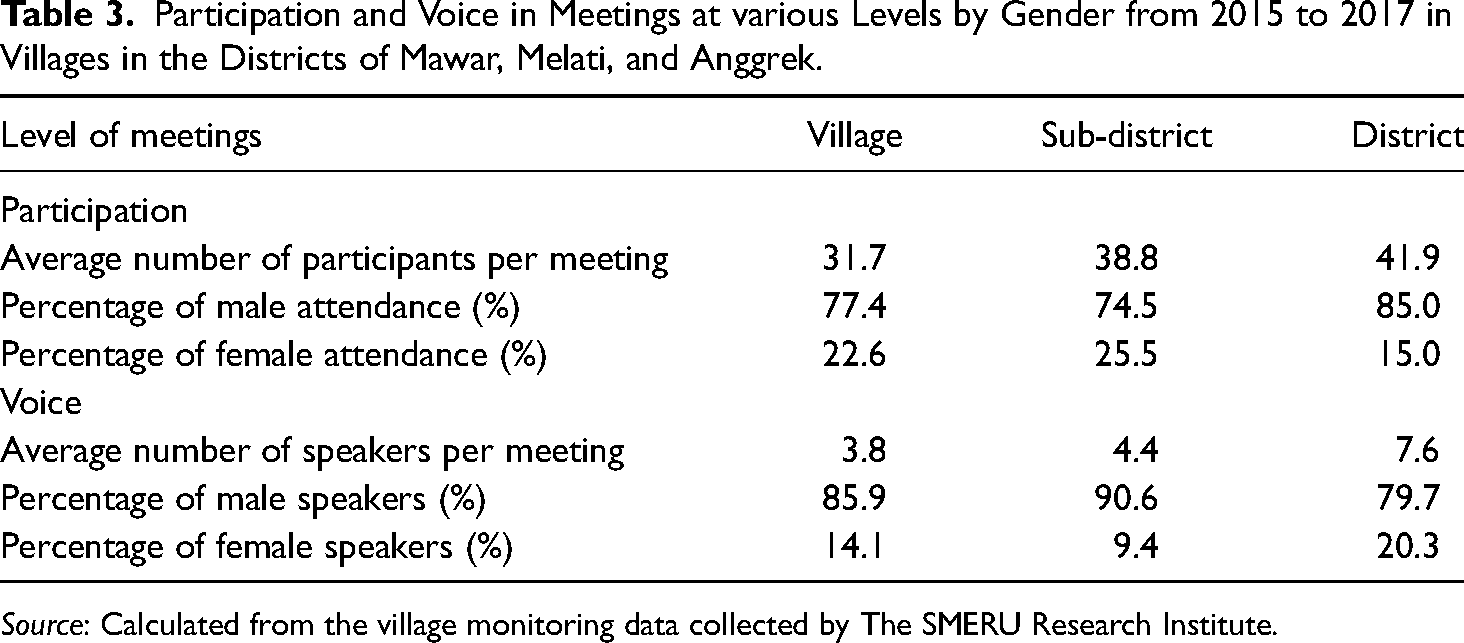
Source: Calculated from the village monitoring data collected by The SMERU Research Institute.
Meetings at the level below the village are the ones that are attended most by the villagers because these are the most accessible socially and geographically to them. The invitees and the participants of these meetings are (literally) all the villagers in the relevant neighbourhood. For those who do not come, there is a penalty, the form of which depends on the neighbourhood tradition. For the meetings at the village level, theoretically, all villagers are meant to be able to attend. However, in reality, the meetings at the village level normally invite the village apparatus, village council, members of organisations affiliated with village government, such as Karang Taruna (a youth organisation), PKK, and farmer groups, and representatives of the villagers, which are mostly the village elites. This pattern leaves most of the village meetings without lay participants, particularly women.
Village-level meetings usually take place at the village hall/office. Meetings below the village level (hamlet, RW, or RT) are typically held at the house of one of the villagers, or house of a neighbourhood head. In Mawar and Melati villages, the meetings at the level below the village are embedded into either (a) the regular religious gatherings, such as pengajian/yasinan (Quranic recitation gatherings) in Mawar, and Kelompok Umat Basis/KUB (basic congregation group) gathering in Melati or (b) social gatherings, such as tablu in Mawar, a traditional gathering held at hamlet level to discuss any problem the community has and which must be attended by representatives of all households in the hamlet, and Minggu wajib (compulsory Sunday), a social gathering after returning from church on Sunday in Melati. This “embeddedness” of the discussion of formal issues of village development into the traditional institutions of hamlet/neighbourhood meetings is an important feature that affects not only how decisions are made, but also women's interests, to which we will return shortly.
What is also important to look at is where the female participants position themselves, or are positioned, in the meetings. Based on the observation in Mawar and to some extent in Melati, women participants sit at the rear end of the house, near to the kitchen, behind the male participants. Before the meeting starts, those women will be busy preparing the drinks and food for the participants. In Melati, although most women sit at the back of the house, some of them sit in the front end of the house among the male participants. In Mawar that was never the case. Although male domination in those two villages is apparent, it seems that in Melati women are more familiar with participation in public arena and various modern meetings thanks to its more equal gender relation than that of in Mawar, and the PNPM programme which was implemented very well in this district. In Mawar, women are positioned backstage in public and domestic life. In the month of the fieldwork in a village in Mawar, not once did the women members of the house where the researcher stayed show up in the living room for dinner or breakfast. They only joined the other members of the family and guests (male household member and the researcher) to watch TV. But they still sat a little farther back from the rest. Such an experience is supported by a Javanese saying that says that women are konco winking or a “backstage friend” (van Doorn-Harder, 2006), a friend who, although very important, may only play her crucial role unseen in the domestic arena.
The description above is only valid for villages in Mawar and Melati, and not for the village in Anggrek. The sample village in Anggrek is totally different from the other two. There is no routine religious or social gathering here. According to many informants, actually, there was a routine yasinan group meeting (Quranic recitation gatherings). However, since 2011 and even more so since 2015, the group has no longer been active due to its members being busy with artisanal mining activities. During the month of observation in the village, there was no single social or religious meeting held in the village. The crucial meeting at the sub-village level for development planning was only held in one hamlet (out of three), and the meeting at the village level was attended by a limited number of the elite male participants. The process of the village-level meeting was not transparent, as nobody knew the outcome of the meetings, including the village development plan document and budget. Even the village secretary had never seen such a document. According to him, the decisions about development planning, budgeting, and the use of village resources are made by the village head alone. In short, this village is not well performed in terms of good governance variables that are agreed by many scholars and organisations (accountability, effectiveness and efficiency, openness/transparency, participation, and the rule of law) as discussed by van Doeveren (2011).
The most important feature of decision-making in village meetings is that decisions are made through “Musyawarah-mufakat”(deliberation and consensus), through which general agreement and consensus are ostensibly reached without any domination from elites (Koentjaraningrat, 1967, quoted in Kawamura, 2011). However, what is ideal in theory is very different in reality. Many studies have shown that the elites and the majority do impose their view on the minority because they think they know what the people in their community need (the benevolent elite thesis), or because they want to capture the benefit of what they are deciding (the elite capture thesis) (Dasgupta and Beard, 2007; Hadiz, 2010; Martines-Bravo et al. 2017). Based on the observation in the villages in Mawar and Melati, musyawarah-mufakat did happen. The lower the level of a meeting, the livelier it is, and the more diverse the participants who speak. However, that is not true for the marginalised people in the village. The poor and the laywomen are not only quiet in the meeting, but also are often not invited to the meeting. The meetings that the general people mostly attend, namely meetings at the neighbourhood levels, are not the decision-making meetings: they are limited to collecting and consolidating villagers’ aspirations or as media for information dissemination. The decision-making meetings normally take place at the village level, or at the hamlet level for some trivial matters. Unfortunately, those meetings are not the ones that the poor, the women, and the other marginalised villagers frequently attend.
The economic context of the three villages might also shed light on why the poor and laywomen were subordinated by the elite women. The main economy of the three villages is agriculture, despite each village relies on different crops. Farmers in Melati, for example, mainly grow clove, cocoa, pecan nuts, and also fruits, such as durian, rambutan, and salak. In Mawar, the main agricultural produce is rice, and some of the farmer’s plant corn as the secondary crop. However, since 2011, encouraged by a cigarette factory, the farmers started to plant tobacco. The commodity is apparently more profitable than rice that the farmers have stopped growing paddy. Anggrek is similar to Mawar where farmers here also grow paddy as the main crop. However, they also grow rubber and vegetables. Like Mawar, since 2011, the village economy experienced a boom where some of the villagers initiated the gold artisanal mining. The practice was growing rapidly in 2018 when the author did a fieldwork, and all paddy fields in the village has entirely transformed into artisanal mining area.
In such a traditional agricultural economy, the ownership of land is a determinant factor. Villagers who have more pieces of land will usually be at the higher rung of welfare ladder. And the marginal women in the village basically are those who come from a family with no or limited piece of land. They work precariously for the landowners, either in agricultural sector or in the artisanal mining. In short, because they are very weak in economy, so too in the social and political life. Their marginal position in village economy is translated into their marginal position in village governance: they are always missing in village decision-making process.
A new Developmental Gender Policy
The above discussion shows that village government policies are basically a response to the higher-level policies introduced either by the national or district governments. The discussion has also shown how technically the village governments managed gender equality and women empowerment policies, by focusing only on practical interests of village women and ignoring their strategic interests, as has been discussed in the previous section. This article argues that the inclination of the Jokowi regime to address (although very limited) gender practical interests and ignore the more strategic gender interests is due to their commitment to the ideology of New Developmentalism. It is this type of gender policy inclination that this article refers to as the new developmental gender policy. Besides its narrow focus on gender practical interests, in Indonesian case, the new developmental gender policy takes the following characteristics:
Improving Women’s Condition but Ignoring Their Position
What we have been discussing shows that, although there are some efforts by the national government (through policies) to improve gender equality, the efforts are not effective enough to transform the unequal gender relations and empower the village women. The policy is not effective enough because from the beginning the intention was mainly to improve the “condition” of the women, and not to transform their “position” and rework the structure of unequal gender relations. The focus of the government with this participatory village governance policy is “development”, particularly village infrastructure and the village economy. We can see this focus from PVG policy documents and its implementation in village activities and budget allocation, which in most villages is overwhelmingly devoted to infrastructure development and operational costs. Other issues are beyond its focus, including gender equality and women's empowerment. The blend of the very narrow focus on village infrastructure and economy, avoidance of dealing with very sensitive issues, and the very dominant position of the village executive, immediately reminds us of the character of the New Developmental state, which subordinates other issues outside of its focus to the primary economic goals through regulatory policies (Syukri, 2022; Warburton, 2016).
Exploiting Women Organisation
With the absence of direct state support for marginalised women (through policy and regulation), we now turn to local groups and organisations to advocate for women's interests. However, in the new participatory village governance, the role of community groups and organisations is very weak. If in the era of PNPM, women's savings and loan groups (Kelompok Simpan Pinjam untuk Perempuan), that each village can have four to more than ten groups, had been the main target of women's empowerment activities (Li, 2007), now those groups are just abandoned, and most of them have disbanded. In the three sample villages, no single PNPM women's group remained active. The more formal women's organisation that tends to exist in villages is the PKK, a corporatist women organisation that is a legacy of the New Order. In the newest Regulation 6 , the community organisations at the village level, including PKK, are defined as “an organ of community participation and partner of the village government…” 7 , and in the other section of the Regulation on the task of these organisations, it stipulates that the organisation must “help the village government’ to implement village development activities. In particular, the PKK has as its main task ‘to help the village government to improve the welfare of the family”. 8 A closer look at the new regulation on the community organisation shows that, first, it positions community organisations in general as the support system of the village government in implementing village development activities, instead of as a civil society group at the village level. Second, specifically in regard to the women's organisation, the government again, through this regulation, takes a very conservative stance by affirming the gender role of women in the domestic arena, that is, to improve family welfare, the position of the New Order developmental state (Suryakusuma, 1996). This explains that the Jokowi regime policy to retain PKK long after Reformasi is not a surprise, because it serves an important function in socialising the state gender ideology of what Suryakusuma has called “state ibuism” (Suryakusuma, 1996).
The tendency of national policies to weaken the community organisations, including women's organisations, is in line with policies, on the one hand, to weaken the village council (Badan Permusyawaratan Desa/BPD), and, on the other hand, to strengthen the village executive. As argued by Syukri (2022: 15) the purpose of such policies is to ensure village development will not be spoiled by boisterous village politics. In so doing, policies assign trivial roles to BPD, such as participating in discussing village regulations, village development plan, and budget, but give it no authority to exercise checks and balances. While the village head (and village executive in general), is defined by the Regulation as the uncontested authority in the village, responsible for all aspects of village governance. The tendency to create a powerful government while weakening the horizontal checks and balances (but imposing very strong vertical accountability) again reminds us of the characteristics of the New Developmental state in Indonesia (Syukri, 2022).
Facilitators That did not Facilitate
Another aspect of participatory governance that contributes to the perpetuation of gender inequality is the role of the facilitator. As mentioned earlier, the role of facilitator under the Village Law regime is significantly different from that in the PNPM programme, where the latter was helping to organise and facilitate the community and the former focusing solely on supporting the village government. The implication is that there is inadequate attention to the needs of the marginal people in village governance activities, especially their strategic needs. To some extent, government focus with facilitation more on village government than the community is not a surprise. To institutionalise whatever policy at the village level nationwide is a huge task (Indonesia has more than 80,000 villages), and the government has decided to focus first on settling down the administrative aspect of the policy and takes care of the rest later. Such a preference by the government, this article argues, exemplifies regime's inclination to the New Developmentalism
To address gender strategic interests, the role of external actor is important. As elaborated by Molyneux (1985), to identify women’s practical interests is easy because they are based on what women experience and directly need in their daily life. The women’s strategic interests are different in which it is more subtle, abstract and need special efforts, frequently by external experts, to understand the underlying condition of gender relation and make them apparent to the women. It is in the effort of discovering the strategic needs of women villagers that the facilitator can play a significant role, that is, to understand the underlying problem of gender inequality in the village, help identifying potential activities that can contribute to the transformation of the traditional gender relation that can be proposed to be included in the village development planning documents, and to help organising and consolidating supports from general villagers for the proposal. However, because the task of the facilitator has been narrowly focused on supporting and ensuring the village government implements various development activities in order to achieve the national interests at the village level that have made them as what Syukri called “compliance engineers” (Syukri, 2022).
The absence of agents that can help women to understand the underlying causes of their subordinate position, hence, to identify their strategic interests to challenge the causes and transform their position, explains why most of the women proposals (if any) in the village development planning is entirely related to their practical interests. By delimiting the role of the facilitator only to help village government instead of playing other important roles of organising and facilitating women's groups to advocate their strategic interests in the village, the new developmental regime of Indonesia has contributed to sustain traditional gender relations, and perpetuate gender inequality in villages.
Pragmatic use of Local Institutions
The last aspect that complicates the gender equality policy is the decision of the government to keep the traditional decision-making institutions in place. On the one hand, using the existing institutions for project purposes might have some advantages, as they are already well established, thus proven effective, which can reduce the cost of learning. However, in reality, it has some problems, that is, aspects of some traditions that I discussed above are not gender sensitive, or even discriminate against women. Those aspects include the time of the meeting that does not suit most women's domestic schedule; the gender bias of the traditional seating arrangements where women sit at the back in meetings; and the traditional division of the roles of women and men in meetings in which male participants engage in debate and decision-making and the women prepare drinks and food – all of which reinforces gender inequality. By allowing the strategic decisions to be made in such circumstances, the government again does not touch the structure of gender inequality in the village, and instead perpetuates it.
Conclusion
This article has discussed participatory village governance and how it deals with gender equality issues in Indonesia. In general, the findings show that in this new policy, the government has taken a very conservative position by only addressing (if any, in a very limited number of policy) the practical needs of women and left out the important but also sensitive issues of strategic needs to rework the unequal gender relations in state policy and society. Instead of transforming these unequal gender relations, this article argues, the participatory village governance policy has perpetuated unequal traditional gender relations.
In order to achieve the national target regarding the development of village infrastructure and economic growth, the policy has instrumentalised women's groups, situating them to think only about their practical interests and forgetting their subordinate position. The rise of such a policy can be seen as one of the indications of the government's inclination to pursue a new developmental approach to governance. With this approach, the government focuses narrowly on infrastructure and economic development of villages and subsumes other issues outside of this focus under the mission of achieving such goals.
The inclination of the New Developmental mode of governance to avoid sensitive issues comes with a cost: the missing opportunity to deepen democracy and to transform unequal power relations in the village. The Village Law actually has opened up opportunities to deepen village democracy by introducing participatory institutions. However, the Law is only a general platform. In order to work it requires technical implementing regulations. Unfortunately, the implementing regulations have turned out to be very regressive and delimit the transformatory spirit of the Law. Instead of deepening village democracy and transforming the unequal gender relations, the regulations put a serious emphasis on the good governance aspects of village governance in order to make sure that village governments comply with the national government orders. The New Developmentalism focus on (infrastructure) development and economic growth has ignored a strategic agenda of transforming unequal gender relations in the village.
Footnotes
Declaration of Conflicting Interests
The author declared no potential conflicts of interest with respect to the research, authorship, and/or publication of this article.
Funding
The author disclosed receipt of the following financial support for the research, authorship, and/or publication of this article: This work was supported by the University of Western Australia, The SMERU Research Institute (grant number 10400095, Travel grant for fieldwork).