



Abstract
Indonesia actively supports the United Nations Framework Convention on Climate Change to achieve the Global Goal on Adaptation by setting ambitious climate change adaptation pledges in its Nationally Determined Contributions. This paper explores the implementation of those adaptation commitments within a polycentric governance structure in Indonesia. There is a debate about whether polycentric institutions help or hinder the effectiveness of adaptation outcomes. The question remains, why is the implementation of climate change adaptation policies in Indonesia ineffective? This paper argues that the contestation between the National Development Planning Agency and the Ministry of Environment and Forestry, as two dominant ministries in adaptation, has beset the polycentric structure of adaptation governance in Indonesia and resulted in ineffective adaptation policy implementation. Moreover, the polycentric adaptation governance is ineffective because Indonesia is still facing problems in coordination, collaboration, policy learning, leadership, resource distribution, and dispersion of power.
Introduction
Indonesia has set ambitious climate change adaptation pledges in its Nationally Determined Contributions (NDCs) to conform to the Global Goal on Adaptation under the Paris Agreement to enhance adaptive capacity, strengthen resilience, and reduce vulnerability to climate change. The implementation of climate change adaptation policies is often situated in a highly contested political space in developing countries (Mikulewicz, 2018). For instance, climate change adaptation governance in Indonesia has become more complex because it involves polycentric institutions where many decision-making centres of adaptation exist at the national and local levels. There are at least 19 ministries or agencies involved in climate change adaptation governance under the 2014 National Action Plan on Climate Change Adaptation framework (Rencana Aksi Nasional Adaptasi Perubahan Iklim, RAN-API) led by the National Development Planning Agency (BAPPENAS, 2014). Each ministry or agency can build polycentric institutions that are not necessarily connected to RAN-API.
There is a debate about whether polycentric institutions help or hinder the effectiveness of climate change policy implementation (Ostrom, 2010a). Winters and Cawvey (2015) provide an example of how an overlapping governance structure in the renewable energy sector confuses international investors, hence a disincentivised investment environment in Indonesia. The implementation of adaptation policies in Indonesia can be considered ineffective because they have not improved adaptive capacity or significantly enhanced the climate resilience of vulnerable communities. The data from the National Disaster Mitigation Agency shows a pattern where the number of Indonesian people who suffered and fled due to climate disasters increased from around 1,227,000 people in 2015 to 8,491,288 people in 2023 (BNPB, 2021, 2024). It is evident that the increased frequency of climate disasters has outpaced the adaptive capacity needed by the Indonesian people to adapt to and cope with the adverse effects of climate change. This pattern also shows that climate change adaptation policies made by the Indonesian government have been ineffective in narrowing the adaptation gap occurring in Indonesia. 1 It raises the question: Why is the implementation of climate change adaptation policies within a polycentric governance system in Indonesia ineffective?
This paper aims to investigate whether polycentric institutions help or hinder adaptation governance in Indonesia. Although research on climate change governance in Indonesia has grown in recent years, studies that focus on examining polycentricity in climate change adaptation governance remain less explored (but see Di Gregorio et al., 2019; Fortnam et al., 2022; Morrison et al., 2017; Nugraha and Lassa, 2018; Sunderlin et al., 2015). Moreover, studies that explore under what conditions polycentric system can be effective in tackling particular issues such as climate change remain largely unexplored (but see Di Gregorio et al., 2019; Fortnam et al., 2022; Gallemore et al., 2015; Hamilton and Lubell, 2019; McGinnis, 2016; Morrison et al., 2017).
This article addresses the aforementioned two gaps. First, it contributes to advancing our knowledge of polycentric adaptation governance in the global south by analysing the efficacy of the polycentric system in tackling climate change adaptation challenges in Indonesia. Second, it explores enabling conditions that can make polycentric system in adaptation governance effective by using adaptation governance in Indonesia as a case study. Moreover, this article also echoes the calls for exploring political dimensions of climate change adaptation in the global south because most adaptation research focuses on technical solutions and overlooks the political dimensions of adaptation implementation (Dodman and Mitlin, 2015; Mikulewicz, 2018; Struthers, 2020).
It is argued that Indonesia's polycentric structure of adaptation governance is detrimental to the implementation of adaptation policies due to contestation and fragmentation between the National Development Planning Agency (BAPPENAS) and the Ministry of Environment and Forestry (MoEF). The contestation and fragmentation between them have formed two branches of climate change adaptation governance that hinder coordination and collective adaptation actions. This article reveals that sectoral ego is the culprit of contestation and fragmentation between BAPPENAS and the MoEF. It also argues that the polycentric adaptation governance in Indonesia is still lacking in coordination, collaboration, policy learning, leadership, resource distribution, and dispersion of power.
This article proceeds by providing the theoretical framework of polycentric governance and identifying under what kind of conditions polycentric structures can be effective in achieving adaptation goals. It then describes the research method used to collect and analyse primary data obtained through online interviews undertaken during COVID-19. Next, this article presents the findings of the elite interviews and documents analysis. It then discusses the findings to develop answers to the research questions. The final section concludes the discussion of this article.
Theoretical Framework
Polycentric Structure of Climate Change Adaptation Governance
Polycentric structure means that there are many centres of decision-making where each centre is independent of another (Ostrom, 2010a). Decision-making processes exist at multiple levels (Marquardt, 2017). Each unit usually makes norms and rules within a specific domain, for instance, a family, a village, a district, a province, a region, a national government, or an international regime (Ostrom, 2010b). Climate change adaptation governance has evolved into a complex polycentric structure that extends from the global to national, province, municipality, regency, district, and village levels (Di Gregorio et al., 2019). The polycentric concept is usually used interchangeably with multilevel governance theory coined by Hooghe and Marks (2001). They use multilevel governance theory to explain the European integration process, which brought about consequences to the European Union (EU) countries that lose their power in monopolising policy implementation because they have to transfer their power to supranational (EU) and also subnational institutions (Hooghe and Marks, 2001: 24). It means that national governments are not the only actors that monopolise the governance of adaptation. International and subnational actors can also play a significant role in the adaptation decision-making process and when conducting adaptation actions (Ishtiaque, 2021).
The polycentric approach is relevant for the analysis of global adaptation actions. There is a presumption by some scholars that only the global scale units are relevant for policies related to global public goods (Ostrom, 2010b). The polycentric approach helps us to rethink the importance of medium- and small-scale units in solving global collective action problems such as climate change adaptation challenges. Polycentric institutions across national, regional, and local levels can provide backup for slow global climate change solutions negotiated internationally (Ostrom, 2010b).
The central debate about polycentricity usually focuses on the effectiveness of polycentric institutions and whether they hinder or help tackle particular problems, such as emissions reduction, and help to achieve more effective, equitable, and sustainable outcomes (Dorsch and Flachsland, 2017; Ostrom, 2010a). Polycentricity has faced criticism from scholars for a long time. More than 60 years ago, Ostrom (1961) raised the question of whether the existence of polycentric institutions in a metropolitan area was evidence of a chaotic system or potentially productive arrangement in providing better public services. Sovacool (2011) has identified several shortcomings of polycentrism. For instance, polycentric institutions with divergent rules and norms can lead to redundancy of regulations, inefficiency, and confusion. When there are many similar rules and norms, people are confused about what rules and norms apply to them. In another case, polycentrism is sometimes time-consuming since it needs more time for the parties to achieve policy resolution. The coordination problem is also a main challenge in polycentric systems where the institutions are fragmented and there is no central focal point (Sovacool, 2011). The question remains under what conditions polycentric institutions can be effective and help achieve global goals on adaptation.
Conditions to Make Effective Polycentric Governance
This article has reviewed works of literature that identify enabling conditions to make effective polycentric governance that helps tackle global climate change problems. There are at least six conditions to build effective polycentric systems: coordination, collaboration, policy learning, resource distribution, leadership, and dispersion of power.
Coordination
McGinnis (2016) points out that a polycentric governance system needs an immense amount of successful collective action to ensure the continuity of the system's operation. Effective coordination is key to forming collective action that can contribute to polycentric success (McGinnis, 2016). Morrison et al. (2017) describe an ideal polycentric system as a system that operates as a coordinated system. Fortnam et al. (2022) analyse the polycentric environmental governance of Taka Bonerate Kepulauan Selayar Biosphere Reserve in the South Sulawesi Province as one of the case studies. They argue that robust coordination is a key component to shift from fragmented polycentricity that produces uncoordinated and contradictory actions. Fragmented polycentric systems are characterised by highly autonomous decision-making centres and limited connections among actors with unequal power distributions and overlapping responsibilities (Fortnam et al., 2022).
Collaboration
Collaboration among adaptation policy actors can be in the form of designing and implementing policies. This collaboration enables polycentric institutions to establish norms of reciprocity and trust (Hamilton and Lubell, 2019). Trust among policy actors can lead to more strongly institutionalised governance with flexible arrangements (Gallemore et al., 2015). Di Gregorio et al. (2019) also highlight collaboration as an integral condition for effective adaptation actions. Using the Indonesian case, they find that cross-level and cross-sectoral interactions and collaboration among policy actors are needed for effective adaptation actions within a polycentric system in Indonesia. Fortnam et al. (2022) also consider cross-level and cross-sectoral interactions for effective environmental governance systems.
Policy Learning
Policy learning can be done through the exchange of scientific or technical information among multilevel actors. This measure enables policy learning that is important to reduce the uncertainties of climate change and prospective adaptation action outcomes (Hamilton and Lubell, 2019). Policy learning also helps policy actors build collective adaptation actions. Polycentric institutions can learn from best policy practices across levels and sectors.
Resource Distribution
Resource distribution is a policy process that allows policy actors to distribute the costs and benefits of climate change adaptation policies based on the procedural fairness principle (Hamilton and Lubell, 2019). The decisions of adaptation resource distribution should target the most vulnerable groups that have been marginalised. However, actors in a complex polycentric governance often seek to get institutional incentives and might be tempted to shirk from their roles, such as not attending the meeting in managing a complex resource (Andersson and Elinor, 2008). These conditions complicate collective efforts in managing distributing adaptation resources becoming inefficient and inaccurate. When the incentives are lacking, actors tend to be reluctant to contribute to arrange resource distribution collectively. Andersson and Elinor (2008) suggest that a well-tailored set of institutional arrangements is needed to offset these incentives.
Leadership
Gillard et al. (2017), using evidence from the development of climate change policies in the United Kingdom, highlight the importance of strong central government leadership in accelerating the development of polycentric governance. The central government can play an important role in building collaboration with private and civic sectors. This article does not suggest policy actors return to a monocentric governance structure where power is centralised, and the central governments monopolise the decision-making process. When polycentric systems seem to be chaotic, strong leadership is needed to provide the right political environment that can enable policy actors to form collective actions (Sovacool, 2011).
Dispersion of Power
Power dynamics among policy actors can shape polycentric governance positively or negatively (Morrison et al., 2017). It is important to consider power relations among actors in the analysis of polycentric governance effectiveness. Power is distributed unequally among policy actors. Some actors can have greater power than other actors. For example, national governments remain more powerful than subnational actors in formulating national adaptation policies. Di Gregorio et al. (2019) identify that the most powerful network communities mainly interact at the national level. Powerful policy actors can shape governance structures to fulfil their own interests. Dispersion of power is needed to prevent the domination of a few actors in shaping the adaptation governance structures (Morrison et al., 2017). It also allows local actors to be more creative and innovative in finding adaptation solutions based on the local adaptation knowledge they have.
Research Method
The arguments of this article draw from document analysis and interview data of 30 elite respondents. It has analysed 20 policy documents published by BAPPENAS and the MoEF from 2009 to 2022 to explore the development of Indonesia's national adaptation policy post-Paris Agreement and investigate contestation over national adaptation policies between BAPPENAS and the MoEF (see Appendix 1). Elite interview data were gathered from July 2020 to July 2021 during the COVID-19 pandemic through qualitative online interviews. Salmons (2015) describes an online interview as a process of gathering original data through interviews conducted using computer-mediated communication via the Internet. The type of online interviews in this research is one-on-one interviews using a synchronous (real-time) approach (Janghorban et al., 2014). The virtual communication tool used was Microsoft Teams. Online interviewing or video conferencing enabled the author to overcome lockdowns, social distancing, and travel restrictions imposed due to COVID-19 (Sah et al., 2020).
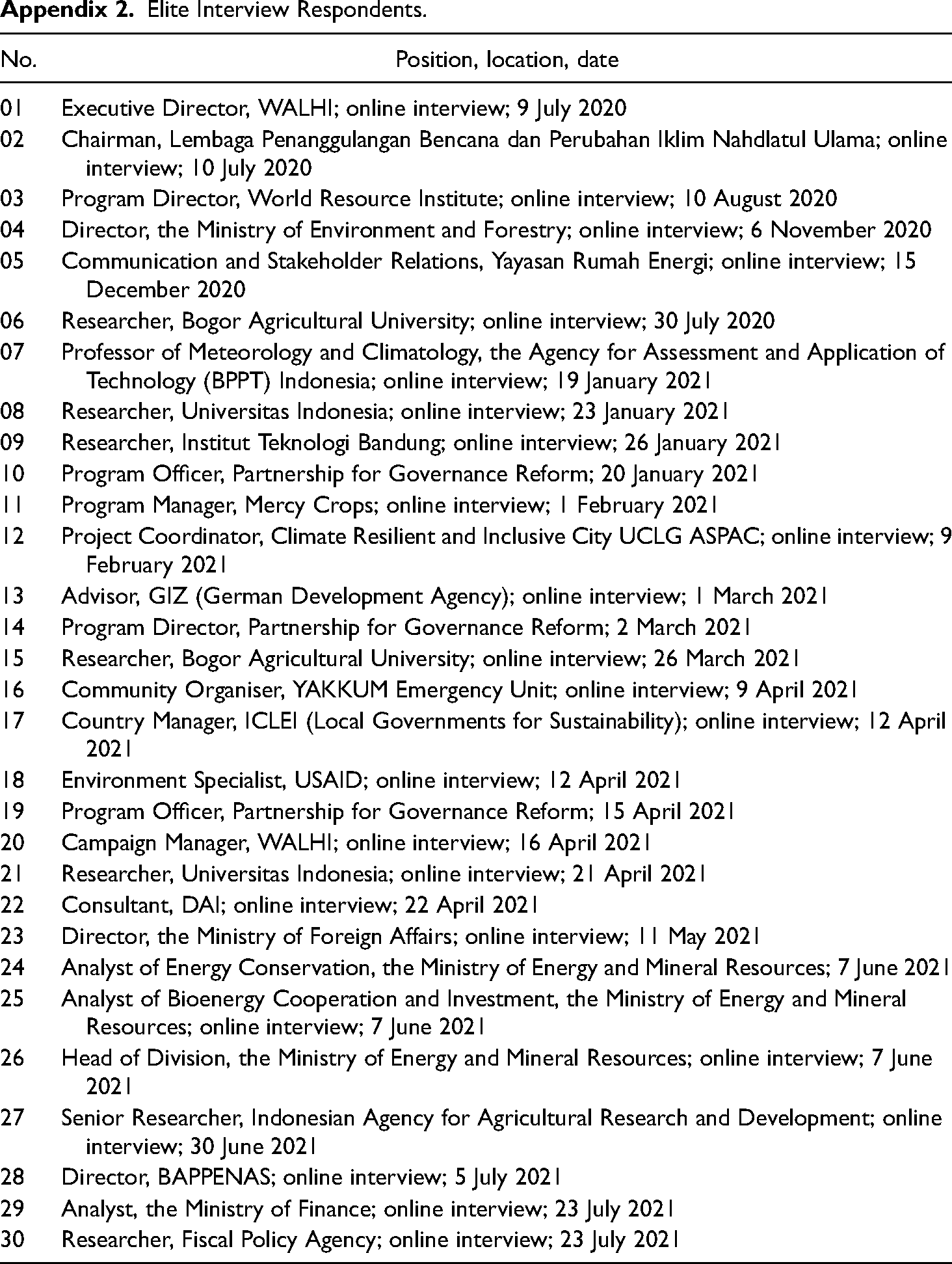
This research relied on ‘elite’ interviewing using an in-depth interview technique to gather primary data from the respondents (Vromen, 2010: 258). Elite interviewing is a type of interview that explores the research questions with people who have power and are prominent in their field, such as political leaders, senior executives, activists, or commentators in the public sphere (Vromen, 2010: 258; Scally et al., 2021). This research used in-depth semi-structured interviews that enabled the author to compare and contrast the respondents’ experience towards the contestation of national adaptation policies in Indonesia (Vromen, 2010: 258). The elite respondents are key stakeholders in climate change adaptation governance at the national level. The respondents are experts in their field and people with positions in organisations where they could influence the adaptation decision-making process. They work in ministries, agencies, non-governmental organisations, universities, think tanks, and international donor agencies (see Appendix 2).
Drawing from the 30 interviews, the respondents identified four problems that undermine the effectiveness of climate change adaptation governance in Indonesia. Contestation, sectoral ego, coordination, and exclusion were recurring themes in the online interviews. First, most respondents identified a contestation between BAPPENAS and the MoEF as the two main dominant actors in adaptation governance. Second, the respondents explained that sectoral ego was the main culprit causing the contestation between BAPPENAS and the MoEF. Third, sectoral ego and contestation lead to coordination problems in Indonesia's national adaptation governance, such as overlapping adaptation policies. Lastly, respondents said that Indonesia's climate change adaptation governance is merely technocratic and top-down. For instance, the central government excludes non-state actors and limits their access to the adaptation decision-making process. The following section presents the findings from the document analysis and elite interviews in detail.
Findings
The Emergence of the Two Power Centres in Adaptation Governance
Climate change adaptation governance can be considered more complex than climate change mitigation because it involves more policy actors (Interview 07). There are at least 19 ministries or agencies listed in the 2014 RAN-API. Meanwhile, based on the 2011 National Action Plan on Reducing Greenhouse Gas Emissions document, climate change mitigation governance only involved nine ministries or agencies. This article examines the dominant actors in adaptation governance to understand power dynamics within polycentric systems in Indonesia.
Based on document analysis and elite interviews, this article finds that BAPPENAS and the MoEF are the two dominant powers in polycentric adaptation governance in Indonesia and in producing national adaptation policies. This article has scrutinised four NDC documents submitted to the United Nations Framework Convention on Climate Change (UNFCCC) and found 13 policies relating to the adaptation agenda (see Table 1). From those 13 policies, BAPPENAS and the MoEF are the two ministries that shape adaptation governance in Indonesia. Both Ministries are also key actors in creating national adaptation planning. BAPPENAS published the RAN-API in 2014, while the MoEF launched the NDC Adaptation Roadmap in 2020.
Indonesia's Climate Change Adaptation Commitments.
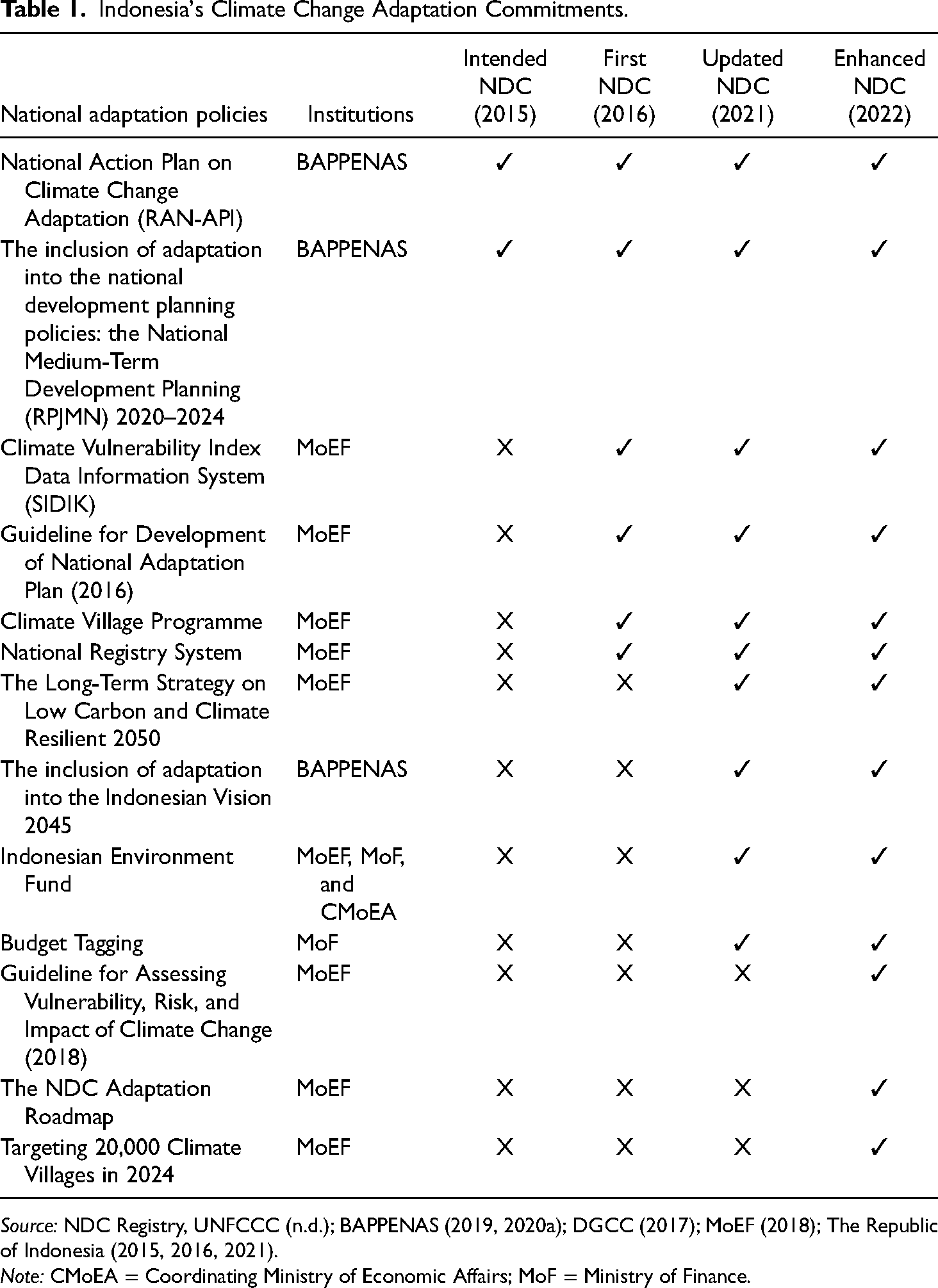
Source: NDC Registry, UNFCCC (n.d.); BAPPENAS (2019, 2020a); DGCC (2017); MoEF (2018); The Republic of Indonesia (2015, 2016, 2021).
Note: CMoEA = Coordinating Ministry of Economic Affairs; MoF = Ministry of Finance.
BAPPENAS and the MoEF are also two ministries frequently mentioned during elite interviews. Some elite respondents also identified the Ministry of Finance as one of the key policy actors because this ministry has the power to manage and distribute climate finance (Interviews 17, 28, and 29). The Ministry of Public Works and the National Disaster Management Agency were also mentioned several times (Interviews 02, 09, 12, and 18). The Ministry of Public Works was considered an essential actor because it builds many adaptation infrastructures and received the biggest share of adaptation funding compared to other ministries. For instance, the Ministry of Public Works received 94.7% of total adaptation funding in 2018. From a total of IDR 37.5 billion in adaptation funding, IDR 35.5 billion was distributed to the Ministry of Public Works (Fiscal Policy Agency, 2019). The National Disaster Management Agency was also mentioned as a potential key actor because the sectoral jurisdiction of this ministry (disaster management) often overlaps with the adaptation sector (Interview 02).
Even though elite participants mentioned five powerful policy actors at the national level, this article argues that only BAPPENAS and the MoEF have the dominant power to shape the adaptation governance structure. The nature of the Ministry of Finance and the Ministry of Public Works’ involvement in adaptation governance is based on their sectoral jurisdictions (finance and infrastructure). The nature of the involvement is different than BAPPENAS and the MoEF, which have the authority to perform cross-sectoral coordination and facilitate collaboration in adaptation actions. BAPPENAS has a mandate to govern all policies related to national planning, including the formulation of RAN-API, the National Long-Term Development Plan, the National Medium-Term Development Plan, and the Government Annual Plan. The MoEF is the national focal point of the Indonesian Government for the UNFCCC. It has roles in representing Indonesia in the UNFCCC fora and communicating agreed points with local climate change stakeholders in Indonesia (Directorate General of Climate Change [DGCC], n.d.). BAPPENAS and the MoEF have mandates that enable them to become leaders in adaptation governance.
The National Disaster Management Agency was a potential policy actor expected to play a significant role in adaptation governance. In the early 2010s, there was a developing discourse to integrate disaster risk reduction and adaptation governances following the outcome of the 2007 Conference of the Parties in Bali (COP 15) that recognised a linkage between disasters and climate change (Djalante and Thomalla, 2012). The National Disaster Management Agency was considered the right institution to realise this plan; however, it faced several political challenges in the implementation process. First, the governances of disaster risk reduction and adaptation are managed by two different policy network communities; hence, it was difficult to integrate (Djalante and Thomalla, 2012; Interview 02). Second, an non-governmental organisation (NGO) official involved in both policy network communities observed that the National Disaster Management Agency was not involved much in the development and implementation of RAN-API under BAPPENAS. Third, the adaptation agenda was not fully institutionalised by the National Disaster Management Agency in its main policy documents. For instance, climate adaptation does not get enough attention in the 2020–2024 Disaster Management Strategic Plan. Climate change adaptation is only mentioned five times in the 170-page document.
During President Susilo Bambang Yudhoyono's administration, adaptation action was commanded by the National Council on Climate Change under the President's supervision (Interview 02). However, a new leadership in 2014 under President Joko Widodo significantly changed the adaptation governance. The President merged the National Council on Climate Change into the newly merged MoEF for the sake of efficiency (Interview 17). The merger between two ministries with two different agendas often results in tensions between two parts of the ministry (environment and forestry). Environment issues are marginalised in the MoEF (Interview 02). The forestry department is more powerful than the environment department, since forestry sector still produces biggest commodities such as palm oil, pulp, and paper (Interview 02). Besides, the Ministry of Forestry and the National Reducing Emissions from Deforestation and Forest Degradation Agency (BP REDD+) used to manage significant amount of international funding, such as from the Norwegian Government that provided financial support up to USD 1 billion (Jong, 2015; Moeliono et al., 2020). Hence, climate change mitigation and forestry agenda become more dominant in the MoEF and adaptation agenda is still being marginalised because it is not focused on forestry sector only.
Di Gregorio et al. (2017) find that BAPPENAS appropriated the adaptation agenda with the dismantling of the National Council of Climate Change and the launching of the 2014 RAN-API. This article finds that BAPPENAS is not the sole actor that appropriates the adaptation agenda. With the launching of the 2020 NDC Adaptation Roadmap by the MoEF, there emerged two dominant powers in governing adaptation planning in Indonesia. The 2014 RAN-API and the 2020 NDC Adaptation roadmap enabled BAPPENAS and the MoEF to perform horizontal coordination in implementing adaptation policies.
A policy emerges from the interactions between governmental and other actors (Rhodes, 2008: 426). BAPPENAS and the MoEF have interacted with other policy actors in formulating and implementing adaptation planning policies. Those kinds of interactions have built close-knit policy communities (Bulkeley, 2000). Still, governmental actors have more considerable power and dominate Indonesia's decision-making process of national adaptation policies. Figure 1 illustrates the polycentric governance structure of climate change adaptation at the national level in Indonesia. It shows that BAPPENAS and the MoEF become two centres in adaptation planning governance with two different close-knit policy communities. They are not entirely independent of one another because they share several actors (in the middle) that work with both in formulating the RAN-API and NDC adaptation documents. Moreover, a line connects BAPPENAS and the MoEF in Figure 1 since they involve each other in formulating adaptation planning. BAPPENAS appears in the NDC Adaptation Roadmap, and the MoEF also occurs in the RAN-API document.
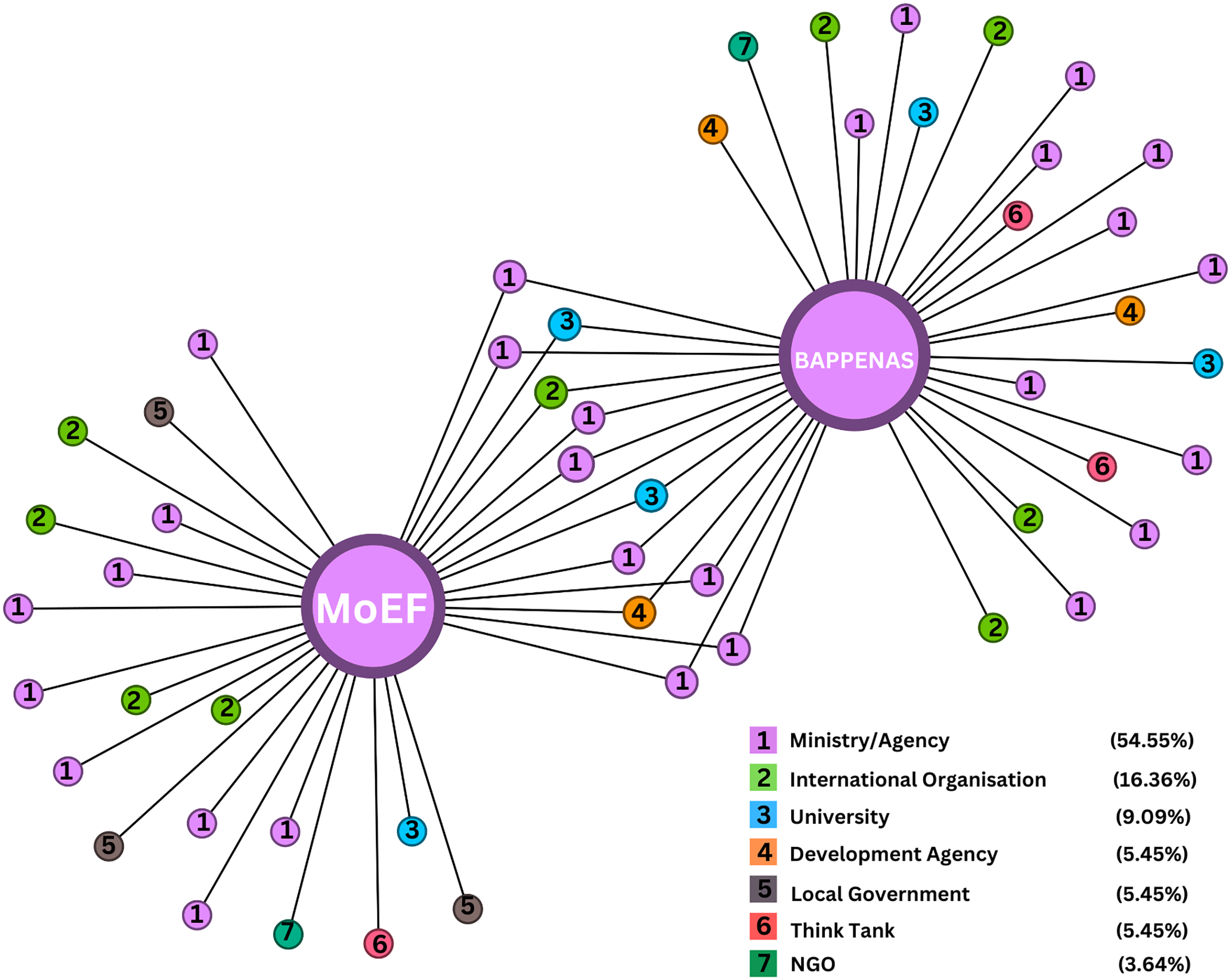
Policy Network in Adaptation Planning. Source: Designed by the author using Gephi software and based on RAN-API and NDC adaptation roadmap documents.
Whereas the governance of adaptation planning is dominated by ministries and agencies (54.5%), multilevel actors are also involved, such as international organisations, non-governmental organisations, development agencies, think tanks, universities, and local governments (see Figure 1). The policy networks of BAPPENAS and the MoEF involve international actors such as UN WOMEN, the World Wildlife Fund, the Japan International Cooperation Agency, the Asian Development Bank, and the Deutsche Gesellschaft für Internationale Zusammenarbeit GmbH (GIZ). They also involve national actors such as Universitas Indonesia, Institut Pertanian Bogor, Institut Teknologi Bandung, and the Indonesian Association of Urban and Regional Planners (Ikatan Ahli Perencanaan Indonesia). However, only the MoEF involves local actors such as the Environmental Agencies of Jakarta, Tangerang, and Bogor in the adaptation planning policymaking. This subsection has highlighted that BAPPENAS and the MoEF have become the two dominant powers in adaptation polycentric governance. Hence, the effectiveness of adaptation policy implementation is determined by the power relations between BAPPENAS and the MoEF.
Figure 1 shows that there is a line that connects BAPPENAS and the MoEF since they involve each other in formulating adaptation planning. BAPPENAS appears in the NDC Adaptation Roadmap and the MoEF is featured in the RAN-API document. However, the appearance of BAPPENAS in the MoEF's adaptation policy documents does not necessarily mean that it is involved in the decision-making process under the MoEF's authority and vice versa. BAPPENAS and the MoEF have two different close-knit policy communities. Several policy actors involved by BAPPENAS in formulating the RAN-API were not involved by the MoEF in formulating the NDC Adaptation Roadmap and vice versa.
Discussion
Polycentric Governance in Indonesia: Hindering or Helping Adaptation Actions?
Conditions to Make Effective Polycentric Governance Section listed six enabling conditions to make polycentricity in adaptation governance work based on several works of literature. Those six enabling conditions are coordination, collaboration, policy learning, resource distribution, leadership, and dispersion of power. This section scrutinises the power relations between policy actors and dissects whether those six enabling conditions occur in Indonesia.
Coordination
The horizontal policy coordination between ministries or agencies at the national level is lacking and this condition is exacerbated by the existence of two paths of adaptation governance. It makes coordination among ministries or agencies even more challenging due to the contestation and fragmentation between two dominant powers in adaptation governance. Fragmentation between ministries in Indonesia has been observed in many sectors. For example, Medrilzam et al. (2011) found that the Ministry of Forestry used to exclusively manage forest areas according to the Indonesia Forestry Law of 1999. They also mentioned that the Ministry of Environment and BAPPENAS published the National Action Plan on Climate Change Mitigation and Adaptation and The Yellow Book as key climate change policies in 2007. 2 However, other ministries did not support both policy packages (Medrilzam et al., 2011).
With the merger of the ministries of environment and forestry in 2014, a new rivalry was created with BAPPENAS. Data from 16 interviews highlights the rivalry between BAPPENAS and the MoEF. Each ministry has its exclusive climate adaptation mainstreaming agenda. It results in the fragmentation of adaptation policies and suboptimal implementation of the national adaptation plan. A rivalry between BAPPENAS and the MoEF leads to considerable contestation over climate change adaptation policies. It exacerbates the coordination problem in adaptation governance and produces two exclusive branches of adaptation governance rooted down to the grassroots level. The adaptation policy discrepancies in adaptation planning, vulnerability assessment, climate finance, and adaptation action are evidence that policy coordination is lacking between these two institutions (see Figure 2).
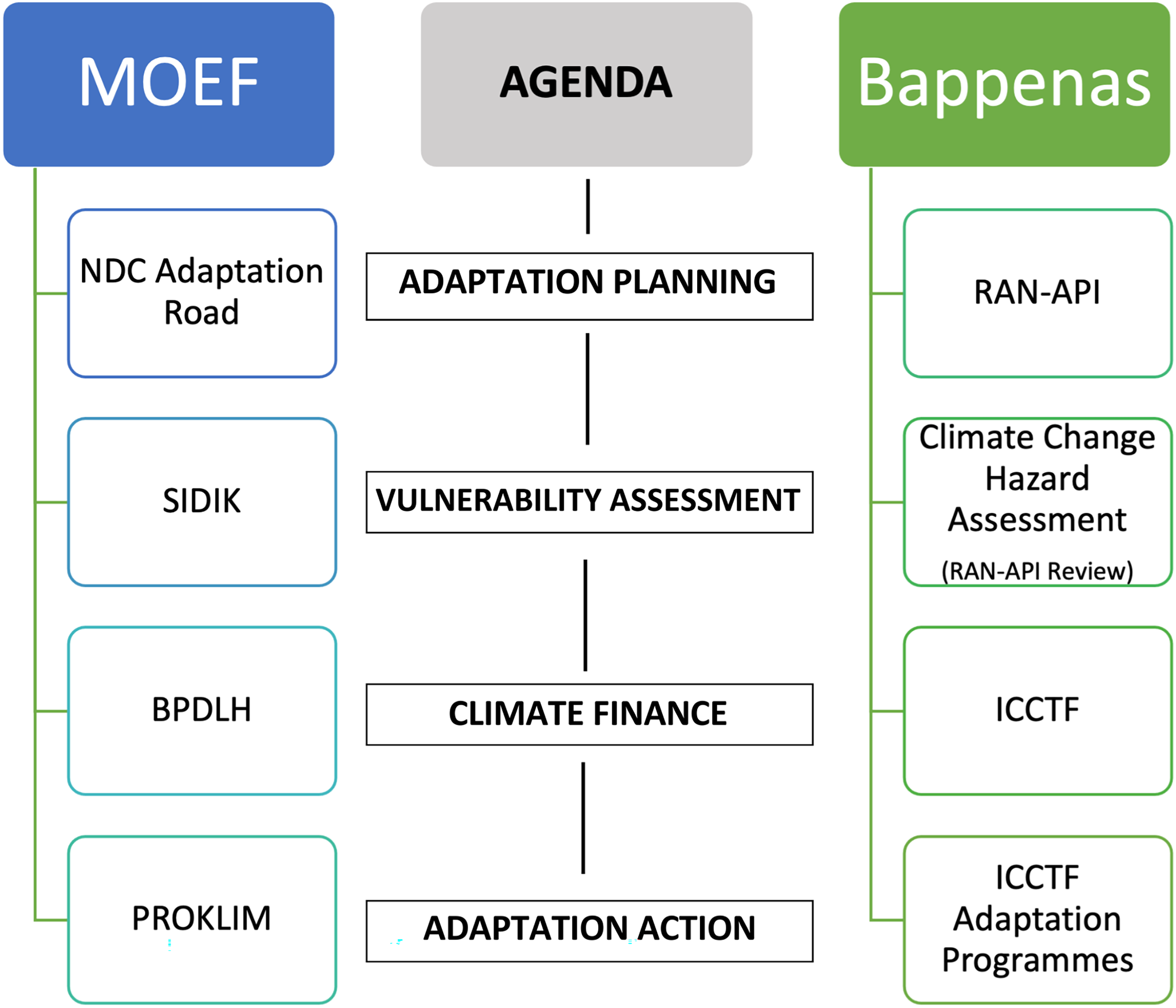
Two Paths of Indonesia's National Adaptation Governance.
In addition to elite interview data, this article has evaluated 20 relevant adaptation policy documents (see Appendix 1) to gain an understanding of national adaptation policies made by BAPPENAS and the MoEF. Several overlapping national policies have been found through the document analysis process. Figure 2 illustrates four adaptation policy discrepancies. First, the national adaptation planning becomes ambiguous, and it is unclear whether it is national or just ministerial adaptation planning. Second, vulnerability assessment remains contentious with two models of assessment. Third, two brokers of climate finance continue to exist under BAPPENAS and the MoEF. Finally, there are no concerted adaptation actions. Concerted actions only exist within a chain of command of each ministry.
Planning
BAPPENAS and the MoEF have the power to lead adaptation governance nationally. They have mandates that enable them to play central roles in adaptation planning. Development planning is undoubtedly the primary mandate of BAPPENAS, and formulating RAN-API becomes one of BAPPENAS’ tasks and functions. As such, BAPPENAS is expected to be the coordinator of national adaptation since the RAN-API is under the agency. It would be less complicated if only one coordinator in adaptation governance existed. However, the MoEF, as a sectoral ministry focusing on the environment and forestry sectors, is also mandated to coordinate climate change adaptation because it is part of the environment and forestry sectors. Under Presidential Regulation No. 16/2015, the MoEF has the mandate to coordinate climate change actions while the DGCC received the mandate as a national focal point for the UNFCCC (President of the Indonesian Republic, 2015). This mandate enables the MoEF to develop an adaptation roadmap. One of the MoEF's tasks and functions is producing an NDC adaptation roadmap document. BAPPENAS and the MoEF have the mandates, tasks, and functions that position them as coordinators with two adaptation planning documents. Moreover, they have resources and a dedicated secretariat or directorate for adaptation. They likely play the same role as the coordinator of adaptation governance. BAPPENAS has the RAN-API secretariat to coordinate the implementation of RAN-API, and so does the MoEF, which has the DGCC to coordinate the implementation of the NDC Adaptation Roadmap. There are substantial data, method, institutional arrangement, and priority location discrepancies between BAPPENAS and the MoEF's adaptation planning documents. The following are some discrepancy examples. BAPPENAS and the MoEF have a different institutional arrangement for adaptation implementation for each priority sector. For example, BAPPENAS only mentions the Ministry of Health with three Directorate General Units, while the MoEF mentions 12 ministries/agencies involved in the health sector. In determining priority locations, the RAN-API and NDC Adaptation Roadmap have different priority locations for adaptation intervention based on different vulnerability assessments. In general, both documents lack coherence. The discrepancies in adaptation planning documents also show reluctance by BAPPENAS and the MoEF to collaborate and align adaptation planning.
Vulnerability
Several contentions can also be found in vulnerability assessment documents published by BAPPENAS and the MoEF. As mentioned earlier, the MoEF has developed the Climate Vulnerability Index Data Information System (SIDIK) for vulnerability assessment and to be used as a tool for the adaptation planning process. The MoEF in the Enhanced NDC document claims that ‘SIDIK helps integrate climate change adaptation into development planning so that it is oriented towards increasing adaptive capacity and resilience and reducing vulnerability’ (The Republic of Indonesia, 2022). Adaptation and development planning thus cannot be separated from BAPPENAS, which has a mandate for national planning. BAPPENAS should be one of the users of SIDIK in formulating adaptation planning. In fact, BAPPENAS does not refer to the vulnerability model built by the MoEF. Instead, it adopted a different method to assess vulnerability in the scientific base study for the RAN-API document review in 2018 (BAPPENAS, 2018). A BAPPENAS official criticised SIDIK for using obsolete data of an insufficient quality to accurately identify vulnerability (Interview 28). This case reveals once again the reluctance of BAPPENAS to utilise a policy outcome from the MoEF.
Finance
Discrepancies also occur in the measurement of loss posed by climate disasters. BAPPENAS and the MoEF utilise different methods to measure loss and damage; hence, different data are presented in the Climate Resilience Development document and the NDC adaptation roadmap. A development agency official involved in adaptation governance also pointed out a discrepancy in calculating loss. The Climate Resilience Development document mentions that Indonesia experienced a potential economic loss of approximately IDR 102.36 trillion (2020), IDR 105.72 trillion (2021), IDR 109.03 trillion (2022), and IDR 112.29 trillion (2023) (BAPPENAS, 2021). Those potential economic losses are 0.66%, 0.62%, 0.56%, and 0.54% of the 2020, 2021, 2022, and 2023 GDP, respectively. The percentage trend of potential economic loss decreased from 2020 to 2023 based on the Climate Resilience Development document published by BAPPENAS. In contrast, the NDC Adaptation Roadmap calculates 0.66% to 3.45% potential loss of GDP, which is higher than BAPPENAS’ calculation (MoEF, 2020). Considering the trend of climate disasters that continuously increase, the calculation of the NDC Adaptation Roadmap seems to be more accurate because it shows the increase in potential economic loss percentage. The differences in calculating potential economic loss can cause confusion in determining priority sectors for adaptation budget allocation. The Climate Resilience Development document identifies that the maritime and coastal sectors suffered the biggest economic loss among other sectors. The NDC Adaptation Roadmap puts health as the main priority sector because it is influenced by the food, water, and energy sectors. The existence of two climate finance institutions is another contestation over climate financing governance between BAPPENAS and the MoEF. Apart from the Indonesian Environment Fund, BAPPENAS established the Indonesia Climate Change Trust Fund (ICCTF) in 2009 to manage and mobilise funds for climate change projects. According to BAPPENAS Ministerial Regulation No. 11/2020, BAPPENAS has a special task as the chair of the ICCTF Board of Trustees (BAPPENAS, 2020b). The ICCTF has disbursed the climate fund for mitigation and adaptation projects since 2014, whereas the Indonesian Environment Fund is a Public Service Agency that can disburse funds to beneficiaries and intermediaries (BPDLH, 2020). Funds can flow back to the Indonesian Environment Fund as revenue. This mechanism is known as a revolving fund mechanism (Mafira et al., 2020) and shows the partition in Indonesian climate finance management. The presence of two institutions that can manage and disburse climate funds sparks a hot debate among adaptation stakeholders. It shows another example of contestation and fragmentation between BAPPENAS and the MoEF in managing climate funds. Both ministries are at the same level but have different tasks and functions as well as authorities. Both ministries can broker international climate funds. The unresolved question is who the leading ministry will be to coordinate the climate fund for better distribution of the adaptation resources. As mentioned earlier, BAPPENAS is not listed as a ministry that initiated the Indonesian Environment Fund. Undoubtedly, the exclusion of BAPPENAS triggers a suspicion that another contestation or rivalry also occurs in climate financing. A BAPPENAS official denied that accusation, claiming that he also contributed to the establishment of the Indonesian Environment Fund by participating in a series of meetings and giving some insights. However, he was against the idea to merge the ICCTF and the Indonesian Environment Fund. He did not see any problems if Indonesia has more than one climate finance agency (Interview 28). This statement shows that merging two agencies is not an option from an official BAPPENAS perspective. The ICCTF and the Indonesian Environment Fund will continue to co-exist. Both funds are symbols of pride for the Ministry of Finance, the MoEF, and BAPPENAS to demonstrate that their ministries have performed well in the climate finance agenda.
Actions
In rendering climate adaptation actions, both ministries have also set different paths. The MoEF manages the Climate Village Programme and BAPPENAS manages the ICCTF adaptation programmes that are also distributed at the village level. The MoEF has local environment agencies, while BAPPENAS has local development planning agencies that spearhead each initiative at the local level in collaboration with donor agencies, companies, and NGOs. The MoEF claims in the NDC documents that the Indonesian government has built a National Registry System to record all mitigation and adaptation initiatives conducted in Indonesia. However, the registration data does not indicate if it reflects adaptation actions by multilevel stakeholders nationally. The National Registry System mainly records the MoEF's adaptation initiatives and excludes most of BAPPENAS’ adaptation programmes. Some of the BAPPENAS-managed programmes under the ICCTF in East Java Province are registered, but those programmes are initiated by the USAID Climate Change Adaptation and Resilience programme (Adaptasi Perubahan Iklim dan Ketangguhan). This case demonstrates the reluctance of BAPPENAS to be involved in the National Registry System programme initiated by the MoEF and the reciprocal reluctance of the MoEF to be involved in adaptation programmes initiated by BAPPENAS through the ICCTF. There are also significant discrepancies in the selection of programme locations. BAPPENAS and the MoEF have different justifications for mapping the most vulnerable locations thus they target different locations for adaptation actions. They do not necessarily need to have the same targeted locations. However, each ministerial planning or roadmap document determines the selection of programme locations. As such, there is no sole guideline to deliver adaptation actions which results in a high risk of overlaps. An illustration of this overlap is the concentration of adaptation actions delivered in the densely populated provinces of Java by both BAPPENAS and the MoEF. BAPPENAS and the MoEF have their own strategic reasons for building separate climate adaptation portfolios. Successful Climate Village Programme outcomes will be associated with the MoEF, while successful Climate Change Trust Fund programmes will be counted towards the annual performance indicators for BAPPENAS. For example, BAPPENAS can use its portfolio and track record to attract more international donors through the Indonesian Climate Change Trust Fund, while the MoEF can use the Climate Village Programme portfolio to enhance Indonesia's credibility at the level of the UNFCCC in the hope of accessing more adaptation funding.
Uncoordinated adaptation policies have confused other policy actors. For instance, a donor agency official was confused about which adaptation planning she should refer to because there were two adaptation planning documents, the RAN-API and the NDC Adaptation Roadmap (Interview 13). In another example, three officials from the Ministry of Energy and Mineral Resources lamented that they were exhausted from fulfilling the documents request from BAPPENAS and the MoEF. It looked like they asked for the same documents but could not understand why the institutions did not coordinate among themselves and share the requested documents. They said that the adaptation governance is inefficient administratively (Interviews 24, 25, and 26).
Moreover, the coordination processes in formulating adaptation policies led by BAPPENAS and the MoEF remained excluding some policy actors. The formulation of adaptation planning is an instance of how the dominance of powerful actors can hinder the effectiveness of polycentric adaptation governance due to asymmetric power relations between policy actors. Some NGO officials revealed that there was a pattern where the ministries had appointed a team to finalise the adaptation policy documents (Interviews 17 and 20). The ministries usually hired academia from public universities in Jakarta, Bogor, or Bandung. BAPPENAS and the MoEF then invited them as though they involved non-governmental actors. In fact, the meetings were socialisation events rather than policy formulation meetings. They provided the ministries with some feedback. However, when the policy documents were finalised, their feedback was not included, and they found that the documents did not change much (Interviews 17 and 20). Coordination becomes a challenge since there is no authority above BAPPENAS and the MoEF that can coordinate the two ministries. The coordinating ministries can be the potential policy actors that have such authority to coordinate them (Interview 15). However, there is no Presidential Regulation that enables any coordinating ministry to coordinate BAPPENAS and the MoEF in adaptation governance.
Collaboration
Cross-sectoral collaboration in implementing adaptation policies between ministries or agencies is still rare to find due to several reasons, such as sectoral ego or silos between ministries, inflexibility in implementing tasks and functions, and mistrust among government institutions. A consultant who previously worked for BAPPENAS mentioned that climate change was a cross-sectoral issue, but ministries usually worked based on their own sector and did not cross to another sector (Interview 12).
This article finds sectoral ego or silo as the main hindrance to effective polycentric adaptation governance in Indonesia based on the elite Interview data. Sectoral ego has led to contestation and fragmentation between BAPPENAS and the MoEF that hinder cross-sectoral collaboration. Sectoral ego was a recurring theme in elite interviews. A contestation theme in elite interviews was often followed by sectoral ego discussion thus highlighting how discussions on both themes became inextricable. ‘Ego sektoral’ or sectoral ego or silo has become a common term used by many Indonesian Government officials, political leaders, scholars, and NGO activists to explain competition and fragmentation between ministries or agencies in Indonesia. President Jokowi, in several speeches, also highlighted sectoral ego as a fundamental obstacle for ministries and agencies to collaborate. For example, during a plenary cabinet meeting in December 2023, President Jokowi highlighted the global economic situation that was not in a good state due to financial and food crises. The President stated, “The key, once again, lies in the collaboration among ministries and agencies. We must avoid sectoral ego” (Widodo, 2022).
Many works of literature that analyse collaboration problems between government institutions also often use sectoral ego to explain competition, lack of coordination, and overlapping policies between ministries or agencies in Indonesia (Afriansyah et al., 2022; Budiman and Smits, 2020; Junita, 2015; Mulyani and Jepson, 2013; Mulyani and Jepson, 2016; Nofyanza et al., 2020; Prasetyo et al., 2023; Susanto et al., 2020). However, studies offering in-depth insight into sectoral ego themes remain underexplored (but see Pangaribuan, 2022). This article offers some important insights to advance the understanding of sectoral ego, drawing from the experience of elite respondents involved in national adaptation governance.
Some literature has offered some definitions to understand the sectoral ego. Mulyani and Jepson (2016: 14) define sectoral ego as a condition “where policy actors put the interest of their ministries.” Nofyanza et al. (2020: 7) also provide a similar explanation and describe the sectoral ego as “a feeling of pride in one's own institution.” It has often led institution staff to prioritise their organisational interests and to reject collaboration if it was perceived to jeopardise the institution's priorities.” Budiman and Smits (2020: 11) focus on cooperation problem and explain institutional or sectoral ego as “the selfish attitude of an institution that avoids cooperation.” Pangaribuan (2022: 1) has included several key ideas mentioned earlier and describes the sectoral ego as a phenomenon where governmental actors prioritise their institutional interests and refuse to cooperate in attaining a common purpose. Pangaribuan (2022) finds a typical narrative the Indonesian governmental elites built to describe sectoral ego. They see that government institutions must build cooperation to reduce sectoral ego. Sectoral ego and cooperation have always been used in tandem in explaining coordination and collaboration problems between government institutions. Overall, those four pieces of literature use several key terms to understand sectoral ego in Indonesia, such as interests, pride, priorities, selfishness, rejecting collaboration, and avoiding cooperation.
Elite respondents also mentioned those key terms during interviews and presented other key terms to advance the understanding of sectoral ego. Three elite respondents from the MoEF, the Ministry of Finance, and the Ministry of Agriculture provided sectoral ego definitions based on their perspectives and experience in adaptation governance. First, the official from the MoEF admitted that the main challenge of adaptation governance was the sectoral ego problem. According to her, sectoral ego referred to a condition where each of the ministries and agencies assumed that adaptation was not their task and function, so they did not have a sense of belonging to the adaptation agenda. They were reluctant to be involved and focused on their respective tasks and functions (Interview 4). Second, the Ministry of Finance official viewed sectoral ego as a situation where each ministry had its respective mandate. They always prioritised their mandate and it sometimes hindered them from supporting other ministries (Interview 29). Third, the Ministry of Agriculture official described sectoral ego as a condition where ministries had no integration because each ministry had its respective realms and should not step on another's foot (Interview 27).
The information from elite participants has provided new perspectives on understanding sectoral ego among ministries and agencies in Indonesia. Sectoral ego is not merely about the pride and interest of each ministry. It is also about how the ministries and agencies are reluctant to get involved in other ministries’ agendas and are very strict on tasks and functions. The inflexibility of tasks and functions hinders cross-sectoral coordination and collaboration among ministries (Interviews 02 and 24). Sometimes ministries are reluctant to collaborate or support other ministries’ programmes because it is not related to their tasks and functions or mandates (Interviews 13, and 20). For example, the Ministry of Agriculture has a climate-smart agriculture programme which can be considered an adaptation action, yet the Ministry of Agriculture implements it independently (Interview 04). The Ministry of Agriculture refers to its ministerial strategic plan to implement climate-smart agriculture rather than referring to the RAN-API or the NDC Adaptation Roadmap policies. A ministry official from the Ministry of Finance pointed out that it was difficult for ministries to work collectively for the same purpose as tackling climate change (Interview 29). Overall, sectoral ego or silo is the main culprit of ineffective adaptation policy implementation led by the two dominant ministries in Indonesia.
Moreover, collaboration is difficult to achieve because the ministries often mistrust other ministries. Trust among policy actors is a key component for effective polycentric governance since it can lead to stronger institutionalised governance with flexible arrangements (Gallemore et al., 2015). When mistrust still exists among ministries, collaboration will be difficult to achieve. This collaboration enables polycentric institutions to establish norms of reciprocity and trust (Hamilton and Lubell, 2019). A BAPPENAS official mistrusted the vulnerability assessment conducted by the MoEF and the MoEF mistrusted the adaptation planning formulated by BAPPENAS are the examples (Interviews 04 and 28). According to an official from the MoEF the 2014 RAN API published by BAPPENAS had not followed the guidance from the IPCC (Interview 04).
Policy Learning
Policy learning through exchanging scientific or technical information among multilevel policy actors helps to reduce uncertainties of prospective adaptation action outcomes (Hamilton and Lubell, 2019). However, policy learning processes did not happen between ministries. The previous discussion of adaptation planning discrepancy has provided an example of how BAPPENAS and the MoEF have different priority sectors for adaptation. Coordination section has given an example of how BAPPENAS and the MoEF have two different methods of assessing vulnerability to climate change hence there exists two different vulnerability mapping with different priority locations. Which regions or communities are vulnerable remains unclear. It becomes a serious problem because we do not accurately know where adaptation resources should be distributed and this can lead to inaccuracies in adaptation resources distribution and widening the adaptation gap between regions. The policy learning process between government institutions and non-governmental institutions also rarely occurred in adaptation governance. For instance, I interviewed three elite participants who received adaptation project grants from the ICCTF established by BAPPENAS and none of them referred to the RAN-API documents nor its vulnerability assessment to determine project locations at the local level (Interviews 05, 08, and 16).
Resource Distribution
To have effective adaptation outcomes, the decisions of polycentric institutions must hinge upon procedural fairness or consider the distribution of costs and benefits of adaptation policies (Hamilton and Lubell, 2019). A well-tailored set of institutional arrangements is needed to enable collective resource distribution (Andersson and Elinor, 2008). However, a set of institutional arrangements for a collective adaptation resource distribution is still absent from the polycentric adaptation governance in Indonesia. The decisions of adaptation project distribution by BAPPENAS and the MoEF remain taken place in each institution independently. Indonesia used to have the National Council on Climate Change to coordinate climate actions in Indonesia under direct supervision of President Susilo Bambang Yudhoyono. However, the merger of National Climate Change Council weakens institutional arrangements to distribute adaptation resource collectively.
BAPPENAS and the MoEF usually receive funding from the state budget and international donor agencies. The establishment of ICCTF enables BAPPENAS to get funding from international donor agencies such as USAID, the UKCCU, Danida, the World Bank, and the Asian Development Bank (ICCTF, 2021). Since the ICCTF is under the BAPPENAS coordination, BAPPENAS has flexibility in making decisions about the resource distribution for adaptation projects. The MoEF as the Indonesia's national focal point can also access international funding, such as from the Global Environment Facility, UNDP, the Australian Aid, the Asian Development Bank, and GIZ (DGCC, 2019). The MoEF usually distributes the funding through the Directorate of Climate Change Adaptation. There are no clear institutional arrangements for distributing those adaptation funding collectively. Indonesia has several coordinating ministries that can play a role to coordinate actors in distributing resources, yet BAPPENAS and the MoEF are not coordinated under the same coordinating ministry. Under Presidential Regulation No. 67/2019 on Indonesia Maju Cabinet, the MoEF is under the Coordinating Ministry of Maritime and Investment Affairs coordination, while BAPPENAS is not under the coordination of any coordinating ministry. According to Presidential Regulation No. 81/2021, BAPPENAS is directly responsible to the President.
The absence of strong institutional arrangements in distributing adaptation resources has resulted in overlapping distribution. This article has found a pattern where many adaptation programmes designed based on the ministries’ adaptation planning and roadmap are distributed on Java Island, the most developed island in Indonesia. Provinces on Java Island are more developed than provinces outside this island (Kurniawan et al., 2019). Although Java Island only covers 7% of Indonesia's land area, its provinces contributed 58.89% of the national GDP in 2019 (Soseco et al., 2023). Based on the ICCTF website, there were a total of 17 adaptation projects distributed nationally and seven of them were distributed in Java Island as of March 2024 (ICCTF, 2024). A similar pattern occurs in the National Registry System developed by the MoEF. The MoEF has gathered adaptation programmes distributed nationwide in the National Registry System. From a total of 35 adaptation programmes distributed nationally until June 2023, only 17 were distributed outside of Java Island while 18 programmes were in Java Island (DGCC, 2024).
Leadership
Sovacool (2011) and Gillard et al. (2017) have a similar argument in viewing the important role of governments in adaptation governance. The central governments can lead the collaboration between private and civic sectors (Gillard et al., 2017) and they can intervene to provide a supportive political environment for policy actors to form collective actions (Sovacool, 2011). The findings in Findings section show that there is no clear leadership by the central government. BAPPENAS has the RAN-API secretariat to coordinate the implementation of RAN-API while the MoEF has the DGCC to coordinate the implementation of NDC. BAPPENAS and the MoEF are ministries at the same level hence BAPPENAS cannot control the MoEF and vice versa. The MoEF, as the national focal point of the UNFCCC, cannot play the leadership role because the mandate is given to the DGCC. A mandate transferred to the DGCC, which operates at the directorate level, to coordinate overall climate change coordination can offend other ministries’ pride. Some elite respondents questioned the mandate given to an institution at the directorate level to coordinate institutions at the ministerial level, which is way above the directorate level (Interviews 02, 12, and 13).
The leadership role of President Jokowi in coordinating national climate actions is not as strong as President Yudhoyono's with the National Council on Climate Change. The institutional arrangements for coordinating national climate actions were stronger during the President Yudhoyono administration because the president had a clear position as the head of the National Council on Climate Change under Presidential Regulation No. 46/2008. President Yudhoyono was aided by the Coordinating Minister of People's Welfare and the Coordinating Economic Minister to play his role. The leadership role of President Jokowi in leading climate governance faded away when President Jokowi decided to merge the National Council on Climate Change under the MoEF to become the DGCC for an efficiency purpose. When there is no robust leadership by the central government, polycentric adaptation governance in Indonesia seems to be chaotic or forms a fragmented polycentric system, which has highly autonomous decision-making centres but lacks the connection among policy actors (Fortnam et al., 2022).
However, this article does not suggest the establishment of a directed polycentric system as the final or ideal form of polycentric adaptation governance in Indonesia. Directed polycentricity, the inverse of fragmented polycentricity, is a form of a polycentric system where autonomous decision-making centres are highly connected through a hierarchical structure (Fortnam et al., 2022). This article argues that strong leadership and intervention by the central government are needed to facilitate collaboration and collective actions between policy actors. The leadership by the central government can help to reduce the chaotic level of the polycentric system in adaptation governance at the level where collaborations and collective actions are attainable.
This article suggests that the central government conducts some coordinated interventions to provide a supportive political environment that enables policy actors to establish cross-level and cross-sectoral collaborations. However, the leadership should avoid homogenising tendencies of centralised regulations (Sovacool, 2011). The central government can increase adaptation funding to encourage collaborative projects. The allocation of adaptation funding is still minimal compared to mitigation funding. For instance, the MoEF allocated IDR 4.52 trillion (around USD 277 million) for mitigation and only IDR 1.2 trillion (around USD 73 million) for adaptation funding from 2018 to 2020 (Fiscal Policy Agency, 2019). When the number of cross-level and cross-sectoral collaborations in adaptation projects has increased significantly, the central government can reduce its interventions gradually.
Dispersion of Power
The dispersion of power is needed to prevent one or a few policy actors from dominating adaptation governance (Morrison et al., 2017). This article finds that BAPPENAS and the MoEF are two dominant powers that shape the adaptation governance structure in Indonesia and that is not an ideal dispersion of power. Both ministries have the power to make adaptation planning and distribute adaptation resources through adaptation projects. BAPPENAS and the MoEF have attempted to transfer some degree of power in making adaptation planning and assessing vulnerability levels to local actors such as the Development Planning Agencies, the Environment Agencies at the province level, and city governments. However, there are only a few provinces or cities that have the Regional Action Plan for Climate Change Adaptation. The data from the MoEF (2024) as of April 2024 shows that from 38 provinces in Indonesia, only seven provinces have adaptation planning and vulnerability assessment documents.
There is a pattern where most of the provinces or cities that have the regional action plan and vulnerability assessment documents were supported by donor agencies. For instance, the West Nusa Tenggara Province government was supported by the Deutsche Gesellschaft für Technische Zusammenarbeit (GTZ), the East Java Province government was supported by the UNDP, Rockefeller Foundation, and USAID, and the South Sulawesi Province government was supported by USAID (MoEF, 2024). The performance of local actors still depends on the assistance of donor agencies.
How to Make Polycentric Work in Indonesia
From the previous discussion, it is evident that adaptation governance in Indonesia continues to face problems in coordination, collaboration, policy learning, resource distribution, leadership, and dispersion of power thus leading to ineffective polycentric adaptation governance. The Indonesian government needs to do its homework to realise those six enabling conditions to achieve a more effective adaptation policy implementation. This article suggests that BAPPENAS and the MoEF are placed under the same coordinating ministry to break the contestation and fragmentation between these two dominant ministries concerning adaptation governance. Another alternative is placing BAPPENAS and the MoEF under the President's coordination directly aided by the Ministry of State Secretariat since an authority above the ministerial level is needed to harmonise the adaptation policies of BAPPENAS and the MoEF (Interview 27). The policy to merge the National Council on Climate Change under the MoEF by President Jokowi for the sake of efficiency has instead resulted in inefficient adaptation governance.
Strong leadership by the central government can help to tackle coordination, collaboration, and policy learning challenges. Adaptation resource distribution led by the central government should meet procedural fairness by distributing them based on robust vulnerability assessments by combining assessments conducted by BAPPENAS and the MoEF. It is crucial to improve the accuracy of resource distribution so that the resources or adaptation projects are not concentrated solely in Java. The transfer of power to local actors faces challenges due to the dependency on donor agencies’ assistance. Donor agencies are more active actors than the central government which is tasked to assist local governments to improve their capacity to become decision-making centres of adaptation at the local level. However, that is not enough considering the limitation of climate funding and human resources of donor agencies operated in Indonesia. The central government should be more active in transferring power to local actors by involving more local actors in decision-making processes at the national level and encouraging local actors to initiate regional adaptation planning, vulnerability assessments, and adaptation actions at the city or regency level.
Conclusion
This article seeks to explore the implementation of climate adaptation policies within the polycentric governance structure in Indonesia. The analysis of this article is based on the main question: Why is the implementation of climate change adaptation policies within the polycentric governance system in Indonesia ineffective? Having more than one governance centre does not always hamper the planning and implementation of adaptation programmes. The polycentric structure is not always detrimental to adaptation actions. It might be a more efficient model if each centre renders specific tasks that complement each other. However, this is not the case in Indonesia. The contestation and fragmentation between BAPPENAS and the MoEF due to sectoral ego or silo have beset the polycentric governance system in adaptation. BAPPENAS and the MoEF have become two dominant centres in adaptation governance that have set the country on two paths of adaptation governance. The discrepancies between BAPPENAS’ and MoEF's adaptation policies are apparent in four adaptation agendas: adaptation planning, financing, vulnerability assessment, and actions due to sectoral ego or silo. Two dominant decision-making centres that are independent of the other at the national level have hampered cross-level and cross-sectoral coordination.
This article has outlined six enabling conditions that can make the polycentric governance system work effectively: coordination, collaboration, policy learning, leadership, resource distribution, and dispersion of power. However, Indonesia is still facing problems in fulfilling those six conditions for a more effective adaptation policy implementation. With the absence of the six enabling conditions and a fragmented polycentric structure, collective adaptation actions are difficult to attain. As such, the polycentric system of adaptation governance in Indonesia hinders the effectiveness of adaptation policy implementation. This article suggests that the Indonesian government can establish a robust institutional arrangement in adaptation governance by appointing one coordinating ministry to facilitate coordination between BAPPENAS, the MoEF, and other sectoral ministries and agencies such as the Ministry of Agriculture and the National Disaster Management Agency in formulating and implementing adaptation policies. Another alternative is for the coordination of climate actions to be under the coordination of the President, similar to that during the era of President Yudhoyono's administration. This will demonstrate that Indonesia has strong leadership and commitment to tackle the climate emergency.
Footnotes
Acknowledgements
This article got benefit from comments and feedback from Dr Adam Tyson, Dr Hugh Dyer, and Dr Simon Manda who were the supervisors of the author during his doctoral study in the School of Politics of International Studies, University of Leeds.
Declaration of Conflicting Interests
The author declared no potential conflicts of interest with respect to the research, authorship, and/or publication of this article.
Funding
The author received financial support for the research from the Indonesia Endowment Funds for Education (LPDP).

Notes
Author Biography
Appendix
Elite Interview Respondents.
| No. | Position, location, date |
|---|---|
| 01 | Executive Director, WALHI; online interview; 9 July 2020 |
| 02 | Chairman, Lembaga Penanggulangan Bencana dan Perubahan Iklim Nahdlatul Ulama; online interview; 10 July 2020 |
| 03 | Program Director, World Resource Institute; online interview; 10 August 2020 |
| 04 | Director, the Ministry of Environment and Forestry; online interview; 6 November 2020 |
| 05 | Communication and Stakeholder Relations, Yayasan Rumah Energi; online interview; 15 December 2020 |
| 06 | Researcher, Bogor Agricultural University; online interview; 30 July 2020 |
| 07 | Professor of Meteorology and Climatology, the Agency for Assessment and Application of Technology (BPPT) Indonesia; online interview; 19 January 2021 |
| 08 | Researcher, Universitas Indonesia; online interview; 23 January 2021 |
| 09 | Researcher, Institut Teknologi Bandung; online interview; 26 January 2021 |
| 10 | Program Officer, Partnership for Governance Reform; 20 January 2021 |
| 11 | Program Manager, Mercy Crops; online interview; 1 February 2021 |
| 12 | Project Coordinator, Climate Resilient and Inclusive City UCLG ASPAC; online interview; 9 February 2021 |
| 13 | Advisor, GIZ (German Development Agency); online interview; 1 March 2021 |
| 14 | Program Director, Partnership for Governance Reform; 2 March 2021 |
| 15 | Researcher, Bogor Agricultural University; online interview; 26 March 2021 |
| 16 | Community Organiser, YAKKUM Emergency Unit; online interview; 9 April 2021 |
| 17 | Country Manager, ICLEI (Local Governments for Sustainability); online interview; 12 April 2021 |
| 18 | Environment Specialist, USAID; online interview; 12 April 2021 |
| 19 | Program Officer, Partnership for Governance Reform; 15 April 2021 |
| 20 | Campaign Manager, WALHI; online interview; 16 April 2021 |
| 21 | Researcher, Universitas Indonesia; online interview; 21 April 2021 |
| 22 | Consultant, DAI; online interview; 22 April 2021 |
| 23 | Director, the Ministry of Foreign Affairs; online interview; 11 May 2021 |
| 24 | Analyst of Energy Conservation, the Ministry of Energy and Mineral Resources; 7 June 2021 |
| 25 | Analyst of Bioenergy Cooperation and Investment, the Ministry of Energy and Mineral Resources; online interview; 7 June 2021 |
| 26 | Head of Division, the Ministry of Energy and Mineral Resources; online interview; 7 June 2021 |
| 27 | Senior Researcher, Indonesian Agency for Agricultural Research and Development; online interview; 30 June 2021 |
| 28 | Director, BAPPENAS; online interview; 5 July 2021 |
| 29 | Analyst, the Ministry of Finance; online interview; 23 July 2021 |
| 30 | Researcher, Fiscal Policy Agency; online interview; 23 July 2021 |