




Abstract
This article examines royal governance under King Maha Vajiralongkorn (Rama X) for the light it sheds on Thailand's recent political development. It is argued that the existence of “fear” defines Vajiralongkorn's relationship with the people. For members of the ruling class, fear keeps them in check. Within the palace, promotion and demotion are vital for control. The Royal Gazette (Rachakitjanubeksa) has become a platform for public humiliation that operates to inculcate fear. For the public, fear proliferates through a variety of means, including employing laws to punish critics of the monarchy, particularly the exploitation of lèse-majesté law, with the state's keen cooperation. But the 2020 protests, which demanded immediate monarchical reform, seriously challenged Vajiralongkorn's fear-based royal governance. The Thai case demonstrates that fear, a centuries-old form of governance used by many rulers to control their subjects, is no longer an effective tool of governance in modern, middle-class-driven, capitalist societies, like Thailand. Fear has a tendency to backfire on a sovereign if overused.
Crown Prince Vajiralongkorn ascended the Chakri throne in October 2016, following the passing of his father, King Bhumibol Adulyadej (Rama IX). The death of Bhumibol ended a seven-decade reign that had successfully situated the monarchy at the apex of Thai politics. Now king of Thailand, Vajiralongkorn is known for his fluctuating temperament. His enthronement was already challenged by his own lack of prerequisite legitimacy. Long before the royal succession, Vajiralongkorn had made a name for himself as a self-indulgent prince with an eccentric lifestyle. In his childhood, he was known to have engaged in bullying and revenge, as reported by his schoolmate at an English boarding school (Christiansen, 2019). The erratic behavior of Vajiralongkorn has sustained a long-drawn-out crisis over the royal succession (Hewison, 2020: 118). Five years into the new reign, the impact of the royal succession has intensified, primarily as a result of the new “royal governance” of Vajiralongkorn. In defining his royal governance, “fear” essentially serves as an instrument for maintaining political and social order. This article examines fear, a political device that governs the relationship between King Vajiralongkorn and the people.
Prior to the royal succession, a climate of fear began to dominate the political landscape, at first within the inner circles of the royal court. This so-called “house-cleaning” was a consequence of both the power consolidation and the emerging royal governance based on fear. Members of his family, his subordinates, and especially his enemies were dealt with in different ways through different degrees of punishment. They were humiliated for their supposed violation of his trust and loyalty. Some died in prison under suspicious circumstances. While there is no proof of the palace's direct involvement in the deaths nevertheless, this was to proliferate fear among the courtiers, government officials, critics of the monarchy, and dissidents living across the Thai border.
Through the use of fear, Vajiralongkorn has disturbed the constitutional threshold by acting above the law. This article introduces numerous cases of those affected by Vajiralongkorn's fear-based royal governance. His third wife, Srirasmi Suwadee was reportedly placed under house arrest following her divorce from Vajiralongkorn. 1 Her parents and cousin—General Police Pongpat Chayapan—were also prosecuted on dubious charges. 2 Vajiralongkorn dismissed Distorn Vajarodaya, the Grand Chamberlain, accusing him of committing “severely immoral acts.” As a result, Distorn faced disciplinary punishment. 3 Three of his subordinates—Suriyan Sucharitpolwong (better known as Moh Yong), Police Major Prakrom Warunprapha, and Major General Phisitsak Seniwongse na Ayutthaya, were found guilty of embezzling the royal project's funds. All died mysteriously while under detention, sparking rumors that their demise could have been premeditated. The circumstances surrounding the mysterious death of these men added to the new king's notoriety and effectively proliferated fear. Police General Jumpol Manmai, a senior figure in Vajiralongkorn's household, was fired for “extremely evil” misconduct, which threatened national security. 4 He emerged from the court having his head shaved. Indeed, most of these convicts were forced to have their heads shaved, a symbol of humiliation. In the subsequent sections, these cases will be elaborated in greater details.
Albeit at odds with the existing laws, the king's judgment has been treated as the final verdict. Accordingly, it prevented the affected individuals from appealing their cases. They were humiliated in the media. But aside from the public humiliation, the process of punishment has been murky. Little information has been provided about what happened to them during the punishment as well as in the post-punishment phase. They could just simply disappear from the public eyes. Nobody knew if they were reinstated into the position they were dismissed, only if the king allowed such information to be released. No media is interested in their post-punishment phase. Victims themselves did not dare to speak out or challenge the royal verdict, either during the punishment or after they served the terms of punishment. The entire process is meant to inculcate fear among those working under Vajiralongkorn. It also highlights the characteristic of fear that derived from the arbitrary power of the king.
This study explores the nature and purpose of fear, its functionality, and its ramification on politics and society in Thailand. As a political and social construct, fear is used as a parameter measuring the level of power of Vajiralongkorn—the more fear grips people, the more entrenched royal power becomes. The more absolute the royal power is, the more powerful fear becomes. In turn, if fear fails to dictate behavior in society, it then exposes the weakness of royal power. There is a dialectical tension between fear and power under Vajiralongkorn. As the article will show, Vajiralongkorn's fear is inclusive and demands the total submission of those it touches. The fear used by Vajiralongkorn is comparable to the various types of fear used in authoritarian and democratic societies as a tool of political control. The Great Terror under the regime of Joseph Stalin employed a tactic of manipulating fear to eliminate potential opposition. Stalin proceeded to purge the party rank and file and to terrorize the entire country with widespread arrests and executions. Millions of Soviet citizens were sent off to labor camps and killed in prison (Harris, 2016: 4). In a very different setting, Corey Robin argues that the U.S. government has manipulated the fear of terrorism to create or consolidate repressive forms of power in the aftermath of the events of 9/11 in the United States (Robin, 2004: 23). The U.S. government treated an external enemy as a proxy, using fear to legitimize its repressive policy toward the people. In the Thai case, Vajiralongkorn has resorted to a primitive and backward means of governance that had been used by most rulers in slave-based and feudal societies. He constituted “the kingdom of fear” in which the people submit to royal prerogatives while accepting limits to their freedom in exchange for security. Vajiralongkorn has employed this type of fear to keep the elites around him in line and the public subservient.
Despite exploiting global terrorism, the U.S. discourse of fear finally lost its effectiveness. David Altheide argues that the capacity of human beings to adjust, normalize horrendous conditions, and eventually resist social control is the ultimate challenge to politicians of fear: the longer fear is promoted, the less effective it is (Altheide, 2017: 233). Altheide's argument can be used to explain the situation in which the Thai protesters in 2020 openly contested Vajiralongkorn's fear-based mode of royal governance. They opposed his overwhelmingly unchecked royal prerogatives accumulated through his interventions in politics and in the legislative process, from imposing constitutional amendments in order to increase his power (Mérieau, 2021) to the transfer of assets of the Crown Property Bureau under his sole possession. The protesters demanded immediate monarchical reform, to ultimately subject the monarchy to constitutional constraints. This demand raises a pertinent question: Will fear still remain an effective tool of governance in modern, middle-class-driven, capitalist societies, like Thailand, today?
In conceptualizing the analysis in these terms, this article argues that fear, a centuries-old form of governance that many rulers used for controlling their subjects, is not an effective tool of governance in contemporary polities. Fear has a tendency to backfire on a sovereign when he uses it extensively, to the point that his subjects could not tolerate, and in the end, they will revolt against him. Previously an inviolable institution, the monarchy is currently subject to widespread criticism, a form of deviance to fear. The article identifies the factors at play. Once fear is overcome, there is a possibility that the table will be turned; it is the sovereign himself who has to fear the uprising of the masses of the people. What has been recently unfolded in Thailand, in the view of the article, fits this explanation.
Fear and Power
Everybody in a lifetime may experience their own form of fear for a variety of reasons, real or imagined. The permeation of fear is therefore treated as a normal state of mind. Owing to this seeming simplification, fear is often taken at face value. In the political realm, however, fear is a potent mechanism in order to control a populace. It can be manipulated for the benefit of political leaders. It holds the people hostage, entrapping them in a profound sense of insecurity. Attempts to comprehend the role of fear have a long history. The Renaissance political theorist, Niccolò Machiavelli, discussed fear as an essential element in the art of government. In The Prince (1532), Machiavelli promoted fear as a tool to be instrumentalized in order for an autocratic ruler to control a fickle populace. In The Discourses on the First Ten Books of Titus Livius, Machiavelli also portrayed fear as a device for uniting the state in the face of foreign invasion or attack (Machiavelli, 2003: 360). The importance of this reference to Machiavelli is to highlight the longevity of fear as an important option for governance. In modern times, scholars like Corey Robin have revived the concept of political fear as a mode of governance. As mentioned above, Robin explained the U.S. strategy vis-à-vis global terrorism through the exploitation of fear at the level of the state. Fear of terrorism was manipulated to emphasize the possibility of harm, which, to be avoided required public submission to repressive policies. Terrorism aside, Islamophobia, racism, sexism, homophobia, and xenophobia are predominantly based on fear, and the ruling elites in many democratic countries, especially the United States, use this feeling of fear to connect themselves with the masses of voters and maintain their status within the structures of the state.
The concept of fear has long been an important subject in studies of Thailand. Pitch Pongsawat, for example, explains fear as being at the foundation of the Thai state. Because people are in fear, the nation-state has been established to provide them with security, assuaging the fear of foreign enemies. On the flip side, fear is exploited as a device for power holders to manufacture insecurity for the control of the public (Pongsawat, 2016). Nidhi Eawseewong recognizes the power of fear—at the very least, fear of being rejected by society for thinking unconventionally. Fear hence demands conformity. 5 In his study on Thai ideas of power, Claudio Sopranzetti elaborates on the dichotomy of moral authority versus amoral power (Sopranzetti, 2020). 6 The former, referred to as barami, is a form of power that resides in righteous and moral people and results from the “karmic merit” accumulated in previous lives. The latter, referred to as amnat, is a form of authority that stems from the position held within a formal structure, rather than an intrinsic characteristic of its holders. Amnat can also be translated as “power,” but it is raw amoral power that can be used for either good or evil. The barami versus amnat concept can also be interpreted alongside the dichotomy of phra khun (righteous power) versus phra det (sheer raw and physical power). Phra det can be used to spread fear as a form of control. This is because phra det is not meant to be challenged and can override existing laws. Factoring in these two ideas of power in Thai political culture provides a useful framework for assessing Vajiralongkorn's fear-based royal governance. While they may seem contradictory, to govern Thailand successfully, rulers must be able to master them both to sustain their legitimacy, thus, guaranteeing their longevity (Sopranzetti, 2020: 62–63). For a ruler, deploying phra khun and phra det must be undertaken in a balanced way. For fear to have a meaningful impact, it has to be exerted together with the moral authority of the rulers. Fear loses its power when phra det is overused at the expense of phra khun.
Fear is a crucial element in Thai political culture, also serves as a factor in shaping a hierarchical relationship among members in society. Influential people (phu mee ittiphon), godfathers (chao pho), and gangsters (nakleng) have their characters depicted within the deep dichotomy of the benevolent and fearful. Sometimes, Sia, the popular depiction of a rich businessman of Chinese origins, is also included in this category. In this regard, it is worth pointing out that Vajiralongkorn has a somewhat derogatory nickname among Thais, namely Sai-O, with “O” deriving from Osarathirat, or Crown Prince.
The instrumentalization of fear by political actors can be found in every unit of society, from the small district in a remote village to national politics and, ultimately, up to the premiership. Fear is used to demand compliance from those considered inferior who would be punished should they challenge the annat, power or authority of their superiors. Meanwhile, rewards are offered if the inferiors show their loyalty to these same “superiors.” Fear and benevolence are the opposite sides of the same coin. Although these same actors may have an intimidating approach, they sometimes express their benevolent side (Samudavanija, 2002: 79). For example, the phu mee ittiphon frequently donates money for religious events and provides scholarships for poor students. These charitable works go in tandem with their shady businesses, presenting a contradictory character that both intimidate others and attracts them at the same time (Nishizaki, 2011: 57).
The above discussion of fear and benevolence supports my argument of the need to contrast phra khun versus phra det, and sheds light on Vajiralongkorn's mode of royal governance. It also helps in explaining the shortcomings of this method of using fear as a tool of governance. Indeed, the case of Vajiralongkorn reveals that Machiavelli's notion of fear as an instrument of power appears dated in Thailand where an articulate part of the population is calling for new forms of governance based on consent, legitimacy, popularity, and accountability.
Instilling Fear Through Royal Power
In structuring fear under Vajiralongkorn, this study suggests a two-fold modality: fear in controlling the ruling class and fear of mass control. The effectiveness of using fear as a modus operandi requires the cooperation of state agencies.
Fear in Controlling the Ruling Class
Fear functions to keep the ruling elites under check. The ruling elite, in this present study, consists of court officials, the military, the police, the judiciary, other civil servants, and monks. The immediate members of Vajiralongkorn's own family are also included. Promotion and demotion serve as a vital means to reward or, on the contrary, to castigate members of the ruling elite, by giving favor or instilling fear. Imprisonment is the ultimate sanction, whereas death, in some cases, is a form of collateral damage (such as dying during imprisonment). Vajiralongkorn has used fear to govern those working under him and to demand their unconditional loyalty as well as rigid conformity in their behavior and even their uniforms. The Royal Gazette serves as a platform to inculcate fear. Since the enthronement of Vajiralongkorn, 86 individuals have been demoted or dismissed from their position. Additionally, 117 commissioned officers who previously served as security guards were dismissed from their position for unknown reasons. 7 I compiled the complete list, as appeared on the 112WATCH webpage 8 , based on Royal Gazette announcements dated from 3 August 2016 to 31 August 2020, detailing the causes of dismissal, demotion, de-decoration, de-robing, and imprisonment of each individual. 9 It is noticeable that cases of dismissal and demotion mostly occurred during the time the king was absent from Thailand. There have been no new cases of dismissal and demotion from September 2020 onwards, following Vajiralongkorn’s return to Thailand from Germany for what appears to be a long-term visit. This would suggest that the use of dismissals and demotion was a strategy to keep order among the elites while the king resided overseas.
The Thai historian, Somsak Jeamtheerasakul has argued that Vajiralongkorn has managed those close to him by promoting them, including his wives, and when infuriated, demoting them in a humiliating way. 10 The reward and punishment system, through favor and fear, has characterized the royal governance in which obedience, loyalty, and respect for the king are of the utmost importance. But the reward and punishment system is arbitrary and at times overrides existing laws, revealing a preeminence of the phra det (raw physical power) of Vajiralongkorn. Arbitrariness generates fear. To further infuse fear, Vajiralongkorn has inculcated a kind of “martial morality” as a device for imposing order. His martial morality is encapsulated in certain qualities: from respect, trust, loyalty, endurance, willpower, and patience to courage. From this perspective, Vajiralongkorn is able to portray himself as a highly disciplined military king whose moral high ground is to be praised when he hands down punishments to violators of this martial morality. Perceived by many of his subjects as immoral himself, Vajiralongkorn proclaims his legitimacy by penalizing those committing similar kinds of immoral acts for which he is notorious. For example, Vajiralongkorn punished military men for committing adultery despite the fact that his reputation as an adulterer is well known. Vajiralongkorn's discourse of “martial morality” is reminiscent of that during the reign of King Vajiravudh (Rama VI), at the beginning of the twentieth century, which was built upon devotion, loyalty, and morality as part of royal governance (Vella, 1978: 260). For Vajiralongkorn, promoting martial morality could be seen as a way of promoting fear, because in this context, members of the ruling class are unable to prove their innocence because of the top-down nature of the moral precepts being enforced. Martial morality hence bypasses laws. This raises the serious question of whether the directives from Vajiralongkorn are indeed legal (Streckfuss, 2019). However, conveniently for him, the lack of legal underpinning is a contributory factor in a climate of fear.
The martial morality is accompanied by a specific kind of language used to condemn and humiliate wrongdoers. In this cyber age, the online Royal Gazette serves as a platform for humiliation and condemnation. The lexicon used includes terms, such as “Extremely evil conduct” [Prapreut Chua Yangrairang], “Ungracious to royal kindness” [Rai Samnuek Nai Phramaha Karuna Thikun], “Rebellious” [Kradang Kraduang], “Ungrateful” [Kadkhwaam Katanyu], “Destabilizing the monarch” [Bontamrai Sathaban], “Lazy” [Kiatkran], and “Lack of devotion” [Kadkhwam Toomthay]. They all have been carefully selected to denounce a breaking of trust with the king. Mainstream media, such as television or social media, regularly report dismissal/demotion cases to the public, adding a further layer to the humiliation. The actual punishments in themselves and the public humiliation are packaged in a way as to engender fear. It is noteworthy that there have been no clear rules of what triggered punishment. The fact that everyone could be punished, at any time, even among the closest people to the king, greatly engenders fear. Martial morality is also promoted by enforcing strictly militaristic manners among court officials, the military, the police, and even some politicians. These manners range from imposing a cropped haircut for men and a short hairstyle for women, tight and crisp uniforms, and a specific militaristic ritual of Yok Ok Eub, literally “lifting your chest up.” This posture was initiated by Vajiralongkorn as part of “upgrading the standard of military exercise.” Ultimately for him, the “development of physical strength” demonstrates both “the prestige of the military” and also a “love for the nation, religion and the monarchy”. 11 The restrictions on haircuts and uniforms could be seen as a form of bodily domination, a fear that even officials are not outside the boundaries of monarchical control.
An examination of the preceding cases of humiliation bolsters the argument that Vajiralongkorn cultivates fear to control the ruling elite. In December 2014, he divorced his third wife Srirasmi. She was stripped of her royal name and title after allegations of corruption against seven of her relatives. Images of her, with her head shaved and dressed like a nun, emerged in a German tabloid deepening a rumor of her being placed under house arrest. 12 Her parents were arrested for lèse-majesté for misusing their royal connection. Nobody knew the exact reason why Srirasmi was punished. Her uncle, Pongpat Chayapan, a former Central Investigation Bureau chief, was also arrested on lèse-majesté for abusing Vajiralongkorn's name in engaging in malfeasance and for gambling activities, and sentenced to 12 years in prison. He was stripped of his rank and decorations. 13 In 2015, three of his former subordinates—Major General Phisitsak, Police Major Prakrom, and Suriyan Sucharitpolwong—were arrested. All died in prison mysteriously. The three were involved in the Vajiralongkorn-led campaign of “Bike for Mom,” to celebrate his mother, Queen Sirikit. All were charged with lèse-majesté for falsely claiming ties to Vajiralongkorn for personal benefit. According to the Thai authorities, both Phisitsak and Prakrom committed suicide in prison by hanging while Suriyan died of a blood infection. It remains moot if the statements by the authorities were true and if they were covering up for murder or other foul play (Haberkorn, 2020: 312). The arrest of these men was conducted almost in secrecy, via closed martial court proceedings. When they appeared in public, their hands were bound and their heads shaved—the same form of public humiliation. The circumstances around their deaths were peculiar as no autopsy reports were disclosed and their funerals were arranged in haste.
In 2016, Vajiralongkorn sent Distorn Vajarodaya, deputy secretary-general of the Royal Household Bureau, to a re-education camp at the Dhaveevatthana Palace for military training. Vajarodaya, one of the most trusted assistants of the late King Bhumibol, was accused of disparaging the reputation of the monarchy. A year later, he was removed from his position, stripped of all royal decorations, and imprisoned. Various forms of punishments were made public via the Royal Gazette in which Disthorn was condemned for doing “extremely evil things.” These ranged from embezzlement to adultery, immoral acts that violated the trust of the monarchy and damaged its reputation. 14 The photos of him and his cousin, dressed in a military uniform with their hair closely cropped, practicing militaristic postures, were released on social media. 15 In 2017, Police General Jumpol Manmai, a former intelligence chief and Grand Chamberlain in Vajiralongkorn's palace, was arrested. Jumpol was accused of “misconduct involving extremely evil behavior,” abusing his official position for personal gain and striving to gain political benefits deemed detrimental to national security and earning the mistrust of the king. He was sentenced to 3 years in prison, also having his head shaved and handcuffed before the eyes of the public. 16
In June 2019, Vajiralongkorn wedded his mistress, Sineenat Wongvajirapakdi, formerly known as Niramon Ounprom, and elevated her to the “Royal Noble Consort,” a position last held nearly a century ago. The wedding ceremony was highly ostentatious, almost in competition with Vajiralongkorn's wedding with Queen Suthida 2 months earlier. But 5 months later, he disowned Sineenat, stripping her of her rank and titles for “misbehavior and disloyalty towards the monarch.” Like in other cases, her dismissal was announced in the two-page long article in the Royal Gazette, written in the language that reflected Vajiralongkorn's martial morality including accusations that she was “ambitious,” “elevating herself to the same state as the queen,” “disrespectful,” “disobedient towards the king and the queen,” “ungrateful to the title bestowed upon her,” and “not behaving appropriately according to her status.” 17 Imprisoned, Sineerat disappeared from public view. As in other cases, Sineenat had no opportunity to defend herself and there were no court proceedings. The king's command was the law in itself.
But to everyone's surprise, on 28 August 2020, Vajiralongkorn reinstated her titles to Sineenat. In a statement in the Royal Gazette, it was indicated that “henceforth, it shall be like she was never stripped of her military ranks or royal decorations” (Beech, 2020). Among multiple cases of dismissal and demotion, some, like Sineenat, had their rank and position reinstated. The arbitrary nature of the reinstating of ranks reiterated the dichotomy, and the power, of fear and favor for once trust is regained, reward is possible. Yet, the rewarding is also itself an arbitrary process and can only become possible when the unstated terms of punishment have been fulfilled. At present in Thailand, the public denunciation and promotion of officials have become a routine matter.
Instilling Fear over the Masses
The objective is to create a compliant society in which fear is a governing force. The idea that Vajiralongkorn is using fear to impose mass control has remained moot due to the absence of solid evidence, yet the strident cooperation of the apparatus of the state, such as in applying legal measures against critics of the monarchy, reaffirms that fear is being used as a method of governance in the Vajiralongkorn era. Furthermore, since 2016, 10 dissidents in neighboring countries have been abducted, forcedly disappeared or killed. It is hardly coincidental that they were all anti-monarchists and that none of the cases has been solved. Hence, it is a logical supposition that state authorities could have played a part in spurring fear across the Thai border.
Legal Instruments
The lèse-majesté law has been used as a common weapon in guaranteeing loyalty to the monarchy and undermining opponents. In the last decade of King Bhumibol's reign, there was an average of 69 cases of lèse-majesté per year, compared to an average of 5–10 cases per year in previous decades. But the increase in the use of this law became counterproductive. Not only did the increase in cases indicate the dwindling power of the rule of law, it seriously damaged the country's reputation in defending human rights (Streckfuss, 2011: 293). Under Vajiralongkorn, the lèse-majesté policy has become ever more unpredictable. After a meeting with Vajiralongkorn in 2018, social critic Sulak Sivaraksa told the media that it was after an initiative of the new king that no new lèse-majesté cases had been filed. According to Sulak, the present king is impatient, he said “no more.” It is true that lèse-majesté had been out of use since late 2017 (see Table 1). Sulak also said, “He has a bad public image, he acknowledges. He is shy but he is knowledgeable. He is very concerned with the survival of the monarchy, and very concerned about whether this country could be really democratic.” Sulak opined, “I think the king is wise. He wants the monarchy to be more open and more transparent. He has gained a lot of confidence since he assumed power” (Ruffles, 2018).
Lèse-majesté cases filed in Thailand from 2007 to 2017.
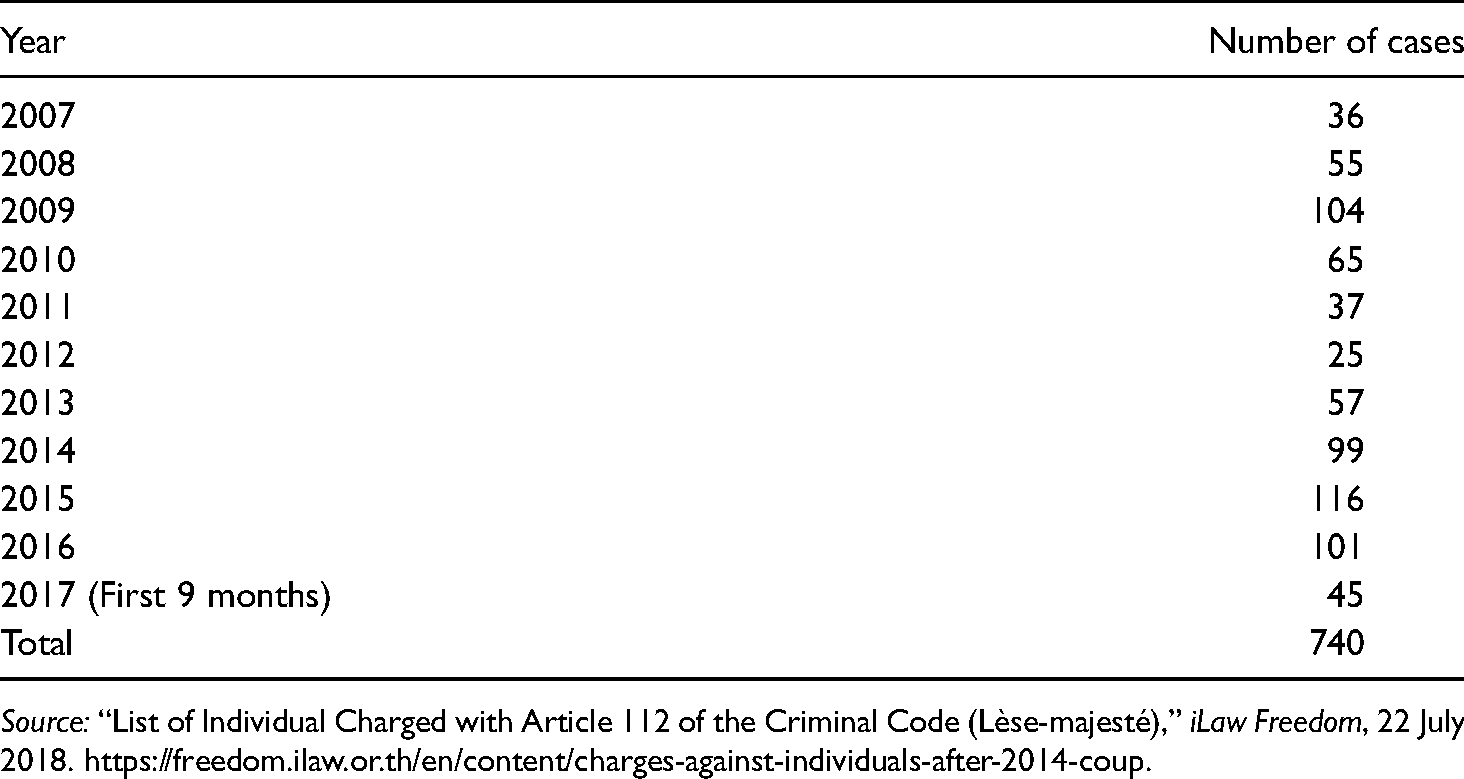
Source: “List of Individual Charged with Article 112 of the Criminal Code (Lèse-majesté),” iLaw Freedom, 22 July 2018. https://freedom.ilaw.or.th/en/content/charges-against-individuals-after-2014-coup.
It is highly questionable that Vajiralongkorn yearned for democracy and transparency, as this would seem in total contradiction with fear-inspired royal governance. Shortly after Vajiralongkorn was enthroned, the government arrested political activist Jatupat Boonpattararaksa, nicknamed Pai, one among thousands, for sharing a profile of the new king published on the BBC website. The government chose to punish Pai, but not the BBC, unveiling a tactic of fear to bring about mass control (Haberkorn, 2018: 935). Pai was jailed until May 2019, and then released by royal pardon. Alongside the lèse-majesté law, the Computer Crime Act is now frequently used to scare off potential critics of the monarchy. The Computer Crime Act defines computer crime offenses and punishments for computer-related and cybercrime activities. These are defined in such a way as to prevent anyone from criticizing certain institutions deemed important to national security, some of which involve “crimes” of lèse-majesté. Critical comments against the monarchy are discursively translated as “false data,” hence violating the Computer Crime Act (Buddharaksa, 2020: 57). Of course, in Thailand, proving the falsification of data about the monarchy is itself unlawful. In 2020, a Twitter user, Niranam (Anonymous), with the account name @ssj_2475, was charged under the Computer Crime Act, simply because he posted an article from a French newspaper critical of King Vajiralongkorn. He was later released on bail. Another Thai activist, Sasiphat Pongpraphapan was also charged under the same law because he wrote about the overthrowing of the French monarchy on his Facebook account.
In another instance, 36 people have been investigated for sharing anti-monarchy content from a UK-based website, KhonThaiUK. 18 In the latter case, sharing online content is also considered as violating the Computer Crime Act meant to strongly dissuade internet users from consuming content from foreign sources. The application of these laws would seem to suggest that instilling fear is an official policy. For example, the Ministry of Digital Economy and Society filed a cybercrime complaint with the police against this author for his role in setting up a private Facebook group entitled “Royalist Marketplace” which promotes critical discussion of the monarchy. 19 Furthermore, at the height of the protests, in November 2020, Prime Minister General Prayuth Chan-ocha announced the revival of the lèse-majesté law so as to charge the core leaders. 20 It has been reported that since the revival of the law (until August 2021), 124 individuals were charged under lèse-majesté law. Among them were juveniles (under the age of 18). 21 Many of these 124 individuals are unique in that many of them have multiple cases against them, which have not deterred them. If comparing cases (2007–2016) to individuals (and not the number of many, many more cases against them), even the rate has increased in the 10 months (November 2020–August 2021) since the return of Article 112 again, if calculated on a per year basis, the rate is 149 cases a year, more than double the rate of 2007–2016. The situation would seem to suggest that there is an attempt to inculcate fear in order to disrupt ongoing protests.
Illegal Measures
A new phenomenon instituted during the early reign of Vajiralongkorn that sent chills down the spine of anti-monarchist dissidents has been a violent tactic of abductions, enforced disappearances and killings. Ittipon Sukpaen, also known as DJ Sunho, went missing in June 2016. In July 2017, Wuthipong Kochathammakun, alias Kotee, was kidnapped from his Vientiane home by 10 men in black. These two deductees had risen to fame after releasing a series of YouTube videos ferociously attacking the Thai royal family. They have still not been found. In December 2018, three more dissidents in Laos disappeared. One of them was the prominent ex-communist and anti-monarchist Surachai Danwattananuson. He went missing with two of his assistants, Kraidej Leulert and Chatchan Bubpawan. In early 2012, Surachai had been sentenced to seven-and-a-half years in prison for lèse-majesté but received royal pardon in 2013. He fled Thailand after the 2014 coup. After their disappearance, two bodies, later identified as those of Kraidej and Chaichan, were found in the Mekong River, cut open and stuffed with concrete. The images of their bodies wrapped in brown sacks immensely petrified the public. To date, Surachai has never been found. In May 2019, three dissidents were reportedly arrested by the Vietnamese police and secretly extradited to Thailand. They are Chucheep Cheevasuth, widely known as Uncle Sanam Luang, Siam Thiravut, and Krisana Thapthai. As the most wanted of the three sought by the authorities, and charged with lèse-majesté, Chucheep regularly broadcast underground Internet shows against the monarchy from Laos, until, fearing assassination, he tried to move to Vietnam. The fate of these three men has remained unknown (Chachavalpongpun, 2019).
After this spate of cases, the four members of the folk band, Faiyen, known for its lyrics mocking the Thai monarchy, sought to urgently leave their home in exile in Laos, apparently for fear of being abducted or killed. 22 But what became the turning point of fear was the abduction in broad daylight of Wanchalearm Satsaksit, in June 2020 in Phnom Penh. Wanchalearm had been highly critical of the junta in the aftermath of the 2014 coup, prior to fleeing to Cambodia. 23 His abduction sent another shockwave to the Thai public about the increasing frequency of criminal operations outside of Thai sovereign territory and in defiance of Cambodian and international laws. Ironically, while the abduction of Wanchalearm helped spread fear, it also motivated protesters to take to the streets against Vajiralongkorn. Among the 10-point demands for monarchical reform was a specific demand for serious investigations into the abductions and killings of dissidents overseas. 24 In October 2020, Thai protesters gathered in front of the German Embassy in Bangkok to submit a letter to the ambassador requesting his government to investigate Vajiralongkorn's affairs in Germany (Kaewjinda, 2020). In an October 2020 interview with Frithjof Schmidt, a member of the country's Green Party and who had raised the issue of Vajiralongkorn's activities in Germany in the German Parliament, the author was informed that his party was investigating whether Vajiralongkorn played any role in the abductions and killings of Thai dissidents and whether the plots were made on German soil. 25 David Hutt reported in The Diplomat that “some sources allege Wanchalearm's abduction was ordered by Thai King Vajiralongkorn himself and overseen by his security chief, Jakrapob Bhuridej” (Hutt, 2020).
In an interview the author conducted in November 2020 with Sitanun Satsaksit, sister of Wanchalearm, she described her feeling of fear as a result of his brother's abduction: I was at first rather ignorant of politics. After my brother was abducted, fear took a hold of me. But I could not let it consume my life. I publicly made a plea for those who abducted my brother to release him. In a way, coming out in public could perhaps guarantee my safety too. But as much as fear is gripping me, I felt obliged to stand up against it. Because if I don’t, it will continue to harass us.
26
The author also interviewed Pranee Danwattananuson, wife of Surachai, who confessed that the abduction of her husband has left a lingering effect on her. Living in fear, she has relocated to Lampang and refrained from being involved in politics. Given the protesters’ demands for monarchical reform, she believed that those in power would employ desperate measures to eliminate their enemies. It is, therefore, reasonable to surmise that fear would continue to play an important role in Thai politics in this critical period in Vajiralongkorn's contested monarchy. 27
Confronting Fear
The protests specifically against the monarchy started in July 2020. Four months previously students had already demonstrated against what was deemed to be the unjust and politically motivated dissolution of the Future Forward Party (FFP) led by a billionaire activist politician, Thanathorn Juangroongruangkit. The FFP had proposed a progressive agenda, particularly in restraining the military's power in politics (McCargo, 2020; McCargo and Chattharakul, 2020). But the spread of COVID-19 interrupted the protests. The protests resumed in June–July partly enthused by the abduction of Wanchalearm. The protestors demanded, not only the dissolution of parliament so that a fresh election could be held, but also an amendment of the constitution and, notably, an investigation into the abductions and killings of Thai dissidents.
Shortly thereafter, the focus of the demonstrations turned to reform of the monarchy. They put forward a list of 10 demands. These included legislative reforms such as the abolition of the lèse-majesté law and the revocation of the Crown Property Act of 2018 which had transferred all of its shares bringing them under the sole possession of Vajiralongkorn. As well the protestors sought a reduction of the national budget for the promotion of the monarchy, the nullification of the transfer of two army units put under Vajiralongkorn's direct command, and the cessation of propaganda and glorification programs toward the monarchy (Prachatai, 2020). These far-reaching demands challenging the status of the monarchy are taking place in the climate of fear engendered by Rama X's mode of royal governance.
This article has argued that, historically, the success of royal governance in Thailand, among other factors, hinges on the equilibrium between barami and amnat or phra khun and phra det. Vajiralongkorn's lack of barami led to a collapse in this equilibrium. While Phra khun or Barami is non-transferable, it can be accumulated through pious acts. Phra det or amnat, on a contrary, is willful and calculating. It does not need to appear effortless or magnanimous, it simply needs to demonstrate its effectiveness in making people act in certain ways, often out of fear. Effective governance can be measured from the longevity of the regime and/or an ability to maintain order. Sopranzetti has examined the survival tactics of several Thai regimes over a lengthy period (Sopranzetti, 2020). In his study of four regimes—those of Phibun Songkhram, Sarit Thanarat, Prem Tinsulanonda, and Thaksin Shinawatra—he argues that they were able to retain power for more than their anticipated terms in office by finding a balance between barami and amnat and extolled both forms of power. For example, Phibun's legitimacy (and barami) was justified through the trope of adherence to his duty to the nation, Sarit's through his defence of the monarchy as well as the promotion of national development, Prem's through serving as King Bhumibol's trusted man and discourse on “good people,” and Thaksin's through unchallenged popular support. Imbued in barami, they simultaneously exercised raw amoral power through fear, ruthless elimination of opponents, and, for Thaksin, an iron-fisted policy vis-à-vis the insurrection in the Deep South and the war on drugs. In all four cases, their power ended with the collapse of the equilibrium, demonstrating the shortcomings of relying on these two sources of legitimacy. Barami can be lost (sia barami) when rulers fail to live up to their demands in terms of their own personal character. Similarly, amnat can also be lost (sia amnat) when used unilaterally without the support of barami (Sopranzetti, 2020: 63). Fear, in this context, can be contested. This explains why, despite the climate of fear, the protesters courageously confronted the monarchy. Since the enthronement of King Vajiralongkorn, the two concepts of power have fallen apart in the minds of Thais, and particularly among the youth. The fact that Vajiralongkorn has striven to consolidate his power, even when in so doing breaches the constitution, questions the legitimacy of his governance. The 10-point demand of protesters for immediate monarchical reform clearly indicates that his legitimacy on the throne has been further thrown into doubt. Without legitimacy, Vajiralongkorn's fleeting efforts to build up his barami are in vain. When, in the absence of legitimacy, the propagation of fear serves as a substitute it loses its power. The popular demand for reform of the monarchy is rooted in serious concerns over legitimacy and is morally grounded. The objective is eminently reasonable, namely, placing constitutional limits on Vajiralongkorn's power. These alternative notions of legitimacy and their moral basis have empowered those expressing public criticism of the monarchy to feel less afraid of him.
Most protesters are in their youth. Kanokrat Lertchoosakul, drawing on her survey of more than 150 young people involved in the protests, argued that this generation grew up with parents who were more liberal (referenced in Reed, 2020). The generational shift is accompanied by the blossoming of a new culture among Thai youths. The rapid socio-economic development in the past decades, the emergence of social media, and Thailand's growing interconnectedness with the outside world—all have powerfully redefined their views of politics and society. On the streets today are young students, some just in high school. The author conducted a non-scientific online survey among members of the Royalist Marketplace website in October 2020. It reveals that, out of 5000 respondents, 58.2 per cent of the members are undergraduate students, 14.9 per cent graduate students, and 11.4 per cent are high school students. 28 The significance of this result is that those involved in the current online/street activism grew up during a period when the effectiveness of King Bhumibol's propagandist agenda was waning. As a result, they were able to escape the impact of this propaganda and became detached from the royalist ideology, which placed an emphasis on the construction of barami or phra khun of Thai kings. Thai youths’ ability to overcome fear under Vajiralongkorn can be understood as resulting from the crumbling of the old propaganda, based on the monarchy's supposed morality. Without a moral veneer, amnat is exposed at the expense of barami as the dominant source of power. Equally important is the fact that the partially anonymous aspect of social media has contributed to boosting the motivation of young protesters in their criticism against the monarchy despite the existing lèse-majesté law. The rapid development of social media in Thailand, despite its imperfections, has challenged the traditional means of distribution of information (Tausig, 2019: 187). Access to information is no longer one-way and top-down. Instead, in the case of the Thai monarchy, as in other areas, social media provides a virtual public space for like-minded people to collectively normalize their discussion thus lessening their fear of retribution. The interconnectedness of Thailand with the world also plays its part in neutralizing fear. In Asia itself from engaging with young protesters in Hong Kong and Taiwan through the “Milk Tea Alliance” (Bernal, 2020) and, more recently with the Civil Disobedience Movement after 1 February 2021 coup d’état in Myanmar, Thailand's domestic dynamics have been contextualized in a larger contest. Furthermore, with the involvement of German politicians in scrutinizing Vajiralongkorn's affairs in Bavaria, this interconnectedness has further placed the fear-based mode of royal governance under the global spotlight.
Conclusion
Fear can be powerful as a domineering emotion to be instrumentalized to control others. Yet, existing analysis has investigated inculcating fear as the prevailing mode of royal governance. This is unfortunate, for in order to examine current political developments in Thailand fear as an element of royal governance requires investigation. This article does not have the presumption to claim that royal governance alone has shaped the contours of Thai politics. Rather, this article argues that royal governance is a subject of study worth exploring per se to understand the relationship between the monarch and his people and the ramifications of this dialectic for Thai society. Given the central role of the monarchy in Thai politics, the study of fear as an attribute of royal governance is crucial. Fear under Vajiralongkorn has been structured, not only for the purpose of controlling ruling elites, but also as a way of dominating Thai society as a whole. The objective is to dictate the behavior of all members of society, and more importantly, to demand both their loyalty and submission to the monarch.
However, as discussed above, the use of fear under the reign of Vajiralongkorn has broken the equilibrium between the two sources of legitimacy: moral authority and raw power. As explained previously, moral authority, or barami, is based on righteousness, usually rooted in the
For example, the abduction of Wanchalearm, among other factors, motivated Thais across the nation to protest against the uncontainable amnat of Vajiralongkorn. Photos of Wanchalearm, alongside those of other victims, were displayed and distributed in the protests, raising the question of the king's involvement in such crimes across borders. Explicit anti-monarchist banners were prominently displayed. Some of these banners used viciously derogatory language against Vajiralongkorn, trespassing the limit within the lèse-majesté law (Joehnk and Wheeler, 2020). Four years after Vajiralongkorn ascended to the throne, the previously revered royal institution is confronting a crisis of legitimacy. Ironically, but also logically, the employment of fear that drives Vajiralongkorn's royal governance is producing a negative impact on the institution of the monarchy per se. The younger generation, taking advantage of the generational shift, the advent of social media, and an interconnectedness with the world, is demanding a more accountable monarchy, one operating within the boundary of constitutional limits. The younger generation yearns for modern governance that is compatible with internationally accepted democratic norms. Fear, as a centuries-old political instrument, fails to live up to the expectation of the young people today.
Footnotes
Declaration of Conflicting Interests
The authors declared no potential conflicts of interest with respect to the research, authorship, and/or publication of this article.
Funding
The authors received no financial support for the research, authorship, and/or publication of this article.
