



Abstract
Indonesia is among the many states that have become interested in conducting deep-sea mining (DSM) since it first became viable in the 1970s. However, it was during the administration of President Joko Widodo (2014–2019) that DSM became an important viable endeavour, with the increasing depletion of Indonesia’s mineral and metal reserves. Nevertheless, Indonesia is yet to undertake DSM activity. This article aims to explain the absence of DSM in Indonesia by analysing the political dimensions of the decision-making process during President Widodo’s administration. This research utilises the poliheuristic theory (PHT) of decision-making. It shows that Indonesia’s DSM absence is the result of conscious decisions made by President Widodo to avoid loss in public support and drop in popularity. This article contributes to expanding the study of non-event or non-decision, which has been largely ignored in decision-making literature in Indonesia.
Keywords
Introduction
Amid anxiety around a global mineral and metal scarcity prediction in the 1970s, many nations showed considerable interest in conducting deep-sea mining (DSM; Glasby, 2000). The sea is arguably the earth’s largest surface, holding an abundant reserve of unexploited minerals and metals. DSM is then considered to be the necessary response in facing the threat of scarcity. As hundreds of sea vessels joined “the race to grab and hold the lands under the high seas” following the publication of The Mineral Resource of the Sea by J.L. Mero in 1965, international regulations for DSM began taking form in the United Nations (UN; Glasby, 2000). By 1982, the UN adopted the Convention on the Law of the Sea (UNCLOS), which formulated regulations for DSM and forever changed the geopolitical characteristics of DSM (Childs, 2020).
Indonesia took a leadership role in UNCLOS negotiations (Butcher and Elson, 2017). Its active participation in the negotiations benefitted Indonesia in many ways, including the expansion of its sea territory by 600 per cent as well as international recognition of archipelagic states and waters. However, the most significant benefit for Indonesia was that it furthered the nation’s interest in conducting DSM (Djalal, 1995, 2020). UNCLOS has provided Indonesia with the right to make use of natural resources, including minerals and metals, within their marine territory. UNCLOS further allows Indonesia to participate in managing and conducting DSM in international seas through the establishment of the International Seabed Authority (ISA) in 1994. ISA is an international organisation responsible for authorising DSM activities (ISA, 2020). Indonesia was elected the first president of ISA in 1995, and since then has maintained consistent participation in the organisation. Moreover, in terms of domestic perspectives towards DSM, Indonesia has included the term “oceanic mining” in various legal instruments such as Indonesian Law No. 4/2009, Law No.32/2014, and Presidential Regulation No.16/201 – thus demonstrating Indonesia’s interest in conducting DSM.
Nevertheless, Indonesia’s interest in conducting DSM has never been as pressing as the first term of President Joko Widodo’s administration (2014–2019). This was following a study by the Ministry of Energy and Natural Resources that predicted Indonesia’s mineral and metal reserves, especially nickel, would be depleted before 2030 (CNN Indonesia, 2019). Despite these findings and other supporting factors such as Indonesia’s consistent participation in ISA and domestic policies, Indonesia’s DSM activity remained non-existent. This inaction has cost Indonesia potential economic growth. By engaging in DSM, Indonesia would have acquired new natural resource reserves that may guarantee future availability and accessibility to alternative options to its thinning land-based mineral reserves. Furthermore, DSM activities would have resulted in mineral surplus, which could increase Indonesia’s exports. Arguably, engaging in DSM would increase Indonesia’s long-term resource security. Here, we define resource security as a condition in which the state develops and secures new sources of resource supply. Resource security then depends on the availability of natural resources at affordable prices (Wilson, 2015).
This article analyses why Indonesia has been absent in DSM activities despite its consistent participation in ISA, the international organisation that was exclusively established to manage DSM. More specifically, it examines the presidential decision-making process of President Joko Widodo. This article argues that Indonesia’s absence in DSM activity is not due to the government’s lack of interest on the issue, but rather because of a conscious decision made by government elites. It suggests that DSM holds an excessive political cost because it is expected to cause a drop in public support, hurting the popularity of Widodo and is therefore politically unacceptable.
This article contributes to the study of Indonesian decision-making in international relations by addressing the mining and maritime policies that led to DSM (in)activity. Most of the literature on Indonesian decision-making process employs constructivism (Agastia, 2020; Rüland, 2017), ontological security (Karim, 2020; Nguitragool, 2020), neoclassical realism (Syailendra, 2017), and domestic politics (Karim, 2019; Laksmana, 2016; Syarip, 2020) in understanding the way in which decisions related to particular international issues are made. This study is arguably the first to utilise poliheuristic theory (PHT) to study the Indonesian political decision-making process.
Moreover, this article expands the study of non-event or non-decision, which has been largely ignored in Indonesian decision-making literature. Since DSM activity has never been realised in Indonesia, the literature on this issue is also limited. Previous literature on Indonesia’s DSM absence has been limited to its legal framework (Puspitawati, 2018) and lack of regional seabed regime (Nugroho and Putranti, 2018), when in fact the study of Indonesian DSM could have been explored through other fields of study. For instance, literature focusing on other countries has examined DSM practices via geopolitics (Childs, 2020), political economy (Childs, 2019; Filer and Gabriel, 2018), and state’s preparedness (Willaert, 2020). As suggested by Carver et al. (2020), there is a need to further scrutinise the practice of DSM from a multi-disciplinary perspective by using additional approaches, particularly social science.
Given this context, we chose to focus on the political decision-making behind Indonesia’s DSM absence. For this purpose, this article utilises PHT of decision-making. The reason PHT is employed is because major rational-analytics decision-making theories such as the retrospective decision model, the bureaucratic politics model, and game theory seem inadequate for understanding Indonesia’s DSM. These major rational decision-making theories do not provide the sequential and non-holistic analysis required to assess the multiple dimensions that construct a DSM policy (Brulé, 2008). PHT, on the other hand, provides a sequential analysis in two stages and puts front and centre the political variables in the analytical process.
The rest of this article is structured as follows. The next section lays out the tenets of PHT and the non-compensatory principles applied for this particular issue. It then discusses the historical development of DSM and its international regime, as well as the political landscape in President Joko Widodo’s first-term administration during which a greater need for DSM arose. It follows with the analysis of Widodo’s decision-making process within the framework of PHT. It concludes with a summary of this article and suggestions for future research.
Poliheuristic Theory of Decision-Making
A Two-Stage Poliheuristic Process in Policy-making
Whereas major rational-analytics decision-making theory originated in economics, PHT originated in political science. PHT thus emphasises the politics of decision-making. It seeks to bridge the gap between cognitive psychological explanation on the one hand and rationalist explanation on the other. PHT offers an integrative perspective on policy decision-making that brings together insight from both sides of the explanation (Mintz and Mishal, 2003).
The term “poliheuristic” itself is made up of “poli” referring to many and “heuristic” to be understood as a mental shortcut to process information. It implies that decision-makers use many heuristic methods in the decision-making process (Cottam et al., 2010). PHT seeks to explain not only the outcome validity (the “why”) but also the process validity (the “how”) of policy decision-making. To that extent, it conceptualises policy decision-making as a sequential process that constitutes two stages (Mintz et al., 1994).
The first stage represents the cognitive psychological elements. The fundamental goal of this stage is to reduce the rich menu of policy options to a more manageable size. The reduction of the numerous policy options is accomplished by employing heuristics (mental shortcuts). All policy options that do not meet the subjectively predefined dimensions are swiftly eliminated. More specifically, this initial stage expects policymakers to employ five interrelated processing characteristics to identify and eventually reject unacceptable policy options as fast as possible. Those processing characteristics include non-holistic search process, dimension-based processing, order-sensitive search, satisficing, and non-compensatory principles (Mintz et al., 2017). In this article, we will focus on the non-compensatory principles, which will be elaborated upon below.
The second stage represents the rational elements of PHT. The goal of this stage is to select a policy option from those remaining after the first round of elimination. The process in this stage is subject to a classical rational choice model. Unlike the first stage, the remaining options in this stage can compensate a low score in one dimension with a high score in another dimension. The decision-maker then will choose an option with minimum cost and maximum benefit from the leftover policy options by accounting for all relevant dimensions (Mintz et al., 2017). Figure 1 helps understand the theoretical framework of PHT.
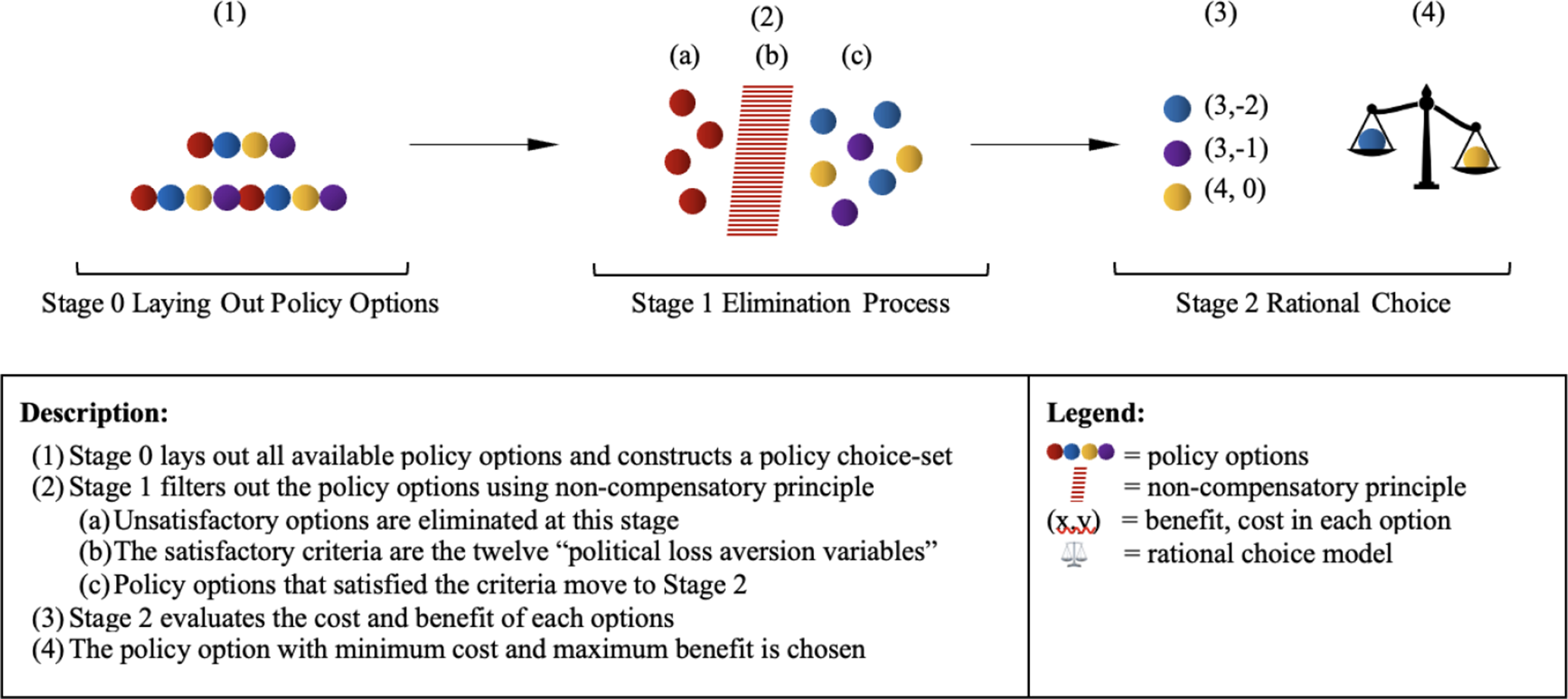
Framework of PHT Decision-Making Model.
Non-Compensatory Principle and Public Support for Policy
The non-compensatory principle is defined as “the core” of PHT and “the most innovative feature” (Goertz, 2004; Oppermann, 2014; Oppermann et al., 2020). This principle suggests that any policy option that scores low or is unsatisfying with regard to one predefined dimension, perceived by the decision-maker as the most crucial dimension, is quickly eliminated regardless of the policy option’s high score in another dimension. This means that major losses on a key dimension (political, domestic, foreign, etc.) cannot be replaced by gains on other dimensions. In other words, non-compensatory principles deal with loss avoidance (Goertz, 2004: 15).
Nonetheless, the non-compensatory principle only examines the behaviour in analysing policy options, not the content of the options themselves. Therefore, hypothetically, any dimension can be used as a reference point for the initial rejection process, such as economy, military, bureaucratic interest, international law, and so on. However, since PHT focuses on the politics of decision-making, the non-compensatory principles are evaluated only against one particular dimension – “domestic politics” (Mintz, 2004).
The justification for focusing on domestic politics is that ensuring political survival is the primary concern of any decision-maker. This argument goes respectively to the notion that policymakers are political actors whose self-interest in political survival is paramount (Mintz, 2016). It suggests that decision-makers tend to reject the alternatives that may hurt them politically and emphasise domestic policy as “the essence of decision” (Geva and Mintz, 1997).
To substantiate the use of non-compensatory principles in the domain of political dimension, Mintz (2004: 9) introduced the “non-compensatory political loss aversion variables” as variables that political leaders tend to assess when making a decision. The application of this variable during the initial rejection process in the first stage of PHT is what makes heuristic variables quantifiable. Those variables include (1) threat to a leader’s survival; (2) loss of public support for policy; (3) significant drop in popularity; (4) decreasing chance of re-election; (5) domestic opposition; (6) threat to regime survival; (7) intraparty rivalry and competition; (8) internal or external challenge to the regime; (9) potential collapse of the coalition or government; (10) threat to political power, dignity, honour, or legitimacy of a leader; (11) demonstration, riots, and threat to security; and (12) the existence of veto players.
Regarding the case of Indonesia, we consider loss of public support for policy, significant drop in popularity, and decreasing chance of re-election to be the most relevant political loss aversion variables. The reason that “loss of public support for policy” and “significant drop in popularity” are considered most appropriate is because Indonesian politics, like many others in democratic countries, focuses heavily on public support and leader popularity in order to gain, if not maintain, votes in its democratic and multi-party system. In this context, political leaders in Indonesia tend to avoid policies that decrease their chance for re-election (Mintz, 2004). Moreover, Kertzer and Zeitzoff (2017) suggest in democratic settings, a policy is shaped to the public preference, as any significant displeasure among the public will create distrust towards the ruling government. Since the public employs their own heuristic methods (quick judgement) in determining their opinion towards policies that are distantly associated with their lives (Mondak, 1993), the “partisan cheerleading” theory suggests that the dislike of certain policies could be amplified into a motion of no confidence towards every other policy the government makes (Gerber and Huber, 2010).
A significant drop in confidence towards the government undeniably hurts a leader’s popularity. During President Widodo’s first term (2014–2019), maintaining popularity was incredibly important to secure his re-election as well as to ensure the ongoing popularity of his party, the Indonesian Democratic Party of Struggle (Partai Demokrasi Indonesia Perjuangan, PDI-P) in the next general election. Therefore, the theoretical framework of this research chose to focus on the two variables of “loss of public support for policy” and “significant drop in popularity.” The variable “decreasing chance for re-election” is implicitly contained within the other two variables.
This article follows the predominant argument of PHT, which holds domestic politics as the critical dimension in applying the non-compensatory principle during the first stage of the decision-making process. Regarding the specific operationalisation of the non-compensatory principle on DSM policy decisions in Indonesia, all policy options that may cause a loss in public support and potentially decrease the leader’s popularity are politically unacceptable, and therefore discarded during the first stage of the decision-making process. A further process is subject to the rational choice model, as suggested by the second stage of PHT.
Deep-Sea Mining and Indonesia’s Role in the DSM Regime
This section provides context to this research by discussing the various aspects that revolve around DSM. It first discusses the establishment of the legal regime that changed the political nature of DSM. Then, it follows with the historical background of Indonesia’s mining activities to illustrate its position on this issue. Furthermore, this section presents the mining regime under the Widodo administration to contextualise the country’s lack of DSM to the recent political condition.
DSM and Its International Regime
Ocean mining refers to the act of collecting ocean mineral from the three layers of ocean waters. These layers consist of surface water at 0–250 m, deep ocean at 250–1,500 m, and very deep ocean at 1,500 m–15 km of depth. The collection of ocean minerals and metals in surface water is a widespread practice, which often referred to as “extraction of aggregate,” while the collection of ocean minerals in the deep and very deep ocean is referred to as “deep-sea mining (DSM)” (Putuhena, 2019)
In response to states’ increasing interest in DSM, a discussion on the international legal framework for DSM took place at the Third United Nations Conference on the Law of the Sea (UNCLOS III) in 1982 (Posner and Sykes, 2010). The conference concluded with the adoption of the UNCLOS, often referred to as “the constitution of the sea.” Several articles were then re-negotiated, which resulted in the 1994 Implementation Agreement of Part XI. Among many others, the adoption of UNCLOS and the 1994 Implementation Agreement sets the establishment of DSM regimes (Kirton and Vasciannie, 2002).
The adoption of UNCLOS and the 1994 Implementation Agreement provides two different legal regimes for DSM activity. DSM activity in oceans under national jurisdiction is subject to a state’s own legal regime, while DSM activity in international waters is subject to the international legal regime. Whilst legal regimes for seas within a nation’s jurisdiction vary from state to state, the design of the international legal system consists of two important instruments: the Common Heritage for Mankind (CHM) principle and the ISA (Butcher and Elson, 2017).
The CHM principle holds that the exploration and exploitation of natural resources in the deep sea are to be carried out for the benefit of humankind as a whole. Its governance is regulated within Part XI of UNCLOS. The ISA was established as the international organisation to manage the seabed on behalf of all humankind.
DSM Efforts in Indonesia
With the spirit of economic development, under Suharto’s authoritarian regime (1966–1998), Indonesia actively participated in the UNCLOS negotiation. UNCLOS was later ratified in Indonesia through Law No.17/1985. Indonesia was keen to partake in UNCLOS discussions because the Convention not only opened up the viability of DSM for Indonesia but also contributed to Indonesia’s sovereignty game and allowed the country to exercise leadership in the international community (Hannigan, 2015).
UNCLOS expanded Indonesia’s maritime territory from less than one million square kilometres to more than 5.8 million square kilometres. It recognises Indonesia as an “archipelagic state” that has sovereignty over its “archipelagic waters.” Moreover, it gives Indonesia the right to regulate and exploit the natural resources within its archipelagic waters as well as all maritime areas within 200 nautical miles of the coastline. This became Indonesia’s foundation for independent DSM activity (Puspitawati, 2018).
Meanwhile, Indonesia pursued a greater leadership role in the international community by becoming the first president of the ISA Assembly from 1995 to 1996. Since then, Indonesia has maintained its leadership in the organisation as an elected member of the Finance Committee (2002–2011) and appointed member of the Legal and Technical Committee of the Council (2002–2011). Every year, Indonesia sends delegations to ISA capacity-building projects and has consistently participated in the primary legislative organ of ISA, the Council, from when the organisation first operated in 1995 until now (ISA, 2020).
In an interview with the authors, Djalal (2020) stated that Indonesia’s leadership role in ISA in 1995 was an important stepping stone that strengthened Indonesia’s identity characteristic as a maritime nation. For the first time, Indonesia was allowed to display its existence on the sea at a global level. By being a member of ISA, especially as President of the Assembly, Indonesia was allowed to conduct mineral exploration in maritime zones that were previously unimaginable, such as the Pacific Ocean, the Atlantic Ocean, and even the unexplored Arctic Ocean.
Djalal added that Indonesia’s role in ISA has strengthened Indonesia’s position in the international community as a trusted mediator, putting front and centre the need for all countries to have equal opportunity for sea exploration, something that was previously only for the benefit of developed countries. The creation of the “Enterprise” as an extension of ISA to conduct independent DSM projects and the “Special Fund” to subsidise government officials’ expenses to attend ISA’s meetings in Jamaica also provides an equal playground in conducting DSM in international seas through the empowerment of less developed nations, including Indonesia.
Indonesia’s participation in UNCLOS, which secured its marine natural resources, and active leadership in ISA showed President Suharto’s strong intention to undertake DSM activity. However, the 1987 stock market crash forced him to impose a mining moratorium until 1997, leading to a collapse in Indonesian mining. At the end of the moratorium, things became worse as the 1997 Asian Financial Crisis hit, resulting in Suharto stepping down as president (van Leeuwen, 1994). The idea of DSM was not mentioned in the following two governments under President BJ Habibie (1998–1999) and President Abdurrahman Wahid (1999–2001).
Indonesia’s political environment began to become more stable during the presidency of Megawati Sukarnoputri. Megawati’s decision relating to DSM began with the implementation of Presidential Decree No. 126/2001, which declared 13 December as Nusantara Day (Archipelago Day). This policy re-acknowledged the existence of the rich natural resources that lie within Indonesia’s maritime territory and reaffirms the importance of its use for the welfare of Indonesian people (Pratama, 2018).
Under Megawati’s administration, Indonesia held its first underwater exploration, the Bandamin Expedition. This expedition was operated by a joint research group named the Indonesia–Australia Survey for Submarine Hydrothermal Activity (IASSHA) in 2001. The expedition successfully identified mineral potential in the Flores Sea, leading to two further expeditions in North Sulawesi: IASSHA I in Talaud and IASSHA II in Kawio in 2003 (Geomagz, 2015). Both expeditions proved the existence of abundant minerals under Indonesian seas and showed that Indonesia did in fact have the appetite to conduct DSM activity. Arguably, should Indonesia invest more in enhancing its technological capacity, it could in fact conduct DSM activity.
The subsequent administration of President Susilo Bambang Yudhoyono (2004–2014) redirected Indonesia’s mining regime. The ratification of Law No.4/2009 on Mineral and Coal, known as UU Minerba, forced foreign mining companies in Indonesia to obtain a Special Mining Business License (IUPK) in exchange for the Contract of Work (COW) (Nalle, 2012).
The implementation of UU Minerba entails several changes to Indonesia’s mining regime. They include the obligation to divest 51 per cent of foreign companies’ shares to the government, the application of mining taxes and royalties, an order to build permanent mineral processing plants in Indonesia, and a ban on unprocessed mineral ore exports. The Law raised several objections from the industry, creating significant tension in both business and political sectors, and ultimately leading to the postponement of the implementation of the Law until the end of President Yudhoyono’s second term in 2014 (Junita, 2015).
Despite such objections and tension, Law No.4/2009 on Mining and Coal set several important foundations for Indonesian DSM activity. First, the Law recognises the extraction of mineral compounds from the sea as part of underwater mining. Second, it assigns authority to specific government institutions in conducting DSM, with regional government holding the authority over mining operations on land, internal waters, and sea up to 12 miles from the coast, while the central government is responsible for all other territories. Moreover, Law No.32/2014 on Ocean Policy, especially Articles 14 (2) and 21 (1), re-affirms the authority of both the central and regional governments to use mineral resources from the sea, on the seafloor, and the subsoil thereof for the welfare of the Indonesian people (Puspitawati, 2018).
DSM and the Political Landscape of President Joko Widodo’s Administration
President Joko Widodo is the seventh and current president of Indonesia. Widodo has been in office since 2014 and is now in his second term. As a member of the PDI-P, President Widodo has had an impressive political career: he was the first directly elected mayor of Surakarta in 2005, was re-elected in a landslide victory with over 90 per cent of the vote in 2010, and won the gubernatorial election of Jakarta in 2012. He attracted national and international attention because he was neither from the military nor from a prominent political family, had a reputation for being anti-corruption, and ran a populist campaign that was nationalist and pro-people (Sherman Hollar, 2014). The recent “new developmentalism” characterisation of Joko Widodo’s presidency means that he is regarded as a conservative, nationalistic, and pragmatic decision-maker (Gede Wahyu Wicaksana, 2021; Warburton, 2016).
During his first term, Widodo was praised for pushing a nine-point development plan known as Nawacita. The plan aimed to help the poor, including improving public services, implementing land reforms, developing affordable housing, clamping down on corruption, and easing the conduct of businesses. On his 100th day in office, Widodo maintained a 60 per cent approval rating (Presidential Staff Office, 2019).
However, as the president began to implement megaprojects on infrastructure across the nation, public support for him started to decline. These megaprojects required a large amount of funding, resulting in a national budget deficit and a series of financing schemes that raised Indonesian government debt to an all-time high at IDR 4,418 trillion (USD 307 billion; IDR stands for Indonesian Rupiah; Daniel, 2019).
The considerable government debt was, and still is, one of the most significant weak spots in President Widodo’s administration. It became a significant challenge for his re-election campaign in 2019. That fact was utilised by his presidential candidate rival, Prabowo Subianto, to garner public sympathy, namely the #2019GantiPresiden (#2019ChangeThePresident) movement on social media. The movement split the public majority into two extremely polarised groups: one supporting Widodo and the other supporting Prabowo (Agung, 2018). This extreme polarisation then followed with what scholars called “partisan cheerleading,” where one group supports everything their party states while harshly rejecting everything from the opposing party, irrespective of facts or hoaxes (Gerber and Huber, 2010).
Compared with previous administrations, President Widodo’s administration is considered to be the most likely to implement DSM activity. This is due to a range of supporting factors in Widodo’s administration, such as the Global Maritime Fulcrum (GMF) doctrine, capital readiness, a relatively stable political environment, and the right moment.
Indonesia’s GMF doctrine, also known as Jokowi’s doctrine, is a doctrine that aims to enhance Indonesia’s maritime identity by utilising the maritime area around Indonesia’s archipelago to boost the nation’s economy (Scott, 2019). The doctrine was introduced when Widodo took office in 2014 (Milner, 2019). The reason this doctrine is considered to have contributed to DSM preparation is because it consists of seven pillars, two of which put emphasis on the development of sea infrastructure and technology, and the enhancement of Indonesia’s participation in international organisations (Sekretariat Kabinet, 2017). Those two pillars then manifested in Presidential Decree No.16/2017 on Ocean Policy and its Appendix II on Ocean Policy Action Plan 2016–2019. Within those legal documents, it is stated that President Widodo’s administration would maximise the use of natural resources, including minerals and metals, from the sea, guided by Law No.32/2014 and Law No.4/2009. Furthermore, the Ocean Policy Action Plan 2016–2019 specifically mandated the Ministry of Foreign Affairs (MOFA) to increase participation and leadership in the ISA. MOFA achieved early success by stating they had developed stronger legal and international treaty cooperation with ISA in their Performance Report of 2018 (Kementerian Luar Negeri, 2019).
Second, President Widodo’s administration is equipped with capital readiness to conduct DSM activity. This capital includes authority, human resources, and financial capital. President Widodo gained the authority needed by implementing Law No.4/2009, ratified by his predecessor Yudhoyono, mandating the nationalisation of foreign mining companies. With this, Widodo holds the authority to order the direction and amount of production of such companies (Gellert, 2019) and, by 2019, Indonesia possessed sufficient human resources in terms of DSM experts who had taken prior studies at ISA capacity-building projects. Moreover, Widodo’s implementation of infrastructure-heavy policies has begun to attract the type of investment required for DSM projects (Junita, 2015).
Third, the political environment during the Widodo administration is relatively more stable compared to the previous presidents’. Indonesia holds both presidential and parliamentary elections. In 2019, Widodo won the presidential election as a PDI-P candidate; PDI-P also dominated the parliamentary elections. This will ease coordination between the executive and legislative pillars of the Indonesian government should DSM activity become viable. Additionally, the Widodo administration is not shadowed by a clear opposition party as was usually found during previous administrations; the vast majority of parliamentarians are part of the ruling alliance with PDI-P (Mietzner, 2017).
Fourth, during his first term, there are various opportunities that make President Widodo have the right moment to start DSM activity. Internationally, many other countries also have a desire to conduct DSM exploration. In 2014, the Government of the United Kingdom enacted the Deep Sea Mining Act, which allows government contractors, instead of only private contractors, to conduct DSM activities in international seas. This policy has increased states’ desire for sea exploration and has already been exercised by the governments of India, Republic of Korea, Russia, and China. Domestically, the Indonesian Ministry of Energy and Natural Resources has found evidence of minerals in the Banten, Flores, and Celebes Seas in addition to the previous findings from expeditions in 2001 and 2003 (Antaranews, 2019). The ministry also provided studies that state Indonesia’s mineral and metal reserves (especially nickel) will be depleted in less than ten years unless new sources are identified (CNN Indonesia, 2019). It is not surprising that the then Minister of Energy and Mineral Resources, Luhut Pandjaitan, stated that DSM should be the next target for the Ministry (Ministry of Energy and Natural Resources, 2016).
With the cost of conducting DSM declining to the point where it is the most affordable it has ever been, DSM could have become a reality during Widodo’s administration. However, to this day, the Indonesian government has not taken any steps to conduct DSM activity. In fact, its response has been the opposite: imposing a ban on mineral exports and delaying the possibility for the exploration of ocean mineral.
Application of PHT Framework to Joko Widodo’s Administration
This section provides in-depth analysis of Indonesia’s decision to remain inactive in DSM. More specifically, it expands the study of a non-event. It makes decision-making theories richer by utilising plausibility probing on study case, which includes Indonesia’s non-decision or decision not to take action in the field of resource security. As this article uses PHT to analyse decision-making, it focuses on the political dimensions that influence presidential decision-making.
In applying PHT to our case, we follow Mintz and Chatagnier (2020) who suggest the need for foreign policy analysts to create a matrix of possible options (alternatives) and decision criteria (dimensions) that fit with the case under investigation. The possible options are then weighted in order to eliminate the options alternatives. By analysing the remaining options, we can then explain the decision maker’s choice.
This section is organised by revisiting the important findings regarding the case study, establishing the variant of non-compensatory principle used for this particular case, and providing analysis within a PHT framework which includes (the introduction of) Stage 0 (the laying out of policy options), Stage 1 (the initial elimination process), and Stage 2 (the selection process).
The Choice to Be Absent from DSM
Of all previous Indonesian governments, Widodo’s administration has the most supporting factors to conduct DSM activity. However, President Widodo did not take this course of action, instead choosing to maintain the status quo (i.e. Indonesia facing a lack of new mineral and metal sources) and implementing the mineral export ban, which had been developed by his predecessor in 2009.
As Widodo himself has stated that “Not deciding … is a decision” (Shihab, 2020), this article argues that Indonesia’s absence in DSM activity is a conscious decision made by Widodo’s administration. The following subsection introduces Stage 0 of the PHT framework. It lays out all policy options Widodo had prior to his DSM non-decision.
Stage 0: Laying Out All Policy Options
In response to the opportunity provided by the international community to conduct DSM in Indonesia’s maritime area, while simultaneously addressing domestic needs to find new mineral and metal sources, President Widodo’s options could be distilled down to three:
Option (a): to conduct DSM in the maritime area beyond Indonesia’s national jurisdiction;
Option (b): to conduct DSM in the maritime area within Indonesia’s national jurisdiction;
Option (c): to maintain the status quo (no action towards DSM).
Bearing in mind that DSM is not only key to future resource security but also a geopolitical tool, Widodo’s option will be interpreted one at a time to clarify their political goals . The summary can be seen in Table 1.
Summary of Policy Options for DSM Activity.
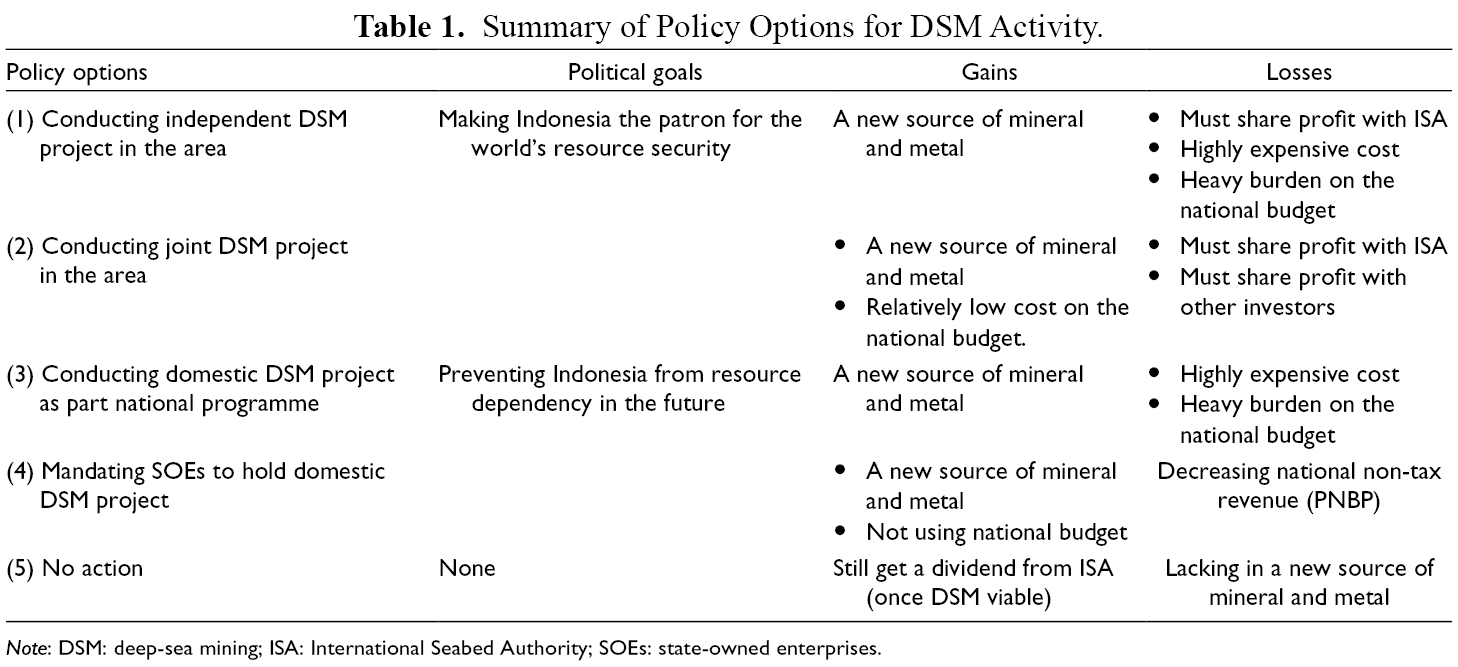
Note: DSM: deep-sea mining; ISA: International Seabed Authority; SOEs: state-owned enterprises.
Option (a) holds that Widodo would begin DSM projects in the maritime area beyond national jurisdiction. For this particular maritime zone, the legal regime applied requires the CHM principle. The enactment of the CHM principle implies that any extraction activity of natural resources within international maritime zones must not solely benefit one state. It must benefit all states. Therefore, the political goal in implementing Option (a) would be that Indonesia is taking a step to become a leader or patron of resource security for the international or at least regional community. Meanwhile, economically, this option would provide Indonesia with new mineral and metal resources, albeit resources that must be divided with ISA as the relevant international organisation.
Moreover, it should be noted that a single DSM venture is estimated to require IDR 175 trillion (USD 12.1 billion) in capital investment and twenty years of operational costs (Sharma, 2011). Theoretically, in financing such funding requirements, Widodo would have two options: financing the DSM project independently using the national budget (APBN) or creating a consortium to share the financial burden with other nations. Ultimately, Option (a) features two subsequent policy options to be considered: (1) conducting an independent DSM project in the area and (2) conducting a joint DSM project in the area.
Option (b) holds that President Widodo will start DSM projects in the maritime area within Indonesia’s national jurisdiction, which refers to Indonesia’s archipelagic waters and other maritime areas up to 200 miles from Indonesia’s coastline. The political goal behind this option would be to prevent Indonesia from being dependent on mineral and metal imports once Indonesia’s own land reserves are depleted. The benefit of this choice would be the identification of a new source for minerals and metals and ensuring future resource security.
In financing Option (b), President Widodo has two primary choices. He can treat DSM as part of central government projects and therefore use the national budget for financing activities, or he can mandate state-owned enterprises (SOEs) as the actors responsible for DSM, therefore using SOEs’ own budgets to finance activities. Opting to conduct DSM as a government programme would put a heavy burden on the national budget, while using SOEs’ budgets would decrease national non-tax revenue (PNBP). This option thus adds two subsequent policy options: conducting domestic DSM projects as a national programme, and mandating SOEs to undertake domestic DSM projects.
Lastly, Option (c) would mean that Widodo does not take any actions to undertake DSM activity. The benefit of this option is that his administration does not have to spend money on DSM. However, since Indonesia is a member of ISA, they have the right to receive a dividend if DSM projects in the area become viable. On the other hand, taking no action means Indonesia may not find new sources for minerals and metals, increasing the risk that Indonesia will run out of these resources.
With all scenarios for potential policy options for President Widodo now established, the PHT decision-making process can begin.
Stage 1: The Initial Rejection Process
Stage 1 of PHT decision-making provides the initial rejection process of policy options from the choices set above. This stage follows the predominant argument that suggests that domestic politics is the key dimension in the application of PHT. In rejecting certain policy options, this stage utilises a non-compensatory principle.
For this particular case study, the variant of non-compensatory principle used holds that “all policy options tend to cause a loss in public support and expected to bear potential drop on the leader’s popularity are politically unacceptable, and therefore discarded during the first stage of the decision-making process” (Mintz, 2004). As has been provided in the previous section, government debt is the indicator that is associated with a loss of public support and the potential drop of presidential popularity. Therefore, all policy options with the potential to increase government debt will be discarded during this stage.
Policy Option (1) holds that President Widodo would conduct a DSM project in international seas with funding taken from the national budget. This policy option is viable because Indonesia has been actively participating in ISA since its establishment. Moreover, since 2014, ISA has been encouraging government contractors to conduct their DSM projects in the area. If this policy option is taken, Indonesia will become the first government to undertake DSM activity in the area. Putting this activity into practice would send a political statement that says Indonesia is taking further steps to becoming a key geopolitical actor in the international community.
Policy Option (2) provides a different approach for funding DSM activities. Instead of funding it independently as in Policy Option (1), President Widodo could use his good relations with other national governments to make a consortium to conduct a joint DSM venture. This way, the tremendous funding required would not burden the national budget as much as in Policy Option (1).
Similar to Policy Option (1), Policy Option (3) also expects President Widodo to use the national budget for a DSM project. However, under Option (3), the project would be located in maritime areas within Indonesia’s jurisdiction instead of in international waters. This policy option simplifies the administrative requirements because it does not need ISA permission to conduct, although the project must still obey international maritime and environmental laws. By choosing this policy option, Widodo would secure Indonesia’s supply of future mineral and metal resources.
Nonetheless, funding DSM activity using the national budget seems unacceptable for Widodo’s administration. According to the Ministry of Finance (2016), Indonesia’s national expenditure was IDR 2,095 trillion (USD 154 billion) in 2016. Funding a DSM project would add another IDR 175 trillion (USD 12,1 billion) to the national expenditure. Meanwhile, Indonesia’s total annual income in 2020 is only expected to be IDR 1,423 trillion (USD 99 billion), implying a budget deficit.
To accommodate DSM projects within a situation of a budget deficit, Widodo would need to look for external financiers. Since Law No.4/2009 does not allow large-scale foreign direct investment (more than 49 per cent of shares) in Indonesia’s mining sector, this means that government debt – either through foreign debt, issuance of state bond, or government to government loan – is the only way to accommodate the project. Since the non-compensatory principle holds that all policies with the potential to increase government debt is unacceptable, Policy Options (1), (2), and (3) are eliminated.
Some might argue that the elimination of these three options for funding reasons is ill-considered when faced with the fact that the use of national budgets (as well as debt) to fund policies and programmes is a common practice in any government. However, the Widodo administration appears to avoid excessive use of the national budget to fund large infrastructure projects similar to DSM. Instead of directly financing these projects under national programmes, Widodo’s administration often employs strategies to mobilise public entities such as SOEs and subsidiary bodies of ministries to channel capital as suggested in Policy Option (4) (Kim, 2020). The non-compensatory principle of PHT also suggests a swift elimination of policy options that cannot meet the subjectively predetermined dimension – in this case, loss of public support following a significant increase in government debt (Mintz, 2004).
The elimination of Policy Options (1) and (2) also follows the recent “new developmentalism” characterisation of Joko Widodo’s presidency, where Widodo has been regarded as conservative, nationalist, and pragmatic in his decision-making (Warburton, 2016). These policy options are perceived to be the least beneficial for meeting Indonesia’s mineral and metal needs, much less to Indonesia’s economic development; thus, they are considered more of a political statement rather than a tool that would bring about real improvements in the business sector.
Stage 2: The Selection Process
Since Policy Options (4) and (5) do not contribute to increases in government debt, these policy options passed the initial rejection process in Stage 1. Furthermore, these policy options can be processed in Stage 2 of PHT, which is the selection process. In this stage, the classical rational choice model is employed. Policy options with the least cost and most benefit will be selected.
Policy Option (4) holds that President Widodo would not conduct a DSM project as part of his national strategic projects. Instead, it suggests Widodo would mandate SOEs to conduct the activities. This article considers this policy option to be the most suitable, bearing in mind that the political system in Indonesia only allows presidents to lead for a maximum of two five-year periods. DSM projects are predicted to take more time than the length of two presidential periods. Therefore, mandating SOEs to conduct DSM would provide more certainty to the projects’ continuity, rather than including them within the resident’s strategic projects.
Furthermore, mandating SOEs to conduct DSM does not increase national expenditure. Instead, it uses the SOEs’ own budget for all funding. However, if one looks at the capital and annual expenditure of Indonesian mining SOEs such as PT Aneka Tambang, PT Bukit Asam, PT Timah, PT Inalum, or their affiliated enterprises, such as PT Freeport Indonesia and PT Nusa Halmahera Minerals, it is clear that their capital is unable to suffice as initial capital for a DSM venture. There is a need for an external financier to fund DSM projects in Indonesia, even when it is implemented by SOEs (Ministry of Finance, 2016).
President Widodo has been utilising several ways to finance sizeable SOE-led development projects, which include commercial bank loans, investment from PT Sarana Multi Infrastruktur (SMI), and fundraising in the capital market through the issuance of corporate bonds (Kim, 2020).
Commercial bank loans are viewed by the government as insufficient to finance DSM projects; conducting these projects requires on average IDR 175 trillion or around USD 12.1 billion. Such loans also hold high risk in increasing financial market vulnerability when overused. Additionally, this option has a commercial orientation, as the banks were partially owned by private shareholders. Therefore, this option is the least likely to be taken to finance Indonesia’s DSM projects (Kim, 2020).
Relying on SMI investment to finance DSM projects is a more likely choice for Widodo. SMI is Indonesia’s Special Mission Vehicle under the Ministry of Finance and is engaged in financing government infrastructure projects. SMI is currently financing large projects valued at IDR 1,151.8 trillion (USD 79.8 billion). However, SMI’s most recent financial statement notes the availability of hard cash and total assets at just IDR 9.83 trillion (USD 679 million) and IDR 75.82 trillion (USD 5.25 billion). This implies that if given the mandate to finance DSM projects, SMI would need to either liquidise some loan receivables or raise more funds by the issuance of bonds (Sarana Multi Infrastruktur, 2020).
Issuance of bonds to raise funding has previously been utilised and proven successful in DSM activities by Canadian DSM venture Nautilus Minerals’ Solwara 1 Project in Papua New Guinea. By 2016, the venture’s production was able to set a record at around 200 tons of minerals daily. The same financing strategy was then employed by Singapore Ocean Mineral Ltd. and other DSM ventures (Ministry of Energy and Natural Resources, 2016).
The nature of this policy option follows the investment principle of high risk, high return. Once DSM is viable, it would bring tremendous profits to the country. However, implementation would take a significant amount of time, including finding investors to fund the project, setting up the technology and infrastructure needed to process the valuable metals, and receiving a return of investment from the project. This long investment duration holds a high risk of business failure.
By considering the aspects mentioned above, it is safe to argue that the high costs outweigh the benefits. More specifically, this policy option would not benefit President Widodo personally. By the time Indonesia’s DSM venture became financially profitable, Widodo’s presidential period would have elapsed. Additionally, if the project hit major challenges during the development phase, the government would have to take measures such as bailing out the failing SEO. This has the potential to ruin Widodo’s reputation even after he was no longer in office. Hence, Policy Option (4) is not beneficial for the Widodo administration and therefore will not be selected.
The rejection of Policy Option (4) thus leaves Widodo with Policy Option (5), which is to take no action. This policy option, however, was selected not merely because it is the only one left. Rather, UNCLOS Part XI means that Indonesia is still able to benefit from any DSM projects in the region. More specifically, it is Indonesia’s membership in ISA that provides them with the rights to claim dividends once DSM activities in the area become viable. Furthermore, former President Yudhoyono’s mineral export ban – developed under Law No.4/2009 and implemented from January 2020 – has also bought Widodo some time before Indonesia’s mineral and metal resources become scarce.
To conclude, Policy Option (5) survived the elimination process during Stage 1 of PHT because it does not increase government debt, which is important to avoid potential loss of public support and drop in presidential popularity. This is non-negotiable for President Joko Widodo as a political leader whose public approval influences the popularity of his political party. Policy Option (5) is then selected in Stage 2 because it holds the best cost–benefit ratio compared to other remaining options. The summary for the PHT decision-making process is laid out in Table 2.
Summary of Poliheuristic Decision-Making Processes.
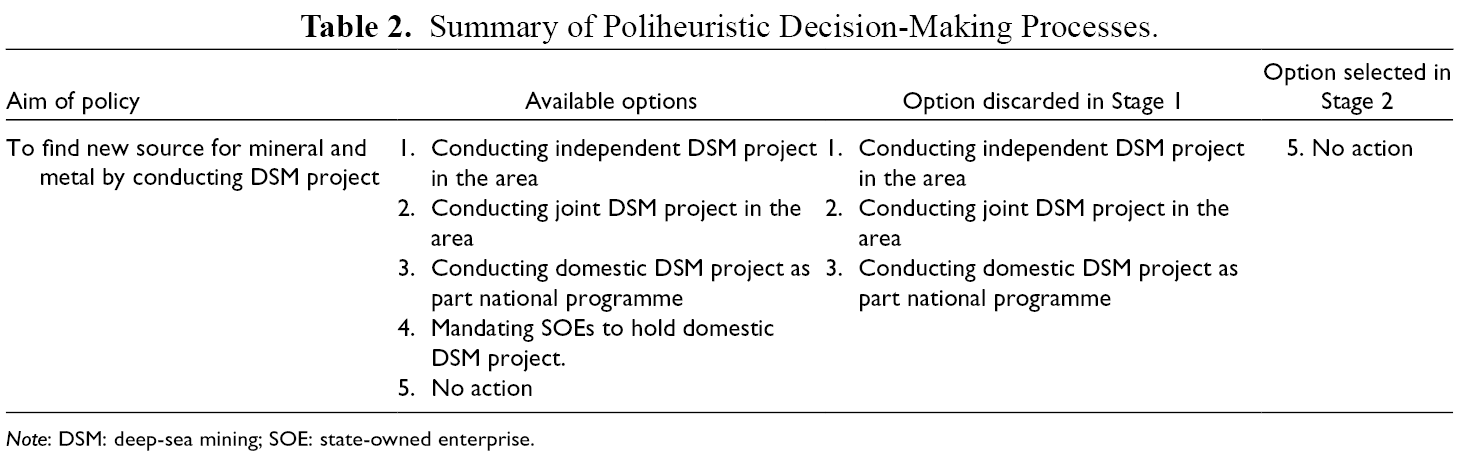
Note: DSM: deep-sea mining; SOE: state-owned enterprise.
Conclusion
This research has expanded the study of a non-event and has made decision-making theories richer by utilising plausibility probing on a case study, which includes Indonesia’s (non-)decision against taking action in the field of resource security. Furthermore, it provides an answer as to why Indonesia is absent in DSM activities, an absence that appears in contradiction to the country’s ongoing participation in ISA. It provides evidence that this condition did not occur due to a lack of government attention towards DSM possibilities but is rather a conscious decision taken by President Joko Widodo.
The Widodo administration indicates that political conditions are different to those analysed by previous literature on PHT decision-making in democratic settings, which offers more nuance in the operationalisation of the theory, especially the non-compensatory principle. Since not all of Mintz’s “political loss aversion variables” suit this particular case study, the non-compensatory principle holds that all policy options that cause a loss in public support and drop in leader popularity are politically unacceptable; they are therefore discarded during the first stage of the decision-making process. With government debt acting as the indicator for loss of public support and popularity, all policy options that potentially increase government debt are then eliminated, meaning that the president’s only option is to make a non-decision and remain inactive in DSM activities.
Moreover, as long as government debt remains positioned as the primary consideration that may lead to reductions in popularity and public support, Indonesia’s DSM activity will remain non-existent. However, this may change once Indonesia’s mineral reserves hit a critical point of full depletion, meaning that the government must consider importing minerals and metals to fulfil domestic demand. When this occurs, mineral insufficiency or reserve stagnancy would replace government debt as the main indicator associated with the president’s loss in public support and drop in popularity.
This article has provided an explanation to Indonesia’s geopolitical positioning in the international realm. The priority of the current administration is to maintain the domestic political landscape, particularly in the face of the public divides that emerged during the 2019 presidential election. Therefore, the decision process for policy tends to prioritise political benefits that are inward-looking instead of outward-looking.
In addition, this inward-looking decision follows Joko Widodo’s “new developmentalism” strategy that puts domestic economic growth above all else (Gede Wahyu Wicaksana, 2021). Significant improvements relating to Indonesian geopolitics are likely to occur when Indonesia elects a president who puts internationalism and national pride front and centre. Such a presidential decision-making process would put Indonesian influence in the international community as the first priority, taking steps to become an important global player. In this case, the pursuit of DSM can be seen as an important step to implement Indonesia‘s aspiration to be an important global player.
Footnotes
Acknowledgements
We would like to thank to two anonymous reviewers who provided critical comments that improved the article.
Declaration of Conflicting Interests
The author(s) declared no potential conflicts of interest with respect to the research, authorship, and/or publication of this article.
Funding
BINUS International Research Grant No. 017/VR.RTT/III/2021

Author Biographies
Email:
Email: