



Abstract
The divergent experiences surrounding merit-making acts represent the distinct backgrounds of individuals and communities that have emerged in postwar Cambodia. This article examines merit-making activities in two Buddhist temples in southwestern Cambodia and the influence of political patronage on temple–community relationships. This influence elicits images of a latent ideal of the Buddhist monastery that are used by local communities to form a social critique both of such political involvement within temples and of the destabilising effect it has on local people's merit-making activities. This ideal also reflected the political economies and social networks created within the temples that comprised two different models of patronage and means of accessing resources.
Introduction
This article examines merit-making activities in two Buddhist wats (temples) based on fieldwork in the southwestern Cambodian provinces of Kampot and Kep. A materialist perspective in the context of an analysis of merit-making activities that are driven by a latent ideal of the monastery is used to examine how local Khmer villagers respond to political influence within temples. “Latent ideal” in this study refers to underlying notions of monastic propriety with concomitant expectations regarding monastic roles and behaviour that have carried through since before 1975 and the formation of the Democratic Kampuchea (DK) regime of the Khmer Rouge, to the destruction of the monastery during its roughly four-year reign, and further to its reconstruction from the 1980s to the present. This ideal influenced and was influenced by the political economies and social networks within the temples and comprised two models of patronage and means of accessing resources. The article will demonstrate how expectations based on this ideal also act as a means of resistance against political influence in the monastery on the part of local villagers through the latters’ social critique of monastic behaviour and avoidance of certain temples.
Research for this paper was conducted at Wat Chum Kriel in Chum Kriel Commune, Kampot Province, and Wat Kompong Tralach in Prey Thom Commune, Kep Province (hereafter, Wat CK and Wat KT, respectively). Data was obtained through participant observation, focus groups and interviews with local villagers and monks in and around both temples. Given that activities conducted within the context of merit-making vary widely, this study takes a broad view of temple economies. Thus, while the study of merit economics tends to focus specifically on those activities involving exchange during ceremonies and rituals, my research includes activities that influenced relations between local villages, temples and outside groups.
The issue of exchange in anthropology has historically centred on how wants and demands balanced against goods and services are culturally defined. These have ranged from Malinowski's study of Trobriand Island economics (1922) to Maus’ “gifting” (1990 [1925]), Polanyi's critique of modern capitalism and its effect on human values (1944), the formalist approach of the 1960s (LeClair and Schneider 1968) and Sahlins’ evaluation of “stone-age” economics (1972). Although Sahlins noted that in “primitive” societies balanced reciprocity was the most common form of exchange (Sahlins 1972: 190), Bourdieu suggests that gift-giving in pre-capitalist societies is a form of domination and was more personal than it is in modern states (1977: 189–191).
The field expanded to include developmental and peasant studies (Appadurai and Breckenridge 1976) along with a neo-Marxist focus on change, struggle and dynamism (Friedman 1975; Godelier 1977), as well as Scott's (1976) and Popkin's (1979) respective studies of moral and political economies, followed later by ecology (Halperin 1989) and feminism (Waller and Jennings 1991). Good (2004) later expanded the field with his work on ceremonial economies, examining worship and distribution within a royal South Indian temple and public and private redistribution. Kobayashi's study of the boran and samay traditions (2005) and village Buddhism (2008) in Cambodia, as well as Nissen's (2008) examination of Buddhism and corruption in a Cambodian monastery raised further issues regarding merit-making activities within Buddhist wats. More recently, Ledgerwood's (2012) study of merit-making activities during rituals such as Pchum Ben has underlined disparities in status and wealth between urban and rural Khmers.
This article adds to the literature on merit-making activities in Cambodia by focusing on the everyday realities regarding the creation of merit and its consequences for rural communities. Although a materialist perspective is employed, it does not utilise the range of cultural divisions formulated by Harris (1964, 1979), nor does it argue that Boasian concepts of cultural boundaries separate local villagers from outside actors. Materialism has its critics, and some may argue that temples serve multiple functions outside of strictly materialist ones regarding the acquisition of merit. These include their role as a socially cohesive institution and an independent voice on issues such as corruption and human rights abuses. However, as Bashkow (2004) notes, penetration of local culture through globalisation and the increased presence of outside groups increases local awareness of identity and cultural differences. Thus, the latent ideal forms a key component of Cambodian culture, influencing behaviour shown towards those in positions of authority (both moral and political), determining social roles and expected behaviours and validating the importance of merit and merit-making activities, which have been instrumental in the reconstruction of society, postwar. As an integral part of social, economic and spiritual relations within Cambodia, the latent ideal's use demonstrated local solidarity and acted as a vehicle for criticising the monastery when outside influence precluded the opportunity for merit-making activities.
A good deal of money is spent annually at wats for ceremonies, alms-giving and involvement in temple activities (Ledgerwood 2008: 152–158) that express one's commitment to the dhamma, to ancestral ties and to merit-making capabilities. In this article, my focus is not on dãna or “pure gifts” but instead concerns those acts specifically done with an expectation of a return in merit leading to a change in events (either in this life or the next). Merit's traditional definition as that quality of moral goodness stemming from good deeds, acts, mental disposition and speech is often misunderstood, and I am not going to attempt to address its many manifestations as identified and analysed by practitioners and academics. This is not to say that dãna are not given. Many Khmers make frequent trips to their local temple for a variety of reasons and giving a “pure gift” counts among them. However, my use of the term “merit” follows that established and conceptualised by Khmers, both laypeople and monks, and expressed to me over the course of fieldwork. Merit, therefore, is defined according to the variety of ways it is employed, including: to gain status in the present or future, to acquire clients (thus repositioning oneself as a powerful individual), to bring about a change in circumstances (such as an alleviation of poverty or hunger) and to aid one's ancestors.
Motivations such as these are not limited to the context of Cambodia. In Thailand, merit-making activities have been described as an “economy of gifts” where “the dhamma becomes limited to what will sell and what will fit into a schedule dictated by the demands of family and job” (Thanissaro Bhikkhu 2010). Although such motivations may be questionable from a traditional standpoint, local expressions of merit-making should be judged according to the contexts in which they are made and by the individuals who make them. Many people, particularly those who are poor and surviving on subsistence agriculture, engage in merit-making for a variety of reasons, some of which involve the acquisition of money and food and the alleviation of hardship. The value of merit as it is understood and employed in Cambodia and other Theravada Buddhist countries cannot be overlooked, and it is unreasonable to dismiss local constructions out of some sense of academic purity. Evolving definitions and practices involving merit and merit-making are just as valid for practitioners for whom the accumulation of merit is of serious importance as definitions of merit that run counter to them.
Following the end of the DK regime, the re-establishment of rituals and merit-making activities took on renewed importance given the misery that pervaded the country. While merit-making activities drew upon ideals of the past, an ideal existence was certainly not within reach during this time given the Vietnamese occupation and ongoing civil war. Zucker states that the loss of so many elders during the DK regime later led to a breakdown in moral order representing a “structural void” in a society organised around kinship, rank and hierarchy (2008: 197). The reconstruction of temples and the relationships created with a revived monastic order acted as both a symbol of national identity and a vehicle for reconnecting with that disrupted social and cosmological order.
Nissen states that Buddhist institutions have become “idealized in the aftermath of the Khmer Rouge era” as people feel “nostalgia for the past that is not matched in attitudes towards present-day state institutions” (2008: 287). I also found in the course of my own research that nostalgia regarding monastic propriety was pronounced. However, I would suggest that this ideal was not likely the construction of individuals coping with the turmoil that follows social upheaval; rather, it was one formalised in colonialist examinations of Cambodian Buddhism and nationalist principles pre- and post-independence and in the experiences of Khmer expatriates abroad, and it is employed today as a form of social critique. This critique, most commonly expressed as criticism of “rich” temples and monks, juxtaposes an idealised Buddhist monastery against the increasing influence of political groups and individuals within local wats.
Merit-making activities can reaffirm this ideal but they also allow for the development of political economies and social networks via exchange. Political economy, or how an economy can affect the possibilities for action among individuals or groups through access to resources (Hughes 2003: 9), relates to the broader economy of a wat in terms of its ability to draw in influential patrons. These patrons can facilitate the creation of social networks which in turn support wider communal action. However, this is dependent on the participation by the wider community a wat serves. With little communal support, locals may forgo accessing the political process, resulting in a narrow circle of individuals for whom contact with influential groups and resources is reserved. Thus, while anyone can participate in the temple's economy, only some have access to its political economy.
The paper begins with an overview of the two temples, which are distinct in terms of physical size and patronage. The second and third sections examine the politicisation of the Theravada Buddhist monastery and of merit-making activities in Cambodia with reference to political activities in temple affairs – that is, how the latent ideal of the Buddhist monastery acts as a social critique of political influence while allowing for the maintenance of relations between the local villagers and the political groups on which villagers depend. The final section examines the political economies and the broader social networks within each temple which determined relationships between temple communities and politically influential patrons.
Wat Chum Kriel and Wat Kompong Tralach
Wat CK and Wat KT are located in the provinces of Kampot and Kep, respectively. Each province holds a unique position in Cambodian history. Kampot, prior to the dredging of the port of Kompong Som (also known as Sihanoukville), was the country's chief port, where a vibrant pepper industry boomed during colonial times, while Kep served as Cambodia's premier resort town and favourite of King Sihanouk. During the DK regime, the two provinces saw some of the most intense fighting and were among the regime's last holdouts. Since the late 1990s, both have made considerable comebacks and have begun to rebuild their reputation among tourists and businesses keen on tapping a growing Cambodian economy.
Being among the last holdouts of the Khmer Rouge, though, also meant that Buddhist wats experienced some of the more extreme forms of violence, remnants of the Khmer Rouge having held out until, according to locals, as late as 1999. Despite this legacy of violence, both provinces have seen a resurgence of Buddhism and the building of temples. The larger of the two temples in this study, Wat CK, is located in Chum Kriel Commune, Teuk Chhu District, approximately six kilometres south of Kampot Town in Kampot Province. The wat is the seat of monastic administration and home of the senior monk (mekun khet) for the province, and it regularly receives visits from political officials, generally from the dominant Cambodian People's Party. It is also home to one of the official memorials for Khmer Rouge victims that dot the country (no. 36, site no. 070701). During the French colonial period, the temple maintained close relations with authorities and played an important role in the reform of temple schools. Its close proximity to an urban area allowed for local inhabitants to engage in labour outside of farming. Having a greater concentration of people meant that homes were built closer together and a there was a greater number of small stalls selling various sundries. There was also a mosque and a Cham village several kilometres south of the wat; however, Cham households were also scattered intermittently among Khmer homes.
Wat CK is also home to the province's only Buddhist high school, built in 1998. During the school year, the wat was said to house up to 200 monks, most attending the high school. Being close to town also allowed for monks to attend English classes or other technical courses. The wat was different from most other temples given its large size, its high school and the high number of monks it housed; it also stood out for being the recipient of political patronage by local and national figures. This had the deleterious effect of garnering it the title of “rich”, which served to determine both the locals’ way of relating with the temple and their opinion of its resident monks.
The other temple in this study, Wat KT in Prey Thom Commune, Kep District, Kep Province, is set off from a highway which meanders east and southeast towards Vietnam. It is eight kilometres north of the seaside town of Kep and twenty kilometres southeast of the town of Kampot. It had anywhere between six and nine monks at any given time, most of whom came from the surrounding villages. It was first built in 1897 by a man named Chong, who was its first abbot as well as the “Teacher of Sutra-Slekrut”. During the DK regime, it was used as a pen for livestock as well as an execution site, only to be destroyed in the late 1970s.
It was rebuilt from 1998 to 2000 with donations from Prime Minister Hun Sen (whose name adorns the façade) along with donations from Khmer expatriates living overseas. The abbot was a monk prior to 1975 and initiated the collection of victims’ remains that had been scattered throughout the area, which he put into a shrine near the vihear (sanctuary). Although small, it is a popular wat; locals would come and go throughout the day while older members of the commune attended to various chores or prepared meals for the resident monks. The methodical rhythm of the countryside combined with temple goings-on marked the time for monks and locals. Recently washed robes were regularly draped hurry-scurry along clotheslines near the monks’ quarters while silent water buffalos stood guard in nearby fields staring impassively this way or that.
Aside from the disparity in size, the obvious difference between the two temples was the amount of local activity occurring at each. Wat CK was often devoid of locals, save young men who had friends serving as monks or the occasional vendor selling CDs or other items. Wat KT, on the other hand, always had some activity going on and was the hub of the commune, whether in terms of children attending the temple's primary school, locals preparing for upcoming ceremonies, or labourers renovating buildings or touching up the murals of the salaa (communal hall). Although Wat KT did receive funds from political elites, it relied mostly on donations from locals and Khmer expatriates.
The two temples’ association with influential groups is indicative of the tension that exists between the political establishment and monastery that has at times reached boiling point. The government encourages monks to take on “traditional” roles as moral and religious educators while labelling personal involvement in politics as “non-traditional” (khos-tomneam-tumlop) (Heng 2008: 242). Monks gained the right to vote under the 1993 constitution but later participated in the 1998 demonstrations against electoral irregularities. The violence which followed moved Tep Vong and Bour Kry, leaders of the respective Mahanikay and Thommayut orders, to sign a public announcement preventing monks from voting. The Ministry of Information and Ministry of Cults and Religions went a step further in 1999 and again in 2005, issuing and respectively re-iterating a statement that all sermons had to be officially checked prior to broadcasting (Heng 2008: 243–245).
The government's limiting of political freedoms has further exacerbated criticism of it and has fuelled a divide between traditionalists, who see the monastery's role as a social and moral guide, and modernists, who support a politically engaged Buddhism and the monastery's involvement in social development (Heng 2008: 243–245). The major division between traditional (boran) and modern (samay) styles of practice emerged in the 1910s during the monastery's reformist movement led by two monks, Samdech Chuon Nath and Samdech Huot Tath. They insisted on a strict interpretation of Buddhist teaching, chanting the suttas in both Pali and Khmer, and a rejection of the reliance on spirits (Kobayashi 2008: 181). According to Kobayashi (2005), the main difference between the two styles today is in perceptions of Buddhist practice as viewed by older and younger generations; the latter include those who were ordained after Buddhism's reconstruction and who did not benefit from seeing traditional practices or learning from older, more experienced monks. Yet, Kobayashi also notes that many temples adopt an amalgamation of modern and traditional practices and that the terms encompass more than just a temple's religious orientation – they also include views of village life (Kobayashi 2005: 502, 508, 512).
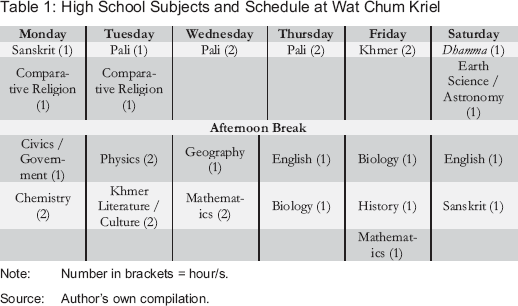
As a traditional temple, Wat KT was seen as an example of good Buddhist practice and monastic propriety where spirits played an active role in ceremonies. Its monks were regularly called on for local life-cycle ceremonies, and the temple itself was a hub of social activity. Within modern Wat CK, the role of spirits was tangential at best; monks even told me that the temple had no guardian neak ta spirit (although I later discovered a dilapidated spirit house that had obviously not been visited for some time). The educational aspect of Wat CK also distinguished it in terms of its modern outlook towards the world. Monks attending the high school studied a variety of subjects – including comparative religion – and took courses in Pali, Sanskrit, biology and civics.
High School Subjects and Schedule at Wat Chum Kriel
Note: Number in brackets = hour/s.
Source: Author's own compilation.
Did the respective traditional and modern orientations of Wat KT and Wat CK influence merit-making activities? Perhaps for some, but their differences were pronounced in many other ways: They were not in close proximity to one another; Wat KT was in a rural area compared to Wat CK, which was in a urban/semi-rural area and located close to the provincial capital of Kampot Town; their respective geographic orientations also led to villages being spread out around Wat KT and more concentrated around Wat CK. Further, as Wat CK was the home of Kampot Province's monastic administration and Buddhist high school, it housed significantly more monks. Thus, its administrative atmosphere and the detached sentiment voiced by monks (who distinguished it from their “home” wat) did not engender close relationships with locals compared to Wat KT, which played a significant role in villagers’ lives.
The presence of wealthy and politically connected patrons, however, was cited repeatedly as the reason locals avoided Wat CK. Further, Wat CK's appeal for these patrons originated less likely from its philosophical outlook and more likely from its large size and equally large number of monks, its proximity to an urban centre (given that wealthy and politically connected individuals came from Kampot Town and not the rural countryside), and from the fact that it was the province's monastic administrative seat and the abbot was the most senior monk in the province. As shown in the following sections, the quality of patronage and its influence on temple relations and on merit-making activities were more significant factors than each temple's respective religious orientation.
Politicisation of the Theravada Buddhist Monastery
Theravada Buddhism has been used throughout history to control the far-flung regions of a ruler's domain. These domains, or mandalas – political apparatuses fluid in terms of territory and lacking a fixed centre – appealed to lesser rulers who were attracted to a king's ability to establish alliances and defeat enemies (Higham in Assavavirulhakarn 2010: 18–19). The cosmological position of the wat and the depiction of the world in terms of space, time, matter and causality (Tambiah 1976: 334) located the king as the pinnacle of society, bonding the physical and spiritual destinies of his subjects to the fate of the kingdom. At the village level, the individual merit created via the wat acted as a “rationalisation for social prestige” helping to explain inequality and social mobility (Mulder 1973: 6, 29–30). Thus, the dhamma, merit and samsara (the cycle of birth, death and rebirth) solidified the king's power and monastic authority while stressing obedience to one's status and position.
As a people's religion, Theravada Buddhism has been both a target and a tool of political manipulation. For example, in 2003 the communist leaders of Laos erected a statue of King Fa Ngum, the legendary founder of the Kingdom of Lan Xang, in an attempt to shore up their declining popularity. Leaders even went so far as to portray themselves as the direct descendants of the king (Thayer 2003: 110). Similarly, political authorities in Myanmar have maintained control over the sangha through the creation of a national committee and honorary titles, countering the monastery's position as an independent voice of moral authority (Hiroko 2009: 230–232).
Within Thailand, codification of the relationship between the monarchy and Buddhism can be traced at least as far back as the fourteenth-century text known as Trai Phum Phra Ruang, which emphasises the ideal Buddhist kingship, the cakkravatti, or universal monarch (Cohen 2003: 243). Modern Thai legislation included the Sangha Act of 1902; the Sangha Act of 1941, which introduced democratic measures into the sangha; and the Sangha Act of 1962, which removed them. Ishii writes that the 1902 act
denied personal charisma and created a situation in which the ‘ex officio charisma’ of monks could sustain popular beliefs. As a result, salvation became inaccessible to people except through the national ecclesia: extra ecclesia nulla salus (1968: 78, emphasis in original).
Tambiah refers to Buddhism's role in Thai society as a “total social fact” (1976: 529): The relationship between the bhikku and the king, the two wheels of the dhamma, encompass the lives of all those falling between them. The king, at the centre of this galactic polity, saw lesser replicas revolving around him who, in turn, were centres which even lesser rulers revolved around, down to the local villager (Tambiah 1976: 70). Being pure and separate from the mundane, the sangha becomes a valid field of merit whereby individuals can sow their offerings with the promise of heavenly reward (Ishii 1986: 12–14). Thus, the dhamma is maintained and transmitted by the sangha, which only exists through outside support; the king supports the sangha as the defender of Buddhism and his support, in turn, contributes to the maintenance of the dhamma (Ishii 1986: 12–14).
In French colonial Cambodia, transferring traditional knowledge within the monastery and state reinforced conceptions of social hierarchy. As the burgeoning Khmer intelligentsia became more vocal, members began working through the Buddhist Institute in Phnom Penh – an institution created by colonial administrators with an eye towards strengthening the central role of the king over rural temples. As Hansen (2004) points out, the connection between Buddhism and Khmer identity in the growing nationalist sentiment of the nineteenth and twentieth centuries was, in certain respects, a reaction to foreign influences and what was being defined by outsiders as “authentic” Khmer culture. The push for independence eventually split the sangha into two main ideological camps, with many joining Song Ngoc Thanh in the Khmer Serei (“Free Khmer”) movement and others siding with Son Ngoc Minh and the United Issarak Front (Harris 2005: 142).
The differences in Buddhism's expression became exacerbated during Sihanouk's Sangkum government with its brand of “Buddhist socialism”. The government's manipulation of class disparities combined with incompetent members of the sangha (Mouly in Meagher 1999: 42) solidified the monastery's role as bearer of the sacred, maintained through the top-down hierarchy of the Khmer state (Ayers 2000: 12). Yet, the political influence which initially divided the sangha became institutionalised following Sihanouk's overthrow in 1970 by General Lon Nol. Ironically it was Lon Nol, an ardent believer in the spells of sorcerers and divination powers of soothsayers, who cast himself as the saviour of Buddhism against the communist aggression which ultimately destroyed the monastery during the DK regime of the Khmer Rouge.
With the collapse of the DK regime in 1979 following the invasion by Vietnam, the Vietnamese-installed People's Republic of Kampuchea (PRK) needed to be propped up with broader societal support. As the government could not rely on the galvanising appeal of Sihanouk, who sought his own opposing coalition to the PRK, it encouraged Buddhism's growth as a source of legitimation (Harris 2005: 197–198). This was codified at least in speech when Pen Sovan, secretary-general of the Kampuchean People's Revolutionary Party (KPRP; later known as the Cambodian People's Party or CPP), noted that monks who interacted with the population were members of the KPRP Front, in effect enlisting the monastery into political service.
By the 1990s the growth of NGOs was often viewed favourably by Western observers as a way to give voice to the oppressed and counterbalance state authority (Marston 2009: 228). A key leader early on who helped link Buddhism to the proliferation of development groups was Venerable Yos Hut, a Mahanikay monk who became a cultural advisor to the Human Rights Division of the United Nations Transitional Authority in Cambodia. Hughes has criticised the conflation of Buddhism with human rights, arguing that human rights in Cambodia are often learned rote with little discussion regarding the deeper meaning of what democracy might hold for the country (in Marston 2009: 236). Although this trend is not necessarily new and can be traced back to Sihanouk's Sangkum government, it exemplifies the continued co-opting of Buddhist institutions by state and increasingly international organisations.
Merit-Making Activities in Cambodia
Heder describes Cambodian society as “interlocking pyramids of patron– client networks” (1995: 425) built on patrimonial as opposed to rational institutions. Khaeng (2006: 227–228) characterises these as supra-net-works, each with its own patron or backer (khnang). Although the relationships established with temples in such a system vary, merit-making remains central to Buddhist practice in the country (Ledgerwood 2008: 163). Individuals often patronise numerous temples, which Kent describes as “evidence of considerable cooperative effort and pooling of resources”, further stating that “the pagoda is ideally the hub of a number of local associations” (Kent 2003: 10). Kent goes on to note that this informal reciprocity, although invisible to outsiders, demonstrates the autonomy of temple communities and can be seen as a form of resistance to both outside influence and administrative officials who lack local legitimacy (Kent 2003: 11).
This informal reciprocity may demonstrate a continuance of communal relationships shaped over decades of instability, relationships which changed, perhaps in an effort to fit the circumstances people found themselves in, pre- and post-1979. Indeed, reconstruction efforts under the PRK government throughout the 1980s and restrictions on ordinations may have strengthened bonds between temple communities (chomnoh) and local wats as the latter became some of the few places individuals could escape the realities of societal reconstruction. Kobayashi defines a chomnoh as “an unbounded social group, defined by shared participation in the activities of a certain temple” (Kobayashi 2008: 177). Yet, he also characterises Buddhist temples in Cambodia as existing in a state of tension and negotiation among participants of diverse backgrounds (Kobayashi 2005: 515). Divisions that emerge among temple members take the form of criticism, or what he calls “lament toward the current situation” while wrapped in the Buddhist ideal of peace (Kobayashi 2005: 515).
That “current situation” often involves donations from powerful patrons, highlighting disparities in wealth while connecting local temples with larger, state-driven efforts to bring rural communities into a broader framework of relationships (Ishii 1968: 865; Keyes 1989: 131–133; Ledgerwood 2012: 197–201). Political patronage can also take the form of alignment with temples believed to have supernatural powers or access to parami, the ten perfections achieved by the Buddha which allowed him to achieve nibbhana. The popular meaning of parami is a benevolent form of power which can be focused by gru parami, or mediums, for specific ends (Bertrand 2004: 156–158). The CPP is well known for its patronage of wats that claim to have cosmo-magical powers, while Prime Minister Hun Sen has all but rebuilt the complex of Wat Weang Chas in the ancient capital city of Oudong (Gyallay-Pap 2007: 92). Guthrie goes as far as to state that Hun Sen's actions are meant to define him as the legitimate successor to the Khmer kings of the former capital (2002: 68).
Edwards observes that this type of patronage has become a type of “racket” where the theatrics of alms-giving by the government are packaged as merit-worthy while suggesting that the monastery may disappear without such support (2008: 220). Kent, likewise, describes temple ground-breaking ceremonies as important displays for ratifying a new kind of political theatre where “power is demonstrated and relations of economic dependency regimented” (2007: 341). For their part, people who live near Wat CK would speak of the day Hun Sen flew to the area in a helicopter, visiting that temple (among others) and offering donations. While this display of power and authority positively reinforced the prime minister's image as patron, it elicited criticism of the temple as being too closely connected to the rich and powerful.
These images stand alongside Hun Sen's portrayal as one who “protects his followers and ruthlessly punishes his enemies” (Hughes in Edwards 2008: 224–225), or what Heder (2011: 208) characterises as “lawfare”: the political use of the law and courts against society. In many ways, the classical image of a dominant ruler acquiring clients through patronage or force represents an entrenched vision of Cambodian power – a power that both opposes the change demanded by some foreign donors and is perpetuated through the aid given by others without preconditions. If the lowly monk represents the “rice field of merit” (Forest 2008: 17) from which merit-making acts bear fruit, overt demonstrations of gift-giving by powerful individuals catalyse dominance through intimations of kingship.
Merit-Making Activities and the Latent Ideal in the Communes of Chum Kriel and Prey Thom
The presence of political elites and other influential donors can bring many changes to local communities, from the disruption of daily life to the potential loss of autonomy. But the overt presence of political groups also disrupts the role of temples as institutions of identity creation – places where children are schooled, young men and women socialise, and some local males serve as monks. The perceived intrusion or even usurpation of this personal relationship calls into question what little control Khmers have over their lives and those institutions which impact them directly.
“Control” has been out of the hands of Khmers for quite some time. Compared to neighbouring Thailand, Cambodia did not so much as step into modernity as it was dragged in. Yet, Kent also describes temples as offering hope of “restoring local microcosms of universal order in which the ideal ruler – the righteous king – is supposed to ensure the proper relationship between ordered life and the forces of chaos” (2007: 339). Those “local microcosms of universal order” are realised on the local level through the relations between villagers and temples and the strategies individuals employ when dealing with influential elites.
Although politicians and wealthy individuals donate large sums of money for construction projects, they differ from those projects funded through rural community networking and what Kobayashi calls “village Buddhism” (Kobayashi 2008: 170). As he notes in his work in San Kor Commune in Kompong Thom Province, while the building of temples is seen as a meritorious act, the funding available for such projects is minimal given the monetary limitations of rural villagers (Kobayashi 2008: 170). Outside funding is sought; however, with it can come tensions that can diminish a temple's standing in the eyes of those it normally serves.
Given the experiences of Khmers over the past forty years, merit-making activities that are money-oriented may be an unavoidable consequence of history. And while I have been present at many T'ngai Seul (the uposatha or Sabbath) where locals would talk and joke in the salaa as the achar (lay ritual specialist) read off the names of donors and donations much like an MC at a fundraising dinner, these activities also provided solidarity. For temples such as Wat KT where donations by locals were often only a few hundred riel – at most a few thousand (1 USD equals roughly 4,000 KHR) – it was more the communal atmosphere of the event than the value of offerings which reaffirmed ties.
By contrast, monks studying at Wat CK would go about their ceremonial duties, but the lack of connection was apparent on days such as T'ngai Seul, which some monks had trouble keeping track of and which brought in far fewer visitors. This difference was also noted by individuals regarding temple patronage. Those who patronised Wat CK were said to be neak mean (rich or well-off individuals) and generally linked to elite circles or urban centres, while neak srok or neak srok srae (country people) were associated with Wat KT, regardless of their actual solvency.
In line with Kent's (2003) research, there was a tendency for attendees at both temples – both neak mean and neak srok – to patronise numerous wats; the more temples/ceremonies one attends, the more opportunities there are for making merit. Yet, how individuals maintain their “merit portfolio” differs according to age, gender and life history. For younger members of the community, attending rituals at numerous temples was also a means of socialising outside of normal hours (such as during Pchum Ben, the festival for the dead). Parents were even said to split their children up, sending them to different temples, thus maximising merit-making activities.
As Ledgerwood (2012) demonstrates in her study of a Pchum Ben ceremony in Kandal Province, the festival has become a means for reintegrating the multitudes who died unknown and agonising deaths under the Khmer Rouge. Temple rituals become a declaration of membership in that unbounded group, reaffirming an individual's commitment to the group's shared trials, or in the case of Pchum Ben, reintegrating the deceased. What this membership also demonstrates is a shared vision of Buddhist temples, even if it is an idealised vision, one that bridges pre-and postwar Cambodia. It is both an ideal of continuity with the past and a social critique of temples at which outside influence precludes and excludes local activities.
Those activities include, first and foremost, the creation of merit. Thus, the lack of monastic propriety (realistic or idealised) in one temple (Wat CK) was a reason to patronise another (Wat KT), but not the motivation for attending either in the first place. Creating merit was the catalyst which drove most villagers to certain wats and it was likewise this ability to facilitate the creation of merit that was seen as evidence that monks were true to their position in society. Those temples that strayed from the ideal demonstrated by close associations with the rich and politically powerful displaced the potential for merit-making acts among locals, which brought corresponding criticism.
This is not to say that there can be only one ideal. Although not interviewed for this study, political elites could have their own perspective of what constituted an ideal, and perhaps Wat CK exemplified it. And there are also temples that have a special status for all Khmers regardless of social background; the temple complex of Oudong, for example, holds a special place in Khmer antiquity. And while it is the recipient of large amounts of money from Prime Minister Hun Sen, it nonetheless receives patrons from all over the country.
As an institution, though, and one that a largely rural population such as that of Cambodia relies on for spiritual, social and educational support, the Buddhist monastery is a fundamental part of the lives of many, and it is more than a place for special events or the occasional festival. Merit-making addresses the real needs of local Khmers and acts as a bulwark against the psychological and physical stress that comes with a meagre and at times uncertain existence. Supplanting local participation brought criticism as it was proof of both a monastery's “rich” status – a stray from ideal behaviour – and the associated decline in its ability to support local merit-making activities.
An event during Pchum Ben illustrates this point more clearly. Around 4 a.m., a Khmer friend named Tommy and I bicycled out to Wat CK for the morning ceremony which included monks chanting the dhamma followed by attendees circling the temple three times and leaving food on the ground for ghosts and spirits of the dead. On arrival, the temple was completely silent, prompting Tommy to comment, “Sorry, I think the monks must be lazy.” Not soon after, an older gentleman riding by on a bicycle stopped and expressed his discontent with the temple: “The monks there [Wat CK] are no good, they take rice from the people and then get rich.” Visibly dismayed as he had spent time arranging both of our offerings the night before, all Tommy could say as we rode off into the darkness was, “I won't come here again.”
When I went to the temple later that afternoon, it was hosting a crowd of approximately sixty well-dressed people, many of whom were from the Ministry of Cults and Religions (all the local ministries were said to have booked time at the temple during Pchum Ben). It was a festive occasion, as it was the twelfth day of Pchum Ben, towards the end of the fifteen-day ceremony. Inside there was a much more charged atmosphere than at other ceremonies I had attended. The achar read the names of donors and their large donations, his voice blaring over the loudspeaker amid the clatter of attendees that filled a nondescript salaa. Juxtaposed against my experience that morning, the scene highlighted local expressions of exclusion and what many perceived as a “rich” temple beholden to powerful groups where the ability to make merit was significantly reduced.
Yet, that ability must be weighed according to what Graeber (2005: 451) calls “fetishism”, or the assumption that value comes from the token involved and not from the individual. That is, the value attached to an offering as opposed to the motivation to make one in the first place. During merit-making activities, offerings are frequently weighed against the context in which they are made. The building of a new temple or the enshrinement of a Buddha statue, for instance, will generally elicit more elaborate offerings than those on T'ngai Seul. And with greater status comes even larger offerings, both real and expected, echoing Bowie's observation that “when rich and poor claim to share common ethical principles, morality can become a weapon of the weak against the strong” (1998: 475).
Could rural communities’ expectations of larger gifts by wealthy individuals be seen as a cause for a given political group's patronage of certain temples? The answer lies in the distinction between secular and religious “gifts”. Infrastructure projects drew local support for the CPP, but improvements to roads or irrigation canals were activities that people expected to be undertaken by the government. Merit-making, however, involved political organisations establishing relationships with the monastery through direct material and monetary support, which distorted the monastery's moral authority and obviated local villagers’ ability to create merit. Thus, while irrigation canals drew support for the CPP, the party's support for the monastery led to a backlash from the community against certain temples. However, realistically, temples are also in no position to turn political groups away without potentially offending those in positions of power, which could have even more severe consequences.
Even though the donations by people living near each temple could not match those of outside groups, when the local community was actively involved in the lives of the temples, the shared sense of participation facilitated a shared sense of merit-making. Thus, when a Khmer expatriate from the US made a large donation to Wat KT during Kathen, the fact that locals were approached beforehand regarding a connected ritual was what mattered. For locals, their being involved in the process served to uphold their idealised image of the wat, enabled their attachment to the offering, and transformed what was otherwise an individual offering into a communal one. Influence by political and otherwise powerful elites disrupts this cycle. Monks are seen as operating for the rich and powerful while their role in merit-making activities is cut off vis-à-vis those who need it most. The monastery is then criticised not because it receives goods per se, but because it accumulates material wealth from a segment of society that is already in a good position in this life while creating a social barrier for another segment that is not.
The irony of the current situation is that the idealised image of the monastery is threatened by Edward's notion of a “racket”, described above, via a political body that on the one hand acts as the protector of the monastery, and on the other is made up of senior officials responsible for its dismantling under the DK regime. Traversing the twisting road of Cambodian historical revisionism is perhaps the only way the latent ideal and the racket could meet. Even so, the strategies ordinary Khmers use to define their involvement and membership within temples are not always straightforward, with new associations stretching the limits of even unbounded groups. Further, if Theravada Buddhism and engagement in rituals are means for Khmers in the diaspora to reaffirm their ethno-religious identity (Thibeault and Boisvert 2010), then the revival of the monastery demonstrates deep-rooted monastic moral authority.
Monks at Wat CK admitted, though, that there were still some among their ranks who entered the monastery for reasons other than strictly Buddhist ideals. This is not necessarily unique to Cambodia, as the monastery has traditionally been a vehicle for social mobility within Theravada Buddhist countries (Tambiah 1973: 74; Suksamran 1982: 23; Stuart-Fox 1983: 432; Hiroko 2009: 215–216). However, the social cohesion nurtured through monastic service was also an important aspect of a temple's economy. As parents were said to patronise wats where their children served, a son's service fostered merit-making activities and reinforced bonds within the community.
A steady stream of shiny new Toyota sedans and SUVs filled with politicians (usually CPP members) during holidays was the surest way to prevent this temple–community cohesion and keep local villagers indoors and away from Wat CK. Such events at Wat KT, however, were infrequent and did not take on similar negative connotations. The manner in which people would patronise Wat CK also influenced local perceptions. Coming from outside the area meant the well-off had little connection with the surrounding communities to begin with, while the “give-and-go” manner in which they would arrive, offer gifts and then quickly move on did little to facilitate interaction with locals. This was somewhat different from the strategy employed by villagers when patronising several temples, given that their movements were on foot (or at most by motorbike), resulting in longer stays and greater interaction with others.
Internal factors also played a role in shaping temple identity. For Loak Loan, the educational and administrative features of Wat CK overshadowed its religious aspects: “Chum Kriel is different, that's why there [are fewer] people. It's the same as Wat Kompong Tralach but different – we go to school here, that's it.” For many, the scholastic and administrative characteristics of the temple, the monks’ detachment and the temple's association with politically connected patrons were signs of corruption and a lack of social order, further entrenched by displays of privilege.
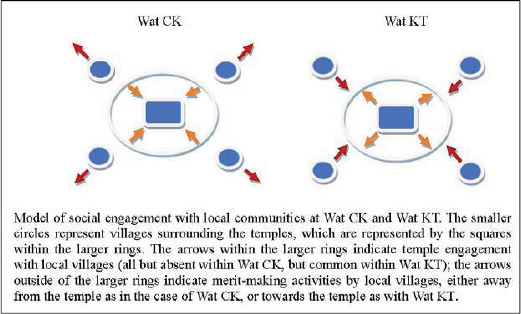
Social Engagement and Merit-Making Activities
These factors had the effect of turning the traditional/modern juxtaposition on its head. Traditional Wat KT with its inward spiritual focus was nonetheless socially engaged with the local community given that monks were from the surrounding villages and were regularly called on to perform rituals and life-cycle ceremonies. Wat CK, however, although more engaged with the world academically, as seen in the temple's high school curriculum above, had little social engagement with surrounding villages, resulting in locals going to outside temples for merit-making activities (monks even admitted that they went to houses outside the immediate area for their daily alms, as some local families refused to donate rice).
During the festival of Pchum Ben, a noontime meal at Wat CK had been booked by the Ministries of Finance and Information (the previous day it had been booked by the Ministries of Culture and Women's Affairs). The usual batch of vans and new cars filled the temple's courtyard as local children took the opportunity to play inside the vihear, which was normally locked. In one vehicle came a monk from Phnom Penh who had travelled to the wat to dole out donations on behalf of a wealthy Khmer expatriate living in the US. Following lunch, dozens of monks stood in a row facing the courtyard, each quietly accepting a donation before making their way back to their quarters. Even though the donations distributed by the visiting monk were made by someone overseas and not by a member of the government, the political presence was more of an issue for many in the local community. One woman I spoke with, Savang, smiled as she told me: “Hun Sen has a special relationship with them [Wat CK]. He came here many times.”
“Hun Sen controls the state so he can give money, but monks vote for Sam Rainsy because he's against corruption. But he doesn't build anything”, said Loak Loan when describing politics and local support for the CPP. Accepting patronage from one political party while voting for a rival that is against corruption may demonstrate adherence to idealised behaviour or even an internal politicising effort on the part of the monastery. Nevertheless, at least in the case of Wat CK this acknowledgment did not extend beyond the temple's gates. Further, the at times overwhelming political presence combined with the monks’ views that the wat was a place for education as opposed to their “home temple” validated the belief that the monastery was bound to outside groups. Thus, when political authority moved from the secular (building projects) to the religious sphere, it generated expressions of disillusionment by locals such as Savang, who sent her children on merit-making activities to other wats.
What this avoidance and support for other temples showed, though, was more than just a fluid resistance but a claim of right to define a monastic ideal when faced with the effects of political patronage. While local infrastructure improvements were appreciated and garnered support for the CPP, donations by political elites to Wat CK brought disapproval directed towards monks who were said to become “rich” through those donations even though they were in no real position to deny such patronage. This “antagonistic symbiosis” (Nissen 2008: 283), or resistance to political influence and to the destabilising effect it can have on monastic identity and temple/community relationships may appear contradictory. Yet, through this social criticism, local villagers maintained relations with wealthy, politically connected donors while simultaneously expressing their disapproval of political influence within the monastery, positioning the current state of the wat against images of the past – that latent ideal of what the monastery was or was thought to be.
This criticism is not without substance. During Kathen following the three-month retreat for monks during the rainy season, monks accept gifts of money, food and material goods as an act of gratefulness. “We can go around and receive many gifts and finally leave the wat. Monks like it the most”, as one monk at Wat CK put it. And although enjoying gifts is not necessarily evidence of straying from a latent ideal, the ceremony can be used as a means for acquiring material wealth. A monk staying at a temple other than the one he normally resides at could (and some do) use the occasion to receive multiple donations at both his wat of residence and his home wat – and those with influential ties have an even greater capacity to do so. Are the people giving gifts perpetuating less than ethical monastic behaviour in their acquisition of merit, or are they merely performing a moral deed? And what of monks? Using a ceremony to obtain material goods may seem at odds for those who have taken a vow of poverty. However, as monks depend on outside donations – and have a duty to inspire good moral character through facilitating moral deeds – their actions can be seen as reasonable.
Nissen argues that the Buddhist logic of kamma and punishment legitimises corrupt practices, which can be rebranded as gift-giving (2008: 285). If a bribe is a “gift” and a payoff a “donation”, then those committing the offense have, in fact, committed no offense at all but a moral deed worthy of good kamma. Indeed, the fact that a person is in a position to offer such a “donation” could be argued as evidence of the moral deeds performed in a former life, legitimising what is otherwise blatant dishonesty. Having spoken with numerous Khmers about this dilemma in regard to the Khmer Rouge, I have come to refer to it as the “Cambodian conundrum”: Those who performed wicked deeds during the DK regime acquired titanic amounts of bad kamma for their acts. However, they acquired positions of power from which they performed those wicked deeds because of meritorious acts performed in a previous life.
This riddle perpetuates corruption and may in some ways help to explain the decades-long struggle to bring the Khmer Rouge to justice. And while people can easily legitimise their corruption as rebranded gift-giving, monks cannot. Overt political influence within the monastery, therefore, is in Nissen's words “a symbolic pollution of the sacred”, disrupting the moral order to a greater degree than the routine, even expected, corruption of bureaucracy (2008: 287).
While the chomnoh of Wat KT could not prevent overtures by the rich and powerful, the community was nonetheless such a constant presence that bypassing them was not an option. Wat CK, however, reflected the observations related to Kent by a Khmer official from the Ministry of Cults and Religions, who noted that inviting CPP officials was beneficial for a new wat in Battambang in order to secure party support and protection (Kent 2007: 347). Yet, overtures made by an abbot of another temple to the rival party, FUNCINPEC (National United Front for an Independent, Neutral, Peaceful, and Cooperative Cambodia), led to a lack of police security for a temple ground-breaking ceremony, disgruntled local CPP members, as well as insolvency when a FUNCINPEC official borrowed money from the wat in order to make donations to other temples (Kent 2007: 347–348).
The fact that overtures were made to officials of the two main political parties reflects the reality of rural villages dependent on political patrons for support. How much of a presence locals would tolerate before a temple was labelled “rich”, though, depends also on the actions of monks and their involvement in the local community. This appears to delineate acceptable secular actions and unacceptable religious overtures. Villagers may and often do accept infrastructure improvements, which may garner support for the dominant political party. However, when patronisation brings temples overt political association, locals direct their discontent towards the monastery, placing the onus on temples for adhering to the latent ideal while maintaining relations with government entities that are expected to be corrupt but on which they depend. And while it can be said that political groups establish their own relationships via merit-making activities, or that local communities form associations with temples just as strong as any political group, it is in the perceived straying from the ideal – that “lament toward the current situation” (Kobayashi 2005: 515) – that often characterises local perceptions and activities.
The level of association and repetition of such merit-making activities, though, are significant factors in how those acts affect relationships and perceptions of temples. An example at Wat KT alluded to above involved a Kathen festival put on by a Khmer expatriate originally from Kampot Province but with no direct connection with the wat. One morning, ten large vans filled with passengers made their way to the wat, which was filled with flowers and audio equipment for the event. The individual putting on the ceremony was reported to have donated 5,000 USD to the temple. Unlike a similar Kathen festival put on by a local government ministry at Wat CK, the expatriate's festival at Wat KT was a special event given the significant time spent travelling to the temple and the fact that he specifically chose the temple over others. Further, as the temple's chomnoh was directly involved, the process became less about the individual and more about the entire community, changing the outlook of the festival from an individual to a collective effort through extending the expatriate temporary membership into the broader group.
As with Kobayashi's (2008) definition of chomnoh, the openness of participation and the fluid environment of Wat KT allowed for the community to facilitate the inclusion of the expatriate's festival, which brought greater prestige to the temple in the eyes of locals. Whereas the Khmer expatriate made a special trip to Wat KT one time (and would probably not repeat), local ministries’ repeated patronage of Wat CK reaffirmed the temple's proximity to elite spheres. Thus, the lack of repetition contributed to the sense of community within Wat KT without diluting it; in addition, the temple has been able to satisfy occasional special requests for membership whose infrequent nature has served to garner respect rather than derision for Wat KT.
Political Economy and Social Networks
According to Sedara and Öjendal (2009: 124), political reforms have reinforced non-democratic practices along patronage lines on the local level while consolidating power by the CPP nationally. Ledgerwood (2012: 202), similarly, cites disparities in wealth – which are more pronounced today than in the prewar years – as driving both the pursuit of economic opportunities and attachment to political patrons for protection. To some extent, the latter has undoubtedly been the case throughout much of Cambodian history. However, the concentration of wealth coupled with an increasingly interconnected Cambodian society has brought many rural Khmers into contact with the politically powerful through political groups’ association with certain wats and their increasing presence in temple affairs.
These connections represent a considerable contrast to the pre-1975 social order, but as substantial change has been the hallmark of Cambodian society since the latter half of the twentieth century, these shifts are not necessarily surprising. Well-off city dwellers have the opportunity to engage in more elaborate merit-making activities than before, thus they are able to position themselves as patrons to their rural counterparts. Likewise, the social networks of even rural villagers created through extended families and modern telecommunications can afford them greater access to politically connected groups and resources. This in turn validates their client status as part of the process of reciprocity, further entrenching conceptions of status and role.
The political economies of the two temples in this study reflected these changes and comprised two ways individuals and groups came to associate with the monastery. Wat KT depended a great deal on support from surrounding villages, drawing in individuals and groups through a radiating web. Wat CK, though, could count on donations from wealthy patrons, attracting affluent and politically connected individuals in a more linear manner ranging from local-level politicians up to the prime minister. Yet, as shown, this support is bifurcated, as it can garner backing for politically funded infrastructure projects while working against temples for being the recipient of political patronage. Wat CK was visited three times by Prime Minister Hun Sen, was the seat of provincial monastic administration, and boasted a large number of resident monks. However, this did not translate to greater numbers of local visitors. Indeed, the opposite was the case: Its political economy was an exclusive economy.
The burial at the wat of an army general killed in 1995 by the Khmer Rouge on a highway near Chheuk District, forty kilometres outside of Kampot Town, exemplifies this exclusivity. Although he did not have any specific connection with Wat CK, his ashes were placed within a large chedey (reliquary) that his family had built for him next to the temple's vihear. Having his remains kept there was a sign of his wealth, while the ability to afford a large chedey brought him an increased status in death and likely enhanced the status of his family. The fact that the general's family had the means to build a chedey was also believed to keep his spirit from wandering the countryside, an option normally unavailable to poor, rural villagers. Given the general's place in society, Wat CK was the likely choice for a man in his position regardless of his actual association with the temple. Thus, the temple's vertical connections stemmed from the wat to influential outside groups who otherwise had little interaction with the rest of the community.
Although locals were not barred in the literal sense, traditional social hierarchies and that invisible barrier dividing neak mean and neak aat mean (the “haves” and “have-nots”) of Khmer society are still powerful social forces defining associations throughout the country. Far from feeling dispossessed, though, many close to Wat CK took on an aloof affect regarding the presence of wealthy patrons. Savang, the local woman noted above, commented that the temple was an “old person's wat” and not one young people would normally attend. Although she may have justified sending her children to other wats for merit-making activities this way, her statement also illustrates an important detail: While social networks were not realistically open to local villagers, access may be a moot point. Attempting to cross social barriers would almost certainly start rumours in a community where local news travels fast and solidarity over the latent ideal is strong. In such a context, the exclusivity of social networks is linked as much to a desire to be a part of them as it is to ability.
The web-like connections at Wat KT provided a different model given its integration within the surrounding community. Local economic engagement was high while the involvement of political elites was low, save for rare visits and donations. The temple's broad-based networks were indicative of both the rural and somewhat detached environment surrounding the temple and the interconnectivity of the commune. Monks at Wat KT came from Prey Thom Commune; life-cycle ceremonies in the surrounding villages were attended to by the temple's monks, who benefitted from local donations; and the temple's primary school educated local children while families participated in the wat‘s functions on a regular basis. For the Khmer expatriate noted above who put on the Kathen ceremony, the ritual began with his initial engagement with the community. Locals were part of the process, part of the economy, and were recognised as having an ongoing relationship with the wat. Far from being a temple surrounded by disconnected locals, Wat KT functioned because of local engagement, not in spite of it.
Monks at both temples were taciturn regarding politics. In private, they supported reform but were cognizant of the difficulties in bringing about real social change. As Cambodia continues to juggle its allegiances to outside powers in the quest for greater economic aid, greater political intrusion into monastic affairs can be expected. Regardless of the centrality of the Buddhist wat in the lives of Khmers, the need for an independent monastery free from political influence is weighed against its dependency on outside support, which has the propensity to bring both pressure from influential groups and increased politicisation.
Conclusion
This paper presented a study of merit-making activities in two Theravada Buddhist temples in southwestern Cambodia and the effects of political influence in local Buddhist wats. The relationships that people established with local temples were driven in part by a latent ideal of monastic institutions, which acted as a social critique of temples where political influence precluded merit-making activities by local villagers. This ideal, espoused by monks, politicians and laypeople alike, has been a hallmark of Khmer monastic identity and continues to define relationships between local villages, temples and powerful outside groups.
Whereas Swearer noted that middle-class laymen were critical of politically active monks following independence in Ceylon in 1948 (1970: 262), criticism by Khmers in this study was directed towards monks and temples which were the recipients of political patronage. This criticism often manifested itself in peoples’ avoidance of “rich” temples in favour of smaller, less solvent temples at which they performed merit-making activities while keeping on good terms with political groups that provided money for local infrastructure projects. Criticism and avoidance, therefore, demonstrated the continued importance of merit-making activities for local communities while simultaneously acting as a claim of their right to define what Buddhist institutions should represent. Thus, while the latent ideal was a symbol of continuity, it also represented a strategy of determinism.
The latent ideal also reveals how political economies and social networks affect local wats according to status and an individual's ability to access resources through networks established via merit-making activities. The poor, rural status of the smaller temple in this study, Wat Kompong Tralach, drew broad support from both locals and non-locals; yet, local support and patronage outdistanced support from outsiders. Its appeal expanded in a web-like fashion, radiating out among local villages. Its integration within the local community ensured that it continued to receive support while the limited political influence allowed it to retain a level of notoriety without diluting its standing within the area. The other temple in this study, Wat Chum Kriel, with its “rich” status, large size and equally large number of monks, received far more in terms of outside donations. However, the status of its donors – political parties and wealthy elites – adversely affected local support, resulting in a more linear political economy. Local villagers felt disconnected from the temple and the (more solvent) patrons who comprised its social network.
While political influence within the monastery obviates the ability of locals to engage in merit-making activities, it also raises questions regarding the ability of temples to remain independent. Do they have a responsibility to reject what they see as undue political influence? Or does the necessity for outside support make such influence an inevitable part of development? These are difficult questions which monks at temples such as Wat Chum Kriel deal with regularly. In the end, those within the monastery have to contend with the fact that patronage by elites is a double-edged sword, bringing prosperity to a temple while at the same time alienating local villagers, who rely on temples and merit-making activities the most.