



Abstract
In recent years, the Chinese government has increasingly utilised online consultation as a means of providing citizens with opportunities to offer feedback on draft laws and regulations. As little is known about the operation of online consultation, this article analyses the content of citizen feedback submitted on a revision to China's health system proposed by the National Development and Reform Commission. Citizen engagement with the political and substantive issues under consideration is crucial if online consultation is to impact government decision-making and enhance the performance of laws and regulations. This paper's main findings are that it was common for comments to address substantive issues in great depth, as well as express negative assessments of government decisions. This suggests that online consultation holds promise as an instrument of governance reform, which the Chinese Communist Party has embraced as a means of cultivating popular support.
Introduction
One of the enduring questions about Chinese politics concerns the ability of the Chinese Communist Party to maintain its monopoly on power in the face of significant economic, political, and social challenges. As part of its ongoing effort to cultivate popular support, the party has initiated a number of reforms in recent years (such as public discussions of budgetary priorities and the adoption of social welfare benefits and sustainable energy policies) oriented towards improving governance and the provision of public goods (Dickson 2011; Fishkin et al. 2010; Saich 2007). A particularly salient instrument of governance reform is online consultation, a process through which citizens are provided with opportunities to offer feedback on proposed government policies. In 2012, for example, it was widely reported that citizen comments on draft revisions to China's criminal procedure law prompted the central government to relax some of the proposal's most stringent provisions regarding the undisclosed detention of criminal suspects (Ford 2012).
Research on the Internet as a means of fostering discourse between government officials and citizens has thus far mainly focused on identifying the theoretical possibilities of information and communication technology. Empirical analyses of experiences with online consultation, by contrast, have not yet been a focal point of observers of the Chinese Communist Party's approach to governing the Internet (Zhou, Chan, and Peng 2008). One area of inquiry where especially little is known concerns the nature of citizen feedback provided in response to draft laws and regulations.
This article 1 takes up this challenge by analysing citizen feedback submitted on a revision to China's health system that was proposed by the National Development and Reform Commission (NDRC) (Thompson 2009). The analysis focuses on the content of a sample of more than 500 citizen comments that were posted to the NDRC's website during a one-month feedback period. The research question is as follows: To what extent do comments contain politically informative and substantively salient arguments and evidence about health system reform? Political information consists of feedback expressing support for or opposition to the health system and reform proposal. Substantive salience entails comment engagement with specific aspects of the health system (such as rural health care and the costs and coverage of government-sponsored health insurance systems) that were articulated in the reform proposal.
The comments of Shanruo Ning Zhang are greatly appreciated, as is the feedback provided by the editor and anonymous reviewers. The Department of Political Science at The George Washington University, Fulbright Scholar Program, and Sigur Center for Asian Studies at The George Washington University made this research possible through the provision of generous grants.
This research question has fundamental implications for characterising the performance of online consultation as a means of governance reform. One pressing concern with online consultation, and governance reform in general, is that such instruments serve merely to provide a veneer of popular legitimacy to decisions that government officials have already finalised (Dickson 2011; Horsley 2009; Gallagher 2006). Although such concerns are difficult to evaluate objectively given the opacity of the Chinese policymaking process, it is possible to analyse the political and substantive nature of the feedback provided in response to draft laws and regulations. Citizen engagement with the political and substantive issues under consideration, in contrast to comments that uncritically ratify proposed policies, is a crucial element if online consultation is to impact government decision-making, enhance the performance of laws and regulations, and cultivate popular support for the Chinese Communist Party that is sustainable in the years ahead.
State of Online Consultation and Citizen Feedback
Online consultation and citizen feedback are relatively new instruments in Chinese policymaking. A necessary condition for the emergence of these instruments has been the extraordinarily rapid growth over the past decade in the proportion of the Chinese population that has access to the Internet. At the beginning of 2001, there were 22.4 million Internet users in China (China Internet Information Center 2001); this number had expanded to more than 513 million users by the end of 2011 (Horn 2012).
Online feedback is also in its infancy because Chinese governments have not typically utilised the Internet as a means of engaging citizens in the making of public policy. Government websites have primarily been oriented towards publicising projects and services (Guo 2006; Jiang and Xu 2009). Exceptions to this overall characterisation include websites that provide citizens with opportunities to directly contact public officials and report instances of government corruption (Hartford 2005; Lollar 2006).
As a general matter, research on online citizen political expression has focused on contexts outside of official government decision-making processes. In one such example, researchers examined the content of 555 blog posts that offered commentary on current affairs (Esarey and Xiao 2011). Nearly two-thirds of the blog posts contained some form of criticism, with the central government being the target of approximately 20 per cent of these critical posts (Esarey and Xiao 2011; see Zhang 2009 for similar findings). Many of these blog posts utilised government statements themselves as a means of buttressing criticisms of corrupt practices and injustices in policy implementation.
In another example, researchers analysed the content of 380 threads that were posted to the discussion forum on the website of Guangzhou Daily, the official newspaper of the Guangzhou municipal party (Zhou, Chan, and Peng 2008). In contrast to the blogosphere, Guangzhou Daily‘s forum is relatively devoid of political discussions and posts that are critical of the government. Although the prevalence of follow-up comments increased over the period under analysis, little evidence emerged of deliberative practices such as substantive engagement with the ideas and evidence presented by previous participants.
Historically, Chinese citizens have been afforded few opportunities to comment on proposed government policies. From 1949 through 2007, the National People's Congress (NPC) released a total of 15 draft laws for public comment (Horsley 2009). In 2001, the NPC circulated a draft marriage law proposal via the Internet, the first such example of online consultation (Horsley 2009). During the early years of the twenty-first century, a number of NPC proposals generated tens or hundreds of thousands of comments. One such proposal was a draft labour contract law that was substantially revised in response to citizen feedback, some of which was provided by ordinary workers (Horsley 2009).
In 2008, it was announced that the State Council “will make use of the Internet as a standard method of inviting public opinion on draft laws and regulations” (Xinhua 2008a). This announcement followed an experiment in the second half of 2007, during which thousands of comments were received on seven draft regulations (Ding 2009). On the part of all central agencies and all levels of government, the State Council has eventual plans to establish a nationwide system for facilitating online consultation (Horsley 2009).
Citizen feedback that occurs within the institutional context of official government policymaking naturally raises questions regarding substantive salience and political informativeness (Fung and Wright 2003). Participants in government-sponsored meetings in Zhejiang Province, for example, indicated concerns about expressing opinions hostile to decision-makers and established courses of action (He 1997). These concerns highlight a danger inherent in the Chinese Communist Party's pursuit of governance reforms. Rising citizen expectations that are not met with commensurate gains in government performance and accountability run the risk of fostering popular disillusionment (Dickson 2011; Gallagher 2006). Citizens whose optimism turns into disenchantment may come to the conclusion that incremental reforms are ultimately not sufficient for bringing about expected improvements in policymaking processes and outcomes.
A key element, then, in assessing online consultation as a governance reform is the political and substantive content of citizen feedback. One approach to making inferences about citizen opinions is survey research. A survey conducted of more than 500 citizens who offered feedback on the health system reform proposal suggests that the comment period did not operate, from the perspective of the participants, as a mere instrument for the ratification of government decisions that had already been finalised (Balla 2012). In fact, expressing concerns about the health system reform proposal was a more frequently cited motivation for the submission of comments than articulating support for the draft as it had been developed to that point.
An alternative approach to assessing citizen opinions is to analyse the content of feedback provided in response to draft laws and regulations. This approach entails evaluating comments for the provision of information regarding the political and substantive consequences of proposed courses of government action. If online consultation does more than legitimise decisions that have already been finalised, then citizen feedback should engage government officials on the political and substantive merits of the issues under consideration.
At the time of the circulation of the health system reform proposal, official media sources portrayed the emergence of a vigorous national debate, with citizens articulating a wide array of substantively salient suggestions, some of which were critical of government policies (Xinhua 2008b). As a means of investigating the content of citizen feedback, this article presents the results of an analysis of a sample of comments submitted in response to the health system reform proposal. The analysis reveals that it was normal for comments to address substantive issues in great depth and express negative assessments of government decisions. In what follows, a context for these results is provided through a description of the health system reform process and the comments that constitute the basis of the analysis, as well as a discussion of the limitations and implications of this research for governance reform and stability and change in the Chinese political system.
Health System Reform Comment Process
Health system reform was one of the NDRC's initial applications of online consultation with the citizenry. In the decades following economic reform and opening up, the proportion of the Chinese population with health insurance dropped substantially; approximately 50 per cent of urban residents and 90 per cent of rural residents lacked coverage of any sort (Liu 2004; Yip and Hsiao 2008). In light of such difficulties, the Chinese Communist Party has taken a number of steps to improve its governance of the health system.
In 2006, the State Council formed the Health Care System Reform Coordinating Small Group (Thompson 2009). This high-level committee was tasked with designing a health system that would, among other attributes, provide universal coverage to both urban employees and rural residents. As part of this decision-making process, the committee solicited reform proposals from a number of outside organisations, such as leading Chinese institutions of higher education (e.g. Peking University) and international non-profits (e.g. the World Bank). Although the government prohibited the public release of these documents, evidence suggests that the proposals varied substantially in approach and specific focus (Thompson 2009). Some proposals envisioned a state-led system, while others called for a mix of public and private provision. The proposals also addressed issues such as disparities in health care access across urban and rural residents, the spiralling costs of pharmaceutical products, the compensation of physicians, and the operation of hospitals and other service locations.
In October 2008, the central government announced, via the NDRC website, the broad outlines of a plan to reform the health system. The plan (which along with associated materials can be accessed at http://shs.ndrc.gov.cn/yg/) laid out the objectives that the system would be expected to meet, such as providing urban and rural residents with access to basic health services, improving the sharing of information about matters of public health, promoting traditional Chinese medicine (TCM), and ensuring the safety and affordability of pharmaceutical products (China Daily 2008). Concurrent with this announcement, the NDRC opened a one-month feedback period, during which nearly 30,000 comments were submitted.
For the research presented in this article, information was collected for a sample of 541 comments on the health system reform proposal. This information is derived from the detailed coding of a wide array of attributes and attitudes expressed in the comments. The comments do not constitute a probability sample, but rather were selected according to several considerations. During the feedback period, the NDRC offered participants the option of submitting an email address along with their opinions on the proposal. Of the comments that were received, 6,402 contained valid information in the email address field. In collaboration with the Research Center for Contemporary China at the Peking University School of Government, a survey instrument was delivered as an attachment to these email addresses (Balla 2012). Completed questionnaires – which provide detailed information about a number of participant attributes, attitudes, and behaviours – were received from 541 respondents. As a result of the survey instrument, unique information exists about salient characteristics of this particular sample of participants, which is of great utility in providing a context for the results of the analysis of the content of citizen feedback.
The sample consists of individuals who are, for the most part, well established in
Chinese society (Balla 2012). These individuals are typically males employed in
well-regarded professions ( , zhuanye jishu
renyuan) – in many instances, specifically in the health care industry.
The participants were largely motivated to submit comments on the basis of personal
and professional experiences with the health system. They expressed concerns about
the current system and the reform proposal more often than they did support for
government policy and decision-making. Overall, the participants held modest
expectations regarding the government's responsiveness to information contained in
comments, with the exception of heightened expectations for submissions emanating
from government organisations and the health care industry.
, zhuanye jishu
renyuan) – in many instances, specifically in the health care industry.
The participants were largely motivated to submit comments on the basis of personal
and professional experiences with the health system. They expressed concerns about
the current system and the reform proposal more often than they did support for
government policy and decision-making. Overall, the participants held modest
expectations regarding the government's responsiveness to information contained in
comments, with the exception of heightened expectations for submissions emanating
from government organisations and the health care industry.
To facilitate analysis of the content of participants’ feedback, a protocol was developed for coding the substance of the comments. The protocol was implemented by this paper's second author, who, as a native of China, reads Chinese characters with fluency. With a single coder, the reliability of the resulting decisions has not been verified in a systematic manner. Comments were coded for a variety of attributes and expressed attitudes. For example, comments were differentiated by the extent to which they express positive or negative sentiments (highly positive attitude, moderately positive attitude, mix of positive and negative attitudes, moderately negative attitude, highly negative attitude, neither positive nor negative attitude) towards the existing health system and the reform plan as it had been developed to that point. The substantive focus of comments, which was induced from an initial reading, was also recorded. Topics, of which there were 18, ranged from the respective roles of government and market in the health system to rural health, the compensation of physicians, and the dispensing of pharmaceutical products. Finally, comments were evaluated with respect to the nature of their arguments and evidence, including discussion of personal experiences (discussion of personal experiences, no discussion of personal experiences) and citation of scientific, research-based findings (not research based, moderately research based, highly research based).
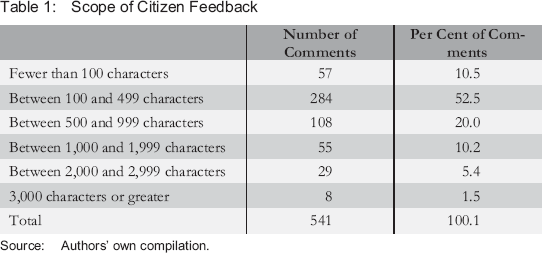
It is apparent upon first glance that the scope of citizen feedback on the health system reform proposal varied substantially across comments. Comments ranged in length from 16 to 5,254 characters. The average number of characters was 610, with a median of 339 characters. As illustrated in Table 1, approximately 10 per cent of comments contained less than 100 characters. By contrast, eight comments exceeded 3,000 characters in length. Nearly three-fourths of the comments consisted of between 100 and 1,000 characters.
Scope of Citizen Feedback
Source: Authors’ own compilation.
Inferences about political informativeness and substantive salience cannot be made on the basis of the scope of citizen feedback. Comments that were short in length may have communicated relevant information about the politics and substance of health system reform. For example, one comment consisted of fewer than 100 characters, yet exhibited knowledge of and dissatisfaction with the price of pharmaceutical products.

The purchase price of some drugs is 1 CNY, yet pharmaceutical companies sell these drugs for 100 CNY. Government regulations stipulate that the maximum price for such drugs is 101 CNY. Is this kind of behaviour legal? Is it fair? Furthermore, the current tax mechanism is calculated as (total sales – total purchase costs) * 17%, and not according to the actual value added of the product. Is this fair? (www.ndrc.gov.cn/ygyj/ygyj_detail.jsp?comId=24415).
By contrast, submissions comprised of hundreds or thousands of characters may have
contained arguments and evidence of little immediate relevance to government
decision-makers. For instance, one 2,518-character comment, the header of which is
excerpted below, advertised an online health care service system and never mentioned
the reform proposal.
Modern Digital/Information Technology Heath Care Service System (www.ndrc.gov.cn/ygyj/ygyj_detail.jsp?comId=28073).
Given that the focus of this article is to assess the extent to which online consultation generated salient information about health system reform, it is essential to analyse the political and substantive content of the comments that were submitted in response to the NDRC's proposal.
Content Analysis of Citizen Feedback
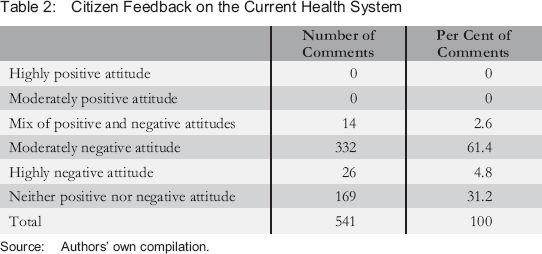
The aim of the coding protocol was to extract information regarding the political and substantive content of citizen feedback provided during the health system reform comment period. Political information entails the extent to which comments offer decision-makers insights into the nature of citizen preferences. It was not uncommon for health system reform comments to express negative sentiments. Submissions were coded, for example, according to their expressed attitudes towards the current health system. As illustrated in Table 2, not a single comment articulated a solely positive viewpoint in this regard, while 14 comments contained a mix of positive and negative assessments. By contrast, 332 comments exhibited moderately negative opinions, and an additional 26 comments were highly negative in their criticisms of the health system as it was currently constructed. Not all submissions expressed clear-cut attitudes towards the status quo, as 169 comments stated neither positive nor negative sentiments regarding the existing health system.
Citizen Feedback on the Current Health System
Source: Authors’ own compilation.
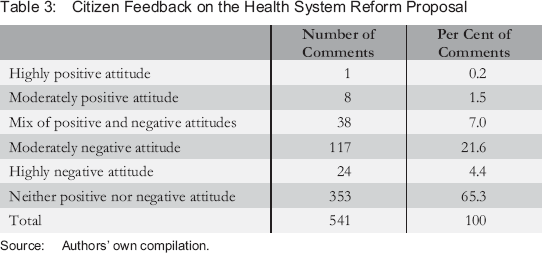
Submissions were also coded, as reported in Table 3, in terms of their reactions to the health system reform proposal. Many citizens did not express readily observable assessments of the government's draft policy, as indicated by the fact that 353 comments were coded as revealing neither positive nor negative attitudes. Of the remaining 188 comments that registered a discernible evaluation, the vast majority exhibited negative opinions towards the proposal as it had been developed to that point: 24 comments were highly negative, 117 comments were moderately negative, and 38 comments contained a mix of negative and positive sentiments. Of the 9 comments that expressed solely favourable viewpoints towards the reform proposal, 8 were moderately positive and 1 was highly positive.
Citizen Feedback on the Health System Reform Proposal
Source: Authors’ own compilation.
Negative comments varied in the specific nature of the information they provided government officials about the politics of health system reform. Some comments expressed stridently hostile attitudes towards the reform proposal.

This plan basically cheats us. If the government cannot provide us with a plan that satisfies the majority of the people, we will be forced to use our power to make you bureaucrats pay (www.ndrc.gov.cn/ygyj/ygyj_detail.jsp?comId=30953).
Other comments focused on the difficulties citizens were facing in understanding the precise content of the proposal.

The plan is too technical to understand. I suggest making it more readable for someone like me, a college student who is not in medical school (www.ndrc.gov.cn/ygyj/ygyj_detail.jsp?comId=13374).
In addition to providing insight into the political environment, the content analysis also extracted information regarding the substantive content of comments – that is, the specific aspects of the health system and reform proposal that were addressed in citizen feedback. The majority of health system reform comments were grounded in knowledge derived from professional experiences and research-based sources. There were 302 submissions that articulated systematic arguments, offered potentially useful information, and, in some instances, referenced sources such as scientific data and statistical analyses. By contrast, 239 comments demonstrated no apparent engagement with these and other types of arguments and substantive information. The following excerpts demonstrate the breadth of substantive knowledge that the comments brought to bear on the health system reform process.

I work at a hospital in a rural area. The New Rural Cooperative Medical System was implemented in 2008, but it does not work to the benefit of peasants. Originally, 1,300 CNY was enough to cover the cost of an appendectomy. Now, however, the operation costs 3,000–4,000 CNY and patients must pay 1,300–1,500 CNY out of pocket (www.ndrc.gov.cn/ygyj/ygyj_detail.jsp?comId=10034).
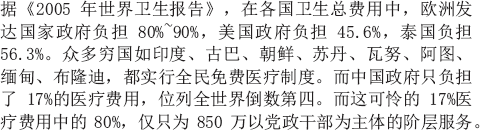
According to the World Health Report 2005, the percentage of national health care expenditures covered by governments was between 80–90% in developed European countries, 45.6% in the United States, and 56.3% in Thailand. Many poorer countries, such as India, Cuba, North Korea, Sudan, Vanuatu, Myanmar, and Burundi, have implemented universal health care systems. The Chinese government, however, covers only 17% of health care expenditures, the fourth lowest of any country in the world. Furthermore, 80% of this paltry 17% is used to cover the medical expenses of a relatively small number of elites – namely, party members and government cadres (www.ndrc.gov.cn/ygyj/ygyj_detail.jsp?comId=16).

Health care costs in Canada are significantly lower than in the United States, yet the quality of care does not suffer. The average life expectancy in Canada is 80.3 years, which ranks 10th among countries of the world. In the United States, ranked 29th globally, the average life expectancy is 78.0 years (www.ndrc.gov.cn/ygyj/ygyj_detail.jsp?comId=1).

Restrictions on private hospitals should be eliminated, thereby allowing private hospitals to compete on an equal footing with public hospitals. In Taiwan, for example, 80% of hospitals are private, while only 20% are government owned and operated (www.ndrc.gov.cn/ygyj/ygyj_detail.jsp?comId=21647).
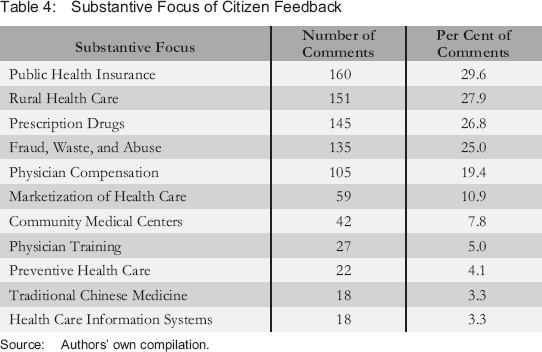
As these examples illustrate, the substantive focus of citizen feedback varied considerably across submissions. Further information about the focus of comments is presented in Table 4, which reports the frequency with which submissions addressed specific issues concerning the health system and reform proposal. The content analysis allowed for the specification of comments addressing multiple topics, as it was not uncommon for individual submissions to raise a number of distinct substantive issues.
Substantive Focus of Citizen Feedback
Source: Authors’ own compilation.
Issues in public health insurance were the most frequently mentioned topic, appearing in 160 comments. These issues include the costs and coverage of government-sponsored health insurance systems. Given the government's stated ambition of achieving universal health care by 2020, it is not surprising that issues in expanding access to basic medical services were a substantive focal point of health system reform comments (Thompson 2009).
A critical component in ensuring medical coverage for all citizens is to alleviate disparities in availability and quality of care across urban and rural settings (Zhang and Unschuld 2008). Consistent with this underlying concern, 151 comments addressed issues in rural health care and the allocation of medical resources to areas that have been underserved by the health system in recent decades. These resources not only include hospitals and medical equipment, but also well-trained, adequately compensated health care personnel.
Health system reform comments approached issues in health care financing from a variety of perspectives. Difficulties in managing the distribution of pharmaceutical products were discussed by 145 comments. Health care providers and facilities derive substantial proportions of their incomes and revenues from dispensing prescription drugs (Hu et al. 2008). This system has proven susceptible to corruption, with citizens at times mandated to pay exorbitant fees for essential medicines (Public Radio International 2011). Consistent with the prevalence of such practices, 135 comments identified fraud, waste, and abuse as concerns requiring attention in the health system reform process.
Despite the fact that promoting TCM has been a central government objective, few comments addressed the current state of TCM and its prospective treatment in health system reform (Cheng 2008). Among the 18 comments that referenced TCM, the vast majority advanced positive arguments and evidence highlighting the cost effectiveness and historical and cultural significance of TCM. The following quotation is indicative of the support citizens expressed for TCM.

Health system reform should advance both Western medicine and traditional Chinese medicine, abandoning the misplaced notion that Western medicine is all-powerful while traditional Chinese medicine is worthless (www.ndrc.gov.cn/ygyj/ygyj_detail.jsp?comId=13814).
Given that the citizen feedback analysed in the article does not constitute a probability sample of comments that were submitted in response to the health system reform proposal, the political and substantive orientation of these submissions may not be representative of health system reform comments in general. As an initial means of assessing this possibility, a probability sample of 50 comments on health system reform was constructed. The content of each of these comments was coded by the second author according to the identical protocol utilised for the primary sample of 541 comments.
The supplementary content analysis reveals both similarities and differences across the two samples of comments. On the one hand, equivalent proportions of the respective samples expressed attitudes that were coded as moderately negative towards the existing health system. On the other hand, comments in the primary sample were more likely than comments in the supplementary sample to be coded as moderately negative towards the health system reform proposal. In addition, primary sample comments were more likely to raise issues in public health insurance than supplementary sample comments. These differences highlight limits in the generalisability of the results of the analysis of the primary sample of comments.
Overall, the content analysis indicates that citizen feedback on the health system reform proposal was characterised by two central elements: First, comments regularly engaged in a substantive manner the arguments and evidence presented by government decision-makers as rationales for prospective courses of action. Second, it was usual for comments to express preferences negatively disposed towards the health system and reform proposal. These attributes of political and substantive engagement were not entirely expected at the outset, because of previous research on the hesitance of Chinese citizens to express contrarian view-points during official policymaking processes (He 1997; Zhou, Chan, and Peng 2008). In the context of the health system reform comments analysed in this article, politically informative and substantively salient viewpoints were articulated by citizens who were, for the most part, well established in Chinese society. Many of the participants, for example, were employed as professionals in the health care industry. The comments submitted by these participants routinely addressed concerns (such as disparities in access across urban and rural settings) that had been core issues in health system reform for years prior to the NDRC's solicitation of citizen feedback. Such engagement is promising from the perspective of governance reform in that political and substantive feedback is crucial if online consultation is to impact government decision-making, enhance the performance of laws and regulations, and cultivate support for the Chinese Communist Party that is sustainable in the years ahead.
Evaluating Online Consultation and Citizen Feedback
The research question addressed in the article focuses on the extent to which comments submitted by Chinese citizens via the Internet in response to a central government proposal to reform the nation's health system contain arguments and evidence that are politically informative and substantively salient. This question is significant in the context of contemporary China in that government organisations are increasingly utilising online consultation as a means of generating relevant information and gauging citizen reactions to draft laws and regulations. Given the growing prevalence of online consultation in Chinese policymaking, it is crucial to develop a store of knowledge regarding the nature of citizen feedback on government proposals. Such knowledge, for which this article establishes an initial baseline, promises to play a fundamental role in evaluating online consultation as an instrument of governance reform and, by extension, stability and change in the Chinese political system.
This article's main findings are that it was normal for comments to address substantive issues in great depth and express negative assessments of government decisions. These findings suggest that online consultation holds significant promise as an instrument of governance reform, which the Chinese Communist Party has embraced in recent years as a means of cultivating popular support in the face of significant economic, political, and social challenges.
This paper's analysis, and therefore its conclusions regarding the broader implications of citizen engagement, is subject to a number of limitations and uncertainties. Health system reform is an undoubtedly important application of online consultation as a means of generating citizen feedback. It is uncertain, however, to what extent the findings regarding the governance of health care are readily generalisable to other policymaking contexts. Although the government faces significant challenges in resolving issues such as access to basic medical services and disparities in urban and rural health systems, such challenges do not pose immediate threats to the underlying legitimacy of the Chinese Communist Party. Therefore, broadening the analysis to politically sensitive issues (such as the online consultation and citizen feedback that occurred during the central government's recent revision of the nation's criminal procedure law) represents an avenue for potential research (Ford 2012).
It is well established that the Chinese government censors Internet content (MacKinnon 2012). It is therefore a distinct possibility that not all comments submitted in response to the health system reform proposal are accessible via the website of the NDRC. For example, comments casting government leaders and the Chinese Communist Party in a fundamentally critical light may not have been publicly displayed. Despite this possibility, the content analysis has documented the prevalence of negative sentiments in health system reform comments, including citizen feedback highly critical of the NDRC's proposed course of action. Such negative sentiments offer insight into the nature of the dissent that government decision-makers were willing to openly acknowledge when seeking feedback on the health system reform proposal.
By definition, the content analysis does not include information about the attitudes of citizens who did not submit comments on the health system reform proposal. One consequence of this focus on participants is that the generalisability of the article's findings is potentially limited by selection bias. To the extent that citizens who are positively (or negatively) disposed towards the Chinese Communist Party are more likely than other citizens to offer feedback on draft laws and regulations, the content analysis may reveal levels of government support (or opposition) not present in the population more generally.
Finally, in focusing on citizen feedback, this research does not offer direct insight into other salient attributes of online consultation as an instrument of governance reform. Government responsiveness to citizen feedback, for example, is a crucial determinant of the operation of online consultation. Given the opacity of the Chinese policymaking process, it is difficult to verify the efficacy of citizen feedback in influencing the content of laws and regulations. There are, however, preliminary indications of the presence of essential prerequisites of government responsiveness. The NPC has adopted the practice of publicly disseminating explanations of major issues raised in draft laws as a means of enhancing the utility of subsequently submitted comments for government decision-makers (Horsley 2009). In addition, the State Council has developed software to assist in the processing and analysing of the substantial numbers of comments that are routinely generated by draft laws and regulations (Horsley 2009). In the years ahead, research on such aspects of online consultation has the potential to broaden the understanding of the implications of governance reform for the prospects of the Chinese Communist Party and, concomitantly, stability and change in the Chinese political system.