



Abstract
In 2011, Hong Kong SAR government announced an unprecedented policy of cash handouts of 6,000 HKD to all permanent residents at the age of 18 or above as a means of defusing public discontent with economic policy and poor governance. Macau SAR has also been distributing similar cash handouts since 2008 to temper public dissatisfaction and widespread demonstrations. Initially, both SAR governments were very reluctant to initiate universal cash handouts. Unlike standard welfare programmes that are budgeted for annually, the cash payment scheme in Hong Kong SAR was a one-off handout. In Macau SAR, however, the payment scheme went from being a short-term policy to a long-term policy, while other welfare programmes were also allocated more public money. This paper argues that although such cash handout policies are avoidable, they are still being adopted by politicians who place self-interest above the public interest.
Keywords
Introduction
In every fiscal year, the governments of the Hong Kong Special Administrative Region (HKSAR) and the Macau Special Administrative Region (MSAR) allocate public money to welfare programmes, or “relief measures”, as a means of (1) easing the economic difficulties faced by low-income households, (2) gaining people's support and (3) helping to stabilise the newly established governments. These kinds of programmes require applicants to go through a stringent assessment process to prove that they are absolutely in need of such social security assistance. In the past, neither the HKSAR nor the MSAR government had provided cash to all their citizens as a means of sharing economic achievements or welfare support. However, in 2008, the MSAR government launched the Wealth Partaking Scheme, which saw all Macau residents receive cash payments. Similarly, the HKSAR government initiated the one-off Scheme $6,000 in 2011, which saw all permanent residents receive 6,000 HKD. Notwithstanding HKSAR and MSAR Basic Law stipulating that both governments should “strive to achieve a fiscal balance, avoid deficits and keep the budget commensurate with the growth rate of its gross domestic product” (HKSAR Basic Law: Art. 107; MSAR Basic Law: Art. 105), the SARs’ financial secretaries offer financial assistance to the low-income and, when necessary, middle-income population in times of economic recession. Although the governments can modify welfare programmes to adjust economic development and focus on certain demographics in need of assistance, the use of non-targeted, universal cash handouts risks becoming populist and an abuse of public money.
Politicians, like decision-makers and bureaucrats, make use of their own policy alternatives while formulating public policy. It can be reasonably expected that the choices eventually made by those public officers will have been made in the public interest. However, the very nature of their choices may sometimes reflect the interests of the public officers rather than wider society. Public choice is a concept that examines how political actors make rational non-market decisions (utility maximisation) and makes predictions about the effects of changes in conditions or policies (Mueller 1989: 1–6; McLean 1987: 1–121). According to this theory, a politician may show preference to lobbyists (either individuals or groups) that are likely to significantly impact votes and the politician's career. Although the efficiency of public service delivery is influenced by the decisions of government officials (Boyne 1998), it may also be affected by the politicians who may “usually or often misinterpret or thwart the choices that the public would wish to make as individuals” (Seldon 1987: 122). Alternatively, the change of choices made by public officials may be “a normal and ongoing aspect of government and a normal and ongoing function of many officials” (Grindle and Thomas 1991: 18–20). This paper will analyse the ways in which bureaucrats in Hong Kong and Macau seek to maximise utility in making cash handout policy, which results in diverse outcomes.
Macau's Cash Handout Policy: Wealth Partaking Scheme
Welfare services provided by the MSAR government remained at a flat level before and after the handover of sovereignty in December 1999. This situation changed when the gaming industry was expanded from one to six licensed gaming operators and the revenue from gaming tax began to increase year-on-year. Economic efficacy has grown rapidly since the first casino opened in September 2004; it took less than one year to earn back the invested capital. Although the MSAR government benefitted from gaming revenue, it did not increase welfare expenditure or raise the basic salary of the civil service. In 2006, when the civil service finally received its first post-handover pay rise, the chief executive, Edmond Ho (He Houhua), explained that this was a political decision rather than a desire to share economic growth. Construction of new public housing had been frozen since the handover in spite of the rapid rise in property prices. Ho was criticised for repeatedly failing to take action on public housing policy, thus making it one of the key focal points of every protest rally since May Day 2007. In response to the growing social unrest, Ho announced in the 2009 Policy Address government plans to build 19,000 public housing flats by the end of 2012 (both for rent and sale) – this time, his political promise was actually put into action. Thus, it is clear that the MSAR government was reluctant to initiate welfare policies in the absence of political costs.
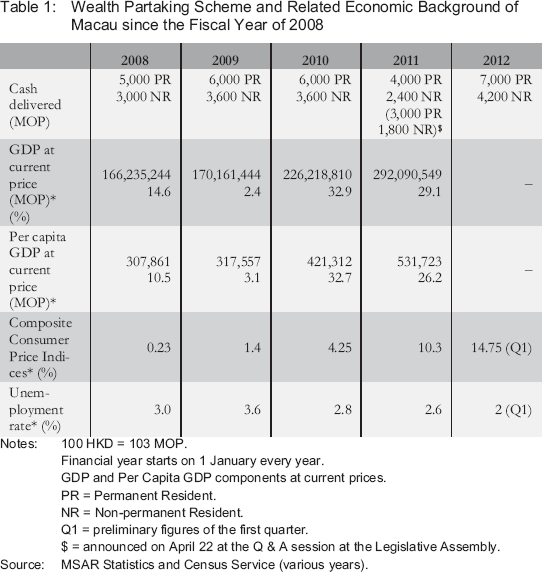
The economic achievement of the MSAR government after the opening of the gaming industry was nothing short of impressive. When the government decided to initiate the one-off Wealth Partaking Scheme in 2008, the economic situation was not as bad as one might think. Table 1 shows that the composite consumer price index (CPI) was only 0.23 per cent, remaining at an extremely low level. The gross domestic product (GDP) and the per capita GDP recorded a 14.6 per cent and 10.5 per cent increase, respectively. Meanwhile, the unemployment rate was at 3 per cent in 2008. MSAR's 2008 economic performance can be described as satisfactory, even admirable, when compared with that of the United States or European countries – particularly after taking the global financial tsunami into account. Nevertheless, the government's use of the Wealth Partaking Scheme to provide financial support to those who had suffered following the global financial crisis was not unreasonable. However, understood as a safety net to protect people from economic hardship during the crisis, one might query the necessity to continue with this policy in the years following. In fact, it is not difficult to find evidence of continued economic achievement in the years after the crisis, which adds to scepticism regarding the continuation of the policy.
Wealth Partaking Scheme and Related Economic Background of Macau since the Fiscal Year of 2008
Notes: 100 HKD = 103 MOP.
Financial year starts on 1 January every year.
GDP and Per Capita GDP components at current prices.
PR = Permanent Resident.
NR = Non-permanent Resident.
Q1 = preliminary figures of the first quarter.
$ = announced on April 22 at the Q & A session at the Legislative Assembly.
Source: MSAR Statistics and Census Service (various years).
Table 1 displays constant and durable growth for the period 2008–2012. With regard to 2009 in particular, GDP and per capita GDP growth of 2.4 per cent and 3.1 per cent, respectively, 1.4 per cent inflation and 3.6 per cent unemployment can hardly be interpreted as an economic downturn or as increasing financial hardship – it is but a mild after-effect of the global financial tsunami. Compared with the critical situations in which many Western economies still find themselves, the economic recovery capacity of Macau is the envy of those countries.
The figures from 2010 to the first quarter of 2012 show that Macau's economy has clearly started to recover from the global financial crisis. GDP and per capita GDP was recorded at 32.9 per cent and 32.7 per cent growth, respectively, in 2010 and 29.1 per cent and 26.2 per cent, respectively, in 2011. Meanwhile, unemployment dropped from 2.8 per cent in 2010 to 2 per cent in the first quarter of 2012, thus rendering it no longer a matter of concern for the MSAR government – at least in the short term. Nevertheless, it is not being argued here that Macau is no longer feeling any effects of the financial crisis. The composite CPI, for instance, increased drastically from 4.25 per cent in 2010 to 14.75 per cent in the first quarter of 2012. If one were to take only this factor into consideration, the need to implement a cash handout policy to help people deal with rising inflation would be justifiable. However, GDP and per capita GDP during the same period have been 16 per cent to 27 per cent higher than that of the CPI. Once these figures are taken into account with the dropping unemployment rate, it becomes difficult to argue that the growing CPI will result in significant financial hardship given that people's earnings have grown at a rate higher than has expenditure on basic consumer products. In other words, the Macau people are richer than they were five years ago and living standards are improving gradually. Therefore, reducing the number of demonstrators is the only reason for the continued implementation of the Wealth Partaking Scheme – a policy that was initiated in 2008 explicitly as a one-off handout.
MSAR's Wealth Partaking Scheme: From One-off Policy to Long-term Policy
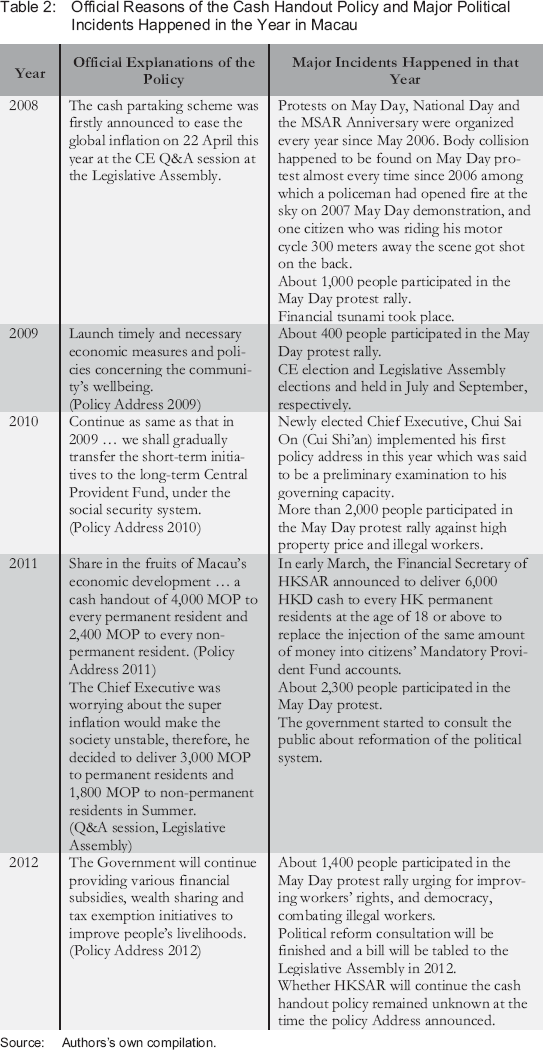
Despite the official explanation issued by the chief executive to justify the initiation of the cash handout policy, there are several political incidents that may have influenced the creation and implementation of this policy (see Table 2). Interestingly, Chief Executive Ho did not mention any kind of cash handout plan in the 2008 Policy Address, which was read in early November 2007. However, on 22 April 2008, Ho announced this innovative one-off policy while he was attending a Q&A session at the Legislative Assembly. Unusually, the scheme was implemented in the midst of the financial year and was officially described by Ho as a paracetamol to ease the pain of inflation. However, the policy was criticised by legislator Ng Kuok Cheong (Wu Guochang) as a means to appease May Day protesters and offset the negative publicity surrounding a bribery scandal involving the former secretary for transport and public works, Ao Man Long (Ou Wenlong). In addition to these incidents, the global financial tsunami saw economic growth in Macau come to a virtual standstill.
Official Reasons of the Cash Handout Policy and Major Political Incidents Happened in the Year in Macau
Source: Authors's own compilation.
It is possible that neither Chief Executive Ho nor his successor, Chui Sai On (Cui Shi'an), realised that the Wealth Partaking Scheme would become a long-term policy. The last few years have clearly revealed that the major function of the scheme is to help stabilise the political atmosphere rather than share the fruits of economic development. Table 2 shows that there was a drastic drop in the number of May Day protestors only in 2009, which indicates that the effectiveness of this cash handout policy was purely short term. In fact, Chui suggested eliminating this policy by gradually reducing the amount of cash handout. However, his plans failed after the HKSAR government announced its own cash payment initiative (Scheme $6,000), which would see HKSAR citizens receive more money than MSAR citizens. Criticised for lagging behind Hong Kong, Chui was faced with the decision to either offer a second round of cash handouts (and surpass the total amount of money offered by Hong Kong) or run the risk of violent demonstrations (as in 2010) by not offering cash handouts. If the aforesaid arguments are valid, then the 2012 cash handouts (of the same amount) will serve to safeguard the stability of the state.
Hong Kong's Cash Handout Policy: Scheme $6,000
In his 2011/2012 budget proposal, the HKSAR financial secretary, John Tsang Chun-wah (Zeng Junhua), announced plans for a one-off injection of 6,000 HKD into the Mandatory Provident Fund (MPF) account of all qualifying Hong Kong citizens (Tsang 2011). However, this measure was met with widespread criticism and disappointment for its ineffectiveness in helping to relieve inflation. Radio phone-in programmes were flooded calls from people complaining that the one-off injection of 6,000 HKD into MPF accounts would not help to solve their immediate economic problems, because the money was only accessible after retirement at 65 years old. A further issue was that there were about 127,000 civil servants and 60,000 teachers who did not qualify for the benefit, as they were not MPF participants. Unsurprisingly, this exclusion from the cash injection initiative aroused discontent and outright indignation amongst the civil service. As a result, the Federation of Civil Service Unions and the Hong Kong Professional Teachers’ Union planned to join a mass protest organised by the Democratic Party to express their grievances against the proposal. Numerous other protest rallies were arranged in order to pressure the government into replacing the unpopular MPF injection with a more immediate cash payment policy. At one such demonstration, Chief Executive Donald Tsang (Zeng Yinquan) was allegedly pushed by a protestor. The violent nature of the demonstrations alarmed the government and led it to reconsider the interrelationship between effective governance and social acceptance.
Meanwhile, an opinion poll conducted by the University of Hong Kong found that 53 per cent of respondents were dissatisfied with the proposal, while 55 per cent urged the chief executive to resign. Furthermore, the MPF scheme did not earn the support of the pro-establishment camp. Liberal Party chairwoman Miriam Lau (Liu Jianyi) pointed out that “the consensus is that the public wants direct cash handouts, regardless of the form they take”. Even though the political parties and the public did not accept the proposal and urged the cash handout, John Tsang still insisted that there was no room for adjustments – a stance he maintained until he announced the change in policy.
HKSAR's Scheme $6,000: From Wrathful One-off Populism to Rational Public Choice
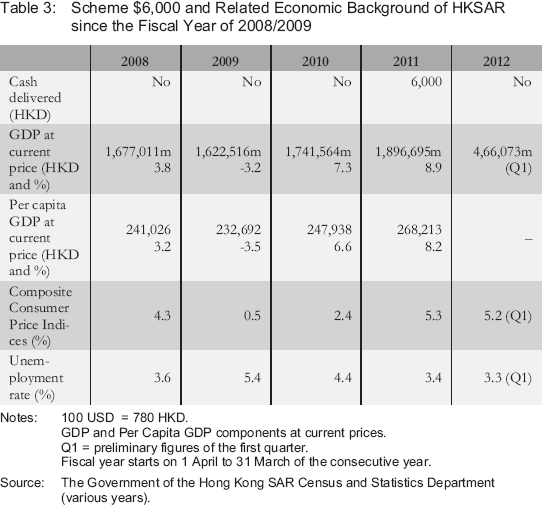
The idea of universal cash payments to Hong Kong residents is nothing new. During colonial rule in the mid-1990s, legislative councillor Dr. Law Cheung Kwok (Luo Xiangguo) proposed disbursing 5,000 HKD to all Hong Kong people because of reserve overflows in the state treasury. In recent years, Hong Kong's economic situation has been worse than it was during the mid-1990s, thus possibly impacting on government capacity (Burns 2004). Table 3 shows optimistic growth of GDP and per capita GDP in 2008 at 3.8 per cent and 3.2 per cent, respectively. However, the composite CPI and unemployment rate were even higher than per capita GDP, showing a decrease in people's living standards. Similar to Macau, HKSAR's 2009 figures were the worst for the past five years. Whereas GDP and per capita GDP declined by more than 3 per cent, the composite CPI remained at less than 1 per cent – which helped ease the financial pressure people faced. The 2009 unemployment rate was also the highest for the past five years; however, it began to steadily decrease in the following year, thus revealing that the economic situation was improving. Notwithstanding the composite CPI's rapid rise in 2009, it has remained stable and at an acceptable rate from 2010 to the first quarter of 2012.
Scheme $6,000 and Related Economic Background of HKSAR since the Fiscal Year of 2008/2009
Notes: 100 USD = 780 HKD.
GDP and Per Capita GDP components at current prices.
Q1 = preliminary figures of the first quarter.
Fiscal year starts on 1 April to 31 March of the consecutive year.
Source: The Government of the Hong Kong SAR Census and Statistics Department (various years).
In 2010, GDP and per capita GDP grew drastically by 7.3 per cent and 6.6 per cent, respectively, while the composite CPI and unemployment rate increased by 2.4 per cent and 4.4 per cent, respectively. The economic performance in this year was good enough to stabilise society. Thus, when the financial secretary, John Tsang, opted to inject 6,000 HKD into all Hong Kong residents’ MPF accounts, public discontent did not result in violence. Despite GDP and per capita GDP rising slightly in 2011, the economic situation for HKSAR residents got worse as the composite CPI grew more than double the previous year. Concerns about hyperinflation and an impending economic recession as well as an awareness of the cash handout policy in Macau sparked a series of anti-government actions aimed at forcing the government to substitute the injection of 6,000 HKD into MPF accounts with cash payments. Almost all politicians and political parties (including the pan-democrats and the pro-establishment camp) as well as some individual legislators joined forces in pressuring Tsang to execute the cash handout policy. Tsang eventually changed his mind despite having claimed a few days earlier that there was no room to fine-tune the budget proposal. What made this historic cash handout policy more interesting is that almost all the legislators refused to ask for it again in the following year, despite the poor economic performance in the first quarter of 2012. On behalf of the financial secretary, the secretary for financial services and the Treasury explained in an email interview that the budget proposal had already satisfied the needs of different classes and reflected the opinions collected during the consultation period. On this basis, the financial secretary decided not to initiate another Scheme $6,000.
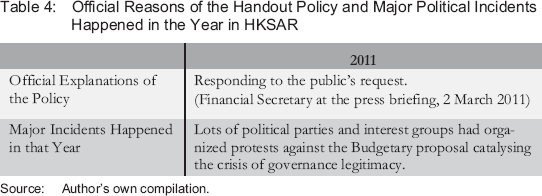
It was interesting to see Tsang's sudden U-turn with regard to the cash handout policy. In several budget forums in 2009, Tsang was urged to give cash payments instead of putting funds into MPF accounts. He resisted these calls, arguing that it was not feasible due to limited public resources and that the government should focus on providing targeted assistance. On 2 March 2011, after a short meeting with pro-establishment legislators in his office, Tsang announced at a press conference (accompanied by the legislators) that the government would in fact disburse cash handouts. As can be seen in Table 4, Tsang's official reason for this change of heart was that he was responding to the public's request – a request that included multiple mass demonstrations and anti-government actions. This episode exposed the reasons behind the dramatic change.
Official Reasons of the Handout Policy and Major Political Incidents Happened in the Year in HKSAR
Source: Author's own compilation.
First, Hong Kong was on the brink of social turmoil resulting in a crisis of governance. There were multiple anti-government protests organised by the pan-democrats, the pro-establishment camps and many other social groups against the scheme. Tsang had to defuse the situation before it escalated. Withdrawing the proposal as a response to the public's request was a win-win solution and restored the government's authority. Second, Tsang had already prepared to accept the legislators’ suggestion to change the policy. Indeed, Tsang was looking for an opportunity to withdraw the policy with dignity. The meeting with the pro-establishment legislators was very short. An interviewee said that when asked to implement a cash handout instead of an MPF injection, Tsang agreed without any hesitation and informed the legislators that he would do it as soon as possible. Moreover, Tsang utilised the meeting to shift responsibility for breaking the principle of prudent financial management to the pro-establishment camp. Interviewees recalled that Tsang had requested them (the legislators) to accompany him to meet the media after the short meeting, creating an illusion that Tsang was forced by the pro-establishment camp to initiate the unprecedented policy. This allowed Tsang to save face and obligated the pro-establishment camp to support Tsang's proposal in return (Anonymous 2). Third, John Tsang did in fact want to implement the budget proposal without any changes to the original version. It was not the first time that Tsang had been confronted with public pressure or even violence from progressive councillors of the League of Social Democrats to disburse cash instead of making payments into MPF accounts. Given his status as a veteran senior civil servant who was familiar with political posturing, it is unlikely that Tsang would have been intimidated by any physical or political threats. Fourth, Tsang had very little reason to resist distributing cash handouts in his original proposal. There was clear evidence that Hong Kong had an extremely strong reserve and budgetary surplus that would have comfortably facilitated such a scheme. It is possible that Tsang did not want to be the person responsible for introducing this unparalleled practice and breaking the principle of prudent financial management. Nonetheless, Tsang needed to consider the potential social unrest that might have (likely) ensued if he had failed to change his mind – as Lau Siu Kai (Liu Zhaojia), head of the Central Policy Unit, suggested. Fifth, he was able to utilise this opportunity to consolidate clientelist relations with the pro-establishment camps and save face for both sides.
Since the HKSAR government has no loyal voting bloc or hard-line support in the legislature, it is important for the government to cultivate and construct patron-client relations to ensure sufficient support in the legislature. Upon deciding to change his stance on the cash handout policy, Tsang arranged for the pro-establishment legislators to stand behind him while he briefed the press on his U-turn. Not only did this help portray his government as being responsive to the public will, it also placed an unavoidable obligation on the pro-establishment legislators who appeared with him in front of the cameras to help ensure that the budget proposal passed in the Legislative Council. One interviewee, who had attended the meeting, said that the legislators “understood that there was an exchange condition within”. He added that their visible presence behind the financial secretary would be of benefit come the elections (Anonymous 3). Based on the discussion in this paper, one can draw the conclusion that public officials make use of public resources to attain their own personal goals ahead of the public interest.
Conclusion
Macau's Wealth Partaking Scheme and Hong Kong's Scheme $6,000 are effective measures to return surplus wealth back to the people. However, such policies are better implemented as one-off schemes during times of hardship, rather than as long-term strategies to maintain government legitimacy. The case of Macau revealed that although cash handouts might foster temporary societal cooperation, public discontent will still boil over if perceived ineffective governance persists. Furthermore, politicians should examine whether a cash handout policy is really necessary or is simply being used as a means to appease the people. In both the case of Hong Kong and Macau, the data show that the economic situation was not critical. Therefore, it was a waste of public money to initiate a universal cash handout policy instead of specifically targeting those groups actually in need of welfare. In fact, the implementation of the cash handout policy has fallen into a labyrinth of equalitarianism. Furthermore, routine cash handouts may create a generation of dependency. For instance, some Macau people have admitted to including the cash handout as part of their annual income. Moreover, disbursing universal cash payments will not necessarily result in public support. In Hong Kong, most of the people were not happy to receive the money; they would rather have seen the government invest the funds in social projects. Indeed, all but three legislators from People's Power decided against re-tabling the cash handout policy.
To conclude, public officers including politicians and bureaucrats make policy decisions on the basis of utility maximisation. In other words, they prioritise self-interest ahead of the public interest. However, as governmental officials, their own interests are also the public's interests. A society where all public officers prioritise self-interest before all else will become an immoral society. Therefore, both politicians and bureaucrats should strive to maintain a higher standard of administrative ethics.