



Abstract
This paper aims to highlight the significance of labour issues – namely, the minimum wage (MW) and standard working hours (SWH) – in shaping candidates’ electoral platforms in the 2012 chief executive (CE) election of the Hong Kong Special Administrative Region (HKSAR) under the sovereignty of the People's Republic of China (PRC). We first offer a brief review of labour politics regarding the MW case as a precursor to the SWH drafting and enactment process. We then provide an analytical delineation of some of the labour and socio-economic dimensions of the CE electoral contest by comparing the candidates’ campaign planks in relation to SWH. We then attempt to predict the likely course of the SWH debate under the leadership of Leung Chun-ying, who eventually won the CE election and assumed power on 1 July 2012. We conclude by examining Leung's social engineering attempts to increase popular support amongst low- and middle-income (LMI) households as part of his long-term strategy for the 2017 CE elections and his broader Beijing-entrusted political agenda.
Introduction
On 1 May 2011, Labour Day, Hong Kong's statutory minimum wage (MW) – set at 28 HKD per hour – came into effect. Since then, the main thrust of organised labour's demands has focused on pushing the government to legislate for official standard working hours (SWH) for most employees. Three recent political developments – in particular, the 2011/2012 Hong Kong Special Administrative Region (HKSAR) chief executive (CE) election campaign – have ushered in new dynamics that have resulted in a major power realignment and, quite likely, a re-prioritised policy agenda on labour and socio-economic issues, including possible SWH. Leung Chun-ying (Liang Zhenying), elected CE in 2012, based his campaign on “change amid stability” to generate support amongst low- and middle-income (LMI) households.
This paper aims to highlight the significance of labour issues (namely, the MW and SWH) in shaping the CE candidates’ electoral platforms and CE Leung's policy blueprint. We first offer a brief review of labour politics regarding the MW case as a precursor to the SWH drafting and enactment process. We then provide an analytical delineation of some of the labour and socio-economic dimensions of the CE electoral contest by comparing the candidates’ campaign planks in relation to SWH. We then attempt to predict the likely course of the SWH debate under the leadership of Leung Chun-ying, who eventually won the CE election and assumed power on 1 July 2012. We conclude by examining Leung's social engineering attempts to increase electoral support amongst LMI households as part of his long-term strategy for the 2017 CE elections and his broader Beijing-entrusted political agenda.
The Minimum Wage Debates
A relevant and perhaps parallel historical experience to the adoption of SWH is the recent introduction of a statutory MW in HKSAR. The realities that Leung must soon confront as CE are different from the conditions during the Tung Chee Hwa (Dong Jianhua) and Donald Tsang (Zeng Yinquan) regimes. The legislative enactment of Hong Kong's statutory MW on 16 June 2010 can be regarded as the single most positive social undertaking by the Tsang regime (2005–2012). With Tsang at the helm, HKSAR policy decisions were characterised as pro–big business despite widening wealth-poverty gaps – evidenced by policy favouring the giant property developers at the expense of the LMI demographic. This ultimately led to high inflation and socio-economic disequilibrium, thus undermining social harmony – Beijing's prime domestic objective and a precondition for sustainable development.
In fact, the introduction of the MW represented a clear victory for local organised labour after eleven years of strenuous battles with conservative elites and business interests. Since Hong Kong's 1 July 1997 retrocession to China, the two local flagship labour federations – the pro-Beijing Federation of Trade Unions (FTU) and the pro-democratic Confederation of Trade Unions (CTU) – have both pushed various labour agendas in the Legislative Council (LegCo) in order to counterbalance the pro-business bias of the HKSAR regime-tycoon coalition. The MW bill became the first major test case. Two further key labour demands are the adoption of official SWH and collective bargaining rights (Fosh and Chow 1999).
The overwhelming LMI demographic majority, the intensification of the class cleavage and the politicisation of labour issues became increasingly crucial in post-1997 HKSAR electoral contests and legislative politics. While generally supportive of improvements to LMI households’ living standards and working conditions, there were serious internal divides in the democratic camp on such issues. A noted case was the 1999 MW debate, which split the democrats over class identity and basic social constituency (Chan 2009).
A 2004 MW bill proposed by FTU vice chair and legislator Chan Yuen-han (Chen Wanxian) and supported by her LegCo peers (including the CTU's Lau Chin-shek (Liu Qianshi) and Lee Cheuk-yan (Li Zhuoren) failed to pass due to opposition by pro-business and pro-middle-class legislators. The 2005 leadership change, which saw Tung replaced by Tsang (who was also re-elected for a full term in March 2007), yielded an opportunity for organised labour to relaunch this battle. Despite his campaign pledges, Tsang was at first reluctant to push through any MW legislation. However, Tsang's “voluntarism” approach to promoting corporate social responsibility, the Wage Protection Movement (WPM), had only seen 1,114 firms (employing 30,000 cleaners and watchmen) sign up between October 2006 and mid-2008. The acute failure of Tsang's approach necessitated his decision to proceed towards MW legislation (Ming Pao 2008a).
The crux of the MW debates was focused on two issues: (1) the scope of the proposed law – that is, universal or initially more restrictive – and (2) the appropriate statutory MW rate. While all the legislators in the pro-democratic camp and in the pro-Beijing Democratic Alliance for the Advancement and Progress of Hong Kong (DAB)-FTU bloc (37 combined votes) were firmly committed to its enactment, a few pro-democratic legislators preferred a more restrictive version. Although, many business and employers’ groups generally did not outright oppose a MW in theory, they were divided on its scope and keen to keep the official standard rate at a lower level (at about 22–24 HKD per hour versus the unionists’ demand for 33 HKD per hour).
To fulfil his earlier pledge, Tsang had to balance the competing claims of employees and employers by offsetting the impact of a universal MW (demanded by organised labour and LMI groups) with a fairly low MW rate (demanded by businesses and employers). The regime's drafting and enactment process lasted two years (2008–2010), coming to an end following the local economy's recovery from the 2008–2009 global financial meltdown. As a concerted lobbying effort ahead of Tsang's 15 October 2008 policy speech, some 800 cleaners, guards and unionists participated in a rally sponsored by 34 pro-democratic organs (including the CTU, Democratic Party, Civic Party and the Liberal Social Democrats) to demand a universal MW of 33 HKD per hour (Ming Pao 2008b; Oriental Daily 2008a). This rally reflected a divide between an assertive civil society and the tycoon and business elites over development projects, welfare and healthcare reform, and other rice-bowl issues in relation to the bleak economic outlook triggered by surging inflation and a likely global recession (Oriental Daily 2008b).
The turning point came in June 2009 when the Executive Council (ExCo) approved the introduction of a MW bill into the LegCo. Needless to say, it is likely that the SWH issue will undergo a similar lengthy process (such as empirical studies; sectoral surveys; regime internal reviews; and a prolonged phase of three-way consultations, negotiations and bargains between the regime, employers and employees) before a final decision is made regarding the legislative enactment and administrative enforcement of SWH.
By comparing the objective conditions that will likely be faced by the Leung regime in the next five years compared to the socio-economic realities and realpolitik experienced by the Tsang regime as the MW issue moved from debates to legislative enactment to implementation, some meaningful parallels can be drawn. In a nutshell, three major factors have decisively shaped the HKSAR's adoption of a statutory MW.
Chronology of Key Events in HKSAR Minimum Wage Legislation
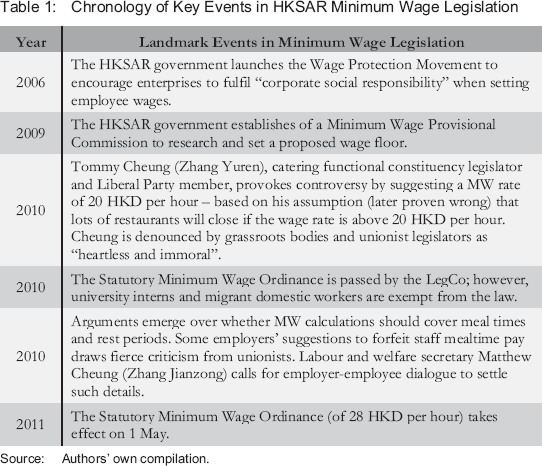
Source: Authors’ own compilation.
First, there was increasingly widespread and fast-growing “on-the-job poverty” amongst local LMI households in the post-1997 (retrocession and financial crisis) era amid a prolonged economic downturn that undermined social stability and threatened to overwhelm the public welfare system. It will definitely be better to promote “workfare” to reduce low-income earners’ reliance on public welfare. Hence, a statutory MW set at an adequate rate to ensure subsistence survival can provide stronger material incentives to low-end job seekers and offer more effective direct relief via a wage floor.
Second, mainland China has had an economic and political impact on HKSAR's deliberation on the MW policy. The introduction of a national MW in China (which saw neighbouring Guangdong province – especially in Shenzhen and the Pearl River Delta region – enjoying amongst the highest wage rates in the provinces) provided a sharp economic contrast with Hong Kong – where there was no MW. Also, Beijing's emphasis on maintaining social stability led Tsang and Leung to use the MW as an important tool by which to pacify the LMI demographic.
Third, Donald Tsang's 2007 re-election campaign platform promised a MW to help tackle grassroots poverty. With the HKSAR wealth-poverty gap widening drastically under Tsang's pro-business policy tilt, he adopted a MW to defuse societal tensions and class conflicts amid popular “anti-business, anti-wealthy” sentiments and fierce criticism of “regime-tycoon collusion”. A statutory MW could help to partially cushion the negative effects of the 2008–2009 global recession that had engulfed Hong Kong.
Labour and Socio-economic Dimensions of the 2012 CE Election
The 2012 CE election was an unprecedentedly fierce contest between two establishment candidates, Henry Tang (Tang Yingnian) and Leung Chun-ying – pro-democratic candidate Albert Ho (He Junren) had no chance of winning due to Beijing's disapproval of him. During Tang and Leung's highly competitive race, the emergence of various socio-economic concerns differentiated their campaign platforms.
Throughout the election campaign, and even during the run-up, Tang was perceived as the favourite of former People's Republic of China (PRC) president and former Chinese Communist Party (CCP) general secretary Jiang Zemin, who as Shanghai mayor befriended Henry's father, Leo Tang, three decades prior. Born in Shanghai to a textile family from Jiangsu (Jiang's province), Leo was amongst the earliest Hong Kong industrialists to invest in Shanghai in the early 1980s at the start of China's opening and reform. Leo also became a Chinese People's Political Consultative Conference standing committee member, a clear sign of his high standing in Beijing.
Before holding positions of public office and besides running his family's textile operations, Henry Tang had been a key figure in Hong Kong business circles. He served as the chair of the Federation of Hong Kong Industries (1995–2001), a committee member of the Hong Kong General Chamber of Commerce, and the chair of the Provisional Construction Industry Co-ordination Board (2001–2002). It was in his capacity as both a business leader and a LegCo/ ExCo member that Tang often interfaced with organised labour. In the eyes of CTU leaders Lau and Lee, Tang was a “capitalist with conscience” who was willing to listen to and able to discuss issues with grassroots unionists. Hence, these pro-democratic labour leaders found Tang to be a decent and reasonable business bloc representative with whom they could work to reach compromises on labour problems (Interview 2).
With a generally positive image amongst organised labour, it is surprising to find that Tang's record as a senior HKSAR official on anti-poverty, labour rights and industrial relations is rather disappointing. As financial secretary, Tang chaired the Poverty Commission set up by Tung in 2003; however, few tangible results were produced apart from a report. Despite his decade-long experience at the top of the Tung and Tsang regimes, Tang could claim little credit for key accomplishments in policy formulation or the effective implementation of major public undertakings. Nevertheless, Tang was seen as an affable senior official who enjoyed the confidence of the local elites as “one of them” while being groomed by Beijing to be a future CE.
As a founding member of the pro-business Liberal Party, Tang's intimate links to the local economic elites are well known. As Tang was seen as Beijing's pick, many tycoons and business elites showed their support for Tang's candidacy. The 379 publicly known candidacy nominations that Tang received amongst the Election Committee's 1,200 members confirmed Tang as the obvious choice of the business bloc, whose portfolios dominated the local economy and whose operations employed a sizeable portion of local workforce. Tang's roster of nominators and declared supporters covered most of the top property magnates, such as Li Ka-shing (Li Jiacheng) of Cheung Kong Holdings and Hutchison Whampao Limited, Lee Shau-kee (Li Zhaoji) of Henderson, Henry Cheng (Zheng Jiachun) of New World, Raymond and Thomas Kwok (Guo Binglian and Guo Bingjiang) of Sun Hung Kai Properties, Joseph Lau (Liu Luanxiong) of Chinese Estates, Robert Ng (Huang Zhixiang) of Sino Group and Gordon Wu (Hu Yingxiang) of Hopewell. The sole and glaring exception is Ronnie Chan (Chen Qizong) of Hang Lung, who openly backed Leung. Financial heavyweights who supported Tang include former Monetary Authority chief Joseph Yam (Ren Zhigang), HSBC Asia-Pacific chief executive Peter Wong (Wang Dongsheng) and Bank of East Asia chairman David Li (Li Guobao). Many of Tang's supporters had backed Tsang in the 2005 and 2007 CE elections – like David Li, who was campaign manager for both Tang and Tsang. Some of these supporters were mentioned in the 2012 scandals regarding Tsang's intimate ties to tycoons. With Beijing's blessing and the backing of local elites, it was widely assumed that Tang would be the next CE.
However, in the public approval polls conducted around Tang's formal candidacy in November 2011 and afterwards, Leung Chun-ying came out on top. In spring 2012, opinion polls continued to place Tang second by some distance. Finally, during the Election Committee vote on 25 March 2012, Leung secured a thin majority with 689 votes (57.4 per cent) of the 1,132 votes cast (which included 1,050 valid votes, 7 invalid votes and 75 blank votes). Tang only received 285 votes (23.8 per cent), while pan-democrat candidate Albert Ho's gained 76 votes (6.3 per cent) (Oriental Daily 2012).
Only three months earlier, the prospect of Leung beating Tang would have been considered unlikely by most observers, including many of those in the business circles and pro-Beijing bloc. However, it was a crucial combination of push-and-pull dynamics that yielded Leung's surprise victory. The “push” factors consisted of Leung's proactive and calibrated mobilisation efforts to boost his approval ratings by courting public goodwill and galvanising collateral support amongst people from all walks of life. Through media-covered daily visits and outreach events, Leung's pseudo mass-line campaign targeted the hard-pressed LMI population – most of whom suffered severely under the inflationary pressures from rising rents and property prices, high utility rates, and public transport fare hikes and subsequently harboured serious misgivings and bitter resentment towards the pro-business Tsang regime. By distancing himself from Tsang's more-criticised decisions, especially his flawed housing policy, Leung positioned himself a “candidate for change” intent on altering the status quo and pursuing urgently needed reform in various policy areas.
Being the first- or second-ranked cabinet official under Tsang for almost seven years, Henry Tang was, in contrast, inevitably identified with the Tsang regime's dismal record on the social front. In realpolitik terms, there was no easy way for Tang to escape the adverse fallout of Tsang's fast-deteriorating approval ratings during the three years prior. Furthermore, as if bearing the burden of an “original sin”, Tang's tycoon family background and long-entrenched pro-business stance (reinforced by the well-publicised roster of his tycoon supporters) contributed to the rising tide of popular revulsion against “property hegemony” and “regime-tycoon collusion”. It was in this context of class cleavage and regime-society discord that the “pull” mechanism came into play and drastically reduced Tang's approval ratings.
A critical factor that caused irreversible damage to Tang's approval ratings was his inept response to various scandals regarding his private life (i.e. allegations of extramarital affairs, illegitimate children and the existence of a massive illegal basement in his private residence), which cast doubt on Tang's personal integrity and his crisis management skills (Apple Daily 2012a). The negative publicity tarnished Tang's image to such an extent that by mid-March 2012 Beijing had ditched Tang and anointed Leung to the HKSAR helm.
In the CE election contest, the PRC/CCP central authorities adopted a new approach by permitting two pro-Beijing contestants (who were both deemed politically acceptable) to openly compete against each other. Furthermore, as explicitly reiterated by Wang Guangya, director of the State Council's Hong Kong and Macau Affairs Office, the three key criteria in the selection of the HKSAR CE were:
patriotism towards China and Hong Kong,
the ability to govern effectively, and
a positive public reputation and an adequate level of acceptance by Hong Kong society at large.
While only the Election Committee's 1,200 members (in fact, only 1,193 voters as 7 of them had overlapping membership and could only cast one vote) enjoyed the right to vote for the nominated CE candidates in this “small circle” poll, the third CE requirement demands a “positive public reputation and adequate level of acceptance by Hong Kong society at large” (Ming Pao 2011). This last requirement caused a profound paradigm shift by indirectly enlarging the electoral arena and opening up CE candidates’ campaigns to a far larger “constituency without the vote”.
While nominally elected in sectoral polling to become members of the Election Committee, an overwhelming majority of pro-Beijing business tycoons, Hong Kong professional elites and associates of the latter toe the Beijing line to support its preferred candidate. Thus, the requirement of “patriotism towards China and Hong Kong” has an actual ideo-political screening effect in eliminating any potentially victorious pro-democratic candidates committed to democracy, civil liberties, human rights and the rule of law in the HKSAR and in mainland China. Even in the unlikely scenario of a pro-democratic candidate winning the CE race, Beijing could refuse – as stipulated in the Basic Law – to officially confirm the winner as HKSAR CE. Thus the 2012 pro-democratic CE candidate Albert Ho was viewed as an “also ran” with no hope of victory, as was the 2007 pro-democratic Civic Party candidate Alan Leong (Liang Jiajie) – though Leong's candidacy did lead to the introduction of televised CE debates.
One major impact from a pro-democratic candidacy is that it both publicises the candidate's pro-democratic political visions and socio-economic agenda and forces the establishment candidates to take clear positions on public policy, prioritise resource allocation and propose new initiatives on key policy areas. The proposal for a MW during the 2007 CE election campaign to alleviate on-the-job poverty did lead to its eventual legislative enactment and implementation in May 2011. Hence, the 2012 contest of two rival pro-Beijing candidates competing for the CE post and the sidelining of a pro-democratic candidate who could not win due to Beijing's disapproval created new realpolitik dynamics that shaped their campaign platforms. The real campaign was that between Tang and Leung.
As expected, by toeing the Beijing line on HKSAR democratisation, both Tang's and Leung's platforms offered no concrete proposals for reform other than vaguely pledging to effect the Basic Law conforming amendments required for Beijing's promise of twin direct elections (i.e. the 2017 CE elections and the 2020 LegCo contest with improved representativeness of functional seats). Their campaign platforms paled in comparison to Ho's extensive electoral reforms. To compensate for their inevitable democratisation void, Tang and Leung should have focused their efforts on socio-economic campaign planks to attract popular support.
As most of the local tycoons and many establishment elites had already endorsed Tang, Leung's obvious choice for alternative sources of public support was the lower socio-economic strata. Making use of Tang's close identification with the unpopular Tsang regime, Leung's platform sought to capitalise on the widespread dissatisfaction with Tsang's failure to cope with worsening socio-economic inequalities and the housing crisis. To reconcile his more populist socio-economic stance with his long-term, more intimately pro-Beijing political credentials, Leung spared no effort in courting his natural allies and potential supporters amongst the leadership and membership of pro-Beijing organisations, especially grassroots groups. Hence, the many planks on specific socio-economic issues and working conditions in Leung's campaign platform could be viewed as an encouraging response to, or at least a sympathetic acknowledgement of, the demands and concerns voiced by these bodies and their members.
In contrast to Tang's stronger support with 379 nominations, Leung only received 293 nominations (57 from the Election Committee's agriculture and fisheries sub-sector; 29 from labour; 25 from engineering, architectural, surveying and planning; and 12 from financial services). Leung also secured 20 nominations from the FTU and 30 from the Democratic Alliance for the Betterment and Progress of Hong Kong (DAB) members. Besides Ronnie Chan, Leung's few heavyweight nominators included former education secretary Arthur Li (Li Guozhang), Shui On Group chair Vincent Lo (Luo Kangrui) and former Broadcasting Authority chair Daniel Fung (Feng Huajian). Leung admitted to having difficulties in securing the prerequisite 150 votes to enter the race. A local newspaper said Leung gained those nominations through the lobbying efforts of officials from the Central Government Liaison Office.
Leung's most whole-hearted endorsement came from the FTU, which casted en bloc all of its 60 Election Committee votes for him. In contrast, the flagship pro-Beijing political party DAB (with a mixed middle-class and working-class base) saw 20 of its 120-plus Election Committee members openly nominate Tang as the CE candidate. Some DAB elements did eventually vote for Tang in the 25 March 2012 poll, even though by then it was commonly known that Leung was Beijing's final choice as the next CE. To appreciate the Leung–FTU ties, a sketch of Leung's background and attainments as a self-made land surveyor turned politician may be useful.
Born in Hong Kong, Leung grew up in police staff quarters as his father was a low-rank colonial policeman from Weihai (a British concession until 1930) in Shandong. After schooling in Hong Kong, Leung studied valuation and estate management at Bristol Polytechnic in the UK. Upon his return to Hong Kong in 1977, Leung joined the real estate firm Jones Lang Wootton (JLW), becoming head of the local JLW branch five years later at the age of 30. In 1993, Leung opened his own surveying firm, which merged with a Singapore firm in 2000 to become DTZ Debenham Tie Leung Ltd. Leung was president of the Hong Kong Institute of Surveyors from 1995 to 1996 and chair of the Hong Kong branch of the Royal Institution of Chartered Surveyors.
Leung's close ties to the PRC officialdom began in the late 1970s when – as an unpaid volunteer – he gave lectures, conducted courses and offered advice on land and property development in mainland cities like Shenzhen, Guangzhou and Beijing. He later became honorary advisor of the Shenzhen, Tianjin and Shanghai governments on land reform and also economic advisor to the Hebei provincial government. A major breakthrough came in 1985, when he was appointed HKSAR Basic Law Consultative Committee secretary general. Becoming politically active, Leung joined forces with former LegCo and ExCo member T. S. Lo (Luo Decheng) in 1989 to found and lead (until it was dissolved in 1999) New Hong Kong Alliance, a political group amongst pro-Beijing professionals. In 1992, Leung was appointed a Hong Kong Affairs advisor by the PRC State Council, which later made him a member of the HKSAR Preliminary Work Committee. Leung also co-headed the latter's political affairs panel in mid-1993 and was vice chair of the HKSAR Preparatory Committee established in late 1995. In July 1997, Leung became a member of the all-appointed HKSAR Provisional Legislative Council and was also recruited by Tung to join the HKSAR ExCo, of which Leung served as convener from July 1999 until he resigned in October 2011 to run for CE. He also chaired the board of directors of the One Country Two Systems Research Institute, a pro-Beijing think tank. Since March 2003, Leung has been a member of the National Standing Committee of the Chinese People's Political Consultative Conference (Chan and Lo 2006: 156–157).
Because of the influential posts Leung has held in the past three decades, there has been consistent speculation regarding his rumoured CCP membership. Despite his seemingly populist approach and support for the LMI demographic, most democrats vigorously opposed Leung's CE candidacy for his being too much Beijing's man with a hidden “mainlandisation” agenda to undermine “one country, two systems” HKSAR autonomy. Unlike other ExCo members in the colonial and HKSAR era, Leung started to become increasingly outspoken in 2009 on policy issues that were pending an ExCo decision or were contrary to the regime's stance. For instance, Leung openly supported the introduction of a statutory MW in 2009 even before the Tsang regime had prepared a draft bill for the LegCo. Furthermore, Leung also publicly called for the resumption of the construction of subsided residential units, while Tsang stubbornly refused to acknowledge any housing crisis that would justify such construction. Leung's non-conformity lasted until October 2011, when Tsang – probably under pressure from Beijing – conceded having made mistakes regarding housing policy in his last annual policy speech.
Labour and Socio-economic Issues in CE Campaign Platforms
In terms of electioneering strategies, it is useful to compare the positions on labour issues of Leung, Tang and Ho. The following labour planks of Leung's campaign reveal the locus of his regime in the realm of socio-economic policy and even indicate Leung's probable social re-engineering effort.
Standard Working Hours (SWH)
SWH have been a high priority for local labour groups in pro-Beijing and pro-democratic camps since the implementation of the statutory MW in May 2011. The FTU and the CTU have both demanded a 44-hour working week (8 hours per day, 5.5 work days per week) and time and a half for overtime. Their respective political allies, the DAB and the Labour Party, have also endorsed such SWH provisions, which will likely appear in the platforms of their candidates contesting the September 2012 LegCo elections. In Leung's several meetings with FTU leaders and cadres prior to 23 March 2012, patriotic unionists repeatedly called for SWH to be a high priority on any regime agenda should Leung become the next CE. Without committing himself either way, Leung addressed the demand for SWH head-on by promising to objectively study the related issues and their wider implications.
Honouring his FTU pledge, Leung's platform has this item in the “Employee Benefits” section:
A special committee comprising of government officials, representatives of labour unions and employers’ associations, academics and community leaders will be established to follow up on the study on standard working hours conducted by the Tsang regime. This committee will examine issues relating to employees’ overtime conditions and arrangements as well as legislative proposals on the standard working hours.
According to a SWH research report published by the HKSAR Labour Department, the mean working week for full-time employees in Hong Kong in 2011 was 49 hours. Amongst those employees required to work outside of their normal working hours, over half performed “uncompensated overtime” – though some received time off in lieu. Most of the employees in the former group were employed in the so-called long-working-hours-sectors and were generally low-educated, front-line, operational staff (HKSAR Labour Department 2012). In fact, this official discourse on long and uncompensated working hours basically reaffirmed the findings from research jointly conducted by a university team and a non-governmental organisation in 2010, which found that the average HKSAR employee worked 50 hours per week and that 60 per cent of respondents supported the legal introduction of SWH (Oxfam Hong Kong 2010).
Selected Opinions for and against Standard Working Hour Legislation
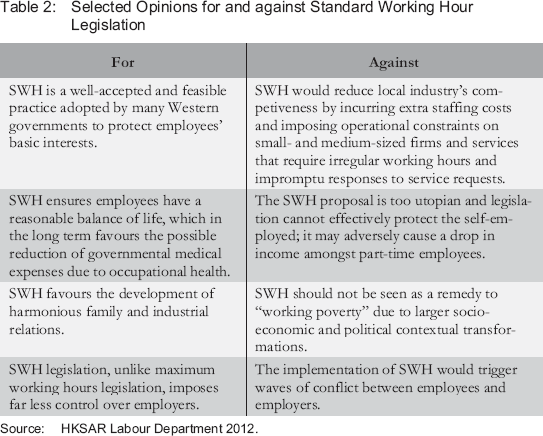
Source: HKSAR Labour Department 2012.
Table 2 presents the major opinions of various sectors for and against the introduction of SWH legislation. These arguments basically centre on several key SWH impacts on: (1) wage structure and level, (2) labour and business flexibility, (3) industry competitiveness and possible effects on industrial relations and (4) enforcement challenges. Major stakeholders explicitly supporting SWH legislation are the CTU and FTU unionists, while the chambers of commerce and the bodies with strong business ties (Hong Kong Federation of Industry, Liberal Party and Economic Power) form the hardcore opposition.
Other Labour Issues
In this section of Leung's campaign platform, SWH appears third amongst four items. Items one and two focus on workplace health and safety and MW effectiveness, respectively, while item four concentrates on reducing workers’ acquired benefits in their Mandatory Provident Fund accounts in order to offset employers’ long-service and severance pay obligations.
In reviewing the entire section of Leung's campaign platform on employee benefits, it seems that his team has relegated the politically sensitive and economically significant issue of SWH in terms of importance. However, any official adoption of SWH would be a major breakthrough in the dynamics of state, society and economy – thus elevating Hong Kong into the same league as most of the industrially advanced and democratically mature polities. The proposed follow-up deliberations on the Tsang regime's SWH report could buy extra time for Leung to proceed cautiously on this challenging task.
Other Labour-Related and Socio-economic Concerns
Leung's platform devoted substantial coverage to poverty alleviation by promising to reinstate the Poverty Commission (once headed by Tang) to study various forms of poverty, including the working poor. The commission would (1) explore ways to alleviate on-the-job poverty, (2) assess the effectiveness of a MW in reducing on-the-job poverty, (3) look into the feasibility of providing subsidies to partially cover LMI families’ living expenses, (4) streamline application procedures for schemes like low-income workers’ transport subsidies and (5) offer employment assistance to the poor. Again, Leung seems to prefer a more methodical approach for obtaining information and exploring technical and administrative options for possible undertakings without really attempting to address the root causes of the widening wealth-poverty gap and the issues of resource allocation and gains redistribution – which is crucial to meaningful efforts at social re-engineering towards greater socio-economic justice as the foundation for social stability and domestic harmony.
As a CE candidate with the most extensive front-line economic experience both in the private sector and in cabinet posts in the Tung and Tsang regimes, Henry Tang's campaign platform was surprisingly thin on improving working conditions and anti-poverty measures (despite his chairmanship of the Poverty Commission established by Tung in January 2005 and continued work under Tsang). Apart from his call for full employment of the entire HKSAR working population, Tang was vague on most of his socio-economic provisions. His economic planks included an all-out effort to promote the rapid development of the six major advantaged industries (that were first proposed by Tsang half a decade ago but without much progress) to create a hundred thousand new jobs within five years. Tang also suggested the establishment of the high-level Societal Cooperative Commission to be chaired by the chief secretary to develop anti-poverty strategies. The chief secretary would also chair the new Middle Class Commission to look into the challenges that this demographic faces.
On labour issues, Tang advocated a gradual increase from 12 to 17 days of annual leave (one extra day of holiday per year over five years) for workers, which brought this amount level with the number of government-designated public holidays. Tang's other suggestion was to raise the income threshold for transport subsidies to encourage LMI households to seek employment. On SWH, Tang was willing to study its many dimensions and implications but without any commitment. On the whole, Tang was much keener on gaining the support of tycoons, establishment elites and sections of the middle class.
In sharp contrast to Leung and Tang, Ho's platform encompassed many more-wide-ranging labour-related items and provisions based on input from his pan-democratic peers – especially from Lee Cheuk-yan of the Labour Party and the CTU. Ho's SWH stance was identical to Lee's demand for a 44-hour working week and time and a half for overtime. The same applied to nearly all the other 16 labour-relevant points in Ho campaign platform, including key issues such as
long-standing concerns about collective-bargaining rights,
redundancy pay,
parental leave for both parents,
workplace health and safety,
penalties for delinquent wage and benefit payments,
a lower threshold for workers’ transport subsidies,
tighter controls on illegal alien workers and
amendments to existing labour laws to better protect labour rights and to prevent employer discrimination against unionists.
Many of Ho's labour provisions primarily targeted blue- and grey-collar workers, but were also intended to benefit white-collar employees – an important segment of the employed population. Hong Kong's economy is no longer based on manufacturing but rather services; it is undergoing a skill-oriented, knowledge-based, post-industrial transformation manned by white-collar technical and professional functionaries. Many HKSAR white-collar employees today are better educated and more skilled than their forefathers. Moreover, they possess a far greater awareness of their rights and are more determined in the pursuit of socio-economic justice. This section of the workforce helps to sustain the HKSAR as a major global and regional corporate and banking centre, as well as a logistics conduit and operational hub for the burgeoning Chinese trade and investment market. They also form a massive, ready-made constituency for the pan-democratic camp, which is searching for electoral support amongst LMI demographic. Many HKSAR-based firms employ millions of workers in Guangdong. The advance in HKSAR workers’ rights could eventually have an impact on those of their mainland peers – just as the mainland's MW legislation facilitated the adoption of a similar law in HKSAR. Regarding SWH, cross-border influences could play a positive role amid increasingly close pan–Pearl River Delta (PRD) cooperation.
The media has said much on the decisive effects of Beijing's “visible hand” in steering Election Committee members of the patriotic bloc and business circles to vote for Leung as the next CE. It should be acknowledged, however, that there were electors who did actually agree with Tang's and Leung's campaign platforms. Despite Beijing's stance, a number of electors reportedly voted for Tang due to their approval of his position on labour and socio-economic issues, such as extending annual leave to 17 days, increasing employees’ maternity leave to 12 weeks and introducing a 3,000 HKD monthly retirement subsidy to qualified seniors over the age of 70. In the comparative assessment of candidates’ platforms, many observers considered Tang's proposed measures to offer more direct benefits to those in real need of support.
As an initial step towards the Beijing-desired “grand conciliation” amongst pro-Beijing elements and establishment elites, DAB chair Tam Yiu-chung (Tan Yaozong) organised a post-election dinner to enable Leung to meet with LegCo members who supported Tang. At that dinner (attended by 21 of 36 establishment legislators with many key Tang supporters absent), they discussed labour issues such as SWH and 17-day annual leave (Hong Kong Economic Journal 2012). Thus, it seemed that his (Tang's) platform had yet to be erased. In fact, at the end of his first post-election meeting with CE-elect Leung on 30 April 2012, Tang publicly stated that he had urged Leung to seriously consider Tang's proposals to increase annual leave to 17 days per year and introduce a 3,000 HKD monthly senior-citizen subsidy. Tang wished to revive his earlier image as an enlightened “capitalist with a conscience” (Ming Pao 2012a).
Closing Observations: The Road Ahead for SWH
The real challenge ahead for Leung Chun-ying is to consolidate power and achieve effective governance, social stability and economic growth in order to win the 2017 CE direct election. Should Leung be re-elected to a second five-year term, he must make full and speedy use of the short window of opportunity (of only three years from mid-2017 to mid-2020) to enact local legislation that meets Beijing's long-awaited requirement of a national security law as stipulated in article 23 of the Basic Law. The new LegCo to be elected in September 2020 will likely consist of directly elected geographical seats and reformed functional seats. It is logical to assume that the 2020 LegCo (supposedly more representative as members are more publicly accountable) will pose a more serious challenge to Leung regarding his timely delivery of an HKSAR national security law – irrespective of the fact that it is one of the “four major tasks” supposedly entrusted to Leung by Beijing.
With this crucial strategic objective in mind, it is imperative for Leung to consolidate the pro-Beijing–establishment-elite axis, probably through a “grand reconciliation” with the big business circles that encompass many Tang supporters. However, in order to win the 2017 CE race, Leung must build a new social support base to increase his popularity as an effective and responsive CE deserving of a second term. Thus, with the 2017 and 2020 electoral reforms to be crafted under Beijing's tight control, Leung will only have room for manoeuvre on the socio-economic front. In such a policy-making context, he must try to balance the vested interests of the tycoons and establishment elites with the legitimate demands of the LMI demographic – the overwhelming majority of the Hong Kong populace and the eligible electorate.
Ideally, Leung could make use of infrastructure projects (with related employment opportunities and economic yields) and concrete improvements in working and living conditions to create political capital for his 2017 CE election campaign, which – in turn – should provide the necessary preconditions for his ability to successfully deliver the enactment of a HKSAR national security law. In a real sense, the MW has already paved the way for the next stage of interactive dynamics between the state, society and the economy; a logical next step would be the necessary and desirable (perhaps even inevitable) introduction of SWH.
The SWH issue is a very sensitive topic directly relevant to a host of divergent but overlapping concerns and competing claims across the socio-economic spectrum. The introduction of official SWH will have an immediate impact on wages, industrial relations, business strategies, family life, communal development and the healthcare system. In the broader societal context, SWH should not be purely regarded as an inherently negative scheme that would simply increase wages and raise operation costs. The overworking of vital personnel can be counterproductive in certain service sectors, leading employee errors that result in serious harm to others and/or costly damages as well as employee ill-health – the latter becomes a heavy burden on the healthcare system. Furthermore, overworked employees are restricted in the amount of quality time they can devote to family and other inter-personal relationships.
Such different concerns and views will take time to be resolved. A study on SWH conducted by the Tsang regime for the consideration of the LegCo and the Labour Advisory Board in July 2012 was to be completed by late June 2012. Assuming this report constitutes a useful first step in initiating an official SWH process, there may be the need for additional research by academics, labour and civic society organisations, NGOs and think tanks with input from local and external (including mainland China) experts. This should be followed by the three-way deliberation between state, employers and employees as well as community consultation. The fact-finding and consultation stage may take up to two years, which would allow the Leung regime to push for the legislative enactment of SWH by 2014–2015. In this case, the adopted SWH legislation could come into effect in 2015–2016 and yield tangible benefits to many amongst Hong Kong's workforce of over three million – a major voting force that could be incorporated into Leung's support base in preparation for the 2017 CE election.
Meanwhile, Leung could play partisan politics by sharing credit with the FTU and the DAB, which were major pillars of support for his electoral victory. According to recent (perhaps optimistic) FTU estimates, the deliberation of the multilateral SWH committee to be set up by Leung may take a year to reach its conclusion. Yet some members of the Leung transition team saw no need in rushing through any SWH legislation, as the business sector is still adjusting to the effects of the one-year-old MW. Still, one must not underestimate the determined resistance and outright opposition to SWH by business and employers’ groups. In fact, a prominent business leader (and trained economist) who supported the MW has expressed strong reservations about SWH, especially regarding the regulatory application thereof to most white-collar jobs in this high-tech age. He asked how one should count the hours a white-collar employee works while away from the office and the hours he or she is on standby. He labelled the SWH concept an outdated idea – a widely held view amongst the HKSAR business elite.
In view of the complexity of the problems with and the vested interests regarding SWH, it is quite likely that the path leading towards any eventual introduction of SWH will be a two-, three- or four-year process based on election-sensitive timing designed to yield maximum political rewards for Leung and his pro-Beijing support. Thus, these supporters could be Leung's natural allies and indispensible providers of massive electoral manpower. Consequently, the enactment of SWH is a crucial instrument for Leung to win the battle of mass support in an election process based on popular participation.
In the context of a possible manipulative power play by Leung (who is well known for his ruthless efficiency in utilising people and issues), technical and administrative details on how far SWH legislation should go could become a powerful bargaining chip between the Leung regime (with its strong labour support) and the moneyed alliance of tycoons and business elites, professional lobbyists and employees, and management groups that might no longer count on Beijing's support even under the “grand conciliation” umbrella. Substantive provisions and specific criteria that need to be settled in any effective SWH legislation will include: (1) the scope of its coverage and specific exemptions, (2) an exact amount of overtime legally permitted per day and per week and (3) the approved rates for overtime compensation (time and a half as demanded by the FTU and CTU, or triple time for public holidays as in Macau).
One must be mindful of the fact the HKSAR government is the largest local employer with a civil service of nearly 170,000 staff. Public protests against long working hours staged by firefighters, doctors and nurses are strong reminders of the government's dependence on its civil service. Having missed the boat at least twice in the post-WWII era and with at least 700,000 local employees having to work more than 60 hours per week (according to 2011 official census data), Hong Kong organised labour will definitely not let Leung off the hook this time on the issue of SWH (Siu 2011). On this score, CTU and Labour Party chief Lee is adamant that the pro-democratic unions must aggressively push their SWH demands to compel the FTU to become more vigorous both in pressuring Leung to deliver and in resisting Beijing's emphasis on compromise in the name of “grand conciliation” in this employee-employer battle (Interview 1). Indeed, it would be a very sad day for HKSAR workers if their interests were again forced to retreat for the sake of partisan loyalty and misguided patriotism.
Looming large on the HKSAR political horizon is an exciting saga with many twists and turns in the battle for the improvement of working conditions and living standards in the realpolitik arena of the state, society and the economy. The battle has already moved from the introduction of a statutory MW to that of SWH – following which may be an even fiercer struggle for workers’ and unions’ collective-bargaining rights.
An Epilogue: HKSAR Labour Politics, June 2012–May 2013
Since the submission of this article in May 2012, the HKSAR political landscape has altered drastically. Therefore, the authors have added an epilogue to highlight three major developments that have been shaping labour politics since Leung Chun-ying became CE on 1 July 2012:
Leung's crisis of electoral legitimacy and personal credibility due to his evasive response to the June 2012 discovery of illegal structures in his private home were compounded by the misdeeds of his new cabinet team. His public approval rating is lower than that for any new leader in the HKSAR's 15-year history, which has diminished his capacity for effective governance.
The September 2012 LegCo elections yielded a victory for the pro-Beijing bloc, with the democrats taking 27 seats from 70. The FTU and the Labour Party both did well. The labour-LMI coalition remains a vocal force in socio-economic battles.
Leung's policy address on 16 January 2013 signalled a retreat from key policy areas of his campaign platform, evidenced by the delay tactic of implementing new committees to study and consult before decisions can be made – this includes SWH, which has still not received the legislative commitment demanded by both the CTU and the FTU.
The pages below will briefly delineate the key dimensions of these three major developments to illuminate their larger implications for the unfolding trends in HKSAR labour politics in the context of state-society and elite-LMI interactive dynamics under the Leung regime from mid-2012 to spring 2013.
Leung's Political Fallout Impact on Labour Issues
Leung's deepening legitimacy and credibility crisis has been compounded by the misdeeds of his new cabinet ministers. The secretary for development lasted barely a week in office before being forced to resign due to corruption charges. Meanwhile, his successor (still in the post) has been mired in two personal scandals (letting substandard residential rooms and driving under the influence of alcohol). Leung's plummeting popularity has led to his diminished capacity to govern on labour issues at three levels:
First, Leung's depleted political capital and tarnished public image has partially led to his inability to recruit top-notch, experienced cabinet secretaries, undersecretaries and political assistants. Even though Leung was able to retain the service of Matthew Cheung as secretary of labour and welfare (a Tsang regime old hand and Tung's labour commissioner), the lack of quality and experience in Leung's team has made it difficult to mount urgently needed measures and push through decisive, long-overdue reform related to working conditions and living standards.
Second, another crucial factor for the Leung regime's lacklustre personnel line-up was the non-cooperation, if not outright boycott, by many establishment figures and seasoned professionals who were either pro-Tang or had serious doubts about Leung's tenure. Many of the tycoons and large firms that had endorsed Tang were alarmed by the Leung campaign's pro-LMI rhetoric. Since mid-2012, they have remained sceptical towards his policies, especially the special taxes designed to cool the property market. This seriously strained relationship between the Leung regime, on the one hand, and the Tang camp and tycoons, on the other, has caused concern in Beijing – whose efforts to promote a Tang–Leung “grand reconciliation” has had limited success. A scandal-ridden Leung cannot hope to win a two-front battle against both the pro-Tang circles and the pro-democratic camp (which has long been Beijing's nemesis). In a calculated realpolitik trade-off, Leung has no choice but to seek to accommodate pro-Tang elites on socio-economic policy in order to isolate the democrats, whose political demands for direct elections in 2017 and 2020 with universal suffrage can only be met with Beijing's approval. Thus, meaningful labour and socio-economic measures are not high on Leung's agenda as he fights for his own political survival.
Third, Leung made a realistic assessment of the power equation with regard to the labour and socio-economic concerns (especially SWH) championed by the FTU, the CTU and the Labour Party. He did not yield too easily and too early on the controversial SWH front, which allowed him to avoid provoking employers and the business elite and – at the same time – prevented the pro-democratic CTU and the Labour Party from claiming credit. As for the FTU, Leung can afford to disappoint this “patriotic” group as it must toe the Beijing line and buttress his regime for the sake of political stability and leftist solidarity. In fact, the FTU has adopted a split-level approach to its public criticism of Leung's non-delivery on labour issues; nonetheless, it still votes in support of his regime in the LegCo. So long as Beijing backs Leung as CE, the FTU must remain in the “pro-regime loyalist” camp.
Labour and the September 2012 LegCo Elections
The LegoCo elections on 9 September 2012 yielded a victory for the pro-Beijing establishment blocs as the pan-democrats only took 27 of the 70 available seats. With only 35 seats (55.4 per cent), the latter also saw a slight decrease in their share of the vote for the directly elected geographical constituencies. The two main labour groups both did well. In its first electoral contest, the Labour Party took four seats, returning all three incumbents and also a former legislator who had lost his seat in 2008. The FTU gained six seats in its first LegCo race under its own banner without links to the DAB, its ex-ally (Ming Pao 2012b; Apple Daily 2012b).
The democrats’ unimpressive electoral results, including serious losses suffered by the Democratic Party with its LegCo ranks reduced from nine to six seats (the same as the younger, more middle-class Civic Party) was no surprise. The divisive intra- and inter-party splits that had simmered for years amongst democratic entities escalated into open strife in 2010, thus wrecking pan-democratic unity with regard to electoral coordination and tactical alliance. Still, the fragmented democrats captured three of the five District Council “super seats”, while the pro-Beijing bloc took two such seats (one each for DAB and the FTU). Following a four-year break, FTU veteran Chan Yuen-han was re-elected to the LegCo after winning one of these five seats – albeit with the lowest victory margin amongst the five winners. Chan complained bitterly in public about the “hostile” and “dirty” campaign tactics of DAB partisans, who failed to gain a second “super seat”. Now that DAB has moved towards the middle-class with its younger, foreign-educated candidates, openly competitive clashes between them and the more traditional, working class FTU are to be expected (Ming Pao 2012b; Apple Daily 2012b).
A review of the parties’ and candidates’ electoral platforms as seen in their campaign literature has shown an amazingly widespread pattern of common focus and fairly similar policy planks with regard to labour and socio-economic matters amongst almost all pro-democratic candidates – with the exception of those from the Labour Party. Amongst the pro-Beijing and establishment bloc, the big business-supported Liberal Party was singularly silent or non-committal on these subjects. Meanwhile, the DAB was selective in its platform emphasis: depending on where its candidates ran, against whom and on what platform, it tried to realign its identity with its core support base or strategically reposition itself.
In terms of the number of seats (six pan-democrats and six pro-Beijing) now occupied by hard-core pro-labour councillors and labour-friendly legislators, the 2012–2016 HKSAR LegCo harbours a sizeable sub-majority of committed labour sympathisers (approximately 33). Thus, the labour-LMI coalition remains a vocal force in the LegCo for the many socio-economic battles.
Leung's Retreat from the Labour Front
As revealed in Leung's policy address on 16 January 2013 (that was deferred three months to yield time for new policy measures), his new regime has dropped central planks of his CE campaign platform. The troubled Leung regime has resorted to a deliberate bureaucratic delaying tactic (i.e. the use of an official committee to study and consult on a sensitive matter before making a decision) in relation to the SWH issue. Specifically, Leung only mentioned the formation of the Standard Working Hours Committee without any reference to the legislative enactment of SWH.
As a means of compensating for his tarnished image, Leung's policy speech failed to achieve the intended effect of improving his popular approval rating. It is still premature to definitively conclude to what extent Leung has failed to deliver on his electoral platform commitments, especially in relation to socio-economic issues. In fact, the SWH issue could become a useful test case given that it has been vigorously demanded by the FTU – which helped to elect Leung as CE with 60 Election Committee votes.
So far, the unfolding trends offer little ground for optimism regarding any imminent consensus amongst Hong Kong's socio-economic sectors on SWH, let alone the successful legislative enactment of statutory SWH with overtime limits and clearly stipulated compensation. The two key interested parties (employers and employees, with the regime supposedly representing society) are all concerned with two basic matters:
The survival of the unpopular Leung regime, despite Beijing's reassuring gestures on his behalf;
Leung's policy bottom line on SWH and other labour/ socio-economic issues in view of his diminished governance capacity.
Employers’ groups have been proactive in their stern opposition to the whole SWH concept, especially regarding the need and desirability for any mandatory, universal SWH ceiling that would be impractical or impossible for businesses to implement. The unusually aggressive stance of these groups included repeated anti-SWH protests, which were jointly sponsored by the seven major business associations and chambers (Apple Daily 2013a). Behind such pre-emptive threat lies a combination of realpolitik factors that prompted the employers to act tough:
Employers’ groups had learned the harsh lessons of the statutory MW that was adopted by the Tsang regime and came into effect in 2011. In mid-December 2012, Leung agreed the Minimum Wage Committee's recommendation to raise the MW from 28 HKD to 30 HKD per hour from May 2013 (Ming Pao 2012c).
They simply did not trust the troubled Leung regime (with low approval ratings) to effectively resist pressure from the working-class majority – especially given that Leung owed much of his electoral success to the FTU's diehard support.
Many leaders from the employers’ groups and business chambers were Tang supporters. They did not, and perhaps still do not, trust Leung to be fair-minded and positive in responding to their demands, let alone genuinely protective of their collective interests as employers. Accordingly, they have resorted to proactive measures in self-defence.
The prospect of Beijing making good (however unlikely that it might seem at this point) on its promise to hold direct elections in 2017 based on universal suffrage for the next CE election means Leung must once again project a “populist” image of caring for the working-class majority in order to court their votes – just as Leung did quite effectively in his campaign against Tang, whom he portrayed as the “tycoon-industrialist born with a silver spoon in his mouth”.
Employers’ groups hope to torpedo the SWH concept by standing firm in their opposition to any SWH legislation. Should they ultimately fail with this primary aim, they will seek to raise any SWH ceiling and also minimise SWH limits and compensation – just as they are now fighting to restrict any increases of the MW rate.
Given Leung's sudden U-turn on “anti-patriotic education” in the face of mass mobilisation mounted by local high school pupils and parents in 2012, employers’ groups have good reason to think that with enough support they can also force a weakened Leung to change his position on issues like SWH.
As diehard Tang supporters, some business elites will use SWH as an opportunity to both put pressure on Leung as a form of political revenge and extract concessions in return for the “grand reconciliation”. They want Leung to extend an olive branch with business friendly policies.
On the employee front, the partisan-ideological polarisation of HKSAR organised labour into the FTU bloc, on the one hand, and the CTU and the Labour Party bloc, on the other, did not help to promote genuine labour solidarity and a lasting cooperative alliance. The two blocs’ sharply conflicting stances on two key political issues (their relationship with the PRC/ CCP and local HKSAR democratisation) lie at the heart of their rivalry. In a classic “divide and rule” power equation, the FTU-CTU split has – in the past – yielded opportunities for regime and business/ employer interests to play one organised labour bloc against the other.
The pro-democratic CTU and Labour Party have been very negative towards Leung since the start of his electoral campaign in late 2011 and have been unyieldingly critical of the Leung regime for both the personal misdeeds of cabinet ministers and the inadequacies of its policies. For instance, Cyd Ho (He Xiulan) – a legislator and also Labour Party vice chair – recently tabled a LegCo motion to invoke the legislature's special powers to investigate allegations that Leung had offered political favours (appointments to regime posts) in exchange for votes in the 2012 CE contest, which – if proven – would be a violation of electoral rules and constitute a criminal act of corruption. Her motion was defeated in a 34– 26 vote, with the pro-Beijing majority opposing any move that would further undermine the already weak and unpopular Leung regime (Ming Pao 2013b; Hong Kong Economic Journal 2013; Apple Daily 2013a).
In response to Leung's new SWH stance, Labour Party chair Lee Cheuk-yan vocally condemned Leung for falsely portraying himself as supportive of the LMI population and labour rights during his CE electoral campaign. Lee further criticised the FTU for tolerating Leung's betrayal of labour interests and opposing all LegCo motions against Leung's questionable personal conduct and flawed policies (Ming Pao 2013a). For instance, Chan Yuen-han and her five other FTU LegCo peers only verbally criticised and expressed their deep regret at Leung's retreat from the SWH front. They did not dare, however, to vote for any LegCo motion that would undermine Leung's authority as CE.
With a relatively low HKSAR unemployment rate of 3.3 per cent at the end of 2012, Leung enjoyed some room for realpolitik manoeuvring on labour issues, allowing him to delay the matter of SWH under the pretext of deeply divergent societal views and stern, collective opposition by employers’ groups (Ming Pao 2013a). Nonetheless, soon after presenting his conservative, no-thrills 2013–2014 HKSAR government budget, financial secretary John Tsang (Zeng Junhua) publicly warned of a likely rise in local unemployment (3.4 per cent in February 2013) amid global economic uncertainty (Sing Tao Daily 2013a).
In a twisted political logic, Leung's political weakness as a despised and distrusted leader damaged by scandals seems to have become a survival insurance policy issued by the PRC officialdom, at least in the short term. Under the authoritative guidance of Beijing (that has often regarded the maintenance of stability in HKSAR society and polity as a top priority), there is little room for local patriotic elements to deviate from the official line on vital political matters. Unless Beijing changes its stance on the HKSAR leadership, the patriotic camp must continue to play the obedient regime loyalist and, at the very least, passively support the CE by not joining any “revolt” against him or her. Consequently, the FTU and its erstwhile ally, the DAB, have abstained from voting in favour of any anti-Leung LegCo motions despite their criticisms of Leung's policies. While the pro-Beijing camp retains a legislative majority, the democrats (including the CTU, the Labour Party and many labour sympathisers) can only embarrass, condemn and/ or even obstruct the Leung regime's policy process rather than remove Leung from office – that remains Beijing's prerogative.
Amid widespread rumours concerning Leung's likely premature demise as CE, the director of the Liaison Office of the Central People's Government in the HKSAR recently took the unusual step of making two public speeches on the same day to reiterate Beijing's support of Leung as CE. Some saw it Beijing's desperate move to stabilise Leung's precarious situation (Ming Pao 2013c). Hence, SWH and other labour and socio-economic issues might become a part of Leung's tight balancing act of political survival and governance performance amid divergent socio-economic interests coloured by ideo-political visions and partisan loyalties. A recent (18–21 February 2013) approval-ratings survey of ten major HKSAR political groups showed that the pro-democratic Association for Democracy and People's Livelihood ranked highest with 49.9 points, followed by the CTU with 49.5 points (up 1.5 points from an earlier poll). The FTU placed third with 49 points (down 0.6 points), while the DAB slipped to eighth with 41.9 points (down 2.8 points) – the DAB is probably paying for its loyal backing of an unpopular regime. The highest score (52 points) actually went to a labour-LMI organ, the Neighbourhood Workers’ Service Centre; however, with a single legislator, it was not counted as a major political entity (Sing Tao Daily 2013b).
When the newly inaugurated PRC president Xi Jinping received Leung Chun-ying in Beijing on 18 March 2013, Xi's televised opening remarks to Leung included the following, telling line:
It's good to know your proposed “seek changes amid stability” approach has been well received by many Hong Kong people, but the crucial point is a firm grip on implementation (Sing Tao Daily 2013c).
It is therefore possible that in Beijing's eyes, the Leung regime's prospects rest with its effective enactment of policy. Thus, the matter of SWH will be a challenging test ahead.
On 9 April 2013, the 24-member Standard Working Hours Committee was established. At its inaugural meeting on 8 May, unionists strongly criticised the Leung regime's three-year duration for its work as unnecessarily prolonged and demanded that an interim report be presented within one year to expedite the enactment of SWH legislation (Ming Pao 2013c; Sing Tao Daily 2013b; Oriental Daily 2013). It is noteworthy that this three-year duration fit perfectly with Leung's 2017 reelection campaign schedule. Coincidentally, the fierce 40-day strike by several hundred container terminal operators also ended on 8 May 2013 with a 9.8 per cent wage hike, just below the strikers’ 10 per cent demand. It was the CTU's partial victory in transforming the strike into a social movement that galvanised widespread popular support to yield over 10 million HKD in fund donations for the strikers. As the FTU took no credit due to its non-involvement, the local leftist press criticised the CTU for its militancy, signalling a deep partisan divide on the labour front.