



Abstract
This paper aims to show that Taiwanese born in the 1980s constitute a “post-reform” generation whose perception of cultural difference and ethnicity may challenge the efficiency of the “four major ethnic groups” categorization as an analytical framework for research on Taiwanese youth's identity, political behaviour and social interactions. Using quantitative data from a questionnaire distributed in 15 universities nationwide in 2010 and qualitative data from interviews, this paper first focuses on the attitudes of Taiwanese born in the 1980s toward what are generally considered the three core elements of ethnic group-making in a Chinese socio-cultural context: patrilineality, locality and language. Then it shows that the combined effects of democratization, Taiwanization and contacts with mainland China have decisively impregnated their life experiences and influenced their perceptions of cultural difference. Consequently, the different aspects/ factors that contributed to the formation and the deepening of ethnic boundaries and ethnic conflict up until the 1990s are not effective anymore, nor are they significant for Taiwanese in their twenties. This process is transforming ethnicity rather than erasing it. Thus “having an ethnic identity” is still considered important by a majority, but its meaning and salience have changed, leading to the necessity to redefine, a process that could be undertaken using the concept of “symbolic ethnicity”.
Keywords
Introduction
Since the beginning of the 1990s, the categorization of the Taiwanese population into
“four major ethnic groups” ( , si da
zuqun) – indigenous Austronesians (
, si da
zuqun) – indigenous Austronesians ( ,
yuanzhumin), Hoklo (
,
yuanzhumin), Hoklo ( , minnanren),
Hakka (
, minnanren),
Hakka ( ,
kejiaren) and mainlanders (
,
kejiaren) and mainlanders ( ,
waishengren) – has progressively entered the doxa
of the spheres of media, politics and academia (Allio 2000: 45). Additionally, a
dichotomy also frequently opposes a group of “native” Taiwanese (
,
waishengren) – has progressively entered the doxa
of the spheres of media, politics and academia (Allio 2000: 45). Additionally, a
dichotomy also frequently opposes a group of “native” Taiwanese ( , benshengren
or
, benshengren
or  ,
bendiren), made up of Hoklo and Hakka, and a group of
“mainlanders” (waishengren) who arrived with the Kuomintang (KMT)
(Guomindang) between 1945 and 1956. We have now at our disposal a vast quantity of
in-depth literature on the formation of ethnic groups in Taiwan and on the
maintenance of boundaries between them (Hill 1981; Hu 1989; Chen, Chuang, and Huang
1994; Pan 2000; Corcuff 2000, 2002; Wang 2002, 2003; Liu 2005). However, authors of
some of the most recent publications in this field of research have begun to admit
to and point out the limitations of this categorization as an analytical tool (Chang
2006: 181; Chang and Yang 2010: 118–119). As a matter of fact, this “four major
ethnic groups” framework has at least three pitfalls.
,
bendiren), made up of Hoklo and Hakka, and a group of
“mainlanders” (waishengren) who arrived with the Kuomintang (KMT)
(Guomindang) between 1945 and 1956. We have now at our disposal a vast quantity of
in-depth literature on the formation of ethnic groups in Taiwan and on the
maintenance of boundaries between them (Hill 1981; Hu 1989; Chen, Chuang, and Huang
1994; Pan 2000; Corcuff 2000, 2002; Wang 2002, 2003; Liu 2005). However, authors of
some of the most recent publications in this field of research have begun to admit
to and point out the limitations of this categorization as an analytical tool (Chang
2006: 181; Chang and Yang 2010: 118–119). As a matter of fact, this “four major
ethnic groups” framework has at least three pitfalls.
First, it uses clear-cut divisions to refer to a very complex social reality made up of diverging life experiences and memories, “ethnic intermarriage” and “multi-ethnic families”. As Chang Mau-kuei and Yang Meng-Hsuan note when it comes to the study of the waishengren:
[T]he ethnicity framework leads to homogenization and generalization – seeing civil war migrants and their offspring as a privileged ruling minority and overlooking the important class difference within as well as the complex relationship between the KMT party-state and the migrant community in the past. Furthermore, human agency is also absent from most studies based on ethnicity (Chang and Yang 2010: 118).
Similarly, reference to the “yuanzhumin ethnic group” obscures the fact that this category includes people that often see themselves as distinct ethnic groups (Amis, Atayal, Bunun, Paiwan, etc.) with fundamentally different cultures and, more important, with persistent antagonisms existing between them inherited from the practice of head-hunting that ended only in the 1930s (Liu 2005).
Second, we must not forget that ethnic groups are social constructions and categories of practice (Poutignat and Streiff-Fenart 2008). Therefore, it is of the utmost importance to avoid reifying ethnic groups and to keep in mind the analytical distinction between ethnic “categories” used by outsiders (administrative powers, the mass media, academics) to build classifications or by ethnopolitical entrepreneurs engaged in a group-making process, on the one hand, and “ethnic groups” or “ethnic communities” that stem from the individual sense of belonging, “experienced groupness”, shared memories and solidarity, on the other hand (Smith 1991: 20–21; Jenkins 1994; Brubaker 2004: 12–13). Sometimes, categories and groups may correspond, but not necessarily. As Fredrik Barth reminds us in the preface to the 1998 re-issue of his well-known edited volume,
ethnic identity is a matter of self-ascription and ascription by others in interaction, not the analyst's construct on the basis of his or her construction of a group's “culture” (Barth 1998: 6).
In other words,
to the extent that actors use ethnic identities to categorize themselves and others for purposes of interaction, they form ethnic groups in this organizational sense. […] The features that are taken into account are not the sum of “objective” differences, but only those which the actors themselves regard as significant (Barth 1998: 13–14).
This leads to the third pitfall: being trapped in a static perception of ethnicity. Ethnic groups must not be seen as essential, immortal entities, but as forms of “social organization of cultural difference” that appear under certain socio-political conditions and may disappear with sociopolitical change. This raises the question of ethnic groups' persistence through history. “When defined as an ascriptive and exclusive group, the nature of continuity of ethnic units is clear: It depends on the maintenance of a boundary” (Barth 1998: 14). Therefore, facing time and social change, an ethnic group may survive or vanish after acculturation, assimilation and absorption into a larger culture and group identity. If it survives, the cultural and symbolic materials that maintain the boundary as well as the meaning of membership and ethnic identity may vary among different generations (Gans 1979). In a word, as Pierre Bourdieu has pointed out several times, it is absolutely essential to maintain a reflexive position with regard to the categories used by the social sciences (Bourdieu 1990, 2001).
Consequently, it is of fundamental importance to come up with a more accurate account of cultural difference in Taiwan and especially to give a more detailed understanding of how ethnic groups structure the island's social landscape. Indeed, the interest of a generational study on possible change in perception of ethnicity is twofold. First, it can contribute to assessing the persistence of the efficiency of the “analytical toolbox” at our disposal when it is confronted with time and tremendous socio-political changes such as those encountered by Taiwan over the past three decades. Second, it will provide information on the future development of Taiwanese society by giving a better understanding of the salience of ethnic identity and ethnic issues within the new generation of Taiwanese citizens and the coming generation of leaders. As Shelley Rigger points out in the introduction to her study on Taiwan's Rising Rationalism amongst political generations,
[a]t the moment, policymakers are most sensitive to the preferences of older Taiwanese, who form the bulk of the political elite and the active electorate. In the future, however, the political centre of gravity will shift toward today's young leaders and voters (Rigger 2006: 3).
Several studies have shown that ethnicity has been structuring the political landscape and social interaction for decades, and each electoral campaign reminds us that ethnic identity politics and ethnic mobilization are still central issues in Taiwan. But it is also important to keep in mind that “each generation is preoccupied with the issues of its time” (Rigger 2006: 14). Thus representations of others, ethnic boundaries and ethnic categorization at work in social interactions among older generations may not be relevant for younger Taiwanese who were socialized and grew up in a radically different socio-political and symbolic environment.
As a starting point, we should always consider that
the act of arbitrarily classifying people without considering their own perceptions and without making a serious endeavour to understand their histories and subjectivities is […] questionable (Chang and Yang 2010: 119).
Therefore I suggest that the “four major ethnic groups” analytical framework be re-examined in the light of recent socio-political changes in order to explore, clarify, and redefine the meaning and the content of its components (that is, each ethnic group), not seeing them as empirical objects reified by an observer, but from the actors' points of view.
Taiwanese Born in the 1980s: An “Actual Generation”
In the case of the youngest generation of Taiwanese citizens, born in the 1980s, the persistence of multiculturality is indisputable, but it seems relevant to question whether or not cultural difference is still used and, when necessary, how it is used as a tool to build or maintain ethnic boundaries. Here, I refer to the Taiwanese between 20 and 30 years of age as a “generation” rather than an age cohort, following Karl Mannheim, who writes that
we shall […] speak of a generation as an actuality only where a concrete bond is created between members of a generation by their being exposed to the social and intellectual symptoms of a process of dynamic de-stabilization. […] Individuals of the same age, they were and are, however, only united as an actual generation in so far as they participate in the characteristic social and intellectual currents of their society and period, and in so far as they have an active or passive experience of the interactions of forces which made up the new situation (Mannheim 1968: 303–304; emphasis in original).
Furthermore, a generation can be divided into “generation units” that are “polar forms of the intellectual and social response to an historical stimulus experienced by all in common” (Mannheim 1968: 304).
As a matter of fact, the Taiwanese in their twenties comprise the first generation whose socialization framework was not a dictatorship based on the myth of “retaking the mainland” and on Chinese nationalism but was instead a democratizing society on the way to “Taiwanization” while opening up to China and the rest of the world. Since the beginning of the 1990s, democratic transition and reform through compromise have resulted in an ambivalent cultural and symbolic environment as well as fierce confrontations on the political scene between Taiwanese and Chinese nationalists. In parallel, the combined effects of Taiwan's democratization and transformation into a post-industrial society that had opened up to transnational cultural flows have connected young Taiwanese to an enlarged spectrum of discourses that carry competing social values and offer heteroclitic cultural materials to be processed in the construction of the self. Together, these forces have created a powerful “process of dynamic de-stabilization” that impregnated the life experiences of Taiwanese born in the 1980s at a decisive age, when they were in the process of shaping their worldview – an interpretive frame made up of beliefs, values, norms and role models through which they interact with the world.
Also following Karl Mannheim in assuming that a person goes through his/ her “formative years” – during which a worldview is persistently being crafted – when he/ she is between 18 and 25 years old, and that a worldview is decisively coloured by destabilizing events that occur during this period of life, two recent studies on political generations in Taiwan chose to cut the island's population into four age groups based on the following events: the retreat of the Kuomintang government in Taiwan in 1949; Taibei's withdrawal/ eviction from the United Nations in 1971; and the establishment of the Democratic Progressive Party (1986) as the starting point of the democratization (Chang and Wang 2005; Rigger 2006). According to this generational timeline, the fourth generation includes people who were born after 1968 (the oldest were 18 in 1986). Nevertheless, evidence from personal interviews I conducted with Taiwanese born in the 1970s suggests that this fourth generation be bisected because great discrepancies in life experience and memories appear when compared to those of people born in the 1980s. Thus, Taiwanese born between the end of the 1960s and the end of the 1970s could be labelled a “generation of the reform”, and they should be separated from a fifth, “post-reform” generation born in the 1980s.
This fifth generation corresponds well to Shelley Rigger's description:
Democracy is the only political system they know; the only presidents they can remember are Lee Teng-hui [Li Denghui] and Chen Shuibian [Chen Shuibian]. This generation is often referred to as the “Strawberry Tribe” because older Taiwanese believe today's young people are like strawberries: beautiful but easily bruised. […] They have never experienced political repression; nor have most of them had to face the brutal examination system that fostered endurance in earlier generations (Rigger 2006: 50–51).
In return, the same description can hardly be applied to Taiwanese born between the
end of the 1960s and the end of the 1970s. Although martial law was lifted in July
1987, real political freedom was not acquired before 1991–1992 (end of the Temporary
Provisions; first fully democratic legislative election). Interviews with Taiwanese
born at the end of the 1960s and in the first half of the 1970s show that they have
a rather clear memory of what an authoritarian regime is – a memory comprising
strict haircuts, fear of the school military instructor ( , jiaoguan),
punishments for speaking the Hoklo language in school, different kinds of military
training at school, etc. Contrary to the Taiwanese born after 1984–1985, they also
used the old history and geography textbooks and, generally speaking, they were
subject to intense political propaganda. Some of the oldest were also directly
involved in – or were somewhat influenced in their political socialization by –
environmental and social protests taking place at that time, such as the Wild Lily
Student Movement in 1990 (
, jiaoguan),
punishments for speaking the Hoklo language in school, different kinds of military
training at school, etc. Contrary to the Taiwanese born after 1984–1985, they also
used the old history and geography textbooks and, generally speaking, they were
subject to intense political propaganda. Some of the oldest were also directly
involved in – or were somewhat influenced in their political socialization by –
environmental and social protests taking place at that time, such as the Wild Lily
Student Movement in 1990 ( , yebaihe
xueyun). Taiwanese born in the 1970s also had to sustain the pressure
imposed on high school students by the old Joint University Entrance Exam system
(
, yebaihe
xueyun). Taiwanese born in the 1970s also had to sustain the pressure
imposed on high school students by the old Joint University Entrance Exam system
( ,
daxue liankao), which was discarded only in 2002; according to
the Republic of China (Taiwan)'s statistics, the enrolment rate in tertiary
education was 33.32 per cent in 1998. Finally, the expression “Strawberry
Generation” (
,
daxue liankao), which was discarded only in 2002; according to
the Republic of China (Taiwan)'s statistics, the enrolment rate in tertiary
education was 33.32 per cent in 1998. Finally, the expression “Strawberry
Generation” ( ,
caomei zu) was originally created by Christina Oong in 1993 to
describe people born in the 1970s, who were just entering the workforce. Her purpose
was to emphasize that
,
caomei zu) was originally created by Christina Oong in 1993 to
describe people born in the 1970s, who were just entering the workforce. Her purpose
was to emphasize that
like strawberries […] grown in environments full of care, love and time […] these youngsters grew up in similar surroundings. They were given the best of everything by their parents (quoted in Chang and Chen 2007).
But nowadays, this phrase and the characteristics it refers to are more commonly identified with people born in the 1980s who grew up within smaller and wealthier families (the total fertility rate had fallen to two in the 1980s from five in the 1960s) and within a highly consumerist culture (Chang and Chen 2007).
However, Shelley Rigger's research is still very valuable for this study because her conclusions on the “fourth generation” (born after 1968) are indeed supported by data that were mainly collected through sixteen focus groups conducted between August and December 2005 with most of the participants being undergraduate and graduate university students (Rigger 2006: 16–17). Thus, most of them were born in the 1980s.
The Apparently Changing Meaning of Ethnicity
One of the purposes of a questionnaire I distributed nationwide in 12 universities in
2005 was to assess the implications of all the profound transformations I mentioned
above on Taiwanese students' political behaviour and identity (Cabestan and Le
Pesant 2009). When I wrote the questionnaire, I eschewed the usual “four major
ethnic groups” categorization in order to give more freedom to the students and to
therefore enable a personalized answer to the following open question: “Which ethnic
group do you belong to?” ( , Qingwen nin shi
shuyu na yige zuqun?) In itself, this question already had a limit: It
could be interpreted by the respondent as presupposing, thus imposing, ethnic
belonging and identification as a norm (see below for further discussion on this
matter). Nevertheless, the fact that one-third of the 564 respondents did not choose
one of the four ethnic categories (Hoklo, Hakka, waishengren,
yuanzhumin) or the benshengren-waishengren dichotomy
that are commonly used in Taiwan emphasized the need for further enquiry to specify
the meaning of these categories for this generation. Indeed, 1.6 per cent chose to
put forward a dual ethnic identity, and 29.3 per cent preferred to answer “Han”; “do
not know”, “no ethnic identity” (
, Qingwen nin shi
shuyu na yige zuqun?) In itself, this question already had a limit: It
could be interpreted by the respondent as presupposing, thus imposing, ethnic
belonging and identification as a norm (see below for further discussion on this
matter). Nevertheless, the fact that one-third of the 564 respondents did not choose
one of the four ethnic categories (Hoklo, Hakka, waishengren,
yuanzhumin) or the benshengren-waishengren dichotomy
that are commonly used in Taiwan emphasized the need for further enquiry to specify
the meaning of these categories for this generation. Indeed, 1.6 per cent chose to
put forward a dual ethnic identity, and 29.3 per cent preferred to answer “Han”; “do
not know”, “no ethnic identity” ( , meiyou
zuqun;
, meiyou
zuqun;
 ,
wu), “do not want to divide” (
,
wu), “do not want to divide” ( , bu xiang
fen), “human being/ earthling” (
, bu xiang
fen), “human being/ earthling” ( , renlei;
 ,
diqiuren), “do not understand the question”, wrote in a
specific Aboriginal people (rather than the yuanzhumin category),
or marked the “youth” or “student” categories.
,
diqiuren), “do not understand the question”, wrote in a
specific Aboriginal people (rather than the yuanzhumin category),
or marked the “youth” or “student” categories.
A question emerged from this initial data: To what extent do ethnic groups that formed during the dictatorship, the liberalization and the democratization periods continue to be meaningful and a source of identification for the Taiwanese born in the 1980s? In other words, are ethnicity and ethnic boundaries still relevant in structuring social interactions at their level? To answer the question as to whether cultural difference still produces and/ or maintains ethnic boundaries and ethnic groupness within the younger generation of Taiwanese citizens, I use data gathered from a questionnaire distributed in 2010. The quantitative perspective provides this study with an outline of trends and orientations but, as I mentioned above, this research aims to understand ethnicity from the actor's point of view. This is why the questionnaire included several open questions and was also completed with information gathered through personal interviews conducted between 2003 and 2010. These quantitative and qualitative data support a discussion on three aspects related to ethnicity among Taiwanese born in the 1980s.
I will first focus on this generation's attitude towards the three basic principles of “the construction of ethnicity in a Chinese socio-cultural context” that is patrilineality, locality and language (Chen, Chuang, and Huang 1994: 15). Then I will concentrate on the generational gap in terms of life experience and memory (collective and individual) that the “de-stabilizing forces” mentioned above have produced. I will show that the different aspects/ factors that contributed to the formation and the deepening of ethnic boundaries and ethnic conflict during the KMT dictatorship, liberalization and democratization periods are no longer effective or significant among Taiwanese between 20 and 30 years of age. Finally, I will examine a potentially appropriate (re)definition of ethnicity for this generation. Before discussing these developments, I will give a brief presentation on the methodology used for the 2010 questionnaire.
Methodology for the 2010 Questionnaire
Since the 2005 survey is not at the centre of this study, but is just a point of departure, I will not detail its methodology (for further information on this questionnaire, please refer to: Cabestan and Le Pesant 2009: 46–47). The 2010 survey was made of 82 questions, 23 of them offered open answers. The questionnaire was distributed in May and June 2010 to undergraduate and graduate students between 20 and 25 years of age in 15 universities and colleges nationwide. Using the statistics provided by the Republic of China (Taiwan)'s Ministry of Education (MOE) for the school year 2009–2010 as a basis, these universities were chosen as part of a non-probability quota sampling in order to reflect the composition of the total student population based on three major criteria: gender, programme (the MOE's statistics distinguish “Humanities”, “Social Sciences” and “Science and Technology”) and geographical repartition. These criteria were considered to have a potentially (but variable) significant impact on the respondents' answers depending on topics (language preference, ethnicity, political behaviour, values and personal life priorities, will to fight for Taiwan, etc.). They were also considered more important than the public/ private repartition of universities that was nevertheless taken into consideration, but with weaker accuracy, public university students being over-represented. Thus, according to the MOE's statistics for the 2009–2010 school year, approximately two-thirds (67.8 per cent) of the total student population attended private institutions (university, college or junior college) and 32.2 per cent public ones, whereas only 49.2 per cent of the students who answered the survey I conducted in 2010 attended private institutions. As for ethnicity, it was not included as a criterion to design subgroups because one of the survey's purposes was precisely to avoid the injunctive effect of the “four major ethnic groups” categorization and therefore to get information on the way people would answer questions related to ethnicity if they did not have to comply with this rigid and imposed framework.
Seven of the fifteen universities that took part in the survey are located in the
northern part of Taiwan: National Taipei University ( , guoli taibei
daxue), Taipei Medical University (
, guoli taibei
daxue), Taipei Medical University ( , taibei yixue
daxue), National Taipei University of Education (
, taibei yixue
daxue), National Taipei University of Education ( , guoli taibei jiaoyu
daxue), National Chengchi University (
, guoli taibei jiaoyu
daxue), National Chengchi University ( , guoli zhengzhi
daxue), National Taiwan University (
, guoli zhengzhi
daxue), National Taiwan University ( , guoli taiwan
daxue), Tamkang University (
, guoli taiwan
daxue), Tamkang University ( , danjiang
daxue) and National Central University (
, danjiang
daxue) and National Central University ( , guoli zhongyang
daxue). One is situated in the centre of the island: Donghai University
(
, guoli zhongyang
daxue). One is situated in the centre of the island: Donghai University
( ,
donghai daxue). Five are in the southern part of Taiwan. Going
southward these are: National Yunlin University of Science and Technology
(
,
donghai daxue). Five are in the southern part of Taiwan. Going
southward these are: National Yunlin University of Science and Technology
( ,
guoli yunlin keji daxue), Nanhua University (
,
guoli yunlin keji daxue), Nanhua University ( , nanhua
daxue), Nan Jeon Institute of Technology (
, nanhua
daxue), Nan Jeon Institute of Technology ( , nanrong jishu
daxue) and National Sun Yat-sen University (
, nanrong jishu
daxue) and National Sun Yat-sen University ( , guoli zhongshan
daxue). Two more universities were chosen in two different parts of the
east coast: National Dong Hwa University (
, guoli zhongshan
daxue). Two more universities were chosen in two different parts of the
east coast: National Dong Hwa University ( , guoli donghua
daxue, in Hualien County) and National Taitung University
(
, guoli donghua
daxue, in Hualien County) and National Taitung University
( ,
guoli taidong daxue). Nine of these universities were
“national”/ public and six were private institutions.
,
guoli taidong daxue). Nine of these universities were
“national”/ public and six were private institutions.
The questionnaire was distributed with the help of local university professors who
taught classes in specific departments or in centres for general education
( ,
tongshi jiaoyu zhongxin). The professors of the targeted
classes were contacted beforehand and the survey was explained to them. In order to
ensure privacy, the students could choose to fill in the form in class or at home
and return it to their professor in a sealed envelope. This method ensured a very
high rate of answers and avoided a deviation from the originally planned sample. A
total of 575 students contributed to the survey, which makes the sample used in this
study two to three times larger than those resulting from national surveys for the
same age cohort (20–25 years old). Among them, 299 (52 per cent) were female
students; 276 (48 per cent) were male.
,
tongshi jiaoyu zhongxin). The professors of the targeted
classes were contacted beforehand and the survey was explained to them. In order to
ensure privacy, the students could choose to fill in the form in class or at home
and return it to their professor in a sealed envelope. This method ensured a very
high rate of answers and avoided a deviation from the originally planned sample. A
total of 575 students contributed to the survey, which makes the sample used in this
study two to three times larger than those resulting from national surveys for the
same age cohort (20–25 years old). Among them, 299 (52 per cent) were female
students; 276 (48 per cent) were male.
According to the MOE's statistics for the 2009–2010 school year, the enrolment rate in tertiary education was 64.5 per cent of the corresponding age cohort (61.34 per cent for male students and 68.93 per cent for female students). Thus, as is the case for other studies (Huang, Liu and Chang 2004; Rigger 2006), this study is also biased in favour of educated youth. It is not representative of the less educated.
Patrilineality, Locality and Language
Several studies have shown that the construction of ethnicity in a Chinese socio-cultural context involves three major principles: patrilineality, locality and language (Chen, Chuang, and Huang 1994: 15–16; Thoraval 1999). Patrilineality means that ethnicity is inherited from the father, regardless of the mother's origin or the person's birthplace. Locality means that the sense of continuity and sameness through time and space which is at the heart of any group identity stems from a connection (firstly through ancestral cult) with the place where a person's ancestors used to live and were buried rather than from his or her own birthplace. Combined with language, these principles have been powerful diacritical features for group-making, group division and boundary maintenance. Until the Japanese colonization period, patrilineality, locality and language worked efficiently not just to divide the Hoklo and Hakka, but also to put people that would be classified today into the “Hoklo group” in opposition with, for example, villages of immigrants from Quanzhou frequently fighting against their neighbours from Zhangzhou. After the KMT took control of Taiwan, patrilineality, locality and language progressively mixed with the new socio-political configuration I will briefly describe in the next section to create another boundary that placed “native Taiwanese” (benshengren/ bendiren) and “mainlanders” (waishengren) in opposition.
Nowadays, based on these principles, state officials, the mass media and a large
number of scholars generally consider the following demographic repartition of the
Taiwanese population into “four ethnic groups” to be common sense: Hoklo (70 per
cent); Hakka (15 per cent); waishengren (13 per cent);
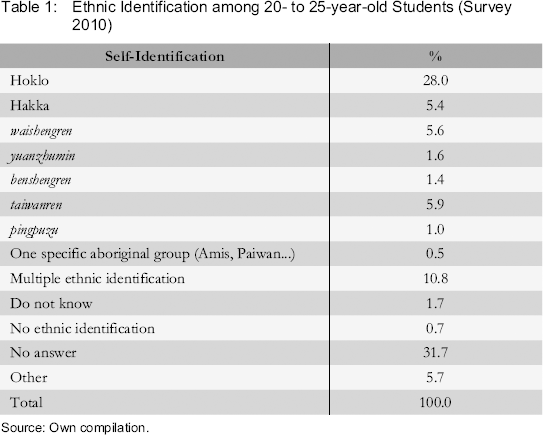
yuanzhumin (2 per cent). But the data gathered from the
questionnaire I distributed in 2010 show that, for the generation born in the 1980s,
this categorization does not reflect what is felt and experienced by a majority of
members of these putative “ethnic groups”. Table 1 shows that when asked the open
question “Which ethnic group (or groups) do you belong to?” ( ), Qingwen nin shi
shuyu na yige zuqun (huo duoge zuqun?), less than half of the
respondents (47.9 per cent) identify with one of the commonly used categories,
whereas almost one third (31.6 per cent) did not answer the question, and 10.8 per
cent put forward a multiple ethnic identification.
), Qingwen nin shi
shuyu na yige zuqun (huo duoge zuqun?), less than half of the
respondents (47.9 per cent) identify with one of the commonly used categories,
whereas almost one third (31.6 per cent) did not answer the question, and 10.8 per
cent put forward a multiple ethnic identification.
Ethnic Identification among 20- to 25-year-old Students (Survey 2010)
Source: Own compilation.
In order to reduce the injunctive effect of such a question, it was preceded by two
other questions. The survey asked first: “Politicians, media and academic research
often divide Taiwan's population into four ethnic groups: ‘Hoklo, Hakka,
waishengren and yuanzhumiri’. Do you think
this classification has a positive meaning?” ( ?, Zhengzhi renwu,
meiti ji xueshu yanjiu zhong chang jiang Taiwan renkou fencheng si da zuqun:
‘heluo, kejia, waisheng ji yuanzhumin’ nin juede zhezhong fenlei you zhengmian
yiyi ma?). Very few answered it “does very much” (1.9 per cent) or it
“does” (13.9 per cent), whereas about one third (29.7 per cent) thought this
division was neither positive nor negative (
?, Zhengzhi renwu,
meiti ji xueshu yanjiu zhong chang jiang Taiwan renkou fencheng si da zuqun:
‘heluo, kejia, waisheng ji yuanzhumin’ nin juede zhezhong fenlei you zhengmian
yiyi ma?). Very few answered it “does very much” (1.9 per cent) or it
“does” (13.9 per cent), whereas about one third (29.7 per cent) thought this
division was neither positive nor negative ( , putong)
and a majority (52.4 per cent) considered it to have “little” (20 per cent) or
“absolutely no” positive meaning (32.4 per cent). Another 6.4 per cent had no
opinion, and 0.7 per cent did not answer the question. Then the students were asked:
“According to you, is having an ethnic identity important or not?” (
, putong)
and a majority (52.4 per cent) considered it to have “little” (20 per cent) or
“absolutely no” positive meaning (32.4 per cent). Another 6.4 per cent had no
opinion, and 0.7 per cent did not answer the question. Then the students were asked:
“According to you, is having an ethnic identity important or not?” ( , Dui nin eryan, you
zuqun rentong shifou zhongyao?). A large majority (58.6 per cent)
considered it to be “very important” (13.7 per cent) or “important” (44.9 per cent),
whereas a quarter of the respondents (26.8 per cent) thought it had no particular
importance (
, Dui nin eryan, you
zuqun rentong shifou zhongyao?). A large majority (58.6 per cent)
considered it to be “very important” (13.7 per cent) or “important” (44.9 per cent),
whereas a quarter of the respondents (26.8 per cent) thought it had no particular
importance ( ,
putong); 11 per cent thought it had “no importance”, and 3.6
per cent had no opinion or did not answer the question.
,
putong); 11 per cent thought it had “no importance”, and 3.6
per cent had no opinion or did not answer the question.
The answers to these two questions show that, generally speaking, ethnicity was not relevant or important for the third of the students who did not respond to the question related to ethnic belonging. More than four in five (80.7 per cent) did not associate the official “four major ethnic groups” division with a positive or very positive meaning, while to almost two thirds (60.5 per cent) ethnic identification had no particular importance (38.5 per cent) or no importance (22 per cent). Thus, it can be said that they chose to put forward no ethnic identity because they do not care much about ethnicity as a major component of their interpretive frame for social interaction.
The relative weakness of ethnic groupness can first be explained by the fact that patrilineality, language and locality, which contributed in Taiwan to what Anthony Smith has coined “participants' primordialism” – meaning the tendency to essentialize the group one believes he or she belongs to, are not efficient diacritical features anymore for Taiwanese in their twenties. For the second generation of waishengren, patrilineality was a device for group division and boundary maintenance through the imposition of the mainlander father's worldview and identity to children born of ethnic intermarriage (Wang Fu-chang quoted in Chang and Yang 2010). But evidence challenges this fact for the third generation of waishengren. Indeed, among the 49 students who stated they are waishengren (8.5 per cent of the total 2010 survey's population), 17 claimed a dual ethnic identity declaring they are both waishengren and Hoklo (12 persons), waishengren and Hakka (3), and waishengren and benshengren (2). Similarly, 64 students (11.1 per cent of the total 2010 survey's population) chose to identify with the Hakka group, with 33 of them claiming a dual ethnic identity: Hakka and Hoklo (29 persons), Hakka and waishengren (3), and Hakka and Amis (1).
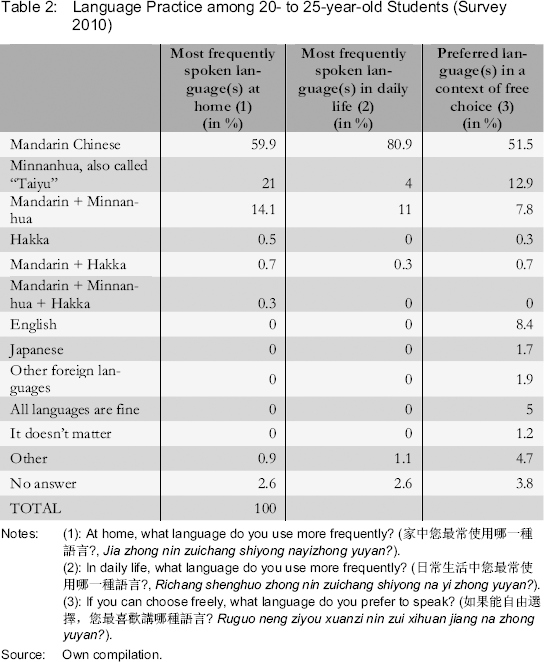
For this generation, language cannot be an efficient diacritical feature, either, for
two major reasons. First, language proficiency and practice do not enable young
Taiwanese to assign a person of the same generation to one or another of the four
ethnic groups anymore. With some rare exceptions, students enjoy similar proficiency
in Mandarin Chinese, with no persistence of Mainland China's regional/ provincial
accents that could be used to divide between “native Taiwanese” and civil war
migrants' offspring. As Table
2 below shows, the practice of Minnanhua  (Hoklo language) and Hakka
at home or in daily life is rather weak for the former and nearly extinguished for
the latter. The interviews indicated that a majority generally understand Minnanhua
quite well but do not feel comfortable with oral expression and would rather use
Mandarin Chinese in interactions with friends and other students. These students
generally speak Taiwan guoyu (
(Hoklo language) and Hakka
at home or in daily life is rather weak for the former and nearly extinguished for
the latter. The interviews indicated that a majority generally understand Minnanhua
quite well but do not feel comfortable with oral expression and would rather use
Mandarin Chinese in interactions with friends and other students. These students
generally speak Taiwan guoyu ( ) – or “Taiwan-flavoured”
Mandarin Chinese. Moreover, they generally face the same difficulties in mastering
“local” languages. These findings may not hold true for the less educated and often
impoverished Taiwanese who did not attend university, especially in the southern
part of Taiwan, where the use of Hoklo is still predominant. Nevertheless, a growing
preference for Mandarin Chinese among younger Taiwanese, with higher education or
not, appears in other studies. To support this conclusion, Shelley Rigger gives the
following example. When the 2005 Taiwan National Security Survey was conducted,
) – or “Taiwan-flavoured”
Mandarin Chinese. Moreover, they generally face the same difficulties in mastering
“local” languages. These findings may not hold true for the less educated and often
impoverished Taiwanese who did not attend university, especially in the southern
part of Taiwan, where the use of Hoklo is still predominant. Nevertheless, a growing
preference for Mandarin Chinese among younger Taiwanese, with higher education or
not, appears in other studies. To support this conclusion, Shelley Rigger gives the
following example. When the 2005 Taiwan National Security Survey was conducted,
Language Practice among 20- to 25-year-old Students (Survey 2010)
Notes: : At home, what language do you use
more frequently? ( : In daily life, what language do
you use more frequently? ( : If you can choose freely, what
language do you prefer to speak? (
 ?,
Jia zhong nin zuichang shiyong nayizhong
yuyan?).
?,
Jia zhong nin zuichang shiyong nayizhong
yuyan?). ?,
Richang shenghuo zhong nin zuichang shiyong na
yi zhong yuyan?).
?,
Richang shenghuo zhong nin zuichang shiyong na
yi zhong yuyan?). ?
Ruguo neng ziyou xuanzi nin zui xihuan jiang na
zhong yuyan?).
?
Ruguo neng ziyou xuanzi nin zui xihuan jiang na
zhong yuyan?).
Source: Own compilation.
respondents could answer in Mandarin, Hakka, or Taiwanese; 45 per cent of the second-generation [born between 1931 and 1953] respondents spoke Taiwanese or a mixture of Taiwanese and Mandarin. Among the fourth-generation respondents [born after 1968], more than 95 per cent chose Mandarin (Rigger 2006: 51).
More important, interviews with students show that most of the time, Minnanhua is not
the language they would use to express deep feelings and emotions. This is also why
language can hardly work as an ethnic group division device. Contrary to their
parents and grandparents, Minnanhua or Taiyu ( ) is not an object of strong
“emotional investment” anymore. In other words, using Taiyu is not part of any
in-group assertion or group-making strategy. It is not a political act either. This
finding also confirms Shelley Rigger's conclusion on the relation between language
choice and Taiwanese identity. Most of the students who participated in the focus
groups she organized
) is not an object of strong
“emotional investment” anymore. In other words, using Taiyu is not part of any
in-group assertion or group-making strategy. It is not a political act either. This
finding also confirms Shelley Rigger's conclusion on the relation between language
choice and Taiwanese identity. Most of the students who participated in the focus
groups she organized
dismissed the idea that language choice is an important marker of one's identification with Taiwan. On the contrary, they believe language is a communication device, and many seemed tired of the issue (Rigger 2006: 52).
Personal interviews also led to the conclusion that most of the time, locality – meaning territorial anchoring of identity on the land formerly inhabited by ancestors – is more a matter of individual/ family memory than a diacritical feature used in ethnic group-making. In other words, for this generation, locality in that sense is still at the centre of individual and family memory, identity and solidarity, but it does not generate ethnic boundaries between members of a group that would consider themselves “true native Taiwanese” with ancestral roots in Taiwan and a group of civil war migrants' descendants seen as outsiders or foreigners because their ancestral homeland is in mainland China. Conversely, the “third generation of waishengren” now in their twenties do not view themselves as “refugees” or “exiles” with their homeland still being in mainland China. Their provincial origin does matter to them, but it is perceived as a feature of their individual and family identity rather than an attribute that could generate ethnic identification with a “super-family” (Horowitz 1985) that would include all the waishengren on the basis of their common origins and shared nostalgia for mainland China.
Consequently, departing from the life experiences of their parents and grandparents, ethnicity is not involved in the choices made by Taiwanese in their twenties in terms of friendship, love and marriage. Although the survey I conducted in 2010 does not provide data on ethnic intermarriage, several studies confirm the general attitude emerging from interviews: Taiwanese born in the 1980s do not pay much attention to “provincial origin” when they make friends or when they think about a future marriage partner. For example, a 1997 survey analysed by Chen Wen-chun shows that very few high school students would consider “provincial origin” when making friends or choosing a marriage partner. Only 6 per cent would do so in the first case, and 18.5 per cent in the second case (Rigger 2006: 19). These findings are consistent with Shelley Rigger's research conducted in sixteen focus groups, each of which averaged approximately eight participants who were all between 18 and 30 years of age in 2005 (Rigger 2006: 19).
In the political sphere, data from the survey I designed in 2010 suggest that
Taiwanese in their twenties also generally oppose ethnic mobilization and ethnic
vote. For instance, when asked if they “agree with some people saying that ‘to love
Taiwan is to support a local government’” ( , Ai Taiwan jiu yao
zhichi benshengren de zhengquan), two-thirds of the respondents (63.7
per cent) “strongly disagree” (30.1 per cent) or “disagree” (33.6 per cent), whereas
less than one in ten (9 per cent) said they “agree” (7.6 per cent) or “strongly
agree” (1.4 per cent). A fifth (21.2 per cent) thought it “depends on the
situation”; 5.4 per cent had no opinion, and 0.7 per cent did not answer the
question. This progressive obliterating of ethnic boundaries contrasts with the
feelings of this generation's parents and grandparents, who are more likely to
maintain ethnic boundaries between benshengren and
waishengren.
, Ai Taiwan jiu yao
zhichi benshengren de zhengquan), two-thirds of the respondents (63.7
per cent) “strongly disagree” (30.1 per cent) or “disagree” (33.6 per cent), whereas
less than one in ten (9 per cent) said they “agree” (7.6 per cent) or “strongly
agree” (1.4 per cent). A fifth (21.2 per cent) thought it “depends on the
situation”; 5.4 per cent had no opinion, and 0.7 per cent did not answer the
question. This progressive obliterating of ethnic boundaries contrasts with the
feelings of this generation's parents and grandparents, who are more likely to
maintain ethnic boundaries between benshengren and
waishengren.
A Generational Gap: Life Experience, Memories and Ethnicity
In the early 1990s, talking of the division between native Taiwanese and mainlanders as being “the main social cleavage” and saying that the “division of political support along lines of ‘ethnicity’ is a reflection of political tension between these two groups” before wondering if the democratization and the “Taiwanization” would ease tensions, Wu Nai-teh argued that
older [native] Taiwanese who experienced repression and who lived under mainlander-dominated politics during their youth (when political ideologies and dispositions are formed) are likely to have maintained their hostilities and biases toward mainlanders (Wu in: Chen, Chuang, and Huang 1994: 151–156).
Several studies have pointed out the factors that resulted in ethnic labelling and self-ascription in older generations (Hill 1981; Chang 1994; Corcuff 2000). They can be classified into four main categories.
First is the role of the KMT-controlled state until the 1990s, which voluntarily reinforced its power through
“forced group separation” in daily life with about 900 “military family
villages” ( , juancun) housing some 110,000 KMT army soldiers'
households (Chang 1994; Chang and Yang 2010: 116–117) and the administrative
classification of Taiwan's population using jiguan
(
, juancun) housing some 110,000 KMT army soldiers'
households (Chang 1994; Chang and Yang 2010: 116–117) and the administrative
classification of Taiwan's population using jiguan
( ),
which defined someone's identity based on the father's origin, starting with
provincial origin and thus enabling the party-state to distinguish between
those with a “mainland China province origin” and those with a “Taiwan
province” origin (Corcuff 2000: 78);
),
which defined someone's identity based on the father's origin, starting with
provincial origin and thus enabling the party-state to distinguish between
those with a “mainland China province origin” and those with a “Taiwan
province” origin (Corcuff 2000: 78);
“asymmetrical juxtaposition” in social, economic and political spheres
favouring waishengren to the detriment of
benshengren (including both Hoklo and Hakka) and
creating a certain “homogeneity in occupations”, the
“jun-gong-jiao” ( ) or “military/ civil
servant/teacher” sector being overwhelmingly dominated by mainlanders (Chang
1994: 108); and
) or “military/ civil
servant/teacher” sector being overwhelmingly dominated by mainlanders (Chang
1994: 108); and
cultural/ educational policies designed to impose the KMT's tailor-made “Chinese traditional culture” as a source of social virtue and aimed at “downplaying values and symbols that concern Taiwan and the Taiwanese” (Wilson 1970; Chun 1996: 129–131; Chang 1994: 121).
Second is the role of social/ political forces, mainly the political forces opposed to the KMT state, which, starting at the end of the 1970s, used the Hoklo group's frustration at being discriminated against and the Hoklo language as a means of ethno-political mobilization. The third category is collective memory related to each ethnic group's own past and conflicts (memories of the civil war on the mainland and exile in Taiwan for the waishengren; memories of the repression and cultural discrimination for the benshengren). The fourth deals with demography linked to democratization in the 1990s, which triggered an identity crisis among the waishengren and, to a certain extent, the Hakka, who were confronted with the risk associated with the rise of Hoklo ethno-nationalism.
A glance at the political and cultural reforms that took place in the 1980s and 1990s illustrates the gap which separates Taiwanese in their twenties and their elders in terms of life experience. Members of this generation were at most seven years old when martial law was lifted in July 1987, paving the way to the democratization of the regime. The democratization rapidly translated into reforms with considerable consequences for the daily life experiences of young Taiwanese and for the formation of their worldview – among those, freedom of the press (1988); a relaxing of the ban on visiting relatives in mainland China and investing there, followed by the rapid growth of cross-Strait economic exchanges in the 1990s; the end of the “Temporary Provisions Effective During the Period of Communist Rebellion” (1991), meaning the unilateral end of the civil war during which Taibei and Beijing were in opposition, and the abandonment of the “sacred mission of retaking the mainland”; the first fully democratic legislative election (1992); the suppression of the jiguan classification system (1992); the liberalization of cable TV channels (1993); and the first universal-suffrage presidential election (1996). In the cultural sphere, reforms initiated the departure from Chinese “integral nationalism” (Thiesse 1999: 14), which defined a person's identity as exclusively national and considered other forms of identification illegitimate, and geared up the (re)building of an officially multicultural society.
Most of these reforms were implemented before the Taiwanese born in the 1980s entered
adolescence. Thus this generation could be called a “post-reform generation”.
Evidence shows it has important specific characteristics with substantial
consequences for ethnicity. First, the survey I conducted in 2010 confirmed the data
I collected in 2005 (Cabestan and Le Pesant 2009). More than four in five (80.9 per
cent) of the students said they are “first” Taiwanese, with 40.9 per cent answering
that they are “Taiwanese”, 33.9 per cent “Taiwanese and huaren”
( ,
Taiwanren ye shi huaren) and 6.1 per cent “Taiwanese and
zhong guoren” (
,
Taiwanren ye shi huaren) and 6.1 per cent “Taiwanese and
zhong guoren” ( , Taiwanren ye shi
zhongguoren). Other answers confirmed the difference between
zhongguoren and huaren. As Chang Mau-kuei
notes,
, Taiwanren ye shi
zhongguoren). Other answers confirmed the difference between
zhongguoren and huaren. As Chang Mau-kuei
notes,
[b]oth “Zhongguoren” ( ) and “Huaren” are
usually translated as “Chinese” in English, but have different connotations and
are used in different contexts. “Zhongguoren” has more emphasis on the Chinese
motherland or the Chinese nation-state, whereas “Huaren” as a connotation of the
connectedness with the Chinese cultural heritage, not necessarily with the
political motherland (Chang 2005: 253).
) and “Huaren” are
usually translated as “Chinese” in English, but have different connotations and
are used in different contexts. “Zhongguoren” has more emphasis on the Chinese
motherland or the Chinese nation-state, whereas “Huaren” as a connotation of the
connectedness with the Chinese cultural heritage, not necessarily with the
political motherland (Chang 2005: 253).
Moreover, data from these two surveys and interviews enable us to assert that, for
this generation, “being Taiwanese” means having a sense of belonging to an imagined,
territorialized, sovereign, political community of shared interests limited to
Taiwan – that is, a Taiwanese nation (Le Pesant 2010).
Additionally, the 2010 survey's respondents placed “the development of
multiculturalism” at the top of a list of “most beneficial changes for the Taiwanese
society during the past two decades”. This list was made up of 14 categories, and
the students were permitted to choose two of them. A third (34.4 per cent) chose
“the development of multiculturalism”, many more than those who chose “the increase
of economic and cultural exchanges with China” (7.5 per cent) – ranked ninth – or
those who chose “the political and cultural indigenization ( , bentuhua)”
(5.2 per cent), ranked tenth.
, bentuhua)”
(5.2 per cent), ranked tenth.
For this generation, ethnic boundaries that appeared during the KMT dictatorship
period and were reinforced during the liberalization and democratization periods are
progressively vanishing. Ethnic identification is weakening, and “ethnic division”
( ,
zuqun fenhua) and “ethnic conflict” (
,
zuqun fenhua) and “ethnic conflict” ( , zuqun
chongtu) within this generation are not sources of major concern in
everyday life. Data from the survey conducted in 2010 show that only a small
minority (12.3 per cent) considred ethnic division to have a “very strong” (1.9 per
cent) or a “strong” (10.4 per cent) negative influence on their daily lives, whereas
more than four in five (83 per cent) thought of this influence as “not strong” (37.9
per cent), “weak” (27.4 per cent), or nonexistent (17.7 per cent). Similarly,
although the Taiwanese in their twenties still see their society as a whole as
ethnically divided, the survey-takers viewed this problem as a “little” one (18.2
per cent) or an “acceptable” one (47.5 per cent), whereas 24.3 per cent thought it
was a “deep” problem and 5.2 per cent a “very deep” problem. Ethnic groups therefore
do exist in their social representation of Taiwan, but only in relation to the older
generations.
, zuqun
chongtu) within this generation are not sources of major concern in
everyday life. Data from the survey conducted in 2010 show that only a small
minority (12.3 per cent) considred ethnic division to have a “very strong” (1.9 per
cent) or a “strong” (10.4 per cent) negative influence on their daily lives, whereas
more than four in five (83 per cent) thought of this influence as “not strong” (37.9
per cent), “weak” (27.4 per cent), or nonexistent (17.7 per cent). Similarly,
although the Taiwanese in their twenties still see their society as a whole as
ethnically divided, the survey-takers viewed this problem as a “little” one (18.2
per cent) or an “acceptable” one (47.5 per cent), whereas 24.3 per cent thought it
was a “deep” problem and 5.2 per cent a “very deep” problem. Ethnic groups therefore
do exist in their social representation of Taiwan, but only in relation to the older
generations.
Toward a Redefinition of Ethnicity for the Generation Born in the 1980s
The data presented in the two preceding sections allow the assertion that ethnic groupness seems to be progressively occulted by another form of more directly territorialized identity – a Taiwanese national identity. In terms of group boundary-making and solidarity, what really matters to these students is their perceived common life experience as individuals who all were born in and grew up in Taiwan, a sovereign, multicultural country which may be part of a larger Chinese/ Huaren cultural sphere but which is nevertheless limited to Taiwan and its population. What matters is their strong emotional investment in “their island”, mixed with their shared feeling of being constantly unfairly treated by the international community and being victims of China's repeated humiliations and negation of their existence, making them “second-class” human beings (Wang 2000: 95–99 and 105–109). This produces an inclusive Taiwanese identity encompassing the “four major ethnic groups” and contributing to decrease the degree of ethnic groupness.
This is not to say that ethnic identities are disappearing in Taiwan. But contrary to older generations, ethnic identities are not central in structuring the social interactions of this younger generation because cultural difference and memories inherited from Taiwan's history are not associated with injustice to maintain ethnic group boundaries. Thus, experienced ethnic groupness is not strong within this generation. But this process is transforming ethnicity rather than erasing it. Indeed, as mentioned above, a large majority (58.6 per cent) still consider having an ethnic identity “very important” (13.7 per cent) or “important” (44.9 per cent) to them. In order to better understand this phenomenon, we should abandon what Rogers Brubaker (2004) criticizes as the usual “groupist” point of view on ethnicity and re-centre the analysis on how ethnicity works “without groups”, as an individual-centred perspective on the world. The following points constitute the outline of research currently being developed using personal interviews on how to redefine ethnicity for Taiwanese born in the 1980s.
As a starting point, it may be useful to borrow some of the core components of the concept of “symbolic ethnicity” coined by Herbert J. Gans (1979), with some necessary adaptations, for Gans was speaking of third-generation European immigrants in America. As a matter of fact, the ethnicity of Taiwanese in their twenties seems to correspond to what Gans wrote about third-generation European immigrants in the United States:
Since ethnic identity needs are neither intense nor frequent in this generation, however, ethnics do not need either ethnic cultures or organizations; instead, they resort to the use of ethnic symbols. As a result, ethnicity may be turning into symbolic ethnicity, an ethnicity of last resort, which could, nevertheless, persist for generations (Gans (1979: 1).
Some of the characteristics of such a symbolic, individualistic and voluntary ethnicity emphasized by Gans may fit well with the situation of Taiwanese youth:
“[T]he secular ethnic cultures which the immigrants [meaning the successive waves of Han migrations for Taiwan] brought with them are now only an ancestral memory, or an exotic tradition to be savoured once in a while in a museum or at an ethnic festival” (Gans 1979: 6).
“[T]he ethnic role is today less of an ascriptive than a voluntary role that people assume alongside other roles” (Gans 1979: 7–8).
“[G]iven the degree to which [this] generation has acculturated and assimilated, most people look for easy and intermittent ways of expressing their identity, for ways that do not conflict with other ways of life. As a result, they refrain from ethnic behaviour that requires an arduous or time-consuming commitment, either to a culture that must be practiced constantly, or to organizations” (Gans 1979: 8).
“Rites de passage, holidays” and “consumer goods, notably food”, are “ready source for ethnic symbols” (Gans 1979: 10).
Each of these four aspects of symbolic ethnicity will have to be further studied in order to refine our understanding of ethnicity as a contextually fluctuating variable for this generation's social life.
Conclusion
Frequent reference to the “four major ethnic groups” in media reports, within the political arena, and in numerous academic papers obscures the fact that these categories are not homogeneous entities but include people with very different “levels of groupness” – that is, fluctuating experienced membership. In order to contribute to a better understanding of how ethnicity, ethnic categories, and ethnic groups structure Taiwan's social landscape, this paper focused on the “post-reform” generation, whose members were born in the 1980s. It shows that for a majority of Taiwanese in their twenties, ethnic identity does not equal a strong sense of belonging to a clearly bounded and exclusive ethnic group. Patrilineality, locality and language, which are still powerful devices to maintain ethnic boundaries between the benshengren group and the waishengren group within older generations, are not efficient diacritical features when considering Taiwanese in their twenties. To the contrary, multicultural-ism is often seen positively. For this younger generation, cultural difference and memories inherited from Taiwan's history are not sources of interpersonal or group conflict, and Taiwanese in their twenties largely oppose ethnic political mobilization.
Thus, for this generation, we should dissociate ethnicity from the existence of “ethnic groups” because, most of the time, Taiwanese in their twenties do not “use ethnic identities to categorize themselves and others for purposes of interaction”. A majority considers “having an ethnic identity” important, but its meaning and salience have changed. Ethnicity is only one of the multiple facets of a protean identity. It is becoming more and more a symbolic device in the construction of the self rather than a primordial component at the centre of crystallized identity and groupness. Generally speaking, it is not perceived in a conflicting way, it does not prevail in social interactions, and it is no longer an absolutely central source of meaning and dignity.