



Abstract
The concept of “migrant workers” derives from the household registration system of China's planned economy period. The continued existence of that system conflicts with the development of an integrated labour market. The current social security system, based on household registration and a large number of local pools, discriminates against migrant workers because of their mobility and the lack of mechanisms to transfer benefits between pools. As a result, migrants have made major contributions to China's economic development but do not get the same benefits as urban residents. Faced with this challenge, China's government has begun to introduce policy reforms to improve social security for migrants. This article explores this development through a focus on old-age insurance. It analyses the special needs of migrants, the obstacles facing policy development and the proposed solutions. It argues that social justice and social equity require the development of a system that treats all citizens equally, and that the logic of an integrated labour market will ultimately require a unified national system of old-age insurance.
Introduction
The development of social security for migrant workers has become a priority for the Chinese government. A series of government policy announcements after 2003 addressed aspects of migrant employment, welfare, education and training, and these developments culminated in the publication of the State Council Document No. 5, 2006, which provided a comprehensive review of all migrant-worker issues (State Council 2006). The document acknowledged the major contributions made by migrants to rural development and to the economic and social transformation of China. It recognized the need to protect their rights and to improve their conditions. It called for an end to discrimination against them. Document No. 5 was thus a clear and unequivocal official declaration that migrant workers should be seen as a group that needs policy support, rather than as a group to be excluded. Given the wide range of institutional and social barriers created by the dual economy policies of the plan era, however, these policy goals are more easily stated than realized. The challenge is how to develop practical policies that match the mobility and characteristics of the migrants in a context where most social policy remains structured around place of household registration (hukou). Migrant workers are now the largest category of non-agricultural workers in China, yet because of their rural household registration and their geographical mobility they do not fit easily into urban social security schemes based on place of residence and contributions to local social insurance pools (tongchou). Their rural household registration implies that they should return to their original home and rely on local provision. In essence, the issue is one of social equity and social justice, and it relates to the rights of all Chinese citizens to enjoy equal treatment and equal opportunity.
The implementation of policies to extend social security and social insurance schemes to migrants is the responsibility of the Ministry of Human Resources and Social Security (MoHRSS), and experiments to provide work-injury and health insurance were launched by local social security bureaus in a number of cities and provinces during the late 1990s. In recent years, local policies for old-age insurance for migrant workers have also been introduced. This study 1 focuses on old-age insurance provision for a number of reasons. First, unlike insurance for health, work injury, unemployment and maternity, all of which are designed for short-term needs, old-age insurance is a long-term process that applies to everyone. It requires many years of contributions and accumulation and many years of benefit payment. System design, fund and database management, and prudential regulation are all complex issues. Analysing the way the schemes are structured and implemented illustrates the relationship between the demands of economic and social change and the reform of systems of governance. Second, the issue involves conflicts of interest between urban and rural areas, between local communities and outsiders, between different regional governments and between different levels of government. The development of policy is thus contested, and the way the issues are resolved provides insights into the political economy of China's reforms. Third, the macro-economic implications of old-age insurance policy choices are large. The government will face substantial fiscal burdens, especially with an aging population, if a viable scheme is not introduced now, while the migrants are largely young and able to contribute. Fourth, the nature and pace of urbanization and industrialization depends on the flow of labour between rural and urban areas and between economic sectors. As the labour market becomes more integrated, this process will increasingly be shaped by how labour responds to relative wage levels and benefits. The choice of old-age insurance schemes has the potential to influence the outcomes. Finally, the role played by large old-age insurance funds in capital formation and investment has implications for the economy as a whole. All these issues are wide-ranging and demanding. The development of old-age insurance for migrant workers is thus both an issue of social equity and of the nature of the Chinese development model.
I am grateful to the Chinese and Australian experts involved in the project for their insights. However, the views expressed in this article are those of the author and not necessarily those of either the Australian or the Chinese government. I am also grateful to Jonathan Unger and three anonymous referees for their comments.
In what follows, I will first review the definition and nature of migrant workers in China. I will then discuss the current social security system and the barriers facing migrant-worker participation in old-age insurance schemes. This will be followed by a review of the evolution of policy on old-age insurance for migrants and the current challenges facing policy development. I will conclude with some discussion of the implications of the issue for China's development.
Migrant Workers and Their Characteristics
Rural-to-urban migration began to emerge in China during the early 1980s. In some ways, it was the inevitable consequence of the rural reforms introduced after 1978. These contracted land to household management, sanctioned the emergence of free markets in non-plan and surplus agricultural products, and gave farmers control of their own labour. These changes liberated farmers from the strict management of the collectives and from the controls over their geographical mobility. The farmers responded rapidly to the incentives to produce more profitable products for the free market and to direct their labour to activities with a higher value added, including off-farm and non-agricultural production. This led not only to the growth of local township and village enterprises but also to the movement of rural labour into the cities. Both of these changes helped realize China's comparative advantage in labour-intensive manufactures and promoted the structural transformation of the economy. By the late 1980s, the rural migrants were already a significant factor in the Chinese economy and major contributors to rural incomes and rural development (for an early discussion of the changes taking place during the 1980s and their economic implications, see Cai 1990).
Strictly speaking, the term “migrant workers” refers to people with rural household registrations who have moved to cities and towns in other areas to work. They may move permanently, for long periods or seasonally, and they may also circulate between provinces and between cities and their old home. Initially in China, they were called the “floating population” (liudong renkou). These definitions focus on household registration and are used to distinguish the migrants from the registered urban population of the areas to which they have moved.
As the labour market has evolved and the population as a whole has become more mobile, however, these distinctions based on the old systems of population management have become harder to sustain. In current usage, migrant workers in China are commonly called nongmingong, literally “farmer-workers”. They are rural people working outside of agriculture and dependent on their wages for their livelihood. They commonly retain links to the rural economy through their land contract, but they do not farm or only occasionally return to the farm during the busy season. This broad definition includes both migrants who move from rural to urban areas and those who move from agriculture into township and village enterprises, as well as those who move between the two categories. In some coastal cities, the term “outside worker” (wailaigong) has also become common, and it refers to any non-local, regardless of whether they came from the countryside or from other cities. Given the changes in labour mobility, the allocation of social welfare and social security provision (including education) according to household registration and the existence of local pooling arrangements (whereby social insurance contributions are pooled at the city or county level rather than at the national level) create major obstacles to the movement of labour and the integration of the labour market. In effect, economic growth and change have generated social transformations that in turn demand the reform of government processes. A system based on a planned economy and a sedentary population no longer corresponds to the realities of the economy. The division of employees into multiple categories (local urban worker, outside urban worker, farmer, rural migrant worker, township and village enterprise worker and so forth) and the structuring and management of social security provision according to category make the system very complex. Furthermore, because people are moving flexibly between places and categories, it is difficult to sustain. Ultimately, the social security system needs to provide similar coverage for all types of employees, both in terms of equity and in terms of simplicity of management.
Given the migrants' existence as highly mobile workers who change job and location frequently, the statistics on them are inevitably inconsistent and uncertain. As can be expected, different statistical systems using different definitions arrive at different totals (for a helpful discussion of the statistical problems see Chan 2009). In 2006, for example, the National Statistical Bureau (NSB) reported that rural-to-urban migrants totalled 132 million, while the Ministry of Agriculture reported 115 million (Han 2009). The most recent NSB report at the end of 2008 gives 140 million. When the township and village enterprise workforce of 85 million is included, however, the total number of “farmer-workers” rises to over 225 million (NBS 2009). This total is similar to the Ministry of Agriculture estimate for the end of 2007 of 227 million, consisting of 126 million migrants and 150 million township and village enterprise workers minus double counting (Xinhua Net 2008). Migrants (that is, “farmer-workers”) can easily shift between migration to cities and working in rural enterprises, and the distinction between the two types of employment is primarily location. In developing social security for migrants, therefore, the MoHRSS needs to cater for this larger figure. Both categories will need provision for their old age.
Surveys of the rural-to-urban migrants have identified the following characteristics: 2
There have been very many large and small surveys, each with variations in the ratios reported according to definitions and sampling. The figures cited here are estimates drawn from Hua 2009. They are cited as indicative references rather than as exact measures. Other useful surveys are reported in Cai and Bai 2006; Cui 2008; Cai and Du 2007; Han 2009: 449–465; Meng et al. forthcoming.
They are roughly two-thirds male and one-third female, with some clear gender distinctions in the type of work undertaken.
The average age is around 29, and job opportunities decline after age 40.
Their employment tends to be in “dirty, arduous and dangerous” jobs.
They are increasingly among the better-educated farmers. Approximately two-thirds have junior secondary school education and a little over 10 per cent are senior secondary graduates.
Some observers argue that approximately 20 per cent of them are settling permanently in urban areas. Some of these have technical or management roles and increasingly see themselves as urban. Approximately 60 per cent are more mobile. They spend most of the year outside the villages, but may return for festivals or busy periods. They move between employers and locations fairly regularly. Another 20 per cent are seasonal workers, who retain an important role as agricultural labour and only “migrate” during the slack agricultural seasons.
Some studies also argue that generational changes have taken place in the nature of the migrants (Han 2009: 452–454). The first wave in the 1980s was essentially strong but unskilled rural labour, taking any work for more income than they could get farming, and many staying locally and retaining strong rural links. Subsequent waves have travelled further and become younger and more educated. Many of these depart for migrant jobs directly after graduating from school and have never worked on the farm and don't want to. They see themselves as becoming urban.
There is also a trend for those who eventually return to their home counties or provinces to settle in local towns and to either set up small businesses or seek employment in local enterprises (Hua 2009).
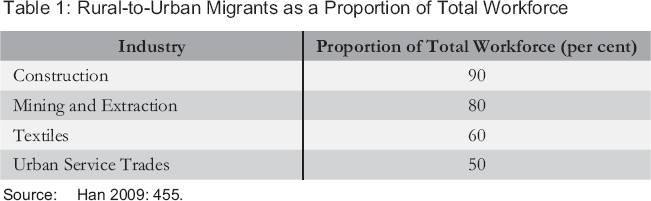
Citing official statistics, Han Jun's study reports that these rural-to-urban migrant workers have also become the largest proportion of the workforce, making up some two-thirds of all non-agricultural workers, and that they have also become dominant in a number of major sectors as follows:
Rural-to-Urban Migrants as a Proportion of Total Workforce
Source: Han 2009: 455.
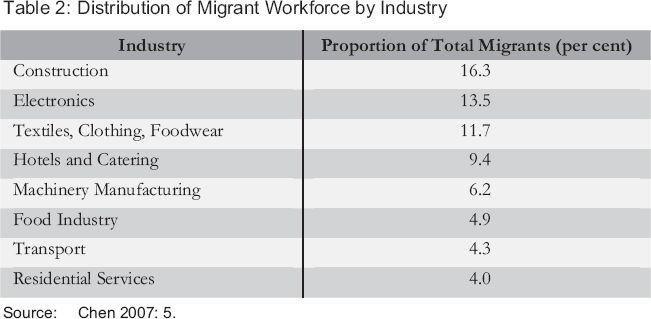
Han Jun also reports that in 2006 rural-to-urban migrant workers' sectoral distribution was as follows: primary sector, 2.8 per cent; secondary sector, 56.7 per cent; and tertiary sector 40.5 per cent (Han 2009: 462). A large survey carried out by MoHRSS (then known as the Ministry of Labour and Social Security) in early 2007 also gave a more detailed breakdown of the migrant labour distribution across industries, with some major concentrations as follows:
Distribution of Migrant Workforce by Industry
Source: Chen 2007: 5.
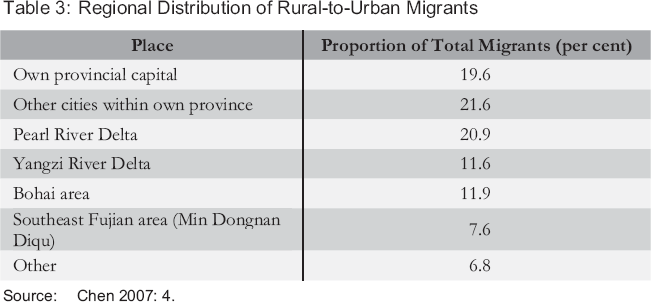
The regional distribution of these workers was reported as 70.1 per cent in the eastern region, 14.8 per cent in the central region and 14.9 per cent in the west (Han 2009: 463). The MoHRSS survey also provided a further breakdown as follows:
Regional Distribution of Rural-to-Urban Migrants
Source: Chen 2007: 4.
Finally, the average length of time spent continuously outside their home by the migrants was 9.4 months (Chen 2007: 6).
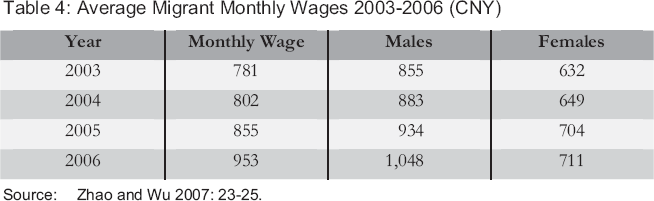
Despite their major role in total employment, the average monthly income of farmer-workers remains low and is well below the urban average. Furthermore, despite the fact that the economy and labour productivity grew rapidly, migrant wages remained almost static from the 1980s until the early 2000s (Li Deshui cited in Chan 2009, footnote 50. See also Li 2005). The labour-intensive development model thus relied heavily on maintaining the supply of cheap labour, and the existence of the household registration system helped sustain the low level of income and benefits for the migrants. In recent years – until the economic downturn in late 2008 – however, there were signs that the supply of rural labour, especially in the 16–35 age group, which was most in demand, was beginning to dry up and this was leading to a rise in wages. Some, such as Cai Fang, had begun to argue that this heralded the imminent arrival of the Lewisian turning point (Cai and Du 2007). According to the National Rural Fixed-Point Survey, average migrant monthly wages in the period 2003–2006 were as follows:
Average Migrant Monthly Wages 2003–2006 (CNY)
Source: Zhao and Wu 2007: 23–25.
Furthermore, in 2006 over half of migrants earned below 800 CNY and one-third between 200 and 600 CNY. The MoHRSS survey, however, reported somewhat higher figures, with a 2006 average of 1,226 CNY and the largest proportion of 41.3 per cent in the 1,000–1,500 CNY level (Chen 2007: 7). While the wage data are inevitably uncertain, migrant remittances are a major source of rural livelihoods. According to one 2005 study, they accounted for 20–50 per cent of the income of receiving households (Cheng and Xu 2005). A different study estimated a lower level at approximately 8.5 to 13.1 per cent (Du, Park, and Wang 2005). The China Statistical Yearbook 2006 (NBS 2006: 369) reports that “wage income”, which is defined as all off-farm income from paid labour and therefore would include migrant remittances, income from township and village enterprises and other earned income, accounted for approximately one-third of the per capita annual net income of rural households.
A final important aspect is that, unlike urban residents' incomes, which rise gradually over the employee's employment life and peak towards the end, migrants' wages tend to rise to a peak early and then decline over time, as the migrant's physical strength declines (Zhang 2008). This fact has important implications for migrant expectations and their capacity to build assets for their old age. When they are young and their income is highest, their family and other needs tend to absorb their income. As they age, they have fewer resources to prepare for retirement.
In sum, the major characteristics of migrant workers are
relative youth;
high geographical and job mobility;
informal employment;
low income;
gender disparity in incomes, with females tending to have even lower incomes and even more informal employment;
an income structure that peaks early and tails off as they get older;
a trend towards having better levels of education; and
a trend towards becoming more settled in cities.
The design of social security programmes for migrants therefore needs to address these characteristics and to respond to the nature of the demand that they create. With this in mind, we can now turn to examine the existing barriers to the development of migrant old-age insurance.
China's Social Security System and the Barriers Facing Migrants
The preceding section has briefly examined the key characteristics of the migrant workforce. As I have stressed, there is an inherent contradiction between the emergence of a mobile and flexible labour force and a social security system that is structured around the administration of a sedentary population. The result is a set of barriers, some inherited and some new, that constrain migrant participation in old-age insurance schemes. Of these, the key ones are
the household registration system,
the nature of the Chinese social security system,
practical and technical barriers,
migrant preferences, and
the political economy of competing interests.
The Household Registration System
The most obvious barrier facing migrants is the household registration system (hukou) that has existed since the 1950s. As is well known, this system allocated all welfare and social service provision, including housing and education, through a citizen's employment unit and registered place of residence. It reflected the priorities of a planned economy based on the bureaucratic allocation of resources for a relatively immobile and controlled population. It tied an individual to a location and created a nexus of interest between the local population and the local economy. Under the plan system, urban residents received welfare benefits from their employer or urban government agencies, while rural residents depended on the local collective economy. The level of benefits was thus tied to the economic capacity of the workplace or the area. The economic reforms swept aside the economic basis of this system. State enterprises declined, the private economy and market relations expanded, and the collectives disappeared. Nevertheless, the household registration system and the link to welfare provision remains.
In the view of Chan, the effect of this system is to perpetuate low incomes for rural people by preventing them from becoming formal urban citizens and, thereby, excluding them from urban rights and benefits (Chan 2009). The system thus stands in marked contradiction to the existence of a mobile population and to the needs of an integrated labour market.
The Nature of the Chinese Social Security and Old-age Insurance System
The reforms of the Chinese social security system during the period 1991–1998 (Wang 2001; Wang 2002: 4–9; Zhao, Lai, and Wei 2006) introduced insurance schemes for urban employees that provided coverage for health, work injury, unemployment, maternity and old age. This new structure replaced the old model of the plan period, whereby urban employees received social security and a defined-benefit old-age pension from their employer (Dixon 1981). It also brought the Chinese system closer to current market economy models for old-age income that in general tend to consist of three pillars:
A basic pension that is funded from government revenue and acts as a minimum income for old people
A compulsory individual account scheme that is funded by employer contributions alone or by employer and employee contributions over the working life of the individual
A voluntary scheme whereby individuals also contribute to funds that are saved for their old age (OECD 2008; Hu and Stewart 2009)
In China, urban schemes are developing rapidly, but rural schemes lag behind and provide a much lower level of benefits. The first pillar of a universal old-age pension provided from fiscal revenue does not exist. There is, however, a minimum income guarantee provided through the Ministry of Civil Affairs as a welfare payment for those who have no other sources of income. This is funded from fiscal revenue and is calculated according to family income. If a family's per capita income is below the minimum, the supplement is paid. The system is most developed in urban areas, and it is still spreading into rural areas at a much lower level of payment. Furthermore, in September 2009, the State Council issued Document 32, which announced the introduction of a new rural pension scheme that would include a substantial amount of fiscal subsidy alongside farmer contributions (State Council 2009). The second pillar is the basic urban old-age insurance scheme managed by the MoHRSS through its subordinate public service unit, the Social Insurance Administration. Once again, rural schemes are still developing, and largely depend on the level of development of the local economy. The third pillar is left to individual choice and to the emerging system of enterprise annuity schemes.
The development of this structure in China was in many ways inevitable, given the erosion of the socialist planned economy and the closure of state-owned enterprises. It also underlined the fact that the old defined-benefit scheme was unsustainable, with some 20 to 30 per cent of state-enterprise wage costs being used to pay the pensions of the retired employees, no accumulated provision to fund pensions, and the ratio of pensions to wages increasing (Zhao, Lai, and Wei 2006: 46–50). The government could no longer guarantee a fixed percentage of an individual's final wage as a pension, and it was necessary to look for ways to ensure that individuals could smooth income over time to provide for their old age and also build assets on which they could depend in later life. The aging population has highlighted the urgency of the change, given the growing number of people dependent on pensions and old-age insurance.
China's urban social insurance schemes depend on contributions from the employer and the employee. These are fixed as a percentage of the wage. Currently, employer contributions for urban employees for all types of insurance are set at approximately the equivalent of 43 per cent of the wage. The health, maternity, work-injury and unemployment benefits are short term and relate to needs as they arise. The insurance is provided by employers for the period of employment, and the benefits are paid as required. By its nature, however, the old-age scheme is ongoing over the lifetime of the individual members. It requires contributions to be recorded and accumulated in a fund, careful management of funds to preserve and improve value, secure systems to manage information databases over many decades, and a method for the payment of benefits. For each participant, the process might last up to 60 or more years, from the time of registration to the time of death.
The design of the basic old-age insurance for urban workers in China is straightforward, though the implementation is complex (Xinhua Net 2005). Employers and employees contribute at a rate of 20 per cent and 8 per cent of the wage respectively. Individuals are able to retire after reaching the requisite age (55 for women and 60 for men) and, provided they have contributed to the local scheme for 15 years or more, they are eligible to register for a monthly pension that is meant to be at a replacement ratio of approximately 60 per cent of the local social average wage (that is, the average wage in the social pooling area and not the actual wage of the individual). 3 As set out in the regulations, the policies for urban social security and old-age insurance are intended to cover all workers in urban employment, including migrants. Moreover, as discussed below, in places with large concentrations of migrants, such as Shenzhen and Dongguan, migrants are enrolled in the urban schemes. However, in operation the system has a number of special characteristics that add to its complexity and also act as barriers to the participation of migrant workers.
It should be noted that employees in government agencies, public welfare units and similar institutions still receive the old planned-economy defined-benefits pensions and do not participate in these schemes.
First, the national scheme is not managed as a single integrated system but as a set of parallel local pools (tongchou). Each pool is local and consists of the contributions from employers and employees. These are held at the local level and managed as a local fund. Each fund has its own specific features, and there is no single, standard national computer system used to manage them. The levels of contributions and benefits also vary. Although efforts are under way to raise the level of pooling, there are currently over 2,000 pools across China, and most of them are at county level. This means that the transfer of contributions and benefits between cities and regions is complicated and difficult, even for urban residents. It is much more so for migrant workers, who might move between jobs and regions within a single year and certainly do so many times over the course of their working lifetime.
Second, the pools also tend to be structured around the employer's level of registration. Thus, the Guangdong Province Social Security Bureau deals with the employees of enterprises registered at the provincial level, while the Guangzhou City Bureau deals with those of enterprises registered at the city level, and so on down through the system. The concept of locality thus combines the notions of both place and administrative level.
Third, participation requires a formal employer who registers the employee in the scheme. After registration, the monthly contributions are calculated by the social security department and collected either through the tax office or through the social security agency, which places them in a special account. This account is operated through the fiscal offices and is meant to be subject to strict management rules in an effort to ensure the security of the funds. Self-employed urban people can also register and make contributions.
Fourth, the contributions from employers and from individuals are treated differently. The employer contribution is seen as part of the common social pool (tongchou), and the individual contributions are seen as part of an individual account (geren zhanghu). Both are used to pay the final benefits, but they are recorded separately. The system is therefore not a pure individual account model.
Fifth, when the system was introduced in 1996, no provision was made for existing retirees or for those approaching the end of their working life. These people are eligible for payments from the funds but have not made contributions over their working lifetime or have only contributed for a few years. In other words, the new scheme inherited large unfunded liabilities from the pre-existing system. Wang Dewen divides the scheme participants into three categories: the “old men” (those already retired in 1997 who continue to draw defined-benefit pensions from the funds but have never made any contributions), the “new men” (those contributing to the new schemes from the beginning), and the “middle men” (those in mid-career who are part of the transition with some unfunded and some funded years) (Wang 2005: 7). The result is that there are many people with “empty accounts”, and the payment of benefits from the funds far exceeds the level of contributions. Most funds are in deficit and are supported from transfers from fiscal revenues (Zhao, Lai, and Wei 2006: 55 report on the deficits between annual contributions and payments in 2001 for 10 provinces, with a range of 15–28 per cent). In 2005, Wang Dewen quoted estimates that the national deficit was 2.5 trillion CNY and likely to grow to 6 trillion over the next 30 years (Wang 2005: 8). According to a 2009 newspaper report, the individual account part of the system had a deficit of 1.4 trillion CNY, despite having a contributing membership of 210 million people (Guo Jinhui 2009). 4 Clearly, the existing schemes are currently not self-funded and will require substantial fiscal inputs for many years.
While these various figures may all refer to slightly different ways of measuring the issue, the huge numbers underline the scale of the problem. Apart from these foreseen deficits, the risks from poor fund management or corruption add to the uncertainties.
This combination of local pools with no mechanisms for interregional transfers, the lack of formal employment contracts for most migrants, the perception of enterprise contributions forming the basis for the local social pool, and the overall shortfall in fund accumulation vis-à-vis benefit payment obligations acts as a powerful barrier to the integration of migrants into the existing systems. Their job mobility, their frequent inter-regional movement and their employment in the informal sector make participation in the urban schemes complicated.
In places where migrant workers are encouraged or allowed to join the urban schemes, the fact that they regularly change jobs or move between regions makes continuity in contributions difficult. The lack of compatibility between pools and the absence of mechanisms to transfer funds are major challenges. As a result, most pools with migrant participants allow them to withdraw their account when they move elsewhere. When they do so, however, the migrants can only withdraw their individual contributions. They lose their claim on the employer's social contribution. In effect, retaining employer contributions made on behalf of migrant workers in the local pool is a way of improving the local balance and reducing the funding shortfall. This combination of a lack of transfer mechanisms and the importance of local interests means that there is little incentive to change the situation. Furthermore, it is difficult for migrants to guarantee that they will make 15 years' worth of contributions to a single fund (including the required 5 consecutive years of contributions in the final years of employment in some pool areas) and qualify for a local retirement benefit. As a result, they have little motivation to participate, and they face the prospect of no old-age income in future. Given this situation and the challenge it presents for both social justice and social stability, it is not surprising that the development of a migrant-worker old-age insurance scheme has become a government priority.
Practical and Technical Barriers
As discussed above, an old-age insurance scheme requires keeping records over a period of up to 60 years or longer and well-structured management and database systems. Furthermore, contributions are made on a monthly basis and need to be recorded, fund values can fluctuate according to investment income, and the payout of benefits also requires constant adjustment in the figures. Thus, the database must be continuously active. Given the huge numbers of individuals involved, the technical requirements for database design, management and structure are demanding, and this requires significant investment in computer systems, information networking and such things as social security cards. As a consequence, the MoHRSS has been making substantial investments in technical and computerized systems for social security through its Jinbao Project (the MoHRSS website has a special section devoted to this project, MoHRSS 2009a). In 1999, for example, it began to work on the introduction of social security cards, and by June 2008, social security cards were in use in 93 areas and approved for issue to 110 million people (MoHRSS 2008). In developed areas such as Wuxi, people now have smart cards, and when they get medical treatment, they swipe their card for the insurance payment and only pay the gap amount from their own pocket. The Jinbao Project includes the development of computerized systems, networking platforms and access for individuals to consult their own records through the Internet. However, computer systems are not yet nationally standardized, links between regional databases are not possible, and some places still use paper records. The technical challenges are thus intensified by regional disparities and by variations in the capacity of local administrations to manage the social security system.
As computer systems develop and the level of pooling rises, it becomes more possible for transfers to be made within the local city or province. Transfers across pools remain, however, very difficult. Even if a pool is willing to transfer funds to an outside entity, migrants going to a new area or returning to their home town might find that there is no local scheme into which the funds can be transferred and no mechanism for calculating the local value of the accrued benefits.
In the absence of a national database – or a national network, national fund, and national tracking system – this technical environment creates major challenges for migrants who move between pool areas. Even if the regulations were amended to allow the transfer of both the social and individual funds, the complexities of transferring the funds between pools are obvious, as are the difficulties of keeping track of the individuals and their contributions to the system. These practical issues represent a significant barrier, and it is not surprising that in places where migrants are enrolled in the urban schemes, they are allowed to withdraw when they move.
Migrant Preferences
Apart from the barriers arising from the operation of the system itself, a further range of challenges arise from the lack of correspondence between the system and the migrants' own preferences and expectations (Zhao, Lai, and Wei 2006: 313–314; interviews with researchers at the Rural Development Institute, CASS, August 19, 2008 and Han Jialing, August 22, 2009; He and Hua 2008). To begin with, the migrants are predominantly young and healthy and do not have a long-term perspective on their needs in old age. They are also not familiar with concepts of insurance against risk or of rights to a social security system. In addition, their income is low, they do not own many assets, and they are not willing to sacrifice part of their wages to an unknown and uncertain scheme. For most of them, the key goals are to send money home to their family, to help build a new family house in their home village, and to prepare for their own wedding and family. They tend to assume that they will have to look after themselves when they are old. These attitudes are not surprising, but as the migrants age, the need to consider their future income becomes more important. According to researchers at the Rural Development Institute, approximately 20 per cent of the migrant workforce is aged 50 or older. The issue of their needs in old age is thus becoming increasingly important. Migrant priorities are, however, changing as the migrant generations evolve. Those who are settling in cities for longer and becoming more urban are increasingly aware of the need to consider their social security. Hua (2009) reports on a Ministry of Labour and Social Security study in 2005 which found that approximately one-third of migrants would be willing to participate in the urban schemes if they could.
However, for many migrants, especially those with family members who have moved to the cities with them, urban housing may be more important than old-age insurance. Urban housing regulations and the nature of the housing market mean it is hard for them to get suitable cheap housing (Zhang and Ge 2007). Education for migrant children in cities is another priority. Another aspect is health. Their employment in dirty and dangerous jobs and their long working hours put their health at risk. Many have to rely on informal medical treatment, but they tend to seek better treatment for their children. For female migrants maternity insurance is also an issue. Without it, they face a challenge to their work and health. They have to go back home to give birth, or they have to rely on cheaper and informal services.
Given these priorities, it is important for the system design to respond to needs in ways that both provide the services wanted and encourage greater willingness to participate. The high cost of employee direct contributions to urban old-age insurance (8 per cent of wages) is likely to be a disincentive. On the other hand, a lower contribution rate would mean a lower income in old age. For women, the issue is particularly difficult. Apart from the fact that they are lower paid and are generally in the more informal employment sectors, they also tend to have more breaks from work for childbearing and family duties and are thus less able to make the regular contributions that are needed. The cost of old-age insurance is thus a significant issue facing all migrants, and especially women.
Alongside these various competing priorities is the perception of risk. A commitment to long-term participation in old-age insurance schemes requires a sense of trust in the security of the funds and awareness that the value of one's benefits is being preserved and improved. This is true for both migrants and urban residents. If fund management is not stable and transparent, if people fear corruption and misuse of funds, and if there is a broad awareness that current contributions are being used to pay the pensions of the “old men” while there are deficits facing fund accumulation for the “new men”, then it is not surprising that migrants are suspicious. They will need to feel confident that all the contributions they are making are accumulating and that they have a growing stake in the system. Regular reporting on their account and reassurance about its growing value are needed to build such incentives. In the absence of such transparent reporting systems, it is understandable that migrants are not enthusiastic. If a compulsory scheme is used and they find that when they move they lose the employer contributions and can only withdraw their own funds, then they might well feel that they would get better value if they saved the money in the bank.
Finally, given the wide range of local experiments and policies, migrants face a range of old-age insurance choices, depending on their place of origin and the place to which they move. They may be in a position to join local rural schemes in their home village, to enrol in local schemes for township and village employees, to enrol in a special scheme for migrants and to join the urban schemes. The current fragmentation of the schemes and the uncertainty about the differences in final outcomes for each scheme makes a clear choice difficult.
The above discussion is impressionistic. It does, however, underline that more analysis of migrant preferences and behaviour is needed if a successful set of social security policies is to be developed for them. The long-term nature of old-age insurance makes that requirement essential.
The Political Economy
The above sections have outlined a series of systemic and contextual challenges facing the development of old-age insurance for migrants. As the discussion has indicated, underlying these challenges are conflicts of interest that shape the way policy is developed and implemented. The main elements are
the ambivalent position of local governments,
conflicts of interest between employers and employees,
conflicts of interest between local residents and outsiders.
Local governments are broadly keen to encourage the employment of migrant workers, since they promote the development of the local economy. These workers provide much of the labour for the construction of local infrastructure and housing, and they do work that local residents are unwilling to take on. There are also incentives for local governments to encourage migrants to join the existing urban schemes in terms of maximizing the local social pool for old-age insurance. The migrants are young and mobile. When they leave the area, they cannot take the employer social-pool contributions with them, and this can help fund the deficits in the schemes. Given these benefits, it is also likely that there would be concerns that introducing new schemes for migrants or expanding participation in urban schemes would increase local production costs for enterprises because of the 20 per cent contribution rate for employers. This might have the negative effect of deterring investment and reducing local economic growth. In places heavily dependent on migrant labour, the need to attract migrants through social security provision may outweigh these concerns, but the issue is not straightforward.
This focus on local economic priorities also illustrates the potential for conflicts of interest between different regional governments and different levels of government. Governments in the poorer regions from which the migrants come have a legitimate concern that they might have to make provision for older migrants returning to their home areas, while the contributions made to social pools on their behalf remain in the areas in which they worked. Governments in the destination areas might take the position that they are unwilling to subsidize social security in distant areas not part of their local economy. Fiscal departments are concerned that they face risks in making provisions for old people with no old-age insurance accumulation of their own. The tensions between central government fiscal responsibilities and local government efforts to maximize local benefits may also play a role. Until some form of a national unified scheme for all forms of old-age insurance is developed, the potential for such frictions will always exist.
For employers, as has been noted, paying social security contributions for migrants means an increase in costs, and many surveys report a tendency to under-report the number of migrant labour employees or to avoid reporting altogether. Furthermore, the constant movement of migrants means that employers continuously have to adjust the name list of migrant employees that they report to the social security bureaus each month. They thus have a strong incentive to avoid participation for their employees and to prefer schemes that have a lower contribution rate for migrants. It is also likely that preferences on this issue will vary between different types of employers and different sectors.
Finally, there is also conflict between the interests of local residents and outsiders. As is common throughout the world, migrants are seen as poorly educated, “uncouth” and “low quality” (suzhi). In the minds of local residents, they are associated with social disorder and crime, with dirtiness, and with pressures on urban services and jobs. Their rural background and regional accents make them clearly distinguishable. The systemic discrimination of the household registration system is thus reinforced through social and cultural discrimination (Li 2004: 217–239; Lu 2004: 306–337). Given this context, it is not surprising that local residents feel that the local social security pool belongs to the local economy and to them. They tend to resent the idea that the migrants might have a right to part of it and take it away.
In sum, the development and implementation of social security schemes for migrant workers is a contested issue. While central policy promotes the goals of social equity for all citizens and the protection of migrant rights, the legacy of existing systems, the demands of local interests and the nature of social stratification combine to create obstacles to their realization, and they also ensure that the implementation of policy will be influenced by the way these conflicting forces play out.
The Evolution of Policy for Migrant Old-age Insurance
Faced with the many complex issues and challenges discussed in the preceding sections, many local governments have experimented with the provision of social security and old-age insurance for migrant workers since the 1990s (Hua 2009; Liu and Xu 2008: 221–227; Han 2009: 481–482). Places like Dongguan in Guangdong, which is heavily reliant on migrant labour, began to allow migrants to participate in the urban schemes during the mid-1990s or even earlier (Interview, Dongguan Social Security Bureau, April 28, 2009). Other cities with large numbers of migrants, such as Wuxi, also began to allow migrants to join the urban schemes during the late 1990s (Interview, Wuxi Social Security Bureau, November 25, 2009). During the early years of the current decade, these experiments spread to places like Shanghai and other cities and provinces, some of which began to introduce specially designed schemes for migrants. The early focus was on health and work-injury insurance, but gradually old-age insurance was introduced, either through participation in the urban schemes or through the design of specific programmes for migrants. Shanghai, for example, established a single integrated scheme to provide all five types of insurance for migrants which is separate from the urban resident insurance scheme. Employer contributions were set at a total of 12.5 per cent of wages. Furthermore, the old-age insurance was established by issuing annual certificates through the China Life Insurance Company (Zhongguo Renshou). Once migrants accumulate 15 years' worth of certificates, they become eligible for an annuity paid from the insurance company. According to Hua Yingfang of the National Institute for Social Security under the MoHRSS, these new programmes fall into three main categories:
Those that bring migrants into the urban schemes
Those that set up special schemes for migrants
Those that place migrants in rural schemes (Hua 2009)
These experiments took place against the background of increasing emphasis on migrant issues by the Chinese leadership. A series of government policy documents after 2003 addressed migrant employment, welfare, education and training. Then in 2006, Document No. 5 provided a comprehensive review of all migrant problems and declared the central government's commitment to help solve them (State Council 2006). In respect of old-age insurance, this document set out the basic principles for policy development (article 19):
Explore a scheme for old-age insurance that suits the characteristics of migrant workers. Focus research on a migrant worker old-age insurance scheme that has a low rate of contributions, broad coverage, is transferable, and can link to existing old-age insurance systems. Where conditions are suitable, migrant workers in stable employment can be brought directly into the basic old-age insurance for urban employees. Employers of migrants already participating in urban schemes should continue to pay contributions for them. The Labour and Social Security Departments must urgently determine methods for transferring and linking migrant worker old-age insurance across regions.
After Document No. 5 was issued, migrants were increasingly seen as a group that needed policy support, rather than a group to be excluded from local social welfare services. The problem, however, has been how to develop policies in practice that match their particular characteristics. As discussed above, the key challenges are as follows:
Job mobility: migrants regularly change their employment. This requires constant registering and re-registering by employers.
Regional mobility: migrants move frequently between provinces and cities and also between local rural enterprises in their home province and enterprises in other regions.
Migrants are more likely to find informal employment than work with a formal employment contract.
Female migrants tend to have greater job mobility, greater levels of informal employment, and more inconsistent employment records because of child-rearing and family responsibilities.
Migrants lack incentives and faith in the long-term benefits they are supposed to receive from existing schemes and are therefore not willing to contribute or withdraw when they move.
Employers are often unwilling to accept the higher labour costs of paying contributions to migrant workers' old-age insurance.
Migrants' income levels are low and the costs of participating in urban schemes are high.
Migrants find it difficult to fulfil the contribution requirements of existing urban schemes, such as contributing for 15 years and, in some places, making continuous local contributions for the final 5 years of employment.
Designing schemes to match these features requires flexible and accurate information management systems to cater for frequent movement and changes, and mechanisms to ensure that fund contributions are preserved in the various pools, combined together and transferred to the place of final residence when the individual retires and starts to draw retirement benefits.
Drawing on the lessons of the various local experiments in dealing with these issues, the MoHRSS drafted a procedure for migrant-worker participation in basic old-age insurance during 2008 (Nongmingong canjia jiben yanglao baoxian banfa) and in February 2009 issued a discussion draft for public comment (MoHRSS 2009b). The draft was made available for public comment until July 2009, with the goal of revising it to a final version during the second half of the year. At the same time, since the issue of portability applies not only to migrants but also to workers moving between cities, the ministry also addressed the issue of the transfer of social insurance registration for urban workers with a draft temporary procedure for the transfer of basic old-age insurance registration for urban enterprise employees (Chengzhen qiye zhigong jiben yanglao baoxian guanxi zhuanyi jiexu zhanxing banfa). This was also made available for public comment. In June 2009 Vice-Minister Hu Xiaoyi of MoHRSS reported that many comments had been received and that, while much complex technical work needed to be done on the implementation procedures, he anticipated that final revised drafts would be issued by the end of the year (Hu 2009).
The discussion draft put forward the following main policy principles:
The procedures would be compulsory and apply to all migrants in urban employment with formal contracts.
The contribution rate would be an amount equivalent to 12 per cent of the wage for the employers and between 4 and 8 per cent for the migrant worker (according to the individual's preference). Employer contributions would go to the social pool, and individual contributions would go to the individual account.
Migrants already enrolled in urban schemes would be allowed to adjust their contribution rates to the new levels if they wished.
Withdrawals would not be allowed when migrants changed jobs. Instead the migrants would be issued with a contribution certificate by the local social security agency. They would then rejoin the scheme in their new place of employment and present the certificate issued by the previous agency. The two social security agencies would complete the transfer of the registration, and the new contributions to the scheme would accumulate in the new fund. The funds and records of those who did not go to new employment would be sealed in their original place of employment. Interest would continue to accumulate in the sealed fund according to the national regulations.
After 15 or more years of contributions, the migrant would qualify for benefits. The migrant would apply to the social insurance agency at their place of final employment, which would verify and issue the retirement benefit, including both the social pool and the individual contribution. This would require the design of arrangements to transfer funds from the earlier social pools to the final one. Those not completing 15 years might have their benefits transferred to a rural scheme or might make a lump-sum withdrawal of their individual contributions.
A unified national information database for old-age insurance contributions by migrants would be established and a lifetime national social insurance card would be issued, bearing a specific identity card number. The migrants would have access to their insurance contribution record from any social insurance office.
The ministry's replies to reporters' questions at the time the draft was issued underlined that these regulations were aiming to improve migrant participation in old-age insurance. At the time, approximately 24 million migrants out of 219 million people were insured in the urban scheme (approximately 17 per cent). It was also indicated that, despite the lower contribution rates, the end retirement benefits would be the same (Guo Huijun 2009).
In sum, the basic outline of the proposed new scheme required (1) compulsory participation with no withdrawals, (2) the reduction of the entry threshold for migrants, (3) the maintenance of sealed accounts in local pools when migrants move, (4) the establishment of a national database for migrant records, and (5) a mechanism for pooling lifetime contributions at the place of final residence. While these proposals were straightforward, they required substantial adjustments to the existing local practices and also the development of new standardized national procedures for fund and database management. Given the large variations currently existing between local regional schemes, the implementation of the new policy thus faced a number of challenges and risks. These included
the potential for continued discrimination against migrant workers by consolidating their status through a distinct old-age insurance system,
the risk of undermining the rights of migrant workers already in stable employment and participating in urban schemes who now consider themselves urbanized and do not want to change,
the need to manage the transition from existing schemes for migrants in ways that do not dismantle established rights,
the possibility that establishing two levels of contributions would potentially encourage employers to favour cheaper migrant labour and create discrimination against urban employees,
the development of transparent and reliable management and information systems that provide clear incentives for migrant workers to join,
the development of fund management and fund security in ways that ensure that contributions both preserve and increase value,
the complexity of fund control and account management problems if each migrant worker's contributions are dispersed among local pools,
the need to establish a national, standardized information database system which can handle large amounts of data at a unified national level.
The creation of a separate structure for migrant workers with different contribution standards from other schemes also risked creating obstacles to the long-term goal of unifying the national system. While the development of a national migrant-worker system might provide lessons for the integration of a national scheme, it would also result in the parallel existence of urban, rural and migrant schemes (and in some places even township and village worker schemes as well).
Even as this draft procedure was under review, however, the context for policy development was further complicated by the State Council's Document 32 2009, the announcement of a proposed new old-age pension scheme for rural residents (State Council 2009). This scheme is intended to provide a monthly payment of 55 CNY to rural residents over the age of 60. Funding for the scheme would come from central and local government subsidies and farmer contributions. It is intended that experiments will begin in up to 10 per cent of counties starting in late 2009 and that the scheme will become universal by 2020. The publication of this new plan immediately raised a further challenge for the proposed migrant-worker old-age insurance scheme, since migrants might regularly move between rural and urban employment and might also have the choice of belonging to either scheme. Furthermore, if they eventually decide to return to rural areas in their retirement, there would be new issues in determining how their urban-based insurance might relate to the proposed rural system. Given this new situation, it is likely that the draft procedure will require further refinement.
Whatever the outcome, the successful refinement of the current policy proposal will require flexibility in responding to transitional problems and openness so that it can promote the evolution of diverse local schemes towards a unified national structure. Ultimately, the demands of a unified labour market require a unified social security system, and the demands of social equity and social justice require that all citizens should have equal access to the same basic structure, with differences depending on their capacity to contribute over their working lifetime.
Conclusion: The Implications
This essay has explored the issues facing the development of social security for migrant workers in China through an analysis of the development of the old-age insurance scheme. It has discussed the definition and nature of migrant workers in Chinese society and identified their key characteristics in relation to old-age insurance. It has examined the barriers facing the development of their social welfare, and it has described how the evolution of policy requires grappling with the many complex issues involved. In this concluding section, I will briefly address the implications of this analysis for China's development.
The first point to note is how the nature of economic and social development in China is leading to policy changes that closely parallel the types of policies adopted in market economies. The combination of an aging population, a flexible and mobile labour force, and the need to encourage citizens to prepare for their own old age in order to reduce future fiscal liabilities is a global issue. In economic terms, this means finding ways to promote income smoothing so that people defer some of their current income for future use and asset building, thus accruing assets that they can use in their retirement. The informalization of employment adds a further dimension to this challenge by placing a large proportion of the workforce outside employer-based social security provision. This is also a major feature of other Asian economies such as Indonesia and India. Like China, they have large migrant-worker populations employed in the informal sector and do not have a social security system to serve these workers' needs. In China, the contribution of the migrants to China's economic growth has been substantial and recognized. If China's current experiments do lead to the development of a viable scheme for migrants, the lessons for other countries in the region could be important.
At the same time, the macro-economic implications of these developments are very significant. Apart from the potential fiscal burden that will be faced if a workable scheme is not developed, the incentive effects of scheme design and the way the insurance funds are managed will have important implications for both labour and capital flows. As the labour market develops, the nature of social insurance will potentially have a growing impact on the way labour flows between sectors. From the point of view of labour, there will be incentives to move to areas or schemes with the best outcomes. From the point of view of employers, there will be incentives to reduce costs by finding ways to limit social insurance contributions. The way the tax system treats the contributions will also play a role. Alongside these effects, the development of large funds needing to be invested in ways that preserve and increase value will also affect the structure and operation of capital markets.
Finally, it is clear that the issue is a contested one, with conflicts between different sets of social interests. The way the policies are debated and implemented reflects both the relative influence of different social groups and the way the government responds to those pressures in the face of social policy needs. As has been illustrated, the process thus provides insights into the political economy of China's reforms. At the same time, this analysis has underlined how economic and social change demands further changes in governance. The social security needs of migrants require a change in the way policy is designed and implemented. If the issue is not addressed, social and economic stability could be threatened. The design of an effective policy with the appropriate incentives will, however, require greater transparency and accountability if it is to work. It will also require coordinated reforms to the household registration system and to the fiscal system. The issue is becoming urgent, and the way the changes evolve will cast light on the capacity of the Chinese governance system to adapt and to respond to fundamental issues of social equity and social justice.