



Abstract
In the face of severe job problems, China's government has adopted a huge stimulus package in a bid to achieve eight per cent economic growth, which is said to guarantee at least enough jobs for the new entrants to the labour market. The real situation, however, will be much grimmer than statistics indicate. Unregistered groups like unemployed rural migrants, job-searching college graduates, laid-off workers and others together with the officially registered unemployed and the new market entrants could add up to 42 million altogether, while even the most optimistic estimates say only around 15 million new jobs could be created in 2009. Nevertheless, the stimulus package demonstrates an at least temporary shift in economic policy from capital-intensive to labour-intensive growth. Additionally, the new initiatives to boost social-security spending could help to address the grievances of the most vulnerable groups in the labour market. The Chinese government's reaction to the emerging employment crisis once again demonstrates the often underestimated adaptability of China's leadership.
Introduction: Three Shortages
China's labour market has been hit very hard by the global financial crisis. As Vice-Minister Zhang Xiaojian of the Ministry of Human Resources and Social Security (MOHRSS) revealed in November 2008, the demand for workers fell in the third quarter of the year for the first time in a long period, dropping by 5.5 per cent in 84 cities across China (Quek 2008a). By that time, more than ten million migrant workers had already lost their jobs after falling demand forced the closure of around 670,000 factories, especially in the export-orientated industries in the coastal regions (Tan 2009a). The negative impact of the current economic downturn on employment is most severe in China's southern manufacturing and export hub, where thousands of labour-intensive firms have collapsed due to weakening foreign demand (Hsiao 2008). The businesses hurt most by the financial crisis are small and medium-sized enterprises (SMEs) as they were already affected by the overheated economy cooling down in the first half of 2008 (Bottelier 2009).
The financial tsunami struck a labour market that faces a number of severe challenges: the enforcement of new labour standards, the strengthening of social insurance mechanisms, fostering of labour mobility and the re-employment of laid-off workers (World Bank 2007). Three shortages have recently been hotly debated: the shortage of jobs for new entrants, laid-off former state-sector workers, rural migrants from China's interior regions as well as qualified college graduates, all of which might induce social instability; the reported shortage of unskilled workers in southern China and export-orientated enterprises elsewhere along the east coast that might threaten China's low-cost advantage and its export competitiveness; and the lack of social-insurance and social-assistance provisions, which exposes workers and peasants to market risks with social, political and economic implications for their well-being, for social stability and for domestic demand.
Economic growth has been presumed to be the best remedy by the government so far and still seems to be regarded as such. Thus, despite the IMF's forecasts of 6.7 per cent growth for China's economy in 2009 and other rather pessimistic prognoses for 2009 made by international and Chinese economists, Premier Wen Jiabao has assured people that it will be possible for the country to achieve a growth rate of eight per cent (Minder and Oliver 2009; Dyer 2009a; Quek 2008b; CD 2009j). Eight per cent is the magical figure said to guarantee sufficient job growth to absorb the nine million new entrants to the Chinese labour market (another “magical” number) – equating one per cent of GDP growth with the creation of around one million jobs. 1 With an economy slowing down below this “red line” and the number of jobless growing, the spectre of unrest might not be able to be kept at bay. “Defending 8 [per cent growth]” (bao ba) has therefore become the government's priority and was at the top of the agenda of the National People's Congress (NPC) in March 2009.
If every percentage point of GDP growth could create 800,000 to 1 million jobs, 8 per cent would create only 6.4 to 8 million, but people leaving the labour market (because of retirement or other reasons) must also be taken into consideration.
The rest of this paper 2 is organised as follows: Section 1 makes some calculations about the true extent of unemployment, while Section 2 provides some details of the stimulus programme focussing on measures to boost employment. In Section 3 I will assess these measures against the backdrop of the “three shortages” mentioned above.
The author would like to thank the Hanns Seidel Foundation and its representative in Beijing, Ulla Bekel, for granting him a short-term stay in Beijing in March 2009 that allowed him to have several interviews with Chinese labour-market experts.
Unemployment: Estimating the Real Situation
It is virtually impossible to determine the true number of unemployed people in China; poor and incomplete collections of data and flaws in the statistical system – like the lack of nationally accepted and implemented sets of data definitions and standards across the statistics – not only hamper academic research, but also restrict China's labour bureaucracy in its policy development and implementation (Duckett and Hussain 2008). Case studies of a local nature seem to be the only reliable sources of data, even for the MOHRSS (personal interview). In addition, official labour market data might be distorted due to political motives; statistical outcomes are often related to targets driven from the centre, as we can see from the “magical” numbers.
Consequently, we have to be cautious when referring to the official unemployment rate (dengji shiyelü). This figure merely refers to the eligible urban workers who have actually registered to seek employment. Because of flaws in the Chinese statistical system and individual decisions, fewer people are registered than those who are actually eligible for employment. But even this rate shows the dramatic impact of the economic downturn. The urban “registered” jobless rate fell continuously for five years, reaching its lowest rate of 4 per cent in 2007. This means that although the increase of 0.2 percentage points by the end of 2008 is much lower than the 4.5 per cent that officials had expected by the end of the year (Quek 2008a), it nonetheless seems to be a turning point. By 31 December there were 8.86 million urban residents registered as jobless, rising by only 560,000 in the fourth quarter (CD 2009i).
The real situation is actually much grimmer than these figures suggest since important groups have not been taken into account. In the ongoing debate about the social risks of the financial crisis, at least two of these groups are explicitly indicated: unregistered, highly mobile migrant labourers and newly graduated college students. Other groups like laid-off workers from state-owned enterprises, demobilised soldiers, those in early retirement or those who stopped seeking employment because they anticipated poor job opportunities (the “hidden reserve”) have been neglected.
Migrant Workers
China's “floating” population was estimated at 225.42 million workers at the end of 2008, with 62.3 per cent (140.41 million) of them working away from their home provinces, overwhelmingly flowing from the rural hinterlands in Central and Western China to the more economically developed eastern and coastal areas (Tan 2009c). Approximately 50 per cent of these economic migrants work in trade and services; around a quarter of them are employed in industry and roughly the same amount in construction (Schucher 2006). The percentage of the migrant population in urban areas is close to 20 per cent of the total population – in cities such as Dongguan, Shunde and Nanhai in the Pearl River Delta, the size of the migrant population is even larger than that of the locally registered residents (Li 2008).
In February 2009, the Ministry of Agriculture revealed that 20 million migrant workers had lost their jobs shortly before its survey, which translates as 15.3 per cent of the 130 million migrants in urban areas. This estimate is based on a survey conducted in 150 villages in 15 provinces before the Spring Festival. Since another 5 to 6 million new migrants join the job market annually, Chen Xiwen, director of the Central Leading Group on Rural Work, expected approx. 25 million migrants to be looking for jobs in the cities this year (Tan and Xin 2009).
A crucial but as yet unanswerable question if one wishes to get a realistic picture of the number of jobless migrants is whether these migrants will return to their villages or whether they will keep on seeking jobs in the cities. In March, the National Bureau of Statistics lowered the number of unemployed migrants to about 11 million, based on a survey of 68,000 rural families from 7,000 villages in 31 provinces. Twenty per cent, or 14 million, of the 70 million migrant workers who returned home during the Spring Festival stayed there (Tan 2009c). 3
The diverging results of the two surveys conducted by the Ministry of Agriculture and the National Bureau of Statistics once again stress the problems of data collection in China. Data is quite often a result of “snapshot” surveys and not the result of a consistent and integrated collection process. The survey of a sample number of villages by the Ministry of Agriculture was actually recognised as being “flawed” as the sample was “too old” and also focussed on poorer villages. As a consequence, a new sample was selected and eleven groups of experts were sent out to conduct a new survey – the result being that the number of unemployed migrants had to be reduced considerably (I would like to thank one of the anonymous reviewers for this information).
Other surveys show that only about half of the jobless migrants actually returned to their native villages for the Chinese New Year (Pei 2009). Some of the nongmingong (peasant workers) no longer seem to be “guest workers” any more – people who can be sent back to the countryside in times of recession, in other words. On the one hand, millions of farmers have lost their land to urban expansion in recent years, while on the other, the “second generation” of peasant workers is particularly keen to work in the cities. Approximately 60 to 70 per cent of the migrants are under 28 years of age and lack basic agricultural skills (Tan 2008). They are still separated from urban workers by the invisible wall of household registration and are underprivileged in terms of income, social security, medical care or education access. They also tend to constitute a new social group in the cities.
College Graduates
The second group with massive job problems that is not included in statistics is that of the college graduates. In 2008, 1.5 million of them were unable to find a job. The reasons for this are manifold, ranging from unrealistic expectations about high salaries, privileged work units and priorities for the big coastal cities to a general supply/demand mismatch – and now even shrinking demand. University graduates trained in popular subjects like Computer Science, Law, the English language, Business Management or Electronic Engineering have found that they are the least desired among employers (Wang, Ying 2008).
In 2009, another 6.1 million college graduates will enter the job market. Some 30 to 40 per cent of these young people (approx. 2 million in absolute terms) are not expected to be able to find a job. The unemployment rate for these young people is more than 12 per cent, triple the official urban rate, says a report by the Chinese Academy of Social Sciences (CD 2008b; CD 2009l; CD 2009k; Zhan 2009; Lawrence 2008).
Laid-off Workers, Demobilised Soldiers, and the Hidden Reserve
Rural migrants and college graduates have been the two major demographic groups entering the job market over the last few years. Thus, the government's current attention is directed at them. There are also other groups with limited employment options, however, like the laid-off workers. Due to the painful restructuring of state-owned enterprises in order to increase their competitiveness in domestic and international markets, around 30 to 40 million workers were made redundant in the late 1990s. Since they are regarded as having “left their posts” (xiagang) temporarily, they still maintain a labour relationship with their work unit and receive a basic living allowance. This is why they have not been counted as being unemployed. “2.1 million laid-off workers by the end of 2005” is the latest data given by the China Labour Statistical Yearbook 2006 (ZLTN 2006). Reportedly, they were “basically” integrated into the official unemployment insurance framework by the year 2007 (MOLSS 2008). With restructuring coming to an interim end, the xiagang method has been gradually phased out, but they still enjoy special treatment by the labour administration. According to MOHRSS, 5.15 million laid-off and unemployed workers were re-employed in 2007 (MOLSS 2008). The financial crisis seems to stimulate companies to revert to the xiagang method, at least temporarily. In fact, this is now called an “unpaid break” (Wu 2008).
There are around 550,000 demobilised soldiers annually, nearly 300,000 of whom seek employment in cities and towns (Xinhuanet 2007). Those who do not register as being unemployed are referred to as the “hidden reserve” because they feel discouraged about finding employment, thus leaving the workforce involuntarily. The size of this group is hard to estimate, but the rather dramatic decline of the labour force participation rate by around ten per cent over the decade from 1995 to 2005 hints at the fact that this group should not be neglected (World Bank 2007: 23). If the labour market relaxes, it could add pressure to it again.
More Realistic Estimates
The true amount of unemployment in Chinese cities is hard to estimate, but it is definitely much higher than the official unemployment rate. A recent survey by the Chinese Academy of Social Sciences revealed that 9.4 per cent of the economically active respondents who were interviewed said they were unemployed, but still willing to work. About 85 per cent of them were aged between 19 and 49, and nearly 30 per cent became jobless less than a year earlier. In medium-sized and large cities the unemployment rate was even higher, reaching as much as 10.1 per cent (Li 2009). Zhou Tianyong, a researcher at the Central Party School in Beijing, even estimates that the real rate of urban joblessness grew to 12 per cent in 2008 and warns that it could climb to 14 per cent in 2009. He not only includes the two “forgotten” groups of migrants and graduates in his figures, but also points at the “hidden reserve”, i.e. those who study longer, stay at home or have very short-term jobs (Zhou 2008; ST 2008).
China's (registered) unemployment rate refers to the ratio of the registered unemployed in urban areas to total employment and unemployment in urban areas (laid-off workers are included, but those with a rural residence card, retired people who are now re-employed and labourers from Hong Kong, Macau, Taiwan or other countries are excluded). This number is not revealed in statistics, but it adds up to 207.5 million 4 if we refer to 8.3 million unemployed workers in 2007 and an unemployment rate of 4 per cent. On this basis, Zhou's 12 to 14 per cent would be equivalent to 25 to 29 million unemployed people. By adding migrants and graduates to the equation, i.e. taking the total urban employment and adding the unemployed, laid-off workers and expected graduates, we have a reference figure of around 312 million. In this case, 12 to 14 per cent would be equivalent to 37 to 44 million urban unemployed. This number is almost commensurate with Bottelier's (2009) calculations of 39 to 48 million job seekers in 2009 and my own estimates given in Table 1 and based on the sources quoted above.
Urban Unemployed and Non-agricultural Job Seekers in 2009
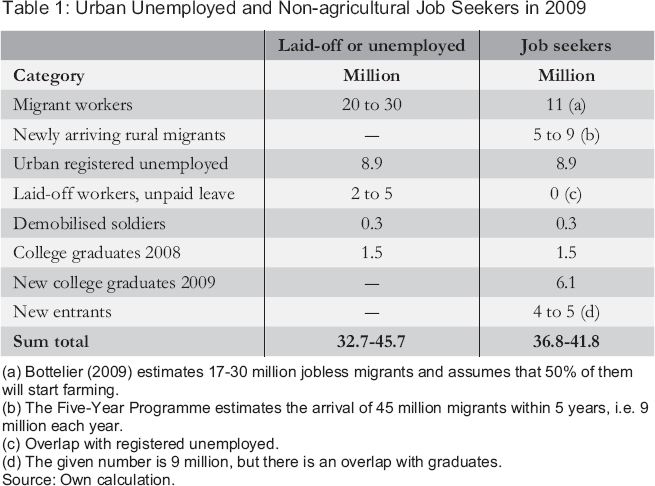
(a) Bottelier (2009) estimates 17–30 million jobless migrants and assumes that 50% of them will start farming.
(b) The Five-Year Programme estimates the arrival of 45 million migrants within 5 years, i.e. 9 million each year.
(c) Overlap with registered unemployed.
(d) The given number is 9 million, but there is an overlap with graduates.
Source: Own calculation.
The total urban employment figure without the non-classified employed people, plus the unemployed and laid-off workers would be the nearest guess, adding up to 195 million.
Between 49 and 53 million people will probably try to find a job in 2009, not including those who withdraw from the workforce because of a lack of opportunities. CASS expects that at least 20 million people will enter the labour market in search of jobs in 2009 and 2010 (Li 2009). MOHRSS estimates 24 million job seekers (Tan 2008). Considering that even with double-digit growth the urban labour market was only able to provide jobs for 12 million new employees in 2007 and for 11.1 million in 2008 (MOLSS 2008; NBS 2009), there will be an enormous supply/demand gap.
The Stimulus Programme
When the Chinese government realised that the effects of its own efforts to cool inflation down would be doubled by the international financial crisis, it announced a major fiscal stimulus plan. This occurred in November 2008. Even though details about the public-spending plans are still scarce and it is still not clear how much of the allocated 4,000 billion CNY (586 billion USD) is genuinely new spending, it seems to be the case that the initiatives focus on job-creating measures and the stimulation of domestic demand. The latter is expected to rise as the result of increasing government expenditure on a wide range of social programmes and income-supporting policies.
Job Creation and Training
Specific policies have been designed for different groups of job seekers and for businesses. Jobs are planned to be created or maintained by public projects, tax reductions, wage subsidies, aid to start up businesses, encouragement for training and retraining, and even administrative measures. Graduates, for example, can get loans of up to 50,000 CNY to start their own businesses. If they join the army or take up jobs in poor, remote areas, they can get their tuition fees refunded by the government (Economist 2009a).
Companies that employ graduates can also qualify for loans and tax savings. The Economic Work Conference held in early December 2008 announced tax and fee reduction for most firms and reduced claims on the profits of state-owned enterprises. Employer contributions to pension funds, medical or unemployment insurance can be delayed or temporarily reduced in case of financial difficulty. According to Prime Minister Wen Jiabao, government decisions would put 500 billion CNY into the hands of enterprises (Naughton 2009; CD 2008a).
For 2009, MOHRSS formulated the “95146 strategy”: 9 million jobs for new labour market entrants, 5 million xiagang workers to be re-employed, 1 million jobs for unemployed persons who are difficult to place, and controlling the registered unemployment rate by 4.6 per cent (interviews). Public work projects are part of the massive stimulus plan, and housing and the transport sector are particularly expected to benefit from the extended funding. Critics admonish China for “taking a more old-fashioned approach […] with a heavy emphasis on pouring concrete and laying rails” and claim that the “green impact” of the investment projects is not large enough. Construction work will convert more of the rather scarce arable land from farming to other uses (Bradsher 2009; Dyer 2009b).
Infrastructure spending is estimated to add 1 to 3 per cent to economic growth this year, however, and will create a considerable number of jobs. Even more could be done by helping small businesses and increasing spending on public facilities, as critics have remarked (Li and Cui 2008; Wines 2009). Additionally, three ministries launched a special programme to beef up vocational training for migrant workers as well as college graduates and laid-off workers (Tan and Xin 2009). Graduates should be encouraged to take subsidised jobs in smaller cities as well as in Central and Western China, at least temporarily (interviews).
Social Security and Domestic Spending
A popular explanation for the height of saving rates in China (around 20 per cent) is the incomplete social security system. Thus, an improved and more comprehensive welfare system would cause households to buy more. On Wednesday 21 January, China announced that it intended to spend 850 billion CNY (124 billion USD) by 2011 to provide universal basic medical care to all Chinese in urban and rural areas and make medical services more accessible and affordable for ordinary people. The government is going to expand the sponsored medical insurance to cover 90 per cent of the population. Each person covered will receive an annual subsidy of 120 CNY from 2010 onwards (Wong 2009; Cui and Lan 2009). New figures provided by the National Development and Reform Commission about the stimulus package during the NPC session in March document that demand-stimulating areas like medical care and education or housing have been boosted (NDRC 2009).
Rural Incomes
Another reason for low consumption is to be found in the slump in rural incomes. “The countryside holds the biggest potential for boosting domestic demand”, said the State Council and the Central Committee of the CCP in their first document of 2009 (CD 2009e). The collapse of China's export engine has hit the most vulnerable group first – rural migrant workers – and thus further aggravated rural-urban disparities. In the fourth quarter of 2008, rural cash income experienced a 5 per cent real drop (corrected for inflation) despite even stronger growth in agriculture than in industry and construction. This can only mean that off-farm wages and migrants' remittances fell sharply. Official figures show that migrant wages account for about 40 per cent of the average net income of rural Chinese. Urban incomes grew by more than 11 per cent (Keidel 2009; CD 2009e). With millions of rural migrants jobless, the disparity between urban and rural residents as well as between rich and poor is bound to grow further.
Anxious to cushion the new blow and to secure farmers' incomes, the central government has now made it easier for farmers to register new businesses and has encouraged banks to lend them money. 250,000 rural retail stores are planned to be established in 2009, creating 775,000 jobs for migrants (CD 2009c). The government will carry out a series of measures to stabilise the price of agricultural products and will increase subsidies for production materials by 17.1 billion CNY. Grain purchase prices will be raised (Tan 2009b). Local authorities are being asked to adopt measures to create jobs and companies are being urged to take more social responsibility and give rural migrants more favourable employment treatment (CD 2009h).
Minimising Layoffs
In the absence of a well-functioning and comprehensive social security system, having a job is the most effective form of social security. Thus, in November 2008, MOHRSS urged local authorities to make the best effort possible to maintain a stable employment market by closely monitoring individual companies' possible layoffs. State-owned enterprises have been encouraged to avoid or at least minimise the number of layoffs. Although the State Council did not interdict dismissals, it did commit companies to inform local labour bureaus about layoffs of more than 20 employees or 10 per cent of staff thirty days in advance and get in touch with them for permission before mass layoffs or recruitment stops are initiated (RMRB 2008; CD 2008c; Reuters 2009).
While some foreign commentators have labelled reinstituted controls and subsidies for hiring manpower as turning back the clock to the “iron rice bowl” era (Cha 2008), the remnants of the command economy might actually turn out to be a positive factor in terms of job stability if banks and state-owned enterprises follow Beijing's orders. Nevertheless, government intervention not only contradicts market regulation, but also compromises China's efforts to move up the value chain. This became obvious in a conflict between the central government and party leaders in coastal areas. In November 2008, at the beginning of the crisis, Wang Yang, the head of Guangdong province's party, declared that Guangdong's government would make no efforts to save “backward enterprises”. Officials of other coastal provinces advocated a similar path. Aware of the potential social unrest of millions of jobless migrants, Premier Wen Jiabao went on an inspection tour to the South and “fully supported small and medium-sized businesses”. Under Beijing's pressure, Wang had to make a U-turn by offering protection for ailing enterprises to keep the economy running (Ma 2008; Anti 2009).
Enough Jobs?
The new measures are aimed at easing employment disputes and job losses, coupled with calls from top security officials for the appropriate handling of protests that are expected to mount. Nevertheless, a further aggravation of the already tense labour market situation seems to be inevitable. 11.13 million urban jobs were created last year, 11 per cent above the government target. In 2009, the government aims to keep its registered jobless rate below 4.6 per cent and to provide around 15 million jobs (CD 2009i; Tan 2009a). Even if this rather optimistic aim is achieved, below the line, China will still have a supply/ demand gap of at least 9 million if one bears the MOHRSS estimate of 24 million job seekers in mind. As we have demonstrated, the actual number of job seekers might be considerably higher. The World Bank
suggests about 16–17 million less non-agricultural employment because of weak growth for the year as a whole, peaking at perhaps 20–25 million early in the year (World Bank Office 2009: 11f.).
Nevertheless, the announced components of the stimulus package creating incentives for labour-intensive growth and domestic demand tend to head in the right direction.
Managing the Social Fallout
Since announcing the stimulus package early in November 2008, the Chinese leadership has turned its attention to managing the more intractable social fallout from the downturn. The Economic Work Conference decided to improve job creation through labour-intensive infrastructural projects and to increase domestic demand by raising budgetary spending on the social field. With unemployment having soared to unprecedented heights, this year's NPC session put employment promotion at the top of its agenda, not least to reduce the possibility of social unrest (ZTS 2009).
Shifting towards Labour-intensive Projects?
High unemployment does not mean that China's labour market policy has not been successful. Actually, job development has been able to keep track with population growth for the last 30 years – despite far-reaching processes of industrialisation, urbanisation and privatisation. The number of employed persons rose by 182 per cent between 1978 and 2007, ultimately reaching 769.9 million. In the same period, the ratio of the three sectors changed from 70.5 to 40.9 per cent (agriculture), from 17.3 to 26.8 per cent (industry) and from 12.2 to 32.4 per cent (services), urban employment grew to 293.5 million or 38.1 per cent of the total workforce, and the percentage of workers in state- and collective-owned units decreased from 99.8 per cent to 24.3 per cent (see table 2).
Employment in China, 1978–2007
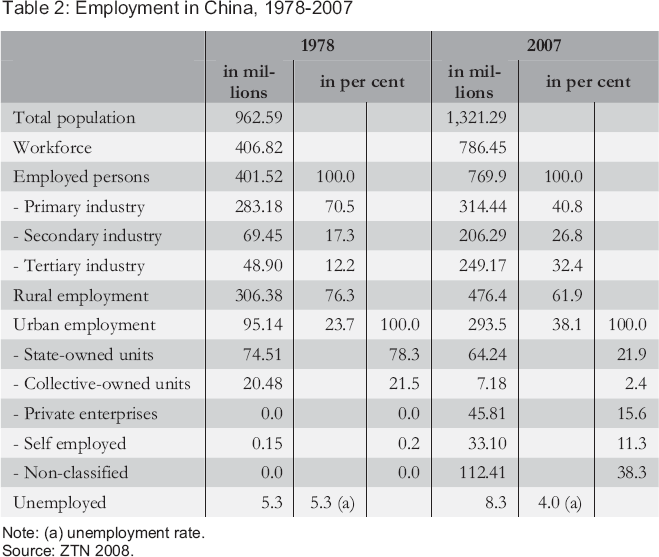
Note: (a) unemployment rate. Source: ZTN 2008.
Over the years, the link between growth and jobs has weakened and employment elasticity (the ratio between economic and employment growth) has declined. In the 1980s, each percentage increase in GDP led to a rise of 0.3 per cent in employment. This dropped to a mere 0.1 per cent job increase at the end of the 1990s (Hu and Yang 2003: 246). The estimated employment elasticity from 2000–2007 was about 0.11, i.e. every percentage point of GDP growth generated an employment growth of 0.11 per cent (Bottelier 2009). China's development path of “high growth, low employment” has been the result of its efforts to move up the value chain. Accordingly, the recent labour law offensive that primarily aims at seeking a new balance between better employment protection and more flexibility for firms will most likely lead to higher wage growth. Laws like the Labour Contract Law demonstrate that China no longer wants to be the home of low-skilled, low-cost and low-margin manufacturing (Chen and Funke 2008: 30f.).
Now the pendulum seems to be swinging back, though. In its 2004 White Paper on Employment, the Chinese government promised to readjust the economic structure and to pay greater attention to the development of labour-intensive industries “to bring into fuller play their important role in absorbing the labour force”. Therefore it would be necessary to direct future efforts at expanded employment to tertiary industries, to support the development of the non-public sector, to encourage small and medium-sized enterprises and to introduce flexible forms of employment (State Council 2004). Premier Wen pledged to follow this strategy at the opening session of the 2009 NPC (CD 2009a). The employment crisis and the menace of mass unemployment breeding social instability seem to provide ample incentives for the government to put its money where its mouth is.
Labour Shortage?
Labour oversupply will continue to exist for a long while yet, but it might be reduced by the looming shortage of cheap labour and the aging of China's population. What could be a shimmer of hope in view of easing employment pressure could, however, be rather worrisome as long as the reservoir of cheap labour is decisive for China's competitiveness.
In late 2005, news reports of unfilled job vacancies in Southern China cropped up, particularly in Guangdong, leading to growing competition between firms for workers. Initially thought to be temporary, the labour shortage phenomenon was underlined by indications that wage costs and turnover rates among unskilled workers and migrants had surged. It seems still debatable whether China really has reached the end of its labour surplus phase – the more so in the light of recent developments. The conclusion that the surplus phase is about to come to an end is based on new estimates of surplus labour in agriculture. Whereas conventional estimates varied between 150–200 million of the 340 million people employed in this sector, new calculations have shown that far fewer farm labourers exist and the actual surplus only about 40 million people. Nevertheless, it may take a while before a shortage of labour becomes apparent: estimates neglect a possible decline in the share of agriculture in total employment, shortages have only cropped up in specific industries and there are also surplus labour groups outside agriculture (World Bank Office 2007).
The speed at which China's population of working age (15–59) is growing has declined since 2005, with 7.5 million new workers in 2006, 5.5 million in 2007 and presumably 2.1 million in 2010 (NDRC 2006). The rapid aging of China's population, 5 however, might not show its impact on the urban labour market in the immediate future. Zhou Tianyong even denies any negative impact, instead predicting a rejuvenating urban workforce due to inflowing migrants, increasing numbers of graduates from rural backgrounds and demobilised members of the army (Zhou 2008).
The proportion of those aged 65 and above rose from 4.9 per cent in 1982 to 7.7 per cent in 2005. By UN definition, a country with over 7 per cent of its populace aged 65 or older is considered an aging society (Wang, Meiyan 2008).
Policy could contribute by reducing regulatory barriers between rural areas and cities (phasing out the hukou system, providing access to education and social security), promoting training in vocational skills in rural areas and improving rural land management, or by creating incentives to take late retirement. Skills training for farmers, migrants and laid-off workers are also regarded as an important measure by which to establish a “unified” labour market (State Council 2004). 6 Some of the recent initiatives indicate a certain awareness that this could help to improve the adaptability of the labour supply.
Actually, the Chinese term used to describe the medium-term aim for the labour market and the social security system is not tongyi (unify), but tongchou, which means “plan as a whole”.
Expanding Social Security Coverage
In March 2009 the NPC supported the government's plans about boosting social security spending in order to channel savings into consumption. Social welfare has become a hotly debated topic among economists and think tanks. Many experts warn that the ratio of social security spending to the total fiscal package is still too low, the more so because local governments are trying to avoid additional spending (interviews). The China Development Research Foundation estimated that by investing 5.74 trillion CNY in total, China could construct an all-round social welfare system by 2020. Over the coming 12 years, the proportion of social welfare in fiscal revenue should increase from the current 27 per cent to 35 per cent (CD 2009b).
The announced increase in spending on public health could be the first step. Another one might be the expected adoption of a long-debated law on a new national social security system that would increase protection for vulnerable groups, including migrants and laid-off workers. The coverage rates of social insurance programmes have remained rather low until now for at least three reasons. First, the schemes are closely linked to employment status, thus excluding informal workers, migrants, the self-employed and poor urbanites as well as farmers. Second, employment has become increasingly informal in nature. Actually, the Chinese government has promoted informal – “flexible” – employment for quite some time as a way of reducing unemployment, alleviating poverty and even “breeding” new entrepreneurs. Informality is deliberately being used to exploit China's labour cost advantage. It is not a transitory, but rather a persisting phenomenon (Braun 2008). With the increase in irregular work, employment conditions in urban areas have actually deteriorated and local governments and entrepreneurs now tend to ignore the recently strengthened laws on protection for workers, safety and labour insurance in order to encourage investment (interviews).
A third reason for low coverage is the low level of pooling at the local government level along with the lack of enforcement. The drafted new law on social security is expected to change this, at least for pension insurance, and to provide portability for an increasingly mobile labour force. Three decades after smashing the iron rice bowl of permanent employment and dismantling the danwei system of cradle-to-grave security, the government finally seems to have recognised the importance of social security for a functioning labour market with adequate forms of protection to ensure the welfare of China's citizens.
The high prominence given to social security spending may also indicate a fundamental shift in China's economic strategy of encouraging its citizens to spend and consume more goods. Welfare is only part of the picture, though. Domestic spending expected to cushion the slump in exports weakened in 2008 and accounted for more than half of the country's slowdown. This mainly happened as the result of a collapse in housing construction, which was meant to make a soft landing possible after inflation had soared (Economist 2009b). Little has it been noticed that wage income has also fallen over the last decade relative to GDP. In China, the share of wages dropped from 53 per cent in 1998 to 40 per cent in 2007 (ibid.). Consumer spending has shrunk from about 45 per cent of GDP in the mid-90s to 35 per cent today (Pilling 2009). One reason is the declining employment elasticity and the slowing of job creation. Despite criticism about possibly unneeded infrastructural projects, these factors could indicate a shift in China's growth strategy towards more labour-intensive investments.
Hopes for a Rebound
The global financial crisis has presented China with some major challenges in terms of its economic and social development. The most pressing issue is unemployment, which worsened when external demand slumped. It is much higher than official figures show, and estimates made by Chinese social scientists range from 9.4 to 14 per cent. The author of this paper has calculated that as many as 42 million people might be searching for jobs in 2009. Faced with the menace of increasing social unrest, government leaders miss no opportunity to emphasise their determination to create jobs, especially for those groups that are not covered by unemployment insurance, i.e. college graduates and rural migrant workers.
Stimulating growth before the slowdown deepens into a prolonged recession has become the top priority of the Chinese government. Besides labour-intensive infrastructure projects, especially extended social security spending – the core ingredient of its stimulus plan – indicates a shift in policy. This “social security turn”, however, might only be effective in the long run instead of showing immediate results. Firstly, investment projects in the stimulus package will generate jobs, albeit not enough to absorb the huge amount of job seekers. Moreover, the government may only temporarily deviate from its course to promote capital-intensive development, as Premier Wen Jiabao has explained (CD 2009d). Secondly, although several measures aiming at rebalancing the pattern of growth like government spending on health and education are meant to stimulate domestic consumption, this is still not picking up. It usually takes quite some time until welfare recipients come to trust new systems. Moreover, there are systemic issues that need to be addressed before the social security system can be expanded. The current management capability and capacity is not ready to manage the changes. Therefore, investments in training and the development of modern management methods are required. 7 And thirdly, private consumption depends to a large extent on higher incomes as well as lower income inequality.
This was pointed out to me by one of the reviewers.
With GDP growth at 6.1 per cent in the first quarter of 2009, the Chinese economy performed “better than expected”, Wen said (CD 2009d). In view of first signs of recovery such as increasing property and car sales and robust retail sales, not only the Chinese leadership and most Chinese economists, but also some international economists expect China's economy to recover fairly quickly after possibly having touched the bottom of the slump in the last quarter of 2008. Merrill Lynch forecasts that China may start to rebound in the second quarter of this year (CD 2009f). Albert Keidel at Carnegie Endowment thinks that
China's domestic demand stimulus should make a difference by the middle of 2009 so China can shift from 6 to 7 per cent growth in the first quarter or two of 2009 to low double-digit growth in the second half and 8-to-9-per cent growth for all of 2009 (Keidel 2009).
The Chinese central government is expected to launch its third batch of stimulus investments in the second quarter. So far, it has invested a total of 230 billion CNY and it is said to be pouring new money into projects that could benefit people's livelihoods, e.g. in the health and education sectors, large infrastructure projects and housing for low-income earners (CD 2009g).
In the face of the wave of strikes at the end of the 1990s, the Chinese leadership proved to be responsive. When President Hu Jintao and Premier Wen assumed power, they extended reforms to social fields and adopted a balanced approach that responded to people's concerns. To maintain social stability in the current crisis, the regime is again showing its readiness to postpone modernisation aims and promote job-creating schemes instead. The effects of the financial crisis on China's real economy have revealed that it is not decoupled from global developments yet, but the clandestine hope that the authoritarian system will be seriously compromised underestimates its adaptability – and overrates the political power of the discontented.
“There is potential for lots of unrest over labour issues”, said Andrew Gilholm at Control Risks in Shanghai. “But it would take a really prolonged slowdown before there was any real threat to the current political system” (Dyer 2008). The number of jobless migrants might be big, but their capacity to organise themselves is assessed as low. Thus, the government's worries and policies are focussing on the urban jobless, including graduates. These groups, however, might also choose another way of expressing their sentiments than by protesting, as a growing interest in joining the Communist Party among university students shows (Wall 2006; LaFraniere 2009).