



Abstract
Despite the expansion of the regulatory agency model in Brazil since 1996, specialized literature has raised concerns that the autonomy of the country's regulators has been persistently undermined. Based on a novel 22-year budget dataset, this study challenges the dominant thinking, as it points to a process of continuous institutional embedding. Nevertheless, this process has been endangered by fiscal austerity since 2016. The article contributes to the literature by presenting new ways in which organizational de facto autonomy can develop in state-dependent market economies. Moreover, it provides political economy insights into the legitimacy acquired by regulatory agencies across the political spectrum in Latin America.
Introduction
Notwithstanding the diffusion of regulatory agencies to different policy sectors in Brazil since 1996, the literature has persistently denounced an environment of great instability surrounding the country's federal regulators (Musacchio and Lazzarini, 2016; OECD, 2008; Prado, 2010; Taylor, 2020). The main thrust is that regulatory agencies have undergone frequent instances of delegitimization and disruption, particularly under left-wing presidencies. Political leaders from the center-left coalition headed by the Workers’ Party (Partido dos Trabalhadores—PT, in Portuguese), which governed the country from 2003 to 2016, would have been less sympathetic to those agencies on ideological grounds (Mueller and Oliveira, 2009; Power, 2010).
With a neo-developmentalist agenda and statist convictions, the center-left would have ultimately worsened the confidence in the country's institutions by somewhat disregarding the market-oriented commitments set by its predecessor, a center-right political group spearheaded by the Brazilian Social-democratic Party (Partido da Social Democracia Brasileira—PSDB, in Portuguese) (Correa et al., 2019; Mendes, 2014). Regulatory agencies were supposed to form the bedrock of those commitments (Gomide and Pereira, 2019).
Like most of the literature on post-privatization regulation in Latin America, these criticisms have placed a premium on cross-sectional micro- and meso-level evaluations built on predefined institutional metrics of international recognition (Manzetti and Rufin, 2012; Pavón Mediano and González, 2022). Consequently, they have not engaged constructively with elements of local variation that also influence capacity in the regulatory state, especially from a longitudinal standpoint (Christensen and Lægreid, 2011; Lodge, 2014).
By focusing on the critical realm of financial autonomy, we conceive of an alternative interpretation. Our research puzzle emerges from important limitations and biases in the dominant line of research on the topic, which the novel empirical evidence that we have amassed for this study further exposes. We draw on official budget expenditure records from the six major Brazilian infrastructure regulators for the period between 2000 and 2022. Our estimates show that, although punctuated by short periods of change, the financial autonomy of Brazilian regulatory agencies has progressed surprisingly well during the time when center-left coalitions ran the country. This finding challenges the prevailing scholarly view.
Additionally, our data demonstrate that the pro-market fiscal austerity agenda which has become the norm in the country since 2016 put downward pressure on the autonomy of regulatory agencies. Right-wing leaders in office championed radical austerity, sidelining institutional concerns and organizational preferences. The four-year period of the far-right presidency of Jair Bolsonaro, from 2019 to 2022, was especially harmful to federal regulatory agencies in financial terms. This is also a novel finding that our research unveils.
The article provides clear theoretical contributions to comparative public administration and policy, especially as we broaden the possibilities of the occurrence of de facto autonomy, expanding Maggetti's (2007, 2012) original articulation. Equally important, we enrich the political economy scholarship by deepening our understanding of the regulatory interface of the early 2000s “pink tide” in Latin American politics (Chodor, 2015). With the resurgence of left-wing presidents in Mexico, Chile, Colombia, and Brazil, our study gains a considerable practical implication as well. Finally, we offer insights into the outcomes of the far-right political turn in Brazil with President Jair Bolsonaro, adding evidence of the effects of his authoritarian conservatism, economic and otherwise, on the state apparatus.
The article begins by providing background information on Brazilian regulatory agencies and the existing concerns regarding their autonomy. It then reviews the theory of organizational autonomy, proposing an adapted framework which is more consistent with long-term examinations. Subsequently, we analyze the numerical trends that our dataset showcases. This is followed by a discussion of the implications of our findings for theory and practice, drawing lessons and conclusions from them.
Regulatory Agency Financial Autonomy in Brazil: Existing Accounts and Their Limitations
Brazilian regulatory agencies are creatures of the liberalization reforms that swept across Latin America in the 1990s (Jordana et al., 2011; Nunes et al., 2007). Regulatory reforms began in the country with the newly privatized infrastructure sectors, and gradually extended to social and environmental areas. At present, eleven organizations are legally classified as federal regulatory agencies in Brazil. 1
All these agencies have been modeled on the precepts of institutional uniformity and depoliticization. These are the normative basis of the “credible commitment” hypothesis, which has underpinned the design of regulatory agencies all around the world as neutral and rational-scientific devices (Christensen, 2011; Pavón Mediano, 2020). The theory posits that commitments set by the state, in the form of legally enforceable contractual agreements and independent regulatory authorities, are fundamental for raising the confidence in national institutions and enticing private investment (Levy and Spiller, 1994; Weymouth and Feinberg, 2011). This economic neo-institutionalist rationale casts aspersions on centralized economic coordination in the developmentalist style, which is deemed anathema to the regulatory state model (Jayasuriya, 2005; Levi-Faur, 2013). In its place, it proposes a redefinition of state-market relations in tune with the era of ‘indirect government’ and private provision of public services (Pierre and Peters, 2000; Salamon, 1989).
When revising recent changes in the area of regulatory agencies under state-centered developmentalism in Brazil, Taylor laments the fact that regulatory prowess in the country has waned over time as it got “tempered by the interests of the central stakeholder, the government” (Taylor, 2020: 53). He also endorses the neo-institutional economic account that left-leaning administrations have self-consciously rejected an arm's length relationship with regulatory agencies, constraining their independence “through budgetary inducements and partisan appointments” (Taylor, 2020: 51). The consequences being frail regulatory autonomy and institutional uncertainty.
This diagnosis is prevalent in the literature on the evolution of the Brazilian regulatory state in the twenty-first century (e.g., Batista da Silva, 2011; Correa et al. 2008; De Bonis, 2016; Euclydes et al. 2022). Accordingly, left-wing administrations in Brazil would have meddled in the regulatory agencies’ affairs more frequently than not. Critics claim in particular that politically motivated interventions led to the impounding of agencies’ budget (Amann et al., 2016; Nunberg and Pacheco, 2016), thereby “suffocating their capacity” (Araújo, 2021: 42). A similar contention has been that “regulatory agencies have been understaffed,” due to the same political animosity by left-wing leaders (Melo and Pereira, 2017: 231).
As quoted from Taylor (2020) above, in addition to allegations that the Executive has encroached on regulatory agencies’ budget, left-wing presidents have been accused of dispensing with purely technical requirements when appointing new members to their board of directors, for political motivations. Non-financial concerns are not directly addressed in this article. Hence, it suffices to comment that the nomination to the regulatory agencies’ board of directors is done by the president with the consent of the Brazilian Senate, and that all board members are bestowed with a fixed mandate of four to five years, disconnected from the electoral cycle. 2 These provisions protect board members from discretionary removal. They also make it more complex and slow-moving for the Executive to effectively change the setup—and the ideology—of regulatory agency boards in any given direction, if at all pursued by the government.
In contrast, the financial levers that the Executive uses at least annually are a much more immediate tool to rein in the structures and activities of regulators. Budgetary trends have an unmatched explanatory power since regulatory agencies’ resources in Brazil come virtually entirely from the National Treasury and budgetary decision-making is centralized, as explained below. For this reason, regulatory agency financial autonomy has been a recurrent theme in the specialized literature (Donadelli and van der Heijden, 2022).
Nevertheless, we identify important limitations in the prevailing scholarship on regulatory agency financial autonomy in Brazil. The main one is that it generally departs from a theoretical point of too high expectation and normativism, which is common in ‘good governance’ oriented endeavors (Andrews, 2010). Existing analyses tend to be premised on a degree of formalism and on ideals of technical purity that would be at odds with the dynamics of hyper-politicization, strategic economic liberalization and institutional layering that have become the norm in regulatory states in the developing as well as the developed world (Coen and Héritier, 2005; Ennser-Jedenastik, 2015; Jordana and Ramió, 2010; Levy, 2005; Thatcher, 2008). When they endure, national regulatory agencies end up mingling, in one way or another, with the administrative and legal systems into which they have been transplanted. The same has happened with the Brazilian agencies throughout the years (Sundfeld, 2017).
Given its systemic linkages, high levels of formal autonomy can potentially be as risky as low levels of it, adding relevance to the contextual reasoning (Bersch and Fukuyama, 2023; Van Thiel et al., 2012). In Latin America in particular, a rationalist view of institutions, which equates government quality with the existence of desirable formal traits, is deficient if the influence of political decisions, both short- and long-term, is not properly factored in (Brinks et al., 2019). Measuring institutional attributes statically and in isolation is likely to be incomplete at best and deceptive at worst.
However, there are methodological shortcomings in the rationalist neo-institutional scholarship as well. By setting the bar at such a high level of abstraction and normativism, and employing somewhat mechanistic evaluation criteria, it becomes virtually impossible not to find instances of underperformance in the real world. For example, previous studies have interpreted the financial autonomy of Brazilian regulators with reference to their (in)ability to maintain control over the monies that they raise directly from regulated companies as well as the budget appropriations that Congress assigns to them. These methodological options may yield inaccurate results given budget centralization, which is entrenched in the Brazilian state (Prado, 2010).
Statutorily, immunity to the likelihood of adjustments by the Executive before appropriations get to their beneficiaries within the federal government is alien to the Brazilian system of centralized fiscal governance. No public agency in the country enjoys unconditional financial autonomy. 3 Thus, although license fees, taxes, fines, and other private payments are regularly made to the Brazilian federal regulators, in most cases they only transit through the agencies to add up to the central government's aggregate revenues with the National Treasury. Eventually, the amount collected from regulatees may or may not return to the regulatory agencies once their grants are decided by the Executive, in the form of annual committed expenditure budgets.
Albeit it has long been a feature of the Brazilian administrative state, budgetary centralization and, linked to it, the dependence of regulatory agencies on the Executive for funding have been criticized by observers such as the Organization for Economic Cooperation and Development (OECD) (2008) and the country's own court of accounts, the Tribunal de Contas da União (TCU). 4 Budgetary centralization, as it exists in Brazil, diverges from the idealized standard of agency financial independence, which is favored by these two institutional observers. However, whether this administrative feature has rewarded or penalized Brazilian regulatory agencies would be better established comparatively and historically, valuing regulators “as part of a broader institutional constellation” (Christensen and Lægreid, 2006: 14).
Given the limitations and biases of the economic neo-institutionalist account, a second strand of research has offered different insights into the same phenomenon. Taking a more macro-level comparativist approach, a smaller group of authors has claimed that regulatory agencies in Brazil have not been left out of strategic governmental plans and priorities in the last decades, even when the developmentalist mindset prevailed (Barbosa and Souza, 2010; Cardoso Jr. and Navarro, 2016; Prado, 2014). Federal regulatory agencies would have expanded numerically but also in expertise, capacity, autonomy and breadth of powers in spite of the political landscape shifting quite profoundly around them (Bersch, 2019; Cunha and Goellner, 2020; Donadelli et al., 2020; Fishlow, 2011).
This second group concurs with the former on the expansionary nature of PT-led governments. However, comparativists tend to disagree with economic neo-institutionalist scholarship on the appreciation of the reasons and outcomes of the center-left developmentalism. Instead of viewing the center-left proactivist stance as leading to institutional dysfunctionality and economic deterioration, some comparativists interpret it from the perspective of a legitimate strategic choice taken by an incumbent government whose ostensive electoral platform involved, from the onset, a moderate reformist agenda. Their assessment is that the PT-led coalition proceeded with prudence, softening its hitherto antagonistic narrative and ultimately embracing the regulatory agency model once the party's coalition switched to the incumbent position (Armijo and Rhodes, 2017; Nem Singh, 2013).
In the remainder of the article, we revisit this interpretative controversy, as it is still largely unresolved. We build on the comparativist tradition and combine it with the analysis of long-term administrative data, resting on an organizational definition of autonomy. From that, we respond to micro- and meso-level concerns as well.
In analyzing the data that we have collected for this study, our underlying assumption is that the preference of Brazilian regulatory agencies, a defining feature of de facto autonomy as explained in the next section, has always been to at least maintain volume and regularity of their resource appropriations. This is not a stylized rational choice account of bureaucratic conduct. Instead, it amounts to the lowest-common-denominator for the agencies in their pursuit of institutional stability, especially if they are expanding and gaining competencies, as in Brazil in the last decades.
Organizational Autonomy: Theoretical Propositions and Adopted Framework
Organizational autonomy is a multidimensional concept that invokes notions of discretion and self-governed reasoning (Christensen, 2001; Gilardi, 2002). Financial autonomy is one of its critical dimensions, together with inter alia the structural, legal, policy, and managerial ones (Verhoest et al., 2004).
Another important theoretical message concerns the difference between formal or de jure autonomy, and actual, substantive or de facto autonomy (Bach et al., 2015; Egeberg and Trondal, 2009; Hanretty and Koop, 2012; Painter and Yee, 2011). Autonomy purely based on formal requirements has limits, since codification per se does not assure real autonomy (Lodge and Wegrich, 2009). Written rules are often “born weak” when they lack deeper institutional support (Levitsky and Murillo, 2009: 120). In contrast, de facto autonomy reflects the interplay between different factors, including economic, political, institutional, and organizational ones (Egeberg and Trondal, 2011; Maggetti and Verhoest, 2014; van Thiel and Yesilkagit, 2014).
In his pioneering work, Maggetti (2007) proposes a measurement criterion which segregates two components of de facto autonomy. One is discretion to execute the regulatory competencies. It relates to the agency's ownership over the activities and decisions it takes in light of its statutory goals. This is a narrower and endogenously formed part of autonomy (Bach, 2018). A broader and more externally oriented part relates to the second component, which Maggetti (2007) characterizes as the self-determination of agency's preference. The intuition here is that organizational preference and autonomy are in a direct relationship with one another. Hence, when the preference of a regulator is endorsed by the politico-institutional environment, its substantive autonomy gets strengthened—and the converse also holds true. In this study, we focus on this second component, aiming to add empirical relevance to the notion of self-determination of agency's preference.
Regarding the financial aspect of de facto autonomy, Maggetti (2007) defines it in relation to who influences the agency's budget and to what extent. In his model, more financially autonomous agencies are less exposed to the direct participation of elected politicians in determining their budgetary endowments (Maggetti, 2012). This is reminiscent of the “fiduciary principle,” where principal-agent distancing is crucial for organizational autonomy and performance. Thus, it is not very different from traditional measurements of formal autonomy, which we interpret as a limitation for making sense of contextual variations in the regulatory state.
Nonetheless, Maggetti's “partially inductive approach” (Maggetti, 2007: 283) leaves open the possibility of alternative patterns of de facto autonomy to emerge. We propose expanding his model to give more weight to historical and political drivers. Organizational autonomy is forged through interactive relationships and intertemporal contextual dynamics (Arregle et al., 2022), in a process similar to Sprague's (1982: 101) idea of “social resonance.” Sprague's concept states that a given property of an agent—for instance, the de facto autonomy of a regulatory agency underpinned by the ratification of its preferences—will be reinforced over time if the attributes of that property continue to find regular confirmation in formal and informal exchanges between the agent and its environment.
Therefore, while maintaining the semantics of Maggetti's conceptualization, we set out in this article to appreciate agency preference self-determination and autonomy from an ex-post and long-term viewpoint. The first analytical justification for it is that the roles of actors are rarely fixed or deterministic. As regulatory agencies age and expand their institutional presence, they will leverage their individual powers within the institutional environment (Carpenter, 2001). Eventually, their relationship with elected politicians will likely near “a game between rough equals” (Carrigan and Coglianese, 2011: 121). An applicable example here is when regulatory agencies enhance their clout at the agenda-setting and policy formulation stages, broadening their participation throughout the policy cycle and wielding practical authority (Bach, 2012; Guaschino, 2022).
A second reason for going beyond static and predefined measurements is that public sector organizations, especially those from the Global South, are always susceptible to the “fads and fashions” of international normative models and blueprints (Baldwin et al., 2012; Weyland, 2009). Recent global trends have transformed regulatory agencies into a “coalition magnet,” that is, a unifying idea that brings together groups that used to harbor contrasting beliefs about them (Béland and Cox, 2016). This process has neutralized the neoliberal image—or substance—of regulatory agencies in many jurisdictions, generating varieties of regulatory state in different guises (González and Gómez Álvarez, 2022; Guidi et al., 2020). It has also fostered the assimilation of the regulatory agency model by the Left, including in non-Anglo-Saxon countries (Coroado, 2020; Ennser-Jedenastik, 2016).
A third important motive for examining regulatory agencies’ preference and autonomy from an ex-post and longitudinal perspective is in the realization that total independence from elected politicians is not necessarily an ideal. Agencies do not need to be sectioned off to manifest autonomy, if looked from a non-utilitarian perspective. Regularity is key for public entities. When they are in a financially stable position to go about their business in a relatively predictable and unbiased manner, even if remaining formally dependent on the state for funding, they can also count as autonomous (Marston and Davidson, 2020). Ongoing resistance to arbitrariness and particularism that allows public agents volition to assert their preferences is a pivotal autonomy standard in the realm of comparative politics (Evans, 1995; Geddes, 1996; Migdal, 1989).
These three justifications for a more historical and political view of regulatory agency autonomy that captures its intertemporal and reflexive nature have been largely overlooked in the extant literature. Nonetheless, it has emerged as a concern in contemporary post-agencification and post-delegation debates (Maggetti, 2022). Previously, in a review article, Maggetti and Verhoest (2014) emphasized that vertical inspections and case-specific studies of autonomy are areas where scholarship should be heading for a more complete empirical coverage. Attempts have been made in this area, but rarely on de facto autonomy in the developing world, including Latin America (exceptions are González, 2018; Trillas and Montoya, 2011). Longitudinal critical research, as we advance in this article, is even more seriously missing from the literature.
Methods and Data Selection
In this research, we put forward a positivist analysis backed up by long-term administrative data and critical historical explanations (Peters and Fontaine, 2020; Stritch, 2017). We mobilize numerical records on a scale that, to our knowledge, has not been engaged before using the same official source and for a similar research purpose.
To consolidate the empirical evidence used in this study, we aggregated data from the budgetary records of the Brazilian federal government called Sistema Integrado de Planejamento e Orçamento (SIOP), 5 for the period between 2000 and 2022. The figures were inflation-adjusted using the official inflation index Índice Nacional de Preços ao Consumidor Amplo (IPCA). Data from the SIOP refer to the amounts officially committed to programs and actions, that is, the annual budget appropriations assigned to hundreds of state organizations by the Executive. In this sense, it does not report the input side of budgetary policymaking, which is made up of state revenues, including those raised by regulatory agencies from regulated companies.
Given the dynamics of budget centralization described above, input figures can be misguided. In the Brazilian case, annual budget outputs make for a more realistic metric as they reflect with greater accuracy how the Executive distributes budget across the public sector. Accordingly, longitudinal expenditure data from SIOP express the outcome of political prioritization over time.
In addition to the annual amounts for each regulatory agency, as well as for the whole federal government, we consider three official budget categories, namely: (i) personnel budget; (ii) budget for investments; and (iii) finalistic or task-related budget. The finalistic budget covers the costs associated with the execution of the mandates of an agency, that is, its legal remit for monitoring and inspection activities in the regulated sectors. The investment budget serves the creation and upgrading of its structure, mainly physical and technological capacities. The personnel budget, in turn, relates to the payment of salaries and other financial benefits to the workforce.
The subjects in this study are the infrastructure regulators. They are the ones where institutional commitments are a more sensitive topic given the existence of concession contracts and other forms of public-private long-term agreements. The six federal agencies surveyed are the following:
National Agency of Electric Energy (ANEEL), created in 1996 National Agency of Telecommunications (ANATEL), created in 1997 National Agency of Petroleum, Gas and Biofuel (ANP), created in 1997 National Agency of Ground Transportation (ANTT), created in 2001 National Agency of Aquatic Transportation (ANTAQ), created in 2001 National Agency of Civil Aviation (ANAC), created in 2005
From a research design perspective, the data for infrastructure regulators have proven to be more solid than those for social and environmental regulators. The latter have undergone more frequent legal reorganizations and changes in their line of ministerial supervision, which may have caused the inconsistencies and historical breaks in their budget records that we identified. Infrastructure regulators, in turn, have generally remained within the same ministerial area, preserving their administrative records.
We use 2000 as the starting point firstly due to SIOP data availability. Moreover, 2000 is analytically suitable as it predates in two years a major change at the presidential level. The transfer of power from the social-democratic President Fernando Henrique Cardoso, from PSDB, to the Workers’ Party's leader Lula da Silva in January 2003 can be seen as a critical moment for regulatory policy in the country, given the two opposing agendas that they had on the liberalization reforms and the creation of regulatory agencies in the 1990s. While the center-right PSDB sponsored the reforms as the incumbent, the left-wing opposition, led by PT, opposed them. Finally, as regulatory agencies appeared in the country in 1996, our study covers almost their entire lifespan until the publication of this article.
Longitudinal Data Analysis
In this section, we verify the extent to which our underlying assumption of regulatory agency preference for budget stability has been met throughout the multiannual period of our dataset, cementing or not their financial autonomy. To interpret the data and given space limits, we highlight key aspects from our estimates, as they point to patterns as well as deviations that help us arrive at relevant conclusions. Chart 1 shows the big picture. It compares the aggregate budget of all six regulatory agencies in our dataset with the general central government budget, based on their committed primary expenditure for the entire period. Chart 2 supplements this depiction by showing the ratio of regulatory agencies’ primary expenditure to the central government's total primary expenditure.
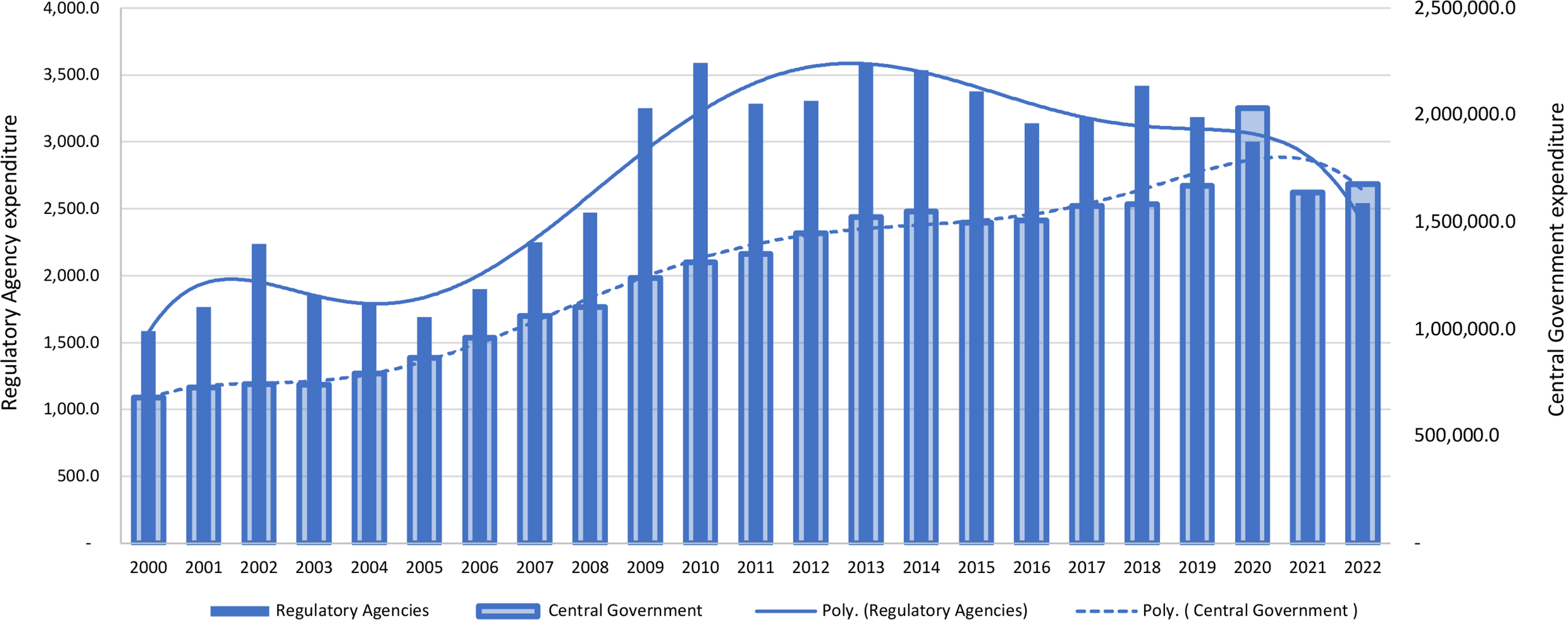
Regulatory agencies vs. central government budget 2000-2022, real values at Dec/2022 prices (BRL million).
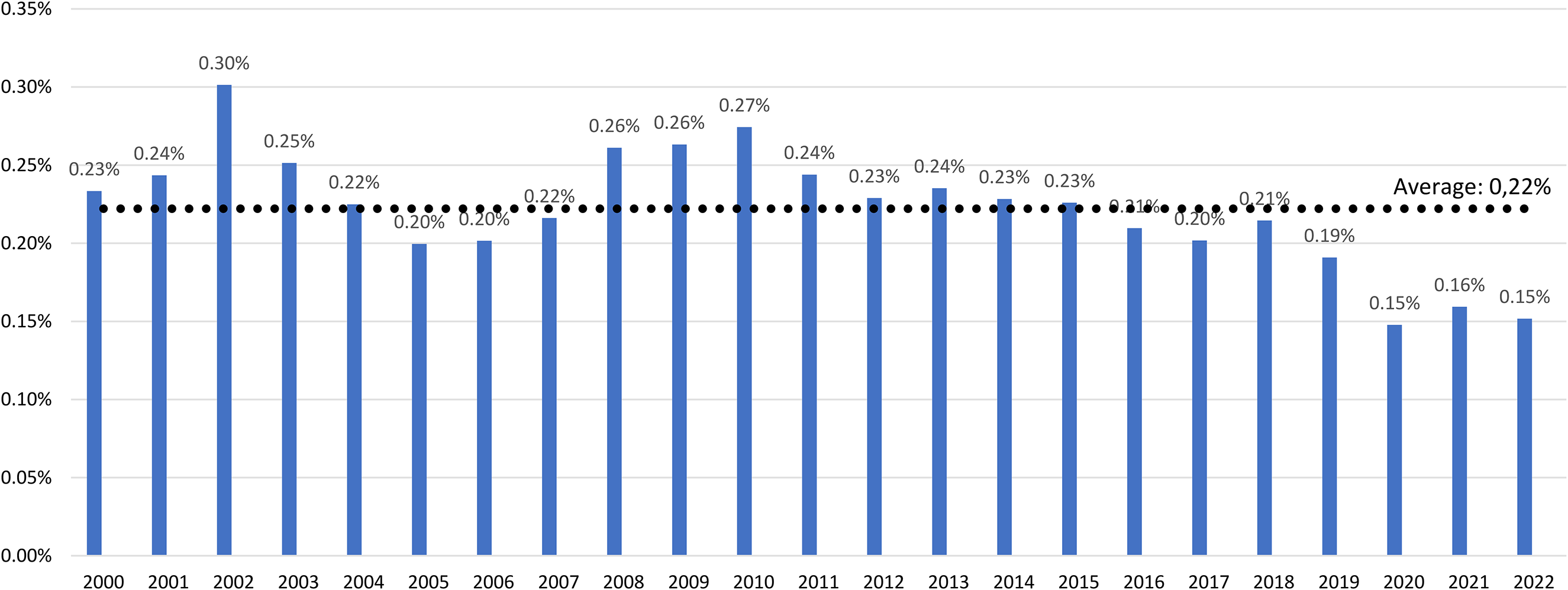
Ratio (%) of regulatory agencies’ primary expenditures to the central government's total primary expenditures.
To interpret Charts 1 and 2, we can subdivide the 22-year period into three stages, roughly defined. The period between 2000 and 2008 was of regulatory agency structuring, when their budget evolved at a similar pace to that of the central government, as shown in Chart 1. Between 2009 and 2018, regulatory agencies reached a stage of institutional maturity and budget stability. This suggests the maintenance of their capacities, even if the government budget went up slightly faster in the second phase. Chart 2 demonstrates that seldom during these two initial periods has the ratio of regulatory agencies’ expenditure to the central government's total expenditure fell below the average for the entire period, 0.22 per cent.
A critical year in the second period was 2016, given the impeachment of the PT's member President Dilma Rousseff. The months leading up to this event were marked by great economic and political instability in Brazil, delaying important decisions and somehow impacting the budget policymaking as well. In December 2016, under the right-wing presidency of Michel Temer, from the Brazilian Democratic Movement Party (Partido do Movimento Democrático Brasileiro—PMDB, in Portuguese), austerity was transformed into a constitutional mandate. The Constitutional Amendment n. 95, the so-called New Fiscal Regime, capped the growth of fiscal spending, linking the nominal expansion of primary annual expenditure to past inflation.
In 2018, the new fiscal regime reached the point of full implementation. As Charts 1 and 2 showcase, it has also contributed to making the third stage in our dataset, which runs from 2019 to 2022, a period of accelerated decline in regulatory agency expenditure. These were the four years of Bolsonaro's presidency. His far-right administration combined socio-political authoritarian inclinations with a radicalized neoliberal agenda, the latter being particularly relevant on the institutional and economic fronts (Andrade, 2021). As Charts 1 and 2 expose, austerity was applied strictly to regulatory agencies after 2018.
Chart 3 complements Charts 1 and 2. It demonstrates that the capacity of regulatory agencies to manage discretionary primary expenditure (principally investment and finalistic budgets, as we detail below) has been consistently greater than that of the central government. Charts 1–3 combined inform us that while regulatory agencies total budget fell in absolute terms in the last four years of our series, reversing previous trends, discretion over their budget has remained about the same in relative terms. It means that the political decision to underbudget regulatory agencies was not compensated by positive variations in their discretion over their assigned budget.
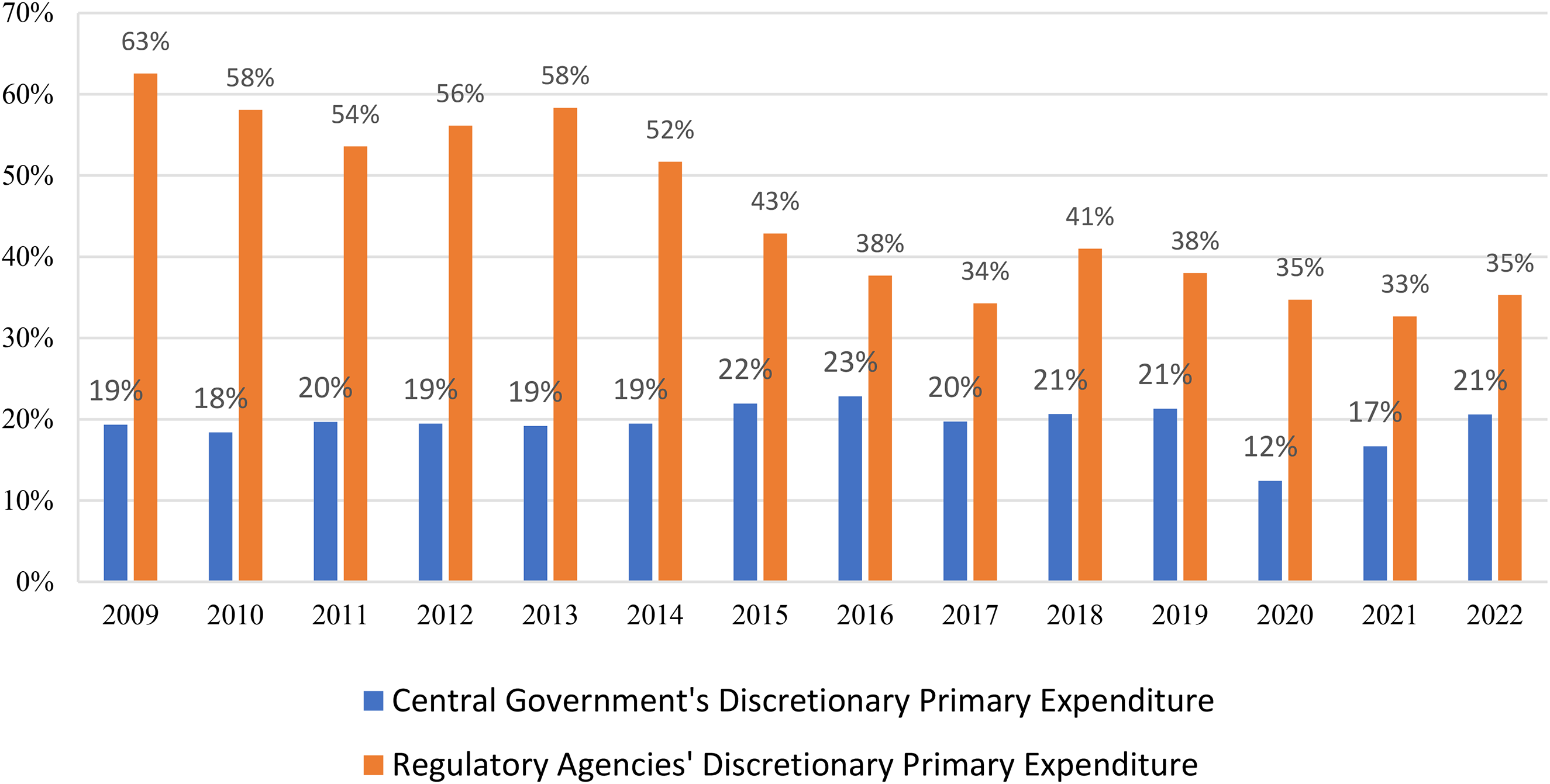
Discretionary primary expenditures of the central government and regulatory agencies (in %).
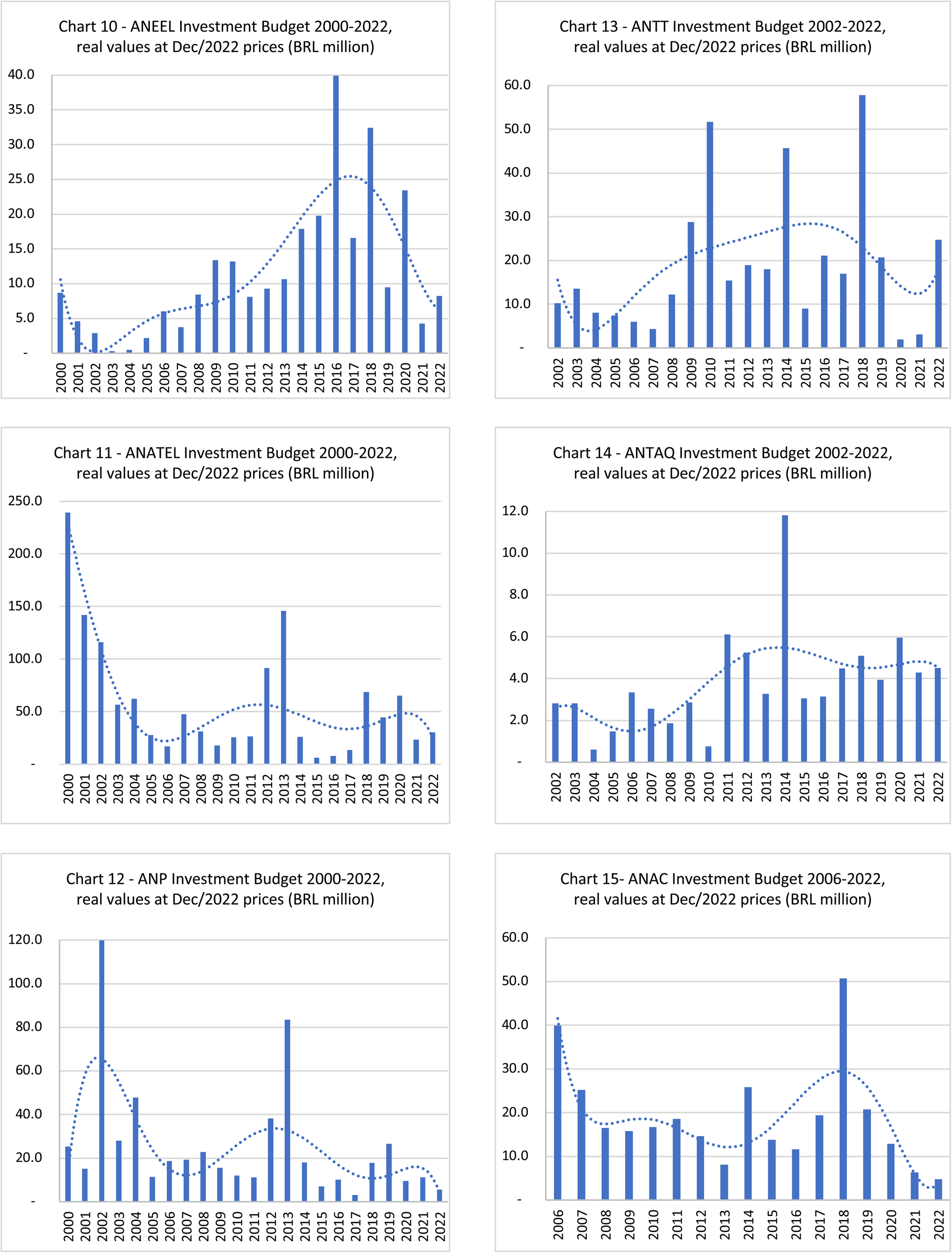
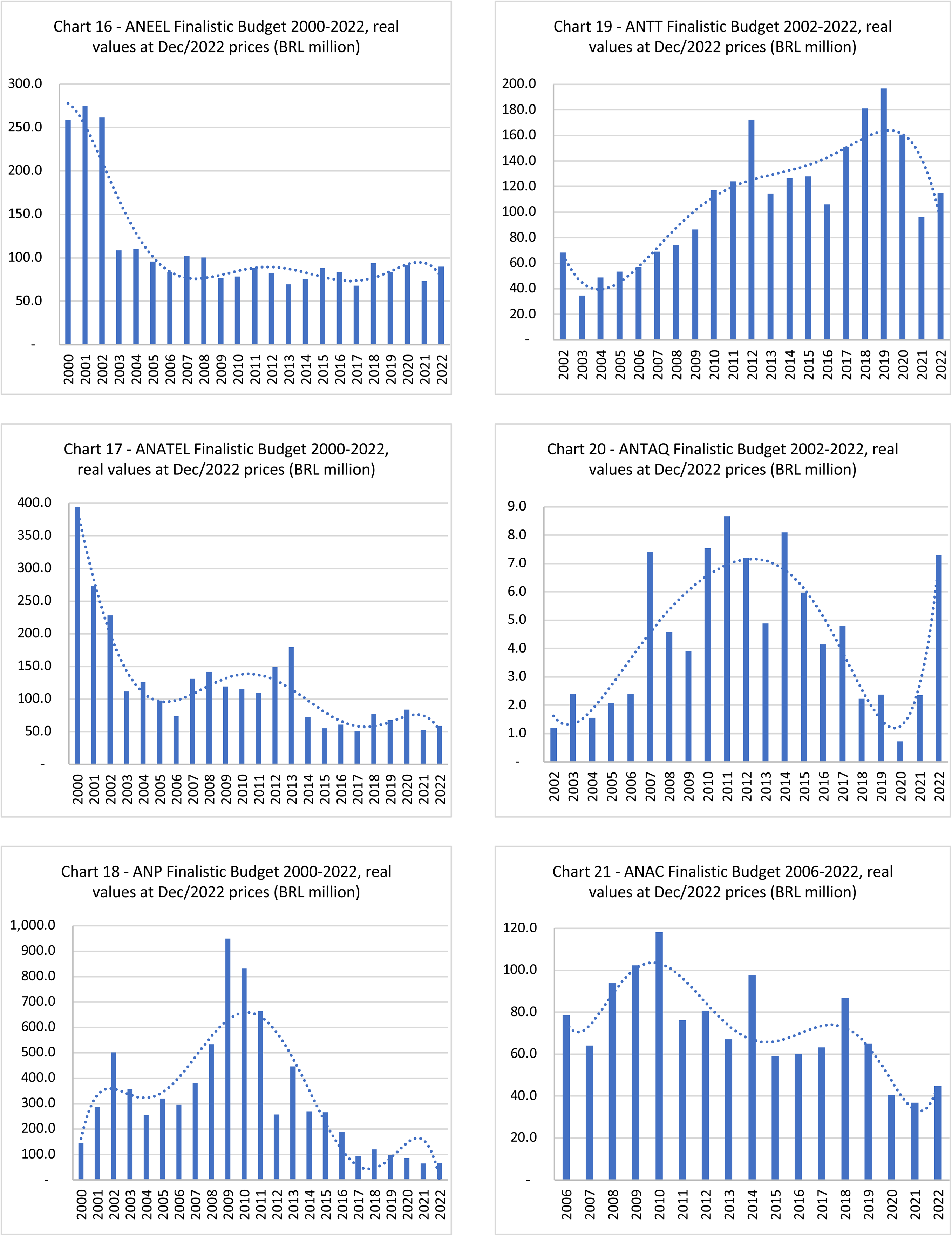
Charts 4–21 provide an even more fine-grained understanding of the data as they report, at the agency level, the three budget categories that we have documented. Personnel expenditure is shown in Charts 4–9. The amounts related to investments are presented in Charts 10–15, whereas the finalistic expenditures are displayed in Charts 16–21.
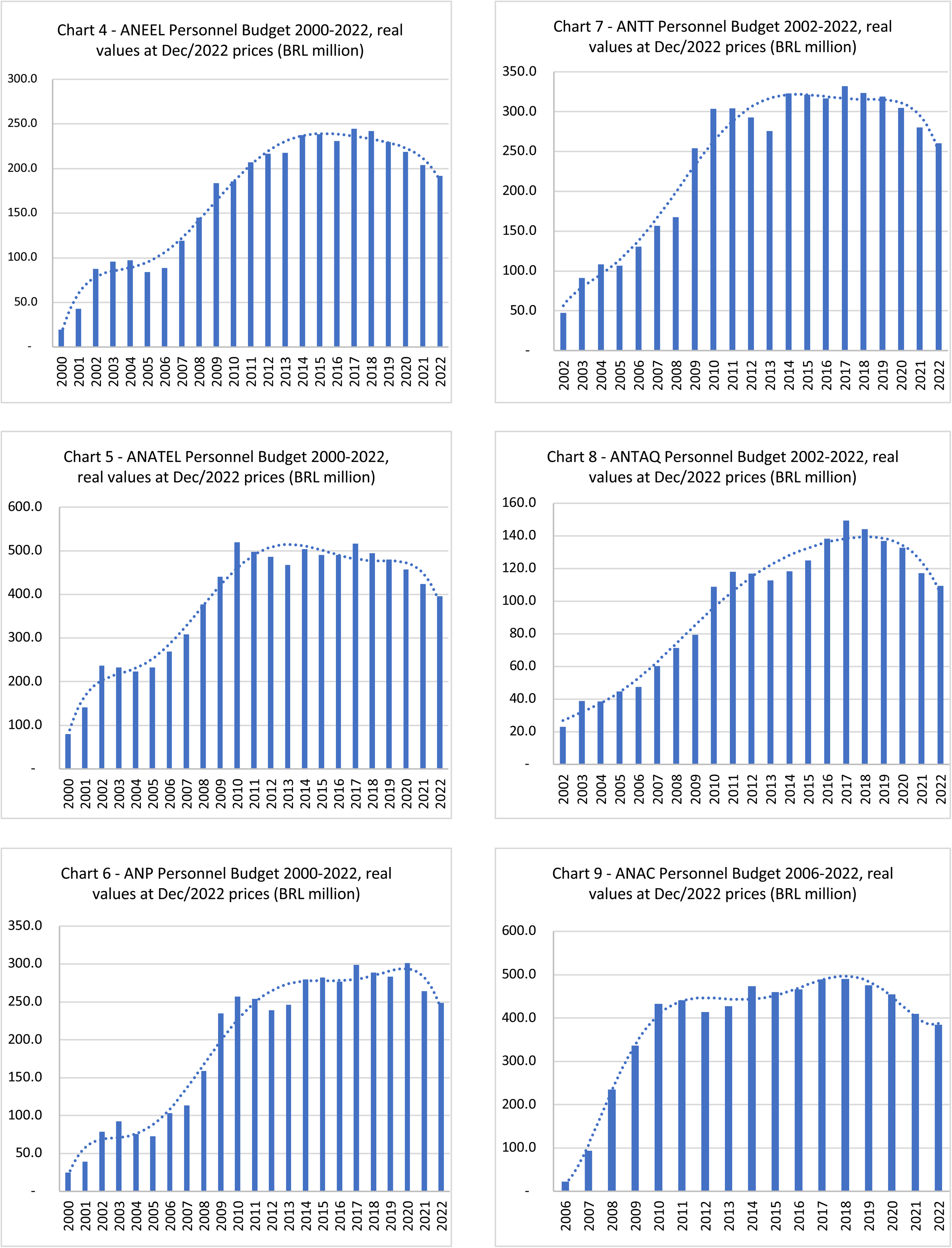
Source (all charts): authors’ own depiction.
Source (all charts): authors’ own depiction.
Source (all charts): authors' own depiction.
Charts 4–9 report on regulatory agency careers, that is, regulators’ permanent staff, most of them graduate-level skilled professionals (Cunha et al., 2017). These charts show a homogeneous pattern across all six agencies. Personnel budget outlays evolved on a positive trajectory at least until 2016, casting serious doubts on any claims of understaffing of regulatory agencies until the end of the period of center-left administrations. Personnel expenditure is obligatory by law, meaning that the National Treasury must transfer to the agencies the total amount under this rubric, and the agencies to their workforce. This gives to the central government a decisive role in the area of personnel management. Although raising personnel salaries is in the interest of the agencies in view of attracting and retaining talented professionals, confirming their preference over time and along multiple budgetary cycles is largely in the hands of the Executive.
The predisposition of the Executive for long-term improvements in both salary levels and staffing numbers for Brazilian regulatory agencies has been described by Fernandes et al. (2022) as well. On their part, Gaetani et al. (2021: 74), when reviewing the historical formation of the Brazilian state, highlighted that regulatory agencies in Brazil “became well-established public bodies, at least with respect to their manpower capacities.”
Investments, Charts 10–15, are less homogeneous. Investment decisions and expenditures tend to be more volatile because they are multiannual and discretionary by law; that is, agencies have more leeway to manage them directly. At the same time, the Executive has also more liberty when judging regulatory agencies’ annual investment propositions. Investment volatility can also be accounted for at the individual level. Physical infrastructure and machinery, and information technology are traditionally the most expensive items for an economic regulator. They are acquired once and subsequently updated or improved, being replaced much later in time, if necessary. Wholesale substitutions of large equipment, laboratories, and other important infrastructure do not happen every year for the regulators.
Hence, investment figures may spike in certain years and plateau or decline thereafter. This explains why ANEEL and ANATEL experienced real-term drops in investment and finalistic budgets in the first years of our data series. These two agencies were set up in the 1990s and had to marshal large amounts of resources for physical and technological infrastructure creation at the earliest phase of their existence. They had also to deal with the first rounds of privatizations and concessions before 2000, which were cost-intensive from an administrative point of view. To some extent, the same situation has affected ANP, which was also created in the mid-1990s. Nevertheless, in the case of the oil and gas sector, regulatory changes happened more gradually than in energy and telecommunications, given the preservation of the dominant position by Petrobras, the state-owned company. In spite of these variations and individual particularities, until 2018, investment figures mainly increased or remained stable, decreasing thereafter for all the agencies.
Finalistic expenses, Charts 16–21, share some of the characteristics of investment data, including the discretionary nature, which induces volatility. However, key finalistic activities such as inspection routines, notice and comment proceedings, and public hearing sessions are even more case-specific as they relate to the object of regulation, tasked to each agency individually. Similarly, finalistic decisions are not necessarily annual. When regulatory routines change, they usually have higher upfront costs. For instance, ANP and ANAC have updated their inspection procedures over time with a more risk-based approach, which demanded higher initial investments but probably saved finalistic expenditures later on. Therefore, the nature of the finalistic expenses makes tendential behavior an important analytical parameter. By and large, the finalistic charts show real-term growth or stability until 2018, even if they present more volatility than the previous two budget categories.
Overall, Charts 4–21 confirm that the rational preference of regulatory agencies for real value budget regularity has been largely met over the years in Brazil, mainly amid center-left leadership. The predominantly stable to positive tendencies found in the charts are curtailed more decisively only when fiscal imperatives override other policy and institutional concerns. The detrimental effect of the New Fiscal Regime is evident, as is the case with Bolsonaro's government decision to apply austerity strictly to regulatory agencies, pushing their budgets down.
A Renewed Interpretation of Regulatory Agency Financial Autonomy in Brazil
If institutional stability and organizational autonomy must align in the task of controlling for time inconsistency, the 22-year budget history reviewed in this article does not support sweeping conclusions of regulatory agency financial autonomy deterioration in Brazil. Commitments can be said to be violated if, in time “t + 1,” politicians forsake policy choices made in “t” (Shepsle, 1992), a contention that our data does not warrant for most of the Brazilian regulatory agencies’ lifetime until the publication of this article. In a region like Latin America, where volatility, short-termism, and cultural indulgence have affected the quality of government and economic performance (Campello and Zucco, 2021; Porcher, 2021), identifying instances of stability and institutional commitment is an important finding.
We argue that, in the process of fomenting regulatory agency budget stability, relationality has also played a key role. Since agencies’ formal dependence on the Executive for funding has not substantially changed throughout the 22-year period that we examined, the generally positive trends that our data display entail that a reasonable degree of politico-institutional deference to the regulatory agency model has been built up in Brazil.
This begs the question of why the center-left in particular has not consistently encroached on the financial autonomy of regulatory agencies, despite expectations that it would and the prima facie legal basis for doing so, given the statutory control over the budgetary process by the Executive. Although we do not propose a definite answer to this conundrum, we argue that our numerical findings should lead to a renewed interest in country-specific explanations of regulatory agency de facto autonomy and institutional stability. The explanations lie in elements of political and institutional path dependence, as well as in instances of programmatic agency and political strategy.
Notoriously, the Brazilian Left harbored no special sympathy for regulatory agencies while it was in the opposition camp in the 1990s, a sentiment that it was expected to hold on to as an incumbent in the early 2000s. Power (2010) highlights that regulatory agencies had indeed been assumed as an area of dissent between the governments led by the center-right PSBD and those headed by the left-wing PT. Yet, we have already alluded to the incremental approach and self-restrained behavior that the center-left administrations have decided to adopt. Given its ostensive reformist program and the fear it generated in the private sector, Lula's first campaign made the official commitment that no alternative economic project would be pursued abruptly (Dagnino and Teixeira, 2014).
Especially in the area of market governance, the center-left proved unwilling to “rock the boat” and sought to respect the institutionalized margin of maneuver it had available (Madrid et al., 2010: 145). To some extent, this more prudent orientation is not unique to the PT-led administrations. Compared to its regional neighbors, there has been a clear tendency toward gradualism in state reforms in Brazil, including for privatization and regulation (Armijo, 2013; Bersch, 2015; Mariscal, 2004). PT leadership respected this tradition for the sake of pragmatism and governability (Ferrari Filho, 2015; Lyne, 2008).
Moreover, if the Latin-American Left—the Brazilian included—showed no interest in advancing privatization in the 1990s (Meseguer, 2004), in the post-privatization phase, in the 2000s, electoral incentives coupled with ideological legacies set boundaries that limited the space for change and demanded political compromise in the realm of regulatory governance (Martinez-Gallardo and Murillo, 2011). In Brazil, this movement was compounded by the characteristics of the country's multiparty political system and fragmented presidential coalition (Figueiredo and Limongi, 2000). In this highly competitive political system, Brazilian regulatory agencies developed increasing political support and attraction. Contrary to technocratic hopes, agencification, that is, the formal delegation of public authority to non-majoritarian specialized entities such as regulatory agencies, breeds its own arenas of subsequent politicization at the national level (Ennser-Jedenastik, 2016; Onoda, 2023).
Mauerberg Junior and Pereira (2020) provided a depiction of contemporary political interest for regulatory agencies. Their study showed that the latitude of regulatory competencies within each ministerial area in Brazil has become a political currency. Ministries with regulatory agencies under their direct supervision are deemed more attractive by the propresidential coalition parties, similar to ministries that control higher budgetary endowments. The PT-led coalition had to navigate this political reality. To weave a policy relationship with regulatory agencies in this increasingly politicized context, the center-left had to balance the formal and informal requirements of autonomy and the pursuit of a legitimate degree of political control over them for the execution of its electoral program and governability (Bersch and Fukuyama, 2023). Safeguarding regulatory agency financial autonomy started to make more political sense in this environment.
On a less parochial and more strategic level, the center-left platform of economic interventionism needed to be reconciled with the resilience of neoliberalism globally (Madariaga, 2020). In this context, the capacity of left-wing parties to “act left” got severely constrained, especially in peripheral economies (Ballard-Rosa et al., 2022). This phenomenon has also compelled the PT-led governments to lean toward right-wing neoliberal policies, which included the traditional model of autonomous regulatory agency (Jarvis, 2017). Likewise, the goal of attracting national and international private capital, which was embraced by the Left in Brazil, emboldened the “neo-institutionalist convention” among the center-left coalition and its pundits (Erber, 2011).
Nonetheless, more counterintuitive in the Brazilian case is the fact that the biggest threat to regulatory agencies’ financial autonomy has not appeared through the hands of statist left-wingers siphoning off their resources, but with an exemplary twenty-first-century neoliberal reform. Stringent fiscal austerity has sparked a new conjuncture where regulatory agencies’ expectation for funding got systematically frustrated. This is an important reversal for Brazilian regulatory agencies.
With Bolsonaro, while budget endowments for regulatory agencies suffered repeated cuts, certain areas of government got away with austerity. This dual strategy of Bolsonaro's government implied that specific agencies and areas of policy were spared while others had to carry an extra and compensatory austerity burden. Military organizations, for instance, benefited from this political choice, as their budget increased during Bolsonaro's years (Hunter and Vega, 2022). According to our dataset, regulatory agencies did not. Political (re)prioritization by Bolsonaro's government is what explains regulatory agencies’ fate after 2018.
Finally, our analysis, although departing from a critical expansion of Maggetti's (2007) framework, is somewhat convergent with his conclusions, at least with respect to the period prior to Bolsonaro's presidency. Regulators’ aging and legitimization, environmental pressure through normative forces, and state coordination via centralized budgeting are factors that could potentially explain de facto autonomy in Maggetti's modeling as much as they emerge from our cases. From this, we accomplish our goal of expanding his framework from a critical, historical, and evidence-based standpoint, broadening the relevance of the concept of regulatory agency de facto autonomy.
Conclusion
This article has dealt with a recurrent yet ill-developed topic in the literature, namely, the de facto autonomy of regulatory agencies. Our long-term longitudinal analysis showed that Brazilian regulators received real-term stable to rising budgetary support from the Executive most of the time between 2000 and 2022. Their actual financial autonomy has formed incrementally, in response to their rational preference for budget stability and regularity, and via channels of political and normative legitimacy. Thus, rationality and relationality have conjointly led to the upholding of agencies’ preferences over time, which is a crucial autonomy criterion laid out by Maggetti (2007).
Left-wing coalitions in power have maintained the flow of resources to federal regulators even if they had the ability and legal powers to do otherwise. A more real threat to regulatory agency financial autonomy emerged with the fiscal austerity era, after 2016. Austerity risks harm regulatory agencies by reducing their resources, frustrating their preferences, and ultimately impairing their autonomy. These risks have been more pronounced under right-wing than left-wing administrations in Brazil over the last two decades. The far-right presidency of Bolsonaro, between 2019 and 2022, was particularly detrimental to regulatory agencies in financial terms. These conclusions challenge the prevailing academic thrust on strong empirical foundations.
Further research may unpack similar phenomena in other state-dependent developing economies that have also undergone fiscal tightening reforms in recent years. Future work can also build on this article to produce more micro-level analyses for each one of the budget categories that we mobilized or the individual agency sectors. With it, they can potentially recommend improvements to existing cross-country measurements of financial autonomy to better respond to contextual variation. Moreover, from a practical standpoint, this study anticipates scenarios that are likely to resurface, given the newest left-right cleavage in Latin America. Left-wing governments have made a comeback in the region, including in Brazil in 2023.
Lastly, there are at least three caveats to consider when interpreting the findings of this study. First, they should not obscure the possibility of different situations occurring in other dimensions of autonomy that we have touched upon only in passing, given the goals of this article. This is the case even if we believe that budget is of utmost importance, considering the characteristics of the Brazilian state that we debated. Second, this article is not an endorsement of counterproductive rhetorical manifestations of elected politicians that have oftentimes put the Brazilian regulatory state under unnecessary tension, during both left- and right-wing administrations. Our theoretical focus and methodological options were not tailored to provide interpretative analyses of discursive data, which would nevertheless be a promising research avenue moving forward.
Third, even though regulatory agencies have been able to sustain their ground for quite some time and secure a generally favorable budgetary trajectory in the last decades, it does not eliminate the importance of formal autonomy. The years of the Bolsonaro administration have proven that commitments of institutional stability can be overturned relatively quickly, harming regulatory agencies.
Footnotes
Acknowledgments
We are thankful to our colleagues at Ipea for their valuable comments and encouragement from the early stages of the research project, especially Pedro Palotti, Leandro Couto, Claudio Amitrano, Flávio Carneiro, Natalia Koga, and Pedro Cavalcante. Flavia Donadelli (Fundação Getúlio Vargas - FGV)) and Mehmet Kerem Çoban (SOAS, University of London) were also careful and generous readers, and for their help we are truly grateful.
Declaration of Conflicting Interests
The author/authors declared no potential conflicts of interest with respect to the research, authorship, and/or publication of this article.
Funding
The author(s) received no financial support for the research, authorship, and/or publication of this article.
