




Abstract
From the 1990s onwards, many Latin American states have adopted constitutional reforms that recognise indigenous peoples’ rights. In this article, we address a much less studied aspect, the emergence of new language rights. Based on field research and process tracing, we study the case of Peru where indigenous language rights were created in the absence of ethnic parties and with a relatively weak indigenous movement. We argue that the country moved slowly away from a monolingual language regime towards the recognition of indigenous languages as official languages and the creation of language rights. We identify key moments of state transformation in the 1970s, the 1990s, and the 2000s as linked to successive building blocks in the creation of a multi-lingual language regime. In particular, the decentralisation reforms of the 2000s created new opportunities for subnational actors to further develop these rights in different regions of the country. We exemplify these dynamics by looking into the adoption of language rights in the regions of Cuzco and Ayacucho.
Latin American countries have seldom been studied in political science through the lens of language politics. Sociolinguists and anthropologists have produced impressive amount of knowledge on linguistic diversity, bilingual education, and language policy in this region (Gustafson, 2009; Hamel, 1994, 2013; Mar-Molinero, 2000b). But in the field of comparative politics in particular, no specific study can be found on the role of political actors or transformation of state policy on language in Latin America. At the same time, in the last decades, indigenous movements have strongly influenced the political dynamics of several countries, generating new institutions and even new ethnic-based political parties in a few cases (Lucero, 2008; Van and Lee, 2005; Yashar, 2005). Where does language sit in Latin American indigenous politics?
As is well known, contemporary ethnic politics in Latin America displays a number of particular characteristics that distinguish it from other regions of the world where it is often associated with armed conflict and/or secessionism (Madrid, 2012). The main claim of most ethnic mobilisations in Latin America is not the formation of independent states but rather the transformation of existing institutions to provide greater autonomy at the local or regional levels for indigenous communities. While some national political parties have been influenced by ethnic-based demands, language rights have not been a central issue. However, as discussed by Van Cott (2000) and Sieder (2002) among others, many Latin American states have adopted constitutional reforms from the 1990s onwards that recognise the multi-cultural nature of their society and protect some minority rights and/or indigenous peoples’ rights. Fewer cases like Bolivia have moved to recognise the existence of a plurality of nations co-existing within the Bolivian state.
For observers looking for evidence of language policy transformation, Latin America presents several cases. Mexico, Bolivia, Colombia, or Chile are only some examples of countries that have moved to recognise indigenous languages in the last decades, with a great diversity of situations in the type of language rights they now acknowledge. A comparative analysis of language regime types is beyond the scope of this article, since what we propose here is rather to advance in the theoretical explanation of the factors accounting for the transformation of a language regime towards the institutionalisation of multi-cultural language rights. Why have some governments in Latin America decided to develop language policy that recognise indigenous language speakers the right to interact in their mother tongue with the state, among others?
Cases such as Bolivia are classic cases of bottom-up ethnic mobilisation producing an accumulation of political force that eventually reshapes state institutions. What is more intriguing, from a theoretical point of view, is how indigenous language rights can emerge even when there is very moderate ethnic mobilisation and no clear political use of ethnicity by the main political parties. In this article, we will address this puzzle by studying the case of Peru, a country with a significant indigenous population yet where the indigenous movement has been notoriously weak in comparative terms (Rousseau and Morales Hudon, 2017). In the latter, starting in the 2000s, some political actors initiated a new politics of indigenous language rights recognition, which led to the adoption of a new national law on the matter and several subnational governments endorsing multi-lingualism. This outcome is considerably more substantive than expected by extant theories. What are the factors that best explain this outcome?
In what follows, we will first present our theoretical framework based on the literature on language regime in comparative politics and present the case of Peru. We will then analyse the dynamics of language regime change in Peru by emphasising the historical origins of state recognition of indigenous languages and the subsequent development of indigenous language rights as manifested in constitutional and legislative norms. We explain the latter based on the following argument: the adoption of a multi-cultural, liberal legal frame in the 1990s provided the normative context for the eventual transformation of the language regime. Yet the latter was a product of other institutional transformations occurring in the 2000s, that is, the decentralisation of the state and the adoption of a new electoral system that allowed regional representation. The election of indigenous language speakers at the national Congress in the 2000s and the capacity of civil society actors at the subnational level to push for the recognition of indigenous languages as official languages are the key determining factors of the outcome we seek to explain. Thus, our research shows that the adoption of a multi-lingual language regime based on linguistic rights for minorities is not dependent on a strong indigenous movement or on the strength of national ethnic parties. Considerable advances can be made through institutional transformation that were not designed, and were not expected, to advance linguistic rights. This article is based on a process-tracing methodology that reconstructs the slow transformation of legal norms regarding official languages using constitutional and legal texts and the data drawn from over fifty interviews done in Peru with key policy experts, politicians, and civil society in 2015 and 2016.
Language Regimes in Comparative Politics
As the literature on nation-state building argued before, language is a strong component of nationalism (Anderson, 2006). Moreover, modern state-building implies developing the infrastructure and norms that allow the diffusion of a common language among the citizenry, notably through public schooling (Barbour and Carmichael, 2000; Gellner and Breuilly, 2008; Hobsbawn, 1996). State initiatives and their regulatory power play a key role in these processes, yet it rarely goes unchallenged, because of the linguistic heterogeneity that characterises most countries. Among others, scholars studying “small nations” have showed that language rights for minorities is one of the key demands associated with ethnic mobilisation (Gagnon, 2009; Mar-Molinero, 2000a; May, 2011).
The literature offers different theoretical explanations of the choices behind language policy adoption. Liu and Ricks (2012) emphasise the role of political coalitions in governments during critical junctures of state-building. Linguistic groups’ access to political power and mobilisation capacity is determinant for these authors, independently of whether they represent a linguistic minority or a majority. The dynamics of government seeking to maintain power and thus adopting a change in language policy to consolidate its coalition is what Liu and Ricks consider central in explaining language regime transformation in South East Asia.
Other authors have adopted a rational choice approach whereby state authorities seek to maximise their power and develop instrumental strategies to enshrine specific language policy choices. Laitin (1992, 1998) has developed this framework to study language politics in African states and post–Soviet state-building. This approach is based on assumptions of policy efficiency as a key goal pursued by policymakers and state authorities. The main driver of change is the maximisation of returns on the adoption of specific schemes of language policy in relation to different political constituencies.
In contrast to these approaches, in this article, we follow the historical institutionalist perspective of Sonntag and Cardinal (2015). In their work, ethnicity and language are interconnected, but distinctive features of a polity and language policymaking are explained in reference to state institutions. As Cardinal and Sonntag (2015: 6) put it, “a language regime refers to language practices as well as conceptions of language and language use as projected by state policies and as acted on by language users. State traditions guide and frame those practices and conceptions.” There are several language regime types, where language policy can be de facto and de jure state monolingualism, or alternatively it can incorporate different degrees of multi-lingualism, with a variety of linguistic rights for ethnic minorities.
State and political actors shape the language regime in the context of specific political institutions that open up or restrict access to the political sphere and manifest different national projects. The notion of state traditions is useful to understand language regime as path dependent. This theoretical apparatus implies that the latter is embedded in broader political dynamics of group representation, citizenship, and state construction. As discussed by Cardinal and Sonntag, challenges often appear in the context where state traditions are weakened – at critical junctures. Challengers need to propose new language policies that will rally effective political support.
Some works emphasise the path-dependent impact of colonialism, with colonial languages determining which language will become the official language of a postcolonial state; or in contexts of strong anticolonial sentiments, colonial language will be replaced by an indigenous language as official language of the state. Yet, colonialism is only one state tradition that can impact on the language regime. The role of the state in asserting and guaranteeing the rights of some minority language users is both ideological and institutional. This involves the decision to guarantee linguistic or language rights in the first place, which essentially corresponds to a liberal state tradition.
According to Kymlicka and Patten (2003), language rights have been conceptualised by Kloss (1971) as being of two broad kinds: tolerance-oriented and promotion-oriented. The first refers to state tolerance of citizens’ use of the language of their choice in the private sphere and civil society, whereas the second corresponds to the rights that allow citizens to use a specific language other than the dominant one in their interactions with public institutions. Kymlicka and Patten argue that the category of promotion-oriented rights is not specific enough. They propose to distinguish between what they call the “norm-and-accommodation model,” whereby those individuals who are not proficient in the dominant state language will have access to interpreters or bilingual civil servants, and an “official-languages regime,” whereby more than one language is recognised as official, and provisions are made to equalise the use and status of these languages in public institutions. In this article, we are interested in the development of promotion-oriented language rights. As we will show, in Peru, the current language regime can be characterised, normatively speaking, as reflecting a mix of the norm-and-accommodation model and the official-languages regime.
The few works that have studied language regimes from a comparative politics perspective deal with cases in Asia (Liu, 2015), Africa (Albaugh, 2015), Europe, or North America (several cases are analysed in Cardinal and Sonntag, 2015). Regional and national differences matter insofar as they reflect significant characteristics in terms of state traditions and how they affect language policy. When approaching Latin American cases, we should emphasise the predominantly authoritarian state traditions associated with a postcolonial heritage of Spanish monolingualism, yet the transitions to a democratic regime since the 1970s have meant the gradual turn to liberal norms and institutions, at least formally.
To study the transformation of the Peruvian language regime from a monolingual to a multi-lingual regime based on indigenous language rights, we propose a historical institutionalist analysis that pays attention to state traditions and to critical junctures. We understand critical junctures as “situations of uncertainty in which decisions of important actors are causally decisive for the selection of one path of institutional development over other possible paths” (Capoccia, 2016: 89). Our analysis points to different transformations in political institutions reflecting new national projects and changing opportunities for a set of actors to successfully lobby for the adoption of a multi-lingual regime. In what follows, we present three observations of the Peruvian case around the changes we identify as qualitatively determinant to explain our core outcome: the adoption of a multi-lingual regime based on indigenous language rights. These observations are summarised in Table 1.
Critical Junctures and Their Impact on the Language Regime in Peru.
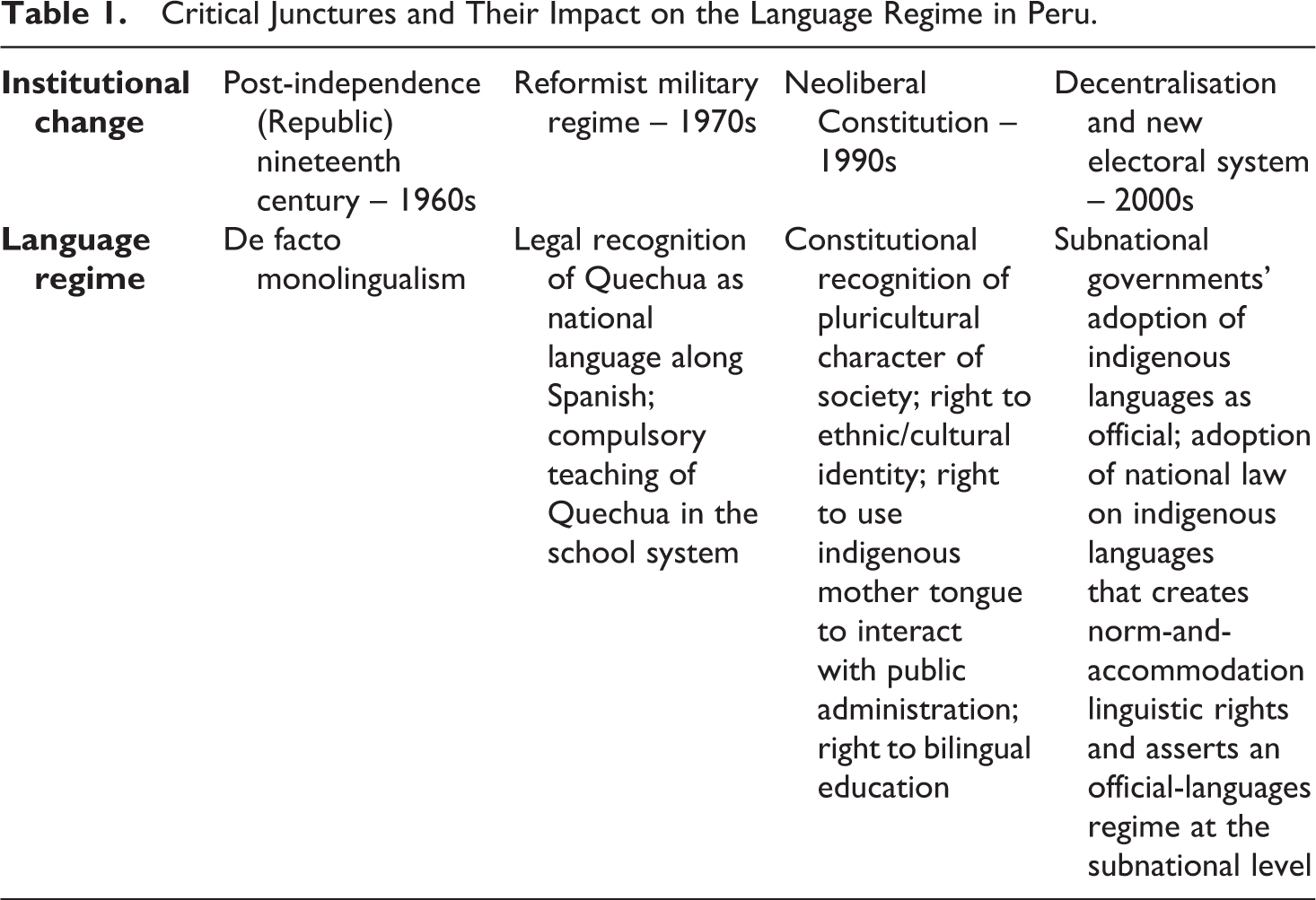
In the next sections of this article, we will analyse language regime politics in Peru as a path-dependent phenomenon. Monolingual state policy was shaped by oligarchic state rule during the nineteenth century and over half of the twentieth century and then slowly opened itself to the recognition of indigenous languages by the state as a symbolic gesture by a progressive-minded military regime in the 1970s. The turn to a multi-cultural liberal frame was introduced in the 1993 Constitution without political pressure from below nor from political elites and as such remained largely on paper. The creation of a multi-lingual language regime with linguistic rights for minorities is a product of the political transformations occurring in the 2000s. After the electoral and decentralisation reforms that created new opportunities for regional actors to participate more directly into politics, the adoption of a specific law on indigenous languages and the involvement of regional governments and civil society allowed for a deeper transformation of the language regime.
Monolingualism and Its First Breaches
When analysing the Peruvian language regime construction, one should note that Spanish, the language of the colonial authorities, was adopted as de facto official language at the time of independence in the early nineteenth century. Spanish was the mother tongue of a relatively large sector of the population – but still a clear minority – at the time of independence (Larson, 2004). The Republican period contrasts with the colonial period when Quechua, the main indigenous language spoken on the territory, and to a lesser extent, Aymara were chosen as administrative languages for religious conversion. This made these languages recognised as prestigious and widely diffused. In fact, Quechua continued to extend its reach beyond the level it had attained under the Inca Empire as a lingua franca. So, Spanish rule was responsible for the expansion of Quechua (principally) as a lingua franca, which over time had as a consequence the disappearance of many other indigenous languages while Quechua became the mother tongue of the majority (Mannheim, 1984). This dominance alongside Spanish was transformed as a result of the Tupac Amaru revolt of 1780–1782, after which Quechua was banned by the colonial authorities in order to eliminate the indigenous highland elite. A few decades later, on its independence, the new Republic did not consider Quechua nor Aymara worthy of official recognition, yet the majority of the population continued to speak them as their mother tongue.
In the Republic, the indigenous population was legally defined and treated as second-class citizens, and remained so largely until 1980, when universal suffrage was finally granted to illiterates and thus to the majority of indigenous language speakers. 1 Still today, speaking “proper Spanish” is a strong marker of race/ethnic difference and is strongly correlated with higher social status (Zavala and Córdova, 2000). The Republican State started to invest in public education (then functioning only in Spanish) slowly in the 1910s, and it reached a greater mass of indigenous language speakers from the late 1940s onwards (Contreras, 1996).
Through the expansion of public schools and a radical agrarian reform in the 1970s which ended the hacienda regime and freed millions of peasants, thus launching permanent and seasonal rural-urban migration, the Peruvian state has been relatively successful in hispanising its population. While millions of Peruvians speak an indigenous language today, 2 the rates of bilingualism and Spanish monolingualism have increased steadily in the last decades (Howard, 2007). Quechua is the mother tongue of around 14 per cent of the population aged five and above, according to the 2017 census. There are forty-seven different indigenous languages recognised by the state.
The first critical juncture we identified with clear consequences on language policy was the military government of General Juan Velasco Alvarado (1968–1975). This reformist regime supported by intellectuals, middle and lower classes was able to impose a series of economic and political reforms that meant the end of the oligarchy. Its rhetoric and politics sought to empower rural and urban lower classes and effectively did so to some extent. Importantly, it adopted the first linguistic policy recognising Quechua as an official language of Peru. In 1972, an education reform provided the first foundations of the bilingual education program that was to be adopted in the schools serving Quechua-speaking areas. One year later, the first regulation on bilingual education was adopted but only started to be implemented as of the end of the 1970s and only through a pilot program in the highland region of Puno. In parallel, Law-Decree 21156 promulgated in May 1975 declared Quechua and Spanish as official languages of the Republic of Peru and mandated that Quechua be taught as compulsory second language in the school system.
However, these institutional innovations lasted only a few years as the state momentum on indigenous language promotion did not continue for some time after the end of the military regime (Howard, 2007). The 1979 Constitution adopted at the end of the military regime downgraded the status of Quechua from official language equal to Spanish to being “of official use in the zones and according to the law” together with another indigenous language, Aymara (Article 83). No law was ever adopted to implement this article of the constitution and therefore it remained a symbolic gesture. As to bilingual education for Quechua-speaking communities (and other indigenous language-speaking communities), it was guaranteed in Article 35 of the 1979 Constitution but remained largely declaratory as it lacked many normative tools to materialise. For example, only in 1985 was the first unified Quechua official alphabet adopted by the State; in 1991, the first National Policy on Intercultural Bilingual Education was adopted, but the first state office in charge of implementing it was created within the Ministry of Education only in 1996 (Howard, 2007). Bilingual Intercultural Education was integrated in state programs as part of a World Bank-sponsored educational reform in 1992 but remained scattered in its coverage of the target population and with few popular support in Quechua-speaking areas throughout the 1990s (García, 2005; Gustafson, 2014: 87).
The second critical juncture we identified with key consequences for the transformation of the language regime is the profound reshaping of state institutions as a result of Alberto Fujimori’s 1992 self-coup and subsequent adoption of a new Constitution in 1993. In contrast to its 1979 predecessor, it includes some articles creating language rights for the first time in Peru’s history. 3 Its second article (Article 2.19) establishes the right to an ethnic and cultural identity, the State’s duty in protecting the ethnic and cultural diversity of the country, and more concretely the right to use one’s own mother tongue with the assistance of an interpreter when interacting with any public authority. 4 According to the members of the Constituent Assembly who proposed this article, mentioning specifically the right to an interpreter was a necessary guarantee to ensure that the right to speak one’s mother tongue did not become merely declarative (Congreso Constituyente Democrático, CCD, 1993: 160–165). 5 More substantially even, Article 48 declares that, in the zones where they predominate, Quechua, Aymara, and other indigenous languages are recognised as official, aside Spanish which is the official language. Also relevant, when discussing the need to eradicate illiteracy, Article 17 specifies that the state should promote bilingual and intercultural education.
It is unclear how these rights reached the constitution, but the debates within the Constituent Assembly show that among members of the incumbent Fujimorista party and of the opposition, there was a broad agreement to include them in the Constitution. Article 2.19 was approved by fifty votes against one. When debating Article 17, the part of the article referred to language rights was not even discussed (CCD 1993: 2115–2141). Through these constitutional innovations, Peru introduced language rights according to the concept of “promotion-oriented rights” that we presented above. The norms follow, broadly speaking, the norm-and-accommodation model proposed by Kymlicka and Patten (2003), yet it associates with it a recognition of the official status of indigenous languages in the zones where they predominate. This comes close to the category of “official-languages regime” also proposed by Kymlicka and Patten (2003), yet the 1993 Constitution did not give any precision as to the consequences of this official status granted to indigenous languages.
These first institutional innovations in the language regime are the products of two critical junctures in Peruvian politics: the reformist military government of the 1970s that ended oligarchic rule; and the radical reshaping of democratic institutions according to neoliberal and multi-cultural norms dominant in Latin America in the 1990s, in the context of the self-coup led by President Alberto Fujimori in 1992. The first introduced legislation on official languages, with the notion that Quechua and Aymara were official languages or of official use in certain areas of the country; the second constitutionalised the right to ethnic and cultural identity and the right of every citizen to speak his/her mother tongue in the context of public institutions. The 1993 Constitution introduced the liberal notion of linguistic rights.
In general, these junctures were not prompted by political dynamics related to indigenous politics or languages. The military coup of 1968 and the adoption of a wide reformist program was not related to ethnic politics; it was rather based on answering old class-based demands. In the decades prior to the reformist military regime, Peruvian social movements in the areas where most Quechua speakers lived were focussing on land reform. Under the influence of urban left-wing parties, these peasant organisations adopted a class-based discourse and did not politicise their ethnicity as such (Rénique, 2015). Moreover, General Velasco is remembered for having publicly criticized the use of the term “indio” (Indian), a pejorative term used to describe Highland peasants. Instead the regime promoted the corporatist class identity of peasant, which it deemed more dignified.
Yet Velasco promoted the linguistic policy on Quechua described above, but without adopting the actual instruments necessary to implement it. His government’s project has been characterised as nationalist not only on the economic front but also from a cultural point of view (Aguirre and Drinot, 2017). From that perspective, Quechua was considered a distinguishing trait of Peruvian nationhood, as part of the creation of new popular symbols of social transformation and social inclusion.
In turn, the 1993 Constitution’s introduction of cultural and linguistic rights should be explained by referring to the region-wide trend of inserting multi-culturalism in constitutional reform rather than internal political factors per se. The same year, Peru ratified the International Labour Convention No. 169 on Indigenous Peoples’ Rights (Brysk, 2000; Yrigoyen, 2002). As is well known, President Fujimori’s self-coup was the key event that eventually precipitated the elaboration of a new Constitution. As such, it was produced under tight and limited political participation, as most democratic forces protested against Fujimori’s self-coup. Yet the latter sought to project the image of an “authentic democratic leader” seeking to modernise the country and we understand the adoption of a multi-cultural frame as part of the attempt to sustain this image.
We ground our interpretation on the basis of the fact that, at that time, there was no indigenous organisation strong enough to even appear on the national political scene (Paredes, 2010). Throughout the 1970s, 1980s, and 1990s, no indigenous movement emerged that would become a significant political actor worthy of attention from the state’s point of view. Several reasons have been mentioned by different authors, and it is beyond the scope of this article to discuss them (Degregori, 1999; Montoya, 1998). The “competitive authoritarian” regime of Alberto Fujimori (1990–2000) was a period of decay and repression of social movements in general.
The Construction of a Minority Rights-Based Language Regime: Institutional Factors
The end of the Fujimori government in 2000 marked the beginning of a new era in Peruvian politics. A new process of indigenous organising, which initiated in the last years of the Fujimori government, grew in strength especially in the Amazon. Several new organisations were created during the first decade of the 2000s and older ones appeared more centrally on the political scene (Rousseau and Morales Hudon 2017; Van and Lee, 2005). In 2001, the transitional government of Valentin Paniagua created a high-level dialogue with Amazonian indigenous organisations, thus recognising their political legitimacy for the first time. However, the two governments that followed (President Toledo 2001–2006; President Garcia 2006–2011) did not attend their demands and on the contrary adopted policies and legal norms that went directly against indigenous peoples’ territorial rights’ aspirations, especially under Garcia's Alianza Popular Revolucionaria Americana (APRA) rule.
One of the two major Amazonian federations, the Asociación Interétnica de Desarrollo de la Selva Peruana (AIDESEP), led a two-year struggle against decrees adopted by Garcia’s government that further liberalised private corporations’ access to indigenous territories and created hundreds of new private concessions. What later became known as the “Baguazo” – because it took place in the province of Bagua – involved hundreds of protesters from the Awajun and Wampi peoples striking for months. On 5 June 2009, thirty-three persons got killed as a result of the clashes between protesters and police forces. This dramatic event shocked public opinion and forced the government to start negotiating in 2009. Among indigenous organisations’ demands, the right to prior consultation on projects or norms affecting indigenous peoples was one of the most debated in the following years. According to the Director of the Indigenous Languages Office at the Ministry of Culture at the time of our research, the issue of language policy was also part of the claims made by indigenous organisations at that time (Interview Panizo 2016). This last issue, however, did not reach the national public debate through this channel.
The visibility of minority languages as a rights claim came about through two levels of political action that preceded the 2009 indigenous protests. First, the national Congress became the site of the public expression of ethnic identity by a group of Quechua Congresswomen elected in 2006 who led the campaign for the adoption of a national law on indigenous languages, which was finally adopted in 2011. Second, and in parallel, within several subnational governments, civil society actors managed to influence newly elected regional governments to adopt legislative norms that officialised indigenous languages within their region, even before the 2011 law in many cases.
These developments are directly connected to two major transformations of political institutions occurring in the 2000s, which we will detail in the following sections. First, the electoral system, which was based on a single national electoral district during the Fujimori era, was reformed for the 2001 elections. This reform allowed for the representation of Peru’s departments (regions) in Congress through the creation of twenty-six electoral districts. The political dynamics at the Congress was importantly transformed as a result, since in the previous electoral system design, candidates coming from the capital city, Lima, were much more successful in getting elected.
The second relevant institutional change is the decentralisation reform that created elected regional governments. Although in Peru municipal authorities (district and provincial mayors) are elected since the 1960s, until quite recently the country was a highly centralised unitary political system. A timid regionalisation effort in the late 1980s was terminated by Alberto Fujimori’s government in 1992. Although the Fujimori regime directed some new resources to local (district) municipalities, it centralised resources in the powerful Ministry of the Presidency, weakened provincial municipalities, and dissolved regional institutions (Muñoz, 2005; Tanaka, 2002). Due to these centralising policies, decentralisation became one of the more important demands of the political opposition to this regime. When Fujimorismo collapsed in 2000 due to a multiple corruption scandal, opposition political parties advanced decentralisation reforms. Perú Posible, winner of the 2001 general elections, and APRA, the runner-up, actively supported these reforms and, as a result, in July 2002, Congress approved a new decentralisation law. In November of that year, the first regional elections took place.
All observers deplore the hasty way through which this reform took place. The speed and little planning of key aspects of the decentralisation process is partly explained by political calculations. As suggested by Tanaka, the main parties in Congress assumed that given their good electoral results in 2001 they could profit politically from a new decentralised arena (Tanaka, 2002). This did not happen and instead national parties have increasingly lost grounds to regional groups (Zavaleta, 2014). Yet the election of regional governments through universal suffrage has activated new spaces for regional political projects, among which proponents of changes in the language regime have found some echo.
Quechua Enters Congress: The Adoption of the Law on Indigenous Languages
Language rights became a matter of national debate and legislation when a handful of indigenous Congresswomen were elected at the Congress. At the 2001 elections, an Aymara woman from the Puno region, Paulina Arpasi, was elected as part of the government party Peru Posible. Arpasi, a peasant leader, was selected along with other Congressmembers to work on Congress’ Commission on Andean, Amazonian, and Afroperuvian peoples, which proposed what became the first law on indigenous languages after the military regime of the 1970s. Law 28106 was adopted in 2003, but only consisted in recognising indigenous languages as official languages in the zones where they predominate, as well as very generally define the state’s obligation to protect and promote these languages. As such, it did not specify any linguistic right.
At the 2006 elections, a greater number of indigenous candidates were elected as Congressmembers. While they were only a handful, three of them, all Quechua speakers, started a national debate on linguistic politics at the Congress. Congresswomen Hilaria Supa, Margarita Sucari, and Maria Sumire, from the Nationalist Party, broke the monolingual tradition of Congress by taking the oath of office solemnly in Quechua on the day of their inauguration in 2006. This provoked immediate reactions of surprise, criticisms, and applause. Maria Sumire, a Congressmember from the highland region of Cuzco, was told three times by the President of Congress to repeat her statement. He urged her to pledge in Spanish. Sumire described this as an aggression against her rights as a Quechua-speaker. 6
Sumire and Supa got into a highly mediatised fight with Fujimorista Congresswoman Martha Hildebrandt, who used her background as a linguist to manifest through racist comments her opposition not only to the inclusion of indigenous languages as official but also against the indigenous Congresswomen’s legitimacy as lawmakers. 7 For example, when Hilaria Supa was chosen as President of Congress’ Education Commission, Hildebrandt resigned from her seat on that commission. She argued that Supa did not have the educational credentials for that position. 8 Supa was also depicted as an “ignorant peasant woman” by an important national newspaper, Correo, which put on its front-page a picture of her handwritten notes in Spanish and signalled her grammatical and orthographic errors. This led to a quick condemnation of the newspaper by Congress. 9
The first significant Bills on indigenous languages were presented in 2007 in the context of this new visible presence of Quechua at the Congress. Law 29735 (a law that regulates the use, protection, development, recuperation, enhancement, and spread of Peru’s native languages, Ley que regula el uso, preservación, desarrollo, recuperación, fomento y difusión de las lenguas originarias del Perú) was adopted in 2011, promoted by a few Congressmembers from the Nationalist Party allied with others from the Unión Por el Perú Party. The law was adopted after a tough battle between the Comisión de Pueblos Andinos, Amazónicos y Afroperuanos, Ambiente y Ecologia, the Comisión de Educación, and the Plenary of the Congress. Congresswoman Maria Sumire was the main promoter of the law within the first Commission mentioned above. She also launched a campaign, the Campaña Nacional por la Interculturalidad: “Habla en tu idioma, es tu derecho” (National Campaign on Interculturality “Speak your language, it’s your right”), to increase public awareness on the linguistic rights contained in the 1993 Constitution and the need to implement them through a detailed legislation. 10
The new law explicitly developed what is contained in Article 48 of the Constitution and established for the first time individual linguistic rights based on the principle of territoriality. Among those, we can signal the right to be served in one’s native mother tongue in public services, the right to have access to an interpreter in public services, and the right to be educated in one’s indigenous mother tongue. Native languages are recognised as official – along with Spanish – in all the zones where they predominate, and the law created new policy instruments for the state to determine where these rights should apply (at the district, provincial, and regional government levels). It also made compulsory for state authorities to progressively develop the means to serve citizens in these languages as well as Spanish, which means training civil servants and adjusting hiring policies accordingly.
The Law was promulgated by the APRA government a few days before the end of its rule. The following government led by President Ollanta Humala (Nationalist Party) put forward a new policy on indigenous peoples’ rights. The creation in October 2013 of the Dirección de Lenguas Indígenas (Office on Indigenous Languages) under the Vice-Ministry of Interculturality – itself only existing since July 2010 as part of the Ministry of Culture – was a necessary step to ensure that Law 29735 would effectively start to be implemented.
Humala’s party, the Nationalist Party, was formed in 2005 originally on the basis of a relatively traditional left-wing platform. After coming close to winning in the 2006 elections, Humala sought an alliance with various centre/left-wing parties for the 2011 elections, when he was elected as the president. During its first years of existence, Humala’s Nationalist Party – the same party to which Congresswomen Sumire and Supa belonged – gathered a few social leaders from indigenous background. Some of them were elected in 2006, others in 2011. While the party did not position itself as an indigenous party or defending any ethnic group in particular, most indigenous peoples’ organisations believed in 2011 that the new government would finally take them seriously. 11
Subnational Language Rights Politics: An Unexpected Impact of Decentralisation
Because the 2011 national law on indigenous languages declares indigenous languages official in the zones where they predominate, one may expect that it would trigger some reaction from subnational governments. However, as we will show, some subnational actors did not wait for legislative developments at the national level to start pushing for new linguistic rights based on the 1993 Constitution. Indeed, what is crucial here is the Decentralisation Reform that created opportunities for regional actors to act on linguistic matters.
In several regions of Peru, the majority’s mother tongue is an indigenous language. According to the 2017 national census, in five of twenty-six regions of the country, over 50 per cent of the population aged five and above learned an indigenous language as a mother tongue – mostly Quechua but also Aymara. According to Law 29735 (Language Rights) and what it mandates, these are the top regions of the country where regional governments should become officially bilingual in the services and communications they provide to citizens. That is, instead of only functioning and attending citizens in Spanish, these governments are now obliged according to the law to gradually develop public services that respect the linguistic rights of the Quechua-speaking majority. In many other regions as well, indigenous languages are spoken by significant proportions of the population.
It is beyond the scope of this article to systematically compare the language politics of Peru’s different regions. We focus here on the adoption of regional ordenanzas – the equivalent of laws but at the subnational level – as a proxy of the activation of political actors capable of generating changes in the language regime by promoting the recognition by regional governments of the official status of indigenous languages in their jurisdiction. In many regions where such ordenanzas were adopted, such as Huanuco in 2005, Cuzco in 2007, Junin and Ayacucho in 2008, Lambayeque and Amazonas in 2010, these preceded the adoption of the national law on indigenous languages that created full-fledged linguistic rights.
These subnational trajectories vary according to the strength of political, civil society, and bureaucratic actors supportive of linguistic rights. A closer look into two regions where we did fieldwork, Cuzco and Ayacucho, shows these dynamics. In both of them, over 50 per cent of the population speaks Quechua as a first language, small minorities speak other indigenous languages, and there is a high level of functional bilingualism. Cuzco is a region in which civil society and bureaucratic actors with a long tradition of defence of linguistic rights advanced these rights in quite successful ways. But even in Ayacucho, a region with weaker social and institutional actors, we found the adoption of ordenanzas and other policy innovations advancing linguistic rights.
In Ayacucho, decentralisation opened a window of opportunity for the adoption of intercultural and bilingual policies, mainly pushed forward by some civil society associations. Newly elected regional authorities adopted two regional ordenanzas 12 on language rights: the Ordenanza Regional 36-06 GRA/GR “Proyecto Educativo Regional de Ayacucho 2006-2021 (PER-A),” a fifteen-year plan on regional education goals with an ambitious bilingual component adopted in 2006; and the Ordenanza Regional 10-2008 GRA/GR, adopted in 2008, which recognises Quechua, Spanish, and Ashaninka as official regional languages (in 2011, a new ordenanza included Matsiguenga language in this list). For both of these ordenanzas, we found a clear pattern: an active civil society pushing for their adoption, the technical and monetary support of NGOs and foreign aid (especially UNICEF), and a clear gap between the adopted norms and their implementation.
In the case of the ordenanza that officialises the use of indigenous languages in Ayacucho, the initiative came from a grass-roots women’s organisation called Federación Regional de Mujeres Indígenas de Ayacucho (FEREMÍA) (previously called FEDECMA, Federación de Clubes de Madres de Ayacucho). The FEREMÍA was concerned with the difficulties experienced by their Quechua-speaking members in accessing public services, as well as the gradual loss of Quechua among Ayacucho’s population. According to our interviews, FEREMÍA leaders received technical support from national NGOs such as Chirapaq, Asociación Tarea, and Servicios Educativos Rurales (SER). The regional government was unclear about its commitment to these policies, but the public pressure by FEREMÍA’s bases and the support of two regional government council members led to the approval of Ordenanza 10-2008 GRA/GR. The latter includes the regional government’s commitment to train public officials in recognising, respecting, and promoting indigenous languages. The Regional Office on Social Development was put in charge of its implementation. This ordenanza complements and modifies the above-mentioned PER-A by mandating that in all public and private schools Quechua and Ashaninka courses be mandatory in all school years.
Language rights were not among the priorities of regional authorities, and no consistent effort to push forward the agenda created by the ordenanza was recorded by our interviewees. Nonetheless, even if there were no comprehensive mechanisms advancing language rights in practice, our fieldwork showed that there is a growing consciousness about the importance of bilingual skills for public servants if there is to be adequate public services. In all the offices of the regional government that we visited, our interviewees mentioned that there were several public officials who were bilingual and that this responded to the need to provide for proper communication. In the regional office attending victims of gender violence (under the authority of the Ministry of Women), for example, there are clear policies that aim to ensure that victims are interviewed in their native language. Similarly, the regional office of the public prosecutor had among its personnel several bilingual lawyers. Similarly, judicial authorities have taken steps to guarantee the presence of interpreters in trials where indigenous language speakers are involved, following a constitutionally defined right. Also, when we visited it, the Regional Health Office (DIRESA) included bilingual personnel in some of their programmes. So, concluding, even if social and bureaucratic actors were weaker and less successful than our next case, Cuzco, the advancement of language rights still is significant in this region.
In Cuzco, Quechua is also spoken by the majority of the population. According to the National Statistics Institute (Instituto Nacional de Estadistica e Informatica [INEI]), in the 2017 census, 55.2 per cent of the population of Cuzco aged five and above had learned Quechua as a mother tongue. As is well known, Cuzco was the capital of the Inca Empire, and contemporary regional identity is strongly marked by a discourse of cultural heritage and even claims to direct filiation to Inca nobility in the case of some Cuzqueño families. This is due to the influence of a regional indigenista ideology that started in the 1920s. This dominant narrative sees the greatness of Inca past as supposedly still present in contemporary Cuzco society while today’s rural Quechua speakers are seen by the Spanish-speaking elite and middle classes as a relatively degenerated product of that past (De la Cadena, 2000).
Linguistic politics entered in Cuzco’s regional government in 2007 with the adoption of an ordenanza which officialised Quechua as a regional language. The same norm declares the teaching of Quechua language as mandatory in the school curricula and that public servants speak at least basic Quechua. 13 While in general the pattern and progress in adopting policies related to indigenous language rights in the context of regionalisation is only a little more advanced than the one we discussed in the case of Ayacucho, Cuzco has a more thorough implementation of these norms, with policies and activities promoting Quechua in the region. We explain this greater activity due to two advantages over the former in terms of institutional and educational capacity.
First, because of the very intensive influx of visitors in its archaeological sites, mostly Machu Picchu, Cuzco receives a significantly higher revenue from tourism in comparison with the other Peruvian regions. This revenue is controlled by the Dirección Desconcentrada de Cultura (DDC), the regional office in charge of patrimonial matters and cultural policy. This office is under the authority of the Ministry of Culture but is institutionally autonomous, in great part because of the vast amount of resources it controls directly. The DDC in Cuzco has over a thousand employees, most of them in the area of archaeological sites maintenance and development. The DDC in Cuzco has become one of the main promoters of indigenous language rights. Its administrative structure includes an office on interculturality with officers in charge of indigenous peoples’ rights and indigenous languages in particular.
Second, we find in Cuzco more actors in civil society promoting Quechua, particularly local NGO’s and a unique civil association called the Academia Mayor de la Lengua Quechua (AMLQ) (which is not purely civil society as it was created as a decentralised public institution of the education sector originally). Some NGOs were the first in assuming the task of organising and promoting intercultural bilingual education in rural schools and in adult-literacy programs since the end of the 1970s. The AMLQ succeeded to the Academia Peruana de la Lengua Quechua, a much older association created in 1953 by Quechua aficionados from the landowning elite of Cuzco. The founders and successive leaders of the Academia were Spanish speakers who spoke Quechua as a second language and gave themselves the mission to “preserve Quechua’s purity” and “teach the correct way of speaking and writing Quechua.” However, the AMLQ is a very ambivalent asset for Cuzco’s language politics. Even if it is an actor which has a vested interest in promoting the Quechua language, it has only very recently started to advocate for language rights. Instead, the core of its activities has focussed on teaching its own version of Quechua, publishing a Quechua dictionary, and trying to institutionalise itself. Since the national state recognised it in 1990, it never managed to receive public funds nor to consolidate its official status.
These civil society actors and the DDC have built new institutional practices and cultural activities displaying Quechua as a language of daily use. This is due mostly to the active role and resources of the DDC. Up to the time of writing, the DDC staff in charge of indigenous peoples and indigenous languages was very committed to contributing to the implementation of language rights. Since the adoption of the national law on the matter, they organised workshops in different provinces of the region to disseminate knowledge about the existence of the new language rights, both to provincial authorities and the general public. It also organised a Cuzco-based course to certify official interpreters that could be called on by regional state institutions. When we interviewed the DDC staff in charge of indigenous peoples’ rights, they mentioned that they were working on an agreement with the regional government to develop its capacity to manage the transition to bilingualism (Interviews 2016).
The DDC was not the only institution in the region to advance the agenda of language rights. For example, the municipal government of the city of Cuzco (Province of Cuzco) adopted as its first ordenanza in 2014, a plan to strengthen Quechua in the municipality of Cuzco (“Plan de Fortalecimiento del Quechua de la Municipalidad del Cuzco”), which signals linguistic discrimination as a public policy problem and proposes various actions to transform the way the municipality works inside its organisation and in its public services. 14 It opened a public information booth that answers citizens’ queries in Quechua. Another example is that the political parties that competed for the 2014 regional elections signed an agreement “Acuerdo por el Cuzco 2015-2018,” in which, among other commitments, they pledged to adopt norms to ensure that the regional government would provide public services in Quechua and combat discrimination.
As exemplified by the cases of Ayacucho and Cuzco, the regional space opened up by decentralisation contributed to the advancement of the agenda of language rights. As we explained, regional authorities did not wait for a full-fledged national law on indigenous languages to promote the adoption of indigenous languages as official in their jurisdiction. With greater or lesser institutional capacity, regional governments were used to transform the few language rights created by the 1993 Constitution.
Conclusion
The transformation of the Peruvian language regime in the recent decades is associated with three critical junctures that transformed political institutions and provided the possibility for some actors to build an alternative to the postcolonial state’s monolingual language regime. First, the reformist military regime of the 1970s proceeded to universalise citizenship rights and recognised Quechua and Aymara as national languages. Second, the neoliberal reforms adopted by President Fujimori in the 1990s aligned the country with multi-culturalism and Indigenous Peoples’ Rights, a dominant regional trend in Latin America. The 1993 Constitution, in particular, introduced the notion of cultural and language rights, which was a crucial step to build a new language regime. Finally, and most importantly, the decentralisation and electoral reforms of 2000s opened up the possibility for indigenous language speakers to be elected at the Congress and confront ethnic discrimination openly as well as new regional political dynamics that addressed the issue of language directly at that level.
This progressive language regime shift introduced indigenous languages into the ambit of state recognition and led to the creation of minority language rights that reversed two centuries of indigenous languages’ exclusion from state administration. This article has contributed to the emerging literature on language regime change in comparative politics by addressing a Latin American case which many would see as an unlikely candidate for indigenous linguistic rights creation. Our historical institutionalist framework showed that the state’s recognition of multi-lingualism was an incremental, cumulative process that only managed to thrive politically with the reform of the electoral system that allowed for the entry of indigenous Congresswomen to parliament and with the decentralisation reforms. Peru’s multi-lingual language regime combines elements of the norm-and-accommodation model with some aspects of the official-languages-regime model. Indeed, it recognises the right to interact in one’s indigenous language with state authorities, at the same time that it officialises indigenous languages in the zones where they predominate, that is, at the subnational level. In a weak state such as Peru, with vast regional disparities, this does not augur very well for the implementation of the newly created rights. The subnational variation we find between Cuzco and Ayacucho regions points to the relevance of social and political actors for the enactment of language rights.
More broadly speaking, our case study shows that the creation of linguistic rights in Latin America is not dependent on the presence of a strong indigenous movement or on the creation of ethnic parties. Rather, it emphasises the importance of studying how state institutional transformations at critical historical junctures can set the ground for the recognition of indigenous languages and how the development of linguistic rights is the product of new political spaces being used by actors previously excluded from politics.
Footnotes
Acknowledgements
The authors acknowledge the research assistance of Alejandra Navarro and Paolo Sosa and thank them for their valuable work. They also wish to thank Carla Alberti, Linda Cardinal and Selma K. Sonntag for fruitful comments on earlier versions of this article.
Declaration of Conflicting Interests
The author(s) declared no potential conflicts of interest with respect to the research, authorship, and/or publication of this article.
Funding
The author(s) disclosed receipt of the following financial support for the research, authorship and/or publication of this article: Research for this article was funded by a research grant by the Vicerrectorado de Investigación, Pontificia Universidad Católica del Perú.