




Abstract
Introduction
Policy changes aim to address social demands and/or to adapt countries to a changing world. But even when these changes are desirable or needed, they are not always politically feasible (Stein and Tommasi, 2008). Key political actors must agree on the direction and magnitude of the change to make it happen, and the conditions to promote political co-operation do not always exist. In Latin America, Ecuador stands out as a case where presidents faced stringent difficulties trying to push policy changes despite pressing social demands. Presidents barely achieved a few economic reforms relying on informal and short-lived support (Mejía Acosta, 2009). Nevertheless, during the 2008–2015 period, the country experienced years of president-led policy changes not seen before; virtually every substantive policy domain (e.g. taxes, hydrocarbons, freedom of speech, electoral rules, etc.) changed within these years. Former Ecuadorian President Rafael Correa became well known for successfully leading these changes. Nevertheless, legislative success did not last forever; for example, in 2015, and facing a congress where his party held a qualified majority, he withdrew an inheritance tax bill to avoid defeat. If we take a closer look at this period, we will see that Correa’s success resembles more a wave rather than a rupture from the past. It began as a shock of bills that Correa sent to congress during 2008–2010, which spurred legislative discussion, voting and ultimately approval during the next few years, until 2015, when Correa’s success decayed. 1 Correa’s wave of policy changes is a unique phenomenon in more than thirty years of democracy. Why is it that he succeeded in an arena where his predecessors failed? And why did it come and go, instead of becoming a new norm, as Correa presumably would have wanted? The answers to these questions relate to the fiscal context that presidents face when they try to produce policy changes. 2 Ecuador’s wave of policy change is the result of an oasis of political co-operation derived from a volatile commodity boom.
The existing literature on policymaking condenses a great wealth of knowledge but has not paid enough attention to the fiscal conditions in which it takes place. Existing explanations of policy change/lock-in stress the role that preferences and political institutions have in shaping policymaking and its outcomes. Nevertheless, this approach finds at least two limitations. First, a presidential prerogative or her ability to convince potential partners could have different outcomes depending on the fiscal circumstances that presidents face; for example, a cabinet position can be valued differently depending on the size of the wallet that the president has. A second problem is that they cannot fully explain the inter-temporal variation seen on policy change. Institutional changes and the configuration of policymaking players do not necessarily correlate with patterns of policy change, like (increasing or decreasing) trends, breaks or cycles. A better understanding on the drivers of policy change would need to consider if and how institutions and preferences operate under distinct fiscal contexts and should be able to explain why policy changes exhibit inter-temporal patterns.
In this article, I propose that in resource-rich countries, windfall revenues affect the fiscal conditions in which presidents advance their policy agendas. I use Ecuador as a case study to theorise about and test the effect of oil revenues on policy change/lock-in. While this proposition might sound intuitive or even obvious to some, it has been under-theorised and has not been explicitly tested before. These revenues are likely to shape the expectations of policymaking players, who could see them as an add-on to existing bargaining chips. Therefore, presidents’ legislative powers or distribution of cabinet positions can be more effective in securing support when the executive has access to more fiscal resources. Additionally, if revenues from natural resources do shape the president’s ability to produce policy changes, then they should follow similar inter-temporal patterns. I find that oil revenues shape policy changes across time; government spending translates windfall revenues into policy change in the short run; finally, fiscal rules are also consequential for policy change.
The findings that I present contribute to the policymaking literature. They show how presidents’ fiscal conditions shape the policymaking process. This article picks up an idea proposed in Acemoglu et al. (2013) – that windfall revenues can induce legislative support – and inserts it in the policymaking literature. Doing so leads to more theoretically grounded implications of the effects of natural resource abundance on policymaking, which combines the political and institutional foundations of policymaking with the fiscal position that presidents can have. The article also contributes to the political resource curse literature. The results show that oil revenues affect political outcomes through its influence in the policymaking process, a mechanism underexplored in the literature. Lastly, this article can help build a framework to study the policymaking process in other resource-rich countries. The results presented here have implications for Ecuador and beyond. It shows that it is possible to overcome some of the perils of presidentialism (Linz, 1990) via a commodity boom, but this might not be sustainable.
The rest of this article continues in the following way. The next section pursues three ends: it uses the existing literature on policymaking in presidential regimes to link windfall revenues with policy change; it explains why we also need to consider an inter-temporal approach to understand the long-run drivers of policy changes; and it derives a set of hypotheses. The subsequent section presents the empirical strategy, including the methodology and variables of interest. The results section presents and discusses the main findings. The last section concludes.
Oil, Institutions, and Policy Change
Institutions, Preferences, and the Presidential Toolbox
The literature on executive–legislative relations, policymaking, and coalition management has produced a considerable wealth of knowledge that can help understand the legislative performance of presidents in comparative perspective. Existing explanations for policy change stress the role of several institutions and political factors. A first class of explanations focuses on the legislative prerogatives that presidents have; institutionally stronger presidents would be in a better position to push through the legislation that they prefer and block what they do not want (Cox and Morgenstern, 2001; Morgenstern and Nacif, 2002). Another class of institutions-based explanations highlights the role of presidents’ partisan powers (Haggard and McCubbins, 2001; Jones, 2010; Mainwaring and Shugart, 1997); presidents who can count on large and disciplined parties have a greater chance of advancing their legislative agenda.
Congressional composition could also be consequential. Multi-party systems can reduce the extent of executive–legislative co-operation (Cox and Morgenstern, 2001; Mainwaring, 1993), while the existence of unified governments would also shape legislative production and success (Alemán and Calvo, 2010). Thus, institutions like electoral laws have an important effect on the legislative arena because they shape the structure of congress, the organisation of political parties, the allegiances of elected deputies, and their ability to maintain a disciplined legislative block. A third class of explanations is based on the preferences of key players. The configuration of veto players can determine the likelihood of changing a specific policy; as the difference between what key players want increases, policy change is less likely to occur (Alemán and Tsebelis, 2016; Tsebelis, 2002).
Another set of explanations of legislative success offers a perhaps more integrative approach and can help frame the role of fiscal conditions. These explanations propose that the president and congress require mechanisms for co-operation (Scartascini et al., 2010; Stein and Tommasi, 2008). One specific way to depict this need for building co-operation states that presidents can use several tools to craft support for their agenda (Chaisty et al., 2012, 2018; Raile et al., 2011). The presidential toolbox consists of agenda power, budgetary authority, cabinet management, partisan powers, and informal institutions. From this perspective, it is the access to these tools that makes presidents able to craft sustained legislative support 3 ; thus, variations on the composition and/or use of the presidential toolbox would explain variation on presidents’ ability to produce policy changes.
The presidential toolbox approach to policymaking can link revenues from natural resources and policy change within a larger theoretical framework of coalition management. Budgetary authority, as a presidential tool, serves two purposes. First, it helps connect presidents’ access to fiscal resources with their ability to produce policy changes. Second, it also inserts fiscal revenues in an institutional context that affects how presidents and congresses interact and how new policies arise. The underlying intuition is that as presidents enjoy more discretion in the use of public resources (i.e. when budget rules are not strict), they will be in a better position to craft legislative support (Chaisty et al., 2012, 2018; Raile et al., 2011). Budget rules assign decision-making power to different actors within the executive and to congress throughout the budget cycle, for instance, by establishing explicit fiscal targets (Hallerberg, 2003). Thus, the more permissive budget rules are, the more budgetary authority presidents have, and the higher the likelihood that their ability to craft and manage legislative coalitions will increase.
But permissive budget rules are not the only path that allows presidents to use fiscal revenues for their legislative strategy. To see why, let me introduce two considerations. First, we can think of budget rules as a valve that regulates the amount of resources that flow into the country. When a president has control over this valve (i.e. when she has discretionary budget rules), she would use them for her benefit if there are sufficient resources; but the effectiveness of discretionary fiscal rules would be limited if resources were scarce. Having permissive budgetary rules might not be enough; presidents need to have financial resources as well. But not all types of revenues are the same, which leads to the second consideration. Revenues from natural resources have an unpredictable component derived from how prices form in international markets. Variations in the price of commodities can result in unexpected changes of fiscal resources that can modify the expectations that political actors have. A sudden increase in the international price of oil can lead to more resources (than expected) at the disposal of the executive, which could be used to craft support for her policy agenda. 4 Thus, it is the combination of increasing exogenous fiscal revenues and budgetary discretion what could affect presidents’ management of policymaking coalitions and their ability to produce policy changes.
Policy Change in the Long Run
One way to understand why a country would experience a wave of policy changes is to focus on policy change patterns across time. In the short run (e.g. for the case of a specific bill), it is true that the president’s strength would depend on her agenda-setting power, legislative prerogatives, and/or policy preferences in congress. However, if we zoom out to gain a wider perspective, we see that policy change can exhibit trends, cycles, or breaks. Thus, there must be time-varying factors that lead to patterns of policy change or lock-in. For example, Figure 1 shows that in Ecuador, president-led policy changes and the price of oil move together across decades. To understand why a country would experience decades of policy lock-in and then an almost decade-long wave of policy change, we need to identify the forces that shape policy change in the long run.
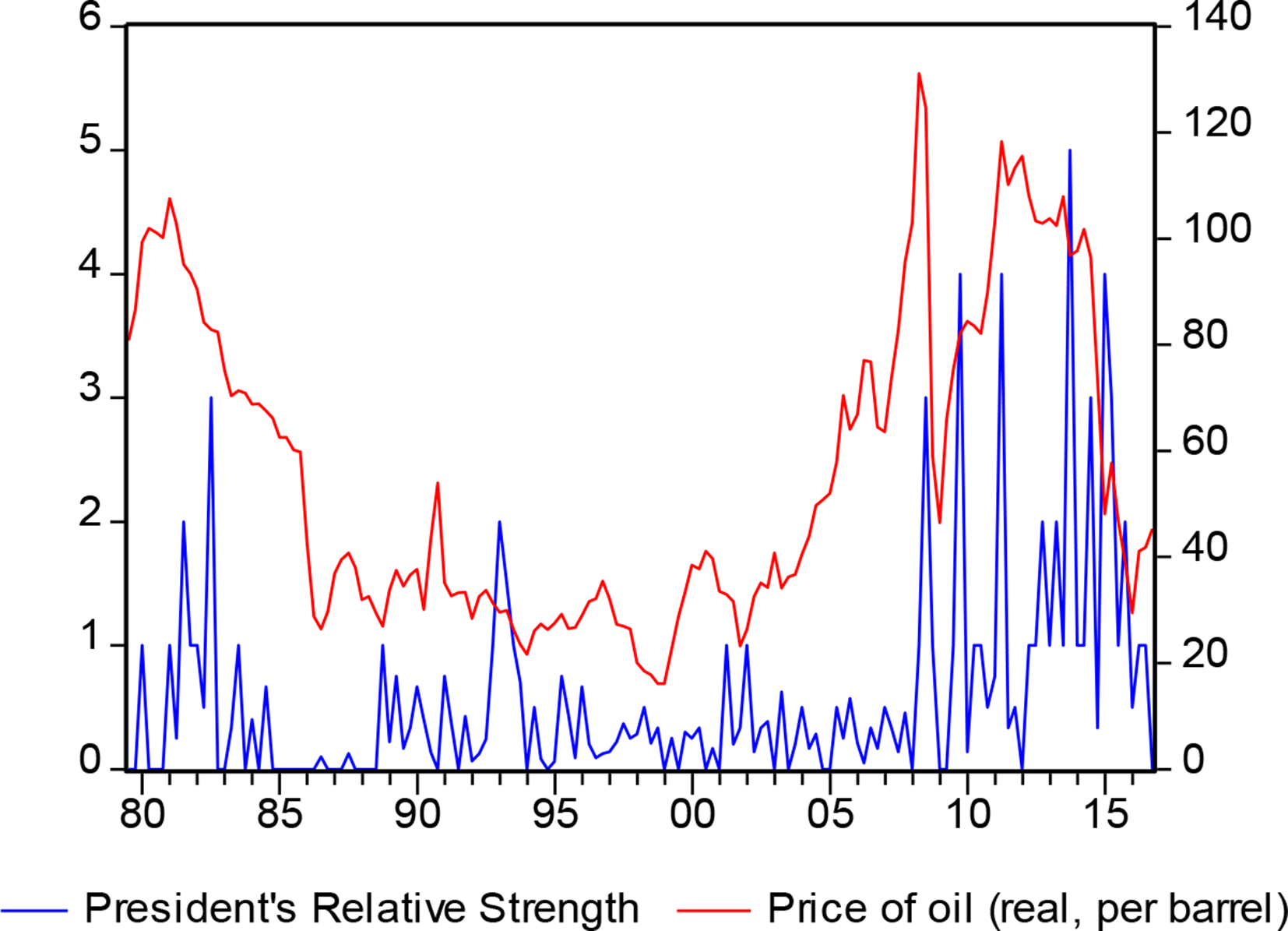
President-Led Policy Changes and the Price of Oil (Right Axis) Move Together.
I consider policy change as a variation in the status quo of a given policy domain that results from the approval of a new bill or from the reform of an existing one. Policy change in the long run refers to sustained inter-temporal behaviour of policy change (e.g. a pattern) as opposed to one-time changes, like the approval of a bill. Thus, the study of policy change in the long run explores the factors that make countries systematically more or less decisive, which would vary across time. Existing explanations cannot fully account for the inter-temporal variation that policy changes exhibit.
Latin America is a region where the volatility of commodities can affect the fiscal position of presidents and thus where we can test if periods of a resource bonanza are also connected with periods of political decisiveness. In fact, Ecuador’s ability to produce policy changes exhibit inter-temporal patterns that institutional and political variations alone cannot fully explain. This diagnosis is not entirely surprising, given that most of the existing explanations for president-led policy changes are static. The explicit inclusion of time, as a dimension along which policy change varies, brings two important elements overseen by most of the literature. First, it helps theorise and explain dynamic patterns of policy change, like cycles, trends, or breaks. 5 Second, the study of policy change in the long run can also shed light on the inter-temporal variation that existing explanations exhibit (e.g. coalition management during and after a resource bonanza). Thus, to understand presidents’ ability to produce policy changes and whether it varies following their fiscal conditions, we need to explicitly model policy change across time.
Oil Revenues and Policy Change
The effects of resource abundance on the policymaking process have been under-explored by the political resource curse literature, which has focused on other political outcomes, like the competition for power, democracy, or patronage (Ahmadov, 2013; Al-Ubaydli, 2012; Andersen and Ross, 2013; Dunning, 2008; Fails, 2020; Haber and Menaldo, 2011; Liou and Musgrave, 2013; Ross, 2001; Ulfelder, 2007). However, there are at least three arguments that link resource revenues and legislatures or policies. Acemoglu et al. (2013) proposes that revenues can buy support in congress for institutional changes that reduce the extent of checks and balances. Alternatively, rents from natural resources can promote policy instability by stimulating risk-taking (Doyle, 2014) and/or provide resources for politicians’ policy goals (Campello, 2015), especially in electoral years (Aaskoven, 2020). While these authors concur in that presidents can use rents from natural resources to move policies away from the status quo, they put forward different explanations for that outcome: executive–legislative co-operation, changing inter-temporal preferences, and extending financial constraints, respectively.
These authors propose different reasons that would link windfall revenues and policy change but do so without using the well-developed literature on policymaking in presidential regimes. Also, these works do not elaborate more on the potential mechanisms connecting resource revenues with policy changes. From the empirical side, this literature has not explicitly focused on variations of policy change or tested its relationship with revenues from natural resources. This article links this discussion with the existing literature on policymaking and provides an empirical strategy to test the effect of revenues of natural resources on policy change.
Oil Management and Policymaking in Ecuador
Ecuador is an oil-rich country with a presidential regime that for years was a case study of deadlock and executive–legislative conflict (Helmke, 2017; Mejía Acosta, 2009). Nevertheless, after 2006, the country experienced a wave of policy changes not seen before (Jones, 2017). Ecuador’s sustained period of policy lock-in and its transition to a decade of president-led policy changes constitutes a case that can help understand the factors that drive policy change in the long run. We know that in Ecuador, policy change was difficult to push through during the 1979–2006 period. Unstable institutions, formal and informal veto players, and political fragmentation embodied the problems for the lack of support required to push new policies (Mejía Acosta et al., 2008; Mejía Acosta, 2009). There were specific institutional and party-based features that were not conducive to political co-operation (Alberts, 2008; Basabe-Serrano et al., 2010, Conaghan, 2003). New institutional designs were ineffective as well. Ecuador’s 1998 constitution established stronger legislative prerogatives and agenda-setting powers for the president, and reduced the attributions that congresses had (e.g. provided fewer mechanisms to control the executive and cabinet members, and less budget influence). These changes reduced the availability of actions and incentives that could have facilitated agreements (Alberts, 2008; Pachano, 2010) and made legislative coalitions more unstable (Mejía Acosta and Polga-Hecimovich, 2011). Given the difficulties created by institutional and political conditions, Ecuadorian executives relied on ghost coalitions – informal, behind-the-scenes agreement – to obtain limited congressional support for specific reforms (Mejía Acosta, 2009).
But the policymaking process changed considerably after 2006. For example, former President Rafael Correa had close to a 100 per cent rate of success for bills presented to congress during the 2013–2017 legislature, a very high rate of bill approval compared with previous presidents, who on average saw less than half of their bills enacted (Aldaz, 2018). In contrast with previous presidents, who barely muddled through a few meaningful reforms in spite of pressing economic conditions, Correa led policy changes in the most relevant economic, political, and social domains (e.g. taxes, mining, electoral rules, decentralisation or freedom of speech, to name a few). Correa was highly influential in the legislative agenda and had a very disciplined party (Le Quang, 2016; Ramírez et al., 2013). However, Correa’s ability to produce reforms decayed; while his institutional strength remained intact and his party still held a qualified majority, he had to “withdraw” a bill to avoid a defeat and had another bill approved without the votes of 25 per cent of members of his party, before a decline in his overall legislative activity. 6 Nevertheless, despite the differences with the law-making process during the 1979–2006 period, little is known about the factors that drove this wave of policy changes. Part of the explanation has to do with the financial context in which presidents operate.
The management of oil revenues can strengthen the political position of the president. As an oil exporter, the country benefited from high oil prices during the 2000s, which were channelled – at a considerable extent – into government consumption (De la Torre et al., 2019). Additionally, Correa consolidated his control over oil revenues by strengthening the executive’s power throughout the budget cycle and facilitating a political use of these resources (Mejía Acosta and Albornoz, 2019). And while Correa’s ability to produce policy changes might not have been the outcome of high oil revenues alone (Sánchez and Polga-Hecimovich, 2019), it was a tool that the president had at hand. Understanding the Ecuadorian case – that is, the transition from deadlock to a wave of policy changes – can contribute to the comparative literature. This case helps test the factors that determine policy change in the long run, and it can also help elaborate how the policymaking process works in resource-rich countries.
Hypotheses
I propose that oil revenues affect presidents’ ability to produce policy changes. More specifically:
The effect of oil revenues on policy change could be contingent on existing budget rules, hence:
This would be the case because presidents are constrained to meet these targets and thus have less room to use fiscal resources for their political benefit. Moreover, a connection between oil revenues and president-led policy changes should be stronger during periods of more discretionary budget rules; thus:
To use the figure presented before, policy changes should be higher when presidents benefit from an inflow of resources and when they have control over their valve.
There are at least two potential reasons why a president with more fiscal resources could be more successful in congress. First, more fiscal resources can facilitate coalition management. The value of the offices part of the executive branch is likely to be higher when the president has access to more resources; similarly, the number of positions that the president can use to craft and manage coalitions can increase when presidents are less financially constrained. 7 As the number of offices and their budgets increase, presidents can accommodate coalition partners inside the executive branch. 8 Therefore, government spending could link oil revenues and legislative success. Another reason could be that oil revenues shaped presidents’ popularity, which, in turn, makes legislators more likely to support their policy agendas (Canes-Wrone and de Marchi, 2002; Lovett et al., 2015). 9 Thus, if oil revenues shaped presidents’ popularity, then this could be another reason for connecting oil revenues and policy change. This article also tests which of these potential mechanisms might be in operation.
Long-Run Drivers of Policy Change
The Dependent Variable
This article aims to identify the inter-temporal drivers of president-led policy changes. These are new bills or modifications to existing ones, initiated by the president. To capture these changes, this article considers the number of approved president-led changes per unit of time. I discuss alternative approaches below, before defining the dependent variable. One alternative route would be to estimate the probability of presidents’ legislative success. This approach would identify the factors that make bills more likely to be approved. Nevertheless, this strategy would not be able to capture dynamic effects derived from inter-temporal co-variation, like the existence of long-run patterns.
Another alternative would be to estimate determinants of legislative success rates (i.e. the number of approved president-led bills over the total number of bills, by sponsor). This approach has the advantage of taking into consideration the success of the president relative to her attempts to change policies. However, this approach has at least one shortcoming. Note that percentages are a stock – not a flux – variable, and stock variables are not always suitable for inter-temporal analysis; a study of success rates would consider presidential terms, but the information that it provides loses meaning as time units become smaller. 10 Nevertheless, a success rate does convey valuable information that the number of approved bills does not. It captures presidents’ ability to push changes relative to their overall legislative activity in each period. Hence, following “denominator” scholars (Binder, 2003; Calvo, 2007), there is a need to adjust the dependent variable and/or the estimations such that they more accurately capture the strength of the president relative to the overall legislative activity across time.
The operationalisation of president-led policy changes needs to consider the system’s overall effectiveness to approve bills. To do so, this article considers president-led changes relative to legislators’ ability to do so. This is done using the ratio of approved president-led bills with respect to approved legislator-led bills, per unit of time, as the dependent variable. I label this measure president’s relative strength (PRS); the strength of the president is measured in proportion to the system’s capability to approve bills. Given that legislatures cannot process and approve every proposal (Cox, 2008), the proportion of approved bills introduced is able to capture the president’s overall strength. This ratio shows the number of bills that the president was able to push through per approved legislator-led bill. 11 It could be argued that presidents can use urgency bills as an alternative route to get policy changes and therefore should not be considered. Presidents do have the power to introduce them, but these bills do not become law automatically (e.g. as the medidas provisórias in Brazil); congress has thirty days to modify and vote on the bill (and, possibly, block it); if not, the bill becomes law. Urgency bills are an agenda-setting tool and not a substitute for legislative support. Therefore, urgency bills should be part of the analysis. The estimations also use alternative measures of policy change to test the sensibility of the results. 12
Independent Variables
Oil Revenues
I define oil revenues here as the gross income generated by oil production and sales that belong to the state. 13 Oil revenues include oil exports, fuel sales made directly through the state-owned company, part of private firms’ production (via different contractual mechanisms), private firms’ use of the state-owned pipeline, and through direct and indirect taxes that firms in the industry pay. The Central Bank of Ecuador estimates the amount of oil revenues that the state receives as defined above. In principle, this estimate could be used to test H1, but it would be a mistake to do so. The reason is that the amount of oil revenues that the state receives depends on the state’s ability to capture rents; for example, contracts with private firms or taxes have varied across time due to changing legislation, which is the dependent variable that this article focuses on (e.g. the Hydrocarbons Bill and public finances laws have changed several times in the past decades). Thus, oil revenues is an endogenous variable and should not be used if we want to derive causal claims. 14
The best proxy for oil revenues is the price of oil. There are at least three reasons why. First, note that oil revenues depend on the quantity of oil produced and on its price. Price fluctuations would be expected to explain most of the variation of oil revenues given that oil production cannot increase or decrease overnight. Furthermore, Supplemental Appendix 3 shows that the correlation co-efficient between the price of oil and oil revenues from 1998 (when the data on oil revenues are available) and 2016 is 0.88. Thus, the price of oil is a very strong predictor of oil revenues. Additionally, the information for oil revenues is available from 1998 onward and thus cannot be used to produce reliable results. The third – and most important – reason is that since oil prices are determined in the world market, where Ecuador is not an influential player, they are exogenous to the system, which makes it suitable for the identification strategy. It could be argued that the share of oil revenues with respect to GDP captures the relative importance of this sector with respect to the overall economy and should be used as a right-hand variable; while this is true, its numerator is still endogenous to the system as discussed above. Furthermore, the correlation co-efficient between the share of oil revenues to GDP and the price of oil is 0.92 (Supplemental Appendix 3). Thus, the price of oil exhibits virtually the same inter-temporal variation as other potential explanatory variables but has the advantage of being exogenous. Given the high correlation between the price of oil and Ecuador’s oil revenues, this article uses both terms interchangeably.
Fiscal Rules
I will test if PRS exhibits structural breaks during periods with different sets of fiscal rules. Ecuador has had three sets of fiscal rules in place between 1979 and 2016. The first set refers to no explicit fiscal rules. That is, from 1979 through 2002, the formulation, approval, and implementation of the budget had to follow a given set of procedures but did not have explicit macroeconomic targets or rules for expenditures, levels, or growth rates for the fiscal deficit or for any other budget component. The second set of rules contained specific targets on the growth of current spending, the size of the deficit, and the extent of external debt that budgets could incur on; this set of rules was present during the 2003–2007 period. This period will be captured by fiscal rules1, a dummy variable that takes a value of one when these rules were in place and zero otherwise. The third set of fiscal rules got rid of explicit fiscal targets and re-defined revenues and expenditures to implement new rules. Specifically, this last set of rules defined revenues and expenditures as permanent and non-permanent, so that non-permanent revenues should finance non-permanent expenditures only. In practice, these rules allowed more executive discretion because the Ministry of Finance – appointed by the President – had the power to classify budget lines as permanent or non-permanent. These rules have been in place from 2008 and, throughout the rest of the sample, fiscal rules2 captures this period; it is a dummy variable that takes a value of one when these rules were in place and zero otherwise.
Controls
Following the literature reviewed above, the estimations that this article presents include several variables that aim to control for other potential determinants of policy change. The estimations control for different legislative prerogatives and processes – usually defined at a constitutional level. Thus, the first set of controls would aim to capture if policy changes exhibit structural breaks during Ecuador’s 1998–2007 and 2008–2016 constitutional periods (compared to the omitted period, 1979–1997). A new constitution could affect not just the law-making process, but also other domains where the executive and congress interact. Specifically, a new constitution can change the budget process and the appointment of regulatory and control agencies, two areas that can be connected with the management of legislative coalitions. 15 To partially overcome the problem of simultaneous (and potential counterweighting) effects, the estimations will control for the budgetary powers of the executive as defined above for fiscal rules. This variable contains a different source of inter-temporal variation, compared with the 2008 constitution variable. The estimations will also control for the size of the ruling party, which could arguably affect presidential success. In Ecuador, only two periods exhibit a dominant party within the 1979–2016 range; the first one corresponds to the 2008 Constitutive Assembly and the 2008–2009 Legislative and Auditing Committee, 16 and the second period corresponds to the 2013–2017 legislature. The estimations also control for legislative terms when the president’s party had the largest plurality. 17
The vector of controls includes other political and economic variables. One set of variables aims to control for the system’s overall ability to lead to policy changes by including the volume of bills sent to congress (by sponsor) and the volume of approved bills (by sponsor); it could be argued that more policy change is the result of more legislative activity and/or control of the agenda. Part of the literature would suggest that policy lock-in/change is a function of the ideological distance between the president and key veto players, which would vary across legislative periods. Thus, the estimations also control for presidential and legislative-specific effects; the estimations include variables for each presidential and legislative period since 1979. Note that if legislative success is the result of Correa-specific factors (or if lack of success is explained by president-specific reasons), then presidential controls would capture them. Another set of variables aims to capture elements of the political context, like honeymoon or lame-duck effects. Other controls include the rate of growth of the economy and of government consumption; the specifications use yearly and quarterly rates of change of these variables. Lastly, the estimations include if the increase of production due to a new pipeline affects the results. 18 Supplemental Appendix 4 presents data sources.
The Model
Preliminary Considerations
Time-series usually has specific properties that need to be addressed before making estimations and interpretations. Series might exhibit unit roots, which could make Ordinary Least Squares estimates biased, but which would make them inefficient. Second, the model should account for potential past effects feeding into the system. Lastly, the variables of interest could exhibit different dynamic relations. To account for these potential problems, the estimation strategy will consider if the series are integrated, the order of integration, model explicitly auto-regression, and test for short and long-run relations.
Testing and addressing unit roots are important steps because the estimation strategy and model specification depend on the dynamic nature of the data. I test if the series are integrated and their order of integration, following standard procedures (Box-Steffensmeier et al., 2014; Greene, 2007). 19 The results show that PRS and the price of oil have an I(1) process; Supplemental Appendix 5 shows the results of these tests for the variables of interest and for the statistically significant controls.
Model Specification
The fact that some of the variables of interest have an I(1) process has implications for the estimation strategy. First, since these variables have the same order of integration and because it is of interest to identify their dynamic connections, the estimation strategy should test if both variables are co-integrated and the co-integrating vector. If two variables are co-integrated, it means that they have a systematic equilibrium relation across time (i.e. they share common trends). The other parts of the estimations should test the existence of short-run dynamics between these variables and whether the series exhibit structural breaks.
I use a vector error-correction model (VECM) to estimate the inter-temporal dynamics of the variables. The VECM provides at least two benefits compared with other approaches. The VECM estimates the co-integrating equation and a vector auto-regressive (VAR) process simultaneously. Also, the VECM automatically normalises the co-integrating equation that enters the VAR. 20 Taken together, this approach leads to a more accurate estimation of the co-efficients in the co-integrating equation, a more efficient estimation of the VAR, and an easier interpretation of the co-integrating equation. Supplemental Appendix 6 presents the model specification.
One of the methodological benefits that time-series provides is that it exploits inter-temporal variance to explain the evolution of the dependent variable. The most adequate unit of time for the analysis depends on the type of dynamic relationship that is under study and on data availability. In general, there are asymptotic gains from using smaller time units, making the use of smaller time units desirable. However, given that not all the information is available at the same level, the estimations will use quarterly data.
The Co-efficients of Interest
There are three types of co-efficients of interest to test H1 (see Supplemental Appendix 6). The first one is
For H2, the co-efficients of interest are
Results
This section presents the outcomes of the estimations. First, it shows the results for H1 and H2; the results for H3 exhibit mixed evidence and are presented in Supplemental Appendix 7. Then I test for potential channels of transmission between the variables of interest. Finally I discuss the results, including the outcomes of endogeneity and robustness tests.
Oil Revenues and Fiscal Rules (H1 and H2)
The results show that the price of oil and PRS have common long-run trends;
The Price of Oil and President-Led Policy Changes Are Co-Integrated.
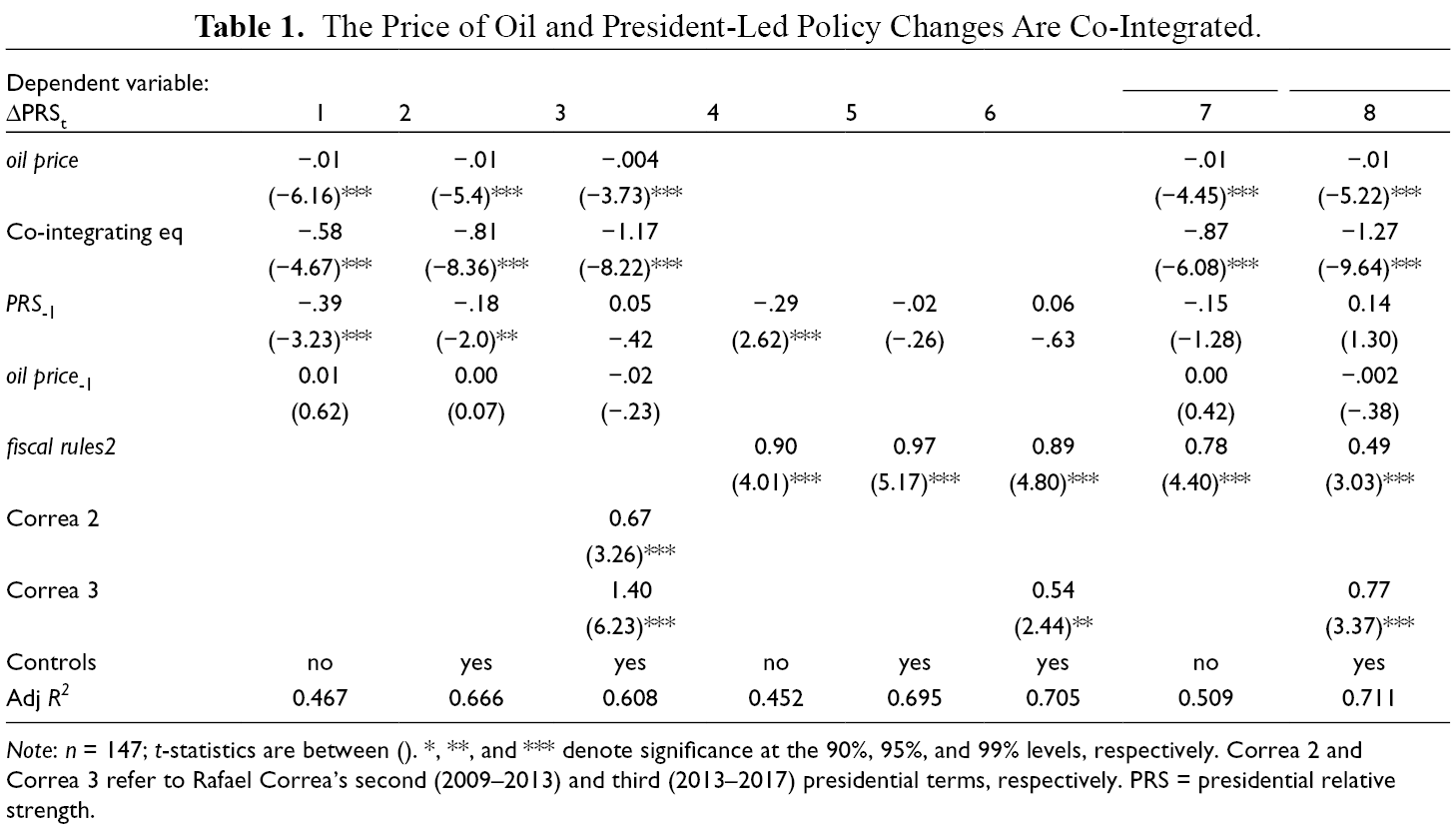
Note: n = 147; t-statistics are between (). *, **, and *** denote significance at the 90%, 95%, and 99% levels, respectively. Correa 2 and Correa 3 refer to Rafael Correa’s second (2009–2013) and third (2013–2017) presidential terms, respectively. PRS = presidential relative strength.
The inclusion of controls did not change the overall results (model 2). 23 With the inclusion of the controls, the size of the co-efficient for the price of oil decreased, but the magnitude of the co-efficient for the co-integrating equation increased; both co-efficients remained statistically significant, so the net effect barely changed. The explicit controls for Correa’s presidential terms show that his second and third periods in office exhibit more president-led policy changes compared to other presidential terms, at least on some specifications; their inclusion also reduces the magnitude of the long-run connection of the variables of interest (model 3). But even with the inclusion of Correa-specific controls, the co-efficients for oil revenues remain significant at the 99 per cent level. Therefore, a second important conclusion is that the long-run connection between the variables of interest is not driven by specific presidential or legislative terms.
The basic results for H2 shows that the period with more permissive fiscal rules (fiscal rules2) exhibits a higher extent of PRS (i.e. the data have a structural break during this period). The test for a break of PRS when presidents did not have specific fiscal targets and rules, fiscal rules1, does not show statistically significant results. 24 The inclusion of controls does not change these results (model 5). But the inclusion of Correa-specific effects does reduce the size of the co-efficient in approximately 10 per cent (model 6). This suggests that part of the effect of fiscal rules can be associated with Correa-specific factors.
Channels of Transmission
There is strong evidence that supports the hypothesis that oil revenues and PRS move together in the long run, but it is not clear what the channel of transmission is. This subsection tests the three possible channels presented in the Hypotheses section (pg 8). The next lines show the results that test these channels of transmission. 25
The inclusion of presidential approval does reduce the size of the co-efficient for the price of oil, but it remains significant. Importantly though, presidential approval is a not a significant determinant of PRS (model 1, see Table 2 for the results). Similarly, partial and total vetoes are not significant (models 2 and 3). Thus, there is no evidence that would support that presidential approval or veto usage are part of the channel of transmission between oil revenues and PRS.
Government Consumption Is Part of the Channel of Transmission.
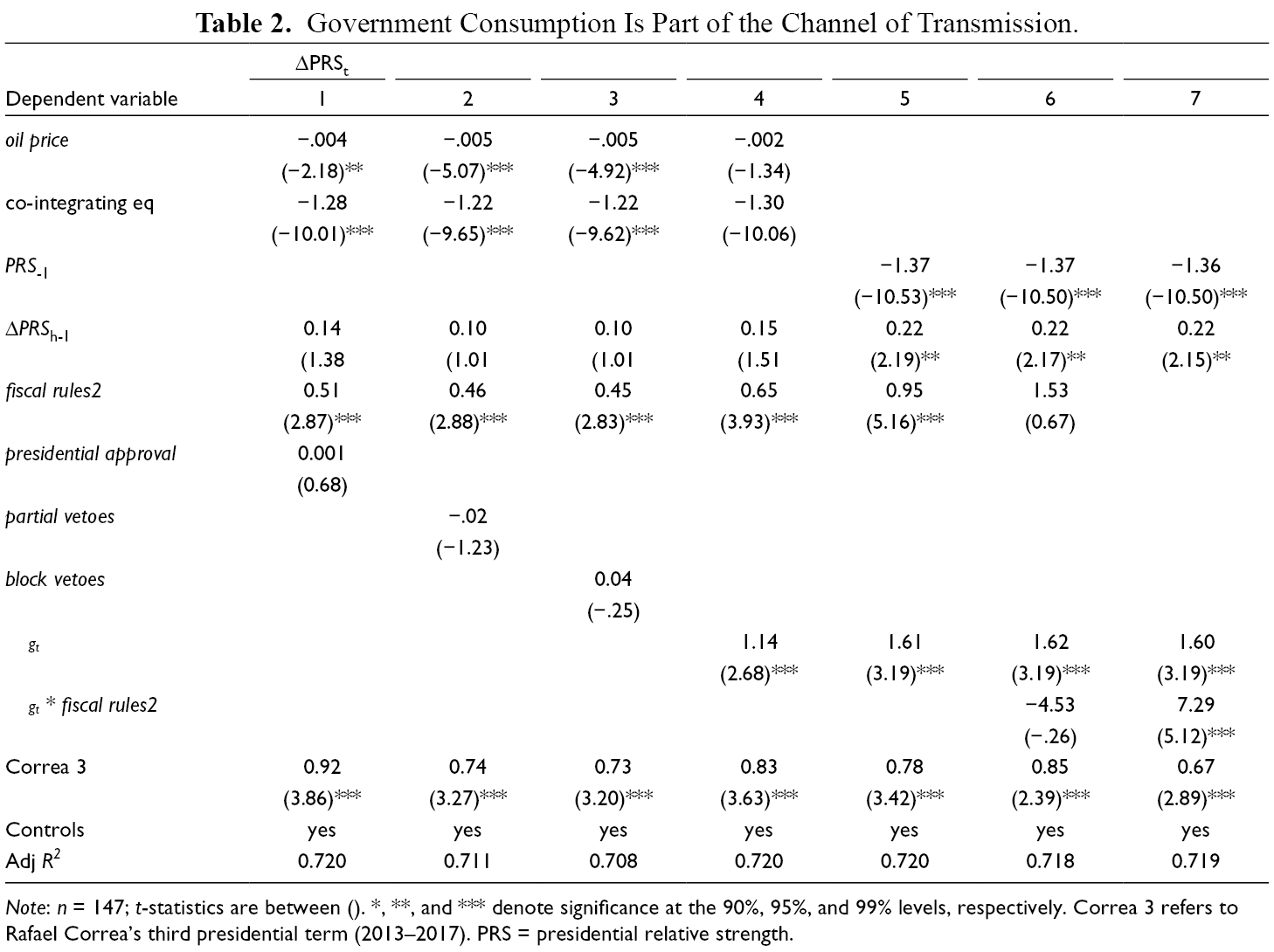
Note: n = 147; t-statistics are between (). *, **, and *** denote significance at the 90%, 95%, and 99% levels, respectively. Correa 3 refers to Rafael Correa’s third presidential term (2013–2017). PRS = presidential relative strength.
The inclusion of government consumption as a share of GDP (
Discussion
The results presented here show that the fiscal context in which presidents operate matters for their legislative success. There are at least two reasons to support this proposition and come from testing H1 and H2. One way to see these results is that presidents’ ability to push policy changes depends on the inflow of resources (oil revenues) and on the valve that controls this inflow (fiscal rules). There is a systematic long-run effect of oil revenues on policy change, connected in the short run via government spending. It could be argued that PRS should differentiate regular from urgency bills. The latter allow the president to put specific economic reforms on top of the debate and give congress a specific amount of time for discussion and approval. Importantly though, presidents still need support to pass urgency bills. Thus, urgency bills are another agenda-setting tool that presidents have in order to push their agenda, but these are not a substitute of congressional support. Supplemental Appendix 9 shows that the exclusion of urgency bills barely alters the information contained in PRS, while Supplemental Appendix 10 shows that excluding urgency bills from the dependent variable does not change the results.
Fiscal rules are also consequential. Rules without specific fiscal targets lead to higher levels of PRS compared with periods of specific fiscal targets (H2). Fiscal rules lead to structural breaks on the series of policy changes but do not affect the trend. I treated fiscal rules as one factor, but they constitute a set of definitions and procedures. It is impossible to disentangle which of these elements drives the relationship; the reason is that none of these elements has an independent source of variation to leverage on for alternative estimations. There is weak evidence supporting a joint effect of fiscal rules and oil revenues (H3). Note that the results for H1 and H2 are independent from each other, robust to the inclusion of several controls, potential endogeneity (Supplemental Appendix 11), robustness checks, and alternative operationalisations of the dependent variable (Supplemental Appendix 12).
Importantly, PRS was high during Correa’s third presidential term, beyond what the main independent variables can explain. Moreover, one of the reasons there is mixed evidence for H3 is a co-linearity problem between oil revenues, fiscal rules, and Correa’s third presidential term. Thus, while the control for unified government is not significant, this period (2013–2017) appears to be different. One hypothesis could be that Correa and his party went through a learning process that helped them push legislation more effectively. Alternatively, Correa acquired or used other tools during this period that are not well-captured by the models presented above. Also, given the type of co-variation between some variables, time-series might not be able to adequately explain one specific presidential term. Thus, there is need for further research during this period to study if and how these factors interacted to make Correa more successful.
Conclusions
Standard approaches in the literature on policymaking in presidential regimes suggest that institutional and political variables explain presidents’ ability to produce policy changes. This article shows that in Ecuador, oil revenues can explain the existence of long-run patterns of policy lock-in and the country’s wave of policy changes seen during part of the 2010s. These results contribute to two research agendas that have not been explicitly connected before – the politics of policymaking and the political effects of natural resource abundance – but that, combined, can provide insights to understand the policymaking process in resource-rich countries, especially in Latin America. The theoretical proposition that windfall revenues could increase legislative support (Acemoglu et al., 2013) finds empirical support; to the best of my knowledge, this article provides its first empirical test. Moreover, I put this proposition and discussion within the policymaking literature to facilitate its analysis and dialogue with existing debates on this topic. Ultimately, the commodity boom not only financed policy reforms (Campello, 2015), but it also made these reforms politically feasible.
I find that in Ecuador, oil revenues shape the fiscal context in which presidents produce policy changes. Moreover, varying oil revenues led to policy change and lock-in patterns across three decades. This argument has two parts that correspond to two results that emerge from the empirical analysis. The first one is that the price of oil and PRS share a similar and stable long-run trajectory, but do not move together in the short run. Additionally, government spending is one transmission channel that connects oil revenues with policy change. These findings are robust to different specifications, tests, and controls. Hence, while trends in the price of oil create different fiscal conditions for presidents’ legislative strategies, it is government spending that translates fiscal contexts into support for policy changes in the short run. Lastly, periods with more discretionary rules (i.e. when budgets do not need to meet explicit fiscal targets) lead to higher levels of PRS compared with periods when budgetary rules establish explicit fiscal targets.
In a comparative perspective, one contribution that this article makes is that Presidents’ budgetary powers can be highly influential in the policymaking process in resource-rich countries. This statement comes from two premises. First, if we use budgetary powers not just as presidents’ discretion over public resources but as access to unexpected revenues as well, we could incorporate the fiscal context in which presidents operate into the analysis of the policymaking process. Second, presidents’ ability to channel windfall revenues into actual spending would likely affect if and how these resources shape their policy agenda. These propositions, derived from the case studied here, can serve as a framework to analyse the policymaking process in other resource-rich countries, a next step for further research.
Another contribution that this article makes is the analysis of policymaking in the long run. This article focuses on the inter-temporal variation of policy change to provide insights on their dynamic properties, not explicitly addressed before. The existing literature on policymaking in Latin America stresses the role that preferences and institutions have on presidents’ ability to approve bills. The problem is that political and institutional factors, like preferences or legislative prerogatives, exhibit little variation over time so they cannot fully account for inter-temporal patterns of policy changes. The explicit consideration of policymaking as a time-changing process that can have dynamic features (e.g. cycles, trends or breaks) opens the scope for other potential explanatory factors.
The focus of this article is an arena that the literature on the political resource curse has not fully addressed. The literature on the political effects of oil or mineral abundance has focused mainly on the political conflict that they generate, for example, on the competition to obtain or secure power. It is true that obtaining power can be the big prize in many contexts, which is a reasonable motivation to study these outcomes. However, in other contexts, the policymaking process is a political arena that can greatly influence the distribution of power and resources; it is also a space where revenues from natural resources can induce co-operation. Rulers of resource-rich countries might find it easier, and/or more consistent with existing institutions and practices, to use revenues from natural resources to craft support for their policy agendas. Thus, the policymaking process is another mechanism through which natural resource abundance affects political outcomes and processes, but via co-operation instead of conflict.
The findings that this article presents can have pessimistic implications for Ecuador’s governance. It appears that the country’s political system is conducive to agreements only when it benefits from windfall revenues. This result and its interpretations suggest that as the price of oil returns to its long-run average, political agreements would become scarcer and the country would likely experience difficult executive–legislative relations again. Beyond Ecuador, this article poses questions on the sustainability of political co-operation. Existing scholars argue that part of the region’s political stability seen during the 2000s was the result of a commodity boom that made fiscal expansion feasible. But this article shows that the commodity boom also supported political co-operation; as the boom faded away, fiscal space is smaller, and political co-operation and policy change have proven more difficult to achieve.
Supplemental Material
Supplementary Material 1 - Supplemental material for Oiling Congress: Windfall Revenues, Institutions, and Policy Change in the Long Run
Supplemental material, Supplementary Material 1, for Oiling Congress: Windfall Revenues, Institutions, and Policy Change in the Long Run by and Raúl Aldaz Peña in Journal of Politics in Latin America
Footnotes
Acknowledgements
I would like to thank Kathryn Hochstetler, Peter Kingstone, Andrés Mejía Acosta, Timothy Power, Michael Ross, participants of APSA 2018, Alacip 2017, two anonymous reviewers and the editors for their comments and suggestions, which helped me improve my argument. All remaining mistakes are my own.
Declaration of Conflicting Interests
The author(s) declared no potential conflicts of interest with respect to the research, authorship, and/or publication of this article.
Funding
The author(s) disclosed receipt of the following financial support for the research, authorship, and/or publication of this article: The author acknowledges financial support from the National Secretariat of Higher Education, Science and Technology of Ecuador.
Supplemental Material
Supplemental material for this article is available online.
Notes
Author Biography
Email:
References
Supplementary Material
Please find the following supplemental material available below.
For Open Access articles published under a Creative Commons License, all supplemental material carries the same license as the article it is associated with.
For non-Open Access articles published, all supplemental material carries a non-exclusive license, and permission requests for re-use of supplemental material or any part of supplemental material shall be sent directly to the copyright owner as specified in the copyright notice associated with the article.
