




Abstract
On July 2017, Brazil’s Senate approved the country’s most extensive labor reform since the emergent 1943’s Consolidation of Labor Law (Consolidação das Leis Trabalhistas, CLT). The aforementioned reform provoked heated debates and its approval faced resistance. Unions, for instance, convened two general strikes: the first, on April 2017, garnered a significant amount of participation, while the latter, on June, ended with participation falling significantly below expectations. Despite the widespread rejection of Temer’s mandate and the content of the law, on June, unions were surprisingly unable to agree on a common strategy regarding a proposal on labor reform. The present research aims to explore this paradox. A survey-based analysis, along with a series of unstructured interviews with union leaders and protesters, establishes a solid empirical base from which to draw hypotheses about the Brazilian state corporatist union model and its evolution.
Introduction
Sanctioned by President of Brazil, Michel Temer, in July 2017, the Law no. 13,467 alters more than a hundred clauses in the Consolidation of Labor Law (CLT). 1 The labor reform provides a legal environment that reappraises collective negotiation (i.e. Articles 444and 510-A), deregulates the labor market (i.e. Articles 443 and 614), and modifies the trade union funding system (i.e. Articles 545 and 883), thus representing a significant and substantial novelty in the Brazilian labor relations system.
The 1943 model has a significant influence on the current Brazilian system of industrial relations (Boito, 1991; Cardoso, 2010). In 1943, Getúlio Vargas’s primary objective in establishing the CLT under the Estado Novo was government control. Thereafter, similar to the state corporatism model of industrial relations (Cook, 2007), Brazilian legislations allowed a significant degree of state oversight and intervention (e.g. the compulsory ministry certification at the National Registry of Trade Unions [Cadastro Nacional de Entidades Sindicais, CNES]). Moreover, until 2017, the government provided for direct subsidies to sindicatos through a variety of mechanisms, such as union dues (the so-called imposto sindical). 2 Because of the imposto, Brazilian federal government subsidised sindicatos through the mandatory deduction of one day of work per year for all workers, regardless of union membership. The principle of unicidade (the single-trade union rule and compulsory representation), the professional sindicato per category and geographic zone, in addition to the union dues, have established the basis of the Brazilian state corporatism model over the years (Costa, 1986).
Brazil has never signed the eighty-seventh International Labor Organization convention about Freedom of Association and Protection of the Right to Organize Convention. Due to the unicidade, competition among labor organisations – as well as the entry of new groups – is drastically limited (Cook, 2007: 18). Definitively, incentives for mobilisation are generally scarce in the state corporatist system, and so too in the Brazilian case (Mattos, 2009: 117–126). In fact, general strikes are quite rare in Brazil. Apart from the general strike of 1917, such a form of union mobilisation regained relevance only in the 1980s.
Worker dissatisfaction in Brazil in the 1960s and 1970s led to an increasing number of protests during the military regime (Almeida, 1975), thus forming the left-oriented Workers’ Party (Partido dos Trabalhadores, PT) in 1979 and the Unified Workers’ Central (Central Única dos Trabalhadores, CUT) in 1983. The most important general strikes occurred in the 1980s as protest against the military regime: on 21 July 1983, the general strike was attended by more than two million workers; on 12 December 1986, approximately twenty-five million people joined the strike movement, representing more than 40 per cent of labor force (this general strike was centred on economic demands, such as the non-payment of external debt and the public policy of privatisations); on 14 and 15 March 1989, the new general strike mobilised approximately thirty-five million workers (i.e. 70 per cent of the economically active population). Despite their success in the 1980s, the number of strikes was dropped by half during the 1990s and demands became fundamentally defensive (Boito et al., 2015). However, the last few years mark a progressive escalation in both conflict and the number of strikes, culminating in a new cycle of union protests against Michel Temer’s labor reform (DIEESE, 2015; Marcelino, 2017).
This research discusses, in particular, the two general strikes of 2017 and attempts to respond a paradox within the Brazilian union movement. Since the impeachment of president Dilma in August 2016, and throughout 2017, the Brazilian trade union movement has organised several protests and two general strikes: the first, which occurred on April 2017, was a complete success, with significant participation; however, the second, on June 2017, resulted in a glaring failure. Considered the success of the first general strike in April, the increasing corruption scandals involving ministers within the Temer government and its party (PMDB, Partido do Movimento Democrático Brasileiro), the content of the labor reform (Krein, 2018), the second general strike on June 2017 was supposed to be a success. Once again, divisions among trade unions prevailed over unitary mobilisation strategies and the divided trade unions failed to mobilise a significant number of workers. Law No. 13,467 was therefore approved, as predicted. In contrast, divisions among reform’s detractors were less predictable.
A mixed qualitative–quantitative approach was used to explain this paradox: a reduced sample of semi-structured interviews collected on April and June 2017 and a survey-based analysis (April 2017). A multiple correspondence analysis (MCA) technique has been used for the analysis of the survey data set. Moreover, the survey is used to provide an overview of the general strike and some aspects of political opinion, especially with regard to assessing the Temer government and its policy.
First, this article presents a brief introduction of the Temer government’s labor reform; second, the research addresses the debate on general strikes by means of a comprehensive sampling and series of unstructured interviews. Attitudes towards trade unions and labor reform, mechanisms of mobilisation and its efficiency are analysed. The use of mixed strategies allows survey research to overcome some of their limitations by incorporating the advantages of qualitative approaches. For example, the interviewer interacts directly with the respondent, which produces more in-depth results from the survey analysis. Finally, the conclusion discusses various perspectives and perils with regard to Brazilian trade unionism.
Labor Reform and Politics
The entire process for the approval of law 13,467 was extremely quick and has never been discussed with trade unions or institutional actors, such as the Fórum Nacional do Trabalho (National Employment Forum). 3 Labor reform arose from a right-wing political milieu: those parties that voted the impeachment of Dilma in 2016 (the base of the Temer government), the main employers’ associations (National Confederation of Industry [CNI], National Confederation of Transport [CNT], etc.) and liberal-inspired political groups Free Brazil Movement (MBL, Portuguese: Movimento Brasil Livre, Vem pra rua, among others) – in other words, those political groups that organised the protests against PT and Dilma in favour of the impeachment (Chequer and Butterfield, 2016).
Employers’ associations were very important in shaping the reform: at least one-third of the approved amendments were decided by lobbyists from the main Brazilian employers’ associations. Intercept Brazil (Magalhães et al., 2017) examined 850 amendments tabled by 82 deputies during the discussion of the bill in the special commission on labor reform and discovered that 292 (34.3 per cent) of them were fully written on computers belonging to representatives of the CNT, the National Confederation of Financial Institutions, the CNI, and the National Association of Freight Transport and Logistics (NTC & Logistics).
Rights ensured to workers by the Brazilian Constitution, such as the minimum wage, Christmas bonus salary, remunerated weekly rest and annual vacation, have been preserved, although the set of legislative devices introduced by the Reform weighs in favour of employers’ associations rather than workers. The labor reform introduces the main legal instruments of labor flexibility: amendments, which include the permission to hire freelance workers (i.e. the creation of the so-called intermittent work; Articles 442–443), the introduction of remote work (Article 75-A), reform of the legislative provisions pertaining to part-time work (Article 58-A), flexibility of holidays (Article 134), higher flexibility in labor relations at the firm level (Article 444), and dismissal (Article 477). 4
The reform altered the system of collective negotiation and established the prevalence of negotiated terms over the labor legislation. Law 13,467 grants more autonomy to employees in negotiations with employers and more importance to the union-negotiated collective conventions and bargaining agreements, which prevail over the law when regulating working hours, work breaks, careers and salary plans, incentive awards and profit sharing, among others (Article 611-A).
An issue that has created visible friction – and divisions – among trade unions concerns the reform of the union funding system. In fact, labor reform removed the main funding instrument of trade unions, the so-called imposto sindical. The payment of union dues by the employees, currently compulsory and deducted from salaries, shall become optional (Article 579).
In addition, the reform introduced a set of dubious legal defects, spurring doubts about its constitutionality among part of the judiciary. The first concrete demonstration of the legal impasse occurred in Brasilia, on 9 and 10 October 2017 at the second Conference on Material and Procedural Labor Law, promoted by the National Association of Magistrates of Justice of Work (Anamatra). A total of 600 members, including judges, prosecutors and labor auditors, as well as lawyers and other legal professionals, divided into eight thematic committees, discussed more than 300 enunciados (proposals for statements) on the law and approved 125, all in contrast to the auspices of the Reform. 5 In all probability, the Law 13,467 will require careful interpretation of Labor magistrates, in the light of the Federal Brazilian Constitution and international conventions and treaties. This is a delicate issue; one of the approved enunciados rejects the idea that judges should only observe the literality of the law without interpreting it, compromising the free conviction motivated by each Labor Judge, who is responsible for assessing any disputes impartially and is technically apt to interpret the concrete will of the law, in the light of constitutional legal bases.
According to Law 13,467/2017, Articles 8º, §3º, in the examination of collective conventions and collective bargaining agreements, Brazilian Labor Courts will be subjected to the principle of minimum intervention and, indeed, that is, will be solely entitled to verify compliance with the essential labor rights. Other “enunciados” contrast the intermittent day and 12 × 36 work cycle (rejecting the possibility of formalising the 12 × 36 cycle by individual agreement, according to Article 7, of the Federal Constitution), along with the “legal fees” for the employee and outsourcing (in the field of outsourcing, several theses were approved, such as the enunciado against outsourcing in direct and indirect public administration) (Krein, 2018: 88–89).
Moreover, since the approval of Law No. 13,467, the number of Ações Diretas de Inconstitucionalidade (direct actions of unconstitutionality) has multiplied, representing a signal of the law’s unconstitutionality, and a general legal uncertainty. Later, the Supreme Federal Court responded to numerous Ações Diretas de Inconstitucionalidade, mainly driven by labor justice. For this, the provisional measure (“medida provisória”) 808/2017 instituted by Temer’s government tried to anticipate and resolve doubts related to labor justice, particularly those regarding intermittent work, the duration of the working day, and the remuneration of extraordinary service. To come into effect, the “medida provisória” 808 had to be approved, but it was not. Furthermore, it is important to consider that at the present moment, there is no rule for the intermittent worker (with regard to sick pay, maternity wage, retirement contribution time, etc.).
Descriptive Statistics and Data Analysis
These provisions have sparked a heated debate among trade unions, with obvious repercussions in terms of political mobilisation. To better understand the protests and general strikes, a survey-based analysis by CUT/IPESA (2017) was conducted in April 2017 and included 1,503 randomly selected respondents. The survey was limited to Rio Grande do Sul, the southernmost state of Brazil, and to a constituency of workers, jobless people and retirees. 6 The IPESA’s main results can be summarised as follows: (1) 62 per cent of respondents declared themselves to be “against” the proposed labor reform; (2) 60 per cent reported being “in favour” of the general strike of April; (3) 72 per cent were “in favour” of the protests against the Temer government. Broadly, there was widespread opposition to the Temer government and an unexpected demonstration of support on behalf of protest movements. On the other hand: (1) one of three interviewees ignored the activity of the CUT (“I don’t know” [the CUT]); (2) on a scale from 0 to 10, the average score for the referred trust in trade unions is rather low, at 4.2; (3) on the same scale, the average for CUT is even lower than the overall average, at 3.9. 7
A more in-depth analysis of part of the sample explains some additional details that were not highlighted in the global descriptive analysis. First, strike support is inter-classist: there are no significant differences between workers and employees (the χ 2 test is not significant; Table 1).
General strike and occupational status.a
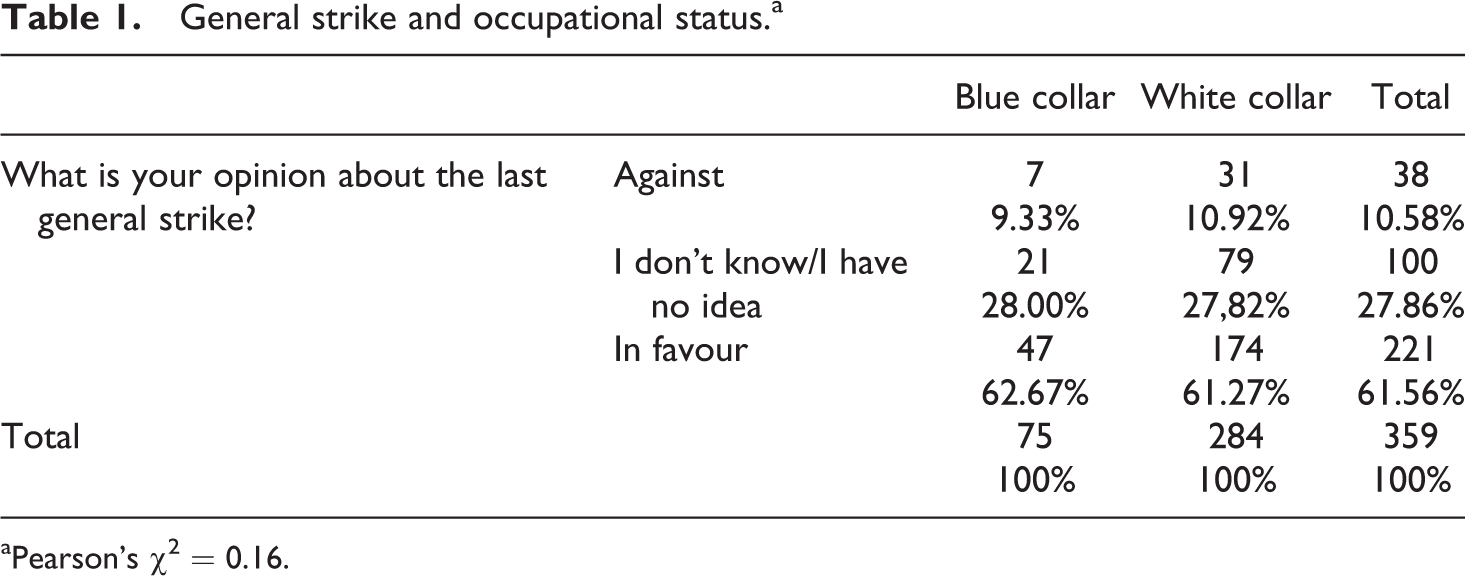
aPearson’s χ 2 = 0.16.
Nevertheless, to get a better data overview, instead of a set of bivariate analysis, variables and their characters were subjected to an MCA. The MCA allows for a multivariate analysis and explores possible relationships among categorical variables (Benzécri, 1973; Greenacre, 2007). MCA is based on distance between both individuals and all levels of all characters, in two respective representation spaces, so that the closer the items are, the more similar they are. The planes are sought in order to maximise the represented distance in a reduced dimensional space. Thus, MCA is merely exploratory; that is, it shows possible relationships between characters without establishing cause and effect among variables. Thereafter, a reduced sample was submitted to MCA, considering eight active variables and three illustrative variables.
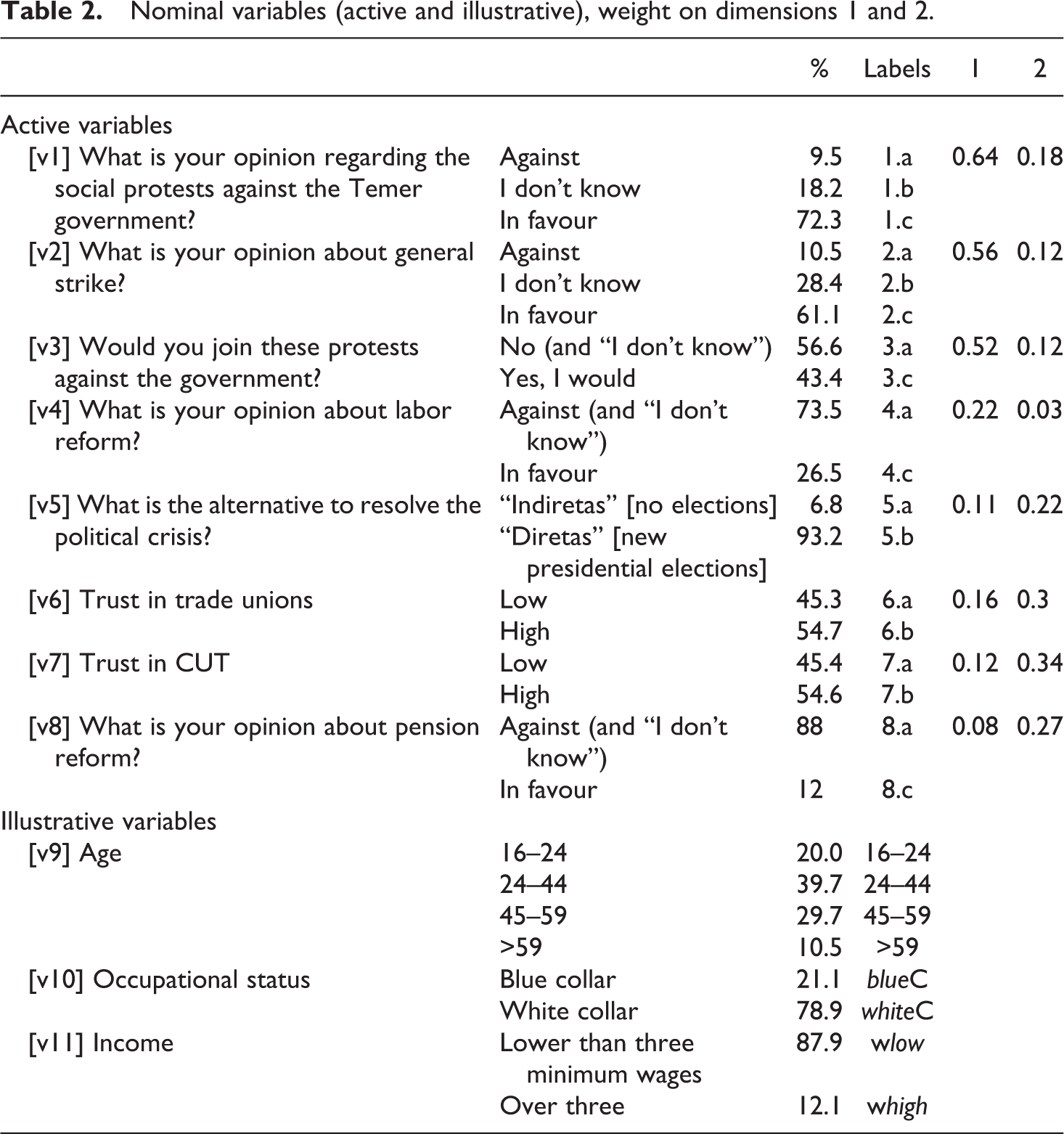
The total inertia explained by these two factors is equal to 50.8 per cent, that is, the first factor explains 30.6 per cent and the second explains 20.2 per cent. Only the first two factors of MCA were considered because the others were too small to warrant consideration. Characters are represented according to their correlation ratio with the first two factors (the last two columns of Table 2). Variables 1, 2, and 3 are correlated with the first factor. The second factor is related to all the items, although a little more to “trust in CUT.” Age, Occupational status, and Income are considered illustrative and do not condition the two factors. 8
Nominal variables (active and illustrative), weight on dimensions 1 and 2.
Two nominal categories that are closely positioned in the factorial space (Figure 1) indicate they are associated and covariate likewise in relation to the other nominal categories; for example, “white collar” and “blue collar”, the cohorts of age “16–24” and “45–59”, “high salaries” (code whigh), and lower (wlow), all these illustrative nominal categories are grouped at the centre of the factorial space. Put another way, the strike is an inter-class event and involves all cohort ages with the exception of the older ones.
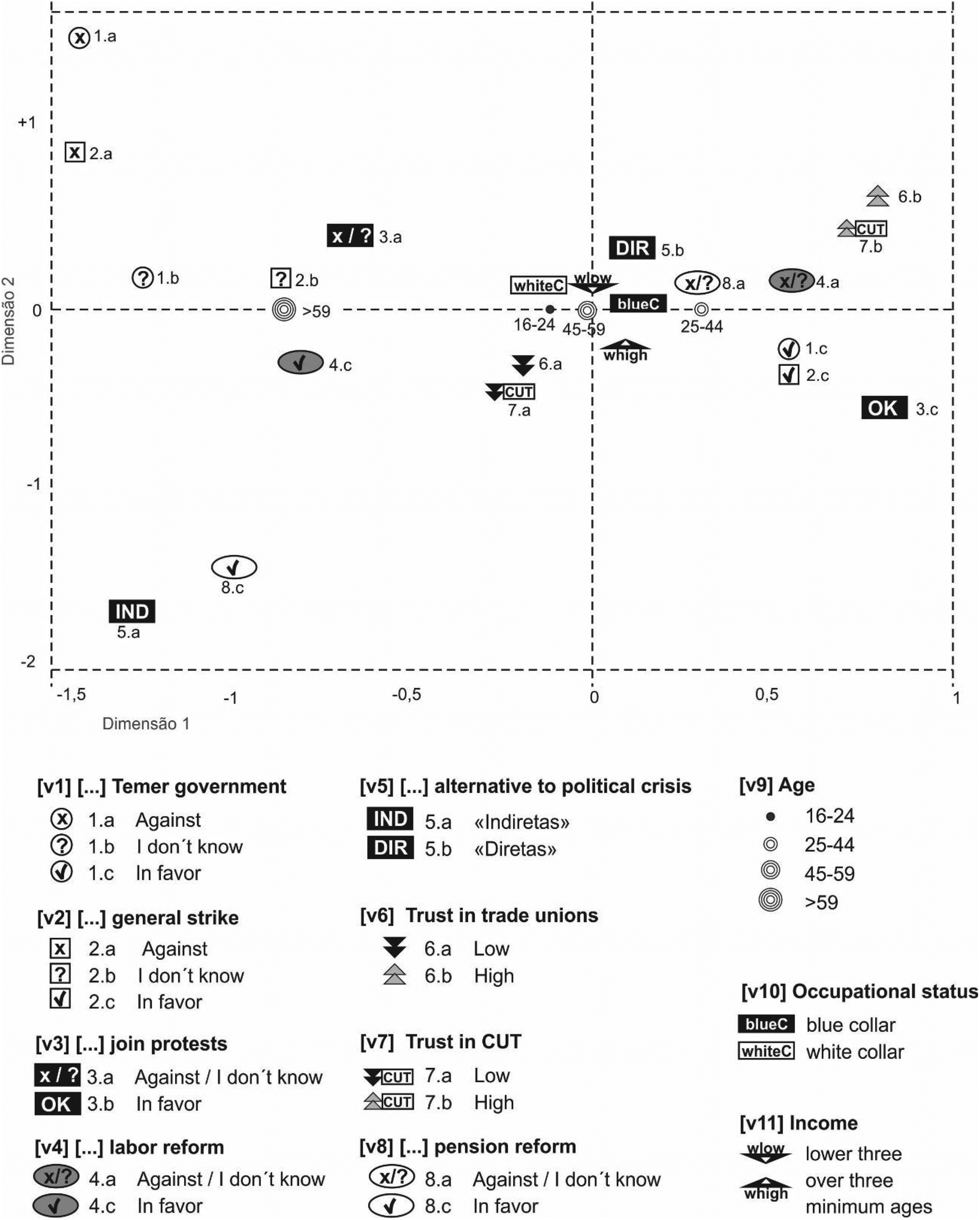
Items and first two factors (MCA). MCA: multiple correspondence analysis.
Opinion “in favour” of social protests (1.c), opinion “in favour” of general strike (2.c), “Yes” to join these protests against the government (3.c), and “against” the labor reform (4.a) are grouped on the right side of the figure (quadrants I and IV). On the same side, there are high trust in trade unions (6.b), high trust in CUT (7.b) and (3.c). It is noteworthy that all these items in favour of the strike and against the Temer government are grouped in the first quadrant.
The Brazilian political spectrum is clearly divided. On the opposite side, in the third quadrant, are items 5.a and 8.c (who does not want “direct election” and who is “in favour of the pension reform”). Items against protest “1.a” and against the general strike “2.a” appear in the second quadrant, far from the centre.
The MCA returns clear results: labor reform is harshly criticised by trade unions, an inter-classist and inter-generation group in favour of the direct election of a new president, which is more confident in CUT and others “centrais” and which is strongly critical of the Temer government and its policies. In contrast, those groups that are in favour of reform opposed to strikes and in favour of an indirect election of the new president.
What Is a General Strike For?
The interviews with protesters and union leaders, especially on the day of the first general strike on April 28, confirm the analysis discussed above and introduce new elements in the relationship among politics, social movements, and trade unions.
Since the narrow re-election of former president Dilma Rousseff on October 2014 until the impeachment (the so-called golpe), various right-wing activist groups have sprung up across Brazil in protest of the government and in response to a massive corruption scandal at the state-owned oil company Petrobras, thus encouraging the growth of the anti–PT movements (i.e. the “antipetismo”; Paiva et al., 2016). As unstructured interviews suggest, protests against labor reform also represent a counterattack against the authors of the “golpe,” the anti-PT movements, the employers’ associations, and the “international finance and its economic interests, the liberal and ultra-conservative Brazilian right-wing” (Student B, 28 April 2017, personal interview).
9
As suggested by the respondents: […] we are here against the golpista government, against the constitutional amendment number 55 […] The labor reform is unfair. And the pension reform is being drafted to be approved in 2018. All that in a deeply inefficient tax system, which makes the poor spend most of its income tax. (Local union leader, April 28 2017, personal interview)
10
[…] Since 2016 there has been an illegitimate president, interested in the general destruction of Brazilian welfare state […] The constitutional amendment 55 is an example of this. They will cut pension rights, then the national health system, the federal university, etc. [and] a new dictatorship is ready. (Student A, 28 April 2017, personal interview). It is important to consider the strike as a demonstration against the new right-wing advance in this country, a partisan judiciary, a government full of corrupt ministers, increasing inequalities […] This strike is against labor reform, but not only. Think about the real disposal of public administration. (Public servant B, 28 April 2017, personal interview) It is not just the strike. We are here also because of the golpe against the elected president Dilma. Against this reactionary and fascist movement that organized the coup. For the rights of black people, the LGTB movement, workers, teachers, public servants. (Student D, 28 April 2017, personal interview) Some right-wing organizations, for example the MBL, have connections with the country’s business elite. And other conservative groups. There are even some fringe organizations demanding outright military intervention [i.e. SOS Forças Armadas], and others groups [and think tanks such as] the Instituto Millenium, […] influencers, and the media against the PT. […] We are here against these groups. We support the Sem Terra Movement, trade unions and other groups in opposition to the Temer reforms. (Student E, 28 April 2017, personal interview) The general strike is unitarily convened by all the centrais. CUT is fundamental. We were sleeping for too long. We have organized the protest movements and today we are here, at the general strike, with many other groups and movements. So, we woke up. (CUT union leader, 28 April 2017, personal interview)
After April’s success, why did the general strike of June then result in failure? As already noted, the trade union agenda is both very rich and capable of aggregating different players and issues. Such a form of mobilisation fosters a protest agenda, with multiple social actors, organised in a political block: “it is not just a general strike” (Student E, 28 April 2017, personal interview).
Moreover, “the media system does not help” (CUT union leader, 15 June 2017, personal interview) because, as some interviewees suggest, it is partisan. On 29th April, the main Brazilian newspapers (Folha de São Paulo and O Estado de São Paulo) spent more time highlighting acts of vandalism than they did covering the peaceful protests that took place all over Brazil. The mayor of São Paulo, João Doria, classified the strikers as a minority of tramps, and the newspapers provided him ample evidence in support of this idea. The broadcaster, O Globo, defined the “strike” as a simple “protest”: “Globo didn’t like to call the ‘strike’ with its proper name: ‘strike’” (CUT union leader, 15 June 2017).
The first general strike, on April 2017, garnered a significant amount of participation, but the second, on June, ended with participating falling significantly below expectations. Despite the popular rejection of Temer’s mandate, a long list of scandals involving the president and members of the executives, and the content of the law, in June, unions were surprisingly unable to agree on a common strategy for dealing with the proposal of labor reform. As interviews explained, there are several reasons as to why the June strike was so disappointing: (1) different union approaches, cultures, and strategies that didn’t favour the success of the strike; (2) the very structure of unions, which are divided into a myriad of sindicatos and federações and organised in different forms and at different levels, with diverging relations to the party system.
The strike of April 28 was considered a success: “trade unions were excited” (XXX union leader, 16 June 2017, personal interview). At the beginning of June, the main centrais (CGTB, CSB, CSP Conlutas, Central dos Trabalhadores and Trabalhadoras do Brasil [CTB], CUT, Força Sindical, Intersindical, UGT) decided to convene a new general strike, to take place on 30th June. Unfortunately, contrary to a previous announcement, on 23rd June, the centrais gave up on calling the general strike and released a note establishing a timetable for “mobilisations,” without using the term “general strike”: “the general strike of April has had negative consequences, especially within private companies” (XXX union leader, 16 June 2017, personal interview). It weighed heavily on the decision of transport workers, especially those from Sao Paulo, who would not stop working on the 30th: [and] the Metropolitan workers of São Paulo were punished with a loss of four days of wages as a result of the strike of April 28 […] Furthermore, it is not so simple to convince all the workers, of all the categories, of all the sindicatos, affiliated to different federations and confederations. There are also divisions among centrais, because of politics. You know. The CUT, in turn, was against the impeachment of the former president Dilma and discards any negotiation with the current illegitimate president. But the Força sindical is negotiating with this government. Maybe the CUT announced the strike too soon, on the wave of the April demonstrations […] I also told to my companions: “We cannot convene another general strike, in such a short time.” It’s too optimistic. (XXX union leader, 31 June 2017, personal interview) And if you lose your job? Who can you ask for help? Sindicatos? Which ones? The trade unions affiliated with your company? Maybe. The centrais? If you lose your job, you, just you, look for another one. Can local unions help you? I don’t think so. What can they do? […] The union movement? Brazil currently has 11,500 sindicatos. Who contacts them all? Brazil has a duplicate structure of federations, confederations and twelve trade union centrals [“centrais sindicais”]. To convene a general strike, all trade unions, all centrais, must accept the general strike. If one central does not accept or changes the idea, it is not a general strike […]. It’s so simple. (CSB union leader, 26 July 2017, personal interview)
On 30th June, in Brasilia, in contrast to expectations, there was no record of demonstrations in the region of the Ministries. Buses circulated in all capitals (the only exceptions being Brasilia and Belo Horizonte). The best example of the failure of June’s “general strike” occurred in São Paulo, where the Metro, CPTM (Companhia Paulista de Trens Metropolitanos) and buses worked normally throughout the day. Participation in the 30th June general strike was far below that of April’s strike: “it was not a strike, but sporadic demonstrations, only in the main capitals; the strike proved to be a failure” (XXX union leader, 31 June 2017, personal interview).
Conclusions
Similar to other Latin American cases (Murillo, 2005: 15), the Brazilian trade union movement is currently entangled with alternative political factions and divided among different attitudes towards adopting labor reforms and between a confrontational activism – which is represented by the majority wing of trade unionism, organised around the CUT – and a more cooperative attitude favouring negotiation with government (which is represented by the Força sindical). In addition to political differences, it is also necessary to take into account the union system’s configuration: such a fragmented industrial relations system does not favour coordination among centrais and sindicatos nor does it favour their collective action.
Labor reform arises from a right-wing political milieu: as such, it does not change the basics of the Brazilian industrial relations system, which is organised on corporatist principles of the forties. Once the Reform is in force, the union structure continues to be based on one sindicato per economic activity and territorial ambit (i.e. the unicidade sindical). Labor reform, however, reduces even more the scope of action of the trade unions, eliminating forms of public funding.
In the polarisation illustrated by the MCA, there are some key distinctions: Dependencies between the party system and trade unions do not favour the reorganisation of labor relations. The CUT was the cornerstone of the PT electoral victories and favoured a subsequent moderation of the CUT, in terms of conflict, towards the governments of Lula and Dilma (Boito et al., 2015). As a consequence, the growth of other, smaller centrais was natural: Some examples include Conlutas (which is more closely related to the Partido Socialista dos Trabalhadores Unificado, PSTU), Intersindical (which is more closely related to the Partido Socialismo and Liberdade, PSOL), CTB (which is more closely related to the Partido Comunista do Brasil, PCdoB). In addition, it is important to consider that a significant number of CUT leaders entered the ministries by means of political co-optation and not just the ministry of labor. At the same time, as trade unions enter the institutions, by means of “antipetismo,” they also lose trust, social credibility, and the capacity for mobilisation (Boito et al., 2015).
The data show a clear polarisation with regard to the principal topics of the reform. On the one hand, the struggle against the Temer government and the organisations that represent the new Brazilian right-wing, and on the other, the support of trade unionism: in any case, this was not enough to mobilise millions of people in June, as had been the case in the April strike.
However, the respondents seem to implicitly accept the current trade union system: it is the cultural and political frame, where workers, militants, students, and so on, can play a role in social protest. Even if it is confusing, it is also an environment where a sense of belonging develops, though it is evident that there is a risk of losing control over the wider political process (a more inclusive labor reform, political reform, welfare reform, a necessary reform of Brazilian institutions and federalism, etc.). Since the “golpe,” the unions have lost their political frame of reference. Similarly, trade unions have failed to realise a counterproposal to Temer’s labor reform and the debate regarding labor reform proposals has been generally weak. All of this paints a rather confusing picture, one that contains a scarcity of viable proposals and perspectives that could promote dialogue, in a moment characterised by reduced welfare, possible recession, and profound political change.
Footnotes
Declaration of conflicting interests
The author(s) declared no potential conflicts of interest with respect to the research, authorship, and/or publication of this article.
Funding
The author(s) received no financial support for the research, authorship, and/or publication of this article.