




Abstract
Violence is unequally distributed across provinces. In Argentina, the least violent provinces have a murder rate similar to Sweden’s. The most violent ones have a murder rate comparable to South Sudan’s. What explains this unequal distribution of violence? This article claims that political turnover at the provincial level reduces the partisan control over police forces and challenges previous informal pacts, while being in the opposition to the president decreases the likelihood of receiving federal assistance to fight violence. When both conditions are met at the same time, crime is more likely to increase. The study examines these claims using difference-in-difference and regression analysis for panel data of the Argentine provinces between 2002 and 2015 and a case study of the province of Santa Fe (the most violent in the country). In the conclusions, it also explores the comparative implications for the discussion on the unequal distribution of violence in federal democracies.
Introduction
Violence is unequally distributed across provinces in Argentina. Catamarca is the least violent province in the country, with a murder rate of .77 per 100,000 inhabitants in 2008, similar to Sweden’s rate in 2012. 1 Tierra del Fuego and San Juan have similar rates. But in the other end of the distribution, the province of Buenos Aires has a murder rate that is eighteen times higher than Catamarca, reaching almost 14 homicides per 100,000 inhabitants in 2002. Santa Cruz had a comparable value in 2003 (14.22) and Santa Fe in 2014. These rates are similar to South Sudan’s (14.4) and higher than those for the Democratic Republic of Congo (13.5) and the Central African Republic (13.6; all values for 2012; UNODC). What explains this unequal distribution of violence among provinces in Argentina?
Argentine provinces are particularly valuable for studying the determinants of violence. First, there is enormous variation in the outcome. Second, many of the determinants presented in the literature vary considerably among provinces, such as the level of economic development, poverty rates, and security spending, which are expected to be related to violence and crime. Furthermore, many other variables can be controlled since they do not vary among provinces, such as cultural factors (ethnic, religious, or linguistic fragmentation), or national institutions, relevant in other countries or cross countries comparisons (Nivette, 2011; Oyefusi, 2008).
This article contends that structural variables make a poor role in explaining the unequal distribution of violence in this country. Thus, we need to look for variation in political variables at the subnational level. The main argument is that partisan turnover and being in the opposition to the federal government reduce the likelihood of controlling violence and crime. Governors whose party has been in power for longer periods of time have more political influence and control over police forces and, hence, a more unified regulation of crime and violence. These governors and their administrations are also more likely to have informal links with criminal organisations, translating into more possibilities of collusion and complicity between them. But more political control and complicity produce informal agreements that translate into a more efficient regulation of crime. Finally, governors who are politically allied with the federal government are more likely to receive more federal funds and operative resources, ranging from specialised police forces to intelligence, to reduce violence and crime (as Trejo and Ley, 2016, claim for the Mexican case).
On the contrary, governors whose party recently rose to power and those in the opposition to the federal government tend to have a weaker control of police forces and fewer resources to control crime. On top of that, incoming political parties are more likely to challenge previous “informal pacts” between politicians, police forces, and criminal organisations and fight criminal gangs. Under these conditions, violence is likely to rise.
Exploring the province of Santa Fe, the most violent in the country nowadays, we found that a weak partisan control over police forces of the incoming Socialist Party together with a more confrontational stance to previous informal pacts with criminal gangs and partisan conflicts between the provincial and the federal government seem to help explaining the rapid surge and the high levels of violence in this province. Structural factors, such as poverty, inequality, and lack of access to public services, do not appear to be enough to account for the province’s abrupt and sudden increase in violence.
We organised the article as follows: first, we discuss the theoretical literature on the topic. Based on this revision, we put forward the main argument and alternative hypotheses and test them in a large-N analysis. We report the empirical results, discuss the main findings, and then explore which claims could account for the sudden increase in Santa Fe’s homicide rate. We present the comparative implications in the conclusion.
The Debate on the Determinants of Violence
There is some agreement in the literature that the typical profile of homicides in low violence societies is quite different from the profile of homicides in high violence societies. Different kinds of violence dominate in each of them (Eisner, 2013: 9, 11). Studies on high violence societies attempt to identify the causes of organised use of force, civil war, genocides, lynchings, and large-scale massacres. This type of violence can be caused by organised gangs who profit from looting, crime and illegal activities, and kleptocratic rivalry (Collier, 2007; see Oyefusi, 2008 for a review), lootable wealth and resources (e.g. diamonds, gold, or oil; Collier, 2007), drug trafficking (and consumption; Calderón et al., 2015; Durán-Martínez, 2015; Fajnzylber et al., 1998; Föhrig, 2015), and competition among drug cartels (Durán-Martínez, 2015; Ríos, 2012). Despite the contributions of this literature, our study focuses on the empirical debate related to the causes of variation in homicide rates in low violence societies (i.e. those with an average rate below 10 homicides per 100,000 inhabitants).
Several studies suggest that some of the causes of macro-level variation in homicide rates in low violence societies are the level of economic and human development, industrialisation, urbanisation, income inequality, unemployment, and poverty (Ehrlich, 1973; Fajnzylber et al., 1998, 2002; Fleisher, 1966; Ingram and Da Costa, 2014; Oyefusi, 2008; Portes and Hoffman, 2003; Yildiz et al., 2013). LaFree (1999), Trent and Pridemore (2012), and Nivette (2011) find some agreement in the literature: economic development and income equality are associated with lower homicide rates. Trent and Pridemore (2012) and Nivette (2011) also conclude that there is evidence linking deprivation (poverty) to higher levels of violence. 2
This study explores whether changes in economic and human development and inequality explain variation in homicides rates across provinces in Argentina. We anticipate that these structural variables do not seem to be enough to explain the unequal distribution of violence across provinces. The data show that structural differences among provinces have been reduced during the last decade, and they are not as large as differences in violence among them.
Some recent studies analyse whether there is a relationship between homicides rates and state capacity, including governance indicators, corruption, and state legitimacy (Neumayer, 2003; Nivette and Eisner, 2013), spending in social welfare protection (Bergman and Kessler, 2008; Fearon and Laitin, 2003; Nivette, 2011; Oyefusi, 2008; Rivera and Zárate, 2016), social transfers (Ingram and Da Costa, 2014; Lance, 2014), and spending in security or policing (Archer and Gartner, 1984; Collier, 2007; Ehrlich, 1973; Fajnzylber et al., 1998). Following this discussion, we empirically evaluate whether variations in provincial state capacity are related to changes in homicides rates at this level of government.
Other scholars also discuss the role of political variables in explaining changes in violence. Some of them claim that political stability and low partisan fragmentation facilitate links between criminal organisations and politicians, increasing violence (Föhrig, 2015). For others, political competition and partisan fragmentation reduces state cohesion and enforcement capacity and, thus, increases violence (Dell, 2015; Durán-Martínez, 2015; Osorio, 2013). Others pay attention to state-sponsored protection rackets (Dewey, 2015; Snyder and Durán-Martínez, 2009; Trejo and Ley, 2017), coordination and political alliances between the central and subnational governments (Dell, 2015; Durán-Martínez, 2015; Ríos, 2015; Trejo and Ley, 2016; Urrusti, 2012), or political movements in the opposition (Barndt, 2012).
We pay specific attention to the role of provincial partisan politics and partisan configurations between the two levels of government that have formal authority over police and security forces: the provincial and the federal governments (although some municipalities have begun to play a de facto role too). In particular, we simultaneously analyse the role of partisan control over police forces, which depends on the provincial government, and the partisan configurations that affect decisions to allocate more federal resources to combat crime, which depends on the national government. These configurations are not unique to the Argentine case: most federal governments (e.g. Brazil, Mexico, and the United States) as well as some unitary countries (e.g. Colombia and Bolivia) have some sort of division of responsibilities between national and subnational governments (provinces, states, departments, or municipalities) in security matters.
Federal Security Politics and the Control of Violence
We begin our argument with the role of partisan control over police forces. We claim that political turnover at the provincial level is crucial to explain changes in crime and violence. Parties in control of the provincial government for a long period of time are more likely to reduce violence and crime through two main mechanisms: first, the political control of police forces, and second, more informal connections with criminal bands. More political stability, control of the police forces, and informal links produce a more efficient regulation of crime.
Snyder and Durán-Martínez (2009: 66–67) claim that political stability increases “both the reciprocity and credibility of transactions,” improving trust and reputation for compliance with organised crime. We claim that political stability of public officials not only improves reciprocity, credibility, trust, and reputation. When parties exert political control in their provinces for a long period of time, they also tend to have more political authority over police forces. We contend that this helps regulating and reducing criminal activities.
In Argentina, governors are at the top of the provincial public administration and have the authority to appoint most public employees, usually on party-based criteria (De Luca et al., 2002: 422). 3 Governors supported by politically stable provincial parties tend to have greater control over the provincial cabinet, the bureaucracy, and have large influence over the provincial legislative, judiciary, oversight institutions, and police forces. Several studies on the police forces in Argentina detail the provincial structure of police institutions and their political allegiance to governors and their parties (Binder, 2004; Eaton, 2008; Föhrig, 2015: 6; Saín, 2002). Governors appoint police authorities in their provinces, ranging from the police chief to heads of the regional delegations. They also influence the structure of police echelons, deciding promotions, removals, and exonerations. Together with mayors of key cities, they have large control of the police in operative terms. 4 They provide the police with money and equipment and they influence their operations through the allocation of police resources (Dewey, 2015: 65–66; Föhrig, 2015: 6–7).
When provincial parties have a larger influence over police forces, they also tend to have a more unified regulation of criminal organisations. This helps reducing competition inside the police forces in their relations with criminal gangs (including for illegal businesses). A unified relation allows for more territorial control, a more effective regulation of crime, a reduction in conflicts (that could affect political careers), and, as a result, acceptable levels of public security (Dewey, 2015: 65). For Durán-Martínez (2015: 1383), “a cohesive security apparatus […] makes state protection more reliable or enforcement more efficient.” In her argument, fragmentation in the security apparatus makes enforcement less effective and more difficult because it complicates coordination.
Political stability of public officials not only improves credibility and reputation (Snyder and Durán-Martínez, 2009) or more political control over police forces (Dewey, 2015; Durán-Martínez, 2015). More political stability over time also means more informal connections between local politicians, police forces, and criminal organisations. On the one hand, this may translate into more possibilities of collusion and complicity between local politicians and criminal organisations (Föhrig, 2013), especially when all of them share physical presence in the same territory. But on the other hand, more stability and informal connections may also produce a more efficient regulation of crime: the main actors are more likely to agree on the level of violence that is socially accepted in their territories to make their relations sustainable over time. Political stability and social acceptability make these informal pacts sustainable. When informal agreements collapse and there are sudden changes in these socially accepted levels of violence, social pressures on politicians and police forces will be more likely to increase. All actors could pay a high price in a situation like this: not only citizens (because of the actual increase in violence), but also politicians and police forces (because they face stronger social pressures), and even criminals (who may now confront more challenges to their illegal activities).
New parties, on the contrary tend to have a weaker control over their territories and, hence, a weaker influence over police forces, especially when they have just accessed office. Moreover, they are less likely to collude and develop relations of complicity with criminal organisations. New political forces are more likely to fight criminal gangs and challenge their previous “informal pacts” with politicians and police forces. Under these conditions, more violence is likely to occur.
We do not expect all incoming parties to automatically fight criminal gangs and challenge previous informal pacts. We expect this to be more likely, in particular, when “new” parties access to power for the first time, when they take “outsiders” into office, and when they campaign denouncing “traditional” parties and their linkages with crime. Under these circumstances, new parties are more likely to give more autonomy to police forces and abandon informal pacts with police forces. The occurrence of this outcomes is less probable when traditional opposition parties access to power as a consequence of provincial partisan turnover.
Shirk and Wallman (2015: 1360–1361) argue that political turnover in Mexico unsettled the negotiated arrangements between state officials and criminal organisations. More competition among police groups and criminal gangs to control the territory also diminishes police capacity to regulate crime (Durán-Martínez, 2015; Ríos, 2012). All this expands violence.
Partisan provincial politics are important to control crime. But security policies do not depend exclusively on the provincial government. The central government also plays a key role in combating crime in violent provinces. Ríos (2015) claims that crime is reduced when the same party rules across levels of government because of a more efficient communication and coordinated policies. Trejo and Ley (2016) argue that partisan conflict leads to the politicisation of military deployments and judicial processes. Our main claim is that distributive politics play a decisive role.
In particular, we claim that governors who are politically allied with the federal government will receive more federal funds and assistance and, hence, be more capable of reducing crime. 5 Federal coordination with provinces is critical in combating crime (Ríos, 2015; Trejo and Ley, 2016). This is so because the federal government can provide crucial resources provinces (and municipalities) usually lack: money and operative resources, ranging from specialised police forces to intelligence. 6 Less developed provinces need federal support because they have limited resources to tackle violence and crime. But larger and more populated provinces also need the federal government because of the scale of crime and their incapacity to cope with it alone, especially considering provinces are responsible for the delivery of several social services (including health and education) that the central government began to decentralise in the late 1970s. 7
Although federal police forces have formal jurisdiction over the entire territory, they do not necessarily have effective presence across it. The federal government can decide whether to reinforce the effective presence of security forces (federal police, naval prefecture, and national gendarmerie) according to political and programmatic considerations. In line with what Trejo and Ley (2016: 14) found for the case of Mexico, we argue that the federal government will be more likely to support politically allied subnational units (provinces and municipalities) in combating crime and violence. But federal support does not only mean more federal security forces, as claimed by Trejo and Ley (2016). Since several types of federal resources (ranging from federal infrastructure to social programmes and security spending and forces) are also decisive to fight crime, political affiliation between presidents and governors will be critical to explain reductions in homicide rates.
In sum, political turnover at the provincial level and being in the opposition to the federal government are more likely to be associated to increases in crime. The effect on crime will be larger when these two conditions are met at the same time; that is, we expect that incoming opposition governors (particularly in the case of new parties) are more likely to face more crime (cell D; Figure 1). We expect lower violence when one of the two conditions is not met. In the case of alignment with national government and partisan turnover (cell B), the control of violence will be more dependent on the capacity of the central government to send resources and forces. In the case of no alignment and partisan stability (cell C), the outcome will depend on the provincial fiscal and operative capacity.
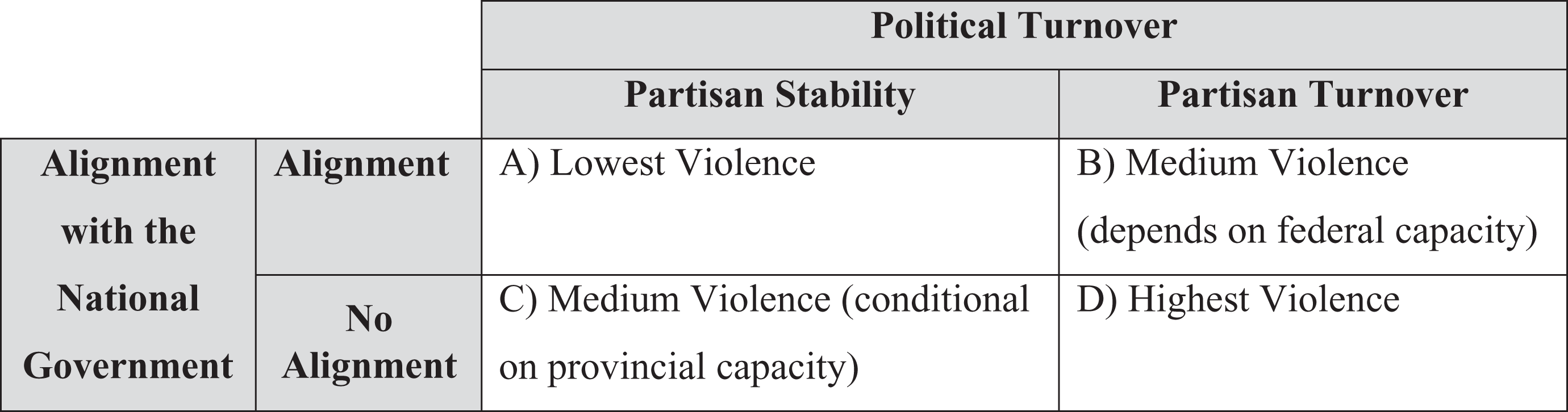
Theoretical Expectations.
Variables and Data
The main dependent variable is the provincial homicide rate per 100,000 inhabitants. We select this variable as a proxy for violent crime because underreporting, and hence systematic bias, is “lower than low-value property crime (e.g., common theft) and for crimes carrying a social stigma for the victim (e.g., rape)” (Fajnzylber et al., 2002: 1326). The rate is calculated based on the number of intentional homicides in each province 8 and provided by the National Criminal Information System (Annual Reports, National Direction for Criminal Policy, Ministry of Justice, Security, and Human Rights) between 2002 and 2008. 9
The two main independent political variables are provincial party turnover and whether governors are politically allied with the president. Provincial party turnover is coded as 1 if there was a change in the provincial party in office in a given year, 0 otherwise. We use this variable to test the role of partisan control over police forces. The second variable is a dummy to determine whether governors are politically allied with the president and we use it to explore the role of partisan alliances in explaining variation in the outcome. This variable is coded as 1 if president and governors are in the same governing coalition in a given year, 0 otherwise. We coded this variable during fieldwork based on official electoral data, information from newspapers, and interviews with provincial experts. 10
Large-N Empirical Analysis
Having presented the main claim, we now test whether these variables are statistically associated in a large-N analysis. We first use a difference-in-difference (DiD) estimation technique, which compares the average change over time in the outcome variable for a treatment group in relation to the average change in the same variable over time for a control group. We use three different treatment groups. The first one is a group of provinces in which there was party turnover; the second includes provinces ruled by opposition governors; and the third one is a group of provinces in which the two previous conditions are met at the same time. We analyse the treatment and control groups before and after 2007, the year in which there was turnover in provincial elections and opposition governors for the available data series. 11
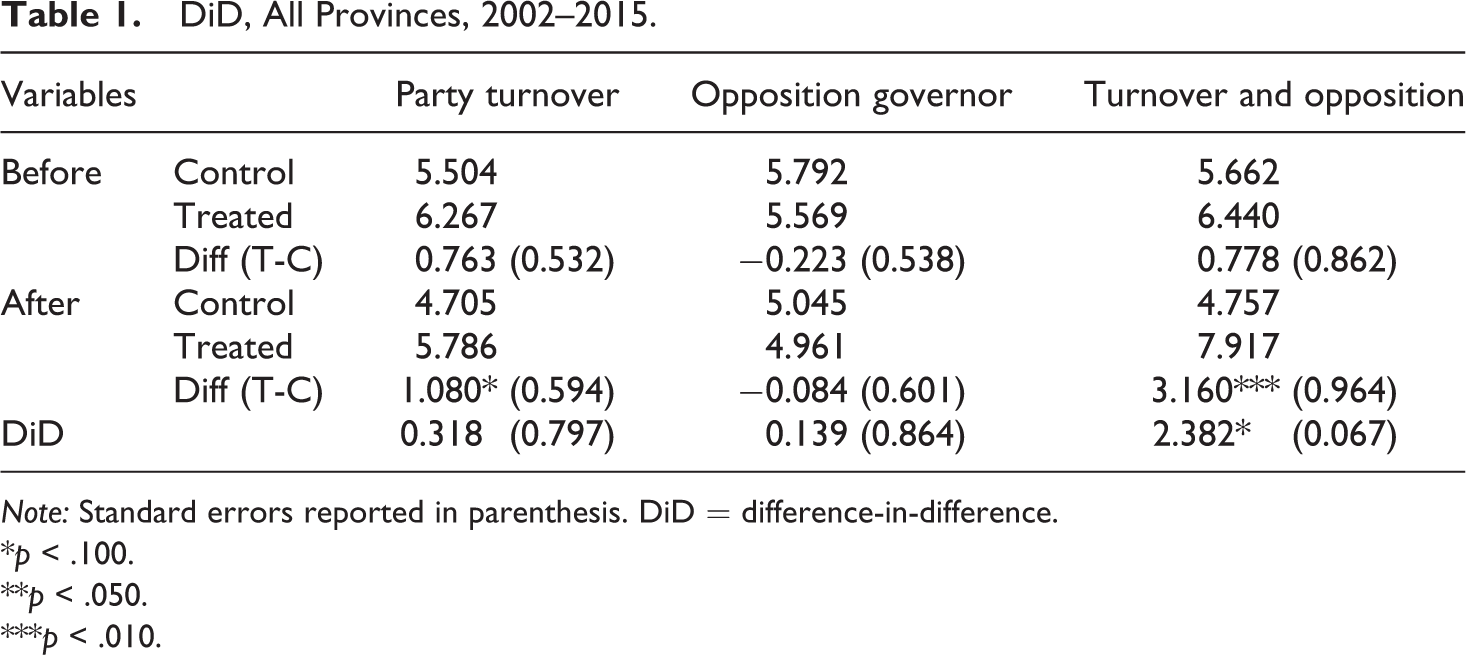
Table 1 reports the DiD results. The first column shows the DiD results between provinces in which there was turnover in the 2007 elections and the control group. The difference between both groups before and after treatment is .32, but this value is not statistically significant. The second column describes the DiD results for provinces in which the governor is in opposition to the federal government and the control group. The difference between both groups before and after treatment is now .14, but once again this value does not reach the usually accepted levels of statistical significance.
DiD, All Provinces, 2002–2015.
Note: Standard errors reported in parenthesis. DiD = difference-in-difference.
*p < .100.
**p < .050.
***p < .010.
The last column presents the DiD results for provinces that met both conditions (turnover and opposition governor) and the control group. Provinces in which there was party turnover and the governor was in opposition to the president had, on average, 2.4 more homicides per 100,000 inhabitants than the rest of the provinces and this result is statistically significant. As we expected, it is when both conditions are met at the same time that the likelihood of crime increasing is higher.
We included a final estimation comparing the four largest and more urbanised provinces in the country (Buenos Aires, Córdoba, Mendoza, and Santa Fe). These four cases are quite similar in most structural control variables, ranging from level of urbanisation, population density, and a range of social indicators (such as levels of poverty, inequality, and access to basic services). 12 The four cases are different, though, in the values of the main political variables related to our claim: in one of them, both conditions are present (Santa Fe); in two others, only one condition is met (turnover in Mendoza, and opposition governor in Córdoba); in the last case, none of the previous conditions is observed (Buenos Aires). Table 2 presents the average murder rates for the four provinces before and after treatment. The difference between the treatment group (Santa Fe) and the controls before and after treatment is 3.27 and statistically significant. In other words, the province in which both conditions are met at the same time (there was party turnover and the governor was in opposition to the president) had, on average, 3.3 more homicides per 100,000 inhabitants than the control provinces after 2007. This is a substantial difference between the treatment and control groups, equivalent to 1.22 times the standard deviation of the dependent variable.
Average Homicide Rates, Four Selected Provinces, 2002–2015.
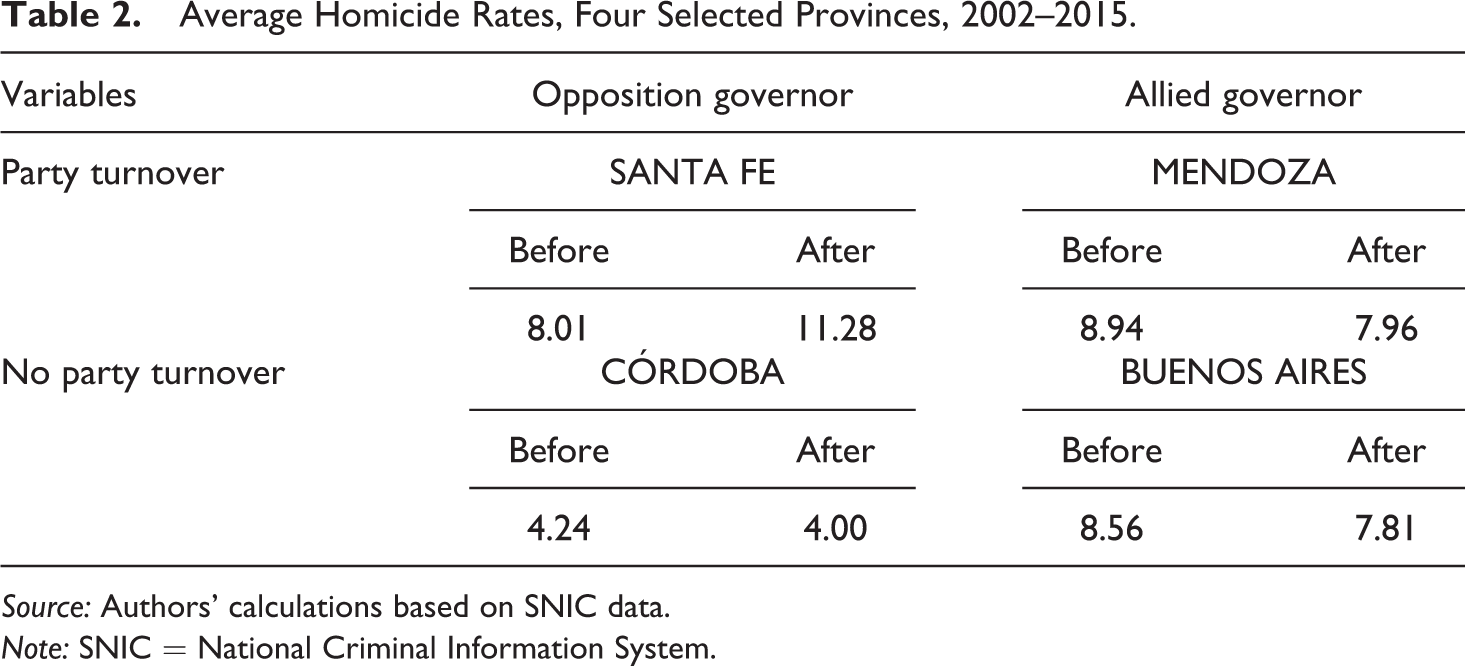
Source: Authors’ calculations based on SNIC data.
Note: SNIC = National Criminal Information System.
Regression Analysis
In a second step, we explore the relationships among the main variables using an ordinary least squares regression with panel corrected standard errors (Beck and Katz, 1995), which is more appropriate for n-dominant data (as opposed to time-dominant data). We conducted several tests to confirm this estimation is the most appropriate. First, the Breusch–Pagan/Cook–Weisberg test (and a scatterplot for the error term) indicates that there is heteroskedasticity in the error term; and the Wooldridge test reports some modest autocorrelation in the panel data. Therefore, we use a model that computes the variance–covariance estimates and the standard errors assuming that the disturbances are heteroskedastic and correlated across panels. Second, to test whether we should use random or fixed effect models, we run a Hausman test of random versus fixed effects. The p-value for the main model using random and fixed effects is .313, much larger than the advised .05. Therefore, we conclude that it is safe to use random effects models. Third, the variance inflation factor (VIF) test reports there is no serious collinearity among the main variables in the model. Finally, the Levin–Lin–Chu unit-root test reveals that the data are stationary and, hence, it is safe not to work with first differences (i.e. change in the dependent variable).
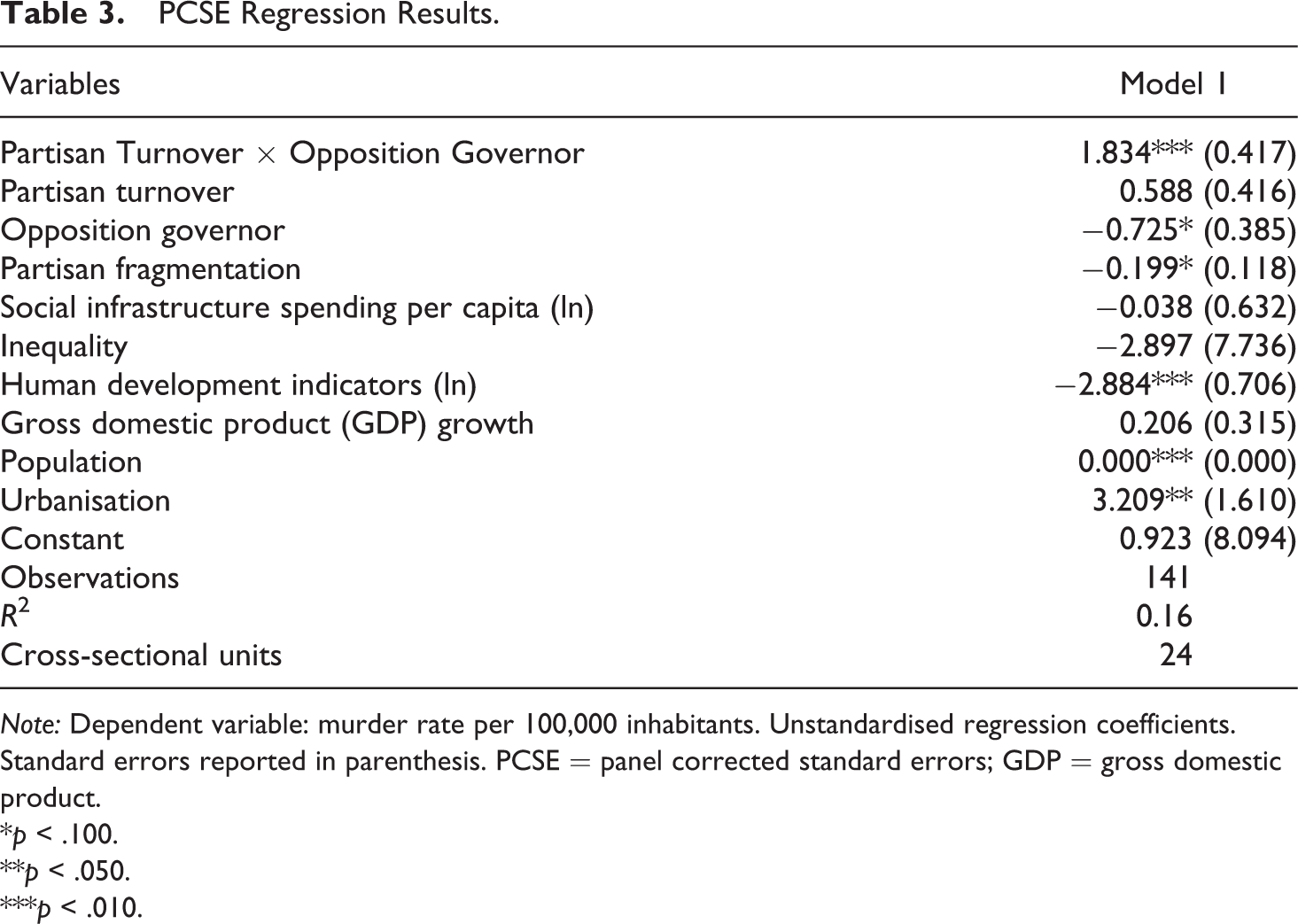
Some of the findings in Table 3 support our main theoretical expectations. Regression results indicate that provinces in which there is partisan turnover and an opposition governor have a larger homicide rate. The interaction term between these two variables is positive, robust, and statistically significant. Holding structural control variables constant, these provinces increase their murder rate in 1.8 homicides per 100,000 inhabitants (see Figure 2). These results provide further support for the previous finding: when both conditions are met (and not when each of them is considered separately), homicides are more likely to increase. There is a clearly significant positive impact if an opposition governor came to power recently. In other words, the opposition variable has the hypothesised impact only under a condition of party turnover, and party turnover has a positive effect on crime when there is an opposition governor taking office.
PCSE Regression Results.
Note: Dependent variable: murder rate per 100,000 inhabitants. Unstandardised regression coefficients. Standard errors reported in parenthesis. PCSE = panel corrected standard errors; GDP = gross domestic product.
*p < .100.
**p < .050.
***p < .010.
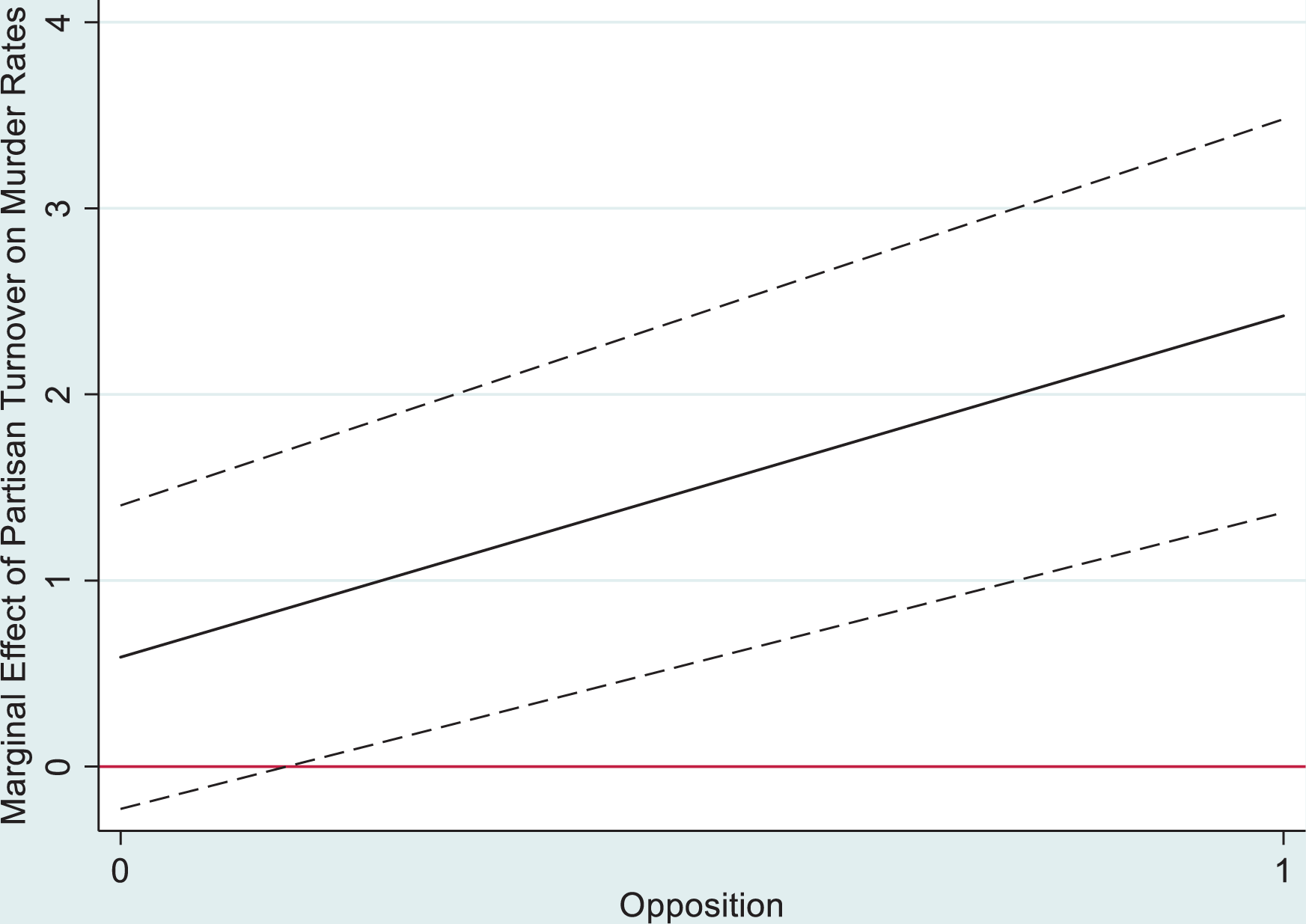
Interaction Effect Between Partisan Turnover and Opposition Governor.
We do not have clear evidence on the role of provincial party system fragmentation (in terms of votes). This variable appears to be negatively associated with murder rates in our model, which is contrary to most theoretical expectations in the literature, but its coefficient is small and very close to the limit of statistical significance (p = .091). On top of that, the standard error is high. 13 Hence, results should be taken with prudence and more research should further explore this relationship to find more conclusive evidence. The important fact, though, is that our main variables remain robust even after controlling for partisan fragmentation.
We also control for provincial structural variables. Results indicate that provinces with higher human development indices have lower murder rates (as several scholars in the literature found; e.g. Eisner, 2013; Nivette, 2011). They also show that there is a positive association between urbanisation, population, and homicide rates. All these coefficients are statistically significant. Provincial inequality and national economic growth, on the contrary, do not appear to be statistically related to violence. 14
Part of the literature suggests that certain types of spending related to state capacity should reduce violence (Neumayer, 2003; Nivette and Eisner, 2013). Hence, we also included provincial spending variables in the model. As expected, results indicate that social infrastructure spending is negatively related to murder rates, but this coefficient is not statistically significant. We run separate models with other spending variables (not included in this one due to collinearity). Controlling for the same variables, security spending is positively related to murder rates, while patronage (personnel) spending is negatively related to them (see models 2 and 3, Table 4, Online Appendix). We have theoretical reasons to suggest that provinces that are more violent tend to spend more in security (but it can also be that more security spending increases violence). Future studies can further explore these connections between spending variables and crime rates.
We also included other controls, such as provincial family and age structure as well as sex ratios. Results for the main variables in the model remain basically unchanged, while the coefficients for these controls move in the theoretically expected direction and are statistically significant (see model 4, Table 4, Online Appendix).
We run another model to explore the effect of federal transfers (they are collinear with provincial spending variables). Holding third variables constant, a 1 per cent increase in federal transfers reduces murder rates in .8 homicides per 100,000 inhabitants. This result is robust and statistically significant (as in the work of Ingram and Da Costa, 2014; Lance, 2014). We do not have data on federal transfers that provinces may use to reduce security. But we have data on federal discretionary transfers that provinces can use without restrictions. Results indicate that, controlling for the same variables, an increase in these federal transfers reduces murder rates in .8 homicides per 100,000 inhabitants. This coefficient is also statistically significant (p = .006).
We calculated two indices that measure the degree of institutionalisation of the area in charge of security at the provincial level (the Index of Institutionalisation of Security, IS) and provincial criminal courts (the Index of Institutionalisation of Provincial Criminal Justice, IPCS), as proxies of provincial state capacity (see the Online Appendix for a detailed explanation of how they are calculated). These indices report how politically relevant is the area of security in the province and how many state resources the provincial government allocates to it. Due to the limited available data, we could not include these indices in the regression models. However, the correlation coefficient between the IS and murder rates is positive (.17), while the coefficient between the IPCS and murder rates is negative (−.17). These results may indicate that more violent provinces tend to have more institutionalised security functions and that those with stronger criminal justice systems tend to have lower murder rates.
In sum, these results provide significant political implications: governors who have been in power for a longer time, rule more capable provincial states, are politically allied with the federal government, and receive more federal transfers, tend to face less violence. These variables are easier to change politically than structural variables: yearly changes in human development indicator (HDI) are quite modest (the standard deviation is .03) and in terms of public policy a substantive change in it requires medium-term to long-term policy efforts.
The R 2 in the main model is 16 per cent. It indicates that a substantive share of the variation in the dependent variable is left unexplained and that we need better theories, data, and models to account for the factors that increase violent crime beyond the ones included in this study. Case studies, particularly in more and less violent subnational units, may contribute to a better understanding of the main factors involved in the process. We intend to do this in the next section.
A Case Analysis: The Province of Santa Fe
Having presented the main claim and some results in a large-N analysis, we now study the Province of Santa Fe. We selected this case because it is the most violent province in the country nowadays and because it experienced the largest increase in the dependent variable over time. The murder rate in the Province of Santa Fe doubled in less than a decade, increasing from 6.56 homicides per 100,000 inhabitants in 2006 to 13.2 in 2014. The average for this province (9.21) is the highest in the country, and higher than the province of Buenos Aires’s (8.02), the Federal Capital’s (4.98), and Córdoba’s (4.11), which is a very similar province in socio-economic and demographic terms. The maximum value of Santa Fe (13.2 in 2014) is 2.7 times larger than the maximum value of Córdoba (5.22). 15
We observe that the main socio-economic variables in this province have improved over the last few years: its gross geographic product grew more than eleven points on average between 1993 and 2009. Between 2002 and 2009, this growth was 23.2 per cent. During this period, Santa Fe had the largest year-on-year rise in the murder rate: 37 per cent between 2006 and 2007 (increasing from 6.56 to 9 homicides per 100,000 inhabitants). Poverty dropped 68 per cent between 1980 and 2010 or 46 per cent between 2001 and 2010 (National Censuses, INDEC). The Gini index of income inequality of the employed population (EPH-INDEC) for Santa Fe also fell from .43 in 2003 to .34 in 2014. In comparative terms, the provincial average for the 2003–2013 series (.38) is similar to that in the most populated districts. The provincial HDI remained very stable during the period (there was a marginal improvement of only .06 per cent). It increased 2 per cent each year during the years with the highest increase in the homicide rate (2006 and 2007).
These data seem to indicate that the rapid increase in violence in the province of Santa Fe is not associated with the socio-economic variables most usually related to it. None of the correlations between its homicide rate and its HDI, average income per capita, and Gini coefficient of income inequality reach the usually accepted values of statistical significance (p values range between .54 and .98).
Despite these aggregate results, some scholars claim that structural conditions in the province of Santa Fe’s shantytowns (villas de emergencia) deteriorated systematically during the last decade (Emmerich and Rubio, 2014). In these shantytowns, a generation of youth has suffered from social exclusion and long-term unemployment. For many of them, violence and drugs are an option for survival. The business of illegal drugs, kidnappings, bank robberies, theft, and the illegal sale of car parts are economic activities that prospered in marginalised sectors of society (El País, 2015; Emmerich and Rubio, 2014). In fact, several experts and pundits point out that violence in Santa Fe city and Rosario is drug related violence (Emmerich and Rubio, 2014; Eventon, 2013). For them, several organised drug gangs, who profit from crime and illegal activities, caused this sharp increase in crime. Rivalry among them produced an escalation in violence. 16 When the illegal market is competitive and criminal organisations dispute the territory, violence is likely to be more frequent as gangs try to drive out competitors using force against them (Durán-Martínez, 2015: 1383; Skaperdas, 2001: 187). Some of these analysts contend that these gangs need institutional support as well as state protection for their proliferation (Dewey, 2012, 2015; Snyder and Durán-Martínez, 2009). They claim that police corruption contributed to the escalation of violence in Rosario (BBC, 2014; El País, 2015; Emmerich and Rubio, 2014; Eventon, 2013; Universidad Nacional de Rosario, 2013) and in other big cities in the country (Eventon, 2013; Föhrig, 2015; Saín, 2002). But according to official figures and data from the University of Rosario, more than 80 per cent of the homicides in Rosario are related to disputes between young men in marginalised neighbourhoods, due to fights between gangs, and not related to drugs (BBC, 2014).
Despite the disagreements over the role of drugs and the limited explanatory power of structural factors in accounting for violence in Santa Fe, we now explore whether the main political variables in our argument may have affected violence in this province. Since Argentina’s transition to democracy in 1983 until 2007, Santa Fe had been governed by the Partido Justicialista (PJ). This party remained in power until the Socialist Hermes Binner was elected governor in 2007. During this electoral year only, the murder rate increased almost 30 per cent, from 8.5 to 11. The average murder rate during the PJ’s administration was 8.60. We have available data from 2002 to 2006, which surely overestimates this mean value. In contrast, the average murder rate during the Socialist government almost doubled, rising to 15.24 (data from Ministerio Público de la Acusación, 2014).
We argue that partisan configurations between levels of government are important, but fundamentally between those which have formal authority over security. In Argentina, only the federal and provincial governments have constitutional authority over security forces. This makes partisan configurations at these two levels much more important than the one at the municipal government. Without denying the relevance of local politics in the control of violence, we analyse the role of partisan control over police forces, which depends on the provincial government; and the partisan decisions to allocate federal resources and deploy special security forces to combat crime, which depends on the federal government.
The twenty-three years of PJ ruling in the Province of Santa Fe had allowed the governor to exercise a tight control over police forces through political appointments in the higher ranks and the selective distribution of resources. These highly controlled police forces were capable of reaching solid agreements with relatively centralised criminal organisations, which resulted in a more contained version of local violence. In this way, the police had the capacity to control crime through effective regulation and informal pacts, and thus, guarantee governability and the possibility of managing criminal matters without social visibility or public scandal.
In 2007, the PJ electoral power and stability collapsed. Consequently, the tight control and stable informal agreements that the PJ had built with police forces to control criminal organisations also vanished. This came to an end as the Socialist Party gained power. This “new” party accessed the governorship for the first time in the history of the province, in a campaign in which it denounced “traditional” parties, particularly the PJ, and their linkages with crime. The Socialist Party in government triggered divisions in police control and, on top of that, decided to give the police more autonomy in dealing with crime and to remove partisan politics from this matter. Some security specialists and public authorities we interviewed in Santa Fe also recognised that the Socialists did not have a clear and consistent security plan to reduce violence (Interview with former provincial security minister and two of his advisors – not named at their request to preserve their identities; Interview with local councillor María Eugenia Schmuck; Interview with Franco Bartolacci, Dean of the Faculty of Political Science, National University of Rosario; 13–14 September, 2016).
Divisions inside police forces proliferated and made them less able to exert control over criminal activities. Raúl Lamberto, security minister of the province during the Socialist government, publicly acknowledged that “the government lost control and command over the police” (La Nación, 2012). To revert that situation, he proposed a decentralisation reform that divided the province in smaller territorial units, each in charge of a police chief. The main goal of the reform was to increase social accountability and political control over them. Instead of augmenting control, the reform fragmented even further the police, which led to a weaker political control and a further increase in violence (Interview with former provincial security public official; 14 September, 2016). The homicide rate increased 43 per cent after the reform, from 16 murders every 100,000 inhabitants in 2012 to 23 in 2013 (Ministerio Público de la Acusación, 2014). The reform was reversed in 2016 by a new minister of security.
The PJ opposition leaders denounced that in Santa Fe, “there are bands that fight for the control of the territory” (La Capital, 2014). They requested the intervention of the provincial police and asked the governor Antonio Bonfatti to appoint a “civilian of trust” as the police chief in order to stop the escalation of killings (El Litoral, 2013). The federal government’s Secretary of Security also stated that “the most serious problem with the Santa Fe government is police malfunction, which is an autonomous force, and does not follow orders” (La Nación, 2015a). Federal deputy Eduardo Toniolli denounced that “in the province of Santa Fe, police forces are self-governed” (La Nación, 2014b). As a result, illegal activities mushroomed and diversified during this period in the province (Emmerich and Rubio, 2014). A fragmented police force was not able to impose control over a growing number of increasingly powerful criminal gangs.
In many cases, the police got involved in criminal activities (La Nación, 2012; Uno Santa Fe, 2015). In total, 1,589 police officers were involved in criminal cases (4 per cent of them for charges related to drug trafficking) and 829 were put on administrative leave (data up to 2015; Clarín, 2015). Only in 2015, 233 Santa Fe police officers were dismissed from duties (115 in 2014). Four police chiefs were replaced between 2011 and 2015 on corruption charges. Hugo Tognoli, one of those former police chiefs, was arrested in 2012 and condemned to imprisonment for six years in 2015 for his links with drug traffickers (La Nación, 2012; Télam, 2015; Uno Santa Fe, 2015). The three Socialist governors had 11 police chiefs during their mandates. Each of them lasted 9.8 months on average. Five police chiefs were replaced during the first Socialist administration of Hermes Binner (2007–2011). Durán-Martínez (2015, 1395–1396) points out that this similar combination of partisan and political fragmentation as well as criminal competition generated sharp increases in violence in Ciudad Juárez and Tijuana, Mexico.
Although the murder rate in Santa Fe has been growing fast since 2007, it marginally declined in 2014. The Socialist Party had been governing Santa Fe for almost a decade and got re-elected in 2015, making time horizons for public officials more stable and more certain than during their first term.
Having analysed the relevance of partisan provincial politics in controlling crime, we now examine federal–provincial relationships. The provincial and the federal governments had tense political relations during this period. The Socialist Party, although a lukewarm political ally of the president during the early 2000s, finally moved to the opposition in 2007. Politicians from both the federal and the provincial governments accused each other of being responsible for the increase in crime. The Socialist governor, Antonio Bonfatti, publicly denounced that the federal government left the province alone in their fighting against violence (Perfil, 2013). The federal Security Secretary accused the Socialist governor of “granting large autonomy to the provincial police, which ended up in high levels of corruption” and an increase in violence (La Nación, 2015b).
Despite this tense political relationship, the national government finally decided to send 3,000 militarised federal police forces (gendarmería and prefectura) to control crime in the province in April, 2014 (La Nación, 2014a). These troops were assigned to stay for about three months (Página 12, 2014) but the operation lasted 250 days. The federal government also collaborated providing federal intelligence services (La Nación, 2015a) and resources for social infrastructure in the most violent areas (to open streets, recover public spaces, and construct water and sewerage networks, and housing), reform the police, and to increase the salaries of provincial police officers (La Nación, 2014a, 2014c).
Provincial politicians publicly recognised that “this decrease in murder rates coincides with the arrival of national forces in the province but also with the decision of working together with provincial security forces and the provincial justice.” “The presence of security forces is key but also the education and social inclusion programs that are being carried out in the neighborhoods” (El Litoral, 2017). Murder rates began to decline in 2014. Federal assistance and not only federal troops appear to be crucial in controlling crime more effectively than would have been the case if only provincial resources and police forces were alone in dealing with crime.
Discussion
In this article, we contend that there is not enough structural variation among provinces in Argentina to explain the unequal distribution of violence across its territory. Hence, we looked for variation in political variables at the provincial level. Provincial level data provide evidence partially supporting some of our claims. Governors whose parties have been in power for a longer period of time and are allied with the federal government are more likely to keep murder rates low. On the contrary, provinces in which there is partisan turnover and governors opposed to the federal government are more likely to face higher murder rates. Murder rates are more likely to escalate when these two conditions (turnover and opposition governor) are present at the same time. Incoming opposition governors have more difficulties controlling police forces and are more likely to challenge previous informal pacts between politicians, the police, and criminals. Moreover, they are less likely to receive federal assistance to fight violence. All this should increase murder rates.
The case of Santa Fe also appears to reaffirm these assertions: violence increased when a new party gained office and provincial authorities were not able to exert political control over the provincial police, giving it large autonomy, and when the new administration decided to challenge previous informal arrangements between politicians, police forces, and criminal gangs.
We stress the relevance of provincial political control of police forces. But controlling and diminishing violent crime is a task that cannot be addressed only by provincial (or municipal) governments, in many cases devastated by social problems and the fiscal obligations to deliver decentralised basic services. Federal support and assistance is crucial, as we also found in Santa Fe. In this case, federal backing depended mostly on political configurations between levels of government. Federal support means not only more federal security forces intervening in provinces, but also a stronger and more redistributive federal state.
Our results also indicate that when provinces spend more in social infrastructure and public employment violence tends to diminish. The opposite is the case when security spending increases, but more research is needed to further assess this particular finding.
Summing up, our results indicate that a more stable political control of police forces, a politically allied and redistributive federal government, and more active provincial administrations, which help improving province-level HDIs, are some of the key factors that help reducing violent crime.
These findings have comparative implications beyond the case studied. In countries where security politics do not depend on a single level of government, we should pay more attention to the subnational political control of police forces and to political relations between national and subnational governments, particularly in weakly institutionalised democracies in the developing world, where rule of law is feeble and the federal and provincial judiciaries are not completely independent from political pressures.
Footnotes
Acknowledgements
The authors thankfully acknowledge the helpful comments of Arturo Alvarado, Diego Fleitas, Alberto Föhrig, Marcelo Leiras, Juan Pablo Luna, Richard Snyder, Guillermo Trejo, the two anonymous JPLA reviewers, and the participants at the Unequal Security Conference, Brown University, April 29-30, 2016. We would also like to thank Franco Bartolacci, María Eugenia Schmuck, the personnel from the federal and provincial ministries of security for their time during interviews and their help in getting access to data and information, and Rocío Moris, who provided crucial research assistance for this project. Any mistake is the sole responsibility of the authors.
Declaration of Conflicting Interests
The author(s) declared no potential conflicts of interest with respect to the research, authorship, and/or publication of this article.
Funding
The author(s) received no financial support for the research, authorship, and/or publication of this article.
Notes
References
Supplementary Material
Please find the following supplemental material available below.
For Open Access articles published under a Creative Commons License, all supplemental material carries the same license as the article it is associated with.
For non-Open Access articles published, all supplemental material carries a non-exclusive license, and permission requests for re-use of supplemental material or any part of supplemental material shall be sent directly to the copyright owner as specified in the copyright notice associated with the article.
