




Abstract
This article examines five years of legislation and constitutional reform under former President Rodrigo R. Duterte. An overview of post-1986 republic acts shows administrations being more successful in legislating social and economic laws than political laws. President Duterte is no exception to this, yet his presidency stands out in both legislative productivity and the passage of long-overdue laws. This success is due in part to high presidential approval, a supermajority coalition in Congress, and a unified Cabinet. These strengthen his influence over Congress, raising expectations that charter change can be fulfiled. His administration's failed attempt at federalism then raises questions on his commitment to the policy in the first place. Despite a populist campaign and institutional means at his disposal, Duterte does not appear any different from his predecessors who prioritised economic laws favoured by the business class over deep political reform with broader implications on governance and development.
Introduction
The Duterte administration started around mid-2016 with promises of real change (“tunay na pagbabago”) in the political system that even included a complete constitutional overhaul. Drawing from the public's latent anxiety about crime and frustration with corrupt elites, President Duterte's campaign highlighted the urgency of reforming the government and framed Duterte as the only leader who is decisive enough to achieve it rapidly. Duterte noted how the nation's capital “gets everything so regions are forced to beg” (Homles, 2016). Federalism was promised as one of the harbingers of deep reform – that “change has come.” The president's assertive rhetoric, along with his influence over Congress through institutions and supermajority alliances, seemed to signal great potential to bring much needed political reforms to improve governance in the country, restrain elite rule in favour of the masses, and distribute economic gains equitably across regions. Such a feat would finally bring some balance in the reform agenda which seemed to be dominated by pro-growth economic reforms. Though much needed, these economic laws brought about growth by liberalising the economy, yet this growth was not necessarily inclusive. Improved governance continued to lag due to a flawed political system that gave undue political advantage to prominent political clans particularly in the poorest and least developed parts of the country (Mendoza and Olfindo, 2018; Mendoza et al., 2022).
However, the Duterte administration concludes with no significant progress in federalism. While we cannot discount the circumstances beyond the president's control, several controversial reforms such as the anti-terrorism act and even a bill that allowed foreign ownership of key industries by amending the Constitution were quickly passed into law amidst widespread protests and a global pandemic. For Palatino (2021), it seems like Duterte's economic agenda, initially promised to deliver economic equity across Philippine provinces, has turned out to be cut from the same cloth as the economic policies of former administrations that relied on foreign investments for development. Rodrigo Duterte, as the president of Philippines, is equipped with the institutional powers to bargain for the passage of federalism. Indeed, the Supreme Court in the landmark case of Marcos versus Manglapus ruled: “It would not be accurate, however, to state that ‘executive power’ is the power to enforce the laws, for the president is the head of the state as well as the head of the government and whatever powers in here in such positions pertain to the office unless the Constitution itself withholds it. Furthermore, the Constitution itself provides that the execution of the laws is only one of the powers of the president. It also grants the president other powers that do not involve the execution of any provision of law, for example, his power over the country's foreign relations. On these premises, we hold the view that although the 1987 Constitution imposes limitations on the exercise of specific powers of the president, it maintains intact what is traditionally considered as within the scope of “executive power.” Corollarily, the powers of the president cannot be said to be limited only to the specific powers enumerated in the Constitution. In other words, executive power is more than the sum of specific powers so enumerated.” 1
The failure of the federalism agenda raises questions on the policy priorities of the Duterte administration vis-a-vis his campaign promise of political change. Thus, this study attempts to evaluate the Duterte administration's track record on legislation and constitutional reforms. First, we discuss the ways in which the president can influence legislation in the Philippines. A second section conducts a comprehensive stocktaking and analysis of laws passed in the post-EDSA period (this period started after the 1986 People Power movement to oust Ferdinand Marcos from presidency located along the the Epifanio de los Santos Avenue or EDSA). Similar to previous administrations, the Duterte administration seems to favour policies for economic liberalisation over the president's promise of political liberalisation, or political competition and accountability, as several key bills remain neglected. This perpetuates a status quo of unequal economic growth and the rule of traditional politicians and dynasties. This is also the very status quo that the president claimed to fight against in his campaign. The third section contains an analysis of his failed attempt to push for a federalist constitution, emphasising how this bold foray into deep constitutional reform was all but scuttled by 2019. Finally, we synthesise how President Duterte – himself a member of a powerful political clan – failed to live up to reform expectations, further exposing the very nature of what needs to be addressed in the Philippine democracy.
Presidential Influence Over Legislation in the Philippines
The Philippines can be characterised as a case of pure presidentialism where there is strict institutional separation between the president and the congress, and both are elected separately with fixed terms (Thompson, 2017). This institutional set up makes the government prone to gridlock due to the absence of a democratic principle that can resolve conflict between two electorally mandated bodies (Linz, 1990). Conventionally, conflicts are minimised since political partisanship binds presidents with lawmakers towards a shared policy goal. Thus, legislative productivity is optimised in times of a unified party government (e.g. Bräuninger et al., 2015; Dodd and Schraufnagel, 2009; Edwards et al., 1997; Howell et al., 2000).
However, the Philippine party system is inherently weak with no clear ideological nor policy goals (Lande, 1967; Quimpo, 2007). Political parties, based on fleeting affiliations and personalities, are formed solely for the purposes of winning elections. Once in power, partisan divides are overruled by dominant ad hoc coalitions through political turncoatism, patronage networks, machine politics, and local alliances. As a result, the primary focus of political contention rests on patronage and pork rather than on policies and programmes (Hutchcroft, 2020). Examples of patronage politics abound, and some localities illustrate how deep-seated patronage politics remain rooted in many local governments in the Philippines (Teehankee and Calimbahin, 2020). The president is part of this recurrent patronage arrangement particularly because of the centralised powers on many facets of governance ranging from key appointments, form of national programmes, and the bulk of the national budget (Hutchcroft, 2020; Yusingco, 2018).
As the chief patron, the president of the Philippines influences the policy decisions of the legislature through the strategic delivery of patronage (Thompson, 2018). The president's discretionary power over the distribution of government funds sets the stage for patronage delivery between the president and key local officials at each stage of the budget cycle (Abad, 2014; Hutchcroft, 2012). The president is also granted wide institutional advantages. The president directly appoints government officials up to the sixth level of bureaucracy, has the power over the national budget through the line veto, and can transfer funds between government agencies (Casiple, 2019). Aside from that, the president also has the right to suspend the writ of habeas corpus as well as circumvent legislative and judicial constraints (Teehankee, 2016).
Bec, every administration in the Philippines comes in with a reform agenda that is very much influenced by the president. The country's policy agenda therefore remains fragmented across administrations and is often undermined by the president's short-term political interests or the noisy political environment. Indeed, the Philippines is often described as a delegative democracy where the elected president is granted formal and informal powers to “govern as he or she sees it fit” (Mendoza and Panao, 2021; O’Donnell, 1994; Thompson, 2018). The absence of strong institutional checks, while strengthening the president's influence over the legislature, also renders the president vulnerable to political instability. Once elected, the presidents are expected to fulfil ambitious campaign promises and even “pay off” power brokers who backed their victory (Coronel, 1998; Migdal, 2001; Neustadt, 1990; Van de loo, 2004). The president of the Philippines, eager to pass flagship policies, would then have to navigate around several circumstances to optimise their bargaining powers and fulfil their electoral mandate.
Patronage in the form of the national budget allotment, government appointments, and judicial concessions are important instruments for presidents to influence congress. In addition, Neustadt (1990) highlights that the president is equipped with public prestige, or presidential popularity, and professional reputation, or the president's political will. Public prestige, often measured through presidential approval, has been found to be a contributing factor to the president's ability to push for key legislation (Bond et al., 2003; Canes-Wrone and de Marchi, 2003; Cohen et al., 2000). Because legislators in the Philippines seek re-elections and anticipate the reaction of voters, they may be hesitant in going against a popular president (Mendoza and Panao, 2021). Meanwhile, professional reputation refers to how legislators anticipate the reaction of the president and how this can shape their careers. Thus, the president's reputation in rewarding or punishing politicians as well as their perceived commitment to the policy would be taken into consideration by legislators.
Building on Neustadt, Kernell (1986) argued that presidents can also influence legislation by “going public” or by directly appealing to voters. Because legislators are accountable to their constituents, public preferences are reflected in policy making (Soroka and Wlezien, 2010). The president can manipulate this by priming policy issues into the public eye through rhetoric and media (Druckman and Holmes, 2004). The president's ability to do so, however, may depend on the socioeconomic contexts that they are working in. Times of crises and the economic environment may shift the priorities of the people towards more urgent concerns. Moreover, legislators in the Philippines tend to be more discreet in public spending during steep inflation (Panao, 2014, 2019).
These dynamics are primarily observed in congressional bargaining. Simultaneously, the presidents also engage with Cabinet members (Neustadt, 1990). While the president of the Philippines can freely select Cabinet members, they are expected to form a Cabinet that is representative of various social groups (Ruland, 2003). A wide network of political connections and previous experience in national politics are an advantage as the president can build a Cabinet composed of loyal and equally capable professionals (De Jesus, 2021). Institutional barriers, in the form of the Congressional Commission on Appointments, also have a record in impeding in the appointment of reform-minded nominees (Caoili, 1998). Finally, the president's leadership style matters. Former President Joseph Estrada, who was ousted in the 2001 People Power movement, had progressive personalities in his Cabinet but was unable to push through with his pro-poor campaign promises due to his personalistic and erratic leadership style (Putzel, 2001; Ruland, 2003).
To illustrate how these factors come into play in the legislation, we examine the failed attempt of President Duterte to pass his campaign promise of federalism. The following section briefly reviews the trend of legislation among post-EDSA administrations and the political context of President Duterte's rise to power. This is then followed by deeper analysis of President Duterte's bid for federalism.
Post-EDSA Legislation
A database of the Philippine republic acts was created through data scraping using the Rvest package (version 0.3.6) in R. A republic act is defined as a piece of legislation crafted by the Congress and approved by the president to carry out the principles of the Constitution (Official Gazette, n.d.). Republic acts were gathered from online law databases namely the LawPhil project, Chan Robles Virtual Law Library, and the official website of the House of Representatives. The current dataset contains 11,530 republic acts from 1949 to 2021 with our sample consisting of 4893 post-EDSA republic acts.
Guided by constitutional design areas outlined by previous studies (Atienza and Cats-Baril, 2020; National Economic and Development Authority (NEDA), 2016) and emergent themes from the data, the codebook for this study is an exploratory and inductive attempt to examine the current state of law-making in the Philippines. An initial run through of 10 per cent of the artefacts, or 1153 republic acts, revealed emergent themes and their corresponding keywords. These five themes are: political reforms, economic reforms, social reforms, bureaucratic, and particularistic laws.
The researchers then assigned themes for each law following the codebook in Appendix 1. The classification of laws is done in two stages. First, each law was assigned one or more themes through R based on the keywords found in the title and text of the republic act. At this stage, one law can be assigned multiple themes. Afterwards, each law was validated manually by the researchers to specify only one theme per republic act and ensure that each would fit the definition or sub-theme stated. Examples of what laws to include and not include for each theme are in the codebook to guide coders at this stage. For intercoder reliability, only one researcher validated all the republic acts in the dataset. After some time, the test–retest method was conducted on 10 per cent of the artefacts for intracoder reliability.
Figure 1 illustrates the average number of Republic Acts passed in a year for each post-EDSA president. The Ramos administration seems to be the most productive with an average of 178 laws passed per year while the least productive is the Estrada administration with only 118 republic acts per year. Particularistic laws comprised 48.5per cent of the total republic acts. These laws include those that allocate funds for the development of municipalities, towns, and districts; laws that establish schools or fishery areas; and laws that change the names among other things provinces and streets. The passage of these laws exclusively serves narrow constituencies at the local level such as specified municipalities and regions. Because these laws are rarely controversial and provide direct aid to a congressman's constituents, these are treated as bargaining chips in bicameral negotiations for programmatic policies in the Philippines (Panao, 2019).
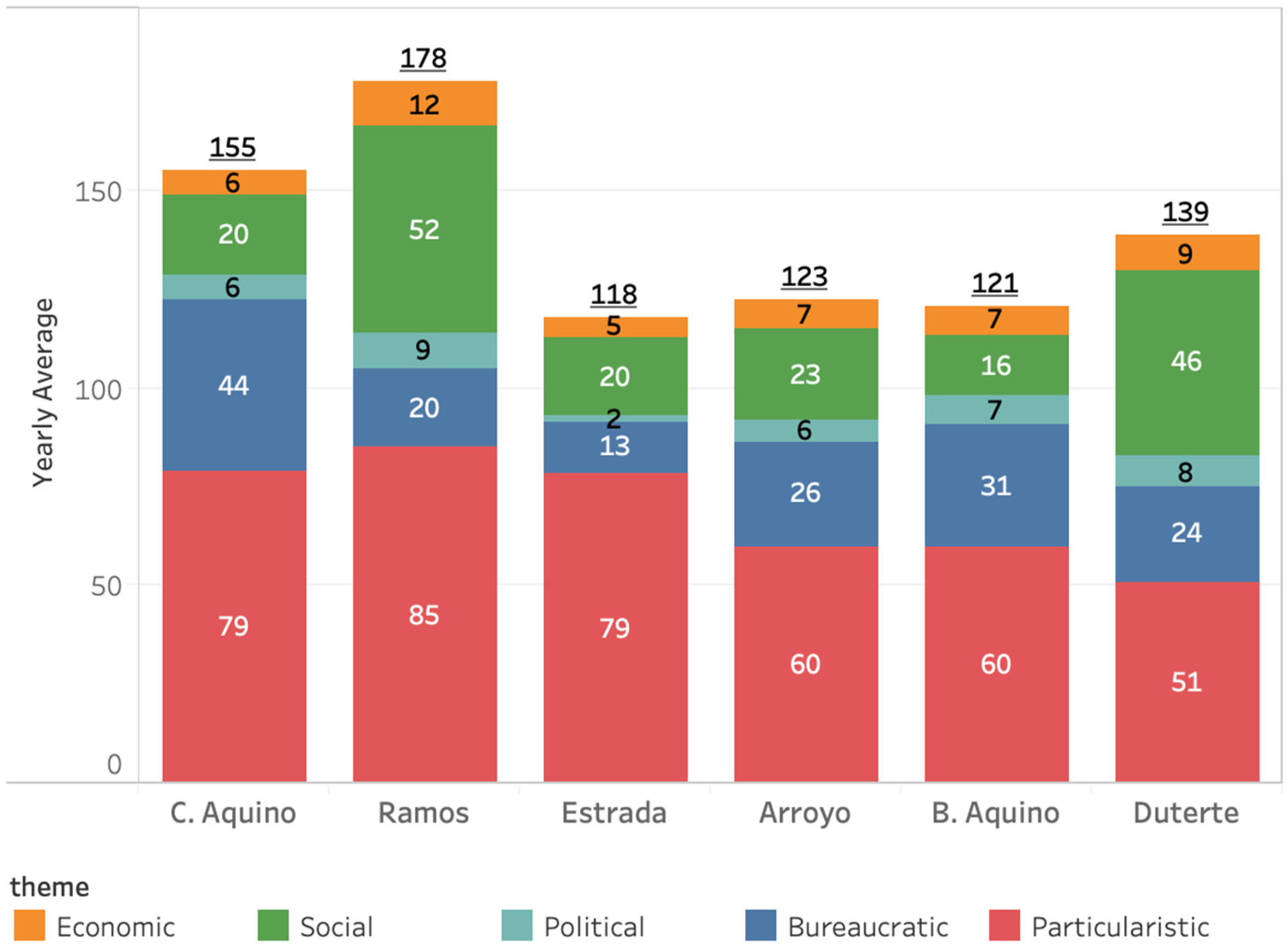
Yearly Average of Laws Passed Post-1987.
Meanwhile, bureaucratic laws regulate government agencies and facilitate the enforcement of public policies. President Corazon Aquino's administration had the highest number of bureaucratic laws with an average of forty four passed yearly and a total of 277 bureaucratic laws. On the other hand, the Ramos administration passed 119 bureaucratic laws with a twenty yearly average, while the Estrada administration only passed thirty two bureaucratic laws with around thirteen laws passed per year. President Corazon Aquino's efforts were concentrated on reforming the bureaucracy and decentralising political power after Martial law; and these are reflected in her administration's track record (Ilago, 2004).
Next, we evaluate laws that affect the entire population and work towards some of the key mandates set by the 1987 Constitution, notably republic acts focused on the political, economic, and social spheres. Figure 2 shows a comparison of the yearly averages of political, economic, and social legislation passed by each administration. While President Duterte only ranked third among post-EDSA presidents in the passage of general laws (see Figure 1), his administration is the second most productive in terms of these political, economic, and social reforms (e.g. second to the Ramos administration; see Figure 2) with economic and social reforms dominating this subset of laws. Economic laws include reforms to the National Internal Revenue Code of 1997, notably the Tax Reform for Acceleration and Inclusion Law (TRAIN Law) and the Corporate Recovery and Tax Incentives for Enterprises Act (CREATE Act), as well as the Coconut Farmers and Industry Trust Fund Act, which returns the funds collected during Martial law to coconut farmers. The law on rice tariffication was also passed by the Duterte administration, further liberalising trade in the politically sensitive crop and enabling the Philippines to finally comply with its commitment to the World Trade Organization. This law was a longstanding advocacy of reformists, possibly spanning almost three decades.
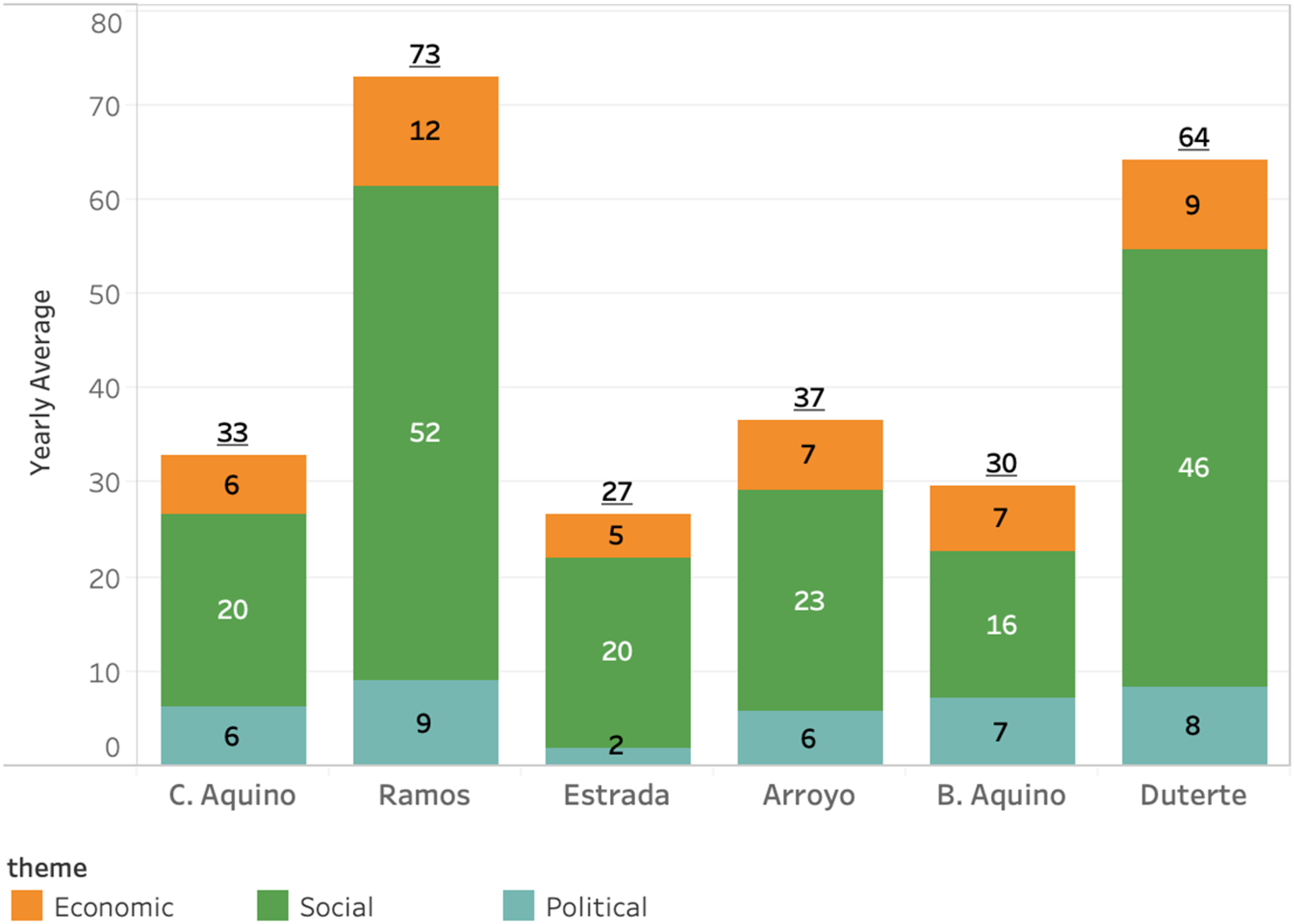
Yearly Average of Political, Economic, and Social Laws Passed Post-1987.
Yet many of these reforms, while on paper useful and long advocated for by reformists, were also accompanied by criticisms from key groups in their implementation. Studies have shown how the TRAIN law disproportionately affects the poor and worsens income inequality (Castillo et al., 2018; Manasan, 2018). Members of the coconut industry have also expressed dismay over the lack of safeguards on the distribution of the trust (Elemia, 2019). Rice farmers noted how support to help boost the competitiveness of the supply side has been poorly organised while the importation of rice delivered a weaker-than-expected reduction in commercial rice prices (Medenilla, 2020; Montemayor, 2020). Analysts have since acknowledged that well-designed policies and laws often do not survive the implementation phase unscathed (Marquardt, 2017; Mendoza, 2020).
Meanwhile, the Duterte administration has successfully passed some notable legislation in the social sphere promoting access to health and education such as the Universal Health Care Act and An Act Promoting Universal Access to Quality Tertiary Education by Providing for Free Tuition and Other School Fees in State Universities and Colleges, Local Universities and Colleges and State-Run Technical Vocational Institutions as well as institutionalising the country's social safety net programme known as the Pantawid Pamilyang Pilipino Program.
Political laws make up the smallest percentage of laws passed post-EDSA. Many of these laws are among the most difficult to pass in the Philippines given their direct impact on issues of political power, accountability, democratic governance, and national security (Abinales and Amoroso, 2017; Teehankee, 2016). The Duterte administration is conservative in the passage of political reforms with only around eight political laws passed in a year. Despite this, the president does not seem to shy away from promising bold political reforms such as federalism with all the complex power-sharing implications this entails. Recently, the anti-terror bill was passed despite widespread public criticism (Mendoza, 2020).
This brief overview illustrates that the Duterte administration fared well in comparison to post-EDSA administrations. Of course, relying on a mere listing of laws is not enough. Some laws are more significant and more difficult to pass than others. Assessing each reform according to the degree of difficulty in passing them is beyond the scope of this assessment. However, we can at least infer part of the challenge from how long some bills have taken to be passed into law. Some of these reforms have also been the subject of extensive analyses that provide a sense of the degree of difficulty in passing them. The table below puts together a snapshot of selected reforms identified as crucial by several reform assessments (e.g. Atienza and Cats-Baril, 2020; Mendoza and Olfindo, 2018). The time since the reform was first filed in Congress provides a possible indicator of how some reforms have been called for repeatedly but continues to be delayed. This raises the issue that the 1987 Constitution is not the main problem, rather the malfunction lies in the continued failure to implement ancillary reforms that were meant to complement and underpin it (Elemia, 2018a; Table 1).
Laws Deemed Critical and Their Status as of 2021.
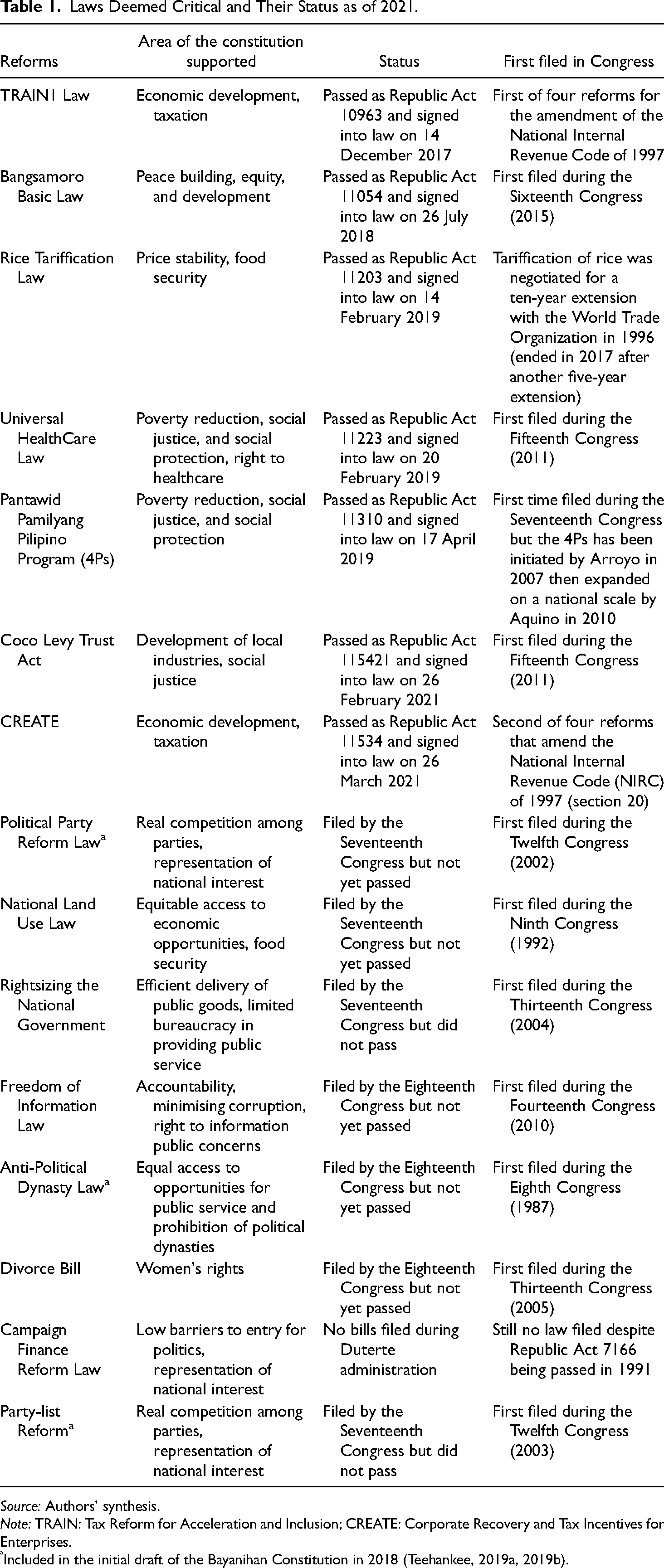
Source: Authors’ synthesis.
Note: TRAIN: Tax Reform for Acceleration and Inclusion; CREATE: Corporate Recovery and Tax Incentives for Enterprises.
Included in the initial draft of the Bayanihan Constitution in 2018 (Teehankee, 2019a, 2019b).
Thus, key reforms are still pending in Congress despite Duterte's legislative productivity. Some of these reforms are aimed at institutionalising the very promises of the Duterte administration to modernise the delivery of public service to the people and to bring political competition back to the government. The president's pursuit of genuine change in government could have then started with political reforms that have been pending in Congress for almost decades. President Duterte seems to have followed the trend of other post-EDSA presidents by prioritising social and economic reforms over political ones. The prioritisation of economic reforms is especially surprising given that there was very little attention to the economy during the president's campaign. The eight-point plan for economic reform under the Duterte administration was only produced three days after he was elected as the president (Cepeda, 2016). Some analysts also note how social and economic reforms prioritise efficiency over equity, a sharp contrast to the president's promise of redistributing the wealth of the country.
This signals an alignment of forces that seem to favour the liberalisation and deregulation of the economy, though not necessarily in terms of rectifying the unequal economic and political outcomes. In particular, the passage of TRAIN1 and CREATE grants corporations and the middle class a large tax cut, while increasing the reliance on indirect taxes shouldered by the public (Castillo et al., 2018; Manasan, 2018). Without a strong emphasis on effective pro-poor investments where leakages in public spending and corruption are minimised, this tax system does not necessarily advance equitable results. Furthermore, the passage of rice tariffication claims to advance consumer welfare (Balié et al., 2021; Cororaton and Yu, 2019), but has not resulted in a dramatic reduction in rice prices that was promised. It appears that rice farmers could have still benefited from increased supply-side and productivity-enhancing support during the transition (Ofreneo, 2020).
It is commendable that the Duterte administration managed to institutionalise social protection and healthcare in the country. In practice, however, these types of reforms are unable to trigger any consistent reform agenda for the executive branch. Corruption and inefficiencies in the bureaucracy remain among the major governance challenges in the healthcare system and in the country's social safety nets (Biana and Joaquin, 2020; Cho et al., 2020; Dayrit and Mendoza, 2020; Oxford Business Group, 2021). These show that, without any deep political reforms that improve the system that shapes day-to-day governance, social, and economic reforms are always subject to implementation deficits.
The overall legislative performance of the Duterte administration raises questions on the president's commitment to influence rapid and genuine political change. It is possible that Duterte had the means to put pressure on Congress and steer legislation in his direction. Duterte had record high approval ratings throughout his term, and enjoyed the largest supermajority coalition in Congress. His inability to do so, however, exposes how he is still perhaps limited by short-term interests he needs to juggle, rather than equipped with bargaining powers at his disposal. To evaluate this further, we trace the failed attempt to pass Duterte's main flagship policy of Federalism.
Charter Change Attempt 3.0
Most scholars agree that national constitutions remain unamended on the average only for nineteen years (Elkins et al., 2009). Hence, it is remarkable that the Philippine constitution has stood unchanged for thirty five years. Nevertheless, initiatives to amend or revise a constitution are part and parcel of being a constitutional democracy. Resisting such an initiative, provided it is supported by a rational public deliberative process, is an integral component of constitutional democracy as well. As a constitutional democracy, the Philippines finds itself perfectly within this constitutional reform context. In fact, former presidents have attempted to change the 1987 Constitution, and also failed just like the Duterte administration did. What stands out about Duterte's attempt, however, is that he is the first president-elect to have promised to change the Constitution to shift from a unitary political system to federalism (Teehankee, 2018).
In 1997, as his 6-year term was about to end, then President Fidel V. Ramos initiated efforts to amend the 1987 Constitution with the help of the People's Initiative for Reform Modernization and Action (PIRMA) through people's initiative. The late Senator Miriam Santiago, a critic of President Ramos, filed a petition in the Supreme Court questioning the propriety of the group's chosen method in amending the constitution. The court ruled in favour of the petition citing the inadequacy of the law regulating the method of people's initiative. 2 This decision effectively stopped the charter change campaign of PIRMA. Yet the failure of President Ramos to achieve his goal of amending the 1987 Constitution was mainly attributed to his administration's inability to overcome widespread public suspicion that their primary intent was to extend his term and those of other elective officials (La Viña and Aceron, 2012).
In 2000, two years into his term, then President Joseph Estrada also launched an initiative to amend the 1987 Constitution with the aid of the Constitutional Correction for Development or CONCORD. President Estrada was a very popular president, but even his popularity could not carry his ambitions over public scepticism (La Viña and Aceron, 2012). At one point, he even publicly lamented the people's lack of support despite his active campaigning for charter change. His plan was ultimately stopped when he resigned from the office in 2001.
Then President Gloria Macapagal-Arroyo, with the rapid support of then House Speaker Jose de Venecia, initiated in 2006 a charter change effort through a purported, but actually government led, people's initiative called Sigaw ng Bayan. This effort was also questioned before the Supreme Court which ruled against Sigaw ng Bayan using the Santiago case as precedent. 3 Similarly, this decision also put a stop to President Arroyo's plans to amend the 1987 Constitution. But her failure was still ultimately blamed on the “lack of credibility of leaders and initiators” of the effort, including the president herself (La Viña and Aceron, 2012: 64).
The most notable facet of the constitutional reform saga of the Philippines is that charter change initiatives are essentially political projects of the incumbent president and his or her allies. Apart from their supporters, there is generally a disconnect between the public-at-large and the charter reform effort. Therefore, the main talking-points accompanying these campaigns have always revolved around the personalities leading it and their motivations (Yusingco, 2019).
Unlike previous presidents whose attempts happened in the near-end of their terms, President Duterte's push for charter change started even before his official campaign for presidency. Duterte had launched a nationwide campaign for federalism in 2014 as Davao City Mayor, claiming that federalism will facilitate better services to the people and address ethno-religious conflicts in Mindanao (Alipon, 2014). Following populist rhetoric, he argued that federalism can correct the antiquated political system that favours the development of Metro Manila over other regions. In the 2016 presidential elections, President Duterte had campaigned to shepherd the Philippines towards a federal form of government; an undertaking that would require an extensive overhaul of the country's constitution.
For Rood (2019), the move to federalism has significant challenges from Manila-centric elites, democracy advocates suspicious of the motivations behind charter change, and businessmen concerned about possible local regulations. Nevertheless, Ferrer (2016) noted that the newly elected president faced promising prospects for uniting politicians in support of charter change. Aside from high-satisfaction ratings that propelled Duterte's influence during his honeymoon period, many legislators saw the 16.6 million votes for the president as a mandate for federalism. All key decision makers in government are also from Mindanao, the southernmost island group of the country with the most stakes in federalism. 4 The president himself is the first Mindanaoan president of the country. Then Senate President Aquilino (Koko) Pimentel and House Speaker Pantaleon Alvarez belonged to the same political party as Duterte. Pimentel was the head of Partido Demokratikong Pilipino-Lakas ng Bayan (PDP-LABAN), a pro-federalism political party. Meanwhile, Alvarez came from Davao and led a broad supermajority coalition in support of the president.
In December 2016, President Duterte issued Executive Order (E.O.) No. 10 directing the creation of a Consultative Committee on constitutional reform. The mandate of the committee was to “study, conduct consultations, and review the provisions of the 1987 Constitution including but not limited to the provisions on the structure and powers of the government, local governance, and economic policies.” The committee was ordered to submit a report to the president within six months. However, there was a long delay as members of the committee were appointed only in January 2018. The committee was headed by former Chief Justice Reynato Puno and comprised reform-minded experts in the field, ranging from former jurists and legal practitioners to scholars. Appointees also included the late former Senate President Nene Pimentel, a long-time advocate of federalism, as well as several members from minority communities in Bangsamoro and Cordillera.
The committee was directed by President Duterte to produce a draft federal constitution by June 2018. This would have enabled Duterte to announce the draft in his State of the Nation Address scheduled the following month. The common view at that time was that he would endorse the draft to both the Senate and the House of Representatives and thus initiate the process of constitutional change. The committee was able to submit their work, which they labelled as the Bayanihan Federalism draft, to President Duterte on 9 July 2018, and a final version was accomplished on 17th July (Ranada, 2018). The Bayanihan Federalism draft contains notable innovations aside from federalism such as the expansion of the Bill of Rights to include socioeconomic and environmental rights, the creation of a Democracy Fund to be distributed to political parties as campaign funds, and anti-dynasty provisions (Atienza, 2018).
During this time, the president has already established a strong professional reputation. An article published in July 2018 states that the war on drugs has resulted in more than 20,000 casualties, including the deaths of at least ten mayors (Hincks, 2018). For human rights organisations, the drug war is a mere cover for the president's crack down of criticism and political opponents. Even well-known figures were not spared. Former Senator Leila de Lima, who investigated then Mayor Duterte in 2009 over allegations of extrajudicial killings in Davao and was an outspoken critic of the drug war, was jailed for accusations of being a drug protector during her stint as justice secretary (Regencia, 2019). Duterte is also known to reward political allies through government appointments (Ranada, 2017) and cronyism (Mendoza et al., 2022).
Yet despite the president's strong signal of political will, Duterte's leadership over the initiative was lax and oftentimes ambiguous. The much anticipated endorsement was not given during the State of the Nation Address. In fact, the attitude he exhibited towards constitutional change offered no clear indication where and how he wanted the initiative to proceed, to wit: Four administrations before me have all tried to amend the Constitution to be able to introduce amendments and reservations to the charter – revisions rather to the charter. But none of them was successfully done for one reason or another. I therefore consider it a distinct honor and privilege to have received earlier from the Consultative Committee that I created, the draft Federal Constitution that will truly embody the ideals and aspirations of all the Filipino people. I thank all the members of the Committee, especially those who came out from their retirement, for their valuable services in crafting this draft Federal Constitution. I would like to extend my particular gratitude to Former Chief Justice Reynato Puno and Former Senate President Aquilino Pimentel, Jr. I am confident that the Filipino people will stand behind us as we introduce this new fundamental law that will not only strengthen our democratic institutions, but will also create an environment where every Filipino – regardless of social status, religion, or ideology – will have an equal opportunity to grow and create a future that he or she can proudly bequeath to the succeeding generations.
5
Just days after President Duterte's tepid response to the Bayanihan Federalism draft, the heads of vital national government agencies such as the National Economic and Development Authority, the Secretary of Finance, and the Secretary of Defense, separately expressed reservation on the readiness of the country for federalism as well as the possibility of its costs disrupting the country's economic growth (De Vera and Yap, 2018; Wakefield, 2018). Ranhilio Aquino, member of Duterte's Constitutional Committee, called for their dismissal from Duterte's Cabinet (Teodoro, 2018). Some of the country's biggest business groups also came together to express anxiety over the proposed constitution. The group raised concern about “the ambiguous provisions on the division of revenue and expenditure responsibilities between the proposed federal government and its federated regions” (Desiderio, 2018).
Congress also ran a parallel process that developed an alternative draft constitution, doing away with some of the key reform features of the Bayanihan Constitution draft. Composed of political dynasts and long-term politicians, Congress removed the anti-dynasty provisions and term limits from the draft constitution. Penned by, among other Congressional leaders, former President and Representative Gloria Macapagal-Arroyo, this draft constitution, at least initially, even went so far as to remove Vice President Leni Robredo in the line of succession during the transition to federalism. This was subsequently removed due to public uproar. Rather than a harbinger of deep political reforms, the competing draft was seen by analysts as an attempt by the politicians in Congress to hijack the reform process.
At this point, the prospects of successfully passing the federalism bill have dimmed. Despite the president's high approval ratings, nationwide surveys in 2018 reflect a deep mistrust among the public in the move for federalism (Rappler, 2018; Social Weather Stations, 2018). The opposition and even allies of the Duterte administrations of constitutional reform have relied on these polling outcomes to justify the unreadiness of Filipinos to undertake charter change and the need to still campaign for awareness and support for the policy (Balagtas, 2018).
Moreover, the July 2018 Supreme Court decision on the Mandanas case increased intergovernmental allocations for local governments, effectively weakening the push for federalism. The total internal revenue allotment for local government units is expected to increase by 291 billion (Romero, 2021). This increase tempered the urgency among local government officials for federalism given that the main raison d’etre in their support is Duterte's promise of an increased share of the public finance pie for the province. However, this also meant a decrease in the amount of funds that can be used by the central government. This prompted the Duterte administration to revisit the administrative decentralisation prescribed by the local government code (LGC) with the issuance of E.O. No. 138 – Full Devolution of Certain Functions of the Executive Branch to Local Governments, Creation of a Committee on Devolution, and for Other Purposes. The implementation of the Mandanas decision and E.O. No. 138 thus became the focus of the Duterte administration, completely side-lining its federalism agenda.
There are significant obstacles to Duterte's push for federalism as interest for federalism is generally low for the public and even local government officials, and Duterte's own Cabinet members raise concerns on the costs and appropriateness of constitutional reform. However, President Duterte surprisingly injected the federalism drive with new energy issuing Memorandum Circular No. 52 on October 2018 calling for the organisation of the Inter-Agency Task Force on Federalism and Constitutional Reform (IATF) which is to be spearheaded by the Department of the Interior and Local Government's (DILG). 6
The creation of the IATF signalled that the charter change initiative has not been relegated to the dustbin. With this new mandate to push the constitutional reform agenda even beyond the Bayanihan Federalism draft, there was an expectation again that President Duterte will have a stronger and more explicit exhortation in his 2019 State of the Nation Address. Indeed, there were talks once again that the president would expressly direct the fast-tracking of the constitutional reform process in order to finish this before his term ends in 2022. But to the shock and disappointment of all those expecting a more compelling declaration of support, there was absolutely no mention of federalism or charter change in the president's State of the Nation Address (Elemia, 2018b). In an interview immediately after his address, President Duterte told reporters that “it is not the proper time” to discuss the issue of constitutional reform, even conceding that this could happen after his term ends in 2022 (Santos, 2019).
In July 2019, Dr. Julio Teehankee, a member of President Duterte's Consultative Committee, penned an article conceding that the administration's federalist project was “indefinitely on hold” (Teehankee, 2019a). The 2020 coronavirus pandemic revealed the shortcomings of federalism as the national government provided authoritative leadership over local government officials as well as the necessary funds to respond to the crisis (Gatdula, 2020). This would have been much more challenging under a federal government as it creates two parallel forms of authority and promotes the fiscal independence of local governments. Along with the end of Duterte's presidency in sight, support, and perceived urgency for federalism among citizens and legislators alike probably reduced further.
Nevertheless, the entire episode still emphasised the same pitfalls and perils of constitutional reform that plagued attempts by previous presidents, in that all were met with suspicion that these politicians would hijack the process and merely wish to claw back more political power. It was clear though that President Duterte failed to use his unprecedented trust rating and supermajority in Congress to really push his constitutional reform agenda. The fact that President Duterte was arguably in a stronger political standing compared to other presidents when they pushed charter change makes his failure more disappointing from the perspective of constitutional reformists.
Conclusion
It is not an exaggeration to assert that an incumbent president's legislative agenda begins and ends with them. In the absence of programmatic political parties that bind the goals of the president and Congress, the president of the Philippines is put in a position of bargaining with Congress for the passage of flagship policies. Conventional literature abroad has detailed the various circumstances that shape how effectively a president can achieve this (Kernell, 1986; Neustadt, 1990). Aside from the strategic dispensation of patronage and appointments, presidential influence over Congress also relies on the president's popular support, display of political will, leadership style, and the socioeconomic contexts within which negotiations are made. Duterte's consistent popularity combined with the supermajority in both houses of Congress offered a rare window of opportunity to address deep structural reforms in the country's political system. Yet like previous regimes, the Duterte administration still fell short in amending the Constitution and, in effect, fulfilling the campaign promise of federalism.
President Duterte's populist rise to presidency is likely tied to the decades-long struggle to advance reforms that have promoted economic growth; but moves more incrementally in areas addressing deep inequality and insecurity among Filipinos. His campaign promise of swift and comprehensive changes to the political system was backed by consistently high public prestige and a coercive professional reputation during his term. Both circumstances result in public pressure and political considerations that could have pushed legislators and Cabinet members to fully support Duterte. While this is reflected in the crucial reforms passed in Table 1, President Duterte's failed attempt at charter change exposes cracks in his commitment to the policy in the first place.
Beyond the institutional means at the president's disposal, the case of federalism during the Duterte administration shows that leadership style matters. For a president whose reputation lies in a strongman political image and a decisively populist rhetoric, Duterte's inadequate and vague statements on Federalism was a clear sign that it is not his priority. Ambiguity led to key political actors loading their versions of the constitutional draft with other interests, effectively triggering the Filipino people's deep mistrust for Constitutional reform in the first place. In addition, unforeseen circumstances strayed the Philippines further away from Constitutional reform. While efforts have continued to campaign for charter change later on, the public health emergency, and economic insecurity brought by the pandemic put other concerns at the forefront of legislators and the public.
The de facto exercise of executive power has become virtually unfettered due to the lack of genuine political parties in the country's political system. The pervading personality-driven politics has in turn led to the practice of tailor-fitting a reform agenda on the person of the holder of the office. President Duterte has not deviated from this practice at all, despite his campaign slogan that “change has come.” The failure of the federalism agenda and the non-implementation of key reforms that could better realise the promises of the president, combined with the continued emphasis on socioeconomic reforms vulnerable to shortcomings in their implementation all signal, in fact, more of the same. A benign interpretation might conclude that the first president from Mindanao continued to push pro-growth reforms but failed to push deeper inclusive development, political, and governance reforms similar to the other post-EDSA leaders. An excoriating view might assert that these attempts are limited by the president's own identity as a member of a prominent political dynasty whose political prospects were buoyed by traditional business and political interests. There might have not been strong motivation to change the status quo as he himself directly benefited from an unequal political landscape that allows dynasties to perpetuate power and evade accountability.
Footnotes
Declaration of Conflicting Interests
The author(s) declared no potential conflicts of interest with respect to the research, authorship, and/or publication of this article.
Funding
The author(s) received no financial support for the research, authorship, and/or publication of this article
Notes
Author Biographies
Appendix 1
See Table A1.