



Abstract
In this article, we analyze the impact that the evolution of the middle classes has had on political representation in Chile. Based on a description of the transformations of Chilean social structure in recent decades, we review the conceptual frameworks available on the subject, from modernization theories and the rise of new masses – particularly the one that “emerged” from poverty – to the forming of new critical citizens. We state that the heterogeneity of Chilean middle classes has challenged the discredited representation system. We observe more efficient representation channels developing for medium-high-income, educated, and consolidated sectors in contrast to new social policy demands from emerging and vulnerable sectors, focusing more on consolidating their economic status than on improving representation channels.
Introduction
A grim perspective on political representation characterizes current diagnoses in Chile and other Latin American countries. Its regular forms have failed to counterbalance escalating citizen disaffection with politics, distrust of institutions, declining voting turnout, or the sustained resurgence of street protest. In this environment, new and consolidated middle classes seem to play an important role in shaping demands that challenge traditional forms of representation; this is a far cry from the pattern of the 20th century, when middle-class interests were channeled by centrist parties (Johnson 1971; Lomnitz 1998). This situation has reopened the debate on whether the middle classes fuel a modernizing democratic project or actually have the potential to destabilize the political system (Zeitlin and Petras 1970), especially regarding new groups that have emerged from poverty in the last decades. A sustained decline in poverty levels across Latin America and the Caribbean in recent decades has made apparent new social demands, well beyond the threshold for inclusion. However, it still remains to be seen whether a causal order exists between these and the challenges to political representation.
In this article, 1 we discuss the extent to which the supposed expansion of middle classes in the last 30 years has impacted the institutional system. We examine the Chilean case from three perspectives. 2 First, by taking up the classical reflection of Germani (1971), we review the implications of the emergence of middle classes as a new stage of modernization (Filgueira et al. 2012). We will particularly observe how these contingents have found room within a restricted political representation system in Chile since 1990. We contrast Germani's conjecture about “available masses” 3 with two more recent approaches. The first is the approach of Norris (2011) on the mobilization of critical citizens who value democracy, but are unsatisfied with how it works. 4 The second approach is one of pragmatism of the middle classes in expressing their interests (Munijin 2010; Paramio 2010). Leaving aside a thesis that sustains a simple association between middle classes and political representation, we aim to better understand the relationships between the political field and the diverse groups located in the middle section of Chilean society. We keep in mind that the heterogeneity of these sectors makes it difficult, even for its members, to read into their political and social interests, thus generating ambiguity in their demands. We argue that there is not enough ground to sustain a hypothesis based on classical modernization theory paralleling the situation of middle classes with the available masses in the populist configuration. Instead, we argue that we must consider two segments. The first is a new, more educated and critical generation that exercises pressure toward opening and modernizing the representation system. The second is the more vulnerable sectors of mesocracy, bordering lower classes, who fearfully regard the opening of the political system as a threat to the precarious status they have acquired in the last decades. These circumstances reinforce the pragmatist hypothesis regarding vulnerable Chilean low-middle classes, who evaluate which proposals best fit its current and changing interests.
Acknowledgments: Projects: CONICYT/FONDAP/15130009, FONDECYT 1160984, USACH-VRIDEI-DICYT 031394VE, Programa de Estímulo a la Excelencia Institucional de la Universidad de Chile-Fondo de Fortalecimiento de Productividad y Continuidad en Investigación; Facultad de Ciencias Sociales. Comments from Cristóbal Rovira, Rossana Castiglioni, Alfredo Joignant, Lucas Cifuentes and our anonymous reviewers who have contributed to enrich the analysis, as well as comments received during the workshop “Challenges to democratic representation in contemporary Chile” organized at Universidad Diego Portales on 31 March 2016. The authors would like to acknowledge support from the Chilean Millennium Science Initiative (project NS130008). We also thank Nikolai Stieglitz for his editing suggestions.
To date, no data has made it possible to measure both social class – as understood in the sociological field – and political action or representation from different political groups in Chile, less so through historical series from 1990 on. This is the reason why we use secondary data and reports.
Although Germani's concept of available masses referred to the origin of Peronism and focused on the newly urbanized working class, some parallels are worth pursuing with regard to the Chilean lower middle class, as we will show in this article.
The critical citizen concept ranges from people who have critical opinions about the political system and do not show formal engagement, to regular participation in political alternative action and protest.
The remainder of this paper is structured in three parts. In the first part, we characterize the position of the middle classes in the social structure as well as in terms of their participation in politics. We discuss the assumption of modernization theory about political representation. In the second part, we raise alternative interpretations regarding the impact of social structure transformation on the democratic representation process in Chile today. Here we discuss the argument about emerging critical citizens, particularly among mobilized groups of civil servants, students, and environmentalists. Finally, we examine the political behavior of the so-called “new” middle sectors, made up of low-income manual workers – frequently called “emergent” or “vulnerable” – who are more relatively apolitical and concerned with possible displacement. We argue that this last configuration poses the greatest challenges to the Chilean representation system and even for the understanding of what middle classes are.
Socioeconomic Characteristics of Chilean Middle Classes and their Relationship to Political Representation
The middle classes 5 comprise a heterogeneous set of social groups that are plainly defined as being neither rich nor poor, or generically as “middle-income earners” (see Introduction by Castiglioni and Rovira, in this issue). The middle of the social pyramid varies greatly in terms of occupation, education level, and income. In terms of their occupations, middle classes represent approximately 40 percent of the workforce (Torche and Wormald 2004; Espinoza, Barozet, and Méndez 2013), encompassing professionals and technicians, non-manual or “white collar” workers, as well as less qualified professionals and skilled “blue collar” workers. They are mostly salaried workers, from the public and private sector, but also comprise small owners and independent workers. Their incomes are usually defined by a standard range around the median income (Barozet and Espinoza 2009). 6 Compared to both ends of the social pyramid, middle classes possess higher cultural capital than lower classes, but lack the patrimony of higher income sectors.
Our use is broader than strict “class” taxonomy (Paramio 2010).
According to CASEN 2015, the mean monthly income in Chile is 425 USD per capita, while the median income (256 USD per capita) is close to the poverty line (215 USD per capita). If purchasing power was the key for characterizing middle classes, Chilean middle-income sectors would hardly correspond to a family with its own house and access to quality health and education services. Yet, following international standards that define middle strata as the group that falls within +/-25 percent of median income, the lower bracket falls under the poverty line. From a consumption point of view, however, that would include households that make between 900 USD monthly on the lower end, up to 4,500 USD at the higher end, comprising several consumption patterns as well as investment and saving capacities (AIM 2015).
Self-assignment to the middle classes applies to over 70 percent of the Chilean population, well above any measurement based on indicators of social position (Méndez 2008). 7 Members of the middle classes usually show no common social identities, because an income bracket or a broad occupational definition does not offer a sound basis to infer about aspirations, opinions, or behavior. Indeed, many people who describe themselves as middle class find it difficult to define their social identity: their status is higher than their parents, but they do not feel they have reached a stable position (Araujo and Martuccelli 2012; Espinoza 2012). Due to the intrinsic heterogeneity of this group, middle classes are often described as “moving targets” (Chauvel 2000) because their configuration changes according to the tool and conceptual definitions applied.
Figures published by Torche and Wormald (2004) show up to 83.5 percent of Chileans self-identifying as middle class in the Chilean population in 2001.
Regarding the regional context, poverty in Latin America dropped from 48.4 percent in 1990 to 28 percent in 2014, but this trend occurred earlier and at a faster pace in Chile. The expansion of middle classes in Chile is mostly the result of the drastic drop in poverty, from 45 percent in 1987 to 11.7 percent in 2015 (CASEN 2016), in a context of low inflation, growth rates close to 5 percent for over two decades, and social policies favoring social inclusion. Since 1992, average household income doubled in real terms (Barozet and Espinoza forthcoming). Although some of these households face the risk of a “poverty relapse”, their increase in developing countries has posed a number of questions about their characteristics and affinity for democratic values.
From an historical point of view, four conglomerates stand out among the different groups composing the middle classes in Chile: the traditional middle class, the new professionals, the self-employed and sectors “emerging” from poverty. First, there is a traditional middle class, mainly represented by civil servants, which flourished from the 1920s until the early 1970s under a protective industrial policy and active economic state involvement. In those days, this group enjoyed favorable status, which it could not regain following its pauperization during the 1970s and 1980s as a result of the implementation of free-market policies in Chile (Martínez and Tironi 1985). But in spite of economic transformations, their unions have gained increasing influence in the definition of public policies since the 1990s.
Starting in the 1980s, new middle segments associated to the private sector appeared, thus increasing occupational and income differentiation within them (Torche and Wormald 2004; Espinoza, Barozet, and Méndez 2013). This group has expanded first with qualified professionals and technicians, as a result of the growth of higher education since the 1990s. This increasing group of engineers, physicians, and financial experts (among other prominent categories) tends to fill the salaried ranks in large firms, although sometimes under precarious contractual conditions (OECD 2010; Ruiz and Boccardo 2015). Neither routine white collar workers nor professionals in the private sector have developed unions or similar organizations, while professional associations lack strength and continuity in their relationship to the public sector or the legislators (Espinoza 2001).
A self-employed middle sector is the third group and the second to grow in recent decades due to the progress of Chilean economy. Trade growth has created opportunities to establish and expand small and medium-sized firms, especially in the service sector, on a formal and stable basis. These self-employed middle sectors belong to traditional industries such as transportation, lodging and retail, and also provide security, cleaning, and financial services to the new economic sector and to large firms (Mac-Clure 2001). Small business represents its interests in several trade associations, usually divided by industry, and has gained some influence in channeling public investment. In 2014, thanks to public debates around tax reform, this group gained support from center and right-wing political parties (Espinoza and Palominos 2014).
Finally, since the early 1990s, the fourth and last middle-sector group has been represented by an important contingent that left poverty to occupy a hard to define position. This improvement is the result of both economic growth and “pro-poor” public policy, particularly through the expansion of the labor market and transfers (Espinoza and Barozet forthcoming). In the absence of a better concept, they were named “emerging”, but also “vulnerable” and even as “the new middle class”. Although some members of this group fall back into poverty, the increase in average income of these groups is noteworthy compared to the 1980s. This low-income non-poor strata use financial credit to expand their consumption and to put their children through college and technical training. Although our viewpoint is that these groups are better defined as working than middle classes, debate remains about whether the whole group outside of poverty must be considered part of the middle class; meanwhile, they are targeted by market strategies and many consider it a profitable category from a political perspective (Gazmuri 2002).
The size of the middle classes has been a controversial subject in the debate about social structure in Chile and Latin America (Espinoza and Núñez 2014). Broadly defined to include groups outside of poverty, the middle classes have increased from 30 percent to 50 percent since the mid-1990s (Bárcena and Serra 2010), based on a non-demanding definition of families whose daily per capita expenditures (valued at purchasing power parity) are between 2 and 10 USD (Banerjee and Duflo 2008). 8 Some have observed that 20 percent of this group have very low income to be considered part of middle classes, despite internal transformations (Franco, Hopenhayn, and León 2010; Ruiz and Boccardo 2015; Güemes 2016). 9 The following table synthetizes the evolution of these social segments using employment data over the last decades. 10
Other measurements place the middle classes between the 20th and 80th percentiles of consumption distribution (Birdsall, Graham, and Pettinato 2000). These measurements are too broad to characterize these groups in terms of their political orientations or demands.
Using OECD measurement of +/-50 percent from the median income, the middle classes would also remain at 33 percent during recent decades.
Chilean historical statistics are quite limited for building detailed, theory-related classifications, specifically for the construction of class variables, based on labor relationships.
Composition of Middle and Working Class Sectors in Chile (1971–2009), as a Percentage of the Labor Force
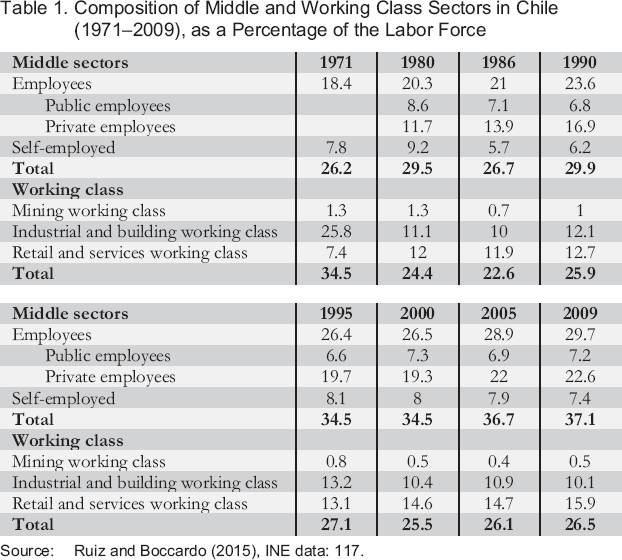
Source: Ruiz and Boccardo (2015), INE data: 117.
Regarding the relationship between middle classes and political representation, we will use a broad definition of representation, as a set of links between citizens, social movements and political institutions, to better capture the diversity of forms of expression of the middle classes. Political representation comprises the relationship between citizens and political parties, as well as autonomous civil organizations and social movements that take responsibility for speaking for the population's interests. Although there is an important representation crisis in several countries in the region (Mainwaring, Bejarano, and Pizarro 2005), Chile is not currently on the verge of rupture or collapse of the partisan system; therefore, we will concentrate on the challenges faced by the country in terms of representation of the middle classes.
Historically, middle-class politics has been associated with a ternary conception of society vis-à-vis lower classes and accommodated sectors. Moore (1966) singled out the close relationship between the bourgeoisie and democratization processes associated with the industrial revolution. The “bourgeois impetus” in northern countries established the idea of a virtuous association between middle classes and economic and political modernization. During the 20th century, as new middle segments develop under the wing of the state, this conception tended to highlight the alleged political stability of the middle classes. Roughly speaking, middle sectors strived for a third, moderate vision between socialism or collectivism of the poorest sectors on one side and the defense of capitalism of the wealthiest sectors on the other (Boltanski 1982). After the Second World War, Lipset and Smelser (1966) brought back the debate pointing to the consequences for political modernization of the rising income of the population; Przeworski and Limongi (1997) refined this relationship for Latin America, stressing the absence of a linear relationship between the two phenomena.
During the 20th century, however, the theory of middle-class pragmatism gained strength (Grynspan and Paramio 2012). Uncertainty in their social position, associated with the absence of political references, offered grounds for this interpretation. Public policies, political discourses, and institutions face great difficulties in identifying their aspirations and demands. Political parties, syndicates, or trade associations do no better in terms of shaping their identities, which are permanently threatened by job turnover. These elements configure an inherent contradiction in the middle classes between emancipating and elitist dimensions, expressed in their interest in differentiating themselves from the lower classes in terms of symbolic status (Gouldner 1979). No direct relationship emerges, then, between middle classes and democratic stability because they could take different courses regarding politics and representation systems depending on the country's economic situation and perspectives of individual progress. Indeed, during the 20th century, middle classes in Latin America have supported authoritarian projects when they felt their position threatened (Tedesco and Barton 2004). Similarly, when the improvement of the living standards of lower classes does not hinder their own improvement, or when transformation favors their position with regard to the elite, middle classes may support democratizing projects. Otherwise, they pragmatically support proposals that they feel will guarantee economic stability (Johnson 1958), as happened at the end of the Unidad Popular in Chile (Candina 2013).
More recently, and largely ignoring these historical trends, international institutions have generally taken a positive view of middle sector, even considering it “the backbone of both the market economy and of democracy in most advanced societies” (Birdsall, Graham, and Pettinato 2000: 1; OECD 2010). Other authors have been more skeptical towards the association between democratic values and middle sectors (López-Calva, Rigolini, and Torche 2011; Fierro 2015). A detailed assessment of the Chilean situation might offer some insights into these varied approaches.
The Impact of Critical Middle Classes on Democratic Representation in Contemporary Chile
Beyond being “neither rich nor poor,” middle classes today share the characteristic discomfort of intermediate categories (Peugny 2009). This theory, which was formulated to describe Chilean society at the end of the 1990s (UNDP 1998), highlights the precariousness of post-dictatorship social protection systems, the “privatization” of public life, which adds to the slowdown of upward occupational mobility during the 2000s (Espinoza and Núñez 2014). Declining prices for raw materials across the continent and the halving of the price of copper in Chile since 2014, have also shaped a new scenario, particularly regarding the government's social investment capacity, which is sure to mold the expectations of expansion or consolidation of middle classes. A segment of “dissatisfied democrats” has risen up against this background of discomfort, giving political expression to the growing distance between citizens and the representation system during the last few decades (Dahlberg, Linde, and Holmberg 2015).
Voting offers a first opening for analysis of the association between middle classes and political representation. Measurements from the 1990s show no direct relationship between socioeconomic level and political preferences because, apart from the simultaneous operation of religious and class cleavages, an authoritarian/democratic cleavage, inherited from the plebiscite of 1988, has had a persistent effect (Valenzuela and Scully 1997; Tironi, Agüero, and Valenzuela 2001). To complicate things more, rampant and unleashed political disaffection grew in large sections of the population (Baño 1995). A drastic decline in electoral participation has reflected this, especially since 2012 when voluntary voting came into effect (Contreras, Joignant, and Morales 2015), with turnout plummeting to 35 percent in 2016 municipal elections. This situation is not only part of the disaffection of citizens, but also of their critical opinion about the political class. 11
The percentage of people participating in elections in Chile, in relation to the total voting age population, decreased sustainably from 86 percent in 1989 to 44 percent in 2013 (UNDP 2015), while the percentage of people disinterested in politics has grown from 56 percent in 1989 to 76 percent in 2016, peaking at 87 percent in 1998 (Mori 2016a). Confidence in political institutions is almost non-existent – 7 percent for both houses of Congress and 6 percent for political parties – while the highest score is for the police force, with 51 percent (Mori 2016b).
The influence of middle classes on electoral outcomes was first hypothesized for the presidential elections of 2009–2010. Middle class “aspirational” groups would have withdrawn their support from the Concertación, the coalition of center left parties, and shifted it to the right, led by Sebastián Piñera (Barrueto and Navia 2015; Aninat and Elacqua 2010). 12 Subsequent elections have confirmed increasing volatility and dealignment of these groups from traditional axes, as well as the re-composition of the middle class vote for the right (Castillo 2014; Bargsted and Somma 2016). These challenges have occurred in conjunction with an expanding wave of social protests since the mid-2000s, 13 which have channeled middle-class demands about upward mobility and social justice. For approximately two decades, successful policies of social in-clusion – namely access to consumption of durable goods and higher education – have kept social demands at bay. However, since 2006, massive street demonstrations have proven quite efficacious for setting the priorities in the political agenda of political parties, without being clearly articulated. These movements have been able to influence the representation system, directing the political energy towards a transformation of the public agenda. The linkages between discomfort and social protest in Chile converge with interpretations by Norris (2011) regarding the influence of critical citizens and their engagement in contentious politics. However, although the middle classes in Chile participate in protests, they use various forms of representation that are worth examining in terms of demand and vectors of the representation system itself.
Using the Centro de Estudios Públicos’ survey, Barrueto and Navia showed that support for the right wing regarding the C2 and C3 sectors (as measured by marketing and which represent lower-middle and middle-middle class) increased from 18.5 percent to 42 percent between the 1993 and 2009 presidential elections, respectively. Research on middle sectors faces the challenge of limited measurement tools, particularly for tracing class or socioeconomic level of voters through their income or education (Bargsted and Somma 2016; Barrueto and Navia 2015; Bucarey, Engel, and Jorquera 2013).
Somma and Medel (2017) show a strong increase of social protest in Chile between 2000 and 2012, through measurement of the number of events (from around 150 a year to more than 400) and of people participating in contentious action (from around 900 to more than 2,000 over the same period).
For example, several traditional middle class unions, particularly those of teachers, health workers, and public officers, have managed not only to increase their demands, but also have met some of them. Examples of these classical “middle-middle class” (clase media-media) demands are the bargaining power of the National Association of Public Employees (ANEF, after its name in Spanish, Agrupación Nacional de Empleados Fiscales), the Teacher's Union, and the National Federation of Health Workers. These unions have improved their members’ life conditions, particularly in terms of salaries, 14 bonuses, training and retirement conditions, especially recently, in the frame of the educational reform designed by the second Bachelet government (2014–2018). The medical and teaching guilds have been particularly strong in terms of corporate negotiation (Espinoza 2001). Interestingly, the number of strikes has grown substantively in the public sector since 1990, much more than in the private sector, especially since 2007 (OHL 2016). The bargaining power of workers in CODELCO – the state copper company – is also high, obtaining significant benefits after periods of strike while the price of copper was ballooning on international markets. 15 However, they coexist with the demands of outsourced staff in the same sector, who earn less and have less stability.
Data are very limited and unavailable by sub- sector. Series are available only from 2001 to 2014 through the Encuesta Suplementaria de Ingresos (ESI). Also, in 2010 there was a change in methodology, which makes it unadvisable to compare the entire period. Comparing nominal income from 2001 to 2009, the salaries of civil servants and private sector workers increased by 1.55 times and 1.44 times, respectively. From 2010–2014, the difference in growth was reduced for these groups (1.33 and 1.34 percent, respectively). In 2010, the mean income in the public sector was 44 percent higher than that in the private sector (INE 2016). Using national employment surveys, Cerda showed that there is a 32 percent gap between public and private sector's remuneration, in favor of the public sector (Cerda 2016).
The comparatively high income of mining workers has enabled them to express the consumption patterns of middle and even high segments.
Regarding contentious politics and critical actions, a long protest by high-school students in 2006 introduced a totally new angle in the rather interest-dominated demands for redistribution of public resources. High school students were demanding improved quality of education through a sustained strategy of street protests and school occupation. Although their demands were initially ignored and sidetracked by formal representation systems, in the medium term, they had a strong effect on 2011 student movement (Navia 2012; Espinoza 2012). Indeed, we can point out the importance of the student movement and its impact on the representation systems, according to a cycle that has been documented since the 1960s, in which the highest level of education attained by a part of the population expresses aspirations in terms of structural changes by increasing the cognitive and civil competencies of individuals (Lipset 1967; Norris 2011). The spark was the high school movement in 2006; however, government co-option of high school students in the following year showed that even if the promise of change could defuse the conflict in the short run, it did not cancel its latency because of the inability of political leaders to keep to their commitments about improving the quality of education. Since 2011, the powerful resurgence of protest in universities, along with widespread support of the Chilean population (close to 80 percent) is one of the most striking phenomena in Chilean politics, reflecting in particular the interests of families who cannot afford to pay their children's student loans or who find it difficult for the first generation of professionals to enter the labor market (Bellei and Cabalín 2013).
Access to higher education was a key component for the cultural distinction of the middle class, the first step to a sound and prestigious social standing. Students showed that higher education was not fulfilling the promises of upward social mobility – a claim supported by almost the entire population – and criticized the assumptions upon which the model of development had been established. Indeed, this movement, due to the relevance it acquired and the challenge it posed to the representation system, seems to embody a new social and political narrative focused on structural inequality, replacing the exhausted one on overcoming poverty (Espinoza 2012). While claims against inequality have become the main slogan of the demonstrations, a double movement of politicizing inequalities is in operation (Guell 2013; see article by Roberts in this issue), 16 keeping part of the demands outside the scope of co-option by the political class and simultaneously calling for state intervention.
Using data from the International Social Survey Program (ISSP), Espinoza and Guzmán (2013) showed that the proportion of people who believe it is fair to have access to health and education depending on one's income, dropped to half in the C2 and C3 sectors between 2000 and 2009.
Mobilizations around students demands are in line with critical citizen theory, due to the permanent pressure exercised by the students on the political system, with a broad reformative discourse of a new “fearless” generation that seeks to effect the full promise of reform by political elites and radically rebalance society and its institutions (Cummings 2015). In this regard, the system of rotating spokespersons, especially by secondary students, has sought to break the verticality of previous forms of organization and prevent co-optation by political parties (Donoso and von Bülow 2017). However, the representation capacity of the Chilean political system shows its greatest power in the parliamentarian elections of 2013, by integrating the main student figures, initially outsiders. These are the new members of Congress, Camila Vallejo, Giorgio Jackson, Karol Cariola and Gabriel Boric, 17 and ministerial collaborators such as Camilo Ballesteros and Miguel Crispi. This carries a high cost for these figures, who were denounced as traitors by later generations of student leaders, causing greater tension with the political system and its channels of representation. Outside the student movement, but otherwise similar, Iván Fuentes, Aysén's fishermen union leader and spokesperson during the regional upheaval in 2012, entered Congress in 2014.
Camila Vallejo took office as the president of the Education Committee of the Lower House of Congress and Giorgio Jackson is one of the most highly evaluated politicians, according to the CEP survey of December, 2015. More recently, in the 2016 municipal elections, Jorge Sharp, a 31-year-old former student leader, defeated traditional parties in Valparaiso, one of the largest cities of the country.
To make the analysis even more complex, we cannot forget that some of the student demands also express the middle classes in their individual aspirational dimension (Grynspan and Paramio 2012). The sharp decline of mobilization after the decision of Sebastián Piñera's government (2010–2014) to lower interest in Chile's state-guaranteed student loan program to 2 percent partially reflects an individualized demand from families investing in education. Only a small part of the set of student leaders and spokespersons have raised broader discourse on social transformation, a discussion that also includes issues like the nationalization of copper and the full provision of social services on a public sector basis. Despite its strength, the movement has not managed to unite middle classes around their demands (Castillo and Maldonado 2015). It has been even less successful with lower income groups, whose members have virtually no chance of attending college. Another complicating factor is the slowdown of the economy since 2014, which has restricted the number of beneficiaries of free education from the promised 100 percent to college students having a household income below the national median. In short, the student movement has exercised strong pressure in terms of inclusion, mainly for the middle classes, but has also maintained a more radical discourse despite difficulties generating consensus around profound changes to the representation system.
In addition to mobilized students, environmentalists and urban patrimony defense movements were largely successful in modifying the public agenda in the last decades, articulating the voice of the dissatisfied middle-class demands (Silva 2011; Schaeffer 2017). Away from media attention, they insert interesting elements into the relationship between middle classes and the Chilean representation system. This set of actors is considered a “new” social movement in Chile, due to its post-materialist characteristics (Inglehart 1997). 18 However, it was not until 2000 that its class component was taken into consideration and it is only recently that its impact on the representation system has been studied – although not systematically – because renewed research on civil society since the 1990s has indirectly tended to minimize the conflictive or classist dimensions of these movements (Maheu 1995). These are often reactive groups such as the case of Ciudad Viva (Alive City), opposing the current public policy model, particularly in the area of infrastructure and urban development, which does not include local communities at the moment of their conception (Silva 2011). These movements in defense of the environment or urban patrimony usually mobilize left-wing upper-middle-class professionals (Canteros 2011; Biskupovic 2015). Their collective dynamics draw less media attention and work more at the level of local institutions.
Although many monographs on the most diverse environmental movements are available, there is no systematization yet of this field in Chile. Somma and Medel (2017) showed that the number of environmentalist protests grew from close to zero to 50 each year from 2000 to 2012, while the number of people participating also grew from zero to 200 per event.
The success of the Patagonia without the Dams movement, in addition to its media strategy, is also explained by the proximity of its members to the political system. The campaign “Vote without Dams” stands out: during the presidential campaign in 2013, seven of the nine presidential candidates sided with the movement against HidroAysén (Schaeffer 2017). This case is a clear exponent of critical citizens, but it also embodies all the ambiguity of the NIMBY (not in my back yard) actions. They display great ability for mobilization before public institutions to achieve goals in terms of housing, tourism, and aesthetics, and also those of class. Even the education level of these types of movements enables them to become “experts” and pressure public and private apparatus (Biskupovic 2015).
Finally, despite emerging critical citizens, the constitution of new political referents seems more challenging. The difficulties in forming and acting in the political-electoral arena faced by organizations as varied as Evopoli (Political Evolution) and Amplitud (Amplitude), independent right and center-right representatives like Ciudadanos (Citizens), independent left-centrist representatives like Revolución Democrática (Democratic Revolution, hereafter RD), and the student caucus reveal ambiguity in the relationship between independents and the party system because they chose to found their own structures to compete with weak results. To date, there is only anecdotal evidence on their class composition, so it is not possible to make inferences in terms of a possible electorate. Regarding RD, which collected the signatures required to register as a political party, one could argue that it represents middle-high and educated groups, which are attracted to deep system reform based on proposals of participatory democracy and universal social policies. However, it is not a destabilizing movement for political institutions. If RD runs successfully in the 2017–2018 elections, the question arises as to whether it has the ability to defy the main political coalitions to reinstall a three thirds configuration. Although comparable to the Spanish case, where the emergence of Podemos captures part of the new groups available, that change occurred within a context of severe economic crisis dissimilar to Chile's present situation. Therefore, although at least one new referent is coming into being, it will take time to assess the success of the permeability strategies (Hanagan 1998) of several of these new movements on the way to creating political parties and conquering the apparatus of government.
In observing the results of the demands of these different groups through street protests, but also through formal channels of representation, it is noted that many of them are taken up by the political system. Thus, they operate as representation mechanisms outside regular voting. In the medium term, this does not correct the lack of confidence in institutions. It does show, however, that beyond generalized skepticism, part of the demands by the middle classes is being dealt with through their own ways of representation, including the demands for transformation from the inside. However, the situations described above make it possible to approach Garretón's thesis that, during the first decade and a half of post-transition, there was no space for the constitution of new actors. According to this thesis, dictatorship destroyed the previous state– market–society articulation, but it did not build a new one; in the last decade, however, traditional and new actors have exerted pressure to define a new relationship with the state apparatus (Garretón 2014).
The Ambiguity of the Relationship between Privatized Vulnerable Sectors and Political Representation: From the Populist Temptation to the Pragmatist Hypothesis
Apart from the actors identified above, a set of more spontaneous and less structured movements stand out among the supposedly lower middle classes, which also challenge political representation in Chile. These are a series of more sporadic, yet no less important social actors on the social horizon: people who cannot afford medical treatments; those scammed by pharmacies, supermarkets, and other retail stores; mortgage debtors; users of public transportation; and the heavily indebted. All of these groups advocate for transparent access to market more than redistributive policies. 19 Anchored in strong disaffection regarding political parties, they represent interests related to consumption and do not have clear channels of expression in the traditional representation systems. A suspicion about their proclivity to support populist movements emerges, bringing to the present a classical threat to political stability in Latin America. 20 Regarding the question of what kind of challenges these more reactive and more consumption-focused groups will bring to the representation system, we argue that the heterogeneity of the middle class and of the generally apolitical vulnerable sectors prevents a populist scenario, at least not while a strong deterioration of the economy is evident. As a Christian Democrat congressman interviewed in 2006 put it, these “barbarians”, 21 who show no interest in politics or state action, could be open to risky political projects. However, the constitution of populist referents faces difficulties: political proposals of this kind were restricted to presidential candidates since the return to democracy, such as Francisco Javier Errázuriz's in 1989 or Enrique Parisi's in 2013, when he attracted 15 percent of the votes. 22 Marco Enríquez-Ominami (MEO), in trying to capitalize on citizen discontent, obtained 20 percent of the vote in 2009, but was not able to achieve much leverage due to finance-related questions surrounding his campaign during the political-financial scandal that has swept the country since 2015. Some even consider it difficult to argue a populist dimension in MEO's political program (Bunker and Navia 2013). Furthermore, the middle-upper class is more resistant to populism, which limits the possibility of developing this type of proposal (Filgueira et al. 2012).
These groups occasionally organize street and internet protests, successfully exerting pressure on economic and political institutions, including fines and jail for colluders, or changing the law, as happened with the Ley Ricarte Soto, which established public financial protection for high-cost diseases in 2015.
Although populism is a slippery concept in social sciences, we can make use of Margaret Canovan's definition, which described it as a form of contentious political action, or social and political mobilization, with very vague outlines and discourses centered on lower classes, mostly promising distributional policies and intending to provoke a strong emotional reaction in the audience to which they are addressed (Canovan 1981).
He used this colorful expression as a synonym for a lack of civic mindedness.
The creation of political referents appealing to the middle class, particularly in regions outside the capital, has not borne fruit during the post-dictatorship period, as seen in the candidacy of Arturo Frei Bolívar in 1999, with 0.38 percent of the votes, or that of Ricardo Israel in 2013, which gained 0.57 percent of the votes during the first round.
Discarding the emergence of new destabilizing referents in the short term, middle-class consumer demands can be seen from different angles, but especially as neoliberal demands that do not alter the system, although they may seem to challenge representation channels. These are the middle-low sectors that depend heavily on their debt capacity to stay afloat and will sink in the event of an economic shock. These types of actors emerged in 2008 after the unveiling of collusion in the poultry industry and each new scandal has reactivated them. The fact that much of the process occurs in social networks also interferes; this is because although these actors have certain determining power in the political agenda, it is limited to those who have Internet access. 23 Within this set, but more commonly in the medium-high segments, there are groups that are affiliated with Isapres (private health insurers) who have successfully judicialized their demands, taking the health plans they consider abusive to court. There is much less systematic information about these groups of sporadic or organized consumers; however, although they lack a strong voice and the power to pressurize the political system, they also carry deep feelings of discomfort and social criticism toward the representation system, because of the unmet promises by capitalist society. The demands for rights carried by these movements do not have the state as an interlocutor, but the companies themselves, which does not result in strengthening the interface with the public sphere (Barozet 2016).
According to Somma (2015), 2012 LAPOP data shows that Chile is the country with the highest rate of Internet use in Latin America, with 55 percent of the population using it at least a few times a month, but only 16 percent of respondents shared any political information online.
Another great challenge for representation in Chile comes from the parents who oppose Michelle Bachelet's primary and secondary educational reform, whose greatest fear is losing the socioeconomic status they have acquired. 24 It is interesting to note the divorce between students – who demand a more regulated and inclusive system that is not-for-profit, cheaper, of better quality and includes proposals for free access – and parents of younger children, eager to differentiate themselves from lower-income sectors through educational segregation (Canales, Bellei and Orellana forthcoming). The Confederation of Parents and Guardians from Subsidized Private Schools (CONFEPA, in Spanish: Confederación de Padres y Apoderados de Colegios Particulares Subvencionados) emerged in the spring of 2014, to oppose the government's reform of the primary and secondary systems. In particular, the announcements of the end of selective admissions and the obligation to attend nearby schools have set off a group of people who see these measures as a threat to their social status. They would rather continue to pay for an education – though no better than public education – where they may select their peers and therefore establish exclusionary mechanisms (Contreras 2015). Families who decide to put their children in voucher schools represent a large spectrum of socioeconomic levels (Mizala and Torche 2012), 25 particularly in the middle classes; some perceive the risk of losing the opportunity to choose their children's school as a real threat and resent it (Stillerman 2010); this resembles the “status panic” described decades ago by Germani (1971). The strong stereotypes of poor and lower classes within this “semi privatized class” (Castillo 2014) has been a surprise element for the broad set of social actors who have taken to the streets in Chile in recent years. It is important to recall that the fear of losing social status (Maurin 2009) has been one of the elements that stand out in studies on the middle strata in Europe and the USA in recent years. It is an element that operates as a strong unitary vector and acts collectively against policies perceived as downward social leveling. This reinforces the idea that part of the middle classes may return to polarizing patterns if the government's political project affects their interests (Paramio 2010).
Although their claim also focuses on education, we give them a different treatment from students, because they oppose the reform proposed by Bachelet's government and the restrictions imposed on private education. This actor is also a more sporadic, occasionally using street demonstration and mostly radio and internet campaigns.
According to Agencia de la Calidad de la Educación (2012), using a five-degree socioeconomic level index, 1 percent of voucher schools belong to the highest socio-economic level, 19 percent to the middle-high level, 36 percent to the middle level, 30 percent to the lower-middle level, and 15 percent to the lower level.
To this description of the demands of mesocratic groups that are more precarious, with much lower salaries, we add a reflection on the rest of the lower groups that is not part of any collective action or has not actively participated in the expression of certain social demands in recent years. Groups that “emerge” from poverty economically precarious and less educated have entered secondary education, work as unskilled workers, and are better off than their parents. Sociologically, they belong to the working classes, but they are often classified by economists and the media as the lower middle class. In Chile and other societies, these groups, which describe themselves as middle class as a symbolic way of differentiating themselves from the poor, are still the “losers” of the system (Paramio 2012), based on a fundamental social division between them, the manual laborers, and the rest of society. They have no savings capacity, health plans beyond basic coverage, or retirement plans; they consequently show concern about their access to health, public security, and employment (Barrueto and Navia 2015). Although sociology of collective action has been a field of many heuristic developments in recent years, it also tends to obscure the fact that an important part of Chilean society – particularly in middle-low and uneducated groups – is not mobilized to defend its own interests against the state or the market or to redefine the rules of the political game or the distribution of growth, which represents the greatest challenge for representation for current democratic systems.
In the view of Norris (2011), these sectors do not have strong expectations of the state, because they consider public assistance a stigma, as it occurs with the poor, and that the possibility of improvement resides primarily in oneself. An important contingent states that there are more opportunities today, especially through education, than for older generations that lived in worse poverty. Their stories are individual, without references either to other actors or to the state. They believe that people who fare poorly do so due to their own faults, according to the hyper-responsibility principle pointed out by Araujo and Martuccelli (2012). In middle-lower and lower classes, particularly self-employed workers, the legitimacy of salary differences is accepted as a reflection of individuals’ degree of preparation and contribution to society. Criticism is directed toward the social barriers to these principles and discrimination people face in the labor market. Although the difference between the richest and the poorest is considered too large (COES 2014), this judgment does not trigger collective action. The affirmation that anyone can rise if they put their heart into it, despite great injustices, especially through access to studies and to effort in work, limits the feeling of frustration (Mac-Clure and Barozet 2016). These groups are willing to sacrifice their own wellbeing in order to give their children the best opportunities, through access to education; therefore, the promise of wellbeing may wait until the next generation. Additionally, these individuals do not believe in politics: they are the ones who most strongly reject the political class, which is aggravated by the political-financial scandals of 2015 (UNDP 2016). There is no sound evidence that these groups are inclined to clientelism like the lower classes (see articles by Morgan and Melendez, and Roberts in this issue). The behavior of these sectors, which is less known, less predictable, and clearly removed from the political apparatus, does raise important challenges to the representation system, in terms of a possible crisis of incorporation (Filgueira et al. 2012) in the event of a slowdown in the economy.
Conclusion
The participation of middle classes in recent mobilizations across Latin America (Paramio 2010) has generated “anxiety” regarding their destabilizing potential (Norris 2011), particularly their ability to consolidate or pauperize in a short time in response to the slowdown of the regional economy. However, in order to analyze the relationship between middle classes and political representation, it is necessary to go beyond unilateral thesis and to differentiate segments among middle classes, as well as representation channels, because they contain diverse realities and show strong ambivalence (Gayo 2013). The political integration of middle sectors is effected firstly by solid economic integration and the perception that the economy and the government in office are doing well (Dahlberg, Linde, and Holmbert 2015). However, this process might be threatened in the medium term due to their vulnerability. The “uncertainty of the growth model” (Paramio 2012: 289) is a key to understanding the position of middle classes. Today, significant parts of the middle sectors consider themselves “capitalists” and wish to continue doing so. However, because of the current train of reforms and the emergence of new social and political referents, Chile may return to a political system based on three thirds, ending the possibility of elite agreements, as has been the case in recent decades. This is one of the greatest fears of the elite, because it could open and shuffle representation mechanisms. Today, there is still strong pressure on the representation system, not only to meet corporate demands, but also to improve the democratic deficit. The question is whether the ongoing reforms will manage to alleviate them and open the representation system without a major crisis.
The shift of the debate in Chile in the last 20 years, from minimum inclusion to questions on the quality of life and fair distribution of positions in society, has been particularly relevant for the varied middle classes, although the answers, in terms of political representation, have been very different according to the segments they are made up of. On the one hand, many of the traditional middle-class and upper- or educated-class demands are taken up by the system, particularly through union negotiation or pressure on the traditional system, and can lead to the creation of new political referents, according to Norris’ hypothesis about the emergence of critical citizens. On the other hand, the situation that is of most concern is that of the emerging middle-lower classes, which border low-income manual workers, who do not have their own representation channels and who are not represented in the new electoral system. Thus, in the event of an economic crisis, as a group, they may be available for projects defying the current representation system. Therefore, the challenge is twofold: to favor their integration into the political system, and also to deploy more universal public policies aimed at social protection, in order to make space at the table for more precarious groups of the mesocracy, which now depend more on their ability to insert themselves into the labor market than on state actions. They have the potential to contribute directly to an eventual representation crisis in Chile and to a “winter of democracy” (Hermet 2007) in the event of sustained degradation of economic performance, exacerbated by the absence of alternatives to the current productive model.