




Abstract
This article compares and contrasts two important phases of social incorporation in Brazil: (i) an early punctuated period that integrated formal sector workers and civil servants under President Getúlio Vargas (1930–1945) and (ii) a later more extended sequence that strived to include the informal sector poor, beginning with the military regime (1964–1985), gaining momentum with the 1988 Brazilian Constitution and the presidency of Fernando Henrique Cardoso (1995–2002), and continuing under President Luiz Inácio Lula da Silva (2003–2010). It captures the shift from a welfare state based on corporatist principles to one that comes closer to basic universalism. Whereas Vargas's incorporation project addressed workers as producers, later governments incurporated the informal poor as beneficiaries of public policy programs – including income support policies – in a more individualist and liberal fashion.
Introduction
Presidents Getúlio Vargas (1930–1945 and 1951–1954) and Luiz Inácio Lula da Silva (2003–2010) are commonly referred to as “fathers of the poor” in Brazil. 1 Beyond the personalistic and paternalistic connotations that this common reference carries, the two presidents are associated with landmark social welfare legislation, with Lula-era policies being part of a sequence of reforms toward basic universalism that began under the military regime of 1964–1985. 2 What is the basis of comparing the two presidents as “fathers of the poor”? Beyond describing and analyzing the principles entailed in the actual policies used to incorporate Brazilians in the earlier and later periods, this article addresses the issue of process – namely, how well the “punctuated equilibrium” framework holds up across the two periods of incorporation. It ends by probing the political repercussions of the two types of incorporation.
The author would like to thank Jean François Mayer, James W. McGuire, Kurt Weyland, and an anonymous reviewer.
Huber and Stephens define basic universalism as “policies that guarantee a minimum income and provide basic free or subsidized health care and child care and labor market training, along with quality primary and secondary education” (2012: 52).
What are the main similarities and differences between the welfare state policies associated with the Vargas period and those begun under the military regime, expanded with the constitution of 1988, and cemented under the Lula administration? The comparisons this article draws underscore a number of important changes as well as interesting lines of continuity between the Estado Nôvo and post-military periods. No doubt the policies associated with the more recent phase cast a broader safety net than those extended by the Vargas regime. By reaching further and deeper into Brazilian society, the more recent reforms lessened the stark divisions put in place and reinforced by President Vargas's corporatist approach – those between urban and rural residents, formal and informal sector workers, the classe trabalhadora and the povo. Another important difference concerns the more “rights-based” focus of recent policies as compared to the notion of social benefits as the privilege of a favored few under the Vargas regime. Relatedly, an additional improvement involves the provision of benefits to virtually everyone who meets certain means-tested qualifications (post-1988) as compared to corporatism's emphasis on group rights in the Vargas period. In short, for the most part, the recent changes enacted represent improvements in both material and political circumstances, with a broader array of Brazilians now enjoying the benefits of the country's considerable affluence. Increasingly, they do so as citizens who are independent of patronage networks and free of the fear of retribution (a withdrawal of benefits) previously associated with challenging local politicians and state officials. Without a doubt, progress has been achieved along these dimensions.
Notwithstanding these advances toward rights-oriented basic universalism, however, past patterns – starkly evident in the Vargas era – remain evident in the present period, albeit to a diminished degree. Brazilian social policy has advanced despite the continuation of a markedly top-down pattern of politics. Improvements for the “poor” (which I use in a sociological sense to refer to a group or class of people in the lower segments of society) have been extended and carried out through the state in a nonmobilizational fashion. Despite what first impressions might suggest based on the social mobilization that took place in June and July of 2013, which consisted mainly of middle-class protestors, there have been few “demands from below” made by low-income Brazilians seeking to expand their claims against the state. Notably, even though the basic universalism aspect of the present model of social assistance (as represented by the Bolsa Família) precedes Lula and is highly bureaucratic in its provision of welfare and its administration, many poor Brazilians attribute their gains to “Lula” the individual in a way not unlike how the poor spoke of their benefactor Getúlio Vargas 75 years prior. The personalistic conception of that program's origins is especially notable given Lula's strong association with a highly organized political party, the Partido dos Trabalhadores (Workers’ Party or PT), which spent years in the opposition promoting programs to “invert priorities” in the country. 3 In another important line of continuity, the new focus on social assistance has for the most part not taken place at the expense of more affluent sectors (Hunter and Sugiyama 2009). Rather than rupturing with the past and putting into place a new way of doing policy and politics, the Lula administrations followed the nonmobilizational style of the Vargas era. While this pattern has contributed to political (and arguably to economic) stability in the country, it has no doubt created an upper limit on the pace and extent to which the needs of the poor are addressed.
The inversion of priorities refers to shaping public policy to favor the poor: enhancing the quality and availability of public education, health, transportation, and low-income housing. The inversion would be accompanied by requiring more affluent sectors to pay higher taxes and improving tax collection overall (Hunter 2010: 84).
Table 1 lays out some of the key differences in the citizenship regimes that were established under Vargas and which later coalesced and were cemented in place by Lula and the policies associated with his tenure in office. 4
Citizenship Regimes Compared
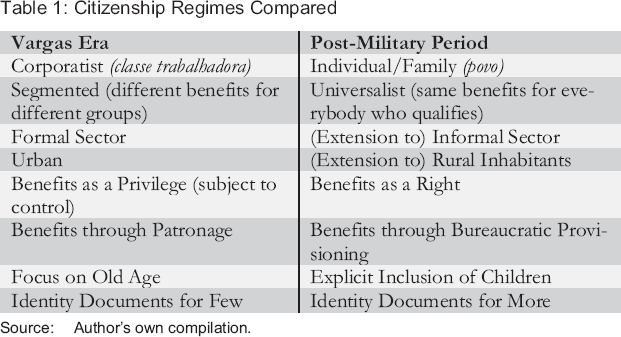
Source: Author's own compilation.
The way I conceive of a “citizenship regime” is inspired by the work of Deborah J. Yashar (1999 and 2005).
The Vargas Era Citizenship Regime
Corporatist Intermediation
As with many of the larger more industrialized countries in Latin America, social policy in Brazil as formulated in the Vargas era was corporatist in orientation. One of the most important legacies of the Vargas period, corporatist legislation targeted groups or categories of people and not families or individuals. Under corporatism, social policy's foundation rested on one's occupational status. Benefits were segmented accordingly. In addition to being accorded to members of the civilian and military bureaucracy, state benefits were granted to the most well-organized and strategic sectors of the working class – that is, those who were well positioned to engage in labor strife. The goal was to preempt the development of an autonomous and militant working class by splitting it up and keeping it divided. This orientation is well explained and discussed in the literature (e.g. Malloy 1979; Collier and Collier 1991; Haggard and Kaufman 2008). Wanderley Guilherme dos Santos coined the term “regulated citizenship” to describe the nature of social policy that began with the Vargas regime in the 1930s, in which citizenship rested on a system of occupational stratification (1979). As a result of labor legislation enacted by Getúlio Vargas under the Estado Novo (1937–1945), the carteira assinada (signed work card) became the “be all and end all,” the ticket to everything from paid vacation time to a pension in old age. Informed by dos Santos's seminal work on “regulated citizenship,” Mariza G. S. Peirano (1986: 52) wrote “a carteira de trabalho passou a ser o documento comprobatório de cidadania.” A second aspect of corporatist intermediation was that the political leadership preempted the autonomous organization of the groups it privileged and dealt with them by subordinating them to state agencies (such as the Labor and Social Security Ministry) run by leaders who owed their positions not to the “rank and file” below them but to the political authorities above them.
A “punctuated” model of change captures this period relatively well. Here, the notion is that change occurs in a dramatic fashion in response to exogenous shocks. When change comes, it is at a break point and in the form of a dramatic breakthrough. A whole line of analysis that examines change in the form of “critical junctures” – points of dramatic and discontinuous change – can be seen in this light (Mahoney and Villegas 2007: 79–80). In their study of labor incorporation and regime dynamics in Latin America, Collier and Collier (1991) exemplify the notion that the outcomes of critical junctures translate into lasting legacies. The coincidence of the first Vargas period (1930–1945) with the Great Depression and World War II, coupled with the fact that civil servants and formal sector workers were a confined group susceptible to being incorporated, renders a punctuated form of change understandable for this early period. This limited group amounted to no more than about ten percent of the population. It was also restricted to three or four main cities, led by São Paulo and Rio de Janeiro.
Formal Sector
Under the corporatist schemes of the Estado Nôvo, President Getúlio Vargas extended social insurance to white-collar and blue-collar workers in the formal sector but not to poor people who toiled in the informal sector. The problem, however, was that those employed in the formal sector represented a small minority. In Brazil, as in many Latin American countries, it was assumed that labor would be absorbed into an expanding formal sector, but the economic models pursued did not produce that outcome (Haggard and Kaufman 2008). The large informal sector – where the overwhelming majority of Brazilians labored as street vendors, repair people, and servants – had virtually no coverage (Blofield 2009). Old age pensions or any other major entitlement for that matter did not exist for those outside of the strictly drawn boundaries of the formal sector.
The health care system established during the Vargas era saw medical services linked to worker and employer contributions and associated pensions based on the insurance principle. This system had two tiers: The upper tier consisted of insured federal employees and workers in the formal sector that had access to complex, curative care through a centralized agency, which later (in 1977) became the Instituto Nacional de Assistência Mêdica da Previdência Social (INAMPS). The lower tier comprised poor Brazilians who fell outside the formal sector and tended to only have recourse to far inferior, preventive health care services that were run by the Ministry of Health and financed through the federal budget. The difference in care between the two sectors was readily apparent (Weyland 1996).
In short, the orientation of social policy as developed under Vargas was so focused on “making citizens” of workers in the formal sector of the economy (as well as civilian and military servants) that broad segments of the population remained almost entirely excluded with regard to health care and pensions. Beyond its exclusiveness, the occupationally based provision of pensions and health benefits was also costly. Who paid for this system? The protectionist element of import substitution industrialization enabled employers to pass on high payroll taxes to consumers, a system that over time allowed for expanded coverage and higher benefit levels for workers in the official economy. In a related vein, Brodwyn Fischer asserts that the rights that were “extended mainly to formally recognized workers and their families, and the burdens imposed by the expansion of legal regulation fell especially on the shoulders of the very poor” (2008: 7).
Urban Residents
The formal-informal cleavage mapped out roughly onto an urban-rural divide. Most of those who worked in the formal sector lived in urban areas. They, but not their counterparts who eked out a bare existence in urban peripheries, were favored by the emerging welfare state. The citizenship regime established under Vargas entailed the virtual exclusion from state benefits of poor Brazilians living in rural areas. It was the strength of regional political machines and their clientelistic control over the countryside that rendered the rural poor unavailable for mobilization against oligarchic power. That was at least the perception of would-be mobilizers (Collier and Collier 1991). Vargas chose to respect the political status quo in this regard and thus took off the table any prospect of incorporating the rural underclass. In concrete terms this meant that discussion of a major land reform was a nonstarter. Looking at socioeconomic and human development indicators, Robert Levine claims that “Vargas had done little for the poor regions of the country” (1998: 128). In fact, according to Levine, “in some ways, Vargas-era reforms widened the gap between the coast and interior, the modern Center-South and the vast rest of the country” (Levine 1998: 11).
Benefits as a Privilege Subject to Authoritarian Control
The bargain represented by the corporatist citizenship regime of Vargas was that political quiescence and obedience were expected in exchange for being among the privileged few who received modernizing benefits and reforms. As such, forging horizontal alliances with other unions outside of established vertical channels, entering into strikes, and promoting shop floor representation were all deemed illegal. Many steps were put in place to assure social control. Indeed, the basic “deal” behind labor incorporation was one of simultaneous “inducements and constraints” (Collier and Collier 1991). By all accounts, corporative structures were crucial in securing the (considerable) consent of the working class (Cohen 1989: 5). For those outside the corporatist citizenship regime, benefits were doled out here and there on a discretionary basis. The rhetoric underscored the need for a disciplined work force (Levine 1998: 102). At the same time,
the Estado Nôvo churned out propaganda asserting Vargas’ compassionate championing of the poor. They told the poor that they were the bedrock of his political movement and thus he expanded his popularity while police raided non governmental unions (Levine 1998: 62).
Indeed, this was not a “rights-based” regime.
Benefits as Patronage
Beginning with the Vargas period, the federal government provided various subsidies for basic goods, often transferred to and distributed at subnational levels. States and municipalities also operated their own programs, many of which became grist for the machinations of patronage-oriented politicians. For those who worked outside of the occupational categories marked for the institutionalized receipt of benefits (albeit subject to heavy-handed control), patronage and personal connections were key in determining who received benefits ranging from medical care to places in schools. As Frances Hagopian states eloquently with reference to work by Brodwyn Fischer (2008),
As defined by Vargas-era laws, citizenship was not a birthright or even a reward for patriotism, hard work, or familial duty, but a privilege won through narrowly circumscribed forms of labor, morality, and bureaucratic agility. Discretionary citizenship afforded petty politicians the opportunity to turn rights that should have been universal into a source of patronage and personalistic political bargains. At the top of the social pyramid was Vargas, the ‘father of the poor’ (Hagopian 2012).
Interestingly, Vargas seems to have been regarded by many of Brazil's poor as their personal benefactor, even among those for whom he actually did very little. As Robert Levine explains, being the first nationallevel politician to even try to reach out to the common people gave many people a sense of hope (1998: 103). Nonetheless, their understanding was that goods could be withdrawn (through personal/political discretion) just as easily as they could be delivered. It would be a long time before social assistance became an entitlement, something regarded by the poor not as a charity but as a securely held right.
Focus on Old Age
Similar to the situation in many Latin American countries, Brazil's welfare state prior to the 1990s concentrated heavily on the later years of the life cycle in the form of old age (and some disability) pensions. Few programs other than basic education focused on children or childhood protection. Most children, other than dependents of formal sector workers, civil servants, the military, or privileged professionals, languished on the sidelines of social policy. And even though schooling expanded and literacy improved, public primary and secondary education lagged in quality, especially in relation to the country's growing wealth. Brazil became known as an “underperformer” in primary and secondary public education relative to its economic affluence. This orientation characterized many Latin American countries that were built around the model of import substitution industrialization. As Stephan Haggard and Robert Kaufman explain,
Workers in the urban informal sector, and in the countryside that fed it, faced weak demand for unskilled or even semiskilled labor. As a result, these workers had limited incentives to acquire secondary education, or even complete the primary grades (Haggard and Kaufman 2008: 64).
Schooling expenditures and enrollments did grow, but these increases were not driven only or even especially by economic concerns. Education resources were grist for the political games played by patronage-seeking politicians and heads of teacher unions (2008: 64).
ID Documents for a Privileged Few
One aspect that reflected the marginalized status of informal sector workers from the emerging welfare system was that few in this demographic category possessed identity documents, beginning with the birth certificate. Although the birth certificate has long been the stepping stone to other documents that are crucial for the exercise of modern citizenship – such as voting, having a bank account, and gaining access to social programs – roughly a third of the Brazilian population (consisting especially of those in remote rural areas) lacked this basic document until well into the 1990s (IBGE 2012). Although the Vargas administration recognized that identity documentation and modernization went hand in hand and made some advances in this respect (Fischer 2008), societal demand for documents was limited, partly because poor people did not perceive an immediate need to acquire them. The lack of social programs, which would have required individual identification, and the fact that formal sector employment remained such a remote possibility reduced people's drive to overcome the many logistical obstacles associated with documentation even though having documents could only increase people's life opportunities over the long run. The state's motivation and capacity to supply documentation was highly restricted as well. That social benefits were doled out as patronage rather than programs virtually nullified the need for documents as far as gaining access to social policies was concerned.
The Evolving Post-Military Citizenship Regime
Key dimensions of Brazilian social policy underwent a reorientation beginning in the second half of military rule due to economic and political motives. Financial crises and the inability to deal with the intensifying problem of poverty brought about efforts to reform the existing systems. Whereas Chile underwent the “radical neoliberal response,” Brazil made efforts to move further toward a universalistic public provision of basic income, pensions and even health care. The idea was to create a floor, however minimum, below which even the most indigent would not fall. Reinforcing the economic rationale of using social expenditures to keep the poor from sinking further into misery, democratization gave the poor a greater voice than they would have had otherwise. This is not to imply that active mobilization would occur. With the change in the political regime, the demand for social policy appears to have become embedded in improving democratic processes, including the eventual development of a more programmatic dimension to electoral politics. The Constitution of 1988 laid the foundation of many policy changes to come, including the enfranchisement of the illiterate. According to Evelyne Huber, in this period Brazil created the legal basis for a universalistic welfare state, aiming to provide basic income security to all citizens (1996: 145). The idea in regard to health care was also to offer full coverage, at least on paper. Whether enough clinics and health workers would be available was another question.
The portion of the population that entered Brazil's new democracy still outside the main programs of the welfare state was by definition heterogeneous. It included everyone from city people who lived in shantytowns on the periphery of the country's major and secondary cities to rural inhabitants who scraped a living fishing in the Amazon. It was unlikely that there would be a punctuated incorporation project for all those sectors. Not only was there no focused political rationale as existed under the first Vargas period (to preempt the development of a militant and autonomous working class), it was also not economically possible to cover that many people with social programs from one day to the next. So, for political as well as economic reasons, incorporating the remaining segment of the population (still the majority) would not be an overnight project.
Therefore, rather than being punctuated, as occurred under the Vargas period toward urban labor, more recent Brazilian governments have sought to incorporate the remaining population in a more incremental fashion. Lula was thus but one of a series of presidents responsible for making further headway in social policy. Even his hallmark social program, the Bolsa Família, had roots in a previous government. In fact, this progress began even before the transition to democracy in 1985 and the promulgation of a new constitution in 1988.
It was the military regime of 1964–1985 that got the ball rolling with rural social security. Several other social programs were instituted that targeted various segments of the heterogeneous informal sector that was overlooked by the Vargas reforms and neglected in Brazil's first period of mass democracy (1945–1964). A key principle that has unfolded in Brazil's evolving welfare state is that of social assistance as opposed to social insurance. Whereas social insurance was grounded in a contributory principle, social assistance is based on a citizenship principle and provided to whomever needs it. This principle has come to underpin the expansion of the welfare state since military rule (Barrientos 2013: 890, 901, 907). Hallmark programs of recent decades include noncontributory social insurance for extremely poor elders and people with disabilities (the Benefício de Prestação Continuada or Continuous Welfare Benefit, henceforth abbreviated as BPC), free and universal health care, of which a family health program is part (the Programa Saúde da Família or PSF), the conditional cash transfer policy (Bolsa Família), and a birth certification program for the destitute, which made sense as both the Bolsa Família and the BPC require applicants to have identity documentation. The state's increasing coverage of poor people has taken place in an incremental fashion. Below I describe these programs, before returning to the point-by-point conceptual comparison with Vargas era legislation.
Benefício de Prestação Continuada
Legally created in 1993 but not truly put into place until 1996, the BPC replaced a previous program for the impoverished – the Renda Mensal Vitalícia, which had been enacted in 1974. The Renda Mensal Vitalícia was intended for those who were 70 years or older or suffered incapacitating disabilities and earned less than 60 percent of one monthly minimum wage. The military regime's Fundo de Assistência ao Trabalhador Rural (FUNRURAL) was a larger manifestation of a social security program for the rural poor, and like the Renda Mensal Vitalícia, it lacked a contributory basis (Weyland 1996). Much is made in the social policy literature in Latin America about the progressive and equity-enhancing nature of the BPC. Enrolling in the BPC program requires that a person be sixty-five years of age or older (the original requirement was seventy) and live in a household where income does not surpass the equivalent of a quarter of one minimum wage per person. 5 The BPC initiative provides for the transfer of one minimum wage to those eligible (as established in the Constitution). The Ministry of Social Development is in charge of the program.
In addition, all household members must have identity documents (a birth certificate or the RG or Registro Geral, a general identity document), proof of income, and a CPF or Cadastro de Pessoa Física (another mainstay document to be an integrated citizen in modern Brazil). The main beneficiary must also have a carteira de trabalho (work card).
To receive the BPC, applicants do not have to prove anything other than that they are destitute and their identity with documentation. In contrast, both the Renda Mensal Vitalícia and FUNRURAL programs required that people provide some evidence about their previous work life. Given that many poor people do not assert their rights from the outset, work for years without proper documentation (or proof of contributions), and/or do not tend to keep good records, the BPC scheme represents a vital safety net for those who fall through the cracks of other programs. Older women in rural areas figure prominently among its recipients. The more inclusive nature of the BPC program made it more popular more quickly than earlier programs. Within ten years of its existence, it had reached 2.6 million beneficiaries; currently, in 2014, that number stands at 3.9 million. Although this may not seem like a huge number, one should bear in mind that there are not many more people eligible for BPC based on information from the current census, the major results of which are reflected in the Pesquisa nacional por amostra de domicílios (PNAD). 6 Although the program started prior to the Lula administration, it was strengthened under his tenure. According to Armando Barrientos, “social pension schemes have pushed pension coverage of people aged sixty-five and above to just over 86 percent, among the highest in the region” (2013: 887). Although the budget for noncontributory pensions is still far smaller than that for social security, it has grown steadily since the mid-1990s. With respect to the BPC scheme, because it is linked to the minimum wage, its value increased greatly under the Lula government due to several raises in the minimum wage (Hunter and Power 2007).
The 1988 Constitution led to a second similar initiative in 1992, the Previdência Social Rural (PRS). This reflected a broader sentiment in the constitutional debates on the need to address the significant inequalities between urban and rural areas in Brazil. The PSR requires ten years of contributions to social insurance (much less than for people in urban areas) but in practice the contribution requirement has never been implemented (Barrientos 2013: 891, 896).
Bolsa Família
In the last decade and a half Brazilian policy makers have developed a series of targeted social grant programs that prioritize relief and services to the country's most destitute children and their families. In 2001 the Cardoso administration enacted the federal Bolsa Escola (School Grant) program, which made cash grants available to participating families as long as their children complied with school attendance requirements. In 2003 Lula as president significantly expanded upon this strategy with the Bolsa Família (Family Grant) initiative, which extends the conditions for enrollment beyond school attendance to encompass basic health care practices, including receipt of all major childhood vaccinations. The grant represents a significant source of a poor family's household income and can greatly enhance its ability to meet basic needs, such as having sufficient food.
The Bolsa Família scheme is the largest conditional cash transfer program in the world. It developed considerably during Lula's tenure. Clearly oriented toward breaking the intergenerational transmission of poverty, it is widely credited with raising the living standards of over 50 million poor Brazilians. The scheme provides help with income as part of one of its goals to relieve the immediate poverty of children and their families. Another objective is to develop human capital, so children are required to maintain a school attendance rate of at least 85 percent. An additional benefit of the Bolsa Família program is the spur it has provided in getting low-income Brazilians documented, not least with the requirement of birth certificates for all children enrolled in the program. Such documentation will enable them to access other social programs and government benefits and compel them to meet their program obligations.
Programa Saúde da Família
In the new democracy health care arrived as a topic of debate on the heels of a strong movement for health sector reform (the movimento sanitarista) led by public health workers. Active as early as the 1970s, the movement pushed for the universal right to preventive health care and sought to secure progressive rights in any constitution promulgated once Brazil re-democratized. The Constitution of 1988 did in fact enshrine a universal right to health care and emphasized the state's obligation to provide it. In 1991 the Sistema Único de Saúde (Unified Health Care System or SUS) was created. It was the beginning of a tax-financed health care system based on the principles of universality, equity, and community participation. 7
Tulia G. Falleti (2010) offers an excellent analysis of incremental change in Brazil's health care system from 1964–1988. Universalization and municipalization, while significant, occurred by gradual and layered change.
Formed in 1994, the Programa Saúde da Família (Family Health Program or PSF) is one of the government's main strategies for realizing universal health care in Brazil. One of its aims is to replace the traditional model of high-cost care carried out by medical specialists for a privileged few with a model that ensures all people have access to primary health care. As the name implies, the focus is on families. The idea is to prevent health problems and drive down infant and childhood mortality and control common adult problems and communicable diseases with as few resources as possible. Rather than build expensive hospitals and clinics that rely on fancy equipment and curative treatments, a better use of public money was deemed to be the deployment of community health agents who live in the same geographic areas as their clients and can hence serve as bridges between the community and health care professionals. Community health agents and nurses are at the core of the program, with social workers, physicians, dentists, and psychologists coming into play at higher levels.
The PSF started in small rural municipalities in the Northeast. It spread to such a degree, that over 95 percent of all municipalities had adopted the scheme by 2013. The PSF is considered highly successful as far as primary health care is concerned (McGuire 2010) and has received high praise from health care technocrats (Sugiyama 2013: 10). With Fernando Henrique Cardoso in the presidency and José Serra as minister of health, the period in government of the Partido da Social Democracia Brasileira (Party of Brazilian Social Democracy or PSDB) was absolutely crucial to the program's growth. Later, the Lula government assigned additional funding to the initiative and strengthened the promotion of primary health care in doing so. Yet Lula's governments were arguably less pivotal than those of Cardoso in supporting the program. Notably, other PT competitors in presidential elections (e.g., José Serra of the PSDB in 2010) have also argued in favor of increasing funding for the PSF. It makes both economic and political sense to serve large numbers of poor Brazilians at a reasonable cost. It should be stressed, however, that the positive contributions of the PSF to preventive health care have not entirely replaced the focus of the previous model of hospital-based high-cost curative care.
Individual
Of the three major social program additions presented in the comparative framework above, two of them (the Bolsa Família and the BPC) provide entitlements that go explicitly to individuals and their families (not to occupational groups or categories of workers) who need only prove that their income levels are under the specified poverty line. In this way, they are highly individualized and “means tested.” In other words, the Brazilian state approaches and deals with people as individuals with respect to these programs. If one dimension of citizenship is to widen the circle of people who feel that they “belong” and are included, both these programs fulfill that aspect. If the povo brasileiro (collective referent) is finally acknowledged and addressed through these programs, it is as a collection of individuals. Health care constitutes the third policy area that has experienced major improvements in Brazil's new democracy. Yet rather than being an individual entitlement based on demonstrated need, it is approaching universality – at least in theory if not in practice.
Informal Sector
Certainly in intent and almost by definition, the programs described above primarily target either Brazil's chronically unemployed or those who have worked for long periods of time in the informal sector. Undocumented domestic servants, day laborers, and people who do odd jobs or engage in seasonal work are typically among those who are eligible for assistance. Without a doubt, these programs extend the safety net to cover Brazil's poorest, who went unprotected under the welfare state established by Getúlio Vargas.
Rural Coverage
Whereas Getúlio Vargas envisioned the “interior” as just about every part of the country outside of Rio de Janeiro and São Paulo, and in a de facto if not de jure way channeled state benefits to urban areas (by virtue of covering only formal sector workers), the majority of beneficiaries of the Bolsa Família and the BPC live outside of Brazil's major cities – as do many who receive support from the PSF. The single biggest concentration of impoverished Brazilians is in the Northeast. Although the population is becoming increasingly urban based (e.g., the cities of Salvador da Bahia, Recife, and Fortaleza have attracted huge numbers of people from the interior of their respective states), the Northeast retains a sizeable population in the countryside.. Its residents are prime beneficiaries of all three programs. For some individuals, these programs are among their few points of contact with the Brazilian state.
Benefits as a Right of Citizenship
Whereas under the Vargas citizenship regime recipients were made aware of their privileged position and expected to be loyal to the state (or else suffer recriminations), the Lula-led governments bent over backwards to show that the Bolsa Família program was a right free of heavy-handed state control and clientelistic manipulation. There are, of course, conditionality requirements attached to receiving support (e.g., the adult holder of the grant in a family must make sure that the enrolled children attend school and fulfill the preventive medical care specifications), but this fundamentally differs from the kinds of restrictions associated with Vargas's corporatist labor legislation and from the political manipulations of the oligarchs who doled out federal subsidies in rural areas. Moreover, the fact that the Bolsa Família program is run by the Ministry of Social Development in Brasília does not allow the state to deprive people of funding for politically motivated reasons. A recent survey (Sugiyama and Hunter 2013) suggests that Bolsa Família recipients – even in highly impoverished areas of the Northeast – do not fear that their vote choices or their associational activities have any bearing on the status of their Bolsa Família grants.
Benefits through Bureaucratic Provisioning
Neither the Bolsa Família nor the BPC is subject to patronage networks. Rather, they are delivered in what appears to be a clean bureaucratic fashion – the same goes for the Programa Saúde da Família. All three of these programs are administered in predominantly apolitical ways. The above-mentioned survey finds that bolsistas themselves believe the program to be apolitical in its screening and selection of beneficiaries (Sugiyama and Hunter 2013). To begin with, the ministry in charge of the Bolsa Família – the Ministry of Social Development – states the following in its public relations material: “Keep in mind: If your family meets the eligibility requirements of the program, receipt of the benefit is your right, not a favor from anyone.” The use of poverty maps and strict eligibility formulas, plus the establishment of a direct payment mechanism (a debit card of sorts) and bureaucratic problem-solving mechanisms that reduce the need for (and possibility of) political brokerage, all work to keep the grant away from local clientelistic politicians. The circumvention of governors removes another traditional point of intermediation (Fenwick 2009). Moreover, it is a major advance that program beneficiaries seem to understand the apolitical nature of the program's provisioning. They clearly associate the program's origins with Lula (an attribution that is not entirely correct), whom many revere, but nonetheless conceive of its administration in more bureaucratic “rights” terms.
Inclusion of Children
Children are the main target population of the Bolsa Família. To reach the children, the scheme goes through their mothers, in whose name most of the grants rest. Although the age of eligibility for receiving assistance has increased over time (adolescents were initially excluded but now the 15–17 age group is eligible – an important extension as school drop-out rates tend to climb in those years), the goal is and has always been to intervene during the early stages of the life cycle. There is an ongoing discussion (accompanied by mixed evidence) about the extent to which low-income adult women benefit from the program. Regardless of the answer to that question, the grant is clearly designed first and foremost to improve the lot of children within a family. The PSF also places major emphasis on the health care of children and has been credited with greatly improving the survival rate of children under the age of five (McGuire 2010). These programs are an important complement to the Brazilian welfare state, which previously disproportionately focused on old age.
Wider Documentation
Along with the above-discussed aspects of the citizenship regime that began in the 1970s and extended through the Lula governments, poor Brazilians have become convinced of the need to acquire basic identity documents. One key reason is to gain access to social provisions that require such documentation. As in other countries that have introduced policies like conditional cash transfer programs and noncontributory pensions, the societal demand for documentation has increased in Brazil (Brill and Hunter 2014). The immediate incentive of acquiring documents in order to gain access to these programs has been met with increased supply-side efforts on the part of the Brazilian government to facilitate documentation. A number of changes have been made since 1997 to smooth the process of providing support, including campaigns by the federal, state, and local governments. The monetary costs have been reduced, and the logistics made easier. This has opened up many more avenues and possibilities for poor people. The Cardoso government instituted legislation to make the first birth certificate free to everyone and subsequent copies free to anyone who could prove being poor. Under the Lula government, legal changes made it easier for children whose fathers did not want to claim paternity to go ahead and receive birth certificates. In recent years there has also been a push to induce civil registrars to establish operations in hospitals and clinics, making it less likely that newborn babies leave without a birth certificate (Hunter and Sugiyama 2011). The combination of increased demand for documentation and measures to ease supply has yielded results. For example, only 6.7 percent of births went unregistered in 2012 compared to 27.1 percent in 1998 (IBGE 2012).
Some Similarities in Social Inclusion Strategies
Notwithstanding some of these differences in the “citizenship regimes” of the two periods and their associated leaders and strategies, there are a number of interesting continuities or similarities that are central to Brazilian politics.
The first is that both strategies of “incorporation” emanated from the “top-down” in the granting of benefits and involved very little mobilization from below. With the caveat that social policy could now be embedded in improved democratic processes so that mobilization is not needed, it is at least descriptively true that the popular sectors were recipients of state programs and did not demand them per se to make their claims. Hence, both periods were modernizing but essentially conservative in their orientation. What Robert Levine writes of the Vargas reforms could be applied to the Lula-led government as well: “Brazilians more and more came to rely on the bureaucracy, not on legislative action or the private sector, as the source of change and benefits […]” (Levine 1998: 11). Moreover, it can even be argued that the PT (while in the opposition) had been unsuccessful in “winning over the masses” with its promise to lead the calls for more fundamental reforms, such as land distribution (Hunter and Power 2007). Poor people only began to vote for Lula in far greater numbers once they started receiving state benefits in his first term. In short, there are continuities to be seen in political “style” between the two leaders and their incorporation efforts.
Second, there is a marked personalistic aspect in the two periods: Vargas was seen as the benevolent father, while Lula was portrayed as the generous provider. In the survey carried out by Sugiyama and Hunter (2013), scores of people attributed the origins of the Bolsa Família program to “Lula” rather than to his party. The scarce mention of the PT in the survey's open-ended questions was truly conspicuous. This is noteworthy because:
Lula was part of a highly organized party that not only had been key in catapulting him into power but also had done much to promote a platform involving the ‘inversion of social priorities.’ That Lula himself rose from grinding poverty and projected publicly that he understood and empathized with those who struggle evidently gave a layer of personal meaning to his government beyond what his party (or leading technocrats in the social ministries) could (Hunter and Sugiyama forthcoming).
Third, both Vargas and Lula engaged in a striking degree of political accommodation with elites. This allowed them to politically and economically stabilize their governments and, ultimately, seriously limit how far their development strategies could reach and how much distribution to the poor could be achieved. Just as Vargas did not challenge the traditional oligarchy and thus never considered any serious efforts to improve the lot of the rural poor, the Lula-led governments were careful to oversee a set of conciliatory policies with business leaders, the financial community, and agricultural elites. Despite previous promises, President Lula shied away from implementing public policies designed to combat the roots of inequality through major interventions in strategic areas like primary and secondary education. Instead, he pursued social protection policies that required modest fiscal resources and also offered limited human development potential. In the words of one set of Brazilian social policy analysts (2010: 124),
as a result of divergence from historic PT goals, the Lula government has not been able to restructure Brazil's pattern of capital accumulation in a way that could overcome the country's peculiar type of underdevelopment.
Moreover, these authors go on to argue,
popular perception has not noticed that meaningful reforms that would stimulate economic and social development, for example through a revamping of the education system, are not taking place. Instead, President Lula da Silva has demonstrated political savvy and an impressive capacity to interact with the least privileged social classes. These skills have helped to ensure support from these poorer segments throughout most of his two administrations (Silva, Braga, and Costa 2010: 133).
In short, progressive reforms have not entirely replaced the prior model put in place by Vargas. Instead, previously marginalized sectors have been brought into the system through extensions to Brazil's welfare state. The fruits of Brazil's public sector, in other words, have not been redistributed from the affluent to the poor. Rather, a growing pie, so to speak, has allowed for the extension of basic coverage or the policies of “basic universalism” to greater numbers of people.
Conclusion
Many scholars have recognized the efforts of recent governments in Brazil to cover the poor. According to Armando Barrientos, “the rise of new forms of social assistance in Brazil in the last two decades has been remarkable” (2013: 887). James W. McGuire similarly writes,
From 1960 to 1995, Brazil had […] extensive welfare-state benefits for the middle and upper classes, but an undistinguished record of providing basic social services to the poor […]. After 1995, government programs made publicly provided health care and education more favorable to the poor. By 2005, although more work remained to be done (particularly in the area of pensions), Brazil had some of the most well-designed, encompassing, innovative, and pro-poor social policies in Latin America (McGuire 2010: 154).
This article chimes in with the work of these authors. To place the contributions of the Lula period in perspective, I have taken a step back and analyzed the broad evolution of social policy over the last 75 years. In doing so, I have outlined some of the key contours of change and continuity between the governments of Getúlio Vargas (1930–1945) and the period leading up to and including the Lula-led governments (2003– 2010). Important benefits have been extended to low-income Brazilians in recent decades. Given that some of them are rooted many years back, even before the Constitution of 1988, their extension has been gradual and steady rather than punctuated. Lula gave the new focus on social assistance a human face. This personification seems to have been important in convincing low-income Brazilians that their government cares about people like them (Hunter and Sugiyama forthcoming). Yet the Constitution of 1988 and the two administrations of Fernando Henrique Cardoso were crucial in laying the institutional groundwork for social protection.
A broader group of citizens now enjoys the fruits of the country's marked wealth. These Brazilians have been incorporated in a less corporatist and less clientelistic fashion than previously. They have also been incorporated in a more gradual fashion than their formal sector predecessors under the Vargas regime. Given their large numbers and heterogeneity, this is not surprising. While progress is evident, clear limitations to change remain present – thus supporting the notion that history still weighs considerably on contemporary Brazilian politics and policy. Yet when all is said and done, the balance is positive. Even though the path to social policy progress in recent years has been gradual, incremental progress has improved the well being of low income Brazilians. Brazil has come a long way in recent years, and with it, so have the country's poor.