



Abstract
The Southern Common Market (Mercosur), the world's fourth-largest trading bloc, represents an intriguing yet under-researched case of a regional organization which has made significant advances in regional integration in the past decades, legalization being a central dimension of its integration process. In 2002, Mercosur's dispute settlement system was substantially revised by its four member states. Up until then, disputes among member states had been resolved by diplomatic negotiations and ad hoc tribunals with limited independence from the member-state governments. The reforms mark a significant advance in the legalization of this regional organization: a standing court with a more independent judiciary and improved access to the court's jurisdiction was established. In order to account for the shift towards more legalization of Mercosur, this article presents a rational institutionalist explanation and develops hypotheses about states’ preferred levels of legalization (why), an account of the “timing” of qualitative shifts in legalization (when), and the institutional form that legalization decisions take (how).
Introduction
In 2002, the member states of the Southern Common Market (Mercosur), one of the world's largest trading blocs then consisting of Brazil, Argentina, Uruguay, and Paraguay, enacted a new protocol introducing far-reaching institutional reforms to the existing dispute settlement system (DSS). 1 Up until then, Mercosur's institutions to resolve disputes had been characterized by diplomatic negotiations and the convening of ad hoc tribunals with limited independence from the member-state governments. The reforms mark a significant advance in the legalization of this regional organization: a standing court with a more independent judiciary and improved access to the court's jurisdiction were established. While the extent of legalization in the European Union – the most integrated regional integration scheme of all politically – is unmatched by other international or regional organizations, Mercosur's DSS is more legalized than that of NAFTA or ASEAN. Mercosur thus represents an intriguing yet under-researched case of a regional organization that has made advances in regional integration over the past two decades or so, legalization being a central dimension of this integration process.
As of July 2012, Venezuela became the fifth state to be a full member of Mercosur.
In order to account for the push for more legalization in Mercosur, this article 2 explains why, when, and how states decide to advance the legalization of interstate dispute settlement systems. We present a rational institutionalist explanation and develop hypotheses about states’ preferred levels of legalization (why), an account of the “timing” of qualitative shifts in legalization (when), and the institutional form that legalization decisions take (how).
Previous versions of this article were presented at the IPSA-ECPR joint conference “Whatever Happened to the North–South?” held on 16–19 February 2011 in São Paulo, the “Dritte Offene Sektionstagung der Sektion Internationale Politik,” DVPW, 6–7 October 2011, Munich, and the Annual Conference of the International Studies Association, San Francisco, USA, 3–6 April 2013. We are indebted to Alípio Ferreira da Silva Filho and Anne-Sophie Lockner for their invaluable assistance with our research. We would also like to thank Karen Alter, Lisa Dellmuth, Benjamin Engst, Jessica Fortin-Rittberger, Sebastian Krapohl, Tobias Lenz, Tonya Putnam, and two anonymous reviewers for their very useful comments and suggestions.
We argue that even though the institutions responsible for dispute settlement have not been used very much by litigants since they were enacted, Mercosur's member governments had well-defined agendas to reform the existing DSS by the time they came to negotiate the “Olivos Protocol for the Solution of Controversies,” which was adopted in 2002. Purposefully opting for a more strongly legalized DSS, they had distinctive preferences about which institutional innovations to install. Taking recourse to contracting theory (Cooley and Spruyt 2009), we argue that the initial legalization preferences on the part of the Mercosur states reflect differing levels of economic strength and interdependence. The economically “weaker” und more vulnerable members, Uruguay and Paraguay, preferred a more legalized DSS because of their anxiety about being dominated by the larger member states, Argentina and Brazil, in the actual application or renegotiation of the initial contract. Despite divergent legalization preferences between these two groups of states, the institutional status quo did not prevail. We argue that the demand for a more legalized dispute settlement system cannot be accounted for by a change in the preferences of the legalization-skeptical states (Argentina and Brazil), but rather by a change in their strategy to achieve political and economic objectives. Turning to externality theory (Mattli 1999a; Mattli and Stone Sweet 2012), we show that the economic and financial crisis at the turn of the millennium provided a catalyst for change: As governments strove for economic growth and the concomitant improvement of their re-election fortunes in a time of crisis, they needed to send a costly and credible signal to potential traders and investors that Mercosur integration – and hence measures facilitating transnational exchange – would prevail over protectionist policies. Among other steps, reforming the existing DSS seemed an apt institutional innovation, since this reform was not only a costly signal, but also allowed governments to modify a system they had found to be dysfunctional in light of their experience with the settlement of disputes under the status quo. Member-state governments explicitly crafted the institutional reforms to account for the unexpectedly high transaction costs and distributional consequences of the original DSS.
Our contribution to the literature on this matter is twofold. Explaining the institutional innovations of Mercosur's DSS builds on and complements current comparative accounts on the design of dispute settlement systems (Alter 2012; Duina 2006; Koremenos and Betz 2013; Krapohl, Dinkel, and Faude 2010; Lenz 2012). It demonstrates how different mechanisms – signaling commitment in crisis situations and updating beliefs to render institutions more functional – interrelate, thereby drawing a nuanced picture of the timing and content of reforms. Moreover, we supplement the existing literature on regional integration in Mercosur. This literature claims, inter alia, that its more powerful members – most notably Brazil – employ the integration scheme as a mere facade. On the one hand, political elites seek to use regional leadership to underpin their interests within the confines of Mercosur (Doctor 2013; Malamud 2011; Montecinos 1996). On the other hand, Mercosur membership is also considered as a means to project power not only on the continent, but more widely as well (De Lima and Hirst 2006; Spektor 2010; Vigevani and Cepaluni 2009). While we do not disagree with these arguments, we add some more nuances to this picture. Focusing on one of the elements of Mercosur's institutional structure, viz., the legalization of its DSS, we argue that member governments sought to create institutions capable of mitigating impediments to collective action. Shared concerns about the actual distributional consequences of Mercosur's DSS and the intention to signal Mercosur's longevity to further economic stability were capable of superseding regional power asymmetries.
The paper proceeds as follows. While the ensuing section maps the qualitative change of Mercosur's legalization by applying the typology developed by Keohane, Moravcsik, and Slaughter (2000), we flesh out our theoretical arguments and hypotheses in section 3. We then probe our theoretical expectations empirically in semi-structured interviews with key officials and decision-makers from Mercosur member states and the Mercosur secretariat who were involved in the negotiation of the reforms. To increase the reader's confidence in our findings, we finally conduct a robustness check by taking issue with rival explanations and discussing a potential counterfactual.
To address the qualitative shift towards a more legalized system of dispute settlement in Mercosur, we first introduce the relevant concepts to capture legalization and any changes therein. We take recourse to the typology proposed by Keohane, Moravcsik, and Slaughter (2000; also see Stone 1994), which distinguishes between two ideal types of conflict-litigation mechanisms, viz., interstate and transnational. This typology presents criteria that allow us to describe and compare dispute settlement systems. In a second step, we apply this typology to map Mercosur's DSS in the period before and after the reform of 2002.
Conceptualizing Legalization
The explanandum of this paper, the reform of institutions for dispute resolution in the context of Mercosur, is an instance of legalization. Legalization highlights specific formal characteristics of institutions in world politics, such as their level of obligation or the delegation of judicial powers to international courts. We are aware of the limits of the focus on legalization, since – contrary to judicialization – legalization eclipses questions about the way in which these institutions affect and gradually develop authority over – and hence “judicialize” – the production of legislation in Mercosur (see Abbott and Snidal 2013 and Stone Sweet 2010 on the concept of judicialization). Nevertheless, we argue that analyses of judicialization are likely to benefit from an understanding of the design and change of institutions for dispute resolution (legalization) and thus deem our contribution to be relevant to this field of study.
The degree to which dispute settlement systems are legalized varies between interstate and transnational forms of conflict litigation (Keohane, Moravcsik, and Slaughter 2000: 457). Systems of interstate conflict litigation are characterized by state dominance. They control access to international courts or tribunals, designate the arbiters or judges, and control the implementation of their rulings. In systems of transnational dispute resolution, however, states lose their gate-keeping role and hence their control over access, process, and enforcement. At the same time, private, transnational actors come to play an increasingly important role. To substantiate and measure these two types of conflict litigation, Keohane, Moravcsik, and Slaughter have introduced three dimensions: independence, access, and embeddedness. Independence “specifies the extent to which formal legal arrangements ensure that adjudication can be rendered impartially with respect to concrete state interests” (Keohane, Moravcsik, and Slaughter 2000: 458). We can assess independence by examining the selection and tenure of judges or arbitrators, their legal discretion, and their control over the court's resources. The second dimension, access, addresses the question of who has standing in an international court. In the case of interstate conflict litigation, governments are the only parties to a dispute. At the other end of the spectrum, individuals may directly file complaints via national courts. Legal embeddedness, the third dimension, refers to the control over the formal implementation of legal decisions. In interstate conflict litigation, member states have the possibility to veto awards ex post. In contrast, in systems of transnational dispute resolution, domestic courts compel their own governments to implement and respect international rules and awards. A more legalized DSS is thus coterminous with shifts towards a more independent DSS with broader access and higher levels of legal embeddedness.
Legalization of Mercosur: Before and after the Reforms
Applying the typology used by Keohane, Moravcsik, and Slaughter to Mercosur's DSS, the reforms enacted in 2002 mark a qualitative shift. While it is initially a system characterized by interstate conflict litigation, it progresses towards a more transnational DSS. 3 In order to appreciate the changes brought about by the Protocol of Olivos in 2002, we need to contrast them with the pre-existing DSS, which was laid down in the Protocol of Brasilia in 1991.
Our findings are by and large congruent with those of Moraes 2002 and Krapohl, Dinkel, and Faude 2010.
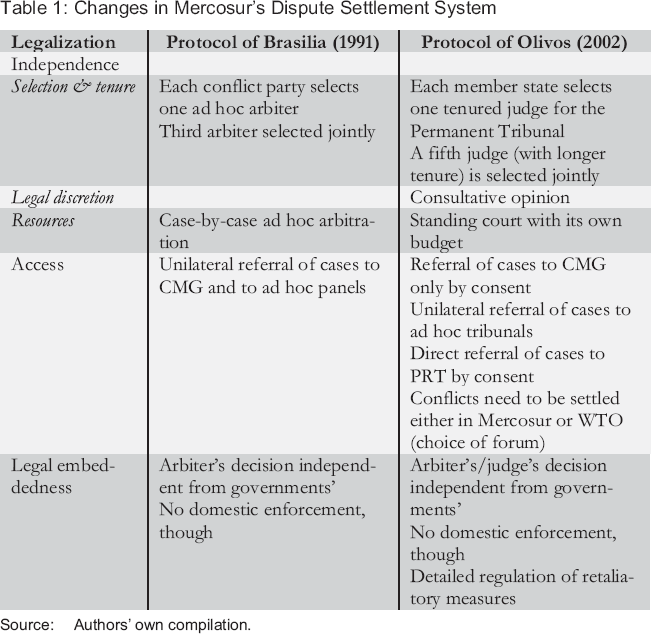
Beginning with the independence dimension, the reforms of 2002 introduced an independent standing court: the Permanent Review Tribunal. While the Protocol of Brasilia knows either interstate forums of dispute settlement or ad hoc arbitration with arbiters chosen by the disputing parties on a case-by-case basis, the Permanent Review Tribunal is a standing court with its own infrastructure and budget. According to the Protocol of Brasilia, interstate conflicts were to be resolved by direct negotiations among the parties involved. Should no compromise be reachable, one side alone may submit the case to the Common Market Group. This executive body has the prerogative to suggest a recommendation, provided that all sides agree. If disagreement persists, however, then one of the conflicting parties could call for ad hoc arbitration. Ad hoc tribunals consist of three judges: one designated from each party and a third, jointly selected judge. The judges reach their binding verdicts by a majority decision, and the rulings cannot be appealed. The Protocol of Olivos maintained basic elements from the Protocol of Brasilia, yet it introduced a major innovation: the Permanent Review Tribunal, composed of five judges, with each member state designating one judge for a two-year term that is renewable. The fifth judge is jointly selected by mutual accord for a three-year term, which is only renewable if the member states come to a unanimous decision. All verdicts are reached by majority rule. This body may also conduct a judicial review of the decisions made by the ad hoc panels. Finally, the Protocol of Olivos offers yet another important juridical innovation with regard to the legal discretion of the DSS. Even though the exact proceedings were left open to later regulation, 4 the Permanent Review Tribunal may serve to pronounce consultative opinions when asked to do so by domestic supreme courts.
The Common Market Council regulated further proceedings with decisions CMC 37/03 and CMC 02/2007. The Common Market Group adopted resolution CMG 40/04.
The Olivos reform also brought about changes in the provisions regulating access to Mercosur's DSS. Access remains unchanged and is only indirect for private actors. These can file cases only through their respective national delegations to the Common Market Group. But the path for the adjudication of member states’ charges has changed with Olivos: the Common Market Group now merely serves as a forum for conflict litigation if all the members agree to use this intergovernmental channel for interstate conflict resolution. Under the new system, the parties to a dispute now face three choices. In the first option, one side may directly call for arbitration in ad hoc panels. Second, the Common Market Group may still settle disputes. But in contrast to the provisions in the Protocol of Brasilia, all parties need to reach a consensus to forward the dispute case to this intergovernmental forum. Finally, if all the sides involved consent, they can immediately file the case with the Permanent Review Tribunal. Moreover, this body may exercise judicial review of the decisions promulgated by the ad hoc panels. The Olivos reforms also foreclose “forum shopping”: if the parties subject to the dispute agree to employ the Mercosur DSS prior to engaging in litigation, they commit themselves to not filing the case in the court of another international organization (for example, the WTO).
Likewise, the legal embeddedness of Mercosur's DSS also underwent a transformation. In contrast to the Protocol of Brasilia, the Protocol of Olivos explicitly allows for and specifies retaliatory measures. Nonetheless, enforcement of the court's verdicts has not been delegated to national courts. Table 1 provides an overview of the described changes.
Changes in Mercosur's Dispute Settlement System
Source: Authors’ own compilation.
Before we present some hypotheses to account for the described changes in Mercosur's DSS, we will turn to the assumptions on which our theoretical arguments are built. We view the institutions for dispute resolution in world politics as rules designed by purposive actors to constrain and shape actors’ behavior and to structure the incentives of actors involved in socio-political exchange relationships (Mattli 1999a: 9). International institutions represent collective outcomes of interdependent (strategic), rational state choices and interstate negotiations in an international environment characterized by anarchy. We also understand that state actors prefer and propose different levels of legalization as a strategy to realize their underlying preferences for cooperation. Preferences and strategies are foundational elements in rationalist models of social behavior, and both are essential in explaining actors’ observed choices (see Rubinstein 1991; Frieden 1999). The first concept, preferences, describes the rank order of all the choices an actor has in a given environment. The second, strategy, provides guidelines for action in contexts with multiple actors (strategic interaction) and lays down the behavioral options actors have in order to obtain their preferred outcome (see Frieden 1999: 41). Devising institutions for dispute resolution in world politics is thus not an end in itself, but a means to an end, viz., to achieve particular policy objectives. Assuming that actors’ policy preferences are exogenous, changes in the preferred level of legalization are expressions of a change in strategies: when actors form preferences over institutions, such as the rules to settle interstate disputes, they project the effects of alternative institutions on policy outcomes and opt for the institutional solution that suits their priorities best. Building on these assumptions, a theory of legalization of world politics should provide answers to three main questions: How can we account for the levels of legalization that states prefer? How can the “timing” of a qualitative shift in legalization be explained? And which institutional solutions do actors strive for?
Preferences for Legalization
In order to account for governments’ preferred levels of legalization, we will now turn to contracting theory. Following Cooley and Spruyt's argument, both the relative distribution of power among states and the nature of institutions as incomplete contracts have profound implications on institutional design (Cooley and Spruyt 2009). Governments of weaker states tend to be anxious about the downstream consequences of international treaties, as stronger states may use their superior bargaining leverage to the detriment of the former by changing the initial contract in ex post negotiations. In international economic governance, state weakness and state strength are commonly attributed to the relative size of the economy of a particular country and/or levels of trade dependence. States with higher levels of trade dependence tend to benefit more from cooperation and are therefore more sensitive to the demands of less dependent states, which yield superior bargaining power. In the light of the incomplete contracting problem, less dependent states can instrumentalize their superior bargaining power: Renegotiating initial contracts, they can tilt terms in their own favor and thereby exacerbate any pre-existing power asymmetries. Weaker states have two options to address this challenge: First, weaker states can either demand that a complete and hence a very detailed and specific contract be negotiated – which renders ex post negotiations less likely and thus circumscribes the possibility that stronger states will exploit their superior bargaining power. Second, weaker states can press the more powerful states to bind and commit themselves to the jurisdiction of a supranational rule-making and/or adjudicatory body. Such “commitment institutions” reduce the possibility that the more powerful states will renegotiate the initial contract in their own favor. Stronger states, however, tend to prefer incomplete contracts to complete ones and view the creation of supranational commitment institutions with skepticism, since these place constraints on the stronger states’ opportunities to renegotiate the initial terms of the contract ex post.
We can deduce from this discussion that, ceteris paribus, high levels of legalization are hardest to obtain when power asymmetries among states are particularly pronounced. Conversely, modest power asymmetries lead interdependent states to accept incomplete contracts, since anxiety about ex post renegotiations is limited. Moreover, modest power asymmetries also increase the likelihood that states will accept supranational adjudicatory authority, since the threat of domination by stronger partners is much less prevalent. Power asymmetries can be mediated by demand for integration. Generally speaking, “[t]he state in which the demand for integration is lower than in other states will have bargaining leverage over the actor whose demand for integration is high” (Cooley and Spruyt 2009: 154). Legalization is thus most likely to progress when power asymmetries are modest and the stronger states expect to benefit from integration (see Mattli 1999a and 1999b). In turn, stark power asymmetries and weak demand on behalf of the stronger states will be least conducive to legalization.
Timing and Content of Legalization
Under what conditions do actors with potentially non-congruous preferences for legalization opt for institutional reforms leading to further legalization? Moreover, what kind of institutional innovations do they strive for? We argue that the presence of two mechanisms is necessary to account for the timing and content of institutional reforms. First, external events can transform the strategic environment for regional cooperation and result in changes in actors’ strategies and displayed bargaining positions. Against the backdrop of a different context for social interaction, actors may find their initial strategy leading to less than optimal outcomes. Governments may then modify their strategies and may seek more legalized forms of dispute resolution, even though their underlying preferences remain unchanged. Second, political actors devise institutions on the grounds of imperfect information. Since the transaction costs and distributional consequences of institutions become apparent only once these institutions are in use, governments update initially held beliefs when they rely on them. They press for revision in case the institutions do not serve to coordinate social interaction in line with actors’ expectations.
Theories regarding international cooperation based on the notion of interdependence (see Keohane 1984 and Pollack 1997) have been criticized for overlooking the fact that demand for cooperation and institutions alone does not automatically lead to institutional change; it takes political leadership to adopt and eventually translate demands for institutional change into policy (Mattli 1999a: 12). Turning thus to political leadership and the key role executive actors play in multilateral negotiations, we have to ask under what conditions governments are able and willing to press for institutional change. It can be argued that political leaders a priori value political survival and the resulting ability to craft policies in line with the preferences of their constituents. Effective self-government can be best achieved if the domestic economy is prosperous (Norpoth, Lewis-Beck, and Lafay 1991; Alesina and Rosenthal 1995; Duch and Stevenson 2008). Political leaders thus evaluate schemes for international cooperation and integration with regard to the benefits they provide: Does international cooperation enhance the likelihood of staying in office and implementing desired political agendas? Like Mattli, we would expect that
economically successful leaders are unlikely to pursue deeper integration because their expected marginal benefit from integration in terms of improved re-election chances […] is minimal and thus not worth the cost of integration (Mattli 1999a: 12).
If the economy is in dire straits, however, the calculations of political leaders may be different. Economic crises change governments’ strategic environment, and political survival turns out to be increasingly uncertain. To ensure their odds of being re-elected are good enough, political leaders may revise their strategies. Deepening regional cooperation and integration may be one way of working towards this objective (Mattli 1999a).
While this argument is supposed to hold for all countries equally, we suggest that governments in emerging markets face somewhat different economic challenges than economically developed states for which the stabilization of the domestic economy via more intraregional trade is a central issue. Foreign direct investments play a significant role in stimulating economic growth in developing countries: the creation of productive capacity and the transfer of knowledge and technology are particularly salient to promote endogenous growth (see de Mello 1997; Borensztein, Gregorio, and Lee 1998). Governments are thus eager to offer potential investors, such as multinational companies, favorable conditions in order to attract foreign direct investments and secure their positive externalities (see Margheritis and Pereira 2007; Lagendijk and Hendricx 2009). In times of economic crises, governments tend to be extraordinarily susceptible to this rationale, since they have to send signals to international capital owners with the intention of stimulating the inflow of capital. For such a signal to be credible, it has to come at some cost to the sender (see Akerlof 1970 and Fearon 1997). Legalization and the establishment of courts that can solve disputes in international economic governance provide such a credible and costly signal. Since legalization implies that the actors delegate sovereignty and hence are willing to tie their own hands, self-binding institutional mechanisms underpin governments’ firm commitment to cooperation (Goldstein and Gowa 2002; Alter 2008; Simmons and Danner 2010). By increasing legal certainty for transnational actors who trade within a regional bloc, their belief in sustained market-liberal reforms is reinforced (Lipson 1985; Frieden and Martin 2002; Elkins, Guzman, and Simmons 2006; Büthe and Milner 2008).
We follow Mattli in accounting for the timing and the direction of legalization in the context of developing countries and emerging markets (Mattli 1999a and 1999b). In times of economic crisis, governments are more willing to concede sovereignty to signal favorable conditions to transnational socio-economic actors. Even economically stronger states that are less trade-dependent within the region may thus accommodate demands for higher levels of legalization in the face of uncertain economic conditions.
While economic crises may serve as catalysts for legalization, the institutional form and design of legalization requires further exploration. Actors devise political institutions under conditions of uncertainty and rely on previous experience and available information to craft them. Once institutions are in place, actors gradually learn about the effect of the rules they initially created. Following a functionalist line of reasoning, we argue that new evidence changes rational actors’ original beliefs about cause-and-effect relationships (Meseguer 2006; Simmons, Dobbin, and Garrett 2006; Dobbin, Simmons, and Garrett 2007; Volden, Ting, and Carpenter 2008; Gilardi 2010). Actors make use of this new information and re-evaluate whether the means, i.e., the institutions in place, are propitious to serve the desired ends. In practice, actors may need a considerable period of experimentation (trial and error) before they can find rules that generate the outcomes they expected from their institutional choices (Ostrom 1998). Contract theory stresses the importance of rational learning for the design of dispute settlement systems (Cooley and Spruyt 2009: 37). When facing or involved in a dispute, government officials update initially held beliefs about the distributional consequences of the existing DSS. Those who make use of the DSS can thus learn that the original design either fits or does not fit their purposes: the transaction costs entailed in litigation may either be considered too high or the litigation outcomes may distribute the gains in different ways than actors assumed ex ante. In the light of better information, actors may then reconsider and strive to modify their initial strategy. Such an updating of prior beliefs not only leads to expectations about the timing of reforms, but it also allows us to account for the character of the innovations and the actors who are most likely to press for the rules to be changed. 5
Even though functional accounts of institutions easily run the risk of being tautological, rational design choices imply that actors always take decisions purposefully. They first identify the problems with the original institutions and, in a second step, seek to devise institutions that will solve their problems with the information available. Circular reasoning is thus no longer a theoretical issue, but is reduced to a measurement problem.
We show below that both factors – the occurrence of an economic crisis as well as the institutions’ unexpected distributional consequences – are necessary factors in explaining the timing and character of reforms to Mercosur's DSS. The first explanation highlights the issue of timing and the push towards more transnational modes of dispute resolution. It suggests that in times of economic crises, governments use legalization to signal to investors that they are committed to upholding or even advancing the conditions for intraregional trade and investment. The second explanation, which rests on the notion of updating initially held beliefs about institutional effects, contributes to our understanding of the timing and content of legalization decisions. Governments are disposed to change institutions after they have learned about the unforeseen consequences of the initial design. Having experienced the workings of an institution in sufficient detail, they possess better information to evaluate the institutions’ impact and may devise improvements accordingly.
What are the empirical implications of these theoretical considerations in the case of Mercosur? Our first hypothesis suggests that the economically more dependent states of the trade bloc, Uruguay and Paraguay, should press most strongly for “commitment institutions” and hence higher levels of legalization to prevent domination from the economically more powerful states, i.e., Argentina and Brazil. We have assessed the relative levels of interdependence by comparing the average yearly intra-Mercosur trade shares of the four member states since Mercosur's founding year (1991) and the termination of negotiations for the Protocol of Olivos (2001). According to the trade data presented in Figure 1, Brazil and Argentina display moderate levels of interdependence at best. We would thus not expect these countries to be among the prime candidates pushing for modifications in Mercosur's DSS. As for the two smallest economies in the region, Uruguay and Paraguay, the situation is different. Compared with Brazil in particular, intraregional trade is very important as a share of their overall trade. We would therefore expect the two smaller Mercosur members to be most in favor of further legalization.
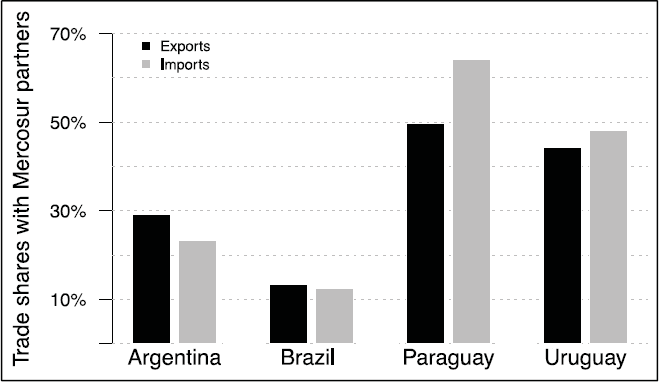
Intraregional Commodity Trade between 1991 and 2001. Imports and Exports as Mean Yearly Trade Shares of Regional Trade Relative to Overall Trade
Following the second hypothesis, we also expect that two interlinked external events should make governments reconsider their initial positions on Mercosur's DSS. The economic and financial crisis in South America at the turn of the millennium had particularly strong repercussions on the Argentinian and Brazilian economies, and we would expect those economies that suffered most from the crises to press hardest for institutional reform. Argentina and Brazil should be prime candidates for signaling their commitment to regional integration in general and legal security for economic investments in particular.
With regard to the third hypothesis, we argued that actors learn about the effects of a DSS once they make use of the system to settle conflicts. Mercosur's member states employed ad hoc panels to solve interstate conflicts for the first time in 1998. Up to the end of the negotiations about the reform of Mercosur's DSS in December 2001, Argentina was involved in five cases, Brazil in four, and Uruguay in one. 6 Since they are the two countries with the highest share of cases, we would thus expect governments and officials from Argentina and Brazil to be particularly susceptible to revising their beliefs about the consequences of Mercosur's DSS. We hence expect that their reform agenda and their proposals will be driven by the experiences drawn from the workings of the initial institutional design.
This data was taken from Mercosur's Secretariat's website: ≤www.mercosur.int≥; last accessed in October 2013.
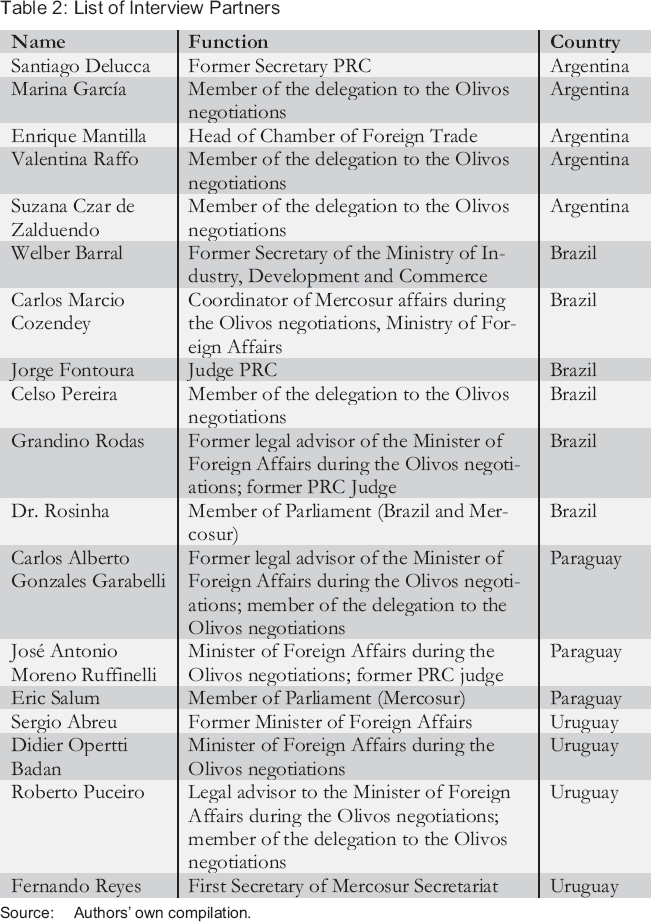
In order to explain the legalization of Mercosur and to empirically inform the hypotheses presented above, we collected enough primary source data to provide first-hand insights into the negotiations concerning the Protocol of Olivos. The treaties and amending protocols have already been interpreted at length in the legal literature, but scholarship unveiling the political process of the negotiations is rare, given the lack of systematically collected primary source data. 7 Diplomatic documents covering the negotiations remain classified, and despite our efforts to obtain them, government and Mercosur officials were reluctant to grant us access. In spotlighting actors who were closely involved in the negotiations of the Protocol of Olivos, we identified theoretically interesting groups of actors (George and Bennett 2005; Tansey 2007). We interviewed members of government, ministry officials involved in the negotiations, a representative of an influential interest group with a particular focus on trade relations within Mercosur, and members of academia (especially lawyers) with close ties to relevant political actors. Overall, we consulted three Ministers of Foreign Affairs, nine officials from other domestic ministries, five fonctionnaires working for Mercosur institutions, seven academics, and one representative from an interest group. 8 Five interviewees come from Argentina, six from Brazil, three from Paraguay, and four from Uruguay. Altogether, eighteen interviews were conducted between February and March 2011. These were semi-structured and explicitly designed to tap the key explanatory concepts identified in our theoretical discussion: the sources of governments’ preferences, the rationale for changing strategies, and associated behaviors in the course of the negotiations between 2000 and 2002.
Some legal texts contain remarks on particular positions of countries on the question of legalization. See, for example, Perotti 2001, Boldorini 2003, Garabelli 2004, and Pimentel and de Klor 2004.
Some of our interview partners belonged to more than one of these groups, which is why the number does not add up to 18.
Turning to the empirical record, our findings on states’ initial preferences regarding legalization offer support for our first hypothesis. While the governments of Uruguay and Paraguay both expressed their support for higher levels of legalization at an early stage, Argentina and Brazil favored the institutional status quo. According to our interviewees, concerns among officials from Uruguay and Paraguay about the larger states’ superior bargaining power and anxiety about renegotiations of the initial bargain were pronounced: “It's the failure to fulfill obligations, the lack of sanctions, and the impunity that the larger countries enjoy,” one government official from Uruguay said. 9 Opting for a more legalized DSS in Mercosur appeared an apt way of restricting larger partners: “It's always the smaller states that worry most about a good system of dispute resolution.” 10 A government official from Paraguay exemplified Paraguay's problems with Brazil:
Authors’ interview 13, Montevideo, February 2011.
Authors’ interview 14, Uruguay, government official, Montevideo, March 2011.
Brazil, for example, used to create problems with the export of some of our products that should get freely into Brazil. Well, this meant a really big impediment for the Paraguayan economy. On the other hand, if Paraguay took similar measures to avoid entrance of some similar products from Brazil into Paraguay, you see the difference between the Paraguayan and Brazilian economies. It mattered very little for Brazil. 11
Authors’ interview 17, Paraguay, ministry official, Asunción, March 2011.
The position of the smaller states was echoed by officials from Argentina and Brazil, who underlined that “supranationality” appeared to be the natural way out for the weaker states, because it allows them to bind their partners to commonly devised rules. 12 In contrast, the two larger countries preferred a more state-centric and intergovernmental setting to resolve disputes. A government official from Paraguay nicely highlights the different dynamics of interaction between a diplomatic and a legalized forum for resolving disputes:
Authors’ interview 2, Brazil, ministry official, Brasilia, February 2011; and authors’ interview 3, Brazil, ministry official, Brasilia, February 2011.
Large countries prefer to avoid controversies being resolved by a tribunal. It's more convenient to keep the question in a diplomatic discussion where they can exercise political pressure. Because once it goes to the tribunal, the pressure from the countries can't exist anymore – theoretically, at least. 13
Authors’ interview 17, Paraguay, ministry official, Asunción, March 2011.
Brazil was particularly “afraid to be bound by law” 14 and intended to avoid a supranational tribunal throughout the negotiations leading to the adoption of the Protocol of Olivos. 15 In February 1997, Brazil's vice-president Marcos Marciel de Oliveira affirmed in a speech before Paraguay's National Congress that the institutions in place were satisfactory as they were:
Authors’ interview 13, Uruguay, government official, Montevideo, February 2011.
Authors’ interview 1, Brazil, ministry official, São Paulo, February 2011; and authors’ interview 2, Brazil, ministry official, Brasilia, February 2011.
Governments as well as private initiatives, businessmen, companies, and citizens can call upon the dispute settlement system whenever and however often they consider it necessary. […] Our institutions have produced excellent results so far and will render the adoption of models that do not correspond to our necessities and common experiences obsolete in the end (cited in Garabelli 2004: 184. Authors’ own translation).
According to the logic of the larger states, departing from a consensus-based system of resolving disputes would create a fiction that smaller partners are equal to their larger partners and thus equip them with a disproportionate share of power (Taccone and Nogueira 2001; Barral 2003).
We have shown that in the period preceding the negotiations of the Protocol of Olivos, Paraguay and Uruguay favored higher levels of legalization while the governments of Argentina and Brazil preferred the status quo. The crucial question to be answered in this section is why Argentina and Brazil agreed to engage in negotiations on a permanent dispute settlement mechanism. In light of the economic and financial crisis besetting the continent in the latter part of the 1990s, Mercosur's governments supported institutional reforms towards a more legalized DSS to signal their commitment to the regional integration project, aiming to secure a prosperous economic environment capable of attracting intraregional and, in particular, extraregional investments. It is often argued that the economic crises in Brazil in 1999 and in Argentina in 2000 marked the end of Mercosur's “golden decade” during the 1990s (Bouzas 2001; Quijano 2005; Gomez-Mera 2009). While the crises initially led to protectionist reflexes and increased distrust among member states (Gomez-Mera 2013: 6), governments decided at a meeting of the Common Market Council in Buenos Aires in June 2000 to respond not by abandoning the regional integration project, but by relaunching it. They intended to revive Mercosur's “spirit” and regain the support of the business sector with a number of policy decisions and institutional innovations, including the reform of the DSS (Taccone and Nogueira 2002; de Klor 2003; Malamud 2005; Vinuesa 2005; decision CMC 65/00).
Documentary evidence on the negotiations and our own interview data offer insights into the rationales that drove the Argentinian and Brazilian governments to change their strategies (not preferences) and commit themselves to further legalization as a response to the crisis. During the 1990s, Mercosur's DSS was often criticized for being dysfunctional. Not only academics, but also politicians from outside the region and actors from other regional integration schemes, such as the EU, took the non-existence of a permanent dispute settlement system as proof of its defective institutional design. 16 The member governments’ decision to engage in renegotiations of the Protocol of Brasilia were part of a larger campaign that sought to reach out to international and domestic actors and revise that image: 17
Authors’ interview 12, Uruguay, ministry official, Montevideo, February 2011; and Lehmann 2001.
As Gomez-Mera 2009 shows, the years 2000 and 2001 were marked by particularly ardent trade disputes between Mercosur's members. Negotiating a more legalized dispute settlement mechanism and engaging in trade wars seems puzzling. But as interviewee 15, a ministry official from Brazil, pointed out in Brasilia in 2011, negotiations about the dispute settlement mechanism would advance more easily in the shadow of this turmoil: “It was difficult to talk about economic issues themselves due to protectionist reflexes from the authorities. […] It was easier to advance on the institutional side than on the economic one due to the crises.”
There was this idea of sending a message to the international community that Mercosur was going to continue to exist. We thought that the clearest message would go through the institutionalization of Mercosur. And one of the topics that always concerned not only Mercosur, but also all those that looked at the bloc, was the topic of resolving controversies. 18
Authors’ interview 8, Paraguay, government official, Asunción, February 2011.
One ministry official from Brazil, the largest member of Mercosur, emphasized the importance of reaching employers and entrepreneurs from within the region:
At the end of the 1990s, Argentina complained a lot about what they called ‘Brazil dependence,’ and when Brazil devalued its currency, it had a big impact on them. […] So they [the Brazilian politicians] had the idea of addressing the employers, entrepreneurs, and governments of these countries and telling them that Mercosur was going to resume its growth path. 19
Authors’ interview 2, Brazil, ministry official, Brasilia, February 2011.
Governments were particularly eager to stress legal certainty and stability within the region (de Klor 2003; Fontoura 2003 and Vinuesa 2005). Martin Redrado, a leading Argentinian politician at the time, announced: “[T]he main idea was to improve the existing judicial system in the conviction that the new one would offer greater guarantees to its participants” (cited in de Klor 2003: 624. Authors’ own translation). Concerns about legal security were so prominent that they even found their way into the preamble of the Protocol of Olivos: governments were “convinced of the necessity to improve the dispute settlement system such that it consolidates legal certainty in Mercosur” (Protocol of Olivos, preamble. Authors’ own translation).
While the economic crisis can be seen as a catalyst for deepening integration and legalization, the reform of the DSS was placed on the agenda as a result of perceived problems with the institutional status quo. Argentina and Brazil began to make use of Mercosur's DSS for the first time at the end of the 1990s. Between 1998 and the end of negotiations concerning the Protocol of Olivos in 2001, Mercosur's larger countries settled their first four disputes according to the rules of the Protocol of Brasilia. Government officials and ministry officials from both sides came to the conclusion that the status quo of Mercosur's DSS entailed distributional consequences and transaction costs for litigation that were higher than initially anticipated.
The Argentinian government began to reconsider its stance on the Protocol of Brasilia in the light of losing the cases brought before the second and third ad hoc tribunal. 20 The results “led the Argentinians to believe that there was a need for a second instance to give the country another chance to argue against the decision.” 21 Apart from mentioning the unintended distribution of gains flowing from the rulings, interviewees from the administrative ranks highlighted their disappointing experience with the litigation procedure itself: “We, the experts – the ones who work in the ‘kitchen’ and prepare the cases and their defense – had realized that Brasilia was full of flaws.” 22 Apparently, the Argentinians had learned that the current institutional design required reforms to reduce the transaction costs involved in litigation: “What all countries agreed on was that we needed a system that was effective, fast, as agile as possible, and not very costly.” 23 It was with the fourth dispute brought before an ad hoc tribunal – the so-called “poultry case” between Argentina and Brazil – that the willingness to reconsider Mercosur's DSS was sparked off (Vinuesa 2005). Brazil, Mercosur's largest member, had been the one most staunchly opposed to renegotiations of the Brasilia Protocol (Barral 2003). Although it was still engaging in negotiations on institutional reforms with some reservation in 2000,
Authors’ interview 10, Argentina, ministry official, Buenos Aires, February 2011; authors’ interview 3, Brazil, ministry official, Brasilia, February 2011; and Perotti 2001.
Authors’ interview 15, Brazil, ministry official, Brasilia, March 2011.
Authors’ interview 9, Argentina, ministry official, Buenos Aires, February 2011.
Authors’ interview 16, Argentina, ministry official, Buenos Aires, March 2011.
this hesitation disappeared the moment the fourth ruling was handed down. […] Up until then, Brazil had said: ‘The Brasilia Protocol is perfect, so we're not going to change it.’ […] After this fourth case, Brazil was more open to negotiating with Argentina about amending the Protocol of Brasilia. 24
Authors’ interview 3, Brazil, ministry official, Brasilia, February 2011.
Brazil's experience with the pre-Olivos DSS spurred on its search for more efficient institutional solutions:
Reforms were a consequence of Brazil's and Argentina's decision to actually rely on the DSS for the settlement of disputes […]. As we started using the mechanism, new ideas on how to improve it appeared, which then finally resulted in the negotiations. 25
Authors’ interview 15, Brazil, ministry official, Brasilia, March 2011.
While Paraguay and Uruguay had been willing to reform the DSS right from the start, given their underlying preference for a more legalized DSS, Argentina and Brazil were only willing to commit to a more transnational form of dispute resolution as a result of the economic crisis and their problematic experience with the existing resolution system.
Concerned about the high transaction costs of conflict resolution as well as its unintended distributional effects, member states introduced a number of well-defined institutional innovations. 26 The first series of reforms addressed the independence of Mercosur's DSS (see Table 1 above). The governments decided to equip judges in the newly established permanent tribunal with a two-year tenure. The very first awards resulted in diverging interpretations of Mercosur legislation. The expectation was that judges with longer tenure would assure greater consistency in handing down rulings and would hence lower the transaction costs associated with arbitration. Permanent judges “ensure that there will be a tendency towards more legal consistency, at least during their tenure,” one government official revealed. 27 All sides consented on this issue; the national delegations negotiating the Protocol of Olivos never really debated this solution. 28
Decision CMC 25/00 contains the problems the national delegations identified at the outset of the negotiations.
Authors’ interview 14, Uruguay, government official, Montevideo, March 2011.
Authors’ interview 15, Brazil, ministry official, Brasilia, March 2011.
The possibility of reviewing rulings passed by the ad hoc tribunals represents an important advancement in the legal discretion of the DSS (Tussie, Labaqui, and Quiliconi 2001; Boldorini 2003). While Paraguay and Uruguay have always demanded a second instance in their pledge for a more supranational tribunal, 29 the Argentinian and, in particular, the Brazilian delegations started to consider the option of judicial revision only in the light of the fourth case brought before an ad hoc tribunal (the “poultry case”). In the case in point, the ad hoc tribunal applied WTO rules on anti-dumping and handed down a ruling in favor of Argentina. Brazil was highly discontented with the ruling, and since there was no possibility of legal revision, it filed the case with the WTO – and won it this time (Sá Cabral and Lucarelli de Salvio 2008). In the light of this experience, all the member states expressed support for establishing a second instance within Mercosur, allowing a “losing country another chance to argue against the ad hoc tribunal's decision.” 30 Similarly, the forum selection clause requires parties to agree to use a particular legal forum to settle their disputes, i.e., once they agree to use Mercosur's DSS, they waive their right to “forum shop” outside the realm of Mercosur. This provision was based on Argentina's and Brazil's experience with the fourth ad hoc arbitration ruling and was intended to prevent comparable events from occurring in the future (Puceiro 2003). The member states essentially intended to lower the transaction costs of litigation with these provisions: once a dispute was settled in the realm of Mercosur, none of the parties had to fear renegotiations and possibly contradicting verdicts from another forum. 31
Authors’ interview 9, Argentina, ministry official, Buenos Aires, February 2011.
Authors’ interview 15, Brazil, ministry official, Brasilia, March 2011.
Authors’ interview 2, Brazil, ministry official, Brasilia, February 2011; and authors’ interview 9, Argentina, ministry official, Buenos Aires, February 2011.
The Protocol of Olivos also explicitly introduced the opportunity to consult the new tribunal to obtain non-binding, consultative opinions. This feature was also intended to lower the transaction costs of resolving disputes. When Uruguay's foreign minister Opperti suggested the innovation,
[…] he thought this could be an important contribution. In the early stages of a conflict, consultative opinions would be insightful, already point to the solution, and thus avoid any further escalation of the dispute. 32
Authors’ interview 11, Uruguay, ministry official, Montevideo, February 2011.
Even though Brazil staunchly opposed this provision initially, 33 it “finally liked the idea and made it go ahead,” an official said. 34
“Brazil didn't even understand the issue!” Authors’ interview 10, Argentina, ministry official, Buenos Aires, February 2011.
Authors’ interview 15, Brazil, ministry official, Brasilia, March 2011.
Additional innovations concern the standing of and access to Mercosur's DSS. The new rules make it easier for the parties to a conflict to circumvent diplomatic forums and file a case directly with an ad hoc tribunal. All parties would need to consent to passing the resolution of a dispute over to the Common Market Group, whereas the parties may bring a case to an ad hoc tribunal unilaterally. The key arguments advanced to bring about this change relate, once again, to transaction-cost considerations:
What happened in the controversies according to the rules of the Brasilia Protocol was that this instance – the Common Market Group – was not used much, because it did not help solve controversies, but only delayed the process. [… In the future, the Common Market Group] should solve controversies over principled questions rather than actual trade disputes. 35
Authors’ interview 16, Argentina, ministry official, Buenos Aires, March 2011.
In contrast, redirecting the cases to ad hoc tribunals seemed to be promising, since conflicting parties would now be able to delegate conflict settlement directly to a third party and save transaction costs for litigation at an early stage. 36
Authors’ interview 12, Uruguay, ministry official, Montevideo, February 2011; and authors’ interview 10, Argentina, ministry official, Buenos Aires, February 2011.
According to the Protocol of Olivos, conflicting parties may unanimously decide to circumvent ad hoc tribunals and directly address the Permanent Review Tribunal for litigation – and not only as an instance of revision. This institutional provision originates in Uruguay's and Paraguay's efforts to install a strong supranational and permanent tribunal to prevent the two larger states from abusing their bargaining power:
Uruguay's proposal of having a single court is reflected in Article 24 of the Olivos Protocol, which permits direct access to the Permanent Review Tribunal. It was the result of a compromise: ‘We do not have a single court, but in case the countries come to an agreement, they can directly address the Permanent Review Tribunal as if it were one.’ 37
Authors’ interview 9, Argentina, ministry official, Buenos Aires, February 2011.
The larger states found it easy to compromise on these terms, since the established rules would always allow them to veto the attempt to bring a case before the tribunal:
At first, like other countries, we were against this option. Nevertheless, we finally agreed, because in order to use this instance, you need agreement from both parties – and Argentina thought ‘we'll never consent anyway.’ 38
Authors’ interview 16, Argentina, ministry official, Buenos Aires, March 2011.
Finally, Mercosur's member states also introduced institutional innovations with regard to legal embeddedness. Even though compliance problems with the rulings handed down by ad hoc arbitration had not been an issue up to the negotiations, governments were eager to improve the existing procedure to pre-empt potential conflicts (Boldorini 2003). As one Argentinian government official voiced:
The Brasilia Protocol said that if one party did not comply with a ruling, the other party could suspend temporary concessions. Full stop. It did not say anything else. So what we did was to improve and develop it a little bit more. When a country suspends concessions, they now have to be equivalent, proportional, and in the same sector. 39
Authors’ interview 16, Argentina, ministry official, Buenos Aires, March 2011.
The issue had already ranked prominently in the first road map for negotiations, distributed by the Argentinian government during its presidency of Mercosur in the first half of 2000. 40 Decision 25/00 made by the Common Market Council, which instructed the renegotiation of the DSS as part of the relaunch agenda in June 2000, contained a clear mandate to improve procedures for the enforcement and monitoring of compliance.
Authors’ interview 9, Argentina, ministry official, Buenos Aires, February 2011.
Our empirical evidence shows that Mercosur's member states signaled their commitment to integration by advancing Mercosur's legalization in response to the economic and financial crises in the later 1990s. Moreover, the content of the reform can be traced back to experiences with the pre-Olivos DSS and the concomitant insight gained by the governments of Argentina and Brazil that the transaction costs of litigating under the pre-Olivos rules were too high and had to be lowered. While we are aware of the fundamental problem of causal inference in social science, we are nevertheless convinced that the outcome would have been different in the absence of one of these two conditions. We propose two counterfactual arguments to substantiate our claims (Goertz and Levy 2007; Lebow 2010). Without the economic and financial crises at the turn of the millennium, the governments of Argentina and Brazil would not have considered the reform of Mercosur a priority and it is highly unlikely that sovereignty would have been delegated to the Mercosur level at this point in time. In our explanation above, we were able to show that the exogenous change in leaders’ strategic environments led to a shift in the strategies followed by political leaders. Functional demands alone, geared towards reducing the transaction costs of litigating, would not have led the governments of Argentina and Brazil to reconsider their stance towards further legalization. We conclude that the external “shock” induced from the economic and financial crises was necessary to place Mercosur on the agenda of political leaders in the four member states. Mercosur reform was thus seen as a means to help appease markets and head for more stable economic times.
The members’ experiences with the existing institutional design are important to comprehend the content and scope of the legalization reforms. The member-state governments could have signaled their commitment to integration in Mercosur by focusing on other institutional changes; the review of the DSS was only one of many reform options that governments had and implemented in the course of Mercosur's relaunch in 2002. As mentioned above, Brazil changed its negotiation position with regard to legalization only after the ruling against it in the “poultry case.” Without the experience of this case, government officials would not have pressed their executive leaders to support substantial changes in the DSS. Both conditions were thus necessary to account for the timing, content, and scope of change – none of the factors alone is sufficient to explain the outcome.
While we have presented evidence here corroborating our theoretical expectations, we also tested for alternative hypotheses to increase the amount of confidence in our findings. First of all, we turned to domestic politics explanations, which addressed the sources of preference and/or strategy changes in domestic politics, such as changes in government. We can rule out preference or strategy changes as a result of changes in government. Even though Argentina and Paraguay changed their governments during the negotiations about Mercosur's relaunch, the political parties concerned did not display any different stances towards regional integration. At the turn of the millennium, “[…] the political changes at the national level […] had no substantial effect on the government positions in the region with regard to Mercosur.” 41
Caetano 2011: 39. On the similarity of positions on Mercosur that the Menem and de la Rua governments in Argentina had at the time, see Gomez-Mera 2013: 126ff.
Second, we were explicitly testing for the impact of domestic groups and the causal importance of their interests in a more (or less) legalized system of regional economic cooperation. From the perspective of liberal IR theory, domestic actors – most notably internationally competitive firms – ought to have the strongest incentive to lobby their governments to create international rules and institutions (see Moravcsik 1998; Mattli, 1999a and 1999b; Tussie, Labaqui, and Quiliconi 2001). When the scope of markets increases beyond the boundaries of an individual nation state as a result of technological changes and concomitant increases in productivity and competitiveness, “actors who stand to gain from wider markets will seek to change an existing governance structure in order to realize these gains to the fullest extent” (Mattli 1999b: 46). However, even though we explicitly asked about such influence in our interviews, we were unable to muster any supporting evidence. While only one interviewee pointed generally at economic sector preferences in favor of a DSS offering more direct access to Mercosur-level arbitration for private actors, 42 societal actors did not articulate their interest in a systematic manner. All our interview partners denied any direct lobbying attempt on the part of this group of actors.
Authors’ interview 2, Brazil, ministry official, Brasilia, February 2011.
Finally, we systematically tested for emulation as a consequence of socialization. The institutional design of the DSS laid down in the Protocol of Olivos closely reflects the legalization preferences of the four member states. While Brazil and Argentina were skeptical about integration and sought to ensure that the new DSS would not become too “supranational,” Uruguay and Paraguay pressed for a more supranational dispute resolution system. The importance and sensitivity of the issue are reflected in the negotiations on the Olivos Protocol, with negotiating officials frequently reporting back to their superiors to obtain instructions regarding the institutional design of the new system. 43 The Protocol of Olivos does not copy any particular model of dispute resolution, but rather combines elements of different systems, reflecting the divergence in preferences for different levels of legalization. The result was “fortunate and constructive ambiguity” 44 – in other words, the outcome neither follows any clear legal doctrine nor does it represent one negotiation position alone: “It attempts to reflect the different visions the member states can have about the same topic. This is why a lot of solutions did not primarily originate from legal concerns, but were the result of negotiations” (Puceiro 2003: 206. Authors’ own translation). Arguments that point to diffusion dynamics whereby “epistemic networks” (see Lenz 2012, for example) spur the emulation of a supranational court with the ECJ serving as a role model appear largely unconvincing in the light of the evidence (also see Alter 2012). The delegations from the different member states proposed institutional design solutions that were closely aligned to their strategies supporting either moderate (Argentina, Brazil) or more extensive levels of legalization (Uruguay, Paraguay). Hence, while those governments pushing for a more legalized DSS made references to the EU's DSS (and hence the ECJ), those favoring a less legalized DSS made references to the WTO's dispute settlement mechanism: “Brazil and Argentina's attitude was to look for improvements in the system and take the WTO as an example.” 45 A Brazilian colleague corroborated this view, saying: “I believe there was strong influence from the WTO's model […].” 46 Delegates from the two smaller countries considered the EU as a role model: “There was this wish from Uruguay and Paraguay to have something more similar to the EU.” 47 Another Brazilian interview partner shared this perspective: “In Uruguay especially, there's still this view from people who study the EU.” 48 Not surprisingly, delegates from the two smaller countries shared these positions: “I think it [the Protocol of Olivos] is more inspired by the EU than by WTO.” 49
Authors’ interview 9, Argentina, ministry official, Buenos Aires, February 2011; authors’ interview 15, Brazil, ministry official, Brasilia, March 2011; authors’ interview 8, Paraguay, government official, Asunción, February 2011; and authors’ interview 11, Uruguay, ministry official, Montevideo, February 2011.
Authors’ interview 12, Uruguay, ministry official, Montevideo, February 2011.
Authors’ interview 10, Argentina, ministry official, Buenos Aires, February 2011.
Authors’ interview 2, Brazil, ministry official, Brasilia, February 2011.
Authors’ interview 15, Brazil, ministry official, Brasilia, March 2011.
Authors’ interview 2, Brazil, ministry official, Brasilia, February 2011.
Authors’ interview 8, Paraguay, government official, Asunción, February 2011.
While evidence of the emulation of one particular model is scant, some of our interviewees questioned the relevance of (positive) emulation altogether. Government officials may have been prone to compare the outcomes of the institutional design choice of Mercosur's DSS with other models ex post facto, but there is evidence that they did not intend to simply “copy” dispute settlement mechanisms from other organizations. Even though institutional elements of the new DSS may have certain features of the EU's own resolution system, the causal effect – i.e., non-spurious emulation – has yet to be established. This means that institutional similarities are not necessarily due to any deliberate copying:
People who negotiated and discussed might swear they did not know about the WTO. […] But you can clearly realize that the appellate body of WTO is very present in the idea of an arbitral appellation tribunal. 50
Authors’ interview 7, Brazil, ministry official, Asunción, February 2011.
Finally, for emulation to be successful, the actors negotiating the new institutions for Mercosur's DSS should possess or develop a common outlook regarding the most effective or appropriate design. According to our interviewees, no common vision or interpretation about the most effective or appropriate DSS arose during the negotiations. Even though delegates to the negotiations admitted that they began to develop mutual trust and amicable relations, we have no evidence of any socialization effects that could have supported an endogenous preference change. Two interviewees participating in the negotiations reported about the atmosphere in a particularly illustrative way: “There was a friendly atmosphere, and you could speak openly. But still, [the representatives’] positions remained distinct.” 51 A colleague from Argentina put it in even more metaphorical language: “They were all close friends of ours. I mean, they were friends until we engaged in discussions. Then we'd draw our swords and fight!” 52
Authors’ interview 11, Uruguay, ministry official, Montevideo, February 2011.
Authors’ interview 9, Argentina, ministry official, Buenos Aires, February 2011.
In the descriptive part of this paper, we demonstrated that the Olivos reforms marked a significant break with the previous system of dispute settlement, which contained strong intergovernmental features. We explained the initial preferences regarding legalization on the part of the Mercosur governments as a consequence of their countries’ different levels of economic strength and interdependence. Uruguay and Paraguay had long pushed for a more legalized DSS because they feared the domination of the two more powerful members, Argentina and Brazil. Moreover, with higher intraregional trade shares, Uruguay and Paraguay benefitted more from unhindered economic transactions within the region than Argentina and Brazil. In contrast to Uruguay and Paraguay, the two larger Mercosur partners were economically less dependent on intraregional trade and preferred a less legalized DSS, since they expected to be able to realize their interests in diplomatic negotiations in a better way than through institutionalized forms of third-party dispute settlement. In the light of the initial reluctance of the Brazilian and Argentinian governments to support any advances in legalization, we offered a two-tiered explanation of the demand for and supply of a more legalized dispute resolution system. First, Argentina and Brazil, which were initially opposed to stepping up the level of legalization, were in favor of more efficient institutions for litigation, given their experience with the pre-Olivos system of dispute resolution. Moreover, the economic and financial crises experienced in the late 1990s induced the Mercosur governments to signal their commitment to the integration project. Delegating (small) portions of sovereignty by empowering the DSS was considered a credible (but costly) signal to transnational economic actors and international capital owners that their investments in the region would be legally secure and profitable.
We have presented a comprehensive explanation of legalization here, highlighting preferences, timing, and the content of institutional change. By taking recourse to insights from contracting theory (Cooley and Spruyt 2009), externality theory (Mattli 1999a, 1999b; Mattli and Stone Sweet 2012), and rationalist theories about learning, and applying process tracing methodology, we were able to show how different causal mechanisms – signaling commitment during crises and revising beliefs in order to render existing institutions more functional – interrelate so as to draw a more complete picture of the timing and content of DSS reforms. While contracting theory offers convincing accounts of actors’ preferences for legalization, changing economic environments induce political leaders to modify their strategies regarding regional cooperation and opt for more transnational forms of conflict resolution (Mattli 1999a). We have argued that the crises of the late 1990s acted as a catalyst for Mercosur reform and made governments reassess their strategies for achieving regional integration. Signaling commitment to further integration in Mercosur was thus a direct response to the economic crisis, yet it does not explain the choice of the respective institutional innovations in the DSS. To this end, we argued that legalization rose to the top of the reform agenda because the Mercosur governments – especially Argentina and Brazil, the more skeptical members – revised their views about the pre-Olivos DSS once they had experienced the first series of cases and rulings; judging the system to be deficient, they agreed to a relatively wide-ranging reform agenda.
In this context, we have also shown that one should not overstate the explanatory power of emulation or diffusion arguments and be too quick in dismissing functional arguments and pressures geared towards lowering the transaction costs of existing institutional arrangements. Having tested these different mechanisms, we found that in the reform of Mercosur's DSS, the actors learned about the effects of the initial institutional design and developed a detailed road map for reform to overcome perceived deficiencies in the existing institutional setup.
Footnotes
Appendix
List of Interview Partners
| Name | Function | Country |
|---|---|---|
| Santiago Delucca | Former Secretary PRC | Argentina |
| Marina García | Member of the delegation to the Olivos negotiations | Argentina |
| Enrique Mantilla | Head of Chamber of Foreign Trade | Argentina |
| Valentina Raffo | Member of the delegation to the Olivos negotiations | Argentina |
| Suzana Czar de Zalduendo | Member of the delegation to the Olivos negotiations | Argentina |
| Welber Barral | Former Secretary of the Ministry of Industry, Development and Commerce | Brazil |
| Carlos Marcio Cozendey | Coordinator of Mercosur affairs during the Olivos negotiations, Ministry of Foreign Affairs | Brazil |
| Jorge Fontoura | Judge PRC | Brazil |
| Celso Pereira | Member of the delegation to the Olivos negotiations | Brazil |
| Grandino Rodas | Former legal advisor of the Minister of Foreign Affairs during the Olivos negotiations; former PRC Judge | Brazil |
| Dr. Rosinha | Member of Parliament (Brazil and Mercosur) | Brazil |
| Carlos Alberto Gonzales Garabelli | Former legal advisor of the Minister of Foreign Affairs during the Olivos negotiations; member of the delegation to the Olivos negotiations | Paraguay |
| José Antonio Moreno Ruffinelli | Minister of Foreign Affairs during the Olivos negotiations; former PRC judge | Paraguay |
| Eric Salum | Member of Parliament (Mercosur) | Paraguay |
| Sergio Abreu | Former Minister of Foreign Affairs | Uruguay |
| Didier Opertti Badan | Minister of Foreign Affairs during the Olivos negotiations | Uruguay |
| Roberto Puceiro | Legal advisor to the Minister of Foreign Affairs during the Olivos negotiations; member of the delegation to the Olivos negotiations | Uruguay |
| Fernando Reyes | First Secretary of Mercosur Secretariat | Uruguay |
Source: Authors’ own compilation.