



Abstract
In recent years, South America has witnessed a large increase in arms purchases. Nonetheless, there are important intraregional differences in terms of the allocation of resources for weapons acquisitions. How can we account for these disparities? Mainstream literature suggests that levels of arms importation depend on either the size of the defense budget or the perception of threat. In contrast, this article contends that the level of spending on arms is mainly determined by: (a) the expansive or nonexpansive nature of the strategic assessment of defense, (b) the available resources allocated by the defense budget, and (c) the level of political attention to defense issues. Thus, the aim of this article is to account for and assess the determinants of the different levels of arms importation in South America from 2000 to 2011.
Introduction
South American states are in the midst of a historical transformation characterized by the combination of high rates of economic growth, the consolidation of democratic regimes and the reduction of poverty. Brazil stands in the spotlight of this change. The country has just become the sixth largest economy in the world, surpassing Great Britain. This new economic and political landscape has been escorted by another novel trend: a regional wave of purchases of advanced military equipment.
Arms purchases have greatly increased in South America in recent years, climbing by 150 percent since 2005 (SIPRI 2010). Chile is the main buyer, having imported USD 4.4 billion worth of weaponry between 2000 and 2011, followed by Venezuela with USD 3.3 billion, Brazil with USD 2.7 billion, Colombia with USD 1.8 billion and Argentina with USD 519 million (SIPRI 2011). An analysis of this expenditure as a percentage of GDP for the same time period reveals that Chile is also the country that spends a bigger proportion of its resources on arms (an average of 0.26 percent), compared to Venezuela (0.16), Colombia (0.08), Brazil (0.04) and Argentina (0.01). It should be noted that Brazil's percentage does not take into account the recent announcements on arms purchases, which – if included – would increase arms spending to 0.28 percent of GDP between 2012 and 2016.
The main aim of this article 1 is to identify the factors that explain these different levels of arms spending in South America for the period 2000– 2011. I will analyze the cases of Argentina, Brazil, Chile, Colombia and Venezuela. Together, these countries accounted for 94 percent of total armament imports into South America during the period analyzed. 2 This period of study allows for a more nuanced control of the impact of the three independent variables, as arms spending only increased significantly from 2005.
I am very grateful for the help and advice provided by Sebastían Etchemendy, German Lodola, Lucas Gonzalez, Christian Bonfili and Richard Hay.
Military spending on armaments in South America can be analyzed using arms imports data. South American countries produce small quantities of arms and when they do, as in the cases of Argentina and Brazil, they tend to import their most advanced and expensive components. For that reason, arm import figures account for almost all of the additions of the most important items of military equipment of a state in South America in the analyzed period. (The most important items of military equipment are combat aircrafts, helicopters, tanks and capital ships.) Moreover, the choice of arms imports spending as the dependent variable is based on the assumption that this phenomenon, and not the overall rise in military budget, is the one that could generate increasing tensions in interstate relations. This leads us to dismiss defense spending as the variable to be analyzed since South American countries spend, on average, 85 percent of their defense budget on operations and maintenance. These two items can significantly increase defense spending (e.g., due to wage increases) and, yet, not necessarily increase other states’ perception of threat. By contrast, the rise in military spending by the purchase of weapons often results in an increase of tensions and distrust. In this sense, this indicator is more accurate than the defense spending as a percentage of GDP, the defense spending in absolute terms, or as a percentage of government budgets. These indicators do not capture whether an increase in military spending reflects an arms procurement process or just allocation of resources to supply the armed forces’ operations and maintenance.
The traditional literature on this subject argues that arms procurement levels are related to the absolute GDP value, the level of GDP growth, the size of the defense budget and the existence of security threats or modernization needs (Brzoska 2004; Smith and Tasiran 2005; Yakovlev 2007). The main claim of this article is that the different levels of arms purchases could be explained by the combining effect of three variables that are usually considered independently in the traditional literature on this subject: (a) the expansive or non expansive nature of the strategic assessment of defense (SAD); (b) the availability of budgetary resources for the defense area, which is in turn a result of the availability of economic resources; and (c) the degree of political attention to defense issues.
Therefore, a multidimensional approach is needed to overcome the limitation of mainstream explanations. For instance, it would be possible to argue that countries with the highest weapons purchases in recent years are those with the highest defense budgets. In the period 2000–2011, however, an analysis of South American countries’ military budgets reveals that there is no relationship between total defense spending and weapons purchases. The country that allocates the most resources to its defense, Brazil, is only the third largest importer of weapons, whereas Chile, the biggest spender on arms in the region, has a military budget four times smaller than Brazil's. Similarly, Venezuela is the second largest importer of weapons, but its military budget is only the fourth largest. The Venezuelan budget is very similar to that of Argentina, the fifth largest weapons importer.
Another possible approximation of weapon acquisitions is based on threat perceptions. This kind of approach emphasizes the existence of an arms race in the region. An arms race has been defined as a dynamic of action and reaction between two countries experiencing an intense security dilemma (Hammond 1993; Glaser 2000). However, the action-reaction pattern so characteristic of an arms race is not present in the region. Countries like Peru and Colombia, which maintain border and ideological disputes with Chile and Venezuela, have not acquired weapons in response to purchases made by their neighbors (SIPRI 2011). Moreover, in cases where military spending has increased, it is not apparent that external threat in the region played a role. Brazil and Chile, for instance, do not perceive significant threats to their security in the region, yet have acquired large amounts of weapons. Meanwhile, Argentina has only procured a small amount of weaponry in spite of being surrounded by the more powerful armed forces of Brazil and Chile.
Other works suggest that the allocation of resources for defense can also be driven by economic growth (Dunne and Perlo-Freeman 2003; Frederiksen and Looney 1983; Hewitt 1991). Economic explanations assume that those countries experiencing higher economic growth should buy more weapons. This hypothesis could be complemented by the idea that countries with larger GDPs should spend more on arms than those with lower GDPs. However, data on average GDP growth between 2000 and 2011 and the position of countries by nominal GDP for the same period do not provide any clear pattern between the size of an economy and the amount of resources allocated to the purchase of weapons. Arms procurement appears to be independent of a country's size and its economic growth rates. For example, Brazil's GDP is the largest in South America and 10 times larger than Chile, yet Brazil is only the third largest importer of weapons in the region. The same applies to Venezuela, whose GDP is twice that of Chile. Argentina has the second largest GDP and is the state that spends the least amongst the five analyzed countries. This order may possibly change in the near future following Brazil's announcement of a vast program of military modernization. When the acquisitions finally take place, Brazil will become the number one importer of arms in the region in the coming years (0.28 percent of GDP) – just ahead of Chile (0.26).
The current literature is not only limited in its ability to explain the recent wave of arms purchases, it has also neglected to analyze this phenomenon in the South American context. Therefore, a key aim of this article is to fill this gap by arguing that those South American countries that have spent more resources on weapons are those (a) that have implemented an expansive SAD, defined as one that favors the establishment of military missions that require a high level of expenditure on arms; (b) that have a high level of budget availability in the area of defense; and (c) where politicians, especially those who govern, are interested in defense issues.
The article is divided into two sections. The first section develops the conceptual framework by explaining the three main variables: (a) SADs, (b) the availability of economic resources and its impact on the defense budget, and (c) the level of political attention to defense issues. Particular consideration is given to the impact of military missions on the allocation of resources as well as to the interaction between variables a and b with c. The second section of the article is devoted to the analysis of the cases of Argentina, Brazil, Chile, Colombia and Venezuela within the theoretical framework discussed here.
Strategic Assessment of Defense, Political Attention to Defense Issues and Economic Performance
The methodology to explain arms spending is focused on the interaction of three main variables whose impact on the final expenditure is rather different. One variable, the SADs, operate by establishing a “spending demand,” which is the desirable amount of economic resources needed to buy the military equipment required to fulfill the missions derived from SADs. However, the final expenditure figure (i.e., the money that will be nominally allocated for arms acquisitions) is the result of “spending feasibility,” which is the outcome of both the availability of economic resources and the level of attention that politicians give to defense issues (see Figure 1). As will be seen, the availability of economic resources does not necessarily imply that those resources will be assigned to the defense budget. If this occurs, there is a situation of “budget availability.” Consequently, the scenario most favorable to high levels of arms expenditure will be one in which (1) the strategic assessment favors the adoption of military missions that demand the acquisition of expensive weapons, (2) there is budget availability to acquire weaponry, and (3) politicians are interested in defense – such as in the cases of Brazil, Chile and Venezuela. In the case of Argentina, despite the country having recently implemented a SAD that is expansive in spending in a context of availability of economic resources, the lack of political attention has negatively affected resource availability in the defense budget and, in turn, the acquisition of weapons. Colombia can be located in an intermediate position with regard to armament expenditure given its adoption of a nonintensive SAD together with the presence of political interest and budget availability (see Table 1 for a summary of the cases).
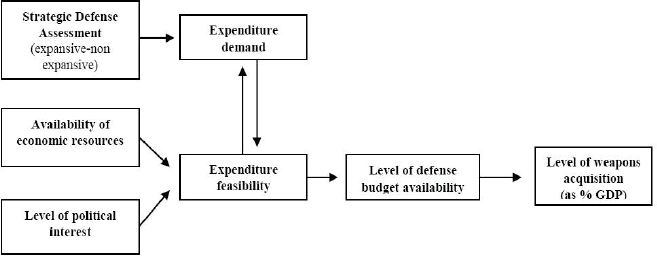
A Stylized Causal Assessment of Arms Determinants in South America
Cases Studies
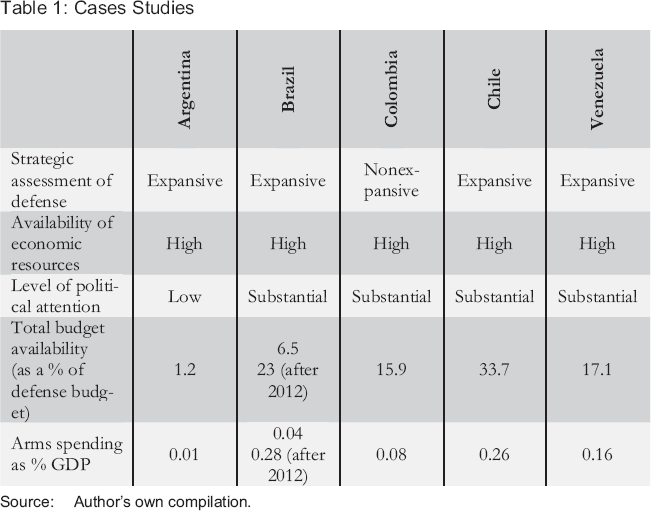
Source: Author's own compilation.
Strategic Assessment of Defense and Spending Demand: The Role of Military Missions
The development of a strategic assessment is the final step of a policy-making process that is shaped by a number of different variables, such as the organizational imperatives of the armed forces, the ideology of governments, the lobbying of companies, the role of parliaments, the type of civil-military relations and even phenomena like corruption. Therefore, our main concern here is to account for the different levels of armament purchases based on the main missions derived from SADs, and not to analyze the factors that influence or determine its formulation. This approach is essential to tackle the multidimensional nature of the process of weapon purchases in comparative research. The world of arms procurement is shaped by many actors who move in a context of high secrecy (Bromley and Solmirano 2012). For this reason, the data determining that process is difficult to obtain. This is why SADs are taken as a point of departure to identify the military missions incorporated in it and their impact on the acquisition of weapons.
It is worth mentioning that the region has been taking different measures to improve the transparency of defense spending. Argentina and Chile developed a common methodology to measure defense expenditure in 2001 with the support of the Economic Commission for Latin America (ECLA). This initiative had no precedent worldwide and has had a great impact at the regional level, serving as the model for the common methodology developed by the South American Defense Council (SADC) to measure Union of South American Nations (UNASUR) defense spending.
SADs normally include both military and nonmilitary diagnoses. The first type of diagnosis refers to the military and political elite's perceptions of the defense challenges faced by a country and usually describes regional and world scenarios and identifies threats. In this respect, SADs set the framework for the establishment of military missions. The second type of diagnosis refers to the importance of achieving nonmilitary goals. In Brazil, for example, defense has been incorporated into a project of national development.
Thus, the impact of SADs on arms procurement depends on their orientation – that is, whether they are money consuming or expansive. Expansive SADs entail a vision of defense issues that demands expensive weapons for one of two reasons: (1) military missions that require the use of sophisticated weapons or (2) the domestic production of advanced military technology. On the contrary, nonexpansive SADs are related to military missions that require the acquisition of cheaper weapons or with countries that are not interested in building a national industry of defense or the dominance of advanced technology.
To sum up, military missions and political needs have a distinct budgetary impact as they require the acquisition or domestic development (via technology transfer) of sophisticated, more expensive weaponry.
The impact that the armed forces’ missions have on arms imports has been scarcely studied. Military missions involve the acquisition of different kinds of weapons (i.e., sophisticated and low-tech equipment). Therefore, missions’ budgetary impacts vary given that their implementation is linked with different levels of spending. South American countries have assigned seven types of missions to their armed forces during the last decades: (1) military conflict with a great power, (2) military conflict with an equivalent state, (3) peace enforcement or multilateral operations under the framework of the UN or NATO, (4) counterinsurgency (COIN), (5) asymmetric warfare, (6) participation in peacekeeping operations, and (7) internal order and other domestic missions.
Weapons spending increases in accordance with the scale of a mission. The first three missions are the most expansive in terms of spending as they involve the maintenance of a certain symmetrical relation with an adversary's military power. The search for symmetry does not necessarily imply reaching a balance of forces but the use of similar kinds of forces (i.e., the deployment of the same kind of weapons and tactics). The search for symmetry is expensive as it involves the acquisition of heavy conventional weapons such as ships, aircraft and tanks. Some middle and emerging powers in South America such as Brazil and Venezuela have designed a hybrid defense doctrine in which a conventional strategy coexists with an asymmetric approach. Both countries have acquired last-generation weapons (essential for symmetrical disputes over airspace, sea and land) and lighter and individual equipment (essential for asymmetric resistance). Participating in UN Chapter VII peacekeeping enforcement operations or operating under NATO command requires the ability to deploy armed forces capable of interoperating with the most advanced armed forces; this demands major arms spending.
COIN and asymmetric missions are characterized by a less intensive use of sophisticated weaponry and therefore demand less spending than the previous three missions. COIN operations essentially require the acquisition of individual weapons, equipment to increase the mobility of troops (helicopters) and COIN aircraft. The disparity in military power associated with asymmetric missions favors the acquisition of light military equipment necessary to maintain a prolonged resistance against a far more powerful force (Arreguin-Toft 2005). The spending on asymmetric missions is less than that needed for COIN missions given that the former implicitly accept an adversary's military superiority. In this context, the acquisition of helicopters or any type of aircraft is worthless for the fulfillment of the mission.
Arms spending is somewhat lower when countries predominantly participate in peacekeeping operations under the UN Chapter VI mandate. These operations generally require inexpensive, unsophisticated equipment such as individual weapons, light-armored vehicles and a few helicopters. Moreover, countries are only expected to devote a small percentage of their forces to such missions. Public security missions are those that generate the least amount of spending on arms because they do not require sophisticated weapons such as aircraft, ships or tanks. On the contrary, the acquisition of light weapons as well as the means of transport and communication is sufficient.
There appears to be a new trend in South American SADs, with four of the five analyzed cases adopting expansive-spending missions. This transformation is related to a new regional security scenario that is linked, in particular, with the resolution of boundary disputes between Argentina, Brazil and Chile. This situation has been complemented by the gradual détente of two other major regional quarrels: (1) the Chilean-Peru maritime dispute, which has been submitted to the International Court of Justice at The Hague (both parties are to accept the forthcoming ruling) and (2) the deepening of Colombia and Venezuela's period of cooperation following the election of President Santos. This new context has led to the progressive abandonment of regional conflict scenarios and their replacement by missions not related to such threats.
The creation of the SADC, which is part of UNASUR, is itself a manifestation of this new trend in regional security. The SADC, South America's first regional institution specialized in defense matters, is composed of the ministers responsible for defense for Argentina, Bolivia, Brazil, Chile, Colombia, Ecuador, Guyana, Paraguay, Peru, Surinam, Uruguay and Venezuela. The Declaration of Santiago de Chile states that the SADC is a forum for consultation, cooperation and coordination on defense. The SADC has established three main objectives that reflect the consensus of its members regarding the challenges that face the region: (a) consolidating South America as a zone of peace, (b) creating a South American defense identity, and (c) generating consensus in order to strengthen regional defense cooperation.
Expenditure Feasibility I: Economic Resources and Budget Availability
Alongside the transformation of strategic perceptions, the region has been experiencing a period of exceptional economic growth. Although SADs set the magnitude of potential spending, it is the availability of resources and the degree of political support that ultimately establishes the budget availability for defense.
The availability of economic resources is mainly related to the economic capacity of a country to purchase weapons. Therefore, the allocation of resources for arms acquisition is mainly driven by economic growth (Hewitt 1991). It is assumed that this capacity is higher when countries enjoy long periods of economic growth, which favor an increase in public spending. This is the case with all South American countries. Average GDP growth over the past 10 years has been 7.2 percent for Argentina, 4.2 for Brazil, 3.6 for Chile and 4.9 for Venezuela (FMI 2011). Thus, the causal chain of high economic growth, the increase of public spending and the expansion of the defense budget would explain – together with an expansive SAD and political attention – the regional trend of increased spending on arms.
It is important to distinguish between budgetary and extrabudgetary funds for the acquisition of weapons, which together make up the total available defense budget. The total availability of resources can be defined as the sum of budgetary and extrabudgetary funds for the acquisition of weapons and can be measured as a percentage of the defense budget. Budgetary funds are those resources of the defense budget allocated to procure arms, while the extrabudgetary funds are those funds not included in the defense budget but allocated for such purchases. Extrabudgetary funds may be established by special laws, raised by bond issue or raised through foreign aid or loans. They can be identified from the information published by defense ministries, economic ministries as well as other sources, such as foreign governments that finance weapons purchases. Both types of funds were calculated from the annual military budget analyses of the fiscal years from 1999 to 2011; the funds allocated for arms purchases were identified within each budget and then calculated as a percentage in relation to the overall budget (see Table 2).
Budgetary and Extrabudgetary Spending for the Purchase of Weapons
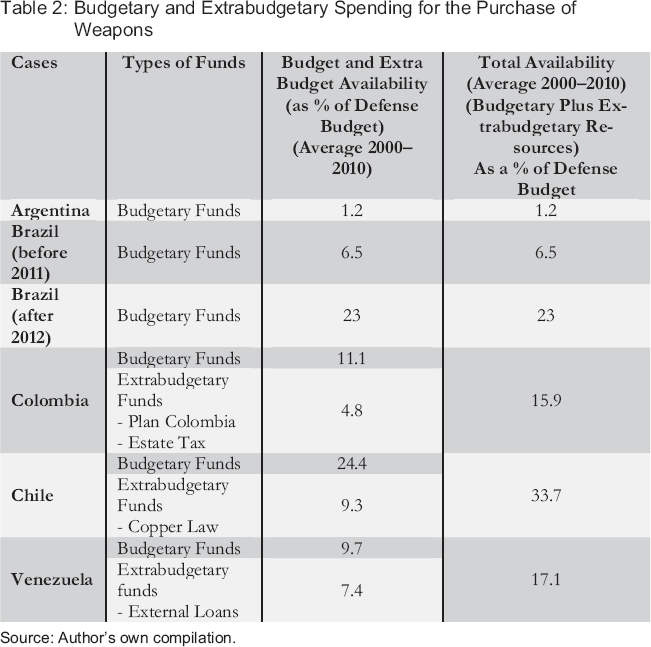
Source: Author's own compilation.
Expenditure Feasibility II: Political Attention to Defense Issues
The political attention to defense issues is a key variable for explaining the likelihood that the “demand of spending” will actually be transformed into a real allocation of resources in the defense budget. Therefore, defense budget availability is one of the main indicators of political attention: the greater the political interest, the greater the predisposition to spend on defense.
The literature has identified various conditions that promote political attention on defense issues – such as structural and social causes, those related to the type of regime transition and those emphasizing government ideology. Structural approaches argue that politicians have a greater interest in defense when the state experiences threats to their security (Desch 1996). Conversely, the absence of threat is a factor that favors the civilian leadership being less likely to be attentive to national security affairs; however, this lack of attention does not have political costs, because the state has assured its survival.
Social approaches assume that politicians are driven by the interests of their constituents and parties. In this sense, their interest in defense matters is mainly determined by the political advantage they can obtain. This tends to happen given two different conditions. First, right or center-right constituencies tend to support the existence of properly equipped and trained armed forces. In such constituencies, it is possible to expect the presence of political parties representing those sectors. Of course, low social interest in defense is unlikely to facilitate significant political attention to defense issues. Second, the existence of a defense industry is an important source of employment and is thus a strong incentive for politicians take an interest in defense. This is because the social sectors that benefit from the existence of such industries represent an extremely attractive constituency for politicians. Thus, the maintenance and/or domestic production of arms is seen as a tool to attract votes (Pion-Berlin and Trinkunas 2007).
Two other conditions have also been linked with political attention to defense issues. The literature on democratic transition holds that pacted transitions are associated with more military leverage during the phase of consolidation (O Donnell, Schmitter, and Whitehead 1986). This is due to the negotiated character of the transition, which involves the acceptance – by the new civilian authorities – of military-run authoritarian enclaves or of certain prerogatives. In other cases, the amount of political power held by the armed forces, inherited from the transition, becomes an important leverage when setting the agenda for budget allocation (Zaverucha 2009). In both cases, the power and influence of the military compels politicians to be concerned with defense issues. Furthermore, such transitions are associated with the presence of relevant center-right parties that tend to favor a high level of military spending and the maintenance of areas of military autonomy.
Politicians may also be interested in defense issues for ideological reasons – that is, when their political projects include defense either because the military are perceived as an essential instrument for national development or because they believe that the defense industry may contribute to job creation or achieve greater technological autonomy.
The political attention dimension should be assessed in relation to SADs and the availability of resources. To better illustrate this point, it is worth comparing the cases of Chile and Colombia. Chile's expenditure on weapons (USD 4.4 billion) far exceeds that of Colombia (USD 1.8 billion). In both cases, there is budget availability and the political attention for defense is grounded in institutional aspects (“Copper Law”) and the internal perception of threat. Therefore, the difference in SADs, which is more expansive in Chile, is the main explanatory factor for spending levels. The contrast is more striking in the case of Argentina, where an expansive SAD and an availability of economic resources have not been translated into budgetary availability for the purchase of arms due to a lack of political support for defense issues.
Case Studies
Brazil
The arms procurement announcements made by Brazil have been made possible by the convergence of three factors: (a) an expansive SAD, which includes a conflict scenario with a great power, favoring the purchase of last-generation weapons; (b) an important budget availability as a result of constant economic growth; and (c) political support for arms purchases. The Brazilian armed forces have considerably increased their military budget, which grew from USD 17.6 billion in 2003 to USD 34.2 billion in 2011. This budget increase has been accompanied by a series of major acquisitions. The most important purchases will be made from France under the military agreement signed in September 2009 for USD 18 trillion. The agreement includes the provision of 4 Scorpene submarines, the hull of a nuclear submarine, 50 EC-725 helicopters and the possible option for 36 Rafale aircrafts. There are other ongoing programs such as the construction of the KC-390 transport aircraft, the modernization of AMX-1 and Tucano planes, and the construction of the infrastructure to maintain nuclear submarines. With the announced purchases, Brazil will become the largest buyer of weapons in the region, reaching 0.28 percent of GDP between 2012 and 2016.
This wave of weapons acquisitions is related to the change in the strategic assessment of the country's defense. For much of the twentieth century, the Brazilian defense assessment was influenced by the likelihood of regional conflict. In fact, the Brazilian military's main mission was to prepare for a military confrontation with Argentina. The perception of this threat began to subside in 1979, when both countries signed an agreement that ended their 13-year dispute over the Paraná River. In 1985, Presidents Sarney and Alfonsin signed an agreement that covered nuclear issues and energy cooperation and set up a commission to examine economic cooperation. By virtue of these agreements, the historic rivalry between Argentina and Brazil became an intense process of political, economic and military cooperation, which continues today (Kacowicz 1998).
This remarkable change in bilateral relations had an inevitable impact on the missions assigned to the armed forces. As Argentina ceased to represent a threat, the Amazonian region began to be identified in the early 1990s as the main security concern. Various official publications highlighted the growing interest in the defense of Amazonas, arguing the possibility of an invasion by a great power. In all of these documents, warnings concerning the malleability of the principle of sovereignty and the possible international intervention or the “Balkanization” of the Amazon were made. For example, a publication by the Ministry of the Army in the early 1990s designated the Amazon as an area of strategic priority and predicted a confrontation with “an incontestably superior military power” through a strategy of resistance (Marques 2004; Zirker and Filho 2000).
This new approach became official in 1996 with the publication of the National Defense Policy (NDP). The document made explicit the abandonment of the possibility of conflict with Argentina and highlighted the importance of the Amazon to the security of Brazil. During Cardoso's presidency, the main mission assigned to the Brazilian military was based on a scenario of asymmetric resistance against the intervention of a great power in the Amazon. Nevertheless, the low rate of economic growth that Brazil experienced during the 1990s prevented the acquisition of sophisticated military equipment for the accomplishment of that mission (Zaverucha 2005).
The arrival of Luis Ignacio “Lula” Da Silva to the presidency in 2002 elevated defense issues to the top of the public debate. For the first time in Brazilian history, a presidential candidate from the Left represented the preferred option for the Brazilian military. Lula's proposals were the most convergent with the armed forces’ interests; his agenda was quite extensive and included an increase of the defense budget from 1 percent of GDP to 2 percent within four years.
Lula's strategic appraisal departed from the approach of his predecessor by portraying US military and economic hegemony as prejudicial to the development and influence of Brazil (Duarte Villa and Trindade Viana 2010; Flemes 2011). Following this, the acceleration of the transition from US dominance to a multipolar order that favors Brazilian interests became the main goal of its foreign policy. This strategy has been defined as an “assertive” project rather than the mere “acceptance of the guidelines set by the big power blocs” (Duarte Villa and Trindade Viana 2010: 25). This assertive orientation distinguishes Brazilian grand strategy from that of Venezuela, which contemplates a more radical confrontation with the United States.
If the NDP of 1996 represented the official confirmation of the elimination of the conflict hypothesis with Argentina, the new edition of the NDP (issued in 2005) officially confirmed a scenario of conflict that had been debated during the previous decade: the defense of the Amazon against a great power invasion. 3 According to the NDP,
In Fact, 82.6 percent of the Brazilian military and 72.7 percent of civilians believe that the Amazon could be militarily occupied by a foreign power (Bitencourt and Costa Vaz 2009: 10).
in this century, disputes over maritime areas, the aerospace domain […] freshwater sources and energy […] may be intensified. These issues may lead to interference in internal affairs.
Furthermore,
the environmental issue remains a concern of humanity. Countries that possess high biodiversity, vast natural resources and vast areas to be incorporated into the production system may become the subject of international interest (Government of Brazil 2005).
The new NDP incorporates the term “Blue Amazon,” which refers to the sea under Brazilian jurisdiction after the extension of the limits of the sea surface in the framework of the UN Convention on the Law of the Sea.
The publication of the National Defense Strategy (NDS) in 2008 further clarifies the mission issue by establishing the need to mount a hybrid defense to be implemented simultaneously against an invasion. Accordingly, flexibility must contribute to the preparation of the military “for an asymmetrical warfare, especially in the Amazonian region, to be held against an enemy of superior military power.” Nevertheless, the navy and air force should also have conventional capabilities to “deny the use of the sea to any concentration of enemy forces approaching Brazil by sea”, or “secure local air superiority” (Government of Brazil 2008). These last objectives refer to a more symmetric phase of a military conflict that demands the deployment of advanced weapons, able to stand on equal footing against the most modern military arsenal of a great power. The recent discovery of offshore oil reserves significantly influenced the orientation of the NDS.
The significant increase in military spending and arms purchases in Brazil after 2009 is related to the impact that the new SAD has had on the missions of the armed forces. It is one thing to have a conflict scenario with Argentina, but quite another to identify a great power as a potential adversary. In the latter case, the pressure to acquire the latest equipment rises considerably. Therefore, the combination of an expansive strategic assessment and the economic boom experienced since 2005 have set the stage for the launch of major weapons programs in Brazil. 4 Furthermore, this would not have been possible without the political support received from the government.
The importance of the “availability of economic resources” variable is evidenced by the fact that the poor economic performance of Brazil until 2005 severely restricted the purchase of advanced weapons. In fact, numerous military programs, like the acquisition of an advance combat aircraft, were cancelled in 2002 and 2003 due to economic restrictions. Conversely, the successful economic recovery, the growth of the GDP since 2006 (almost double that of the previous five years), has allowed the launch of a vast program of military modernization.
However, given the low intensity of the perception of threat, it has not been the main cause of political support for arms purchases; there are other factors fuelling this interest. The first, and most relevant in terms of political attention, is that the ideology of Partido dos Trabalhadores (Workers’ Party) has favored the incorporation of defense into the strategy of national development (Saint Pierre 2009). For instance, the NDS revives the desire for an autonomous national arms industry with a focus on developing high technology military equipment. Here, the interest extends beyond national security to include civilian spin-offs from advanced military research and the ability to become a source of advanced weaponry for Southern countries wishing to avoid dependence on US or European suppliers. The NDS supports the strengthening of three strategic sectors: space, cyber-space and nuclear. The document states that “by its very nature, these sectors transcend the division between development and defense, between civil and military” (Government of Brazil 2008: 6). It should be noted that political attention to defense issues also has an important social base as reflected by the fact that the Brazilian armed forces have a 68.4 percent approval rating, the highest among South American countries (LAPOP 2009).
Chile
Chile is the Latin American country that has purchased more weapons in absolute terms as well as in relation to its defense budget and the size of its GDP. The most important items acquired by Chile were 8 second-hand frigates from the Netherlands and Great Britain, 2 Scorpene submarines, 200 Leopard 2 tanks and 48 F-16 aircraft. As in the case of Brazil, Chile's purchases were made possible by the convergence of an expansive strategic assessment, a high availability of funding (mainly provided through the Copper Law) and the political support for weapon acquisitions.
Chile has experienced a process of change in its SAD, which essentially has been caused by the progressive disappearance of regional enemies and by their strategy of international economic insertion. For instance, territorial conflicts with Argentina were resolved in the 1990s, and the pending territorial disputes with Bolivia and Peru are confined to diplomatic negotiations (Paz Millet 2008). In this sense, the transformation of the regional scenario of defense and the model of international insertion have been the main driving forces for the adoption of an expansive strategic assessment that led to the adoption of resource-intensive missions, which – combined with a remarkable cycle of economic prosperity and political support – has facilitated the higher regional availability of resources for weapons acquisitions (0.26 percent of the GDP).
The progressive decline of regional threats has been one of the main determinants behind the transformation of Chilean strategic views. Until the mid-1980s, the worst scenario for Chilean strategists was a simultaneous military conflict with Argentina, Bolivia and Peru. Chile was on the brink of war with Peru in 1975, while the military confrontation with Argentina was averted at the last moment thanks to the Pope's mediation in December 1978 (Mares 2001). Chile continued to contemplate the possibility of a conventional conflict with Argentina until 1994, when both countries managed to resolve their pending territorial disputes. This event marked the beginning of a period of growing political and military cooperation that has recently led to the formation of the first South American binational peacekeeping force: the Cruz del Sur (Southern Cross).
Relations with Bolivia and Peru have improved considerably over the past 10 years (Yopo and Ruz 2011; Toche 2011). However, bilateral relations are still conditioned by the presence of unresolved territorial conflicts. Relations with Peru are in the midst of a period of tension due to the case brought by Peru to The Hague for the demarcation of maritime boundaries. Notwithstanding, military conflict is unlikely. This is because both countries have declared that they will accept the ruling of The Hague regardless of who prevails (La Tercera 2011). Moreover, Chile's arms purchases have not received any response from Peru; this lack of reaction indicates that the Peruvian government considers the outbreak of war improbable. Furthermore, military and political cooperation in the framework of UNASUR has fostered a climate of trust and certainty that significantly reduces the possibility of military confrontation between these countries.
The reduction of interstate threat perception has been reflected in the most recent Chilean white paper on the matter. Whereas the 2002 edition states, in reference to the regional situation, that “it would be premature to argue that interstate conflict has disappeared because there are still some pending territorial issues,” the 2010 edition omits this statement and refers, instead, to the increasing levels of economic, political and military cooperation between Bolivia, Chile and Peru (Government of Chile 2002: 49–50).
Although a scenario of a conventional conflict with Peru is still one of the missions of the Chilean military, its improbability has encouraged the search for new missions. This quest is not only rooted in the progressive disappearance of regional threats, but also in a new international stance of Chilean elites, who “have abandoned completely regional isolationism and belligerence as the primary means of effectuating Chilean national and security interests” (Martin 2010). This perspective is based on the model of international economic insertion that is grounded in the search and consolidation of new international markets to sustain long-term domestic growth. In this respect, Chile has become a regional actor with global interests and has signed a total of 47 free trade and economic association treaties. In this sense, national interests are conceived in terms of the maintenance of the economic conditions that have fostered political and economic stability since the restoration of democracy in 1990. These conditions can be maintained only if the international system is secure and stable. The relevant white paper from 2010 contends that Chilean economic success rests on the “existence of international stability and peace,” and that the security of Chile “depends on problems that arise in remote settings, but radiate to us” (Government of Chile 2010: 2).
A recent trend of adopting NATO military standards sheds light on the future orientation of military missions in Chile. The arms purchases made by Chile during the last five years have transformed its military into the only one in the region that meets NATO standards (Duarte Villa 2008; Holtom, Bromley, and Wizeman 2008: 305). This could be analyzed as a way to continue building a relationship with NATO that has, in fact, already begun at different levels. For instance, in May 2009, a workshop was developed on NATO cataloging, with the aim of implementing a classification system in accordance with the standards of the NATO Codification System (Riquelme 2009). Moreover, Chile's relationship with NATO is also defined by the framework of its participation in the EUFOR ALTHEA peacekeeping force; Chile is the only non-NATO country that participates in this mission (Government of Chile 2008).
Chilean participation is highly valued by politicians across the entire political spectrum, revealing a broad consensus behind acquiring NATO standards. For example, the Senate Committees on Foreign Affairs and Defense have unanimously supported the decision to maintain the deployment of members of the armed forces in the NATO mission on the grounds that Chile's participation is of great importance for both the military and the country (Senate of Chile 2010).
Senator Larrain said that “the fact of being integrated into NATO has a very important value for our country and our armed forces and that compels us to have European standards” (Senate of Chile 2009). Meanwhile, Rodolfo Codina Diaz, former commander in chief of the navy (2005–2009), noted that “in terms of professional preparation Chile is among the best in the world and it has a NATO standard” (Espinoza 2009).
It is important to note that Chile's approximation to NATO cannot be dissociated from its process of developing the new strategic concept, culminating in 2010 with the publication of NATO 2020: Assured Security; Dynamic Engagement. The report states the need to adopt a new strategic concept given that the world has changed significantly since the current concept was adopted in 1999 (NATO 2010). According to that view, facing new threats requires the adoption of a new vision. This document establishes two important points that contextualize the Chilean strategy. First, the document defines a new geography by giving much more importance to the South Atlantic. 5 Second, the paper emphasizes the need for the organization's greater global presence (Nazemroaya 2007). Therefore, the secretary general, Anders Rasmussen, said during the presentation of the report in May 2010 that “NATO should take a dynamic commitment beyond the treaty area in order to minimize threats” (Martinez de Rituerto 2010). From this perspective, NATO should not exclude the possibility of including allies who share the basic goals of the organization and possess significant military capabilities that may assist NATO. For instance, the current US representative to the NATO Council, Ivo Daalder, strongly supports the idea of expanding NATO to invite other nations, thus making it a global organization (Daalder and Lindsay 2007). Moreover, some authors propose “to transform NATO from a pact between North American and European countries into a global alliance of free nations with the inclusion of countries like Japan, Australia, India, Chile and other stable democracies” (Marshall 2009).
This vision follows the reaction of Brazil's defense minister: “Brazil and South America cannot accept that the US and NATO assume the right to intervene anywhere in the world” (Mathieu and Niño Guarnizo 2011: 54–55).
It is quite likely that the acquisition of NATO military status is related to Chile's perception of this organization's possible orientation in the near future. If NATO expansion to the South finally happens, Chile will be in a position to take advantage of it, thanks to its military capacity. Although this type of mission has not yet been formalized, its adoption would be functional to the interests of both civilians and the military. From a political standpoint, this type of mission is functional to the maintenance of international stability and peace, which are seen as prerequisites for the model of economic insertion. In military terms, such a mission serves the organizational and professional interests of the armed forces because it requires the acquisition of sophisticated weaponry.
Chile has recently taken another step toward upgrading its military capabilities so that it is capable of participating in multilateral missions both in the framework of NATO and in peacekeeping operations. In 2011, the first amphibious expeditionary brigade was created, which is the first of its kind in Latin America. This is a rapid deployment force composed of four battalions of marines and a strategic projection ship. In terms of size and firepower, this force is clearly different from the Cruz del Sur, whose main purpose is to participate in traditional peacekeeping missions.
It is important to note that the institutions inherited from the military regime have encouraged a high level of defense budget availability. The Chilean political system maintains two budgetary institutions inherited from Pinochet's military regime: an extrabudgetary fund (the Copper Law) and a fixed military budget (Weeks 2003). 6 Both measures yielded an average of 33.7 percent of the defense budget for weapons acquisitions between 2000 and 2011. Consequently, spending on arms imports has been high, averaging 0.26 percent of GDP since 2000.
In June 2012, the Chilean House of Representatives repealed the “Copper Law” and passed a new law that established a 12-year defense budget and set up a strategic contingency fund, which will allow the armed forces to meet unforeseen spending arising from external threats or national disasters.
Venezuela
The Caribbean country has experienced a significant change in its SAD in the last years. Until the late 1990s, the main mission assigned to the Venezuelan military was the preparation for a conventional conflict with Colombia. This perception of threat changed drastically after the 2002 coup attempt, when Chavez alleged US involvement (Jacome 2006). Since then, the United States has been perceived as the main threat to Venezuela's security – although a conventional conflict with Colombia has not been completely ruled out. The danger of a military conflict with the United States has been the main cause for the transformation of Venezuelan military doctrine and organization (Trinkunas 2005).
The scenario of a military conflict against the United States entails a conventional component and an asymmetric component. The latter contemplates the implementation of a strategy of national resistance for a prolonged period of time against an invasion from the United States. Venezuelan military officers studied asymmetric warfare in Vietnam and Iraq and incorporated the new doctrine into all military academies in only six months. Chavez stressed that asymmetric resistance must be developed “in every neighborhood, every island, in every field, at every university, in every factory […] in each place where there are a group of patriots” (Chavez 2006). Some of the arms recently purchased are clearly related to a scenario of an asymmetric conflict. For instance, in mid-2007, Venezuela acquired 5,000 sniper rifles from Moscow. In addition, Russia delivered as many as 1,800 shoulder-fired antiaircraft missiles to the Venezuelan military (Washington Post 2010).
This position has been reflected in various official documents. For example, the Bolivarian Constitution reflects the regime's perspective on popular participation in national defense by developing the concept of “integral popular national defense” (Jacome 2010). The integrality refers to the organization of civil society in armed militias – which are able to cooperate with the military – fighting in urban and rural areas in a decentralized and indefinite manner. In July 2008, the Organic Law of the Bolivarian National Armed Force was passed, which created the National Militia composed of the National Reserve and the Territorial Militia. This militia was meant to complement the Bolivarian National Armed Force (FANB) in the “integral defense of the Nation” (Jacome 2010). It is estimated that the militia's members totaled 1.5 million in 2010, while the total strength of FANB is 129,150.
Therefore, although Venezuela has bought equipment to maintain – at least for a short period of time – a conventional conflict with a great power, it has also acquired material for sustaining an asymmetric resistance. This combination of missions is intensive in resources because it demands the acquisition of some of the most advanced weapons, such as the Su-30MK combat aircraft or the S-300 air defense system.
The political support for arms spending is significant in this case because of the strong perception of threat posed by the United States. Moreover, the military origin of its president and the process of militarization of the state, which includes the military control of the Ministry of Defense, have created a more favorable ideological context for the acquisition of weapons. Besides that, the high economic growth experienced by Venezuela since 2002 has also been a contributory factor to the decision to allocate 17.1 percent of the defense budget to weapons acquisitions between 2000 and 2011.
In the Venezuelan case, extrabudgetary resources – in particular long-term Russian loans – have been fundamental for the acquisition of equipment. In 2005, Russia replaced the United States and Europe as the main supplier of military equipment to Venezuela. There are two prominent phases in relation to purchases from Russia. Between 2005 and 2007, Venezuela and Russia signed 12 contracts for the supply of arms worth between USD 3–4.4 billion (Bromley and Guevara 2010). These deals covered the acquisition of 10 Mi-35 combat helicopters, 3 Mi-26 heavy helicopters, 40 Mi-17 helicopters, 100,000 AK-103 rifles and 24 Su-30MK combat aircrafts. The second phase began in September 2009 when Russia agreed to loan Venezuela over USD 2.2 billion to finance the purchase of weapons. There has been a lot of speculation about which weapons will be bought with this loan; Venezuela has shown an interest in TOR-M1 SAM systems, T-72 tanks, Su-35 jet fighters and S-300 air defense systems.
Colombia
The strategic assessment in the case of Colombia has been largely conditioned by the long duration of its internal conflict. The Colombian armed forces have been engaged in a conflict against several guerrilla movements since the mid-1960s. However, the possibility of an armed clash with Venezuela remained its main mission until the late 1980s. Thereafter, the increase in both the size and firepower of the two main guerrilla groups (the Revolutionary Armed Forces of Colombia [FARC] and the National Liberation Army [ELN]) has determined Colombian armed forces’ main mission. The growing power and mobility of the guerrillas led to the design and implementation of the Plan Colombia in 1998, which represents the most important effort to modernize the armed forces in the country's history (Leal Buitrago 2006).
Since 2000, the Colombian state has launched a sustained offensive against guerrillas. Plan Colombia included, inter alia, a substantial increase in the number of helicopters and military units trained in COIN tactics. Helicopters, new units and the support of COIN aircrafts were fundamental both in deterring the mobilization of guerrillas and in substantially reducing guerrilla numbers. This initiative acquired a new impulse after President Uribe took power in 2002. Uribe was the first president who made security the primary focus of his government program. He implemented a policy of “democratic security” that included several major strategic objectives, such as the consolidation of the state's control over the territory, the protection of the population and the elimination of the illicit drug trade (Government of Colombia 2003). As a matter of fact, the policy of democratic security had an immediate impact on the military budget, which jumped from sixth place in the region in 1990 to second place in 2011.
The Colombian case shows how a nonexpansive SAD, which is based on a COIN mission, explains low-level spending on arms. For instance, although the Colombian military budget is now double that of Chile, its weapons imports are three times lower – 0.08 percent compared to 0.26 percent. Considering the context of sound economic performance and the strong interest that politicians have in defense issues, the low spending on weapons can only be explained by the type of SAD. The pattern of weapons purchases in Colombia mainly reflects the needs of a COIN conflict. The fact that only a few weapon systems have been acquired in recent years indicates that the perceived threat of military conflict with the Venezuela is very low. 7
Colombia recently brought 13 Kfir C-10 from Israel. However, they are third generation fighters with somewhat inferior capacities than the Venezuelan SU 30MKII.
Colombia has systematically used various types of extrabudgetary funds for the purchase of armaments; the main funds have come from the Plan Colombia and from various national taxes. Thanks to the funding of the Plan Colombia, a helitransport brigade was organized and the funds put toward the purchase of 95 helicopters. Plan funds have also enabled the purchase of a wide variety of light equipment for COIN operations. Likewise, the Colombian government widely used the so-called patrimony tax between 2002 and 2004. These resources were used to purchase 25 EMB-314 COIN aircraft from Brazil and for the organization of new military units (Government of Colombia 2011).
Argentina
The expenditure on weaponry in Argentina was the lowest in the region for the period analyzed (0.01 percent of GDP). Despite the economic boom that the country has been experiencing since 2003 and the recent design of an expansive defense strategy, there has been a lack of political support for military spending. In fact, politicians and society have exhibited a notable lack of interest in defense issues since 1983, which can be attributed to the political, economic and military failure of the last military dictatorship (1976–1983). Defeat in the Malvinas War coupled with the deep economic crisis and massive human rights violations committed by the regime finally resulted in the downfall of a culture of militarism and praetorianism that had characterized the Argentine political system during previous decades. It is noteworthy that society's trust in the military collapsed and has remained the lowest of all Latin American countries since (LAPOP 2009). Certainly, low social interest in defense is definitely not a favorable setting for significant political attention to defense issues (Pion-Berlin and Trinkunas 2007). This context of disinterest is further affected by the absence of imminent threats to its security.
The new SAD adopted by Argentina is expansive because it identifies the defense of natural resources as one of the main missions for the military. Since the region is witnessing a process of generalized waning of conflict, the only actor who can threaten those resources is an extraregional state. Therefore, the new Argentine SAD follows the new regional trend of including a scenario of conflict with an extraregional power, as in the cases of Brazil and Venezuela. In 2009, Argentina endorsed the Directive of National Defense Policy (DNDP), which was the first official document on defense strategy since the restoration of democracy. The DNDP has defined the international context as being characterized by “increasing complexity” and “a marked asymmetry in the military capabilities of states.” The DNDP warns that “the consolidation of practices of cooperation has not led to the renunciation by any country to deploy and organize a military force that would ensure an autonomous defense capability” (Government of Argentina 2009). It affirms the need to examine the risks and threats to national interests in relation to the overall strategic situation. It also argues the need to adapt the missions of the military to such threats and to provide them with the necessary resources.
It is possible to infer, from the emphasis given in presidential and ministerial speeches, that the defense of natural resources has become the main perceived risk. In this regard, President Kirchner has repeatedly mentioned the importance of defending natural resources:
Together with you, I'm going to build the national defense system that requires the world to come, which is not a world divided between ideologies, but on the contrary, […] where the point is the defense of our natural resources. […] The defense and protection of our natural resources is important for Argentineans, Brazilians, Venezuelans, Chileans, Uruguayans, Bolivians, Ecuadorians as a region producing energy and food (Government of Argentina 2008).
The emphasis on the protection of natural resources has been reiterated by the president in all camaraderie dinners with the armed forces 8 and was incorporated into the 2010 national defense white book:
The camaraderie dinner is the most important meeting that the president has with the armed forces and it is commonly used to make policy relevant announcements.
Any aggression against a country of our region because of their natural resources affects the strategic interests of our country. South America is a land of both human potential and enormous cultural and natural wealth. South America has 44 percent of the natural reserve of water on the planet, 25 percent of the cultivated land and approximately 26 percent of oil and gas reserves. Therefore, the armed forces should be on alert to protect sovereignty (Government of Argentina 2010: 4).
However, this expansive assessment and the availability of resources have had no impact on the purchase of advanced equipment. As it has been argued, this is because the political interest is lower than in other countries in the region. Nevertheless, the case of Argentina reveals the importance of understanding that the purchases of sophisticated weaponry cannot be taken as the unique indicator of political attention. On the contrary, this interest can be fueled by ideological considerations related to the contribution of defense to the model of development.
It is precisely in the latter direction that defense issues in Argentina have started to receive increasing political attention in the last few years. This is evidenced by the fact that military spending has considerably increased since 2005, the arms industry has been reactivated, and a new national defense strategy has been defined for the first time since the return to democracy in 1983. The reason for the new political interest in defense issues can be traced back to the ideological orientation of the governments of Nestor Kirchner and Cristina Fernández de Kirchner. The increase in military spending is a direct result of the implementation of a neodevelopmentalism program (Moreira Cunha and Ferrari 2009; Wylde 2010). The Argentine version of neodevelopmentalism involves substantive wage increases as a tool to increase aggregate demand, which is perceived by the government as an essential condition to boost the internal market and industry. Therefore, the significant increase in defense spending has been a direct result of the expansion of the aggregate demand policy promoted by constant wage increases in the state and private sectors. The armed forces have not been exempted from these increases given the significant number of military and civilian personnel. The military budget has grown 190 percent since 2003, from USD 1.7 billion in 2003 to USD 5 billion in 2012 (Resdal 2012).
Similarly, the implementation of a neodevelopmentalist strategy has had a positive impact on the reconstruction of the defense industry, which was perceived as an area that could contribute to job creation and to the development of dual-use advanced technologies. The process of recovery has been developed into three main areas: (1) the nationalization and modernization of different companies that were privatized during the 1990s, (2) the development of programs to modernize existing military equipment, and (3) the design and manufacture of military equipment with different levels of technological complexity. For instance, the main naval projects recently announced were the building of a nuclear submarine and the modernization of 10 MEKO combat ships. Similarly, the Military Aircraft Factory of Córdoba, which was privatized in 1995, was renationalized in December 2009. Currently, its efforts are dedicated to the production of 40 Pampa aircraft and the modernization of the Pucara COIN aircraft. Other ongoing projects include the design and manufacture of a training plane (IA-73) and the production of components for the KC-390 transport aircraft, under an agreement signed with Embraer of Brazil.
Finally, private and state companies in collaboration with research centers of each branch of the armed forces are in the process of building or designing advanced military technology, such as long-range surveillance radars, a nuclear submarine, tier II and III unmanned aerial vehicles, communications and observation satellites, and a medium-range cruise missile; they are also relaunching the rocket program for civilian (Tornado) and military use (Gradicom) and modernizing both the Aspide and Exocet missiles.
It is important to note that while neodevelopmentalist strategies have contributed to an increase in military spending and to the reconstruction of the defense industry, they have not promoted the acquisition of sophisticated weapons – despite the implementation of an expansive SAD. This may be due to the recent implementation of the strategy or to the fact that the political interest in defense issues is mainly linked to the development dimension of defense policy.
Concluding Remarks
The amount of a South American country's arms imports is independent of the size of its military budget, the total amount of its GDP and the perception of threat. Rather it is the interaction among the type of SAD, budget availability and political support for defense issues that ultimately determines the different levels of weapons spending as a percentage of GDP.
In this regard, the region is experiencing a convergence of factors that have favored arms spending in recent years. This is mainly due to the fact that four of the five countries analyzed have incorporated military missions that are expansive in terms of spending. This change in the configuration of military missions has been fostered by the gradual disappearance of border disputes. In South America, most of these conflicts have been resolved or are in the process of being so.
Ecuador and Peru signed a peace treaty in 1998 that resolved the last dispute between the two countries, while Chile and Peru have submitted their maritime dispute to The Hague; both have declared that they will accept the court's ruling. Recurrent conflicts between Colombia and Venezuela have been successfully contained and resolved in the framework of UNASUR.
This, of course, is a positive feature that reinforces the definition of the region as a zone of peace. From a national defense point of view, however, the disappearance of traditional conflict scenarios (i.e., the envisaged military clashes between neighboring countries) represents a challenge in terms of the so-called deficit of threat (Buzan 2006). Preventing such a deficit has been one of the main incentives for the adoption of expansive SADs. The most significant evidence of this reconfiguration has been the increasing adoption of military missions that reflect perceived extraregional threats or the possibility of deploying armed forces outside the region.
The missions performed by South American armed forces can also help us identify the intensity of the threat that is perceived by a country and its origin. The decrease in intraregional threats refutes the views that define arms purchases as the result of an arms race. South American countries are buying weapons, but do not do so in response to their neighbors’ purchases. This is evidenced by the lack of response from Colombia to Venezuela's arms purchases and from Argentina to Brazil's and Chile's purchases. In addition, Peru has not responded to the significant acquisitions made by Chile, a country with which it maintains a boundary dispute.
The region is at a unique stage in its history, characterized by increasing levels of cooperation in the realm of defense. There are two factors related to the new pattern. First, the participation of Argentina, Brazil and Chile in the joint peacekeeping operation in Haiti has fostered the daily interaction of hundreds of members of the armed forces from these three countries, thus contributing to the development of bonds with and sense of belonging to the region. Second, the SADC was established with the mandate to create a South American identity on defense. These ongoing processes cannot be dissociated from the reformulation of SADs and regional arms purchases, which are essentially political phenomena. Their significance, therefore, should be sought in that dimension. To do otherwise would be to seek a reductionist explanation of a complex and diverse phenomenon.