



Abstract
During the first decade of the 2000s, Bolivia occasionally turned violent. Yet the causes of these episodes of sustained violence have not yet been identified. To this end, this article tests which mechanisms theorized by existing scholarship produced two prolonged episodes of violence. It concludes that both episodes emerged from the same causal pathway: the national government provoked violence by seeking to raze the economic foundations of well-organized sectors – sectors that represented the mass bases of ascendant political oppositions. This finding not only sheds light on political order in Bolivia, but also opens up new directions in research on violent confrontation in Latin America.
Introduction
Twice this century, Bolivians have entered into sustained violent confrontations. In 2001 and 2002, long-simmering tension between the national government and coca-producing peasants (cocaleros) erupted into violence. From 2006 to 2008, the state and regional autonomy (autonomista) movements did battle with each another throughout much of the country. Why, in a period of relatively peaceful transformation, did sustained violent confrontation occasionally erupt? The emergence of these prolonged bouts of violence calls out for explanation.
Accounts of these two episodes regularly cite the importance of income shocks, ethnic cleavages, a hydrocarbons-dependent economy, and low state capacity: the regular correlates of domestic armed conflict. Because all four of these factors co-existed in Bolivia during the early years of the 2000s, it has appeared all but impossible to isolate which actually produced these violent episodes. This article overcomes this analytic dilemma by testing which mechanisms associated with these four correlates led to violence. As it turns out – and contrary to many existing accounts – neither ethnicity, natural gas, nor the weak state were directly related to the outbreak of violence in Bolivia.
Both episodes instead emerged via a pathway related to income shocks. In both cases, the national government adopted new policies intended to consolidate its control over the country: widespread coca eradication in the early 2000s and the recentralization of revenues in the latter half of the first decade of the new millenium. In practice, however, these policies threatened the economic livelihood of the most viable political opposition of the moment. In 2001 and 2002, the cocaleros who came under assault were the backbone of Evo Morales’ ascendant political movement. From 2006 to 2008, revenue recentralization threatened the departmental urban middle-class that represented the most important source of mass support for displaced elites trying to reconstitute their own political movement after the national party system had collapsed. The pathway to violence in Bolivia was thus economic – but with a decidedly political tinge.
In both the cocalero conflict (2001–2002) and the autonomista conflict (2006–2008), the national government provoked violence by seeking to raze the foundations of well-organized sectors for which limited alternative economic opportunities existed. Many scholars who focus on the conflict-inducing effects of income shocks seem to suggest that violence occurs in response to abstract volatilities in commodity prices or GDP. But to paraphrase Bermeo (2003), simple economic crisis did not drive Bolivians “mad.” As the two cases considered in this article demonstrate, citizens responded with violence to the state's attempts to undermine their – and their political allies’ – livelihoods.
This article makes this argument in seven steps. Section 1 begins by discussing patterns of violence in Bolivia. Section 2 outlines the design of the study, then lays out four different theories of violence and the mechanisms associated with them. The subsequent four sections evaluate whether any evidence actually exists for the various mechanisms specified by each of these four theories: Section 3 evaluates mechanisms associated with income shocks; Section 4 evaluates mechanisms associated with natural resources; Section 5 evaluates mechanisms associated with ethnicity; and Section 6 evaluates mechanisms associated with low state capacity. The final section discusses the foundations of Bolivian political order and the broader implications of the analysis for Latin America.
Conflict and Violence in Bolivia
The last quarter century of Bolivian politics is ground well trodden by researchers (e.g., Van Cott 2003; Yashar 2005; Barr 2005; Postero 2007; Crabtree and Whitehead 2008). Between 1985 and the early 2000s, two parties – Acción Democrática Nacionalista (ADN) and the Movimiento Nacionalista Revolucionario (MNR) – traded control of the state, promoting a liberal political economy in coalition with other smaller parties. No alternative actors mounted serious challenges. During the first decade of the new century, however, opposition to the national government grew: unions, indigenous organizations, and social movements began to contest power more actively. In 2002, Evo Morales and his Movimiento al Socialismo (MAS) party, rooted in the cocalero unions he headed, placed a strong second in national elections. Three years later, Morales won the presidency, demolishing the older parties’ long-standing control. The Morales administration sought to reorganize Bolivia, supporting a constitutional convention, pushing land reform, and reconstructing state control over certain economic sectors. In response, a regional (autonomista) opposition emerged, becoming the major political opponent of the MAS government.
As many have noted, this transformation was associated with an increase in political violence. According to data collected from Annual Human Rights Reports, 1 Bolivia experienced an average of four violent incidents per year between 1985 and 1999; the minimum number of deaths resulting from these 15 years of incidents was eighty, averaging less than six per year. Between 2000 and 2009, the average annual number of violent incidents tripled; the minimum number of deaths that occurred rose to 230, averaging more than twenty per year.
Bolivia has not devolved into civil war, thus is absent in standard conflict datasets (e.g., Gleditsch et al. 2002). Moreover, Bolivia-specific datasets do not differentiate between violent and non-violent events (Evia, Laserna, and Skaperdas 2008; Arce and Rice 2009; De Borger and Verardi 2009; Laserna 2010), though Evia, Laserna, and Skaperdas do differentiate between “passive” and “active” events: in the latter, the contend, “the risk of violence is greater.” Consequently, this article employs a new dataset of “incidents of armed conflict” in Bolivia between 1985 and 2009. The incidents were identified using U.S. State Department Annual Human Rights Reports. An incident was recorded each time one of the following was mentioned: militarized engagements between organized groups, attacks by one organized group, bombings, kidnappings/detentions, and protests that devolved into violent confrontations. Human Rights Reports are a regular source for conflict analysis (e.g., Sambanis and Kalyvas 2005; Gibney, Cornett, and Reed 2006). The patterns identified in the data converge with the accounts of area specialists (e.g., Ledebur 2005; Gamarra 2002; Lehoucq 2008) and the limited quantitative evidence (Evia, Laserna, and Skaperdas 2008: 10–11; Ledebur 2005: 164).
Excellent accounts of Bolivia have understandably treated this increased violence as a micro-level manifestation of macro-level sociopolitical change: as power shifted hands – these accounts imply – conflict escalated, producing higher levels of violence during the 2000s (e.g., Postero 2007; Lehoucq 2008; Laserna 2010). Yet such arguments cannot account for why violence became more pronounced during particular periods during the decade. This article seeks to unravel that puzzle.
To do so, the analysis focuses on sustained campaigns between two or more actors that began to take the operational and organizational forms of domestic armed conflict. To identify such episodes, a modified version 2 of Sambanis’ (2004: 829–831) operational criteria is used. To be selected for analysis, an episode had to meet four criteria:
This excludes those facets of Sambanis’ (2004) operationalization that relate to casualty levels, and conflict termination. It modifies Sambanis’ criteria for conflict duration.
“The parties are politically and militarily organized, and they have publicly stated political objectives.”
“The government (through its military or militias) must be a principal combatant.”
“The main insurgent organization(s) must be locally represented and must recruit locally” from “some [Bolivian territory under its/their] control.”
“The conflict must be characterized by sustained violence [several months]” throughout which “the weaker party [must be able to] mount effective resistance.”
This modified set of Sambanis’ criteria allows us to identify clashes that resemble domestic armed conflicts (Sambanis 2005: 323). To be clear, Bolivia has not devolved into civil war in the twenty-first century. Indeed, most of the protest in Bolivia since 2000 has not been violent in nature, and certainly has not involved armed conflict. Yet – in this modified form – these criteria allow for the systematic identification of episodes of sustained violence in conflictive settings.
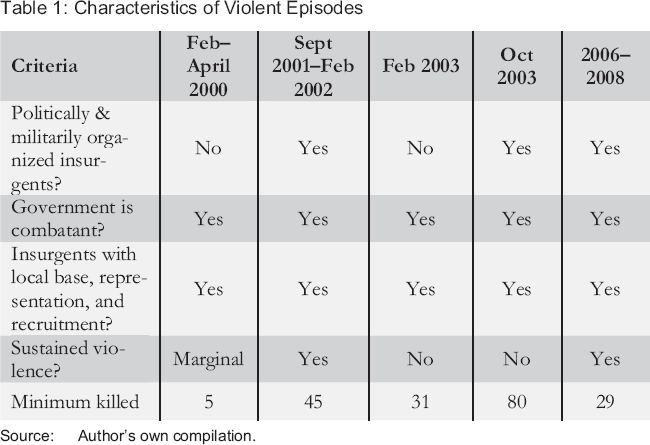
Five episodes met at least two of these criteria: the “water war” (2000); the conflict with cocaleros over Plan Dignidad (2001–2002); the “tax war” (February 2003); the “gas war” (October 2003); and the autonomista conflict (2006–2008). Yet three of these episodes – the “water war,” the “tax war,” and the “gas war” – fail to meet all four criteria. The Cochabamban “water war” and the “tax war” in La Paz each lacked two criteria. First, neither was both politically and militarily organized. The Coordinadora de la Agua in Cochabamba was organized politically (Spronk and Webber 2007), but never developed serious offensive capabilities. The February 2003 clash entailed militarized conflict between the armed forces and insurgent police, but lacked clear political organization. Second, neither of these episodes was characterized by sustained violence. The 2000 episode consisted of just two violent events: one in early February and one in early April, with the February 2003 conflict lasting less than one week. The events of October 2003 – which produced the highest death toll of any conflict – is a more intriguing case. The conflict may well have been taking on the characteristics of domestic armed conflict, but the emergence of a broader opposition and resignation of President Sánchez de Lozada defused the crisis before this occurred (see Table 1).
Characteristics of Violent Episodes
Source: Author's own compilation.
The body of this article, therefore, focuses on the conflicts of 2001 to 2002 and 2006 to 2008 (hereafter, the cocalero conflict and the autonomista conflict, respectively). Though these episodes varied in scale – the former was regionally concentrated while the latter expanded into a broader confrontation – both met all four criteria outlined above: in organizational and operational terms both began to take on the characteristics of domestic armed conflicts. While both were indicative of the larger transformation unfolding in the 2000s, each can also be analyzed as an individual episode of sustained violence produced via its own micro-level mechanisms.
Of course, this is not to say that the other three episodes were substantively or theoretically unimportant. As discussed in Section 7, shorter-lived explosions of contentious violence in Bolivia – including the “water war,” “tax war,” and “gas war” – may also be explained by the argument developed in this article. Yet focusing on the two episodes that produced the most prolonged and organized bouts of violence allows for the clearest exposition of the mechanisms that underlie the emergence of such episodes. As I will show, an analysis of the cocalero conflict and the autonomista conflict provides real insight into the “black box” (Sambanis 2005: 323) of emergent violence in conflictive societies.
Describing the Episodes
The cocalero conflict of 2001 to 2002 occurred between government forces and organized coca-growers (cocaleros) in the Chapare region. Coca is culturally important in Bolivia and has been a mainstay of the economy for decades. Production is centered in two regions: the Yungas (where coca is grown legally for domestic use) and the Chapare (where coca is grown illegally for export). Throughout the 1980s and 1990s, the Bolivian government experienced international pressure to reduce export-oriented coca-growing, especially in the Chapare (Painter 1994; Sanabria 1997). This led to an expansion of state security forces in the region, notably the Mobile Rural Patrol Units (UMOPAR). During the same period, and partially in response, Chapare cocaleros formed the Coordinating Committee of Cochabamba Federations, which came to serve as their political and organizational locus (Healy 1991; Assies and Salman 2005; Lucero 2008).
Yet state-cocalero in conflict the Chapare remained low-intensity until August 2001 (Painter 1994; Sanabria 1997; Ledebur 2005: 158), when violence became increasingly militarized. In 2001 and 2002, annual casualties reported by the Chapare Human Rights Ombudsman's Office doubled, to over 200. During 2002, moreover, military and police casualties in the Chapare comprised nearly one-third of this total (Ledebur 2005: 164). Violence by cocaleros took two forms (specific incidents are described below): First, cocaleros engaged in offensive maneuvers, ambushing security personnel and setting booby traps. Second, cocaleros blocked highways, leading to battles with security forces; such confrontations had occurred throughout the 1990s, but they increased during 2001 and 2002. In March 2002, however, violence declined sharply (author dataset).
The second (autonomista) episode occurred in six cities and their surroundings between late 2006 and mid-2008. As the national government succumbed to social challenges in the early years of the 2000s, its partisans began to organize at the departmental level (departments are the largest subnational administrative unit in Bolivia). The 2003 deposal of Sánchez de Lozada stimulated departmental calls for autonomy, leading to the rise of regional movements centered in the cities of Santa Cruz, Tarija, Trinidad, Cobija, Cochabamba and Sucre. Assisted by local officials and civic committees, these movements became increasingly organized following the 2005 election of the MAS, and constituted the main political opposition thereafter.
In late 2006, these regional movements turned to violence against MAS partisans and state security forces. Beyond rallying their affiliates into violence, the movements mobilized armed militia, like the Unión Juvenil Cruceñista (UJC) in Santa Cruz. For nearly two years, these local groups attacked MAS affiliates, provoking the state security forces and MAS partisans to respond in kind. The conflict unfolded in three phases. The first bout of violence began in September 2006 and culminated in January 2007. The next bout began in August 2007 and escalated until the end of November, when the conflict exploded in Chuquisaca. The final bout of violence began in May 2008 and escalated until the 2008 massacre at El Porvenir. The worst incidents took the form of hand-to-hand battles, as occurred in Cochabamba (2007), Sucre (2007 and 2008) and Pando (2008), during which hundreds were injured and at least 29 were killed. By the end of 2008, however, the violence had subsided.
A Causal Mechanisms Approach
How do we explain these two episodes? For possible answers, this article turns to the scholarship on domestic armed conflicts. Over the past decade, four theories have emerged to explain such conflict (cf. Kalyvas 2007; Blattman and Miguel 2009): One maintains that negative income shocks and poverty cause conflict. A second suggests that natural-resource dependence leads to violence. A third argues that particular ethnic configurations produce conflicts. And a fourth finds the cause of violence in state weakness. Bolivia, like many countries that experience such conflicts, exhibited all these correlates simultaneously: both episodes of violence were preceded by negative income shocks, growing natural-resource dependence, ethnic divisions, and state weakness. As such, any or all of these factors could have produced the violence.
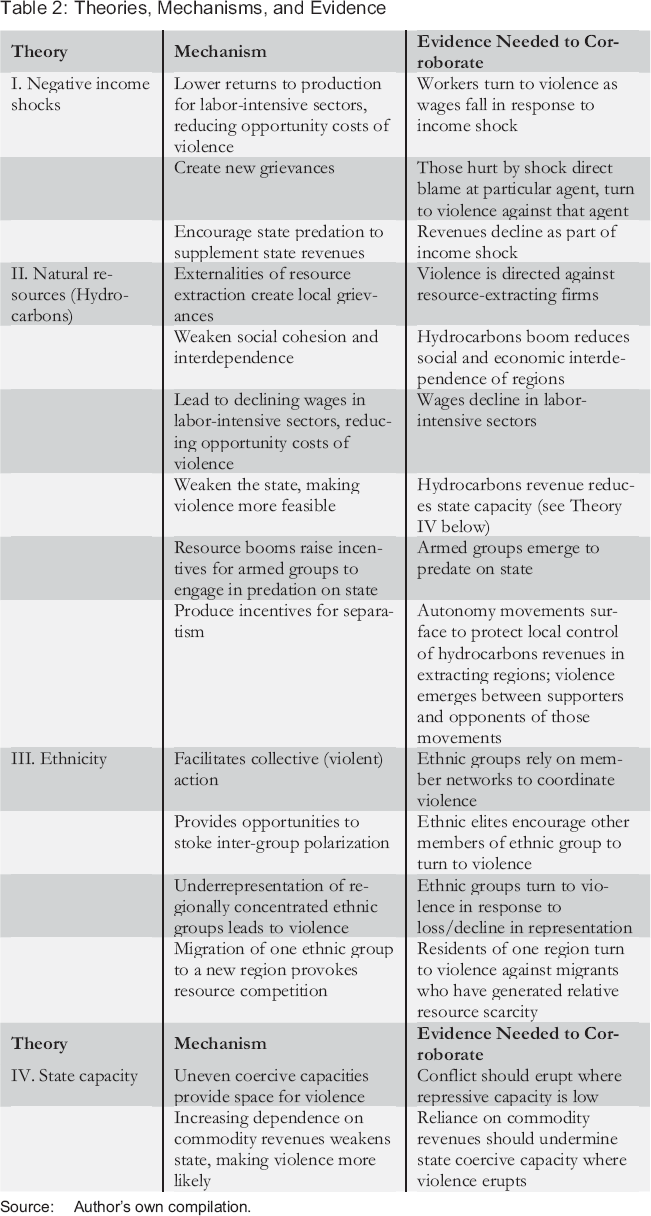
Indeed, isolating what led to violence in Bolivia might be impossible, were it not that the theory associated with each of these four factors is “sufficiently developed that it generates or implies predictions about causal processes that lead to outcomes” (George and Bennett 2005: 217). 3 Recent scholarship on domestic armed conflict has focused on identifying the mechanisms (Gerring 2007) that may connect individual correlates to the onset of violence (e.g., Ross 2004; Sambanis 2004a; Humphreys 2005; Snyder and Bhavnani 2005; Blattman and Miguel 2009). Consequently, robust hypotheses now exist about what mechanisms may lead from income shocks to violence, from resource dependence to violence, from ethnic division to violence, and from state weakness to violence (see Table 2).
Theories, Mechanisms, and Evidence
Source: Author's own compilation.
Note that no “degrees-of-freedom” problem exists for process-tracing analysis (cf. George and Bennett 2005: 30).
Consequently, process-tracing can be used to evaluate which mechanisms actually constituted pathways to violence in Bolivia: “In this use, process-tracing evidence tests whether the observed processes among variables in a case match those predicted or implied by a theory” (George and Bennett 2005: 217). Each of the following sections thus begins by delineating the mechanisms each theory suggests may produce conflict. Each section then uses observational evidence to evaluate whether those mechanisms are “causally linked” to the relevant correlate to violence in each episode. Mechanisms are evaluated by a strict standard: “[A] potential causal path cannot explain a case if it does not establish an uninterrupted causal path from the alleged cause to the observed outcome” (George and Bennett 2005: 166). A hypothesized mechanism is rejected when evidence contradicts the chain of events it predicts between cause and outcome; a hypothesized mechanism is corroborated when evidence exists that the chain of events predicted by the mechanism actually occurred. The mechanisms associated with each theory, as well as the evidence needed to corroborate them, are summarized in Table 2.
For this corroborating evidence, the analysis draws on five sources: (1) newspaper and periodical accounts; (2) the wealth of data contained in academic scholarship on Bolivia; (3) existing datasets (many Bolivian); (4) accounts of incidents from the author's dataset (described in footnote 1); and (5) author observations and field notes accumulated during four research trips to Bolivia during the 1990s and 2000s. Each of the following four sections uses this evidence to evaluate which mechanisms produced conflict in Bolivia.
Theory I: Income Shocks
A growing scholarship argues that negative income shocks – and low income, more generally – are associated with the onset of domestic armed conflict. (Miguel, Satyanath, and Sergenti 2004; Dal Bó and Dal Bó 2004; Dube and Vargas 2008; Collier, Hoeffler, and Rohner 2009: 12; Brueckner and Ciccone 2010). The initial plausibility of this hypothesis seems clear: Bolivia is one of the poorest countries in the Americas and, as depicted in Figure 1, both episodes of violence coincided with declining GDP per capita (cf. Barr 2005). Moreover, Bolivia depends on primary commodity exports with high levels of price volatility (Wanderley 2008; Miranda 2008).
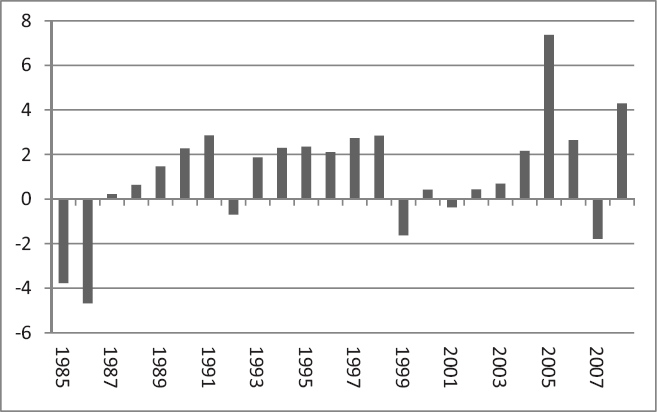
Real Economic Growth in Bolivia (1985–2008)
The scholarship suggests three mechanisms through which negative income shocks might produce violence. First, shocks may decrease the returns of production in labor-intensive sectors, reducing the opportunity costs of violence for workers in those sectors (Dube and Vargas 2008; Justino 2009; Hartzell and Hoddie 2010). Second, negative shocks may create new grievances among those who bear their brunt, providing an incentive for the aggrieved to turn violent (cf. Regan and Norton 2005). Third, shocks may reduce state revenues to the point where officials begin preying on citizens, provoking those citizens to violence (Bates 2008). The following sub-sections evaluate each of these mechanisms.
Mechanism: Declining Opportunity Costs of Violence
This mechanism operates in two steps. First, individuals experience a loss of income from some economic shock. In order to reverse their losses, they turn to violence. As it turns out, substantial evidence supports this argument in both episodes considered here. Yet the shocks Bolivians experienced neither were distributed across the entire economy nor did they result from faceless shifts in supply or demand. Rather, they resulted from particular policies that threatened to undermine particular economic sectors: cocaleros in the Chapare and the state-dependent, urban middle class outside of the highland departments. I begin by evaluating this mechanism during the cocalero conflict, then turn to the autonomista conflict.
The Cocalero Conflict (2001–2002)
Until 1997, the Bolivian government had never sought to eradicate illegal coca-growing completely. That year, however, the Banzer-Quiroga administration (1997–2002) launched “Plan Dignidad,” a program aspiring to “zero coca” in the Chapare. State agencies charged with eradication received new support in the region, which was placed under the control of the armed forces (Gamarra 2002; Lebedur 2004; Kurtz-Phelan 2005; Barr 2005). As a result, coca production was disrupted, forcing thousands of cocaleros to abandon growing. 4 By 2001, the number of hectares under production had declined nearly 85 percent since the mid-1990s (United Nations Office of Drugs and Crime 1999, 2009).
Estimates of employment in the sector range from 90,000 to 300,000 (Leons and Sanabria 1997: 18–19).
Then, in September 2001, the government reversed an “earlier claim that only 600 hectares of coca remained to be eradicated in the Chapare,” announcing that 5,400 additional hectares were still to be eradicated. As such, it “secretly ordered the entry of 4,000 military and police troops into the Chapare” in an “intensified effort” to “end all production” (Gamarra 2002: 16, 21, 7). Four months later, the government adopted a “no-holds-barred approach” to the cocaleros, when it “prohibited the drying, transport, and sale of coca leaf grown in the Chapare region in previously legal markets” (Ledebur 2005: 158–159). The period between September 2001 and February 2002 thus marked the first attempt to eliminate the Chapare's coca economy.
Alternative employment for cocaleros was limited, especially as the economy contracted between 1999 and 2002. Efforts to fund “alternative development” (fruits and spices) in the Chapare failed (Gamarra 2002). Opportunities to migrate eastward were limited by a shift toward capital-intensive commercial agriculture there (Economist Intelligence Unit 2002: 20). Though many joined the urban informal sector, the open unemployment rate in capital cities had jumped to over 9 percent by 2001, three times that of the mid-1990s (UDAPE 2009). Given this situation, many cocaleros remained in the Chapare.
As the drive to “end all production” continued, violence between these cocaleros and the state security forces escalated sharply. On 6 December 2001, for example, the Chimore Coca-Growers Federation blocked a highway, leading to a battle with the army and the shooting deaths of at least two civilians. And in January 2002, cocaleros clashed with security forces in Sacaba over the state's attempt to close the town's previously legal coca market. Gunfire killed at least two cocaleros and eight members of the security forces; dozens were injured. Throughout this period, moreover, state forces were ambushed by organized cocaleros and confronted with sniper fire and booby traps (author dataset). Faced with this violence, the government agreed in February 2002 to allow production to resume, and in 2003, violence returned to pre-2001 levels (author dataset; Ledebur 2005: 158–160).
This episode of violence can thus be traced to the state's effort to eliminate a particular regional economy, coca-growing, on which the Chapare's population depended. The elimination of this economy would have forced cocaleros to abandon production, but no comparable employment existed. Consequently, anti-state violence became the rational option for many: an “uninterrupted causal chain” led from a state-provoked economic shock, through the opportunity-cost mechanism, to violence.
The Autonomista Conflict (2006–2008)
Significant portions of the Bolivian urban middle class have long depended on public sector employment (Malloy 1970; Gamarra 1994; Gamarra and Malloy 1995; Lozada and Saavedra 1998; Gamarra 2003: 291). 5 Between 1985 and 2005, this patronage was divided among the MNR, the ADN, and their allies. Distribution was facilitated by the electoral system, which mandated that congress choose the president if no candidate won a popular majority. Since no candidate ever did, presidents secured election by distributing jobs widely among parties in congress (Lozada and Saavedra 1998; Gamarra 2003). This resulted in multiparty distributional coalitions.
The public sector comprises approximately 10 percent of total employment in urban Bolivia (UDAPE 2009). Though opportunities exist for the (admittedly small) Bolivian middle class in the private sector, Gamarra (1994, 2003; Malloy and Gamarra 1998; Gamarra and Malloy 1995) persuasively argues that those factions that do depend on the state for employment have few alternatives.
For two reasons, middle-class factions that depended on state patronage faced a serious threat to their welfare upon President Morales’ inauguration in January 2006. First, Morales won a majority of the vote in the 2005 election, thus did not need to promise patronage to multiple parties to be elected president. Second, Morales had developed his own party organization (MAS). Consequently, the new administration could replace executive ministers and agency heads with MAS supporters and publicize the corrupt employment practices of previous governments (e.g., Los Tiempos 2006). In practice, this ejected many dependents of the old parties from their positions in national government.
Yet this displacement did not sever these middle-class factions from their dependence on the state. Though the 2005 elections removed long-standing parties from control at the national level, they also initiated direct elections for departmental prefects (governors). Prior to 2005, prefects had been appointed by the president. The change to direct election transformed this relationship: in 2005 five departments elected prefects tied to the parties that Morales had displaced from the national government. Four of these prefects had served as key nodes in the pre-Morales patronage network – and the fifth represented the prime beneficiaries of pre-Morales agricultural credit (El Mercurio 2008; Eaton 2007; Laserna 2010: 43). As a result of changes to hydrocarbons law and a boom in prices, 6 moreover, these prefects enjoyed a sharp increase in the revenues available to them, which rose between 140 and 160 percent in 2006 7 (see Figure 2).
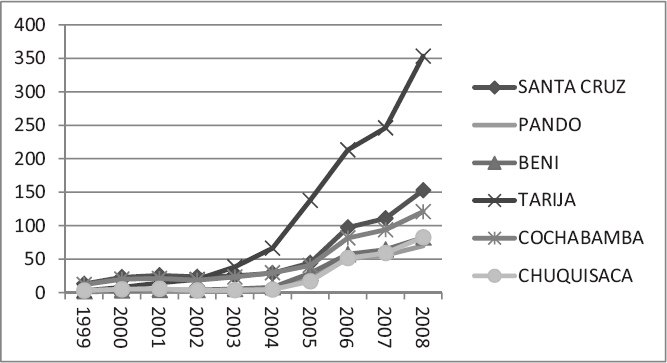
Departmental Hydrocarbons Revenues (in million USD)
The 2005 hydrocarbons law devolved revenues to prefects (e.g., Miranda 2008).
A complete time series of hydrocarbons revenues is not readily available. This calculation is based on data from Villegas (2004), Medinaceli (2007), Ministro de Economia y Finanzas (2009), UDAPE (2009), and YPFB (2010). Available from author.
Consequently, these opposition prefects – and to a lesser extent their municipal counterparts – provided a way to maintain pre-Morales patronage networks for those who depended on the old parties: Dependents could turn to departmentally elected officials for employment. 8 The prefect of Tarija, for example, was accused of illegally hiring nearly 400 employees upon taking office (Los Tiempos 2010). Public employment at the prefectural level grew by more than 6 percent in 2006, 9 faster than any other level of government that year (UDAPE 2009).
In a similar vein, Laserna (2010) argues that Bolivia is experiencing a revival of rentismo.
Unfortunately, this employment index is based on a sub-sample that cannot be used to estimate the absolute number of employees in the sector (personal communication, Fernando Landa, UDAPE Economist, 17–18 March 2010).
Beginning in late 2006, however, the Morales government began to contest local control over departmental revenues, both directly (through decrees that slashed departmental hydrocarbons revenues) and indirectly (through an ultimately failed attempt to undermine prefectural autonomy in a constituent assembly). Together, these policies threatened to undermine the livelihood of dependent middle-class factions in the regions. Consequently, middle-class dependents in the departments turned to violence. Four pieces of evidence are key to establishing the “uninterrupted causal chain” that led from the Morales government's assaults on departmental revenues to this episode.
First, every incident of non-anonymous violence by the opposition in Santa Cruz, Cochabamba, Pando, Beni, and Tarija was committed by some combination of employees and partisans of the opposition prefects, sometimes in coalition with those of municipal governments 10 (author dataset). Moreover, violence was invariably directed against MAS partisans or the armed forces sent to restore order (author dataset).
Chuquisaca is a partial exception, as it was governed by an MAS prefect until 2007, and opposition municipal employees were the participants in the violence (e.g., Jeria 2010: 23). Those mobilizing with the movements – relatively well-off urbanites and students – also depended on the largesse of the old parties to maintain their own statuses.
Second, these dependents turned to violence in direct response to attempts by the MAS government to undermine a major resource on which many of their livelihoods depended: departmental revenues. The violence between September 2006 and January 2007 was provoked first by a procedural debate in the constituent assembly (Lehoucq 2008; Jeria 2010; Laserna 2010) that threatened to undermine prefectural autonomy, then (more seriously) by a threat by Morales to subject the prefects to congressional dismissal (Latin American Weekly Report 2006). The violence between August 2007 and November 2007 was provoked by a trio of related issues: (1) Morales’ announcement that he would cut prefectural hydrocarbons revenues (cf. Medinaceli 2007); (2) an attempt by the opposition to transfer additional government functions – with all the patronage they implied – to Sucre from La Paz (cf. Centellas 2010; Jeria 2010; Laserna 2010: 30); and (3) the constituent assembly approving a draft constitution that included only a “limited” form of departmental autonomy (Latin American Weekly Report 2007). The final bout, between April and September 2008, broke out when the government contested illegal autonomy referenda held by prefects in Santa Cruz, Pando, and Beni, and urban residents of Sucre again turned violent against MAS partisans (Laserna 2010). In August and September, the conflict came to a head when Morales refused to return any of the revenues he had diverted from the prefects the previous year (Latin American Weekly Report 2008). While this was a politically complex period, each bout of violence was clearly underlain by threats to strip departmental governments of their ability to provide for urban middle-class dependents of the state.
Third, relatively limited comparable employment opportunities existed for displaced middle-class dependents. While the wealthiest among them could emigrate or live off liquidated assets, much of the state-dependent urban middle class faced less-appealing alternatives (cf. Gamarra 2003: 300). It is true that the eastern regions are the most economically productive in Bolivia. Yet recent economic growth in the region (outside the public sector) was in hydrocarbons and capital-intensive agriculture (Wanderley 2008) – neither of which provides comparable opportunities for middle-class employment. Unfortunately, survey evidence about the connection between threats against departmental revenues and middle-class fears does not exist. Yet in combination with the other three pieces of evidence discussed here – especially the fact that it was urban middle-class employees of the prefects who often perpetrated the violence – it is reasonable to infer that the middle classes were afraid to lose their jobs. Indeed, violence provided these individuals with a way to signal their support for their prefectural patrons, help keep them in office, and thus keep their own jobs.
Fourth, this two-year episode ended precisely as the national government developed its own patronage in opposition-controlled departments. To begin with, the Morales administration increased its spending at the departmental level: employment by the decentralized administration of the national government increased more than 20 percent by the end of 2008 (UDAPE 2009). Morales also shifted departmental revenues from the prefects to municipalities: municipal hydrocarbons revenues rose in all departments over the course of 2008 (UDAPE 2009). As this occurred, dependent middle-class factions could, if necessary, transfer their loyalties downward to municipalities and laterally to local agencies of the national government, decreasing their dependence on prefectural revenues. As the national government became the source of, rather than a threat to, the livelihood of these factions, their violence declined. 11 Like the cocaleros of 2001 and 2002, these middle-class factions turned to violence only when the national government sought to eliminate the economy on which they depended.
Retaliatory violence by MAS partisans declined thereafter.
Mechanism: Grievances
Neither of the income shocks that provoked these episodes resulted from abstract shifts in supply or demand: the Bolivian national government decided to put organized sectors out of work. As a result, the cocaleros and the state-dependent factions in the departments developed specific grievances. The cocaleros blamed the national government for forcing them into unemployment (Assies and Salman 2005) and thus directed their violence at state agencies supporting eradication (Ledebur 2005; Gamarra 2002; author dataset). Dependent middle-class factions in the departments believed Morales’ government would eliminate their livelihood (Vacaflores and Lizárraga 2005; Eaton 2007; Lehoucq 2008), thus directing violence at MAS-affiliated politicians, peasant unions, and the state security forces (author dataset). Because these grievances focused violence against particular state agents, they represent an integral part of the causal chain that led to conflict.
Mechanism: Declining State Revenues and Predation
Little evidence supports this mechanism. Although the recession that began in 1999 caused state revenues to dip 11 percent by 2002 (before recovering in 2003), 12 state officials did not turn to predation as an alternate source of revenue. As discussed, it was instead widespread coca eradication that provoked conflict in 2001. But Plan Dignidad was unveiled in December 1997, and implementation began in 1998 (Gamarra 2002; Ledebur 2005). Given this timing, it could not have been a recession-induced attempt to supplement state revenues. From 2006 to 2008, moreover, national and departmental revenues rose to all-time highs (author calculations; see footnote 7): the opposite of what this process requires. No evidence exists that this mechanism provides an “uninterrupted causal path from the alleged cause to the observed outcome” (George and Bennett 2005: 218).
Moreover, revenue never dipped below 1997 levels (UDAPE 2009; Instituto Nacional de Estadística 2010).
Conclusions
This section has demonstrated that two of the three mechanisms specified by this theory – declining opportunity costs of violence and grievances – together provide an “uninterrupted causal pathway” between negative income shocks and violence. Both episodes resulted from this same process. In each case, policies adopted by the national government threatened to undercut the livelihood of a well-organized sector, effectively enacting a sector-specific income shock. This both decreased the opportunity costs of violence for the sector and created anti-state grievances within it, propelling violence against the national government. In both cases, violence subsided when the government effectively reversed its position, allowing the sector to return to its livelihood (and removing the source of its grievance). The implications of this finding are discussed further in the conclusions. For now, however, the article turns to refuting three alternative sets of mechanisms.
Theory II: Natural Resources
A rich scholarship suggests that natural-resource dependence increases the probability of conflict (Collier and Hoeffler 2004; Humphreys 2005; Ross 2006). 13 Bolivia depends on numerous commodity exports, but none has been more central in recent years than hydrocarbons (natural gas). 14 Consequently, some have argued that recent violence may be tied to the hydrocarbons boom of the 2000s (e.g., Weisbrot and Sandoval 2009).
Recent research suggests this may not be correct (Dunning 2005; Fjelde 2009; Basedau and Lay 2009).
Little evidence suggests that Bolivia's other exports – soya, coca, lithium, tin, gold – contributed to these episodes (cf. Humphreys 2005; Fearon 2005; Lujala 2009).
Existing scholarship suggests six mechanisms through which hydrocarbons dependence might produce violence. First, negative externalities of extraction may create local grievances, providing incentives for the aggrieved to attack resource-extracting firms (Ross 2004; Humphreys 2005). Second, natural resources may produce less “dense trade networks,” weakening “social cohesion and interregional interdependence,” thus making inter-group violence more likely (Humphreys 2005: 513). Third, as the price of capital-intensive resources increases relative to the price of labor-intensive goods, wages may fall, reducing the opportunity costs of violence to the labor-intensive sector (Dube and Vargas 2008: 7; Dal Bó and Dal Bó 2004). Fourth, natural-resource dependence may weaken the state, making rebellion more “feasible” (Collier et al. 2003; Ross 2004; Fearon 2005; Collier, Hoeffler, and Rohner 2009). Fifth, positive income shocks to capital-intensive sectors may provoke violence by raising the incentives for armed groups to capture local state resources (Dube and Vargas 2008; Blattman and Miguel 2009; Collier et al. 2003). Sixth, conflict over increased hydrocarbons rents may provide incentives for separatism in hydrocarbons-rich regions, leading to violence (Collier et al. 2003; Ross 2004; Sambanis 2005: 327). 15
The “lootability” mechanism (Collier et al. 2003; Ross 2006) is not addressed: gas is not lootable. Humphrey's (2005: 511) “greedy outsiders” hypothesis is also implausible.
Three of these mechanisms can be dismissed quickly. First, none of the observed violence was directed against resource-extracting firms in retaliation for externalities (author dataset). Second, there is little evidence to suggest that the recent hydrocarbons boom (further) decreased regional interdependence (cf. Miranda 2008). 16 Third, wages rose in all labor-intensive sectors between 2005 and 2007 (Instituto Nacional de Estadística [INE] 2010). 17 A separate section below argues that hydrocarbons revenues have not (further) reduced state capacity. Yet the fifth and sixth mechanisms merit further consideration.
With the possible exception of Tarija (Bebbington and Bebbington 2010). Yet Tarija experienced some of the lowest levels of regional violence.
Only executives, managers, and support professionals experienced declining salaries during this period – a fact that could have contributed to the participation of some of them in the violence.
Mechanism: Resource Booms and Predation
This mechanism operates in three steps: A resource boom increases local state revenues. This produces the incentives for armed groups to move into the now-wealthy regions to access those revenues, leading to violence (Dube and Vargas 2008: 28). Although the cocalero violence of 2001 and 2002 provides no evidence for this mechanism – it was a response to crop eradication – the autonomista violence from 2006 to 2008 presents a plausible case. Prefectural revenues from hydrocarbons accelerated dramatically in 2005 as a result of boom-time profits and a change in the hydrocarbons law (Villegas 2004; Medinaceli 2007; see Figure 2). Yet this boom did not bring armed groups into the wealthy departments. Instead, urban middle-class dependents of the departmental governments themselves turned to violence in response to the national government's attempts to redistribute revenues. As such, this does not resemble the argument that conflict results from attempts by armed groups to prey on local resources. Indeed, it more closely resembles the argument that conflict results from local claims to local control of those resources – an argument to which I now turn.
Mechanism: Local Resource Claims and Separatism
Though it provides little insight into the cocalero conflict, this mechanism has understandably garnered much attention in Bolivia: as the gas boom took off, “autonomy movements” gained strength in six departments, then turned to violence from 2006 to 2008. A closer look at the evidence, however, suggests that the link between local hydrocarbons, autonomy movements, and violence is not clear. If this mechanism were present, autonomy movements should have surfaced to protect local control of hydrocarbons revenues in hydrocarbons-producing departments. Violence should then have broken out between supporters and opponents of those movements.
Yet of the autonomy movements that materialized in the four hydrocarbons-producing departments (Tarija, Santa Cruz, Cochabamba and Chuquisaca), only the Tarija movement emerged directly in response to conflict over local hydrocarbons (Vacaflores and Lizárraga 2005: 26–29; Bebbington and Bebbington 2010). As Eaton (2007) documents, the Santa Cruz movement was driven by the fears of various business interests, many unrelated to hydrocarbons (see also Peña Claros 2010; Spronk and Webber 2007). Autonomy movements in Cochabamba and Chuquisaca surfaced for unrelated reasons. In Cochabamba, the political aspirations of the prefect were paramount (cf. Fuentes 2007; Webber 2008: 97–100; Shanks 2009). In Chuquisaca, the autonomy movement focused on moving government functions to Sucre (cf. Centellas 2010). Additionally, robust movements surfaced in two departments that had no local hydrocarbons reserves (Pando and Beni), demonstrating that local control of hydrocarbons did not necessarily drive autonomy claims. The diverse foundations of these movements suggest that no easy causal connection can be drawn between their development and hydrocarbons.
Since no link exists between local hydrocarbons and the rising autonomy movements in Cochabamba, Chuquisaca, Cochabamba, Beni and Pando, none of the violence perpetrated by those movements could have been caused by resource-based separatism. In fact, only in Tarija can autonomist violence be wholly traced to conflict over local control of hydrocarbons. Yet the Tarija movement was perhaps the least violent of all: the department experienced just three violent incidents between 2003 and 2009 (author dataset). In Santa Cruz, the autonomy movement did engage in widespread violence; yet, as noted above, this movement strengthened only partially in response to concerns about local hydrocarbons. Despite the correlation between a growing hydrocarbons sector, the autonomy movements, and conflict, evidence for a causal pathway between them is weak.
Conclusion
In short, strong evidence does not exist for mechanisms specified by theories that link resource dependence to violence.
Theory III: Ethnicity
Bolivia recently witnessed the rise of indigenous organizations (Yashar 2005) and movements claiming regional identities (Eaton 2007). As such, it seems possible that ethnicity contributed to the conflicts. Recent scholarship suggests four plausible mechanisms. First, violence may emerge in ethnically divided societies because the ethnic character of organizations “facilitate[s] strategic coordination and enforcement among group members” (Blattman and Miguel 2009; Sambanis 2005: 324–325). Second, conflict may result from an increase in ethnic polarization (Bhavnani and Miodownik 2009) due to “memories of old group-level conflicts and new manipulation by elites” (Sambanis 2005: 326). Third, underrepresentation of “large ethnic groups” (Cederman, Wimmer, and Min 2010: 88; Sambanis 2004a), particularly regionally concentrated groups (Sambanis 2005: 302), may lead those groups into conflict. Fourth, the migration of one ethnic group to a new region may provoke resource competition, leading longer-standing residents to antimigrant violence (Fearon and Laitin forthcoming). 18
Varshney (2003) suggests inter-group tension leads to violence only when different ethnic groups do not engage through civil society organizations. Though intriguing, this argument begins with exogenous shocks, thus not specifying an “uninterrupted causal chain.”
Ethnicity in Bolivia
Of course, the plausibility of these mechanisms depends on whether those who engaged in violence were, in fact, “ethnic.” Most scholars now define ethnicity as a group identity based on “attributes associated with, or believed to be associated with, descent” (Chandra 2006: 400; see also Laitin 2007: 64–65; Cederman, Min, and Wimmer 2010). Most importantly, this scholarship argues that “the qualifying attributes for membership are restricted to one's own genetically transmitted features or to the language, religion, place of origin, tribe, region, caste, clan, nationality, or race of one's parents and ancestors” (Chandra 2006: 400).
By this standard, the cocaleros who participated in the violence in 2001 and 2002 were not an ethnic group. To be sure, many cocaleros possess ethnic identities, both Quechua and Aymara (Van Cott 2003). Yet being a cocalero did not require one to possess these identities; one could be non-Quechua or non-Aymara and still be a cocalero. 19 Moreover, the cocaleros themselves were not clearly ethnic. Through the end of the 1990s, the Chapare coca-growers claimed no “strong indigenous identity”:
Moreover, cocaleros come from multiple indigenous groups.
[T]here was a strong class identity on the part of the peasants in the [Cochabamban] valley as well as of the coca-growers […] but a specifically indigenous identity would not, at the end of the decade, have been particularly prominent across these groups (Canessa 2006: 248).
And while their leaders did position themselves strategically as part of an indigenous revival (Canessa 2006), through the mid-2000s “among themselves the Chapare coca-growers often self-identif[ied] as ‘campesinos’ [peasant agriculturalists]” (Albró 2005: 438–439). The cocaleros thus neither were defined by ethnic properties nor clearly conceived of themselves as ethnic. 20
The case is even clearer for partisans of the MAS, which uses the language of indigeneity to refer to Bolivians who lack indigenous identities (Madrid 2008; Albró 2005; Canessa 2006: 256).
A similar situation existed among departmental autonomy movements from 2006 to 2008. While many members of the movements claimed descent from departmental residents, no descent-based identity was required for membership. Take the opposition in Santa Cruz, which made the strongest “ethnic” claims of the movements. In response to Sánchez de Lozada's deposal, a set of Santa Cruz elites rallied a departmental movement around the cruceño identity (Peña Claros 2006: 82; Eaton 2007). Yet membership was not limited to those descended from cruceño parents. Rather, it was a residual category that lumped together “natives and residents of Santa Cruz” alike (Peña Claros 2006: 78, emphasis mine) who opposed the MAS. Moreover, not all who claimed Santa Cruz descent were eligible to belong (Peña Claros 2006: 87–88). And while race (whiteness) has been an important part of cruceño discourse, the movement actively courted non-white and even indigenous actors (Eaton 2007: 90–91). As such, the Santa Cruz movement cannot be understood as ethnic. This reasoning can be applied to the other departmental movements, all of which made much weaker ethnic claims. Of course, regional identity has long been a motivating factor in Bolivian politics. Yet the very fact that the discourse of regionalism has been so pervasive for so long makes it an unlikely precipitating cause of violence – absent some other mechanism.
Neither the cocaleros nor the departmental autonomy movements were defined by ethnic identities. If such ethnic properties are central to the mechanisms listed above, then the claims made by those mechanisms are, by definition, invalid in these cases. Yet this is unsatisfying: It may be that these mechanisms can still produce inter-group violence, even if the groups in conflict are not ethnic. In the following sub-sections, therefore, we evaluate whether the two (non-ethnic) episodes of violence might still have emerged through the mechanisms suggested by the scholarship on ethnic violence (cf. Chandra 2009).
Mechanism: Underrepresentation/Exclusion
Absent ethnicity, evidence for this mechanism would consist of a given group turning to violence due to underrepresentation, exclusion, or a recent loss of power. This is an implausible explanation for the cocalero conflict, which followed a rapid increase in representation of the cocaleros in national politics (Van Cott 2003). That said, a loss of power certainly preceded violence by the departmental autonomy movements, which were comprised largely of supporters of the parties displaced in 2005. But it was nearly a year after the opposition lost national power that violence erupted in the departments. This timing suggests that the conflict was not a response to exclusion, per se, but rather to the national government's threats to undermine departmental revenues.
Mechanisms: Organization and Polarization
Sans ethnicity, evidence for the organization mechanism would consist of groups relying on networks among their members to coordinate violence (cf. Chandra 2009). Evidence for the polarization mechanism would consist of elites encouraging members of their group to turn to violence against another group. Organization was certainly critical from 2006 to 2008 – when partisan networks helped coordinate violence against the MAS (Bebbington and Bebbington 2010; Peña Claros 2010; Shanks 2009; Webber 2008; Centellas 2010; United Nations 2009) – and in 2001 and 2002, when the cocalero union structure helped coordinate anti-state activity. During the autonomista violence, moreover, opposition elites fomented anti-MAS sentiments among their departmental followers. Similarly, Morales contributed to rallying the cocaleros against the state in 2001 and 2002 (Van Cott 2003; Kurtz-Phelan 2005). But absent ethnic identity, these mechanisms convey little about why these groups became violent. Indeed, they amount to a restatement of the fact that coordinated mass violence requires organization and leadership – a fact underscored by the high level of political organization among cocaleros and the departmental middle class when violence broke out.
Mechanism: Anti-Migrant Sentiments
Without ethnicity, evidence for this mechanism would consist of residents of one region turning to violence against migrants who generated “competition and dispute over scarce resources such as land, jobs, educational quotas, government services, or natural resources” (Fearon and Laitin forthcoming). This was not the case during the cocalero violence: although many cocaleros were migrants, the violence was not between them and less-recent migrants, but between them and the government. The autonomista violence presents a more complicated case, as the violence was committed by departmental opposition movements – which tended to include longer-term and wealthier urbanites – against MAS partisans, who were more likely to be rural or poor (Madrid 2008): two groups that comprise the majority of Bolivian migrants. 21
Moreover, migration alone is unlikely to have provoked violence: the eastern departments had been migration hubs for decades (Gil 1987). As of 2001, for example, nearly one-quarter of the Santa Cruz population and nearly one-third of Pan-do's population had been born in a different department (Instituto Nacional de Estadística 2010).
Nonetheless, the inference that migration induced competition over scarce resources is unwarranted. Little evidence exists that migrants reduced the availability of state resources or land in these departments. Between 2001 and 2006, growth in departmental revenues per capita far outpaced departmental population growth – phenomenally so in the departments of Pando, Tarija and Beni (UDAPE 2009). And in departments where land became an issue (Pando, Beni, Santa Cruz), those who turned against the MAS were overwhelmingly urban, a group unlikely motivated by the threat of land redistribution. 22 In short, little evidence suggests that the autonomista conflict, which did pit longer-term residents against newer migrants, was provoked by a growing resource shortage.
Population density also remained low in these departments (though levels of land concentration could be high) (Instituto Nacional de Estadística 2010; Eaton 2007: 96, fn16).
Conclusion
No identifiable causal pathway exists between ethnicity and either the cocalero violence of 2001 and 2002 or the autonomista violence from 2006 to 2008. The major groups driving these episodes were not clearly ethnic. Moreover, the mechanisms specified by ethnicity arguments contribute little to understanding why these non-ethnic groups turned to violence. Although both conflicts most certainly involved ethnically charged appeals by groups claiming ethnic properties, the existence of such appeals and claims does not, by itself, provide a convincing case that ethnicity was the pathway through which violence emerged.
Theory IV: State Capacity
Consensus exists that state weakness is a near-necessary condition for violent insurgency (Snyder and Bhavnani 2005; Collier, Hoeffler, and Rohner 2009; Fjelde and De Soysa 2009). The Bolivian state's relative weakness (Malloy 1970; Malloy and Gamarra 1988; Laserna 2010) 23 thus may have provided a pathway to conflict. Existing scholarship suggests two mechanisms: First, states with uneven coercive capacities may provide effective spaces for insurgencies (Fearon and Laitin 2003; Kalyvas 2007: 421). Second, increasing dependence on primary commodities, like hydrocarbons, may weaken state capacity, facilitating rebellion (Fearon 2005; Humphreys 2005; Snyder and Bhavnani 2005; Kalyvas 2007; Lujala 2009).
Though the state increased its presence during the 1990s via new municipal governments and drug eradication forces.
The first mechanism suggests that conflict should erupt in areas where the state's repressive capacity is low. Yet neither episode was focused in such areas. The cocalero violence emerged in the rural Chapare, but it was a direct response to the state's increasing repressive capacity there (Gamarra 2002, 20; Leons and Sanabria 1997; Kurtz-Phelan 2005). The autonomista violence occurred largely in urbanized departmental capitals, where state repressive capacity is arguably highest.
The second mechanism suggests that the boom in hydrocarbons revenues in the early years of the 2000s may have further undermined state capacity, creating new opportunities for rebellion. In the short run, however, this boom did not undermine the state's coercive capacities. On the contrary, since 2000, the state expanded the presence of the National Armed Forces and regional forces in the departments of Pando, Cochabamba and Santa Cruz. In 2006, moreover, the revenue boom allowed the state to raise the average salary of members of the armed forces by more than 70 percent (Instituto Nacional de Estadística 2010). This suggests that the hydrocarbons boom has instead helped the state bolster its coercive capacities (cf. Basedau and Lay 2009; Fjelde 2009) – at least in the short run.
Conclusion
There is little reason to think that decreasing state capacity caused these episodes of violence. The most that might be concluded is that the state's overall low capacity made it “feasible” (Collier, Hoeffler, and Rohner 2009) for violence to emerge. Yet this background condition conveys little about the pathway that led to conflict.
Discussion
Although this analysis focuses on Bolivia, it suggests a generalizable hypothesis: particular violent episodes may result from states seeking to undermine well-organized economic sectors in societies where few alternative opportunities exist. Of course this raises the following question: Did the government try to undermine these groups, or was it an unintended consequence of other policies? This is a critical and subtle point that goes to the heart of the motivation of the violent episodes discussed in this article.
Especially in chronically unstable countries like Bolivia, politics and policy are rarely analytically distinguishable. The policies that the Banzer and Morales governments adopted cannot be understood separately from the desire of those governments to undermine the potency of the alternative political movements that their policies threatened. Yes, the Banzer government wanted to eradicate illegal coca production. But it wanted to do so in part because illegal coca production was underpinning the rise of a new political movement that challenged much of what Banzer had worked for over the last 25 years. Yes, the Morales government wanted to recentralize revenues. But it wanted to do so because a majority of revenues were controlled by departmental prefects that neither shared the government's priorities nor served its major constituencies. Pursuing these key policy agendas, in effect, meant persecuting one's political adversaries. These two cases thus suggest the extent to which political order in Bolivia – and elsewhere – may rest on the unlikely willingness of the national government to resist pursuing politics that undercut the foundations of organized sectors for which few alternative economic opportunities exist, even when those sectors spearhead new political oppositions.
This argument may well apply not only to the two most sustained periods of Bolivian violence discussed at length in this article but also to the three briefer episodes considered above – the “water war,” the “tax war,” and the “gas war.” In each of these three cases, the state pursued policies that threatened the livelihoods of (more-or-less) well-organized sectors. The water war pitted, in part, the government against small farmers whose livelihoods were threatened by higher water prices. The violence associated with the tax war was kicked off by (middle-class) policemen who saw their incomes cut by the state. And the even more complicated gas war – set off by a conflict over the distribution of rents in the hydrocarbons industry – included violence both between cocaleros and the state and between the economically fragile highland urban populations and the state. Future research would do well to consider the separate but related question of why these shorter-lived explosions of contentious violence were not sustained over time.
More broadly, future research in both Bolivia and in Latin America should focus on the potential relationship between the rise of new political challengers, government attempts to undermine particular economic sectors, and episodes of violence (cf. Dunning 2005). For example, the argument developed here may help explain why the Venezuelan state-dependent urban middle class itself has occasionally turned to violence since 2000, or help shed light on the reasons for the re-emergence of violence in rural Peru. Research is also needed on why state–society conflict takes different forms at different times in Latin America. Episodes of sustained violence (like those analyzed at length in this article), shorter violent outbreaks (like the three Bolivian “wars” noted in the previous paragraph), executive deposals (like that of Sánchez de Lozada in 2003; see also Pion-Berlin 2010; Pérez-Liñan 2007), and one-sided state repression (as the Bolivian state inflicted on miners and peasants in 1986) seem to have similar contours. Yet we do not yet understand why such initially similar conflicts in Latin America eventually take these different forms. Comparative analyses of this variation are needed and should provide new insights into the foundations of political order in the region.
Recent scholarship on conflict has moved in the direction of analyzing the outbreak of violence in terms of “feasibility,” effectively abandoning the search for precise causal pathways in favor of identifying sets of correlates that make insurgency possible. For example, Collier, Hoeffler, and Rohner (2009: 24) argue that the “motivation [of insurgents] is indeterminate, being supplied by whatever agenda happens to be adopted by the first social entrepreneur to occupy the viable niche.” The issue of feasibility was certainly not irrelevant in Bolivia: Had the state not been (relatively) weak, rebellion would have been impossible. Had the economy been more diversified or had per capita income been higher, individuals in threatened sectors could have turned to alternative employment. Had cocaleros or middle-class factions not been organized in some sort of group, individuals in those sectors could not have been easily organized or mobilized into violence. Yet the theoretical point of this article is, in large part, that a satisfactory answer to the question “Why violence?” requires identifying not only the conditions that make violence possible, but also why people only sometimes take advantage of those conditions. The search for causal pathways is, in effect, the search for motivations. As Collier, Hoeffler, and Sambanis (2005: 19) correctly argued, “Causal theories should explain how a particular outcome […] occurs – how and under what conditions different explanatory variables led to that outcome.”