




Abstract
Humidity, as an important meteorological factor, has rarely been taken into account as far as the ice-phobicity research is concerned. For the first time, the ice-phobicity of a silver-modified copper surface with 1-dodecanethiol coating was investigated in an environment with 69% humidity. It turns out that high humidity has no impact on the superhydrophobicity of the surface at the room temperature. However, humidity compromises the water repellency by decreasing the contact angle from 156° ± 2° to 116° ± 2° when the temperature reaches zero. By further lowering the temperature, the robust ice-phobicity is observed on the superhydrophobically coated surface. In conjunction with the favorable topological configuration and in high humid surroundings, the intrinsic wettability of the superhydrophobic surfaces dramatically delays the freezing process for 120 s.
Introduction
Accretion of ice and wet snow on surfaces of outdoor devices may cause disastrous events such as bringing down power lines, bursting pipes, and even losing the lift force on aircraft wings. 1 –3 The state of the art for ice protection falls into passive deicing technologies as the adopted techniques are to melt ice layer intermittently after ice built-up on the surface. 2,4 Spraying glycol-based chemicals on iced surfaces is another popular method. All approaches are resource intensive, toxic, and not reliably up to the task. For instance, costs involved in removing accreted ice during winter time merely using the navigation projects were estimated to be huge (about $33 million in 1992 in USA). 5 Therefore, ice formation has been a major headache especially in cold regions because of no sustainable technology for dealing with ice. The more promising and proactive way to tackle ice problems is to keep surfaces ice-repellent/anti-icing under freezing conditions. Hence, anti-icing research has attracted tremendous attention, since ice formation could be prevented from onset. 3,6 –9 Extensive research has proven that superhydrophobic coatings could delay freezing and reduce ice accretion under some circumstances, 7,9,10 thus promoting superhydrophobic surfaces as ideal candidates for anti-icing materials.
However, in reality achieving anti-icing is far more complicated than simply fabricating superhydrophobic surfaces, which determines nothing but the substrate conditions. Too many ambient factors are involved in ice formation including air pressure, air velocity, wind direction, air humidity, and so on. 11 All of these environmental conditions are naturally present, which can fundamentally complicate the ice scenario. Exploring anti-icing/icing mechanism has become even more challenging due to the complexity of the icing issues. A great deal of research attention has been focused merely on scrutinizing the impact of substrate conditions (morphology and low-surface energy coating) on ice formation. 7,8,9 Some ongoing research attempts to look into the role the atmospheric factors play in icing issues. For instance, several teams of researchers investigated how the temperature affects icing issues in an enclosed chamber with controlled conditions (low humidity, no wind, and so on). 12 And some groups examined the ice adhesion by simulating various wind speeds in the wind tunnel. 13,14 To our knowledge, little research has factored humidity in the ice-phobic study, although humid levels cannot afford to be neglected as far as meteorological conditions are concerned. Water vapor (air humidity) can play a crucial role in wettability and anti-icing properties. 11,15 When the temperature drops below zero, moisture in the surrounding air condenses and freezes, adhering to the cold surfaces. There are lots of open questions about humidity in icing issues. For example, it remains unclear whether the dew/frost formation alters the wettability and whether the anti-icing properties could be destroyed by frost.
In order to explore the answers to these questions, investigations on the hydrophobicity of copper-based surfaces were conducted by exposing them to the ambient conditions. The ice-phobic behaviors were also investigated in the high humid surroundings under the temperature below the freezing point. It was found that the superhydrophobic surface can delay the ice nucleation by about 120 s under high humid conditions. The factors involved were discussed based on the experimental observations and nucleation theory. The results and discussions presented in this work could provide insights into complex phenomena about icing issues. These findings may pave the way for ultimately solving the long-standing icing problems even under harsh conditions.
Experimental section
The preparation method is as follows: 16 –18 precleaned shiny copper plate was placed into 10 mM silver nitride (AgNO3) solution for about 10 s until the bottom half surface turns black. After taking out, the sample was rinsed with deionized water for three times and then dried using compressed air. Electrodeless deposition of Ag on Cu plate creates sufficient roughness. Subsequently the silver-coated portion was dipped into 1 mM 1-dodecanethiol (≥98% grade, CH3(CH2)10CH2SH, denoted as DCT hereafter) solution for 20 min. After taking it out, the black portion was rinsed with ethanol for 5 s and dried again using compressed air. This may allow us to obtain three samples: the portion roughened by Ag deposition and coated with DCT is called coated sample. And the other portion without any treatment simply as purchased is named untreated surface. The third sample (uncoated) was fabricated simultaneously but with DCT coating to compare the roughness. The surface morphology and structure were examined by scanning electron microprobe (SEM) and X-ray diffraction (XRD); and the surface chemical bonding were checked by reflective Fourier transform infrared (FTIR) spectroscopy. The hydrophobicity of the surface was characterized by checking the water contact angles. Additionally, the ice behaviors were examined by looking into water droplets under ambient conditions (69% humidity; Albany, Georgia, USA) when the temperature drops below 0°C.
Results and discussion
The hydrophobicity of the surfaces was examined by water contact angle measurement at room temperature. The metal copper surface exhibits hydrophilic property and the contact angle increases by raising the surface roughness after the deposition of silver dendritic structure. After the further DCT coating, the static water contact angle increases up to 156° ± 2° (as shown in Figure 1), showing the major characteristic property of the superhydrophobic surfaces with water contact angle larger than 150°. 19

Wettability characterization for the silver-modified copper with DCT coating. The contact angle is 156° ± 2°. DCT: 1-dodecanethiol.
It is well-known that wettability of surfaces is governed by the surface morphology and surface chemical composition. 20 To examine the surface morphology, SEM images of the uncoated and coated samples were taken at different resolutions. No recognizable difference was noted, therefore, DCT coating does not contribute to the surface roughness as revealed in Figure 2. Hierarchical-structured silver was deposited on the flat copper surface. The bumpy clusters are clearly shown on micrometer level as seen in Figure 1(a′) and (b′). A dendritic texture is revealed to be finely distributed down to nanoscale as disclosed in Figure 1(a″) and (b″). Multiple-level roughness assembled on the surface with plenty of entrapped air between micro- and nanostructures, which favors superhydrophobicity because water droplets rest partially on solid surface features and partially on air. The appropriate chemical composition coupled with hierarchical-structure renders quite a large contact angle on the sample.
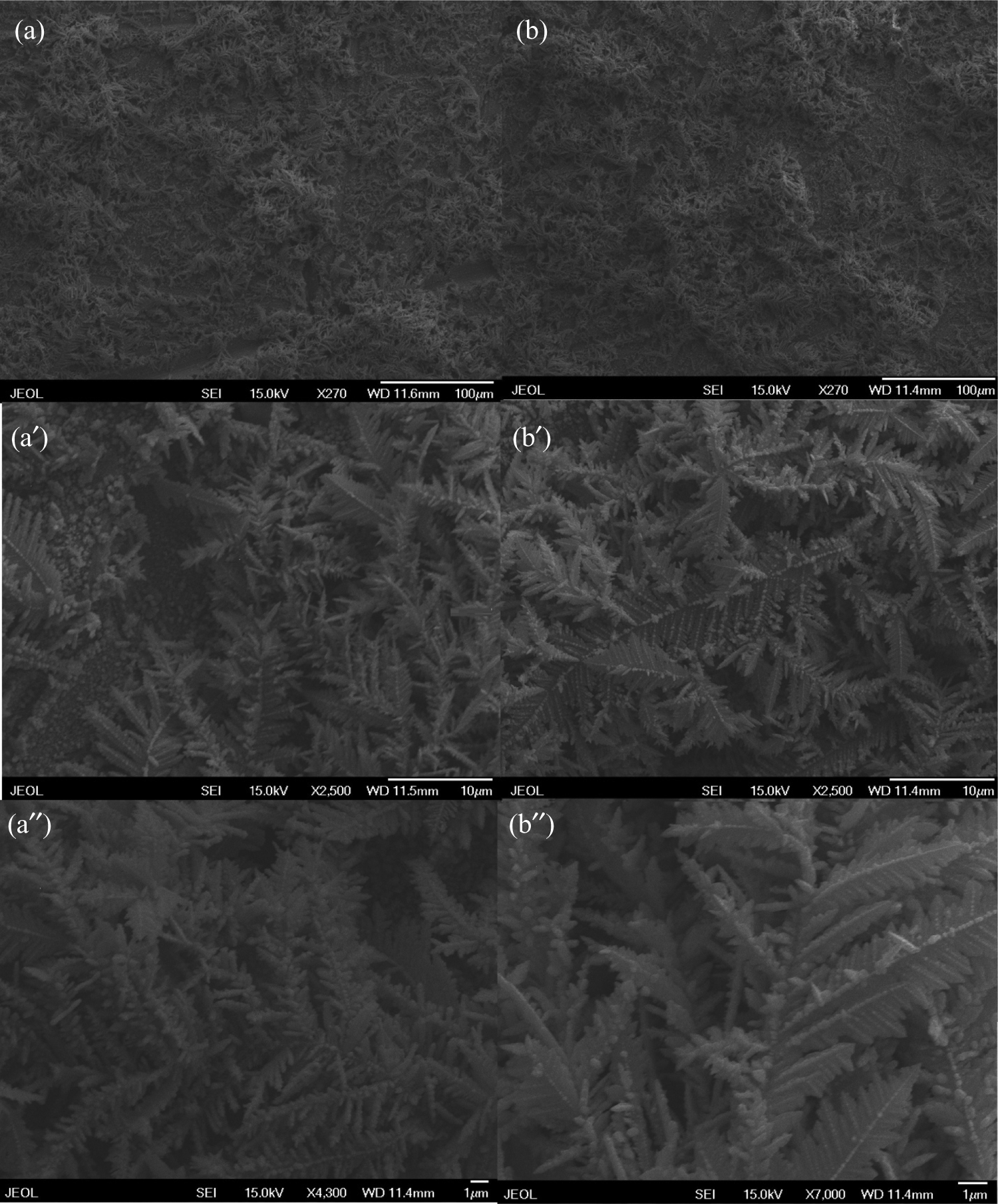
SEM images of the Ag-modified Cu plate (a, a′, a″) without coating and (b, b′, b″) with DCT coating at different scanning scales. SEM: scanning electron microprobe; DCT: 1-dodecanethiol.
The chemical composition of surfaces plays a critical part in determining the wettability. So the coated and uncoated samples were thoroughly characterized with XRD and FTIR. As exhibited by XRD pattern in Figure 3, the additional silver peak at 38.3° was detected in both the samples, which further substantiates the dendritic texture on copper plate is made of silver. Meanwhile, the XRD analysis also illustrates that the long-chain DCT-modification does not affect the crystalline structures of underlying silver/copper, since the structure parameters obtained from the XRD analysis are very close for both the samples. The surface chemical composition was further analyzed with the FTIR. After dip coating with DCT, the active hydrogen carbonaceous groups chemosorb on the metal surface as their atoms bond to the surface, 13 attributed to –CH3 and –CH2 as displayed in the FTIR spectrum in Figure 4. The peak at ∼2964 cm−1 corresponds to the CH3 antisymmetric stretching mode. While the peak at ∼2931 cm−1 is the CH2 antisymmetric stretching mode. No such groups are detected for the silver-modified copper sample. Reportedly, –CH n groups are one type of the most efficient surface energy reductants which could make the surface water repellent, 21,22 directly inducing the hydrophobic behavior, given the proper chemical composition.

The XRD patterns for the silver-coated copper samples before and after the DCT chemical modification along with that of Cu reference (copper: JCPDS card no. 4-0836) (silver: JCPDS card no. 04–0783). XRD: X-ray diffraction.

The FTIR spectra of the silver-modified copper film with/without DCT coating. Peak at ∼2964 cm−1 corresponding to CH3 stretching modes. Peak at ∼2931 cm−1 corresponding to CH2 stretching mode. Without DCT coating, no peaks corresponding to CH3 or CH2 were detected. FTIR: Fourier transform infrared; DCT: 1-dodecanethiol.
The ice-phobicity was investigated by observing the transparency of water droplets under ambient conditions with 69% humidity. Thermal conductive paste was painted onto the Peltier plate in order to fix the sample, which facilitates the heat transfer. As shown in Figure 5, one copper-based plate was placed on a Peltier stage. The dark-colored portion of the plate is coated with DCT, while the light-colored part is untreated. To detect how long it would take for water droplets to freeze, the process was recorded by a camera while the temperature was decreasing. When the temperature was dropping, moisture in the surrounding air condenses first, followed by the frost formation on the plate. At the moment the temperature reached zero, two water droplets were dispensed onto the coated and untreated areas, and the timing process was started. As the video sequence disclosed in Figure 5(a), when T = 0 s the temperature started to drop, both droplets were perfectly transparent and aqueous. Additionally, illuminating light was reflected by two aqueous droplets, accounting for two brighter spots on them. However, the preexisting condensation of ambient water vapor noticeably reduced the water contact angle from 156° ± 2° to 116° ± 2°, as compared with one under room temperature in Figure 1. Although it is smaller than 150°, the water contact angle 116° ± 2° is quite larger than 90° which still classifies into the hydrophobic category. 19 When T = 30 s and further lowering the temperature, the water droplet on untreated surface completely froze up, losing its transparency and light reflectivity as observed in Figure 5(b). Yet the droplet on the coated surface still maintained its transparency and the shiny reflective spot kept its original size and brightness, which implies the water droplet on the coated portion hasn’t started to freeze. At this point, a filmy frost layer barely could be noticed. Figure 5(c) shows that when T = 60 s, the frost layer was visible, particularly on the frozen water droplet. While the water droplet on the coated portion became translucent and the shiny reflective spot shrunk a little, indicating the water droplet starts freezing partially. When T = 90 s, more frost accumulates on the surfaces as shown in Figure 5(d). The shrunken reflective spot was hardly noticed. At this stage, a big portion of the water droplet froze up. After another 30 s (at T = 120 s), the droplet on the right entirely became frozen as indicated in Figure 5(e). By now, it has completely lost its transparency and reflectivity. It is noteworthy that Figure 5(e) and (f) visibly demonstrated that frost forms indiscriminately all over the surface.

The sequence of super-cooled water droplets freeze up while the temperature drops to −8°C under ambient conditions. The left water droplet is on raw copper plate while the right droplet is on the Ag-modified copper plate with DCT coating.
As observed, the frost formation could not convert the surfaces from superhydrophobicity into hydrophilicity in spite of the lessened water repellency. It is worth pointing out that nonpreferential nucleation of water does not lead to the loss of either hydrophobicity or ice-phobicity. Superhydrophobic surface considerably delays the freezing even in 69% moisture environment, which is consistent with lot of ice-phobic results under controlled conditions. 7 –9
While lowering the temperature to 0°C, ambient water vapor starts condensing and precipitating all over the substrate. Those preexisting tiny water droplets enhance the cohesiveness of the surface. Consequentially, the water droplet spreads out a little after dispensing on to the coated substrate, which results in the declined contact angle 116° ± 2°, instead of 156° ± 2°.
The freezing ensued from further lowering the temperature. The coated and untreated surfaces demonstrate different icing behaviors. Generally speaking, different substrates have different ice nucleating abilities. 23 The ice nucleating activities are governed by morphology as well as wettability of the surface. The deposition of silver on a copper plate naturally generates sufficient roughness. As the temperature drops, the water vapor from high humidity precipitates and partially fills up the spacing between apexes. The water droplet sits atop of those protruding structures. A large amount of air is still entrapped underneath the water droplet. The substantial presence of air below the water drop acts as a thermal transport barrier (thermal insulation) between the solid and the liquid, which could significantly slow the freezing on the coated surface. While on the untreated surface, the absence of the thermal transport barrier allows the heat to transfer easily between water droplet and the substrate, which facilitates the icing process. Moreover, the topological configuration of the coated superhydrophobic surface mismatches the ice lattice ΔG. The dissimilarity between the crystal structure of the coated copper substrate and the hexagonal ice could effectively deter the water from nucleating, therefore, further retarding ice formation. 24 On the contrary, due to the lack of roughened structure on the untreated surface, the condensed water vapor becomes protruding portions after they precipitated on the substrate. The water droplet sits right on the condensed water vapor. As the temperature declines further, the condensed water vapor and the water droplet start to freeze. Morphologically, they share the similarity which is instrumental in the ice formation.
Conventionally, the ice formation from water droplets attached to foreign solid surfaces with roughened structures is referred to as heterogeneous ice nucleation. 25 It is the most common mechanism for ice accretion on surfaces. According to the well-established Volmer’s classical nucleation theory, 26 the icing activities or the nucleation level are governed by the nucleation rate, which is controlled by the nucleation energy barrier. The free energy barrier of the formation of a liquid nucleus on surfaces can be expressed as

where σlv is the liquid–vapor interfacial energy, r* the critical radius, and θ the contact angle. When the liquid–vapor interfacial energy and the critical radius of r* are comparable on the untreated and the coated surfaces, the contact angle θ makes the difference in the free energy barrier.
The relationship of θ, as shown in Figure 6, indicates that the nucleation energy barrier increases monotonously with water contact angle, namely, the superhydrophobic surface coated with DCT have much higher ΔG than that of the hydrophilic untreated surface. Apparently, the nucleation energy barrier is determined by the intrinsic wettability of the surfaces. 15 While the nucleation rate can be expressed in terms of

The relationship between

where J 0 is the kinetic constant and K is Boltzmann constant. Because of the inversely exponential dependence of J on ΔG, the higher nucleation energy barrier ΔG, and the lower nucleation rate J. As a result, the nucleation rate on the hydrophilic untreated surface would be considerably higher than that of on the superhydrophobically coated surface which explains why the freezing process completes in no time on the hydrophilic untreated surface. In conjunction with the favorable topological configuration, the lower nucleation rate on the coated superhydrophobic surfaces considerably delays the freezing process till 120 s later even under high humidity.
Conclusions
Overall, we investigated the wettability and the anti-icing performance of a silver-modified copper surface with DCT coating under ambient conditions with 69% humidity. At the room temperature, the humidity does not affect the superhydrophobicity of the coated copper surface. The humidity compromises the water repellency by decreasing the contact angle from 156° ± 2° to 116° ± 2° when the temperature reaches 0°C. But when further lowering the temperature, the robust ice-phobicity was observed on the superhydrophobically coated surface. In conjunction with the favorable topological configuration, the intrinsic wettability of the coated superhydrophobic surfaces dramatically delays the freezing process till 120 s later. These observations suggest that some superhydrophobic surfaces would be of limited use in ice prevention technology, since they only could work under controlled conditions like low humidity, while the copper surface with silver deposition for sufficient roughness, coupled with DCT superhydrophobic coating, holds greater promise in the ice-phobic fields, thanks to its robust anti-icing property under more realistic conditions. This knowledge would provide guidance to devise sustainable strategies to dealing with ice to avoid catastrophic consequences.
Footnotes
Declaration of conflicting interests
The author(s) declared no potential conflicts of interest with respect to the research, authorship, and/or publication of this article.
Funding
The author(s) disclosed receipt of the following financial support for the research, authorship and/or publication of this article: The authors acknowledge Undergraduate Research Center at Albany State University for their financial support.