




Abstract
To solve the problem of tumor multidrug resistance in cancer therapy, a new drug delivery system of genipin-cross-linked iron (III) oxide/polyetherimide nanoparticles was used to load doxorubicin and small interfering RNA for combined cancer therapy. The results showed that the drug loading and encapsulation efficiency of doxorubicin could reach 45.39% and 52.18%, respectively. Doxorubicin released from iron (III) oxide-polyetherimide-doxorubicin is about 40% in the first day and 95% in 14 days. When loading doxorubicin and small interfering RNA, small interfering RNA could be absorbed completely. Besides, small interfering RNA could strengthen the anticancer effect when iron (III) oxide-polyetherimide-doxorubicin/small interfering RNA was used for in vitro HeLa cell combined treatment, and the effect of combination group was better than that of the group with doxorubicin alone. In addition, the toxicity of iron (III) oxide-polyetherimide was low when examined by the Alamar Blue assay. Therefore, our results reveal that this new system has potential applications in the future drug combination therapy, especially in the combined targeting drug delivery field.
Introduction
Tumor multidrug resistance has been a serious problem in the tumor treatment. 1,2 In recent years, more and more attentions have been paid to the gene and chemotherapy drug combination therapy system. 3 This system has good synergy effect, because exogenous gene can inhibit the expression of the target gene, reduces multidrug resistance, and accelerates cell death. And it can also reduce the drug dosage, thereby reducing the side effects. 4,5 Therefore, the combined system is expected to become an effective method of tumor treatment in the future for a better curative effect.
Small interfering RNA (siRNA) is a 21–25 short-chain nucleotide fragments. It can degrade its complementary pairing mRNA sequence and the complementarity effect can silence the expression of target genes, which is a kind of typical negative regulatory mechanism. 6,7 Although drug combination therapy system can solve tumor multidrug resistance in the treatment, as chemotherapy is systemic therapy, it is difficult to be precisely targeted to the tumor site. It is necessary to use targeting carriers in order to achieve a more accurate and effective therapeutic effect. 8,9 Among these targeting carriers, magnetic nanoparticles have the characteristic of noninvasive and high targetability, which has become a research focus in the current delivery systems. 10 –12 The principle is to use nanoparticles with high magnetic responsiveness to load drug, and then magnetic field is added to make the nanoparticles move to the target organ or tissue, thus improving the local drug concentration. 13
In this study, we used a biological cross-linking agent, genipin (GP), which is extracted from gardenia fruit and has some therapeutic effects such as antitumor and anti-inflammation, 14,15 to load doxorubicin (DOX) on the Fe3O4-polyetherimide (PEI), and then siRNA was loaded to form a drug/gene combination delivery system. Drug loading properties, in vitro release profiles, as well as the in vitro antitumor effect were all investigated. We expect that this combination system could show better therapeutic efficiency than one drug alone, which will eliminate the multidrug resistance of tumor cells, and thus improves the exploitation degree of DOX in the future cancer combination therapy.
Methods and materials
Materials
DOX was purchased from Dalian Meilun Biology Technology Co. Ltd (Dalian, China). siRNAs, with the sense strand 5′-GGAAAAGAAACCAACMGUCTT-3′ and the antisense strand 5′-GACAGUMGGUUUCUUUUCCTT-3′, were synthesized from Shanghai GenePharma Co., Ltd (Shanghai, China). GP was obtained from Linchuan Zhixin Bio-Technology Co., Ltd (Fuzhou, China). Fe3O4-PEI was provided by Nanjing Nanoeast Biotech Co., Ltd (Nanjing, China). Alamar Blue was purchased from Invitrogen (Carlsbad, CA, USA). All other chemicals were purchased from Sinopharm Chemical Reagent Co., Ltd (Beijing, China) unless otherwise specified. HeLa cell line was from the Type Culture Collection of the Chinese Academy of Sciences (Shanghai, China). Cell culture medium was composed of RPMI1640 (Gibco, Gaithersburg, MD, USA) supplemented with 20% fetal bovine serum (Gibco). All cells were incubated at 37°C in humidified air with 5% CO2.
Preparation of DOX-loaded magnetic nanoparticle composites (Fe3O4-PEI-DOX)
First, 20 µL of DOX standard solution (0.8 mg mL−1) was added into centrifuge tubes labeled as A, B, C, and D, respectively. Then, 10 μL of Fe3O4-PEI solution was added to the above solution and mixed (1 mg mL−1). Afterward, 20, 40, 80, and 120 μL of GP solution (0.3 mg mL−1) was added into groups A, B, C, and D, respectively, and cross-linked under 37°C at 60 r min−1 for 48 h and 72 h in a shaker.
Morphology characterization of Fe3O4-PEI-DOX
The prepared Fe3O4-PEI-DOX was centrifuged at 13,000 r min−1 for 15 min, and the precipitates were dispersed again in the ultrapure water, freeze-dried, and kept in a vacuum drying oven. The sample was put on the conductive adhesive, sprayed with gold for 3 min, and then placed in a field-emission scanning electron microscope (S-4800; Hitachi, Japan) to observe the surface morphology characteristics. Zeta potential was measured by Zetasizer (ZEN3600; Malvern Instruments Ltd, Malvern, UK).
Drug loading and encapsulation efficiency of Fe3O4-PEI-DOX
According to China Pharmacopoeia, 16 drug loading and encapsulation efficiency were calculated according to the following equations: drug loading (%) = (W1/W2) × 100% and encapsulation efficiency (%) = (W1/W3) × 100%, where W 1 is the amount of DOX loaded on Fe3O4-PEI-DOX, W 2 is the amount of Fe3O4-PEI-DOX, and W 3 is the whole amount of DOX in the solution. The absorbance was calculated at the DOX’s maximum absorption wave (487 nm). The amount of DOX coupled to the Fe3O4-PEI-DOX can be represented by the standard curve equation: y = 58.0770x + 0.4752 (R2 = 0.9905), where y is the concentration of DOX (µg mL−1) and x is the absorbance of DOX in the blank liquid at 487 nm.
Fe3O4-PEI-DOX release in vitro
The DOX released was tested in tubes placed in an incubator shaker at 60 r min−1 at 37°C. The DOX concentration in the supernatant of each tube was evaluated by a UV–vis spectrometer after incubated for 3, 6, 12, and 24 h. And then, the same amount of ultrapure water (300 μL) was added into the tubes. The concentration of DOX was calculated using the standard curve equation. Thus, in vitro release studies could be achieved. During the sampling process, a magnet was placed at the bottom of the tube to ensure that all the magnetic nanoparticles gathered at the bottom and had no influence on the determination result. All assays were performed in triplicate.
Preparation of Fe3O4-PEI-DOX/siRNA
Fe3O4-PEI-DOX was placed in a test tube, and then 20 μmol μL−1 of siRNA solution was added and kept for 30 min at room temperature to form the Fe3O4-PEI-DOX/siRNA.
Drug loading of Fe3O4-PEI-DOX/siRNA
The drug loading of siRNA in Fe3O4-PEI-DOX/siRNA was tested in the electrophoresis tank with the conditions of 10 µL/lane, 1× MOPS electrophoresis buffer, 80 V, and 20 min electrophoresis. The result was obtained using a gel imaging system (Tannon-GIS2008; Tanon Science & Technology Co., Ltd, Shanghai, China).
Cytotoxicity of Fe3O4-PEI
The Alamar Blue assay was used to determine the cytotoxicity of Fe3O4-PEI. HeLa cells in the logarithmic phrase were digested with trypsin to obtain single cell suspension and the required cell concentration was adjusted to 2 × 10 4 mL−1 with RPMI1640 medium containing 10% fetal bovine serum (FBS) and then seeded in each well of 96-well plates. Two-hundred microliters of mixed medium containing different concentrations of Fe3O4-PEI was added into each well and RPMI1640 medium was used as a blank control group. Each group included six parallels. After 24, 48, and 72 h, respectively, the original medium was drawn out and 100 μL of 10% RPMI1640 medium containing 10% Alamar Blue (excluding double-antibody) was added to each well. After incubated for another 4 h, the absorbance values were quantified at 570 nm and 600 nm using a SpectraMAX M5 microplate reader (Molecular Devices, Silicon Valley, CA, USA) according to the manufacturer’s instructions. The relative growth rate (RGR) was calculated by the following formula:

Anticancer performance of Fe3O4-PEI-DOX/siRNA
The process of determining the anticancer performance of Fe3O4-PEI-DOX-siRNA is similar to the cytotoxicity assay. Three micrograms of DOX, 5 μL of Fe3O4-PEI-DOX solution, and 5 μL of Fe3O4-PEI-DOX-siRNA solution were placed into the wells of 96-well plates instead of Fe3O4-PEI. The predetermined time intervals were 24, 72, and 120 h. Then, the Alamar Blue assay was used and RGR was calculated by the aforementioned formula.
Results and discussion
Morphology characterization of Fe3O4-PEI-DOX
Figure 1 gives details about the morphology characteristics of Fe3O4-PEI and Fe3O4-PEI-DOX. It can be seen that Fe3O4-PEI nanoparticles were spherical with a smooth surface, while after cross-linking of DOX with GP, the sphericity decreased slightly and the nanoparticles agglomerated to some extent, which suggested that DOX might attach to the surface of Fe3O4-PEI nanoparticles. The average diameters of Fe3O4-PEI and Fe3O4-PEI-DOX were 38.6 and 38.9 nm, respectively, and the zeta potentials were 29.0 and 31.9 mV, respectively, when GP:DOX rate was 4:1, which indicated that these nanoparticles could disperse well in the medium.
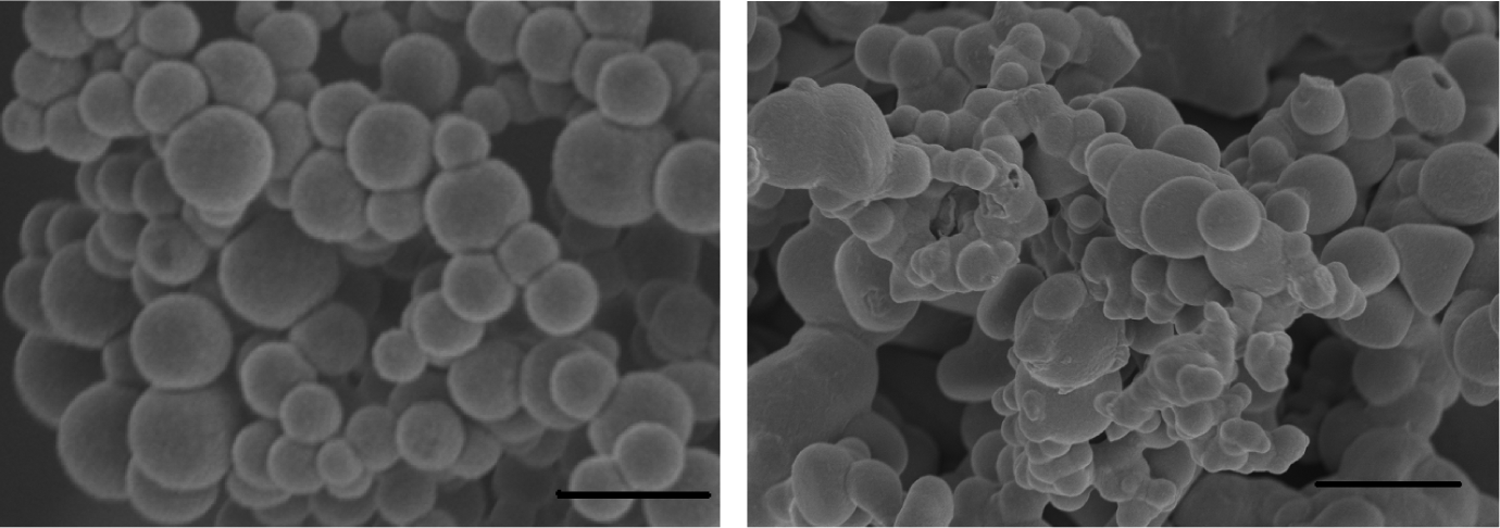
SEM images of Fe3O4-PEI (left) and Fe3O4-PEI-DOX (right) (bar = 500 nm). SEM: scanning electron microscope; PEI: polyetherimide; DOX: doxorubicin.
Drug loading and encapsulation efficiency of Fe3O4-PEI-DOX
To test the drug loading profiles of Fe3O4-PEI-DOX nanoparticles, the influence of different GP:DOX rates and cross-linking times was investigated. As can be seen in Figure 2, both of the two factors could affect the drug loading and encapsulation efficiency obviously. Drug loading and encapsulation efficiency were both lowest when the cross-linking time was 48 h, which means that the cross-linking time is not enough to load the drug completely. The ideal cross-linking time was 72 h; both the drug loading and encapsulation efficiency could achieve a high value by changing the GP:DOX rate. The optimal values were 45.39% and 52.18%, respectively, when GP:DOX rate was 2:1. While increasing the time to 96 h, these values decreased obviously when GP:DOX rates were 2:1 and 4:1, and these values were nearly close when changing the GP:DOX rate. The reason is that the full reaction occurs when the cross-linking time is 72 h, and the drug can be combined to the carrier sufficiently, but the space steric hindrance will lead to a decrease trend when increasing the rate to 6:1. At the same time, on increasing the time from 72 h to 96 h, the combined drug starts to release from the carrier due to the concentration gradient and reaches equilibrium which leads to drug loss and the decrease of the drug loading profiles.

Drug loading and encapsulation efficiency of Fe3O4-PEI-DOX with different rates of GP:DOX and different time intervals (48, 72, and 96 h). PEI: polyetherimide; DOX: doxorubicin; GP: genipin.
Fe3O4-PEI-DOX release in vitro
The drug release behavior of the Fe3O4-PEI-DOX was studied to reveal their potential application in the drug delivery system. Figure 3 shows the in vitro drug release curves of drug-loaded magnetic nanoparticle composites. It can be seen that the cumulative release rate was all no more than 20% in the initial 0.5 h and over 80% in the next 10 days. Compared with 1:1 and 6:1 groups, both 2:1 and 4:1 groups showed a slower release behavior that mainly contributes to the higher drug loading profiles, while all the groups presented a similar trend when releasing the drug from the composites. The results indicated that there was no burst-release effect and the Fe3O4-PEI-DOX could control the drugs’ release rate significantly with a period over 10 days, which also revealed the potential applications in the future research.

Cumulative release of DOX from Fe3O4-PEI-DOX with different rates of GP:DOX. PEI: polyetherimide; DOX: doxorubicin; GP: genipin.
Drug loading of Fe3O4-PEI-DOX/siRNA
The loading capacity of siRNA was measured by gel retardation electrophoresis. As shown in Figure 4, stripe brightness turned darker when increasing the concentration of Fe3O4-PEI-DOX, which reflected the combination extent between siRNA and Fe3O4-PEI-DOX. When there was no Fe3O4-PEI-DOX, the stripe was brightest. Afterward, the siRNA:Fe3O4-PEI-DOX ratio increased from 3:2 to 3:8, the brightness got darker which indicated that the siRNA began to combine with the Fe3O4-PEI-DOX gradually, while the residual siRNA could still escape from the swimming tank. When the ratio reached 3:10, there was no obvious visible stripe existed which revealed the full combination of siRNA with Fe3O4-PEI-DOX. In other report, Peng et al. used magnetic cationic liposome to conduct DOX and special AT-rich binding protein short harpin RNA (SATB1 shRNA) in a combination therapy of gastric cancer. This system could also load the RNA completely and obtain good antitumor effect. 17 Thus, the loading capacity of siRNA in Fe3O4-PEI-DOX to form a complex Fe3O4-PEI-DOX/siRNA also exhibited potential applications in the future antitumor combination therapy.

Fe3O4-PEI-DOX was complexed with siRNA at various weight ratios and separated on a 2.0% (w/v) agarose gel (lane 1: siRNA alone; lane 2–6: different weight ratios). PEI: polyetherimide; DOX: doxorubicin.
Cytotoxicity of Fe3O4-PEI
To test the influence of the original carrier, the cytotoxicity of Fe3O4-PEI was preliminarily investigated. As shown in Figure 5, the relative cell viability ranged from 87.4% to 111.9%, which showed that Fe3O4-PEI had no obvious influence on the cell growth. Therefore, Fe3O4-PEI is biocompatible and is suitable for the next anticancer experiment.

Cytotoxicity of Fe3O4-PEI evaluated by Alamar Blue assay. PEI: polyetherimide.
Anticancer performance of Fe3O4-PEI-DOX/siRNA
As shown in Figure 6, the relative cell viabilities of DOX, Fe3O4-PEI-DOX, and Fe3O4-PEI-DOX/siRNA were 83.8, 74.6, and 69.8%, respectively, in 1 day, and 53.5, 81.5, and 69.3 in 3 days, and 43.8, 61.9, and 60.5% in 5 days. In comparison with the cytotoxicity results of Fe3O4-PEI in Figure 5, since the carrier itself had no obvious influence on the cell growth, it could be concluded that the results in Figure 6 were associated with the loaded drug(s). In the initial 1 day, the Fe3O4-PEI-DOX/siRNA complex presented the best anticancer performance compared to the pure drug and Fe3O4-PEI-DOX group, with the efficiency near 30%. For Fe3O4-PEI-DOX group, there existed a turning point at 3 days, with the anticancer efficiency decreased from 25.4% to 18.5% and then increased to 38.1% in 5 days. While the pure drug DOX showed continuous increasing anticancer effect from 16.2% to 56.2%. Compared with the pure drug DOX, both Fe3O4-PEI-DOX and Fe3O4-PEI-DOX/siRNA showed a sustained release effect in anticancer performance in the investigated period. At the same time, the anticancer performance of Fe3O4-PEI-DOX/siRNA was better than that of Fe3O4-PEI-DOX, which indicated that the combination of drug and siRNA had a better effect than the drug alone when cross-linked in the drug carrier.

In vitro antitumor effect of Fe3O4-PEI-DOX/siRNA. PEI: polyetherimide; DOX: doxorubicin.
Vitor et al. used amphiphilic triblock micelle modified with PEI as DOX and DNA carrier for antitumor treatment, and the result showed that the lung cancer cell apoptosis rate was about 40%. 18 Our combination group showed a similar effect (the anticancer performance of the Fe3O4-PEI-DOX/siRNA group was near 40% in 5 days), which revealed that the Fe3O4-PEI-DOX/siRNA could also be used as a new carrier in cancer therapy in the future.
Conclusion
In this study, we successfully built the Fe3O4-PEI-DOX magnetic targeting drug delivery system using GP as cross-linker and then packaged siRNA on Fe3O4-PEI-DOX to construct the Fe3O4-PEI-DOX/siRNA drug carrier. Both the carriers showed appropriated drug loading profiles and sustained release performance with no initial burst effect. And what’s more, the anticancer performance of Fe3O4-PEI-DOX/siRNA was better than that of Fe3O4-PEI-DOX, which indicated that the combination of drug and siRNA had a better effect than the drug alone when cross-linked in the drug carrier. We believe that the Fe3O4-PEI-DOX/siRNA system will have potential applications in the future cancer therapy field.
Footnotes
Declaration of conflicting interests
The author(s) declared no potential conflicts of interest with respect to the research, authorship, and/or publication of this article.
Funding
The author(s) disclosed receipt of the following financial support for the research, authorship, and/or publication of this article: This work was financially supported by Natural Science Foundation of China (31000441 and 31170939), National marine economic innovation and development project (16PYY007SF17), the Science Research Foundation of National Health and Family Planning Commission of PRC & United Fujian Provincial Health and Education Project for Tacking the Key Research (WKJ2016-2-22), the Program for New Century Excellent Talents in Fujian Province University (2014FJ-NCET-ZR01), and the Promotion Program for Young and Middle-aged Teachers in Science and Technology Research of Huaqiao University (ZQN-PY108).