




Abstract
Carbon nanomaterials are effective adsorbents for water treatment. This study examines natural organic matter (NOM) removal from drinking water with combined coagulation processes using single-walled carbon nanotubes (SWCNTs) and multiwalled carbon nanotubes (MWCNTs). Conventional coagulation using aluminum sulfate (alum) and ferric chloride (FeCl3) was also conducted using Ulutan Lake water (ULW) samples collected in four seasons. The removal was characterized by ultraviolet absorbance at 254 nm (UV254) and dissolved organic carbon (DOC). The proposed process was more effective than using alum and FeCl3. The highest removal occurred for FeCl3 with SWCNTs in winter (94.13% DOC and 96.14% UV254). In spring and fall, DOC (90% and 84.63%) and UV254 (95.87% and 88.8%) removal was highest when using FeCl3 with MWCNTs. The DOC removal was lowest in summer (67–71% for alum and 72–79% for FeCl3). Summer UV254 removal was similar to DOC removal for combined coagulation. Hydrophobic NOM in winter ULW samples is more easily removed by SWCNTs than by MWCNTs, while MWCNTs were more effective in other seasons. The results reveal that the proposed process is more effective than the conventional coagulants alone in different seasons.
Introduction
Natural organic matter (NOM) plays an important role in water treatment. Research interest in the structure and properties of NOM in an aquatic environment is growing since it can cause undesirable color, taste, and odor. 1 Moreover, NOM is a major organic precursor for disinfection by-products (DBPs) that can form during chlorination, such as trihalomethanes and haloacetic acids. 2 –6 The characteristics of NOM may change significantly with the water source and biochemical cycles of the surrounding environments. 7,8 For example, the range of organic structures of NOM can vary seasonally due to intensive rain events, snowmelts, floods, and droughts. 7,9 –12
The NOM in raw water has to be characterized to understand its complexity and heterogenicity. 13 –16 NOM is generally divided into hydrophobic, transphilic, and hydrophilic groups based on resin adsorption affinity. 3,17 Total organic matter (TOC), dissolved organic matter (DOC), and UV absorbance at 254 nm (UV254) are common surrogate parameters for quantifying NOM reactivity in different surface waters. 18 Hydrophobic NOM consists of humic and fulvic acids and is rich in activated functional groups, such as phenolic structures and conjugated double bonds. Hydrophilic NOM is composed of mostly aliphatic carbon and nitrogenous compounds, such as carboxylic acids, carbohydrates, and sugars. 3,8,19 Specific ultraviolet absorbance (SUVA) is a significant indicator for defining hydrophobicity. High SUVA means that the organic matters are largely hydrophobic, whereas low SUVA indicates mainly hydrophilic organic compounds. 7,20,21
Coagulation is one of the most common methods for removing NOM in water. 22 –24 Multivalent salts such as aluminum sulfate (alum) and ferric chloride (FeCl3) have been widely used in water treatment for years. 25,26 The coagulation process is highly effective for the removal of hydrophobic fractions of NOM like humic acid, 27 but the hydrophilic fraction cannot be removed effectively. 27 –29 Many researchers have presented other water treatment technologies for NOM removal, including membrane filtration and adsorption technology (e.g. powdered activated carbon and granular activated carbon). 30,31 Several studies achieved 45–80% removal of NOM with combined coagulation and adsorption. 32 Although activated carbon is the most commonly used adsorbent in water treatment, 33,34 carbon nanotubes (CNTs) have been used as an effective adsorbent for the removal of heavy metals, chemicals, and biological components from water in recent years. 35 –38 Several studies have shown that CNTs can be effective in the removal of various types of NOM. 39 –42
The application of CNTs has several advantages in many functional areas, including water treatment. However, they also have significant impacts on safety and the environment. 43 The release of CNTs into the environment can have harmful impacts on natural ecosystems. 43 In addition, CNTs might damage DNA and could have harmful effects on organs if introduced into the body. 44,45 The biological effects of CNTs occur if they can enter the body or a biological system at a sufficient level. 46 CNTs also have the potential to influence biochemical processes or cell biology processes and directly or indirectly affect biological systems. 46 Research has shown that CNTs can enter the body through the skin, respiratory tract, or gastrointestinal tract. They can deposit in several organs within the body and may thus cause many adverse biological effects. 47 –50
Interactions between CNTs and NOM are likely to alter trends in DBP formation. In addition to direct reaction with chlorine-based disinfectants, CNTs are likely to influence DBP production through their ability to concentrate NOM on their surfaces through sorption. 51 –53 Thus, it is reasonable to expect that these same surface functionalities may also react with chemical disinfectants to yield undesirable by-products with adverse effects on human health. Many of them have been classified as possible human carcinogens and have been regulated by several international regulatory agencies worldwide. 54 Also, CNTs can leak from water purification operations into the surrounding water, soil, and air. The fate and transport processes that can act on nanomaterials after their release include photochemical transformation, oxidation and reduction, dissolution, precipitation, adsorption, and biotransformation, among other biogeochemically driven processes. 55,56 They could be hydrolytically disintegrated and could be oxidized photochemically and biologically in water matrices. CNTs could react with various biomolecules such as DNA, RNA, proteins, and enzymes, which might lead to toxic effects, especially on aquatic flora and fauna. For example, nanomaterials can react with humic acids and result in a nanoscale coating, 57 which is comparable to protein coronas in mammalian systems. 58
These factors strongly change the aggregation, deposition, and toxic properties of CNTs. 59,60 Novel synthesis methods have produced new properties of CNTs that have attracted attention from governments because of their uncertain effects on the environment and human health. 61 The presence of CNTs could potentially stimulate the oxidation of other metals in aquatic and terrestrial environments and release toxic ions. 62 However, several methods could be applied to remove environmental CNTs. First, enzymatic treatments are effective in degrading CNTs upon release into the environment. Zhao et al. 63 presented an eco-friendly enzymatic way to degrade and eliminate transformed CNTs from the environment. Membrane filtration has also been used to eliminate CNTs from solutions, 64 and a simple coagulation technique was effective for collecting CNTs after use. 65 According to the Health and Safety Executive, 66 waste containing CNTs must be classified and labeled as hazardous waste. Therefore, after purification of CNTs used in experimental studies, the CNT waste must be sealed carefully using double layers of polyethylene bags. Combustion of waste containing CNTs is preferred as pyrolysis above 500°C completely oxidizes the CNTs.
In recent years, many studies have focused on CNTs and their adsorption properties. CNT adsorbent materials can remove a wide range of heavy metals, organic compounds, and biological contaminants, including bacteria and viruses. For example, Long and Yang 67 reported a significantly higher dioxin removal efficiency with CNTs than with activated carbon. Li et al. 68 showed that CNTs are good fluoride adsorbents with superior capability to activated carbon. Lu et al. 69 demonstrated that both NaClO-oxidized single-walled CNTs (SWCNTs) and multiwalled CNTs (MWCNTs) are effective Zn2+ sorbents. Amin et al. 70 found that CNTs (especially SWCNTs) are efficient and rapid adsorbents for removing ethylbenzene. This method could therefore be used to maintain high water quality. Chen et al. 71 investigated the adsorption of chlorophenols on pristine and functionalized SWCNTs (hydroxylated SWCNTs and carboxylated SWCNTs). Duijneveldt et al. 72 focused on the small-angle scattering studies of SWCNTs dispersed with sodium dodecyl sulfate in order to characterize the adsorption.
The aim of this study is to examine the removal of NOM in drinking water sources through a combination of coagulation with CNTs. SWCNTs and MWCNTs were investigated for their removal efficiencies in the presence of alum and FeCl3 as metal coagulants. Ulutan Lake water (ULW), an important source of drinking water, was used in experiments to determine NOM concentrations for each season. SWCNTs and MWCNTs are used as coagulant materials to remove NOM in ULW by a new water treatment technique involving a novel combined coagulation process.
Materials and methods
Source water and sampling
Representative water samples were collected from raw water entering Ulutan Lake at four different times in Zonguldak, Turkey. Ulutan Lake is a reservoir that provides nearly 35,000 m3 of raw water to the drinking water treatment plant of Zonguldak. The sampling was done in all four seasons from 2014 to 2015 (with seasons starting in September 2014, January 2015, April 2015, and July 2015). The physicochemical characteristics of ULW are given in Table 1. The ranges throughout the year were as follows: pH: 7.43–8.11; turbidity: 3.42–16.5 Nephlometric Turbidity Unit (NTU)
Physicochemical characteristics of Ulutan raw water samples (September 2014–July 2015).

TOC: total organic matter; UV254: ultraviolet absorbance at 254 nm; SUVA: specific ultraviolet absorbance; THMFP: trihalomethane formation potential.
aAverage concentration of 3 months in one season.
Coagulants
SWCNTs (1–2-nm diameter, 5–30-µm length, purity >90%) were obtained from Cheap Tubes, Inc. (Brattleboro, Vermont, USA). MWCNTs (50–80-nm diameter, 5–9-µm length, purity >90%) were purchased from Sigma Aldrich (St. Louis, Missouri, USA). Aluminum sulfate (Al2SO4·18H2O) and FeCl3 were purchased from Fisher Scientific (Fair Lawn, New Jersey, USA). Stock solutions of 10 g/L for both coagulants were prepared by adding 10 g of each chemical to 1 L of ultrapure deionized water and stirring overnight. The coagulants were stored in a refrigerator at 4°C for the duration of the study.
Purified CNTs
One gram of raw CNTs was dispersed into a 100-mL flask containing 40 mL of mixed acid solutions (30 mL of HNO3 +10 mL of H2SO4) for 24 h to remove metal catalysts (Ni nanoparticles). After cleaning, the CNTs were again dispersed in a 100-mL flask containing 40 mL of mixed acid solutions, which were then shaken in an ultrasonic cleaning bath (Model Branson 3510 Ultrasonic Cleaner, Connecticut, NISH, USA) and heated at 80°C in a water bath for 2 h to remove amorphous carbon. After cooling to room temperature, the mixture was filtered with a 0.45-µm glass-fiber filter, and the solid was washed with deionized water until the pH of the filtrate was 7. The filtered solid was then dried at 80°C for 2 h to obtain the purified CNTs. This test procedure of purified CNTs has been used by other researchers in previous CNT studies. 73,74 After purifying the CNTs, the CNT waste was sealed carefully using double layers of polyethylene bags and transported to solid waste incineration plants with other hazardous wastes from the laboratory. 66
Jar test procedure for coagulation experiments
Prior to the jar test, stock solutions containing 5000 mg/L of the SWCNTs and MWCNTs were prepared by adding 1 g of the CNTs to 200 mL of DI water and stirring with a magnetic stirrer at 600 r/min. The applied coagulant doses ranged from 0 to 100 mg/L. The jar test setup procedures were performed using a Phipps and Bird six-paddle jar test apparatus. The jars were round beakers with 1 L capacity. The jar test mixing conditions for the first setup were as follows: rapid mixing at 150 r/min for 2 min, flocculation at 30 r/min for 15 min and at 20 r/min for 20 min.
At similar coagulant dosages, the FeCl3 consistently outperformed alum for DOC removal. These results are consistent with other studies. 75,76 A dosage of 100 mg/L of alum and FeCl3 resulted in the maximum DOC removal in ULW sample coagulation. However, based on economic and engineering considerations, 80 mg/L was selected as the optimum coagulant dosage. When the combined coagulation was analyzed, preliminary testing was applied to determine the optimal coagulant dose for raw water samples. The optimum combined coagulant dosage for ULW was determined as 40 mg/L. After the jar tests were completed, the coagulated water samples were passed through 0.45-µm membrane filters for DOC analysis.
Chlorination procedure
THMFP measurements were conducted in accordance with standard method 5710 B of the American Public Health Association. 77
Analytical methods
DOC analyses were performed with a Shimadzu TOC-5000 analyzer equipped with an auto sampler 77 according to the combustion–infrared method described in standard method 3510 B. 77 The sample is injected into a heated reaction chamber packed with a platinum-oxide catalyst oxidizer to oxidize organic carbon into carbon dioxide gas. UV254 absorbance measurements were performed in accordance with standard method 5910 B 77 using a Shimadzu 1608 UV–vis spectrophotometer at a wavelength of 254 nm with a 1-cm quartz cell. The samples were first passed through a 0.45-µm membrane filter to remove turbidity, which can interfere with the measurement. Distilled ultrafiltered water was used as the background correction in the spectrophotometer. THM concentrations were determined with liquid–liquid extraction method according to standard method 6232 B. 77
Results
Seasonal variations of NOM in ULW
Table 2 illustrates the impact of seasonal variations of NOM in ULW. The concentrations of NOM were characterized with the surrogate parameters DOC, UV254, SUVA, and THMFP, which give information about the NOM structure and reactivity in raw water. The highest average DOC concentrations were observed in winter (5.44 mg/L), whereas the lowest were determined in summer (4.89 mg/L). Similarly, the highest UV254 measurements were recorded in winter (0.176 per centimeter) and the lowest value of 0.113 per centimeter was measured in summer.
Seasonal characterization of surrogate parameters of NOM in ULW.

DOC: dissolved organic carbon; UV254: ultraviolet absorbance at 254 nm; SUVA: specific ultraviolet absorbance; THMFP: trihalomethane formation potential.
aAverage concentration of 3 months in one season.
Hydrophobicity is determined using the SUVA parameter (the UV254 absorbance divided by the DOC concentration). The high SUVA in winter (3.25 L/mg·m) indicates that the organic matter is composed of hydrophobic organic materials with high molecular weight. The low SUVA (1.88 L/mg·m) in summer shows that ULW contains organic materials that are mostly of aliphatic carbon and nitrogenous compounds. 9,13,78 These observations illustrate that the range of organic components of NOM in ULW changes mainly in winter owing to storm water runoff after rainfall events, snowmelts in mountain regions, or flooding. 11 –13 Furthermore, the ULW in summer also experiences the diffusion of sediments, plankton, and bacteria remains, in addition to the production of effluents from wastewater treatment plants. ULW contains mainly high concentrations of hydrophilic NOM with low molecular weights. 79,80
The THMFP values in winter, spring, fall, and summer were measured as 340.55, 246.73, 227.46, and 214.76 µg/L, respectively. These results suggest that higher DOC and UV254 values produce more THMs. As the hydrophobic organic matter is chlorinated with different chlorine dosages, higher THM concentrations form in ULW samples than the hydrophilic fraction of NOM with respect to SUVA levels. Similar results were obtained in other studies. 4,78
Combined coagulation using CNTs
DOC removal with coagulation using SWCNTs
Figure 1 shows the change in DOC when increasing the doses of SWCNTs with the addition of alum and FeCl3 in the jar test procedure. The largest DOC removal using only SWCNTs was recorded in winter (81.13%), followed by fall (63.5%), spring (69.08%), and summer (56.23%). As mentioned, winter showed the highest DOC removal efficiency, while summer had the lowest when using only SWCNTs. For all seasons, a significant increase of about 10% in the removal of DOC occurred with the addition of alum. Removal of 80% or higher was achieved in winter. These findings are explained by the different properties of SWCNTs and MWCNTs. Since the surface area of SWCNTs is larger than that of MWCNTs and their diameter is smaller, the removal of DOC in winter is higher than the removal of hydrophilic NOM in other seasons. This outcome has been determined in other studies that investigated the removal of NOM. 30,31

Removal of DOC by SWCNTs and combined coagulation using jar test for (a) winter, (b) spring, (c) fall, and (d) summer. Optimum coagulant dose = 50 mg/L. DOC: dissolved organic carbon; SWCNT: single-walled carbon nanotube.
With the addition of alum, the removal percentages of DOC remained constant at SWCNT doses of 50 mg/L or greater, with 88.7% for winter, 72% for fall, 79.2% for spring, and 67.11% for summer (Figure 1). Many studies have shown that FeCl3 is more effective than alum because of the higher charge density of ferric coagulants. 81,82 With the addition of FeCl3, the removal percentages of DOC were 94.13% in winter, 76% in fall, 83% in spring, and 72.64% in summer. With the application of FeCl3, the maximum removal percentage of DOC is achieved in winter (>90%). However, the lowest was observed in summer as about of 65%, followed by spring and fall (75% and 70%, respectively). Previous studies have explained that coagulation is not effective for the removal of the hydrophilic fraction of NOM, 83,84 which is why the removal ratio of DOC was lower in summer.
UV254 removal with coagulation using SWCNTs
UV254 is a surrogate organic parameter for defining the aromatic content of NOM in water. Figure 3 compares the removal of UV254 when increasing the doses of SWCNTs with the addition of alum and FeCl3 coagulants for four seasons. The percentages removed according to UV254 using only SWCNTs were about 82%, 76%, 71%, and 65% for winter, spring, fall, and summer, respectively (Figure 2). High UV254 removals of 93.74% were obtained with the application of alum and SWCNTs in winter, with 81.6% in spring, 78.32% in fall, and 71.87% in summer. Higher UV254 removal was observed with FeCl3 + SWCNT than with alum. The greatest UV254 removal of 96.14% was determined in winter using FeCl3 + SWCNT. The other UV254 removals by FeCl3 + SWCNT were 86.6% in spring, 83.21% in fall, and 77.68% in summer. This result shows that the large aromatic portion of NOM in winter was preferentially removed by the coagulation process, and the removal percentages of hydrophobic compounds were higher than those of hydrophilic compounds. These results are consistent with other studies. 13,81,85
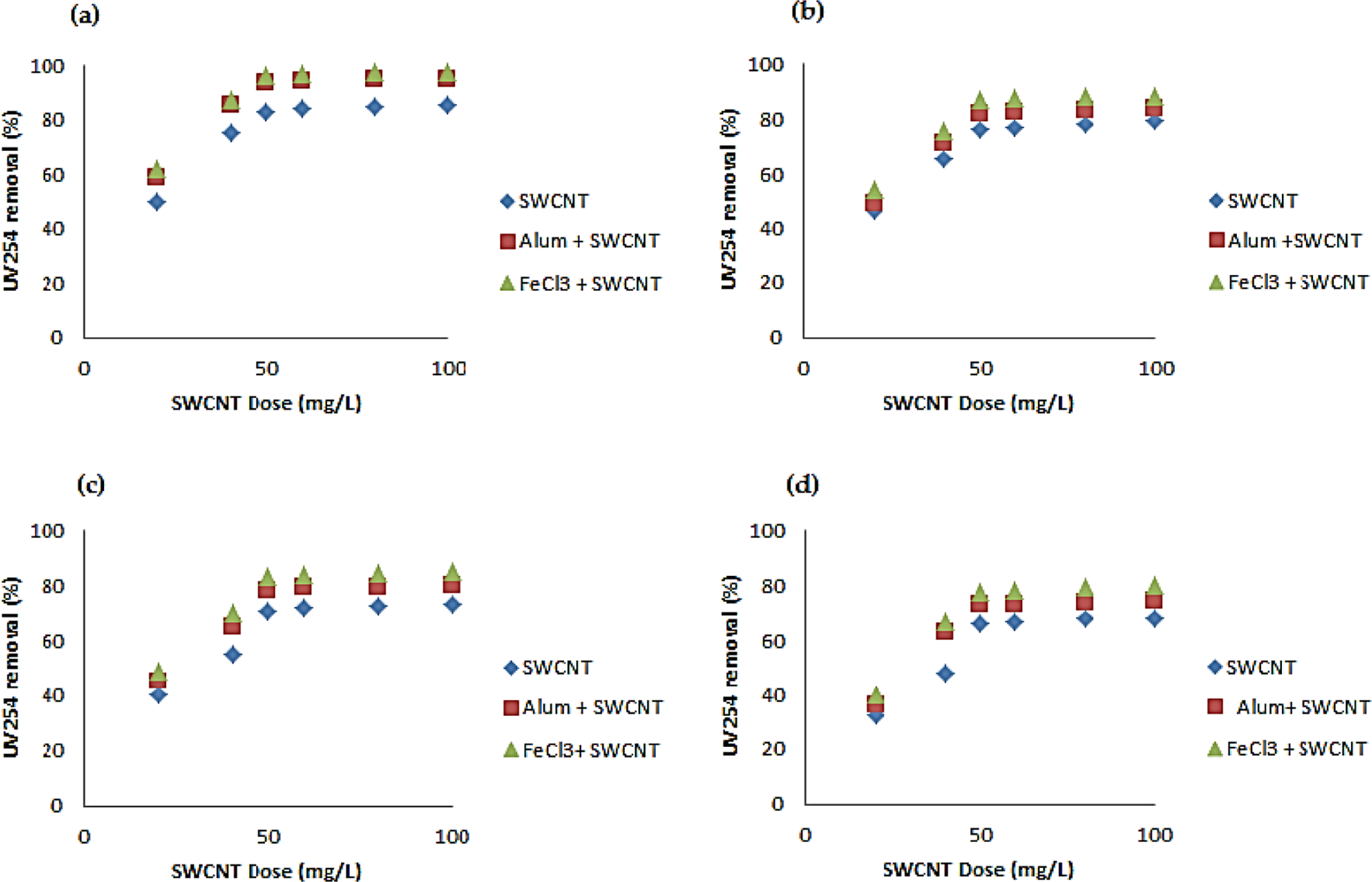
Removal of UV254 by SWCNTs and combined coagulation using jar test from (a) winter, (b) spring, (c) fall, and (d) summer. Optimum coagulant dose = 50 mg/L. UV254: ultraviolet absorbance at 254 nm; SWCNT: single-walled carbon nanotube.

Removal of DOC by MWCNTs and combined coagulation using jar test for (a) winter, (b) spring, (c) fall, and (d) summer. Optimum coagulant dose = 50 mg/L. DOC: dissolved organic carbon; MWCNT: multiwalled carbon nanotube.
Comparing Figures 1 and 2, the UV254 removal was higher than the DOC removal for all seasons. For instance, although the percentage of DOC removal using alum + SWCNT was 88.7% in winter, the percentage of UV254 removal was 93.74% under the same conditions. This observation could be explained by UV254 reflecting the more aromatic compounds in the structure of NOM. Compared to DOC, UV254 is a better indicator for the reactivity of the compounds that comprise aquatic humic matters than for the DOC present in the ULW samples. Therefore, it is concluded that coagulation generally removes a large amount of UV-absorbing substances in water and to a greater extent than DOC.
DOC removal with coagulation using MWCNTs
Figure 3 compares the removal of DOC when increasing the doses of MWCNTs with the addition of chemical coagulants during the jar test procedure. Similar to SWCNTs, the highest percentage of DOC removal using only MWCNTs was obtained as about 73% in winter. Also, although the removal percentage of DOC was slightly lower in winter when using only MWCNTs (73.4%) than when using SWCNTs (81.13%), the remaining seasons experienced relatively high levels of NOM removal using only MWCNTs, with removal percentages of 76.54%, 66.44%, and 61% for spring, fall, and summer, respectively (Figure 3). The MWCNTs indicated a significantly higher removal capacity for DOC in spring, fall, and summer.
Compared to the other seasons, the significant increase in the removal capacity of the MWCNTs detected in summer could be the result of the ionic strength. The ionic strength of ULW in summer (conductivity = 684 µS/cm) is higher than that of spring (conductivity = 611 µS/cm), fall (conductivity = 593 µS/cm), and winter (conductivity = 511 µS/cm). Therefore, the increasing ionic strength generally resulted in increased DOC removal with MWCNTs. Moreover, the higher ionic strength resulted in reduced electrostatic interactions with the CNTs. Thus, MWCNTs are more effective in the removal of the hydrophilic portion of NOM. These observations are consistent with other studies on removal of NOM. 4,22,27,28 The increase in the removal capacity of the MWCNTs detected in summer could be a result of the increase in the pH (pH 8.11) compared with that in winter (pH 7.43), spring (pH 7.75), and fall (pH 7.70; Table 1). As the pH increases, the NOM may become less compact and more separated owing to increased electrostatic repulsion, resulting in an overall increase in removal capacity.
As shown in Figure 3, the addition of alum increases DOC levels in all four seasons. The removal of DOC also remained constant at MWCNT doses of 50 mg/L or greater (74.21% in winter, 83.1% in spring, 77.5% in fall, and 71.1% in summer). With the addition of FeCl3, the maximum removal of DOC in all four seasons occurred at MWCNT doses of 50 mg/L. The combined coagulation experiments demonstrate that the hydrophobic NOM in ULW was more easily removed by SWCNTs than by MWCNTs, whereas the hydrophilic NOM in the three seasons other than winter was more easily removed by MWCNTs than by SWCNTs (Table 3).
The highest DOC removals from ULW with combined coagulation.

DOC: dissolved organic carbon; ULW: Ulutan Lake water; SWCNT: single-walled carbon nanotube; MWCNT: multiwalled carbon nanotube.
UV254 removal with coagulation using MWCNTs
Figure 4 shows the removal of UV254 in all four seasons in ULW samples during the combined coagulation experiments. The percentage removal of UV254 using only MWCNTs was 72.2% in winter and 68.29% in summer. The highest UV254 removal using only MWCNTs was recorded in spring (80.2%), followed by fall (76.61%). It was concluded that the coagulation process was more effective on NOM that includes a greater amount of UV absorbing sites or activated functional groups in aromatic compounds.

Removal of UV254 by MWCNTs and combined coagulation using jar test for (a) winter, (b) spring, (c) fall, and (d) summer. Optimum coagulant dose = 50 mg/L. UV254: ultraviolet absorbance at 254 nm; MWCNT: multiwalled carbon nanotube.
As shown in Figure 4, UV254 was always removed to a greater extent than DOC. The application of alum + MWCNT doses greater than 50 mg/L was similar to that observed with SWCNTs, with 77.35% removal in winter, 81.12% in fall, 87.76% in spring, and 76.23% in summer. This result shows that while the increases in UV254 removal changed with increasing doses of alum + SWCNTs in winter, higher removal percentages of UV254 were determined with the application of MWCNTs and conventional coagulants. Moreover, the greatest percentage of UV254 removal was observed in spring (95.87%) with the addition of FeCl3 doses greater than 50 mg/L. As a result, the combined coagulation was more effective at removing UV254-absorbing materials than DOC (Table 4).
The highest UV254 removals from ULW with combined coagulation.
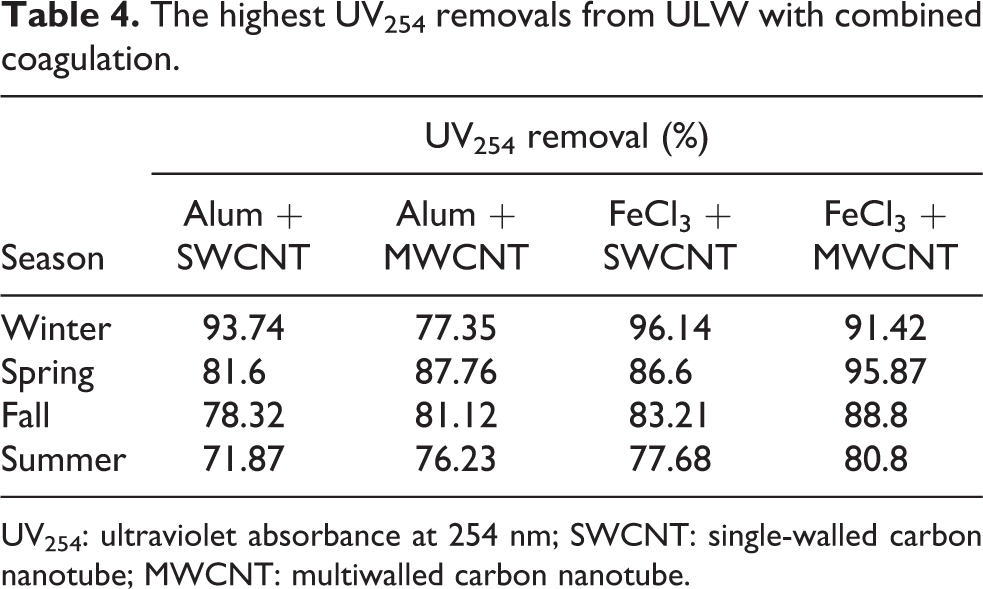
UV254: ultraviolet absorbance at 254 nm; SWCNT: single-walled carbon nanotube; MWCNT: multiwalled carbon nanotube.
Comparison between only conventional coagulation (alum and FeCl3) and combined coagulation process
Figures 5 and 6 compare the removal percentages of DOC and UV254 using only conventional and combined coagulation processes. In winter, high DOC and UV254 removal percentages (>80%) were determined when using the combined coagulation. When using only alum, the DOC and UV254 removals were 51.65% and 59.78%, respectively. Higher DOC and UV254 removals were observed when using only FeCl3 (63.05% and 69.57%) than with alum. A significant increase was seen when FeCl3 was combined with SWCNTs compared to the use of only FeCl3. For all seasons, DOC and UV254 removals were low for both alum and FeCl3 alone, while high DOC and UV254 removals were observed with combined coagulation. The highest DOC (94.13%) and UV254 (96.14%) removals were obtained by combining coagulation with FeCl3 + SWCNTs. DOC and UV254 removals in summer were lower than in other seasons with removal percentages of 27.29% and 32.5% when alum was used, while they were 40.15% and 46.83% when FeCl3 was used. The use of FeCl3 with CNTs provided the highest removal percentage of DOC and UV254 in spring (90% and 95.87%), followed by the fall (84.69% and 88.80%). Another trend was observed for DOC and UV254 removal using alum, which produced the highest DOC and UV254 removal alone and combined with SWCNTs (88.7% and 93.74%) in winter.

Comparison of DOC removal using conventional coagulation (only alum and FeCl3) and combined coagulation processes. Optimum alum and FeCl3 dose = 80 mg/L and combined coagulant dose = 50 mg/L. DOC: dissolved organic carbon.

Comparison of UV254 removal using conventional coagulation (only alum and FeCl3) and combined coagulation processes. Optimum alum and FeCl3 dose = 80 mg/L and optimum combined coagulant dose = 50 mg/L. UV254: ultraviolet absorbance at 254 nm.
Higher NOM removal percentage was observed in winter using SWCNTs with conventional coagulants compared with other seasons, which was expected because of the larger molecular size and increased hydrophobicity of the NOM. However, NOM removal in fall, spring, and summer was higher when using MWCNTs and conventional coagulants. This result could be explained by the hydrophilic portion of NOM. The removal of hydrophilic NOM by combined coagulation is more difficult than hydrophobic NOM removal.
Discussion
The coagulation experiments showed that SWCNTs were generally more powerful than MWCNTs for removing the hydrophobic portion of NOM in winter because of the larger surface area of the SWCNTs. Although the hydrophilic removal in spring and fall was slightly higher with MWCNTs and the conventional coagulant, the majority of hydrophilic NOM was removed by using MWCNTs and FeCl3 in summer. Combined coagulation treatment generally resulted in higher removal of DOC and UV254 in ULW samples. DOC and UV254 removals were 63.05% and 68.75% with the use of only FeCl3 in winter, whereas the removal ratio increased by about 30% with the combined use of FeCl3 and SWCNTs. The removals were lower when using only conventional coagulants in spring and fall, while the highest was recorded with FeCl3 and CNTs. For example, the DOC removal with only FeCl3 was about 50% in spring and nearly 44% in fall, but the addition of SWCNTs increased the removals to 83% in spring and nearly 77% in fall. Furthermore, among the other seasons, using FeCl3 and MWCNTs produced the largest amount of DOC (80.5%) and UV254 (84.6%) removal in summer.
Along with the potential changes in the physical characteristics of the CNTs, the change in content of the water source due to seasonal changes may also contribute to the NOM removal with a dependence on the type of CNTs. For instance, the pH value in summer (pH 8.11) is higher than that in winter (pH 7.43) with the coagulation using MWCNTs. Compared to SWCNTs, the removal of DOC and UV254 is significantly higher in summer with coagulation using MWCNTs. Figures 5 and 6 compare the removal percentages of DOC and UV254 using coagulation only and combined coagulation. In winter, DOC and UV254 removals were higher than 80% when using combined coagulation. However, the removal percentages were around 50–70% when using alum or FeCl3 only. For all seasons, the highest DOC and UV254 removals were 94.13% and 96.14% when using FeCl3 and SWCNTs, respectively (Table 4). As shown in Table 3, the lowest DOC and UV254 removals were determined when using only alum as 27.29% and 32.5% in summer, followed by FeCl3 (40.15% and 46.83%).
Another important water quality parameter that affects NOM removal is the ionic strength. The outcomes demonstrate that increases in ionic strength are caused by the increased DOC and UV254 removal due to the chemical and physical structure of NOM in ULW in all four seasons. Similar observations were determined by previous studies on CNTs and NOM removal. 42,73,74
The combined coagulation treatment using carbon nanomaterials was more efficient than the conventional coagulant in the removal of NOM from ULW. The removal percentage of the hydrophilic portion of NOM is very low for coagulation with only alum or FeCl3, but the removal increases significantly with the combined coagulation. This phenomenon may result from the CNTs having π–π electron donor–acceptor interactions and hydrophobic interactions for the removal mechanism. Depending on their relative surface charge, the CNTs are more effective in NOM removal when using the combined coagulation process. This finding has been confirmed by many studies. 25,26,41,42 Because of the harmful effects on human health and the environment, the CNT waste was transported to solid waste incinerators with other hazardous wastes from the laboratory after purifying, where they can completely oxidize at above 500°C through pyrolysis. 66 Therefore, the combined coagulation process can be used in water treatment plants instead of conventional coagulation in order to remove NOM effectively.
Footnotes
Acknowledgment
Authors would like to thank the Scientific and Technological Research Council of Turkey for supporting this study as a scientific and technological research project under Project No. 114Y030.
Declaration of conflicting interests
The author(s) declared no potential conflicts of interest with respect to the research, authorship, and/or publication of this article.
Funding
The author(s) received no financial support for the research, authorship, and/or publication of this article.