




Abstract
A simple method for controllable growth of zinc oxide nanorod arrays by adjusting preparation conditions of their seed layers is studied. Mole ratio of zinc acetate to diethanol amine, concentration of the two chemicals in the solution, and addition of polyethylene glycol in the solution are identified as three key parameters that have a great influence on microstructure of the seed layers. Surface roughness and uniformity in thickness of the seed layer are found as main factors that determine the nanorod arrays’ morphologies and alignments. Average diameter of the nanorods can be tuned from 106 to 336 nm; spacial distribution density of the nanorods is effectively controlled by adding polyethylene glycol. Advantage of this simple method lies in two aspects: First, it ensures that all the nanorod arrays have same chemical compositions as their morphologies change. Second, the controlled morphologies of zinc oxide nanorod arrays can significantly tune the hydrophobic properties. As demonstrated in their hydrophobic properties measurement, the static contact angle of water on their top surfaces can be finely tuned from 127° to 143°.
Introduction
Zinc oxide (ZnO) nanorod arrays have received much attention during the past few years for their unique morphologies and potential applications in various fields, such as photovoltaics, 1 biosensors, 2,3 detectors, 4 and hydrophobic films. 5 Different methods have been developed for the synthesis of ZnO nanorod arrays, such as thermal evaporation, 6 metal-organic chemical vapor deposition, 7 hydrothermal synthesis, 8 wet chemical route, 9 and electrochemical deposition. 10,11 However, the ZnO nanorod arrays reported usually show large differences in morphologies and intrinsic properties, even though synthesized by same method. Our previous study 12 found both diameter of the single nanorod and luminescence properties of the ZnO nanorod arrays vary obviously with growth temperature and solution concentration, respectively; Laurent et al. 13 reported that ZnO nanorod arrays prepared on sputtered seed layer and spin-coated seed layer show very different hydrophobic properties.
In this study, large-scale and uniform ZnO nanorod arrays have been fabricated through a facile and low-cost seed layer-assisted solvothermal method without using vacuum or high-temperature processing. The diameters, alignments, and spacial distribution density of the ZnO nanorods can be conveniently varied by only adjusting the growth parameters of the seed layers. This not only provides a simple route for controllable growth of ZnO nanorod arrays but also helps to understand the nanorod arrays’ growth mechanisms. Furthermore, their tunable hydrophobic properties were also investigated by measuring static contact angle of water on the surface.
Experiment
The ZnO nanorod arrays in this study were synthesized by a seed-layer-assisted solvothermal method. Before the growth of ZnO nanorod arrays, a thin ZnO film called seed layer was predeposited on the surface of indium tin oxide (ITO) substrates.
The seed layers were prepared by spin coating of solution containing zinc acetate and diethanol amine. A general procedure can be found in the following: First, certain amounts of zinc acetate and diethanol amine were dissolved in 50 ml alcohol to form seed layer solution. Second, 3 ml seed layer solution was dropped on the surface of ITO substrate. Finally, the substrate was annealed on hot plate at 500°C for 10 min. We have identified three synthesis parameters that would affect the morphology and structural quality of the seed layers, that is, the mole ratio of zinc acetate to diethanol amine, the concentration of the solution, and addition of polyethylene glycol (PEG 4000).
For the ZnO nanorods growth, mixture of 0.06 M zinc acetate and 0.2 M hexamethylenetetramine aqueous solution was first added in a stainless steel Teflon-lined autoclave. Substrate with seed layer was then inserted to the above solution, keeping the seed layer side facing down. After being sealed, the autoclave was kept at 90°C for 5 h and then cooled down to room temperature naturally. Finally, the substrate was taken out of the solution, rinsed with distilled water, and dried in air.
The general morphologies of ZnO seed layer and nanorods were examined using scanning electron microscopy (SEM). The crystallinity of ZnO nanorods was characterized by X-ray diffraction (XRD) and Raman spectroscopy. The hydrophobic properties of the nanorod arrays were examined by measuring the static contact angle of water on their surfaces, after the as-synthesized nanorod arrays were baked at 180°C for 24 h in a dark vacuum environment.
Results
Mole ratio series
Figure 1 shows top view SEM images of seed layer prepared at different mole ratios of zinc acetate to diethanol amine and images of ZnO nanorod arrays grown on each seed layer. All the seed layers are continuous films with different roughness, covering on the whole surface of substrate. The high-magnification SEM images (Figure 1(a) to (d)) reveal their features in detail. In the case of mole ratio 1:1, the seed layer looks like consisting of large amounts of uniform particles with an average diameter around 15–20 nm (Figure 1(a)). ZnO nanorods grown on such seed layer have their diameters about 146 nm and are almost vertically aligned (Figure 1(e)). As the mole ratio decreases, roughness of the seed layer decreases. Less and less detail feature can be clearly viewed in the SEM images, indicating the film becomes much denser and flatter. Meanwhile, ZnO nanorods grown on the seed layers have their average diameter increases but have a larger non-uniformity existing in their individual diameters. Moreover, along with increasing of the nanorod diameters, some rods have their top regions contact and form bigger crystals, as revealed in Figure 1(h). The nanorod array tends to become a continuous thick film. When the mole ratio of zinc acetate to diethanol amine is 1:1, 1:2, 1:3, and 1:4 (Figure 1(a) to (d)), the average diameters are 146, 165, 242, and 336 nm (Figure 1(e) to (h)), respectively. Interestingly, when the mole ratio is increased to be 1:4, several ZnO nanorods with diameters larger than 500 nm appear (Figure 1(h)).

SEM images of (a to d) seed layers and (e to h) ZnO nanorod arrays grown on the seed layers with different mole ratio of zinc acetate to diethanol amine: (a) and (e) 1:1; (b) and (f) 1:2; (c) and (g) 1:3; (d) and (h) 1:4. (i to l) The diameter distribution of the corresponding ZnO nanorods in (e to h), respectively. SEM: scanning electron microscopy; ZnO: zinc oxide.
Concentration series
Concentration of the seed layer solution also plays an important role in affecting morphology of the products. Figure 2 shows top view SEM images of seed layers prepared at different solution concentrations but with the mole ratio of zinc acetate to diethanol amine kept at 1:1 as well as SEM images of ZnO nanorod arrays grown on corresponding seed layers. When the concentrations of both zinc acetate and diethanol amine are 0.01 M, the substrate surface is partially covered by some ZnO nanocrystals, which look like very short nanorods with their [001] axis inclined or vertical to the substrate surface (Figure 2(a)). Moreover, these nanocrystals are aligned to form different spacial domains; crystals in the same domain have the same axial orientation. ZnO nanorod arrays grown on such substrate exhibit a similar character, that is, the whole arrays can be spacially divided into different regions (Figure 2(e1) and (e2)). Some ZnO nanorods grown on the seed layer in Figure 2(a) are inclined with average diameters of 134 nm (Figure 2(e1)). The other ZnO nanorods grown on the seed layer in Figure 2(a) are perpendicular with average diameters of 128 nm (Figure 2(e2)). In the same region, the nanorods have similar individual diameters and orientations.

SEM images of (a to d) seed layers and (e to h) ZnO nanorod arrays grown on the seed layers with different solution concentrations: (a) and (e) 0.01 M; (b) and (f) 0.05 M; (c) and (g) 0.1 M; (d) and (h) 0.2 M. (i to l) The diameter distribution of the corresponding ZnO nanorods in (e to h), respectively. Images (e1) and (e2) show two typical morphologies of the nanorods, indicating the whole arrays can be divided into different regions according to the nanorods’ diameters and orientations. SEM: scanning electron microscopy; ZnO: zinc oxide.
As the solution concentration increases to 0.05 M (Figure 2(b)) and 0.1 M (Figure 2(c)), the substrate surface looks like covered by many tiny particles. Nevertheless, the particles have better uniformity in their size when the solution concentration equals 0.1 M. While the solution concentration further increases to 0.2 M (Figure 2(d)), detail feature cannot be clearly observed in the SEM image, indicating a dense and flat film formed on the substrate surface. For the three situations, ZnO nanorods covered on each substrate have better uniformity in their individual diameters and orientations, and average diameter of the nanorods slightly increases as the seed layer solution concentration increases (Figure 2(f) to (h)). ZnO nanorods shown in Figure 2(g) have the best uniformity in their individual diameters and most of them are vertically aligned on the substrate surface. On the other hand, most nanorods shown in Figure 2(f) are thinnest but inclined to the substrate surface, with their own [001] axis randomly oriented. When the concentrations are 0.05, 0.1, and 0.2 M, the average diameters are 106, 146, and 201 nm, respectively.
Addition of PEG 4000
When PEG 4000 was added to the seed layer solution (mixture of 0.1 M zinc acetate and 0.1 M diethanol amine), the seed layers became porous. In the SEM images, they look like flat films but with many pores tunneling from their top to bottom surfaces. Moreover, as amount of PEG 4000 increases, more and more large pores with lateral size around several hundred nanometers appear. Nevertheless, the higher magnification SEM image (inset in Figure 3(a)) reveals that the “flat” regions among the pores are actually composed of large amounts of uniform nanoparticles with their diameters less than 20 nm. ZnO nanorods grown on such seed layers are rather thin and uniform in their morphologies. They are densely and vertically packed. However, it is worth to be noted that voids with similar size as that of the pores in corresponding seed layers appear in the ZnO nanorod arrays. This phenomenon is obviously observed in specimens that have larger pores existing in their seed layers, as illustrated by Figure 3(g) and (h). When the addition of PEG 4000 is 0.05, 0.1, 0.25, and 0.5 g (Figure 3(a) to (d)), the average diameters are 107, 117, 120, and 128 nm (Figure 3(e) to (h)), respectively.

SEM images of (a to d) seed layers and (e to h) ZnO nanorod arrays grown on the seed layers with different amounts of PEG 4000: (a) and (e) 0.05 g; (b) and (f) 0.1 g; (c) and (g) 0.25 g; (d) and (h) 0.5 g. (i to l) The diameter distribution of the corresponding ZnO nanorods in (e to h), respectively. SEM: scanning electron microscopy; ZnO: zinc oxide.
XRD and Raman characterizations
The crystalline form and orientation of the ZnO nanorod arrays were characterized by Raman and XRD techniques. Figure 4 reveals the representative Raman spectrum of the specimen recorded with a 514 nm excitation wavelength. Two characteristic Raman features of wurtzite ZnO 14 can be clearly observed. The sharp peak at about 440 cm−1 is related to the E2 mode, which is originated from the vibration of the oxygen atoms. The broad band at about 1150 cm−1 corresponds to the combination of A1 and E1 modes, which is owing to the symmetry species of the longitudinal optical phonon. The XRD characterization about the nanorod arrays also indicates the formation of pure wurtzite ZnO.
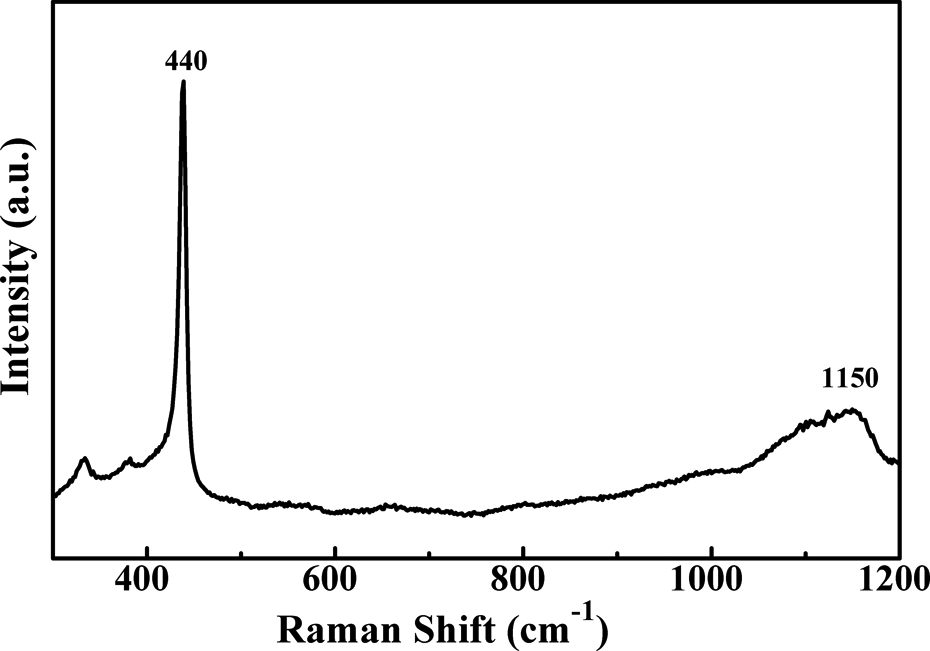
Raman spectrum of the ZnO nanorod arrays grown on ITO/glass substrate, recorded with a 514 nm excitation wavelength. The seed layer was prepared by spin coating of mixture of 0.1 M zinc acetate and 0.1 M diethanol amine. ZnO: zinc oxide; ITO: indium tin oxide.
Figure 5 shows the representative XRD pattern of the ZnO nanorod arrays grown on ITO/glass substrate. The diffraction peaks at 2θ = 34.4°, 36.2°, 47.5°, 62.9°, and 72.6° can be indexed originating from the (002), (101), (102), (103), and (004) crystallographic planes of pure ZnO with a wurtzite structure (Joint Committee on Powder Diffraction Standards [JCPDS] card no. 36-1451). In addition, the diffraction peaks at 2θ = 30.6° and 35.5° correspond to the (222) and (400) crystallographic planes of indium sesquioxide (In2O3) (JCPDS card no. 06-0416), which are contributed by the ITO/glass substrate. The intensity of (002) diffraction peak of ZnO is extremely stronger, which indicates that the ZnO nanorods grow along the [001] direction. 15

XRD patterns of ZnO nanorod arrays grown on ITO/glass substrate and bare ITO/glass substrate. Seed layer of the ZnO nanorod arrays was prepared by spin coating of mixture of 0.1 M zinc acetate and 0.1 M diethanol amine. ZnO: zinc oxide; ITO: indium tin oxide; XRD: X-ray diffraction.
Discussion
Diameters of the ZnO nanorods
Diameters of the ZnO nanorods are strongly affected by the seed layer preparation conditions. The average diameter increases apparently with decreasing of the mole ratio of zinc acetate to diethanol amine, that is, concentration of diethanol amine increases when the concentration of zinc acetate was kept constant. Formation of the seed layer can be understood as hydrolysis of zinc acetate and final precipitation of ZnO in an alkaline environment. Diethanol amine in the solution plays a role to depress the vigorous hydrolysis of zinc acetate 16 in the process. When the mole ratio is 1:1, that is, the concentration of diethanol amine is not so high, ZnO tends to precipitate fast. At the moment, large amounts of ZnO nanoparticles may form simultaneously and condense, forming seed layer with certain roughness. A rough ZnO surface is crucial for the next solvothermal growth of ZnO nanorod arrays on it. It helps the Zn and O atoms in the solution nucleate and form large amounts of nanocrystals by providing much larger adhesive surface. Crystalline wurtzite ZnO has a natural tendency to grow along its [001] axis. Once the ZnO nanocrystals form, they grow along their own [001] directions, forming ZnO nanorods after a time duration. If a rough surface facilitates the formation of large quantities of tiny and uniform ZnO nanocrystals initially, there will be thin and uniform ZnO nanorods grown on the surface (Figure 1(e)). However, when the mole ratio decreases, that is, the concentration of diethanol amine in the solution increases, hydrolysis of zinc acetate is much more depressed and the precipitation of ZnO slows down. The seed layer thus tends to be a thin-flat film, which restricts the formation of large amounts of ZnO nanocrystals initially, due to the reduced surface area. There are not so much nuclei for subsequent steady accumulation of Zn and O atoms, so larger crystals appear, that is, the ZnO nanorods become wide (Figure 1(h)).
The average diameter of the ZnO nanorods decreases dramatically when PEG 4000 is added during the preparation of seed layers. The PEG 4000 is evaporated during the heating process, leaving huge amounts of pores in the seed layers. This makes the seed layers have rough surfaces, resulting in huge surface areas, and helps to form huge quantities of ZnO nanocrystals with much smaller size. Thus, ZnO nanorods grown on such seed layers have much thinner diameters.
Uniformity and spatial distribution density of the ZnO nanorods
Uniformity of the ZnO nanorods can be divided into two aspects. One is uniformity in their diameters, and the other is uniformity in their alignments. The uniform diameter depends on whether ZnO nanocrystals with uniform size formed at the beginning, which is determined by roughness of the seed layer. The 1:1 mole ratio of zinc acetate and diethanol amine exactly makes a rough seed layer, which promotes the formation of large quantities of uniform ZnO nanocrystals. Because an appropriate amount of diethanol amine in the solution keep ZnO separating out at a suitable speed, resulting in the rough seed layer we need. When the mole ratio deviates from 1:1, the best roughness of the seed layer cannot be achieved. The ZnO nanorods thus have large non-uniformity in their diameters.
The uniformity in alignments of the nanorods mainly depends on whether the seed layer is unbroken and uniform in its thickness. When concentration of the seed layer solution is small, for example, 0.01 M in our experiments, although the mole ratio kept at 1:1, the seed layer is not a continuous film, but some ZnO nanocrystals covering on partial surface of the substrate, which have different sizes and have their own [001] axis randomly orientated (Figure 2(a)). Zn and O atoms in the following solvothermal process epitaxially accumulate along the [001] directions of these nanocrystals, forming ZnO nanorods with different diameters and various orientations of their own [001] axis, that is, some are perpendicular to the substrate surface (Figure 2(e2)) and some are inclined (Figure 2(e1)). When the concentration increases to a certain value, for example, 0.1 M, the seed layer becomes homogenous, covering the whole substrate surface. It provides all the ZnO nanorods similar microenvironments for growth, so the nanorods have similar orientations. If the seed layer has little fluctuation in its thickness, that is, its surface is nearly parallel to the substrate surface, most ZnO nanorods grown on it will be perpendicular to the substrate surface.
On the other hand, it should be noted that concentration of zinc acetate and diethanol amine in the solution is another key factor affecting quality of the seed layer. A moderate concentration is also important for a homogenous seed layer. When the best mole ratio is kept, a higher concentration (e.g. 0.2 M) slightly affects surface roughness of the seed layer, which leads to a little variation on diameters of the ZnO nanorods.
The spacial distribution density of the ZnO nanorods significantly changes as different amounts of PEG 4000 were added. Because the PEG 4000 helps to form huge amounts of pores in seed layers, there will be no nanorod growth on a pore with lateral size larger than that of the nanorod. So the size, quantity, and spacial distribution density of the pores in the seed layers determine the growth positions of the nanorods and determine whether the nanorod arrays are dense or sparse. Adding PEG 4000 becomes an effective way to control the spacial distribution density of the ZnO nanorods.
Hydrophobic properties of the ZnO nanorod arrays
During the synthesis of diverse ZnO nanorod array, the morphologies of ZnO nanorod arrays are only tuned by changing the seed layers in which the other conditions such as temperature and solution compositions are kept the same. This brings a big advantage that it ensures all the ZnO nanorod arrays have the same chemical compositions even if their morphologies change. This is very essential for understanding some surface science issues, for example, to understand the hydrophobic properties of the ZnO nanorod arrays, it can be confirmed that the changing of static contact angle of water on the surface is due to variation of the surface roughness but not by different chemical compositions of the specimens. Insets of Figure 6 are photographical images of a drop of water on top surfaces of different ZnO nanorod arrays. The static contact angle changes from 127° to 143° as the morphologies of the arrays vary a little. Classically, the static contact angle is understood mainly depending on void ratio of the specimen. A high void ratio may improve the fraction of air trapped within the voids, leading to increased air/water interface and high-static contact angle.
17
–21
Assuming that those nanorods for each sample have the same length and cylindrical shape, the void ratios (ŋ) of the four samples in Figure 6 were estimated using the following formula
18
SEM images of ZnO nanorod arrays grown on different seed layers prepared at different mole ratios and concentrations of zinc acetate and diethanol amine: (a) 1:2; (b) 1:3; (c) 0.1 M; (d) 0.01 M. Insets are photographical images of a drop of water standing on top surface of the arrays. All ZnO nanorod arrays were solvothermal grown by keeping the solution (0.06 M zinc acetate, 0.2 M hexamethylenetetramine), temperature (90°C), and time duration (5 h) unchanged. SEM: scanning electron microscopy; ZnO: zinc oxide.

Contact angles and void ratios of the four specimens in Figure 6.

Conclusions
We demonstrate a simple route for controllable growth of ZnO nanorod arrays by slightly adjusting the preparation conditions for their seed layers. Average diameters of the nanorods can be tuned from 106 to 336 nm. At the same time, the nanorods’ spacial distribution density, uniformity in both their diameters, and alignments can also be controlled.
The study proves the important role of seed layer in affecting morphologies of the nanorod arrays. Adjusting mole ratio of zinc acetate to diethanol amine or concentration of the two chemicals in the solution and adding PEG 4000 to the solution are effective ways to change microstructure of the seed layer. Size and uniformity of the diameters of the nanorods mainly depend on surface roughness of the seed layer. Uniformity in alignments of the nanorods mainly depends on uniformity in thickness of the seed layer. A homogenous seed layer with certain surface roughness is very essential for the growth of uniform ZnO nanorod arrays.
Our strategy to achieve variable ZnO nanorod arrays has another advantage, that is, it ensures all the nanorod arrays have same chemical compositions as their morphologies change. This is very essential for understanding some surface science issues, such as the specimen’s surface morphology–related properties. On the other hand, the fine control on morphologies of the products means a fine control of their morphology related properties, for example, their hydrophobic properties demonstrated in the study.
Footnotes
Author Contribution
Authors Li-Xia Du and Yang Jiao have equal contribution in this article.
Declaration of conflicting interests
The author(s) declared no potential conflicts of interest with respect to the research, authorship, and/or publication of this article.
Funding
The author(s) disclosed receipt of the following financial support for the research, authorship, and/or publication of this article: This work is supported by grant from Education Department of Shaanxi Provincial Government under project no. 2013JK0622 and grant from Northwest University under project no. 337050013.