



Abstract
The construction industry suffers from high accident rates and inadequate safety management. Internet of Things (IoT) integration holds promise for improving safety. However, research has focused on adoption barriers without exploring key success factors, and many rely on a single weighting technique, which can yield method-sensitive priorities and limited actionable guidance for implementation planning and resource allocation. To address these gaps, this study proposes a robust decision-support framework for IoT integration that identifies and ranks barriers and success factors and derives consensus priorities by integrating multiple Fuzzy Analytic Hierarchy Process (FAHP) variants with a game-theoretic, metaheuristic optimization model, thus mitigating method sensitivity issues. A literature review and a survey of 22 experts from China and Hong Kong support the study using a novel two-module approach. In the first module, weight computation utilizes an improved FAHP and its extensions to evaluate the significance of IoT-related factors. The second module aggregates these weights with metaheuristic algorithms integrated into a hybrid game theory model that minimizes discrepancies among methods and yields consolidated priorities and normalized coefficients. Comparative analysis shows that the particle swarm optimization-based model achieves the most accurate weight distributions with deviations of 7.35E-02 for technological barriers, 6.81E-03 for economic barriers, and 6.72E-03 for technical and operational success factors. Other models perform best for operational, construction management, and organizational culture categories. Results indicate that incompatibility among technologies is the most critical technological barrier, while the impact on productivity due to wearable devices constitutes the most prominent economic barrier. Furthermore, regarding the success factors, enhancing customer satisfaction is the leading customer and market-driven driver, facilitating knowledge sharing among organizations is the most influential organizational and cultural enabler. These insights offer actionable guidance for industry stakeholders and demonstrate the potential of IoT technologies to enhance construction safety and overall project performance.
1. Introduction
The construction industry is widely recognized as one of the most hazardous sectors globally, characterized by a high incidence of workplace accidents and injuries. 1 Studies indicate that construction workers face numerous risks due to the unique nature of their tasks, including working at heights and exposure to heavy machinery and hazardous materials, which contribute to elevated rates of fatalities and injuries compared to other industries.2,3 The lack of effective safety management practices exacerbates these risks, as many employers remain unaware of the negative impacts of workplace accidents on productivity, costs, and company reputation.2,4 Furthermore, risk assessments reveal a variety of physical, chemical, and ergonomic hazards prevalent on construction sites, necessitating proactive strategies for risk identification and mitigation to enhance worker safety and project outcomes. 5 Thus, addressing these challenges through improved safety practices is crucial for fostering a safer working environment in the construction industry. 4
Various innovative methods have been developed, focusing on technology integration and data-driven analysis, to enhance construction site safety. One approach involves the use of vision-based systems, such as the Helmet-Yolov5 model, which detects unauthorized intrusions by classifying safety helmets, thereby improving worker identification and area access control. 6 Additionally, machine learning models have been employed to predict injury types based on historical accident data, enabling targeted safety interventions and risk management strategies. 7 The implementation of a BIM-based mobile app facilitates real-time safety monitoring, allowing for the visualization of hazardous locations and worker tracking, which can significantly reduce accidents. 8 Furthermore, advanced data augmentation techniques and lightweight deep learning models enhance proximity detection capabilities, improving real-time monitoring under challenging conditions. 9 Moreover, a knowledge graph-based dynamic risk analysis method combines expert insights with historical data to provide a more objective assessment of safety risks, thereby informing behavior-based safety management practices. 10 Lastly, the Internet of Things (IoT) significantly enhances construction site safety through various innovative applications. 11
IoT has become a revolutionary force in enhancing construction site safety by utilizing interconnected sensors and devices to gather and process real-time data. Various IoT implementations strengthen construction site safety. These include wearable technology that monitors workers’ health and environmental conditions, sensors that detect air quality and hazardous substances, and machinery tracking systems that prevent accidents from equipment failure. These innovations facilitate the early detection of risks and the improvement of safety measures.11–14 However, the integration of IoT in construction is hindered by obstacles such as high costs and technical limitations in challenging environments, which restrict its broader application.15,16 Despite these barriers, IoT offers considerable potential to transform safety management by enabling predictive analytics, automated processes, and immediate response mechanisms. Although previous research has primarily focused on the challenges hindering IoT adoption in construction site safety, a significant gap remains in examining both the critical success factors and influential barriers affecting safety outcomes. This gap highlights the need for further investigation to identify the key drivers and obstacles crucial for enhancing safety through IoT implementation.
This study aims to develop a comprehensive framework for integrating IoT within the construction industry by systematically identifying, prioritizing, and synthesizing the technological, economic, and organizational barriers and success factors that affect its adoption. Such a framework is designed to enable targeted strategies, boost safety and efficiency, optimize resource allocation, and inform future policy and research. Initially, an extensive literature review and a questionnaire survey of industry experts were conducted to evaluate the key factors influencing IoT-enhanced construction site safety. The methodology then employs a two-module approach: the first module calculates the importance weights of these factors using an improved Fuzzy Analytic Hierarchy Process (FAHP) with its magnitude-based and total difference-based variants, while the second module aggregates these weights utilizing a suite of meta-heuristic algorithms, namely Genetic Algorithm (GA), Particle Swarm Optimization (PSO), Wave Search Algorithm (WSA), and Lion-AYAD, within a hybrid game theory model. This integrated approach minimizes discrepancies among the different weighting methods and yields consolidated, normalized weight coefficients. Ultimately, by achieving these objectives, the research seeks to guide the development of effective strategies for IoT integration in construction, thereby enhancing safety outcomes.
2. Literature review
In this section, we reviewed the literature on IoT adoption in construction safety by examining the key barriers, critical success factors, and examined studies that integrate FAHP with metaheuristic algorithms across various domains. This synthesis establishes the foundational factors influencing IoT implementation and highlights current methodological gaps that motivate the integrated framework proposed in this study.
2.1. Barriers to IoT adoption in construction safety
The construction industry’s adoption of IoT and related technologies has shown significant potential for enhancing safety and operational efficiency. Studies have highlighted barriers to this adoption across various contexts. For instance, Khan et al. 17 and Waqar et al. 18 emphasize the role of IoT in improving environmental monitoring, equipment management, and safety monitoring, with strong empirical evidence supporting its positive impact on site outcomes. However, both studies note that barriers such as high costs, cybersecurity risks, and interoperability issues significantly hinder adoption, especially in developing regions and small-scale projects.
Technological challenges, including inadequate infrastructure and data privacy concerns, are recurring themes across the literature. Cheng et al. 19 and Tabatabaee et al. 20 both highlight the critical role of robust infrastructure and regulatory frameworks in enabling IoT adoption, with inadequate governance and insufficient technical training cited as significant barriers. These findings align with Dosumu et al., 21 who observed similar challenges in the Rwandan construction industry, particularly a lack of training centers and low awareness of IoT technologies.
Privacy and security concerns also emerge as central barriers, particularly in the adoption of Wearable IoT (WIoT) and safety technologies. Okonkwo et al. 22 provide a detailed analysis of these challenges, including data breaches and a lack of standardized regulations, proposing security frameworks as essential for fostering trust and widespread adoption. Similarly, Yap et al. 23 identify privacy concerns alongside prohibitive costs and organizational resistance as critical barriers to adopting safety technologies in the Malaysian construction industry.
The integration of immersive technologies (ImTs) and other advanced tools like UAVs has also garnered attention. Swallow and Zulu 24 and Onososen et al. 25 explore the potential of ImTs and UAVs in enhancing safety processes and site digitalization, noting that while these technologies can improve hazard communication and risk assessment, their adoption is constrained by economic, regulatory, and training-related challenges. These findings resonate with Teoh and Yahaya, 26 who observed low adoption rates of safety technologies in Malaysia, attributing this to inadequate network connectivity, low profitability, and outdated regulations.
Across the board, studies underline the importance of organizational and leadership support. For example, Nnaji and Karakhan 27 and Khan et al. 17 emphasize the need for top management commitment and client-driven initiatives to overcome barriers such as high initial costs and workforce resistance. These studies collectively advocate strategic interventions, including government subsidies, public-private partnerships, and regulatory reforms, to foster technology adoption in the construction industry.
Categorization of barriers to IoT adoption in construction safety. 30
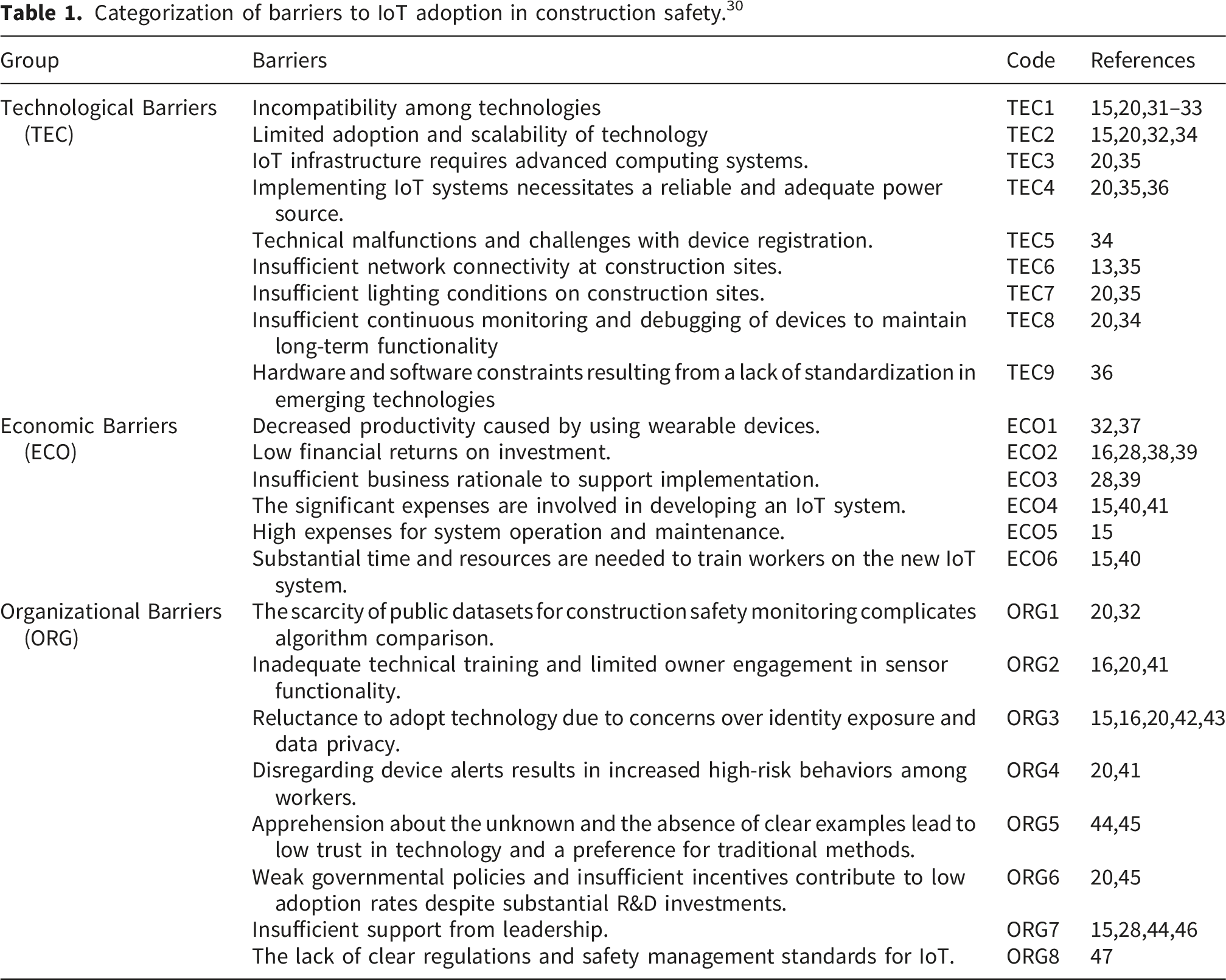
While the literature provides valuable insights into the challenges of IoT and related technologies, significant gaps remain. Few studies address the interconnectedness of barriers or offer comprehensive frameworks for integrating IoT across diverse contexts. Additionally, the focus on developing regions and high-risk environments warrants further exploration to tailor solutions to these unique challenges. This review highlights the need for future research to build on existing findings, providing actionable strategies to bridge the gap between technological potential and practical implementation.
2.2. Critical success factors for IoT adoption in construction safety
The successful adoption of smart devices and other advanced technologies in the construction industry hinges on several critical success factors (CSFs) that vary across regions and technological applications. Leadership and organizational support consistently emerge as pivotal enablers. Silverio-Fernandez et al., 48 focusing on the Dominican Republic, identified leadership and technology awareness as the most influential CSFs for implementing smart devices. Larger companies were found to have a higher likelihood of adoption due to their resource availability and project scale, highlighting the importance of organizational capacity in driving technology uptake. Similarly, Oke et al., 49 examining digital technologies for sustainable construction in Nigeria underscores management and leadership support as essential for successful adoption, alongside factors like education, training, and effective communication.
Interoperability and usability also play significant roles in successful implementation. Nnaji and Awolusi, 50 investigating wearable sensing devices (WSDs) for safety and health monitoring in the U.S., revealed that device performance, adherence to industry standards, and real-time information usability are key determinants of success. These findings align with Silverio-Fernandez et al., 48 who emphasized the importance of technical knowledge and user-friendly devices, particularly in the context of resource-constrained environments.
Education and training appear repeatedly as vital CSFs across studies. Oke et al. 49 highlighted employee development and organizational learning as fundamental to the adoption of digital technology, categorizing success factors into clusters such as management needs and effective communication. This resonates with Nnaji and Awolusi, 50 who emphasized the need for qualified staff and specialized training to maximize the potential of WSDs, ensuring they deliver practical, actionable insights for safety and health management.
Beyond organizational and technical factors, user acceptance and social influence also shape the success of technology adoption. Choi et al., 51 employing the Technology Acceptance Model (TAM), identified perceived usefulness, privacy concerns, and social influence as significant factors affecting workers’ willingness to adopt wearable technologies. Workers with prior experience and foremen recognized the safety benefits of smart vests and wristbands, suggesting that familiarity with technology and perceived value significantly enhance acceptance. These findings emphasize the human-centric challenges of adoption, which are often as critical as the technical and organizational dimensions.
Categorization of critical success factors for IoT adoption in construction safety. 30

Despite the growing body of research on CSFs, notable gaps remain, particularly in understanding how these factors interact across different technologies and contexts. Future research should focus on developing comprehensive frameworks that integrate organizational, technical, and human factors while also addressing regional and cultural variations. This synthesis provides a foundation for leveraging CSFs to ensure the successful integration of smart devices and digital technologies in construction, particularly for improving safety, sustainability, and operational efficiency.
Finally, this study partially adopts the TOE framework to provide a coherent conceptual structure for interpreting the reviewed barriers and critical success factors. The TOE framework is a widely recognized lens for examining technology diffusion in complex industries, highlighting how adoption is shaped by three contextual dimensions: the technological context (e.g., compatibility, complexity, infrastructure readiness), the organizational context (e.g., cultural norms, internal capabilities, leadership support), and the environmental context (e.g., regulatory requirements, market pressures, competitive conditions). 64 The framework has been applied extensively to digital technologies, such as ERP, e-commerce, and RFID systems,65,66 providing a robust basis for analyzing emerging smart-construction technologies. Since technology implementation typically originates at the organizational level, workplace culture, openness to innovation, and top-down expectations strongly influence individual engagement and acceptance.65,66 By mapping the identified barriers and success factors onto the TOE dimensions, this study offers a theoretically grounded and integrative lens for understanding IoT adoption dynamics in construction safety, while maintaining methodological flexibility that suits the research aims.
2.3. Review of hybrid FAHP–metaheuristic approaches
A growing body of research has explored the integration of the FAHP with metaheuristic optimization techniques to address complex decision-making problems under uncertainty. The reviewed studies illustrate several hybrid FAHP–metaheuristic frameworks applied across different engineering and management domains. Several studies combine traditional FAHP with metaheuristic algorithms, primarily to enhance predictive performance or refine decision weights. For example, Ref. 67 integrates FAHP with PSO, GA, and ABC to prioritize risk factors in green building projects and to optimize a neural network model for improved risk prediction. In a similar manner, 68 couples FAHP with a Genetic Algorithm to tune the initial parameters of a Backpropagation Neural Network, thereby improving early-stage construction cost estimation.
Metaheuristics are also used to support multi-objective optimization tasks. In Ref. 69, FAHP is combined with a constriction-factor PSO algorithm to determine the optimal placement of Static VAR Compensators in power systems, where FAHP supplies the stability-related weighting criteria for the optimization. Likewise, Ref. 70 employs FAHP alongside PSO, k-means clustering, and fuzzy TOPSIS to support the design of District Metered Areas in water distribution networks, with FAHP generating the objective weights for evaluating alternative configurations.
Other studies blend FAHP with data-driven or soft computing techniques. For instance, Ref. 71 integrates Latent Dirichlet Allocation (LDA) with FAHP and PSO in a hybrid model for product design evaluation, where LDA extracts latent customer preferences, FAHP assigns decision weights, and PSO adjusts them. Similarly, Ref. 72 combines FAHP with a GA-optimized neuro-fuzzy system for project risk evaluation, linking expert-derived FAHP weights with adaptive fuzzy inference mechanisms. Across these studies, two characteristics are evident: • Most of the reviewed works rely on traditional FAHP, without incorporating recently developed FAHP variants such as Magnitude-Based FAHP (MFAHP) and Total Difference-Based FAHP (TDFAHP). • Most of the studies use a single metaheuristic technique (e.g., GA, PSO, ABC) either to tune a predictive model or refine a single FAHP output, rather than to integrate multiple weighting methods or combine multiple metaheuristics.
Although prior research demonstrates the value of combining FAHP with metaheuristic algorithms, most of these approaches are generally structured around a single FAHP method paired with a single optimization technique, typically for tasks such as prediction improvement, parameter tuning, or multi-objective ranking. Broader architectures that incorporate multiple FAHP variants or multi-algorithm optimization schemes appear less represented in the reviewed literature.
The proposed framework builds on well-established concepts in FAHP and metaheuristic optimization. FAHP extends the classical AHP by representing pairwise judgments with fuzzy numbers rather than crisp values, allowing linguistic assessments and uncertainty in expert comparisons to be captured more realistically. 73 In particular, recent work has introduced MFAHP and TDFAHP as ranking-based variants that aim to obtain accurate weights from fuzzy pairwise comparison matrices while controlling computational load. 73 Hybridization of FAHP with evolutionary optimization has also been explored, for example, by combining fuzzy AHP with a genetic algorithm for test sheet question selection, 74 or embedding fuzzy rule-based reasoning within decision support systems in other application domains. 75 On the optimization side, metaheuristic algorithms such as genetic algorithms, swarm-based methods, and other population-based search procedures are widely used to solve complex optimization problems where exact methods are impractical and have been systematically surveyed and benchmarked in terms of their design features and application scope.76,77 Moreover, recent reviews highlight the growing integration of metaheuristics with multi-criteria decision-making methods, including AHP and its fuzzy extensions, to better handle high-dimensional criteria spaces and conflicting objectives. 78 These studies collectively support the use of FAHP-family methods together with metaheuristic optimization as the core building blocks of the two-module decision model developed in this study.
Summary of existing FAHP–metaheuristic studies compared with the proposed framework.

3. Research methodology
This study aims to develop an integrated model for prioritizing the barriers and success factors of IoT implementation in China and Hong Kong. This section outlines the research methodology employed in the study. Initially, the study involved an extensive literature review to identify the barriers and success factors that influence the use of IoT for enhancing safety at construction sites. Following this, a questionnaire survey was developed to gather evaluations of various IoT barriers and success factors from experts in the field.
The study incorporates two core modules: weight computation and weight aggregation. The first module, weight computation, focuses on the improved FAHP and its extensions, including the MFAHP and the TDFAHP. These methodologies are specifically designed to assess the significance of the barriers and success factors associated with IoT. Importantly, the weighting methods derived from this module are intended to be integrated into the second module.
The second module, weight aggregation, employs several meta-heuristic algorithms, including the GA, PSO, WSA, and the Lion-AYAD algorithm. This module aims to develop a hybrid meta-heuristic-based game theory model that unifies the weights obtained from the different methods while minimizing discrepancies between the final weights and those reported by each method. The objective function of this model incorporates principles from game theory to systematically compare and synthesize the weighting results, ensuring a rational aggregation of weights. Ultimately, the module generates consolidated importance priorities and normalized weight coefficients, reducing discrepancies between individual methods and accurately reflecting the relative influence of each computational approach. Figure 1 illustrates the research design, providing a visual representation of the methodology and the interactions between the two core modules. Research design.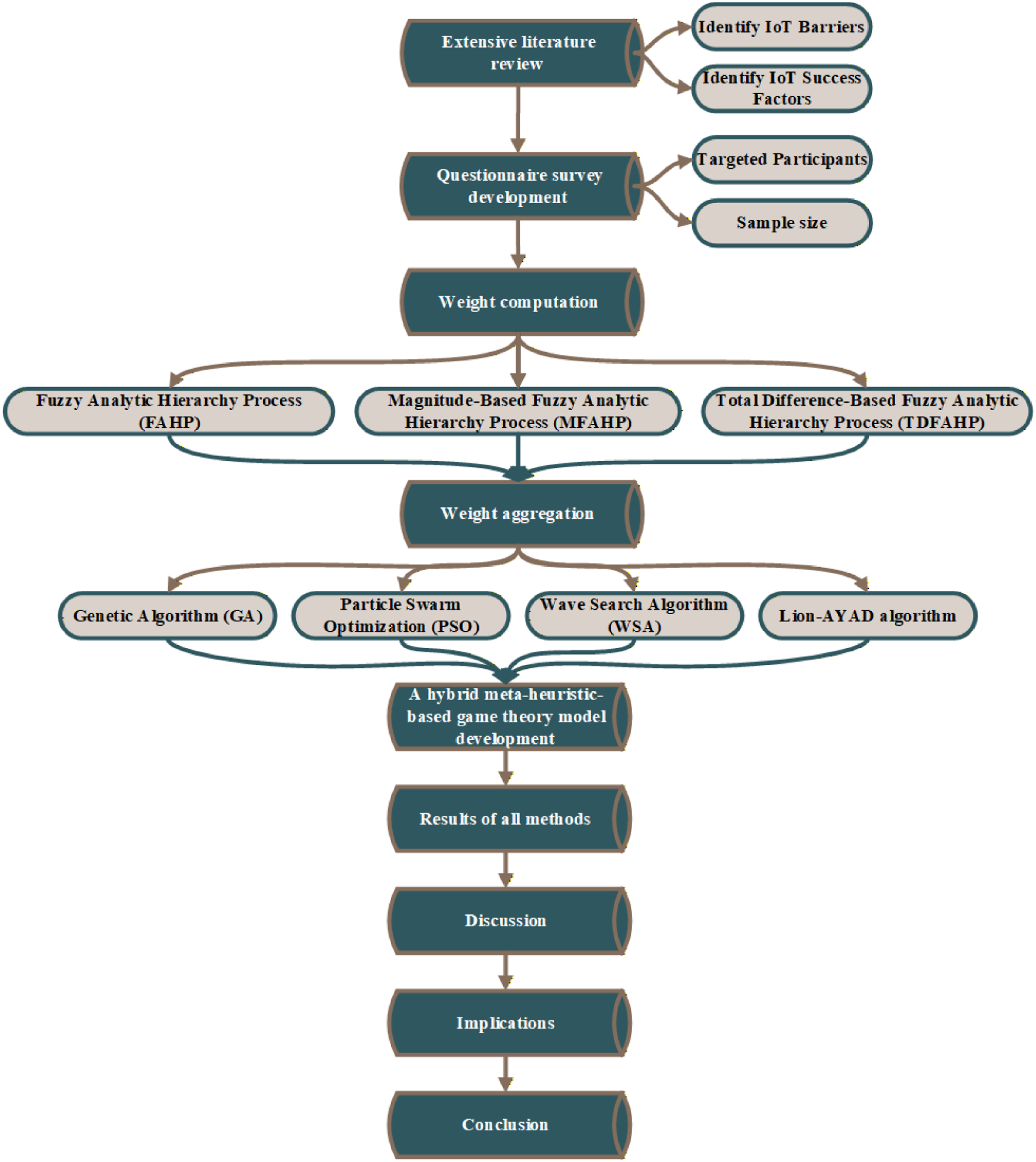
3.1. Searching strategies for identifying IoT barriers and success factors in construction site safety
This study involved a thorough review of the literature to identify the barriers and success factors influencing the use of IoT for improving safety at construction sites. The Web of Science and Scopus databases were utilized as the primary sources for searching, employing specific search phrases.79,80 Regarding the success factors, terms such as ‘success drivers,’ ‘CFS,’ ‘success factors,’ and ‘enablers’ were included. Concerning the barriers, the search incorporated terms such as ‘limitations,’ ‘barriers,’ ‘obstacles,’ and ‘challenges.'
Both categories were explored alongside keywords like ‘Safety management systems,’ ‘IoT,’ ‘wearable devices,’ and ‘ubiquitous surveillance.’ The search strategy identified 48 success factors and 54 barriers. After removing duplicates, these were reduced to 13 success factors and 23 barriers. Table 1 outlines the final list of barriers, while Table 2 presents the final list of success factors.
3.2. Questionnaire survey development
This study developed a questionnaire survey as the primary tool for data collection, employing a structured expert elicitation approach. The questionnaire was structured into three main sections. The first section gathered general information about the respondents. The second and third sections were designed to capture expert evaluations on barriers and critical success factors, respectively, following an identical structure for consistency. This study does not use an elicitation framework such as the Delphi method, as the Delphi technique is most appropriate when iterative rounds of consensus-building are required among a dispersed expert panel. 81 In contrast, the aim here was not to achieve consensus but to capture individual expert judgments from a diverse group of high-caliber specialists. Given that the FAHP method and its modified forms (MFAHP and TDFAHP) accommodate variability in expert opinions and do not require convergence through multiple rounds, a single-round structured questionnaire was both sufficient and methodologically appropriate. 73 Moreover, the subsequent metaheuristic game theory model provides an objective reconciliation of variations in expert-assigned weights, thereby fulfilling the consensus-oriented function that Delphi methods typically achieve through repeated rounds. This approach aligns with established practices in similar multi-criteria decision-making (MCDM) studies, 82 while the substantial experience of the participating experts further supports the reliability and credibility of the elicited judgments without the need for iterative refinement.
3.3. Target respondents, sampling method, and sample size
The targeted participants for the survey comprised experts from both industry and academia in China and Hong Kong. The study utilized three criteria to ensure participant qualifications: (1) a moderate to advanced understanding of IoT technologies; (2) a minimum of a bachelor’s degree in civil engineering, architecture, or a closely related discipline; and (3) a minimum of 10 years of experience in either domain. The study employed a random probability sampling method to select participants from a larger population for the survey. This method gives every member of the study population an equal chance of being chosen, ensuring a representative sample. As a result, researchers can generalize their findings to the larger population.83,84
The adequacy of the sample size in MCDM studies depends primarily on the experience level of the experts and the complexity of the decision-making technique, rather than on the size of the numerical sample. Prior research has consistently demonstrated that FAHP and related MCDM methods can produce reliable and stable weighting results with relatively small but well-qualified expert panels. For example, Ref. 85 applied FAHP using 12 expert evaluations, while Ref. 86 and Ref. 87 conducted FAHP-based assessments with 10 respondents each, all of whom possessed substantial professional experience. Even smaller expert groups have been used effectively in MCDM applications, such as the AHP-based study in Ref. 88 with five experts and the FAHP-based analysis in Ref. 89 conducted with a team of five senior managers. These studies collectively demonstrate that MCDM methods, particularly FAHP, prioritize expert competence, domain knowledge, and consistency over large sample sizes.
In this study, 22 experts with relevant professional backgrounds and more than ten years of experience were consulted, which not only exceeds the sample sizes commonly reported in FAHP literature but also provides a strong basis for generating consistent and meaningful pairwise comparisons. Therefore, the number of responses is considered more than adequate for the FAHP and hybrid MCDM approach used in this research.
Summary of the data collection process.

3.4. Fuzzy Analytic Hierarchy Process (FAHP)
An improved FAHP is implemented to determine the importance of assessment factors and analyze feedback from expert responses. Traditional questionnaires using pairwise comparisons have two significant shortcomings: (i) the complexity of the assessment model when involving many influential factors, and (ii) potential inconsistencies in the resulting judgment matrix. 90 To address these limitations, a revised questionnaire is introduced, following the approach of Ref. 91 and, Ref. 86 which streamlines the process by listing all factors in the first column and their corresponding ratings in subsequent columns. This approach enables the simultaneous evaluation of all barriers and success factors, facilitates the calculation of triangular fuzzy numbers, and ensures the development of a coherent judgment matrix. The triangular FAHP method, integrated with the revised questionnaire, proves particularly effective for assessing IoT barriers and success factors.
According to Ref. 92, the process of employing the triangular FAHP to rank factors can be summarized in five key steps. First, scores are assigned to each factor. Next, each score is expressed as an interval number ranging from 1 to 9, which summarizes the minimum and maximum scores for each factor. Following this, a judgment matrix is created by performing pairwise comparisons of factors at the same layer and calculating their coefficients as ratios of the interval values. Afterward, these ratios are converted into crisp values that satisfy the consistency criterion of the judgment matrix. Finally, the crisp values are transformed into triangular fuzzy numbers to formulate the final judgment matrix. This structured approach ensures a systematic ranking of factors using the triangular FAHP methodology.
The linguistic variables and their associated triangular fuzzy numbers are comprehensively outlined in earlier research by Ref. 93. Following this, the extent analysis method developed by Ref. 94 is utilized to derive the importance weights of the factors from fuzzy pairwise comparison matrices due to its effectiveness in applications of the FAHP. In the case of a triangular fuzzy-based pairwise comparison matrix, the judgments provided by respondents are represented as
Initially, the sums of the row values in the fuzzy comparison matrix are normalized according to Equation (1). Subsequently, the degree of possibility that 



3.5. Modified fuzzy analytic hierarchy process via different ranking methods
In recent years, the application of fuzzy set theory within the Analytic Hierarchy Process (AHP) has gained traction in multiple criteria decision-making, allowing for a more nuanced representation of human judgment.95,96 However, this advancement comes with a trade-off: fuzzy calculations often result in a greater computational load. Consequently, the computational demands of FAHP methods frequently exceed those of traditional AHP methods. 97 Addressing this challenge requires efficient FAHP proposals that can be practically applied in real-world scenarios while maintaining comparability with classical AHP methods. This study explores two FAHP methodologies: MFAHP and TDFAHP. Both methodologies focus on ranking fuzzy numbers to derive accurate weights from fuzzy pairwise comparison matrices while minimizing computational effort.
3.5.1. Magnitude-Based Fuzzy Analytic Hierarchy Process (MFAHP)
Kinay and Tezel
73
indicate that the MFAHP method is designed to derive accurate weights from fuzzy pairwise comparison matrices, characterized by high accuracy and low computational effort. Initially, the sums of the row values in the fuzzy comparison matrix are normalized according to Equation (5). The magnitude value for each 


3.5.2. Total Difference-Based Fuzzy Analytic Hierarchy Process (TDFAHP)
Reference 73 introduced the TDFAHP method to derive non-fuzzy weights for various factors by assessing the differences between fuzzy numbers. Specifically, the simplified total difference between 

3.6. Metaheuristic optimization algorithms
Metaheuristic optimization algorithms are advanced computational methods designed to find optimal or near-optimal solutions for complex, nonlinear, and multidimensional optimization problems where traditional mathematical approaches are often ineffective. These algorithms are inspired by natural, biological, or physical processes and operate through iterative search and learning mechanisms to balance exploration and exploitation within the solution space. Their adaptability and robustness have made them highly effective for solving engineering and decision-making problems that involve uncertainty, multiple objectives, or high-dimensional data. Among the most widely adopted metaheuristic algorithms, which are used in this paper, are the GA, PSO, WSA, and the Lion-AYAD Optimization Algorithm, each employing distinct strategies to navigate and optimize within complex search spaces.
3.6.1. Genetic Algorithm (GA)
The GA is a metaheuristic optimization algorithm that mimics the process of natural selection to find approximate solutions to optimization and search problems. It is part of a larger class of algorithms known as evolutionary algorithms, which are inspired by biological evolution and the principles of natural selection. 98 The primary purpose of genetic algorithms is to solve optimization problems where traditional methods are inefficient or infeasible. They are particularly useful in scenarios where the search space is large, complex, or poorly understood. 99
A typical GA begins by initializing a population of candidate solutions, which are often represented as chromosomes. Each chromosome consists of genes, which may take the form of binary strings or other representations depending on the specific problem domain. The fitness of each chromosome is evaluated through a fitness function that quantifies how well each solution meets the desired objectives.99,100 The GA employs several genetic operators, including selection, crossover, and mutation, to facilitate the search for optimal solutions. 101
3.6.2. Particle Swarm Optimization (PSO)
The PSO is a metaheuristic optimization algorithm inspired by the social behavior of birds and fish. This computational method is employed to solve optimization problems by allowing a group (swarm) of candidate solutions (particles) to explore the solution space. The primary objective of PSO is to identify optimal or near-optimal solutions to complex optimization challenges. 102 PSO stands out as one of the most widely used metaheuristic algorithms, known for its simplicity, efficiency, and remarkable effectiveness in addressing complex optimization challenges. 103
The algorithm mimics the social behavior of birds or fish, where particles navigate through a multidimensional search space. It operates by iteratively updating the position of each particle. At each iteration, every particle assesses its current position, comparing it with its best-known position (Personal Best) and the best-known position of any particle in the entire swarm (Global Best). These comparisons drive positional adjustments, allowing particles to explore the search space in a dynamic and adaptive manner. 104
3.6.3. Wave Search Algorithm (WSA)
The WSA is characterized by its accuracy, efficiency, and adaptability. Its ability to leverage radar-inspired techniques, innovative initialization strategies, and gradient-based adjustments positions WSA as a versatile and high-performing tool for solving a wide range of complex optimization problems. The algorithm represents a pioneering approach to optimization, drawing its core inspiration from radar technology, which significantly influences its design. This connection to radar principles allows WSA to simulate the propagation, reflection, and detection of waves, facilitating a systematic exploration of the search space. 105
WSA introduces a novel initialization method that ensures a diverse and evenly distributed set of starting points, enhancing its capability to explore complex, high-dimensional landscapes and avoid premature convergence. Moreover, it incorporates advanced boundary restriction rules to handle constraints effectively. These rules dynamically adjust solution boundaries, ensuring that all candidate solutions remain within feasible regions while preserving diversity throughout the optimization process. By preventing the algorithm from becoming trapped in infeasible areas, WSA maintains robustness in solving constrained problems. 105
Additionally, WSA employs various improved greedy mechanisms that refine the balance between exploration and exploitation. These mechanisms guide the search process by selectively intensifying or diversifying movements based on the gradient information of the optimization problem. The integration of gradient data improves precision and speed of convergence, allowing WSA to quickly identify promising regions of the search space while maintaining global exploration capabilities. 105
3.6.4. Lion- AYAD optimization algorithm (Lion-AYAD)
The Lion-AYAD optimization algorithm is characterized by its accuracy and adaptability, deriving its foundation from the traditional Lion Optimization Algorithm (LOA). This method begins by defining several key parameters, including the number of populations, the maximum number of iterations, the initial positions and fitness values of each agent, and the search area defined by upper and lower boundaries. A preprocessing step ensures that the algorithm can dynamically handle varied input sizes, making it adaptable to both short and long sequences with differing start and endpoints. Following the establishment of these parameters, the optimizer initializes a population of agents. It determines their initial positions, calculates the distances between the agents and the goal, and employs these distances as fitness metrics. The agents are then ranked based on their fitness values. 106
The Lion Optimization Algorithm is further enhanced by integrating advanced search mechanisms, such as spiral searching and bubble-net searching, which significantly improve accuracy while reducing execution time. As agents move toward intermediate sub-goals, their positions, and fitness values are continuously updated, enabling gradual progression toward the final goal. An adaptive “yauld” feature is applied to evaluate the productivity and activity of each agent. To refine performance, the algorithm incorporates cooperative processes that iteratively build upon prior results, enhancing both accuracy and robustness. Finally, the method applies a set of key rules within a deep composite framework to ensure consistent and optimized outcomes, delivering high performance and adaptability in solving complex optimization problems. 106
3.7. Meta-heuristic-based game theory model
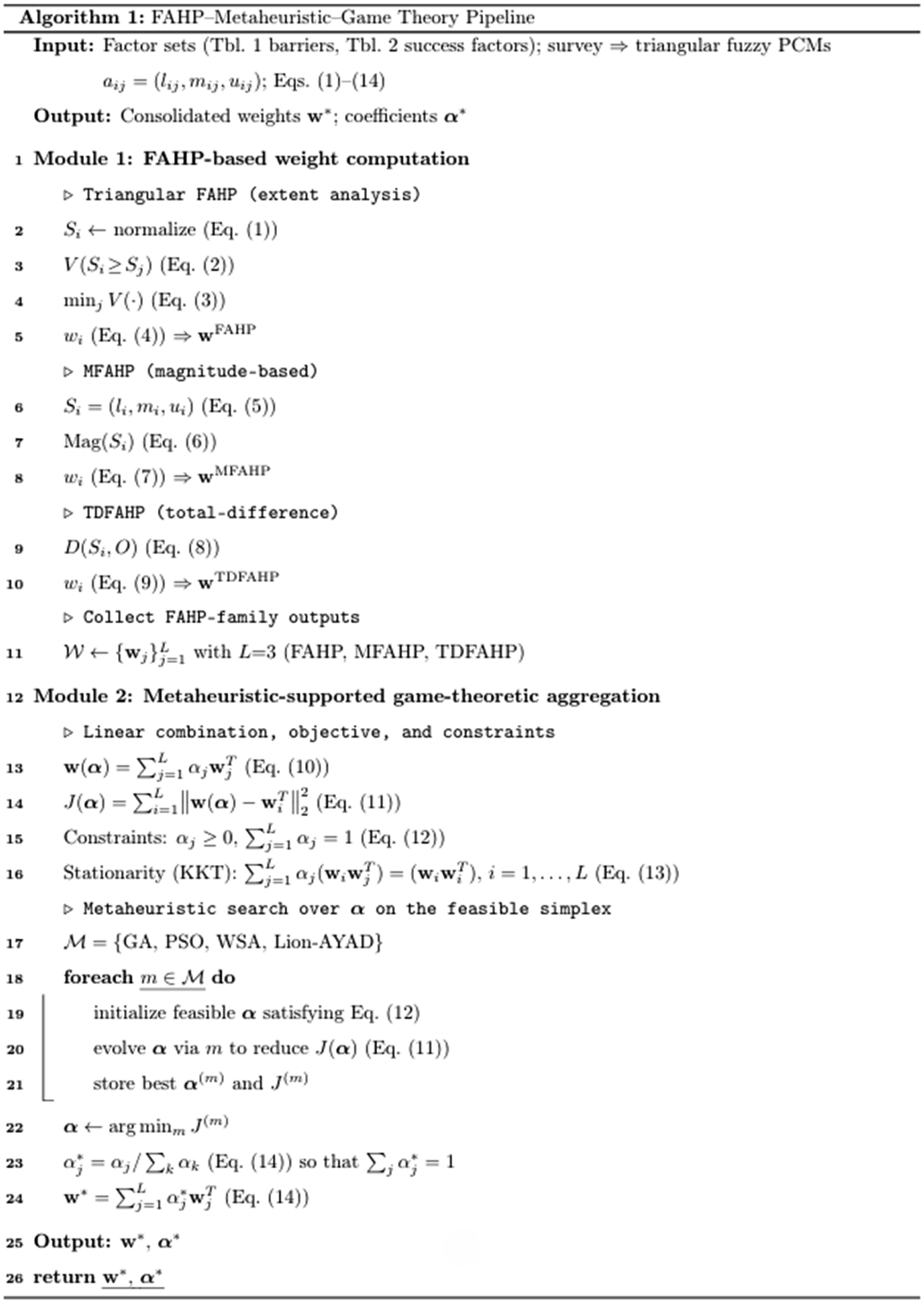
After computing the weights using the four metaheuristic algorithms, a game-theoretic aggregation model is employed to unify these results into a single rational set of weights. The primary objective of the proposed metaheuristic-based game theory model is to achieve a rational combination of weights by minimizing discrepancies between the final weights and those reported by each individual method.82,107
In this model, the players are the 
To achieve consensus among the methods, the model defines a discrepancy-minimization objective. The goal is to select 
Subject to the standard game-theory constraints ensuring feasibility of the combination as per Equation (12):
This formulation corresponds to a cooperative consensus game, where the selected
The optimality condition follows from matrix differentiation of the discrepancy function. Applying the first-order (KKT) conditions yields the linear system in Equation (13):
This expression represents the stationarity condition for interior solutions (i.e.,
Finally, the linear coefficients are normalized to produce the final combined weights, as defined in Equation (14):
Here,
3.8. Validation of game-theory weight aggregation models
To validate the performance of the proposed game-theory heuristic models, their resulting weights are benchmarked against three established approaches: FAHP, arithmetic mean, and geometric mean. Three quantitative metrics in Equations (15)–(17) are used for this evaluation: Mean Absolute Deviation (MAD), Root Mean Squared Deviation (RMSD), and Spearman rank correlation. Together, these metrics evaluate the numerical closeness of the weights (MAD and RMSD) and the alignment of their ranking (Spearman), providing a robust assessment of how well the game-theory models replicate or improve upon traditional techniques.


3.9. Overview of the FAHP (MFAHP–TDFAHP) and metaheuristic game-theoretic framework integration
This study develops an integrated two-module workflow to prioritize IoT implementation barriers and success factors using expert judgments and computational consolidation. Figure 1 summarizes the overall design. The inputs to the workflow are the finalized factor sets identified from the literature search strategy described earlier (48 success factors and 54 barriers initially identified, reduced to 13 success factors and 23 barriers after screening). The survey instrument, sampling and respondent qualifications are described in the preceding subsections, and the resulting expert evaluations form the basis for subsequent weighting.
3.9.1. Module 1: Weight computation using improved FAHP and its ranking variants
Module 1 computes factor-importance weights from expert assessments using an improved FAHP and two efficient ranking variants. Triangular FAHP with extent analysis generates crisp weights from fuzzy pairwise information. Expert judgments are represented as triangular fuzzy numbers
3.9.2. Module 2: Weight aggregation using meta-heuristics within a game theory model
Module 2 aggregates Module 1 outputs into a single, rational set of consolidated weights. Four meta-heuristic algorithms are used in the study: GA, PSO, WSA, and Lion-AYAD. These algorithms support the search for combination coefficients that best reconcile differences across method-specific weight vectors. The aggregation is framed as a game theory-based linear combination. Suppose
4. Results and analysis
This section presents the results obtained from the data collected through expert surveys and the subsequent MCDM analyses. It begins by outlining the demographic characteristics of the respondents to establish the credibility and diversity of the expert sample. The following subsections then detail the application and comparative outcomes of the FAHP, its modified versions (MFAHP and TDFAHP), and the integrated metaheuristic-based game theory model. Together, these results provide a comprehensive understanding of the relative importance and prioritization of IoT barriers and success factors in enhancing construction site safety.
4.1. Demographic information
The sample’s demographic information.

4.2. Multi-criteria decision-making techniques
Frequencies of responses for different scores.




Aggregate triangular pairwise comparison matrix.

Weights of assessment factors using FAHP method.
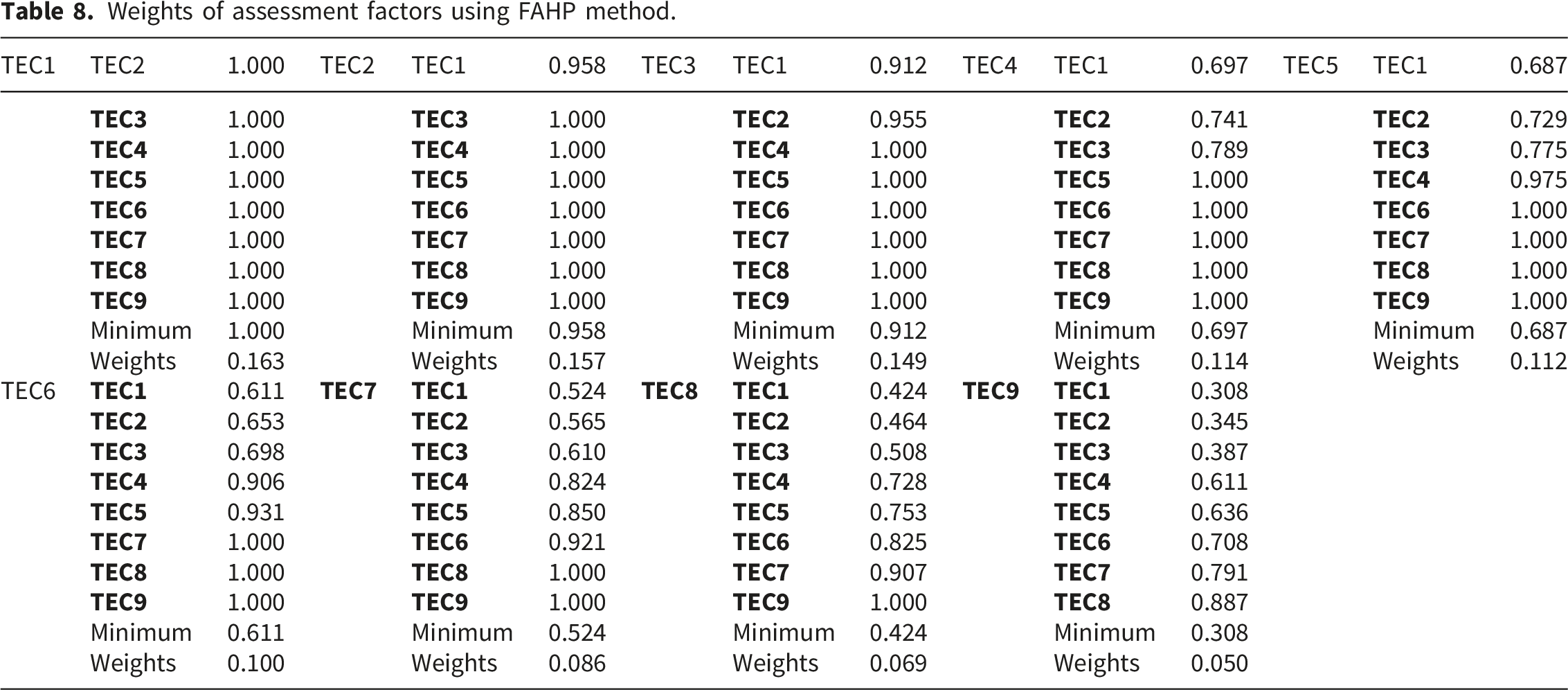





Weights of assessment factors using MFAHP and TDFAHP methods.
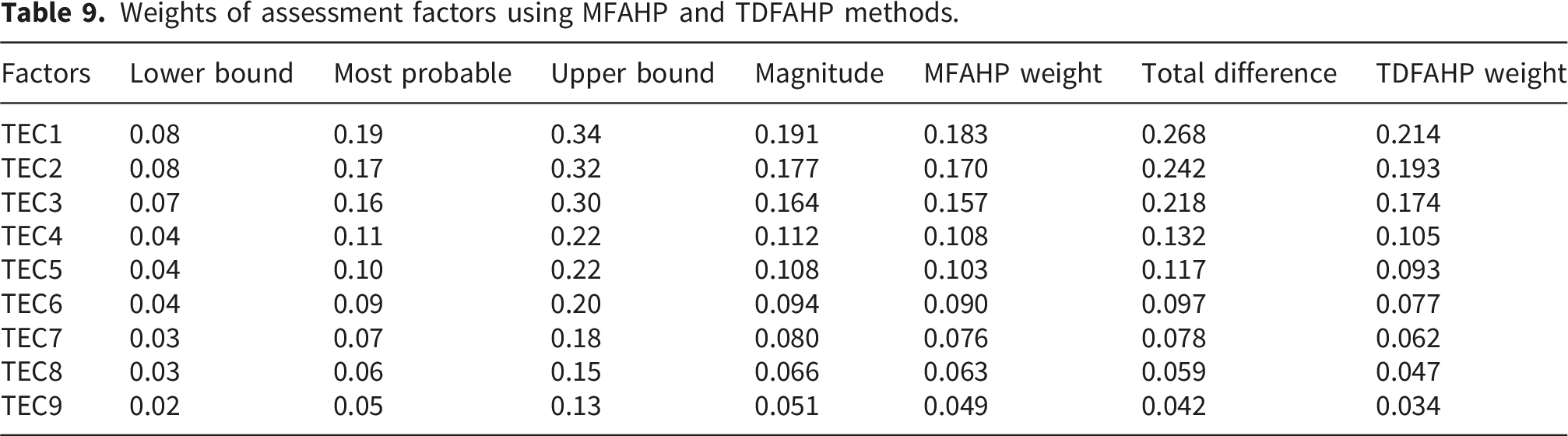
Figure 2 illustrates a comparative analysis of various categories of barriers and success factors using three weighting methods: FAHP, MFAHP, and TDFAHP. This analysis includes the final weights assigned to technological, economic, and organizational barriers, as well as to customer-driven, market-driven, organizational and cultural, and technical and operational success factors. The findings highlight the variations in relative importance across the different weight interpretation methods. IoT barriers and success factors importance priorities using three-weight methods.
Starting with the barriers, the technological barriers (TEC) category shows that TEC1 consistently ranks highest, indicating a strong consensus regarding its critical importance, with weights peaking at 21% under TDFAHP. In contrast, the significance of the other technological barriers (TEC2 to TEC8) gradually declines across all methods, reflecting varying degrees of technological challenges. In the economic barriers (ECO) category, ECO1 stands out as the most significant across all three methods, with weights ranging from 21% to 23%. This underscores its central role in economic assessments. Meanwhile, in the organizational barriers (ORG) category, both ORG1 and ORG2 maintain stable high weights ranging from 15% to 16% across the three methods, reinforcing their importance. Conversely, the remaining organizational barriers (ORG3 to ORG8) exhibit lower and more varied weights, suggesting that while organizational dynamics are crucial, not all barriers are perceived as equally significant.
Turning to the success factors, the customer and market-driven (CUS) category reveals that CUS1 and CUS3 consistently receive the highest weights, ranging from 24% to 31%. This underscores their critical role in shaping strategies focused on customer and market needs. In the organizational and cultural (CUL) category, CUL1 and CUL3 also rank highly across all methods, with weights between 25% and 30%, highlighting the significant influence of organizational culture on strategic outcomes. Meanwhile, in the technical and operational (OPE) category, OPE1 and OPE2 are consistently identified as the most crucial factors, with values ranging from 28% to 30%. This reinforces the idea that technical and operational considerations are foundational to achieving overall success.
4.3. Meta-heuristic game theory
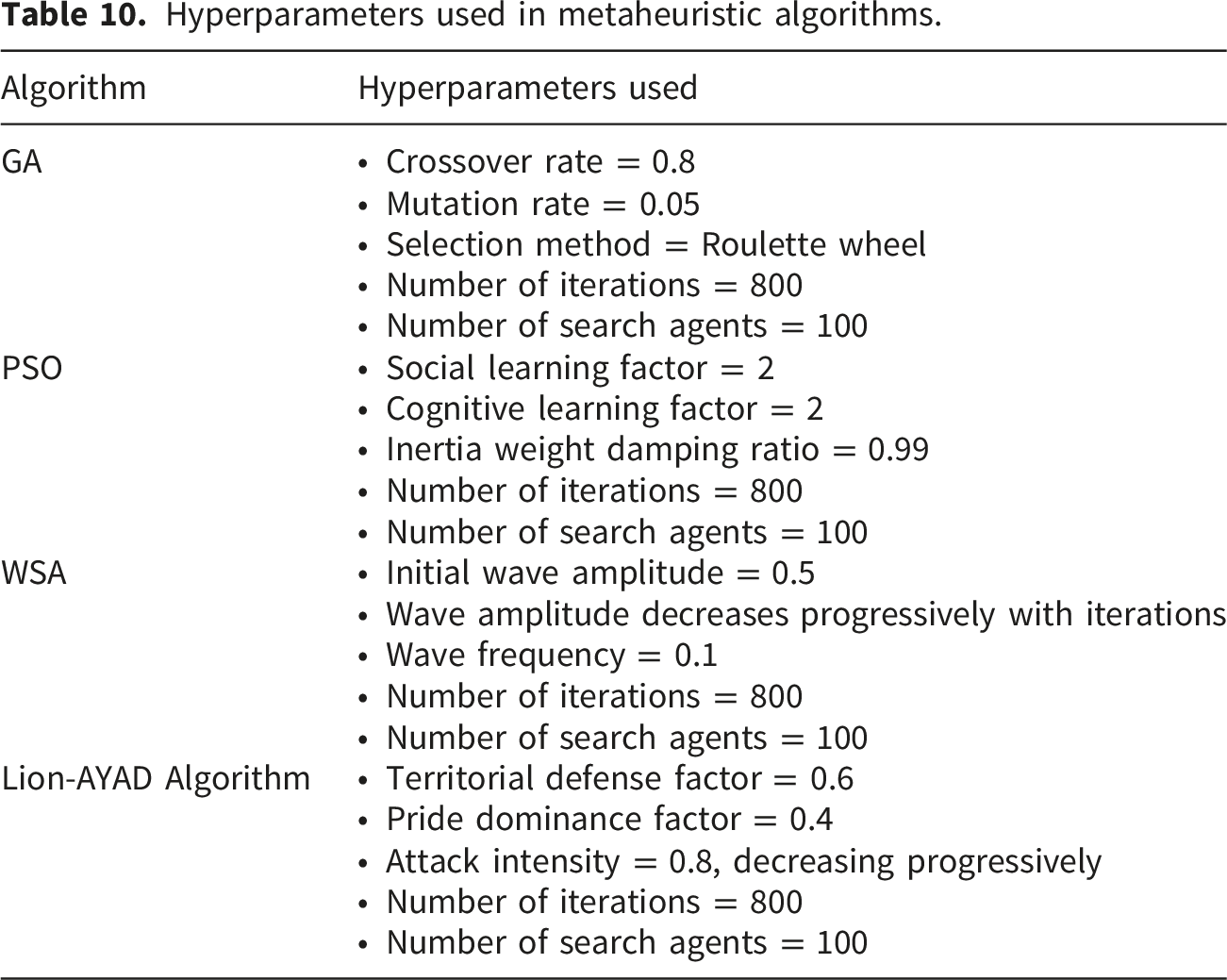
The hybrid meta-heuristic game theory model introduced in this study incorporates weights derived from the FAHP, MFAHP, and TDFAHP methods, achieving a comprehensive and balanced evaluation of the factors. A fair comparison of the meta-heuristic algorithms is ensured by uniformly setting the number of iterations and the number of search agents at 800 and 100, respectively. The parameters tuned for the four optimization algorithms employed, namely the GA, PSO, WSA, and Lion-AYAD algorithm, are detailed below.
In the GA, the crossover rate is set to 0.8, while the mutation rate is maintained at 0.05 to ensure diversity and prevent premature convergence. The roulette wheel selection strategy is employed to choose parent solutions based on their fitness scores. The population evolves over generations through selection, crossover, and mutation processes aimed at minimizing the objective function.
In PSO, both the social learning factor and the cognitive learning factor are set to 2, establishing a balance between individual and collective learning during the search process. The inertia weight damping ratio is configured at 0.99, facilitating a gradual reduction in exploration intensity as the algorithm advances. This setup allows PSO to converge efficiently toward the optimal solution while minimizing deviations.
In WSA, the wave propagation amplitude is initialized at 0.5 and decreases progressively with each iteration, while the wave frequency is set at 0.1 to regulate the exploration rate. The algorithm dynamically adjusts wave properties, including wave height decay, to enhance local search capabilities as it approaches the optimal solution. These parameters allow WSA to effectively balance the exploration of the search space with the exploitation of promising solutions.
Hyperparameters used in metaheuristic algorithms.
The convergence behaviors of the introduced hybrid meta-heuristic game theory models are illustrated in Figure 3. The analysis reveals that the PSO-GT and WSA-GT models outperform the other meta-heuristic approaches by effectively balancing exploration and exploitation. This enables thorough exploration of the entire search space without stagnating in local optima. In contrast, the convergence patterns of the GA-GT and Lion-AYAD-GT models indicate premature convergence to sub-optimal solutions, primarily due to inadequate exploration of the search space. Convergence analysis of the introduced hybrid meta-heuristic game theory models.
Deviation between weights across the hybrid meta-heuristic game theory models.

Weight coefficients of the hybrid meta-heuristic game theory models.

Figure 4 presents the final weights derived from the introduced meta-heuristic game theory model for the IoT barriers and success factors. In the TEC category, there is a decline in importance from TEC1 (19%) to TEC9 (5%), with TEC1, TEC2, and TEC3 identified as the most significant factors. In the ECO category, ECO1 (22%) is the most prominent, followed by ECO2, ECO4, and ECO5 (18% each), while ECO6 has the least impact at 9%. For the ORG category, ORG1 and ORG2 (16%) are the most influential, with moderate contributions from ORG4 (14%) and ORG3 (13%), whereas ORG6 holds the least weight at 8%. The OPE category shows balanced importance, with OPE1 and OPE2 each at 23%, and a slight decrease was observed in OPE3 (15%), OPE4 (19%), and OPE5 (20%). The CUS category is led by CUS1 (30%), followed by CUS4 (25%) and CUS3 (24%), with CUS2 having a lower weight of 21%. In the CUL category, CUL1, CUL4, and CUL3 dominate with weights of 30%, 25%, and 24%, respectively, while CUL2 has a lesser weight of 21%. Final weights of IOT barriers and success factors.
4.4. Comparative performance of meta-heuristic game theory
Deviation and rank-order metrics for weight aggregation methods.

AM: Arithmetic mean, GM: Geometric mean, GT: Game theory.
In contrast, the game-theory metaheuristic method consistently yields lower within-group deviation (MAD = 0.005–0.018; RMSD = 0.006–0.022), demonstrating that the method is more effective at reducing divergence among FAHP variants. The aim of game theory is to search for an aggregated solution that jointly considers the trade-offs between decision-makers or FAHP formulations rather than purely averaging their outcomes. This explains why the game theory results do not necessarily coincide with any single FAHP vector, the method optimizes for consensus stability, not replication of a single model.
Rank-order analysis further supports this interpretation. Spearman correlations between FAHP and traditional aggregation methods vary across categories (0.400–1.000), showing that deterministic averages sometimes alter the relative priority of criteria. The game theory maintains equal or higher rank agreement in most categories, which indicates that it produces a more stable prioritization structure without forcing alignment to the exact FAHP weight magnitudes.
In practical terms, the hybrid metaheuristic game-theory layer adjusts priorities by optimally tuning the combination coefficients
5. Discussion
The integration of IoT in construction offers transformative potential to improve efficiency, safety, and decision-making. However, its adoption faces challenges due to technological, economic, organizational, and cultural factors. This study develops an integrated model to prioritize IoT barriers and success factors, focusing on China and Hong Kong. Using a two-module methodology, weight computation and weight aggregation, the study systematically evaluates these factors. The discussion is divided into two sections as follows.
5.1. Barriers to IoT adoption in the construction industry
This section presents the key barriers that hinder the effective adoption of IoT technologies within the construction industry, as prioritized through the integrated weighting and game theory model. The discussion is structured around three main categories: technological, economic, and organizational barriers, each analyzed in light of relevant literature and expert evaluations. These subsections highlight the most critical challenges and propose targeted strategies to mitigate them, providing practical insights for policymakers, contractors, and technology developers seeking to facilitate IoT-driven transformation in the construction industry.
5.1.1. Technological barriers to IoT adoption in the construction industry
The integration of IoT in construction faces significant technological barriers, many of which stem from the industry’s unique operational demands. First, incompatibility among technologies (TEC1) creates interoperability challenges, as proprietary systems and legacy tools (e.g., AutoCAD, Excel) often fail to communicate with newer IoT sensors and platforms, fragmenting data streams critical for real-time decision-making.15,20 This aligns with the findings by Ahsan Waqar et al., 28 who identified compatibility with existing systems as a primary technical obstacle to IoT implementation in Malaysia. Second, limited adoption and scalability (TEC2) hinder progress, as pilot projects struggle to expand across large, multi-stakeholder sites due to inconsistent connectivity in remote areas and the prohibitive costs of deploying IoT infrastructure at scale.15,34
Ahsan Waqar et al. 28 further emphasize that IoT’s inherent complexity exacerbates scalability limitations. Compounding this issue is the requirement for advanced computing systems (TEC3), where real-time processing of data from drones, wearables, or environmental sensors demand cloud or edge computing capabilities, resources are often inaccessible to smaller firms with constrained IT budgets. Okonkwo et al. 15 corroborate this, highlighting limited IT infrastructure as a critical barrier to deploying IoT solutions. Equally critical is the reliance on reliable power sources (TEC4), as IoT devices on temporary or off-grid sites frequently depend on batteries or unstable grids, leading to maintenance burdens and operational downtime.35,36
Finally, technical malfunctions and device registration complexities (TEC5) further undermine confidence, with sensor calibration errors, connectivity drops, and cumbersome onboarding processes disrupting workflows, particularly in harsh environments prone to dust, moisture, or vibrations. These findings resonate with Nnaji and Karakhan, 27 who ranked “concerns regarding technical support availability” as a top obstacle to IoT adoption in the United States. Addressing these barriers requires targeted strategies: adopting open-source platforms and industry standards to bridge compatibility gaps, leveraging low-power networks and energy-harvesting solutions (e.g., solar sensors) to enhance scalability and power resilience, partnering with cloud providers to democratize access to computing resources, and deploying ruggedized, industrial-grade hardware with plug-and-play functionality to minimize downtime. By prioritizing these solutions, the construction industry can mitigate adoption hurdles and unlock IoT’s potential to drive efficiency, safety, and data-driven innovation across projects.
5.1.2. Economic barriers to IoT adoption in the construction industry
Beyond technological challenges, economic barriers further complicate IoT integration in construction, as evidenced by game theory-based prioritization of key obstacles. The most critical barrier, ranked first, is decreased productivity caused by wearable devices (ECO1), where workers perceive IoT tools like smart helmets or sensors as disruptive to workflows, leading to resistance and temporary efficiency losses. This finding aligns with a study in Hong Kong by Tabatabaee et al., 20 who highlighted similar productivity concerns. Closely following are low financial returns on investment (ECO2), which determines adoption as stakeholders question the low investment return (ROI) of IoT systems amid the industry’s thin profit margins and cyclical demand.16,39
Compounding this issue is high expenses for system operation and maintenance (ECO3), ranked third, as recurring costs for software updates, data storage, and device repairs strain budgets, particularly for small firms. This aligns with findings in Malaysia, 28 where high implementation costs were identified as the second most significant economic barrier after ROI for economic barrier. Significant upfront expenses for IoT system development (ECO4), ranked fourth, pose another hurdle, with costs spanning hardware procurement, customization, and integration with existing tools. This aligns with studies in the United States, 27 where upfront costs were cited as the most significant barrier to IoT adoption. Finally, insufficient business rationale to support implementation (ECO5), ranked fifth, reflects a lack of clear use cases or metrics to justify IoT’s value, perpetuating skepticism among decision-makers. These findings resonate with studies in developing economies, where cost-benefit ambiguities stall IoT adoption in resource-constrained sectors. 15
To address economic barriers to IoT adoption, targeted strategies are essential: developing phased implementation plans to reduce upfront costs, creating ROI frameworks tailored to construction project-based economics, leveraging public-private partnerships to subsidize maintenance costs, designing ergonomic IoT wearables to minimize productivity disruptions, and piloting data-driven use cases (e.g., predictive maintenance) to demonstrate IoT’s value. By aligning financial incentives with operational realities, the industry can overcome economic hesitations and unlock IoT’s long-term benefits.
5.1.3. Organizational barriers to IoT adoption in the construction industry
Organizational barriers prioritized using game theory, significantly hinder IoT adoption in construction. The most critical barrier, ranked first, is the scarcity of public datasets for construction safety monitoring (ORG1), which complicates algorithm development and benchmarking, limiting the effectiveness of IoT-driven safety solutions. 32 Closely, the following is inadequate technical training and limited owner engagement in sensor functionality (ORG2), where a lack of expertise and stakeholder involvement undermines the proper use and maintenance of IoT systems. This obstacle was mentioned by many studies from literature, and they mentioned that Need for Extensive Training Before Achieving Optimum Performance.20,27,108
Ranked third is disregarding device alerts, which results in increased high-risk behaviors among workers (ORG4), as workers often ignore or bypass IoT-generated warnings due to distrust or habituation.20,41 Ranked fourth is reluctance to adopt technology due to concerns over identity exposure and data privacy (ORG3), where fears of surveillance or misuse of personal data create resistance among workers and stakeholders.16,43 Finally, insufficient support from leadership (ORG7), ranked fifth, exacerbates adoption challenges, as executives often fail to allocate resources or champion IoT initiatives.15,46
To overcome organizational barriers to IoT adoption, targeted strategies are essential: developing open-access datasets for algorithm development, implementing training programs to enhance technical skills and stakeholder engagement, fostering a safety culture that values IoT alerts, addressing privacy concerns through transparent policies and anonymization, and securing leadership support by demonstrating IoT’s value. These steps can create an enabling environment for IoT adoption, unlocking its potential to improve safety, efficiency, and decision-making in construction.
5.2. Critical success factors for IoT adoption in the construction industry
This subsection presents the key factors that facilitate the successful adoption and implementation of IoT technologies in the construction industry. Drawing on the integrated weighting and game theory model, the analysis identifies and prioritizes the most influential success factors across three main dimensions: technical and operational, organizational and cultural, and customer and market-driven. The following subsections discuss each category in detail, highlighting how these factors collectively enhance IoT integration, improve safety performance, and promote sustainable digital transformation within the construction sector.
5.2.1. Technical and operational factors for IoT adoption in the construction industry
The adoption of IoT in the construction industry is heavily influenced by several interconnected factors that require careful consideration to ensure success. A key indicator of success lies in the user-friendliness of IoT devices (OPE1), as intuitive and accessible interfaces encourage faster adoption by workers and management alike. 109 Additionally, the perceived complexity of IoT technology can negatively affect adoption behavior, highlighting the need for user-friendly designs that cater to the needs and preferences of diverse users, ensuring seamless collaboration and boosting productivity. 110
Furthermore, integrating features that are valued by both workers and management (OPE2) are critical for fostering acceptance and ensuring that IoT solutions align with the priorities of all stakeholders. This integration not only enhances usability but also ensures that IoT technologies address the practical needs of construction projects, thereby driving adoption and improving outcomes. Additionally integrating IoT with Construction 4.0 drivers, such as Building Information Modeling (BIM) and Structural Health Monitoring (SHM), provides a robust framework that meets the diverse needs of stakeholders and enhances project outcomes. 111
Additionally, it is essential to thoroughly account for the project’s unique characteristics (OPE5), as specific requirements demand tailored IoT solutions that can adapt to varying conditions, workflows, and challenges. For instance, the adoption model for IoT technologies in sustainable construction emphasizes the importance of addressing project-specific challenges and fostering awareness of IoT’s potential. 112 By addressing these factors holistically prioritizing user-friendliness, integrating IoT with Construction 4.0 technologies, and tailoring solutions to project needs, construction firms can maximize the benefits of IoT, streamline operations, and drive innovation across the industry.
5.2.2. Organizational and cultural factors for IoT adoption in the construction industry
The adoption of IoT in the construction industry is not only a technical endeavor but also deeply rooted in organizational and cultural dynamics that influence its success. A key organizational factor is facilitating knowledge sharing among stakeholders (CUL1), which fosters collaboration and the exchange of best practices, enabling smoother adoption of IoT technologies.50,59 Equally important is cultivating a supportive organizational culture that embraces change (CUL3), as openness to innovation and adaptability are critical in overcoming resistance and ensuring workforce alignment with new IoT-driven processes.
This aligns with findings by Silverio-Fernández et al., 113 who identified organizational culture as the third most prioritized factor in IoT adoption in both the United Kingdom (UK) and the Dominican Republic (DR), following leadership and staff training. Additionally, organizational scale (CUL4) plays a significant role, as larger companies often have more resources to invest in IoT technologies, while smaller firms may need to adopt more flexible or cost-efficient strategies. This is supported by Silverio-Fernandez et al., 109 who highlighted that company size directly impacts resource availability for IoT implementation. By addressing these factors collectively, construction companies can create an enabling environment for IoT adoption, driving operational efficiency and competitive advantage.
5.2.3. Customer and market-driven factors for IoT adoption in the construction industry
The adoption of IoT in the construction industry is significantly influenced by customer and market-driven factors, which emphasize meeting client demands, enhancing operational efficiency, and maintaining competitiveness. A key priority is enhancing customer satisfaction (CUS1), as IoT solutions provide real-time project tracking, improve communication, and enable data-driven decision-making. These capabilities align with clients’ growing expectations for transparency and efficiency. 49
Furthermore, IoT adoption plays a crucial role in strengthening organizational reputation (CUS3) by demonstrating a commitment to innovation, sustainability, and safety, qualities that help firms distinguish themselves in a competitive market. This aligns with a study conducted in Nigeria by Oke et al., 49 which identified organizational development as the third enabler of IoT adoption, following education and training. Another critical factor is minimizing accidents while increasing profitability (CUS4). IoT technologies, such as safety wearables, predictive maintenance tools, and environmental monitoring systems, contribute to reducing risks, preventing operational downtime, and optimizing resource utilization.56,57 By addressing these factors holistically, construction firms can ensure a customer-centric approach, build trust, and drive long-term success in the market.
6. Implications
The results of this study offer several key implications for industry practitioners, policymakers, and researchers involved in the integration of IoT technologies in the construction sector. By systematically identifying and ranking the technological, economic, and organizational barriers alongside the critical success factors for IoT adoption, this research provides a comprehensive framework that can guide strategic decision-making and implementation efforts.
6.1. Practical implications
This subsection outlines the practical implications derived from the study’s findings, translating the prioritized barriers and success factors into actionable strategies for improving IoT adoption in construction. Building on the results of the integrated weighting and metaheuristic game theory analysis, the following subsections highlight how construction firms can develop targeted strategies, enhance safety and operational efficiency, and make informed decisions about resource allocation to support effective IoT implementation.
6.1.1. Targeted strategy development
The prioritization of barriers, such as technological incompatibility, limited scalability, and high upfront costs, underscores the need for construction firms to adopt targeted strategies that address these specific challenges. For instance, mitigating issues related to interoperability among legacy and modern systems can be achieved by adopting open-source platforms and industry standards. Similarly, addressing economic barriers may involve phased implementation plans, developing clear return-on-investment (ROI) frameworks, and exploring public–private partnerships to ease financial burdens.
6.1.2. Enhanced safety and efficiency
The identification of success factors, such as user-friendliness of IoT devices, effective integration with Construction 4.0 drivers (e.g., Building Information Modeling and Structural Health Monitoring), and the cultivation of a supportive organizational culture, suggests that IoT integration is not merely a technical upgrade but a holistic process. By focusing on these success factors, construction companies can leverage IoT to enhance safety outcomes, streamline operations, and drive data-driven decision-making across projects.
6.1.3. Informed resource allocation
The detailed weighting of different barriers and success factors using multi-criteria decision-making methods (FAHP, MFAHP, TDFAHP) combined with meta-heuristic game theory provides managers with a robust tool to allocate resources more effectively. Decision-makers can now identify which obstacles require immediate attention and where investments (in training, technical infrastructure, or process redesign) are most likely to yield significant improvements in safety and productivity.
6.2. Theoretical and methodological implications
This section discusses the theoretical contributions of the study, emphasizing how the proposed integrated framework advances decision-making methodologies and enriches the body of knowledge on IoT adoption in construction. The following subsections highlight the methodological innovations derived from combining fuzzy AHP with metaheuristic game theory and outline avenues for future research based on the study’s theoretical foundation.
6.2.1. Advancing multi-criteria decision-making applications
The integration of fuzzy AHP methods with meta-heuristic game theory in this study not only enriches the literature on IoT adoption in construction but also offers a methodological blueprint for addressing complex, multi-dimensional decision problems. This hybrid approach enhances the accuracy of weight distributions across factors and can be adapted to assess technology adoption challenges in other high-risk, dynamic industries.
6.2.2. Framework for future research
By bridging the gap between theoretical constructs and real-world applications, the research paves the way for subsequent studies to explore longitudinal outcomes of IoT implementations. Researchers can extend this framework to investigate how the prioritization of barriers and success factors evolves over time and under different operational contexts, such as varying scales of construction projects or in other geographic regions.
6.3. Policy implications
This subsection translates the analytical findings into actionable strategies for policymakers, industry practitioners, and organizations aiming to enhance IoT adoption in construction safety management. Based on the prioritized barriers and success factors identified through the integrated weighting model, the following subsections outline targeted recommendations addressing technological, organizational, and economic dimensions of implementation.
6.3.1. Standardization and data sharing
The finding that technological incompatibility and the lack of coordination between technologies are critical barriers calls for industry-wide efforts toward standardization. Policymakers and industry bodies should work collaboratively to develop common standards, protocols, and open-access datasets, which are essential for advancing IoT-enabled safety monitoring and data-driven innovations in construction.
6.3.2. Capacity building and financial incentives
Addressing organizational and economic barriers requires supportive policies that promote technical training and stakeholder engagement. Government agencies and trade associations can facilitate the adoption of IoT by offering incentives, subsidizing initial implementation costs, and providing platforms for knowledge sharing. These measures can help alleviate the economic hesitations and cultural resistance that currently impede broader IoT adoption.
6.4. Overall impact
In summary, the implications of this study are multifold. Practitioners are equipped with a clear, prioritized roadmap to overcome the obstacles inherent in IoT integration, thereby enhancing project safety and operational efficiency. The theoretical contributions offer a new lens for evaluating technology adoption challenges, while the policy recommendations provide actionable guidance for fostering an ecosystem conducive to innovation. By addressing the identified barriers and leveraging the critical success factors, stakeholders in the construction industry can unlock the transformative potential of IoT, paving the way for safer, smarter, and more efficient construction processes.
7. Conclusion
Globally, the construction industry ranks among the most dangerous, with a high prevalence of accidents and injuries. Workers face numerous hazards, such as falls from heights, exposure to heavy machinery, and contact with hazardous substances, that are further intensified by inadequate safety management practices. Although the integration of IoT technologies holds transformative potential to boost safety and enhance project outcomes, past research has mainly concentrated on adoption obstacles while neglecting the success factors vital for effective implementation. To address this oversight, the aim of this research is to develop an all-encompassing framework for IoT adoption in the construction sector by systematically pinpointing, ranking, and consolidating key technological, economic, and organizational challenges and enablers, with the goal of guiding strategic interventions, enhancing safety and operational performance, streamlining resource distribution, and shaping subsequent policy and academic investigations. Hence, the present study conducts an extensive literature review and a survey of 22 experts from China and Hong Kong using a novel two-stage methodological framework. In the first stage, weight computation is performed using an enhanced Fuzzy Analytic FAHP together with its magnitude-based and total difference-based variants to rigorously evaluate the significance of IoT-related barriers and success factors. The resulting weights are then carried forward to the next stage.
The second stage focuses on weight aggregation, where several meta-heuristic algorithms, namely, the GA, PSO, WSA, and Lion-AYAD algorithms, are employed within a hybrid game theory model. This model leverages a game theory-based objective function to systematically minimize discrepancies among the different weighting approaches, ultimately generating consolidated importance priorities and normalized weight coefficients. Comparative analysis shows that the PSO-based game theory model (PSO-GT) produces the most accurate weight distributions for technological barriers (with a deviation of 7.35E-02), economic barriers (6.81E-03), and Technical and Operational success factors (6.72E-03). In contrast, the GA-based model (GA-GT) excels in the Organizational barriers (deviation of 7.57E-02), while the WSA-based model (WSA-GT) performs best in both the customer and Market-Driven success factors (7.18E-03) and organizational and cultural success factors (1.15E-02) categories.
Moreover, the optimal weight coefficients calculated using FAHP, its magnitude-based variant, and its total difference-based variant provide further insights. For example, within technological barriers, TEC1 is the most significant at 19%, declining gradually to TEC9 at 5%. In the economic domain, ECO1 stands out at 22%, followed by ECO2, ECO4, and ECO5 at 18% each, with ECO6 at 9%. For Organizational barriers, ORG1 and ORG2 are both 16%, with ORG4 at 14%, ORG3 at 13%, and ORG6 at 8%. Regarding Technical and Operational success factors, the ease of use of IoT devices (OPE1) and the integration of features valued by workers and management (OPE2) are both rated at 23%, while OPE3, OPE4, and OPE5 receive 15%, 19%, and 20%, respectively. In the Customer and Market-Driven success factors, CUS1 leads with 30%, followed by CUS4 (25%), CUS3 (24%), and CUS2 (21%). Finally, in organizational culture, CUL1, CUL4, and CUL3 dominate with weights of 30%, 25%, and 24%, respectively, and CUL2 is rated at 21%. These comprehensive findings offer actionable insights for practitioners and policymakers, laying the groundwork for more effective IoT integration strategies in the construction industry that simultaneously address both the barriers and success factors essential for improving worker safety and overall project performance.
This study has several limitations. The expert survey was conducted primarily with professionals from Hong Kong and Mainland China, which may restrict the generalizability of the results. The analysis is cross-sectional and static, meaning it does not capture how IoT adoption factors evolve over time. The focus remains on barriers and CSFs without examining interactions with emerging technologies such as AI or blockchain. Additionally, the study relies on self-reported expert evaluations, which may introduce subjectivity.
Future research could expand the geographic diversity of respondents and integrate objective evidence, such as real IoT deployment data or safety performance records. Incorporating emerging technologies (e.g., AI, blockchain, digital twins) would provide a more holistic view of IoT-enabled safety management. To address the static nature of the present study, future work could employ system dynamics modeling to capture temporal feedback loops and simulate how barriers and success factors interact over time. Longitudinal studies could further track the evolution of IoT adoption and empirically test how specific barriers affect the strength and effectiveness of CSFs.
Supplemental material
Supplemental material - Metaheuristic game theory for fuzzy weight consolidation in Internet of Things (IoT) adoption decisions for construction safety
Supplemental material for Metaheuristic game theory for fuzzy weight consolidation in Internet of Things (IoT) adoption decisions for construction safety by Mohamed Elrifaee, Tarek Zayed, Ali Hassan Ali, Abdelazim Ibrahim, Nehal Elshaboury and Ghasan Alfalah in International Journal Of Engineering Business Management.
Footnotes
Acknowledgements
The authors acknowledge the use of large language models (LLMs), including ChatGPT, Grammarly, and Quillbot, to enhance the language and readability of this manuscript. These tools were employed to improve clarity and coherence while ensuring that the authors’ original ideas and intellectual contributions remained intact. The authors take full responsibility for the content and interpretations presented in this paper.

Funding
The authors disclosed receipt of the following financial support for the research, authorship, and/or publication of this article: This work was supported by Ongoing Research Funding Program (ORF-2026-899), King Saud University, Riyadh, Saudi Arabia.
Declaration of conflicting interests
The authors declared no potential conflicts of interest with respect to the research, authorship, and/or publication of this article.
Data Availability Statement
The data will be available on request.
Supplemental material
Supplemental material for this article is available online.
Appendix
References
Supplementary Material
Please find the following supplemental material available below.
For Open Access articles published under a Creative Commons License, all supplemental material carries the same license as the article it is associated with.
For non-Open Access articles published, all supplemental material carries a non-exclusive license, and permission requests for re-use of supplemental material or any part of supplemental material shall be sent directly to the copyright owner as specified in the copyright notice associated with the article.
