




Abstract
Due to increasing global political and economic uncertainties and awakening public awareness caused by drastic climate change in recent years, stakeholders are increasingly demanding sustainability and robustness in supply chains. During the pandemic, supply chains experienced multiple pressures, particularly for products in high demand such as food and medical supplies. In this context, researchers have devoted attention to sustainable supply chain management (SSCM) and supply chain risk management (SCRM). That made these two research fields have many intersections, but currently there is no literature discussing the similarities and differences between the two, and there is no definitive definition of the nexus between the two. This study makes a novel contribution by executing a structured literature review of 65 articles related to SSCM and SCRM published between 2007 and 2025, conducting descriptive and thematic analyses to explore the interface between them, developing a theoretical framework, identifying key lessons for practitioners and illuminating future research directions.
Keywords
Introduction
In recent years, systemic changes in the global political, economic, and healthcare landscape have impacted on supply chains. For example, the war between Russia and Ukraine in 2022 led to food and energy supply problems in Europe. 1 The impact of COVID-19 on supply chains has been profound, reflected in supply and demand,2,3 and in production, transportation and sales in global supply chains. 4 It has been suggested that during the pandemic, 94% of global Fortune 1000 companies experienced disruptions in their supply chains (Fortune 2020) 1 . Whether it is food agriculture, 5 healthcare, 6 manufacturing or service sectors, 7 all supply chains seem to have been negatively impacted by COVID-19. 8
Mass have also become more aware of the climate crisis and its consequences, such as extreme temperatures, flooding and wildfires, which have heightened societal concerns. Companies are being scrutinised more closely for how their supply chains impact on the environment. For example, in August 2023, Japan’s Tokyo Electric Power Company released nuclear contaminated water into the Pacific Ocean, raising concerns about nuclear contamination and triggering a fishing crisis. 9 Stakeholders such as customers, employees, government regulators and NGOs, are paying more attention to sustainability in supply chains, requiring supply chain decision makers to solve and manage environmental and social issues. 10
In order to manage the social, environmental and economic impacts in supply chains caused by risk events and uncontrollable factors, researchers have turned their attention to sustainable supply chain management (SSCM) and supply chain risk management (SCRM), with a view to managing supply chain risks from a sustainability perspective. Over the past two decades, there has been a growing interest in both fields, as evidenced by an increase in the number of published papers. Although both are separate fields, they are both important aspects of supply chain research. If SSCM and SCRM continue to develop as two separate fields without integration, it will be difficult to adequately explain the interrelationship between risk initiatives and sustainability initiatives within the supply chain. Therefore, the integration of these two fields in this study is both meaningful and necessary.
There have been many definitions of SSCM and SCRM over the years, and we discuss some highly cited and more recent definitions here. A top cited definition is provided by Seuring and Mueller (2008), who suggest that SSCM is “managing the flow of materials, information and capital while collaborating with companies that are in the supply chain and taking into account the economic, environmental and social goals stemming from customers and stakeholders in sustainable development.” More recently, SSCM has been defined as the need to “… design, organize, coordinate and control the supply chain without harming the social and environmental system while ensuring economic development. 11 ” Although this newer definition appears similar to that of Seuring and Müller in emphasizing the economic, environmental, and social dimensions of supply chains, its underlying logic differs significantly. In Seuring and Müller’s definition, economic objectives are treated as goals on an equal footing with environmental and social objectives, implying that firms should actively pursue initiatives to achieve all three dimensions of sustainability. In contrast, the newer definition regards economic goals as a baseline necessary for a firm’s operation, suggesting that as long as business activities do not harm environmental or social systems, sustainability is achieved. This distinction in the conceptualization of SSCM highlights ongoing debates and divergences within the academic community.
A regularly cited definition of SCRM is provided by Christopher et al. (2003) who suggest that SCRM is “the identification of potential sources of risk and implementation of appropriate strategies through a coordinated approach among supply chain members, to reduce supply chain vulnerability”. More recently, SCRM has been defined as “the identification, assessment, treatment, and monitoring of supply chain risks, with the aid of the internal implementation of tools, techniques and strategies and of external coordination and collaboration with supply chain members so as to reduce vulnerability and ensure continuity coupled with profitability, leading to competitive advantage. 12 ” These evolving definitions indicate that risks within supply chains have become increasingly complex, requiring firms to manage and control them through systematic processes involving both internal mechanisms and external collaboration at technical and operational levels.
As sustainability and risk management have become intertwined goals in supply chains, many scholars have added sustainable elements to risk models, addressing sustainability and robustness simultaneously.13–20 For example, Ghadge et al. (2016) developed a contemporary model that incorporates environmental sustainability metrics alongside supply chain risk factors. Golpîra et al. (2017) introduced the concept of the Green Opportunistic Supply Chain (GrOSC), integrating environmental considerations and risk into a unified framework. Similarly, Darom et al. (2018) incorporated carbon emissions and safety stock into their analysis and proposed a two-stage recovery model for continuous supply chains to mitigate the effects of supply disruptions.
Conversely, some studies have added risk elements to sustainability models to enhance the resilience of sustainable supply chains.21,22 For instance, Abdel-Basset and Mohamed embedded risk management strategies into sustainable supply chain management by considering both financial and environmental risks and developed a TOPSIS-based model to strengthen supply chain resilience. Building on this line of inquiry, Giannakis and Papadopoulos conceptualized supply chain sustainability as an extension of the risk management process and advanced an operational perspective on sustainable supply chain management. This perspective suggests that sustainability itself has become a nexus of risks, 23 forming the basis upon which the present study further extends this stream of research.
Numerous literature review studies have investigated SCRM24–26 and SSCM.27,28 For example, Ho et al. (2015) conducted a comprehensive review of SCRM, analyzing the types of risks, risk factors, and risk management approaches identified in previous supply chain research. Pournader et al. (2020) reviewed and synthesized emerging themes in the SCRM literature, while Seuring and Müller (2008) developed a conceptual framework for SSCM based on existing studies and outlined directions for future research. Reviews from both fields have consistently indicated that SSCM and SCRM have evolved into mature research domains. However, it is noteworthy that while these studies mention each other to varying degrees, they have not explicitly integrated the two concepts or explored the interface between them. The interface between SSCM and SCRM is becoming increasingly important as real-world business practices demand and development. Indeed, this intersection appears to be emerging as a distinct research domain in its own right. Accordingly, this study aims to answer the following research questions (RQs): RQ1: What is the interface and the current state of research between SSCM and SCRM? RQ2: What are the problems at the interface between SSCM and SCRM? What are the implications for future research?
In order to answer these questions, a comprehensive review of past studies has been conducted to clarify how to define the interface and nexus between SSCM and SCRM, to explore key factors affecting SSCM and SCRM and identify practical implications. The interface of SSCM and SCRM as an emerging field has not been reviewed, so there is a necessary and urgent to conduct a systematic review of this intersection field.
This study makes three contributions. Firstly, the fuzzy area between SSCM and SCRM is explored to clarify the boundaries of SSCM and SCRM, which is conducive to the discussion and development of both SSCM and SCRM. Secondly, the study builds on the thematic analysis to develop a theoretical framework (Figure 4) for understanding the interface between SSCM and SCRM, which we term Sustainable Supply Chain Risk Management (SSCRM). We review the methods and factors identified by previous studies to solve sustainability and risk problems in the supply chain, and integrate operations and technology into the theoretical framework, providing a reference point for scholars and practitioners to solve similar problems in the future. Finally, based on the interface of SSCM and SCRM, we discuss the current status and development direction of this emerging field, laying a foundation for future research and theoretical development.
The remainder of this paper is structured as follows. In the next section, the research methodology is introduced, including the criteria for selecting appropriate papers as well as the procedures for data processing and coding. The third findings section presents both descriptive and thematic analyses of the relevant literature, summarizing key themes and theoretical development trends that integrate SSCM and SCRM. In the fourth discussion section, the study addresses the proposed research questions based on the findings, synthesizing the current research status at the intersection of SSCM and SCRM and developing a reasonable and practical definition of SSCRM grounded in the literature. Finally, the last section discusses the research results, highlights the limitations of this study, and outlines directions for future research.
Method
Selection of articles
This study conducted a systematic literature review and adopted the steps of Tranfield et al. (2003), by conducting a scoping study (Appendix A of the Supplemental Material) to clarify search terms and inclusion and exclusion criteria, followed by filtering the articles for relevance by reading the abstracts and then full text as necessary. 29 In order to minimize subjectivity in the selection process, one author led the article selection process, and after each phase all authors independently checked the article selections and met to discuss any discrepancies until a consensus was reached. The selection process also met the modified AMSTAR criteria to assess the quality of literature reviews, 30 as shown in Appendix B in the Supplemental Material.
Number of articles identified in main study.

Coding of articles identified in main study
The final 65 articles (Appendix C of Supplemental Materials) were coded and data was recorded in a spreadsheet, to identify the characteristics of the 65 studies. We have provided an illustrative Table of some of the coding categories for the first five articles (Appendix D of Supplemental Materials). The descriptive analysis considered publication trends by year, industries and sectors by Global Industry Classification Standard (GICS), and research methods (Modelling, Experimental Research, Case Study, Survey, Interview, Grounded Theory Approach, Literature Review, Observation). The thematic analysis of the dataset identified sustainability factors (social, economic, environmental) and influencing factors (operational, technology), and associated risk theme categories (environmental, social, economic, operational, technology).
Findings
Descriptive analysis
Publications
The number of articles discuss both SSCM and SCRM is increasing over time. The solid line in Figure 1 represents the number of articles published over time, while the dashed line represents the trend in the number of articles published in the field, showing articles published up to November 2025. Before 2014, there were few articles discussing SSCM and SCRM at the same time, while after 2016, the idea of combining sustainability and risk in the supply chain field gradually became popular and gained explosive attention after 2020. About 81% of the articles were published at this time, which may be closely related to the outbreak of the pandemic and the impact on the global supply chain system. This indicates that the overlapping part of the two fields of risk and sustainability is growing as an independent research area. Distribution of journal articles over time.
Sectors
Figure 2 shows the sectors and industries focused on in articles, these industries are categorized according to the Global Industry Classification Standard (GICS). Consumer Discretionary and Consumer Staples have received the most attention within these sectors, and within the industries within these sectors, Food, Beverage & Tobacco, Consumer Durables & Apparel and Automobiles & Components, Oil, Gas & Consumable Fuels were discussed more often. The results indicate that industries involving tangible products have received considerably more focus within this intersectional field compared to industries without tangible products, such as services or finance. This discrepancy in attention across industries may be related to the varying sustainability needs and pressures faced by firms in different sectors. Distribution of sectors and industries across articles.
Methods adopted in studies
Research methods adopted across studies.

Thematic analysis
Sustainability elements
The articles were coded as social, environmental, and economic, and it is apparent that many articles address all three SEE elements.
Figure 3 shows that “environment” received the most attention across the articles, and “social” and “economic” received less attention. “Social” and “environment” were often regarded as the ‘icing on the cake’ after meeting the organization’s economic goals and needs. The notation “N/A” in Table 3 does not indicate the absence of specific focal elements. Rather, it refers to cases where the elements of interest cannot be simply represented by the categories Social, Economic, or Environmental (SEE). These studies focus more on the overall concept of sustainability, or on other factors beyond SEE that are nonetheless highly relevant to sustainable development. Which sustainability elements received the most attention? Elements of sustainability addressed in articles (N/A refers to articles not easily categorised as SEE).

Factors affecting SSCM and SCRM
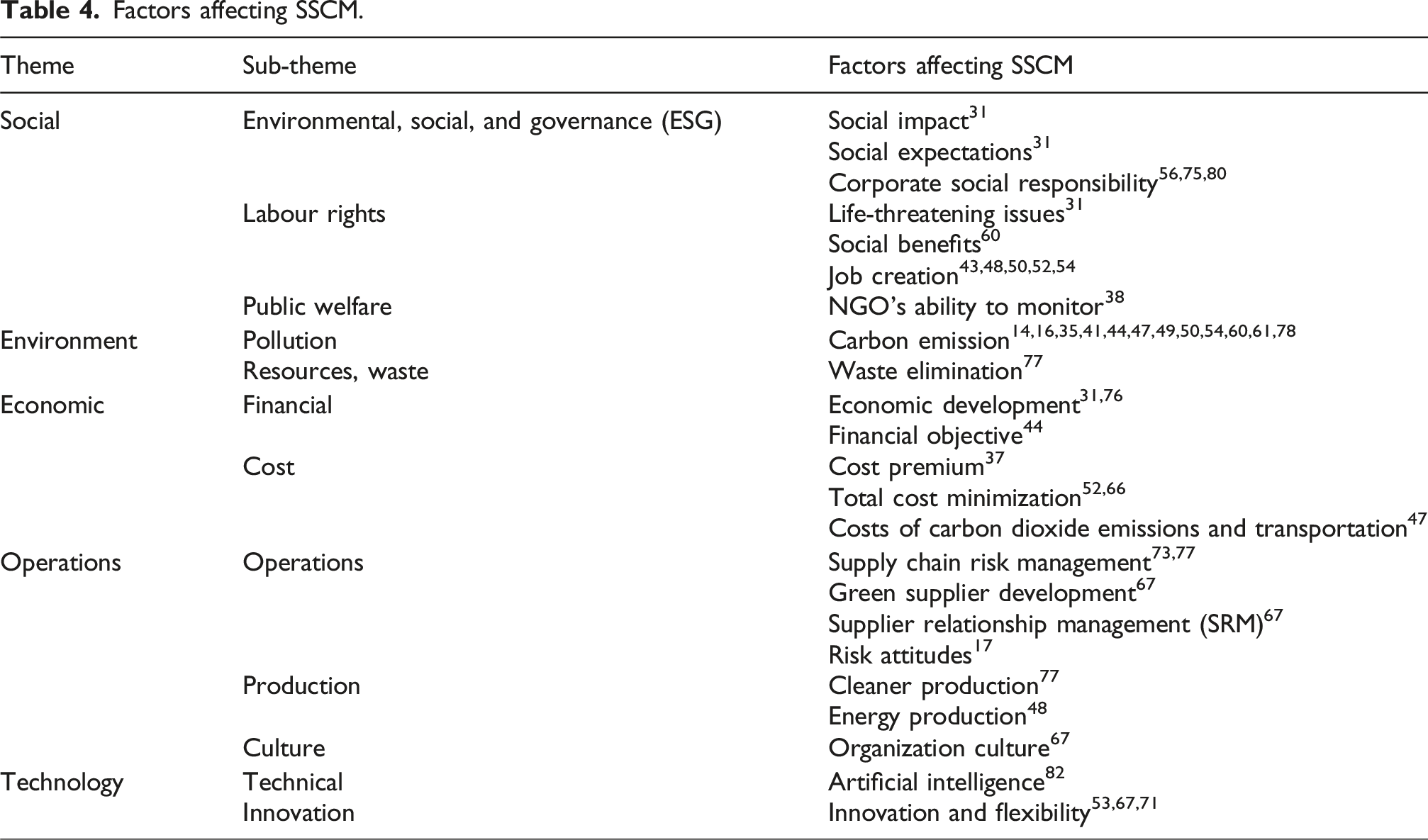
Factors affecting SSCM.
Factors affecting SCRM.
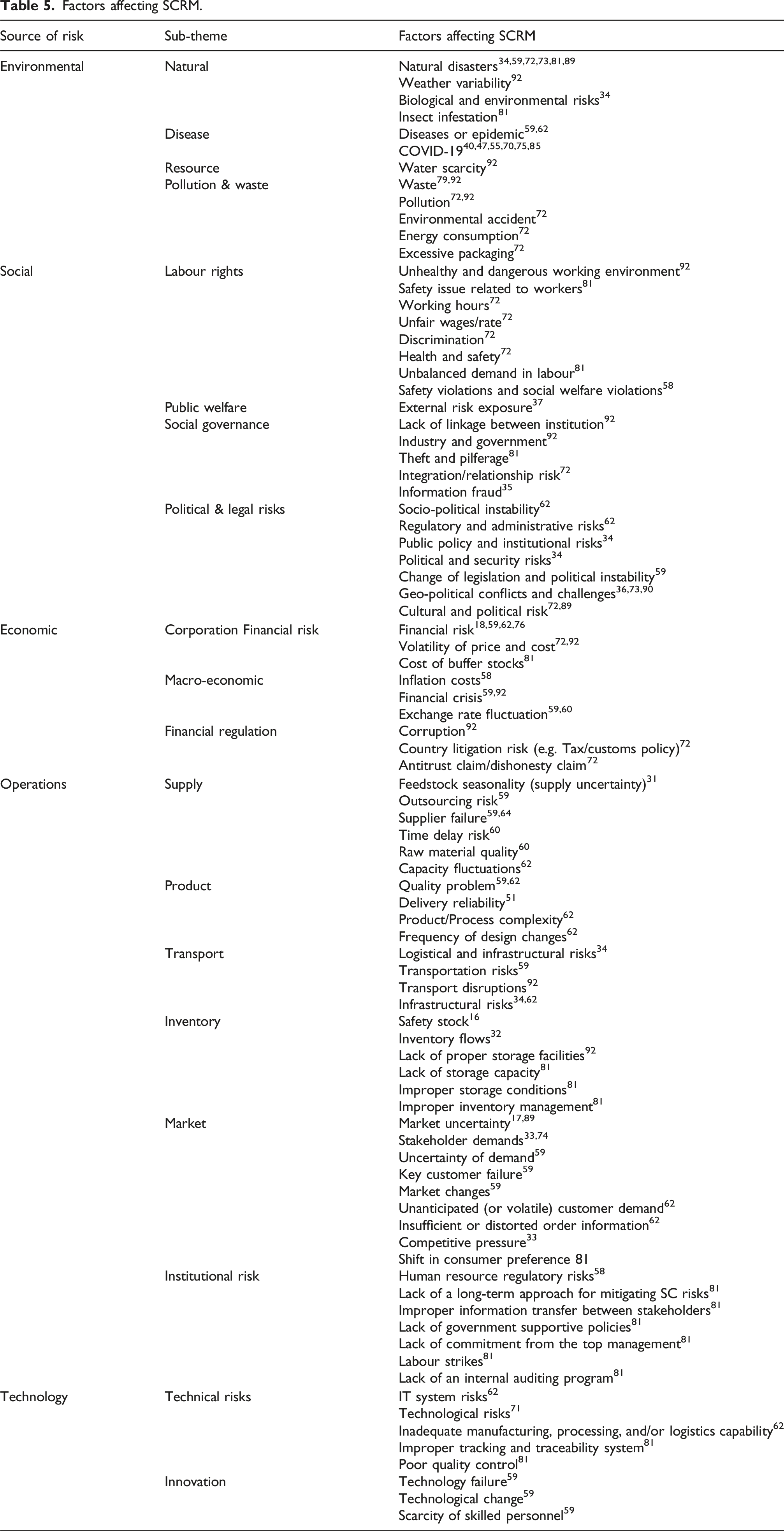
Risk factors can also be classified according to SEE factors. It is clear there is some overlap in items when looking at the factors affecting SSCM and SCRM, because managing and controlling risk in the supply chain is to some extent promoting the sustainable development of the supply chain. The objectives of the two are similar in the process of supply chain management.
Themes from studies combining SSCM and SCRM
The literature review identified a range of studies that addressed SSCM and SCRM issues, which are discussed by theme below.
Environmental sustainability and risk
Some authors have a broad approach to ‘environment’, including ‘political environment’ or ‘business environment’, emphasizing that the realization of sustainability requires attention to the potential risks of the business environment within the industry. 93 Fattahi et al. (2021) quantified air pollutants and greenhouse gas emissions according to risk measures, aiming to reduce the harm of environmental risks in the supply chain. 94 Ghadge et al. (2016) included sustainable facility location as a required consideration to reduce carbon emissions during operations and transportation by reducing the total distance covered by the supply chain network. 14
Brandenburg (2017) considers how to configure new product supply chains for ecological efficiency, and through the modelling method, explores the operations and the relations between financial and environment measures and the resulting risk. 13 da Silva et al. (2020) considered factors such as demand uncertainty and environmental monetization, and developed a general decision support tool that takes into account both risk minimization and expected economic and environmental impact maximization. 95 Darom et al. (2018) consider supply disruptions and the cost of carbon emissions, so the supply chain can become environmentally sustainable and robust. 16 Khan et al. (2022) evaluated five supply chain strategies in order to enable firms to select the best green SCM strategic decision based on the attributes of sustainability. 96
Social sustainability and risk
Some studies have explored how social sustainability affects supply chain risk. For example, employee benefits were suspended in favour of profit during the pandemic lockdown, leading to the proliferation of modern slavery. 97 Also focusing on modern slavery, the risk of disruption to the social sustainability of supply chains has been discussed. 98 In the humanitarian field, one study has focused on external emergency response and humanitarian logistics in the face of the pandemic. 99 Another study has proposed a comprehensive model for sustainable humanitarian supply chain (SHSC) decision-making. 100 These studies show that attention to social responsibility can influence risk in the supply chain. Adopting social sustainability measures can convey a responsible corporate image to consumers and regulators, and can reduce the reputational risks associated with negative social supply chain practices.
Economic sustainability and risk
Some studies consider the negative impact of supply chain risk on economic sustainability. One study found that sustainable supply chain practices (SSCP) can help organisations reduce their financial risks. 18 Jabbarzadeh et al. (2019) believe that economy and environment are contradictory in many cases, and it is difficult for organisations to minimize the overall environmental impact and the total cost of the supply chain at the same time, so they propose a multi-objective optimization model to help achieve a strategic balance between the two. 101
Combining SEE elements and risk
Some studies have combined the SEE elements and risk to offer models that bring benefits for the organisation, the supply chain and contributing to sustainable development in society. 102 Ebrahimi (2018) attempts to establish a stochastic multi-objective model that simultaneously considers total cost, environment and risk to improve the sustainability of the supply chain network. 103 Kolotzek et al. (2018) evaluated supply chains in terms of supply risk, environmental impact, and social impact, developing an assessment model that shows that sustainability-oriented companies are more likely to be economically successful. 104 Tat & Heydari (2021) proposed a two-tier optimal coordination model that simultaneously considered environmental, economic and social responsibility indicators to help companies address the risk of pharmaceutical waste. 105 Bai et al. (2022) proposed a MCDM method that uses q-ROF to assess the SCSC risk of manufacturers to help achieve sustainability. 93
Kumar et al. (2021) analysed risk mitigation strategies during the pandemic, ranked preferences and provided priority weights for risk mitigation strategies. 106 Some studies include sustainability factors in the priority weights of risk mitigation strategies. For example, Darom et al. (2018) included the carbon emission cost of supply chain logistics activities in the measurement index, took safety inventory as a mitigation strategy, and established a supply chain disruption recovery model, which can effectively control risks in the short term. 16 In the long-term, it can help organisations reduce carbon emissions and establish a good corporate reputation, thus reducing the probability of future risks.
Discussion
This study sought to answer the following research questions, which are answered in turn in the sections below.
What is the interface and the current state of research between SSCM and SCRM?
SSCM and SCRM share some similarity of purpose. Some scholars believe that improving sustainability can effectively reduce supply disruption caused by risk events, and conversely improving the robustness can also improve sustainability in supply chain.17,18,35,60 In terms of how they are managed, SSCM usually takes social, environment and economic as the starting point and adopts a series of sustainable practices to improve the sustainable development of firms, while SCRM often starts from the risk and adopts risk management practices to achieve the robust development of firms. Firms can improve profitability and business continuity through effective SSCM and SCRM.
However, some scholars believe that sustainability and risk in supply chains are different goals in supply chain management,33,42,107,108 so scholars often choose multi-objective optimization methods to solve the problems that need to consider both sustainability and risk.
Although SSCM and SCRM are conceptually independent, there is no clear boundary between them. The two domains influence each other and form an overlapping area, which can represent the risk-related aspects within SSCM or the sustainability-related aspects within SCRM. Looking across the studies we analysed, no article explicitly puts forward a definition of the interface between SSCM and SCRM. The overlap can be seen as either resilient/robust SSCM, or as sustainable SCRM. We also found that operations and technology emerged (Table 4) as strong factors alongside the traditional SEE sustainable dimensions. We propose the term “Sustainable Supply Chain Risk Management” (SSCRM) to describe this overlap. We therefore offer the following definition of SSCRM: ‘SSCRM entails balancing economic, social, environmental, operational and technology impacts across the whole supply chain, so that risks are identified, assessed, mitigated and monitored in all processes in order to pursue reducing vulnerability and ensuring profitability and business continuity’.
This definition integrates the concepts of SSCM and SCRM, and considers the scope (whole supply chain), factors (balance SEE, operations and technology; identify, assess, mitigate and monitor risks) and goals (pursue SDG; reduce vulnerability; ensure profitability and business continuity) of SSCRM. The definition also has an emphasis on the long term, for example focusing on carbon emissions and labour rights may not bring significant benefits in the short term, but may help organizations achieve sustainability and risk management goals in the longer term.
We propose a theoretical framework of SSCRM, that encapsulates the various aspects of the definition of SSCRM that we offer above. The proposed SSCRM framework is directly derived from the patterns identified in our systematic analysis. Specifically, the five domains integrated into the framework (Social, Economic, Environmental, Operational and Technology) emerged consistently across the reviewed studies as the principal factors influencing both sustainability-oriented and risk-oriented supply chain practices (Tables 4 and 5). In parallel, the four risk management stages (risk identification, assessment, mitigation and monitoring) were the dominant processual elements through which SCRM was conceptualised in the literature.
As shown in Figure 4, by integrating the five domains of SSCM with the four processual stages of SCRM, this framework reveals a core mechanism through which both supply chain sustainability and supply chain robustness can be simultaneously enhanced. Therefore, the framework not only synthesizes the most recurring themes identified in prior research but also highlights the distinctive theoretical positioning of SSCRM at the intersection of SSCM and SCRM. SSCRM theoretical framework.
Furthermore, several observations can be made at current state of research area in SSCRM from our analysis of the literature. Regarding the descriptive analysis, it seems that the majority of studies focus on manufacturing and physical product supply chains, with service supply chains underrepresented, and no studies looking at the public sector and its supply chains. There is also a proliferation of quantitative studies that employ mathematical modelling, with qualitative methods that afford a deeper understanding between SSCM and SCRM being underrepresented.
The thematic analysis identified that the majority of studies included some assessment of economic elements, suggesting that most studies are focused on looking at the economic viability of firms. It seems a good proportion of studies combine SEE elements, or environment and economic elements. The analysis also identified all the sustainability, risk and performance factors that have been related to SSCM and SCRM in previous studies. There was overlap between some of the factors across SSCM and SCRM, which could be viewed as broader issues relevant across supply chain research, including inventory, products, transport, finance, and technology. Furthermore, the analysis revealed that the issues most frequently addressed by scholars are “reducing greenhouse gas emissions,” “reducing total costs,” and “improving job opportunities”.
The current research mainly explores the influence of certain factors on the sustainability or robustness of the supply chain, or considers the design of multi-factor and multi-level robust and sustainable supply chain. The SSCRM concept has not been subjected to in-depth theoretical development as an independent emerging field.
What are the problems at the interface between SSCM and SCRM? What are the implications for future research?
Having reviewed the 65 articles, we find that there are still many issues in this field that deserve attention. The first is environmental issues. Before discussing environmental issues in depth, it is necessary to clarify the boundaries of environmental factors in the supply chain. ‘Environment’ in a humanistic context refers to the space of human life, including the natural environment and social environment. Whereas risks such as natural disasters concern the impact of the natural environment on the supply chain, pollution and waste mainly explore the impact of the supply chain on the natural environment. This distinction has not been significantly explored in SSCRM research. The social environment, in this context, mainly refers to factors related to human society, such as the business environment and financial environment. Compared with the natural environment, the social environment has received little attention. Research tends to investigate the impact of social environmental factors on the supply chain, but the impact of the supply chain on social environmental factors is rarely mentioned.18,59,63,68,80,86 It is also worth considering whether social environmental factors should be classified as social, environmental or both. Clarifying the boundaries between social and environmental factors can help firms formulate clearer sustainable development strategies.
Secondly, when firms formulate development strategies, although the ultimate results they pursue are consistent, the approaches and routes they adopt are often different or even contradictory. For example, a firm invests a lot of money to improve the workplace environment and corporate social image, reducing reputational risk and hoping to achieve sustainable development of the firm in the social and environmental dimensions, but the investment of this capital cannot be converted into economic benefits in the short term, which may be unsustainable for the firm in the longer term. The contradictions and tensions, as well as the different routes adopted by firms, would benefit from further research.
Currently, robustness and sustainability have become important factors that many firms must consider in their supply chain processes, and simply considering one of them at the expense of the other can no longer meet the actual needs of firms. This has led many practitioners and scholars to devote their efforts to developing robust and sustainable supply -chain network designs and explore new ways for firms to improve the sustainability of supply chains while reducing their risk exposure. This new way requires firms to consider not only the traditional SEE, but also incorporate operations and technology into the framework. In this new framework, operations and technology factors can serve as representatives of risk management to balance the firm’s sustainable development needs with its risk management needs. These dimensions enrich the concept of sustainable development but are not widely accepted and applied, which may be related to the different perceptions that scholars have of sustainable development.
Conclusions
This paper provides the first comprehensive and systematic review of overlapping SSCM and SCRM literature published between 2007 and 2025. Unlike prior reviews that examined SSCM or SCRM in isolation, this study explicitly explores their intersection, synthesising insights across both domains to create an integrated perspective. This unique approach enables a more comprehensive understanding of how sustainability and risk considerations interact in supply chains, thereby filling a critical gap in existing academic research.
From a practical perspective, we identify various SSCM and SCRM factors from previous studies (Tables 4 and 5) which can serve as a practitioner-oriented checklist. We integrate the factors into a single comprehensive framework (Figure 4) for developing more robust, sustainable, and risk-resilient supply chains. By moving beyond models that address only one or two sustainability factors, and incorporating operations and technology, our work provides decision-makers with tools that better reflect the complex, multi-dimensional nature of real-world supply chain challenges.
This study has several limitations. By tightly defining the search terms and criteria for inclusion and exclusion, some relevant publications may have been excluded. We also observed that much of the current literature relies on mathematical modelling, leaving room for richer qualitative explorations of the organisational and behavioural dimensions of SSCRM.
Future research can build on our conceptualisation of SSCRM by testing, refining, or challenging its theoretical underpinnings. Given the limited definitional work and theory development in this emerging field, we call for studies that advance theoretical integration and practical applicability. As publication activity accelerates, our study provides a foundational platform for shaping scholarly discourse and guiding empirical and theoretical advances in SSCRM.
Supplemental Material
Supplemental Material - The interface of sustainability and risk in supply chain management: Insights and implications
Supplemental Material for The interface of sustainability and risk in supply chain management: Insights and implications by Ying Li, Helen Walker, Jon Gosling, Ying Kei Tse in International Journal of Engineering Business Management
Footnotes

Funding
The authors disclosed receipt of the following financial support for the research, authorship, and/or publication of this article: This work was supported by the China Scholarship Council (CSC) under Grant CSC NO 202208420031.
Declaration of conflicting interests
The authors declared no potential conflicts of interest with respect to the research, authorship, and/or publication of this article.
Data Availability Statement
Data sharing is not applicable to this article as no new data were created or analysed in this study.
Disclosure
The authors report there are no competing interests to declare.
Supplemental material
Supplemental material for this article is available online.
Note
References
Supplementary Material
Please find the following supplemental material available below.
For Open Access articles published under a Creative Commons License, all supplemental material carries the same license as the article it is associated with.
For non-Open Access articles published, all supplemental material carries a non-exclusive license, and permission requests for re-use of supplemental material or any part of supplemental material shall be sent directly to the copyright owner as specified in the copyright notice associated with the article.
