




Abstract
This study investigates how customer sentiments and engagement stages, as conceptualized by the AIDA (Awareness, Interest, Desire, Action) model, influence purchase intention in the context of online food delivery services. Leveraging over 1.5 million English-language reviews from Uber Eats and DoorDash collected via the Google Play Store, we developed a robust machine learning pipeline to classify sentiments, detect AIDA stage keywords, and predict purchase intention using deep learning models. A Sequential Neural Network and a Bidirectional LSTM model with pre-trained GloVe embeddings were trained on processed review text to predict purchase intentions, achieving high accuracy across both datasets (Uber Eats: 94.69%, DoorDash: 95.87%). Regression analyses using Ordinary Least Squares (OLS) further validated the predictive power of AIDA stages and sentiment, yielding R-squared values of 0.947 for Uber Eats and 0.915 for DoorDash. All AIDA stages and sentiment showed statistically significant positive effects on purchase intention. Variance Inflation Factor (VIF) analysis confirmed the absence of multicollinearity, reinforcing the reliability of the findings. This integrated framework offers valuable insights for digital platform operators and marketers by demonstrating how user-generated content can be harnessed to understand and influence consumer behavior in service ecosystems.
Keywords
Introduction
The AIDA model, first proposed by Lewis, 1 introduced the “Hierarchy of Effects” (HOE) in marketing, outlining the stages of customer progression: Attention, Interest, Desire, and Action. Initially, consumers become aware of and interested in a product, which eventually leads to a desire to purchase. The final stage, Action, involves the decision to commit to the purchase. 2 Rossiter et al. 3 further refined this model by categorizing consumers as Low-Involvement or High-Involvement based on their information-gathering behavior. The AIDA model has been effective in illustrating human behavior from media exposure to purchase, 4 assuming consumers progress through cognitive, affective, and behavioral stages. 5 This sequential framework has been foundational in understanding consumer behavior, particularly in predicting purchase intention.5,6 In the specific domain of food delivery services, the AIDA model is instrumental in understanding consumer behavior on digital platforms. For instance, Song et al. 5 integrated the AIDA model to explore how marketing communication influences consumer behavior towards food delivery apps, emphasizing the roles of attention and interest in shaping perceived usefulness and ease of use. Recent studies by Raj et al. 7 and Wei et al. 8 further expand the AIDA model’s application across various marketing and technology adoption contexts, validating its relevance in understanding consumer decision-making processes.
This research aims to dissect the pathways from consumer awareness to purchase intention in online food delivery services, analyzing how each AIDA stage—attention, interest, desire, and action—affects consumer decisions. Advanced feature engineering techniques, particularly keyword searches, are employed to identify and quantify the AIDA stages within consumer text reviews. Feature engineering plays a pivotal role in machine learning by enhancing predictive model performance.9,10 Previous research has demonstrated significant improvements in model accuracy and interpretability through well-engineered features.11,12
Sentiment analysis is another cornerstone of this research, providing insights into customer attitudes and behaviors from textual data. While direct studies linking sentiment to purchase intention are limited, extensive literature underscores its broader impact across diverse sectors. For instance, Zhou et al. 13 demonstrated how sentiment analysis elucidates consumer repurchase intentions in online reviews, offering insights into customer satisfaction and trust. Similarly, Hardt and Glückstad 14 explored shifts in travel preferences during the COVID-19 pandemic through sentiment analysis, helping businesses tailor their offerings. Moreover, sentiment analysis has been used to understand public perceptions of emerging technologies 15 and to shape attitudes towards inclusive education. 16 These examples highlight the role of sentiment analysis in transforming raw textual data into actionable insights, thereby enhancing customer satisfaction, refining predictive models, and informing marketing strategies. Ultimately, sentiment analysis equips businesses with the tools to understand current consumer behaviors and anticipate future trends, making it an essential component of modern data analytics methodologies.
In the evolving realm of consumer behavior analysis shaped by digital platforms and dynamic market conditions, understanding the path from awareness to purchase intention is crucial for businesses in the food delivery sector. This study integrates theoretical insights from the AIDA model with practical applications in machine learning and sentiment analysis to explore how each stage—attention, interest, desire, action, and sentiment—shapes consumer purchase decisions. Recent advancements in machine learning and deep learning have significantly enhanced the analysis and classification of textual data, particularly for sentiment analysis, toxicity detection, and intent prediction in social media and online platforms. Omar and Abd El-Hafeez 17 present a comparative study demonstrating that both classical machine learning and emerging quantum computing approaches yield high accuracy in Arabic language sentiment classification. Their findings highlight quantum computing’s slight performance edge and faster processing times on large-scale datasets, emphasizing the growing potential of hybrid computational paradigms for document classification. Complementing this, Koshiry et al. 18 contribute to the Arabic natural language processing field by developing a standardized toxic tweet dataset and showing that fine-tuned transformer-based models like AraBERT outperform other architectures, achieving near-perfect accuracy in toxicity classification, underscoring the importance of pretrained contextual embeddings and language-specific modeling. Koshiry et al. 19 further explore the detection of harmful content by employing a hybrid deep learning architecture combining convolutional neural networks with bidirectional LSTMs trained on pretrained GloVe embeddings, enhanced with focal loss to address class imbalance. This model achieves notable accuracy and precision in cyberbullying identification, reflecting the power of combining advanced deep architectures and specialized loss functions. In a related vein, Farghaly et al. 20 demonstrate that associative classification integrated with Support Vector Machines (SVM), augmented by sequential forward feature selection and attribute reduction, can effectively reduce classification rule complexity while improving accuracy, thereby illustrating the critical role of feature optimization in enhancing classifier performance. Dimensionality reduction and feature selection remain essential in handling high-dimensional textual data, as detailed in Farghaly et al. 21 who propose a hybrid filter-based feature selection method combining chi-square, Relief-F, and mutual information measures to automatically identify significant features, thereby improving model interpretability and reducing computational demands. Similarly, Mostafa et al. 22 review the application of deep learning for feature selection in medical domains, revealing how these techniques simplify identifying relevant predictors and boost predictive accuracy in complex datasets such as hepatocellular carcinoma. The experimental study 23 confirms that feature reduction techniques enhance the performance and efficiency of classical machine learning algorithms including Naive Bayes, SVM, and neural networks. The importance of selecting high-quality features without redundancy is further highlighted by Farghaly and El-Hafeez,24,25 who introduce novel association analysis-based feature selection techniques. Their methods prioritize both relevance and feature interaction, yielding high accuracy with a significantly reduced feature set in text classification tasks, thereby addressing common issues of duplicated and irrelevant features. Beyond classification, semantic web technologies and knowledge extraction tools, as explored by Mahmoud et al. 26 and Badawy et al., 27 provide complementary frameworks to enhance content understanding and retrieval, fostering improved semantic analysis capabilities.
Building upon these foundations, our study implements advanced deep learning models—specifically a Sequential Neural Network and a Bidirectional LSTM—utilizing pretrained GloVe embeddings to predict purchase intention from large-scale English-language food delivery app reviews. By integrating keyword-based indicators derived from the AIDA model stages with sentiment analysis, and employing rigorous feature selection and data preprocessing techniques, our methodology draws on the demonstrated strengths of these prior works to deliver robust and generalizable predictive models. This approach aligns with the state-of-the-art in text classification and feature optimization while extending it to the emerging domain of online consumer behavior prediction in the food delivery sector.
Literature review
AIDA Model’s influence on consumer behavior
The AIDA model—Attention, Interest, Desire, and Action—remains a foundational framework in marketing, illustrating the stages a consumer goes through from initial awareness to purchase decision. 28 Developed by E. St Elmo Lewis in the late 19th century, 1 it maps the consumer’s cognitive journey from encountering a marketing stimulus to taking action. In the Attention stage, marketers capture consumer awareness through compelling stimuli like advertisements. The Interest stage follows, where consumer curiosity is maintained by emphasizing product benefits. 5 In the Desire stage, marketers foster a strong emotional connection, making consumers feel they need the product. 7 Finally, in the Action stage, consumers are driven to make a purchase or sign up for a service. The AIDA model is widely used in digital marketing, advertising, and sales strategies to convert prospects into customers. For example, Kim et al. 29 emphasize the importance of capturing consumer attention to create initial awareness, setting the stage for further engagement. The Interest stage is critical as consumers seek more information and deepen their engagement. 5 As consumers develop a strong desire for the product, they are more likely to take action, influenced by both internal motivations and external factors. 7 The AIDA model’s applicability extends across various contexts. Sharma et al. 2 illustrate its role in mobile banking adoption, particularly in how social media influences the Interest and Action stages. Baber 30 shows the model’s relevance in crowdfunding, guiding backers from awareness to contribution. In technology adoption, perceived ease of use and usefulness are key factors that align with the AIDA stages, particularly in mobile payment adoption. 29 Song et al. 5 explained consumer behavior in food-delivery apps, highlighting the impact of marketing communication on attention and interest. Raj et al. 7 demonstrated the model’s effectiveness in lead conversions in B2B services, while Wei et al. 8 showed its relevance in sensory advertising in tourism, where multisensory cues enhance each AIDA stage, boosting visit intention. Xu and Schrier 31 confirm the model’s applicability in the shared accommodation industry, where website aesthetics significantly guide customers through the AIDA stages to booking. Lastly, Pashootanizadeh and Khalilian 32 explore the model’s effectiveness in encouraging teenagers to use public libraries, finding television programs primarily influence the Attention stage. Collectively, these studies underscore the AIDA model’s versatility across contexts, from mobile technology adoption to tourism and digital marketing.
Sentiment analysis in consumer behavior
Sentiment analysis plays a critical role in understanding consumer opinions and emotions expressed in textual reviews, offering deep insights into attitudes toward online food delivery services. Xu and Schrier 31 explain that sentiment analysis systematically extracts sentiment polarity and intensity from large text datasets, ranging from positive endorsements to critical feedback. Wei et al. 8 highlight its importance in interpreting consumer perceptions that influence decision-making. Integrating sentiment analysis with predictive models allows marketers and platform operators to better understand consumer sentiment across the AIDA model stages, helping businesses tailor marketing strategies and services to enhance user engagement, satisfaction, and loyalty on food delivery platforms. Beyond consumer insights, sentiment analysis has become a vital tool across various domains, aiding in decision-making and policy formulation through the analysis of user-generated content. 33 The inclusion of non-textual features, such as emojis, has significantly advanced sentiment analysis methodologies, especially in social media contexts. Xu et al. 33 introduced a multi-view deep learning approach that incorporates both textual and emoji data, resulting in notable improvements in accuracy and F1-score compared to traditional methods. This enriches sentiment analysis by providing insights into factors driving customer sentiment, essential for businesses in digital markets. In product marketing, Zhang et al. 34 developed a method for extracting consumer preferences from online reviews using fine-grained sentiment analysis combined with the Kano model. This approach addresses challenges in aspect-level sentiment analysis, enabling businesses to tailor product designs based on consumer feedback. In hospitality, Bian et al. 35 identified customer preferences from hotel reviews using neural network-based fine-grained sentiment analysis. Their work in aspect-opinion pair identification and sentiment intensity measurement provides actionable insights for improving service quality and customer satisfaction. In the restaurant industry, Li et al. 36 demonstrated that aspect-based sentiment analysis can predict restaurant survival by analyzing specific aspects like location, tastiness, and service, offering more accurate predictions than overall sentiment analysis. Expanding to decision-making contexts, Guo et al. 37 utilized sentiment analysis in large-scale group decision-making by constructing social networks based on sentiment values, which aids in consensus-building among decision-makers. In online consumer behavior, Wang et al. 38 studied how sentiment quantity, dispersion, and dissimilarity affect online review forwarding behavior, revealing how different sentiments influence information dissemination and informing digital marketing strategies. Lastly, Zhang et al. 39 investigated live streaming e-commerce, showing that real-time sentiment analysis of live comments impacts user engagement and purchasing behavior, highlighting the role of interactive features in shaping consumer decisions. In this study, sentiment analysis is integrated with the AIDA model stages to assess purchase intention based on customer reviews, reinforcing its value as a tool for analyzing consumer behavior.
Online food delivery services and consumer behavior analysis
Recent research on online food delivery (OFD) services has increasingly leveraged user-generated content, such as online reviews, to better understand consumer behavior and service quality perceptions. Shah, Abbasi, and Yan 40 examined the role of online peer reviews as environmental stimuli influencing diners’ continued log-in behavior on online-to-offline (O2O) meal delivery apps. Drawing on the stimulus-organism-response (SOR) framework and the pleasure-arousal-dominance (PAD) model, their quasi-experimental study with German participants found that both textual and pictographic review content significantly evoke emotions—pleasure, arousal, and dominance—that mediate continued app usage. Their findings highlight the emotional impact of review content and suggest that app familiarity moderates this relationship, underscoring the nuanced interplay between consumer emotions and technology use in Western cultural contexts. Teichert, Rezaei, and Correa 41 took a data-driven approach to analyze customers’ written experiences with fast food delivery services, conceptualizing these services as service mix decisions (SMDs). Using web scraping, text mining, and multivariate statistics, they revealed that fast food delivery satisfaction depends not only on speed but also on four experiential factors spanning actual product attributes (e.g., product quality and brand satisfaction) and augmented product aspects (e.g., payment processes and service handling). This study underscores the multifaceted nature of food delivery service quality and the value of text mining techniques for uncovering semantic core benefits from customer narratives. Expanding on service quality assessment, Ma et al. 42 employed a large-scale analysis of online reviews in the OFD sector using the BERTopic machine learning algorithm. They identified key service quality topics, some of which—such as corporate social responsibility—had been overlooked by traditional frameworks based on interviews and surveys. Their integrative method combined advanced machine learning with established theoretical scales, allowing for an importance-performance analysis that prioritizes service improvement areas for OFD platforms. This balanced approach offers both theoretical insights and practical implications, demonstrating the potential for scalable, data-driven evaluations of consumer perceptions in evolving service industries.
In a related investigation, Ray and Bala 43 explored factors influencing consumer intention to use OFD and online travel agency (OTA) services by analyzing user-generated content (UGC). Their mixed-methods study combined qualitative interviews with natural language processing (NLP) analysis of online reviews, supported by structural equation modeling (SEM) of survey data. They identified price benefits and trust in service as primary predictors of usage intention, illustrating how traditional and computational approaches can jointly unravel the drivers of consumer decision-making in digital service contexts. Finally, Khan et al. 44 focused on the relationship between online reviews, ratings, and sentiments in the Indian food delivery market using text mining and regression analysis on Zomato.com data. Their qualitative and quantitative analyses identified hygiene and pricing as critical sub-themes negatively affecting delivery ratings and associated with negative sentiments. Their findings provide actionable insights for restaurants and delivery services aiming to improve customer satisfaction. Furthermore, their standardized methodology for processing large volumes of user-generated content presents a transferable model applicable across diverse service sectors, including tourism and healthcare, particularly during pandemic conditions.
Building on these foundational studies, the present research investigates how customer sentiments and engagement stages—conceptualized through the AIDA (Awareness, Interest, Desire, Action) model—jointly influence purchase intention within the online food delivery context. Utilizing large-scale datasets from two leading food delivery platforms, Uber Eats and DoorDash, this study applies advanced deep learning models, including sequential neural networks and bidirectional LSTMs, to predict purchase intention directly from textual reviews. Additionally, our study uniquely integrates behavioral intention modeling with sentiment and stage-specific keyword analysis derived from review text. Moreover, by conducting parallel analyses on two distinct datasets and incorporating regression techniques to assess the relative impact of AIDA stages and sentiment on purchase intention, this study contributes both methodologically and theoretically to understanding consumer decision processes in digital food delivery services.
Theoretical framework: Understanding purchase intention based on the stages of AIDA and sentiment
Purchase intention reflects consumer readiness to buy, marking their journey from interest to final decision. Monteiro et al. 45 highlight how factors like convenience, pricing, service quality, and preferences shape purchase intentions in online food delivery services, emphasizing the complexity of predicting consumer behavior in digital marketplaces. Predictive modeling techniques, such as those discussed by Chen et al., 46 are crucial for quantifying purchase intentions, enabling marketers to align strategies with consumer preferences effectively. 21 Research by Fei et al. 47 and Monteiro et al. 45 underscores attention’s role in purchase decisions. Fei et al. 47 find that social cues in e-commerce livestreaming, like herding messages, significantly boost purchase intentions, especially when the anchor is attractive. Monteiro et al. 45 demonstrate that visual attention, particularly toward wine labels with awards, enhances purchase intentions through improved quality perceptions. Regarding interest, Chen et al. 46 show that assertive speech in livestream shopping increases consumer interest and purchase intention. Wu et al. 48 propose a scenario-based recommendation algorithm that tailors products to consumer interests, sustaining purchase intentions in IoT environments. In the Desire stage, Kim and Park 49 reveal that virtual influencers’ attractiveness, when aligned with brand fit, significantly drives consumer desire and purchase intentions. Finally, Lau et al. 50 and Meredith Robertson and Kopot 51 explore how consumer actions, influenced by engagement and shopping channel fluency, enhance purchase intentions across luxury fashion and omnichannel retail.
Sentiment analysis also significantly impacts purchase intentions. Zhou et al.
13
demonstrate that positive sentiments in reviews boost trust and satisfaction, directly influencing repurchase intentions. Sahadev et al.
52
find that positive review sentiments increase occupancy rates in peer-to-peer accommodations, reinforcing the link between consumer emotions and purchasing decisions. Despite these insights, research gaps remain regarding how the AIDA model stages and sentiment in reviews affect purchase intentions specifically in online food delivery. This study addresses these gaps by analyzing how consumers progress through AIDA stages and how their sentiments influence purchasing decisions in the online food delivery sector. Understanding these dynamics provides valuable guidance for marketers aiming to enhance user engagement, satisfaction, and loyalty by refining strategies in the competitive digital marketplace (see Figure 1). Theoretical framework.
Proposition development
Exploring the impact of AIDA model stages on purchase intention
The Attention-Interest-Desire-Action (AIDA) model stands as a cornerstone in comprehending consumer behavior and decision-making processes across diverse industries. In the realm of mobile banking adoption, Sharma et al. 2 exemplify how social media platforms effectively capture consumer attention through targeted advertising and informative content, thereby fostering interest and desire among users to explore mobile banking services further. Similarly, Baber 19 highlights the AIDA model’s relevance in crowdfunding, where attention-grabbing strategies and compelling narratives generate interest and desire among backers to support projects financially. Kim et al. 29 emphasize in mobile payment adoption the pivotal role of promotional campaigns and user testimonials in guiding users from initial awareness to active adoption of mobile payment technologies. Additionally, Xu and Schrier 31 demonstrate in hospitality sharing economy platforms how user-friendly interfaces and positive reviews stimulate desire and prompt action among consumers to book accommodations via online platforms. Across these contexts, the AIDA model proves invaluable for marketers in orchestrating effective engagement strategies that cater to consumer preferences and motivations, thereby enhancing overall customer acquisition and retention efforts.
Purchase intention serves as a critical predictor of consumer behavior, influenced by various factors elucidated in prior studies across different domains. Song et al. 5 underscore the consumer purchase intentions within food delivery apps. Raj et al. 7 further explore how user experience and service quality impact purchase intention within e-commerce platforms, emphasizing how positive interactions and seamless transaction processes bolster consumers’ inclination to make purchases online. Moreover, Wei et al. 8 illustrate in digital advertising platforms how personalized content and targeted marketing strategies can significantly heighten consumers’ purchase intentions by aligning product offerings with individual preferences and needs. These studies collectively underscore the multifaceted determinants shaping purchase intention across diverse sectors, providing valuable insights for marketers seeking to optimize their strategies and enhance consumer engagement through tailored approaches and enhanced service delivery. However, there remains a gap in research specifically examining how the stages of the AIDA model, identified from customer reviews, influence subsequent purchase intentions computed from textual data. This presents an opportunity for further exploration into how attention, interest, desire, and action stages extracted from review texts impact purchase intentions, thereby enriching our understanding of consumer behavior and informing more effective marketing strategies. While several studies not directly related to our specific focus have investigated relevant aspects, offering insights into consumer behavior, engagement strategies, and decision-making processes, they contribute to the development of our propositions. Research on consumer behavior highlights the pivotal role of attention in shaping purchase intentions across different domains. For instance, Fei et al. 47 investigate the impact of social cues like herding messages and interaction text in e-commerce livestreaming, finding that these cues influence viewers’ attention allocation and subsequent purchase intentions. Similarly, Monteiro et al. 45 explore how visual attention to wine labels affects purchase decisions, emphasizing that attention to product details significantly influences consumer purchase intentions, particularly in conjunction with factors like awards and consumption contexts. These studies underscore the critical role of capturing and directing consumer attention in enhancing purchase intentions through influencing perceptions and desires associated with the product. Thus, the following proposition has been developed for this study:
Research examining consumer behavior in various e-commerce contexts underscores the pivotal role of interest in shaping purchase intentions. For instance, Chen et al. 46 delve into livestream shopping dynamics, revealing that streamers’ speech acts significantly influence consumer interest, word of mouth, desire, and ultimately purchase intention. Their findings indicate that directive, assertive, and declarative speech acts from streamers enhance consumer interest and desire for products, thereby boosting purchase intentions. This insight underscores the importance of engaging and persuasive communication strategies in driving consumer interest towards purchase decisions. Together, these studies illustrate that stimulating consumer interest through effective communication and visual presentation strategies plays a crucial role in fostering purchase intentions in e-commerce environments. Therefore,
Recent research highlights the significant role of consumer desire in influencing purchase intentions across various digital marketing contexts. Chen et al. 46 explore livestream shopping dynamics, revealing that streamers’ speech acts, particularly directive, assertive, and declarative ones, effectively enhance consumer desire for promoted products. Their findings underscore that heightened desire, mediated by persuasive speech acts, directly contributes to increased purchase intentions among consumers engaged in livestream shopping. Additionally, Kim and Park 49 examine the impact of virtual influencers’ attractiveness on purchase intentions, highlighting that consumer desire, mediated by mimetic desire and brand attachment, plays a crucial role. Their study emphasizes the role of virtual influencers in fostering consumer desire through attractive endorsements, thereby positively influencing purchase intentions. Together, these studies emphasize that stimulating consumer desire through persuasive communication and attractive endorsements significantly enhances purchase intentions in digital marketing environments. Thus
Action, as a stage in the consumer decision-making process, plays a pivotal role in determining purchase intentions across various consumer contexts. Lau et al. 50 investigate the purchase intention for luxury fashion among young consumers in Hong Kong, integrating the Theory of Reasoned Action (TRA), identity theory, social identity theory, and the ABC model of attitude. Their findings suggest that both affect-based (passive and active engagement) and cognition-based attitudes significantly enhance brand attractiveness, subsequently influencing purchase intentions. This study underscores that consumers’ actions, influenced by their attitudes and brand perceptions, directly contribute to their likelihood of purchasing luxury fashion items. Additionally, Meredith Robertson and Kopot 51 explore generational cohorts’ behaviors in omnichannel fashion department stores, finding that perceived fluency through different shopping channels significantly impacts purchase intentions across different income groups. Their study reveals that actions such as patronage and actual purchase behaviors are influenced by consumers’ perceptions of channel fluency, indicating that ease of navigation through various shopping channels influences their final purchasing decisions. Therefore,
Hypothesis development
Impact of sentiment on purchase decision
While direct studies specifically linking sentiment in reviews to intention to use are scarce, prior research provides a foundation for developing these variables and their impact on intention to use. Based on the studies by Xu et al., 22 Zhang et al., 23 Bian et al., 35 Li et al., 25 Guo et al., 37 Wang et al., 36 and Liu et al., 53 sentiment analysis continues to evolve in diverse fields, demonstrating its versatility beyond traditional domains. From enhancing customer experience in peer-to-peer accommodations to predicting product preferences in competitive markets like air purifiers and hotels, sentiment analysis not only captures nuanced customer emotions but also drives strategic decision-making and policy formulation. Embracing innovative methodologies such as multi-view deep learning and fine-grained sentiment analysis, researchers are uncovering deeper insights into consumer behavior and market dynamics, paving the way for more informed business strategies and responsive governance in the digital age. Zhou et al. 13 highlight how sentiment analysis of online reviews contributes to understanding consumer repurchase intentions, demonstrating that emotional content influences subsequent consumer behaviors. Their work underscores the relevance of sentiment mining in gauging consumer attitudes and behaviors, suggesting a similar potential in assessing intention to use through sentiment analysis. Additionally, Tan and Cienki 54 explore sentiment development in governmental discourse, revealing how affective processes shape attitudes and socio-political behaviors over time. Although their focus is on political discourse, the dynamic nature of sentiment development resonates with consumer sentiment in reviews, where evolving attitudes can similarly impact intention to use by reflecting changing perceptions and preferences. Further support comes from Lian et al., 15 who analyze public attitudes towards AI technologies using sentiment analysis. Their findings indicate that sentiment towards technological advancements influences public adoption behaviors, implying a parallel effect in consumer decision-making processes related to service or product use. Moreover, the study by García-García et al. 55 on flamenco show audiences reveals how sentiment analysis uncovers audience preferences and attitudes towards cultural experiences. This demonstrates the applicability of sentiment analysis beyond traditional consumer goods to experiential services, suggesting its relevance in understanding intention to use various services. Additionally, Pashchenko et al. 56 assert that sentiment derived from star ratings provided by customers is suitable for evaluating textual reviews. Collectively, these studies provide a robust foundation for hypothesizing that sentiment expressed in customer reviews positively impacts intention to use, supporting the integration of sentiment analysis into predictive models of consumer behavior. Therefore, it is posited that sentiment derived from customer star ratings or textual reviews positively influences purchase intention computed from their review text using feature engineering. Accordingly, the following hypotheses are formulated:
Sentiment computed from the star ratings provided by customers has a positive impact on purchase intention computed from their review text using feature engineering.
Method
All English reviews for the two most popular food delivery apps, Uber Eats and DoorDash, were downloaded from the Google Play Store for this study using a Google scraper in Google Colab. These files were then downloaded separately to our computer, resulting in 902,150 reviews for Uber Eats and 665,614 reviews for DoorDash. To ensure the generalizability of the findings, procedures were conducted separately on these two datasets. Consistent results across both datasets will validate the robustness of the analysis. First, the Uber Eats reviews were processed, followed by the DoorDash reviews using a similar method in Jupyter Notebook. After importing necessary libraries such as pandas, wordcloud, seaborn, matplotlib, statsmodels, sklearn, tensorflow, and more, we focused on the users’ text reviews (column name “content”) and the review star ratings provided by the reviewers (column name “score”). Based on the review star ratings, we created a new column called “Sentiment”. This function assigns a sentiment value based on the review star rating: Reviews with a star rating of four or five are classified as positive (sentiment = 1). Reviews with a star rating of three are classified as neutral (sentiment = 0). Reviews with a star rating of one or two are classified as negative (sentiment = −1). This approach is validated by Pashchenko et al., 40 who compared sentiment analysis using both review stars and lexicon-based methods, concluding that sentiment derived from customer-provided star ratings is effective for evaluating textual reviews. Next, we used ChatGPT to generate a list of 50 keywords related to different stages of the AIDA model and purchase intention, which were mentioned in text reviews for food delivery apps. Although ChatGPT produced more keywords, we retained the top 50 for all our variables (presented in Appendix-1).
To identify the presence of keywords related to different stages of the AIDA model (Awareness, Interest, Desire, Action) and Purchase Intention in the reviews, we implemented a method to check for these keywords in the text reviews. For each review, we checked whether any of the keywords associated with each stage were present in the review text. If any keywords were found, a corresponding column (Awareness, Interest, Desire, Action, Purchase Intention) was marked with a 1, indicating the presence of relevant keywords. If no keywords were found, the column was marked with a 0. This allowed us to create new columns that reflected the presence of keywords related to each stage of the AIDA model and Purchase Intention in the review content. To ensure that we only included reviews with relevant information, we filtered out rows where all the new columns (Awareness, Interest, Desire, Action, Purchase Intention, Sentiment) were 0. This step removed reviews that did not contain any keywords related to the AIDA stages or Purchase Intention and did not have a sentiment value. Additionally, we assumed that Purchase Intention is the final internal stage. Therefore, if the sentiment was negative (Sentiment = −1) but Purchase Intention was marked as positive (Purchase Intention = 1), we considered this to be inconsistent. In such cases, we converted the Purchase Intention value from one to −1 to align it with the negative sentiment. All other values remained unchanged. This adjustment ensured consistency between the sentiment and purchase intention indicators. After filtering the data, we obtained 808,660 reviews for Uber Eats and 608,433 reviews for DoorDash. Subsequently, we predicted purchase intention based on text reviews for both datasets separately. We imported necessary libraries and loaded the filtered dataset, then tokenized and padded text data for uniform input length. Numerical features excluding ‘content’ and ‘Purchase_Intention’ were prepared. The dataset was split into training (80%) and testing (20%) sets, with labels adjusted accordingly. The test set was strictly held out and not used during training to ensure unbiased evaluation. Within the training data, 20% was further reserved as a validation subset to monitor model performance and prevent overfitting. A comprehensive summary of the dataset features and the train/test partitioning is provided in Appendix 2.
We developed and evaluated two deep learning models—a Sequential Neural Network and a Bidirectional LSTM—to predict purchase intention from textual reviews in the Uber Eats and DoorDash datasets. To evaluate the effectiveness of these models, the Sequential Neural Network was designed with an embedding layer, followed by dense and flatten layers, to capture semantic representations of user-generated text (see Figure 2). In contrast, the Bidirectional LSTM (BiLSTM) model was constructed to capture contextual dependencies in both forward and backward directions, improving the network’s understanding of complex linguistic patterns (see Figure 3). Architecture of the proposed sequential neural network model. Architecture of the Proposed Bidirectional LSTM model.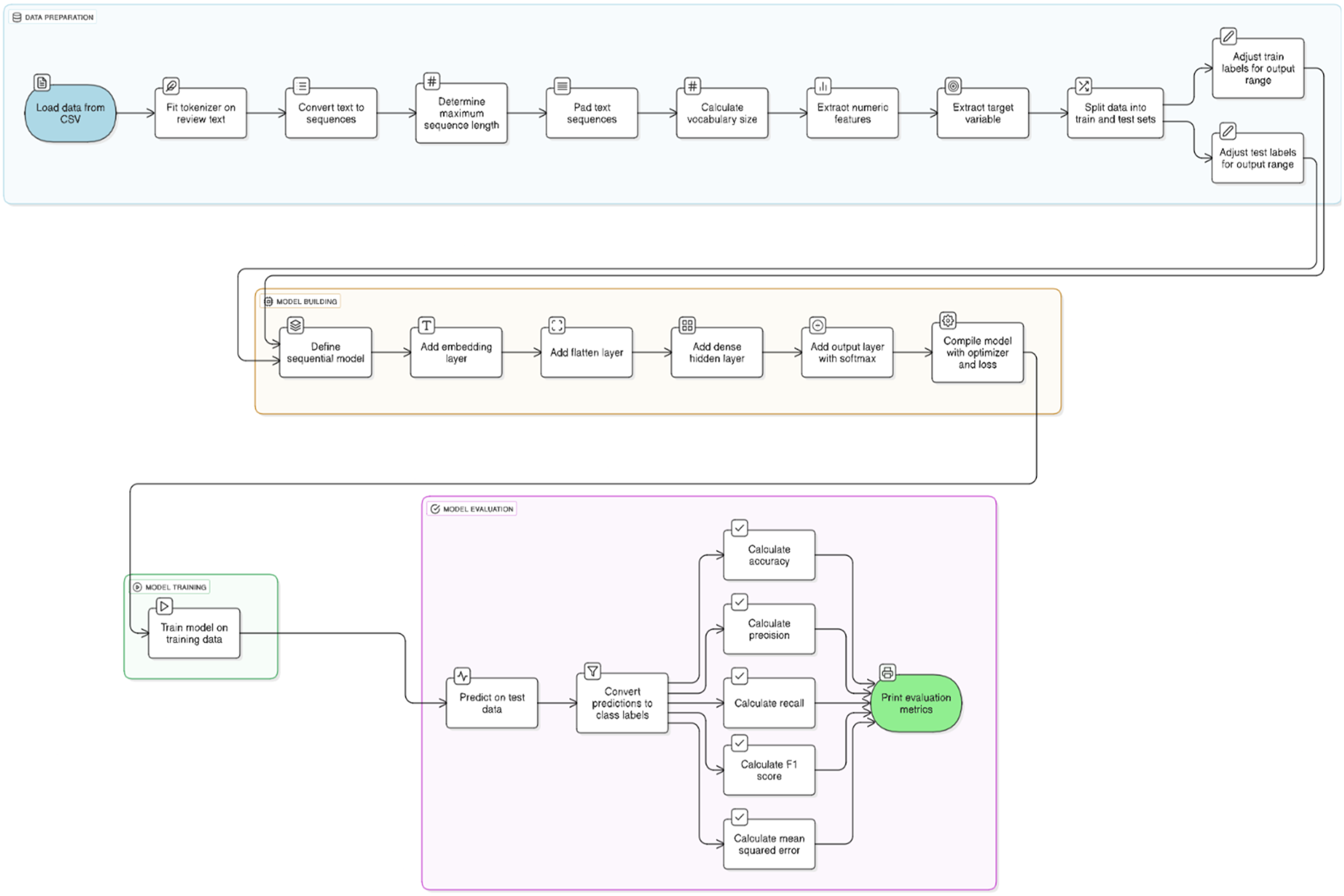

Both models were trained and evaluated using preprocessed review data to determine their performance in classifying user purchase intentions. Both models utilized pretrained GloVe embeddings with a fixed embedding layer and processed text sequences padded to a maximum length of 100 tokens. The Sequential Neural Network featured a dense hidden layer with ReLU activation, whereas the Bidirectional LSTM incorporated dropout regularization (SpatialDropout1D and recurrent dropout) to mitigate overfitting. Models were trained using the Adam optimizer with sparse categorical cross-entropy loss for 10 epochs and a batch size of 32. Detailed model parameters for both architectures and datasets are summarized in Appendix 3. Model training duration was recorded to assess computational efficiency. For the baseline Sequential Neural Network, training required approximately 5.3 h on the Uber Eats dataset and 5.0 h on the DoorDash dataset. By leveraging pretrained embeddings and Bidirectional LSTM layers, training time decreased significantly to around 3.6 h for Uber Eats and 2.8 h for DoorDash. This reduction highlights the effectiveness of combining pretrained embeddings with advanced model architectures to optimize efficiency without compromising predictive performance. Deep learning models were trained with early stopping and dropout mechanisms to further reduce overfitting risks. Pretrained GloVe embeddings were used as non-trainable weights to capture semantic information while minimizing model memorization. Finally, model performance was rigorously evaluated on the unseen test set using accuracy, precision, recall, F1 score, and mean squared error metrics to ensure robust predictive capability. Additionally, using Ordinary Least Squares (OLS) Regression, we analyzed Uber Eats and DoorDash datasets separately. This analysis aimed to assess how different stages of the AIDA model and sentiment influence purchase intention, providing insights into user behavior and preferences. Finally, we calculated Variance Inflation Factors (VIF) to ensure there was no multicollinearity in our regression models. VIF helps assess the severity of multicollinearity among predictor variables, ensuring the reliability of our findings. A flowchart of the proposed work has been included in Figure 4 to visually summarize the overall methodology. Flowchart of the proposed work.
Results and discussion
Sentiment analysis of reviews for uber eats and DoorDash.

Distribution of Purchase_Intention for uber eats and DoorDash.

Distribution of reviews based on presence of keywords across AIDA stages for uber eats and DoorDash.

Additionally, using the Python programming language, we utilized the wordcloud library to generate word clouds for both Uber Eats and DoorDash based on their respective text reviews (presented in Figure 5). A word cloud visually represents the frequency of words in a corpus, with larger words indicating higher frequency. This approach allowed us to observe which words appeared most frequently in user reviews for each platform, providing a qualitative overview of key themes and sentiments expressed by users. Wordcloud.
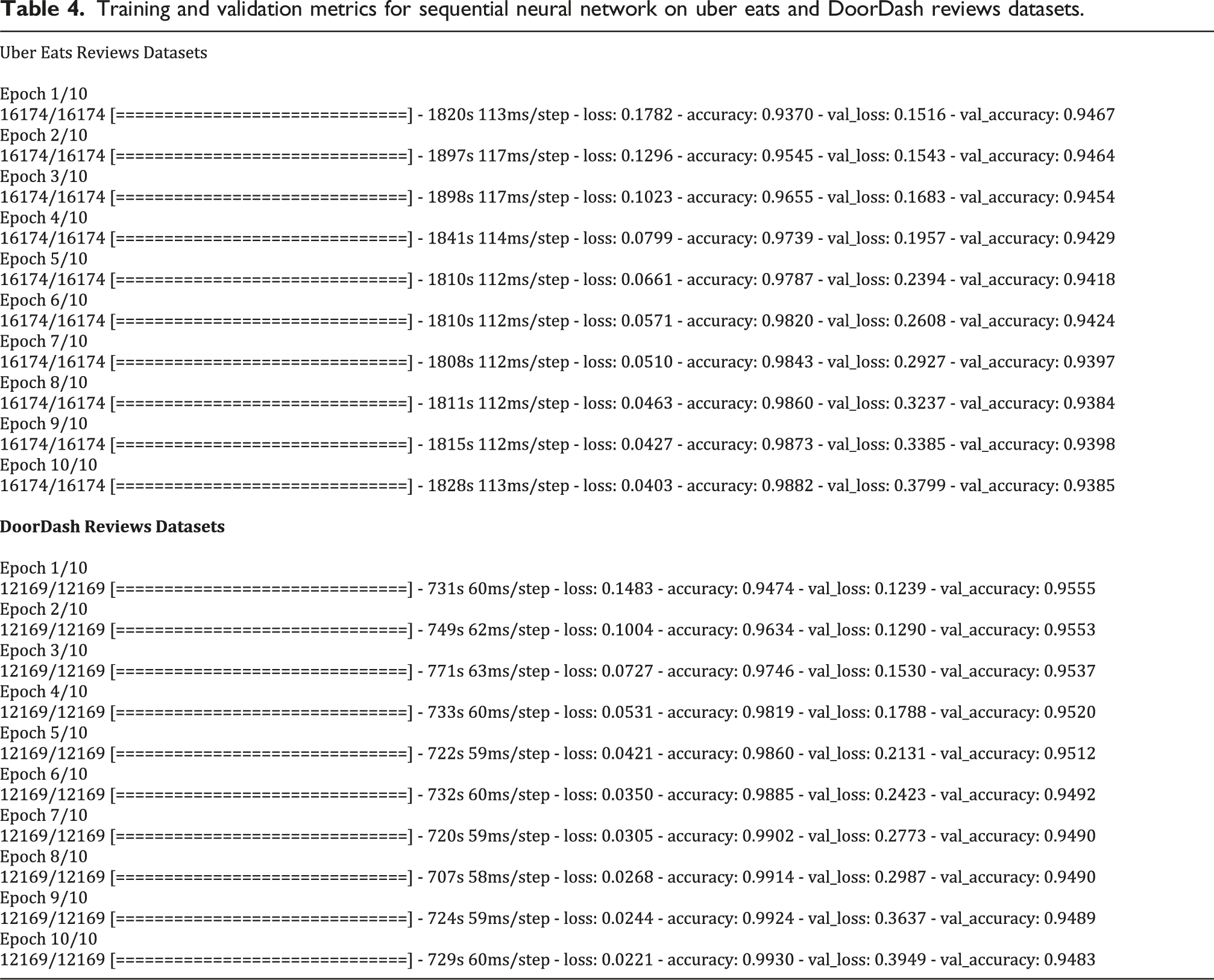
Training and validation metrics for sequential neural network on uber eats and DoorDash reviews datasets.

Training and Validation Metrics for Bidirectional LSTM model with pre-trained GloVe embeddings on Uber Eats and DoorDash Reviews Datasets.


Performance of models across two datasets.
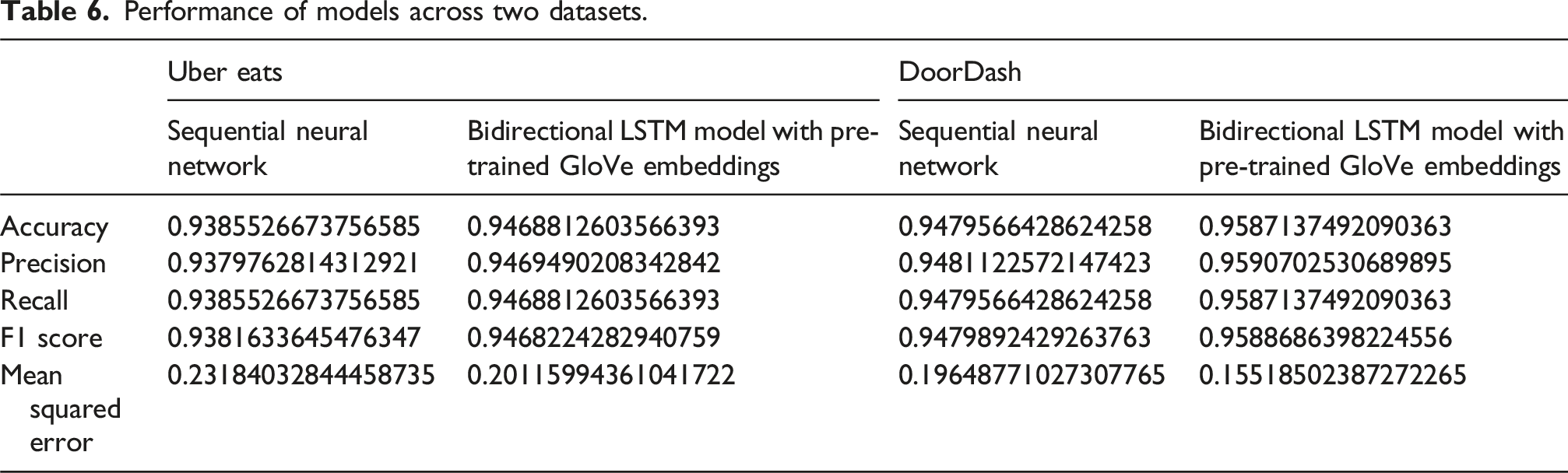
In our research, the robustness of our findings is underscored by the consistent and reliable performance of both the Sequential Neural Network and Bidirectional LSTM models with pre-trained GloVe embeddings across two distinct datasets: Uber Eats and DoorDash reviews. Across 10 epochs, both models exhibited stable trends in key metrics such as accuracy, precision, recall, and F1 score, demonstrating their capacity to generalize well to unseen data. The Bidirectional LSTM model consistently outperformed the Sequential Neural Network, particularly notable in accuracy and precision metrics, suggesting its effectiveness in capturing complex dependencies within textual data. Moreover, validation results closely aligned with training outcomes, indicating minimal overfitting and reinforcing the models’ robust predictive capabilities. Our study also highlighted the models’ performance stability under various conditions, further supporting their robustness in handling diverse and nuanced text data from different sources. These findings collectively affirm the reliability and applicability of our approach in leveraging advanced deep learning techniques for sentiment analysis and purchase intention prediction in the context of food delivery service reviews.
To the best of our knowledge, there is currently no published research that directly predicts purchase intention using text reviews in the online food delivery domain. This highlights the novelty of our study. However, comparable methodologies have been applied in related domains such as sentiment classification, toxicity detection, and user feedback analysis across various datasets. For example, Omar and Abd El-Hafeez 17 applied classical ML and quantum computing to classify sentiment in Arabic tweets, achieving precision and recall scores above 0.81. While their work focused on sentiment analysis rather than behavioral intention, it demonstrated the strength of machine learning in extracting emotional signals from text. Similarly, Koshiry et al. 18 used the AraBERT model for classifying toxic Arabic tweets, achieving 99.6% accuracy. Their focus was on identifying harmful content, but like our work, it leveraged deep contextual understanding of user-generated text to make predictions relevant to platform management. Koshiry et al. 19 proposed a hybrid CNN-BiLSTM model using pre-trained GloVe embeddings to detect cyberbullying in tweets. This model setup is similar to our Bidirectional LSTM with GloVe implementation and confirms the value of embedding-based architectures for nuanced text classification tasks. In contrast to these studies, which predict emotional or harmful content, our models aim to infer user behavioral intent—specifically, purchase likelihood—directly from review text. While sentiment may indirectly influence purchase behavior, our target is a distinct outcome. This difference in prediction objective and domain (food delivery apps) distinguishes our work from prior literature, even as it builds upon similar neural architectures and evaluation methods. Thus, while the datasets and prediction goals differ, our comparisons to these related studies demonstrate that our models perform competitively with high validation accuracies (up to 95.95%) and F1 scores across Uber Eats and DoorDash reviews. This supports the effectiveness and transferability of deep learning methods—especially those using GloVe embeddings and BiLSTM—in understanding user-generated content across applications.
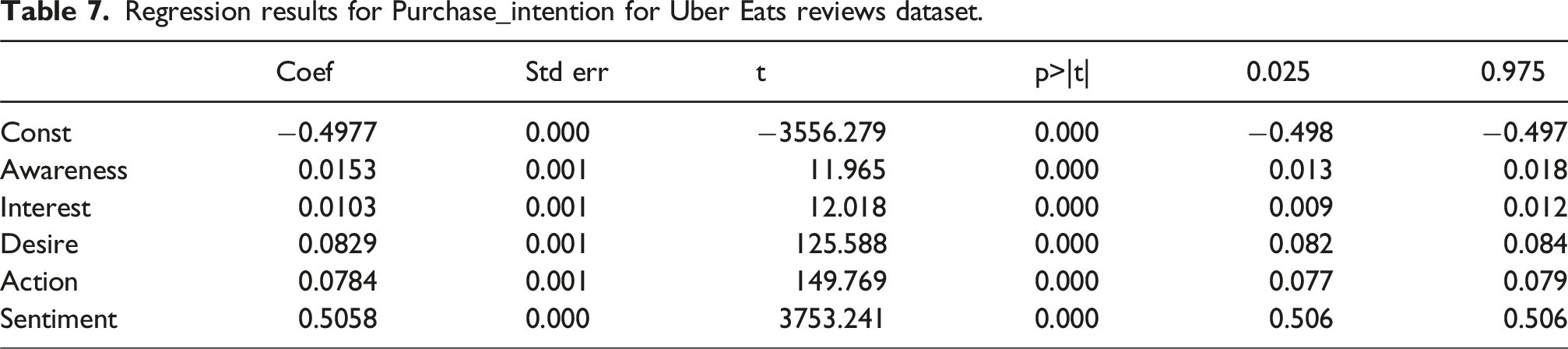
Regression results for Purchase_intention for Uber Eats reviews dataset.
Regression results for Purchase_intention for DoorDash reviews dataset.

Overall, our regression analyses underscore the critical roles of consumer engagement stages (Awareness, Interest, Desire, Action) and sentiment in driving purchase intention within the context of online food delivery services. These findings contribute to a deeper understanding of consumer behavior dynamics and provide actionable insights for marketers and platform operators aiming to enhance user engagement and satisfaction. Moreover, propositions (P1 to P4) and hypotheses (H1) derived from prior literature were validated through the regression analyses. Propositions positing the positive impacts of Attention, Interest, Desire, and Action stages computed from customer reviews on purchase intention were supported by the empirical data. Additionally, Hypothesis 1, which proposed a positive impact of sentiment derived from customer reviews on purchase intention, was confirmed with strong coefficients in both datasets (Uber Eats: coef = 0.5058, DoorDash: coef = 0.5040, both p < 0.001). These findings collectively contribute to a deeper understanding of consumer behavior in online service environments and offer actionable insights for enhancing marketing strategies in the food delivery industry.
Variance inflation factors (VIF).

Moreover, we have achieved consistent and reliable results across both the Uber Eats and DoorDash datasets, indicating robust findings in our regression analyses. The high R-squared values of 0.947 for Uber Eats and 0.915 for DoorDash reflect strong explanatory power, with approximately 94.7% and 91.5% of the variance in purchase intention explained, respectively. Each stage of the AIDA model—Awareness, Interest, Desire, and Action—demonstrated statistically significant positive coefficients, underscoring their influential roles in shaping purchase intention. Additionally, sentiment analysis revealed a significant positive effect, further emphasizing its impact on consumer decisions in both platforms. Importantly, our assessment of multicollinearity through Variance Inflation Factors (VIF) yielded values well below the threshold of concern (VIF < 10), confirming that correlated predictors do not distort our regression results. These findings reinforce the reliability and consistency of our conclusions regarding the effects of AIDA stages and sentiment on purchase intention across different food delivery services.
Applications
Practical applications
Our study offers several practical applications that can directly support marketers and platform operators in the online food delivery sector by leveraging sentiment analysis, AIDA model keyword identification, and predictive deep learning techniques. For small-to-medium platforms aiming to implement these methods, sentiment analysis can be incorporated using widely available open-source libraries such as VADER or TextBlob, or cloud-based APIs like Google Cloud Natural Language or AWS Comprehend, which require minimal technical expertise. By categorizing user reviews into positive, neutral, and negative sentiments, platforms can build real-time dashboards that highlight emerging customer satisfaction trends, enabling prompt responses to negative feedback and improving service quality proactively. This approach helps cultivate positive brand perception and customer loyalty with relatively low investment and infrastructure needs.
The integration of keyword identification based on the AIDA model stages (Awareness, Interest, Desire, Action) can be operationalized through natural language processing (NLP) pipelines using Python libraries such as spaCy or NLTK combined with custom keyword lists generated via AI tools like ChatGPT. Businesses can automate the tagging of reviews to understand which parts of the customer journey require focused marketing efforts. For example, if many reviews contain keywords related to the “Interest” stage but fewer indicate “Action,” marketers can design targeted promotions or incentives to convert interest into actual purchases. This method offers a low-cost, data-driven way to optimize marketing messages and campaigns in alignment with customer behavioral signals.
Regarding predictive modeling, while deploying deep learning models like neural networks or Bidirectional LSTMs may seem technically complex, small-to-medium businesses can leverage pre-trained models or partner with AI service providers who offer customizable prediction tools via APIs. Cloud platforms such as Google AI Platform or AWS SageMaker provide accessible infrastructure for training and deploying models without extensive in-house expertise. Our results demonstrated that these models achieve high accuracy in forecasting purchase intention from review texts, enabling businesses to anticipate customer behavior and allocate marketing resources more effectively. For instance, a platform noticing a rising negative sentiment trend coupled with low purchase intention predictions can prioritize customer retention strategies or service improvements.
The differences observed between Uber Eats and DoorDash reviews also provide valuable insights for tailoring strategies. Uber Eats’ higher proportion of negative reviews suggests that platforms similar to Uber Eats should prioritize addressing customer pain points, such as delivery time or food quality, to improve sentiment and purchase intention. In contrast, DoorDash’s stronger positive sentiment and purchase intention imply that platforms with similar profiles might focus more on scaling successful engagement tactics and loyalty programs. Additionally, keyword distributions across AIDA stages differed slightly between platforms, indicating that marketing messages should be adapted accordingly. For example, if “Desire” keywords are more prevalent in DoorDash reviews, marketing campaigns emphasizing exclusive deals or menu variety might resonate better, while Uber Eats-like platforms might focus on enhancing “Awareness” through visibility campaigns.
Finally, the use of Ordinary Least Squares (OLS) regression and Variance Inflation Factors (VIF) in our study equips businesses with statistically reliable methods to monitor which consumer engagement stages and sentiment drivers most influence purchase intention over time. Incorporating these statistical techniques into business analytics enables continuous refinement of marketing strategies based on validated data relationships. Overall, by combining accessible sentiment tools, AI-powered keyword extraction, predictive modeling, and robust statistical analysis, food delivery platforms of varying sizes can make informed, data-driven decisions to enhance customer satisfaction, increase purchase rates, and maintain competitive advantage in a rapidly evolving market.
Theoretical applications
Our study introduces several theoretical applications that contribute to the broader understanding of consumer behavior and marketing strategy in the digital age. Firstly, it enriches theoretical frameworks by detailing the nuanced progression of consumers through the AIDA model (Awareness, Interest, Desire, Action) within the context of online food delivery services. This deeper understanding elucidates how consumer perceptions and decision-making evolve from initial awareness of brands and services to eventual action, influenced by factors identified through AI-generated keyword analysis and sentiment evaluation. 57
Secondly, our application of sentiment analysis as a theoretical tool enhances discussions on emotional engagement and its impact on consumer behavior. By examining the correlations between positive or negative sentiments derived from customer reviews and subsequent purchase intentions, our study contributes theoretical insights into how emotional responses shape consumer preferences and actions in digital marketplaces. 58
Building on the foundational frameworks of consumer behavior and marketing strategy, our study further extends theoretical understanding by integrating insights from recent advances in service quality evaluation and textual feature engineering. Drawing on the work of Hossain et al., 59 who applied deep learning and feature engineering to analyze SERVQUAL dimensions in Uber Eats reviews, our study supports the theoretical linkage between service quality attributes—such as Empathy, Responsiveness, and Reliability—and consumer sentiment formation. This integration enriches existing marketing theory by empirically validating that nuanced service dimensions significantly shape emotional engagement and thus influence purchase intention. It also underscores the utility of combining classical service quality models with AI-driven sentiment analysis techniques to generate more granular and actionable theoretical insights into customer satisfaction dynamics in digital service environments. Furthermore, our research complements findings by Hossain 60 in the domain of textual feature engineering for consumer behavior prediction. By leveraging AI-generated keywords associated with brand attributes and customer interaction alongside sentiment metrics, we advance theoretical discussions on how textual features extracted from user-generated content contribute to the formation of purchase intention and customer satisfaction. This approach bridges Marketing 4.0 paradigms with computational analytics, reinforcing the theoretical premise that digital textual data encapsulates rich behavioral signals that can be systematically decoded to forecast consumer decisions. Our findings thereby extend theoretical models by incorporating brand-related textual cues as significant predictors within consumer engagement frameworks. Together, these integrations contribute to a more comprehensive theoretical model that situates AI-enabled text analytics and service quality dimensions within a cohesive framework explaining consumer emotional and behavioral responses. This expanded perspective not only advances theoretical rigor in the context of online food delivery but also suggests pathways for applying these insights to other service-oriented digital marketplaces, providing a foundation for future cross-industry theoretical exploration.
Methodological applications
Methodologically, our study introduces several applications that contribute to advancing research methodologies in consumer behavior and marketing analysis. Firstly, our approach of utilizing AI-generated keyword analysis and sentiment evaluation from large-scale text data sets offers a robust methodological framework for studying consumer behavior in digital environments. By leveraging natural language processing (NLP) techniques, including ChatGPT for keyword extraction and sentiment analysis tools, we enhance methodological rigor in identifying and categorizing consumer sentiments and behaviors. Secondly, the integration of machine learning models, particularly neural networks, for predicting purchase intentions represents a methodological innovation in consumer research. This approach expands methodological boundaries by demonstrating the application of advanced analytics to forecast consumer behaviors based on textual reviews and sentiment data, thereby enriching predictive modeling methodologies in marketing research. Moreover, our methodological application of filtering and processing extensive datasets from Uber Eats and DoorDash through Python libraries and Google Colab showcases the scalability and efficiency of AI-driven methodologies in handling large volumes of consumer-generated content. This methodological efficiency contributes to streamlining data processing workflows and optimizing resource allocation in research endeavors focused on digital consumer behavior. Furthermore, our use of statistical analyses such as Ordinary Least Squares (OLS) regression and Variance Inflation Factors (VIF) assessment enhances methodological robustness by providing insights into the relationships between AIDA stages, sentiment metrics, and purchase intentions. These methodological tools facilitate deeper insights into the factors influencing consumer decision-making processes and enable more accurate modeling of consumer behaviors in digital marketplaces.
Additionally, our methodological applications highlight the importance of data preprocessing and validation techniques in ensuring data quality and reliability. By implementing rigorous data filtering, validation checks, and consistency assessments across datasets, our study reinforces methodological standards in handling and analyzing consumer-generated data for research purposes. Moreover, our study’s methodological contributions extend to theoretical frameworks by bridging AI-driven analytics with established consumer behavior theories such as the AIDA model. This integration not only enhances methodological rigor but also facilitates theoretical advancements in understanding how digital interactions and consumer sentiments shape purchasing behaviors over time. Lastly, the methodological implications of our study for future research underscore the potential for AI and machine learning techniques to further innovate methodologies in consumer behavior research. By advancing methodological approaches that integrate AI-driven insights with traditional research methodologies, researchers can gain deeper insights into consumer behaviors, preferences, and decision-making processes in increasingly complex digital environments. Moreover, our study’s methodological applications contribute to advancing research methodologies in consumer behavior and marketing analysis through the integration of AI-driven analytics, machine learning models, statistical techniques, and rigorous data processing methodologies. These methodological innovations pave the way for future research endeavors focused on understanding and predicting consumer behaviors in digital marketplaces.
Conclusion
In conclusion, this study has leveraged advanced AI and machine learning techniques to delve into the nuanced dynamics of consumer behavior within the context of online food delivery services. By applying natural language processing (NLP) methods, including AI-generated keyword analysis and sentiment evaluation, we have explored how consumers progress through the stages of Awareness, Interest, Desire, and Action (AIDA), culminating in Purchase Intention. Our findings underscore the critical role of consumer sentiment in shaping purchasing decisions on platforms like Uber Eats and DoorDash, revealing that positive sentiment significantly enhances purchase intentions. Furthermore, our methodological approach, which integrates neural networks for predicting purchase intentions based on textual reviews, represents a significant advancement in consumer behavior research. This approach not only enhances predictive accuracy but also demonstrates the efficacy of AI-driven methodologies in understanding and forecasting consumer behaviors in digital environments. Practically, our study offers actionable insights for marketers and platform operators seeking to optimize their strategies in the competitive landscape of online food delivery. By identifying and monitoring specific keywords associated with each stage of the consumer decision-making process, businesses can tailor their marketing efforts to resonate more effectively with target audiences, thereby enhancing engagement and driving conversion rates. Overall, this research contributes methodologically by demonstrating the applicability of AI and machine learning techniques to consumer behavior research, and theoretically by validating and extending the AIDA model in the digital age. As digital interactions continue to shape consumer behaviors, our study provides a foundation for future research endeavors aimed at deeper explorations into how AI-driven analytics can further illuminate consumer preferences and decision-making processes.
Limitations and future research directions
While our study has provided valuable insights, there are several limitations that warrant consideration. Firstly, the keywords generated by ChatGPT may vary depending on the specific prompts used during the analysis. In this study, we selected 50 keywords for each variable (Awareness, Interest, Desire, Action, Purchase Intention) based on the output of ChatGPT. Future research could explore how different prompts influence the keywords generated and consider increasing or decreasing the number of keywords analyzed to understand their impact on the robustness of the findings. Additionally, the reliance on static datasets from Uber Eats and DoorDash, while comprehensive, may not capture real-time fluctuations in consumer behaviors and sentiments. Future studies could benefit from incorporating dynamic data streams to capture temporal variations and trends in consumer preferences and decision-making processes over time. Also, while our study demonstrates the effectiveness of the proposed deep learning models in predicting purchase intention, an ablation study analyzing the individual contributions of different model components was not conducted. Future research could incorporate ablation experiments to systematically evaluate the impact of key elements such as embedding layers, dropout mechanisms, and model architecture choices. This would provide deeper insights into which components most significantly influence model performance and help optimize model design for enhanced predictive accuracy. Furthermore, our study focused on English-language reviews where Uber Eats and DoorDash are prominent. This limits the generalizability of our findings to other linguistic and cultural contexts. Future research should explore cross-cultural variations in consumer behaviors and sentiments across different regions and platforms to enhance the external validity of the findings. Moreover, while neural networks have demonstrated efficacy in predicting purchase intentions based on textual reviews, the interpretability of these models remains a challenge. Future research could explore techniques for enhancing model interpretability and transparency, thereby enabling marketers and platform operators to derive actionable insights more effectively. Also, although our deep learning model shows strong performance, we did not discuss the cost of deploying such models in real-world settings. Training the model took around 2.8 to 5.3 h on a GPU-enabled system, which may be expensive or difficult to access for small-to-medium businesses. While we used free tools like TensorFlow and Python, running these models efficiently may still require extra hardware or cloud services. In the future, researchers could explore ways to reduce these costs, such as using smaller models, model compression, or testing low-cost deployment options. A cost-benefit analysis could also help businesses decide whether deep learning is worth the investment. Finally, although our study emphasizes Bidirectional LSTM neural networks due to their superior capability in capturing the contextual and sequential nature of user-generated text, we did not benchmark our model against simpler traditional machine learning algorithms such as logistic regression, decision trees, or support vector machines. Given our study’s deep learning focus, we prioritized exploring the advanced potential of neural architectures. However, future research could benefit from comparative benchmarking to quantitatively assess the added predictive value of deep learning over more interpretable and resource-efficient models. This is especially important for small-to-medium food delivery platforms that may seek a balance between model performance and computational feasibility. Moreover, addressing these limitations and pursuing future research directions will not only enhance the validity and applicability of AI-driven consumer behavior studies but also contribute to the ongoing evolution of theoretical frameworks and practical applications in digital consumer research.
Footnotes

Ethical considerations
This research does not contain any studies with human participants or animals performed by any of the authors
Consent for publication
We give our consent for the publication.
Funding
The authors received no financial support for the research, authorship, and/or publication of this article.
Declaration of Conflicting Interests
The authors declared no potential conflicts of interest with respect to the research, authorship, and/or publication of this article.
Appendix
Top 50 keywords produced by chatgpt for indicating stages of AIDA and Purchase intention.
Variable
Keywords
awareness_keywords
‘Monitoring’, ‘confirm’, ‘thoughtful’, ‘trainer’, ‘obligatory’, ‘ecstatic’, ‘assurance’, ‘acknowledged’, ‘patient’, ‘resonated’, ‘reassure’, ‘breaks'
‘Thinking’, ‘offended’, ‘concerns’, ‘puzzled’, ‘nonsense’, ‘irritated’, ‘mystified’, ‘unfriendly’, ‘disappointed’, ‘suspicious’, ‘inflexible’, ‘displeased’, ‘unresponsive’, ‘apathetic’, ‘muddled’, ‘uncertain’, ‘unconcerned’, ‘dismissive’, ‘doubtful’, ‘questioning’, ‘bewildered’, ‘impatient’, ‘hesitant’, ‘hesitating’, ‘regretful’, ‘hasty’, ‘undecided’, ‘insistent’, ‘desperate’, ‘understandable’, ‘disingenuous’, ‘perturbed’, ‘resolute’, ‘unconvinced’, ‘dejected’, ‘misguided’, ‘reviewed’, ‘felt'
interest_keywords
‘Borrow’, ‘rudest’, ‘drawback’, ‘jealous’, ‘illustrative’, ‘powerful’, ‘attraction’, ‘actuarial’, ‘renting’, ‘favorably’, ‘persuaded’, ‘humanly’, ‘draining’, ‘guaranteed’, ‘defrauded’, ‘relatively’, ‘submit’, ‘prepared’, ‘involve’, ‘stall’, ‘promote’, ‘impressed’, ‘jeff’, ‘seeking’, ‘awarded’, ‘proactive’, ‘inappropriately’, ‘conned’, ‘assumption’, ‘replenished’, ‘passionate’, ‘competed’, ‘reached’, ‘staffed’, ‘disliked’, ‘debt’, ‘graduating’, ‘fishing’, ‘refusal’, ‘assumed’, ‘deserve’, ‘timely’, ‘humbly’, ‘willing’, ‘advised’, ‘robbed’, ‘repulsed’, ‘revealed'
‘Gave’, ‘delighted'
desire_keywords
‘Promoted’, ‘surprised’, ‘exposed’, ‘grew’, ‘analyzed’, ‘rob’, ‘operate’, ‘integrated’, ‘supposed’, ‘informed’, ‘estimated’, ‘snatched’, ‘ensuring’, ‘coerced’, ‘recommended’, ‘erased’, ‘tooth’, ‘browsing'
‘Revealed’, ‘scattered’, ‘arrived’, ‘accumulated’, ‘escaped’, ‘talked’, ‘possessed’, ‘educated’, ‘advise’, ‘expected’, ‘imitated’, ‘destroyed'
‘Qualified’, ‘misled’, ‘drew’, ‘mistreated’, ‘snatched’, ‘instructed’, ‘acquired’, ‘decided’, ‘forgotten’, ‘annoyed’, ‘prolonged’, ‘revised'
‘Encouraged’, ‘cared’, ‘raced’, ‘completed’, ‘devastated’, ‘brought’, ‘enticed’, ‘disgruntled'
action_keywords
‘Suggested’, ‘admitted’, ‘liking’, ‘stopped’, ‘condemned’, ‘burned’, ‘rejecting’, ‘catered’, ‘gave’, ‘reviewed’, ‘work’, ‘reporting’, ‘admit’, ‘proof’, ‘doomed’, ‘swallowed’, ‘realized’, ‘packed’, ‘compared’, ‘bought’, ‘argued’, ‘confirmed’, ‘report’, ‘fishing’, ‘received’, ‘stressed’, ‘succeed’, ‘responded’, ‘answered’, ‘read’, ‘turned’, ‘apologized'
‘Handled’, ‘defeat’, ‘blessed’, ‘puzzled’, ‘graduated’, ‘saved’, ‘arrested’, ‘surpassed’, ‘focused’, ‘dominated’, ‘embarrassed’, ‘weighed’, ‘agreed’, ‘achieved’, ‘wanted’, ‘shamed’, ‘proven’, ‘stated'
purchase_intention_keywords
‘Respected’, ‘solution’, ‘policy’, ‘sufficiently’, ‘purposed’, ‘assisted'
‘Secured’, ‘managed’, ‘intent’, ‘planning’, ‘considering’, ‘decided’, ‘committed’, ‘opted’, ‘finalized’, ‘ensured’, ‘expected’, ‘willing'
‘Ready’, ‘prepared’, ‘arranged’, ‘organized’, ‘calculated’, ‘coordinated'
‘Confirmed’, ‘prioritized’, ‘targeted’, ‘aimed’, ‘intended’, ‘resolved’, ‘pledged’, ‘promised’, ‘vouched’, ‘confirmed’, ‘assured’, ‘guaranteed’, ‘finalized’, ‘validated’, ‘verified’, ‘approved’, ‘endorsed’, ‘supported',' advocated’, ‘acknowledged’, ‘addressed’, ‘assured’, ‘sanctioned'
‘Facilitated’, ‘backed’, ‘authenticated'
Dataset description and partitioning. Notes:
Dataset
Total reviews
Key features
Train size (80%)
Test size (20%)
Uber eats
808,660
Content (text review), score (star rating), sentiment, awareness, interest, desire, action, purchase_intention
646,928
161,732
DoorDash
608,433
Same as uber eats
486,746
121,687
Neural Network and Bidirectional LSTM model parameters.
Parameter
Uber eats sequential NN
Uber eats bidirectional LSTM
DoorDash sequential NN
DoorDash bidirectional LSTM
Vocabulary size
vocab_size (e.g., 15,000)
vocab_size (e.g., 15,000)
vocab_size (e.g., 12,000)
vocab_size (e.g., 12,000)
Max sequence length
100
100
100
100
Embedding dimension
100
100
100
100
Embedding layer
Trainable = False, pretrained?
Trainable = False, pretrained (GloVe)
Trainable = False, pretrained?
Trainable = False, pretrained (GloVe)
LSTM units
N/A
64
N/A
64
Dropout (LSTM/SpatialDropout)
N/A
SpatialDropout1D: 0.2, LSTM dropout: 0.2, recurrent dropout: 0.2
N/A
SpatialDropout1D: 0.2, LSTM dropout: 0.2, recurrent dropout: 0.2
Dense layers
Dense (64, relu), Dense (3, softmax)
Dense (3, softmax)
Dense (64, relu), Dense (3, softmax)
Dense (3, softmax)
Output classes
3
3
3
3
Optimizer
Adam
Adam
Adam
Adam
Loss function
Sparse categorical crossentropy
Sparse categorical crossentropy
Sparse categorical crossentropy
Sparse categorical crossentropy
Batch size
32
32
32
32
Epochs
10
10
10
10
Validation split
0.2
0.2
0.2
0.2