




Abstract
This paper explores the innovation ecosystem and performance of South Korean manufacturing firms during the digital transformation era, emphasizing differences between high-tech and conventional-tech firms. Using data from the 2022 Korea Innovation Survey, the analysis covers 4000 firms, including 1364 high-tech and 2636 conventional-tech firms. The study focused on two models: the innovation ecosystem model, which examined knowledge dissemination channels and innovation partnerships, and the product innovation performance model, which evaluated the effects of internal capabilities and government policies on innovation outcomes. The findings indicate that high-tech firms primarily utilize “slippery knowledge” channels, such as public domain and intellectual property rights (IPRs), and prefer external innovation partnerships with public research institutions, universities, and private companies. Conversely, conventional-tech firms rely more on “sticky knowledge” channels, such as collaboration & network and venture creation, and depend heavily on internal resources and affiliates. These results suggest that high-tech firms favor an open innovation approach, while conventional-tech firms focus on internal capabilities to protect their IPRs. Public research institutions play a critical role in South Korea’s ecosystem, unlike Western countries where universities are more central. Furthermore, government’s technology support policies were more effective for high-tech firms than direct financial support, highlighting the need for tailored innovation strategies across technology groups.
Keywords
Introduction
The spillover effects of new industries and new technologies in the global economy are not confined to the respective country or region. Instead, they are rapidly disseminated to other countries and regions through channels such as the development of information and communication technology and the expansion of global supply chains.1,2 However, during the unprecedented COVID-19 pandemic over the past 3 years, the world has simultaneously entered an era of digital transformation, not due to technological shocks from any particular leading country, but as a global phenomenon. 3 This rapid digital transformation has increased the demand for new industries and new technologies, bringing significant changes to industrial ecosystems and technological innovation.
In response to the rapidly changing economic and industrial environment, including the era of digital transformation, major Western countries such as the United States and the European Union emphasize innovation in high-value-added service sectors such as artificial intelligence (AI), ICT, and platform services. However, in Asian countries such as Japan, South Korea and China, the emphasis remains on innovation aimed at strengthening manufacturing competitiveness. 4 The advent of the digital transformation era is driving convergence across multiple domains, particularly in the industrial sector, where innovation strategies that integrate manufacturing and services are being pursued. This is because manufacturing innovation is essential to effectively deliver high-value-added service products. The South Korean government has recognized these challenges and is implementing various support policies aimed at enhancing the digital transformation capabilities of firms and strengthening the competitiveness of the manufacturing sector. Recently, the government enacted the ‘Smart Manufacturing Innovation Act’ (effective as of July 4, 2023), which aims to support companies (especially for SMEs) in improving product development, manufacturing processes, distribution management, and business practices by integrating ICT, AI, and other advanced technologies.
Moreover, since the technologies of digital transformation pertain to new technologies and new industries, applying them positively to the innovation performance of manufacturing firms requires the formulation of innovation strategies that utilize internal and external capabilities and resources.5,6 The adoption of new technologies, such as the technologies of digital transformation, necessitates an exploratory innovation strategy that can boldly explore new domains. This requires firms to have internal absorptive capacities or innovation support systems in place. 7 Furthermore, innovation activities and performance can vary depending on the technological level of manufacturing firms. In other words, the innovation pursued by high-tech manufacturing firms may differ from the innovation approaches taken by conventional-tech manufacturing firms. Additionally, to analyze the innovation ecosystem and the structure of innovation performance in manufacturing firms, it is essential to consider government innovation support policies. In most countries, governments take the lead in formulating R&D support policies and implement both financial and non-financial support policies to enhance the innovation capabilities of firms.4,8,9
This study focuses on the innovation ecosystem and structure of manufacturing firms in the era of digital transformation, as well as to examine government policies that can support the creation of innovation performance. This study also addresses the following research questions: First, what is the structure of knowledge dissemination and the innovation ecosystem in manufacturing firms, and what elements constitute it? What are the differences between high-tech and conventional-tech firms? Second, what elements constitute the structure for creating product innovation performance in manufacturing firms? Additionally, what are the differences between high-tech and conventional-tech firms? Third, do government innovation support policies positively impact the product innovation performance of manufacturing firms? If so, what types of support policies are more effective? Furthermore, what are the differences between high-tech and conventional-tech firms? Therefore, this study analyzes the innovation ecosystem and performance of manufacturing firms in South Korea, with a focus on deriving implications for open innovation and knowledge dissemination channels in high-tech firms. Additionally, through an analysis of the innovation ecosystem reflecting the unique characteristics of Asian countries, this study seeks to provide policy recommendations.
Literature review
Innovation ecosystem: Knowledge dissemination channels
Innovation is shared and facilitated through knowledge dissemination channels, and the form of these channels varies depending on geographic and physical proximity.10,11 According to the study by Lee (2016), knowledge producers generate knowledge through a knowledge production function, but when this knowledge is transmitted to knowledge users, it is disseminated through four major types of channels. As shown in Figure 1, knowledge dissemination channels are structured into four quadrants based on their competitiveness and exclusivity, and, similar to the study by Jaffe (1989), are organized along two axes determined by geographic proximity. A typology of four types of knowledge dissemination channels. Source: Lee (2016).
Traditional knowledge dissemination channels are characterized by non-rivalrous and non-excludable modes, typically involving the public domain channels that include academic papers and specialized books.12–14 In contrast, when knowledge involves intellectual property rights (IPRs), such as through patent applications and licensing, non-rivalrous but excludable knowledge dissemination channels are utilized. These non-rivalrous channels tend to have a wide range of knowledge dissemination and do not require geographic proximity, resulting in low transaction costs.15,16 Knowledge dissemination channels that are rivalrous but non-excludable include collaborations such as conference participation, academic activities, and networking with associations and consortia. Channels that are both rivalrous and excludable involve technology entrepreneurship activities, such as venture creation. 17 However, these channels are constrained by geographic proximity and thus tend to have high transaction costs.18,19
Innovation ecosystem: Innovation partnership
The key factors constituting an innovation ecosystem can include innovation creators, innovation intermediaries, and innovation users, with each actor existing interdependently within the ecosystem.15,20,21 Historically, the innovation ecosystem was primarily centered around industry-academia research collaborations, but more attention has been given to a model that includes the government’s role, forming an innovation ecosystem centered around industry, universities (including research institutes), and government. Notably, Etzkowitz and Leydesdorff (2000) developed the Triple Helix model, which moves away from the traditional single-leader model (Mode 1 or 2: government-led or industry-led) and proposes a dynamic and collaborative combination (Mode 3) where universities, industries, and governments work together in a triple helix to build an innovation ecosystem. While the Triple Helix theory focuses on three central axes—industry, academia, and government—more recent studies by scholars such as Bozeman et al. (2015) have introduced the Quadruple Helix model, which adds public value and social responsibility (CSR) to the original framework. Additionally, the Quintuple Helix model, which incorporates environmental factors (related to ESG), has also emerged.22–26
Innovation performance: Innovation capability of firms
The process of innovation performance creation in firms is achieved through the interaction between tacit and codified knowledge. 27 Innovation capability is built through collaborative relationships with internal and external factors, and its outcomes are created in various forms. 28 The creation of intellectual property rights is recognized as an outcome of the knowledge production and innovation activities of universities and firms.29,30 The appropriability of technology is increasingly important, particularly in an environment where open innovation is actively pursued, as firms employ various appropriation mechanisms to secure it.31–33 A firm’s innovation activities are closely related to its ability to effectively utilize internal resources and explore external resources.28,34
Innovation performance: Government support policy
Government support plays a crucial role not only in firms’ innovation activities but also in overall innovation performance. As part of policy support for corporate innovation, the government provides various incentives such as tax credits or reductions for research personnel development, subsidies for innovation or R&D, and encourages firm participation in national R&D projects to foster corporate innovation activities. 35 Small and medium-sized enterprises (SMEs) often face challenges in securing funding when pursuing innovation activities. In such situations, governmental financial support, including technology finance, guarantee-linked technology evaluations, and R&D guarantees, can encourage corporate innovation activities.36,37 Direct support from the government, such as financial aid, technical assistance, and manpower support, is likely to have positive effects on the process of firms pursuing R&D activities.38,39 Furthermore, government support can influence activities related to building innovation infrastructure. Specifically, government support (financial, technical, and manpower) not only directly impacts the development of infrastructure but also has a significant influence on firms’ product innovation activities.40–42
Model framework and data
Statistical methods
The research methods intend to utilize a qualitative choice model where the dependent variable is a binary variable. In other words, as shown in equation (1), it distinguishes between cases with product innovation and those without, assuming a linear probability model based on the cumulative distribution function (CDF).

The dependent variable of this model follows a Bernoulli probability distribution, where it assumes P
i
if the event occurs and (1-P
i
) if the event does not occur. In other words, the value of the dependent variable is Y
i
= 1 when there is product innovation and Y
i
= 0 when there is no product innovation. When such a binary choice dependent variable is analyzed using a conventional linear model, it is challenging to derive estimators with efficient and unbiased estimates. Therefore, to obtain estimators that are BLUE (Best Linear Unbiased Estimators), models such as the logistic model or probit model should be used. In this study, a preliminary test was conducted, and the logit model was adopted as shown in equation (2).

The logit model enables precise estimation of how the factors examined in this study influence the probability of product innovation. By addressing the binary nature of the dependent variable, the model provides statistically robust and meaningful results. This approach supports the study’s objective of examining the effects of innovation strategies and partnerships on product innovation performance, particularly highlighting differences between high-tech and conventional-tech firms. The logit model’s suitability for binary analysis ensures its relevance to the research framework and objectives.
Research model and hypothesis: Innovation ecosystem model
Figure 2 presents the innovation ecosystem model of this study, which can be divided into the knowledge dissemination channel model and the innovation partnership model. Each model allows for the analysis of the characteristics of the innovation ecosystem in manufacturing firms while simultaneously enabling a group analysis to identify the distinctions between high-tech and conventional manufacturing firms. Product innovation performance, when used as a dependent variable, refers to the outcomes achieved by a firm when it launches new products to the market or significantly improves the functions, performance, or design of existing products and reintroduces them to the market. This encompasses a wide range of innovations, from incremental improvements to the development of entirely new products. Innovation ecosystem model.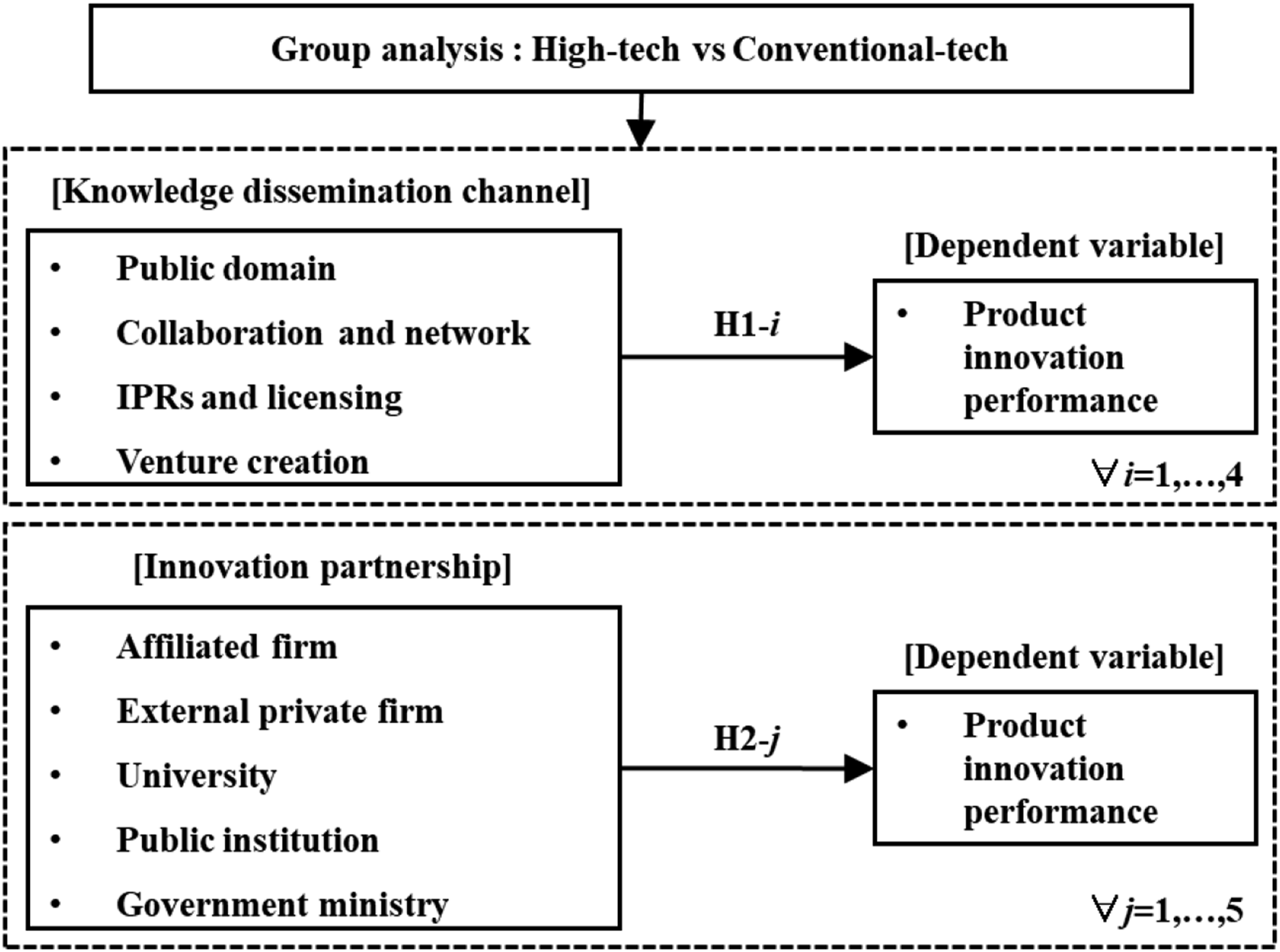
The knowledge dissemination channel model refers to the key sources of information necessary for manufacturing firms to generate product innovation, and the research hypotheses have been established as below.
Similarly, the innovation partnership model refers to the most useful collaboration partners for manufacturing firms to generate product innovation performance, and the research hypotheses have been established as below.
Research model and hypothesis: Product innovation performance model
Figure 3 illustrates the product innovation performance model, which identifies the innovation structure required for achieving product innovation performance in manufacturing firms and analyzes the characteristics of each element. It also includes a group analysis to discern the differences between high-tech and conventional-tech manufacturing firms. Product innovation performance model.
This model has product innovation performance as the dependent variable and six independent variables, which are divided into internal innovation capability and government innovation policy. Additionally, firm revenue and the number of employees were set as control variables to maintain the model’s balance. Accordingly, the following research hypotheses have been established as below.
Research data
This study utilized data from the ‘2022 Korea Innovation Survey (KIS) for the Manufacturing Sector’ (Approved Statistics No. 395001, Statistics Korea). Out of a total of 4000 samples, 1364 high-tech manufacturing firms related to ICT, pharmaceuticals, semiconductors, displays, computers, precision instruments, secondary batteries, advanced automobiles, and aerospace were selected according to the Korean Standard Industrial Classification (KSIC). The remaining 2636 samples comprised conventional-tech manufacturing firms.
Operational definitions of variables.

Note: Knowledge dissemination channels are based on the ‘2020 Korea Innovation Survey’.
Empirical results
Results of innovation ecosystem model: Knowledge dissemination channels
Innovation players utilize various knowledge dissemination channels within the innovation ecosystem when generating innovation activities and performance. According to Jaffe (1989), non-rivalrous and non-excludable channels, based on geographical proximity, primarily fall within the public domain, while non-rivalrous and excludable channels pertain to the domain of intellectual property rights (IPRs). Fundamentally, non-rivalry is associated with low transaction costs and represents ‘slippery knowledge,’ which has less limitation in terms of the speed and distance of knowledge dissemination. Conversely, rivalrous and non-excludable channels are found in the realm of collaboration and networks, while rivalrous and excludable channels belong to the area of venture creation. Rivalry is characterized by high transaction costs and ‘sticky knowledge,’ which has more limitation in terms of the speed and distance of knowledge dissemination.
Results of knowledge dissemination channel model (Logit model).

Note: Parentheses indicate White’s robust standard errors; statistical significance is denoted by ***p < .01, **p < .05, *p < .10; the data based on the ‘2020 Korea Innovation Survey’
The four different types of knowledge dissemination channels utilized by manufacturing firms to achieve product innovation performance demonstrated at least 5% statistical significance. Thus, all hypotheses can be accepted. According to the group analysis results, as shown in Figure 4, high-tech firms primarily utilize slippery knowledge channels, such as public domain and IPRs, which are directly related to R&D outcomes in the process of generating innovation performance. In contrast, conventional-tech firms mainly employ sticky knowledge channels, such as collaboration & network and venture creation. Results of a typology of knowledge dissemination channels between high-tech and conventional-tech firms.
Results of innovation ecosystem model: Innovation partnership
Results of innovation partnership model (Logit model).
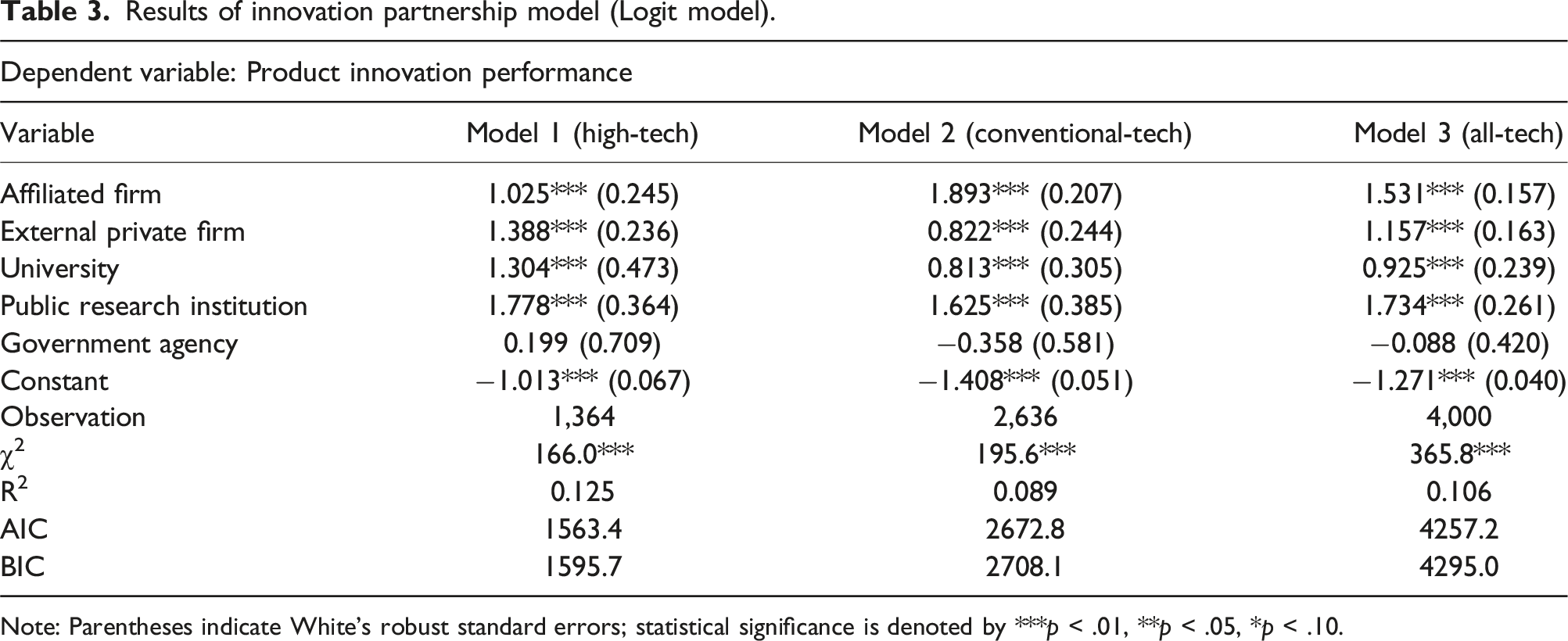
Note: Parentheses indicate White’s robust standard errors; statistical significance is denoted by ***p < .01, **p < .05, *p < .10.
Moreover, there are some differences in the importance of innovation partners across different technology groups. High-tech firms responded that public research institutions are relatively the most important innovation partners, while conventional-tech firms identified internal innovation resources and affiliates as their most important partners. These results show that high-tech firms pursue an open innovation approach, actively leveraging external ideas, technologies, or partnerships to enhance their innovation capabilities.43–45 In contrast, conventional-tech firms appear to follow a traditional approach, relying solely on internal resources, capabilities, and R&D efforts to create new products or technologies, primarily to prevent technology leakage and protect intellectual property rights.
Another notable finding is the high level of reliance on public research institutions within South Korea’s overall innovation ecosystem. This contrasts with the innovation ecosystems of Western countries, such as the United States and the EU, which tend to depend more heavily on universities. In South Korea’s innovation ecosystem, the role of universities is primarily focused on the cultivation of specialized human resources, while public research institutions are responsible for conducting basic research and R&D activities.
Results of product innovation performance model
Results of product innovation performance model (Logit model).

Note: Parentheses indicate White’s robust standard errors, and statistical significance is denoted by ***p < .01, **p < .05, *p < .10.
According to the group analysis results, similar outcomes were observed across different technology groups, but there were some variations in the effects of government innovation support policies. Among the government support policies for product innovation performance in manufacturing firms, direct financial support policies, such as R&D expenditure subsidies and tax credits, were found to be insignificant across all technology groups. In contrast, government technology support policies, such as tech transfer and commercialization support, were found to be significant for only high-tech firms. Notably, several previous studies have shown that direct financial support policies from the government may actually reduce a firm’s product innovation performance and could lead to issues of moral hazard. Therefore, technology support policies that strengthen R&D capabilities are considered to be more effective.4,46–48
Discussion
Previous studies on innovation ecosystems have predominantly focused on Western countries, failing to reflect the unique characteristics of Asian countries such as South Korea. For instance, in the United States, universities play a significant role within the innovation ecosystem, with technology transfer offices (TTOs) serving as key moderators within the triple helix framework. In contrast, South Korea places greater emphasis on the role of government-affiliated public research institutions rather than university TTOs. This distinction in the innovation ecosystem structure can be attributed to the different historical and institutional contexts of these countries. In the United States, universities have long been at the forefront of research and innovation, with well-established mechanisms for technology transfer to industry. South Korea, on the other hand, has historically relied more heavily on government-led research initiatives and public research institutions to drive technological advancement and economic growth.
The findings of this study share similarities with previous studies but also exhibit notable differences. The similarities suggest that the key elements of the innovation ecosystem can positively influence the innovation performance of manufacturing firms, a conclusion supported theoretically by prior studies. On the other hand, the differences may be attributed to the unique characteristics of the manufacturing industry in Asian countries, including South Korea. Even in cases where the results do not align closely with previous studies, this result offers meaningful and valuable insights. Based on the findings, the following policy implications are proposed.
First, to enhance the innovation performance of high-tech firms, it is necessary to strengthen government policies supporting technology transfer and commercialization. Expanding programs that promote collaboration between public research institutions and manufacturing firms could be particularly effective. Second, the findings of this study demonstrate that innovation strategies and performance structures differ based on the technological level within the manufacturing industry. Therefore, when implementing policies such as the ‘Smart Manufacturing Innovation Act,’ a differentiated approach tailored to specific industries and technological levels is essential. Third, given the importance of public research institutions in South Korea’s manufacturing innovation ecosystem, policies should be designed to strengthen the capabilities of these institutions and further promote collaboration with firms in the long term. Simultaneously, the role of universities should be redefined to enhance their competitiveness not only in cultivating talent but also in conducting fundamental research.
Conclusions
This study analyzed the innovation ecosystem and performance of manufacturing firms in South Korea amid the era of digital transformation, emphasizing the distinct innovation strategies of high-tech and conventional-tech firms. In response to the accelerated digital transformation triggered by the COVID-19 pandemic, the South Korean government implemented various policies, including the “Korean New Deal” and the “Smart Manufacturing Innovation Act,” to enhance firms’ innovation capabilities, particularly for small and medium-sized enterprises (SMEs). The primary objective of this research was to identify the structural characteristics of the innovation ecosystem and the key factors influencing innovation performance in South Korean manufacturing firms.
The study utilized data from the ‘2022 Korea Innovation Survey (KIS) for the Manufacturing Sector,’ analyzing 4000 manufacturing firms, including 1364 high-tech firms and 2636 conventional-tech firms. The research focused on two main models: the innovation ecosystem model and the product innovation performance model. The innovation ecosystem model has two parts. One is identified four different types of knowledge dissemination channels—public domain, collaboration & network, intellectual property rights (IPRs), and venture creation. Another is the importance of internal and external innovation partners, including internal resources and affiliates, external private firms, universities, public research institutions, and government agencies. Meanwhile, the product innovation performance model examined the impact of various factors, such as internal innovation capabilities and government support policies, on the innovation outcomes.
Major findings revealed that high-tech firms primarily rely on “slippery knowledge” channels, such as public domain and IPRs, to enhance their innovation performance, while conventional-tech firms depend more on “sticky knowledge” channels, such as collaboration & network and venture creation. Moreover, high-tech firms actively prefer external innovation partnerships, such as those with public research institutions, universities, and private companies, while conventional-tech firms tend to rely on internal resources and affiliates. This suggests that high-tech firms adopt an open innovation approach, actively leveraging external ideas, technologies, and partnerships. In contrast, conventional-tech firms tend to rely on internal resources and capabilities to prevent technology leakage and protect intellectual property rights.
The results also highlighted the significant role of public research institutions in South Korea’s innovation ecosystem, contrasting with Western countries like the United States and the EU, which depend more on universities. In South Korea, universities primarily focus on cultivating specialized human resources, while public research institutions lead in conducting basic research and R&D activities.
Furthermore, within the government innovation support policies, while direct financial support policies, such as R & D expenditure subsidies and tax credits, were found to be statistically insignificant across all groups, technology support policies, such as technology transfer and commercialization support, were significant for only high-tech firms. These findings align with prior studies indicating that direct financial support may reduce innovation performance due to moral hazard, suggesting that technology support policies that enhance R & D capabilities are more effective.
Despite deriving meaningful findings regarding the innovation ecosystem and product innovation performance of manufacturing firms, this study has several limitations. First, the dataset is based on the case of South Korea, which limits the direct applicability to other countries due to differences in industrial structures and innovation systems across nations. However, it is expected to serve as a valuable reference for Asian countries with similar industrial structures to South Korea. Second, this study utilizes cross-sectional data, which restricts the ability to capture the dynamics of the innovation ecosystem and product innovation performance in manufacturing firms. Therefore, further research might employ panel data to conduct a more in-depth analysis of these dynamics. Third, while this study focuses on product innovation performance, process innovation performance is equally important in manufacturing. In particular, most digital transformation technologies can positively influence the process innovation of manufacturing firms. Thus, further research may also analyze process innovation performance as a dependent variable.49–51
Footnotes
Declaration of conflicting interests
The author(s) declared no potential conflicts of interest with respect to the research, authorship, and/or publication of this article.
Funding
The author(s) disclosed receipt of the following financial support for the research, authorship, and/or publication of this article: This work was supported by the Chungbuk Research Institute; 2025.
