




Abstract
The government conducts feasibility studies as a way of determining allocated amounts in the government budget. It rationally adjusts the priorities of policymakers regarding new projects that will receive large budgets in the process of budgeting. In this article, efficient improvement plans and policies are proposed through research on preliminary feasibility studies for the government research and development (R&D) innovation strategy. First, the concept of a preliminary feasibility study and its methods are presented and discussed. A questionnaire survey was conducted on professional groups for the improvement of preliminary feasibility studies. The survey results were then subjected to influence factor analysis, and the results were used for research on the preliminary feasibility study improvement for the government R&D innovation strategy. These findings are expected to significantly contribute to improving the government’s public investment and science and technology policies.
Introduction
The Ministry of Science and ICT (MSIT) of South Korea established a government research and development (R&D) innovation plan in 2016, and as part of the said plan, science and technology development is being promoted as the country’s core future growth engine. The economic strategy centered on labor and capital input, which has led to the high growth of the South Korean economy and has already reached its limit due to the global economic crisis and the impact of emerging economies. South Korea is now faced with a low growth rate due to sluggish domestic demand, low birth rate, and the changes in the industrial structure. Also, the emergence of a new growth industry that would link the flagship industries has not been sufficient. R&D innovation acceleration is essential in resolving structural problems and in securing the future growth engine of South Korea’s economy. South Korea invested US$17.6 billion in government R&D in 2016. The South Korean government’s R&D investment has been steadily increasing (2003, US$6 billion → 2008; US$10.2 billion → 2014; US$16.3 billion → 2016; US$17.6 billion). All government R&D businesses have needed zero-based review for strategy investment enhancement through R&D efficiency. Reinvestment is done for the leading future and national strategy sector through the 15% restructuring of the R&D budget and resource reduction. The government budget request of South Korea’s MSIT was reduced by more than 5% based on the R&D innovation plan review and as part of the budget adjustment efforts. The reduced resources were reinvested for selecting and concentrating on the leading future and national strategy sector (2017, US$0.6 billion). The preliminary feasibility study is the most reasonable means to reduce and reinvest government budget. The preliminary feasibility study prevents the unnecessary use of government budget and can help investment for the necessary R&D business.
This research was focused on policy research on the preliminary feasibility study for the government’s R&D innovation plan. Governments around the world aggressively establish R&D strategies in the current era of the fourth industrial revolution, in which new and advanced technologies change the world at a dizzying pace (Internet of Things (IoT)], big data, artificial intelligence (AI), etc.). 1,2 Technology and engineering R&D was not performed in a timely way, and excellent research results were often dropped due to the limited preliminary feasibility studies in South Korea. South Korea’s MSIT finally confirmed its preliminary feasibility study results in the Science and Technology Strategy Council. It has attempted to reflect the determined R&D business on the government R&D budget (2017) through project business groups for universities, institutes, enterprises, and the government. The national R&D plan can also ensure timeliness through the improvement of the preliminary feasibility study process.
This study background emphasizes the need for improvement in conducting the preliminary feasibility study because of its growing importance. Improvement is urgently needed for the efficiency and accuracy of economic validity analysis, policy validity analysis, technical validity analysis, and AHP comprehensive evaluation.
In this article, an efficient improvement plan and policy is proposed based on the results of a research on the preliminary feasibility study as a tool for determining the government’s R&D innovation strategy. These findings are expected to significantly contribute to the government’s public investment and science and technology policies.
Preliminary feasibility study
The government conducts feasibility studies as a way of determining the amount of resources to be allocated to the government budget from the country’s limited resources. 3 –5 It helps rationally adjust the priorities of the policymakers with regard to new projects that need large budgets in the process of budgeting. 6 –8 The preliminary feasibility study reviews the technological aspect of the government R&D business in terms of its propriety and the financing method used. 9 –12 It is based on the available economic data and reviews the government’s R&D business, and it is used to come up with an efficient and realistic plan through economic, policy, and technical analyses, among others, in its financial management frame. 13 In the comprehensive analysis process, the comprehensive analysis is limited to the missing non-physical elements that are difficult to quantify and qualify. Evaluation results of the various policy effects are presented as quantitative indicators of the qualitative contents and can serve as objective criteria for a comprehensive evaluation, such as the degree of importance of the policy effect and the economic efficiency. 14 –16 The institutional aspect of evaluation for driving sustainable development is shown in Figure 1.
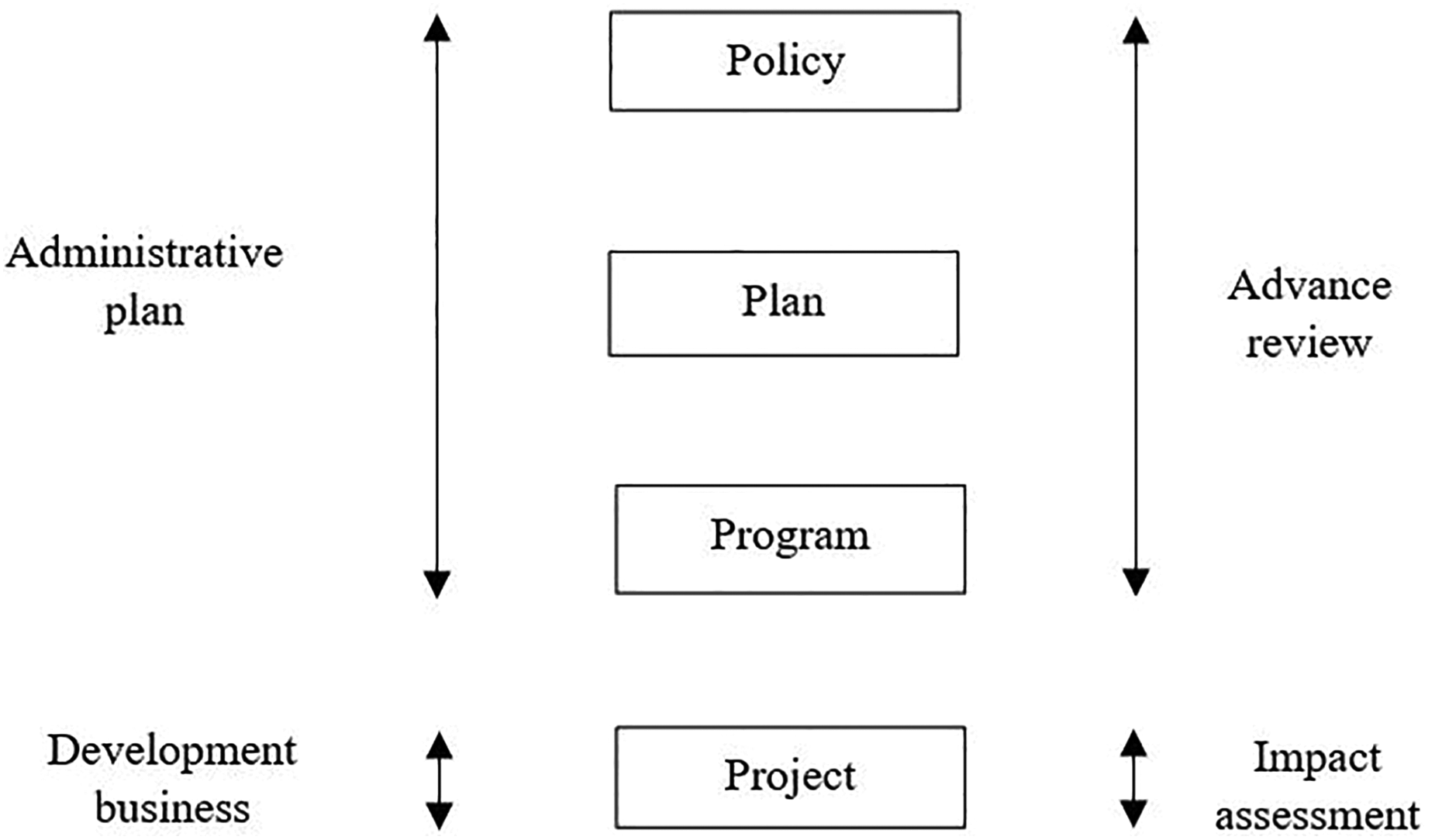
Institutional aspect of evaluation to drive sustainable development.
The Ministry of Strategy and Finance (MOSF) is conducting a preliminary feasibility study to fairly and objectively investigate the feasibility of a large-scale public project in South Korea. The study target is the total cost of the target business (more than US$46 million) and of new treasury businesses (more than US$28 million). The new businesses involve the informatization, construction, and R&D businesses. Other new financial businesses with medium-term fiscal expenditures of more than US$46 million have undergone a preliminary feasibility study, along with other new financial businesses like those related to social welfare, health, education, labor, cultural tourism, environmental protection, industry (agriculture, forestry, and marine), and small and medium-sized industrial businesses. Private investment projects are undergoing a preliminary feasibility study for a total cost of more than US$46 million for each target business and more than US$28 million for each new treasury business. In South Korea, a preliminary feasibility study was conducted on a total of 654 cases (based on the survey of completed projects) from 1999 to 2016. Among all the businesses, road and railway projects accounted for 53% of the cases that have undergone preliminary feasibility studies (road projects: 229 and railway projects: 118). Since 2007, the conduct of preliminary feasibility studies has been expanded to include other irregular projects, such as construction projects. Considering the total cost of the project from 1999 to 2016, a preliminary feasibility study was conducted to review the total project cost of US$278 billion. The total project cost of the projects reviewed (US$5.5–31 billion each year) and the total cost of the road and railway projects account for 69.2% of the total. The Ministry of Land, Infrastructure, and Transport (MOLIT) and the Ministry of Oceans and Fisheries (MOF) have conducted 434 preliminary feasibility studies to date (66.4%).
Since recently, various preliminary feasibility study systems have been utilized by various business departments, such as the National Tax Service (NTS) and Internal Revenue Service and the Ministry of Employment and Labor (MOEL), in accordance with the expansion of the range of preliminary feasibility studies. The preliminary feasibility studies that have been conducted showed a 47.5% economic feasibility rate (benefit–cost (B/C) ≥ 1), with the economic feasibility rate of harbor projects being the highest (62.8%). Those of other projects were from 40% to 53%. 17 The performance of preliminary feasibility studies is depicted in Table 1, while the economic feasibility rate is shown in Table 2. The government’s R&D business was included in both tables. The preliminary feasibility study selection criteria were determined to consist of the business goal, implementation system, budget, manpower, and private ownership possibility judgment, by reviewing the conformity of the upper plan and the concreteness of the business plan. The preliminary feasibility study selection criteria should be considered through the project implementation urgency evaluation in the national mid- to long-term plan, the priorities of the concerned government department, and the budget for the next year. Regional balance development and economic development (local businesses) and the technology demand analysis and development possibilities (R&D projects) should be considered based on the regional development factor and through evaluation of technology development potential. The appropriateness of financial support, such as fiscal support and the financial allocation method, should be determined through the appropriateness evaluation of the treasury support.
Performance of preliminary feasibility study (number of cases).

Peliminary feasibility study economic feasibility rate (B/C ≥ 1, %).

The financial advisory council determines the final destination through the preliminary feasibility study selection criteria. In South Korea, MOSF conducts preliminary feasibility studies, the Korea Institute of Science & Technology Evaluation and Planning manages the preliminary feasibility studies on the government’s R&D businesses, and the Korea Development Institute manages the preliminary feasibility studies on the other government businesses. The dedicated specialist research team consists of a research institute, a university, an engineering company, and so on. The preliminary feasibility study performance method is shown in Figure 2. 18

Preliminary feasibility study performance method.
Preliminary feasibility study analysis method
The methods employed in the conduct of preliminary feasibility studies for the government’s R&D businesses are classified into economic validity analysis, policy validity analysis, technical validity analysis, and analytic hierarchy process (AHP) comprehensive evaluation. The scope of the preliminary feasibility study analysis method is shown in Figure 3.

Preliminary feasibility study analysis method scope.
Economic validity analysis
The major scope of the economic and policy analyses of preliminary feasibility studies spans government businesses. Economic validity analysis is a core survey process for the economic effect and the suitability of investment. Basically, it adopts a cost-benefit analysis. Surveys of economic validity analysis cover the following factors: appropriateness of assessment and management, rationality of funding and allocation method, practicality of technology development, appropriateness of budget scale and project performance duration, forecast of technological demand and future performance, R&D success possibilities (industrial competitiveness, the success potential of market entrance and growth, etc.), prospects for economic and social performance, the benefits of R&D achievement, and the ripple effect among others. Economic analysis is the most important analysis based on the cost-benefit analysis for surveying the business impact and investment suitability. To determine the economic validity of a government business, its financial affairs are evaluated through the B/C ratio, net present value (NPV), internal rate of return (IRR), and so on. B/C has economic validity when it is above 1 (B/C ≥ 1). The benefit estimate is identified as a benefit item. The detailed formula is as follows:

where Bbt is the benefit estimate value, Dbt is the demand estimate value, Pb is the per unit value, and t is the time.

where Bbt is the benefit estimate value, Bt is the benefit estimate sum, and t is the time. The detailed formula for B/C is as follows:

where Bt is the total benefit, Ct is the total cost, r is the discount rate, and n is the analysis period.
The NPV should be estimated through the cost and benefit criteria for the government business. NPV is the amount minus the present value of the base year for the cost and benefit of a government business. It is the total benefit minus the net benefit. It has economic validity when it is above 0 (NPV ≥ 0). The detailed formula is as follows:

where Bt is the total benefit, Ct is the total cost, r is the discount rate, and n is the analysis period.
IRR is a method of obtaining the discount rate, at which the values converted to the present benefit-cost values become equal. It makes the NPV “0” when the government business is performed. When IRR is greater than the social discount rate, it has economic validity. The detailed formula is as follows:

where Bt is the total benefit, Ct is the total cost, r is the discount rate, and n is the analysis period.
Policy validity analysis
Policy validity analysis is used when an economic validity analysis cannot quantify the cost and benefit in R&D business evaluation. Policy validity analysis is a method for analyzing critical evaluation items that cannot be done in a B/C analysis. It is an evaluation factor to consider when judging whether the government business should be carried out or not. It is difficult to judge whether a government business should be implemented only through economic validity analysis. Public finance is built on the government’s funding character. The review involved in policy validity analysis is highly diverse, including the analysis of the economic ripple effect, the consideration of regional balance development, the feasibility of the financing plan, the validity of fiscal support, the environment, the culture, and so on. In this study, the analysis of the ripple effect of the regional economy, the regional underdevelopment evaluation for regional balance development, the feasibility of the financing plan, the region preference, and the relevance evaluation for the upper plan were evaluated as the major factors that should be considered in policy validity analysis. Therefore, the policy consistency and commitment (degree of commitment of the government business, relevance of the upper plan, preparation of the government business), the risk factor (validity of fiscal support, environment), and the government business special evaluation item should be estimated comprehensively and qualitatively.
Technical validity analysis
Technical validity analysis technologically reviews the government business validity. It is only an estimation factor for the government’s R&D businesses. The qualitative estimation of the implementation of government business assesses the appropriateness of the technology development plan (appropriateness of the planning process, appropriateness of the business objectives, appropriateness of the implementation system, and adequacy of details), the possibility of technology development success (analysis of the technology level and competitiveness, reduction of the technological gap for developed countries), and the redundancy for the existing government business estimation (redundancy of the business and project levels, appropriateness of the support scale). Surveys associated with government technical validity analysis include the following: the excellence of R&D business (performance ability, achievement, and task understanding); the validity of an application for creativity and pre-study for R&D business; the infrastructure, excellence, innovation, and differentiation for R&D business; the strategic direction and systematic adequacy for R&D business; the appropriateness of composition of sub-unit projects and tasks; the significant technological advancement and transfer (the product, the process, the service, etc.); and the ripple effect.
AHP comprehensive evaluation
To make a final decision on whether or not to implement a government business, it is necessary to comprehensively evaluate the economic, policy, and technical validity. Economic analysis focuses on the efficiency of the government business, policy analysis focuses on the fairness, and technical analysis focuses on the adequacy, possibility, and redundancy. Comprehensive evaluation applies AHP and utilizes standardized scores for government business implementation. AHP has business implementation validity when it is above 5 (NPV ≥ 5). Comprehensive evaluation (brainstorming → structuring → measurement → feedback) should be implemented and presented with appropriate comments based on the AHP results. The mission of the preliminary feasibility study team is not to determine the final investment for a government business but to produce the data needed by the government for it to be able to make the most reasonable final decision. Decision-making based on an arbitrary multi-criteria guide and the obtained economic and policy analysis data on the part of the preliminary feasibility study team is not desirable. It is preferable for the obtained economic and policy analysis data to be arranged in a parallel manner. This can also help the preliminary feasibility study team make the best choice, without any prejudice.
Research design and method
In this article, economic validity analysis, policy validity analysis, technical validity analysis, and AHP comprehensive evaluation are discussed. A questionnaire survey was conducted on a professional group for the improvement of preliminary feasibility studies.
First, influence factor analysis was conducted. Factor analysis is a research method for reducing the variables through correlation analysis between the variables (covariance and correlation). The remaining variables can represent all the data. Factor analysis can easily understand and analyze information and can abbreviate several core internal factors when the given information is voluminous. Correlation analysis using covariance should simultaneously consider the distribution of two variables. In this case, it is called “covariance” and is distinguished from general variance, which shows a common distribution between two variables. Covariance is a representative indicator of the linear association between two variables. It is a concept similar to general variance and is a value indicating that the observations are scattered from the mean. In general, variance is the average of the squared values of the observed values for the variables, which indicates that the observed values are far from the average value of the variables. This is the mean of the squared deviation. The covariance is calculated as the deviation of the mean for the variables of the observations that have two or more variable values at the same time. It is the average of the variances multiplied. It is also a variance that represents a common distribution between two variables, measured through the interval or ratio scale. It is a representative indicator of the linear association between two variables. When the covariance as a positive number is very large, the two variables have a positive linear association; when the covariance as a negative number is very small, the two variables have a negative linear association. The linear association between two variables is determined through the scale of the covariance, which indicates that the variable is changing in conjunction with another variable.
The detailed formula for sample dispersion is as follows:


The detailed formula for sample covariance is as follows:

Confirmatory factor analysis was utilized for the R-type factors. This method is based on the previously developed research models or on prior knowledge. It is an analytical method of confirming if the content is correct for the extracted variables and the variables belonging to each factor.
Research results
A questionnaire survey was conducted on a professional group (30 specialists) for the policy research on preliminary feasibility studies for the government’s R&D innovation strategy. The professional group consisted of 10 professors, 10 scientists, and 10 engineers. Fourteen variables were selected for the major influence factor analysis in the preliminary feasibility study, with each variable consisting of seven steps for the interval scale. The factor method is effective for extracting and analyzing the core common factors. Also, reliability verification is required for the extracted factors. The reliable factors obtained from the reliability verification can be utilized in the various types of analysis and for effective policymaking.
First, the review opinions of the professional group were surveyed and were utilized as the interval scale. Factor analysis was then performed for the extraction of the core common factors, then the reliability was tested. The extracted factors were set as the independent variables, and the review opinion of the professional group was set as the dependent variable. Multiple regression analysis was performed using the independent and dependent variables, and comparative analysis was performed using the standardized regression coefficient obtained through regression analysis. The questionnaire items are presented in Table 3.
Questionnaire items.

R&D: research and development.
The correlation coefficients between the input variables were analyzed through the questionnaire survey results. The correlation matrix is presented in Table 4. The Kaiser-Meyer-Olkin (KMO) is a value indicating the correlation between the input variables. When it is above 0.5 (KMO ≥ 0.5), the correlation is high. Based on the analysis results obtained, the correlation between the input variables is not high because the KMO value is less than 0.5 (KMO < 0.5), which is statistically significant. The correlation matrix is related to the variables. The KMO and Bartkett’s test are presented in Table 5. “Communalities” refer to the distribution of variables, which is explained through the extracted factors. The variable distribution can be described because the communalities are above 0.5 (communalities ≥ 0.5). The communalities values are presented in Table 6. The total variance explained can describe the variance distribution of the extracted factors. The eigenvalue is the value that explains the positive dispersion. In this study, seven factors were extracted (eigenvalue ≥ 1). In the analysis results, seven factors indicate that the total variance of all the input variables is 78.8%. The total variance value is presented in Table 7. The screen graph is a graphical representation of the eigenvalue of each factor, from small to large. Generally, the number of factors is determined at a point where the eigenvalue is greater than 1. Seven factors were selected in the results. The scope of the methods of preliminary feasibility study analysis is shown in Figure 4. The component plot in a rotated space is shown in Figure 5. Factor loading is the correlation coefficient between the derived factor and each variable. The rotated component matrix is presented in Table 8 and is calculated through regression analysis. The result is shown in Table 9. The factor scores can be obtained through the total sum for multiplying the coefficients given in the component score coefficient matrix and the input variable Z. The component transformation matrix is presented in Table 10, the component score component matrix is presented in Table 11, and the component score coefficient matrix is presented in Table 12.
Correlation matrix.

KMO and bartlett’s test.
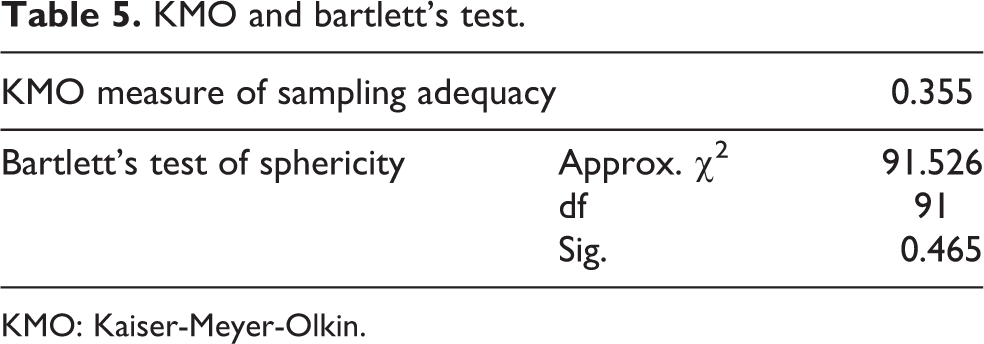
KMO: Kaiser-Meyer-Olkin.
Communalities.a

a Extraction method: Principal component analysis.
Total variance explained.a

a Extraction method: Principal component analysis.
Component matrix.a
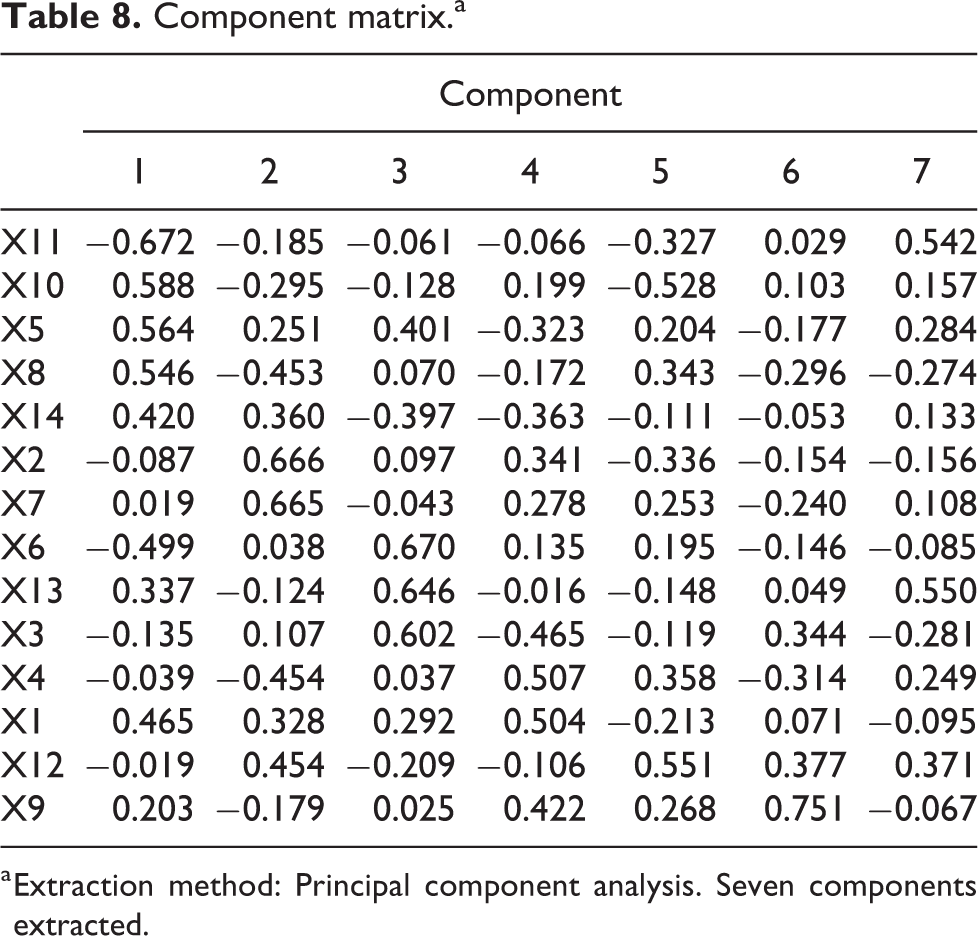
a Extraction method: Principal component analysis. Seven components extracted.
Rotated component matrix.a

a Extraction method: Principal component analysis. Rotation method: Varimax with Kaiser normalization. Rotation converged in nine iterations.
Component transformation matrix.a

a Extraction method: Principal component analysis. Rotation Method: Varimax with Kaiser Normalization.
Component score coefficient matrix.a

a Extraction method: Principal component analysis. Rotation method: Varimax with Kaiser normalization Component scores.
Component score coefficient matrix.a

a Extraction method: Principal component analysis. Rotation method: Varimax with Kaiser normalization Component scores.
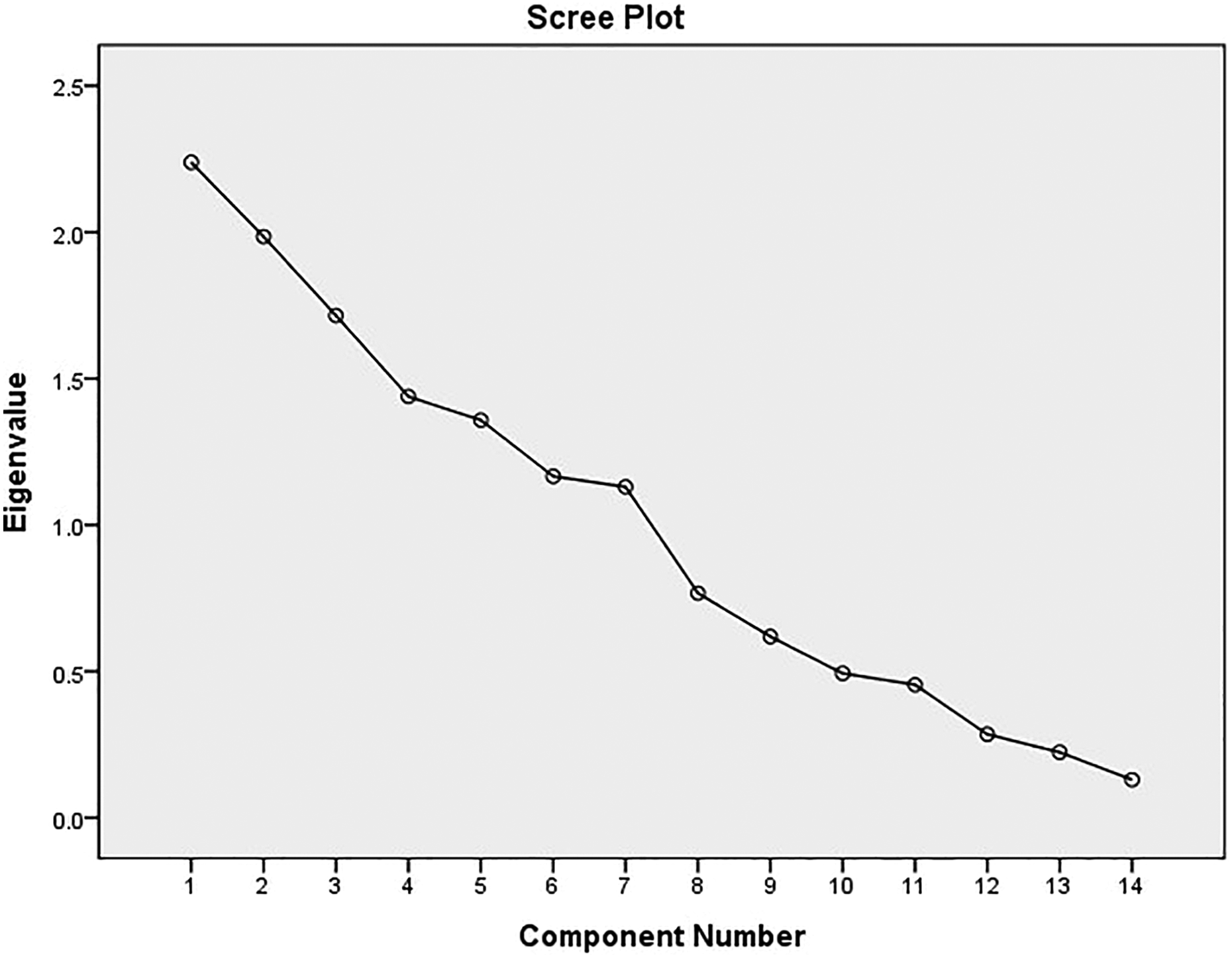
Scree plot.

Component plot in a rotated space.
Policy implications and conclusions
First, more accurate analysis results can be derived by improving the economic validity analysis. Basic science research equipment and facilities are difficult to quantify through B/C ratio analysis, because it is difficult to specify the final results and identify the end users. A comprehensive analysis of the economic ripple effect and the R&D contribution possibility through a survey of specialists or related enterprises is desirable. Qualitative evaluation based on cost-effectiveness analysis is needed, through a questionnaire survey. If the B/C ratio is adopted to maintain the consistency of the overall preliminary feasibility framework, it is necessary to use the same valuation technique as much as possible for a similar function business and to consider ways of estimating the benefits based on various scenarios. In basic science, the government R&D investment rate can be calculated through a survey on the contribution of universities and institutes in the development of promising technologies (IT, materials, pharmaceuticals, etc.). In particular, Information Technology (IT) governance has risen in importance in recent years, driven by various trends in IT development. 19 It is possible to derive the benefit induction coefficient. To calculate the general construction cost, the operation cost, and the research cost, the accounting information of the long-term government R&D should be utilized. The research and operation cost should be also be estimated accurately. For the replacement cycle of large-scale facilities, the estimation cost and basis should be presented in advance, when the business plan is submitted. The cost scale should be determined through consultation with specialists.
Accurate results can be generated by improving the policy validity analysis. In R&D investment, the development evaluation item of regional balance should not be separated. It is beneficial to evaluate the development of regional balance only for businesses aiming to establish regional science and technology infrastructure, rather than for building institutions and equipment that have technical development functions focusing on business objectives. The possibility of linking with the specialized industry that is mainly being promoted in the region should be explored for the purpose of improving the underdeveloped regional technology infrastructure. Also, there is a need to differentiate the development evaluation item of regional balance from the other items. The funding plan of the research institute should be submitted with reference to the case of the benchmarking institution when the business plan is submitted. The possibility of private research fund procurement should be differentiated according to the technical field and development stage (basic planning, application, development, etc.). The possibility of competitive research fund procurement should also be evaluated considering the research ability.
Improvement of technical validity analysis can produce more accurate analysis results. When technology development has been completed (paper, patent, etc.), the research implementation ability, the possibility of R&D implementation duplication, and the manpower training function for the technical validity analysis should be judged based on the level of contribution to enhancing the national technological competitiveness. The possibility of technological development success should be increased when the R&D business is performed, as an evaluation factor of the supply and demand of the technical manpower. Commercialization is a critical step in technological innovation. 20 Innovation activities are a critical factor in national and regional development. 21 Considering that the necessary sources of innovation are widely dispersed around the world, organizations need to identify and connect to new external sources to develop new technologies. 22 Innovation debates dealing with regional economic development have generally focused on densely populated, technologically advanced areas and areas around university cities, undervaluing rural regions and their integration in national innovation systems. 23 A group of specialists on the technological capabilities of R&D equipment and facilities should participate in the preliminary feasibility study. The technical aspects should be reflected on the preliminary feasibility study. There is also a need to institutionalize AHP evaluation for the R&D business through the participation of a group of related specialists. To ensure objectivity and fairness, the pool of specialists should be broad and diversified.
Improvement of AHP comprehensive evaluation can give more accurate analysis results. Economic validity analysis, policy validity analysis, technical validity analysis, and AHP comprehensive evaluation should be comprehensively reflected for the decision-making on the validity of government businesses. The analysis results of AHP comprehensive evaluation should be applied and utilized by policymakers and interested parties.
The decision-making system of public investment project is needed for the preliminary feasibility study. The decision-making system consists of government plan, regional development plan, validity analysis, investment decision, and budget assignment. Securing objectivity in the process of making public investment decision is possible through checks and balances for the parties involved in public investment. The structure is necessary to determine the priority of projects in preliminary feasibility study and validity analysis through the opening of information related to public investment decision.
In this article, the concept of a preliminary feasibility study and its methods are presented and discussed. A questionnaire survey was conducted among professionals (30 specialists) regarding the policy research on the preliminary feasibility studies for the government’s R&D innovation strategy. The survey results were then subjected to influence factor analysis. Based on the results, suggestions for improving the conduct of preliminary feasibility studies for the government’s R&D innovation strategy were presented and discussed. These study’s findings are expected to significantly contribute to the improvement of the government’s public investment and science and technology policies.
Footnotes
Declaration of Conflicting Interests
The author(s) declared no potential conflicts of interest with respect to the research, authorship, and/or publication of this article.
Funding
The author(s) received no financial support for the research, authorship, and/or publication of this article.
