



Abstract
Complex products and systems (CoPS) development demands effective risk management, which is frequently impeded by a lack of clarity regarding the impact of risks on performance. This study aims to investigate how multiple risks jointly affect innovation performance in CoPS projects. Based on the configurational theory and WSR framework, we use fuzzy set qualitative comparative analysis (fsQCA) with data from 97 CoPS projects and examine the combined effects of risks on innovation performance. We identify two types leading to high innovation performance and four patterns causing low innovation performance. The results verify the asymmetrical causality of the influence of risks on innovation performance in CoPS projects. The findings contribute to broadening the relationship studies of risk and innovation performance by adopting an empirical method in the context of CoPS. Moreover, our study can help managers implement flexible risk management activities within CoPS projects, by addressing several equivalent and distinctive paths.
Keywords
Introduction
Complex product systems (CoPS) have been widely discussed owing to their high added value and unique position in the national strategy.1,2 They are characterized by high-cost and high technology, customized for specific customers, and developed in multi-party projects, 3 which exclusively refer to engineering-intensive products, systems, networks, and constructs. These attributes bring numerous product components, tasks, and human interactions in CoPS development, 4 which makes the CoPS projects full of risks and difficult to achieve target innovation performance. 5 For example, due to the technical challenges were not promptly addressed and quality issues with crucial component suppliers, the development of the Chinese C919 aircraft was originally scheduled in 90 months but was finally completed in 127 months. In practice, understanding how risks influence innovation performance within CoPS projects can help managers cope with risks and implement performance management better. 6
Risk analysis, as the premise of risk management, is to evaluate risks’ impact on outcomes and support the decision-making in terms of planning response actions and allocating resources. 7 Exploring the specific relationships between risks and innovation performance helps managers formulate an effective risk management strategy. 8 Moreover, considering the high complexity of humans, technology, and organization in CoPS projects, risks are usually interdependent and jointly affect the innovation performance. 9 Revealing the compound paths of risks to innovation performance provides a synthetic perspective to understand complex risk activities. Furthermore, the high cost, long cycle, and complex technology of CoPS development mean it needs abundant resources, while resource allocation in realistic is usually limited and different in various projects. 10 Thus, it is not suitable to follow a unique path to manage risks and performance. Providing a flexible and alternative path will benefit to give effective guidance for practical risk management.
Despite these challenges, existing studies fall short of providing specific guidance on the risk management of the CoPS projects. First, prior studies on risk analysis mainly concentrate on the utilization and improvement of techniques for quantitative risk analysis and pay less attention to exploring the effects of risks on innovation performance, which might contradict the calling on integrating risk and performance management.
11
Second, extant studies usually analyze the risks independently according to their single effect,
12
which is not conducive to reflecting the characteristics that risks perform interdependence and produce a collective impact on the performance of CoPS development. Third, the literature placed greater emphasis on examining particular risk management activities at the level of individual projects, and this has made it unclear when extending to a different industry setting.13,14 However, resource distribution is constrained and differs throughout CoPS projects, indicating that it’s difficult to follow a unique path.
15
Therefore, to cover the shortages, the research question of this study is:
To address this question, the study adopts a configurational thinking approach to explore the different configurations that consist of diverse risks. Specifically, based on the previous studies and practical requirements, we select seven typical risks in CoPS projects, including technological risks, environmental risks, communication risks, resource capacity risks, digital capacity risks, human risks, and trust risks. Subsequently, we introduce the WSR (Wuli-Shili-Renli) framework to classify these risks and take the configurational theory (see more in section 2) to reveal the joint effects, with a sample of 97 Chinese CoPS development projects.
The main contributions of this paper are multifold. First, it broadens the studies on the relationship between risks and innovation performance in CoPS projects, by exploring the risk combinations of high innovation performance and low innovation performance. Second, it contributes to the literature on risk analysis in CoPS projects, by considering the inter-relationships among risks and analyzing a configurational effect rather than net effects on innovation performance. Third, this article expands the research scope and approach to risk management in CoPS projects by employing an empirical approach that encompasses 97 examples from various industries. From the managerial perspective, this study offers specific guidance for managers in CoPS development, by offering several equivalent configurations that can be flexibly employed according to their resources in realistic risk management activities.
The remainder of this paper is organized as follows: Section 2 provides the literature review and theoretical development. Section 3 describes the research framework. Section 4 introduces the data and methodology. Section 5 presents the main results. Section 6 presents a conclusion and its implications. Lastly, in Section 7 we put forward the limitations of this paper and provide several future avenues.
Literature review and theoretical development
Risks of CoPS development projects
Risks refer to uncertain activities that may lead to development failures and undermine the successful realization of the innovation performance, like time, cost, scope, and quality. 5 CoPS development is facing a growing complexity in its organizational structure, technology, and tasks. Managers must recognize the potential risks using their tacit knowledge and experience to analyze and cope with them. 16 According to the existing literature, we summarize some typical risks identified from various perspectives in CoPS development (see more in Appendix I). Although multiple risks are identified by researchers in CoPS projects, a comprehensive perspective and an appropriate risk classification are still needed for further effective risk analysis activities. 17
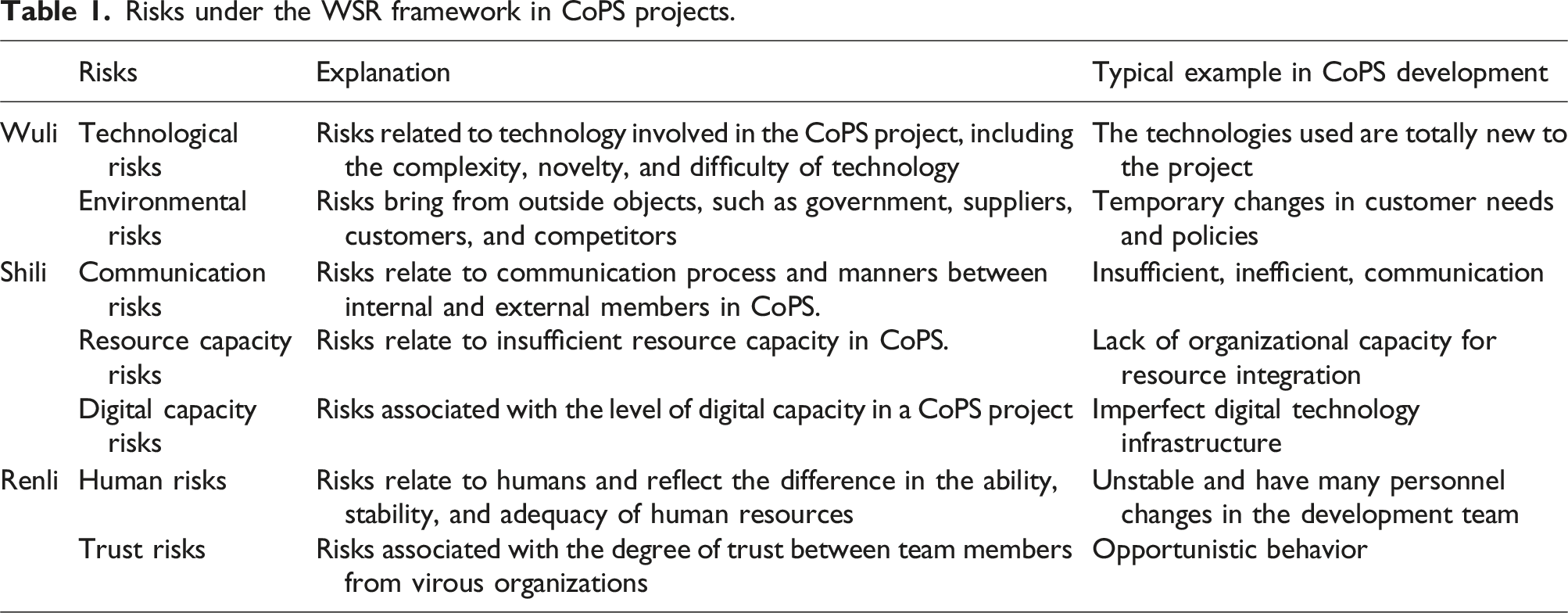
Risks under the WSR framework in CoPS projects.
Risks and innovation performance in CoPS development projects
Effective risk analysis helps organizations identify the most significant risks and is the premise of developing an appropriate response strategy. Researchers have used a variety of quantitative techniques to carry out a very thorough risk assessment study. A topological study using network theory was given by Fang et al. (2012) in order to identify important elements in the structure of interrelated risks that could affect a large engineering project. 5 Literature 24 used Colored Petri Nets (CPNs) to model risks in Enterprise Resource Planning (ERP) projects to deal with the problem of interdependence in risk assessment. Hu et al. (2023) built a quality risk assessment model that used FMEA, IPA, and Kano’s model to evaluate the quality risk for the city bus service system. 25 These studies offer valuable insights into evaluating the significance of risk in CoPS projects. However, they do not establish a connection between risk analysis and innovation outcomes within CoPS projects, which hinders the application of risk management strategies that facilitate the attainment of performance objectives.
As scholars are increasingly prioritizing the examination of the correlation between risk and performance, 6 corresponding studies have been conducted. In their study, Nepal and Yadav (2015) employed Bayesian belief networks to investigate the impact of sourcing risk on cost outcomes for suppliers chosen in complex product projects. 26 Taylor et al. (2018) conducted case studies to gain a comprehensive understanding of the main uncertainties and how they impact performance within global product development projects. 8 Literature 11 examines the influence of uncertainties on innovation performance in the pharmaceutical sector. They analyze data from 96 pharmaceutical companies in the United States and find that partnerships can enhance innovation performance by effectively managing risks. However, they mostly focused on the individual effect of risk on performance and paid attention to a single CoPS industry. Whereas, risks are often inter-relationships with other risks and produce a joint effect on the results. 15 Thus, it’s necessary to explore the relationship between risks and performance in a collective perspective encompassing several CoPS industries, in order to bring operability and specific guidance for both theory and practice in CoPS projects.
Configurational theory
Configurational theory is first introduced by Danny Miller in organizational management studies. 27 The theory focuses on the non-linear relationships and the complex causality between multiple antecedents and outcomes, which distinguishes from the traditional correlation theory to study linear and symmetrical relationships between individual antecedents and outcomes. 28 Its theoretical advantages compared to traditional correlation theory are mainly reflected in three aspects. First, configurational theory can provide a systematic research perspective that emphasizes the joint effect of antecedents on the outcome. 29 Second, it can help discover the equivalent solutions, which breaks the mindset of “optimal distinctiveness”. 30 Third, it can explore the asymmetry of causality, i.e., the antecedent to high performance and low performance is different. 29
Owing to these advantages, configurational theory is valued and used by scholars studying a range of complicated management issues. For example, literature 31 gathered 248 personal data to investigate the interrelationship between internal marketing, knowledge management processes, and knowledge worker satisfaction. The use of fsQCA reveals multiple pathways to improve knowledge worker satisfaction and exposes asymmetric relationships between internal marketing and knowledge management processes that lead to knowledge worker satisfaction. Chen et al. (2022) developed a configurational framework and proposed that digital transformation does not depend on a single condition but on interactions between environmental uncertainty and resource orchestration. Based on a fuzzy-set qualitative comparative analysis of 25 Chinese enterprises undergoing digital transformation, they showed that both high and not-high levels of digital maturity can be achieved through different configurations of antecedents. 32
However, there is still a lack of the application of configurational theory in CoPS development issues. However, CoPS projects are compliant with the characteristics of complex systems, risks usually perform interdependence and produce a collective impact on the innovation performance. In addition, configurational theory can provide several comparable approaches that correlate to the occurrence in CoPS projects where resources are diverse and constrained across different projects. This implies that a flexible and alternative approach should be pursued. Moreover, the considerable intricacy of persons, tasks, and technology in CoPS projects necessitates the management of high complexity. It is crucial to differentiate the impact of risks on high and low performance to effectively apply risk management strategies. Therefore, it’s suitable and necessary to provide a more precise analysis of risks and innovation performance based on configurational theory in CoPS development.
Research framework
Based on the literature review, this paper finally focuses on seven types of risks, i.e., technological risks, environmental risks, communication risks, resource capacity risks, digital capacity risks, human risks, and trust risks. To enhance the effectiveness of risk analysis, we utilize the WSR theoretical framework as a systematic categorization method to further categorize risks. We categorize technological risks, environmental risks as Wuli risks, communication risks, resource capacity risks, digital risks as Shili risks, human risks, and trust concerns as Renli risks following the concept of the WSR framework.
Wuli risks and innovation performance within CoPS projects
Wuli risk refers to uncertainties that are resistant to modifications based on subjective ideas. This research focuses on two specific risks: environmental risks and technological risks. Their specified impact on the performance of the CoPS project is as follows.
Technological risks (TR): this risk is related to the technology involved in the CoPS project, including the complexity, novelty, and difficulty of technology. 33 On the one hand, managing a complicated product presents greater challenges and makes achieving project performance more difficult. 34 On the other hand, the successful development of advanced technologies can result in substantial performance improvements.
Environmental risks (ER): this risk is mainly related to outside stakeholders, such as the government, suppliers, customers, and competitors. 35 Anticipating policy changes is challenging, however, they can have a direct impact on the project development process and may even cause project interruptions. Customer demands can also exert a substantial influence on the execution of the project, thereby impacting the ultimate success of the innovation. 36 A stable external environment will benefit the achievement of innovation performance within CoPS projects. 37
Shili risks and innovation performance within CoPS projects
Shili primarily focuses on aspects associated with actions, specifically risk factors that arise from techniques, capacities, and other elements in the CoPS development process. This research focuses on three specific risks: Resource capability risks, Communication risks (CR), and Digital capability risks (DR). Their specified impact on the performance of the CoPS project is as follows.
Resource capability risks (RR): this risk focuses on the capability of resource integration and leverage within CoPS projects. 38 The process of complex product creation requires the allocation of several resources and their corresponding subjects, which are characterized by a high level of uncertainty. Having abundant resources ensures the successful advancement of CoPS projects 39 while possessing strong resource integration capabilities facilitates the efficient promotion of the project innovation performance. 40
Communication risks (CR): this risk concentrates on the communication process and manners between internal and external members in CoPS. 16 A standardized communication method enables the effective flow and distribution of knowledge and information, serving as the basis for the development process to ensure the seamless progress of CoPS projects. 41 Whereas, excessive reliance on stereotypical communication methods can also hinder the prompt exchange of information, which is not beneficial for sharing technical knowledge and eventually affects innovation performance.
Digital capability risks (DR): this risk stresses the uncertainties of acquiring, deploying, and reconfiguring digital-related resources in supporting CoPS development, 42 it will also affect the innovation performance. Specifically, the possession of advanced digital technology can enhance management efficiency during project development, facilitate knowledge sharing, and ultimately contribute to improved member capabilities and innovation performance.
Renli risks and innovation performance within CoPS projects
Renli mainly focuses on aspects connected to human resources in the workplace, such as risk factors deriving from the competency of individuals and the relationships among partners involved in the CoPS development process. This research focuses on two specific risks: human risks and trust risks. Their specified impact on the performance of the CoPS project is as follows.
Human risks (HR): this risk results from the development team of CoPS projects, which includes uncertainties about the R&D team’s technological expertise, development background, and capacity for handling conflict. 43 Elevated levels of technological subjectivity will impede the advancement of CoPS innovation initiatives, impeding the attainment of anticipated objectives. 44 For example, a team with too little expertise may encounter many operational issues and be unable to resolve them quickly, which might result in project failure. Technological subjective risks need to be included in the link between risks and innovation performance.
Trust risks (TrR): this risk is mainly related to the relationships among partners within CoPS projects. The relationships among collaborative partners influence the internal innovation environment, which in turn affects how well CoPS projects perform in terms of innovation. 45 For example, inequalities in internal partners’ skills within CoPS efforts may give rise to opportunistic behaviors, which could ultimately affect the innovation outputs. 46 It is vital to build a connection between internal relationship uncertainty and innovation performance in order to pinpoint their exact influence path.
Overall, this paper provides a research paradigm based on configurational theory, exploring how multiple risks across Wuli, Shili, and Renli dimensions collectively affect innovation performance in CoPS projects (shown in Figure 1). Research framework.
Methodology
Data collection
This study used a questionnaire survey to collect relevant data from CoPS projects. We selected 8 firms encompassing several critical industries in China to investigate their complex project development (see more in Appendix). Three criteria were used to define the concept of a CoPS, drawing on Davies’s (2000) research. 47 First, the innovation investment of the project is more than two million yuan. Second, the project involves more than three technological/knowledge areas. Third, there are more than two partners directly involved in the project.
To ensure the consistency of items, we invite one researcher to translate all items into Chinese and then the other researcher to translate these Chinese items back into English. To further ensure the questionnaire quality, we first designed a preliminary draft of the survey questionnaire based on the previous literature. For a preliminary pretest, managers of 10 CoPS development projects received this draft questionnaire. We made changes to the questionnaire based on the manager’s feedback, and we then extensively disseminated it to senior managers and technological leaders who were well-versed in the performance and risk management of the CoPS projects.
To obtain reliable data, questionnaires were only distributed to project managers of targeted firms who had prior knowledge of the collaborative innovation of CoPS projects. The survey was conducted using an online interview platform known as So Jump (https://www.wjx.cn/). With the support of the project management offices (PMO) of targeting companies, questionnaires were distributed to these project managers or technological leaders within a CoPS project. The collection of the questionnaire spanned a duration of 3 months. We distributed 200 questionnaires and received 109 responses, of which 12 questionnaires were deemed invalid, resulting in a total of 97 valid questionnaires being obtained, equating to a response rate of 54.5% and an effective recovery rate of 88.9%.
Characteristics of the sample.

Bias control
By comprising a diverse group of technological leaders and project managers from various companies operating in distinct CoPS industries, this research sample effectively mitigated the risk of single-source bias. In addition, to prevent respondents from providing biased comments and to maintain their focus on the specific aspects examined in this study, we deliberately refrained from mentioning the model depicted in Figure 1 while collecting data. To mitigate social desirability bias, the researchers ensured confidentiality and posed broad inquiries regarding the behavior of both the organization and its members. 48 Furthermore, the items were not associated with individual behaviors or performance, making them less susceptible to the influence of social desirability bias.
We checked for possible common method bias (CMB) using Harman’s single-factor analysis. 49 The results show that seven factors have eigenvalues larger than 1, while the variance explained by the largest factor is 23.58%. These results are consistent with the findings of Fiss (2011), meaning that the CMB is unlikely to be a problem. To detect potential nonresponse bias, multigroup analysis was used. 36 Respondents were randomly grouped into two groups to examine potential differences between early and late responses. The results show that no significant differences exist in the two groups regarding relations between risks and innovation performance due to insignificant differences in their path coefficients. Thus, nonresponse bias is absent in the study. The maximum variance inflation factor (VIF) value of the inner model is 4.154, which is lower than the suggested threshold of five in multivariate models, and this indicates that multicollinearity is not a serious concern.
Measurements
To ensure the validity of the measurements, the scales of this study were derived from previously published pertinent research. All items were measured on a five-point Likert scale, ranging from 1 = strongly disagree or significantly lower to 5 = strongly agree or significantly higher.
Innovation performance (IP) in CoPS concerns whether the outcomes achieve the expected goals. Five items from the research of 50 were selected and adapted to measure IP, including cost, time, quality, degree of technological innovation, and market competitiveness. Technological risks (TR) refer to the uncertainties related to the technology. The six-item scale concerned with the novelty and difficulty of technology developed by Mohan (2000) was used to measure TR. 51 Environmental risks (ER) imply risks from the outside environment, such as government, suppliers, and customers. We used four items developed by Cooper (1981) to measure ER, involving government policy, customer demands, and competitor behaviors. 33 Communication risks (CR) are mainly related to communication capability within projects. The five-item scale adapted from the study of 52 was chosen to measure CR. The items included the adequacy, timeliness, and enthusiasm of communication between internal and external members. Resource capacity risks (RR) mainly refer to the risks caused by insufficient resource capacity. We adapted a five-item scale from the study of 53 to measure RR, including the capability of integrating and leveraging resources. Digital capacity risks (DR) mainly refer to the risks associated with the digital level. A three-item scale found in the work of 54 was used to measure DR and focus on the levels of digital technology infrastructure. Human risks (HR) refer to risks related to project members. The measures of HR were derived from Janne’s (2000) work, encompassing the manager’s capability, sufficiency of human resources, and stability of the development team. 55 Trust risks (TrR) refer to issues regarding the relationships between internal and external partners. The nine questions defined by McAllister (1995) were employed to assess TrR, including the establishment of emotional trust and cognitive trust within different partnerships. 56
Fuzzy-set qualitative comparative analysis (fsQCA)
This study employs the fsQCA approach, an empirical method aligned with configurational theory and grounded in set theory and fuzzy logic. fsQCA integrates quantitative and qualitative procedures by overcoming the constraints of approaches that rely primarily on direct relationships, such as regressions or structural equation modeling.29,57 When causality in a research phenomenon is multifaceted, as in our case (with the desired outcome depending on a set of risks), fsQCA is an appropriate method of analysis.
58
Rather than estimating the net effects of an independent variable on a dependent variable, the fsQCA method examines the relationships between an outcome and all binary combinations of the independent variables. This methodological approach enables the identification of relevant configurations that guarantee high (or low) performance in the outcome condition. According to Ragin (2008), applying fsQCA can overcome several limitations of traditional, linear, and test theory, as the method allows for causal asymmetry, neutral permutation, and limited diversity.
29
In fsQCA, a configuration represents a combination of factors or situations that are favorable, unfavorable, or non-existent. As a result, the primary aim of fsQCA is to identify key configurations that lead to specific outcomes and identify instances that share a particular set of requirements. Finally, we employed the reporting framework for fsQCA-based studies presented in.
59
Such a framework allowed us to graphically compare the various fsQCA solutions (Figure 2 and Figure 3) with the theorized baseline model (Figure 1). Graphical representation of fsQCA solutions (high innovation performance). Graphical representation of fsQCA solutions (low innovation performance). Note: Bold lines indicate the presence of a condition, and dashed lines indicate its absence. Solid-filled circles indicate the presence of a core condition, and dashed-filled circles indicate the absence of a core condition. The absence of circles indicates a “do not care” condition.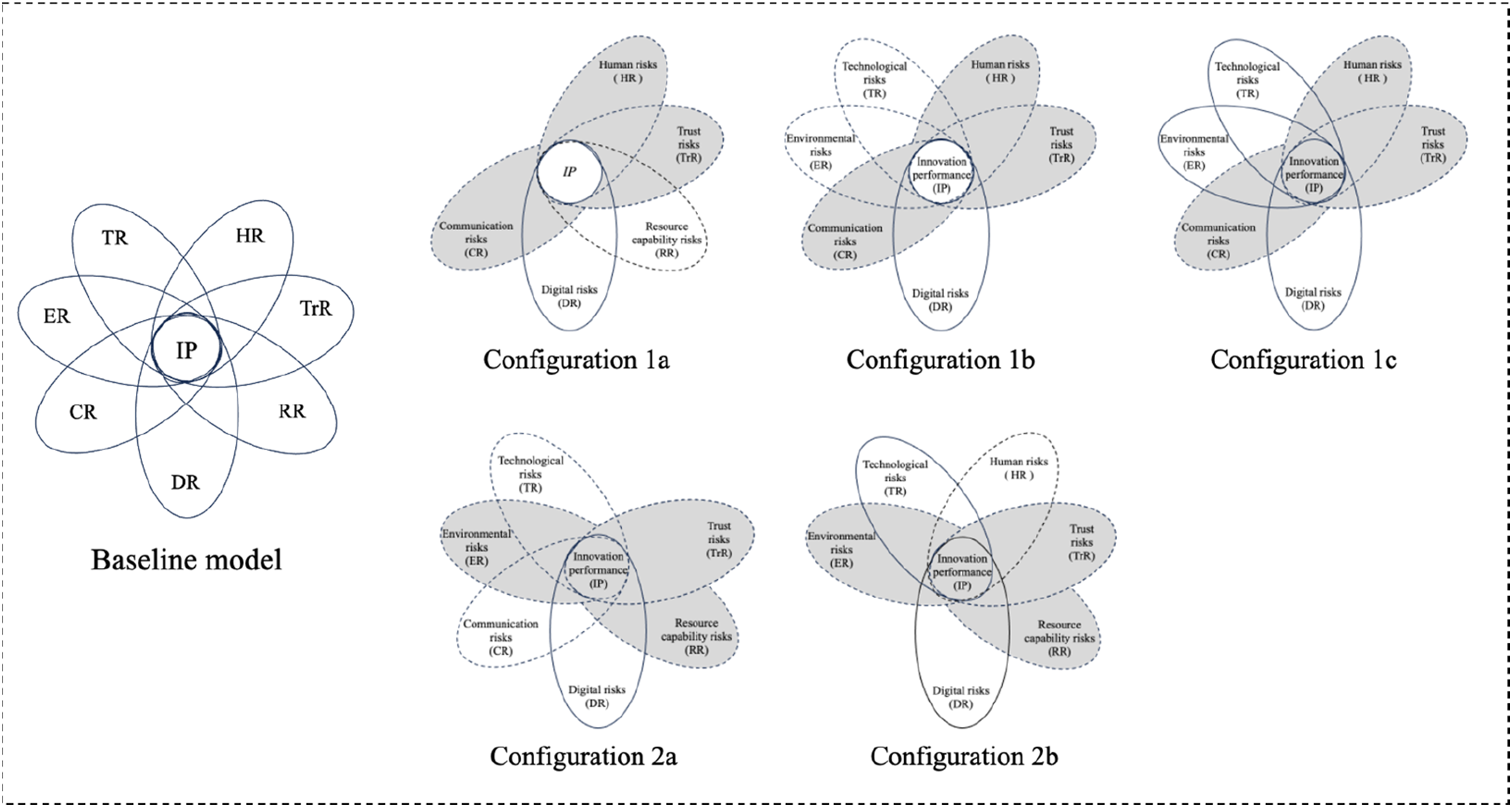

Results
Reliability and validity
Construct measurements.

Discriminant validity.

Note: The data on the diagonal (in italic) is the square root of AVE of the construct while the other values are the correlations with other constructs.
Calibration
Calibration.

Necessity analysis
Necessity analysis of single conditions.

Sufficiency analysis
We established a truth table to show all possible combinations of causal conditions of the innovation performance. 29 In line with prior research, we conducted a sufficiency analysis by using a minimum case frequency benchmark ≥1 63 and a raw consistency benchmark ≥0.8. 49 We also applied PRI (proportional reduction in inconsistency) to further filter the truth table rows that are reliably linked to the outcome. 62 As the configurations with a PRI score below 0.5 may show inconsistency, 62 we adjusted the data of corresponding rows to 0. After applying these thresholds and running the data, three solutions were reached: a complex solution, a parsimonious solution, and an intermediate solution. We chose the intermediate solution for the interpretation of the final configuration, as it can simplify a complex solution, thereby reducing complexity without making unreasonable assumptions.
Configurations of intermediate solution.

Note: ● = core casual condition (present).  = peripheral casual condition (present). ⊗ = core casual condition (absent).
  = peripheral casual condition (absent). Blank spaces indicate “do not care”.
Configurations for high innovation performance in CoPS projects
CR-HR-TrR co-oriented: this path configuration indicates that the absence of communication risks, human risks, and trust risks are the core conditions for high innovation performance within CoPS projects. Specifically, based on the differences in peripheral conditions, we distinguish three different equivalent paths and named them 1a, 1b, and 1c. Configuration 1a focuses on the combined effect of the absence of RR, and even though there exist some digital risks, the absence of CR, HR, TRR, and RR will jointly lead to high innovation performance of CoPS projects. In practice, CoPS projects with an effective communication channel and a reliable and highly skilled R&D team can enhance and cultivate a mutually beneficial and trustworthy partnership between collaborators . 16 Configuration 1b and 1c both pay attention to TR and ER as the peripheral conditions, while 1b indicates the absence of them and 1c implies the presence of them. Indicating that CoPS projects with efficient management of communication, human, and trust risks, high innovation performance can still be achieved despite significant levels of external environmental and technological uncertainty. Noticeably, we can find that 1a focuses on the Shili and Renli dimensions, while 1b and 1c highlight the interplay of risks from the Wuli, Shili, and Renli dimensions.
ER-RR-TrR co-oriented: this pattern highlights the significant need to mitigate environmental risks, resource capability risks, and trust risks to achieve a high level of innovation performance in CoPS projects. This type includes two pathways: configuration 2a and 2b with a sum coverage of 0.047. Particularly, the coverage of configuration 2b is 0.021, which is notably higher than other types. This suggests that configuration 2b has a significant effect on innovation performance and demonstrates its broad applicability within CoPS projects. By reviewing our studied cases, configuration 2a is aligned with some military-related projects which generally have a positive external environment and healthy internal relationships. These projects are typically owned by monopolistic corporations that have a strong capability to integrate resources. 64 This makes it easier to develop complex products with lower risks and realized performance. Moreover, as shown in configuration 2b, highly advanced technological items are more likely to achieve great performance when there is low risk in other areas and the project resources are well-equipped. Overall, this path type highlights the cumulative effect of risks from the Wuli, Shili, and Renli dimensions.
Configurations for low innovation performance in CoPS
TR-RR-TrR co-triggered: this pattern highlights the presence of technological risks, resource capability risks, and trust risks are the core conditions leading to low innovation performance within CoPS projects. This type of influence includes three paths: configuration 3a, configuration 3b, and configuration 3c. The sum coverage is 0.019. Specifically, successful research and development of highly complicated technologies are challenging when the project lacks sufficient resources and there is a lack of cooperation and trust among internal and external team members. 65 Moreover, when combined with additional uncertainties, this will result in diminished levels of innovative performance within CoPS projects. These three configurations all focus on the interplay of risks from the Wuli, Shili, and Renli dimensions, providing a comprehensive influence of risks related to objective and subjective factors.
ER-CR co-triggered: this pattern emphasizes the presence of environmental risks and communication risks are the core conditions of low innovation performance within CoPS projects. This category consists of three pathways: configuration 4a, 4b, and 4c. The total coverage amounts to 0.052. The majority of collaborators lack the ability to predict and manipulate the external environment, thereby making them vulnerable to negative consequences when the external environment changes. 37 For example, emerging technologies under development within CoPS projects may face impediments in additional investment due to recently enacted rules and regulations. Furthermore, the evolving demands of customers and the inadequate capacities of suppliers have introduced additional ambiguity to both internal and external communication. Remarkably, this pattern highlights the combined influence of risks from the Wuli and Shili dimensions.
CR-RR-HR co-triggered: configuration five stresses the crucial role of the presence of communication risks, resource capability risks, and human risks resulting in low innovation performance. Particularly, the unique coverage of this configuration is 0.188, which is significantly higher than the other three types that lead to low performance, suggesting that this type exhibits strong universality. Communication risks can impede the sharing and transmission of knowledge, technology, and other resources during the development process, hence hindering resource integration and effective innovation. 66 Furthermore, if the management is inept and the team exhibits significant levels of mobility. Firstly, it cannot take independent action to address the current issues. Secondly, it will negatively impact communication and collaboration among partners, leading to a deterioration in resource integration. In this scenario, despite the presence of a reasonably steady external environment, it will result in a decline in innovation performance. Notable, this pattern concentrates on the interplay of risks from the Shili and Renli dimensions, suggesting that project managers should pay more attention to the organization and partners.
ER-HR-TrR co-triggered: configuration six highlights the presence of environmental risks and human risks, and the absence of trust risks are the core conditions that jointly lead to low innovation performance. Specifically, the significant level of unpredictability in the external environment, along with the instability and inadequate proficiency of the project team, poses challenges in attaining high performance, especially in the presence of favorable internal and external collaboration and minimal organizational risk. In practice, these CoPS projects typically originate from medium-sized private firms, which face challenges in dealing with environmental unpredictability and workforce expertise. Particularly, this type emphasizes the joint effect of risks from the Wuli and Renli dimensions on innovation performance.
Asymmetrical analysis
The existence of Wuli risks has a more significant influence on low innovation performance than the absence of Wuli risks does on high innovation performance. Firstly, technological risks play a critical role in leading to low innovation performance, while revealing a peripheral role in realizing high innovation performance. Align with the fact that the difficulty level of technological factors is inherently objective and resistant to human influence. Secondly, the external environment plays a relatively important role in bringing low performance (presence of environmental risks) and promoting high performance (absence of environmental risks). That could be because the key stakeholders in the external environment, including suppliers, customers, and governments, can be effectively managed through relationship management.
The absence and presence of Shili risks are both important in high innovation performance and low innovation performance, indicating that the mechanisms and tools of management play a decisive role in the success or failure of an innovation project. 33 If the fundamental risks that contribute to high innovation performance are well controlled, the presence of some level of digital risk does not hinder the attainment of high innovation performance. Whereas, if the core risks that lead to low innovation performance occur, combined lacking digital information capacity, it will eventually result in low innovation performance. This is likely because many enterprises are still in the early stages of developing their digital capabilities and can only offer limited assistance. As a result, human intervention remains crucial in resolving problems.
The lack of Renli risks has a more significant effect on high innovation performance than the presence of Renli risks has on low innovation performance. Specifically, the absence of human risks plays a more prominent role in improving CoPS innovation performance compared with its role in leading to low innovation performance. Asserting that humans play a crucial role in management and are vital in ensuring the achievement of high performance in CoPS projects. This could be attributed to the fact that humans are the focal point of all management endeavors and have a direct impact on the outcomes of management. Furthermore, the exercise of human subjective initiative can yield adaptable and beneficial outcomes, particularly in the domains of problem-solving, communication, and coordination.
Robustness test
We used standard methods to conduct our robustness analysis of the QCA results. 67 We referred to the above methods and used the set relation and fit difference of the configurations as the judgment standard. First, we decreased the consistency threshold from 0.8 to 0.85 and found that the six types were still supported. The overall consistency decreased slightly, and the overall coverage increased slightly. Second, two cases were then randomly selected and removed. The solutions remained similar, indicating that the research results remained robust.
Conclusion and implications
Research conclusions
The objective of this study is to investigate what configurations, consisting of multiple risks from the Wuli, Shili, and Renli dimensions, influence innovation performance in CoPS projects and how. Different from prior studies few concentrate on the relationship between risks and innovation performance, this paper focuses on revealing the specific influence paths of various risks to innovation performance, by using the fuzzy set qualitative comparative method with data from 97 CoPS projects.
Based on the different configurations of risks, we propose two types promoting high innovation performance according to different core risks: CR-HR-TrR co-oriented and ER-RR-TrR co-oriented. The former has three specific paths that highlight the absence of communication risks, human risks, and trust risks are the core conditions. The latter has two paths which emphasize the absence of environmental risks, resource capability risks, and trust risks are the core conditions. Moreover, the CR-HR-TrR pattern pays attention to the interplay of risks from the Shili and Renli dimensions. While the ER-RR-TrR pattern focuses on the risks from the Wuli, Shili, and Renli dimensions. We also propose four types leading to low innovation performance according to the absence of core conditions: TR-RR-TrR co-triggered, ER-CR co-triggered, CR-RR-HR co-triggered, and ER-HR-TrR co-triggered. TR-RR-TrR type has three paths and stresses the joint effect of risks from the Wuli, Shili, and Renli dimensions; the ER-CR type also has three paths and highlights the interplay of risks from the Wuli and Shili dimensions; the CR-RR-HR type concentrates on the combined influence of risks from the Shili and Renli dimensions; the ER-HR-TrR type emphasizes the cumulative effect of risks from the Wuli and Renli dimensions.
Theoretical implications
Theoretically, this study contributes to the discourse on the relationship between risks and innovation outcomes in CoPS projects in the following ways. First, despite the increasing number of studies that highlight examining risks’ effect on performance has a significant influence on more effective risk management activities, extant studies have paid less attention to investigating the combined effect of risks on innovation outcomes. Since risks usually perform interdependence and produce a collective impact on the innovation performance of CoPS projects, 68 this study identifies diverse risks according to the WSR framework, covering Wuli risks, Shili risks, and Renli risks, and further explore their joint effect rather than net effect. This may enhance the understanding of the complexity and interdependencies among risks and their specific influence on innovation performance.
Second, this study contributes to the configurational theory by introducing it into the context of CoPS development. Prior studies highlighted the necessity of adopting a configurational lens to explore complex management issues, 69 while there is still a lack of introducing configurational theory into the complex product development context. The existence of highly complicated characteristics renders the management of CoPS projects tough. Analyzing risk factors individually can be challenging as they often have a systemic impact, interacting with one another and collectively influencing the outcome. 15 This paper applies the configurational theory to reveal the influence of risks on innovation performance in the CoPS development context, thus extending the boundary of configurational theory.
Third, this study enriches the literature on risk management within CoPS projects by extending the research method and scope. Existing studies mainly focused on a particular CoPS project and used the case study method to discuss concrete risk management activities.34,25 However, adopting the in-depth method in a single scope of CoPS projects is limited to exerting universal conclusions and scholars also called for a supplement regarding to research method. 6 This study adopts an empirical method with data from 97 CoPS projects involving 8 typical complex product industries, thus we contribute to a more general and effective understanding of risk management in the context of CoPS projects.
Managerial implications
This research also provides practical management recommendations for managers in CoPS development. First, given that this paper studies the relationship between risks and innovation performance and reveals several specific influence paths within CoPS projects. Project managers should pay more attention to the combined effects of multiple risks on performance and make effective management of these risks to ensure the smooth realization of innovation performance. Particularly, individual circumstances alone cannot completely produce a desirable result in the same manner that the presence of all seven uncertainties is not both essential and sufficient for attaining a high innovation performance. Therefore, project managers should adopt a configurational viewpoint when assessing the impact of risks on innovation performance in CoPS projects.
Second, the casual recipes in this study can either directly or indirectly guide project managers in the CoPS development context to understand how to achieve high innovation performance or avoid low innovation performance through risk management activities. Specifically, project managers need to understand the causal asymmetry relationship between risks and innovation performance. Moreover, it will be better for managers to stress the core conditions that affect ultimately innovation performance within CoPS projects. For example, to prevent project failure, managers must focus on the interplay between TR, RR, and TrR, the interplay between ER and CR, the interplay between ER, HR, and TrR, and the interplay between CR, RR, and HR. Whereas, to enhance project innovation performance, managers should prioritize the interplay between CR, HR, and TRR, as well as the interaction between ER, RR, and TrR.
Third, the integration of the diverse project risks unveils the equivalent paths of risks to innovation performance, necessitating project managers to carefully select a suitable trajectory for effective risk management based on their internal and external circumstances. Various industries encounter distinct innovation conditions, whereas projects possess varying fundamental resources. Therefore, every project must develop suitable risk management strategies that align with its specific environmental circumstances. For instance, the efficacy of specialized supply product innovations is predominantly influenced by external market conditions, while intricate product innovations targeting the broader market are more contingent upon the organizational capacities of the respective entity.
Limitations and future research
Although this study addresses some of the gaps in the literature, it also has several limitations. First, the CoPS sector covered by the data is still insufficiently large and systematic, the data sources have not been further differentiated and generalized, and the results’ generalizability still needs to be strengthened. Second, given the frequent fluctuations in the external environment and technology, the seven risk variables chosen in this research may lack the ability to accurately reflect the antecedent variables. Third, the process of developing a complex product requires the involvement of several team members, each with their specific duties and responsibilities. However, this study has not distinguished between these roles, resulting in varied management approaches.
This study also presents many avenues for future research as follows. First, by acquiring the relevant data and conducting a more thorough generalization of the product’s technological maturity, development stages, etc. Involved in CoPS projects, a more sophisticated risk management countermeasure for CoPS development may be formed. Second, in-depth and more comprehensive risk factor identification can be achieved, for instance, by using case studies in addition to current research. Furthermore, risk factors frequently adapt to their surroundings, therefore splitting risk factors at various stages of innovation within CoPS Projects can lead to more tailored and efficient management strategies. Third, future exploration should take into account the large number of stakeholders and the differences in strategic objectives. To provide more valuable practice guidance, future research can investigate whether there are variations in influence relationships and management responses among different roles based on relevant theoretical perspectives, such as the innovation ecosystem perspective.
Footnotes
Declaration of conflicting interests
The author(s) declared no potential conflicts of interest with respect to the research, authorship, and/or publication of this article.
Funding
The author(s) disclosed receipt of the following financial support for the research, authorship, and/or publication of this article: This study was supported by the National Social Science Foundation of China under Grant numbers 22BGL034.

Appendix I
Risks in CoPS development.
Identification dimensions
Risks
Reference
Perspective of risks’ source
External risk, internal risk
Cooper (1981)
Technical risk, marketing risk, environmental risk, organizational risk
Balachandra (1997)
Strategy risk, development risk, market environment risk, organizational risk
Polk (1996)
Market risk, policy risk, finance risk, capability risk
Keizer (2002)
Environmental risk, IT risk, performance risk, market risk, collaboration risk, funding risk
Su (2005)
Technical risk, organizational risk, development risk
Yeo and Ren (2009)
Market risk, development risk, finance market risk, procurement risk
Häntsch and Huchzermeier (2013)
Technical risk, opportunistic risk
Jing (2020)
Perspective of the technical phase
Project initiation phase risks, development phase risk, production phase risk, market phase risk
Mohan (2000)
Perspective of the technical difficulty
Low technical difficulty risk, medium technical difficulty risk, high technical difficulty risk, medium technical difficulty risk
Shenhar (1993)
Appendix II
Questionnaire distribution company.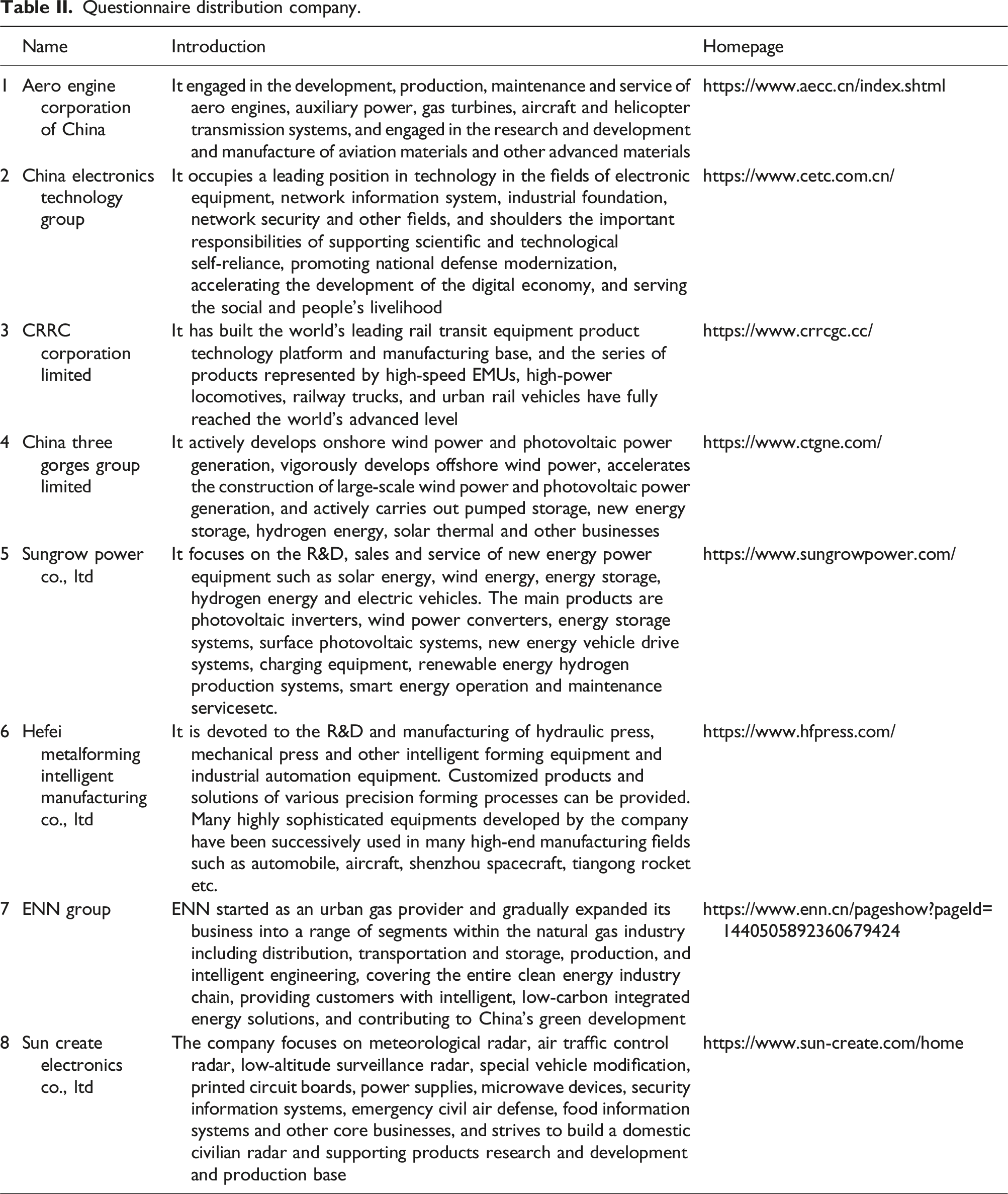
Name
Introduction
Homepage
1
Aero engine corporation of China
It engaged in the development, production, maintenance and service of aero engines, auxiliary power, gas turbines, aircraft and helicopter transmission systems, and engaged in the research and development and manufacture of aviation materials and other advanced materials
https://www.aecc.cn/index.shtml
2
China electronics technology group
It occupies a leading position in technology in the fields of electronic equipment, network information system, industrial foundation, network security and other fields, and shoulders the important responsibilities of supporting scientific and technological self-reliance, promoting national defense modernization, accelerating the development of the digital economy, and serving the social and people’s livelihood
https://www.cetc.com.cn/
3
CRRC corporation limited
It has built the world’s leading rail transit equipment product technology platform and manufacturing base, and the series of products represented by high-speed EMUs, high-power locomotives, railway trucks, and urban rail vehicles have fully reached the world’s advanced level
https://www.crrcgc.cc/
4
China three gorges group limited
It actively develops onshore wind power and photovoltaic power generation, vigorously develops offshore wind power, accelerates the construction of large-scale wind power and photovoltaic power generation, and actively carries out pumped storage, new energy storage, hydrogen energy, solar thermal and other businesses
https://www.ctgne.com/
5
Sungrow power co., ltd
It focuses on the R&D, sales and service of new energy power equipment such as solar energy, wind energy, energy storage, hydrogen energy and electric vehicles. The main products are photovoltaic inverters, wind power converters, energy storage systems, surface photovoltaic systems, new energy vehicle drive systems, charging equipment, renewable energy hydrogen production systems, smart energy operation and maintenance servicesetc.
https://www.sungrowpower.com/
6
Hefei metalforming intelligent manufacturing co., ltd
It is devoted to the R&D and manufacturing of hydraulic press, mechanical press and other intelligent forming equipment and industrial automation equipment. Customized products and solutions of various precision forming processes can be provided. Many highly sophisticated equipments developed by the company have been successively used in many high-end manufacturing fields such as automobile, aircraft, shenzhou spacecraft, tiangong rocket etc.
https://www.hfpress.com/
7
ENN group
ENN started as an urban gas provider and gradually expanded its business into a range of segments within the natural gas industry including distribution, transportation and storage, production, and intelligent engineering, covering the entire clean energy industry chain, providing customers with intelligent, low-carbon integrated energy solutions, and contributing to China’s green development
https://www.enn.cn/pageshow?pageId=1440505892360679424
8
Sun create electronics co., ltd
The company focuses on meteorological radar, air traffic control radar, low-altitude surveillance radar, special vehicle modification, printed circuit boards, power supplies, microwave devices, security information systems, emergency civil air defense, food information systems and other core businesses, and strives to build a domestic civilian radar and supporting products research and development and production base
https://www.sun-create.com/home