




Abstract
This empirical study investigates the relationship between entrepreneurship environments and entrepreneurial intention, contributing to the academic literature on entrepreneurial intentions in emerging economies. It specifically examines the mediating effect of entrepreneurship self-efficacy beliefs and the moderating effect of role models on these relationships. Data were collected through a questionnaire survey of 592 undergraduate students from 11 universities and colleges in Vietnam. Structural equation modeling analysis was employed to test hypotheses. The results indicate that while perceived supportive entrepreneurship environments and entrepreneurship university environments did not have direct significant impacts on entrepreneurial intention, their indirect effects were significant, mediated by entrepreneurial self-efficacy. Furthermore, prior exposure to business role models strengthened the associations between environments and entrepreneurial intention. This research offers empirical insights and suggests practical implications for fostering entrepreneurship in both practitioners and scholars in developing countries.
Keywords
Introduction
In the past decades, entrepreneurship has served as an important function in driving nations’ economic development, reducing youth unemployment. 1 As a critical role in economic as well as social development, entrepreneurship not only attracts government agencies but also takes notice of many academic scholars and educators’ attentions. 2 Governments, scholars, and educational institutions have both made great efforts to understand, introduce supportive policies and set up entrepreneurship supporting programs in order to inspire the entrepreneurial mindset of potential entrepreneurs. Such efforts have been based on the implicit premise that those actions will enhance the entrepreneur’s self-efficacy and inspire entrepreneurial intention 3 and then students’ entrepreneurial intentions will reinforce and contribute to entrepreneurial behavior. 4
With the gradual widening of research on entrepreneurial intentions in recent years, researchers have focused on the impact of environments on entrepreneurial intentions.5,6 However, the influence of environmental factors on entrepreneurial intention has been extensively discussed in previous research, but research results are partly inconsistent.7,8,9 The associations between environment determinants and entrepreneurial intentions have also been found to vary across contexts and from situation to situation.5,9,10 The partial inconsistency of the previous research findings showed that improving our understanding of the preconditions of entrepreneurial intention is still crucial. In particular, it is necessary to develop interactive models in which entrepreneurial intention is a function of the combined environmental conditions and other factors. In addition, existing studies only analyzed the influence of the environment on entrepreneurial intention, and little attention has been paid to the mediator and moderator effect.1,6 Researchers have therefore proposed that the inconsistencies found across studies resulted from the exclusion of additional variables through moderator variables.4,6,11 Several authors have called for the inclusion of additional mediator factors and external variables (demographic variables) or exogenous variables to be included in predicting entrepreneurship intentions.12,13,15 In addition, scholars also suggest that the need for the development of a supportive environment may be greater in developing and emerging market economies because of the several environmental hostilities and the low level of entrepreneurial activities in these countries. 16
Entrepreneurship is a dynamic and multifaceted phenomenon influenced by various individual and contextual factors. In recent years, based on the theory of plan behavior, scholars have identified self-efficacy as a mediator in several research on the impact of exogenous factors on entrepreneurial intention.8,11 This study extends previous research by investigating the mediating role of self-efficacy, arguing that supportive environments influence individuals’ perceptions of their abilities, thereby shaping their self-efficacy beliefs, which subsequently influence their entrepreneurial intentions. Recent studies also stress the role of inspiring role models in the development of entrepreneurial intentions and entrepreneurial activity.3,11 While the influence of role models on entrepreneurial intention is well-documented, the mechanism where role models improve and change the relationship between contextual factors and entrepreneurial intention remains relatively underexplored. Since people learn and are inspired by observing the behaviors of others, this study investigates the moderator effect of role models in the relation between the entrepreneurial environment and entrepreneurial intention, shedding light on how the presence or absence of role models may enhance or attenuate the influence of environmental factors on individuals’ intentions to engage in entrepreneurial activities.
Drawing on Ajzen’s (1991) 17 Theory of Planned Behavior and behavioral entrepreneurship theory, 18 the purpose of this study is to analyze the impact of environmental factors on students’ entrepreneurial intentions in an emerging and developing country context. Second, by examining the mediator impact of entrepreneurship self-efficacy, we extend the studies of BarNir et al. (2011), Xu et al. (2023)8,11 who argue that entrepreneurship self-efficacy belief plays an important role in the relationship between entrepreneurship intention and its personal determinants. Third, we add to the current literature by identifying the moderation effect of role models on the relationship between entrepreneurship environment dimensions and entrepreneurial intention through SEM analysis, responding to the appeal of Abbasianchavari and Moritz (2020), 15 who claim that role model may bias career choices. Our research enriches existing literature on entrepreneurial intentions and expands the research framework in academic students, who prepare to enter the labor force for professional careers in the near future.
Literature review and hypotheses development
Entrepreneurial environment and entrepreneurial intention
Numerous approaches have been applied to explain why individuals become entrepreneurs. 1 The theory of planned behavior suggests that a decision to start a business is a conscious and voluntary process, intention is often the best predictor of entrepreneurship behaviors. In this sense, entrepreneurial intention would be a previous and determinant element in performing entrepreneurial behaviors. 17
Entrepreneurial intention can be defined as the involvement of an individual to start a new business venture. Studies of entrepreneurial intention can help us understand entrepreneurship cognition and entrepreneur behaviors. 19 The behavioral entrepreneurship theory postulates that individuals do not act in a fully rational way, and they are also influenced by their psychological, cognitive and emotional biases. 18 Therefore, we argue that entrepreneurial intention is impacted by individual perceptions of personal and environmental conditions.
After a decade of exploring various personal factors that may be associated with entrepreneurial intention, researchers found that the study of entrepreneurship is deficient if it concentrates only on individual entrepreneurs’ characteristics and behaviors. 20 Another stream of literature in the entrepreneurship study has been arising which is interested in environmental conditions as the antecedent of people’s intention to start a new venture. Intentionality is indeed “a state of mind,” but it is really a socially contextualized state of mind and entrepreneurial intentions underplay the wide range of environmental context. The environmental context of entrepreneurship can give explanations for why the relations between personal-related factors and entrepreneurial intention are not always deterministic. 13 The entrepreneurship process is an embedded process in a particular economic, social, and cultural context. Entrepreneurial intention and its preceding factors are impacted by circumstances beyond a person. 21
Entrepreneurial environment is a combination of various factors that play a function in the entrepreneurship process, it includes overall political, economic, social and cultural factors that impact a person’s attitude and ability to undertake entrepreneurial activities as well as the availability of support and assistance services that facilitate the entrepreneurship actions. 13 Literature on entrepreneurial environment grouped environment into two major streams. The first is the general environmental condition for entrepreneurship. The general environment for entrepreneurship includes various elements such as government policies, socio-economic conditions, business competitiveness conditions, financial support to new businesses, and non-financial support. 20 We argue that students are also impacted by the second dimension of the environment- the university environment, where students study and interacting.
A general supportive environment and entrepreneurial intention
The literature on entrepreneurship proposed that environments where individuals live influence their intention to become entrepreneurs. Schwarz et al. (2009) argued that the intent to involve in entrepreneurial activities depends on economic, social, political and cultural aspects such as business life, the instructional and legal system, global economic situation, the availability to access capital in the economy. 10 Chahal et al. (2023) pointed out that the environment, where individuals interact on a daily basis, impacts the intention of starting a new venture. 13 However, while the role of environmental conditions in guiding entrepreneurship intent has been reported, almost all research is highly descriptive, fragmented, focused on limited aspects of the environment and results are inconsistent. 1 This research concentrates on the general environmental supportive conditions which have been appealed in the research of Schwarz et al. (2009), Nguyen (2020).10,21
Previous research indicated that a perceived entrepreneurial supportive environment is an external influence factor that plays a very important role in developing an individual’s intent to become an entrepreneur. 7 Schwarz et al. (2009) argued that perceived entrepreneurship-related supportive environment factors directly affect students’ entrepreneurial intention. 10 The more favorable perceived entrepreneurship support environment beliefs, the stronger entrepreneurial intention. When students realize a supportive environment for entrepreneurs, for instance, bank loans can be accessible, open marketplace, or favorable governmental policies, they are more likely to become entrepreneurs irrespective of their adverted attitude toward entrepreneurship.6,13
University environment and entrepreneurial intention
Universities nowadays are more responsible and committed to entrepreneurship activities. 4 Universities around the world have greatly increased their entrepreneurial activities: providing entrepreneurship courses, extra-curricular activities, creating incubators, science parks, supporting and consulting services, investing in infrastructure for start-ups, and workshops. 13 Despite of these efforts, the impact of university entrepreneurship activities remains unclear. 12 Sesen (2023) found no significant relationship between the university environment and entrepreneurial intention. 14 Çera et al. (2020) found significantly lower entrepreneurial intentions in students who perceived the university environment as being negative than those who had more positive perceptions. 7 Moreover, the impact of university context on entrepreneurial intentions is stronger than the impact of individual attitudes, personality traits, socio-economic environmental, and demographic factors on intention. Barral et al. (2018) 12 found that the impact varies across universities. Schwarz et al. (2009), Nguyen (2020) reported similar findings in their research that the university environment impacts significantly on entrepreneurial intentions; their studies suggested that a negative appraisal of the university’s activities in providing students required knowledge to start a new venture and to support the entrepreneurship process actively resulted in the lower level of student’s start-up intentions.10,21 We argue that the educational environment is an important factor in a student’s entrepreneurial intentions in the social context of Vietnam and propose the following hypothesis:
Self-efficacy and entrepreneurial intention
Self-efficacy is widely recognized as a key construct in social learning theory as well as research on entrepreneurship. Begley and Tan (2001) defined self-efficacy as the task-specific consideration of perceived fitness to perform a particular activity. 22 Self-efficacy is a perspective which assumes that behavior, cognition, and the environment continually influence each other in the mindset of individuals. Self-efficacy is people’s judgment regarding their ability to perform a given activity and is proposed to influence individual goals, choices, effort, emotional reactions, ability to cope and persistence. In the field of entrepreneurship study, entrepreneurial self-efficacy may be comprised of deliberation of tasks that relate to the creation and development of new businesses. 23
The relationship between entrepreneurial self-efficacy and entrepreneurial intention has already been explored.11,23 Entrepreneurial self-efficacy being a positive determinant of entrepreneurial intention has been strongly supported by empirical studies in the literature. Entrepreneurial self-efficacy beliefs impact individual aspirations and shape individuals’ attitudes and career choices, especially important in risky and uncertain situations or professional choice situations. 3 Austin et al., (2015) proposed that individuals choose to start a new business because they have high entrepreneurial self-efficacy— they believe that they can succeed in setting up new business ventures. 23 Thus, we proposed the following hypothesis:
Mediator effect of self-efficacy in the relationship between entrepreneurial environment and entrepreneurial intention
According to Ajzen (1991), in intention models, exogenous factors do not directly influence either intentions or behaviors of individuals; they indirectly impact through the perceptions of desirability and feasibility. 17 Laviolette et al. (2012), Austin and Nauta (2015), Nowiński and Haddoud (2019)3,23,24 provided evidence that self-efficacy as a key factor to affect entrepreneurial intention, and external factors indirectly impact the formation of entrepreneurial intention by influencing beliefs of entrepreneurial self-efficacy. Self-efficacy is not only often a direct predictor of intention or performance of career choices, but it can also mediate the effects of other external variables.9,24 Therefore, factors that enhance entrepreneurial self-efficacy may also indirectly impact career-choice intention.
Role model and moderator effect
The institutional approach of entrepreneurship indicates that the socio-cultural environment shapes individual attitudes and behavior. 22 Trang et al. (2019) further illustrated entrepreneurial role models as one the most significant socio-cultural factors to play a crucial role in entrepreneurship. 25 Entrepreneurial role model is a key factor to understanding entrepreneurship as a career choice. 11
Bandura in social learning theory argues that one way to learn is by observing the behaviors of others. 26 Observing role model choices in life has a very pragmatic influence on potential entrepreneurs, role model serves as an orientation guide and encourage imitation. 23 Role model not only provide learning but also provide inspiration and motivation to help individuals define their careers. 3 Individuals can acquire unsuccessful or successful experiences of role models through observational learning of role models and form clear self-assessments about certain attributes or behaviors of successful imitation or avoidance of role models in similar situations. 26 Business role models provide entrepreneurial spirit, behavioral supports, and guidance, which have an important influence on individual entrepreneurship activities. 3 Entrepreneurship role models can give potential entrepreneurs indirect experience such as business information, improve the ability of recognizing, discovering and utilizing business opportunities.3,22 Role models trigger entrepreneurship events. Business role models are a promising resource for students in learning and a source of entrepreneurial inspiration to become entrepreneurs, but there are still controversial discussions on the mechanisms and role of their influence on intention. 15
We propose that the entrepreneurial role model moderates the relationship between environment and entrepreneurship intention. Abbasianchavari and Moritz (2020) suggested that the more individuals observe and learn from their role models, the less they need to find external supportive justifications and illustrations to reinforce their entrepreneurial intention. 15 Although a supportive environment may have a positive effect on the entrepreneurship intent of either people with or without exposure to role models, it will have a stronger impact on individuals who have acquired successful experience of role models, leading to higher entrepreneurship intention belief. The learning lessons provided by role models improve the ability of discovering and utilizing business opportunities from the environment. 23 It means that if you have relatives or friends as entrepreneurs, your intent to start a business will be stronger in supportive environment conditions than if you do not have any role models.
Materials and methods
Participants
We assumed a quantitative research approach to obtain empirical evidence to affirm the theoretical model (Figure 1). We collected quantitative survey data through a self-administered questionnaire. The target participants are final year students at various higher education institutions in the North of Vietnam. Since a student can be seen as a potential incubator for entrepreneurs, final-year students are expected to be at a stage close to making career decisions, undergraduate student sample is widely used in entrepreneurship research.
5
The final sample consisted of 592 university students. The students were from both business - economics and technical- science programs. Research model.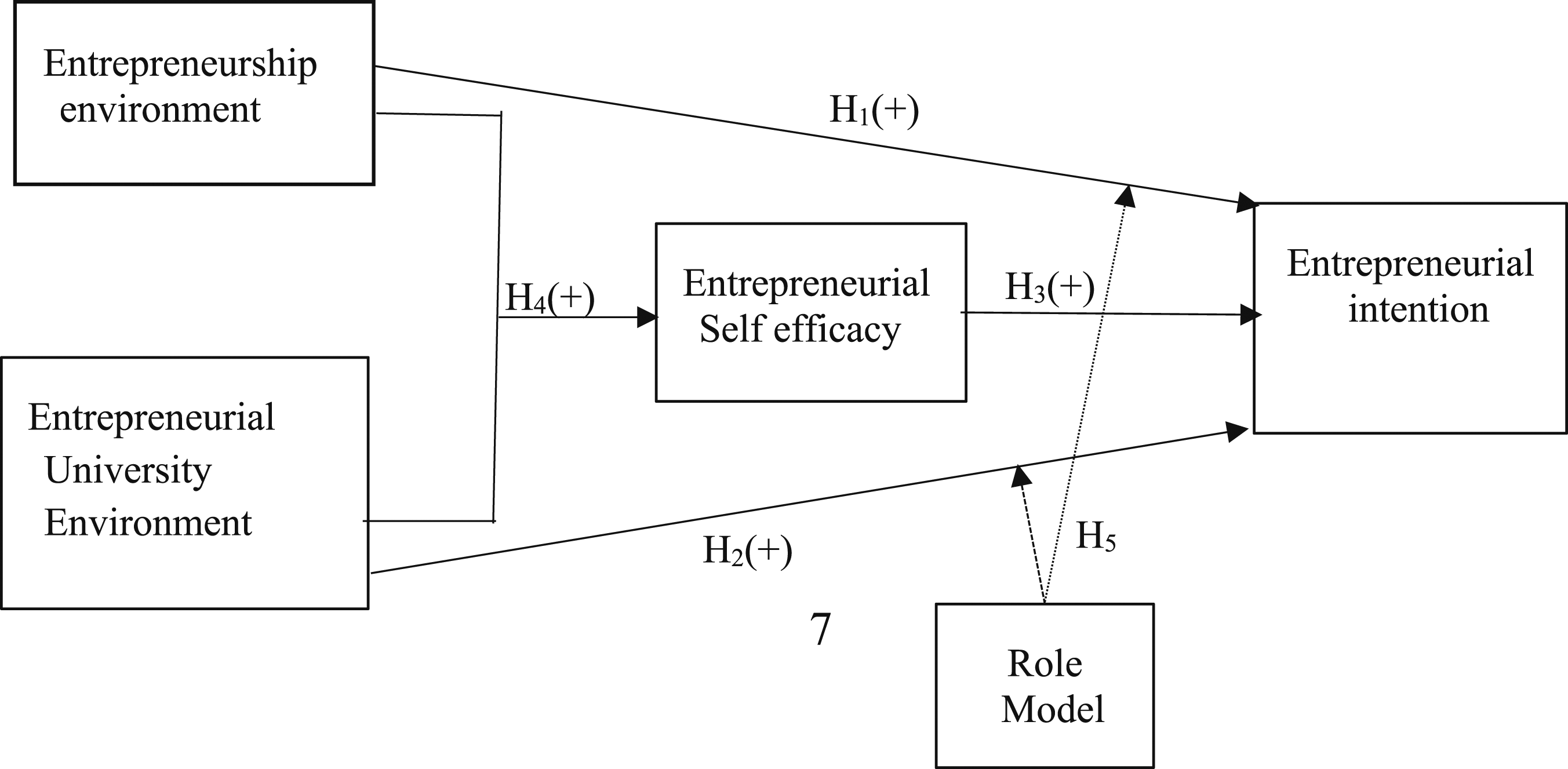
All the measures are adopted from previous research. The measurement translation and adaptation process consisted of 5 steps: translation from English to Vietnamese, assessment of the forward translation, translation back from Vietnamese to English, assessment of the backward translation, check with experts. Five-point Likert scale is used: ‘1 = totally disagree through to ‘5 = totally agree’. All scales are assessed by qualitative research and pre-quantitative test before being used in the quantitative survey.
Scales
Entrepreneurial intention (INT) is measured by using a six-item scale from Linan and Chen (2009)’s research including items like “If I have the opportunity, I will start my own business venture” “I am ready to do everything as an entrepreneur”, and “I am determined to set up my own job”. 19 Role model: whether individuals have entrepreneurship role models or not. This research uses this form “Are there successful entrepreneurs among your family or relatives or friends?”. The answer “No” (code 0) means that they do not have entrepreneurship role models, “Yes” (code 1) means that they have at least an entrepreneurship role model. Entrepreneurial self-efficacy (SB) is measured by adapting the Begley and Tan (2001) scale which includes 7 items asking the respondents of their confidence in taking 7 entrepreneurship tasks. 22 Entrepreneurship university support environment (UE): this scale of the students’ perception is measured by adapting a three-item scale taken from Shirokova et al. (2016). 4 Entrepreneurial environment supports (ES) is measured by using a six-item scale taken from the study of Schwarz et al. (2009). 10
The measurement scales were tested by using Exploratory Factor Analysis for validity and Cronbach for reliability. Then, a confirmatory factor analysis, is designed to define the convergent validity and the discriminatory validity of the constructs. The suggested hypotheses were tested by structural equation modeling (SEM) with AMOS 23 software, SEM takes into account measurement errors and help to obtain more precise estimates of regression coefficients than classical methods The authors applied the bootstrapping method to capture the mediating effect of factors on entrepreneurial intention. 27 Bootstrapping is a non-parametric method by resampling with a replacement that is done many times. To investigate the moderating role, we applied multiple group analysis. The first model was estimated using the data of the role model group and the second model was with the data of the remaining group. We estimated the significance of the difference between the two groups by comparing the χ 2 statistics of the unconstrained (or free) model and the cross-group equality constraint model. If there are significant differences between them, we could argue for the moderating effect of role models on the relationship between environmental factors and entrepreneurship intention. Since the samples are separated, it is impossible to compare the coefficients of each sample, we use unstandardized path coefficients for assigning the relative importance of the coefficient instead of standardized path coefficients.
Results
The sample
The final sample consists of 592 questionnaires. 52.9% of them are technical- engineering students and 47.1% are business – economics majors. The students’ ages ranged from age 19 to 23 years, all are final year students. The sample included 36.5% female. 18.4% of the students had previous entrepreneurship experience by involved in setting up a new business or investing in a new company whilst 81.6% of them did not. 57.8% of the students know an entrepreneur among their family, relatives, or friends. 42.2 % of their parents work in business-related careers.
Testing for measurements
First, we test for common method bias. Harman’s technique, where all variables are loaded onto a single factor, is used to test the possible common method bias. The total variance for a single factor is less than 50% and eigenvalues are greater than 1, we can conclude that the problem of common method bias is unlikely to be represented in this study.
Prior to modeling the structural model and executing SEM, the study needs to validate the measurement model of latent constructs for unidimensionality, validity, and reliability. Cronbach’s Alpha analysis was done to test the reliability of the measurement instrument. All scales have Cronbach’s Alpha from 0.802 to 0.869 > than 0.7 reference value. All the research variables have “Cronbach’s Alpha if item deleted” to be lower than its Cronbach’s Alpha. All the values of “Corrected item total correlation” are more than 0.5 > 0.3 indicating a good—reliability of indicators of each construct.
Factors and reliability analysis results.

Notes. CR = Composite reliability, AVE = Average variance extracted, MSV = Maximum Shared Variance.
Correlations of variables and descriptive statistics.

***, **, * 1%, 5%, 10% significance levels, respectively.
Note. INT - entrepreneurial intention; SB - entrepreneurial self-efficacy, UE - university environment; ES - environment supports.
The diagonal values are the square root of AVE value.
Hypotheses testing
SEM analysis – Regression Weights.

Note. INT - entrepreneurial intention; SB - entrepreneurial self-efficacy, UE - university environment; ES - environment supports.
Direct, indirect and total effects with bootstrapping - standardized coefficients -Two Tailed Significance (BC).

Results of the mediation analysis confirmed the full mediation role of entrepreneurship self-efficacy in the relation between UE, ES and entrepreneurship intention. 27
Moderating effect of role model - non-standardized estimates.

***, **, * 1%, 5%, 10% significance levels, respectively.
First, overall, the causal relations between UE, ES and entrepreneurial intention have not been significant (both p > .05). When separating the data set between a role model group and a group without role model, the effect of UE on INT was significant only for the group having a role model (p < .01, β = 0.437), not for the group without a role model (p > .05); χ2 of the unconstrained model is 286.825, and χ2 of the equally constrained model for all variables is 291.294, so the difference between the two models is 4.469 > 3.841 (Table 5). Thus, the moderating effect of role models on the relations between UE and entrepreneurial intention has been confirmed.
The effect of ES on entrepreneurial intention was significant only for the group having a role model (p < .01, β = 0.317) not for the group without a role model (p > .05). χ2 of the unconstrained model is 286.825, and χ2 of the equally constrained model for all variables is 300.177, so the difference between the two models is 13.352. Thus, the moderating effect of role models on the relations between ES and entrepreneurial intention has been confirmed. Hypothesis 5a and 5b are supported by the research data.
Discussions
The study provides evidence that the perceived contextual environment support factors play a significant role in the student’s perception of entrepreneurial self-efficacy. It is consistent with findings from studies by Fini, Grimaldi, et al (2009) and affirmed that environmental support predicts entrepreneurial self-efficacy. This also supports the theory of Planned Behaviors and the contextual theory of entrepreneurship. The individuals’ judgments of entrepreneurial skills are closely related to surrounding contexts, significantly influenced by their perception of the supportive environment’s favorability. 4
The findings confirm the link between entrepreneurial self-efficacy and entrepreneurial intentions, this can be traced back to the entrepreneurial event model (Shapero & Sokol, 1982) and the theory of planned behavior (Ajzen, 1991) which claimed that self-perceptions of personal capabilities and skills in performing entrepreneurial tasks influence career intentions,17,26 or Bandura who regard self-efficacy as a major determinant of behavioral intentions. 26
These findings are consistent with the findings of Schwarz et.al. (2009), we cannot report a significant relationship between a perceived supportive entrepreneurship environment and entrepreneurial intention. 10 Consistent with the findings of Barral (2018) and Sesen (2023),12,14 the estimated parameter for relations between the university environment and entrepreneurial intention is not significant. Although the entrepreneurship environment does not impact directly entrepreneurial intention, the supportive environment indirectly influences entrepreneurial intention through through the cultivation of self-efficacy. Self-efficacy fully mediated the association between a supportive entrepreneurship environment and an entrepreneurship university environment with entrepreneurial intention, this is aligned with the findings of Xu et al. (2023).9,29 Our results confirm that self-efficacy appears to be a crucial factor in the association of a perceived supportive entrepreneurship environment and an entrepreneurship university environment with entrepreneurial intention. The evidence presented in this study demonstrates the key leading theories in entrepreneurial intention, which regard self-efficacy as a bridge for fostering individuals and students toward starting businesses.17,30
This research’s findings are also in line with previous literature which illustrated an important function of entrepreneurial role-model exposure in studies of entrepreneurship environment as well as entrepreneurial intention.11,30 This study finds out that the impact of perceived supportive entrepreneurship environment and entrepreneurship university environment on entrepreneurial intention is significantly stronger for those with exposure to entrepreneurial role-model. These findings are in line with identification theory 31 as well as previous research,3,22,31 which have illustrated that having a role model can offer entrepreneurs human capital including experiences, vicarious learning opportunities, support and mentors that play a function in building up an individual’s entrepreneurial intentions. Role models can provide a major source of start-up capital, or provide individuals opportunities to observe and gain favorable evaluations about the benefits of running a business, such as perceived satisfying income, job security, self-esteem, so individuals become more motivated to engage in entrepreneurial activities in favorable environment conditions.3,23 Thus, from a psychological perspective, exposure to role models impacts the relationship between the entrepreneurial environment and entrepreneurial intentions. The relationships between the perceived supportive entrepreneurship environment and entrepreneurship university environment with entrepreneurial intention are stronger for individuals with role-models than for individuals without role-models, suggesting that a supportive entrepreneurship environment may be especially important for entrepreneurial intention in the group of people having role models. This result is in line with Pérez-Campdesuñer et al., (2021) proposal that not in all contexts do potential entrepreneurs behave in the same way, nor are they inspired by the same factors. 32 Thus, our results imply that role models may help to explain why some people choose to set up new businesses while others do not. In situations where supportive environments are combined with a role model, intentions are more likely to take place. This is in line with Bandura’s social cognitive theory which argues that human behavior is caused by the combined influences of personal, behavioral, and environmental factors.26,30
Conclusion
A substantial amount of entrepreneurial literature reported that a supportive environment can reinforce the individuals’ intention to set up a company. However, we lack empirical evidence concerning the relationships between environmental factors, role models, entrepreneurial self-efficacy entrepreneurial intention. Our experimental research strongly confirms that the perceived supportive entrepreneurship environment and entrepreneurship university environment indirectly impact entrepreneurial intention through entrepreneurial self-efficacy belief. Business role model moderates these relationships between perceived supportive entrepreneurship environment, entrepreneurship university environment and entrepreneurial intention.
The study suggests several implications for both practitioners as well as scholars. From an academic perspective, the mediating and moderating effects that are reported in this research may explain the inconsistent findings in prior studies on the relationship between environmental effects and entrepreneurship intention. Further research should be called for deeper reasons why the effects of environmental factors differ from people with to people without role models. Future research also be interested in the mediator effects of self-efficacy belief and moderator of role models in explaining differences in various entrepreneurship activities. Future research would pay attention to additional factors that could explain the effect of environmental factors by exploring other dimensions of the environmental variables and developing new models to assess the incidence of higher education in entrepreneurship intention in a more direct way.
From the practitioner’s perspective, the findings that entrepreneurship self-efficacy belief is a primary factor in developing entrepreneurial intention suggest that actions should be done concentrating on specific aspects that affect entrepreneurial self-efficacy belief. The study recommends public policy makers should introduce supportive environmental conditions, provide financial, structural and institutional supports for starting a company; universities should create a better supportive learning environment to equip students with entrepreneurial skills and abilities. Encouraging entrepreneurship intention in university students should be done in society as a whole since students’ perception of self-capability is impacted by the environment. Since role model plays a function in the relation of environmental factors and entrepreneurial career intention, role model stories and modeling may be needed in entrepreneurship education to strengthen the impact of supportive environments on entrepreneurial career intention. Higher educational institutes, when designing Entrepreneurship education programs, should systematically put forward glorious success stories of entrepreneurs. Successful business role models should be introduced widespread in universities entrepreneurship-related activities.
This research has several limitations. First, our key outcome variable entrepreneurial intention is only a proxy for behavior. We may be more interested in determining how to develop the actual entrepreneurship behavior. Second, the analysis uses cross-sectional data, the common method bias can be represented and the long-term effects of the environment, role model and intentions could not be investigated. Research using a longitudinal design to examine changes in student perception and the association between environment, self-efficacy belief and role models to entrepreneurial actions over time would be valuable. Third, this study limits the investigation of the environmental impacts on college students, since students and not actual entrepreneurs, the analytical results might be affected. Future researchers are required to investigate the immediate and longitudinal impact using new, larger and more diverse samples, such as those who have ventured into business and compare those successful with the unsuccessful ones.
Supplemental Material
Supplemental Material - Entrepreneurship environments and entrepreneurial intention- the role of self efficacy and role model
Supplemental Material for Entrepreneurship environments and entrepreneurial intention- the role of self efficacy and role model by Thuy Thu Nguyen and Hoa Thi Thanh Phan in International Journal of Engineering Business Management.
Supplemental Material
Supplemental Material - Entrepreneurship environments and entrepreneurial intention- the role of self efficacy and role model
Supplemental Material for Entrepreneurship environments and entrepreneurial intention- the role of self efficacy and role model by Thuy Thu Nguyen and Hoa Thi Thanh Phan in International Journal of Engineering Business Management.
Footnotes
Declaration of conflicting interests
The author(s) declared no potential conflicts of interest with respect to the research, authorship, and/or publication of this article.
Funding
The author(s) disclosed receipt of the following financial support for the research, authorship, and/or publication of this article: This research is funded by This research is funded by Ministry of Training and Education, Vietnam. Project number: B2022.KHA.01.
Ethical statement

Data availability statement
The corresponding author is willing to share the research data upon request.
Supplemental Material
Supplemental material for this article is available online.
References
Supplementary Material
Please find the following supplemental material available below.
For Open Access articles published under a Creative Commons License, all supplemental material carries the same license as the article it is associated with.
For non-Open Access articles published, all supplemental material carries a non-exclusive license, and permission requests for re-use of supplemental material or any part of supplemental material shall be sent directly to the copyright owner as specified in the copyright notice associated with the article.
