



Abstract
Small and medium-sized enterprises (SMEs) are contributors to economic growth. Many studies have mentioned a broad range of factors that influence the development of SMEs. However, studies examining SME growth between developed and developing countries have not been comprehensively investigated. The growth of SMEs relies on the entrepreneurial skills of the entrepreneur, who has the ability to manage business effectively, achieve profit, identify market opportunities, and enhance innovation by optimizing all available resources. The objective of this article was to synthesize the factors that influence the growth of small and medium-sized enterprises (SMEs) across developed and developing countries. This study particularly synthesized interrelationship factors depicted in a framework addressing resources and capabilities for SME growth. A systematic literature review (SLR) was employed to examine the research activities on this topic, referring to 108 articles from the Scopus and Web of Sciences databases. The articles synthesized individual studies to analyze the trend of SME growth research in developed and developing countries. Next, the factors of SME growth were identified into 6 (six) categories, including human capital resources, entrepreneurial perspectives on marketing, innovation, SMEs partnership, technology, and entrepreneur personality. The result represents that the factor extensively studied concerning SME growth is innovation capability, both in developed and developing countries. Differences exist in both critical factors and interrelationships among factors in developed and developing countries, particularly in the innovation capability, SME partnership and marketing capabilities.
Keywords
Introduction
Small and medium-sized enterprises (SME) growth is often perceived as an effort to increase economic growth in a country. SMEs contribute to the gross domestic product (GDP), value added, and employment absorption both in developed and developing countries. Due to characteristics differences between developed and developing countries, the challenges, the complexity, and hence the solutions vary. 1 In developed nations, SMEs contribute to the economy, 2 export and trade, 3 and supply chain integration. 4 Economically, SMEs contribute to value-added and employment by 40-88% and 35-71% with the average of 51.8% and 67%, respectively. 5 The existence of SMEs boosts the international market entry by export and trade. 3 SMEs have also contributed to the production processes of large companies by supporting the connection of supply of goods and services that is crucial for the overall functioning of the economy in developed countries. 6
In developing countries, SMEs contribute to economic growth, job creation, poverty alleviation, and inclusive growth in local areas. 7 In the economic sector, SMEs contribute to the increase in gross domestic product (GDP) and employment by 20-60% and 38-77% with the average of 36% and 64%, respectively. 8 The growth performance of SMEs in developing countries serves as tools for providing opportunities to produce income for individuals and communities, especially in rural areas. 9 The SMEs also contribute to inclusive growth, promoting equality among various entrepreneurs, including women and minority groups, in economic activities. 10
Based on the statistical data, it is known that the contribution of SMEs to the economy in developing countries is lower compared to developed ones. The condition of SMEs facing low potential growth and failing to achieve sustainable growth is intriguing for study. The contribution of SMEs in the economic sector encourages many countries to actively promote SMEs to improve the private economic sector in both developed and developing countries. 11 Therefore, there is a need for studies that can provide insights into the factors driving the growth of SMEs and particularly on the interrelationship between factors in both developed and developing countries. The interrelationship among factors aims to help assist in designing strategies for the development of SMEs. The research on the small and medium-sized enterprises (SMEs) growth remains a subject of interest for researchers in both developing and developed countries. Previous studies, which have involved systematic literature reviews (SLR) on SME growth, have focused on analyzing various factors influencing SME growth. However, there is a gap in the existing research concerning perspectives, the scope of the study, and the interrelationships among factors. Previous research has primarily concentrated on specific perspectives, such as the innovation perspective, 12 technology adoption,13–16 entrepreneur personality traits, 7 and marketing capabilities.17–19 SME growth is a multifaceted issue that cannot be accurately understood from a single perspectives.
Another aspect that has been overlooked pertains to the level of research scope. This study’s coverage is related to the level of influence in both developing and developed countries. In developed countries, the earlier literature reviews have primarily examined the organizational level with factors related to organizational learning, 20 business innovation,21,22 and human resources. 23 Conversely, some literature reviews have addressed factors for SMEs growth factors in organization level and individual level, such as technology adoption,24–26 and entrepreneur personality.7,27
Research on SMEs between developed and developing countries has predominantly focused on organizational aspects, utilizing single-country samples in both developed and developing nations. This approach may lack of represent the overall conditions of both types of countries. Importantly, these studies have not comprehensively addressed the interrelationships among factors influencing SME growth. Therefore, a literature review study is necessary to collect and identify the factors influencing SME growth examined in both developed and developing countries in order to obtain a more comprehensive studies by exploring the interrelationship between these factors.
Research question
Based on previous literature reviews, it is evident that studies on the growth of SMEs have not addressed interrelationship among factors underlying the growth. Research related to SMEs does not examine the interrelationship factors of SMEs between in developing and developed countries. The comparison between these countries is necessary for formulating strategies to facilitate accelerated growth in developing countries. The objectives of this article are (i) to identify critical factors that influence SMEs’ growth in developed and developing countries and (ii) to develop a framework on the interrelationship between factor in developed and developing countries to measure SMEs' growth.
The article consists of five sections. The first section describes the method to conduct the systematic literature review. The second section discusses the paper analysis, which shows the trend of publications related SMEs growth. The paper analysis identifies the year of publication, the countries as the research location, and the methods that contributed to SME growth research. Following that, this article explains the synthesis of factors that influence SME growth. The factors are synthesized using inclusion criteria. The fourth section involves a systematic analysis that shows the relationship between factors in previous studies. The final section explains the SMEs growth framework that is taken from synthesizing the relationship between factors from developing and developed countries.
Methods
To address this research question, we use a systematic literature review approach. The systematic literature review is used to identify, select, and analyze relevant data from the studies that are included in the review.
28
The study identified the factors used in the SME growth model from indexed journals. The systematic literature review (SLR) followed the Preferred Reporting Items for Systemic Reviews and Meta-Analysis (PRISMA) method.
29
The SLR began by searching journals in electronic databases, followed by identifying, screening, assessing for eligibility, and synthesizing them (Figure 1). Step-by-step systematic literature review.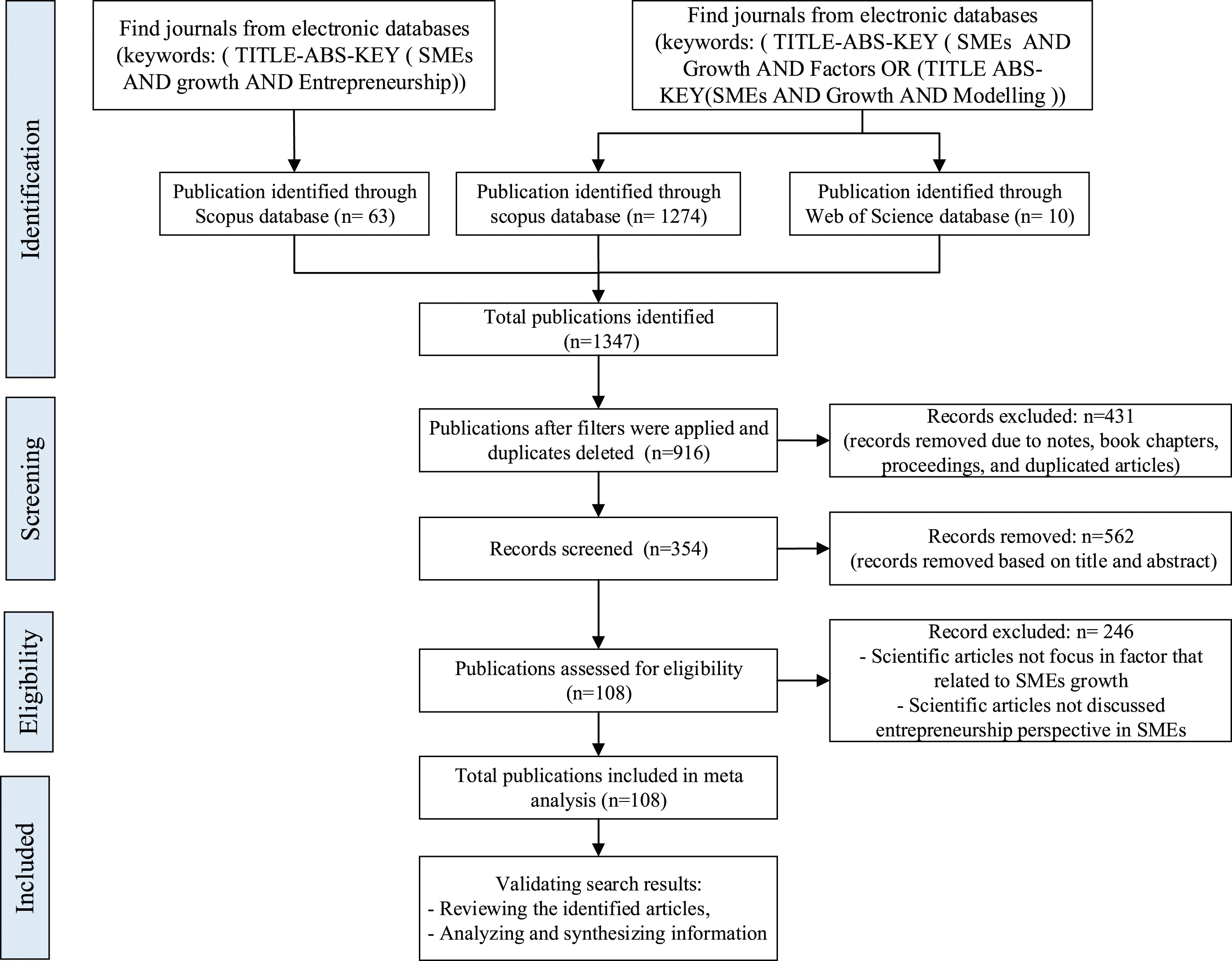
Stage 1: Identify the publication
In this literature study, the process began with identifying the publication. The publication was searched by determining research objectives. The search utilized databases such as Scopus and Web of Science. The publication search did not limit the year of publication. The keywords used to search the journal were “SMEs AND Growth AND Modelling” or “SMEs growth AND Factor”, “SMEs AND growth AND Entrepreneurship”. From electronics databases, it was found that 1274 journal articles were obtained through Scopus, and 10 were derived from Web of Science by using the keywords “SMEs AND Growth AND Modelling” or “SMEs growth AND Factor”. In addition, we obtained 63 journal articles from Scopus using the keywords “SMEs growth and entrepreneurship”. Therefore, the total of journal articles obtained in this study was 1347.
Stage 2: Screening articles
The next step was screening the types of articles. To start with, the articles were removed from the list of journals, such as notes, book chapters, proceedings, and duplicated articles. This screening obtained 916 articles and removed 431 articles. The screening was conducted by reading the titles and abstracts following the research objectives. By reading the title and abstract, the search resulted from 354 articles.
Stage 3: Eligibility assessment
The inclusion criteria of the literature review.

Stage 4: Data analysis and qualitative synthesis
The last stage was data analysis and synthesis. In this stage, articles were reviewed and categorized into SMEs’ growth factors, research outputs, research methods, and hypotheses that stated the relationship between variables. The systematic literature review used limitations on the scope and internal factors such as resources and capabilities that influenced the growth of SMEs.
The data analysis was used to obtain profiles of the paper, such as the number of studies per year, the countries of the research locations, and the number of research outputs. Qualitative synthesis was used to get an overview of the interrelationships between factors from previous studies. 30 The results of the analysis were used to build an SME growth framework based on previous research.
Eligible articles were read, analyzed, and checked for consistency. The articles were then categorized based on the country where the research was conducted. In research conducted in multiple countries, the country category was chosen according to the country where the research was conducted. The category of countries consisted of the accumulation of countries classified as developed and developing countries. Research on small business growth began in 1998 when the growth of SMEs was influenced by technology users. 31 The growth regarding internal SME factors studies began to change from 2000 onwards, such as learning orientation. 32 The research topics discussing entrepreneur’s factors were begun in 2008, such as innovativeness and creativity, 33 and human capital (e.g. knowledge).33,34 The research output of these articles was organized into factor analysis, model, framework, and simulation.
Result
Description of the literature
Figure 2 shows the trend of research on SMEs’ growth. The literature was searched without year limitation. Thus, we obtained literature that observed the SME growth model in 1998. Over 25 years, research trends in the field of SME growth have increased. The upward trend in SME growth research occurred from 2008 to 2022. The highest amount of research occurred in 2022. Figure 3 shows countries that contributed to the SME growth literature. We categorized the countries into developed and developing countries.
35
Figure 3(a) illustrates contributing SME growth literature for developed countries, including Spain (6), Taiwan (6), Finland (5), Saudi Arabia (4), United Kingdom (4), and Slovenia (4). Meanwhile, Figure 3(b) shows developing countries contributing to SME growth studies, such as Malaysia (7), Indonesia (6), India (5), Iran (4), South Africa (3), and Ghana (3). The total number of articles in developed and developing countries is 56 and 52, respectively. Publication trend of SMEs growth in entrepreneurship perspective. SME growth literature by country: (a) developed country, (b) developing country.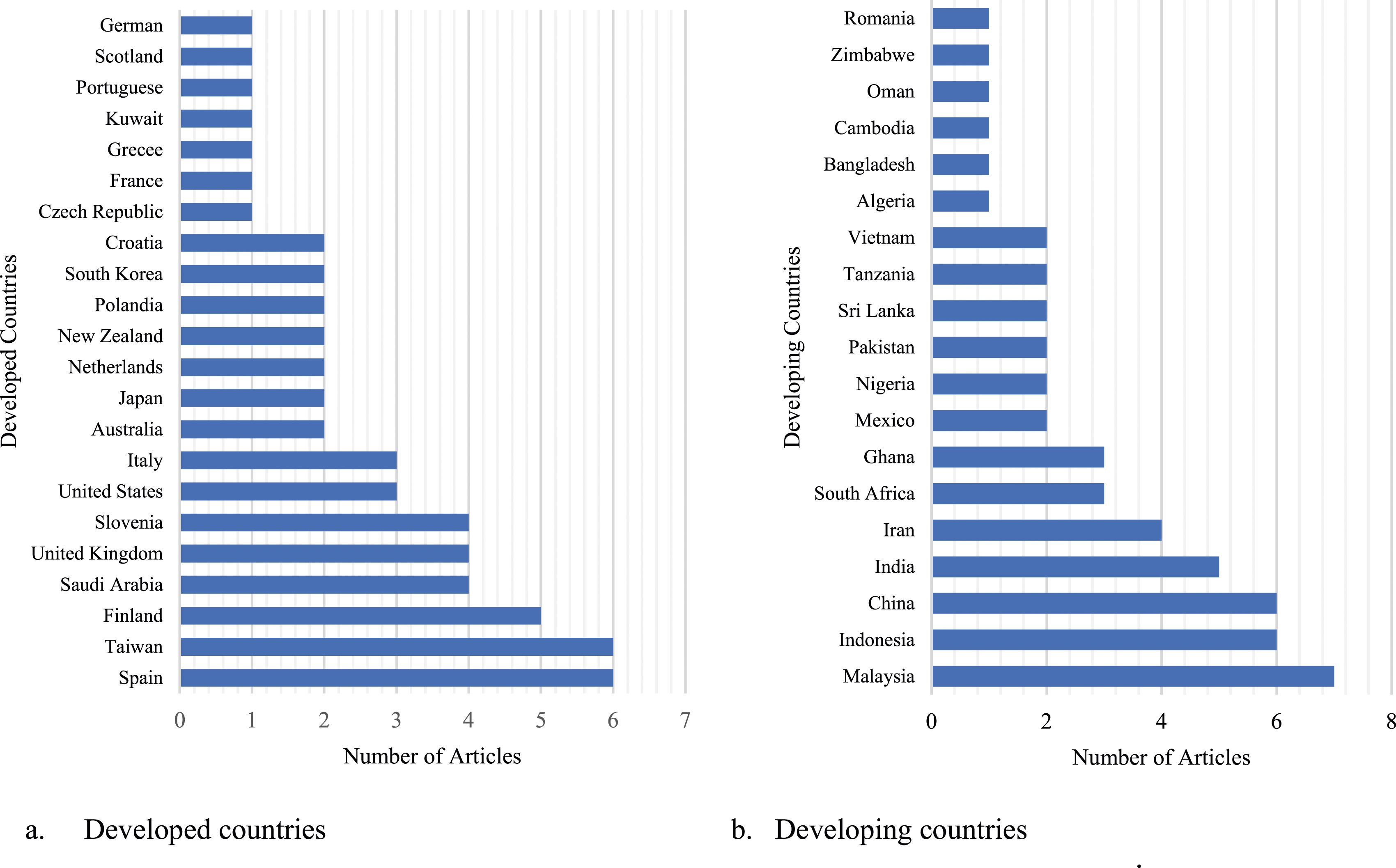

The research output was divided into two including critical factor and interrelationship between factor. The critical factor used several methods such as descriptive statistics analysis,
36
content analysis,37,38 thematic analysis, grounded theory,
39
and statistical inferences. The descriptive statistics are used to provide a summary of secondary data to assist in analyzing current performance.
36
The critical factors also use qualitative methods such as content analysis, thematic analysis, and grounded theory. The content analysis is used to analyze and interpret the content of various forms of communication, such as written, verbal, or visual material with sample in SMEs to identify specific patterns, themes, or characteristics within the collected data.
40
Thematic analysis is used to recognize, examine and report the pattern or themes within dataset entrepreneur by generating code.
18
The statistical inferences use the correlation test to examine an association between two variables. The statistical inferences that used in previous literature such as Chi-square test,19,41,42 Pearson Correlation,
19
Cramer’s V test,
43
and analysis of variance (ANOVA).44,45 This method is utilized to identify factors influencing SME growth, such as innovation capabilities,33,42,46 marketing capabilities,
19
and entrepreneur personality.
47
the statistical inferences has limitations, including its application within a specific scope and the potential for misleading results due to the assumption that observations are independent during variable testing Figure 4. The research output SMEs growth literature.
The interrelationship factor utilizes a model approach divided into including theoretical models, structural equation model, empirical models, and simulation model. The interrelationship factor used theoretical model to generate framework discussing entrepreneurial activity is used as a benchmark for the growth of SMEs. The theoretical model investigated the model from literature study and synthesized the critical factor into framework. The previous study examined causal loop diagram that is explained individual participation in business operations, participation in market development, and the ability to increase SMEs’ income. 48 The framework for the SME’s growth was based on the owner’s innovations, the ability to sense market needs, the awareness of the owner in increasing firm sales, and the total commitment and involvement in the allocation of limited resources. 31
The empirical model in the study of SMEs growth discusses a growth model using regression analysis approach. In previous articles, regression model was used to investigate SME growth employing techniques such as linear regression, 49 multiple linear regression,50–54 logistic regression, 55 logit distribution regression, 56 and combining multi-regression analysis with fuzzy analysis. 57 Regression models are more commonly utilized in developed countries compared to developing countries. This approach is used to understand the extent of the relationship between variables, such as innovation capability, and SME growth.51,54 However, the regression approach has a limitation, as it assumes that factors have a linear relationship and cannot be used for prediction with complex and non-linear variables.
Structural models are descriptive models of a system developed by utilize established causal and logical relationships that occur in the system. 58 This model consists of structural equation modeling and system dynamic model. Structural equation modeling (SEM) is used to validate the conceptual framework. This approach uses two analytical techniques consisting of confirmatory analysis and exploratory analysis. The SEM method in the analysis of SME growth provides significant results, with each being associated with the innovation capability variable,12,59–61 marketing capability,17,62,63 technology capability,64–66 human capital resources 2 dan partnership. 67 This study also reported SEM Software that was widely used by researchers, such as Smart PLS,22,26,61,65,68,69 Analysis of Moment Structures (AMOS), STATA, and EQS 6.1.
The simulation approach provides feedback relationships for variables that may not be explained in other method such as the structural equation modeling method. 32 Simulation models related to SME growth using system dynamics are still relatively underdeveloped in both developing and developed countries. The simulation utilized to model growth is system dynamics. The system dynamics are model approach used to obtain long-term predictions of SME growth simulation model. System dynamics simulation incorporates growth factors such as physical resources,32,70 SME partnerships, 71 and innovation capabilities. 48 Simulation models have the advantage of depicting real-world conditions with several variables assumed to behave homogeneously.
Each method used has strengths and weaknesses. The most straightforward approach is descriptive statistics. This method is employed to provide a summary of secondary data to assist in analyzing current performance. In developed countries, descriptive statistics are used to track the progress of SMEs through data on management improvements related to education for enhancing SME innovation. Additionally, it is used to understand the development of knowledge and innovation in SME products. 72 In developing countries, research using descriptive statistics is applied to analyze the growth of the number of female entrepreneurs and barriers to SME growth. 73 However, a limitation of this method, especially with the use of secondary data, is its ability only to depict current conditions. It falls short in offering predictive insights into growth and the underlying factors behind indicator performance, potentially leading to misinterpretation.
Factors influencing SMEs growth model
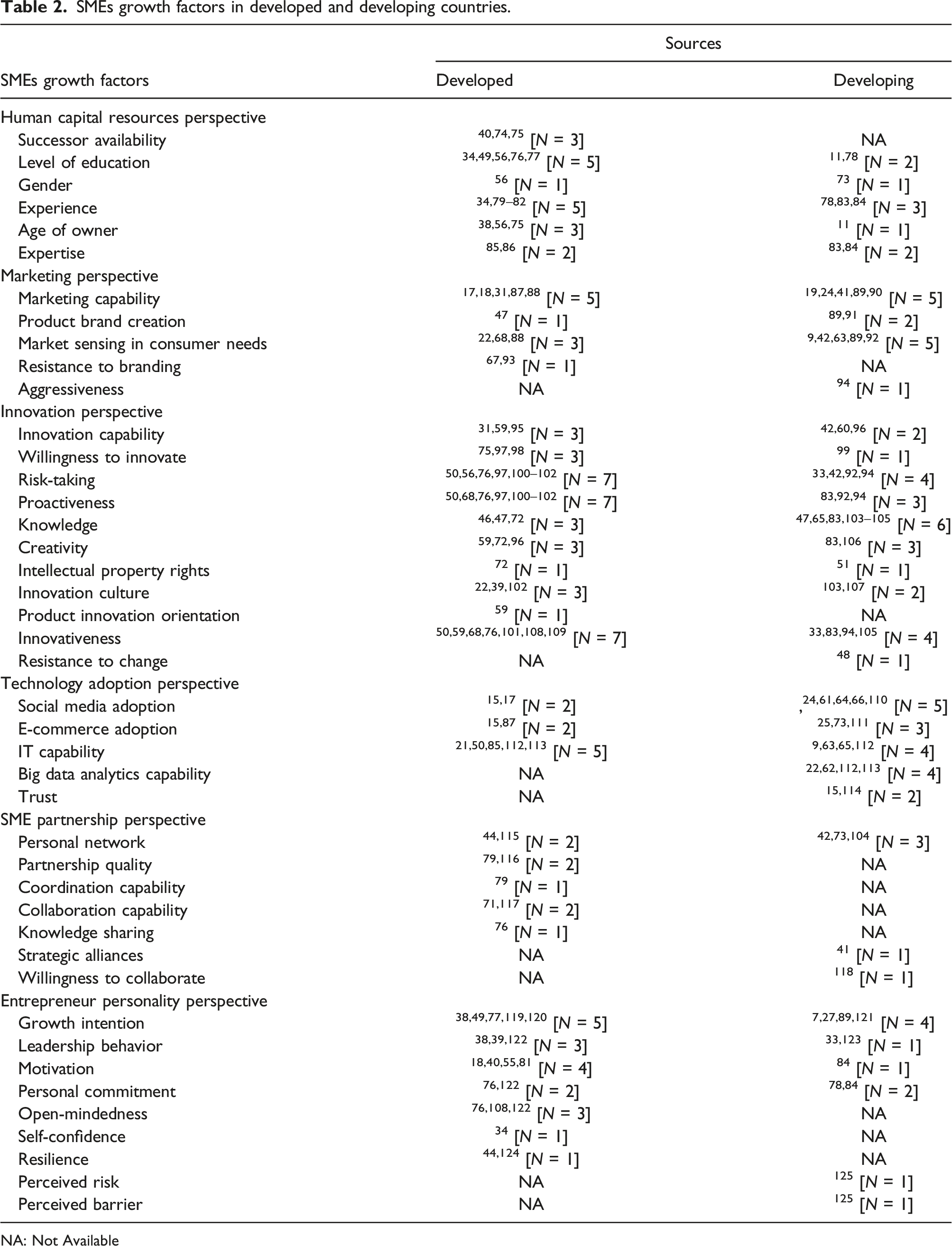
SMEs growth factors in developed and developing countries.
NA: Not Available
Theme 1: Human capital resources perspective
The human capital resources is related to the characteristics of entrepreneurs that serve as capital for the firm to gain development opportunities. 126 The growth of SMEs is supported by human resources as well as the availability of successors. 74 The successors are influenced by the leader’s willingness to delegate their power to successors. 75 Following the literature review, the developed countries were more concerned with human capital resources such as successor availability than developing countries.40,74,75 The availability of successors encourages the continuation of SMEs’ innovation. The SMEs' performance was supported by the human capital component, such as level of education,11,34,49,56,76–78 experience, expertise,83–86 and age of the owner.38,56,75,83,84 The results indicated that the entrepreneur characteristics, such as the age of the owner, experience, and education level, had a relationship with SME growth.11,49,73,76–78,83,84,127 Both developed and developing countries showed the same factors in the entrepreneur’s human capital. Research in developed countries found that education and experience were the most critical factors for enhancing SME growth. In addition, there is a deficiency in recognizing the importance of successor availability as a crucial factor for the sustainability of SMEs.
Theme 2: Marketing perspective
The marketing perspective assesses the factor that supports market performance on an individual and organization level in marketing capability. 128 This literature review confirmed that the growth SMEs described the performance in marketing in terms of sales growth, profit, and market share.41,46,71,77,87,127 It is supported by entrepreneurial factors to give the competencies. 37 In developed countries, the factors of SMEs growth related to marketing perspective discussed marketing capability,17,18,31,87,88 product brand creation,47,89,91 market sensing in customer needs,22,68,88 and resistance to branding. Differently, the marketing capabilities in developing countries did not discuss resistance to branding but discussed aggressiveness. Marketing capabilities are defined as the processes that a firm uses to define, develop, communicate, and deliver value to its target customers by combining, transforming, and deploying its available resources. 128
Marketing capabilities are important marketing-related mechanisms that refer to the firm’s ability to perform marketing routines and attain marketing objectives to improve its competitiveness and generate economic rents. 129 The aggressiveness shows the entrepreneur’s behavior in responding to market demands and dealing with competitors. 94 Market sensing is defined as the capability to sense opportunities involving scanning and monitoring the environment, reviewing, and detecting the effect of changes to it. 17 The expanding market is influenced by successful branding in SMEs. The well-established brands make the customer familiar with the products and services of the firm. The resistance to the branding of the owners or managers influenced the capability to upgrade their market. 93 The upgrading of SME markets is also influenced by product brand creation that requires active engagement from the actors in SMEs. 91
Theme 3: Innovation perspective
The innovation was explained as the factors that drive owners to create new products and improve the chances of the firms’ success. 54 The developed and developing countries have investigated SME factors consisting of innovation capability, willingness to innovate, risk-taking, proactiveness, knowledge, creativity, intellectual property rights, innovation culture, and innovativeness. Although they both investigated the innovation, the focuses were different. Based on the number of articles, the innovation factors in developed countries were more focused on the entrepreneurial orientation that consists of proactiveness, risk-taking, and innovativeness.50,97,100,101 Meanwhile, developing countries were concerned about knowledge and innovativeness.
The owner’s innovation capability is characterized by the ability to develop new products according to market demand. 12 This innovation requires knowledge as a key intangible resource that properly leads and represents a way to create more value in a firm. 2 Additionally, it needs proactiveness, which is defined as the initiative process of the owner or manager to seek opportunities related to the operation, product, brand, and strategies to enhance the competitive advantage.50,100,101 Meanwhile, risk-taking is also critical as the commitment and willingness of managers to make risky decisions. 94
The innovation capability is also related to intangible assets from the entrepreneurs, like intellectual property rights in terms of patents and industrial designs. Intellectual property rights are extremely important to develop market opportunities. 72 The intellectual property in product and services are capable of measuring the innovation capability in SMEs. 51 Based on the literature review, intellectual property was investigated in developed and developing countries. The psychological attributes pull business owners’ attention to develop their businesses, such as willingness to innovate. 130 The willingness to innovate comes from an individual who is willing to develop new ideas, experiments, products, services, or technologies.46,56,101 While creativity in SMEs growth is defined as entrepreneur originality in generating ideas, innovation should be seen as a treatment, improvement, and, more critically, the implementation of these ideas. 108 Hence, the innovation capability supports marketing capability to achieve competitive advantage. 131
Innovation is influenced by innovation culture. 103 Innovation culture reflects a degree to which values, norms, and atmosphere support the organization’s innovativeness. 132 The owner or manager in SMEs has the responsibility to encourage the employees to become alert, creative, and innovative to drive a successful organization.
Theme 4: Technology adoption perspective
The literature study from empirical research showed that technology adoption had a positive relationship with SME performance.13,15,22,25,133 The SMEs face challenges in increasing information systems knowledge and technology to control industrial productivity and market share. 112 The technology adoption in SMEs particularly information technology (IT) such as social media and e-commerce was capable of enhancing the existence of SMEs in both developed and developing countries.22,64 The digitalization era, indeed, causes SMEs to face the creation of vast amounts of data. This situation urges them to deal with ever-increasing data generated from digital transactions, clickstreams, voice, and video channels.
The developing countries examine indicators related to technology adoption more extensively than developed countries. Small and Medium Enterprises (SMEs) in developing countries have also conducted studies such as big data analysis to develop business insights by using data management, foundation information technology, and talent. 113 In previous research, the technology capability indicates that entrepreneurs use an application to help them perform their job better.134,135 In practice, leaders are responsible for motivating employees to follow new technology. 66 Technology adoption also requires trust in technology security for process business. 15
Theme 5: SME partnership perspective
The partnership perspectives describes the entrepreneur’s intention and behavior toward SME activities in managing resources through partnership or collaboration. 136 In developed and developing countries, the literature discussed some factors that influence SME partnerships. The most important factor discussed in SME partnerships was personal network. The developed countries investigated factors from a partnership perspective: partnership quality, coordination capability, collaboration capability, and knowledge sharing. Meanwhile, the research in developing countries has identified factors related to SME partnerships, such as strategic alliances and willingness to collaborate. The personal network is described as a way of measuring the number of resources available to an entrepreneur through the network. 137 The entrepreneur who has a personal network is defined as the person with whom a decision-maker has direct relationships or indirect relationships via direct relationships. 115 The personal network engages with access to knowledge, support, and resources for SME development. 44 Partnership in SMEs is shown in supplier relationships in the supply chain, which aims to increase profits and reduce costs. 138
In developed countries, the research investigated factors that influenced SME partnerships, such as coordination capability, collaboration capability, and partnership quality to manage partnerships. 79 The coordination capability describes the effort to integrate external and internal activities and resources more efficiently. 79 Moreover, it reduces conflicting objectives and uncertainties in corporations. The collaboration capability explains that the owner has the capability to collaborate with external parties. 117 The partnership quality helps SMEs to be competitive with the principle of joint and mutually dependent actions based on mutual trust, commitment, and business understanding, resulting in improved performance. The partnership quality refers to an SME’s perception regarding how effectively partnership results satisfy expectations. 79
In developing countries, factors for SMEs’ growth in a partnership perspective covered the willingness to collaborate 118 and strategic partnership. 41 The partnership engages with the willingness to collaborate from the entrepreneurs. 118 Further, willingness to collaborate is concerned with assessing a partner’s attitudes and intentions towards concrete collaboration situations. 139 In addition, trust and social capital were the drivers to establish alliances, creating mutual dependencies and hence contributing to the resiliency. 140 Strategic alliances influence the performance of SME partnerships. They explain the collaboration of SMEs with other enterprises to break through the market barrier and strengthen the market position to competitors. 41 In strategic alliances, the enterprise needs the SME owner to consider the capability to combine resources, enhance the market, and improve skill and technology to make SMEs more competitive. 80
Theme 6: Entrepreneur personality perspective
The growth of SMEs is also influenced by the entrepreneur’s personality. The entrepreneur personality belongs to psychological attributes that pull business owners to develop their businesses. 130 In this review, both developed and developing countries have studied growth. The entrepreneur personality was observed in the intention growth of SMEs,7,27,89,119,121 leadership behavior,39,141 motivation,40,55,81 commitment,76,122 and self-confidence. 34
The intention to grow a business is an essential characteristic of entrepreneurial behavior. It represents the entrepreneur’s intention to grow the business and maximize profit. 7 It also reflects SME owner-managers interest in expanding their business and taking opportunities. 119 The business expansion in SME is influenced the leadership behavior. The owner’s intention to grow is also called growth aspiration, which describes the desire of the business owner to achieve a higher level of business growth. 121
The entrepreneur personality that influences SME growth is leadership behavior. The leadership behavior of SME owners or managers shows the ability to develop strategic agendas and work with strategy development to enhance SME growth. 39 In terms of SME performance, leadership behavior can be defined as the behavior in transformational leadership where the leader can articulate the vision for the future, provide an appropriate role model, foster acceptance of goals, set high-performance expectations, and provide individual support and intellectual stimulation. 122 The leadership behavior of SME owners or managers shows the ability to develop strategic agendas and work with strategy development to enhance SME growth. The SME owners express their growth ambitions and approach growth proactively. They actively search for opportunities and emphasize this search in their strategic thinking. 39
The entrepreneur must have personal commitment, motivation, and self-confidence to maintain the continuity of SME growth. Personal commitment is the dedication or willingness of entrepreneurs to conform to the agreed practices in enterprises to enhance the SME market. 78 The market performance is an indicator of the growth of SMEs. 25 The growth of enterprises (or lack of it) is dependent on the entrepreneur’s motivation at the birth of the enterprise and during the enterprise’s survival time. The entrepreneur’s motivation defines what they do and what they do not do, which determines the future growth of the enterprise. 84 Next, self-confidence indicates the personality of the entrepreneur in preparing and implementing planning, facing new challenges, making decisions about important matters, and taking efficient action to cope with the problem. 34
In this literature review, the entrepreneur personalities in developed countries were marked by open-mindedness and resilience. Open-mindedness describes that entrepreneurs must be open to new things that can help them do business. 108 The resilience investigated the psychological condition of the entrepreneur personally to recover from failure. 44 Resilience has been proven to support organizations in integrating the capability to adapt to unfavorable conditions, identifying potential threats or significant developments, and ensuring thorough preparedness for unforeseen occurrences. 124 In developing countries, there is still a need for the development of capabilities in adaptation and anticipation. 124 The adaptation capabilities revealed that the ability of businesses to adapt to unfavorable conditions and take advantage of changes maintain resilience, enabling to continue business growth. The anticipation capabilities explain the capacity for observing internal and external changes; the capability to identify potential threats or significant developments, and thorough preparedness for unforeseen occurrences. In developing countries, the entrepreneur personalities were characterized by perceived risk and perceived barriers. 125 Perceived risk is defined as the entrepreneur who is willing to take a risk of a business. 125 Perceived barrier is interpreted as one’s assessment of the difficulty of social, personal, environmental, and economic barriers in a particular behavior related to SME growth. 142
Theme 8: SME growth indicator
SMEs growth indicators.

Evidence has shown that SME growth could be measured by a change of the amount of sales growth in terms of revenue in several years.6,16,37,82,92,95,96,120,144,148,150,152,153 Usually, sales growth is in line with the increase in sales volume. Thus, the SME growth used firm indicators such as sales growth,37,52,61,66,144,152 employment growth, 19 profit growth,9,12,65,71,148 market share growth,12,19,37,87,144 turnover, growth,11,17,52 and export rate.72,153
The framework of SME growth from an entrepreneurship perspective
Relationship matrix between constructs.

aN = number of articles.
The technology adoption factor has a relationship with marketing capabilities,24,73 innovation capabilities,22,65,71,95 and SME partnerships. The technology adoption in SMEs, particularly social media, increased SMEs’ competitiveness in marketing capability. Social media is an inexpensive technology platform and accelerates the sharing of information between partners and customers, thereby accelerating product brand marketing. 24 The technology adoption can be used to improve business data processing capabilities for the information availability that is needed to make decisions in innovation strategies.22,95 The use of the technology also influenced SME partnership. The technology particularly IT can facilitate SME activities in supporting coordination capabilities with both internal and external partners.71,144
The innovation capability has a relationship with marketing capabilities.22,71 The ability to innovate is shown in the product innovation orientation, which is related to market sensing to customer needs. 22 The market sensing to the customer is the indicator of marketing capability.88,92 The higher the results of innovation that are in accordance with consumer needs, the higher the opportunity to increase the market. 22 Innovation capability is influenced by entrepreneur personality.2,97,141 The relationship between entrepreneur personality and SME growth is shown by growth intention.7,27,89,121
The SME partnership has an association with marketing capabilities. 18 The partnership in SMEs is characterized by entrepreneurial networking. Entrepreneurial networking refers to entrepreneurs building and forming links with external entities.18,115 It includes entrepreneurs’ behavior in creating and forming ties, such as networking style, strategies, and processes that support market growth. Previous studies reported that the SME partnership in the supply chain increased sales growth. 154 In addition, it has a relationship with innovation capability 104 and resources. 71
The partnership is an essential input to innovation activities, particularly in SMEs. 155 Ease of access to resources, for instance, is greatly influenced by partnerships. Thus, SMEs seek strategies to reduce production costs by developing business partners to increase the availability of resources. 71 The resources can be in the form of investment and availability of raw materials. 52 The matrix relationship showed the relationship between constructs.
Human capital resources have an association with SME growth.11,43,55,56,73,79,81,84,101 Interestingly, they do not have a relationship with other constructs. In developed and developing countries, each construct has a relationship with SME growth. However, the relationship between SME partnership and SME development is found only in developed countries.
The framework (Figure 5) describes the relationship between each factor related to SMEs’ growth. The framework explained that constructs have an association with SME growth. The first factor is the entrepreneur demographic. The entrepreneurs' demographics cover several factors, e.g., level of education, gender, age of owner, experience, and expertise. There are no differences in demographic factors between developed and developing countries. The second factor is entrepreneur personality. The third factor is marketing capabilities. The marketing capabilities show the capability of the entrepreneur to use available resources to carry out marketing tasks and produce desired marketing outcomes.
128
The marketing capability is a construct that is measured by market sensing, product brand creation, resistance to branding, and aggressiveness. The fourth factor explains innovation capabilities have measurement indicators in the form of willingness to innovate,75,97,98 risk-taking,50,56,76,97,100–102 proactiveness,50,68,76,97,100–102 creativity,59,72,96 intellectual property rights,51,72 innovation culture,22,39,102 product innovation orientation,
59
and innovativeness,50,59,68,76,101,108,109 and resistance to change.
48
SME growth framework in entrepreneurship perspective.
The fifth factors are followed by technology adoption. Technology adoption is measured by social media adoption, e-commerce usage, IT capability, and big data analytics capability. Research on technology adoption for SMEs has been developed nowadays. It is used to measure the technology adoption readiness, level of behaviour, intention to adopt, perceived risk, and perceived barrier. The sixth factor is SME partnership, which is interpreted as the factor that shows the ability of SMEs to partner and collaborate. The factors include personal network, partnership quality, collaboration capability, coordination capability, knowledge sharing, strategic alliances, and willingness to collaborate. The SME partnership has a relationship with SME growth.41,117,156 The seventh factor is entrepreneur personality is measured by growth intention, leadership behavior, motivation, commitment, perceived risk, self-confidence, and perceived barriers.
Figure 5 shows that innovation capabilities are the most studied factors in SME growth research. The relationship between factors is shown by the thickness of the arrow. The thicker arrow indicates the more articles that were discussing the same thing. Of the many factors, the entrepreneur demographics show that level of education was the most studied factor.
Interestingly, this study documented the most studied items of each factor. For example, in the entrepreneurs’ personality factor, the growth intention was a factor that has been extensively studied. In technology adoption, IT capability has been studied the most in both developing and developed countries. In resources, capital availability was the most studied in growth. The most studied factors in the SME partnership, marketing capability, and innovation capability were the personal network, market sensing, risk-taking, and innovativeness. In developed and developing countries, each construction had a relationship with SME growth. However, the relationship between SME partnership and SME growth was only found in developed countries. In developed countries, more personality factors have been discussed than in developing countries, particularly for open-mindedness76,108,122 and resilience. 44 The growth of SMEs is influenced by entrepreneurs’ demographics factors. The level of education, for instance, gives opportunities for knowledge enhancement to create products that support the growth of enterprises. 55 The owner’s level of education particularly influences turnover growth or sales growth. 11 Research indicated that entrepreneurs who had an education above high school up to a degree showed a higher percentage of improvement. 43 Other demographics factors, such as the age of the entrepreneur affect SME performance, where SME growth is more rapidly developing in younger entrepreneurs. 55 Unfortunately, certain demographic factors, such as gender, have become a problem in the growth of SMEs because women entrepreneurs have many barriers to developing SMEs quickly because of cultural barriers, lack of spouse support, and lack of confidence in operational business. 73
The marketing capabilities factors in developed and developing countries have been measured with market sensing9,13,55,73,82 and product brand creation.47,89,91 Indicators of resistance to branding are only studied in developed countries.67,93 Meanwhile, the marketing capabilities in developing countries investigated aggressiveness showing the behavior of the entrepreneur in responding to market demand and deals with competitors. 94 In developed countries, discussion is more directed to the brand of SME products, which is believed to be one of the factors that are increasing progress in the market. The market capabilities in developing countries emphasis the level of aggressiveness of entrepreneurs to develop their markets.
From the entrepreneurial perspective, technology adoption is a widely discussed topic in previous research. Technology adoption has experienced developments in research. The technology adoption measurement in SMEs has started with technology acceptance.7,15,66 The previous literature measured technology acceptance by investigating the behavior intention to adopt, perceived risk, and perceived barrier of entrepreneurs in technology. The technology adoption level in developed and developing countries has been measured by IT capabilities, social media adoption, and e-commerce adoption. In particular, social media is the easiest technology for SMEs to use in developing countries. 64 E-commerce technology is used to market products in SMEs. 25 The topic of technology adoption in developing countries that has become a research trend is big data analytics capability.22,62,112,113 Big data analytics is a technology that needs to be considered because SMEs are facing the digital age, which requires a lot of data storage and data analysis to assist in planning, evaluating, and creating strategies for operations and business activities. 113
The framework shows that innovation capability is the factor that is mostly researched in relation to SME growth. Based on 21 studies that explicitly discover an influence between innovation capability and SME growth in both developed and developing countries. In developed countries, innovation capability is influenced by entrepreneur personality and technology adoption. Meanwhile, in developing countries, innovation capability is influenced by partnerships. The progress of SMEs in building innovation is driven by partnerships in building networks with suppliers, customers, and business partners. 104
Discussion
This paper provides insights into the critical factors influencing the growth of small and medium-sized enterprises (SMEs) in both developed and developing countries. This study successfully identified six factors that influenced SME growth, consisting of human capital resources, entrepreneur personality, technology adoption, marketing capabilities, innovation capabilities, and SME partnership. The most investigated factor in developed and developing countries is innovation capabilities. The innovation is the strategies carried out by enterprises to utilize existing resources for new breakthroughs in product and service development to strengthen the competitiveness of SMEs. 42 In contrast, the least studied factor is SMEs partnership. The partnership of SMEs is characterized by personal networks in developed and developing countries.44,104,115
The key differences between developing and developed countries is the emphasis in indicator in each factor and the interrelationship between factors. Indicators in developed countries that are not addressed in developing countries include human capital resources, innovation capabilities, entrepreneur personality, marketing capabilities, SME partnership, and SME growth. The factor of human capital includes the successor availability indicator used to measure SME sustainability. SMEs need to pay attention to entrepreneur personality factors, reflecting the growth intentions of business owners to enhance SME performance. 77 The SME partnership, which features different indicators such as partnership quality, collaboration capability, and coordination capability. The indicator offer insight that partnerships require strategies to measure the quality of the undertaken partnerships. 79 In the innovation factor, developed countries investigated product innovation orientation to develop new products. The product innovation orientation indicates the commitment of SME owners to engage in research and development for product development. 59 Regarding entrepreneur personality, the indicator of resilience is used to measure market shock resilience. In marketing capabilities, developed countries have investigated resistance to branding, which measures owner behavior in brand building.67,93 Developed countries have measured SME growth not only in economic scales such as sales growth, employment growth, and market share growth but also in indicators such as the quality of products, the number of customers, and export growth.
In developing countries, indicators that are not explained in developed countries include innovation capabilities, entrepreneur personality, technology adoption, and SME partnership. In the innovation factor, developing countries investigate resistance to change, indicating that SME owners in these countries still face resistance to innovation. Regarding entrepreneur personality indicators in developing countries, the focus is on perceived risk and barriers, as SME owners in these countries still perceive risks and barriers to strategic decision-making for SME development. In technology adoption, developing countries face issues of trust in technology adoption and the ability to use big data analysis.15,114 In SME partnership, developing countries encounter problems with willingness to partner, where the role of the owner in initiating partnerships is crucial. 118 Indicators of SME growth used by developing countries still focus on economic aspects. The findings suggest that developed countries have explored more relationships among variables compared to developing countries.
The interrelationships (Figure 5) revealed that the structured framework suggests theoretical implications that developed countries have focus on innovation capabilities to support marketing capabilities.22,71 Innovation activities can find new market opportunities, thereby enhancing market conditions. 71 In developed countries, the innovation capability serves as a strength to confront market competition, maintain product brand quality, and compete on pricing, thereby maintaining market presence. The innovation capabilities are supported by the entrepreneur personality of SME owners such as motivation, growth intention, and strong commitment. SMEs in developed countries have gone further to analyze the resilience of entrepreneurs as a form of strength in facing uncertain market. 44 The marketing capabilities is influenced by technology adoption. The impact of technology adoption not only on marketing capabilities but also more extensively on innovation capabilities22,65 and SME partnerships. 144 Technology adoption has implications for the level of innovation in SMEs. The use of technology contributes to increase knowledge in the process of creating innovation. 65 This knowledge enhancement in innovation influences the outcomes that align with customer needs, thereby creating opportunities for increased profits. Technological capabilities have implications for facilitating partnership processes among enterprises along the value chain. 144 The partnership processes of SMEs are supported by technology capabilities in integration and coordination processes that influence partnership enhancement and the fast growth of SME performance. 79 Moreover, these SME partnerships reinforce marketing capabilities through networks used as a strategy for marketing processes to enhance market share. 18
The interrelationships identified in developed countries serve as a guide for developing countries to enrich studies on the development of SMEs. Developing countries require development in terms of marketing capabilities and partnerships to become market leaders. 144 In developing countries, SMEs need to adopt several steps taken by developed countries, such as the adoption of technology to enrich their knowledge about innovation in both products and processes, and evaluating the market. Developing countries need a strategy to strengthen the entrepreneurial personality to foster interest in innovation, where SMEs particularly require entrepreneurs with a strong desire to cultivate innovation. Furthermore, the interrelationship between entrepreneur personality and innovation capabilities need to studied in developing countries. This insight serves as input for developing countries to adopt factors such as innovation and partnerships to improve their marketing capabilities.
The findings reveal several gaps regarding the indicators that used to measure SMEs growth in developing countries. The factor of human capital resources, particularly the availability of successors, and the interrelationship between entrepreneur personality needs to be examined in developing countries for the sustainability of SMEs. In developing countries, the measurement of SMEs growth typically relies on economic scales such as sales growth,10,12,18,23 employment growth,16,23,49 and market share growth.11,18,44,49 The developing countries need to upgrade indicators of SME growth such as the quality of products, the number of customers, and export growth, which have already been undertaken by developed countries. The growth of SMEs is concerned with maintaining demand by focusing on the quality of products and services and increasing the number of customers each year. SMEs in developing countries need to pursue markets similar to those in developed countries, not only domestically but also internationally, as indicated by export growth indicator.
Practically, this research contributes to SME owners and policymakers in evaluating growth of the SMEs based on the identified factors. The framework can be employed to formulate models and predict the level of SME growth. This can be valuable in providing solutions and recommendations for SME development through resources and capabilities factors. For owners or managers, the critical factors can be used to assess SME performance through multi-perspective evaluation. The perspective of factor is innovation, marketing, technology, SME partnership, human capital resources, and entrepreneur personality. Policymakers can utilize these growth factors to consider strategies for SME development, focusing on innovation and marketing capabilities. Practitioners need to consider the organization’s capability in partnering with other SMEs and organization to expand networks that can broaden market share. The partnership related with technology investment that necessary to enhance connection in business networking. The technology also enhance knowledge for innovation, improving product quality, and targeting new markets.
Based on the literature review, the future research agenda encompasses opportunities to investigate the interrelationship between factors such as innovation capabilities, entrepreneur personalities, human capital resources affecting marketing capabilities, SME partnerships, and in developing countries. The growth of SMEs is needed to address questions on how to measure SME growth using multidimensional factors from economic, social, and behavioral aspects to generate comprehensive measurements. Subsequent research should focus on designing growth models that simulate growth through mathematical modeling and optimize the use of resources for optimal SMEs growth. Moreover, this research field remains open to predictive studies employing both qualitative and quantitative factors. to simulating models that consider non-linear conditions and understand trends in SME development, allowing for the formulation of scenarios to enhance SME growth.
Conclusions
This study addresses the research question by providing critical factors and framework for SME growth based on a literature review. The results indicate that the development of SMEs in multi-perspectives factors is not only viewed as organizational level but also individual development. The results identify six categories significant factors from multi-perspective for SME growth including human capital resources, marketing capability, innovation capability, technology adoption, SME partnership, and entrepreneur personality. Each factor is accompanied by indicators to measure different levels of SME growth factors. The most significant factor in developed countries is human capital resources, SMEs partnership and entrepreneur personalities. Moreover, the developing countries revealed that the significant factors including technology adoption. is a factor that influences both developed and developing countries.
The interrelationship factors showed that each of critical factors have relationship with SMEs growth. There are several differences of relationship factors between developed and developing countries. In developed countries, the innovation capability and SME partnership have interrelationship with marketing capabilities. Additionally, the innovation capabilities are influenced by entrepreneur personality and technology adoption. The technology adoption has interrelationship with SME partnership. In contrast, the developing countries only has one interrelationship between SMEs partnership and innovation capabilities.
This study contributes to theoretical implications for fostering SME growth by examining the interrelationship between factors. Firstly, developed countries have fully recognized that the critical factors investigated should be able to cultivate the marketing capabilities of SMEs, the marketing capabilities increase the opportunities for market share growth. Almost all interrelationship factors follow a path toward marketing capabilities (except human capital resources) before leading to SME growth. This aligns with indicators in developed countries, which have concentrated not only on achieving domestic growth but also on export growth and the number of customers they possess. Secondly, marketing factors are influenced by innovation capabilities and SME partnerships in developed countries. Innovation capabilities serve as a strength to face market competition, maintain product brand quality, and compete on pricing. The SME partnerships act as a force to expand networks and open up new market opportunities. Thirdly, the technology adoption factor is not only used as a marketing strategy but, more importantly, to enhance innovation capabilities, resulting in increased knowledge about products and process improvement. Fourthly, developed countries have depicted that SME growth is influenced by entrepreneurial personality as one of the factors indicating that the emergence of innovation is driven by the individual character of the SME owner. Fifthly, developed countries have recognized that the sustainability of SMEs requires human capital resources, particularly in terms of successor availability. Therefore, this has implications for developing countries to consider strengthening factors similarly to developed countries.
In terms of managerial implications, the findings assist practitioners in assessing businesses based on human capital resources, entrepreneur personalities, and competencies. The human capital resources contributed to ensuring the sustainability of SMEs through the preparation of successor availability. Competencies such as innovation capabilities, marketing capabilities, technology adoption, and SME partnerships can be utilized to formulate business strategies. Marketing capabilities and technology adoption play a crucial role in expanding the target market for SMEs. Innovation capabilities and SME partnerships aid practitioners in driving income through product innovation. By understanding entrepreneur personality factors, practitioners can enhance individual personal qualities to contribute to the improvement of enterprise innovation capabilities. The interrelationship among these factors helps managers balance the roles of marketing, innovation, technology, and partnership competencies when designing SME growth strategies.
The study has limitations in terms of examining the stages of SME growth. This study does not discuss the relationship between factors and the types of SME growth levels. The framework formulated does not indicate reciprocal relationships. This reciprocal relationship is needed to understand the behavior between one factor and another factor that is non-linear. This study lacks consideration of uncertainty conditions that may interact with SMEs’ factors. The literature study only uses journal articles and does not include studies in the form of proceedings. This study has limitation on lack of strong contribute to innovation and new ideas from proceeding article due to the journal has longer time publication than the proceeding.
Essentially, this literature study can be employed as a starting gate for further research. Further research on SMEs’ critical factors is needed to investigate the interrelationship factors between technology adoption, innovation and marketing capability, and entrepreneur personality in developing countries. These interrelationship factors are underexplored in developing countries. This topic has opportunities to explore the indicator and factors of partnership in developing countries. According to the literature review, there is a great opportunity to conduct research using this framework to simulate the relationship factors into a quantitative model and investigate the relationship between factors of SME growth. Research using simulation approaches needs to be further conducted to predict future SME growth. The research remains open to examine human capital resources and innovation capabilities factor influencing in both of countries.
Footnotes
Author contributions
Dian Fajarika developed the research framework, collected the data, performed the analysis, and wrote the manuscript with support from Fitri Trapsilawati and Bertha Maya Sopha. Fitri Trapsilawati and Bertha Maya Sopha supervised the project, provided critical feedback, and helped shape the research, analysis, and manuscript.
Declaration of conflicting interests
The author(s) declared no potential conflicts of interest with respect to the research, authorship, and/or publication of this article.
Funding
This work was supported by Final Project Recognition Grant Universitas Gadjah Mada (Grant Number: 5075/UN1.P.II/DitLit/PT.01.01/2023).
