



Abstract
The digital transformation of our physical lives, driven by cutting-edge technologies like AI, 5G, and Extended Reality, is rapidly unfolding through the metaverse. This study investigates the factors influencing the adoption intention of the metaverse and its impact on small and medium-sized enterprises (SMEs) performance, employing the technology-organization-environment (TOE) framework. A cross-sectional analysis involving 173 owners/senior managers of SMEs in Canada was conducted to develop a conceptual model. Exploratory factor analysis and Cronbach’s alpha were employed to assess the questionnaire’s validity and reliability. Correlation, regression analysis, and Baron and Kenny’s method were used to evaluate relationships and mediation effects. The findings revealed seven significant factors influencing SMEs’ metaverse adoption intention. Notably, anxiety, security, and privacy did not impact adoption intention. Conversely, a positive correlation emerged between metaverse adoption intention and SME performance. The study demonstrated that metaverse adoption intention fully mediated the relationship between predictors and performance, with the indirect effect moderated by relationship qualities (RQs) like service experience and customer engagement. These insights provide decision-makers with valuable guidance for prioritizing essential factors crucial for successful metaverse technology implementation in SMEs.
Keywords
Introduction
While the concept of the metaverse has recently emerged within the common discourse among technology commentators and scholars, its inaugural usage dates back to 1992 in the Neal Stephenson novel titled “Snow Crash.” In recent years, the metaverse has emerged as a transformative concept, reshaping the landscape of online social interaction and commerce. Barrera and Shah 1 define the metaverse as a new iteration of the internet, integrating VR headsets, blockchain technology, and avatars to seamlessly merge the physical and virtual realms. This innovative environment establishes a persistent, shared virtual space, enabling real-time interactions among users and with digital entities. 2 Notably distinguished from traditional online communication channels, the metaverse has initially been associated with gaming and entertainment. However, there is a growing recognition of its potential applications in various business contexts, particularly among small and medium-sized enterprises (SMEs). 3
Precursors to the metaverse, such as Second Life, Roblox, and Fortnite, have laid the groundwork for immersive virtual experiences, allowing users to create avatars and engage socially within virtual worlds.4,5 The metaverse, as envisioned by Meta Platforms in Horizon Worlds launched in 2021, transcends these predecessors by providing an immersive ecosystem where users seamlessly transition between virtual and real worlds, utilizing avatars and holograms for work, interaction, and socialization.
6
In alignment with the concise definition by,
5
the metaverse is portrayed as “the layer between you and reality,” a 3D virtual shared world facilitated by augmented and virtual reality services. In a scholarly context,
7
systematically delineates the metaverse architecture, encompassing the amalgamation of digital realms with both the human and physical domains, as illustrated comprehensively in Figure 1. Metaverse architecture with the integration of digital worlds and the human and physical worlds. Source:.
7
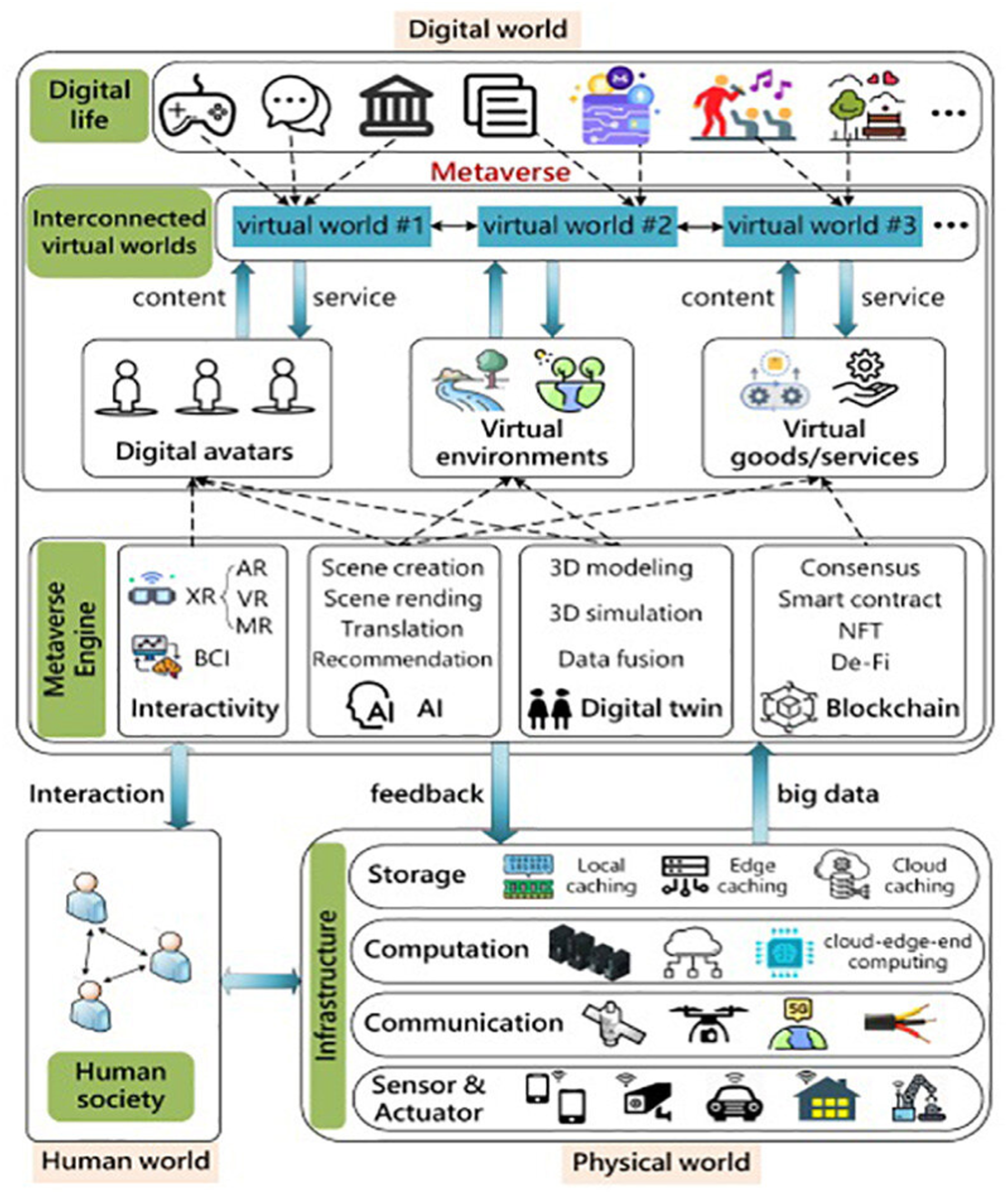
Technological advancements, including VR headsets, haptic gloves, AR, and Extended Reality (XR), are propelling the development of the metaverse, offering users highly interactive and immersive experiences. This surge in technological capabilities prompts organizations to explore the integration of the metaverse into their existing business models.
While SMEs play a vital role in the global economy, contributing significantly to job creation and economic development, they often grapple with challenges stemming from limited resources and market access. 8 Emerging technologies like the metaverse present new opportunities for SMEs to overcome these challenges and expand their reach. By utilizing metaverse platforms, SMEs can showcase products and services, collaborate with partners and customers, and offer immersive customer experiences.9,10
However, the potential benefits of adopting metaverse technology are accompanied by challenges for SMEs. Primary concerns include a limited understanding of effective integration into business models, technical expertise and resources for development and implementation, and issues related to privacy, security, and regulations.3,11,12
Despite the burgeoning interest in the metaverse, there is a research gap concerning the adoption intention of metaverse technology within SMEs. While existing studies explore the potential of metaverse technology across various sectors, such as education, healthcare, and gaming, a focused investigation into the opportunities and challenges specific to SMEs is lacking.13–16 This study is designed to explore the challenges and opportunities related to metaverse adoption within organizational contexts. To delineate the research objectives, the study follows a systematic approach. Initially, a comprehensive systematic review was performed to examine existing literature on metaverse adoption. The insights gained from this review then informed the identification of key challenges, paving the way for a subsequent quantitative research phase. The objective is to develop an integrative framework guiding future research and practical applications in this domain.
Given the limited accessibility of metaverse adoption in manufacturing for many SMEs due to affordability concerns, this study centers on investigating the adoption intention of metaverse technology in SMEs and its potential impact on performance. The research questions guiding this study are as follows: • What are the specific technological, organizational, and environmental factors that significantly influence SMEs’ intention to adopt metaverse technology? • How does the adoption intention of metaverse technology impact the financial and marketing performance of SMEs, and what are the mediating mechanisms at play? • To what extent do relationship qualities (RQs) moderate the relationship between SMEs’ adoption intention of metaverse technology and their overall organizational performance?
It is essential to emphasize that this study’s primary objective is not merely to test the adoption intention of the metaverse. Rather, it seeks to gain a comprehensive understanding of the underlying factors driving adoption intention, aligning with existing literature that explores technology adoption drivers after widespread usage and acceptance.17–19 Consequently, our study takes on both exploratory and explanatory aspects, aiming to identify and explore the nuanced drivers of metaverse adoption and examine their actual influence on the adoption process.
This study employs the Technology, Organization, and Environment (TOE) framework to identify factors influencing the adoption of the metaverse from an organizational perspective. The TOE framework, well-established in the information systems literature, offers insights into the implementation and adoption of innovations, making it a suitable choice for understanding the adoption of novel solutions like the metaverse. 20
To make our study more manageable and relevant, we narrowed our focus to Small and Medium Enterprises (SMEs) due to their unique characteristics and challenges in adopting emerging technologies. We then systematically identified and analyzed key factors influencing SMEs’ intention to adopt metaverse technology, further narrowing our focus to the determinants of adoption. With a refined focus on adoption intention, we established a connection between SMEs’ intention to adopt metaverse technology and its potential impact on organizational performance. Here, we emphasized that our study does not measure the direct impact but rather explores the associations and pathways. Finally, we zoomed in on the ultimate outcomes—financial and marketing performance. Our analysis revolves around understanding how the intention to adopt the metaverse could influence these critical dimensions of organizational success.
This research holds significance not only in comprehending the adoption intention of the metaverse in SMEs but also in providing valuable insights for metaverse marketers and manufacturers targeting these businesses. The proposed conceptual model, empirically validated, offers practical guidance for SMEs in formulating effective strategies for adopting metaverse technology. The study’s findings contribute to informed decision-making and facilitate the successful integration of the metaverse into SMEs’ operations.
In summary, this study comprehensively investigates the interplay of various factors, including TOE, ADN, and RQs, to understand how they collectively influence the overall performance of organizations in the context of metaverse technology adoption. The findings aim to provide a nuanced comprehension of the metaverse’s impact on organizational success and guide future strategies for effectively integrating this technology into businesses.
The paper begins with a provision of the theoretical background, where relevant theories, including the TOE framework, are reviewed. These theories are used to develop key research hypotheses. Following this, the research methodology is outlined, illustrating the research design, methodology, and methods used to test the proposed model. Next, in the data analysis section, the results are elucidated and discussed. The paper concludes by discussing practical, theoretical, and managerial implications, highlighting the limitations of the study, and proposing a research agenda.
Literature review
Metaverse: scope and characteristics
The concept of the metaverse, initially conceived for fictional purposes, has transformed into an immersive 3D virtual world where users can engage in social and economic interactions regardless of their physical location. This virtual environment boasts unique features that distinguish it from other educational tools, including interactivity, corporeity, and persistence. 21 The metaverse’s interactivity allows for dynamic and innovative autonomous and collaborative learning experiences. Users can interact with each other and access resources through a virtual learning platform without the limitations of physical movement, remaining connected to the virtual world for an unlimited time.
The corporeity feature breathes life into avatars, creating a realistic environment where their shape and movements rival or surpass those of 3D games. This enables limitless representations of users in the virtual world. The persistence feature is crucial as it preserves conversations, data, and objects even after users have left the virtual world, ensuring continuity and evolution. 22 From a contextual setting of the business landscape with specific focus of manufacturing, the metaverse presents new challenges for industry and business, necessitating an educated workforce adaptable to this environment. This requires new management and organizational leadership models. 23 Metaverse environments offer a unique opportunity to study human behavior in an educational context, distinct from behavior in the physical world. 24 Higher education institutions can harness these environments, providing a flexible platform for communication and collaboration among faculty, staff, and students without the constraints of traditional classrooms. Digital communication between students and professors enables hybrid and collaborative classes that embrace the capabilities of the virtual world. 25
The metaverse system is closely linked with artificial intelligence technologies and collaborative learning systems that enhance educational methodologies and learning styles. Recent studies have explored various topics, including students’ attitudes in different countries, gender differences, and the role of social media in blended learning. Successful implementation of these technologies requires additional tools to track learners’ skills and performance. Eye-tracking techniques have been utilized to assess how learners process texts and graphics during reading. The growing focus on virtual reality indicates that the metaverse system will exert a significant impact in the near future. Recent studies have examined the positive and negative effects of virtual reality for educational purposes.26,27
Previous studies and metaverse system
The exploration of the metaverse concept traces its roots to early works, notably introduced by Neal Stephenson’s 1992 science fiction novel “Snow Crash.” This conceptualization laid the foundation for subsequent discussions on virtual reality, shared digital spaces, and immersive online environments. While these early works sparked interest and imagination, the practical implications for the business landscape were not fully realized until recent advancements in technology. As interest in the metaverse expanded, studies began to emerge, highlighting its potential applications beyond gaming and entertainment. Notable works by3,28,29 emphasized the growing relevance of the metaverse in business contexts. These studies marked a pivotal shift from perceiving the metaverse as a purely recreational space to recognizing its potential impact on organizational performance, especially in sectors such as manufacturing.2,30 highlighted benefits for SMEs, including virtual showrooms and collaborative innovation. 31 explored applications in the fashion industry, while 32 considered its use in museums.
Building on the foundational works, recent literature has seen a surge in interest in the business applications of the metaverse. However, a critical examination reveals a need for more focused investigations, particularly in understanding the factors influencing metaverse adoption in the manufacturing sector. Previous studies, while contributing to the broader discourse, lack a comprehensive exploration of the specific challenges and opportunities faced by businesses, especially SMEs, in adopting metaverse technology. Metaverse technologies offered cost-effective and immersive training for SMEs. 33 Barrera and Shah 1 showcased marketing advantages, reporting increased brand awareness. 34 identified efficiency gains in project management, emphasizing improved communication in virtual environments. 35 emphasized metaverse use in marketing for SMEs. 36 explored applications in architecture, while 37 highlighted potentials in the gaming industry. 38 delved into enhancing e-commerce, and 26 explored healthcare applications. 39 focused on virtual tourism, and 38 highlighted improved customer experience in retail. Metaverse technologies found applications in healthcare training, 40 education, 41 and corporate collaboration. 42 Jungherr and Schlarb 43 emphasized their impact on the gaming experience. Critical reviews by, 44 and 45 explored Facebook’s metaverse strategy, immersive marketing, and metaverse adoption in higher education, respectively.
This study aims to bridge existing gaps by providing a nuanced examination of metaverse adoption intention in SMEs within the manufacturing sector. By synthesizing insights from previous studies and focusing on the unique challenges faced by SMEs, this research contributes to a more targeted understanding of how the metaverse can be effectively integrated into the business landscape. In summary, past studies underscore factors shaping metaverse adoption, showcasing its potential in diverse applications. The chronological exploration sets the stage for the current study, unveiling opportunities and challenges within the manufacturing sector.
Benefits of the metaverse in a business context
In aligning with the overarching focus of this study on the performance implications of metaverse adoption in the business landscape, we emphasize the benefits that directly contribute to external stakeholder engagement and organizational outcomes. One of the prominent advantages of integrating the metaverse into business operations is the potential for heightened customer engagement. Metaverse platforms offer innovative ways for businesses to interact with their external stakeholders, providing immersive product experiences, virtual storefronts, and collaborative environments. Through metaverse technologies, businesses can forge strategic partnerships and collaborations with external entities. This dynamic interaction can extend to co-creation, joint ventures, and immersive brand experiences that resonate with external stakeholders, thereby positively influencing organizational performance. The metaverse breaks down geographical barriers, allowing businesses to extend their reach to a global audience. This aspect is particularly relevant for external stakeholders such as customers, partners, and investors, opening new avenues for market expansion and international collaboration.
Throughout the subsequent sections, the discussion maintains a performance-centric lens, focusing on the implications of metaverse adoption for organizational performance with a specific emphasis on external stakeholders. This consistency ensures that the study’s objectives are aligned with the interests of businesses in leveraging metaverse technology to enhance their interactions and relationships with external stakeholders.
Theoretical background
The technology, organization and environment (TOE) framework
In the early 1990s, 46 introduced the Technology-Organization-Environment (TOE) framework as a theoretical model to understand how innovative technologies are adopted at the firm level. This framework consists of three perspectives: technological, organizational, and environmental.
The technological perspective focuses on the unique features and characteristics of the technology being adopted. It considers aspects such as technological complexity, compatibility with existing systems, and the advantages it offers compared to existing solutions.
The organizational perspective looks at attributes within the organization that are relevant to technology adoption. This includes factors like the organization’s readiness and capabilities to adopt the technology, the perceived benefits and costs of adoption, and the level of top management support for the initiative.
The environmental perspective considers broader contextual factors that may influence technology adoption. This can include regulatory or legal considerations, market pressures, and the competitive landscape. The TOE framework has been widely adopted in both academic and practical settings and has proven useful in understanding technology adoption in various industries and organizational contexts. 47 Its applicability to different technology adoption scenarios and its ability to identify key drivers and barriers to adoption make it valuable for researchers and practitioners.
It is important to note that the TOE framework does not provide a specific set of factors for a given problem. Instead, it organizes relevant factors into individual constructs related to technology adoption.48,49 However, the framework has been effectively applied to investigate the adoption of various technologies, including augmented reality, AI in talent acquisition, intelligent robots in manufacturing SMEs, software as a service, Industrial Internet of Things, and Industry 4.0 in the Chinese automotive industry. The focus of this paper is to examine the adoption intention of the metaverse in SMEs.
Conceptual model and hypotheses
The theoretical model presented in this study is built upon the TOE framework and is depicted in Figure 2. It comprises three main drivers of metaverse adoption, which are technological characteristics, organizational characteristics, and environmental characteristics. Research framework.
Our work is the first model that investigates the Technology-Organization-Environment (TOE) framework with different antecedents and their impacts on metaverse adoption intention in SMEs. The metaverse is poised to have a significant impact on organizational performance. According to a survey conducted in January 2022, around 30 percent of C-Level executives worldwide believed the metaverse was going to have an incremental impact of optimizing processes for their companies. 2 Similarly, 28 percent of the respondents thought the virtual environment could allow a breakthrough change for new businesses possibilities and customers. 50 The metaverse is also expected to reshape the world of work in at least four major ways: new immersive forms of team collaboration; the emergence of new digital, AI-enabled colleagues; the acceleration of learning and skills acquisition through virtualization and gamified technologies; and the eventual rise of a metaverse economy with completely new enterprises and work roles.
Our model provides valuable insights into how SMEs can leverage the TOE framework and other antecedents to successfully adopt metaverse technology and improve their organizational performance. In our investigation of the factors influencing SMEs’ adoption intention of metaverse technology, we underscore the significance of relationship qualities (RQs) such as service experience and customer engagement. These RQs emerge as pivotal components for shaping customer engagement within the metaverse, encompassing specific attributes and interactions designed to enhance the overall customer experience and interaction dynamics. Moreover, we explore how these relationship qualities act as moderators between the adoption intention of metaverse technology and organizational performance. Our model investigates how these factors can influence the relationship between metaverse adoption intention and organizational performance, providing valuable insights into how SMEs can leverage these factors to successfully adopt metaverse technology and improve their organizational performance.
The choice of an appropriate theoretical framework is pivotal in guiding the analysis and interpretation of research findings. In this study, we employ the Technology-Organization-Environment (TOE) framework, a well-established model in the information systems literature. The TOE framework is selected based on its proven efficacy in explaining the adoption of innovations within organizational contexts, particularly those involving both hardware and software elements. 20 By adopting a structural approach, the TOE framework allows us to systematically examine the technological, organizational, and environmental factors influencing metaverse technology adoption among SMEs. Our research objectives necessitate a comprehensive framework that captures the multifaceted influences on metaverse adoption within SMEs. The TOE framework aligns seamlessly with our study’s focus on the interplay between technological advancements, organizational dynamics, and the broader business environment. Furthermore, the utilization of the TOE framework not only enhances the analytical rigor of our study but also contributes to the cumulative body of knowledge in technology adoption. By applying this established model to the emerging context of metaverse technology in SMEs, we aim to enrich the theoretical discourse surrounding the adoption of innovative technologies.
Within the technological dimension, the study takes into account factors such as technology roadmapping,51,52 security and privacy concerns,53,54 and visual appeal55,56 as influential aspects.
Within the organizational perspective, Word-of-Mouth, 57 collective capability, 58 and computer anxiety59,60 are considered significant drivers of metaverse adoption.
Based on previous research within the environmental perspective, this study recognizes social influence, 61 vendor support, 62 and technology investment 63 as three crucial antecedents and drivers of metaverse adoption.
The main objective of this study is to explore the potential use of the Metaverse and its connection with adoption intention. This study aims to predict the potential impact of metaverse adoption on firm performance by investigating the organizational intention to adopt metaverse technologies. We explicitly acknowledge that, due to the predictive nature of this research, we are exploring associations and pathways rather than establishing direct causation. In particular, the research aims to investigate how the moderating influence of service experience and customer engagement impacts the relationship between the adoption intention of the Metaverse and its impact on performance.
Technological characteristics
Technology roadmapping (TRM)
Contemporary technologies, such as artificial intelligence (AI), are increasingly being integrated by small and medium-sized enterprises (SMEs) to enhance their business performance. 64 Various factors are driving this adoption, and AI enablers play a key role in facilitating the adoption of these technologies within corporate organizations. These enablers fall into categories such as technology roadmapping, attitude, and expert knowledge, all of which can have a substantial impact on organizational processes. Notably, technology roadmapping serves as a strategic planning approach for researching, developing, and implementing emerging technologies.
In a study conducted by, 65 they found that strategic roadmapping is a significant predictor of the adoption of Information and Digital Technologies related to Smart Manufacturing (SMIDT). This study analyzed the adoption of SMIDT within the operational frameworks of Malaysian and Iranian SMEs.
In line with this perspective, 66 emphasized the significance of establishing an AI-based digital roadmap for the effective integration of AI into corporate operations. The study’s focal point was an IT company aiming to adopt AI, which encountered substantial challenges due to an insufficient technological groundwork. Recognizing this, 66 recommended the creation of a “value generation team” within the organization to formulate a strategic plan for AI implementation. In light of these insights, the current study formulates the following hypotheses:
In a study conducted by, 65 they found that strategic roadmapping is a significant predictor of the adoption of Information and Digital Technologies related to Smart Manufacturing (SMIDT). This study analyzed the adoption of SMIDT within the operational frameworks of Malaysian and Iranian SMEs.
In line with this perspective,
66
emphasized the significance of establishing an AI-based digital roadmap for the effective integration of AI into corporate operations. The study’s focal point was an IT company aiming to adopt AI, which encountered substantial challenges due to an insufficient technological groundwork. Recognizing this,
66
recommended the creation of a “value generation team” within the organization to formulate a strategic plan for AI implementation. In light of these insights, the current study formulates the following hypotheses:
Security and privacy concerns (SNP)
The term SNP stands for the perceived unreliability of information systems (IS) and technology in executing tasks and sharing data. 67 Within the metaverse landscape, customer-centric security considerations emerge as pivotal factors influencing the adoption of metaverse technology in small and medium-sized enterprises (SMEs). 68 In our study, we emphasize the significance of addressing customers’ security and privacy concerns, as these factors play a decisive role in shaping the adoption intention of metaverse technology. 68 This customer-centric approach to security aligns seamlessly with our research’s primary focus on financial and marketing performance, where ensuring a secure and trustworthy metaverse environment directly contributes to organizational success. Previous research has established that the implementation of new technology can give rise to security concerns.69,70 The presence of security-related issues has been observed to negatively affect the adoption of information systems by businesses.71,72 In the context of employing Artificial Intelligence Technology (AIT) for Talent Acquisition (TA), substantial data is involved, encompassing applicant profiles, personal CVs, and candidate selection outcomes.
In order to safeguard personal data and maintain the confidentiality of selection results, AIT must possess sufficient security measures to manage such information.
73
Furthermore, the utilization of AIT for TA has given rise to potential concerns regarding security, legality, ethics, morality, and the privacy of prospective applicants.74,75 HR managers express apprehension regarding the application of AI technology for TA, particularly with respect to the security and privacy of applicant and employee data.
73
Thus, this study proposes the following hypotheses:
Visual appeal (VA)
Visual appeal stands as a pivotal factor influencing the adoption of metaverse technology in SMEs. This concept denotes the tangible aspect of the online environment that conveys the perceived attractiveness and overall “look and feel” of a website. 76 The research by 77 underscores the significance of visual appeal in capturing user attention, enriching user experiences, and augmenting overall satisfaction. Further investigations by78,79 illustrate that a visually pleasing user interface design contributes positively to users’ perceptions of metaverse technology, rendering it more inviting and user-friendly. These insights underline the importance for SMEs to prioritize the visual design of their metaverse applications, ensuring a captivating and immersive user experience.
Additionally, research by80,81 reveals that visual appeal also bolsters users’ perceived trust in metaverse technology. When SMEs develop visually appealing metaverse applications, users are more inclined to trust the technology and view it as dependable, fostering heightened intentions for adoption. Thus, the role of visual appeal is pivotal in the metaverse technology adoption journey for SMEs. Consequently, this study puts forth the following hypotheses:
Organizational characteristics
Computer anxiety/anxiety (ANX)
The exploration of computer anxiety has garnered substantial attention since the inception of the Digital Revolution in the 1980s, and its relevance persists today. 82 An influential work by Powell in 2013 provided an exhaustive review of the foundational concepts of computer anxiety, proposing several variables as predictors of this phenomenon. 83 The concept of computer anxiety suggests that it emerges in response to perceived threats stemming from technology that may be too intricate to operate, and where the benefits of usage are overshadowed by the requisite effort. This can significantly influence users’ behavior, leading to diminished enjoyment when considering the use of digital tools 84 and heightened apprehensions regarding their utilization. 85
Numerous studies have delved into anxiety across diverse technology adoption contexts, encompassing digital-native generations, 86 and computer anxiety. 87 Given the emergence of AI anxiety as a novel concept,86,88 further examination of anxiety within the management domain, especially in HRM, is imperative. 89 Asserted that the emotional component of an attitude can be differentiated from its cognitive and behavioral components using the TMA. Hence, when assessing individuals’ willingness for change, 90 considering both their emotional responses and cognitive experiences becomes crucial.
The exploration of vital emotional factors like AI anxiety within the context of technology adoption remains limited in existing studies. Although anxiety has been employed to gauge worker well-being, its influence on organizational performance and job satisfaction has been the subject of scrutiny among researchers.91,92 Nonetheless, there exists a paucity of research on individuals’ perspectives regarding AI anxiety. Presently, there are no empirical investigations probing into how individuals’ AI anxiety impacts their willingness to adopt AI, with the exception of studies concerning the anxiety AI generates among job seekers. 75
As intelligent machines gradually assume the roles of decision-makers and information processors previously undertaken by humans, the rise and ubiquity of AI have sparked augmented uncertainties about the future of work, inducing feelings of anxiety. 93 This anxiety can play a substantial role in causing distress and might deter employees from embracing these novel technologies. Moreover, ongoing debates revolve around the extent to which trust should be vested in AI-driven technologies like medical aids and self-driving vehicles. 94 Those who harbor such concerns might conjure worst-case scenarios, experience a sense of helplessness, and lack clarity on how to manage the emergence of AI. 90 underscore the significance of employees’ positive outlook toward organizational transformations. This viewpoint is reinforced by, 95 who propose that the impact of such changes on both individuals and the organization should be perceived positively by the staff. It is our contention that individuals’ attitudes toward change substantially influence their readiness to embrace it. 90
Consequently, the metaverse’s adoption intention could potentially be dampened by individuals’ anxiety towards it, as those who experience heightened anxiety are less likely to be inclined to adopt new technology. Hence, this study advances the following hypotheses:
Collective capability (CC)
Collective capability signifies the ability of small businesses to comprehend and embrace the perspectives and initiatives of the majority of their workforce through open interaction. It is suggested that the viewpoints of micro-business managers regarding digital marketing might diverge based on variations in knowledge acquisition and social contexts.96,97 have demonstrated that shared comprehension enhances efficiency, fosters collective value, and nurtures understanding. The circulation of shared meaning across organizational tiers influences the values associated with technology. 98
Frequently, businesses form extensive partnerships to construct and capitalize on integrated competitive advantages. This cultivates a collaborative experience, reflecting the extent to which integrated businesses are devoted to collectively resolving problems to exploit comparative cost benefits. However, findings indicate that most small businesses are less inclined to collaborate when IT applications fail to assist them in comprehending their trading partners. This finding aligns with prior research99,100 that underscores how corporate initiatives and collaborative endeavors influence IT adoption decisions.
SMEs endowed with robust collective capability are better poised to harness the advantages of metaverse technology, including heightened customer engagement, enhanced service quality, and improved performance. Moreover, fostering collective capability within SMEs can be facilitated through training and developmental initiatives that bolster employees’ knowledge and skills concerning the adoption of metaverse technology.
98
For instance, workshops and training sessions can be arranged to educate employees on the technical nuances of metaverse technology and its potential applications within their respective roles. Hence, this study advances the following hypotheses:
Word-of-mouth (WOM)
In the Organization dimension of the Technology-Organization-Environment (TOE) framework, it is pertinent to consider Word-of-Mouth (WOM) from an external perspective. Word-of-Mouth serves as a crucial subdimension, particularly when examining how customers express their demand for metaverse experiences from business organizations. The significance of WOM in influencing users’ intentions to adopt products, services, or technologies is well-established. 57 WOM, whether positive or negative, plays a pivotal role in shaping perceptions and guiding adoption decisions. Positive WOM, as highlighted in prior studies,101,102 significantly influences Small and Medium Enterprises’ (SMEs) intentions to adopt metaverse technology. It acts as a catalyst, raising awareness and stimulating interest in the potential advantages and opportunities associated with metaverse adoption. Within the SME context, WOM becomes a valuable source for accessing information, gaining insights, and assessing the metaverse’s potential to elevate business operations and customer experiences. It is important to note that while positive WOM encourages adoption, negative WOM can also pose challenges by triggering concerns or uncertainties about the value or efficacy of the metaverse. 103
Therefore, understanding the role of WOM in metaverse adoption is of paramount importance for SMEs seeking to leverage this technology for competitive gains and overall business enhancement. As such, this study proposes the following hypotheses:
Environmental characteristics
Social influence (SI)
The prevalence of social media and other technologies that foster continuous connectivity among people has notably amplified social interactions and connections in contemporary society. This social milieu has elevated consumer consciousness and has swayed individuals’ attitudes, intentions, and decision-making processes. This social context encompasses diverse groups, including reference groups, friends, family, and coworkers. Social influence, as defined by,
104
pertains to the extent to which an individual perceives that others regard the adoption of a new technology or information system as significant. Previous research has unveiled that social influence exerts a noteworthy, albeit variable, impact on behavioral intentions, contingent upon the context. For example, the connection between social influence and behavioral intentions was found to be marginal in the realm of mobile banking services.105,106 Recent investigations have identified social influence as a substantial predictor of behavioral intention to use.107,108 Hence, this study postulates the ensuing hypotheses:
IT investment/tech investment (TI)
Information processing capability, denoting the extent of IT support for organizational functions, is a concept introduced by. 109 The conventional IPT model argues that an organization’s capacity for processing information can be enhanced through diverse mechanisms, including investments in IT,110,111 a notion corroborated by empirical evidence. For instance, Epson, a Japanese electronics manufacturer, deployed Conversica’s AI-powered sales assistant in 2016 to discern promising leads without the need for costly sales personnel, resulting in a 75% surge in qualified leads. 112 Similarly, Dell harnessed Lattice Engines’ cloud-based analytics to enhance its sales force’s efficacy by identifying prospective customers likely to purchase from Dell. 113 These instances underscore how investments in IT can heighten an organization’s information processing capabilities.
In line with,111,114 the core tenet of the information process theory (IPT) posits that information processing requirements should align with information processing capabilities for optimal outcomes.
115
Extended this framework to surpass the notion of alignment, incorporating the moderating impact of information processing capabilities on an organization’s propensity to adopt cloud computing technologies. Based on this perspective, we posit that augmented information processing capabilities can mitigate technical impediments to metaverse adoption, thus reinforcing the connection between technology investments and metaverse adoption. Consequently, this study puts forth the ensuing hypotheses:
Support from metaverse vendors (SMV)
To effectively tackle challenges associated with the incorporation of novel technologies, consistent backing from technology providers plays a pivotal role. Termed STV (support for technology utilization and implementation), this support constitutes a substantial determinant of the adoption rate for IS innovations.11,116,117 Research underscores the significant impact of STV on HRIS implementation within healthcare settings.118,119
Although metaverse technology stands as an advanced solution for talent acquisition, HR managers might lack the expertise required for its effective deployment. In light of this, the anticipation for continuous vendor support throughout the adoption journey is reasonable.
120
Vendors shoulder the responsibility of executing diverse AI software development tasks and tailoring solutions to align with an organization’s talent acquisition objectives, thereby underscoring the criticality of vendor support in facilitating the seamless adoption of metaverse technology. Consequently, this study introduces the ensuing hypotheses.
Adoption intention (ADN) and impacts on performance
The adoption of metaverse technology within SMEs hinges on several critical factors, encompassing dimensions like organizational size, technological prowess, and industry attributes. Notably, as outlined by, 121 SMEs endowed with heightened technological capabilities are more inclined to embrace metaverse technology, primarily due to their adeptness in managing the intricacies of this technology. Additionally, the propensity for metaverse technology adoption appears to be more pronounced within industries that necessitate extensive customer interaction and engagement, typified by sectors such as gaming, entertainment, and hospitality.
The emergence of metaverse technology, enabling individuals to immerse themselves within interactive virtual environments, has garnered widespread attention from individuals, organizations, and scholars alike. Concurrently, small and medium-sized enterprises (SMEs) are actively delving into the potential advantages offered by metaverse adoption, envisioning its positive impact on both marketing strategies and financial outcomes. As elaborated by, 122 metaverse technology has the capability to sculpt a distinctive customer experience while fostering heightened engagement with the brand.
As highlighted by, 123 metaverse technology presents SMEs with a distinctive avenue for crafting immersive and interactive marketing experiences, which in turn can cultivate heightened customer engagement and satisfaction. The technology’s potential extends to enabling the creation of user-generated content, including virtual events and experiences, thereby bolstering brand awareness and engendering customer loyalty. A further dimension, as illuminated by, 124 lies in metaverse technology’s capability to facilitate personalized marketing campaigns, thus contributing to the augmentation of customer loyalty and retention. Beyond this, the technology’s prowess encompasses SMEs’ reach, offering the opportunity to tap into a broader audience, enlarge their market foothold, and drive an upswing in sales revenue, as articulated by. 125
A perspective outlined by 126 underscores how metaverse technology stands to empower SMEs with cost-effective avenues for communication, collaboration, and networking, thereby enhancing operational efficiency and productivity. Additionally, the technology’s potential to curtail expenses linked to physical infrastructure, travel, and logistics is noted by, 127 highlighting potential cost savings for SMEs. Furthermore, the adoption of metaverse technology is touted as a means to fortify SMEs’ brand image, reputation, and competitiveness, with potential cascading effects on revenue and profitability, as detailed by. 80
However, the endeavor of metaverse technology adoption within SMEs is not devoid of challenges. As elucidated by, 61 this undertaking may entail substantial investment in hardware and software, posing financial constraints for some SMEs. Furthermore, the intricate technical demands associated with metaverse technology may outstrip the technical capabilities readily accessible within SMEs. Additionally, the nascent and evolving nature of regulatory frameworks governing this technology, as noted by the same source, introduces a further layer of complexity.
In light of these considerations, this paper posits that the adoption of metaverse technology holds promise for positively impacting SMEs’ marketing and financial performance. This potential is grounded in its capacity to elevate customer engagement, thereby engendering novel revenue streams. Consequently, the ensuing hypothesis is advanced by this study:
Mediation role of metaverse adoption
Reference 128 unearthed a constructive correlation between individuals’ adoption intentions and the perceived technological attributes of the metaverse, such as technology roadmapping and visual appeal. The reciprocation of this adoption, as underscored by, 126 has been implicated in enhancing performance, particularly evident in realms like communication, collaboration, and networking within SMEs. In concurrence, the research by 129 highlighted how metaverse adoption stands as a mediator in the relationship between collective capability and performance. This implies that higher levels of collective capability led to an elevated likelihood of metaverse technology adoption, culminating in a beneficial influence on overall performance. 45 Further illuminated the mediating role of metaverse adoption in the link between WOM and performance. The study illustrated how WOM, through its impact on metaverse adoption, indirectly augments performance. Similarly, 130 divulged the mediating facet of metaverse adoption in the correlation between technology investment and performance. Their findings indicated that heightened technology investments led to a greater propensity for metaverse technology adoption, which consequently exerted a favorable impact on performance.
The tapestry woven by these studies paints a coherent picture: there exists a significant and affirmative nexus between technological, organizational, and environmental characteristics and performance. Moreover, metaverse adoption emerges as a key partial mediator within the intricate interplay of these antecedents and performance dynamics. Thus, in alignment with these insights, the following hypothesis takes shape through this study:
Moderating effect of relationship qualities between adoption intention and performance
Service experience (SE)
As posited by, 64 artificial intelligence emerges as a revolutionary force, capable of casting a favorable influence across diverse dimensions of business-client relationships. The metamorphosis brought about by AI is nothing short of transformative, bestowing upon organizations the means to forge ahead in the race for competitive superiority. This newfound prowess manifests through the delivery of unparalleled customer experiences, the nurturing of engagement, and the subsequent elevation of brand value within the market’s echelons.131,132 collectively echo the symphony of AI’s virtues in this context.
Within this narrative, 133 assert that the infusion of AI has wrought an evolution in the very fabric of business-customer interactions. Consequently, the spotlight of marketing research has swung its beam toward the pivotal role played by AI techniques in sculpting the contours of the B2C customer experience (as underscored by the works of132,133). 134 Have woven empirical threads to illustrate how AI applications, particularly within the service sector, adeptly navigate vast troves of customer data, therein enriching the service experience with bespoke layers of customization. The advent of AI has bequeathed businesses with an augmented lens, offering nuanced insights into the nuances of customer yearnings, anticipations, and purchase behaviors, thus unfurling doors to myriad avenues for heightening the customer experience (as resonated by 132 ).
Based upon the harmonious discourse that has transpired, the following hypothesis stands forth:
Customer engagement (CE)
Therefore, the following recommendation is proposed based on the above discussion:
In accordance with the research findings of, 135 the integration of AI applications not only amplifies customer experience but also plays a pivotal role in shaping the extent of customer engagement with suppliers. This assertion finds support in previous studies, such as the work by, 136 which highlights that customers are more inclined to interact with their providers when transactions are interactive in nature.
AI’s innovative attributes contribute significantly to bolstering customer interaction with suppliers, a perspective underlined by. 133 Their insights underscore how AI’s capabilities facilitate more substantial customer engagement compared to conventional approaches. Moreover, the research conducted by 135 provides recent evidence that underscores the critical significance of AI in fostering customer engagement. Their study establishes a direct link between satisfaction with AI systems and the information derived from AI, both of which significantly contribute to the overall degree of customer engagement observed.
The analysis provided by 133 further bolsters the idea that customers’ willingness to utilize AI-based services forms a crucial foundation for effective communication with service providers.
Building upon these insights,
137
emphasize that SMEs can achieve seamless communication across their organizational stakeholders by strategically embracing AI technology. They propose that the most effective approach to directly involving customers in an organization’s operations is by adopting AI implementation. Consequently, in accordance with these insights, the following hypothesis is formulated in the context of this study:
Research methodology
This study utilized quantitative methods, employing in-person face-to-face, online, and telephone survey techniques. These methods were chosen for their efficiency in data collection. The research instrument design, sampling strategy, and data collection processes were meticulously developed and executed to examine the interrelationships among variables in the proposed research model. The survey included questions to gauge firms’ intention to adopt metaverse technologies, acknowledging that our study is designed to predict potential outcomes based on organizational readiness and willingness reflected in the intention to adopt.
Research instrument design
To investigate the adoption intention of metaverse technology in small and medium-sized enterprises (SMEs), the research instrument was developed based on the established Technology-Organization-Environment (TOE) framework. The measurement scale used in this study was adapted from prior research in both the TOE field and innovative technology adoption.138–140 In line with best practices in scale development, the items for each dimension were carefully selected and adapted based on an extensive literature review. The scale’s content validity was assessed through expert reviews and pilot testing. Additionally, we followed the methodology proposed by 141 for scale evaluation. This method involves a rigorous process, including factor analysis, reliability testing, and validity assessments, to ensure the robustness of the measurement instrument. The following sections provide a brief overview of the scale evaluation process. Furthermore, a panel of subject matter experts consisting of five senior officials from Canadian SMEs was assembled to validate the face validity of the scale. The insights provided by these experts were integrated into the pre-test questionnaire, which employed a seven-point Likert scale to gauge the constructs. The sample of SMEs for this study was drawn from a database containing over 400 firms in Canada. Specifically, this study selected Small and Medium-sized Enterprises (SMEs) that had already incorporated advanced technologies similar to metaverse technology, such as Industrial IoT, Computer Vision, Blockchain, Artificial Intelligence, and Augmented Reality, into their manufacturing processes. The sample SMEs were selected at random for the research. The pre-test survey encompassed interviews with 10 managers, technology officers, and SME owners, utilizing a preliminary questionnaire. Feedback from these respondents led to minor revisions in the questionnaire, and Cronbach’s alpha was employed to gauge the internal consistency and reliability of the instrument. Once the pilot test yielded satisfactory outcomes, the primary data collection phase was initiated. Table A1 summarizes construct operationalization, while detailed descriptions are available in the appendix.
Sampling and data collection
Respondents’ descriptive characteristics.

In addition to online surveys, we obtained verbal consent via telephone before visiting SMEs in person to conduct the survey. We surveyed technology managers, owners, and production managers within these companies. Out of the 320 questionnaires distributed, 173 were deemed suitable for data analysis, resulting in a response rate of 54.06%.
Non-response bias
To assess potential variations in responses between the early wave (105) and late wave (68) groups, a t test was performed following the methodology outlined by.149,150 The results (p = .36) indicate that non-response bias did not significantly influence the study. The total count of complete responses collected for the study was 173.
Data analysis and findings
Respondents’ information
Table 1 presents full descriptive details of the respondents’ characteristics. The male respondents constituted the majority (60%), while the female respondents accounted for 40%. Among the participants, 19% were aged below 30, while 38% fell within the age range of 30 to 40 years. Around 28.3% of the participants were aged between 40 and 50 years, with the remaining 14.7% being 50 years old or older. Regarding educational background, 7% of participants had associate degrees or lower, and 43% had attained bachelor’s degrees. Roughly 31.4% of the respondents held master’s degrees, and the remaining 18.6% had achieved doctorate degrees.
The participant roles were diverse, with 74.3% holding executive positions and 25.7% serving as general directors. In terms of industry representation, the majority of the participating SMEs operated in either the manufacturing sector (48.6%) or the construction sector (31.1%). Lastly, over 43.2% of the SMEs in the sample reported having between 51 and 200 employees.
Total variance explained.

It is recommended that retained factors should ideally explain at least 50% of the total variance. In this study, the analysis reveals that 77.48% of the common variance shared by the 43 variables can be accounted for by these 14 factors.
Reliability, validity, and exploratory factor analysis
Reliability, validity and exploratory factor analysis.
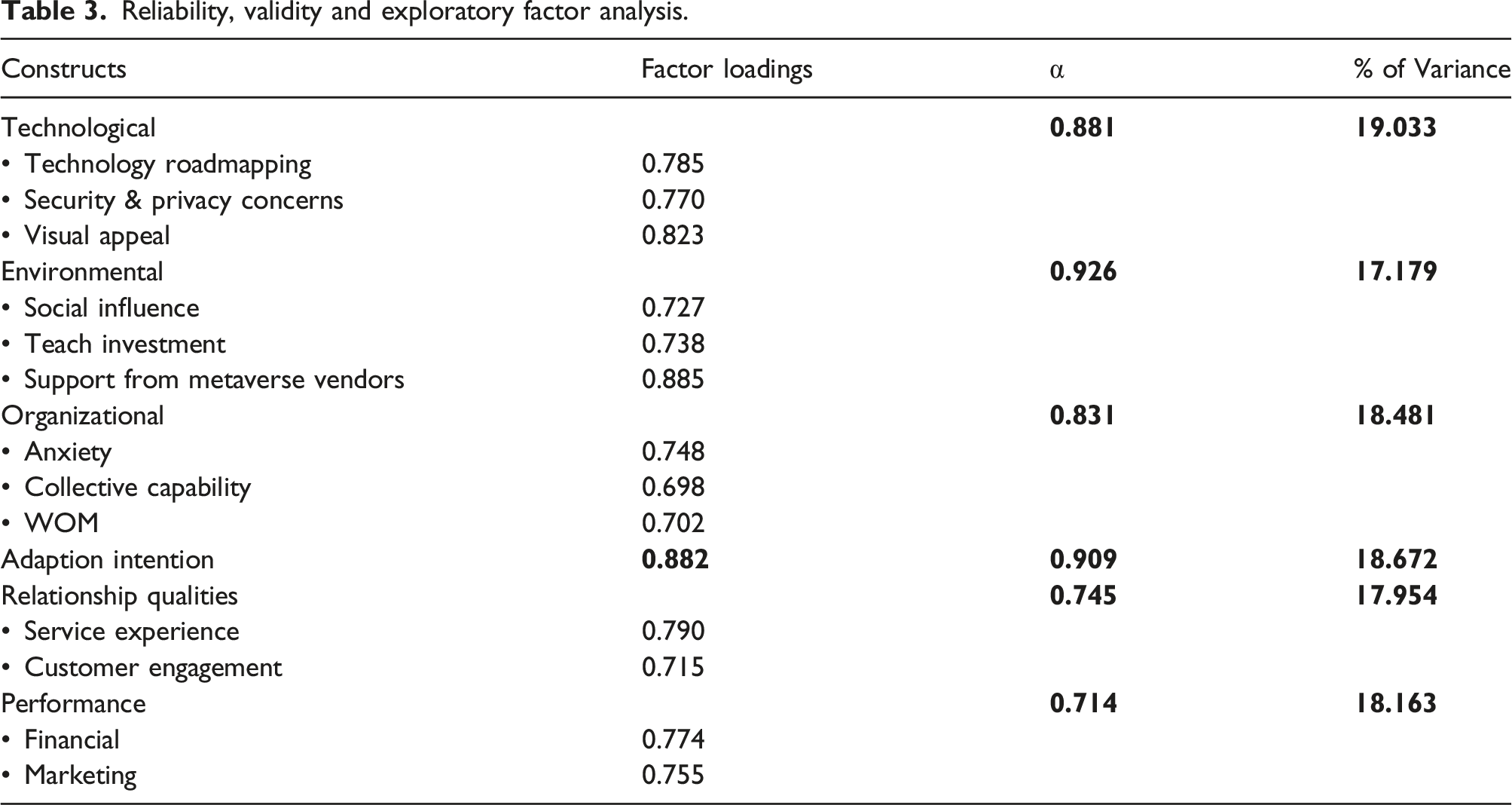
The evaluation of convergent and discriminant validity was executed through exploratory factor analysis, resulting in 14 variables. Notably, all factor loadings surpassed the 0.40 threshold, 151 ranging from 0.69 to 0.88. Together, these factors account for 83.27% of the total variance, thereby corroborating the presence of both convergent and discriminant validity.
Harman’s single-factor test was employed to examine the potential existence of common method bias. The outcomes of this test revealed that only one factor explained 34.08% of the variance. This suggests that common method bias is not a significant concern, implying that the correlations between the research variables are not greatly impacted by it.
Hypothesis testing
Variables descriptive analysis.
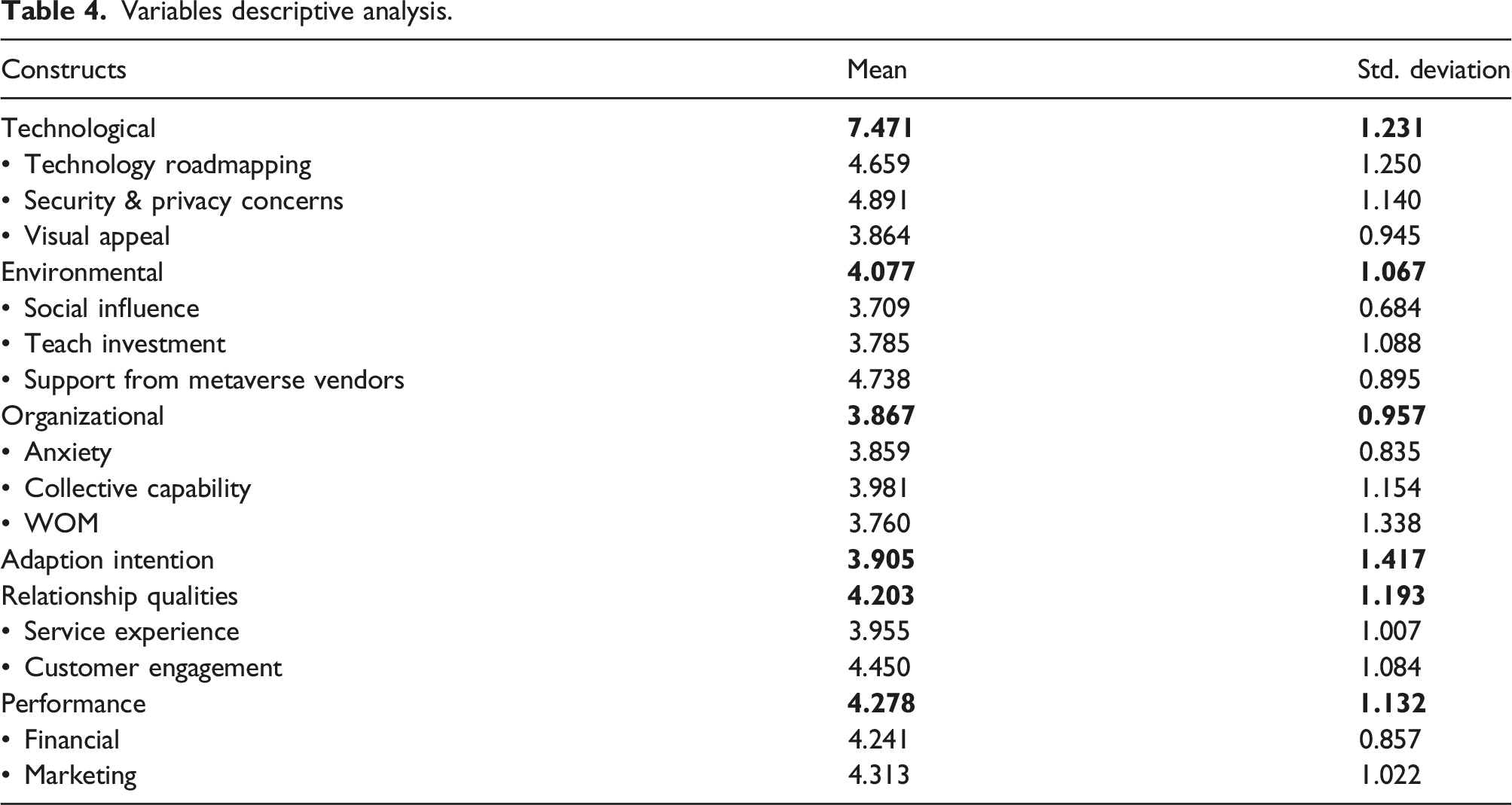
Correlation between variables.
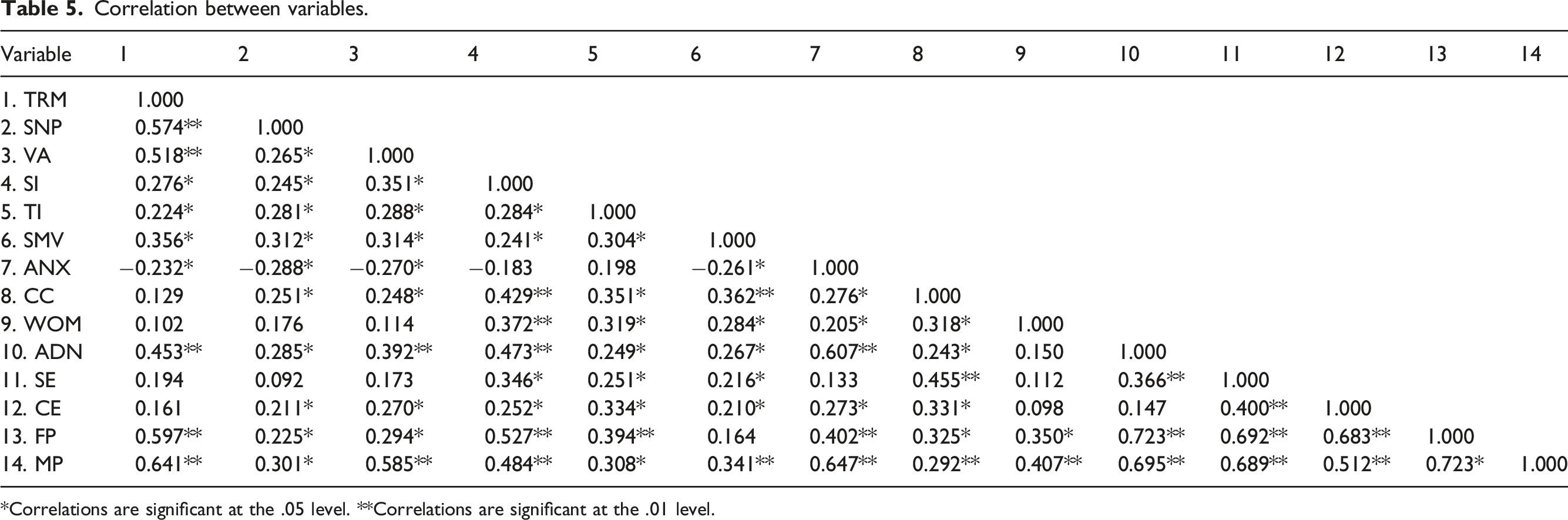
*Correlations are significant at the .05 level. **Correlations are significant at the .01 level.
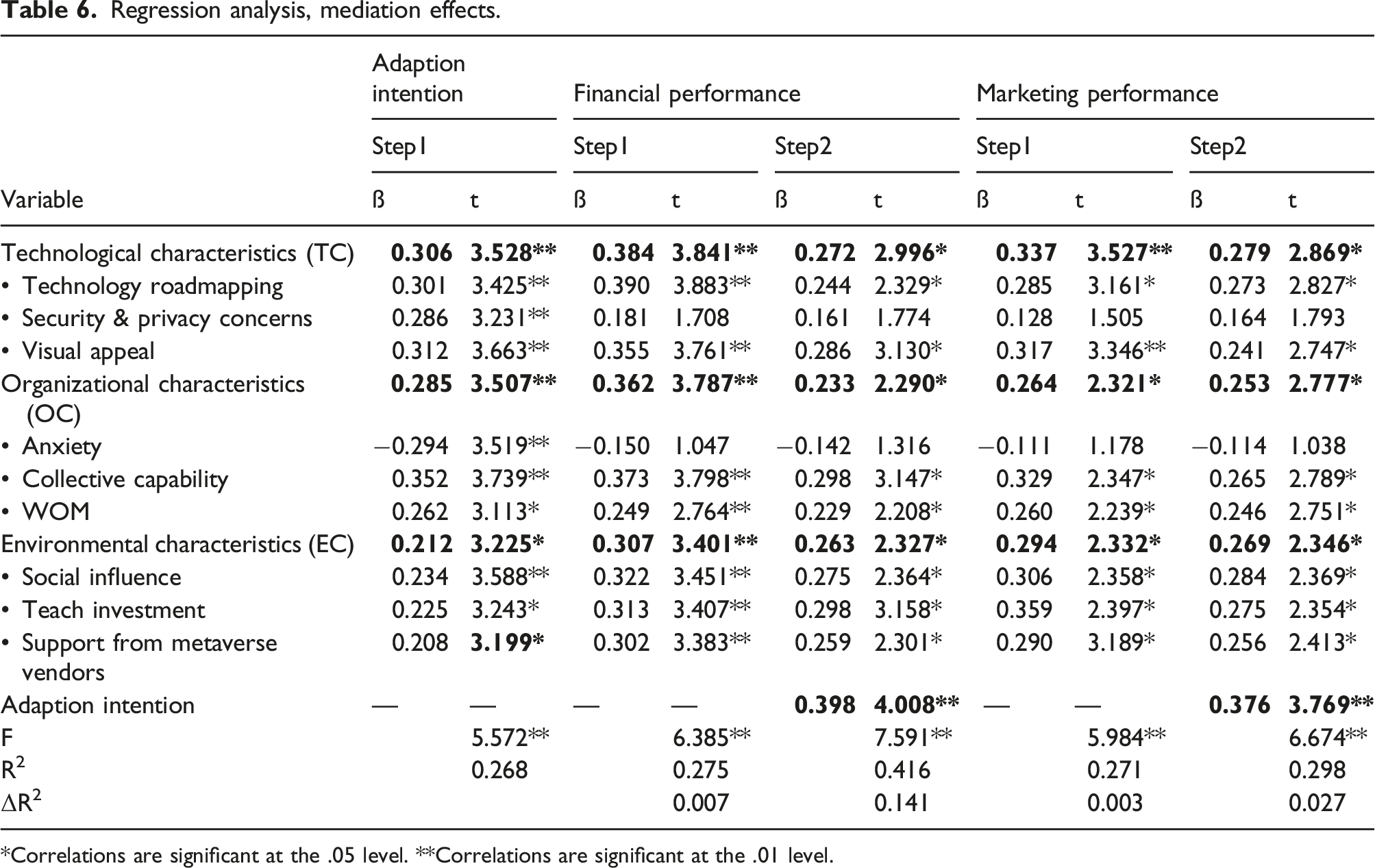
Regression analysis, mediation effects.
*Correlations are significant at the .05 level. **Correlations are significant at the .01 level.
Moreover, Table 6 underscores a significant positive correlation between the intention to adopt metaverse and financial (β = 0.39, t = 4.00, p < .01) and marketing (β = 0.37, t = 3.76, p < .01) performance, thus providing support for H4.
The study 152 employed the Baron and Kenny approach to investigate the mediation effect. The initial condition of this approach pertains to the direct impact of the predictor variables on the criterion variable. Table 5 illustrates significant correlations between the predictor variables and FP (TRM and FP: r = 0.59, p < .01; SNP and FP: r = 0.22, p < .05; VA and FP: r = 0.29, p < .05; SI and FP: r = 0.52, p < .01; TI and FP: r = 0.39, p < .01; SMV and FP: r = 0.16; ANX and FP: r = 0.40, p < .01; CC and FP: r = 0.32, p < .05; WOM and FP: r = 0.35, p < .05).
Likewise, significant correlations were observed between the predictor variables and MP (TRM and MP: r = 0.64, p < .01; SNP and MP: r = 0.30, p < .05; VA and MP: r = 0.58, p < .01; SI and MP: r = 0.48, p < .01; TI and MP: r = 0.30, p < .01; SMV and MP: r = 0.34, p < .01; ANX and MP: r = 0.64, p < .01; CC and MP: r = 0.29, p < .01; WOM and MP: r = 0.40, p < .01). Therefore, the first condition has been met.
The second condition concerns the association between predictors and mediators. The outcomes demonstrate that significant positive relationships exist between TRM and ADN (r = 0.45, p < .01), SNP and ADN (r = 0.28, p < .05), VA and ADN (r = 0.39, p < .01), SI and ADN (r = 0.47, p < .01), TI and ADN (r = 0.24, p < .05), SMV and ADN (r = 0.26, p < .05), ANX and ADN (r = 0.60, p < .01), CC and ADN (r = 0.24, p < .05), WOM and ADN (r = 0.15). These findings indicate that the second requirement has also been fulfilled.
The third criterion pertains to the relationship between the mediator and the criterion variable. The results reveal a positive and significant association between ADN and FP (r = 0.72, p < .01) as well as between ADN and MP (r = 0.69, p < .01). This confirms that the third condition has been satisfied.
The fourth condition pertains to the indirect relationship between predictors and criterion variables when considering the mediation effect. The outcomes presented in Table 6 demonstrate that even after controlling for the mediating effect of the intent on metaverse adoption, a significant association remains between technological characteristics and financial performance (β = 0.38, t = 3.84, p < .01 to β = 0.27, t = 2.99, p < .05). Similarly, a significant association persists between technological characteristics and marketing performance after accounting for the mediation effect of intent on metaverse adoption (β = 0.33, t = 3.52, p < .01 to β = 0.27, t = 2.86, p < .05). These findings affirm that the intent to adopt metaverse fully mediates the relationship between technological characteristics and performance, thereby confirming H5a.
Referring to the information presented in Table 6, it can be deduced that even after accounting for the mediation effect, the linkage between organizational characteristics and financial performance (β = 0.36, t = 3.78, p < .01 to β = 0.23, t = 2.29, p < .05) as well as marketing performance (β = 0.26, t = 2.32, p < .05 to β = 0.25, t = 2.77, p < .05) remains significant.
Similarly, considering the mediator, it is evident that the indirect impact of environmental characteristics on financial performance (β = 0.30, t = 3.40, p < .01 to β = 0.26, t = 2.32, p < .05) and marketing performance (β = 0.29, t = 2.33, p < .05 to β = 0.26, t = 2.34, p < .05) continues to be significant. These results indicate that the intent to adopt metaverse technology functions as a mediator in the relationship between environmental and organizational characteristics and performance. Therefore, hypotheses H5b and H5c are substantiated. Therefore, hypotheses H5b and H5c are supported.
The subsequent series of analyses will center on investigating the moderating effect. This examination was conducted in two stages: firstly, the predictors (technological, organizational, and environmental characteristics) were included in the analysis individually; and secondly, the influences of service experience and customer engagement were introduced separately. Subsequently, the interaction terms were integrated into the analysis.
Regression analysis predicting financial performance (FP).

*Correlations are significant at the .05 level. **Correlations are significant at the .01 level.
Regression analysis predicting marketing performance (MP).

*Correlations are significant at the .05 level. **Correlations are significant at the .01 level.
Furthermore, the analysis highlighted that even when considering the interaction effect, the correlation between organizational characteristics and financial performance (β = 0.23, t = 3.06, p < .05), as well as marketing performance (β = 0.31, t = 3.56, p < .01) through the mediation of metaverse adoption intention, remains significant. This outcome lends strong support to hypothesis H6b. Conversely, concerning the interplay between anxiety and service experience in relation to financial and marketing performance through metaverse adoption intention, a significant effect is not observed. Hence, hypothesis H6b1 is not corroborated.
Likewise, the association between environmental characteristics and financial performance (β = 0.32, t = 4.67, p < .01), as well as marketing performance (β = 0.23, t = 2.96, p < .05) through the mediation of metaverse adoption intention, retains its significance. This result substantiates hypothesis H6c.
Furthermore, the examination of interaction effects between predictors and performance through metaverse adoption revealed significant moderation by customer engagement. The influence of customer engagement was subjected to analysis and is presented in Tables 7 and 8. Upon considering the interaction effects, the connection between technological characteristics and financial performance (β = 0.42, t = 5.98, p < .01), as well as marketing performance (β = 0.35, t = 3.48, p < .01) through the mediation of metaverse adoption intention, was found to be substantial, thus providing support for hypothesis H7a.
However, in terms of the interaction between security and privacy concerns (SNP) and customer engagement with respect to financial and marketing performance through metaverse adoption intention, a significant effect is not observed. As a result, hypothesis H7a2 is not supported.
Similarly, the relationship between organizational characteristics and financial performance (β = 0.23, t = 3.22, p < .05), as well as marketing performance (β = 0.42, t = 4.56, p < .01) through the mediation of metaverse adoption intention, was established to be significant, thereby confirming hypothesis H7b. Nevertheless, in relation to the interaction between anxiety and customer engagement with regard to financial and marketing performance through metaverse adoption intention, a substantial effect is not observed. Consequently, hypothesis H7b1 is not substantiated.
Likewise, the link between environmental characteristics and financial performance (β = 0.44, t = 5.43, p < .01), along with marketing performance (β = 0.35, t = 3.37, p < .01) through the mediation of metaverse adoption intention, was also determined to be significant, providing support for hypothesis H7c.
Figures 3–6 present an illustrative plot depicting these interactions. When interpreting the outcomes, it became evident that employing unstandardized beta regression coefficients in equations was more fitting than utilizing standardized β regression coefficients.
153
The moderating role of service experience in the relationship between metaverse adaption and financial performance. The moderating role of service experience in the relationship between metaverse adaption and marketing performance. The moderating role of customer engagement in the relationship between metaverse adaption and financial performance. The moderating role of customer engagement in the relationship between metaverse adaption and marketing performance.


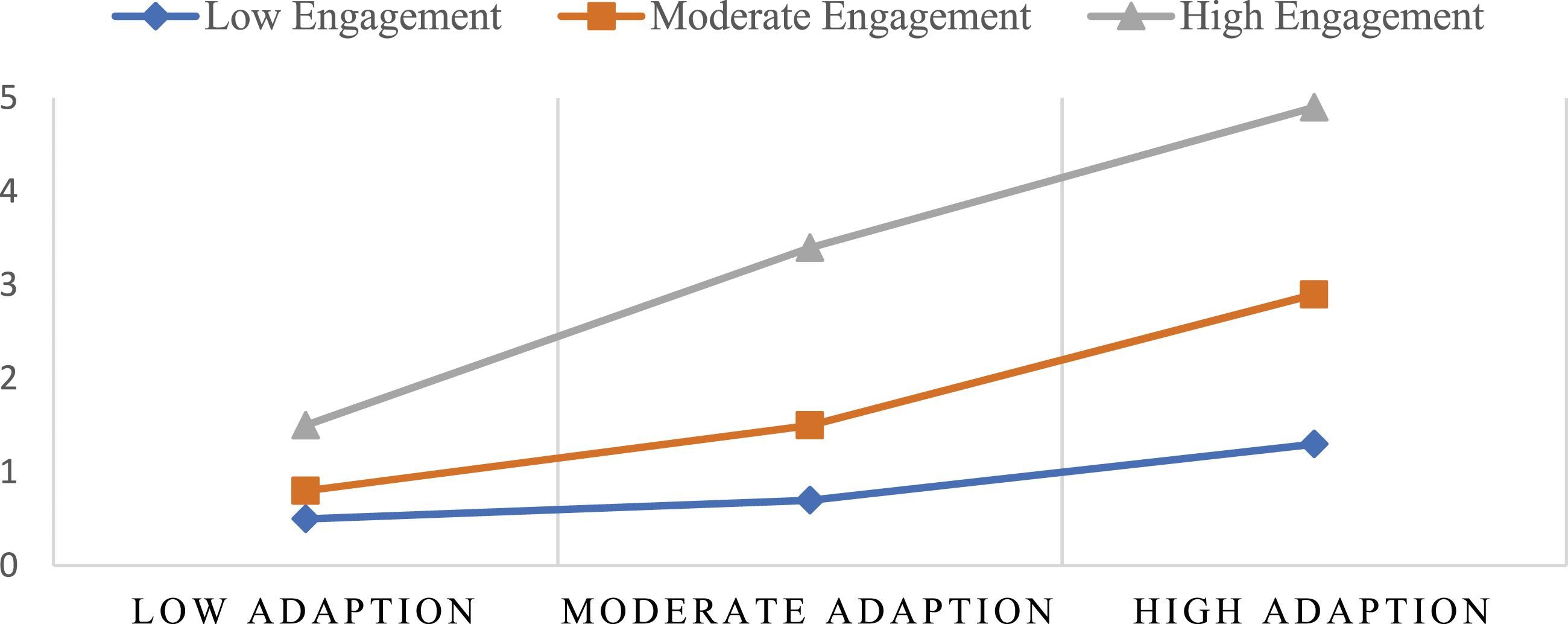
As shown in Figure 3, the relationship between metaverse adoption and financial performance is bolstered by a positive service experience. This implies that metaverse adoption is more strongly associated with enhanced financial performance when the service experience is rated as satisfactory, as opposed to when it is deemed unsatisfactory.
Figure 4 represents that service experience strengthens the positive relationship between metaverse adoption and marketing performance. In other words, metaverse adoption is more positively related to marketing performance when service experience is satisfactory rather than unsatisfactory.
Figure 5 show that customer engagement strengthens the positive relationship between metaverse adoption and financial performance. In other words, metaverse adoption is more positively related to financial performance when customer engagement is satisfactory rather than unsatisfactory.
Figure 6 show that customer engagement strengthens the positive relationship between metaverse adoption and marketing performance. In other words, metaverse adoption is more positively related to marketing performance when customer engagement is satisfactory rather than unsatisfactory.
Discussion
Our study builds upon existing empirical research, aligning with, 128 to underscore the pivotal role of technological characteristics in influencing metaverse adoption intentions. Specifically, the positive associations found between Technology Roadmapping and Visual Appeal and the intention to adopt metaverse highlight the significance of a well-defined technology roadmap and visually appealing environments in shaping individuals’ attitudes towards metaverse adoption. 128 Moving to organizational characteristics, our findings echo previous research 154 by revealing a positive association between organizational characteristics and metaverse adoption intention. SMEs with robust social networks and effective communication channels may leverage these resources to foster positive word-of-mouth (WOM) and disseminate metaverse-related information, aligning with 154 assertions about the impact of environmental characteristics on adoption decisions. Our study extends the understanding of the relationship between technological characteristics and performance by introducing the mediating role of metaverse adoption intention. The positive impact of technological characteristics on performance is channeled through the intention to adopt the metaverse. This suggests that firms actively engaging with technological advancements and expressing an intent to adopt the metaverse are likely to exhibit higher levels of innovation and adaptability, translating into superior overall performance. Moreover, our findings reveal that the relationship between organizational and environmental characteristics and performance is entirely mediated by the intention to adopt metaverse technologies. This underscores the pivotal role of a company’s openness to metaverse adoption in determining how organizational and environmental factors will impact overall performance. The integration of metaverse technologies is highlighted as a catalyst for heightened collaboration, enhanced customer engagement, and streamlined workflows, contributing to improved business performance in terms of profitability, efficiency, and competitive advantage.
In the context of SMEs, our study establishes AIM (Adoption Intention of Metaverse) as a significant predictor of performance, emphasizing the importance of organizations’ readiness to invest in metaverse technologies. The study further reveals that the relationship between the adoption intention of metaverse and performance is subject to moderation by service experience and customer engagement. Positive service experiences and strong customer engagement emerge as factors enhancing the connection between intent-to-metaverse adoption and performance, suggesting that customer satisfaction and loyalty contribute to improved performance metrics.
Implications
The implications arising from the study’s findings underscore the strategic considerations that SMEs should undertake when contemplating the adoption of metaverse technology. Specifically, SMEs aiming to integrate metaverse technology into their operations should give due regard to an array of organizational and environmental factors. These encompass aspects like technology investment, the extent of support offered by metaverse vendors, the sway of social influence, as well as the crucial dimensions of customer experience and engagement. By meticulously weighing these multifaceted factors, SMEs stand to bolster their prospects of executing a successful metaverse technology adoption initiative, thereby enhancing their overall performance outcomes. Moreover, the study serves as a clarion call for metaverse vendors to proactively extend ample support and guidance to SMEs throughout the adoption journey.
The study’s findings further illuminate the nuanced nature of the relationship between adoption intention of metaverse technology and performance. While a positive impact is discernible, this relationship is intricately interwoven with diverse organizational and environmental dynamics. As such, organizations should engage in thoughtful deliberation encompassing these multifarious factors when contemplating the adoption of metaverse technology and formulating strategies for its effective implementation.
Our findings suggest that organizations should strategically align their metaverse integration with various innovation types, as highlighted by. 73 This aligns with the recommendation that successful metaverse adoption requires consideration of different innovation dimensions.
To maximize user engagement, organizations should focus on improving visual appeal and user interface design within the metaverse, as emphasized by. 45 This underscores the importance of user-centric design principles for a positive metaverse experience.
Organizations need to implement strategies to alleviate technology anxiety, ensuring a smooth transition to metaverse technologies. 95 This emphasizes the human factor in metaverse adoption and the need to address concerns related to technology anxiety.
It is imperative for organizations to consider both internal and external environmental factors in metaverse adoption decisions. 82 This underscores the need for a holistic approach, considering various factors in the internal and external environment.
Metaverse adoption acts as a mediator, influencing organizational performance by assimilating technological, organizational, and environmental characteristics. 155 This reinforces the role of metaverse adoption as a key driver of overall organizational performance.
Practical implications
This research has implications for practitioners who are involved in the adoption and use of metaverse in SMEs. For practitioners and decision-makers in SMEs, our findings underscore the importance of strategic technological investments. To enhance metaverse adoption intention, organizations should prioritize the development of robust technological infrastructures, including VR headsets and haptic gloves. Allocating resources to ensure technological readiness will position SMEs for a seamless integration of the metaverse into their operations. Organizations, particularly SMEs, can leverage the identified determinants—technological readiness, organizational preparedness, and environmental considerations—to formulate strategic adoption plans. Understanding the specific factors influencing metaverse adoption allows for targeted resource allocation and focused efforts. SMEs aiming to enhance their overall performance can consider fostering a positive adoption intention toward the metaverse. Practitioners should implement performance metrics to assess the impact of metaverse adoption on organizational outcomes. Regular evaluation and adaptation of strategies based on performance feedback will be essential. Continuous monitoring will allow SMEs to refine their metaverse initiatives, ensuring alignment with organizational goals and maintaining a competitive edge in their respective markets. Our study establishes a direct positive relationship between metaverse adoption intention and organizational performance, emphasizing the potential for tangible benefits in financial and marketing domains. Recognizing the significance of environmental considerations, especially privacy, security, and regulatory issues, SMEs should proactively address these challenges. Establishing compliance mechanisms and robust security protocols will be crucial for successful metaverse integration. The moderating role of relationship qualities (RQs), such as service experience and customer engagement, highlights the importance of fostering positive interactions. SMEs can focus on cultivating strong customer relationships and enhancing service experiences to amplify the positive effects of metaverse adoption on organizational performance. Given the dynamic nature of metaverse technology, collaboration and knowledge sharing are crucial practical implications. SMEs can explore collaborative initiatives, both within and across industries, to share insights, best practices, and lessons learned. Establishing communities of practice focused on metaverse adoption will foster a collective understanding and contribute to the growth of immersive technology applications.
Theoretical implications
From a theoretical standpoint, the adoption of metaverse technology stands as a relatively nascent research domain, with a predominant focus on examination within developed Western countries. However, recognizing the distinct cultural and contextual landscapes characterizing emerging economies like Canada, it becomes imperative to ascertain the potential influence of these factors on the adoption of metaverse technology among SMEs. To this end, future research endeavors should be directed towards delving into the cultural and environmental determinants that might exert an impact on metaverse technology adoption within SMEs situated in emerging economies, such as Canada. This holistic exploration holds promise not only in advancing the metaverse adoption literature but also in providing valuable insights for policymakers and industry practitioners within emerging economies. The resultant insights can effectively guide the design of supportive strategies and policies aimed at fostering and stimulating the uptake of metaverse technology among SMEs.
This study contributes a distinct perspective to the existing body of literature concerning the adoption intention of new advanced technologies, specifically within the realm of metaverse. By employing the Technology-Organization-Environment (TOE) framework, this research scrutinizes the factors influencing the inclination to adopt metaverse technology and its resultant impact on organizational performance.
This study presents an original scholarly contribution to the domain of research that centers on the application of the Technology-Organization-Environment (TOE) framework in the context of adoption studies. It underscores that the propensity to adopt new technology cannot be exclusively elucidated by the mere availability of specific resources, such as IT infrastructure. This revelation challenges prevailing conceptions in the field and underscores the necessity for a more comprehensive approach when comprehending the diverse factors shaping technology adoption.
In light of this, we contend that the conventional TOE framework should undergo expansion to encompass additional metrics that can more effectively encapsulate the value of resources, such as total assets and number of employees. As a result, future research endeavors that revolve around technology adoption should reflect a broader appreciation of resources within their model specifications, leveraging insights from the Resource-Based View theory of the firm.156,157 Subsequent studies might further investigate whether the adoption of metaverse technologies can indeed manifest as a collection of valuable, scarce, difficult-to-replicate, and irreplaceable resources for SMEs. Such resources could potentially empower SMEs equipped with metaverse capabilities to attain a sustained competitive edge by virtue of the diversity inherent in their resource pool, distinct from that of their competitors.
Hence, we advocate for the expansion of the traditional TOE framework by incorporating alternative metrics that more accurately reflect resource value, such as total assets and workforce size. Consequently, future research endeavors that center on technology adoption should manifest a more encompassing understanding of resources within their model constructs, drawing inspiration from the Resource-Based View theory of the firm.
In the realm of forthcoming investigations, an exploration into whether the adoption of metaverse technologies can encompass a collection of resources that hold value, rarity, are difficult to replicate, and stand as non-substitutable entities for SMEs could be instrumental. Such resources might endow SMEs with metaverse capabilities, potentially propelling them towards a sustained competitive advantage due to the distinctiveness of their resource portfolio in contrast to those of their competitors. 158 The outcomes of this study shed light on the fact that computer anxiety does not appear to exert a significant influence on individuals’ intentions to adopt the metaverse. 159
The integration of novel technologies holds paramount significance for small and medium-sized enterprises (SMEs) seeking to maintain their competitiveness within the modern digital landscape. Nonetheless, our study has brought to light a notable finding: computer anxiety exerts a substantial and adverse influence on SMEs’ inclination to adopt the metaverse. This outcome can be attributed to an array of factors encompassing limited familiarity with the technology, perceived technical intricacies, apprehension of failure, perceived expenses, and inadequate support. SMEs might experience unease or trepidation when confronted with unfamiliar technology, thereby engendering reluctance towards its adoption. Additionally, the perceived complexity and convoluted nature of metaverse technology could augment anxiety levels and subsequently dampen the adoption prospects. Apprehensions related to potential failures and adverse outcomes associated with novel technology implementation could further elevate anxiety levels and depress the intention to adopt. 160 Perceived costs, spanning financial as well as temporal and effort-related aspects linked to training and integration, might exacerbate the heightened anxiety and impede adoption. Lastly, the perception of lacking the requisite support and resources indispensable for successful adoption could also amplify anxiety levels and deter the likelihood of adoption. Tackling computer anxiety and its associated elements could be pivotal in fostering metaverse adoption within SMEs.
This study significantly advances the realm of inquiry concerning the impact of metaverse adoption intention on performance, while simultaneously delving into the moderating role of relationship qualities between adoption intention and performance. A distinctive and noteworthy contribution emerges as the study empirically validates that service experience and customer engagement positively moderate the nexus between adoption intention and performance within the metaverse context.
Managerial implications
This study has illuminated the intricate web of factors that wield influence over metaverse adoption and its subsequent repercussions on performance. The insights garnered hold substantial value for marketers in diverse sectors, such as entertainment, gaming, education, and healthcare, enabling them to devise potent marketing strategies tailored to the unique landscape of metaverse adoption within SMEs.
The study’s findings resoundingly affirm that the adoption intention of metaverse is underpinned by an array of significant predictors. These encompass crucial elements like technology roadmapping, visual appeal, social influence, technological investment, metaverse vendor support, collective capability, and word-of-mouth recommendations. However, intriguingly, security and privacy concerns, as well as computer anxiety, were not found to exert any discernible impact on the intention to adopt metaverse. Moreover, a noteworthy discovery surfaced: relationship qualities, embodied by service experience and customer engagement, wield a positive moderating influence within the nexus between adoption intention and performance.
Manufacturers, designers, and marketers operating within the metaverse realm stand to gain profound insights from this study. By comprehending the factors that sway the adoption intentions of metaverse, they can adroitly tailor strategies for its creation and marketing, especially within SMEs. A pivotal consideration for SMEs embarking on metaverse adoption lies in assessing its compatibility with their prevailing business processes and systems. This approach aligns metaverse seamlessly with the organizational machinery. To ensure this alignment is efficacious, constant employee training and support are imperative. Given the nascent nature of metaverse technology, employees may require guidance to navigate its intricacies. Marketers and manufacturers can further bolster adoption by offering free training sessions and demonstrations, elucidating the tangible benefits that metaverse confers. The perceived advantages play a pivotal role in nurturing the intention to adopt.
Fostering trust and confidence is paramount, and marketers can harness the potency of customer testimonials to fortify perceptions about vendor support. The strategic dissemination of metaverse’s benefits among SMEs can catalyze adoption, amplifying aspects such as augmented communication and collaboration among remote staff, seamless assimilation of digital assets, and substantial savings accrued from reduced travel and training expenditures.
This research offers valuable insights for SME managers seeking to navigate the intricacies of technology adoption. The study underscores the significance of addressing security and privacy concerns as they emerged as non-significant factors, implying room for enhancement in these domains. Given the advanced nature of metaverse technology, ensuring robust security and privacy measures is imperative for SMEs aspiring to embrace metaverse adoption. This underscores the necessity for prioritizing these aspects to facilitate a smooth transition.
Encouragingly, the study unveiled that computer anxiety does not pose a significant barrier for SMEs in adopting metaverse technology. In light of this finding, it is advisable for policymakers to intensify efforts in increasing awareness among SMEs regarding the manifold benefits of metaverse adoption. Policymakers should also delve into the factors that hinder the uptake of such initiatives, thus enabling SMEs to comprehend the advantages and leverage them for fostering business growth.
Furthermore, the government can play a pivotal role in facilitating metaverse adoption among SMEs in Canada. By offering incentives, reducing import duties for metaverse technologies, or promoting domestic manufacturing, policymakers can provide substantial impetus to SMEs. A skilled workforce and enhanced metaverse infrastructure would further elevate the prospects of precise, cost-effective, and efficient production. Policymakers’ focus on enhancing SMEs’ awareness about the merits of metaverse technology while addressing adoption barriers would empower them to harness these benefits for their business expansion endeavors in Canada.
In order to promote metaverse adoption within SMEs, it is essential for policymakers to craft policies that underscore the advantages of this technology, including its potential for enhancing production speed and accuracy. This entails a specific call for Canadian policymakers to formulate comprehensive policies and regulatory frameworks that extend incentives to SMEs for embracing the metaverse. Such an approach holds the potential to yield positive outcomes in terms of industrial production planning and overall productivity improvements.
Collaborative platforms within the metaverse should be developed to facilitate networking and collaborative projects, emphasizing improved teamwork. Highlighting the customization and flexibility features of metaverse technologies can attract SMEs by offering tailored solutions to meet unique needs. Policymakers can assist SMEs in navigating metaverse regulatory compliance, providing guidance and resources. Encouraging cross-sectoral collaboration among SMEs in different industries fosters partnerships and knowledge exchange. Offering research and development incentives for metaverse technologies stimulates innovation within SMEs. Knowledge-sharing initiatives, such as mentorship programs and webinars, connect experienced adopters with SMEs. Advocating integration with established metaverse ecosystem players through partnerships streamlines the adoption process. Continuous monitoring and evaluation mechanisms allow SMEs to share experiences, guiding marketers and policymakers for ongoing refinement. Policymakers should invest in talent development initiatives for metaverse-related skills through subsidized training and educational partnerships. Establishing industry standards and certifications related to metaverse adoption provides clear benchmarks, instilling confidence in SMEs. Finally, showcasing success stories through case studies and testimonials can inspire confidence among hesitant SMEs by illustrating tangible benefits and positive outcomes.
Conclusion
Metaverse technology holds immense potential for diverse applications within SMEs. Its capabilities encompass process automation, novel customer engagement avenues, cost savings, and enhanced returns on investment. Embracing metaverse becomes pivotal for SMEs to maintain competitiveness within the dynamic landscape of technology-driven businesses.
The primary objective of this study was to delve into the factors influencing the intention to adopt metaverse and its subsequent impact on performance, particularly in small and medium-sized enterprises (SMEs). To attain this goal, the researchers formulated a comprehensive model by integrating the resource-based view into the conventional technology-organization-environment (TOE) framework. Involving a survey, the study garnered data from 173 valid respondents representing SMEs, which was subsequently analyzed.
The findings unveiled several noteworthy insights. The intention to adopt metaverse was significantly influenced by predictors including technology roadmapping, visual appeal, social influence, tech investment, and support from metaverse vendors. Interestingly, the study observed that factors such as anxiety, security, and privacy concerns did not exert any influence on the adoption intention of metaverse. Furthermore, the research demonstrated that the quality of service and customer engagement played a constructive moderating role in the relationship between metaverse adoption intention and performance within SMEs.
Limitation and future works
The study, while insightful, does exhibit certain limitations that warrant consideration in future research endeavors. Primarily, the study was geographically confined to Canada, raising potential concerns about the generalizability of findings to other global regions. Therefore, future investigations could illuminate the drivers of metaverse adoption across diverse countries and regions, allowing for a broader perspective. Expanding the research model constitutes another avenue for enhancing future studies. Incorporating additional constructs and variables, such as trust, perceived value, security, and organizational fit, alongside control variables like firm size and industry type, could provide a more comprehensive understanding of the complex adoption process.
Moreover, future research could focus on exploring metaverse adoption across various sectors, particularly its integration within service industries. Additionally, delving into actual usage and implementation of metaverse, alongside addressing related challenges, would contribute to a more holistic comprehension of its implications. To deepen insights, leveraging updated versions of resource-based view theories, such as dynamic capabilities, could offer a more nuanced understanding of how the adoption of metaverse technology can be influenced by a well-crafted set of dynamic capabilities, fostering resource reconfiguration for sustained competitiveness.
Taking into account additional contextual elements like organizational size, structure (centralized vs decentralized), corporate culture (values, principles, and routines), workforce size, and workforce skills in adopting metaverse technologies could be identified as another potential avenue for future research.
The adoption of a cross-sectional design in this study could potentially introduce common method bias. To mitigate this, the study incorporated both statistical and procedural remedies following recommendations by. 161 Procedurally, psychological separation was employed, while Harman’s single-factor test served as a statistical remedy, demonstrating control over common method bias. For future investigations, adopting a longitudinal design with time lag between questionnaires is advisable to further enhance methodological robustness. Furthermore, examining how the current level of technological maturity, encompassing online presence and development, may influence the future integration of the metaverse, and exploring potential variations in this influence based on the organization’s existing technological landscape, presents an intriguing avenue for future research.
Furthermore, for a more comprehensive appraisal of resource impact on performance, it’s prudent to consider multiple performance dimensions, including operational performance (e.g., efficiency, productivity), innovation performance (e.g., new product development, R&D investment), customer satisfaction, employee satisfaction, and environmental and social responsibility. This broader approach can yield a more holistic understanding of how metaverse adoption interplays with overall performance dynamics.
Footnotes
Acknowledgements
This project has been partially supported by the Social Sciences and Humanities Research Council of Canada (SSHRC) Insight Development Grant; the views expressed herein are those of the author(s) and do not necessarily reflect those of the SSHRC.
Author contributions
TH: the corresponding author conceived of the presented idea, performed the computations, wrote the first draft of the manuscript and verified the analytical methods. DR: supervision, reviewing, visualizing and validating this study. MM: supervision, reviewing and editing.
Declaration of conflicting interests
The author(s) declared no potential conflicts of interest with respect to the research, authorship, and/or publication of this article.
Funding
The author(s) disclosed receipt of the following financial support for the research, authorship, and/or publication of this article: Partially funded by the Social Sciences and Humanities Research Council of Canada (SSHRC).
Ethical statement

Data availability statement
The datasets generated during and/or analyzed during the current study are available from the corresponding author on reasonable request.