



Abstract
In view of the higher demand and customer expectations on the speed and accuracy of e-commerce logistics service as well as the repetitive and time-consuming nature of manual order processing operation. This paper proposes a robotic process automation (RPA) model to liberate human resources over time-consuming, inefficient, non-value-added, and repetitive operational processes occupying workforces. This paper proposed an RPA model that integrates three functional RPA bots in (1) tracking order status, (2) capturing order data, and (3) verifying order data to increase the efficiency and accuracy of logistics operation and the order-handling process in small- and medium-sized enterprise (SME) logistics company. A case study was conducted on an SME logistics service providing customers with inbound and outbound operation services. The result demonstrated that the proposed model significantly improves logistics operations performance against a human approach concerning key indicators after implementation. Logistics companies could free up the workforce for value-creating activities in value-added services.
Keywords
Introduction
COVID-19 changed consumer buying behavior from traditional offline shopping to online shopping. Many customers use different online platforms to purchase items, including daily necessities. The demand for e-commerce increased. 1 Also, customers requested companies provide a high-quality and high-accuracy service in logistics, delivery service, and after-sales, 2 for example, having a same-day or next-day delivery. 3 However, government policies such as social isolation, home quarantine, and closing public areas during the pandemic highly disrupt workforce management, particularly for small and medium-sized enterprises (SMEs). Therefore, this brings a challenge for SMEs logistics company in handling a large number of customer requirements with limited resources.
To maintain the speed and accuracy of the service when faced with a large volume of orders, it is essential to ensure the integrity of order handling. Errors in handling customer orders will damage the company’s revenues and reputation. These order handling activities are time-consuming and inefficient, but the company has no choice but to fulfill the customer’s requirements and keep the customers satisfied. Also, human errors easily occur in the working process due to repetitively handling huge amounts of data in a short time. Furthermore, companies are required to put extra resources into these business activities, which seriously impacts SMEs with little capital. However, only a few e-commerce orders could be preprocessed in order handling before the customer confirms the orders. 4 Therefore, it formed a bottleneck in the order fulfilment process and slowed down order picking and delivery.
To address the current challenges, some logistics managers are seeking to transform these non-value-added activities into digitization which becomes more efficient and accurate and frees up the human workforce for handling other high-value-added activities. In this stage, the concept of digital transformation is introduced. Digital transformation (DT) could be summarized as a strategy to improve business workflow, operations, and performance using digital technologies. 5 There are three common technologies used in the logistics industry for transforming a business into a digital-based business, namely, robotic process automation (RPA), artificial intelligence (AI), and blockchain. 6 Among these, applying RPA is the most suitable transformation technology for managers to automate order operations activities in order to increase efficiency and accuracy. RPA was hailed as the initial step of the digital transformation in the company. 6 RPA, a computer software robot, works like humans and performs repetitive, simple, and easy activities between different information systems. 7 Based on past research, 10% to 40% of the potential costs could be saved by appling RPA. 8 Moreover, it can help improve productivity by freeing employees from routine and repetitive activities to value-added activities. 9 While a successful RPA implementation could benefit the company, research on the implementation of RPA in over 20 companies found that 30%–50% of RPA applications fail due to the identified wrong attributed business processes. 10 Therefore, identifying possible and correct operation activities for applying RPA also is essential.
In order to address these research gaps in the order handling process in SME logistics companies facing handling a large amount of e-commerce customer orders, the contribution of this study is to explore the enhance existing knowledge on digital transformation and RPA technology implementation: (i) Identify the possible logistics business activities that are suitable for implementing digital transformation. (ii) Develop RPA bots for an efficient and high-accuracy approach to replace humans in non-value-added activities. (iii) Facilitate digital transformation in logistics companies.
This paper studies RPA technology and provides operational insights to help SME logistic companies increase efficiency and accuracy in daily business activities. Also, an analysis is conducted to identify suitable areas in logistics operation activities for applying RPA bots to automate the process. Moreover, a case study is conducted in a real-world company to implement developed RPA bots and evaluate the performance in improving business operation efficiency.
The rest of the paper is organized as follows. Section 2 conducts a literature review on digital transformation, RPA technology and Application of RPA in the logistics industry. Section 3 presents the architecture of the proposed model. Section 4 presents a case study to perform the developed RPA and test the performance of RPA bots. Section 5 discusses the results. Section 6 concludes this paper.
Literature review
Current order operational process in logistics industry
COVID-19 accelerates e-commerce growth, as more companies expanded their business to B2C e-commerce to fulfil increased customer demand during the pandemic. 11 While this business expansion increased sales in e-commerce, it added pressure to the logistics company on the order fulfilment process. Different from traditional logistics order handling, e-commerce orders have an irregular order demand, request small quantities but large stock keeping units, a tiny order fulfilment time, and a short delivery time window. 3 Also, lockdowns and isolation policies during COVID-19 negatively impact logistics operations, including delivery, product production and labour input. 12 Therefore, it puts pressure on order handling efficiently and effectively in the logistics companies in order to provide a timely delivery service to customers, especially SMEs. The order fulfilment pressure, mainly within the warehouse or distribution centre, includes inbound, storage and outbound operations. 13 It is important to have an efficient and accurate handling of the inbound and outbound processes towards performing a prompt order-picking process. Without it, the consequence is a delay in receiving and delivering customer orders, which fails to fulfil customer requirements and damages the company’s reputation. However, the throughput of employees in SMEs is fully utilized. They are unable to release extra capabilities to resolve the new requirements from new types of business in a short period. 14 Therefore, some SMEs in the logistics industry are seeking new transformation opportunities in order to enhance their order-handling capability increasing the efficiency and accuracy of handling customer orders with different requirements. One possible concept is transforming their business from a human-oriented operation to a digital one. Digital transformation has been introduced to the logistics industry.
Digital transformation
In general, Digital Transformation (DT), is the implementation of different digital technologies to improve the quality and efficiency of business processes, strengthening the business performance and the company’s competitiveness in the fast-changing market.15,16 Vial 17 further summarized and defined digital transformation as a procedure that significantly integrates information and communication technologies to modify the current physical process.
Various digital technologies are providing different transformation opportunities for companies. Generally speaking, implementing digital technologies can improve the current business operation workflow, facilitate customer relationships, and develop a new business model. 5 Major serval digital technologies support digital transformation, including Cloud-based technology, Blockchain, Internet of Things, Big Data, Artificial Intelligence, Mobile technology, and Robotic Process Automation.18,19 Cloud-based technologies help companies manage available resources, such as connection platforms with collaboration partners, data storage, and data analysis. 20 Blockchain helps to securely and transparently store, and transfer collected data. 21 The Internet of Things enables large collection of real-time data. 22 Big Data analyzes data collected on different channels with high generation speed. 23 Artificial Intelligence provides the capability to analyze large amounts of data. 24 Mobile technology offers real-time operation and decision support through the mobile application when employees work. 25 Robotic Process Automation automates some repetitive activities. 26 Robotic process automation is used for supporting operations.27,28 In viewing all the digital technologies, Robotic process automation is the more appropriate technology targeted for improving the operational capability of the logistics SMEs due to being easier to use in business activities than other digital transaction technologies. 29
Robotic process automation (RPA)
Robotic process automation (RPA), the developed RPA mechanical, is named a bot, which works as an agent and imitates a human to finish specific activities within the business operation. 30 Functionally, it works as an agent, combining different applications and systems originally needed to process manual activities. 29 For example, interacting with Excel to process data, email systems to send emails to different clients, and Enterprise Resource Planning Systems to handle transactions and generate reports. 31 Also, it transits the operation process from manual handling of business activities to complete business process automation. 32 Activities automated by RPA mainly have characteristics including redundant, repetitive, structured, routine, and rule-based. 33 Not only that, but the current development of RPA technologies also allows the processing the unstructured data. 34 Currently, many vendors provide RPA technologies in the RPA market, including UiPath, Automation Anywhere, Microsoft, Blueprism and Nice, etc., that provide coding-free RPA bot development services. 35
There are serval benefits to applying RPA to business processes towards the company. Developers can create RPA bots without professional coding and programming knowledge. 6 Operationally, it includes being available to work 24/7, improving operation efficiency, decreasing human errors, and reducing the waste of the human workforce in non-value activities. 36 At the managerial level, one-third of the cost could be saved after implementing RPA technologies. 37 Another advantage of implementing RPA technologies is that they can avoid human error. Cooper et al. 38 stated that applying RPA technologies in accounting could improve the accuracy rate from 90% to 99.9%. From an employee’s point of view, RPA bots release the employees from repetition and redeploy them to more variable and problem-solving activities, resulting in increased employee satisfaction.39,40
These RPA technologies have been discussed in recent years and implemented in different industries by different researchers. Mohamed et al. 41 implemented RPA technology in Human resource management for reducing the processing time of documents by 10 times more than manual. Viale and Zouari 42 researched three companies that implemented RPA technologies in procurement management and significantly reduced the processing time of non-productive activities. Carden et al. 43 applied RPA in information management for improving operational efficiency and reduce cost and process time. Lin et al. 44 also researched applying RPA technologies in library management. Kedziora and Smolander 45 proposed using RPA to reduce the workforce shortage issues in the healthcare industry. Houy et al. 46 highlighted that public administrations could implement RPA technologies to improve efficiency.
In the logistics industry, Bu et al. 47 pointed out that RPA technology can be implemented in inventory management, order management, information management, and customer relationship management. However, a more significant amount of research on RPA in logistics is mainly focused on the managerial perspective and lacks specific RPA bot development details. For example, Gruzauskas and Ragavan 48 applied RPA for handling documents in the logistics process; Brzeziński 49 suggested the possible automation process in logistics; Krakau et al. 50 considered the success factor for applying RPA in logistics; Sullivan et al. 51 discussed the influence of the operation process of adopting RPA in the company from a strategic and managerial deployment view; Lambourdiere et al. 52 provided insight into Implementing RPA in logistics companies in management viewpoint. Zhang and Huang 53 provided a detailed development of RPA bots for supporting activities in the logistics process, but required advanced coding knowledge. Despite the increasing attention to implementing RPA technologies, the discussion on the operational perspective and more systemic approach to developing bots in the logistics industry still needs to be explored. When transitioning from manual to digital, development difficulties, changes in workflow and operation issues are important considerations for the company to determine whether to implement new technology into business activities. Jeeva Padmini et al. 10 pointed out that identifying incorrect business processes and implementing RPA technologies will lead to the automation failure of the company. Therefore, in order to tackle the limitation of the current situation, this research study tries to fill the gap in the operational view on implementation and suggests a feasible and straightforward approach for a company to experience the advantages of digitalization in the business process.
In summary, the pandemic has led to a speedy increase in the development of e-commerce, and new customer expectations have been created. Logistics companies, especially SMEs, transform their business by adopting digital transformation in order to adapt to the large numbers of orders and unique requirements of e-commerce businesses. In order to increase the efficiency and accuracy of the order fulfilment process, RPA bots are introduced to logistics SME companies. Although e-commerce, digital transformation, and RPA generated high attention in the literature, there is still a research gap regarding the implementation in an SME logistics company from an operational perspective. Therefore, an RPA development model is proposed in this paper that helps the company achieve an efficient and accurate order-handling process. By applying so, it allows SME logistics companies to free up the workforce for other value-added activities to optimize business performance.
Methodology
This paper focuses on transferring routine, repetitive, and time-consuming activities on logistic business activities currently being handled manually to automate operation activities by RPA bots to improve efficiency and release the human workforce to other high-value activities. The architecture of the proposed system, namely, the RPA developing model, consists of three modules, which are shown in Figure 1, including: (i) Module 1 - Data Collection, (ii) Module 2 - Bot Development, and (iii) Module 3 - RPA Performance Evaluation. The details of each module are explained below. The architecture of the RPA developing model.
Data collection
Module one aims to gather the necessary data for the proposed model and identify the logistics business activities suitable for implementing RPA bots by analyzing the current operation flow. There are two primary data sources, including (a) customers from B2C businesses and (b) clients from B2B businesses. Data from B2C customers is based on the order transmitted from e-commerce platforms to the company database, encompassing information such as order numbers, item codes, item descriptions, etc. Another data source came from commercial B2B clients using the company service. Data mainly comes from shipping documents, such as airway bills and bills of landing, used for tracking shipments, The data includes airwaybill numbers, shipper names, shipment dates, origin and destination, weight, etc., and is delivered through various communication platforms. Once the data are saved to the company database, the data will be processed by the RPA bots created by Module two to automate the processes.
Also, to access the scope of the RPA application area, a company workflow study is conducted to identify potential opportunities for applying RPA technology to enhance operational efficiency. Data such as the operation time of each current daily process, the volume of the shipment tracking daily, and the number of total orders handled daily are collected to identify the bottlenecks or inefficient tasks in the existing workflow. The company can prioritize and determine which areas can implement RPA technology to replace manually based operations by analyzing these metrics. After selecting the application area, the existing workflow and documentation within the workflow may not entirely fit the requirements of RPA implementation. Re-engineering the existing business workflow and documentation is an important step in preparing for future integration with RPA bots, for example, redesigning a new operation workflow, standardizing document naming, formatting, etc.
Bot development
The main purpose of developing RPA bots is to automate logistics activities that free up the workforce in repetitive and time-consuming activities. This section suggested three common and key operation processes during the logistics operation that highlight the availability and usability of RPA technology in the logistics industry: tracking shipments, capturing data, and verifying data. In order to develop the RPA bots, the Automation Anywhere platform is used. Using the drag-and-drop method and code-free platform, the company can apply RPA technology to their business more efficiently and without advanced coding knowledge.
Bot 1: Shipping Status Tracking Bot
Overall features of Bot one and related process activities.

Bot 2: Product list generation bot
Overall features of Bot two and related process activities.

Bot 3: Data verification bot
Overall features of Bot three and related process activities.

RPA performance evaluation
In this study, RPA is applied to improve the daily operation of a logistics company. Evaluation of the performance of developed bots can provide a better comparison for the company to understand the benefits of RPA technology. In order to determine the improvement of implementing RPA technology in logistic activities, it is essential to suggest some evaluation criteria. This module proposes two evaluation criteria, namely (i) Accuracy and (ii) Efficiency by comparison with before and after implementing RPA technology in the handling of the operational tasks. The list of order is denoted by the
Accuracy presents the percentage of correct data during data capturing, extracting, and matching, which the sum of binary index with respect to the list size, namely 

Efficiency gives the operation and cycle time used by manual and RPA bots for conducting operation activity. The total time spent performing an activity 

These evaluation criteria provide a simple and effective means for the company to identify the source of operation improvement through transforming from manual labor to RPA bots. The proposed model supports the logistics company in re-engineering current order fulfilment operations from human force to a digital approach. By releasing more human workforce from non-value-added repeat tasks, the logistics company can invest the released crew in other complex and value-added tasks. The proposed evaluation indicators, namely efficiency and accuracy, allow logistics companies to evaluate the performance of implementing RPA in an order-handling process more intuitively. The implementation process of the RPA developing model in a real-world logistics company is discussed in the next section.
Case study
In order to validate the performance of the proposed model, RPA technology is implemented in a medium-sized logistics company. The logistics company provides different solutions to its customers, including air freight service, sea freight service, e-commerce logistics service, and road transportation service. Also, the company developed a new logistics business in recent years, which provides an international cold chain freight transportation service to different customers with a 24/7 cargo monitoring service to attract more customers to use its services. Due to the increasing requirement and demand for logistics service, the company seeks an operation automation approach to increase the efficiency and accuracy of handling customer requirements and orders that release more employees to expand its business.
To implement the proposed model into the company, it is following the implementation flow shown in Figure 2, can be derived into four stages, namely, (i) Digital transformation activities identification, (ii) Business workflow and documentation reengineering, (iii) RPA bot developing, and (iv) Digital transformation bot performance evaluation. Implementation flow of the RPA to the company.
Possible digital transformation activity identification in the company
This stage aims to study the company’s current inbound and outbound workflow and identify the issues in the current workflow to identify possible transformation activities. After reviewing the inbound and outbound workflow of the company, the following statements summarize the challenges that the company is facing in operation that hinder efficiency and productivity, which can be improved by implementing RPA bots. The challenges are summarized and highlighted as follows.
High workload on checking shipment status
Figure 3 shows the overview of the inbound workflow of the company for handling goods and highlights the repetitive tasks in the process. Five parties are involved in the process: Customer or consignee, Company back office, Company warehouse, Trucker, and Airline or Cargo terminal. Currently, the manual check method is used in the company’s back office by inputting the Airway bill (AWB) number into the cargo tracking website and copying data to the company database when they receive the shipping order information. Once the shipment arrived at its destination, the back-office clerk would capture the latest shipment data on the airline website and prepare trucker collection record documents for the company warehouse simultaneously. However, the frequency of checking the shipping status of shipments is high, and clerks need to monitor statuses multiple times repetitively each day. Consequently, this process creates a high workload for workers and limits them from focusing on more value-added tasks. The RPA bot can make the process quick and easy by capturing all website data to the database automatically and accurately. Therefore, the first possible automation process is developing an RPA bot to automatically check the website’s shipping status. Shipment inbound workflow and repetitive tasks.
Inefficient of checking picking items and related documents
The increasing demand for e-orders during the pandemic pressures the company warehouse outbound workflow. Due to the delivery commitment promised to deliver the order to the customer the same day or the next day, a highly efficient and accurate order-handling process becomes a critical bottleneck, especially in checking items and associated documents. Figure 4 shows a goods outbound workflow and highlights repetitive tasks. In the current operation, item counting and data input to the database is conducted manually before item outbound. After picking items, order pickers would review the chosen items with the picking list and delivery notes to check whether they are consistent. The information includes item names, item codes, item quantities, etc. The warehouse is outbound over 500–800 SKUs daily. Warehouse operators need at least 2–4 h per day to check all the order data and create the picking list for picking. Therefore, it brings a heavy workload for the warehouse operators and occupies many staff working hours in non-value-added activity, which leads staff to put less time into value-added tasks. Also, busy work schedules cause inaccurate, incomplete, inconsistent, and irregular order processing. Operators need to check these data frequently and repetitively to ensure accuracy, leading to inefficiency operation. RPA bots could process this business operation with better timesaving and accuracy. Therefore, the second possible automation activity occurs in the company warehouse. Goods outbound workflow and repetitive tasks.
Business workflow and documentation reengineering
To overcome the challenge mentioned above, the company decided to apply the proposed RPA model and reengineer the operation workflow and documents to better fit for implementing RPA technologies.
Workflow reengineering
Overall, applying RPA bots in the company could increase the efficiency of the operation. However, the bots should be used correctly in the workflow to connect automated and manual tasks seamlessly. Therefore, a reengineering of the current workflow is needed to ensure the connection is smooth.
The re-engineered inbound workflow mainly simplifies the shipment status-checking activity. Figure 5 shows the re-engineered inbound workflow of the company’s back office with RPA bot. By implementing the RPA bot, workers in the back office are only required to press the button to run the RPA bot. The bot will automatically extract the AWB numbers in the database and regularly collect the data on the cargo tracking website. After confirming the shipment arrives, the bot will notify and send the necessary data to the worker for preparing the trucker collection record document. In the new workflow, workers no longer need to input AWB numbers to the cargo website manually, monitor when the cargo arrives, and capture data on the cargo status website. The worker can conduct other value-added activities with the time saved in the monitoring and tracking process. Reengineered inbound workflow.
Figure 6 shows the re-engineered outbound workflow with the implementing RPA bot. Targeting the three primary bottleneck operations: Creating an item picking list, checking the picking list with an order list, and updating the inventory record. These activities were conducted initially by warehouse clerks and combined into two tasks operated by bots. RPA bots can create an item-picking list in a significantly shorter time after the warehouse clerk receives delivery notes and invoice files. Subsequently, warehouse operators begin the picking process quickly. After picking, the warehouse clerk can check and update the inventory record accurately using the bot. Compared to the original operation workflow, the automated workflow shortens operation time significantly. The warehouse clerk no longer needs to spend significant time manually typing these data in delivery notes to generate a product list for warehouse operators to pick items and handles the time-consuming, cumbersome, and redundant data-checking process. The efficiency and accuracy could significantly increase because RPA bots conduct all operations with consistent actions. Reengineered outbound workflow.
Documentation reengineering
Reengineering of documents is conducted in the standard format of all the delivery notes in order to improve the data-capturing quality for RPA bots. During the case study, it was found that the existing delivery notes documentation lacked consistent formatting. When using the product list generation bot to capture data in delivery notes, the format is only sufficiently consistent for the human eyes but not for the machine. The table format of each delivery note is different, which decreases the accuracy of checking activity due to capturing unnecessary data captured by the bot. Thus, using the RPA bots leads to an increasing capture error. In order to increase the capture accuracy, a reengineering of the document is conducted. Figure 7 shows an example of highlighting the issue in a delivery note and the result of reengineering. The redesigned delivery note is standardized as (a) a standard and unchangeable layout and (b) the total number of SKUs in each delivery note is not more than 6. Therefore, it can ensure the capture area to be the same and avoid capturing unnecessary data. Thus, increasing the accuracy. An example of unstandardized delivery notes and the result of reengineering.
RPA bots developing
To develop the RPA bot for handling the process, Automation Anywhere is selected as the development platform. In this study, three RPA bots are developed in order to support business process improvement. Namely, (a) Shipment status capturing and tracking bot, (b) Product list creating and checking bot, and (c) Data verification bot.
Shipment status tracking bot
The shipment status tracking bot captures the latest shipment data from the cargo tracking website and stores the captured data in the company database. The data mainly includes two types of data. The first is the latest shipment data like port, status, prices, weight, flight, and milestones. The second is tracking data such as station, checkpoint, temperature, volt, and event time. In order to operate the bot, three main bot actions are involved in the case: Opens the excel by the “Open” action, remarks the checking time by the “Log to file” action, and captures the necessary data shown above by the “Recorder: Capture” action. After that, a notification will be sent to clerks for further actions, such as preparing trucking collection documents. Figure 8 shows the detailed process flow of the developed bot with the business operation process. The operation flow of shipment status capturing and tracking bot.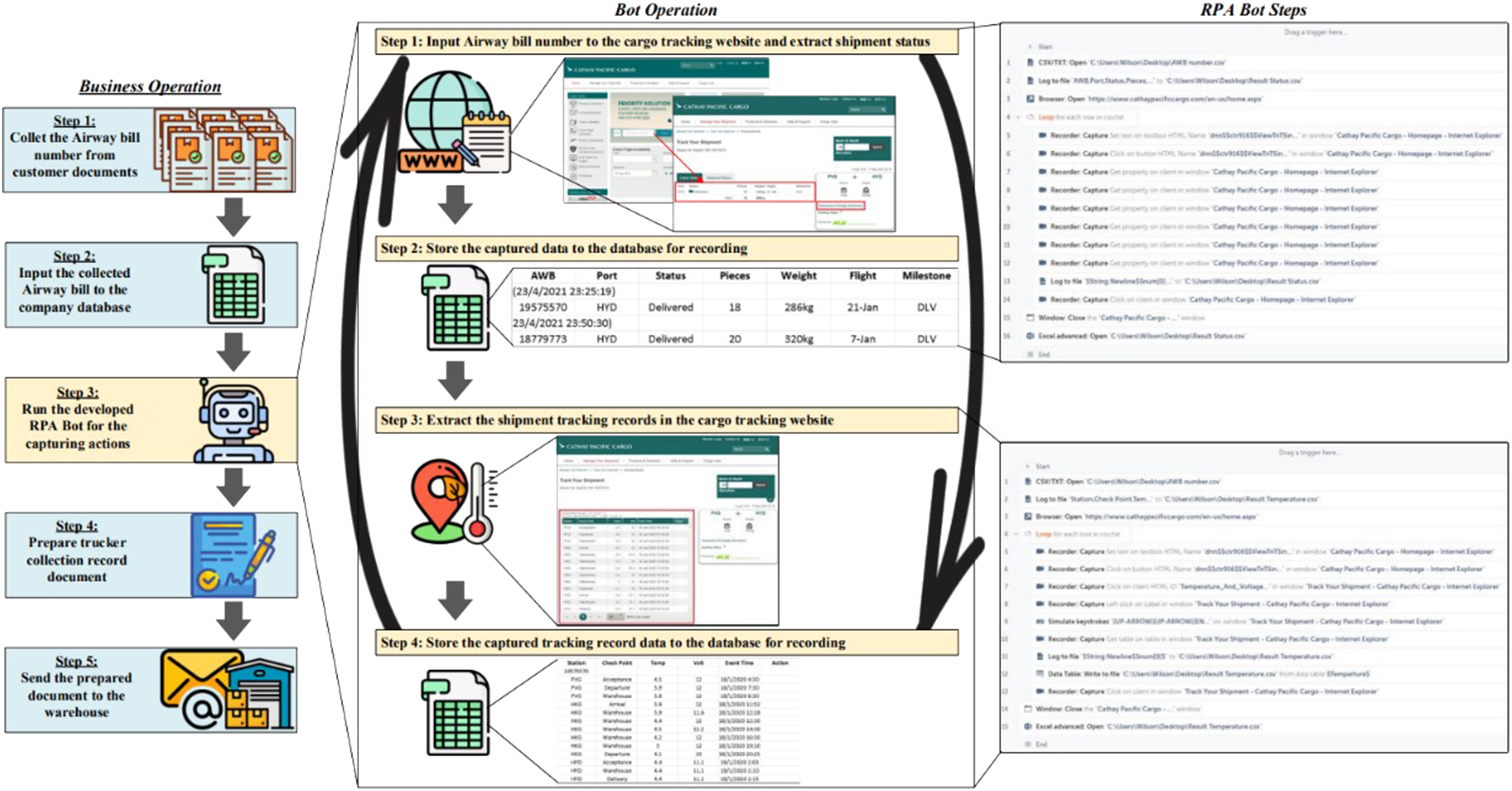
Picking list generation bot
The generation bot aims to identify and select the delivery notes to the document sent from the back office and captures the data for picking list creation in order to support the order picking operation. Once the back office confirms orders, they create documents and send them to the warehouse. Relevant shipping documents are included in the report file: invoices, delivery notes, and transmittal sheets. In this case study, only delivery notes are considered to demonstrate a proof of concept. First, the bot would split the original file into individual shipping documents. In the case of delivery notes, the bot will capture the delivery note number, item code, item size, item qty, and item-unit. Upon completion of capturing, the bot would close the file and move on to the following shipping document. This loop action repeats until all the documents are processed. Once the data is captured, the bot will start creating the picking list for warehouse workers to pick up the customer-requested items. “Replace,” “Trim,” and “Split” actions were included in the bot for replacing and trimming the unnecessary data, such as small letters, symbols, and space. Afterwards, the bots store the final data in the database to finish the process. At the same time, warehouse workers will prepare equipment for pickings, such as forklifts and pallet trucks. Figure 9 shows the detailed workflow of the product list generation bot. Operation flow of product list generation bot.
Data verification bot
The data verification bot aims to verify the consistency of captured data by the second bot with the original picking list in order to speed up the order data checking activities. Once finished picking, warehouse operators will review the selected items with the picking list before packing. Then, workers pack items into pallets based on different delivery locations. Before delivery, the clerk needs to ensure items are recorded and updated in the inventory system before outbound. By using the bot, the checking time can be shortened. Since there is a lack of primary keys to identify the data row in the database, item code and location are combined to help the bot determine the correct data row using excel formula action. Second, the bot would check the delivery note number in the same row. Then, the bot would verify the item quantity until all the data were checked using a loop action. Finally, the bot would report the “Incorrect” in the extracted database when data in the same row are inconsistent. Therefore, the warehouse clerk is only required to recheck the incorrect data. After that, the warehouse operators can prepare delivery, and the warehouse clerk can contact the logistic parties. Figure 10 shows the workflow of the verification bot. The operation flow of data verification bot.
Result and discussion
Comparison between the manual and RPA bot in efficiency
To determine the performance of the three developed bots in supporting business operations, comparison testing is conducted to evaluate the performance before and after adopting RPA bots and manual methods based on efficiency and accuracy. RPA bots are executed on an Intel Core i5 processor machine, and manual entry is collected with three individual operators performing the manual data entry tasks. After comparison, it is found that the processing time of each operation process could be significantly shortened.
First, the shipment status tracking bot could significantly reduce the operation time on tracking shipment status. In the existing manual operation, the back-office clerk needs to update the data record to the database once there is any shipment status update on the cargoes website. The operation process repeats several times daily until the shipment arrives. Originally, the clerk may use 4 min to check and record data for one airway bill. However, applying the RPA bot, only 1 min is used to check and record. 84% of process time is reduced for checking. Also, an evaluation is conducted and predicted on checking and documenting the shipment status for 20/50/100/1000 airway bills. The result shows that an average of 88% of the time is reduced using an RPA bot compared with a manual. Figure 11 compares checking the shipment status between the manual and the RPA bot. Comparison of manual and RPA bot on tracking shipment status.
Furthermore, the picking list generation bot could accelerate order picking activity. In the current operation, the generation time of picking list creation highly affects the starting time of the order-picking process. Warehouse operators start the order-picking process once they receive the picking list from the warehouse clerk. Therefore, the faster the picking list is generated, the earlier the item-picking process can start. Using the RPA bot, 91.6% of the generation time is diminished from 1.5 min to 7.6 s for one delivery note compared with the manual. An experiment is adopted to test and forecast the processing time with 10/50/100/1000 delivery notes. The result shows that an average of 92% of process time could be decreased by using RPA. Figure 12 shows the comparison result of the manual work and picking list generation bot. Comparison of manual and RPA bot on product list generation.
Finally, the data verification bot could reduce the delay between order packing and delivery. In the existing operation, the order is available to be outbound once the warehouse clerk checks that all the data is correct and consistent. To confirm that all the data is accurate, the warehouse clerk needs to use at least 30 s to check each row of data currently. After applying the RPA bot, the verification time was significantly reduced to 2 s. When verifying 20/50/100/1000 item rows testing, only 6 min were spent by the RPA bot to finish verifying 100 item rows in the process. An average of 89.9% of process time was reduced compared to manually checking. Figure 13 show the result of the data verification bot. Comparison of manual and RPA bot on verifying captured data.
Comparison of reliability/accuracy between manual and bots
Comparison of manual and RPA bots in terms of accuracy.

*Accuracy: Correctly records the data value inside the capturing area.
Academic and managerial implications
From the academic implications, with the higher customer requirements for logistic service, providing timely and accurate order handling not only relies on manual but also on digital technologies to increase efficiency and precision. The past research has been focused on the managerial perspective. However, the operational perspective on comprehensively implementing RPA technology in logistics operations on both inbound and outboard processes is still limited. This study contributes to the existing knowledge by filling a research gap in implementing an RPA technology in SME logistics companies from an operational perspective. It provides insights into applying RPA technology in logistics operations, particularly in the order fulfilment processes. This finding can serve as one of the possible future developments in digital transformation and automation in the logistics industry. Also, this study provides an example for showcasing an implementation framework of RPA technology in logistics operations. Through the implementation, this study encourages researchers to explore and contribute to the potential opportunity of RPA technology. It helps to foster research and development of RPA technology in different domains and industries to enhance its capabilities and effectiveness of RPA technology.
From the managerial implications, the efficiency and accuracy has been significantly increased after implementing three RPA bots into the operations. The performance of RPA bots in terms of the operation time has been improved between 84% and 94% compared with manual work in three different operational activities. Also, the workflow of operations is streamlined. Using a shipment status tracking bot in the inbound process, the operation tasks decrease from nine tasks to six tasks, and three operation tasks are simplified. The bot automatically opened and collected the shipping status on the cargo tracking website by the settled period. Also, reviewing the outbound operation, four tasks have been reduced, and the total tasks have decreased from 12 to nine. The bots will generate the product list and validate the data by following the developed steps. It needs to highlight that all the reduced tasks are time-consuming, highly repetitive, easy to conduct human errors, and non-value added but require continual monitoring. After applying the RPA bots to the new workflow, the employees are no longer fully contributing to these redundant activities. By using highly efficient and high-accuracy RPA bots in non-value-added tracking, capturing and checking activities, the company can redeploy the idle workforce into other value-added tasks to increase employee utilization and productivity in creating company value.
Conclusion
Due to the ongoing pandemic situation, the shipping pattern of customers changed from offline to e-commerce. In order to provide a high-quality logistics service to the customer, the logistics service providers need to redeploy more human resources to keep tracking and monitoring the logistics operation tasks. This leads to human resource being misallocated on time-consuming, repetitive, and non-value-added tasks. In order to maintain a high-quality logistics service using less workforce, digital transformation is introduced to address the problem more efficiently and effectively. Hence, this paper proposes an RPA model to improve the efficiency of logistics operation tasks. It developed three RPA bots and implemented them into three different logistics operational bottleneck tasks in both the back-office and warehouse for real-time monitoring of the shipment status, high-speed generating product list, and high-accuracy data checking for performing efficient and accurate shipment monitoring and order picking operation. Once the model applies, the company will instantly benefit from the RPA performance. This study contributes to transforming the logistic industry from manual-based to digital-oriented, which (1) performs the daily tasks of logistics operation in a more efficient, accurate, and cost-effective way, (2) suggests an easily developed approach for the company to reallocate the human resources to better value-added activities rather than non-value-added activities, and (3) encourages more logistics to apply digital technologies in these operation tasks to boost digitization in the industry and increase supply chain resilience. Also, a case study is conducted to evaluate the proposed model’s performance. Our study reveals that implementing RPA bots significantly increases efficiency and accuracy compared with the manual. Also, the workflow of inbound and outbound has been further simplified, saving operations time for the company. However, there are two limitations of this study. Firstly, this study only considers a set of delivery notes documents, and data can restrict the evaluation of results. To achieve more accuracy and reliability of the proposed model, further research should be conducted into the long-term performance evaluation of RPA bots, and more diverse data is needed. Secondly, the layout of design of the document is not the primary focus of this study, further research should be done on designing the optimal layout with respect to the state-of-the-art RPA technology, for example, field placement, font types, and table structures.
Footnotes
Declaration of conflicting interests
The author(s) declared no potential conflicts of interest with respect to the research, authorship, and/or publication of this article.
Funding
The author(s) disclosed receipt of the following financial support for the research, authorship, and/or publication of this article: This project was supported by the Research Grants Council of Hong Kong, University Grants Committee [UGC/FDS14/E04/21 and 840002]. In addition, This research was also supported by the Research Matching Grant Scheme (RMGS) under Project (Digital Transformation in Warehouse Management using MES, RPA and AI). Also, this project is also supported partially by the Big Data Intelligence Centre in The Hang Seng University of Hong Kong.

Appendix
RPA bot 1 – Shipment status tracking bot: Pseudo code
Load {InputFile}
Load {ResultFile}
Load {Website} = {Cargo Tracking Website}
├ Init {Header_1}= [^″ AWB#^″, ^″ Port^″, ^″ Status^″, ^″ Pieces^″, ^″ Weight^″, ^″ Flight^″, ^″ Milestone^″ ]
Init {Header_2}= ├ [″AWB#^″, ^″ Station^″, ^″ Check Point^″, ^″ Temp^″, ^″ Volt^″, ^″ Event Time^″, ^″ Action^″ }
Init {Capture_date_1}
Append {Header_1} to {ResultFile}
Open {Website (Website)}
Loop over {AWB}in {InputFile}:
Init {Row}
Access {Tab of AWB} on {Website}
For {Data} in {Header_1}
{Capture_data_1} = Capture (Website, Data, AWB)
Append {Capture_data_1} to {Row}
Append {Row}to {ResultFile}
End Loop
Init {Capture_data_2}
Append {Header_2} to {ResultFile}
Open {Website (Website)}
Loop over {AWB} in {InputFile}:
Init {Row}
Access {Tab of AWB} on {Website}
For {Data} in {Header_2}
{Capture_data_2} = Capture (Website, Data, AWB)
Append {Capture_data_2} to {Row}
Append {Row} to {ResultFile}
End Loop
Close {Website}
Close {Input File}
Close {Result File}
RPA bot 2 – Picking list generation bot: Pseudo code
Load {ResultFile}
Load {OrderFile}
Load {OrderFolder}
Init {Header}├ =[^″ DeliveryNote#^″, ^″ ItemLocation^″, ^″ ItemCode^″, ^″ ItemQuantity^″, ^″ ItemUnit^″ ]
Init {extension}
Append {Header} to {ResultFile}
Open {OrderFile}
Init {number}=1
Loop over {Page} in {OrderFile}:
Save {Page} to order_{number}.{extension} to {OrderFolder}
{number} += 1
End Loop
Loop over {file} in the {OrderFolder}:
Init {Row}=[┤]
Loop over {header} in {Header}
{Capture_data} = Capture({file}, {header})
Append {Capture_data} to {Row}
End Loop
Append {Row} to {ResultFile}
Close {file}
Close {file}
End Loop
Close {ResultFile}
RPA bot 3 – Data verification bot: Pseudo code
Load {ResultFile}
Load {PickingListFile}
├ Init {Header_1 }=[^″ ItemLocation^″, ^″ ItemCode^″, ^″ ItemQuantity^″, ^″ ItemUnit^″ ]
├ Init {Header_2 }=[^″ Location^″, “Code”, “Quantity”, “Unit”]
Open {ResultFile}
Init {number}=0
Loop over {Row} in {ResultFile}:
{number}+=1
PickingListFile[{number}][^″ Location^″] )
Print ([“No”]) in {Column, ^″ F^″ } in {ResultFile}
continue to next loop
header = “DeliveryNote#”
Print (“No”) in {Column, ^″ F^″ } in {ResultFile}
For header in Header
header2=merge([^″ item^″],{header})
Print (“No”) in {Column, ^″ F^″ } in {ResultFile}
Print (“Yes”) in {Column, ^″ F^″ } in {ResultFile}
End Loop