



Abstract
During the pandemic, the attention and demand for cold chain increased owing to considerable use of low-temperature logistics in transporting perishable goods and vaccines. To ensure the shipping performance for reduced damage, logistics companies are required to track continually and repetitively the status of shipments daily. However, typing various air waybills for searching the shipping status is a cause of frequent errors. Also, tracking the shipping status is labor-intensive, resource intensive, inefficient and repetitive. Moreover, repetitive tasks result in low employee satisfaction. Therefore, robotic process automation (RPA) applications have gained the attention of practitioners in the cold chain logistics industry. This study contributes to (i) determining possible areas requiring automation through the workflow study on cold chain logistics and (ii) streamlining the operation by the develop a robotic process automation bots. A case study tested and evaluated the performance of two unattended RPA bots applied in a freight forwarder company to check shipment status and temperature conditions. The results determined that implementing RPA in the workflow reduces significant data processing time. With the implementation of proposed RPA bots, the company can better comprehend its shipping performance of logistics and can get an immediate notification from RPA bots when an abnormal situation occurs with regard to a shipment.
Keywords
Introduction
A cold chain is a special supply chain system in which every link in the supply chain system involving production and processing, storage and transportation, distribution and retail is performed in a specific low-temperature environment necessary for the product. With recent technological advancements, the low-temperature logistics process is designed for vegetable, food, biopharmaceuticals, industrial products, etc. to ensure good quality and performance of items over time. According to Markets and Markets, 1 the global cold chain market size was valued at 233.8 billion USD in 2020, and is expected to reach 340.3 billion by 2025. The impact of COVID-19 has indirectly increased the requirements of cold chain system standards, owing to reasons such as preventing the contamination of transported items by the virus. During global vaccination against COVID-19, the demand for cold chain was at its peak and the difficulty of maintaining vaccines in the cold chain technology and transportation process was also greatly increased. 2 This has created challenges for the freight forwarding industry regarding the handling of temperature-sensitive products in the cold chain.
The freight forwarding industry provides a transportation mode of cargo that enables faster and more delicate delivery suitable for products that are time-sensitive and fragile. Checking the shipment status is important in every freight forwarding company; however, it is a repetitive work process. The staff needs to repeatedly type in different air waybill (AWB) numbers on the airline’s Web site for checking. After searching the AWB, they have to check the status of the cargo, such as the port, flight, weight, temperature (for cold chain shipment) etc. and create a report with this information for their clients. From booking confirmation to checking shipment status, tasks are done on a real-time basis, and they create a large workload on the staff in freight forwarding companies. In addition, the typing is error prone due to the repetitive nature of the task.
Applying automation to these labor-intensive tasks can allow staff to focus on more complicated tasks.3,4 Following the COVID-19 pandemic, process automation has become a trend that many industries are trying to follow as it reduces direct contact between employees.5,6 This new-normal also reduces human error while inputting data provided the automation programs are set up properly. Motivated by this new normal, the objective of this study is to develop the robotic process automation (RPA) bots in the freight forwarding company in order to improve the operation effective and efficiency. In the first step in this study, the existing workflows for a freight forwarding company in a cold chain are examined to identify possible automation processes. In addition, two RPA bots are developed for capturing the shipping status of cargoes on the airline shipping tracking Web site for the company to review the real-time shipping performance and prevent and process any abnormal situation during transportation with a shorter reaction time. By doing so, with the automation from data entry to a completed business process that structures and streamlines operation processes, it can further enhance the business compliance, as well as efficiency and competitiveness, in the freight forwarding industry.
The remainder of the paper is organized as follows. In Section 2, key concepts on cold chain management and RPA are studied. Section 3 presents key lessons regarding program command in Automation Anywhere (one of the RPA development platforms) and a case study to demonstrate how to design RPA bots. The results and discussion are given in Section 4, while the implications for practice are discussed in Section 5. Finally, a conclusion is presented in Section 6.
Literature review
Cold chain management is essential for maintaining the quality of perishable products (e.g. fresh food, pharmaceuticals, vaccine, etc.) because it prevents the spoilage of products and preserves their value. 7 The cold chain represents a unique type of supply chain owing to its operation of temperature-controlled equipment and limited shelf life of perishable products. Such products require a different logistics process than that of typical non-perishable products. During the shipment, the electronic container records the temperature in a stable period to ensure the products are shipped in a proper environment. The purpose of cold chain management is managing activities related to perishable products such as medicine, blood, dairy, meat, fruit products, etc. Such products must be distributed within a specific time and maintained in a suitable or specific environment condition. As the spoilage of perishable products may lead to wastage and toxicosis, monitoring becomes crucial during all stages of cold chain management. 8
The success of industries involved in such perishable products relies on the cold chain system, which helps in shipping a product in a required temperature range. Every type of product should be provided with suitable temperature control to maintain it an optimal condition during the shipment. There are four common types of temperature standard, which are “Banana”, “Chill”, “Frozen” and “Deep Frozen”.9,10 First, “Banana” ranges from 12°C to 14°C. This temperature range is chosen specifically for one of the world’s most produced fruits that usually has its ripening controlled during shipping. Second, “Chill” is from 2°C to 4°C. This range of temperature is commonly used to transport fruit, vegetables, and fresh meat because in this range, they remain fresh without being affected by the freeze damage. Third, “Frozen” is from −10°C to −20°C. This standard is used to transfer frozen meat, including beef, pork, etc. Also, some frozen bakery-like seasonal products from Japan fall within this temperature range. Fourth, “Deep Frozen” is from −25°C to −30°C. This is the coldest temperature range that can be maintained by conventional refrigerated units. This temperature range is used mostly for transporting ice-creams and frequently consumed seafoods such as shrimp or lobsters. 11 Staying within these temperature ranges is vital to the integrity of a shipment along the supply chain and ensuring an optimal shelf life for perishables. 12 Any deviation can result in irreversible and expensive damage, leading to a loss in the market value of a product.
The transportation and warehouse require continuous monitoring of conditions such as temperature, humidity, and vibration that can be translated to support real-time assessment of quality, determination of actual remaining shelf life of products, and aid in decision making in cold chains.13,14 Firms need to adopt appropriate technologies to capture data across the cold chain.15,16 Monitoring the temperature in appropriate areas always requires personnel. Therefore, applying automation to deal with such repetitive tasks allows the employees to focus on more complicated work. There was a particularly high demand for cold chains during the COVID-19 pandemic. Automation is a new choice for industries for monitoring the status of cargoes. Software automation can replace manual labor and be used to monitor the process in real-time and more accurately.17,18
Robotic process automation refers to configuring software to do the work previously done manually, such as transferring data from multiple input sources like email and spreadsheets to systems of record like enterprise resource planning (ERP) and customer relationship management (CRM) systems. 19 It is important to understand that RPA is not a physical robot but a software-based solution. RPA can deal with structured data, rule-based processes, and deterministic outcomes to allow workers to have more time for value added tasks. The robots operate on the workers interface layers to mimic human interactions and maintain the process workflow. Robots can automate rule-based work without compromising the IT infrastructure. RPA provides many advantages, which include accuracy, reliability, consistency, high productivity, efficiency, low barriers, and compliance.20,21 When compared with manual operation, RPA provides more accurate data in accordance with the established process. The bots can work 24/7 with high reliability. The RPA process can perform efficiently as designed and does not deviate from the established track. It can also gather feedback for the final required results and is the most suitable tool for repetitive tasks. Finally, RPA can reduce the operation costs. According to Ivančić et al., 22 one robot can perform structured tasks equivalent to two to five humans. The company can hire less workers to do such tasks.
Methodology
In this section, the RPA bots are designed to automate the daily operation in the freight forwarding company. The research methodology is presented in Figure 1 which consists of four phases: Research methodology.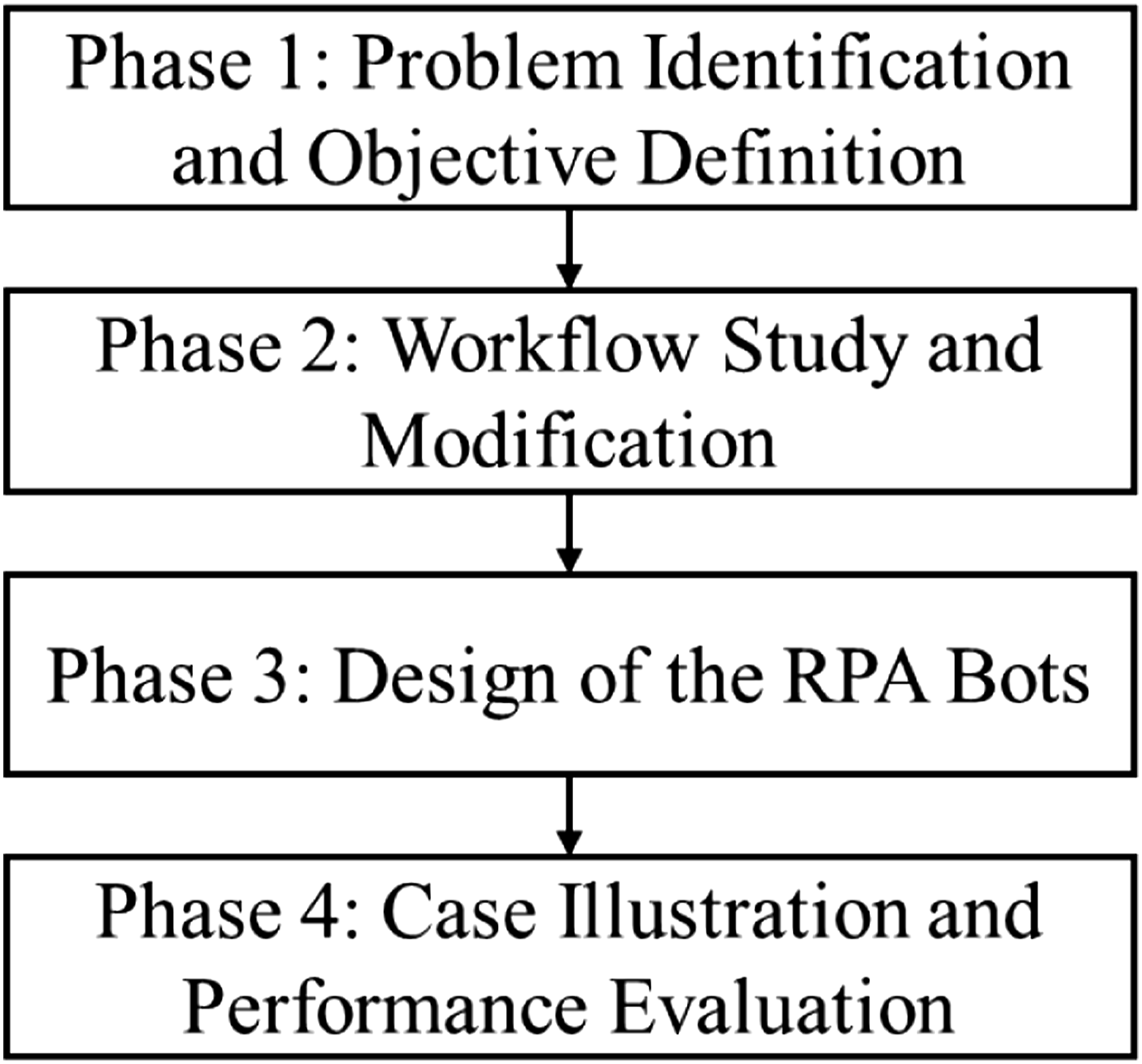
Phase 1: Problem Identification and Objective Definition
Phase 2: Workflow Study and Modification
Phase 3: Design of the RPA Bots
Phase 4: Case Illustration and Performance Evaluation
In phase 1, to perform digital transformation in the freight forwarding industry, background study and problem formulation are conducted to study the critical concept of cold chain logistics and RPA. Applying the workflow study with a cross-functional map is performed first to understand the relationship between each party and their significant operational activities. Also, the activities that have scope for improvement using the RPA approach, reducing the bottlenecks in daily operation, are determined. The necessary data for analysis is identified and collected. In phase 2, a workflow study is conducted to understand the daily information and goods transaction flow. The related data, such as process time used for each daily operation task, airwaybill numbers, and cargo tracking Web site, are collected in this module. Several process criteria are defined to access the suitability of the implementation of RPA such as frequency in interacting with multiple systems, volume of transactions and the level of cognitive requirements. Standardizing the process before applying RPA is also essential as the more standardized the process is, the fewer exceptions happen. 23
In phase 3, the RPA technology is used to design a customized robot for the operation and testing the capability and feasibility of the designed robot. For designing bots, the RPA development platform and the available bot actions have been reviewed to find a stable and suitable RPA platform for this study. Also, bot testing is done to find bugs and functional issues to ensure the designed bots can run properly. Finally, the robot performance evaluation module evaluates the designed bots.
In this study, Automation Anywhere was used to illustrate the design of an automation bot. Automation Anywhere is a global leader in the field of RPA, providing cloud and web-based intelligent automation solutions. Users can deploy the function locally and store the functionalities on cloud, and then deploy the bot on any computer anywhere. Several program commands that are commonly used in building the bot are introduced in the following sub-sections.
Log to excel
“Log to Excel” allows the bot to assign the captured data or the word input in the command to a specific column in a specific Excel file. The bot can log the captured data of the latest status of shipment and the input words, such as AWB, Port, Weight, etc. as a column heading into an Excel file, as shown in Figure 2. Program command: log to Excel.
Loop
“Loop” allows the bot to repeat the actions assigned to it. In this case, it is used to run on multiple airwaybill numbers and capture all the targeted shipment data, as shown in Figure 3. Without the loop function, only a single airwaybill is checked. As many shipments need to be tracked every day, it is an extremely useful command. Program command: loop and recorder.
Recorder
“Recorder’” allows the bot to capture a set of actions performed during recording. In this case, this command captures the data from the specified space, such as the table of shipment data on Cathay Pacific Cargo Web site and stores it in the database for logging into Excel file, as shown in Figure 3. Also, it can locate the search box on the home page and then input the airwaybill number in the search box. Furthermore, it can capture the search button and set a command to click it.
Simulate Keystrokes
“Simulate Keystrokes” allows the bot to use the keyboard in a selected window. As the button “All” as shown in Figure 4 cannot be captured by the Recorder command, the ‘simulate keystrokes’ command should be used. This commands the bot to select “All” from the tab via simulating keystrokes, then making use of the “Up-Arrow”, “Down-Arrow” and “Enter” button to perform the designated actions. As some airwaybills have larger records because of far destinations and longer stays, all data are not visible in a single table just containing 10 data rows. This action can authorize the bot to show all pages of records for capturing the complete information. Program command: simulate keystrokes.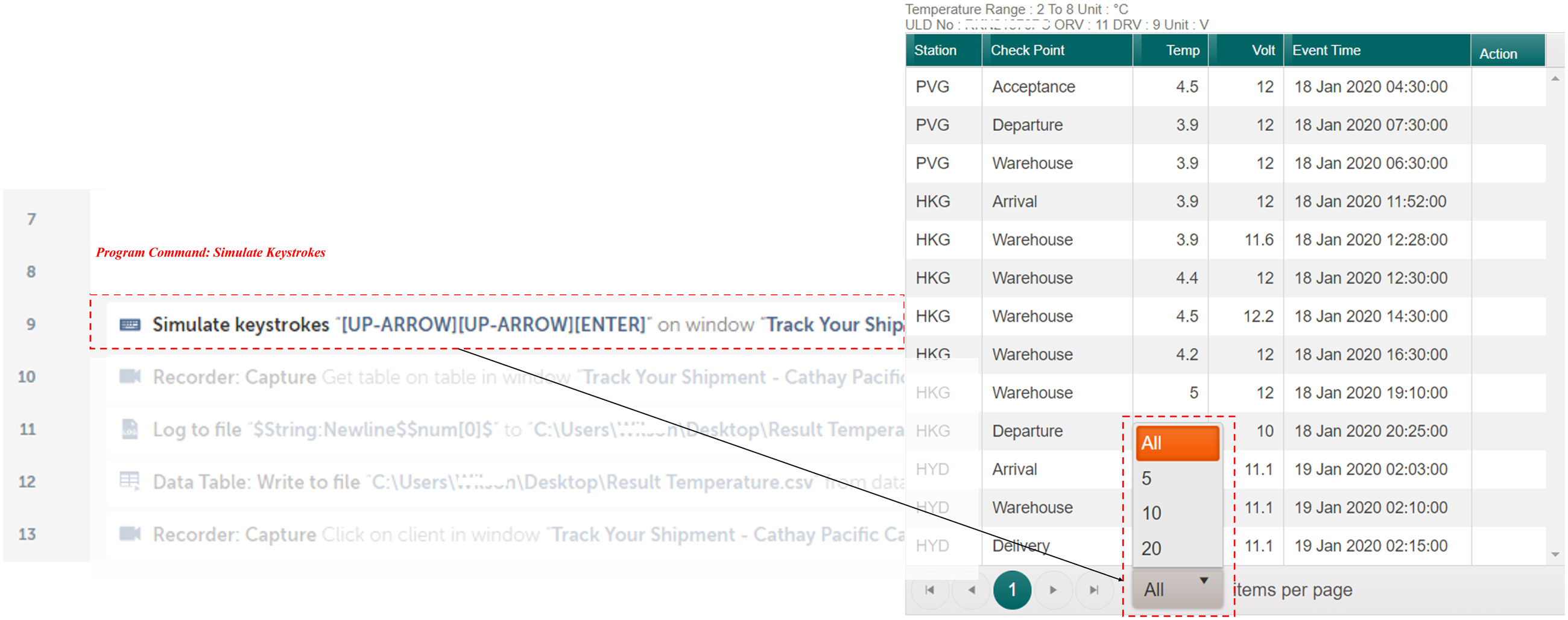
Lastly, in phase 4, a case study is conducted to apply the designed bots to a real-life case and the details are presented in section 4. After the implementation of the designed RPA bots in the case company, its performance is evaluated in term of efficiency and effectiveness.
Case study
AOC Pharma is a pharmaceutical cold chain logistic division of Chevalier AOC Freight Express Holdings Ltd. It is a logistics service provider for international freight transportation. Pharmaceutical logistics need strict requirements and standards for temperature control. AOC Pharma provides temperature logistics management and regulatory compliance through qualified packaging systems to support pharmaceutical cold chain logistics. It is an IATA certified pharmaceutical forwarder and also a member of WCA Pharma, the world’s leading pharmaceutical logistics network provider. AOC Pharma’s pharmaceutical cold chain transportation network has world-leading standards and is a trusted provider of pharmaceutical cold chain services. AOC Pharma’s 24/7 monitoring transportation service control center supervises all information about the pharmaceutical logistics status, including the temperature of the transportation equipment, the temperature of the products, the state of the transportation tool, and other necessary logistics information. This information is a huge data collection, most of which needs to be provided in real-time. If the information is provided manually, it will bring information delay and labor costs, so it is necessary to make use of RPA to capture the data and monitor the real-time pharmaceutical transportation situation.
Workflow of handling temperature sensitive products
The outbound workflow of handling temperature sensitive products is complex and the steps in each stage are shown in Figure 4. The whole process flow includes three parties: customer, back office, and airline. Customers initially give the shipment order information to the back office for booking the aircraft cargo cabin. To complete this stage, the staff needs to check the booking status on Cathay Pacific Cargo’s Web site. Cathay Pacific Cargo is a shipment tracking Web site which allows customers to check the shipment status and temperature-controlled container’s condition for cold chain by searching the corresponding air waybill number. If the booking is confirmed, the office captures the booking information for preparing air waybill to pick up the cargo and send the cargo to the airline. The back office then sends the booking confirmation and air waybill number to the customer through email. After submitting air waybill, repetitive work processes, highlighted in blue in the Figure 5, are required. Outbound workflow of managing temperature-sensitive products.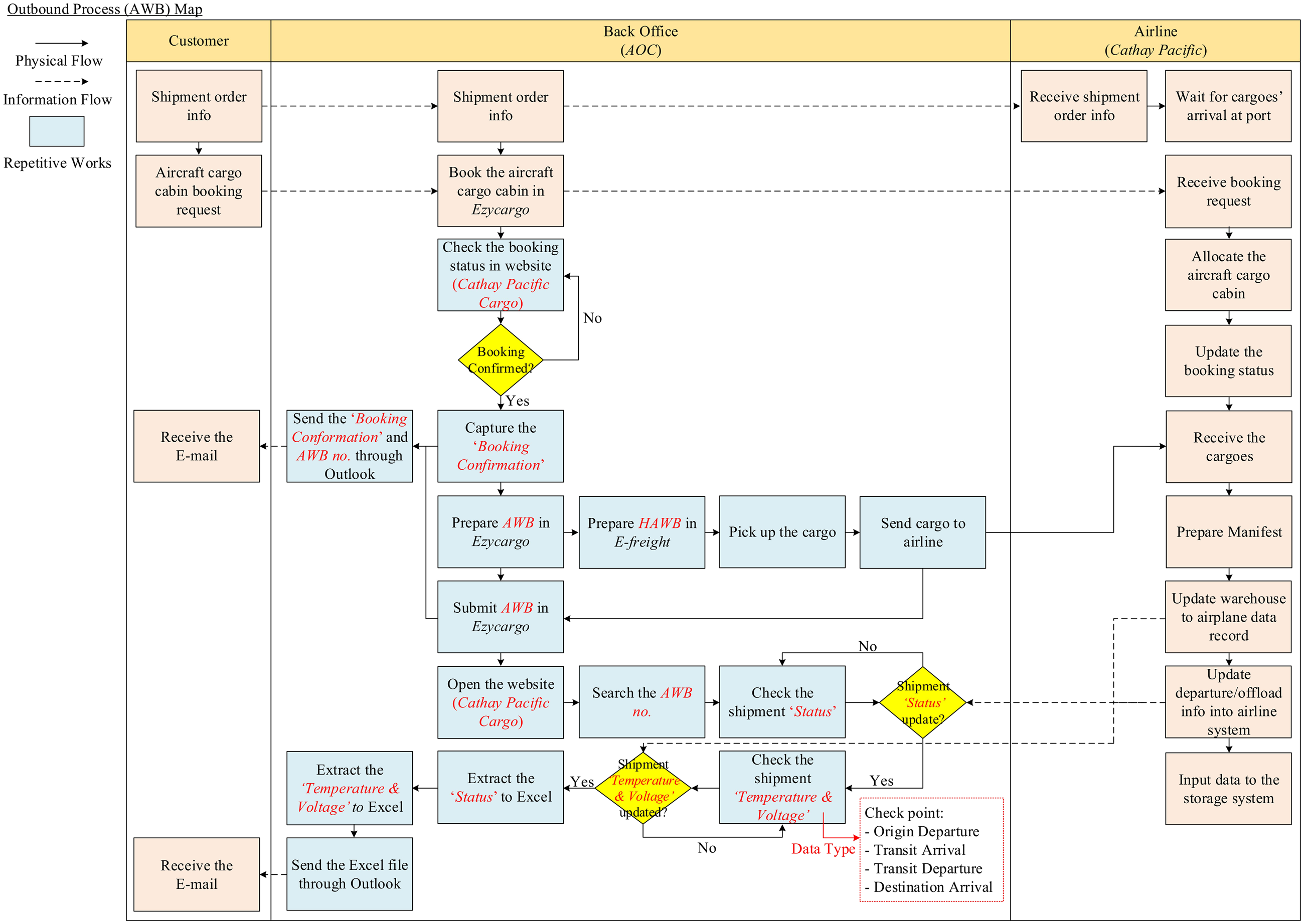
The staff opens the Cathay Pacific Cargo’s Web site to search the air waybill for the shipment status. Once the shipment status is updated, the shipment temperature and voltage between the checkpoint that involves origin departure, transit arrival and departure, destination arrival are checked. If the shipment temperature and voltage are updated, the staff is then required to extract the data of “status” and “temperature and voltage” to an Excel file. Once the data is arranged, the staff can then send the excel file to the customer through email.
Design of RPA bots
To solve the problems that exist in Chevalier AOC Freight Express Holding Limited, RPA should be implemented. The automation bot should be built to replace human control for handling repetitive tasks. As two kinds of shipment data need to be extracted, two bots are built for serving different cargo information, Bot-Status and Bot-Temperature. Bot-Status is designed for capturing shipment status of cargoes. Bot-temperature is specially designed for shipments that requires temperature monitoring, to capture the temperature and voltage shipment data of temperature-control containers.
Bot-status
The first bot, Bot-Status, captures the latest data of port, status, piece, weight, flight date, and milestone of the shipment on the Cathay Pacific Cargo Web site and extracts the data to the dedicated Excel file. Figure 6 shows the flow of capturing the latest status. To check the shipment status on the Cathay Pacific Cargo Web site, the necessary data is in the AWB numbers database. To acquire the latest shipment status for each AWB by Automation Anywhere, the first action is to copy a specific AWB number stored in the excel file using the “CSV/TXT: Open” and “Log to File” actions. Second, the Cathay Pacific Cargo Web site is opened using the “Browser: Open” action. Third, a “Loop” function is added to ensure all the available AWB numbers in the excel file are checked on the Web site. Then, the bot will input the AWB number into the shipment search box on the Cathay Pacific Cargo Web site using a “Recorder: Capture” action if there are available AWB numbers in the excel file. After the Web site is reloaded, the bot captures the latest shipment data by applying the “Recorder: Capture”. Finally, captured latest shipment data is stored in the excel file using the “Log to File” action. The bot runs until all the available AWB numbers in the excel file are checked on the Web site. Capturing the latest shipment status by RPA bot.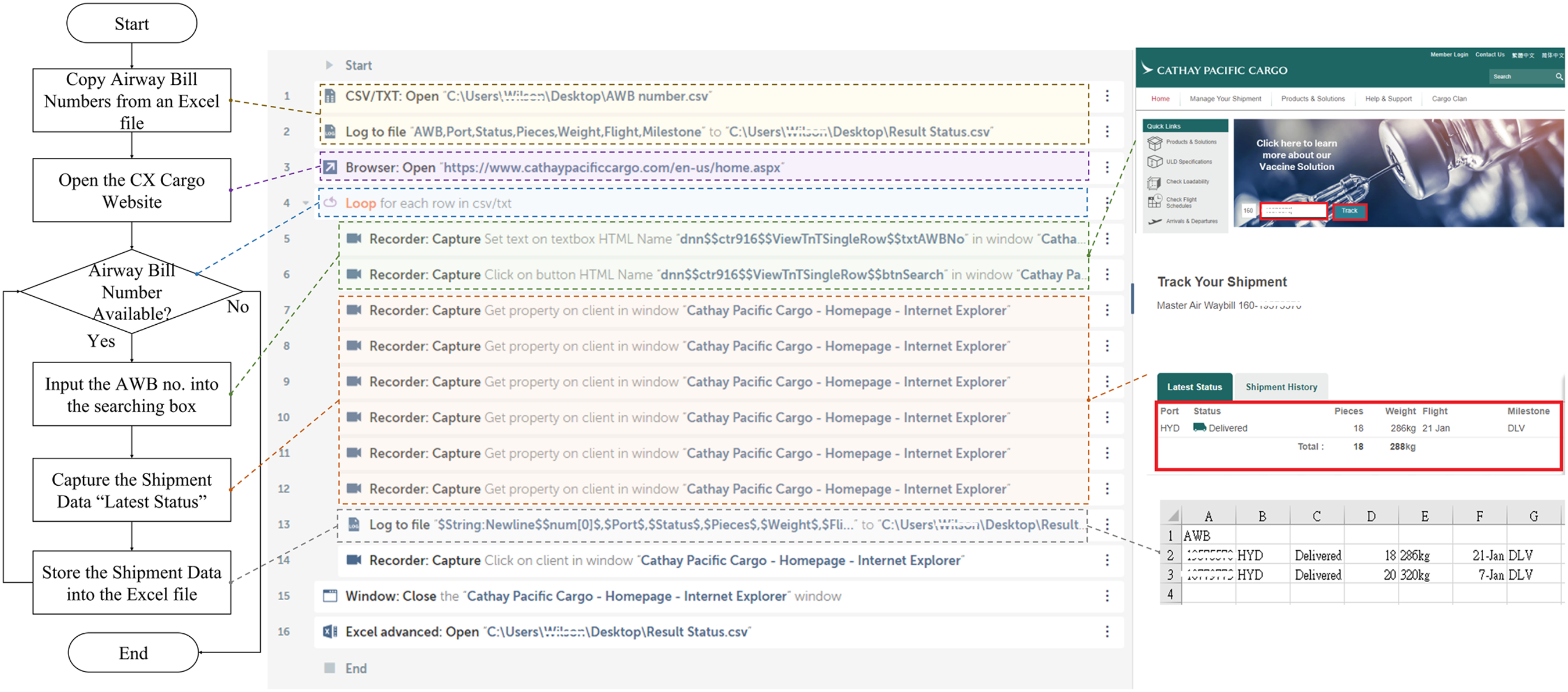
Bot-temperature
The second bot, Bot-Temperature, captures the data on the temperature and voltage of the temperature-control container at each checkpoint. Figure 7 shows the flow of capturing the temperature and voltage information. To extract the temperature and voltage information on the Cathay Pacific Cargo Web site, capturing all the AWB numbers stored in the excel file is required. Most of the steps are similar to capturing the latest shipment status in Figure 6, in which the first step is to open the excel file and obtain the specific AWB number in the excel file. Subsequently, the Cathay Pacific Cargo Web site is opened, and the “Loop” function is added to ensure all the available AWB numbers stored in the excel file are checked on the Web site and then the AWB number is input into the Web site search box. After the Web site is refreshed, the bot clicks on the temperature and voltage information button and opens the information page. An action “Simulate Keystrokes” was added to make all the temperature and voltage records on the Web site display on one page as the temperature and voltage information are multipage and not shown on one page. Then, the bot captures all the shipment temperature and voltage information data. Finally, the extracted temperature and voltage information is stored in an Excel file. The action “Data Table: Write to File” extracts the whole temperature and voltage information in a table format rather than extracting each data as an independent variable, which increases extraction accuracy. The bot runs until all the available AWB numbers in the excel file are checked on the Web site. Capturing temperature and voltage information by RPA bot.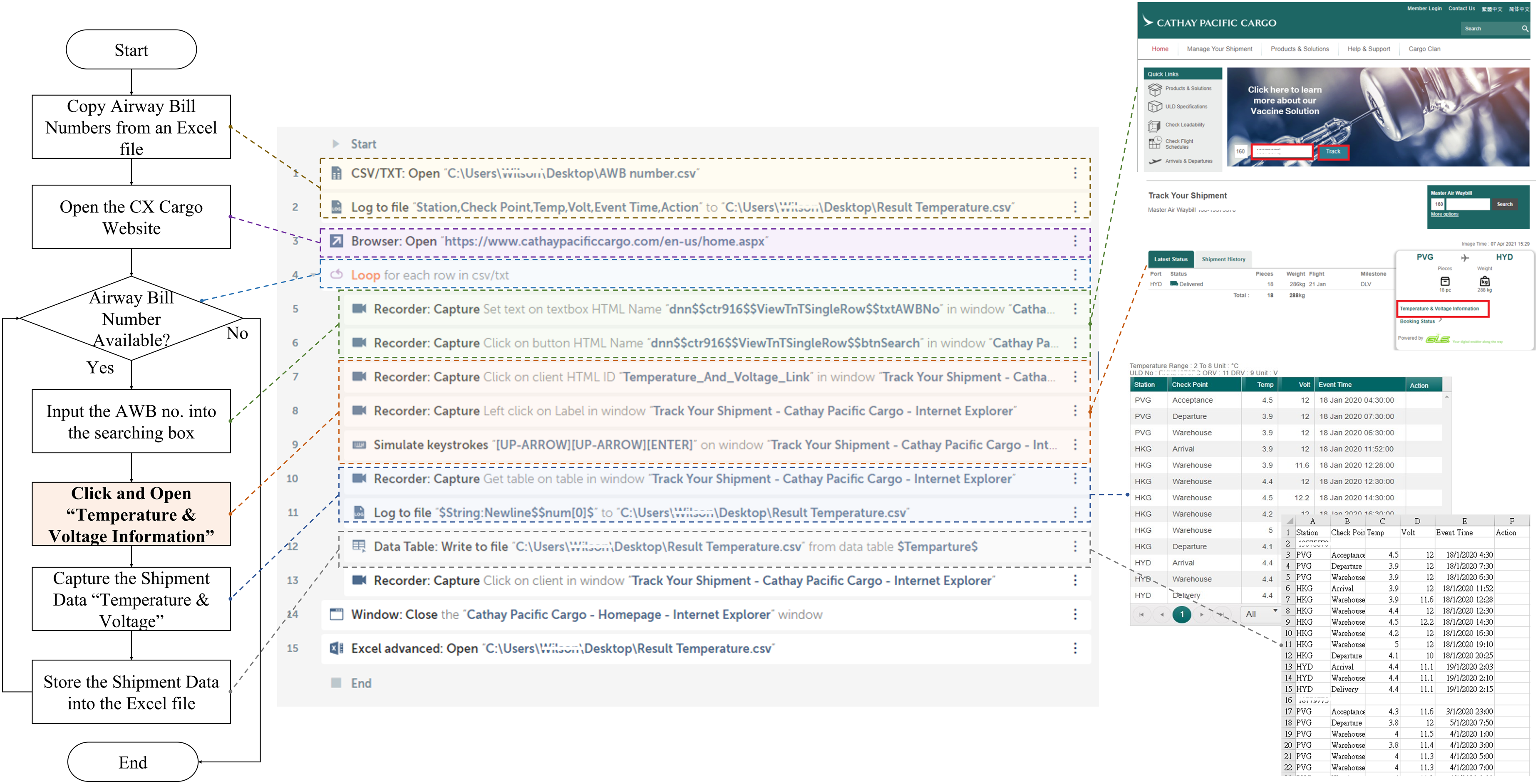
Results
To further evaluate the performance of the RPA bots, the comparative analysis was conducted to show the performance difference before and after implementation of RPA. In addition, the discussion of workflow improvement is also presented in this section.
Comparison before and after implementation of RPA


Improved workflow
The implementation of RPA can replace manual control to complete repetitive tasks. The main difference between the original and improved workflow is the use of RPA. Bot-Status checks the shipment’s status and also is updated automatically while Bot-Temperature checks the shipment’s temperature and voltage and is updated automatically. The staff does not need to intervene in these two processes after the employment of RPA, and they just need to execute the bots. The bot will then collect the data and extract to an Excel file automatically. The improved workflow of these two operations is shown in Figure 8. It is found that the improved workflow avoids the staff performing repetitive tasks on numerous AWB numbers and does not require the time-consuming step that involved checking for updates manually on the Web site as in the original workflow. Eight repetitive steps were reduced after the implementation of RPA bots. Improved workflow.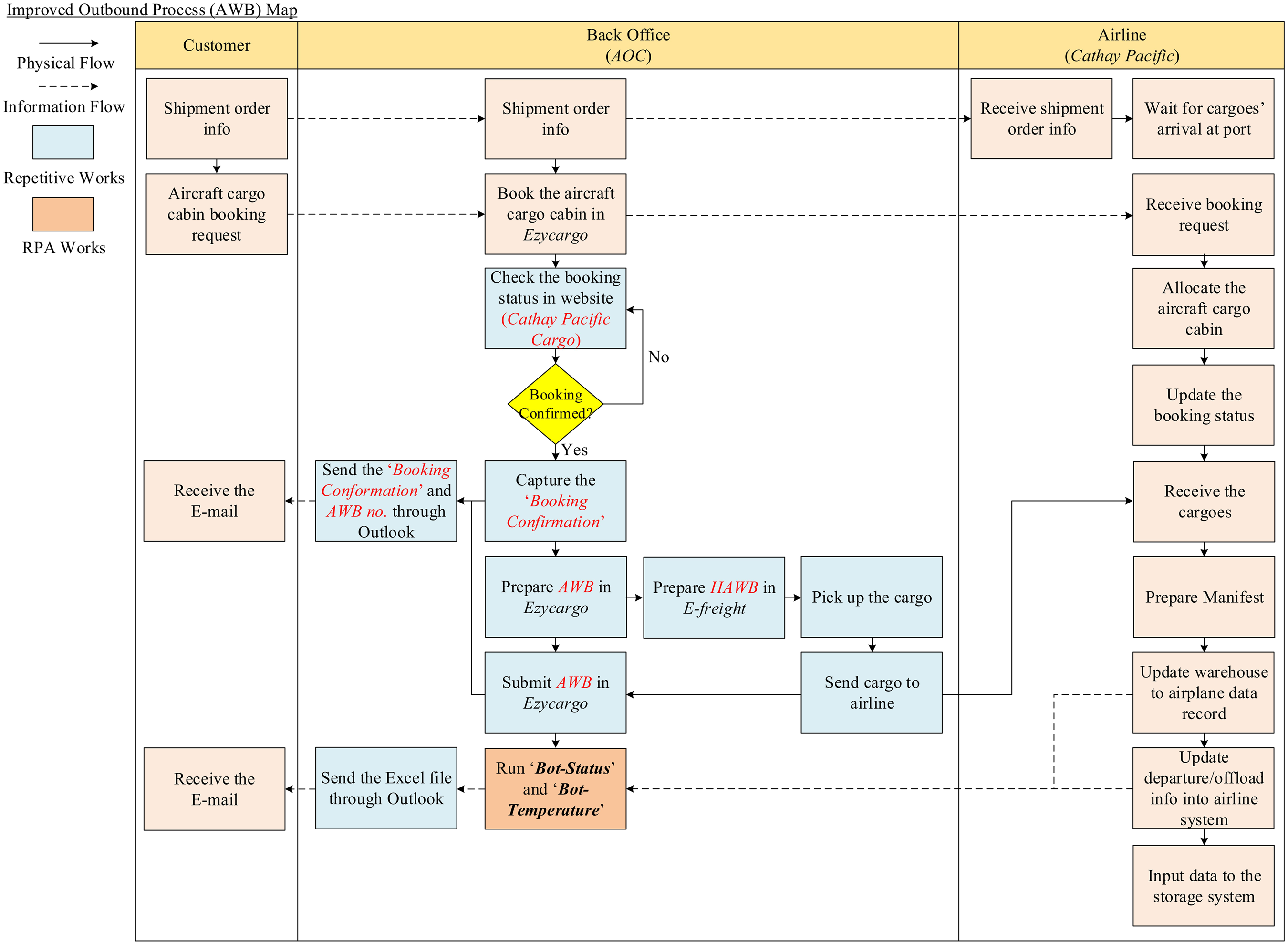
Discussions and implications
From the case study results, the use of RPA to replace the manual process was found beneficial to the freight forwarding industry. Firstly, RPA can enhance productivity. Human are prone to errors when handling repetitive tasks. As RPA follows pre-defined steps, it not only improves the operation efficiency, but also reduces the data entry and other manual errors by an automatic execution of the tasks. As RAP bots do not get distracted, manual errors are eliminated once the RPA setup is completed. However, this does not mean that RPA guarantees error-free operation. RPA operations should be checked from time-to-time to ensure that special cases are also covered successfully by RPA bots. Once there is a change in the operation workflow, the update should be executed to modify the steps in the RPA. Another advantage of RPA is that it reduces workload of workers. With the implementation of RPA, valuable data can be generated and extracted after running the RPA bots. Robots interact with legacy systems uncovering data that was previously labor-intensive to extract. Timely data extraction enables the analytics team to access more data so as to provide the useful recommendations for top management in making the appropriate decision in cold chain logistics. Lastly, employee satisfaction can be enhanced. Employees are no longer required to perform repetitive and boring tasks, e.g. checking updates and copying data from the airline Web site to an Excel file. RPA bots can perform these tasks while employees can focus on more challenging tasks. Ultimately, this can help achieve full automation in the freight forwarding industry.
Given the advantages, the difficulties when implementing the RPA should not be underestimated. In order to successfully implement the RPA in companies, appropriate training should be provided. Since the workers may be entrenched in manual approach to check the freight status and temperature information for cold chain cargo and be reluctant to learn new advanced technologies. Therefore, clear instructions should be given to front-line workers and manager should discuss with the front-line workers regularly to understand the problems encountered during the use of RPA bots.
Conclusions
Owing to the recent pandemic, the attention and demand for cold chain has increased. The trend of the new normal in digital processes has also put more focus on automation to reduce face-to-face interactions and increase efficiency. To save manpower, increase efficiency, and improve accuracy, repetitive tasks such as checking shipping status and temperature condition became a key area for automation in the freight forwarding industry. In this study, the outbound workflow on managing cold chain in a freight forwarding company was studied to identify the areas for automation. Two RPA bots were then designed and developed for checking shipment status and temperature condition on an airline Web site. These two bots can run without supervision at any time. With the information captured by RPA bots, the freight forwarding company can acquire a better understanding of the shipping performance. The company can get an immediate alert if any abnormal situation occurs regarding the shipment. Moreover, the performance of using RPA in handling the temperature sensitive air cargoes was evaluated. Based on a comparison, it was found that the RPA bots performed better than the manual approach in terms of the processing time. However, there is a limitation of using the RPA approach. As the function of an RPA bot is designed based on a specific Web site, the bot can capture correct information until the Web site design remains unchanged. The change in Web site design would render the bot incapable to capture the data at the designated area and hence adjustment is required in the bot with each Web site design modification.
Footnotes
Acknowledgements
The authors would like to thank the support by the Big Data Intelligence Centre in The Hang Seng University of Hong Kong.
Declaration of conflicting interests
The author(s) declared no potential conflicts of interest with respect to the research, authorship, and/or publication of this article.
Funding
The author(s) disclosed receipt of the following financial support for the research, authorship, and/or publication of this article: This work was supported by the Research Grants Council of Hong Kong, University Grants Committee (UGC/FDS14/E04/21). In addition, this project was also supported with matching grant from the University Grants Committee of Hong Kong (RMGS Project No. 700011).
