



Abstract
Regional culture plays an important role in the dissemination of culture along “the Belt and Road Initiative”, and through the efficient application, layout and flow of cultural resources, it can achieve industrial and economic efficiency. Cultural exchanges and interflow are raised and recommended by “the Belt and Road Initiative”. From the three dimensions of history, reality and development, the paradigm shift of regional culture in the context of “the Belt and Road Initiative”cultural development must be based on a historical and developmental perspective, with heritage and innovation as the body, and contemporary values to reflect on the problems in cultural development, so as to achieve the integration of unity and pluralism, and to provide a strong impetus for the cultural development of “the Belt and Road Initiative”.
Introduction
Significance of the study
In recent years, China has put forward “the Belt and Road Initiative” national policy, which focuses on political mutual trust, economic integration and cultural inclusion, and has made great efforts to deepen regional cultural exchanges, optimize the allocation of cultural resources in “the Belt and Road Initiative region”, spread Chinese culture and Chinese voice, and enhance national cultural soft power. Among them, regional culture plays an important role in the dissemination of the Belt and Road Initiative culture. Regional culture is the foundation for the survival and development of the region in the process of modernization, and it is also the reform base for the realization of cultural consciousness and cultural innovation along “the Belt and Road Initiative”. Based on this, this paper starts from exploring the characteristics and inner spirit of regional culture, and seeks new thinking dimensions and means for regional culture to promote the development of “the Belt and Road Initiative”. This paper achieves several contributions: Firstly, through this research, a theoretical understanding of the development background, status, and patterns of Lingnan culture can be established. The study of the uniqueness of culture in the Lingnan region is beneficial for the tailored implementation of the “the Belt and Road Initiative” cultural promotion strategy. Secondly, through this research, a further examination of the interplay between regional culture and economics, as well as the role of Lingnan culture in the development of the regional economy, can be elucidated. Third, based on this, the main problem to be solved in this paper is to start from the ontological characteristics of culture and put forward the thinking paradigms of cultural development that is suitable for the cultural characteristics and the regional culture of the regions along “the Belt and Road”. These dimensions include respect for cultural history, contemporary transformation and realization of value consensus. They provide a new thinking angle for Lingnan culture to integrate into the “the Belt and Road Initiative”. Forth, strategic recommendations: this paper will develop the cultural radiation of the countries along “the Belt and Road”, nurturing the common recognition of different cultures for the affirmation of human value. It will also help to build up cultural confidence and enrich the traditional genes and expression forms of regional culture. Combined with the policy of dual drive, it will promote regional cultural innovation and development and figure out other specific ways to propose solutions.
Research on the definition of culture
Having its own developing pattern and influencing Lingnan region deeply, Lingnan culture is one of the important and representative national culture in China. Considering national culture, it is defined as the values, beliefs and assumptions learned in early childhood that distinguish one group of people from another by Beck and Moore. 1 This definition is consistent with Jaeger's idea of national culture, stating that national culture is the common theory of behaviour or mental programs that are shared. 2 National culture is embedded deeply in everyday life and is relatively impervious to change.
The word “Culture” has four meanings, one of which refers to the sum of the material and spiritual productive capacity obtained and the material and spiritual wealth created by human beings in the process of social practice in a broad sense, and the spiritual productive capacity and spiritual products in a narrow sense, including all forms of social consciousness: natural science, technological science and social ideology”. 3 In this study, culture can refer to the spiritual form and social ideology of material, spirit, behavior and psychology contained in the scene of regional life. The people living in the region will form a conscious cultural cognition after a long period of historical development based on the common feelings of region, tradition, lifestyle and value experience in the long-term production practice. As Leung K, Bhagat R S, Buchan N R, et al. stated, the present model proposes that as a multi-layer construct, culture exists at all levels from the global to the individual. At each level the initial change occurs at the most external layer of behaviour. Gradually, when the change is shared by individuals who belong to the same cultural context, it becomes a shared value that characterizes the aggregated unit, namely the groups, the organizations, or the nations. 4 In China, for example, the rough northwest culture, the delicate Jiangnan culture, the inclusive and pioneering Lingnan culture, etc., constitute a part of Chinese traditional culture and have strong vitality. The Lingnan culture is representative of the late-developing and marginal culture in history. It takes its special geographical location in the Pearl River Delta as its source and foundation, and gradually absorbs the background of the mainstream culture of the Central Plains in the process of its southward migration, and becomes its own cultural backbone. In the context of “the Belt and Road Initiative”, the integration of Lingnan culture into the cultural construction of neighbouring countries and regions is necessary to enhance the soft power of the region, and it is also necessary to inherit and innovate Lingnan culture.
Culture is in the form of cultural diffusion in different regions and groups of people, integrating and migrating and evolving. This way of cultural diffusion is the process of spatial movement and time development of cultural phenomena, and it is one of the basic ways for cultural development and prosperity. First, there are two main types of methods: expansion diffusion and migration diffusion. 5 In the meantime, Lingnan culture, based on marine culture and commercial economy, has got the opportunity of rapid development in the history of modern China, and gradually developed into a representative of modern civilization with foreign cultures, inclusiveness, absorption and practicality. In “Multidimensional Thinking of Guangdong Culture”, scholar Li Zonggui summarized the three stages of Guangdong's cultural change. Three decades of reform and opening up, Guangdong culture has developed and inherited on the basis of traditional Lingnan culture. It has experienced the self-defense of the cultural desert theory, the narcissism of the “cultural northern expedition” theory, and the self-confidence of the “cultural Guangdong” theory. These three different Stages. The cultural concepts and self-value positioning concerned at different development stages reflect the staged characteristics of Guangdong's cultural development. 5
The development stages of Lingnan culture are closely related to those of the Maritime Silk Road. Before the 14th century. The native culture represented by “Baiyue” culture is backward on the one hand, and less affected by war on the other hand, which is deeply influenced by the idea that small wealth is satisfactory. The Ming and Qing Dynasties witnessed the budding development of capitalism in China and the eastward transmission of western sciences. The Lingnan culture, corresponding to the great changes in China's social development, rose rapidly and formed its own cultural system and cultural symbols due to the geographical superiority of marine culture. Along with the arrival of the wave of capitalist colonialism in modern Europe and America, Lingnan culture has become more and more vigorous in the sharp social changes and has become the mainstream cultural representative of the changes and national rejuvenation in modern Chinese history. With the reform and opening up, Lingnan culture has continued to play its people-oriented and efficiency-oriented characteristics, advocating and forming a strong trend of emancipating the mind and renewing ideas throughout the country, and providing a powerful force for regional economic and social development. In “Thinking about Guangdong Culture in Multiple Dimensions”, scholar Li Zonggui summarises the three stages of cultural change in Guangdong. “Over the past 30 years of reform and opening up, Guangdong culture has developed and inherited on the basis of the traditional Lingnan culture, and has gone through three different stages, from the self-justification of the cultural desert theory to the narcissism of the ‘cultural northern expedition’ theory to the self-confidence of ‘cultural Guangdong’.” The cultural concepts and their self-valuation at different stages of development reflect the staging characteristics of Guangdong's cultural development. 5 The scholar Li Quanshi believes that “the essence of Lingnan culture is a primitive, pluralistic, perceptual, and unorthodox secular culture, which is mercantile, open, compatible, diverse, innovative, pragmatic, hedonic, and intuitiveness.” 6 Li Zonggui pointed out, “Lingnan culture is essentially an agricultural culture that is alienated from the Central Plains culture but still influenced by the Central Plains culture, has strong commercial awareness and marine awareness, and has significant compound characteristics. The regional culture is characterised by pragmatism, commercialism, compatibility, secularism and plebeianism.” 7
Research on the relationship between culture and economics
The association between economics and culture has been a subject of longstanding interest in the academic community. The founding father of economics, Smith (1776), emphasized a dual standard involving both economic and moral dimensions in defining the “economic man,” thus reflecting the acknowledgment of cultural elements in Smith's study of economic growth. 8 Mill (1848) extended Smith’s economic philosophy, highlighting the significant role of morality in a society's economic growth. 9 It is evident that classical economists, represented by Smith and Mill, attached great importance to the role of culture in economic growth. Neo-classical economists, with figures like Marshall as representatives, focused more on real individuals in the economic landscape. They explored the non-economic motives, particularly those stemming from cultural factors such as ideas, values, and religious beliefs, when investigating the reasons for economic growth.
Weber (1905) offered an extensive interpretation of cultural ethics and the spirit of capitalism in his work “Die Protestantische Ethik und der Geist des Kapitalismus,” explicitly asserting that cultural factors possess significant driving force and influence in human economic activities. 10 Mill (1956) continued this research and proposed that the customs and habits of a society exert constraints on economic behavior, sometimes surpassing the pursuit of economic interests by individuals. 11 Schumpeter (1912), in his work “Theory of Economic Development,” prominently introduced the innovation theory, contending that the inheritance and transcendence of traditional culture are the primary sources of entrepreneurial innovation. 12 Easterly and Levine (1997) integrated cultural factors into the analysis framework of economic growth, making cultural variables a standard explanatory component in economic growth models. The interplay between culture and economics has gradually evolved into a coexisting paradigm in the discourse of economic growth issues. 13
As the interaction between culture and economics has gained prominence in economic research, and with the extensive increase in high-frequency trade and investment activities between China and countries along “the Belt and Road Initiative” in recent years, an increasing number of scholars have become engaged in this field of study. For instance, Bai Ling and Lv Dongfeng (2001) employed a deductive approach to analyze the promotion effect of cultural complementarity on international trade from a theoretical perspective, suggesting that moderate cultural differences can enhance trade between nations. 14 Luo Nengsheng (2006) constructed a model of cultural conflict trade costs, which examined the interplay between culture, transaction costs, and trade efficiency, highlighting the role played by cultural differences in economic trade. 15 Through a review and synthesis of relevant academic literature pertaining to cultural concepts and content, the relationship between culture and economics, culture and international trade, as well as the cultural and trade-related developments in countries along “the Belt and Road Initiative,” we have observed that scholarly research on the role of regional cultural characteristics in “the Belt and Road Initiative” strategy remains somewhat limited. Presently, the co-construction of “the Belt and Road Initiative” has become a significant opportunity for the economic development of China and the countries along this route. Therefore, research on regional culture and the mechanisms of its influence in the context of “the Belt and Road Initiative” strategy is an area that requires concentrated investigation.
With a long history, Lingnan culture has gradually formed a large number of Lingnan literary practices with unique styles and distinctive regional characteristics, such as Cantonese, Cantonese opera, Cantonese music, Lingnan arts and crafts, Lingnan folk customs and Lingnan food culture. Guangdong, as the birthplace and flourishing place of Lingnan culture, has the inner spirit of being the first, being open and inclusive, and being realistic and pragmatic. Especially for Lingnan culture, a cultural system with strong instrumentalism, humanistic pursuit and realistic value recognition, its cultural practice shows the distinctive characteristics of publicity of human nature and the particularity of psychological cognition of cultural values. In recent years, “Outline Development Plan for the Guangdong-Hong Kong-Macao Greater Bay Area” has proposed to support Guangzhou in building a “Lingnan cultural centre and a gateway for external exchanges”, to support Lingnan culture in playing the role of the demonstration zone of in-depth cooperation among Guangdong, Hong Kong and Macao in the construction of the “the Belt and Road Initiative”, and to give full play to the cultural and psychological role of Lingnan culture in building a quality living area suitable for living, working and traveling.
People-oriented philosophical logic
Спиркин,А.Г., a philosopher of the former Soviet Union, said “There can be no culture outside or before people. Similarly, there can be no people outside or before culture.” 16 Obviously, culture exists based on people’s lifestyle, which is the embodiment of people’s subjective initiative. In the same way, the development of culture should keep pace with the value, will and richness of human nature, and be accepted by people. Traditional Lingnan culture embodies the people-oriented secular social world outlook, which highlights people’s status and role in reality, their subjective acquisition and participation, their pursuit of value and their sense of happiness and satisfaction.
The literary styles, themes, contents, images and symbols of Lingnan culture all show that the masses are the majority, and abandon the cultural aesthetic meaning that powerful and noble people are the absolute protagonists in traditional culture. Sun Yat Sen’s main thought of “easier said than done” and the Three People’s Principles (Nationalism, Democracy, the People’s Livelihood) are the embodiment of the cultural psychological view of people oriented in Lingnan culture. Compared with all kinds of traditional literature’s spiritual expectations of the temple, Lingnan culture is unique in that it pays attention to the spiritual life of ordinary people, their individual needs and free choices, which is an important support for Lingnan culture to keep its true colors during the historical development of stormy times, and it is also an important part of the contemporary development of Lingnan culture that should be focused on and developed in “the Belt and Road Initiative”. The humanistic view of Lingnan culture has precipitated its cultural characteristics with strong vitality in the long-term historical practice, which has enabled its cultural context to be inherited and continuously developed.
The moral choice of advocating individual freedom and liberation
According to Engels, “Every progress in culture is a step towards freedom.” 17 With people's values, people's needs and people's free and all-round development as the highest goal and standard, the research of cultural psychology emphasizes the function of “truth, goodness and beauty” of cultural practice. In addition to the fact that culture can arouse people's pleasure in beauty by shaping beautiful things, it pays more attention to the deep-seated psychological identity of culture and the resonance of value orientation. Lingnan culture embodies the cultural psychology of advocating the moral spirit of individual freedom and liberation. Furthermore, it also recognizes the rationality of human desires, the individual pursuit of social life and the liberation of personality, and combines the instinct of individual desires for life with the pursuit of happiness, realistic satisfaction and sensory pleasure. Human desires and desires-driven behaviors are reasonable and worth advocating as long as they can make individuals feel happy and are beneficial to their own survival and development. Therefore, it is a deeply-rooted feature of Lingnan traditional culture that the subject actively exchanges worldly objects and spiritual enjoyment.
The moral choice of Lingnan culture focuses on people’s liberation and free development and provides a deep-rooted cultural psychological basis for the construction of the cultural identity of “the Belt and Road Initiative”. On the one hand, it advocates abandoning regional cultural prejudices and perspectives, thinking about cultural and psychological self-consciousness in the deep thread of historical and social development, and removing dogmatism and empiricism that have imprisoned ideological development. On the other hand, it pays full attention to people's ability and freedom, and masters scientific laws through social labor and practice, so that people can constantly improve their freedom and consciousness of transforming the objective world and subjective world.
The values of pragmatism and utilitarianism
All the achievements of social, economic and cultural development in Guangdong in modern times, especially since the reform and opening up, are influenced by the pragmatism in Lingnan culture, which makes Guangdong people pursue pragmatic and innovative values and take root in all aspects of Lingnan social life. The pragmatic features are also reflected in the contemporary Guangdong culture, which emphasizes practicality and efficiency, and takes practicality as an important measure, reflected in cultural practice and creation. For example, Chen Clan Temple, the representative of the architectural style with Lingnan characteristics, changed the wooden pillars of traditional buildings into solid iron pillars and made improvements in material, which is still the aesthetic of Chinese wooden pillars in form. Such improvements are durable and reflect the pragmatic style of Lingnan culture. Guangdong’s economic and cultural influence in the countries along the Belt and Road Initiative in the last hundred years has always been permeated by the cultural and spiritual influence of pragmatism. With the development of the times and the continuous development of cultural consciousness in the countries along the Belt and Road Initiative, the values of pragmatism can improve efficiency and maintain speed, they also have obvious disadvantages, such as the excessive pursuit of efficiency, which easily leads to the mercenary, blind pursuit of economic benefits and neglect of social benefits. Since the 1980s, Guangdong, as a pioneer of reform and opening up, has taken the lead in both economic and cultural models across the country. With a large amount of capital injected into the literary and artistic market, Guangdong's cultural industry led the trend of the times at that time. Lingnan culture quickly occupied the market in a civilian, commercial and short, adaptable and fast way, bringing opportunities for cultural development and impact on values. Benefit-seeking of the market economy restricts the inherent law of literary and artistic creation, while the priority of efficiency leads to the mixed quality of literary and artistic creation to a certain extent. History has proved that the cultural practice with prominent values of pragmatism is easy to be surpassed. Reflection on the cultural psychological characteristics of pragmatism shows that the practice that only seeks market economic benefits, without rich traditional cultural accumulation and without grasping the core laws of cultural construction has no vitality.
The integration of Lingnan culture into “the Belt and Road Initiative” in the new era, attention should be paid to the leading role of civic education, the creation of spiritual civilization, the creation, production and dissemination of spiritual and cultural products, and the common value of cultural psychology should be regarded as the common pursuit of condensing the collective will of contemporary Chinese spirit and society, which not only provides a theoretical fulcrum for the choice of “righteousness” and “profit” in the innovative development of Lingnan culture, but also answers the question of sublation and innovation of traditional basic cultural characteristics in the innovative development of Lingnan culture.
Feelings first and empiricism
Lingnan culture advocates giving priority to feeling, and empiricism is superior to scientific inference in the way of understanding the world. To begin with, attaching importance to the intuitive feeling of individual psychology is the promotion and continuation of Lingnan culture to human subjectivity. It is the core feature deeply rooted in Lingnan culture that people-centered psychological feeling takes precedence over logical thinking and timely satisfaction of human desires takes precedence over the long-term layout of grand narration. In the second place, the practice of putting experience above logical reasoning and theoretical summary is closely related to the long-standing geographical environment and marginalization of political and social status in the history of Lingnan culture. Located in an isolated corner, Lingnan area was a late participant in the historical process of the Chinese nation. In the early stage of development, people’s satisfaction with the means of production and living was relatively backward, and it was handed down from hand to mouth for a long time. The authority characterized by skills and experience became the cognition handed down from generation to generation, easily saddled with the shackles of light scientific theory and heavy empiricism. In the literary and artistic expressions of Lingnan culture, secular scenes, praise and criticism, and townsfolk sentiment have always occupied a major position to satisfy people’s sensory needs, stimulating feelings, and individual likes and dislikes, lacking the ability of logical thinking, scientific reasoning and dialectical thinking. On the academic atmosphere of Lingnan culture, “the academic research in Lingnan since the Ming and Qing Dynasties has always had the tendency of sentimentalism and empiricism, which was inherited by Chen Baisha, Zhu Jiqi, Chen Mifeng, and even Kang Youwei and Liang Qichao.” 18 Empiricism, which emphasizes feeling and despises logic, has played a positive role in the development of Lingnan culture since modern times. The Lingnan style, which is aggressive, committed, flexible and changeable, has led the tide of modern social revolution and modern reform and opening up in China. In the course of advanced human culture, however, a culture without a solid scientific system and theoretical support of the same strain is unsustainable. Faced with the challenges and coexistence of various contemporary cultures, how to view Lingnan culture and establish a scientific cultural theoretical system to enable the innovation and development of Lingnan cultural structure are the important issues in the future. Thus, it is necessary to establish a new atmosphere of Lingnan cultural structure with the coexistence of human-oriented thought and scientific speculation, as well as academic nourishment and free spirit.
The intrinsic link between regional culture and socio-economic development
Regional culture and economic performance with local characteristics
Lingnan is a historical concept, and the division and designation of the Lingnan establishment varied considerably from dynasty to dynasty, depending on the administrative establishment. Nowadays, when the term Lingnan is mentioned, it refers to Guangdong, Guangxi, Hainan, Hong Kong and Macao, which is the present-day scope of South China.
Lingnan culture is an important part of Chinese culture, which is characterised by openness, enterprise and commercialism. In ancient times, due to the high mountains and steep hills, Lingnan was difficult to communicate with the Central Plains and developed late. But it was the “high mountains and far away emperor”, less affected by the political turmoil in the Central Plains, the economic development has been relatively stable. It is also because of being located in the subtropical south of the Five Ridges, by the mountains and the sea, the river and the Han River, the ancient Baiyue ancestors living here, from the early fishing and hunting civilisation, rice civilisation to the later trade civilisation, can not be separated from the river and the sea water transport, so like to be mobile, not conservative, that is, the Baiyue culture is different from the inland civilisation or the valley civilisation of the true nature of the Baiyue culture.
According to the results of the Seventh National Population Census, the resident population of South China in 2020 will be approximately 187 million, accounting for 12.96% of the country's total population. The total economic output will exceed RMB 15 trillion, with Guangdong accounting for nearly 70% of the population and 80% of the total economic output. Although South China as a whole is a large region, its population and resources are over-concentrated in Guangdong, and its economic and social resources of high quality are over-concentrated in the Pearl River Delta (PRD) region, so the imbalance of social resources is becoming more and more apparent in the Lingnan culture-influenced region. Looking closely at the leading industries in South China influenced by the Lingnan culture, it is not difficult to find that the development of automated production and intelligent research and development, and the cultivation of a new generation of information technology growth points is its consensus, especially Guangdong Province plans to build a cultural industry cluster, with “Cantonese Opera”,“Tea Ceremony”, “Wake-up Call”, “Tea Ceremony”, “Tea Ceremony”, and “Wake-Up Call”. Guangdong Province plans to build a cultural industry cluster, using traditional culture such as “Cantonese opera”, “tea ceremony”, “lion dance” as a carrier, and combining it with creative forms such as “5G + AR” to create a new scene of cultural experience, so as to better meet the cultural needs of countries along the “Belt and Road”. To better meet the cultural needs of countries along the “Belt and Road”.
Linkages between regional culture and economic culture from the perspective of entrepreneurship
Regional culture acts extensively on the local economy, and the process of interaction between the two is a set of material and cultural practices involved in survival and reproduction. 19 The cultural identity of the place is inextricably linked to the normative and value order behind its economic system, especially the values related to entrepreneurship, which can provide a key reference for entrepreneurs to make relevant decisions. Entrepreneurship is a mediator between regional culture and economic creation, and with entrepreneurial activity firmly rooted in the regional economic ecology, grasping entrepreneurship is an important part of future economic and social change.
The report of the 20th Party Congress pointed out that “improve the modern enterprise system with Chinese characteristics, carry forward the entrepreneurial spirit, and accelerate the construction of world-class enterprises”. Since the 18th Party Congress, General Secretary Xi has repeatedly emphasized the cultivation and promotion of excellent entrepreneurial spirit, and the State Council has issued a special document entitled “Opinions on Creating a Healthy Environment for Entrepreneurs to Grow and Promote Excellent Entrepreneurial Spirit and Better Perform the Role of Entrepreneurs”, to make clear the important role of entrepreneurs in economic activities, and to create a fair competition and honest business market order. In addition, entrepreneurship has a significant positive impact on the regional innovation efficiency, 20 entrepreneurs with the spirit of innovation pilot, entrepreneurship for the implementation of the path of the process, can maximize the stimulation of regional economic performance, 21 to promote the coordinated development of the regional economy, driven by the growth of the local economy. Therefore, this paper selects the representative entrepreneurial spirit under the cultural characteristics of different regions in China, and conducts comparative analysis to find that there is consistency between regional culture and entrepreneurial spirit in the region. Lingnan cultural characteristics profoundly affect the entrepreneurship in Lingnan region.
Cultural capital has an important impact on regional economic development
The rich cultural resources in Lingnan region provide people with creativity and inspiration, stimulate their innovative thinking and entrepreneurial spirit, and advance the development of cultural and creative industries. These industries can not only bring growth to the regional economy, but also cultivate new talents and skills to support economic transformation and upgrading. Take Shenzhen as an example, which is a representative city in the Lingnan region. Shenzhen is an important base of China's reform and opening up and one of the world's well-known innovation centers. The economic development of Shenzhen is rapid, in which cultural capital plays an important role. These cultural resources not only have attracted a large number of tourists and spectators, but also provide important support for the local creative industries and innovation and entrepreneurship. Overseas Chinese Town in Shenzhen has built a culture-wide industrial camp gathering cultural tourism, cultural festivals, cultural performing arts, cultural technology, culture-themed hotels and culture-related products manufacturing and has developed into the only Asian enterprise that has entered the top eight of the world tourism groups. Nowadays, OCT also owns and manages a number of cultural and art venues such as He Xiangning Art Museum, Huaxia Art Center and OCT Contemporary Art Centerand has built 13 large-scale cultural industry development demonstration bases across the country. In 2010, the main culture-related business revenue of OCT reached 5.2 billion yuan, and the number of visitors exceeded 20 million.
In addition, cultural resources can shape regional competitive advantages. Lingnan culture can be an important factor in attracting talents, capital and innovative industries, thereby driving economic development. Cultural heritage and traditional arts in Lingnan region will attract talents to create new cultural products and services. At the same time, these cultural resources will also cultivate the entrepreneurial spirit and innovation consciousness of the residents, and stimulate the vitality of regional economy. Zhuhai is one of the important economic zones and tourist cities in China. Zhuhai has rich cultural resources, such as Zhuhai Chimelong Ocean Kingdom, Hengqin port and so on. These cultural resources not only bring huge economic benefits to Zhuhai's tourism industry, but also provide important support for the local creative industry and scientific and technological innovation. At the same time, Hengqin Island in Zhuhai is also an important cultural and creative industry base. Hengqin Port on Hengqin Island is a comprehensive area integrating culture, art, creativity and technology, attracting a large number of creative talents and technology enterprises. The gathering of these talents and enterprises has provided an important driving force for the development of technological innovation and creative industries in Zhuhai.
Development priorities of south China provinces in 2018.
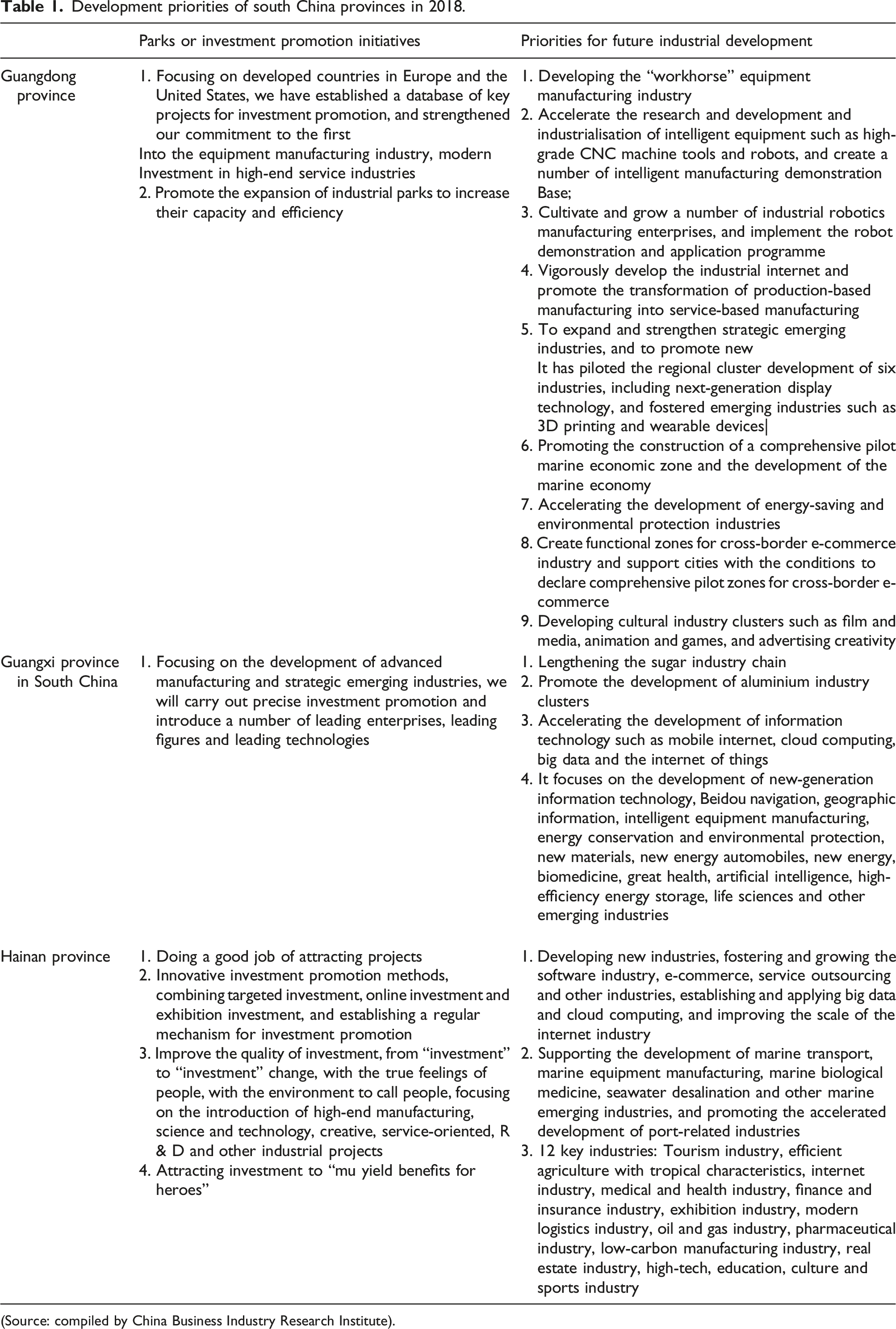
(Source: compiled by China Business Industry Research Institute).
Entrepreneurship in different regional cultures of China.

(Source: Based on the author's works “Qilu Culture”, “Jingchu Culture”, and “Lingnan Culture” by Zhou Lixia).
Comparison of key development indicators of the four major international bay areas.

(Source: “Global Urban Competitiveness Report (2018–2019): The Global Industry Chain: Shaping the Swarm Networked Urban Planet”, “Annual Report on Culture Development of Guangzhou in China (2019)” (new section)).
A paradigm shift in the integration of regional culture into the economic development of “the belt and road initiative”
The concept of paradigm was put forward by the famous American philosopher of science Thomas Kuhn, which refers to the theoretical basis and practical norms on which conventional science operates, and is the worldview and behavior pattern that a group of researchers engaged in a certain science abides by. 22 As Shenkar stated we should pay attention to the tenuous connection between the construct of culture and the theoretical frameworks, into which it has been deposited in an implicit, haphazard and questionable fashion, and whose latent assumptions are problematic. 23
Lingnan culture as an important representative of regional culture has a profound impact on the social development of Guangdong and is an important cultural foundation for the social development of Guangdong. The external world of culture has changed dramatically in the great process of the new era, and various cultures in the world are blending and stirring, while the internal innovation of culture also creates the need for creative transformation with the development of “the Belt and Road Initiative” construction pattern. In recent years, open innovation gets amounts of attention in different fields. It is recognized that innovative ideas and information would flow internally and externally to a field. 24 Different kinds of open innovation may have various effects on strategic and paradigm innovation. 25
Generally speaking, culture will have an impact on the local economy, advanced culture can inspire people to take the initiative to open up, actively enterprising, and pull economic growth, while the backward culture is often accompanied by a backward economy. Marine culture is conducive to enterprise innovation investment, ethnic culture has a moderating effect on enterprise innovation 26 Lingnan region facing the sea, is a collection of agricultural civilization and marine civilization, with the characteristics of industrial production and commercial cultural diversity, and upholding the attitude of openness and inclusiveness, pragmatism and innovation, pioneering and enterprising, Lingnan culture as the core of the Guangfu merchants, Chaoshan merchants, Hakka merchants, as the southern merchant gangs, outstanding representatives, has the “merchant gangs”. As the outstanding representatives of the southern merchant gangs, the Guangfu Merchant Gang, the Chaoshan Merchant Gang and the Hakka Merchant Gang, with the spirit of “business without boundaries”, provide support for enterprises to go out and industries to go out. They formed a strong cohesive internal organization based on the ties of blood and fellowship, and held an open and tolerant attitude towards external values, thus taking the lead in contacting foreign cultures and accepting the baptism of “European and American cultures”, which changed the marginal position of the Southern Guangdong culture in the Chinese culture, and became a new cultural center.
The Fourteenth Five-Year Plan for National Economic and Social Development explicitly proposes the establishment of a cultural powerhouse by 2035, the first time that the Party Central Committee has specified a specific time frame for the establishment of a cultural powerhouse. According to Guangdong 2035: Trends and Strategies, Guangdong's cultural development vision for 2035 is to create a new modern cultural highland and become a center of new culture in the digital era. This means that Guangdong Province needs to build its core competitiveness by focusing on its own cultural resources and comparative advantages, and accelerating the pace of cultural “going out” by focusing on cultural productivity under digitization. The cultural industry based on Lingnan culture has the advantage of being the center of new culture in the digital era, which means that Guangdong Province needs to start from its own cultural resources and comparative advantages.ccording to a report by the Cultural Industry Research Institute of Renmin University of China, in 2020, China's provincial and municipal cultural.
Guangdong Province ranks third in the comprehensive index of industry development, which is determined by the productivity sub-index, influence sub-index and driving force index, evaluating the development of cultural industry in Chinese provinces from multi-dimension and all-round, and Guangdong Province is in the first position with a large productivity base in cultural industry; and then we look at the index of attractiveness of investment in cultural industry, which reflects the degree of favorability of investors to the cultural industry in the region within a certain period of time, and Guangdong Province is in the first position, attracting 620,000 investment times. The degree of favor, Guangdong Province is located in the first place, attracting investment times 620,000 times.
Influenced by Lingnan culture, Guangdong, Hong Kong and Macao Greater Bay Area, relying on the country's complete cultural production system and local specialty service system, has created local specialty industries integrating finance, science and technology, creative talents, and folklore experience. Based on Porter's competitiveness theory, scholars Li Yan and Li Yanxin constructed a competitiveness analysis model of China's regional cultural industry, and found that the cultural industry development level and cultural infrastructure of Guangdong, Hong Kong and Macao Greater Bay Area have a greater advantage over the Yangtze River Delta and Beijing-Tianjin-Hebei regions, which is attributed to the fact that the culture in the region takes the lead in absorbing and incorporating foreign cultures, and that the science and technology in the region takes the lead in connecting with the world's cutting-edge science and technology and in the building of the talent team. 27
Therefore, we can propose a paradigm transformation approach for the active integration of regional culture into the development of “the Belt and Road Initiative” cultural construction in three dimensions: the historical dimension, the reality dimension and the development dimension.
Historical dimension: The paradigm shift of deepening history, eclecticism and dialogue with the world
Cultural psychologists believe that “human psychology, as a whole system, is not only a kind of natural existence, but also a kind of cultural generation. The study of human psychology and behavior should follow holistic thinking, and study human psychology and behavior from the relationship between psychology and environment.” 28 The dialectical thought of holism is to use the viewpoint of connection and development to look at problems dialectically, and use the method of mutual connection and interaction to look at the problems of world culture and local culture. The historicity of regional cultures, like all cultures in the world that can survive and have a strong influence, is their uniqueness and the foundation that cannot be easily shaken by any realistic trend of thought. People should not only base themselves on their own country, but also approach the world and face the future. With a long-term vision and strategic development, they should learn from and absorb the outstanding achievements of human civilization, and make rational planning and key promotion of cultural development. Cultural psychology in China is not only based on the ancient Chinese traditional cultural ideas, but also rooted in the needs of the future development of human society. It shows that on the one hand, cultural development should respect the exchange of world cultures, attach importance to the dialogue role of world cultures, and look at various cultures from a historical and developmental perspective; on the other hand, cultural development should look at the relationship between tradition and the future as a whole, to realize the prosperity of local cultures.
The civilization of all mankind is progressing in the alternation of mutual iteration, prosperity and demise of various civilizations. All advanced cultures are progressive cultures that constantly integrate, innovate, reflect conflicts and adapt to the development of the social environment with great vitality in the historical cultural conflicts and the ups and downs of national ethnic groups, instead of being stagnant. Nowadays, with the rapid entry of the world into the era of globalization, the integration of cultural values and diverse cultural competition constitute the cultural development trend of integration and competition. Lingnan culture, as a representative of regional culture, should examine its position and development trend in the world cultural development trend with historical dialectics. On the one hand, it should give full play to the characteristics of Lingnan culture, which has always been a combination of China and the West and inclusive, treat the world culture in a friendly way, and actively absorb the beneficial parts from other cultures. On the other hand, guided by the important exposition of socialist culture with Chinese characteristics in the new era, efforts should be made to maintain the right of “dialogue” with various cultures in the world, to tell good cultural stories, and to expand the radiation and influence of regional cultures, which are the general laws followed by various cultures in their future development. Creative development of regional culture must innovate the cultural spirit, break through the shackles of regional thinking and the weakness of scientific logic, and provide important spiritual support and internal motivation for the practice and exploration of social activities with a kind of tolerance of mainstream culture that pays attention to tradition, faces the present and points to the future.
It is the cultural identity, in line with the psychological acceptance characteristics of the masses, that has given rise to a humanistic and conscious influence on the surrounding regions and countries along the route, deepening in the course of a long historical development and forming a common perception of values in human culture. For example, in recent years, China has been expanding people-to-people and cultural exchanges with CEE countries under the Belt and Road Initiative. In the fields of education, economy, science, technology, and culture, through Confucius Institutes, high-end think tank summits, and people-to-people exchanges, China has expanded the pursuit of common cultural ideals among different regions and countries. Common values are becoming an important bridge for cultural exchanges between countries in the Belt and Road Initiative. The civic education advocated by the Belt and Road Initiative will minimize the narrow perspective brought by emotions and traditional cultural prejudices, and it helps people perceive events from the national, inclusive and cooperative world perspective as much as possible, encouraging learners to think about regional and global issues together, so that they can formulate rational thinking ability, think critically and engage responsibly in social issues.
Realistic dimension: Paradigm shift oriented to the contemporary era, cultural consciousness and concept guidance
The paradigm shift of cultural self-consciousness and reflection is to reflect the development of regional culture with the need for contemporary social and cultural value identification. In the development of “the Belt and Road Initiative”, “the more humane, advanced, tolerant and civilized a culture is, the more likely it is to become the mainstream culture that people around the world will admire, cherish and share” 29
Cultural psychology holds that “the continuous reproduction and reshaping of culture is a process of continuous evolution. The change or dynamics of culture depends entirely on the cultural behavior or practice, and on the ever-changing dynamic balance between the politics, ideology, economic conditions, lifestyle, etc. it covers and their combination. In a sense, it will change direction in people’s choices, meaning construction, understanding and interpretation, and will be redefined and shaped.” 30 The persistence of culture comes from the present life and practice of contemporary people, which influences their living habits, thinking patterns, manners and values, and also permeates the actual life practices of contemporary literature and art, architectural style, folk customs, etc. The persistence of cultural development lies in the ability of contemporary and future cultures to guide and reflect on contemporary social values.
Cultural psychology provides a method of contradiction in studying culture. That is to say, we should be good at solving internal contradictions in the process of cultural inheritance, and face up to contradictions and solve them with correct practical methods. In the creation and development of culture, the change of things should be viewed continuously from the perspective of social development, which is a process of cultural consciousness and also a process of people's subjective initiative. In the long-term practice, Lingnan culture has condensed out the cultural characteristics with the core of Lingnan spirit, such as inclusiveness, freedom and openness, people-oriented and seeking truth from facts, which play a decisive role in promoting the process of economic and social development in Guangdong. Every development and take-off of Guangdong is the exuberant vitality of generate from the core of Lingnan culture, and it is an important magic weapon to unite the hearts of Guangdong people. At the same time, with the progress of the times, the cultural characteristics of Lingnan culture, such as “small wealth ensures security”, emphasizing feelings over logic, and lacking the support of the scientific theory, have also seriously restricted the social and economic development of Guangdong. As the forefront and pioneer of the reform and opening-up, after nearly three decades of rapid development, problems such as insufficient stamina, conservative thinking and a rigid system have emerged in Guangdong, which is closely related to the disadvantages of Lingnan culture. Clearly, the development of Lingnan culture in the new historical development opportunities lies in “newness”, that is, keeping integrity and innovation, and returning to the original and novelty. The inheritance of Lingnan culture is not the specimen and model, but the activation and inheritance, which goes deep into the real life of “the Belt and Road Initiative” and influences the value identity, behaviour, habits and moral values of countries and people along the route. Consequently, it is necessary to dialectically examine traditional culture from the standpoint of the contemporary value of culture, innovate in inheritance, take its essence, discard its dross, and realize the contemporary value of culture.
Taking Africa as an example, the Belt and Road focuses on basic issues such as transportation and communications, resources and energy development, and public health care in African countries. By setting up specific funds to promote independent development in the countries and regions along the route, it has focused on solving the living conditions of local people. Based on the cultural heritage of the ancient Silk Road and with the freedom and liberation of people in different countries and regions and the improvement of material and spiritual conditions as the core under the new situation, the construction has become a powerful measure for cohesion. Principles, morality, equality, and emotion have become the development consensus of the people who are influenced by the Belt and Road Initiative.
Development dimension: Paradigm shift of value consensus, free practice, integration and pluralism
Regional culture has made great progress in the competition and blending of various cultures and has cultural endurance and development potential. The combination of integration and pluralism can be used to study the development of regional culture, and the principles of whole and part, generality and individuality in cultural psychology can be used to solve the problem of value identification in the development of regional culture.
The presentation of cultural expressions is closely related to values, which are the reflection of people’s living conditions, material pursuits and spiritual beliefs in a certain social environment. Social values have a lasting and far-reaching impact on culture. In the construction of “the Belt and Road Initiative”, the mainstream consciousness has been emphasized to grasp the direction of cultural development. It is only by taking mainstream consciousness and core values as the common value identification of social and cultural development that culture can be condensed into a cultural spirit with contemporary value significance in the contemporary social environment. In addition, it is necessary to face up to the law of diversified development of culture, pay attention to the methods and paths of diversified development while leading as a whole, and correctly handle the relationship between the unification of core values and the diversification of cultural concept practice. Both cultural innovation and diversity, and the diversified development of different forms in the internet plus the new media era should be encouraged. The exchange and mutual learning of different cultures from different countries and regions should be respected, and a relaxed, free and comfortable cultural practice environment should be created. In the theory of cultural psychology, the combination of the diversification of values and the maximization of core value consensus reflects the innovative thinking and systematic logic in paradigm shift and provides a guiding path for the development of regional culture. For the innovation and development of Lingnan culture in the new era, we should dare to reconstruct cultural values and build a scientific cultural psychological structure that combines mainstream and pluralism, elite and popularity, socialist core values and Lingnan cultural characteristics, moral identity and regional aesthetics, whole and individual, order and freedom.
As the countries along the Belt and Road stretch across the Eurasian continent, most of them have different histories and traditions. The political systems, economic development and cultural customs are very different, and there are still differences in value judgments in various aspects, which will hinder the development of the entire region. Through civic education, the Belt and Road helps people in countries along the route to fully understand the relationship between interests and rights based on the traditional Chinese cultural concept of justice and interests and develop a common feeling of understanding and inclusiveness, and actively promotes the common values based on reciprocity, mutual benefit and mutual preservation, so as to alleviate misunderstandings and conflicts at various levels between different countries.
Reflections on the path of regional culture in the development of “the belt and road initiative”
In order to realize innovative development and creative transformation, cultural consciousness and cultural promotion, regional culture must take inheritance and innovation as the body from a historical and developmental perspective, reflect on the problems existing in cultural development with contemporary values, and realize integration and pluralism, thus providing a strong impetus for the cultural development of “the Belt and Road Initiative”
It is sure that the value of culture to humans is common. It is necessary to grasp the emphasis of cultural impact on human nature, and seek common ground while reserving differences based on the different customs, cultural regional backgrounds and living habits of countries along “the Belt and Road”. With cultural integration as the bond, exchanges and cooperation between cultural industries and cultural cities should be strengthened. In the specific path, we should start from the genes of regional culture itself, enrich the innovative expression forms of traditional culture, export the spirit and cultural interaction of Lingnan culture, tell Chinese stories well, and enhance cultural influence.
Rebuilding the cultural values and returning to the humanism of culture
Wahda, Mursalim, Fauziah and Asty stated that culture is essentially important for an organization because it influences the behaviour and attitude of the individuals in the organization. The same fashion can be reflected in a region and area. 31 The Lingnan culture, for example, has a strong humanism in its genes, no matter in ancient times or in modern times, which always promotes cultural innovation and progress. In the new era, humanism points more clearly to people's common value orientation and people's increasing cultural demand. The development of regional culture in the context of “the Belt and Road Initiative” is based on the innovation of cultural values, taking the establishment of a cultural value system that meets the needs of social development and human development as the development goal, and must inherit the humanistic thought in cultural genes, and re-examine human needs and human value consensus from the standpoint of contemporary values. Building a humanistic cultural development structure requires shifting the focus of cultural development to the people, and appropriately leading and promoting secular culture.
First of all, to fully understand the cultural needs of the people along “the Belt and Road Initiative”, in-depth research should be conducted to reflect the people’s real needs. The Blue Book 2020 of China Cultural Development Report pointed out that in the survey of China’s cultural development (2019), the public’s feedback rate was as high as 88.4% for “I look forward to watching more excellent domestic film and television works reflecting local characteristics”, indicating the lack of film and television works with regional cultural characteristics and a big gap to the needs of the broad masses of the people. Second, lead the way in cultural values for the people of the region. To guide the people's ability to appreciate the beauty of culture, it is necessary to promote high-quality, high-quality literary and artistic works with correct value pursuit, grasp the spiritual and cultural needs of the grassroots people, and create cultural masterpieces that meet the needs of the people and the requirements of socialist core values. According to the investigation results of the integration of local traditional culture and socialist core values in Blue Book 2020, people have a good recognition of traditional culture, but the inheritance and practice of local excellent traditional culture are not optimistic. The phenomenon that regional traditional customs are gradually melting is based on the fact that the core of traditional culture fails to combine well with modern means of communication, resulting in the lack of fine products.
Practicing cultural self-confidence and enriching the traditional genes and expressions of regional culture
The importance of culture to national and ethnic development has been mentioned constantly. The great rejuvenation of the Chinese nation requires a high degree of cultural self-confidence and a prosperous culture. The regional culture contains a deep accumulation of traditional culture, and has excellent genes that dare to innovate and develop. In the new era, the innovative development of regional culture should practice cultural self-confidence, take excellent traditional culture as a solid foundation, incorporate mainstream values into regional characteristics and elements of the times, carry out the cultural practice, constantly tap the spiritual connotation of regional culture, and enhance the competitiveness and influence of regional culture.
First, to be good at exploring the traditional factors of regional culture. The characteristics of language, thinking mode, values and communication behavior of regional culture among regional people should be studied from people's life practice, and the genes and characteristics of regional culture should be known from literary practice such as historical sites, cultural relics, classics, traditional arts and historical celebrities. Second, to enrich the traditional symbols of regional culture. It is necessary to carry out various forms of cultural communication, such as cultural tide, which are popular with the people, by means of various cultural creations, such as art, literature, music, film and television, and new media communication, with activities as the carrier, so as to enrich Lingnan cultural symbols and enhance local cultural resources. The source of materials, acquisition methods, creative ideas and application ways of Lingnan cultural symbols should be explored, and the form of Lingnan culture should be recreated, innovated and derived, and the traditional Lingnan cultural gene innovation should be used to deduce the cultural thoughts and consumption concepts of the new era. Third, to tell the traditional story of regional culture well. Guangdong, for example, ranks first in terms of cultural input and production level in the whole country and ranks fifth in terms of the cultural supply index, which indicates that the regional economy is relatively developed, and it has high cultural product supply capacity and service capacity, which provides important support and guarantee for telling the story of Lingnan cultural tradition innovatively. Therefore, it is necessary to refine the unique charm, contemporary value, modern demand and transformation of Lingnan culture by means of modern media, and realize the oldest, newest, most traditional and most modern transformation.
Combining the dual drive of policies to promote regional cultural innovation
Žižlavský believes that the process of innovation begins with an idea or the imagination, moves through many stages of development, and ends with implementation. 32 The dual policy drivers of the construction of the Greater Bay Area and “the Belt and Road Initiative” have brought unprecedented opportunities and challenges to the innovative development of Lingnan culture. Using Lingnan culture as a linkage is the best vehicle for building a Chinese cultural community. Lingnan culture becomes an important window to showcase China’s cultural soft power. As Sarkkinen and Kässi stated, the biggest obstacles to innovation, in general, are a shortage of time and limited financial resources. 33 First, Lingnan culture should play a leading role in Guangdong-Hong Kong-Macao Greater Bay Area. Secondly, the historical fact that Lingnan culture is a common value identity along the Belt and Road, especially for Southeast Asian countries should be utilized, to advocate and lead cities along the route to inherit and promote Lingnan culture together. Introduce cities with special characteristics as cultural blocks along “the Belt and Road Initiative” through the establishment of cultural corridors, cultural industry platforms and cultural cooperation zones with other cities along the Maritime Silk Road, to form a new Lingnan cultural circle. Thirdly, it is necessary to highlight the characteristics of Lingnan culture and stimulate the new vitality of cities along “the Belt and Road Initiative”. Cultural identity is an important driving force for urban integration. It is necessary to highlight the characteristics of Lingnan culture in the development strategy of Bay Area and to shape and advocate the urban landscape, market, forum and image of Lingnan culture through the city culture business cards.
Conclusion
Regional culture plays an important role in the dissemination of culture along the Belt and Road, and through the use, layout and flow of cultural resources, it can achieve the agglomeration, integration and radiation of industrial and economic effectiveness, and the dialogue between regional culture and other cultures provides a broader perspective for the innovative development and creative transformation of regional culture itself. Firstly, this paper provides a theoretical overview of the development of “the Belt and Road Initiative” culture: a human-centered philosophical logic, a moral choice that exalts individual freedom and emancipation, pragmatism, utilitarian values and sensory-first empiricism. Secondly, through the interpretation of Lingnan culture's instrumentalism, humanistic pursuit and realistic value identity, it can be seen that Lingnan culture still has its limitations in the face of the world's various cultural integration and it needs to be transformed. From a practical point of view, this paper proposes a paradigm shift for the active integration of regional culture into the cultural construction and development of “the Belt and Road Initiative” from three perspectives: the historical dimension, the reality dimension and the development dimension. Thirdly, to propose a specific path for regional culture in the cultural development of “the Belt and Road Initiative”, one is to base on the cultural radiation of the countries along the route and to bring into play the common identity of different cultures in affirming human values. Second, we should practice cultural confidence and enrich the traditional genes and expressions of regional culture. In addition, it is necessary to combine the “the Belt and Road Initiative”, and the Greater Bay Area policies to promote regional cultural innovation and development.
Based on the relationship between regional culture and the economic development of the “Belt and Road”, this paper proposes that regional culture should adapt to the changing environment of the world's social and economic development, and should be based on deep cultivation of history, and correlate with the paradigm transformation of the world. Paradigm shift need to face the contemporary society, cultural awareness and concept guidance. Besides, the paper states that paradigm shift should focus on value consensus, free practice, and one unity with multipolarity constitution. The further study can also dig deeper into the correlation between regional culture and socio-economic development, and use more data and models to support this correlated concept.
Footnotes
Declaration of conflicting interests
The author(s) declared no potential conflicts of interest with respect to the research, authorship, and/or publication of this article.
Funding
The author(s) disclosed receipt of the following financial support for the research, authorship, and/or publication of this article: This work was supported by the Research Projects of Philosophy and Social Sciences in Higher Education Institutions in 2019 in the 13th Five-Year Plan of Guangdong Province (2019XJK028) and The Research Project of Ideological and Political Education of Guangzhou Academy of Fine Arts in 2024 Inheritance and Development of Lingnan Culture from the perspective of “One Belt and One Road”.
