



Abstract
Social responsibility issues keep reoccurring despite the popularity of numerous approaches perceived widely as adequate. In this paper, the authors conducted a systematic literature review to explore this phenomenon from a systems thinking standpoint. The findings revealed that each approach is founded on a different systemic paradigm, makes different assumptions on the nature of social responsibility issues, and has different objectives when resolving them. Therefore, employing any of these approaches alone will certainly fail given their underlying systemic limitations. The findings also revealed that these approaches are complementary from a critical systems thinking perspective, hence, researchers and practitioners can use their tools and methods together in the form of tailored interventions to better address efficiency, subjectivity, and fairness when resolving social responsibility issues. This paper concludes by proposing a practical framework based on critical systems practice which encompasses four systemic paradigms allowing the inclusion of a spectrum of perspectives, and assumptions.
Keywords
Introduction
Social responsibility is the responsibility of organizations for the impact of their decisions and activities on society. 1 Such responsibility is maintained through ethical behavior consistent with society's well-being, accounting for stakeholder expectations, 2 and conforming to applicable laws and international norms. 3
A social responsibility mess is a failure of social responsibility at one or more levels, creating problems not only to the offending organization but, more importantly, to its supply chain and the society of which it is part. Such messes have resulted in severe consequences to the supply chains that endured them, ultimately impacting revenues and threatening all member organizations' growth prospects. Therefore, from a supply chain perspective, the need to prevent and manage such messes is real, urgent, and justifiable. 4
The term “Mess” was coined by Russ Ackoff 5 to denote complex problem situations that are characterized by their interdependent and ill-structured nature. Messes occur when rational actors exhibit behavior of collective self-damage. Resolving messes requires collective action following a systemic approach, i.e., addressing the whole system instead of one or more of its parts.
In a supply chain context, social responsibility messes are incredibly complex because supply chains are complex systems: firms within a chain have mutual relationships, and all depend on each other to secure critical resources, products, services. A supply chain's size and web of connections implies that it operates within complex social contexts, as its business necessarily impacts a wide range of places and peoples. Understanding these social contexts is crucial when it comes to avoiding or addressing social responsibility messes. This is where conventional supply chain management fail and the need for dedicated approaches capable of perceiving and addressing such multidimensional complexity becomes clear.
Acknowledging that social responsibility messes are serious material risks directly impacting bottom lines, and that traditional supply chain management techniques focusing solely on business priority were not adequate to anticipate and handle them, supply chains have turned to various mainstream approaches for prevention and remediation. 6 Through such approaches, supply chains aim to establish more responsible policies, governance, and management practices. However, for this to work, such approaches must be holistic and enable the consideration of all stakeholder viewpoints to reach sufficient multifinal outcome. 7 Therefore, systemic holism becomes necessary to outperform one-sided mono-disciplinary approaches and methods. 8 Holism outperforms reductionism since the latter fails to predict and manage higher-level patterns. 9 Holism means that a system's properties cannot be determined or explained by its parts alone. Instead, the system as a whole determines how the parts behave. 10
Furthermore, the closer such messes are inspected, the more it becomes clear that a larger group of stakeholders are implicated. 11 Supply chain stakeholders include community members, shareholders, employees and their families, customers, suppliers, business partners, regulators, governmental and non-governmental organizations, and international agencies. 12 More importantly, stakeholders are diverse in their backgrounds, worldviews, and perspectives. 13 Thus, supply chains and their stakeholders form incredibly complex systems; resolving social responsibility messes is correspondingly complex. Therefore, resolutions require systemic approaches, that is, approaches possessing systems thinking tenets capable of addressing these complex systems. 14
Indeed, given the complex nature of social responsibility messes, the high degree of structural complexity and change within the supply chain and its environment, and the diversity of its stakeholders, 15 it is practically impossible—from a critical systems thinking standpoint—for any single approach or methodology with a particular perspective to offer a viable solution. 1 Therefore, any solution addressing supply chain social responsibility messes must be holistic and creative: holistic by accounting for the entire supply chain, not just one or more of its member firms; and creative by embracing the multi-perspectival nature of the messes of interest. 16
Basta et al. 17 conducted a mapping study of the supply chain social responsibility literature to uncover what systemic paradigms it embraced. The authors revealed that this literature was mostly Interpretive, one third Functionalist, and one tenth Emancipatory. More importantly, the authors revealed the innate inability of most of this literature in offering creative and holistic solutions, i.e., it can only resolve the subset of social responsibility factors it perceived, which explains at the literature level why such messes persist and resurface. Hence, the gap this paper addresses is why a single social responsibility approach cannot effectively address supply chain social responsibility messes from a systemic perspective, and can their tools and methods be combined using a systemic meta-methodology to design better interventions.
Therefore, the goal of this paper is to understand why supply chains continue to endure social responsibility messes despite their adoption of social responsibility approaches. The originality of this paper lies in making both researchers and practitioners aware of each of the approaches' systemic strengths and weaknesses permits better judgment of their suitability for addressing a social responsibility mess, particularly in a supply chain context, while making it clear when to expect each approach to fail, in what way, and what can be done in such cases.
The main contributions of this paper are threefold: Firstly, it uncovers the top three social responsibility approaches; Secondly, it provides a novel systemic analysis these approaches to reveal their systemic paradigm pertinences, this brings into light each approaches’ strengths and weaknesses. Thirdly, it shows how the tools and methods from each of the approaches can be used jointly to deduce better interventions based on multiple systemic paradigms.
Literature review
Supply chain social responsibility experts are increasingly implementing initiatives to address social responsibility incidents that impact bottom lines, 18 supply chain sustainability strategists are increasingly engaging in initiatives to address them. 19 Practices like worker abuse, factory collapses, and corporate duplicity had led to protests, reputation damage, and targeted regulations. 20
The following subsections further revisit the literature on systems thinking, supply chain social responsibility and the role of systems thinking in the context of this paper.
Systems thinking
Systems thinking is a holistic analysis approach that considers emergent complex systems, such as supply chains, as wholes rather than its individual parts or their relations. It recognizes that a system is more than the sum of its parts, and thereby rejects simple solutions to complex problems, embracing holism and creativity instead. This is contrary to reductionist approaches, where a system is broken down into its constituents to understand and fix the whole. 9 It is interesting to know how little systems thinking is used in the social responsibility literature 14 ; it was reported that less than 9% of the social responsibility literature uses systems thinking. 21
Critical systems thinking is of special interest to this paper. Jackson 22 discussed this concept as part of their seminal work on the System of Systems Methodology (SOSM) presented in detail in a later section in this paper. The SOSM came as natural development from the work of other authors who made significant contributions to the complementary systems thinking tradition. For example, Flood and Romm 23 showed how Soft and Structural systems thinking methodologies could be used in cases of coercion regardless of their innate theoretical purpose. The authors introduced the concept of the Oblique use of systemic methodologies to overcome special circumstances which hinder the use of direct emancipatory systemic methods which could be perceived as confrontational, and instead used systemic methodologies from a less direct angle that are sensitive to political dynamics to rally stakeholder support and commitment.
Other important contributions to complementary systems thinking are the works of Mingers and Brocklesby 24 and Midgely. 25 These two papers introduced the concepts of Multimethodology and Mixing Methods; Multimethodology advocates for the use of multiple systemic methodologies in tackling the same problem situation to account for the richness of the real world and better assist through the stages of an intervention, the authors also presented a framework that highlights the strengths of different systemic methodologies which assists in constructing multimethodology designs. Mixing Methods on the other hand, advocates for mixing methods and tools from different systemic methodologies belonging to the functional (first wave) and interpretive (second wave) traditions while keeping value and boundary judgement consistent in a given intervention.
Systems thinking and social responsibility
Reviewing the literature, very little use of systems thinking in the context of social responsibility can be found. For instance, Molderez and Ceulemans 26 used rich pictures in the form of art paintings to foster soft systems thinking competences and develop holistic solutions in the context of Corporate Social Responsibility (CSR). The authors reported that soft systems thinking and its tools allowed a better understanding of CSR related issues, their holistic nature, and interconnectedness.
Moreover, Waller 27 advocated for the use of systems thinking in turning social responsibility into a mainstream supply chain activity, instead of a luxury affordable only by big-brand firms. The authors 27 advocated that holistic systems thinking, because of its ability to enable collaboration and innovative strategic planning, is at the heart of supply chain social responsibility initiatives and is crucial to their success. In particular, the authors highlighted the importance of interpretive and emancipatory systems thinking for stakeholder management and conflict resolution, in order to minimize the supply chain’s costs.
Additionally, Starik and Kanashiro 26 used system dynamics to model and address the interconnectedness between social sustainability components—people, organizations, society, and environment—across temporal and spatial dimensions. The authors argued that only structural systems thinking, as opposed to traditional management theories, could offer solutions appreciated by all the stakeholders involved.
Interestingly, some authors attempted to make use of relatively modern technology to manage a supply chain’s impact across the life cycle of a product or service. For instance, Kopanaki et al. 28 used Blockchain technology to track food waste in the hospitality industry. The goal was to reduce costs and, more importantly, attract more clients by offering a differentiated service where social and environmental sustainability are core to an organization’s business model. Moreover, it is worth noting that some forms of novel social responsibility models were attempted and showed considerable success such as the social supermarkets-model implemented in central Europe whose purpose is to promote resource efficiency and waste reduction in the food supply chains allowing a wider access to food to those in need. 29
Finally, Cordoba and Tim 30 reemphasized the importance of considering different stakeholder worldviews and various perspectives when dealing with CSR. The authors explained that CSR means something to everyone but not the same thing to everyone, consequently making the process of prioritizing social responsibility messes and deciding on actions prohibitively challenging. The authors explained that this confusion led many organizations to engage in CSR without necessarily assessing its fit to the problems at hand. However, as opposed to considering CSR and Systems thinking as two separate approaches that could help with handling the complexities of social responsibility, this paper uncovers the systemic tenets of CSR itself and explains where it sits in the systems thinking paradigm spectrum; this is presented in detail in the next sections.
Paradigms
Paradigms are an important component of systems thinking, as the different systems thinking methodologies are founded on different paradigms. A paradigm is a grouping of ideas, backgrounds and beliefs that shape conduct. Different paradigms are founded on different assumptions, which means that the same problem can be viewed from different perspectives and inspected by a variety of different methods with distinct theoretical backgrounds by approaching it from different paradigms. 31 Importantly, each paradigm holds that it offers the best account of observed reality, and therefore they are inherently in conflict with each other. It follows that different systems thinking methodologies are also in conflict, due to their underlying paradigms.
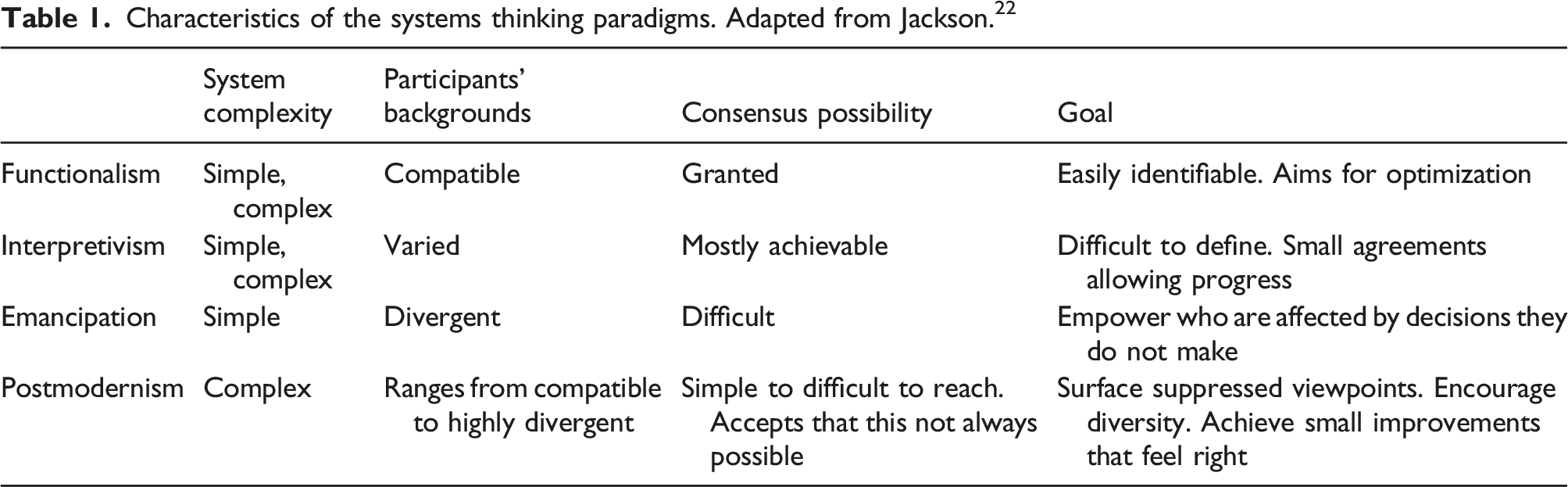
This paper addresses four paradigms: Functionalism, Interpretivism, Emancipation, and Postmodernism. These four paradigms were selected because they work well with the SOSM. Moreover, limiting the scope of this paper to only these four paradigms was also in accordance with the resources available to conduct this research paper. Functionalism is concerned with ensuring that everything in a system is functioning well while promoting efficiency, adaptation and survival. Functionalism assumes that the inner workings of a system can be modeled using mathematical techniques to understand the nature of its parts. Conversely, interpretivism believes that systems result from people with different purposes interpreting the same situations according to their different backgrounds and worldviews. Interpretivism is concerned with finding where such interpretations overlap so that collective purposeful activity becomes possible. Emancipation seeks to emancipate oppressed individuals and groups who are participants of a given system, and to manage and reveal forms of power that it considers unlawfully used. Finally, Postmodernism challenges the idea that systems can be fully understood. Postmodernism takes a less serious view of systems and stresses having fun, implementing what feels right, embracing conflict, and encouraging verity and diversity. 22 Postmodernism rejects the idea that a system can be steered to a desired state by following one or more systems thinking methodologies, but instead advocates for a best-can-do approach that acknowledges limitations and constraints.
To put it differently, each paradigm represents a lens or frame of reference through which we can understand how each of the social responsibility approaches engages messes, the supply chain, and the social context. 32 For instance, some approaches might define the messes of interest as optimization issues, whereas others might define them as power-struggles. These understandings naturally shape actions accordingly. Therefore, it is important to be aware of the frame of reference when addressing supply chain social responsibility messes. 32
In their influential paper, Jackson and Keys 33 presented the SOSM of problem-contexts. The authors used this framework to study the interrelationship between Operational Research and other systemic methodologies. Problem-contexts are abstractions of the stakeholders involved and the systems bearing the problem. The authors showed that different problem contexts require different methodologies, and that mismatching hinders problem-solving. Nevertheless, the SOSM allows for avoiding such discrepancies given its core principle that different methodologies have different capabilities, and no one methodology can fit all circumstances.
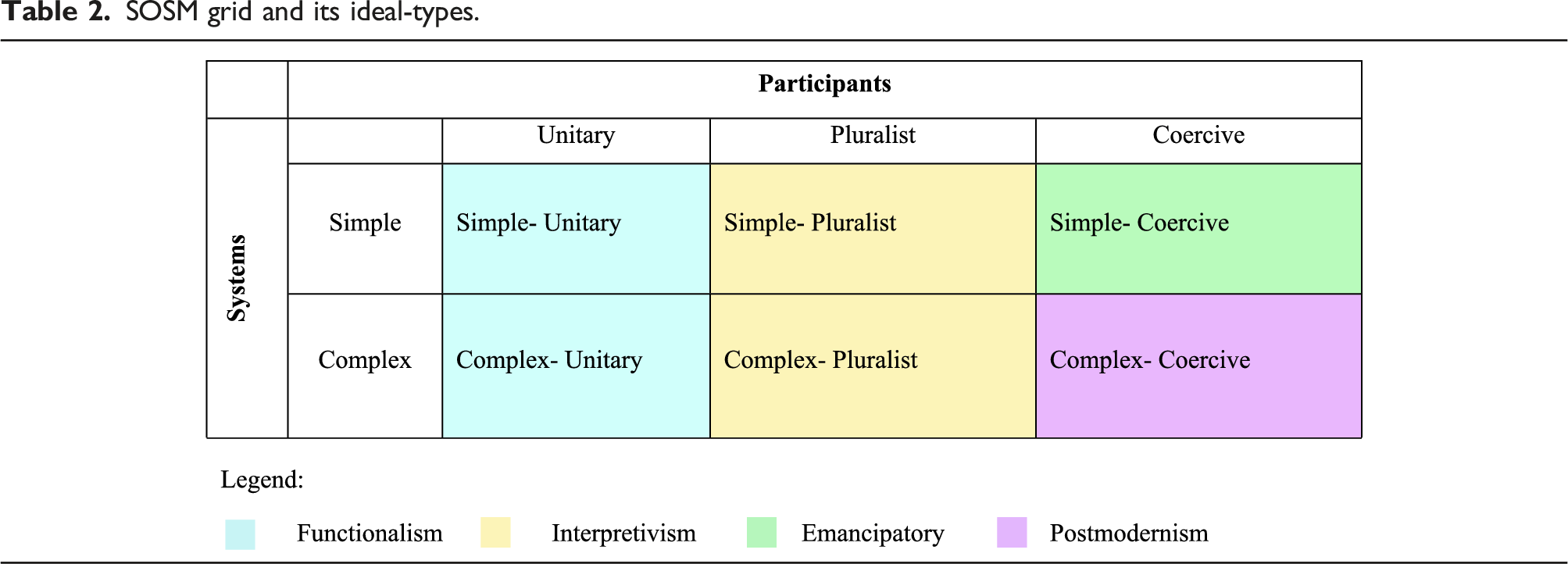
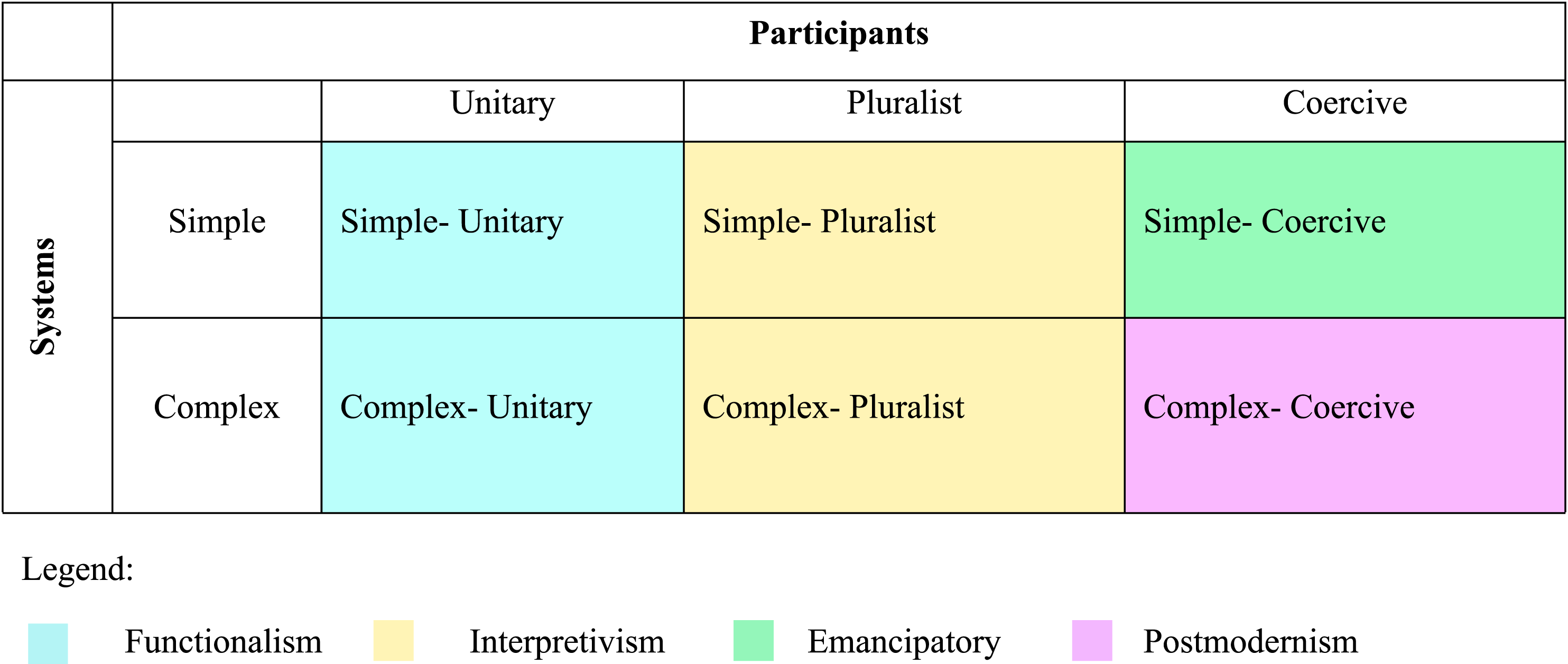
Jackson 22 expanded the SOSM framework and used it to classify various systemic methodologies. The SOSM makes it clear that difficulty in addressing problem-contexts results from their increasing complexity, change, and diversity which could be studied along two axes: the size and structure of a system; and the compatibility of the views and objectives of the systems’ participants; stakeholders. These two axes of “systems” and “participants” form a grid that constitutes a number of problem-contexts called ideal-types. In this grid, the vertical axis represents a range of system types from simple to extremely complex, whereas the horizontal axis represents the types of relationships between the participants, which could be “unitary”, “pluralist”, or “coercive”. In consequence, the two axes yield six ideal-types: simple-unitary, simple-pluralist, simple-coercive, complex-unitary, complex-pluralist and complex-coercive. To resolve messes, different systemic methodologies, and management methods, span one or more of the these ideal-types. 16
Paucar-Caceres and Wright 34 proposed a framework bases on similar paradigms to reflect on their development in information systems in contrast to management science. The paradigms were: positivist; interpretive; pluralist; and constructivist. The authors outlined each paradigm and investigated how each handled the concepts of system, organization, management, and information, and suggested a list of management science systemic methodologies pertinent to each of these paradigms. The authors found that information systems is shifting from positivistism to interpretivism, followed by critical and constructivist discourses.
Characteristics of the systems thinking paradigms. Adapted from Jackson. 22
Supply chains and sustainable supply chain management
A supply chain is the amplitude of activities performed and resources consumed to yield a product or service from concept to consumption and beyond. 35 From a sustainability perspective, there exist two types of supply chain designs: open; and closed. Closed loop supply chains are distinguished by having formal procedures for recycling their products back into the system along with raw materials. 36
In their never-ending pursuit for efficiency, supply chains developed into large and highly complex systems that are global in nature. 37 Contemporary supply chains comprise numerous companies with complex relations between and within them, and vast amount of information is used for control. 38 This came because of them being in direct competition with one another for growth and revenue in order to ensure the continuity of their member firms. 39 Nevertheless, the gains in efficiency usually came at the expense of the stakeholders in its sphere of influence including employees and surrounding communities, 12 consequently leading to rising social responsibility incidents. 40
Lambert et al. 41 define supply chain management as integrating corporate procedures through the establishment of business processes with and across member companies of the Supply Chains. This definition acknowledges to the complex nature of supply chains and the diversity of stakeholders but is fundamentally focused on the composition of the supply chain and how optimization should only be driven by business priorities. Moreover, Lambert et al., 42 Beamon, 43 and Mentzer et al. 44 all concur that supply chains are structured in complex networks of business entities contributing to the flow of material, information and finances upstream and downstream.
The literature categorizes supply chain complexity into three groups: dynamic; static; and decision-making. Static complexity is concerned with the structure of the supply chain, the number and variety of its components and the interactions between them. Dynamic complexity focuses on the notions of time and randomness in the supply chain such as its operational behavior and its relationship with the environment. Decision making complexity involves taking into account both the static and the dynamic complexity aspects in order to make sound decisions. To adequately manage a supply chain, a management method that can understand and handle such types of complexity is necessary. 38
In discussing the sources of uncertainty in the supply chain, Kytle et al. 35 emphasized that its complex structure is one of the major drivers making risk management a considerably challenging undertaking. Lambert et al., 42 described the supply chain as a highly complex systems and identified its members, structural dimensions and the types of process links as causes of this complexity.
Therefore, it is difficult to ensure social and environmental integrity across the supply chain. 12 This substantial supply chain complexity in both structure and stakeholder diversity brought forth a new set of challenges, amongst which is the challenge of social responsibility. 45
Accounting for stakeholder interest is a steppingstone for serious social responsibility initiatives, as stakeholders are considered essential in identifying the goals, priorities and potentialities of any supply chain initiative that includes social responsibility. Stakeholders can be categorized into focal firm stakeholders, supply chain stakeholders and stakeholders beyond the supply chain such as local communities. 46 Moreover, stakeholders can monitor and hold supply chains accountable for behavior they perceive as socially irresponsible. 20
It follows that the numerous stakeholder types and their diverse nature further exacerbates the complexity of supply chain social responsibility issues and messes.
Furthermore, any approach claiming to be viable must account for all distinct realities of the messes of supply chain social responsibility, i.e., be of a critical nature. These realities can be catalogued into six different types: simple-unitary; simple-pluralist; simple-coercive; complex-unitary; complex-pluralist or complex-coercive. The six reality-types reflect assumptions about the messes of interest that could be further grouped into four paradigms: Functionalism (simple-unitary and complex-unitary), Interpretivism (simple-pluralist and complex-pluralist), Emancipation (simple-coercive) and Postmodernism (complex-coercive). 47
Research questions
The aim of this Systematic Literature Review (SLR) is to aggregate evidence to answer this paper’s main question: why do supply chains continue to endure social responsibility messes despite their adoption of social responsibility approaches?
Given the broad nature of the question, it was divided into the following sub-questions: RQ1. What are the top supply chain social responsibility approaches? RQ2. To what extent is CSR underpinned by systems thinking perspectives? RQ3. To what extent is SLCA underpinned by systems thinking perspectives? RQ4. To what extent is SA8000 underpinned by systems thinking perspectives? RQ5. Are the top three supply chain social responsibility approaches founded on multiple systemic paradigms? RQ6. Are the top three supply chain social responsibility approaches capable of addressing all factors of a social responsibility mess from a systems thinking perspective? RQ7. Can the top three supply chain social responsibility approaches be used in tandem in a Critical System Practice (CSP)-like intervention?
It is worth noting that it was only after the answer to RQ1 was available that RQ2, RQ3 and RQ4 took their final form in terms of naming specific approaches.
Methods
This study set out to uncover how three selected social responsibility approaches differ from each other, from a critical systems thinking perspective. The approaches analyzed are CSR, Social Life Cycle Assessment (SLCA), and Social Accountability 8000 (SA8000). These approaches are the most common, giving them prominence and further adoption in academia and industry circles alike. 21
This study used a SLR to answer its research questions. An SLR is a secondary study that finds and aggregates evidence from a group of primary documents to answer specific research questions. This method has a clear process with well-defined steps and a high degree of rigor, thereby ensuring internal and external validity. 48
Unlike Basta et al., 17 where the SOSM served as a data extraction and classification tool to analyze the supply chain social responsibility literature, this paper uses the SOSM to provide a map where the three top approaches are placed side by side in a convenient and easy to grasp visual format. Each approach covers one or more problem contexts along the grid’s two dimensions based on their underlying systemic tenets and paradigmatic pertinence. This way, it becomes evident that none of the approaches is creative from a critical systems perspective, and each approach can only address messes in a specific context. Later in the discussion section, further details will be provided about this SOMS-based map.
To help ensure the validity of this paper, specific techniques from content analysis were incorporated into this SLR. Content analysis is a qualitative research method for making scientific, objective, systematic and generalizable inferences from texts. 49 Firstly, the analysis was guided by a data-language—described in detail below—following the four systems thinking paradigms: Functionalism; Interpretivism; Emancipation; and Postmodernism. Secondly, the results were validated by having a calculated reliability data set—from each social responsibility approach’s reference guide—recoded by an independent analyst who received proper training and a guiding codebook; the training and guiding book thoroughly explained the four systemic paradigms and the SOSM. Finally, the outcomes of the second coding were used to calculate intercoder reliability coefficients to prove this study’s generalizability. The following subsections outline the details of the SLR as recommended by Kitchenham et al. 48
Cordoba-Pachon and Paucar-Caceres 50 have also used Content Analysis in analyzing a body of literature. They used a software tool called Leximancer to help surface concepts or themes emerging in the literature of information systems. The authors’ aim was to understand who Information Systems (IS) knowledge unfolded over time from a social sciences perspective. The authors found that IS concepts such as System and information do not accumulate but instead reappear over time.
Finding primary studies
To find the necessary primary documents, the 10 databases used by Basta et al. 17 were searched again for journal articles, the only difference in this paper is that the period covered is from 2004 to 2017 instead of from 2004 to 2015. The databases were: American Society of Civil Engineering; Compendex; Emerald; Inspec; Proquest; Science Direct; Scopus; Web of Science; Wiley Online Library; and Worldcat. Since this paper is interested in studying a similar dataset to the one used in Basta et al. 17 and to build on the authors work, a similar search string was reused:
(“supply chain” AND “social sustainability”) OR (“supply chain” AND “social risk”) OR (“value chain” AND “social sustainability”) OR (“value chain” AND “social risk”) OR (Logistics and “social risk”) OR (Logistics AND “social sustain-ability”).
This string returned a total of 1387 articles, 204 of which were duplicates, which were filtered out, leaving 1183 articles:
Inclusion and exclusion criteria
The SLR method requires the definition of a set of inclusion and exclusion for the primary documents. This study used the following inclusion criteria: the article is about supply chain social responsibility; is published inclusively between 2004 and 2017; is a journal article; is written in the English language; and is available in the Portable Document Format (PDF). The sole exclusion criterium was that the article is not about philanthropy, charity, or social innovation. Applying the inclusion and exclusion criteria excluded 593 inadequate articles, leaving 590 pertinent ones.
Data language
After the SLR uncovered the top three social responsibility approaches using keyword searches. However, this paper avoided keyword searches in the next step to examine the actual social responsibility references of these approaches. It relied instead on the careful reading of every paragraph in every examined reference. As explained in Basta et al., 17 keyword searches only generate superficial insights, they overlook context while focusing on counts, which prevents uncovering implicit tenets such as the systemic qualities a reference embraced. Instead, careful reading can uncover such innate systemic qualities, and therefore allows associating a paragraph to specific variables in the data-language, with which one could quickly identify the paradigms used by a document.
To guide the evidence extraction process, a well-defined and reliable analysis scheme must be defined. 51 To build on the work of Basta et al., 17 the scheme for this paper was designed in the form of a data-language; since in this paper we are also interested in uncovering innate systemic pertinences, the difference is that this paper focuses on the top three social responsibility approaches as a opposed to the entire supply chain literature.
A data language is a descriptive device in the form of a system of categories and their measurements used in classifying and analyzing relevant data which is itself organized into chunks called “coding units.” A data-language mediates between unstructured phenomena and the scientific inferences about them. It must be simple, detailed and basic. 49
Accordingly, the following is the paradigm-based data-language using in this paper, it is similar to the one used by Basta et al. 17 It has four variables each providing a conceptualization of a given systems thinking paradigm. These variables are system complexity, participant backgrounds, consensus possibility, and goal (see Table 1). To be included in a paradigm, a paragraph must contain fragments of text, of any size and not necessarily contiguous, that denote the presence of principles from one or more of the four paradigms.
The variables of the data-language are mutually exclusive, which is guaranteed by the inherent mutual exclusivity of the paradigms. When coding a reference, it was read in its entirety. Every paragraph was analyzed separately to uncover any innate systems thinking principles, in order to associate it with one or more paradigms. 1. Functionalism
22
• Definition: the paragraph uses principles like those of the functionalist paradigm. • Example: The formed team of practitioners discussed how to assess and measure the social effects, and how to assign a result or a number to the working conditions in factories. 2. Interpretivism
22
• Definition: the paragraph uses principles like those of the interpretive paradigm. • Example: the team may wish to hold discussions with key external stakeholders about CSR. Mapping the interests and concerns of stakeholders against those of the firm can reveal both opportunities and potential problem areas. 3. Emancipation
22
• Definition: the paragraph uses principles like those of the emancipatory paradigm. • Example: It can also be useful to reach beyond those with whom the firm has contractual relations to more broadly affected groups, such as consumer, labor and environmental organizations, community groups and governments. 4. Postmodernism
22
• Definition: the paragraph uses principles like those of the postmodern paradigm. • Example: Eventually, the factory’s management decided to upgrade its agronomics monitoring and safety equipment in a staged and priority-driven approach over the next 3 years due to limited resources, this is in spite of what was initially agreed to with the workers. Management felt that was the right solution the financial circumstances. The workers were involved in making this concession and agreed to this modified commitment.
Although in the literature previous works 34 used comparable classification schemes which they based on some systemic paradigms, our classification scheme is different in that it does not rely on a simple keyword-search confined to the title and abstract of an article. Instead, our classification scheme identifies the implicit systemic tenets in all paragraphs of all the references listed above before the latter can be linked to one or more categories each linked a systemic paradigm. Careful reading of every paragraph of every reference looking for codes of optimization, inclusiveness, Emancipation, and fairness was necessary.
Data extraction
To find the most adopted social responsibility approaches, all journal articles remaining from collection step were searched for keywords denoting them, then the top three approaches were selected for further analyses. The following is the set of keywords used.
CSR (including name variations), SLCA (including name variations), ESG (including name variations), Sustainable Design (e.g., Quality Function Deployment for the Environment), Industry Standards (e.g., SA8000), Sustainable Reporting (e.g., GRI).
SOSM grid and its ideal-types.
Using the SOSM allows for a direct and theoretically founded comparison of the top social responsibility approaches, which previously has only been done superficially through surveys and structured interviews. 13 This paper offers a scientific understanding, while explaining the mixed and sometimes contradictory results on the performance of the various approaches.
Quality assessment
To establish internal and external validity, SLRs demand high quality of both the evidence extraction process and its results. 48 This is done by having more analysts recode a sample of coding-units from the original population, which is called a reliability data set. The coding-units for this review were the individual paragraphs in each reference guide.
Number Nk\not-k = T (Pk, αmin, p) of values for αmin to inform reliability.

Intercoder KALPHA agreement coefficients.

Results and discussion
The analyses highlighted valuable insights into the most adopted social responsibility approaches and their systems thinking tenets. This discussion is organized into subsections following this papers’ research questions listed earlier.
Figure 1 next highlights the differences between this paper and Basta et al.
17
How this paper differs from Basta et al.
17

What are the top three supply chain social responsibility approaches? It was found that CSR
52
was used in 41.81% of the articles that employed industry approaches, whereas SA8000 was used in 15.97% of the articles. Moreover, SLCA
53
and sustainable reporting, such as the Global Reporting Initiative (GRI), each occupied roughly 15%. Consequently, the official references for CSR, SA8000,
54
and SLCA were acquired for further analysis. GRI was excluded due to time and resource constraints.
To what extent is CSR underpinned by systems thinking perspectives? Analyzing the CSR reference revealed that most of its paragraphs identified various principles, practices, and instructions associating the approach with the interpretive paradigm. This was especially clear given its emphasis on addressing stakeholder subjectivity and on the idea that stakeholder inclusiveness and engagement are prerequisites to success. Moreover, many of the paragraphs indicated that CSR is suitable for all business sizes, be it a single small firm or an entire supply chain. See Figure 2. Interestingly, a few paragraphs from the CSR reference uncovered hints of emancipation, where all stakeholders affected by the activities of a supply chain take part in the decision-making process, e.g., “it can also be useful to reach beyond those with whom the firm has contractual relations.” Nevertheless, such evidence was in the form of recommendations, not requirements, and revolved around stakeholder consultation rather than including them in decision making. Moreover, the reference allows senior management to choose which stakeholders are within their supply chain’s sphere of influence. Additionally, a few paragraphs underscored some CSR practices that follow predefined and process-like procedures, e.g., conducting initial assessments. Such practices require the participation of senior management or the board of directors who are initiating-stakeholders with political power, therefore hinting at a very limited functionalist nature of CSR. Finally, no paragraphs were found connecting CSR to postmodernism.

Corporate social responsibility paradigm usage.
To what extent is SLCA underpinned by systems thinking perspectives? Inspecting the coding results of the SLCA reference showed that the approach is primarily functionalist, except for a few paragraphs recommending, but not stipulating, the participation of certain stakeholder groups, e.g., “engage [impacted people or their communities] as much as possible,” thus relating the approach to interpretivism. Similarly, a few other paragraphs recommended, but did not necessitate, the involvement of the disadvantaged stakeholders in decision making, hence adding an emancipatory aspect to the approach. Furthermore, the SLCA reference made it very clear that the approach is intended only for supply chains and is not particularly useful when implemented by a single firm, given the limited data it can collect about its impacts in such cases. No paragraphs were found connecting SLCA to postmodernism. See Figure 3.
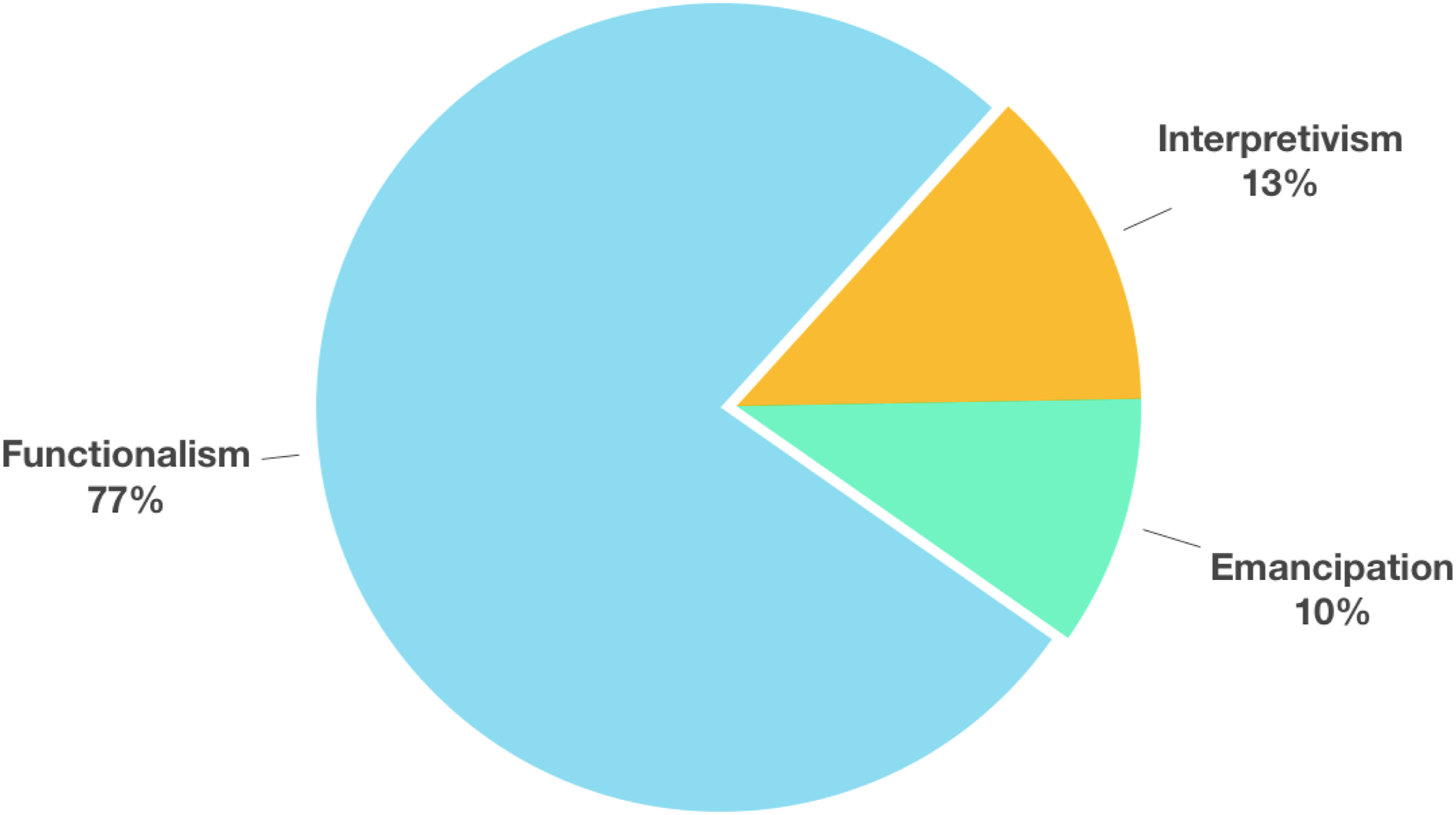
Social life cycle assessment paradigm usage.
To what extent is SA8000 underpinned by systems thinking perspectives? Examining the coding results of the SA8000 reference revealed that the approach is uniquely emancipatory, apart from a few paragraphs suggesting very limited interpretive and functionalist traits, such as giving the audited organization’s management the freedom to establish a complaints management system of their choosing, without involving the impacted stakeholders. The chief goal of SA8000 is to get all stakeholders affected by the organization to become part of its decision-making process. This approach includes a wider range of stakeholders such as communities, workers, worker-families and even schoolteachers. The approach is designed to be used by single organizations with the possibility of collaboration with immediate suppliers. The approach also recommends but does not require collaboration with lower-tier firms in its supply chain. No paragraphs were found connecting SA8000 to postmodernism. See Figure 4.

Social accountability 8000 paradigm usage.
Are the top three supply chain social responsibility approaches founded on multiple systemic paradigms? The results revealed varying degrees of association between the top three supply chain social responsibility approaches and the four systemic paradigms. For instance, CSR showed evidence of Strong Association (SA) with interpretivism, Week Association (WA) with emancipation, Very Week (VWA) association with functionalism, and No Association (NA) with postmodernism. Table 5 provides an overview of the associations between the three approaches and the paradigms. In summary, SLCA focuses on improving goal seeking and viability by solving well-defined problems identified by the powerful stakeholders. CSR explores purpose while addressing the subjectivity of stakeholders, whereas SA8000 ensures fairness by acknowledging all impacted stakeholders. It is worth noting that the degrees of association denote how the principles from a certain paradigm are present in an approach as shown in the previous figures, and whether they take the form of requirements or suggestions. The results also highlighted an interesting finding in that none of the approaches were associated with postmodernism. All three approaches followed a particular school of thought and a process-driven way for tackling social responsibility. Moreover, all three approaches promised improvements when implemented; such ideas are rejected by postmodernism, which is essentially opposed to the premise of systemic solutions and instead promotes diversity, creativity, as well as contested and localized solutions that are justified on the basis that they “feel” right.
22
Perhaps one of the most important findings from this paper is that each approach predominantly relates to a single paradigm, despite none of them making its systems thinking underpinnings clear. The findings revealed that all three are in fact systemic approaches. Moreover, their assumptions can be summarized in relation to two dimensions: the complexity of the business entity they address, and the views of the stakeholders they acknowledge, as shown in Table 6. However, none of the approaches is holistically multi-perspective because each is dominated by one paradigm, and each does different things to solve the factors of the messes it perceives. See Figure 5.
Approach paradigm association.

Approach assumptions.


Proposed framework for supply chain social responsibility.
Are the top three supply chain social responsibility approaches capable of addressing all factors of a social responsibility mess from a systems thinking perspective? The finding that each of the top three supply chain social responsibility approaches pertains to a different systemic paradigm is significant: it shows that none of them takes a creative and holistic view of the messes of interest, therefore making different assumptions about them, and considers some factors more significant than others. This finding uncovers that each of these approaches defines the problem differently, given what their corresponding paradigm allows, and hence offers divergent and partial solutions. Therefore, there is no one-size-fits-all approach, but rather different approaches specialize and do well in addressing different parts of a social responsibility mess. To further frame the findings from a systems thinking perspective, Table 7 shows where the three approaches are located on the SOSM grid based on their systemic assumption along the grids’ two dimensions. The table can be used as a map, called the SOSM Approaches Map (SAM), to determine the suitability of an approach given the context of a social responsibility mess. SAM makes it clear why a supply chain adopting only one of these approaches is almost guaranteed to continue to endure social responsibility messes. SAM shows how a certain approach reduces the messes of social responsibility into its systemic paradigm assumptions and worldview.
The SOSM approaches map.


Can the top three supply chain social responsibility approaches be used in tandem in a CSP-like intervention? The finding that each of these top three approaches is confined within a different systemic paradigm could be discouraging. However, from a Critical System Practice (CSP) standpoint, the opposite is true. CSP advocates for holistic and creative interventions by deducing solutions that better account for the context (reality-types) of a social responsibility mess. CSP emphasizes that messes cannot be understood and addressed from one paradigmatic perspective, and as such promotes the combination of a plurality of systems approaches. It seeks to guarantee pluralism in perspective by compensating for the systemic weaknesses of one approach by the strengths of others. By doing so, CSP ensures that factors concerning technical-optimality (Functionalism), practical-subjectivity (interpretivism) and political-fairness (emancipation) are addressed. With CSP viewing the different approaches as complementary, it is poised to offer interventions that address all factors of supply chain social responsibility messes, as opposed to any of the paradigm-confined approaches. CSP sees the bigger picture when dealing with complex systems such as the supply chain and their complex social context. CSP allows for a plurality of approaches to be used in a coherent and complementary manner to promote successful interventions where there are complex organizational and societal problem situations. From a practical view and considering the findings from this paper, SLCA is a functionalist approach, it excels at solving the well-defined social impact assessment factors of the messes of supply chain social responsibility, it answers the questions of those with the organizational power and resources who initiated it. However, it fails quickly when different stakeholders with different views, aims, and backgrounds are involved, in such situations is where CSR shines. With great ease, CSR is capable of bringing stakeholders with different viewpoints together to agree on small plans of action, or accommodations, that move the cause forward and enable progress. Nevertheless, CSR, being dominantly interpretive in nature, falls short in face of conflict or when the unaccounted-for stakeholders are wary, specifically those who are affected by the supply chains’ activities but do not participate in decision making. Such situations require approaches of an emancipatory nature such as SA8000 capable of giving the disadvantage stakeholders a say in decision making.
Conclusion
Supply chains are increasingly incorporating social responsibility into their business strategies. This trend is being reinforced by the direct impact of incidents like protests, consumer boycotts and negative media coverage on their bottom lines. Such incidents result from absent or ineffective social responsibility practices, which in turn cause serious issues such as worker abuse, factory collapses, and natural resource depletion.
Consequently, a myriad of approaches and techniques have emerged promising solutions. The goal of this paper is to understand why they consistently fall short from addressing supply chain social responsibility messes. This paper analyzed three of the top used amongst them to understand to what extent these approaches are underpinned by systems thinking perspectives to uncover their systemic strengths and shortcomings. The approaches that were analyzed were CSR, SLCA, and SA8000.
The analyses revealed that each approach is confined within one systems thinking paradigm. Therefore, each approach has different worldviews, considers different factors as significant, and consequently offers divergent partial solutions. Different approaches address the messes of interest as either optimization issues, by addressing subjectivity, or by resolving conflicts. In systems thinking terms, each approach makes different assumptions about the context of the messes of interest.
Accordingly, this paper presents novel findings as far as these three selected approaches are concerned, and to our knowledge, from reviewing the literature, no such systemic grounding was done before. This paper shows that SLCA is concerned with improving goal seeking and viability by solving well defined problems identified by the powerful amongst the stakeholders. On the other hand, CSR is concerned with exploring purpose while addressing the subjectivity of stakeholders, whereas SA8000 is concerned with ensuring fairness.
Nevertheless, the findings are promising from a CSP standpoint. Advocating that approaches from different paradigms are complementary rather than contradictory, CSP is in a position to offer superior multi-paradigm interventions by incorporating the tools and techniques from CSR, SLCA and SA8000, thereby constructing a complete view of a social responsibility mess. Therefore, researchers and practitioners alike can deduce holistic and creative CSP interventions based on these three approaches, with the advantage of not having to learn the various systems thinking paradigms and their associated methodologies. This understanding is developed into framework presented in the next subsection.
In terms of practical implications, this paper provides a scientific exploration of the top three social responsibility approaches from a systems thinking perspective, something that is so far done superficially via interviews and surveys, therefore filling an important knowledge gap.
Moreover, this paper sheds light on an overlooked yet important factor concerning the limitations of the most common social responsibility approaches. After having established the systemic paradigms of each, it is straightforward to determine the suitability of an approach given a social responsibility mess from a managerial perspective for instance. This is further simplified using the SAM framework presented earlier.
Finally, this paper showed that new forms of better interventions are possible. These interventions can perceive all factors of a supply chain social responsibility mess, therefore tailoring customized solutions based on the tools and methods from the very well understood existing approaches, making such interventions highly convenient and practical.
In terms of limitations, the allocated resources allowed us to focus only on the top three social responsibility approaches. In future work, the authors intend to study more approaches such as Environmental Social and Governance, the Global Reporting Initiative, etc.
For future research, it is worth investigating more mainstream approaches such as the GRI, ISO26000, ESG, and others. Moreover, an intriguing research project would be to conduct an action research based on the findings from this paper where a volunteering firm, that is interested in preventing or is facing social responsibility messes, is guided into implementing an intervention using CSP for Social Responsibility (CSPSR) which will be presented in the next section.
Therefore, we propose an idea of a framework that could worked on in future research for addressing the messes of supply chain social responsibility. Note that this is only a preliminary version. Further ameliorations and details will be presented in a forthcoming paper with insights from this paper and Basta et al. 17 A possible path is to conduct a case study where this proposed framework will be used to design and implement preventive and reactive social responsibility interventions based on Critical Systems Thinking. One expectation would be to help the participants appreciate the differences between the social responsibility approaches they already know, and how to choose amongst them given the messes they are facing.
The framework is an application of Jackson’s Critical System Practices metamethodology, which promotes the combination of a plurality of systems approaches, their methodologies, and methods in solving messes. The framework is called CSPSR and is a proposal that remains to be tested. In this framework, each approach is broken into its composing techniques, then interventions are tailored by reassembling carefully selected techniques from different approaches according to the nature of the mess being addressed. Therefore, the interventions tailored by CSPSR are cross-paradigm, which is guaranteed given its incorporation of techniques from the various approaches. Researchers and practitioners alike, who are not familiar with systems thinking, can leverage this framework to devise critical and holistic interventions in an informed and scientific way.
For example, a CSPSR-based supply chain social responsibility intervention may utilize CSR tools to bring together stakeholders with different worldviews to formulate objectives, develop a strategy and agree on commitments. Moreover, stakeholder definition and interviewing techniques from SA8000 can be used to ensure that all impacted stakeholders such as surrounding communities participate in the. Additionally, SLCA could be used to get an objective account, based on data collection, of what the current social footprint is, as well as providing reports that give an idea of what initiatives are possible and where resources should be allocated.
Figure 5 depicts the proposed framework. Each circle represents one of the analyzed approaches. The small distinct shapes within each circle represent the tools of the corresponding approach. The figure also highlights how each approach is confined within a different paradigm, hence highlighting their limitations, and how this setting can allow them to only offer partial solutions to the factors of a mess they perceive and consider significant. More importantly, the figure shows how the proposed framework functions across the paradigms by using various tools from the different approaches while also considering the social context. This way, the framework can perceive all facets of a mess and tailor interventions that are far better than what the other approaches can singly offer. Jackson 22 explained CSP and how it can be used to consolidate approaches from different systemic paradigms and how to use them to resolve systemic mess.
Supplemental Material
Supplemental Material - The systemic tenets of the key supply chain social responsibility approaches
Supplemental Material for The systemic tenets of the key supply chain social responsibility approaches by Mohamed Basta, James Lapalme and Marc Paquet in International Journal of Engineering Business Management
Footnotes
Declaration of conflicting interests
The author(s) declared no potential conflicts of interest with respect to the research, authorship, and/or publication of this article.
Funding
The author(s) received no financial support for the research, authorship, and/or publication of this article.

Supplemental Material
Supplemental material for this article is available online.
References
Supplementary Material
Please find the following supplemental material available below.
For Open Access articles published under a Creative Commons License, all supplemental material carries the same license as the article it is associated with.
For non-Open Access articles published, all supplemental material carries a non-exclusive license, and permission requests for re-use of supplemental material or any part of supplemental material shall be sent directly to the copyright owner as specified in the copyright notice associated with the article.
