



Abstract
Organizations in today’s supply chains strive for transportation activities optimization. However, transportation is a significant environmental impact activity. Particularly, road transportation is the highest emission rate source and the most widespread modality for last-mile delivery. In this context, the use of performance management tools, such as key performance indicators (KPIs), is a strategy to reach both economic-operative and environmental benefits. Among all KPIs, overall equipment effectiveness (OEE) is one of the most suitable KPIs to measure the utilization of an industrial asset. In the transportation sector, a variant of the OEE, known as the transportation overall vehicle effectiveness (TOVE), is used to define the performance of vehicle distribution activities, such as road transportation for last-mile delivery and urban logistics. Although TOVE is effective for evaluating vehicle performance in terms of administrative availability, operating availability, performance, and quality, the indicator does not take into the environmental impact related to road transportation activities. Literature has proposed several formulations to quantify transport carbon emissions, most of which are linear relationships to the distance travelled. However, these models are not suitable for assessing the TOVE performance of road transportation activities. This paper aims to compare the performance of last-mile delivery in terms of TOVE and carbon emissions evaluated with a distance travelled formulation in two different scenario systems. The comparison shows the inadequacy of TOVE in terms of environmental sustainability, as maximizing road transport performance while ignoring the environmental dimension excludes the minimization of CO2 emissions. Therefore, the foundation for future developments of TOVE for sustainable road transportation can be established from this divergence.
Keywords
Introduction
To efficiently meet customer needs while providing high service levels, organizations in today’s supply chains strive for transportation activities that are fast, accurate, flexible, and cost-effective. 1 However, transportation is also a major contributor to carbon emissions, and the transportation sector is the fourth largest source of environmental impact, with road transport accounting for 80% of emissions from freight and passengers. 2 Furthermore, to achieve net-zero emission targets, the transportation sector has the ambitious goal of reducing a large share of environmental emissions despite expectations of business growth. 3 Against this backdrop, finding a balance between economic and environmental sustainability is crucial. 4 Generally, three strategies can be implemented to improve the efficiency of an industrial process and reduce its environmental impact. The first strategy is direct mitigation, which involves reducing the emission rate produced by an asset or equipment, such as a vehicle. For example, this first strategy includes the revamping of an asset. The second is the replacement of the equipment with a new one characterized by better performance and lower consumption.5–7 Finally, the third is the optimization of the entire process according to strategic and operational considerations. This paper focuses on the third strategy, as confirmed by Simons et al., 8 studies are missing holistic measures proposal of transportation efficiency toward sustainable development goals. In fact, most of these propose economic-operative performance measures while neglecting the impact that transportation activity has on the environment. To fill this gap, this paper evaluates the transportation process from both economic-operative and environmental perspective. Regarding economic-operative perspective, transportation overall vehicle effectiveness (TOVE) is a well-defined overall equipment effectiveness (OEE) variant to measure the performance of a distribution process 9 and satisfy customer needs. However, TOVE does not take into account the environmental dimension, which is usually evaluated by using other consumption models. Consumption models involve the quantification of both pollutant emissions (e.g., particulate matter, nitrogen oxides, and sulphur oxides) and climate-altering substance emissions (e.g., CO2). A widely used approach entails measuring the amount of CO2 emissions based on the distance travelled by the vehicle.10–12 Objectives targeting economic and environmental performance improvements may not be aligned as higher utilization of a vehicle leads to a greater environmental impact. Therefore, organizations lack a specific indicator for road transportation that considers both economic and environmental sustainability. From this perspective, this paper aims to highlight the need to develop a comprehensive indicator, laying the foundations for future research developments. The need of a comprehensive indicator is highlighted by the comparison of TOVE and CO2 emissions in two different system scenarios. Specifically, it is intended to analyze two road distribution scenarios that implement different routing policies varying parameters of vehicle speed and maximum customer distance. The first scenario uses a first-in-first-out (FIFO) last-mile delivery policy whereby the first customer to request an order is the first to be served. In contrast, the second scenario proposes a last-mile delivery policy that follows a minimum shortest path (MSP) route to serve customers. The contribution of the paper is twofold. On one hand, it offers an updated list of OEE-based transportation efficiency indicators that may be useful for practitioners. On the other hand, the comparison of economic-operative and environmental measures lays the basis for researchers to develop a comprehensive indicator.
As a reminder, the structure of the article is as follows. In Literature review, a literature review is presented on key performance indicators (KPIs) specific to the OEE family for road transportation and models quantifying CO2 emission on the road. Methodology outlines the methodology used. Results reports the results achieved. Finally, in Conclusion, the results are discussed, and conclusions and future developments are presented.
Literature review
This section provides the theoretical background of this study, investigating the existing literature on road transportation OEE-based indicators and carbon emission models. Specifically, Overall equipment effectiveness variants explore the proposed OEE variants for transportation activity, highlighting the pros and cons that led to the development of the KPI used in this study, namely, the TOVE. In addition, the section highlights the lack of OEE-based KPIs for the transportation sector that quantitatively account for the negative contribution of the logistics process to environmental impact. In Carbon emission models, the CO2 emission quantification models are presented, including the assumptions and data availability under which they are typically used.
Overall equipment effectiveness variants
The OEE was originally created to implement Total Productive Maintenance as one of the lean techniques for efficient production. 13 It calculates the productivity of assets in terms of availability, performance, and quality to track and improve an industrial system continuously. OEE is used in various industries, with variants such as Overall Tool Group Efficiency, 14 Overall Throughput Effectiveness, 15 and Overall Space Effectiveness. 16 These are used to assess the performance of individual industrial assets, specific parameters in industrial processes like productivity, and layout performance, respectively.
In lean theory, transportation is regarded as one of the seven wastes and a non-value-adding activity that needs to be eliminated. However, service companies in the logistics sector view the delivery process as a key activity for customer satisfaction and, thus, economic growth. As a result, several variants of the OEE have been developed specifically for the transportation sector, all of which evaluate the performance and distribution of vehicles in terms of three major components: availability, performance, and quality. First, the Overall Vehicle Effectiveness (OVE) indicator was introduced to measure the performance of road freight vehicles based on the percentage of availability, the performance rate, and the quality mark.
8
However, OVE is not suitable for scenarios with multiple destinations per delivery. OVE rewards less efficient routes from a fuel consumption point of view. In fact, the indicator gives better values to routes that minimize the total distance, regardless of the vehicle load that affects fuel consumption. A more appropriate performance estimate is to consider how much weight is moved and how much distance. To solve this problem, the Modified Overall Vehicle Effectiveness (MOVE) breaks down the performance component into route efficiency and time efficiency. The first component evaluates the efficiency of a route in terms of weight and distance compared to that consumed to cover the MSP route. Instead, the second component evaluates the efficiency of the route in terms of time, compared to the time for the MSP
1
. Another alternative, Overall Transportation Effectiveness (OTE), measures economic-operative performance by identifying road transportation losses in higher detail. From the total time, OTE identifies the time spent by the company for some activities, such as planned standstill (e.g., maintenance, operator training, revision), routine losses (e.g., dock waiting time), and speed losses (e.g., traffic jams and kilometers empty).
17
The above mentioned OEE-based indicators for transportation efficiency (OVE, MOVE, and OTE) evaluate performance excluding unscheduled time for shifts and company closures, and scheduled time for maintenance activities. However, such times are relevant to maintain assets in the operational phase.
18
Therefore, another OEE-based indicator, namely TOVE, was developed by Villareal et al.
19
to evaluate transportation performance on total calendar time, instead of only considering the net time of system closure and planned downtime. TOVE divides the organization’s activities into in-transit (IT) (i.e., activities involving active vehicle operation) and non-in-transit (NIT) (i.e., transport activities not involving the active use of vehicles) to assess logistics performance. As reported in Figure 1, TOVE evaluates availability by dividing it into administrative (AA) and operating availability (OA) and considers the performance (P) and quality (Q) of the systems in terms of IT activities.9,19 Thus, TOVE is a well-established road transport-specific OEE variant.
21
Table 1 summarizes the OEE variants found in the literature for transportation efficiency, along with reporting their identification (ID), reference, and pros and cons of their adoption. OEE and TOVE description. OEE variants for the transportation sector.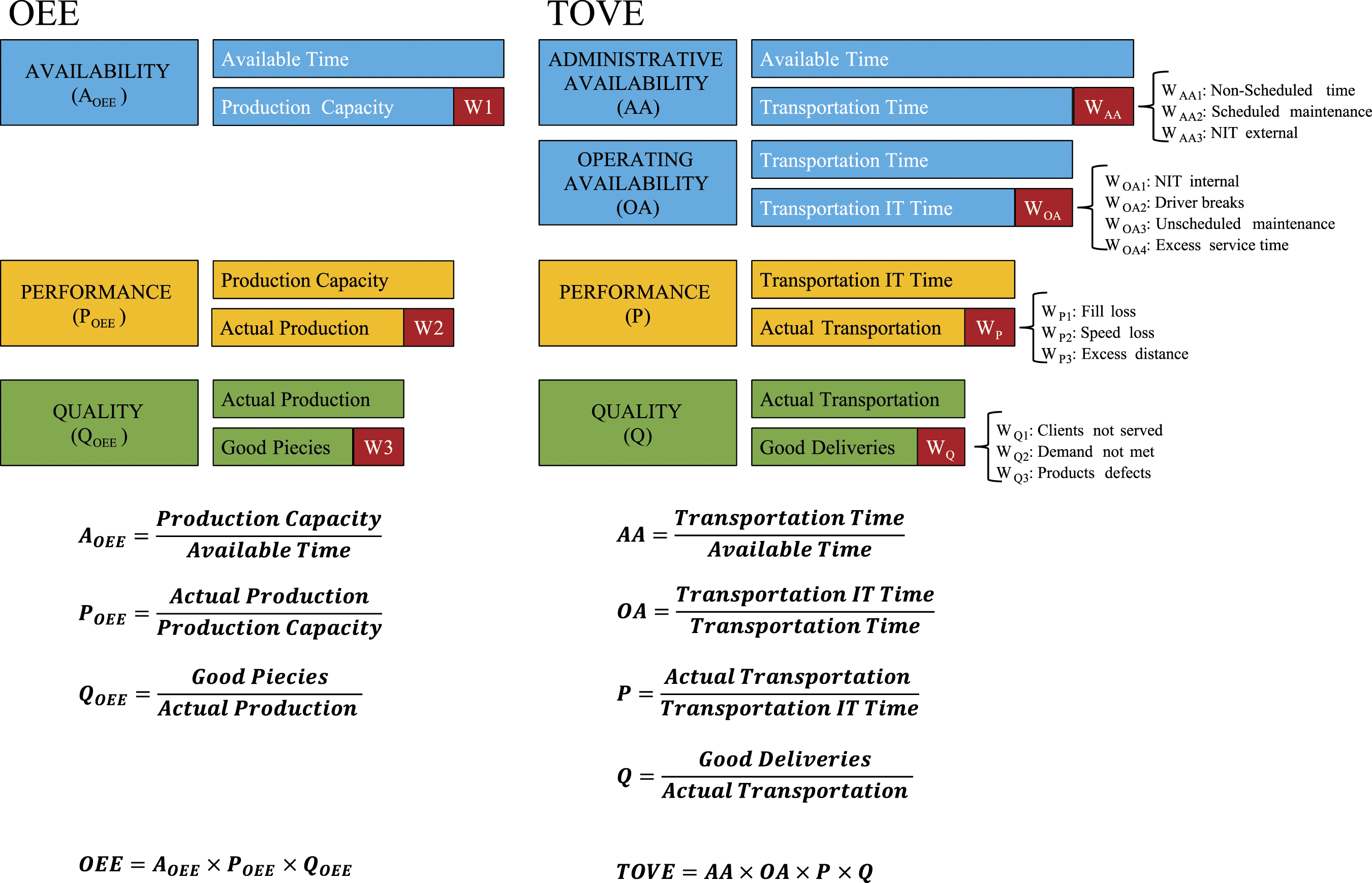

As summarized in Table 1, the previously mentioned indicators do not take into account the domain of environmental sustainability. There are “sustainable” versions of OEE in the literature, but they are not designed for the transportation sector. Among the sustainable versions of OEE, an example is the Overall Greenness Performance (OGP), which evaluates the environmental performance of value-added activities based on four components: (i) company context for local environmental legislation and organizational culture, (ii) supply chain for supplier conditions and client requirements, (iii) consumption of non-value-added processes, and (iv) consumption of non-necessary non-value-added processes.22–24 At a broader level, the Sustainable Overall Throughput Effectiveness (SOTE) KPI, incorporates environmental sustainability of production processes for series, parallel, converging, and diverging flows into the OEE components. 25 Finally, the Business Overall Performance and Sustainability Effectiveness (BOPSE), measures the relationship between Lean practices and Green production by combining OEE with a sustainability indicator that considers the three aspects of the Triple Bottom Line. 26 As stated by the literature review results, the performance management field lacks an OEE-based indicator to evaluate the environmental performance of transportation processes. On the other hand, several OEE-variants deal with economic-operative performance. Within this paper, TOVE was chosen as the indicator to measure the effectiveness of a road transportation process, even if it does not consider the environmental issue. The reason of the choice is that TOVE is a novel but well-established indicator that simultaneously improves on the criticalities and provides guidance on practical usefulness.
Carbon emission models
The amount of CO2 emissions produced by a vehicle is directly proportional to the amount of fuel it consumes. In turn, fuel consumption is impacted by various factors, such as speed, road slope, traffic on the route, driver behavior, fleet size and mix, payload, empty miles, and green freight corridors. 27 Based on this, vehicle consumption models can be classified into three groups: macroscopic, microscopic, and factor emission models. 27 Macroscopic models estimate network-wide emissions using average network parameters. For example, MEET (Methodology for calculating transportation Emissions and Energy consumpTion) is a macroscopic model for calculating transport emissions and energy consumption per heavy-duty vehicle. The model evaluates the CO2 emissions considering two different components, which are first determined through a series of regression functions and then merged into a single macroscopic function. The first component is the CO2 rate calculated for standard conditions based on the distance travelled. The second component introduces some correction factors related to the gradient of the road and the load transported. Finally, the product of the two components gives the amount of CO2 emitted. 28 Another macroscopic model is COPERT (COmputer Programme to calculate Emissions from Road Transportation), which estimates vehicle emissions by using specific regression functions for fuel consumption, where each of them depends on the vehicle weight. The function depends on speed and total distance. 29 However, macroscopic models do not estimate the instantaneous vehicle fuel consumption and emission rates at a more detailed level. To this end, microscopic models were developed. Microscopic models calculate emissions with more accuracy by considering instantaneous kinematic variables (speed and acceleration) or aggregated variables (e.g., time spent in traffic mode, cruise, and acceleration). Concerning microscopic models, Bowyer et al. 30 proposed several approaches, such as an instantaneous fuel consumption model (IFCM), a four-mode elemental fuel consumption model (FMEFCM), a running speed fuel consumption model (RSFCM), and an average speed fuel consumption model (ASFCM). However, both macroscopic and microscopic models require much information on traffic flows and the vehicle operating mode. 27 This information is not always available. Therefore, several authors have proposed factor emission models as valid and simpler approaches. Factor emission models appear to be unaffected by the variables of road transportation activities, such as environmental and traffic conditions, driver behavior, and vehicle operating conditions that are difficult to replicate. 31 Generally, factor emission models use predefined emission factors to estimate CO2 emissions, which are calculated per unit distance, per unit weight, per product, and per vehicle. 32 Specifically, in the road transport sector, predefined emission factors measure the CO2 consumption of transportation activities based on the distance travelled. 33 In contrast to TOVE, although factor models are widely used to quantify the environmental impact of road transport, they neglect economic-operative performance.
Overall, the performance management field lacks a specific indicator for road transportation that evaluates the optimization of economic and environmental dimensions. Moreover, to the best of the authors’ knowledge, the current scientific literature has not already provided a comparison between the performance of a road distribution system in terms of TOVE and factors models based on the travelled distance to evaluate CO2 emissions. Hence, the aim of this article is to fill this gap by highlighting the inadequacy of TOVE and the importance of a comprehensive indicator that considers both economic and environmental perspectives.
Methodology
The methodology adopted in this work follows four sequential steps as shown in Figure 2. Firstly, the flow of activities is mapped, collecting quantitative and qualitative process information and splitting activities into IT and NIT ones. Secondly, the waste associated with each activity is identified. The wastes are associated with the four elements of TOVE that are, respectively, Administrative Availability (AA), Operating Availability (OA), Performance (P), and Quality (Q). Thirdly, the transportation route is planned, opting for an FIFO or an MSP policy. Finally, KPIs are calculated to assess both the economic-operative (TOVE) and environmental (CO2 emission) performance of the last-mile delivery activities. Below, each step will be described in more detail. Methodological framework.
Components of TOVE related to different waste sources as represented in Figure 1.

Route planning is the third step of the proposed methodology. To identify vehicle routes, let’s consider a group of customers scattered throughout a network, where a distribution center runs a product delivery vehicle. The first strategy considered is to follow the FIFO policy, which states that the first client who made the order will be the first to be served.
39
According to the FIFO policy, the sequence of served customers is not necessarily geographically organized in a logistic effective and efficient manner. The second strategy follows a MSP policy to identify the shortest path by minimizing the delivery route, without considering the order in which clients arrive. To solve this problem, there are methods for vehicle routing problems (VRPs) that define the best route by meeting a set of criteria.
40




The efficiency of the last-mile distribution actions in the two system scenarios is then measured using KPIs from an economic-operative and environmental point of view. TOVE and CO2 emissions from road transportation are used as the KPIs for scenario evaluation. The assessment of TOVE has a similar formulation to the one of the OEE indicator (Figure 1). The best-case scenario for each component is that it can only assume the unit value. Because of the existence of waste, practical scenarios define lower levels. Each waste is identified in the TOVE component where it causes inefficiencies, as previously mentioned (see Table 2). On the other hand, the distance travelled is taken into account when calculating carbon emissions (Equations (5)). Practically, a light goods vehicle model with an emission factor (
Results
The comparison between TOVE and CO2 emission was conducted in two scenarios, one for FIFO strategy and one for MSP policy. Each scenario consists of two three-level variables, namely, the maximum acceptable distance of customers from the distribution center (30, 40, and 50 km) and the vehicle speed (40, 60, and 80 km/h).
The analysis generated a random distribution of 50 customers within a circle with a radius equal to the maximum acceptable distance from the distribution center, as shown in Figure 3. The last-mile delivery process is carried out by a single vehicle with a speed loss (WP2) of 10%. The distribution center operates within a 12-h time interval, of which 8 h are dedicated to transportation activities. Prior to delivery, activities such as procurement, storage, truck loading, and periodic maintenance are performed. Once the allotted time for deliveries is completed, any undelivered products are unloaded and stored. The evaluation of the operational and environmental performance of the two scenarios is assessed using a discrete event simulation model. The activities on the nodes were linked logically in a sequence. Within the simulation model, the variables Delivery and C are used as state variables. Delivery is a Boolean variable that identifies the state of the last-mile delivery process, with a value of one indicating an active state and a value of 0 indicating an inactive state. This classification makes it possible to distinguish activities that are IT (Delivery equal to 1) from those that are NIT (Delivery equal to 0). The discrete status variable C indicates the total orders to deliver daily, that correspond to the number of customers to be served. The graphical representation of the simulation model is shown in Figure 4. Customer space distributed according to three levels of a concentric circle at the distribution center. Graphical representation of the simulation model.

Event transition table of the simulation model.

To build and run the simulation model, the following assumptions were considered: • Scheduled maintenance activities are considered sufficient to avoid significant downtime in unscheduled maintenance activities (WOA3),
9
• a daily route design is implemented to maximize vehicle capacity, such that waste fill loss (WP1) is negligible,
43
• a daily route design is implemented to minimize the routing distance, such that the excess waste distance (WP3) and driver breaks (WOA2) are negligible,
43
• demand is always met without backlog/backorder policies, such that waste demand not met (WQ2) is negligible, and
44
• there are no handling errors in the loading and unloading vehicle activities, resulting in zero waste product defect (WQ3).
45
Average values and standard deviation of TOVE results for both scenarios.

Average values and standard deviation of total KgCO2 emissions for both scenarios.

From a general perspective, the TOVE indicator tends to have lower values for longer delivery distances and slower vehicle speeds. In contrast, higher speeds typically result in relatively good TOVE values. Comparing the two scenarios, it becomes clear that optimizing the delivery route can yield significant benefits in terms of performance. Scenario 2, which minimizes the route and vehicle usage time, allows more customers to be served. On average, Scenario one served 27.13 customers, while Scenario two served 43.48 customers, representing 54% and 87%, respectively, of the maximum of 50 customers to be served. These results have a significant impact on the quality of the transport service, which is one of the four components of the TOVE indicator (Q).
Figure 5 provides a more detailed analysis of Scenarios one and two through a box plot representation of the TOVE components. Most of the TOVE components are independent of both vehicle speed and distance between customers and the distribution center. AA is similar for both scenarios as wastes are identified with the same assumptions and activities assume equal time distributions. OA assumes lower values for Scenario 2, with average values ranging between 66.86% and 81.01%, while Scenario one assumes average values ranging between 86.68% and 94.49% independently of vehicle speed and customer distance. The difference in average values between the two scenarios is due to a particular loss that exceeds service time. The greater the number of satisfied customers per time interval, the greater the probability of incurring a higher customer service time. This variation is driven by the strategic choice to optimize routes instead of distance and speed parameters. The only component of TOVE that depends on the maximum distance and speed parameters is the quality of the transport service (Q). As detailed results show, the average values of Q for Scenario one fall within an average range of 36%–64.60%, while in Scenario two the average range is between 69.60% and 99.60%. The difference in values is due to the strategic choice of route planning, which allows more customers to be satisfied in the same time interval with the same operating parameters. Furthermore, as expected, Q worsens as the maximum customer distance increases and improves as the vehicle speed increases, due to the transportation vehicle time that is dependent on these two parameters. TOVE components for Scenario 1 (a) and Scenario 2 (b).
Regarding carbon emissions, both scenarios exhibit the same pattern for each combination of variable levels. On average, Scenario one produces about 200 kg of carbon emissions, which is more than twice the value of Scenario 2. Average values are minimum when orders are processed within 30 km of the distribution center (i.e., the lowest level of the distance variable). The results demonstrate that the environmental impact is directly proportional to the vehicle speed. For the CO2 emission model employed, which is solely a function of the distance travelled (Equation (5)), the increase in emissions is due to the greater number of customers served (and therefore Q value of the TOVE indicator). This justifies the maximum value assumed for both scenarios by both high levels of distance and vehicle speed. Finally, at the same levels, Scenario 2, which employs routing optimization to minimize the distance travelled (corresponding, in this case, to the only dependent variable of transport emissions), has lower values than Scenario 1.
It is possible to state that the two investigated KPIs assume high results for opposite pairs of values. TOVE reaches high values at the highest speed level. Instead, CO2 emissions register low values at the lowest speed and distance levels. The trade-off is found for intermediate values. As shown in Tables 4 and 5, for Scenario 2, a good compromise is obtained for the combination of intermediate values of both analyzed variables. This evidence highlights the inadequacy of the TOVE performance indicator in optimizing both economic and environmental goals. The higher the value of the vehicle speed, the higher the number of customers served, and consequently the TOVE. This is reflected in the fact that the higher the number of customers served, the greater the CO2 emissions of the transportation process.
Conclusion
Several studies have highlighted the importance of process efficiency in achieving economic goals while also addressing environmental concerns. In the transportation sector, these two factors are closely related, as increased transportation usage often leads to greater environmental impact. While the concept is well understood, studies on performance management lack comparisons between economic-operative and environmental indicators, which highlights the need for comprehensive indicators. This paper compares two indicators, TOVE and CO2 consumption, and lays the groundwork for the future development of effective sustainable logistic indicators.
TOVE is a specific variant of the OEE family designed to quantify the economic and operational performance of road transportation at the calendar level. It consists of four components: administrative availability, operational availability, performance, and quality. On the other hand, CO2 emissions measure the environmental impact of road transportation. The paper proposes a methodological framework to compare two scenarios that differ in their use of routing optimization policies. Each scenario is evaluated by combining (on three levels) the variables of the maximum distance of the customer and the average speed of the vehicle. A discrete-event simulation model replicating last-mile delivery on a random sample of 50 customers is used to assess the two scenarios for each combination of the variables.
Achieving a balance between economic and environmental goals is essential for ensuring sustainable and efficient transport operations. The result show that the two indicators outperform for opposite pairs of variables, with the trade-off being the respective intermediate levels. TOVE records high values for high speed levels, while CO2 emissions (measured in kg) have low values for low levels of distance and low levels of vehicle speed. Therefore, there is a need to find a balance between the two KPIs to optimize both economic and environmental goals. This could involve finding optimal combinations of speed and distance levels that result in a good compromise between high TOVE values and low CO2 emissions. Among the four TOVE components, Q is the only one that depends on changing parameters and conditions OA. While TOVE is a well-established indicator for road transportation performance, it does not take environmental aspects into account. Therefore, the comparison presented in this paper lays the foundation for a new global KPI that takes into account both economic and environmental aspects.
From a practical perspective, this work identifies an updated list of indicators for assessing the performance of road transportation. However, the study also highlights limitations in the use of tools for measuring economic and environmental performance, as well as the assumptions made for evaluation. The factor emission model used to assess the impact of the activity on the environment is general and lacks detailed data. Future work could consider the use of microscopic or macroscopic models for assessments with a higher level of detail. Another alternative direction could be to incorporate additional environmental performance indicators into the analysis, such as energy consumption or air pollution, in order to provide a more comprehensive view of the environmental impact of the transportation process. Another limitation is the consideration of a single vehicle for last-mile delivery. Future development could involve the vehicle fleet, considering vehicles of different types and larger numbers. Finally, this work is limited to last-mile delivery with a single mode of transportation, leaving out other logistics activities. Future work could extend the comparison to a higher level by considering all logistic activities across a supply chain using different and combined transportation modes.
Supplemental Material
Supplemental Material - Assessing the adequacy of transportation overall vehicle effectiveness for sustainable road transportation
Supplemental Material for Assessing the adequacy of transportation overall vehicle effectiveness for sustainable road transportation by Saverio Ferraro, Alessandra Cantini, Leonardo Leoni, and Filippo De Carlo in International Journal of Engineering Business Management.
Footnotes
Authors contribution
All authors acknowledge their contribution according to the following criteria of International Committee of Medical Journal Editors authorship guidelines:
• Substantial contributions to the conception or design of the work; or the acquisition, analysis, or interpretation of data for the work;
• drafting the work or revising it critically for important intellectual content;
• final approval of the version to be published;
• agreement to be accountable for all aspects of the work in ensuring that questions related to the accuracy or integrity of any part of the work are appropriately investigated and resolved.
Declaration of conflicting interests
The author(s) declared no potential conflicts of interest with respect to the research, authorship, and/or publication of this article.
Funding
The author(s) received no financial support for the research, authorship, and/or publication of this article.

Supplemental Material
Supplemental material for this article is available online.
References
Supplementary Material
Please find the following supplemental material available below.
For Open Access articles published under a Creative Commons License, all supplemental material carries the same license as the article it is associated with.
For non-Open Access articles published, all supplemental material carries a non-exclusive license, and permission requests for re-use of supplemental material or any part of supplemental material shall be sent directly to the copyright owner as specified in the copyright notice associated with the article.
