




Abstract
Building on the resource-based view theory, the purpose of this study is to investigate the configurational relationship between green human resource management (GHRM) practices and supply chain integration. There were six dimensions of GHRM practices in our study. To investigate their configurational effects, a conceptual model was examined through a fuzzy-set qualitative comparative analysis. The responses from 76 production supervisors and managers in Indonesian footwear companies were collected. The results revealed three distinct combinations of GHRM practices to affect supply chain integration. The first configuration suggested that green development and training and teamwork would affect supply chain integration. The second configuration indicated that green recruitment and selective hiring and green performance evaluation also influence supply chain integration. In addition, achieving all GHRM practices was also important. This study provides implications from the complicated relationships between the dependent variable and independent variables other than structural equation modeling.
Keywords
Introduction
The modern business era includes fast-growing enterprises and new businesses consistently emerging. Thick competition within markets has encouraged organizations to renovate their management system to survive. Firms do not only fight with competitors; they have to collaborate with other firms in order to compete against other supply chains. Supply chain management (SCM) has been one of the successful management disciplines to support and coordinate the flows of material, information, and cash within and between companies for higher performance, productivity, and profitability. 1 Supply chain integration (SCI) is seen as the core of supply chain management. 2 Before building effective strategies, process standardization and information integration are fundamental in a supply chain. 3 Previous studies have found that companies engaging in SCI can develop competitive advantages.4–6
When various firms are pooled into one and are coordinated in the supply chain, more people are involved. Thus, systems are more complicated, leading to more behavioral issues. Regarding this issue, Fisher et al. 7 affirmed that effective human resource management (HRM) could improve the operations of SCM and enhance operational performance. It is suggested that HRM practices impact organizational performance by converting employees into rare, valuable, and unique resources that contribute to the firm’s goals and business processes. 8 Not only does HRM impact organizational performance, it also plays important roles on SCI. Teller et al. 9 found that sufficient human resources, as one of the important strategic organizational components, are needed before the execution of external SCI. In addition, it is the major driver to improve the level of SCI. SCI relies on coordination and collaboration between supply chain partners. When building close relationships with these partners thoroughly, human resources create values. Huo et al. 10 found that some of the HRM practices such as employee skills, incentives, and participation, have different impacts on internal and external SCI in different countries and industries. It suggested that the SCI should align with the design of HRM for future competitive advantages.
However, some scholars argued that the traditional SCM approaches are not sufficient to solve complicated challenges in this rapidly changing environment and the definition of the so-call “successful” SCM is questionable.11,12 The theme of ecological sustainability and the greening of firms has gained much attention from the managerial field.13,14 Sustainability has been widely discussed and is a new competitive measurement in the field of SCM. 15 According to Longoni et al., 16 balancing environmental, social, and economic performance is a significant obligation of organizations to society. Numerous researchers and practitioners notice that environmental management systems would enhance full-spectrum environmental performance. 17 Thus, new businesses ideally strive to reduce environmental waste and to become environmentally friendly while managing their supply chain. 18
To implement successful sustainable strategies, organizations have to develop strong leadership and specific processes to connect a variety of units, with HRM being the most important contributor. 19 Green human resource management (GHRM) leverages normal HRM plans with the target of endorsing the use of sustainable resources within a business firm, while confirming the promotion of environmental sustainability.
Previous studies have found the positive impacts of HRM on SCM or GSCM. However, whether the effects of different HRM activities are the same, or whether the combinations of a set of HRM activities have different effects, has not been addressed. Thus, it is difficult for practitioners to apply the solutions. Scholars pointed out that different HRM functions must cooperate with each other to achieve synergy. 20 For example, an interviewer recruits new graduates with environmental awareness, it may need to be paired with the development of followed-up training courses to make effective GHRM. It is necessary to explore the combined benefits of activities in GHRM. GHRM and HRM have the same activities and functions generally; the only difference is that the core of GHRM targets for a sustainable way. GSCM has become the trend and the supply chain partners have to think green and act green when seeking for integration.
In this study, the Fuzzy Qualitative Comparative Analysis (FsQCA) was applied. The contribution of this study would explain configurational complexities assuming asymmetrical relationships between GHRM dimensions instead of net effects of structural equation modeling (SEM) estimates. We highlight the role of GHRM as a motivator among employees for environmental values and principles. Therefore, the following research question is stated: What combinations of GHRM practices lead to high SCI.
Literature review
The importance of green human resource management
In recent years, GHRM has been one of the critical green business practices to ensure future sustainability and enhance positive environmental performance.21,22 Firms required the support of HRM activities such as training, performance, assessment, and rewards to implement green activities. 23 The stakeholders of the organizations are looking for the positive influences of firms’ responsibilities regarding HRM policies and practices. 24 Zhu et al., 21 termed GHRM as the environmentally friendly alignment of all HRM functions, objectives, processes, activities, and strategies to accommodate the needs of ecological sustainability. Ansari et al. 25 also pointed out that once the HRM activities align with environmental goals, it becomes GHRM. GHRM is considered as a proactive HRM modality that would achieve better ecological results. 26
Organizations need GHRM for many reasons, such as to ensure the accomplishment of environmental functions, 27 to achieve sustainability, 8 to develop sustainable processes, 28 to motivate employees, 29 and to create and improve sustainability within the organization. 30 The activities of GHRM could enhance the reputation of a company and eventually improve its competitive advantage. 31 When organizations begin to record and measure sustainable performance, it is necessary to incorporate effective GHRM to promote green behaviors. 32 Many of the related research was performed on GHRM investigation on supply chain management and green behaviors in different regions, especially in Europe and Asia. 33 However, how GHRM influences SCI is still not fully researched.
Key dimensions of GHRM
The key dimensions of GHRM differ according to the literature. 34 Yusoff et al. 35 identified four important GHRM practices: green recruitment and selection, green training and development, green performance appraisal, and green compensation. Siyambalapitiya et al. 36 also applied similar dimensions. In Shah’s 37 study, three more dimensions were added, namly green job design, green health and safety, and green involvement in labor relations. Yusliza et al. 38 adopted the four basic dimensions and added green analysis. In this study, the most commonly used and critical dimensions, green recruitment and selective hiring”, “green development and training”, “green performance evaluation”, “green pay and reward”, “green empowerment”, and “teamwork” were included.
Green recruitment and selective hiring
In the modern era, attracting and selecting high-quality workers is a key challenge of HRs. 39 Firms “go to battle” over high-quality workers, especially within multinational companies. 40 Recruitment activity has recently allowed recruiters to deliver much more information than during the traditional era, where newspapers were the only way to see vacancies. During that era, people lacked the information needed to choose companies that best matched their values. The hidden information in the process caused candidates to only use environmental appearance and company reputation as clues. 41 On the other hand, organizations would be likely to attract potential candidates with green knowledge. 42 In the selection process, candidates should be selected based on the commitment and sensitivity toward environmental issues. 43
Stringer 44 reported that graduates were likely to be attracted to organizations with environmental management initiatives. A company having performed corporate social responsibility (CSR) activity was more attractive to candidates with a high-level of job choice. 45 These candidates mostly had high-level skills and education, resulting in good reputations for the firms. Moreover, candidates’ green consciousness and value alignment could help companies to accomplish their environmental goals. 8 Thus, companies gain a competitive benefit from their capability to hire high-quality employees.
Green training and development
Another key dimension in GHRM is green training and development (GDT), that aims to develop employees’ environmental attention and knowledge so that they would have capabilities directed toward environment management. 46 In the extant literature, training is widely considered as a challenge. To increase employee awareness of the environmental influence of organizational activities, management must be equipped with core skills to advance the degree of eco-literacy and environmental proficiency. 47 The well-trained staff that is aware of the environment are ideally placed to detect and eliminate waste, because they are the first tier to solve the problem. Nisar et al. 48 found that a pro-environmental approach required improved employee knowledge, awareness, and skills in processes and materials. This, in turn, requires integrated training in environmental management, to create the necessary sensitive involvement for environmental concerns.
Green performance evaluation
Performance evaluation is essential for the effective HR of an organization (e.g., the evaluation of individual development, organizational performance improvement, and business planning). 49 Performance evaluation enables a leader to identify an employee’s strengths and shortcomings, evaluate individual’s performance, provide feedback, and elaborate a future development plan to enhance performance capabilities.50,51 The objective of GHRM performance evaluation (GPE) is to improve employee job performance and increase environmental awareness. Using performance evaluation to measure staff performance presents many challenges, including how to measure environmental performance standards and how firms gain useable data regarding units and staff. 52 However, addressing changes in performance evaluation is difficult. Most organizations use performance appraisals to influence and control employees rather than to help them develop. This problem is known as “performance control”. 53
Green pay and reward
Tang et al. 34 stated that green pay and reward are measures to attract, retain, and encourage employees to gain sustainable knowledge, attitudes, and behaviors toward environmental management. Some firms have developed rewards systems to incentivize staff, except for senior managers and chief executive officers (CEO). From a study by Cordeiro and Sarkis, 54 there was a strong relationship between compensation for executives and firms’ environmental performance. Environmental rewards, such as daily praise and bonuses, are considered to have an important impact on employee participation. Muisyo et al. 55 found that green pay and reward (GPR) for green competitive advantages was very effective.
Patton and Daley 56 showed that reward systems could motivate and strengthen employees to be environmentally responsible. Reward systems could be used to motivate employees to perform actions desired by the company, resulting in benefits for both the firm and the workers. Rewards can improve empowerment, resulting in good decision making and improved corrective actions and prevention. Good environmental practices can also be created by employees if rewards are seriously considered. Renwick et al. 57 acknowledged that providing financial and non-financial rewards are effective to encourage employees for better environmental behaviors. Govindarajulu & Daily 58 reported that compensation and rewards do not only encourage employees to have sustainable behaviors, but they also innovate products and processes to become green.
Green empowerment
Management without employee participation is useless, and the need to gain employee’s beliefs and minds is paramount. Once a firm does this, employees become more loyal. Denton 59 labeled employee empowerment from the perspective of providing them with both the ability and the responsibility to take active actions to identify problems in their working environments, as well as fixing problems affecting quality or customer service. Simpson and Samson 60 proved a positive correlation between the level of green empowerment (GE) in environmental management and overall environmental performance in Australian manufacturing firms.
In a firm, unempowered employees will be less likely to commit to improving themselves or the firm. Management can inspire empowerment by altering the organizational structures that support it. Traditional top-down organizations erect barriers that inhibit employee empowerment, whereas horizontal or flattened organizations encourage it. 61 Employees can also contribute more effectively when they can be involved in management decisions, giving them more freedom and incentive to make improvements and suggestions. Thus, they are motivated to implement better environmental practices. 62
Teamwork
Contributions from individuals to firms are critical. However, a successful environmental management system has to involve teamwork. 63 Beard and Rees 64 defined the teamwork of “green teams,” as that used for idea generation, learning experience improvement, issue exploration, conflict identification, and activity concentration to improve knowledge about pursuing the practicable environmental options. In a firm, each individual requires communication and coordination with many other department members, and the information generated must be synchronized within the organization. Thus, teamwork is essential.
Theoretical background and propositions
A theoretical view of the framework is important for determining the relationship between GHRM and SCI. Environmental management practices are required to achieve an integrated supply chain. Therefore, the resource-based view (RBV) is used to describe the framework.
The RBV was developed in the 1980s and 1990s as a theory to achieve competitive advantage. 65 According to the RBV, human capital is valuable and required by an organization to implement effective supply-chain strategies. It is much easier to use current resources with motivated methods for achieving external opportunities rather than acquiring new skills for each new opportunity. Based on the model, there are two critical assumptions: resources must be heterogeneous and immobile. Heterogeneity means that capabilities, skills, and other resources controlled by a particular organization differ from other companies. The other company cannot copy these items. Immobility implies that resources do not move from one company to another within a short period. To achieve a sustained competitive advantage, the companies must fulfill criteria that are valuable, rare, costly to reproduce, and organized to capture value. Wright et al. 66 stated that HRM was one of the resources with critical implications for supply-chain strategy. Therefore, in this study, SCI is considered to have the same effect.
In the present study, SCI can be viewed from two perspectives: internal and external integration. Simply put, the company that achieves this integration will be better positioned to thrive in a sustainable future. Furthermore, it becomes a sustainable competitive advantage that can be adopted by any department and participant within the supply chain. 67 We have learned that some GHRM activities could affect GSCM. Nejati et al. 68 investigated the link between GHRM and green SCM (GSCM), and showed that the connection between GHRM and GSCM was very tight. Gandhi et al. 69 found that human expertise and capabilities are one of the dominant drivers to accomplish GSCM adoption. Regarding resource-based theory, 70 the association between HRM and environmental management helps firms overcome barriers to consumer collaboration. However, this can be accomplished only if the company employs the right individual with the right expertise and capabilities. 71 However, there is a lack of SCM research to address the configurations of a causally associated set of GHRM factors and SCI. Based on those perspectives, we formulate two propositions:
In the first proposition, we assume that GHRM practices were not initiated along to achieve a high level of SCI. Several combinations of GHRM practices would lead to high SCI. The second proposition represents that a high level of SCI could be achieved without certain GHRM constructs. To conceptualize the relationships between GHRM practices and SCI, we provide a conceptual model showing the link (Figure 1). The overlapping area indicates possible combination of different GHRM dimensions that affects SCI.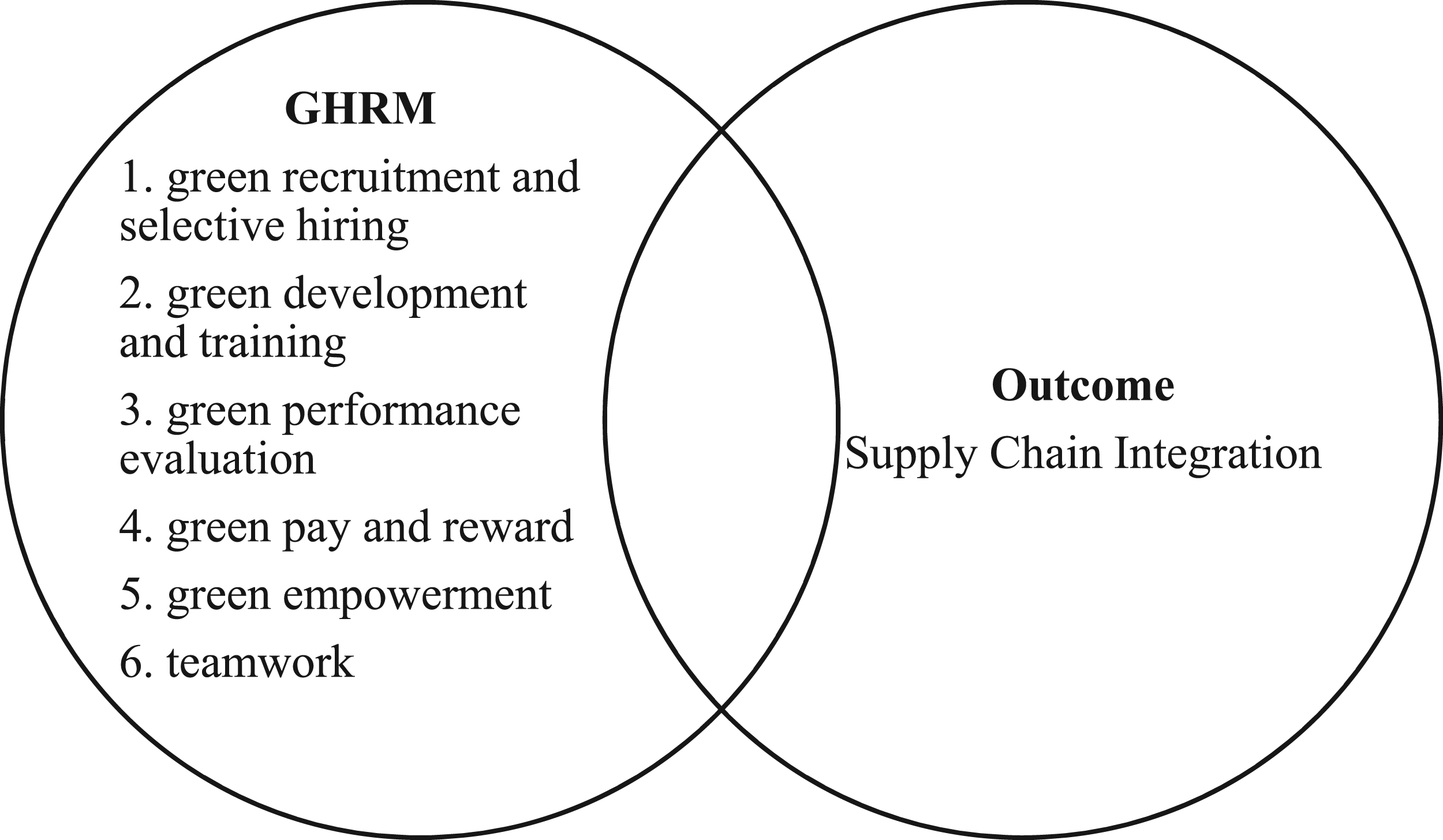
Methodology
Data collection and measures
The target of this study was the footwear industry in Indonesia. The footwear industry in Indonesia is continually improving. Indonesia is part of the Asian community and has significantly contributed to global footwear production. It is also highly active in industrial activity and the use of manufactured goods. However, unfair wealth distributions and pollution are major issues. In Jakarta, industrial and transportation firms were the largest polluters. On the other hand, Indonesia plays a vital role in the global economy. Thus, uncovering the link between of GHRM and SCI on the backdrop of the Indonesian industry is of paramount importance. The two-stage sampling procedure was used to select appropriate candidates. The first stage searched for the potential respondents through search engines and online supplier directories. To collect the data, we contacted the footwear suppliers and manufacturers by email and telephone. We stated the objectives of this research to the companies and asked for their participation. The second stage was to set up the selection criteria and send the survey. The survey was distributed by emails. Respondents had to work as production supervisors or managers for at least 6 months in the footwear companies in Indonesia. Thus, only 150 questionnaires were sent, 83 responses were collected, 76 of them valid, achieving a 55% response rate and a 92% valid response rate.
Description of characteristics of the respondents.

Measurement scales of GHRM and SCI constructs.

Data analysis
Validity and reliability
Item loadings, AVE, composite reliability, and Cronbach’s alpha.

Fuzzy qualitative comparative analysis
In contrast to statistical regression-based methods, which are limited to two-way or three-way interaction effects, Qualitative Comparative Analysis (QCA) is based on set theory and logic, and is designed to deal with multiway interactions that examine how complex causal combinations create outcomes. 75 In other words, QCA is configurational because it allows investigators to identify combinations of configurations associated with an outcome of interest. 76 To put it simply, the results do not focus on the net effects of constructs on the outcome. Instead, the results generate complex construct combinations that would affect SCI. In this study, we identify which combinations of GHRM activities lead to the same outcome, high SCI. QCA was firstly developed in political science to evaluate studies with too few cases for standard statistical analysis, it is ideal for small to intermediate research sample size (5–50), while the samples are always a big organization, country, or company. 76
Data calibration
Differing from the conventional QCA which is dichotomy, this means that each case is assigned two outcome possibilities: “1” represents the membership and “0” represents non-membership. 76 In other words, an object or element is either present or absent from the group to produce the outcome. For example, a manager who mostly answers strongly disagree (1) or disagree (2) for measurement items of green recruitment and selection, this value would be transformed into non-membership (0). We decided to apply the fuzzy-set approach because it offers an outlet using different levels of membership in a set. FsQCA allows a characteristic to have any continuous value from 0 to 1 so that it is not stated as either true or false, but as being possibly true to a certain level. Thus, the data will be calibrated into fuzzy membership scores with varying degrees, belonging to different sets. In this case, there are thresholds: full membership (1), non-full membership (0), and the cross-over point (0.5), where there is maximum ambiguity regarding whether a case is more “in” or more “out” of a set. 76 In our study, data calibration is done by using percentiles, where the 95th percentile is the full-set membership, 50th percentile is the cross-point, and 5th percentile is the full-set non-membership.
Obtaining the solutions
After transforming the dataset into a fuzzy set, a truth table algorithm is applied. The truth table algorithm consists of two steps. The first step is to create a truth table of 2k rows, which is to identify a number of possible configurations based on the frequency and consistency of the outcome. K is the number of constructs, and each row means a possible combination of constructs. Frequency indicates the number of cases belonging to each configuration. When the sample size is small, the frequency threshold should be at least one case with greater than 0.5 membership. 76 In addition, the consistency threshold is recommended to set as 0.75. 76 The second step is to determine the necessity of each variable and the sufficiency of each configuration. A necessary variable is considered when it “must” occur for an outcome. A sufficient configuration could generate a certain outcome, which means that there is no single factor to produce an outcome. A necessary and sufficient factor means that it is the sole cause with no combination for an outcome.
Research results
In the study, we measured the scores of each latent variable by averaging the item scores. For example, the first respondent answered “4” for the first item, “3” for the second item, and “4” for the third item of GR. The average score of first respondent for GR was 3.67. Then the score of each latent variable was computed one by one. The second step is to calibrate these numbers into fuzzy sets using FsQCA 3.1b. In our study, we used the 95th percentile, 50th percentile, and 5th percentile of each variable score. For example, the 95th percentile of GR was 4.717. This score was then calibrated to 0.6 automatically. The fuzzy set was used to calculate the truth table in the software.
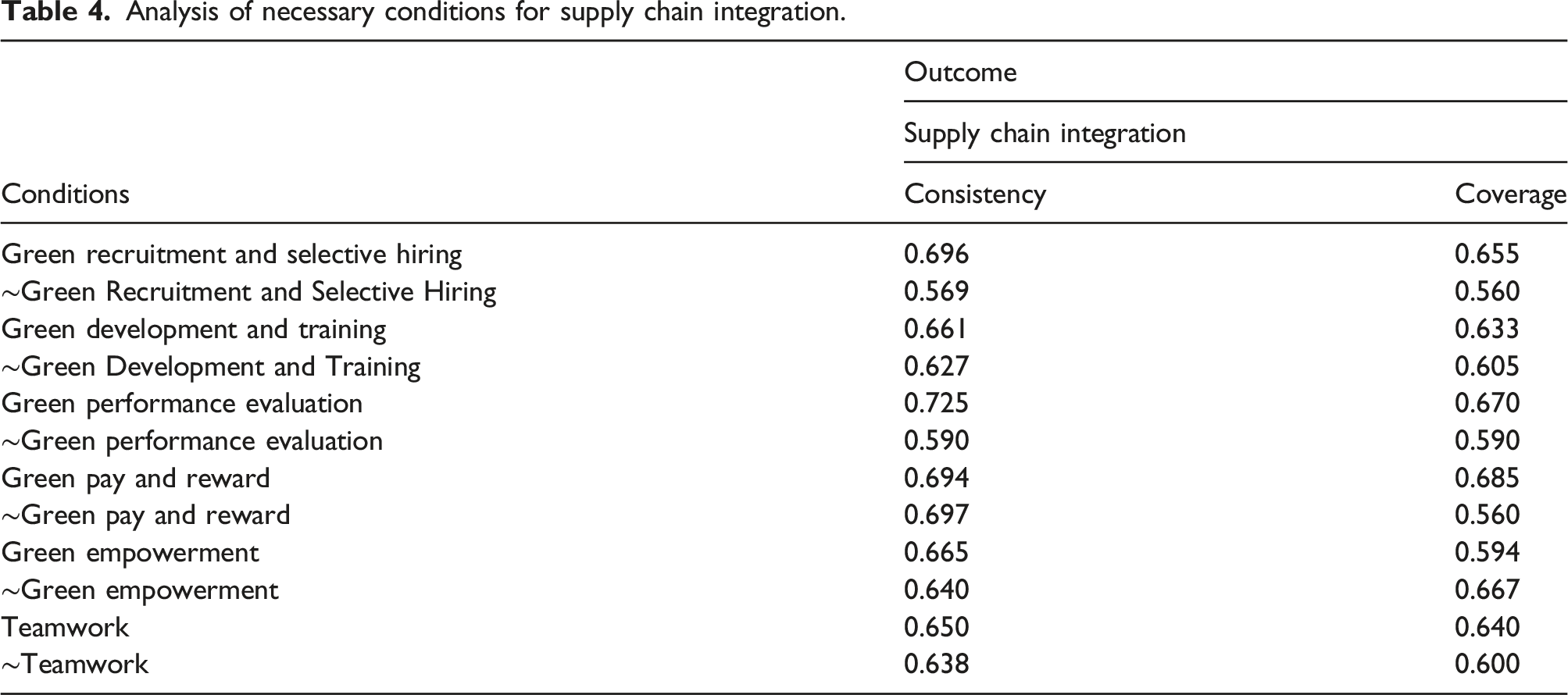
Analysis of necessity
Analysis of necessary conditions for supply chain integration.
Analysis of sufficiency
Configurational conditions for supply chain integration.
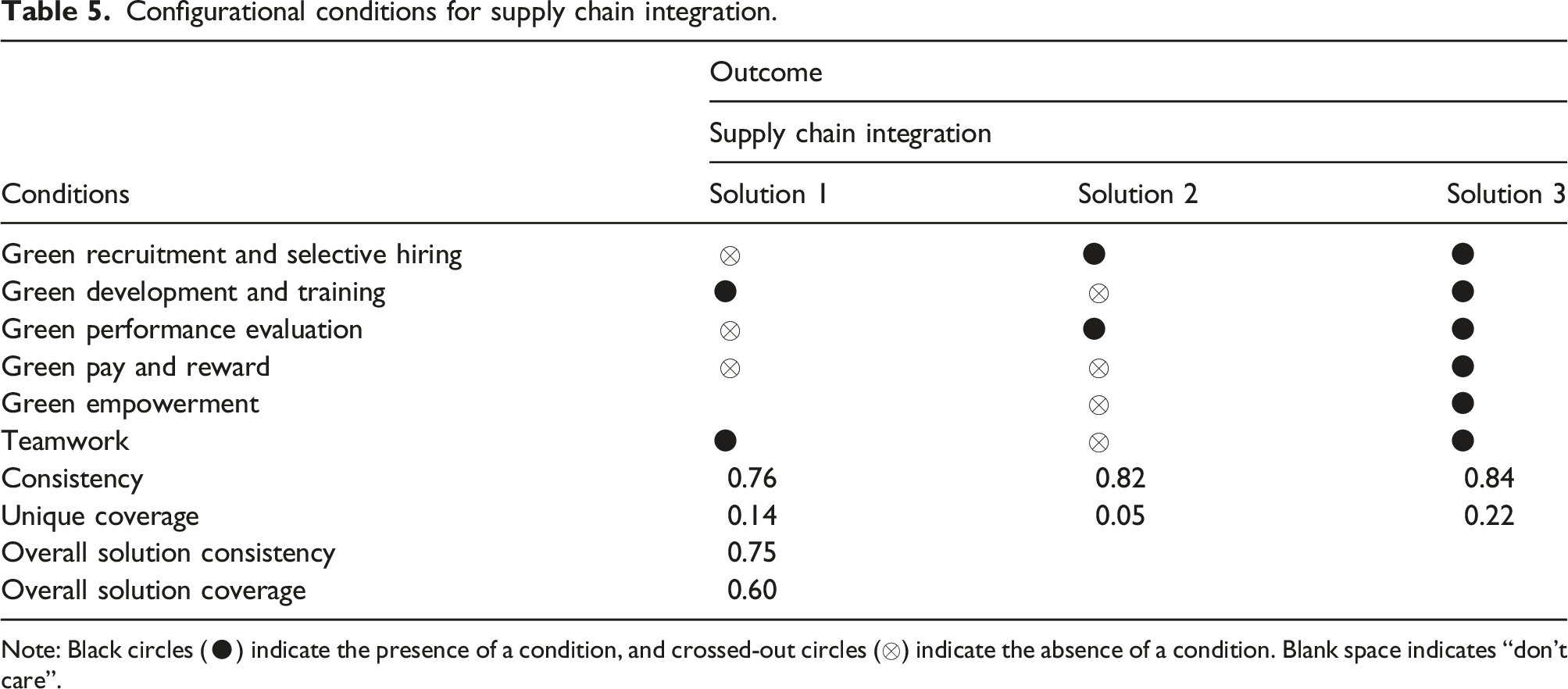
Note: Black circles (●) indicate the presence of a condition, and crossed-out circles (⊗) indicate the absence of a condition. Blank space indicates “don’t care”.
The first solution indicates that companies with the presence of GDT and teamwork would reach SCI, where GRS, GPE, and GPR were absent. The second solution shows that in companies with of GRS and GPE present, these would influence SCI, when other conditions are absent. The last solution demonstrates that all of the conditions would affect SCI. The overall consistency of 0.75 and coverage of 0.60 indicate that these three solutions could explain a substantial proportion of SCI. In conclusion, the propositions are both supported by the results.
Discussion
In this study, we specifically targeted green initiatives. Our focus on GHRM will hopefully lead to environmental principles and advantages that will, in turn, lead to integrated internal and external supply chains. We analyzed the necessity and sufficient conditions that lead to a high level of SCI. Analysis of necessity indicated if any of the construct had to be a “must” condition associated with SCI. Nevertheless, none of the constructs must be present or absent. This interesting finding is shown here first. Previous research has identified the importance of GHRM on supply chain activities;79–81 however, the results presented only the significant effects. For example, Nejati et al. 79 found that GDT, GPR and GE are important to GSCM. The results could not explain whether the presence or absence of GDT, GPR, and GE would lead to the same outcome. The second part of the fsQCA is to find multiple sufficient solutions that can reach the same outcome. The first condition indicated that when the company initiates green development and training and teamwork together, SCI would be positively affected, even when other activities were not implemented. The second condition showed that once green recruitment and selective hiring and green performance evaluation were adopted, SCI would be positively affected, even other when activities were not executed. The last condition specified that when all the GHRM activities were achieved, SCI would be positively affected. Yong et al. 82 reviewed 70 GHRM articles and found that GDT is the most important practice for organizations. Two of our solutions also aligned with this finding.
Theoretical implications
This study enriched the theoretical insights to the existing literature. Firstly, we contribute to the association between GHRM activities and sci, which can be explained by RBV. Human resources can be seen as both tangible and intangible resources that lead to competitive advantages. Once a company can adopt GHRM activities effectively, these will eventually play an important role in SCI. Companies would respond to environmental changes while integrating information. Moreover, the findings confirmed with a prior study 68 that green recruitment and selective hiring, green development and training, green performance evaluation, green pay and reward, and green empowerment were all important activities. We also provide evidence that the collaborative effort (teamwork) in a company should not be ignored when involving other GHRM activities. Lastly, we provide several configurational conditions of GHRM activities that would affect the integration of the supply chain. Currently, this was not examined by previous research. Generally speaking, the linear causal relationships between independent variables and dependent variables are usually examined by regression or SEM. However, the results can only determine the significant variables, whereas possible combinations of effects are not investigated. Therefore, we provide a better understanding of several specific patterns of GHRM activities that increase the level of SCI.
Practical implication
This paper presented the integrative and synergistic GHRM- SCI framework, including elements of a future research agenda. Moreover, we provided the following practical implications. We discussed and suggested that investments in environmental management issues should be attractive for management. GHRM has the potential to benefit SCI. We proposed three solutions for decision-makers to reach desirable outcomes. Managers should understand how important HR is, how they make choices, and how to add the benefits of green culture to the company. If the company has sufficient resources to adopt all six GHRM activities into SCI, this would be greatly beneficial for the company. A company with limited resources could focus on the other two solutions first. Green recruitment and selective hiring and performance evaluation are necessary to understand the connection between GHRM and SCI. The company has to make sure that the employee has knowledge and awareness of sustainability whthin the recruitment and selection process. The candidates also need to ensure the company’s objectives toward sustainability. Even when both sides agree upon the same goal, GPE has to be performed for the maintenance of competitive advantages. By applying GDT, the company should also concentrate on teamwork to have sufficient SCI. We encourage managers awareness that aiming to improve the organization’s environmental and SCI performances via GHRM can positively affect integration. With the integration of environmental principles, we find that organizations can attain more of their full potential.
Conclusion
In this study, we investigated how the combinations of different GHRM activities would affect SCI by using fsQCA. Six GHRM activities, namely GRS, GDT, GPR, GPE, GE, and teamwork, were selected as the major constructs based on previous studies. The survey was taken by 76 production supervisors and managers working in Indonesian footwear companies. The results showed that three configurational conditions of GHRM activities would lead to a positive effect on SCI. Two propositions were supported. When GHRM is applied correctly within the company, it can be an essential tool for motivating staff to adopt green practices, resulting in sustainable company culture. GHRM practices can also transform staff into the important, extraordinary, and unique resources required for market advantage. Indonesia is a developing country facing many challenges and issues. The rapid growth of industry and competition in foreign markets has put the Indonesian footwear industry under heavy pressure. Managers and CEOs should recognize the importance of GHRM within their organizations, because it will ultimately lead to a competitive advantage. Therefore, green initiatives have to be closely managed, and companies must show more concern regarding environmental issues.
Limitation
This study has a few limitations. First, there could have been biased data collection due to respondents’ perspectives and approaches. However, we minimized this by dropping biased results, as judged from our perspective. We also made strong efforts to ensure that respondents were very familiar with the study objectives. Second, our data collection was restricted to production supervisors and managers, and therefore, the sample size was relatively small. The research could be expanded by leveraging employee perspectives and usage other verification methods such as SEM.
Future research direction
First, this study was based only on the Indonesian context. A regional or industrial comparison could be added to expand the scope. Future researchers should seek to extend the scope of GHRM research and not limit it to GSCM issues. They should combine fields and dimensions into the research and add more dependent, independent, and moderating variables. We explicitly designed our study to test the effect of general GHRM practices. A more comprehensive set of GHRM variables or other operational-related variables could be explored to gain a deep understanding of business operations and supply chains. Using different theoretical perspectives could also help. In this case, RBV was used to explain the framework. Different theoretical views could be useful for a better understanding of the linkage between GHRM and GSCM. Cross-country and larger-scope studies should be conducted to ascertain the larger effects of GHRM. Moreover, researchers should be aware of both the possibilities and limitations of these research designs.
Footnotes
Declaration of conflicting interests
The author(s) declared no potential conflicts of interest with respect to the research, authorship, and/or publication of this article.
Funding
The author(s) disclosed receipt of the following financial support for the research, authorship, and/or publication of this article: This work was supported by the National Science and Technology Council, Taiwan [grant number NSTC-110-2221-E-035 -085].
