



Abstract
This study aims to see how the big data analytics capability (BDAC) and its dimensions affect the absorptive capacity and autonomous R&D of high-speed railways. As well as their impact on the organization’s long-term sustainability, using the mediation of absorptive capacity and autonomy in R&D. Employees and the heads of the planning, HR, R&D, and technical departments of high-speed railways were polled for information. For data analysis, we used PLS-SEM, and then we employed mediation analysis. BDAC increases the organization’s ability to tolerate change and gives management instructions on making decisions. This study adds to the body of knowledge on absorptive capacity development and autonomy over R&D activities by investigating the role of BDAC in the long-term development of high-speed trains.
Keywords
Introduction
Many firms have successfully used big data analytics capabilities BDAC to obtain competitive advantages in recent years.1,2 BDAC is a general term that refers to a method of improving how businesses operate (D. Barton and D. Court, 2012). BDAC has the potential to change management practice and theory, 3 the next revolution in management, 4 and innovation. 5 Big data also help decision-making accuracy within an organization, 6 the fourth paradigm of science, 7 maximizing innovation performance, 8 and reducing expenses. 9
Some scholars argue that investing in BDAC is a fallacy since by using this talent, a company’s innovation performance has improved, even if BDAC has changed from a more traditional organization to one that does innovation work.10,11 Organizations are expected to use effective innovation technology to maintain adequate productivity levels in their environments. To achieve societal sustainability and progress, they have thus realized the importance of technical advancement.12,13 In this context, big data analytics (BDAC) allows organizations to maintain their growth and contribute to numerous advancements in their specific settings. 14 BDAC has motivated organizations to provide cutting-edge and intelligent services while maintaining highly developed predictive skills.13,15 These abilities allow organizations to make more intelligent business decisions, boost company performance, and contribute to sustainability. Even though there have been some BDA adoption success stories, many organizations have yet to fully understand the value of big data, their organizational readiness, and the technical requirements for such an investment. Therefore, it is crucial to understand the dynamics of how organizations and more research adopt BDAs is needed in this area. A surprising amount of material has been written about BDA adoption, but most of it has concentrated on the individual and behavioral levels.16,17 There hasn’t been much study that offers organizational-level viewpoints.
Additionally, research that has sought to investigate the intention to embrace BDA has not considered value creation through the adoption of cutting-edge technology within organizations.12,13 Many of these studies have been influenced by marketing, with little attention paid to operations or projections aligned with the various objectives.16,18 The following questions are so addressed in this work.
How does BDAC affect the sustainable growth of organizations, and how can organizations profit from it?
Q2. How crucial is autonomous R&D for organizational sustainability, or does it serve as a bridge between BDAC and sustainable development?
Q3: How important is AC relative to BDAC and OSD, and what function does it play in sustainable organizational development?
This study tests a model that includes BDAC, autonomous R&D, absorptive capacity, and sustainable organizational development. We researched China’s high-speed railways; the growth in this sector has been remarkable in the last decades but still needs further improvement in terms of BDAC and sustainable development. Earlier research on the impact of HSR frequently used a dummy variable to reflect the presence of HSR service.19,20 Recent evaluations 21,22,23,24 looked at the social, economic, and environmental implications of HSR development. There is a rising interest in looking at the multiple repercussions of HSR. There is also evidence that by adding more HSR lines, more equitable accessibility is obtained.22,23,25 For this purpose, this study is vital for carrying sustainable development of HSR through BDA and important mediating variables (autonomous R&D and absorptive capacity).
The study goal is to construct a theoretical link between BDAC and autonomy in R&D, as well as organizational AC. and organizational Sustainable Development in China’s high-speed rail system. This research develops and tests the BDAC model, examining the direct impact of each BDAC dimension on firm R&D and absorptive capacity. After that, we investigated the relationship between absorptive capacity and organizational sustainability. Last, we investigated the mediating role of autonomous research and development and absorptive capacity in BDAC and firm sustainability. The study begins with a review of the literature and a connection to RBT, after which it discusses each dimension of the BDAC and develops hypotheses based on absorptive ability and long-term organizational development. The study then moves on to methodology and analysis, concluding with a discussion of contributions and future directions (Figure 1). Hypotheses model.
Theoretical review and hypotheses development
Resource-based theory (RBT)
The RBT has two basic concepts about firm resources: why some firms perform better than others and how to improve the firm’s performance. To begin with, “the same commercial operating entity possesses a variety of resources”. 18 This assumption about resource differences specifies that exclusive resources are used in some firms to complete the purposes. Second, “the difficulty of trading resources among enterprises enables these differences in attributes.” This assumption denotes “resource immobility,” emphasizing that synergistic assistance from several resources is continuous across time. 26 In addition to these two premises, RBT has a background that asserts that the value, rarity, and imitability of a company’s resources all impact its performance.26,27 To begin with, valuable resource measurement enables an organization to increase net returns while lowering the risk. 28 In other words, it allows enterprises to capitalize on an opportunity while minimizing risk. 29 The second dimension stipulates that a smaller number of businesses-controlled resources is required to gain a competitive advantage over others.
According to resource base theory, an organization can efficiently manage its resources, such as human and non-human resources, to gain maximum profit, and improve its performance. 30 According to Millar & Porter, 31 the inherent ambiguity of the firm, path dependency, and social complexity produce long-term benefits and sustainability, which lead to the firm’s inventive capability. Davenport 32 found that BDAC is a critical component of a firm’s staff because it provides the building blocks for a competitive edge in big data that is difficult to duplicate. Therefore, the firm’s inventive performance becomes a prime source. Compared to an ordinary rival who cannot provide these values in an industry, a firm’s creative performance is the development of specific additional values. 33
Big data analytics capability and sustainable organizational development
Big data refers to investigating and acting on large amounts of data to determine a firm’s future orientation.32,34,35 Big data has two key characteristics: big data analytics (BDA) and technological and computing infrastructure factors, known as data analysis and technical challenges. 36 Another is extensive data analytics capability (BDAC), which deals with organizational processes such as combining big data with other management processes and difficulties. 35 Top management support reveals how much top management is active in new innovative initiatives like BDA and how much it appreciates the value of innovation. 37 In their investigation of the theoretical underpinnings of BDA, Baig et al. 38 discovered that managerial support had a considerable impact on BDAC. Additionally, Park and Kim, 39 using the TOE framework, confirmed how executive sponsorship could be essential for the success of BDAC. Top management may assist with the innovation implementation process, which would significantly help BDA uptake. 40 Support from senior management plays a crucial role in creating a setting with enough resources to facilitate the adoption of new, innovative technology. 41
Through several benefits in various business activities, such as supply chain activities, BDA utilization can assist organizations in realizing opportunities to support sustainable development while also aiming for growth. 42 In this aspect, BDA increases the potential for linking datasets and provides a wealth of opportunities for doing dynamic studies that could help clarify relationships and provide additional information relevant to policy and based on outcomes. 43 Organizations can use the benefits of adopting BDA technologies and related applications to help achieve their ecosystem goals as they grow. 44 As a result, businesses can gain from using BDA by making better decisions and acting on real-time information to make improvements.43,45 On the other hand, BDA capability depends on the firm’s management’s ability to create value through the development and continued use of big data resources as a strategic aim and convert it to competitive organizational advantages. 46 Technological complexity measures how difficult it is for an organization to understand and implement BDA technology. 47 In this context, 38 made the case that the complexity of BDA may significantly hinder the adoption process for many organizations. As a result, it can prevent organizations from using BDA by creating problems with compatibility and interoperability with current data-processing architectures.48–50 From this angle, the study contends that an organization would be less likely to use and adopt BDA than if it did not hold the perspective that BDA adoption is complicated and incompatible with current IT systems and infrastructure work methods. According to earlier studies, a company with a well-developed IT infrastructure (hardware, software, and knowledge) may influence the adoption of BDA. 47 According to Chen et al., 51 organizations would be more inclined to implement BDA if decision-makers saw it as compatible with their current IT architecture. According to Kamal, 52 the more IT infrastructure capabilities it owns, the company is likelier to adopt cutting-edge technology like BDA.
Big data analytics capability (BDAC) is an organization’s ability to transform the business into a competitive force using infrastructure, data management, and human resource expertise. 53 According to Wixom, 36 BDAC is strategic analytics that provides the organization with value and long-term growth. The researcher discovered that BDAC is the ability to use big data to make decisions, fundamentally linked to the organization’s strategies. 54 The corporation gains an advantage over competitors by using big data analytics to evaluate real-time data. 27 According to Kiron et al., 53 creating an analytics climate in capacity and strategy (technology, talent, and data management) is linked to achieving competitive compensation. According to, 11 BDATC is a significant aspect in leveraging extensive data, with the organization’s management trusting in big data environments that improve workers' abilities and proficiency in successfully executing big data analytics. In the framework of BDATC, workers with high potential might transform data into company visions using data analytics technologies, demonstrating management’s confidence in workers' abilities to grasp market change, consumer demand, and organizational success. 55 Big data talent capability boosts organizational capacity, which refers to a company’s long-term planning expertise and other technical knowledge to develop commercial opportunities. 41 According to, 56 positive adaptation and implementation of new technology using BDATC can be easily integrated into the present organizational culture and values. The organization is more eager to apply big data analytics in this study context since it is well-matched with current corporate norms. 55 Using BDA talent and management capacities, Motwani 57 stated that the organizational preparedness to approve new technologies develops the managerial competence to share information, gain new knowledge, and make judgments. Employees of the organization are happy to accept new technology. As a result, we hypothesized that
BDA management capability positively influences sustainable organizational development
BDA technological capability positively influences sustainable organizational development
BDA talent capability positively influences sustainable organizational development
BDA, autonomous R&D, and sustainable organizational development
Competitive pressure is the term that describes external factors that impact an organization’s decision to adopt BDA. It has been asserted that organizations aim to achieve a competitive advantage through innovation, like BDA, as market competition rises. According to Ali Q et al., 58 environmental factors may favor top management support. The authors believe that stronger top management attitudes about the advantages of new technologies through research and development result from higher degrees of environmental pressure. Additionally, top management would constantly be under pressure to create new technologies to obtain a competitive advantage to be more effective and efficient than the firm’s rivals. The concern is whether R&D management is ready to deal with the new climate. As a result of the rise of big data and big data tools, challenges and opportunities will arise throughout the entire spectrum of R&D management responsibilities and operations. It will increasingly inform innovation and the process a company uses to execute innovation in the future, allowing for new approaches to R&D and transforming R&D practice. Some of these improvements may be little; particularly those related to how big data inform or enable innovation. Still, they will help accelerate R&D while lowering costs and risks—the potential for big data and analytics to disrupt or transform current business models.
Nontraditional players find ways to use big data to dislodge established market leaders, or established leaders radically reshape their structures and processes to make better use of big data. That potentially remakes their businesses, rendering competitors' models obsolete, and poses more enormous challenges. Big data is also influencing how businesses approach open innovation. Companies build networks of individual and organizational collaborators who share information, gleaning insights from widely scattered resources that may subsequently be used for R&D, as pioneered by Procter & Gamble in the early 2000s. 59 P&G successfully included outside sources in its innovation process. The company might reduce R&D expenditures and streamline its infrastructure for innovation as a result.
On the other hand, P&G had to devise ways to control and filter the flow of ideas and knowledge. This is an example of how a big data analytics solution helped alter and disrupt R&D by collecting opinions from a broad range of external participants. Other firms are using big data and analytics to support R&D approaches that would not have been possible without them.
BDA technologies allow businesses to comprehend the risks of demand, capacity, and supply availability. It encourages the analysis and synthesis of data from many sources for decision-makers in this situation. 12 Consequently, BDA may be seen as a value generator for businesses across various industries and is regarded as one of the most important fields of future technology. 60 As a result, it can help firms add value and improve their financial performance, customer happiness, and market performance. 61 The function of successful BDA adoption in organizations for producing a variety of opportunities has been slightly acknowledged for sustainable development. 43 Understanding its importance could help in achieving the necessary aims. Big data analytics uses unique information processing skills in organizational value-creation processes to improve a company’s competitive advantage. Senior management’s support and dedication are crucial in this approach.5,62 We presented study hypotheses based on the discussion above.
BDA management capability positively influences autonomous R&D
BDA technical capability positively influences autonomous R&D
BDA talent capability positively influences autonomous R&D
Autonomous R&D positively impacts sustainable organizational development
Autonomous R&D positively mediates the relationship between BDAC organizational sustainable developments.
Big data analytics capability and absorptive capacity of the organization
Organizational Absorptive Capacity (AC) is a supplementary resource and a BDA facilitator.63,64 One may argue that supply chain businesses must have all the necessary competencies to extract value or insight from raw data. According to,65–67 many researchers employ AC to explain organizational learning from a strategic management standpoint. The construct of AC has multiple levels and dimensions. It has connections between groups at the individual and inter-organizational levels and has various interconnected capabilities. Regarding BDA, the crucial data required to boost performance is primarily found in external sources that are not easily accessible for decision-making. 68 However, BDAC can deliver essential data in real-time and emphasize the organizational capacities to gather, digest, transform, and use the information and knowledge for profit. Additionally, emerging BDA technologies like Elasticsearch, Kibana, and Beats would be challenging for businesses with low absorptive capacities to embrace. 69 It can also be claimed that when an organization lacks absorptive capacity, even if BDA resources are effectively established at the organizational level, they become ineffective. Absorptive capacity is considered one of the requirements for BPAC projects to be implemented successfully. 70
This ability to draw unique and critical perceptions connects big data and organizational absorptive capacity. 71 Similarly, BDAMC advises organizations to use big data in their business processes successfully, as well as to make long-term and effective decisions to invest in new initiatives to add value to the process and the business, which demonstrates the firm’s ability to adapt to change. 72 BDAMC enables companies to track their customers' activities as potential opportunities and assess competitive outcomes. 41 BDAMC is an essential indication of absorptive capacity based on a resource-based perspective. Technical expertise with big data In terms of a firm’s absorptive capacity, BDTC is a systematic measurement that aids in evaluating new technologies. 73 In turn, an organization’s absorptive capacity depends on some aspects of technology and big data technological capability (connectivity, compatibility, and modularity) in the innovation process. 74 The dimensions of organization infrastructure, data management, analytics, governance, and technical capabilities, according to Braun, 75 are the elements that determine preparation (absorptive capacity).
Financial and human resources are crucial to a company’s ability to analyze large amounts of data. 1 BDATC invests in workers' technological skills to complete large-scale data analysis. 76 According to the RBV, device functionality can measure a physical source that could be critical using big data analytics. And create value for the organization, workers' analytics ability to analyze large amounts of data using cutting-edge applications, and workers' analytics ability to research large quantities of data using advanced applications. 77 These skills improve workers' technical skills and require knowledge of text mining, visual analytics, and natural language processing aids to seize the results. 72 As a result, to get the most out of big data analytics, companies need to develop high-level capabilities in their staff that allow them to use new-age analytical approaches to study and generate meaningful insights from big data. 16 Thus, we hypothesize that
BDA management capability positively influences the organizational absorptive capacity.
BDA technical capability positively influences the absorptive capacity of the organization
BDA talent capability positively influenced the absorptive capacity of the organization
Absorptive capacity and sustainable organizational development
The capacity and knowledge of the field management team are the foundations of the organization’s long-term growth and competitive advantage. 78 Knowledge is a resource that can be understood and implemented in organizations; employees with unique knowledge directly impact the organizations' competitive advantage and contribute to the firm’s long-term success. 79 The company increases its efficiency and internal business processes by utilizing external knowledge. 80 Knowledge is the main driving force, and from a knowledge base perspective, it increases the organizations' long-term competitive advantage. 81 Organizational procurements of knowledge depend on the organizations' absorptive capacity; hence, the organizations' absorptive capacity is a significant source of accepted change and maintains sustainable development. 82 The firm’s absorptive capability over external knowledge has maximized the firm’s sustainability, according to Chen, H. 83 By exploiting realized absorptive potential, a source of competitiveness, the aviation sector improves the strategic management process. 84 Furthermore, absorptive capacity improved the firm’s flexibility in terms of strategy, customer preferences, stockholder experience, and network capabilities, resulting in lower costs.
We hypothesized that, based on the preceding discussion,
Absorptive capacity of the organization positively influenced the sustainable development
Absorptive capacity as a mediator between BDAC and organization sustainable development
In the context of big data analytics, the organizations' generated insights have indicated that some administrative areas have been overlooked or that the organizations' capacity has been exceeded. Therefore, action has been taken to focus on such sites to boost absorptive capacity. 85 BDAC gained a keen awareness of how to increase the firm’s internal capabilities while capitalizing on market prospects.86,87 This enables the company to comprehend and implement its product and service improvement objectives, interactions between internal and external sources, and consumer behavior. 88 The outcome of the BDAC can be discerned as boosting the ability of the firm to reshape its techniques, identify opportunities, and make decisions that match its absorptive capacity, which helps maintain its sustainability. 86 The outcome of the BDAC can be discerned as boosting the ability of the firm to reshape its techniques, identify opportunities, and make decisions that match its absorptive capacity, which helps maintain the. 89 According to, 90 the relevance of planning in decision-making offers the ability to comprehend and strengthen organizational culture. Developing necessary BDA procedures and structures that enable organizations to produce and operate creative ideas that better direct to sustainability is critical. 91 BDATEC enables organizations to create processes and systems that solve problems quickly, develop new products and services, and absorb technical knowledge from the outside world. 92 According to Chen, 83 organizations that have developed their BDAC can better identify faults in their operations and make them more efficient. 93 It also enables the company to allocate resources to capture market share. Through active and timely utilization of resources, these abilities enhance chances for the organization and help prevent risks. 94 As a result of the preceding explanation, absorptive capacity strengthens the association between BDAC and long-term organizational development. As a result, it is suggested that
absorptive capacity mediates the relationship between BDAC and organization sustainable development.
Measurements and method
Measure
Big data analytics management capabilities (BDAMC)
We used the same four items from Kiron D 81 to scale the big data analytics management skills. We also employed the Datta, S., and Malhotra, L. four-item scale for big data investment decision-making. 95 We used the scale for big data analytics coordination. J. Finally, Chen et al. 96 employs the same scale previously employed for big data analytics control. 97
Big data analytics technical capabilities (BDATEC)
BDATEC has three sub-dimensions, and everyone was assessed using four items on a five-point Likert scale, as Akhter et al., 16 Terry Anthony Byrd, D.E.T., 98 and Kim, H.J., 93
Big data analytics talent capabilities (BDATLC)
We used the 4-item, 5-point Likert scale (strongly agree to disagree strongly) for all the sub-aspects of BDATLC to assess big data analytics talent capabilities.93,98
Absorptive capacity
We used to measure the organizations' AC using a previously employed scale. 99 We used a 7-item scale to assess the firm’s absorption capacity.
Autonomous research & development
This study used the scale to evaluate independent research and development. 100 This study added three new questions to the previous four-item autonomous research and development scale. For autonomous research and development, there are seven components.
Sustainable organizational development
We utilized a 12-item 5-point Likert scale devised by Wing and Chan 51 to assess the firm’s long-term social, economic, and environmental development.
Control variable
Control factors include the respondent’s age, gender, education level, and work experience. The standing of those who participated in the survey using 16 using a 5-point Likert scale to measure the same.
Data collection
Demographic information of the respondent.

Regarding education, 52.1% of respondents have a master’s or technical degree. Regarding the year’s employees had worked for the company, 37.8% of respondents had spent 6 and 10 years in the same department. Around 28.4% of those who responded to the survey worked in the research and development department.
Measurement model
Reliability and convert validity.

Figure 2 depicts a significant positive association between big data analytics competence, absorptive capacity, autonomous research and development, and long-term organizational growth. Furthermore, the absorptive capacity of BDAC varies by 0.53%, while the autonomy of R&D varies by 0.49%. The independent variables account for 74.6% of the variation in sustainable organizational development. Variation of independent variables towards dependent variable.
Correlation between the constructs.
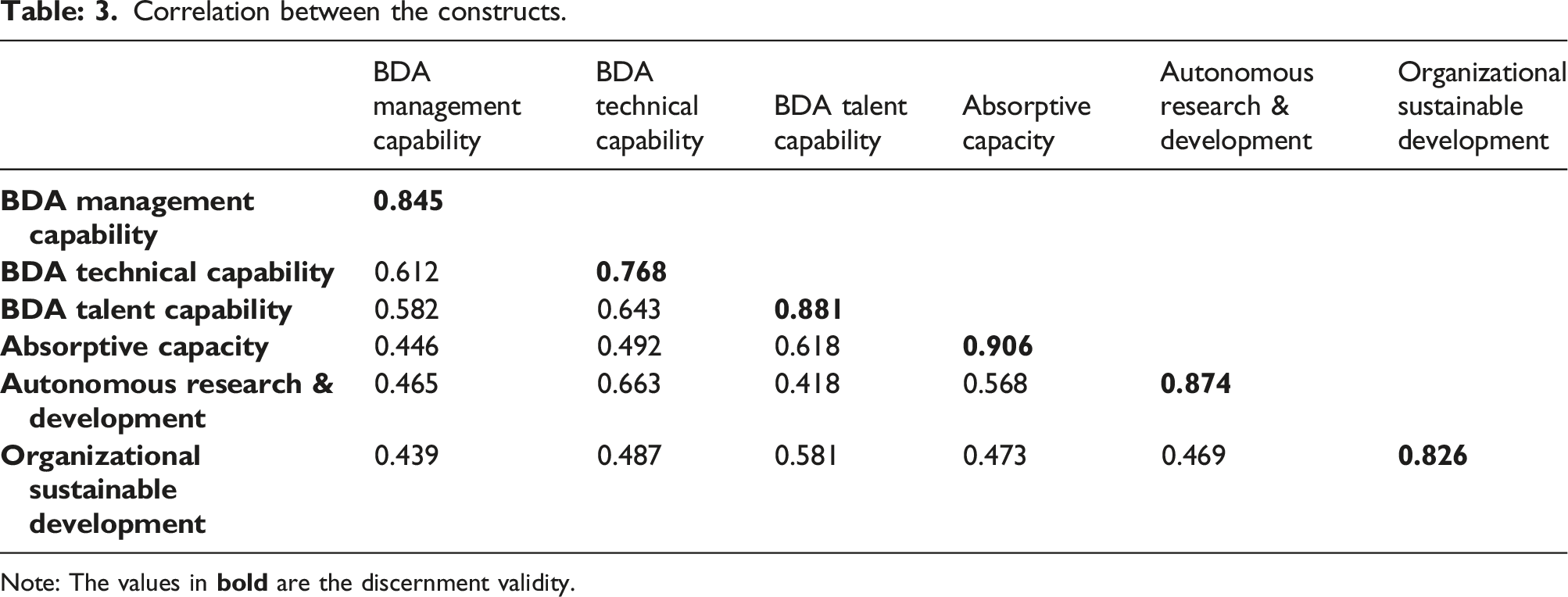
Note: The values in
Hypotheses testing
The study model confirms the direct relationship of BDA management, technical and talent capability with absorptive capacity, autonomous R&D with sustainable organizational development. We were tested using regression analysis to test the effect of absorptive capacity and autonomous R&D in the relationship between big data analytics capability and sustainable organizational development. The structural model is shown in detail in Figure 3 below. The following are the outcomes. Relationship among variables. Note: beta and t values of the construct.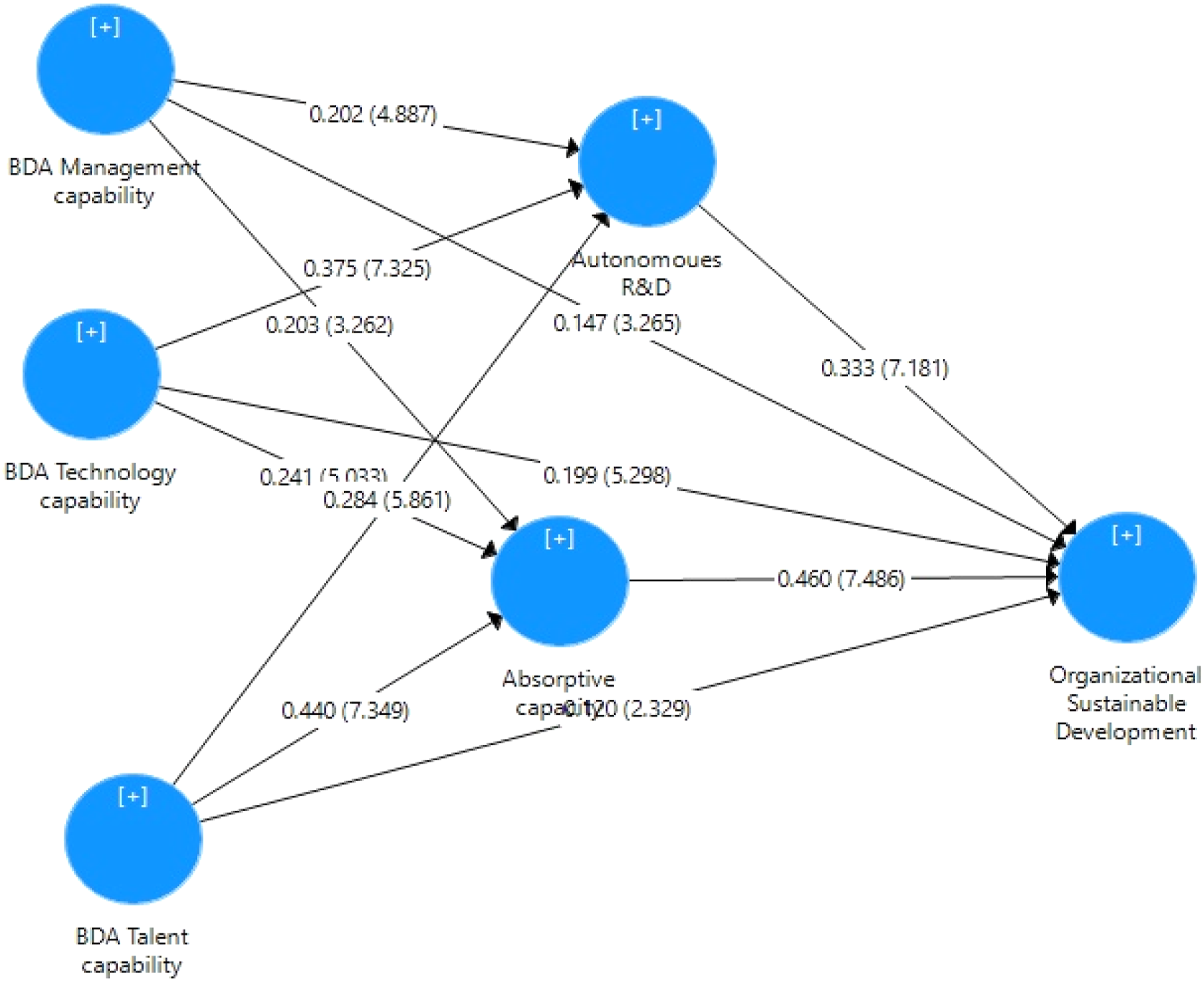
The direct hypothesis construct is shown in Figure 3 among BDAC, mediating variables, and dependent variables. The study hypothesis H1 is validated since there is a positive and significant association between BDA management capability and sustainable organizational development (β = 0.14, t = 3.26 p = .001). BDA technical skill was statistically significant with long-term organizational development, i.e. (β = 0.19, t = 5.29, p = .000); hence the H2 hypothesis was adopted. We accept H3 since the link between BDA skill capability, and sustainable organizational development is likewise significant and favorable (β = 0.12, t = 2.32 p = .001). This study also looked at the direct relationship between BDAC and autonomous research and development and found that (β = 0.20, t = 4.88 p = .001), which is statistically significant and positive; hence the H4 hypothesis was accepted. The study also found a positive and substantial association between BDA technical capability and autonomy in R&D, indicating that H5 (β = 0.37, t = 7.32, p = .000) is correct. The study’s second hypothesis is that BDA skill capability is linked to autonomous research and development. The study found a positive and substantial link between BDA talent competence and autonomous R&D (β = 0.28, t = 5.86, p = .000), indicating that H6 is supported. We also claimed that independent research and development has an impact on the long-term development of organizations. As a result of the study’s findings (β = 0.33, t = 7.18, p = .000), we accept H7.
The study also looked at the relationship between BDAC and absorptive capacity. It concluded that BDA management competency impacts an organization’s absorptive capacity (β = 0.20, t = 3.26, p = .000), which is significant and favorable. The following hypothesis is the association between big data technological capability and absorptive capacity; according to Figure 3, this relationship is equally optimistic and statistically significant (β = 0.24, t = 5.03, p = .000); hence we accept H10. We also looked at the association between big data talent capability and the firm’s absorptive capacity, which was positive and highly significant (β = 0.44, t = 7.34, p = .000), indicating that this study supported H11. This study also looked at the association between absorptive ability and OSD, and the results showed that this relationship is also solid and statistically positive (β = 0.46, t = 7.48, p = .000); hence we accept H12.
Mediating effect of autonomous research & development
Mediating effects of autonomous R&D.

Note: P is less or = 0.001.
Mediating effect of absorptive capacity
Mediating effects of absorptive capacity.

Note: P is less or = 0.001.
Discussion
The study aimed to investigate and test a BDAC model for enhancing company sustainability and the mediating effect of autonomous research & development and absorptive capacity. Big data analytic capabilities’ management, technological, and talent capabilities are further separated into three aspects. The findings show that big data analytics capabilities considerably and favorably impact the firm’s long-term success. First and foremost, the big data analytics management capabilities (BDAMC), BDATEC, and BDATL greatly impacted the firm’s AS, management’s ability to influence human resources, and the firm’s ability to develop long-term strategies using its capabilities. Firm management’s analytical capabilities enhance healthy, particularly long-term development. 92 The technological capability directs analytics, the sharing of information, ideas, and knowledge, the development of strategies for the firm’s competitive advantages, and the ability to launch a reliable model. 107 When an organization has talented human resources, it can gain an advantage and promote a culture of innovation in the workplace. 48
The achievement of organizations' strategic goals from such technology advancement has not yet been examined, even though many studies on BDA adoption have concentrated explicitly on fostering comprehension of issues for workers. 108 The empirical data show that the technological driver of BDA, in combination with top management support, can significantly impact how widely BDA is adopted. As a result, these drivers might offer ways to design actual economic benefits for realizing the desired sustainable development. The acquired results show an outcome consistent with the existing research on the organizational added value from BDA implementation.109–111 The study also demonstrates that organizations should carefully consider various technological, organizational, and environmental elements that may aid in realizing the benefit of BDAC and ultimately produce genuine commercial value for achieving corporate sustainability. Understanding the mechanisms necessary to help build and foster business value from BDAC has been emphasized by Grover et al. 112 and Lavallee et al.,. 54 Therefore, it is necessary to have enough non-technical and technical resources. The findings show how implementing BDAC directly contributes to creating organizational value supporting sustainable development by considering these technological elements.
While several studies have confirmed these elements' independence and acknowledged their external impact.12,13 Which has demonstrated how top management support may significantly aid in acquiring and applying innovative technologies, such as BDA.113,114 Top management should play a crucial role in creating the necessary vision and later couple related strategies with associated alignment issues for generating business value from innovative technologies, as investigated by.42,115,116 This study proves how individuals and important decision-makers can make investments. Organizations need a strict system for gathering, analyzing, and integrating important information for BDA technologies. To assist set up a seamless implementation, this calls for cooperative efforts within the organization and across all divisions. Organizations could create the necessary value in this way to contribute to global sustainable development. However, the concept of sustainable development was developed to understand that the world needs constant growth while preserving the peace and prosperity of people today and in the future. BDA has unmatched potential to solve numerous societal and personal problems that these purposes are now pursuing.44,117 Consequently, creating value in support of the development might be aided by developing effective strategies for accepting and implementing BDA. Insights about organizational activities and processes, such as productivity, sustainability, customer retention, product and service quality delivery and experiences, as well as competitive advantages, can therefore be carefully examined and utilized by organizations.
Overall, the BDAC positively impacted the HSR absorptive capacity; the firm paid attention to all the dimensions of big data analysts; each element plays a role in a company’s long-term development, and they are all interconnected. The BDAC has a significant and positive relationship with autonomous R&D. The study’s new findings show that all dimensions of big data analytics, management, technical, and talent strongly influence the autonomy of R&D activities. Big data analytics capability directs organizations to concentrate on the autonomy of the high-speed rail network of China routes using big data analytics capability.
The study also investigated the effect of absorptive ability in mediating the relationship between BDAC and healthy long-term development. The findings demonstrate that absorptive capacity mediates the link well, consistent with previous findings. 113 The study’s primary goal was to investigate the role of autonomous research and development in mediating the relationship between BDAC and OSD. This study demonstrates that having more control over R&D speeds up the relationship between big data analytics and the long-term sustainable development of high-speed rail.
Conclusion
Many organizations have failed to recognize the value BDA may add to advancing sustainable development, despite the significant investments and resources earmarked for its use. This study’s purpose was to better understand how BDAC’s effectiveness in China’s high-speed rail network would help generate value and ensure sustainability. The resource-based view served as the theoretical underpinning for the study, which looked at how BDAC contributes to organizational value creation for sustainable development. This study focused on the function of top management in HSR and essential factors that could facilitate the BDAC in this setting. The model was empirically tested based on a survey of BDAC-experienced employees in HSR of China. The outcomes supported the idea that BDA’s technological engine should be combined with top management assistance to speed up sustainable organizational development. The study also showed that understanding the function of the external environments via autonomous research and development, the internal dynamics of organizations through absorptive capacity, and the technology component might facilitate the BDAC’s successful adoption. This will maximize the sustainable development of HSR within the organization.
Theoretical contributions
The study adds to the body of knowledge about BDAC in the following ways. The current research builds the three primary dimensions of the BDAS and subdivides the scale into multiple sizes. The study’s findings suggest that management capabilities improve planning, control, and strategy creation for big data model construction. 81 Second, the findings of our study model, when combined with all the BDAC aspects, optimize sustainable organizational development through absorptive capacity and direct management to focus on core components while improving weak areas of the firm. Third, the results reveal that the firm’s technical and talent abilities are directly linked to its long-term viability. This aids analysts in analyzing the firm’s capabilities while keeping RBT in mind, which helps determine its direction. 118 Finally, the management of big data analytics was able to provide the best model that was compatible with the capabilities of big data analytics and the firm’s strategies, removing the confusion and allowing the firm to launch their strategic Alliance, either short or long-term. 119 At last, the role of autonomous research and development is critical in any organization. This study adds to the management literature by providing new information and avenues for researchers to focus on autonomous research and development and provide businesses with a new approach to sustainable development.
Managerial contributions
The study provides some beneficial insights for managing HSR and other industries globally, like airlines, hospitals, IT-based companies, media, and higher educational institutions. The BDAC impacts the sustainability process in the following ways: The competencies of BDA Management are focused on planning and providing direction for future investments, coordination, and control. BDA’s technological capabilities boost the organizations' absorptive capacity and sub-dimensions, connectivity with the objective, compatibility, development of practical models, and modularity. BDA talent skills influenced firm innovation performance in various ways, from recruiting to training and development to retaining skilled employees. The model directs management to focus on the firm’s technology resources and human resource capabilities while developing BDA plans and models. Big data analytics also alerts management to the need for employee training and organizational capacities to deal with a crisis, a vital tool for gaining a competitive advantage in the market. 53
The study clarified that fostering BDAC culture at the highest levels of organizations is essential to the program’s success. Therefore, top management must provide the appropriate direction and assistance to individuals tasked with configuring BDA tools and programs. Top decision-makers must support efforts involving new technology from a management perspective. To secure maximum management support for implementing BDA, emphasis on the perceived benefits of BDA, awareness, training, and establishing an analytics cultural mindset is essential for technology positioning. Additionally, technical training programs and compatibility/integration processes must be developed to reduce the perceived or actual complexity of BDA technology to promote the successful utilization of BDAC. Absorptive capacity, resources and capabilities, and skills difficulties have frequently been problems in the organizational setting. Therefore, organizations must address these problems right away. Organizations must devote enough financial, human, and IT infrastructure resources to implement BDAC successfully. Organizations would be able to implement the BDA adoption procedure with ease if they did this. Government support for initiatives that promote the creation and use of new technology is a significant motivator for businesses to adopt them from an environmental standpoint. This is crucial for BDA since there are numerous ongoing problems with data, including concerns about confidentiality, security, privacy, and governance. More significant support for the implementation of new technologies through autonomous research & development in general, and BDA, would be provided by more clear government legislation.
Future directions and research limitations
The study employed BDAC’s direct association with absorptive capacity and autonomous research & development with the dimensions; however, it would be more interesting if moderating variables, such as business processes, were used. 120 Because the study only included one participant to reply to the questions and utilized a 5-point Likert scale to assess and analyze the data, future studies can focus on including the most people possible in a survey. 16 Finally, the study only looked at China’s high-speed rail network; future research might be done on multinational and large corporations.
Footnotes
Declaration of conflicting interests
The author(s) declared no potential conflicts of interest with respect to the research, authorship, and/or publication of this article.
Funding
The author(s) received no financial support for the research, authorship, and/or publication of this article.
