




Abstract
The adoption of new technologies is the most important phase for integrating new technologies into the traditional processes of an organization. This study aims to assess the importance of critical success factors by developing a critical success factor framework, relationship, and subfactors that influence the adoption of advanced manufacturing technologies (AMTs) in small- and medium-sized enterprises (SMEs). The framework was developed based on previous studies that were grouped into five critical success factors, namely, strategy, organization, top management, environment, and technology. We then applied structural equation modeling (SEM). A total of 212 samples were gathered and grouped. The results indicate that strategy is the most important critical success factor, followed by organization, top management, technology, and environment.
Introduction
As a result of globalization, companies worldwide are competing in terms of price, quality, reliability, and product delivery. Many large companies have adopted advanced manufacturing technologies (AMTs) to improve efficiency and performance; yet, they continue to face a high level of competition as well as inflexibility in the global market, which has affected many organizational aspects. As a result, new technologies are required to help organizations meet customer needs and global market requirements. Advanced manufacturing technologies have proven beneficial to many industries, including those in developing and developed countries. In the majority of developed countries, AMTs have already been applied with the integration of Industry 4.0. Successful AMT implementation in developed countries brings both advantages and disadvantages; developing countries can leverage this knowledge and apply it to their own countries to establish better production processes in the manufacturing sector. This is the main focus of this study. Tavakkoli 1 noted that mass production has been transformed into low-volume production, enabling the production of a wide range of branded products. Manufacturers recognize the importance of flexibility in production systems, which is particularly important in coping with challenges for a wide range of products and shorter waiting times, along with higher fertility and modality.
Despite the fact that AMT provides many advantages, 50%–75% of implementations fail. 2 The implementation of automation requires proper planning and management throughout a project’s lifecycle. Moreover, researchers agree that many AMT implementation failures are related to firms’ inability to integrate advanced technologies with existing technologies, infrastructure problems, insufficient planning, poor operator training, low management determination, and insufficient strategy. 3 In addition, Marri et al. 4 suggested that the lack of technological initiative and continued support from top management, poor commitment to shop floor employees, and inadequate managerial training for AMT projects are the reasons behind AMT implementation failure. According to Bhise and Sunnapwar, 5 the pre-implementation stage, which involves improper and inadequate planning, impacts the success of implementation. The reasons underlying AMT failures mainly include organizational problems, especially those related to technology, economy, and manpower, according to Tavakkoli. 1 The planning step, which involves the decision-making process of whether or not to adopt new technologies, is the most important phase in integrating new technology into an organization’s traditional processes and benefiting from its use, as stated by Simões et al. 6 Mechling et al. 7 mentioned that AMT adoption is one way to respond to this growing demand for flexibility and reduced production time.
The objective of this study is to analyze and identify the importance of critical success factors, relationship factors, and subfactors for AMT adoption in developing counties. A critical success factor framework, the relationships among factors, and the subfactors for enhancing the analysis of the five critical success factors are proposed in the subsequent sections to achieve the objectives of this study, to establish a critical success factor framework of AMT adoption. This is a new study developed and combined through a synthesis of the literature. Every critical success factor contains separate subfactors that represent different parts of the company, namely, the organization, strategy, top management, environment, and technology. These critical factors combine the results of the relationship between the critical success factors, which represent a company’s indicators for AMT adoption. The use of each critical success factor depends on a company’s readiness to use AMT in its manufacturing organization. Finally, this study derives a percentage of critical success factors and subfactors by converting them from loading scores that can be further developed as an assessment score for company readiness to use AMTs.
This paper is organized as follows. The next section discusses the literature review for theoretical AMTs and identifies critical success factors and subfactors. This is followed by relevant findings regarding the relationships among the critical success factors and the development of a framework for AMT adoption. Finally, the research methodology, results, discussion, and conclusions are presented.
Literature review
Theoretical background of AMTs
Advanced manufacturing technologies involve the application of advanced manufacturing process technologies that use computers to store and manipulate data. 8 Advanced manufacturing technologies refer to a group of technologies for manufacturing that links the framework of manufacturing. It has the critical function of enabling a traditional company to acquire possible competitive advantages against its competitors. 7 Advanced manufacturing technologies involve the application of computers to manage data in manufacturing processes. 9 Rahardjo et al. 10 specified that “AMT” is a term used to describe a variety of technologies that involve the use of a computer to control or monitor production processes. It applies computer and machine technologies to augment and enable a high-performance workforce and to facilitate production at different volumes and under variable time constraints. It responds quickly to customer demands, provides efficiencies for mass production, and enables the flexibility of custom manufacturing. 11 It was derived as an automated production system of humans, machines, and tools for planning and control. It includes the procurement of raw materials, parts, and components, and the shipment and servicing of finished products. 12 Marri et al. 4 argued that AMT was a key technical process that helped transform firms into goal-achieving successful businesses that could maintain their competitiveness in the global market. Advanced manufacturing technology implementation is considered an effective method of improving sustainable development, profiteering, and business expansion.
Furthermore, Rahardjo and Yahya, 3 and Dangayach and Deshmukh 12 classified AMT into three dimensions, namely, (1) direct, wherein technology is used on the factory floor to cut, join, and reshape; (2) indirect, wherein technology is used to design products and schedule production; and (3) administrative, wherein technology is used to give administrative support to the factory and integrate its operations with the rest of the organization. The effect of its use depends on the process of using its application. 13 Advanced manufacturing technology is a technology that includes hardware and software for improving manufacturing capability. 14 Tavakkoli 1 noted that AMT, such as flexible manufacturing systems, computer design, and robotic systems, will help a company achieve a substantial competitive advantage.
Many studies highlight the advantages of AMT, 15 including an increased production rate, higher flexibility, and quality improvement. Singh et al. 16 concluded that adopting an advanced manufacturing system helps small- and medium-sized enterprises’ (SMEs) growth and competitiveness in the global market including tangible and intangible advantages. Gill et al. 17 suggested that companies required technology application with strategic management to achieve business goals. Hynek and Janecek 18 showed that the adoption of advanced, capable, and effective manufacturing technologies accord a positive impression and is important to compete in the global market. Darbanhosseiniamirkhiz and Wan Ismail 19 also stated that the adoption of AMT can provide perceived benefits as an advantage.
Identification of critical success factors and subfactors of AMT adoption
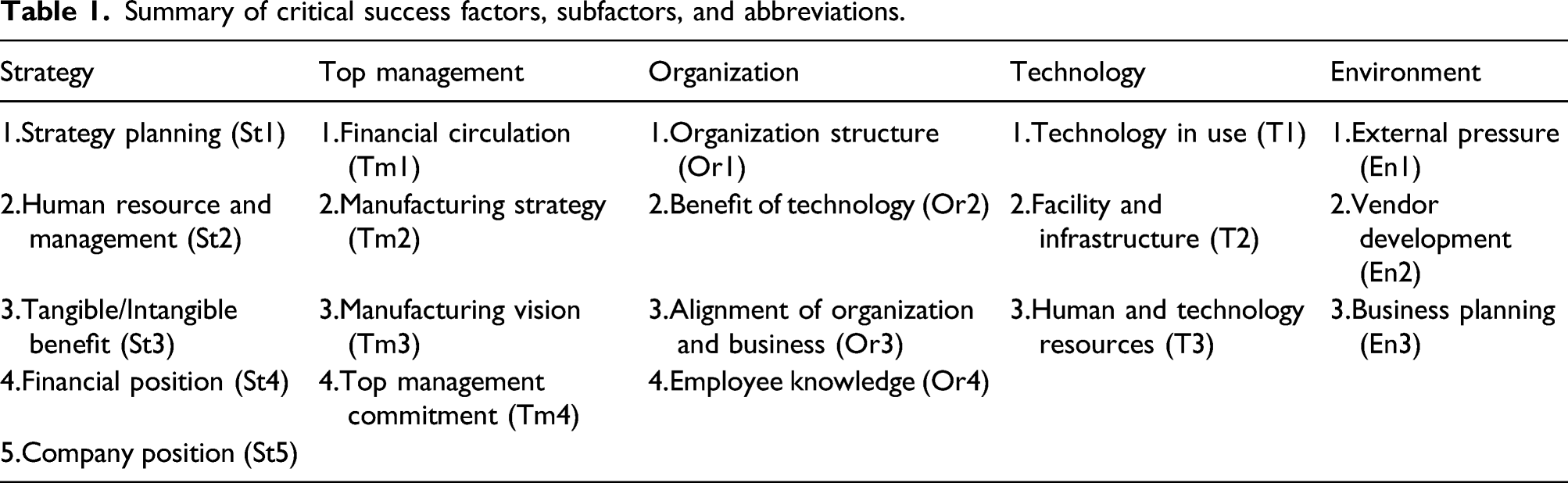
Summary of critical success factors, subfactors, and abbreviations.
Organization
Organization describes the components of a company, including staff, infrastructure, and other stakeholders; it represents the internal characteristics and resources of an organization. 6 Organization is one factor that must be considered before AMT implementation because it can cause implementation failure. 20 Marri et al.19,21 considered the organizational factor to be crucial in AMT adoption. Organizational design is about combining technical and societal systems. 19 Organizational design dimensions can be divided into two categories: structure and context. Structural dimensions provide labels to describe the internal nature of organizations and the basis for measuring and comparing organizations. The context dimension, which defines the nature of the entire organization, includes size, technology, environment, and goals. 22 According to Bhise and Sunnapwar, 5 adoption by manufacturing organizations must match products with technologies that offer not only operational but also marketing benefits. In this section, we define the organization’s critical success factors and identify four subfactors, as follows.
Organization structure is determined by the company culture that develops from organizational structures and organizational processes; it is defined by all human and technical components at different levels in relation to achieving possible goals. 23 The organizational structure is the formal allocation of work roles and administrative mechanisms to control and integrate work activities. 24 Organization structural dimensions provide labels to describe the internal nature of an organization. They form the basis for measuring and comparing organizations. 22 An organizational infrastructure is defined as the internal configuration and management associated with the organizational structure. 25 Chan et al. 20 found that organizational infrastructure is critical to staged implementation. A supportive organizational infrastructure is the key to successful AMT implementation. Darbanhosseiniamirkhiz and Wan Ismail 19 considered organizational structure as a crucial factor. They found that adoption required the involvement of all employees. Xiao-lin et al. 26 noted that a proper organizational structure and a defined set of processes help firms grasp the advantages of successful AMT implementation.
Benefits of technology can be gained from AMT implementation directly and indirectly. Darbanhosseiniamirkhiz and Wan Ismail 19 stated that successfully adopting AMT depends on recognizing its tangible and intangible aspects. The adoption of technology is positively influenced if users accept the benefits of such technology over current systems and practices. Simões et al. 6 stated that perceived benefit is a key factor in the adoption of new technologies. Costa and Lima6,27 stated that an organization’s benefits consist of tangible resources (e.g., administrative system, task performance improvement, and cultural resources), intangible resources (e.g., brand, competitive pressure, and reputation resources), and human resources that can be mobilized and organized to gain a competitive advantage.
Alignment of organization and business depends on the terms of the objective to be achieved. Saberi and Yusuff, 28 proposed success factors of implementation using a method that leveraged the alignment of organization and business. The adoption of a flexible manufacturing system involves large investments and high levels of uncertainty and, hence, needs attention from more companies at the strategic level to achieve economic goals. 29
Employee knowledge is the knowledge of employees related to the technology to be implemented. Marri et al. 4 suggested that to successfully implement in firms, employees must understand the principles, goals, and objectives through training and education. According to Barua and Islam, 30 employee motivation, training and education, employee relations, and cooperation are key to implementation. Safety and team familiarization with new technology are the most important factors. Rahardjo et al. 12 found that hiring more talented workers was statistically significant during the installation process. According to Rao and Deshmukh, 28 for successful adoption, the company needs support from employees with adequate training in operations.
Strategy
Strategy describes how companies must perform in the future to achieve their goals. According to Darbanhosseiniamirkhiz and Wan Ismail, 19 there are various types of strategies applied by firms: production, manufacturing, quality, cost, dependability/delivery, and flexibility. Production (manufacturing) strategy is considered key to maintaining competitiveness because it provides the most advantages. Quality strategy is used to ensure the appropriateness and suitability of services and products. Cost strategy focuses on cost reduction and supply-chain efficiency. Dependability and delivery strategies aim to meet consumer demand. Flexibility strategy is applied in terms of logistical power and efficiency. Indeed, all of these strategies play an important role in implementation. Barua and Islam 30 stated that strategic considerations significantly influence the success of post-installation implementation activities. According to Bhise and Sunnapwar, 5 strategic advantages must match with manufacturing organization and technologies for AMT adoption. According to Voss, 31 when strategy is disconnected from operations, there are few advantages of the adopting AMTs. Marri et al. 21 found that strategy is the key perspective of successful implementation. Strategy is dependent upon business factors such as flexibility in meeting customer demand; sustaining a competitive advantage; and technological, economic, and demand forecasting. In this section, we define strategy’s critical success factors and identify five subfactors as follows.
Strategy planning includes a pattern of decisions that determine or specify how an enterprise will operate to meet a set of objectives consistent with overall business objectives. Abd Rahman and Bennett 32 mentioned the importance of strategy planning in the success of implementation. Chan et al. 20 stated that strategic planning was required to elaborate manufacturing strategy and operational performance. According to Barua and Islam, 30 rather than rushing to invest in AMTs, a manufacturing firm must review a direction, as well as strengths and weaknesses, and then develop a strategy for successful implementation. Application of AMTs require strategic planning at the business level. 3
HR and management of the enterprise should be able to manage the human resource required for implementing. According to Lindström and Winroth, 33 the fundamentals of adopting technology comprise a human approach that includes allocating the tasks that best suit humans and automation for achieving the best combination of each. Bhise and Sunnapwar 5 stated that lack of resources will affect the benefit of the adoption of new technology. Effective human resource management (HRM) is critical for the success of innovation. 6
Tangible/Intangible benefits can be gained from AMT implementation. Singh et al.1,16 stated that there are two different types of advantages: tangible and intangible benefits. The tangible benefits include inventory saving, less floor space, improved return on equity, and unit cost of product reduction. Enhanced competitive advantage, flexibility, product quality improvement, and faster response to customer demand are intangible benefits.
Financial position is the status of financial well-being of a firm. Companies’ financial position was discussed by various studies as an important factor in AMT implementation.1,3,29,30 The sources of finance and investment strategy must also suit the company’s overall strategy because AMT installation requires a large investment, which come with high uncertainty. However, collaborating with the right partners may reduce the risk. 10 Moreover, Tavakkoli 1 noted that rapid development and the high core costs of the AMT comprise the first aspect that must be considered with regard to the development of the relevant steps of installation and implementation of equipment.
Company position is the current position of the enterprise, with regard to making required investments and financial decisions, as well as investment suitability to strategy and technological fit. Sambasiva Rao and Deshmukh 29 found that company position is crucial to proper investment for the adoption.
Top management
Top management includes departments and key positions responsible for development, improvement, and enterprise prioritization. According to Rahardjo and Yahya, 3 top management plays an important role in every step from the initial stage to the next stage of the team on an implementation project. In line with Darbanhosseiniamirkhiz and Wan Ismail, 19 top management is essential because it inspires the desire to expand and integrate technologies in an organization. It is responsible for supporting and motivating employees to understand and apply AMT. Marri et al. 4 explained that top management must consider strategy based on quality, flexibility, and responsiveness. The top management must support all AMT implementation efforts by providing financial support and the time needed for teams to pursue an implement project. Simões et al. 6 commented that top management is critical in providing organizational vision and commitment to successful AMT implementation. Durmuşoğlu 34 found that top management’s views on information technology (IT) infrastructure comprised a key influencing factor for the adoption of business technologies. In this section, we define top management’s critical success factors and identify four subfactors as follows.
Financial circulation refers to the intensity of exchanging enterprise financial assets via transactions, speculations, and processes of conveying current savings and profits. Rahardjo and Yahya 3 showed that during the growing stages of the implementation, the financial factor was the most important, so the firm needed to integrate strong leadership with development via the top management. According to Singh et al., 16 financial conditions are the main drivers for the use of AMT. The investments yield strategic benefits such as early market entry, market leadership awareness, the ability to offer ongoing custom products, and flexibility. 20
Manufacturing strategy comprises a set of coordinated objectives and action programs used by the enterprise manufacturing function aimed at securing sustainable advantages for the medium and long terms. According to Lindström and Winroth,27,33 a manufacturing strategy can be defined as the policies that accompany and support a firm’s competitive position. It is one of the key factors for AMT implementation.33,35 Tavakkoli 1 studied flexible manufacturing in the United Kingdom. He mentioned that companies are paying attention to the selection problem from opinions such as marketing, manufacturing strategy, and production cost reduction methods that influence the AMT implementation process. Strategic planning is required not only at the business level but also at the manufacturing level. 3
Manufacturing vision includes strategic decisions of the top management that determine the direction of enterprise strategy in using AMT. It describes a set of manufacturing capabilities a business intends to develop. 27 Lindström and Winroth 33 argued that successful decisions about automation must be consistent with the company’s goals in terms of their long-term vision. 6
Top management commitment is the commitment of the management to the policies and activities that help an organization achieve the company’s business objective. According to Singh and Khamba, 36 commitment of the top management is a critical factor in any major organizational change. Singh et al. 16 applied a survey that illustrated how top management support is a key factor for implementation. 29 The commitment of top management during preinstallation of AMTs is needed for the development of technology to optimize and prepare for the use of more advanced technology. 3 According to Singh et al., 16 top management commitment is a main driver for the use of AMT.
Environment
Environment includes the external factors affecting or influencing business activities, including external and competition pressures, supplier support, and financial resources. They continually influence firms to be more creative and frequently upgrade their technology to remain competitive. 19 According to Simões et al., 6 environment is the field in which an organization conducts its business and dealings, and some outside of the direct control of organizations can influence the adoption and implementation of technologies. Darbanhosseiniamirkhiz and Wan Ismail 19 stated that the environment is one key factor for AMT adoption. In this section, we define critical environmental success factors and identify three subfactors as follows.
External pressure comes from customers and market demands that force the enterprise to adopt AMT. According to Simões et al., 6 the external factors beyond the direct control of the organization may influence the adoption and use of technology. For example, government regulations may have both benefits and limitations in terms of innovation, and business partners can put pressure on the company to innovate.
Vendor development is any activity that an enterprise undertakes to improve its performance and capabilities to meet market needs. According to Frohlich, 35 vendor relation is among the key factors for AMT implementation. Making the right decision for vendor development will reduce risks in AMT implementation. 10 Rahardjo and Yahya 3 stated that suppliers can play an important role in improving the company’s performance by sharing knowledge about the AMT optimization system.
Business planning determines the objectives of commercial enterprises, strategies, and predictive operations to promote survival and development within a given time frame. The lack of long-term planning at the beginning of the process of implementing advanced manufacturing technology preinstallation is a factor for the development of technology to optimization and preparation for the use of more advanced technology. 3 According to Darbanhosseiniamirkhiz and Wan Ismail, 19 a suitable AMT must be carefully chosen based on the planning system that evaluates the cost-effectiveness of the alternatives. Marrie et al. 21 posited that business flexibility is required to meet customer demand; to sustain a competitive advantage; and for technological, economic, and demand forecasting. Business planning guides business practices and directs how to deal with customers, competitors, and the conditions for implementation.
Technology
Technology is defined as “the practical knowledge, know-how, skills and artifacts that can be used to develop a new product or service and a new production/delivery system (p.44).” 36 Technology includes inventions, innovations, and modern systems used to replace or augment the human workforce with efficiency, quality, and shorter lead times. Soft and hard technologies should be developed concurrently. Various characteristics of technology can influence AMT adoption. 6 According to Bhise and Sunnapwar, 5 the technology selection factor is critical to the success of the justification and planning phase. Technology is a key factor for AMT adoption. 19 Chan et al. 20 found that technology identification is critical to AMT implementation. Businesses should select technology that aligns with current technology and future development plans. In this section, we define critical technological success factors and identify three subfactors as follows.
Technology in use is the type of technology that will be implemented into the enterprise system. According to Singh and Khamba, 36 AMT is a key technical procedure that could help SMEs transform from traditional methods to modern technology in their production operation to reach their business goal and compete in the global market. Gill et al. 17 suggested that companies use technological applications with strategic management to achieve business goals. According to Sambasiva Rao and Deshmukh, 17 technology involves the ability of a company to understand the competitor situation, prices, customer requirements, and product variety. The technologies used must be considered based on the current technological use, Industry 4.0 platform, and future development plans for competition in the market as well as customer requirements.
Facility and infrastructure include the availability of facilities and infrastructure necessary for implementing AMT. Simões et al. 6 mentioned that the industry structure can influence the adoption of innovation. According to Darbanhosseiniamirkhiz and Wan Ismail, 19 the suitable AMT choice should be based on a good planning system. Rahardjo and Yahya 3 stated that implementation in large companies fails because of factors such as IT infrastructure. Information technology infrastructure comprises various hardware and software that facilitate and assist in the provision of technological capabilities that lead to the transfer of knowledge from one unit to another and assist in the extraction of relevant information and data when necessary. 37 Information technology infrastructure refers to installed network technology and organizational systems that provide a platform on which AMT applications can create. 6 Information technology infrastructure must be aligned with the current Industry 4.0 platform and future development plans to minimize the cost of equipment and infrastructure.
Human and technology resources include the availability of technology and human resource required to set up, operate, and maintain operations. According to Marri et al., 4 implementing AMT successfully requires employees to have good understandings of principles, goals, and objectives via training and education. Human resource management is essential for implementing new technologies. 29 It involves company performance in terms of safety and ergonomics, wherein management influences the manpower’s involvement in upgrades and implementations. Darbanhosseiniamirkhiz and Wan Ismail 19 stated that HRM is key to implementing new technologies. This is about workers’ attitude, morale, and motivation.
Empirical findings about the relationship between critical success factors
According to the literature review, there are five relevant success factors for AMT adoption by firms. The relationships between these factors are examined to show their relations and interdependencies.
Technology and organization
Several studies have exposed the relationships and support structures of technologies and organizations. For example, electronic data interchange is known to influence organizational readiness that tends to be prioritized. 38 Another study showed that IT had a significant impact on outcomes only when the organization’s proper context of learning was in place. 39 Web 2.0 technologies and social media services among the Chinese civil society organizations (CSO) have become very common, and the medium financial support CSOs became highly dependent on them. 40 There are positive and significant relationships between Internet technologies and customer experiences concerning e-commerce. 41
Technology and top management
Technology impacts HR significantly. 42 Technology and top management are closely related. 43 Chou et al. 44 indicated that improving IT infrastructure is beneficial in the long run. Durmuşoğlu 34 found that top management’s view on IT infrastructure influenced the adoption of business technologies. Top managers should implement effective IT strategies to encourage innovations. 45
Technology and environment
“Technology-based start-up companies operate in high-velocity environments increase the demands on comprehensiveness and speed of strategic choices.” 46 Another study showed that external factors had the greatest effect on technological production. 47
Top management and organization
The interaction between chief executives and top management has a positive effect on organizational performance in terms of its sustainability, growth, and internationalization. 48 The following triggers were identified for the transition process: CEO succession, project failure, top management intervention driving change governance mechanisms, and recognition of the organization’s betrayal of the project team. In addition, top managers’ participation influences the organization for being responsible for strategic decisions resources integration and distribution. 49 Moreover, the board of directors is responsible for the overall operation, while the managing director is responsible for running an organization based on the guidelines issued by the board. 50 Furthermore, a skilled executive team applies communication skills within the organization and promotes for innovation. 51
Top management and environment
Environmental values, leadership, stakeholder engagement, environmental sustainability, operational performance, and top management values and leadership in advancing environmental commitments are related and significant in running a company. 52 The perceptions of an organization’s top management toward the environment significantly affect organizational strategies. In addition, when top managers believe that environmental uncertainty is high, their strategies must be carefully designed. Also, identifying the environmental dimension is an important factor in creating a suitable strategy. 53 The environment is complicated and difficult to interpret. 54
Organization and strategy
A good strategy can minimize an organization’s weaknesses. Thus, firms should give priority to effective environmental strategies. 55 Furthermore, the strategy has a significant effect on the organization. 56 Moreover, the role of top management and organization processes are key factors for strategic decision-making comprehensiveness and speed. 46
Organization and environment
Organizations conduct activities within an environmental context that offer many opportunities and constraints and help to meet demand. 57 Innovation is often the result of organizations changing in response to environmental needs and limitations. 58
Environment related to operation strategy
With respect to the substance of operational strategy, the environment appears to have a tangible impact on strategic choices in operations. 59 Competitive strategy mediates the effects of environmental dynamism on manufacturing strategy in high-performance firms. 60
Strategy related to environment, organization, top management, and technology
Both external and internal environments have positive influences on competitive strategies, and competitive strategies have positive influences on strategic orientation and organizational structures. 61 Strategy impacts organizational environment that can be mediated by competitive and manufacturing strategies and vice versa. 60 Furthermore, a skilled executive team and a top management team good with communications and understanding are better at describing the roles of innovation within the organization’s overall strategy and can promote innovation. 62 A study performed by Wonglimpiyarat 63 showed that AMTs and competitive capabilities between manufacturing managers’ participation in strategy formulation proved to have a positive relationship. 64 Moreover, it was shown that strategic capabilities can fully mediate the relationship between technology-driven strategies and firm performance. 65
Developed critical success factor framework for AMT adoption
The adoption of new efficient manufacturing techniques may be problematic in SMEs. The implications of AMT for workers are many, and workers should be considered at the earliest stages of AMT adoption and implementation to ensure peak performance of an integrated system.
4
According to Bhise and Sunnapwar,
5
adopting AMT can help SMEs sustain their growth and competitiveness in the global market. Marri et al.
4
identified four different contexts of the dimensions of the AMT implementation framework: top management, organizational ability of the enterprise, training and education, and incentive and rewards. Furthermore, Darbanhosseiniamirkhiz and Wan Ismail
19
stated that the classification and definition of the AMT implementation framework consist of important factors, like environment, organization, and technology. Simões et al.
6
developed a conceptual framework through synthesis and literature review using the technology–organization–environment (TOE) framework, diffusion (DIO), and institutional theory (INT) to characterize the critical factor influencing advanced technology in a manufacturing context. Environment, innovative organization, and external environment are the three factors identified in the conceptual framework. Rahardjo et al.
10
constructed a theoretical framework and hypothesized that there is a relationship between the implementation of AMT and the performance of SMEs, where several factors affect the implementation of AMT. Saberi and Yusuff
28
developed a T-O-P map framework to show the alignment of technology, organization, and performance in technology adoption. Koc and Bozdag
66
identified specific steps of researching a new framework. Small and Yasin
9
also built a framework based on a literature review, questionnaire, data analysis, and measurements. The developed framework has synthesized previous studies and integrated related studies by adopting and implementing a comprehensive literature review (Figure 1) to achieve research objectives. This study is a theoretical construction that synthesizes previous studies on five critical success factors (environmental, strategy, top management, organizations, and technologies), subfactors (refer Table 1), and relationships among factors. This influences the adoption of AMT and helps managers and management-level employees to evaluate the availability of companies prior to deciding to use AMT. The model suggests that the success of AMT adoption is influenced by five critical success factors and relationships among factors and includes subfactors demonstrating the importance of each factor such that the company is prepared and evaluates its ability before making decisions to apply AMT. Develop model for critical success factor, subfactor, and relationship framework of AMT adoption.
Research method
After reviewing literature and collecting information about AMT adoption success factors, the next thing to do is to evaluate the significance of each factor in influencing AMT success by using structural equation modeling (SEM). Structural equation modeling can specify latent variable models that provide separate estimates of relations among latent constructs and their manifest indicators and of the relations among constructs. Another widely accepted strength is the availability of measures of global adequacy that provide a summary evaluation of a complex form related to many linear equations. 67
To use SEM, a questionnaire with questions that are designed to discover the framework for the AMT adoption critical success factors was used. A limitation of this study is that the data obtained were based on Thai experts and industry practitioners. The questionnaire was distributed to firms in Thailand. Respondents were asked to rate three questions under each subfactor of each critical success factor in terms of its influence on AMT adoption by giving a score ranging from 1, if the factor does not influence, to 5, if the factor has extreme influence. In total, there were 19 subfactors under five critical success factors. We distributed the questionnaires to different departments according to the context of the questions. A total of 212 samples from 65 companies of small size (35%), medium size (48%), and enterprise size (17%) were obtained for SEM analysis. 212 valid responses were received from males (68%) and females (32%) among respondents who had experienced AMT for 1–3 years. Respondents were separated into production engineer (52%), maintenance engineer (15%), purchasing (25%), and manager (8%). Data were gathered from each question under subfactors and analyzed using LISREL 8.54 software to verify the proposed model with empirical data.
Several significant factors were used to compute the model criteria, consisting of the saturated model, independence model, sample size, degree of freedom, and the chi-square (χ2) value. Consequently, the computation fit the index of the model ranging in value from 0 (no fit) to 1 (perfect fit). However, the interpreted model appeared after the acceptable model was fitted. Some researchers have suggested that a SEM with a model fit value of 0.90 or 0.95 or higher is acceptable, 68 whereas, more recently, a no centrality parameter (NCP) close to zero [NCP = max (0, χ2 – df)] was suggested.69,70 The variety of model fit criteria, which included the equation modeling program, LISREL (Linear Structural relationship) was employed to analyze the answers. Furthermore, it was necessary to fit the criteria with combination of model fit assessment, model comparison, and model parsimony as global fit measures. 71
Result and discussion
Hypothesis testing and analysis
Hypothesis testing was performed with a testing-mode measurement framework: a relationship validation research model. Hypothesis testing was done by comparing all criteria, such as chi-square (χ2), goodness of fit index (GFI), norm fit index (NFI), standardized root-mean-square residual (SRMR), and root-mean-square error (RMSE), for model measurement and model validation via t-statics theory > 1.96 with 5% alpha. From Rahardjo et al. (2016), the hypothesis was acceptable if the value of the t-statistic of the model > 1.96.
The initial hypotheses (H) were as follows: H1. Observation and latent factors significantly impact the AMT critical success factors. H2. The model framework developed and the correlations of individual factors are congruent with empirical data.
Model measurement result of five critical success factor.

Model specification comparison result.

Critical success factor model measurement validation and result
After obtaining the required information for SEM analysis, respondent answers were inputted to the SEM analysis software. LISREL 8.54 was employed to analyze the answers and to identify the variable correlations. This program automatically calculated and identified the correlation between each factor.
Based on the results of Table 2, χ2, GFI, NFI, SRMR, and RMSE passed model criteria. All observation factors of each latent factor showed t-statistic values > 1.96. Every latent variable validated the model compiled with empirical data. Thus, it can be used for the next step.
Framework and critical success factor relationship validation and result
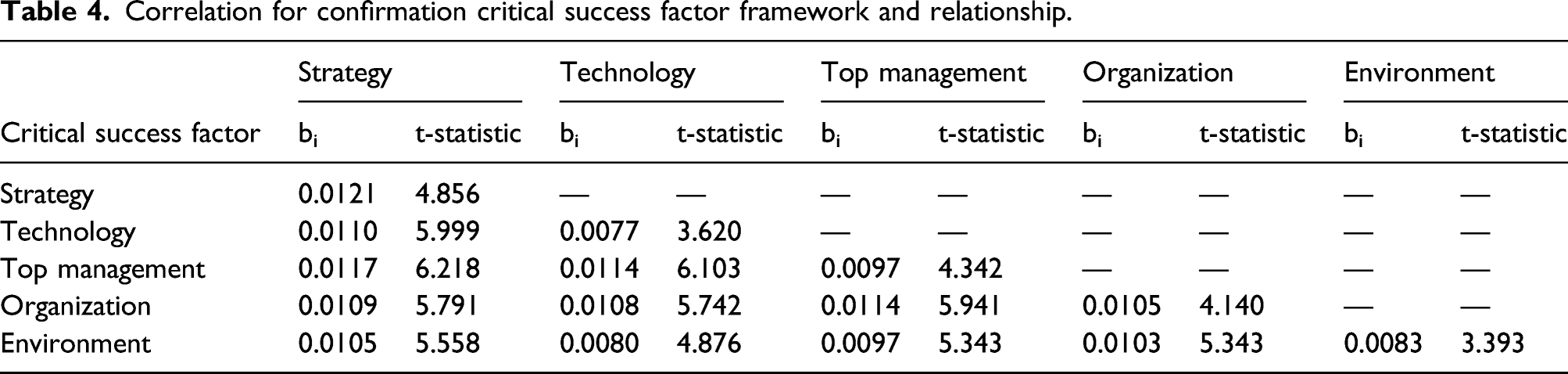
After each variable was shown to meet the criteria, the second step was the performance of the first-order confirmatory factor analysis (CFA). This process was completed to examine the hidden factor in each variable. Some latent variables had more weight compared to others.
Following the first-order CFA, the five factors or variables were further examined at the second-order level for model specification. This analysis was executed to attain an accurate and valid model fit for data collected with the theoretical supports behind the constructed model. 68 The assessment of the first-order CFA denoted that five variables were fit with the constructed model. Those factors were strategy, top management, technology, organization, environment, and empirical data to support H2. The correlation value was influenced by respondents being from different departments.
Correlation for confirmation critical success factor framework and relationship.
Critical success factor estimate model validation and result
The last step of validating the purposed model was the second-order CFA. This step played an important role in justifying a higher-order factor. Strategy, organization, top management, technology, and environment were five factors that led to the second-order factor results.
Estimate model criterial comparison result.

χ2=169.95, df = 151, and p-value = .13861, as shown in Figure 2. Table 5 shows that RMSEA = 0.024, SRMR = 0.0473, NFI = 0.931, CFI = 0.988, GFI = 0.922, and AGFI = 0.902. The value of the t-statistic of five critical success factors was > 1.96 with 5% alpha, as shown in Table 6. After analyzing the value of each path parameter, it can be concluded that the developed model corresponded to empirical data. Second CFA for critical success factor model measurement result. Loading factor estimation model of critical success factor result.
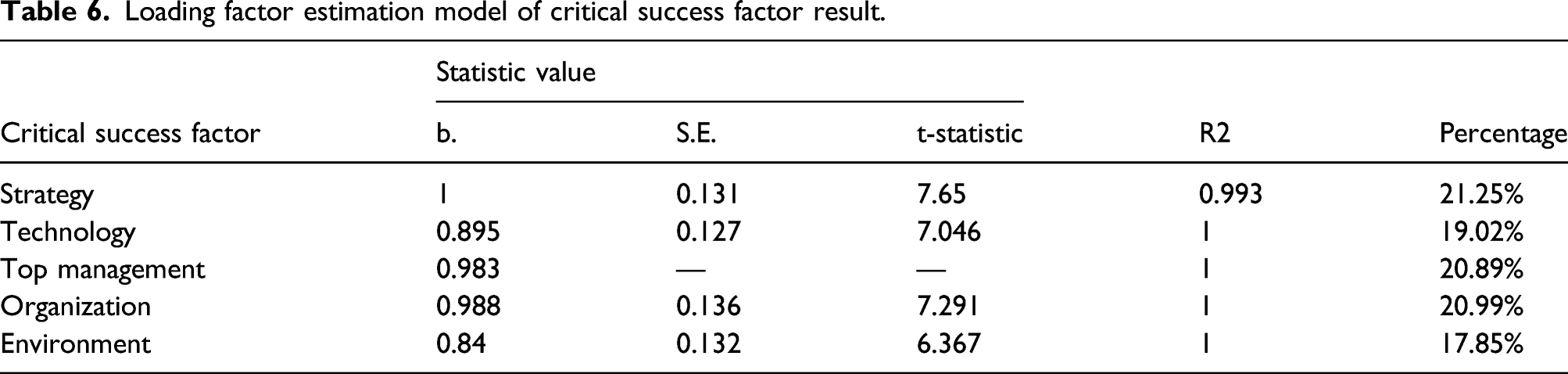
The results show that all critical success factors had loading values of critical success factors that could be used. It shows the importance of the factor of AMT adoption to manufacturing. The ranking of all critical success factors is presented in Table 6. The first factor, the result of strategy, is statistically significant, meaning it has a positive impact on the critical success factor of AMT adoption. The value of the loading factor was equal to 1.00, or 21.25% of the total. The second factor was organization. It had statistical significance and a positive impact on the critical success factor of AMT adoption. The value of the loading factor was 0.988, or 20.99%. The third factor was top management. It had statistical significance and a positive impact on the critical success factor of AMT adoption. The value of the loading factor was 0.983, or 20.89%. The fourth factor was technology, which also had statistical significance and a positive effect on the critical success factor of AMT adoption. The value of the loading factor was 0.895, or 19.02%. Finally, the environment factor had statistical significance and a positive effect on the critical success factor of AMT adoption. The value of the loading factor was 0.84, or 17.85%, as shown in Table 6.
Loading factor and percentage of subfactors under each critical success factor
Data summary standardized solution of loading factor of each subfactor.

Discussion
Advanced manufacturing technology failures might cause considerable losses. Implementing automation is not as simple as replacing humans with machines. It requires proper planning and management throughout the project lifecycle. A firm must fully understand all critical success factors for AMT adoption in their manufacturing process. The study’s results confirmed previous research that identified five critical success factors and subfactors that impact AMT adoption. The analysis shows that strategy (21.25%) is the most critical factor followed by organization (20.99%), top management (20.89%), technology (19.02%), and the environment (17.85%).
A proper and well-designed strategic approach (24.53%) is first required, and it should contain clear instructions for AMT adoption with plausible and achievable objectives. Further, firms should consider the tangible and intangible benefits (19.65%) that the company will obtain from the use of advanced technologies. The company’s position (19.13%) and financial position (18.89%) should be used to consider its situation in the market along with its HR and management (17.62%).
Functional organization
According to the results of the program analysis, employee knowledge (29.73%) is a critical success factor; it is important because an employee will use the new technology and maintain the system in good condition. The benefits of the technology (27.52%) should be considered to select new technology and align it with the company’s business (24.02%) so that it benefits the company in terms of revenue. The company’s organizational structure (18.72%) should arrange resources to accommodate their use of advanced technologies responsibly within the company.
Top management is another important factor that contributes to successful AMT adoption. According to the results of the analysis, top management should concern itself with financial circulation (29.74%), which considers the company’s cash flow and assessment followed by manufacturing strategy (26.13%), which drives the company organization and aligns with the new technology used. The commitment of top management (22.57%) to the use of advanced technologies in the future should be in support of the company’s goals and manufacturing vision (21.57%), focused on marketing, technology, the manufacturing process, and presenting new products in the market.
As per the technology results of the program analysis, a company should first consider facilities and infrastructure (36.21%). Next, the company should consider employee knowledge and abilities (32.1%). The technology in use (31.38%) that is chosen should be appropriate, such as Industry 4.0 or IoT, for the infrastructure and goals of the company.
Finally, the first priority for the environment should be business planning (35.46%) regarding the suitability of the advanced technology and aligning it with company goals, followed by external pressures (34.41%) that concern the company’s competitive situation in the global market. Next, vendor development (30.13%) should be considered to support the company in terms of machine manufacturers and knowledge about installation and maintenance. The training of staff is also critical.
Conclusion
The study comprised a collection of critical success factors and their subfactors where SEM was used to evaluate and validate each critical success factor, relationship, and its subfactors. After conducting the analysis with 212 questionnaires, five critical success factors and subfactors were identified and validated via SEM and influence the adoption of AMT. The result shows that all factors were congruent with empirical critical success factors, subfactors, and relationship data and will aid in successful AMT adoption.
A framework developed with relationships will form a theoretical basis for further practical research. This framework can be used by senior management to answer questions before deciding on AMT adoption. They should ask several questions before making a decision. Why do we use AMT in the organization? There is an appropriate strategy to implement. There is a new organization with resource planning, staff training, and preparation for adopting new technologies. Do we select new technologies and match them with current technologies, such as Industry 4.0, and future implementations? Do we have supplier development for the adoption of new technology? What are the expected benefits of adopting new technology? Also, how much capital investment is required for AMT adoption? How do manufacturing strategies and human resources practices help technological adoption in a company? Is top management committed to overcoming the risks associated with adoption? How is the company’s readiness in the current situation? These questions should be asked before investigating the use of new technology in an organization. An analysis of the answers to these questions reveals all the critical success factors and subfactors. However, this does not mean that all answers have to be satisfactory to adopt AMT. Gaining an in-depth understanding of internal, external, and technological situations before making a decision to accept them is essential.
Indeed, the study has identified five critical success factors, subfactors, and priorities. The knowledge gained from this study will be useful for industrial companies in developing countries to adopt the required steps before deciding to adopt the advanced technology. Additionally, the study provided required steps before deciding to adopt advanced technologies that would be useful for interested companies. This study is more useful for developing countries than for developed countries because the former still lack knowledge and experience for AMT adoption and implementation. Furthermore, it can be used as a guideline for companies in designing the assessment process, including factors weight score to check the readiness of the business before the adoption of AMT. It will allow companies, both SMEs and large enterprises, to increase their efficiency and reduce cost and time.
Supplemental Material
sj-pdf-1-enb-10.1177_18479790211055057 – Supplemental Material for Analyzing the importance of critical success factors for the adoption of advanced manufacturing technologies
Supplemental Material, sj-pdf-1-enb-10.1177_18479790211055057 for Analyzing the importance of critical success factors for the adoption of advanced manufacturing technologies by Sakonphot Sukathong, Poonpong Suksawang and Thanakron Naenna in International Journal of Engineering Business Management
Footnotes
Acknowledgments
This dissertation could not have been completed without the invaluable support and encouragement from many people. I would like to express my appreciation to my advisor, Asst Prof. Dr Thanakron Naeanan, for his patience, suggestions, and guidance throughout the program. I also wish to express my appreciation to Assoc. Prof. Dr Poonpong Sukawang, Asst. Prof. Dr Tuangyot Supeekit, and Dr Chairawat Worawichai for their kindness in serving as the examination committee. The comments during the examination had enhanced the quality of this dissertation. Sincere thanks and appreciation go to all participants who were part of the interview and data collection processes. Thank you to all my friends especially my mom, daughter and Tawinan, colleagues at work, and family for the great support and encouragement during the process of PhD program.
Authors’ contributions
Conceptualization – Sakonphot Sukanthong. Project administration – Sakonphot Sukanthong. Writing, review, and editing – Sakonphot Sukanthong, Poonpong Suksawang, and Thanakron Naenna.
Declaration of conflicting interests
The author(s) declared no potential conflicts of interest with respect to the research, authorship, and/or publication of this article.
Funding
The author(s) received no financial support for the research, authorship, and/or publication of this article.
Ethics and Patient Consent
This section is not applicable for this manuscript type.

Supplemental Material
Supplemental Material is available for the article.
References
Supplementary Material
Please find the following supplemental material available below.
For Open Access articles published under a Creative Commons License, all supplemental material carries the same license as the article it is associated with.
For non-Open Access articles published, all supplemental material carries a non-exclusive license, and permission requests for re-use of supplemental material or any part of supplemental material shall be sent directly to the copyright owner as specified in the copyright notice associated with the article.
