



Abstract
The purpose of this study is to outline a transformation model that can help commercial enterprises to design, develop and launch a transformation programme of change within its global human resource (HR) operations function using the Six Sigma Define-Measure-Analyse-Design-Verify (DMADV) methodology. A qualitative approach of a single descriptive case study using the Six Sigma DMADV methodology was chosen to develop an iterative strategic roadmap that enables a HR function to transform its current service delivery operating model in line with organisational challenges. The present results indicate that the design of a strategic planning process, transformation programme and roadmap of prioritised improvement initiatives can enable human resource management (HRM) functions to scale their operating model into the future. Furthermore, the flexibility of the DMADV methodology means that the proposed model may be applied in any function outside of HR and indeed may be of interest to private organisations seeking to develop a similar programme of change.
Keywords
Introduction
Human resource (HR) processes are aimed at enhancing organisational performance, compliance and employee development. At its core, human resources management is a strategic function responsible for the formation of organisational culture and the development of employee’s abilities to deliver increased value for their organisation. By establishing a culture of continuous improvement, HR departments can ensure that their people management processes remove non-value adding tasks and increase their value in delivering improved employee experiences. Lean principles have been successfully used in manufacturing systems to eliminate waste and improve customer experience.1,2 Indeed, the term ‘Lean’ was coined in 1987 by an MIT research team studying the Toyota Production System. 2 described how lean was a way to ‘do more with less’ towards achieving customer satisfaction. Since then, a large volume of research has become available on the topic of Lean and many industries beyond manufacturing have applied the tools and principles of lean throughout their operations. 3 Although several definitions and interpretations of Lean exist, the consensus amongst researchers and practitioners is that Lean is focussed on eliminating waste from processes while maximising customer value. Furthermore, there are documented examples of Lean helping organisations to increase their competitiveness, reduce operational costs and improve customer satisfaction. 4 Thus, we believe that Lean systems offer huge potential to implement innovative solutions to Human Resources Management (HRM) practices.
The key mission of human resources is to enable businesses to achieve their strategic goals and views employees as an organisation’s greatest asset. Today, HR comprises of the key activities undertaken by organisations to achieve their strategic business objectives. 5 However, as global businesses continue to experience disruption and unprecedented change, including the increasing adoption of e-HRM, there is a real need for human resources to evaluate their service delivery strategy and develop the means to transform its operations to remain competitive. Rapid technological advances in web-based e-HRM applications including employee self-service-channels, recruitment as well as online training platforms are increasing the customer experience and reducing the need for manual HR processing thus contributing to overall HR transformation. 6 Furthermore, global HRM functions are adopting machine learning (ML) technologies including robotics and chatbots for low complexity administrative processes including onboarding, benefits or leave management to increase the efficiency and effectiveness of their operations. 7 With the increased adoption of disruptive digital technologies on HRM practices coupled with ever changing employee expectations, there is a real need for HR department to elevate its service delivery strategy and develop the means to transform their operating model.
Indeed, the word ‘transformation’ can have various meanings. The essence of any operational transformation is the need to increase value, continuously evolve your operating model and deliver exceptional products or services for your customers. 8 It has been previously outlined how organisations must instil a programme of change by making processes more efficient and effective as well as enabling an environment of continuous learning. 9 Nevertheless, transformation poses challenges and risks for any organisation seeking to undertake a radical change. 10 Transformation is also complex and strongly influenced by the role of leadership in creating a vision, the effective application of change management practices to overcome employee resistance to change and the establishment of a core team to guide the change process. 11 The present research is an attempt to integrate HR transformation into the planning cycle of a business regardless of their size.
Human resource management has been considered as a part of the enterprise information system. 12 The authors considered both equipment and human as a part of the system, structural resource to improve the resilience of the enterprise. However, an enterprise information system in practice has limitations with respect to the number of components which can be considered at the same time. This requires a more comprehensive consideration of various compounds through the system automation. Integrated design and operational management methodology are other options to integrate transformation in the enterprise. 13 However, this concept falls beyond the scope of the present article.
Human resource itself has been on a transformative journey over several decades yet in the eyes of many organisations, it is seen as a clerical administrative function rather than a strategic business partner. 14 Nevertheless, there are significant gaps in empirical research outlining the constraints or enablers for HR to elevate itself to being a strategic business partner committed to enabling the organisation to transform itself. 15 According to a recent report from the Society of Human Resource Management, 16 key challenges facing global HR organisations include the ability of an organisation to execute transactional processes under increased operational constraints, growing legal and compliance complexities as well as the need to elevate HR to be recognised as a strategic transformational partner. However, it is not enough to focus on internal challenges. Instead, HR should also look beyond their operations to better understand how they can increase value for their organisation and their customers. In addition, we often hear that people are an organisations greatest asset but despite this, strategic decisions often run contrary to this widely held belief and according to researchers, 17 leadership often fail to recognise the value which HR can enable for an organisation. There is also an increasing need for HR leadership to recognise the impact of industry 4.0 on the skills and competencies of its workforce. Employees must develop problem solving skills to adapt to new changes which machines in their current capacity are incapable of doing so. 18 In addition, the technological impact of robotic process automation, artificial intelligence (AI) and the ‘Internet of things’ are placing increased pressure on organisations as well as the workforce to build skills in these recent business technology developments.
It is therefore essential for HR to demonstrate in tangible terms the value that it enables in an organisation through continuous people development and strategic partnerships. We believe that this can also be achieved through the careful management of the organisations culture and the application of quality improvement frameworks such as Lean Six Sigma in pursuit of meeting the organisation’s strategic objectives. However, if HR take the perspective that Lean and Six Sigma are strategic enablers which add value to their customer’s, it becomes easier to appreciate how these established quality methodologies can enable the transformation of HR processes and services. 19 By doing so, HR can be a catalyst for further transformation across the organisation thereby elevating itself to being recognised as a strategic business partner. Indeed, it has been demonstrated that Lean Six Sigma can be applied successfully beyond the manufacturing floor and has been used to improve HR processes including reducing talent acquisition cycle times, improving the onboarding experience of new hires and training of employees. 20 Raytheon have successfully embedded Six Sigma within their HR function having recognised the role that HR can play in supporting cultural and mindset changes needed across the organisation. 21 GE, Honeywell and Motorola are other leading organisations who have applied Lean and Six Sigma principles beyond their manufacturing processes into the HR function to varying degrees of success. 22 Thus, recent studies have begun to demonstrate how Lean and Six Sigma methodologies have enabled HR to increase its value and strategic presence in organisations. In addition, the previous work has shown that there is a synergy between Lean and resilience concepts, whereas Lean implementing firms have a greater chance of leveraging resilience capabilities to manage disruptions without necessarily requiring huge investments on redundancies. 23 Introducing any major change to an organisation introduces change-related risks. According to previous studies, 24 there are several change management-models which leadership should become familiar with prior to the implementation any major transformation. For example, ADKAR® (Awareness, Desire, Knowledge, Ability, Reinforcement) is an established evidence-based change management model comprising of five key milestones which an organisation must meet to achieve a successful transformation outcome. 25
Continuous improvement projects within HR often follow the Six Sigma DMAIC (Define, Measure, Analyse, Improve, Control) methodology which has been applied since the 1980s as a recognised data driven scientific method for solving complex business problems. The DMAIC methodology has been built on established scientific, engineering and quality improvement techniques pioneered throughout the 20th century. 26 The DMAIC methodology is supported by an extensive toolbox of improvement and statistical methods that are used to deliver step change process improvements in both manufacturing and non-manufacturing environments including HR. 27 A more recent Six Sigma methodology known as ‘design for Six Sigma’ or DFSS was introduced in the late 1990s to support with the design of new products, processes and services. 28 A popular way of applying DFSS is by using the DMADV methodology (Define, Measure, Analyse, Design, Verify). Whilst utilising many of the established processes, tools and techniques of Six Sigma, DMADV differs from DMAIC in that it solves for the design and development of new products or services that currently do not exist. In contrast, DMAIC is a structured way of solving problems for existing processes or services. Although the application of DMAIC has been highly standardised overtime, there are in contrast criticisms of the use of DFSS. A clear consensus of the application of DMADV across industry was previously reported. 29 Nevertheless, leading organisations such as GE have embraced DFSS within their Medical System’s Division to a high degree of success. 26 Although DMAIC and DMADV share common steps and characteristics, they are not interchangeable since they were fundamentally developed to solve different business requirements. For example, DMAIC is typically applied to improve existing processes whereas DMADV is applied in the design and development of new products, processes and services. In addition, several competing methodologies have been defined overtime which can be used by an organisation to structure a programme of change. There are limitations to previous management and transformational frameworks which have having developed independently overtime have failed to integrate with one another in support of achieving transformative objectives. 2 Hence to the best of this author’s knowledge, no previous work has been undertaken in the application of the DMADV methodology to design a transformation programme within HR. Despite Lean and Six Sigma being leading business strategies for organisational improvement, companies have struggled to find a strategy that can be adopted within HR. 1 A common misconception amongst HR professionals is that application of Lean and Six Sigma is applicable in manufacturing environments or that improvements require the application of complex statistical methods. Consequently, the opportunity arises to demonstrate how Lean Six Sigma can be used by HR professionals to transform their organisation.
The novelty of this research relies on the fact that the transformation model could be used by any organisation seeking to design and launch a major programme of change using the established Six Sigma DMADV methodology. This aim of this work is to therefore provide a new model for HR to their operations model that uses Lean Six Sigma tools, techniques and methodologies in pursuit of achieving strategic objectives. Furthermore, this research will present the findings of a separate case study involving industry peers that helps to validate the uniqueness and applicability of this model for use in other organisations.
Methodology
Research methods
The study method relies on continuous comparison of experimental data and theory using an incremental approach to case selection and data gathering. The success of the case study depends on the selection of operational measurement criteria to establish a chain of evidence to support the research findings and conclusions. 31 Case studies are known to serve exploratory, explanatory and descriptive purposes. 32 However, the development of replicable, relevant and valid theory requires connections with the real-life application. 33 Case study research allows for the establishment of both variance and process theories. Here, variance theories provide fundamentals for the explanation of the linkages between independent and dependent variables, whereas process theories are mostly focused on explaining how sequences of events have led to an outcome.34,35 The present work is based on a single case study design that according to the literature can provide a particularised understanding of the case with the rich contextual insights, which paves a way for learning with the concurrent development of a novel theory. 36
In the present work, a single case study was selected with the defined objectives, design method, data collection strategy, analysis method and write-up template – which are key elements in any case study research of Sigma Six Lean Systems. This single case study was undertaken within global HR enterprises, headquartered in Dublin, Ireland. The responsibilities of the process improvement team include the coaching of HR management in the tenets of Lean Six Sigma, providing in house training in quality improvement techniques and delivering transformation projects in partnership with the operations teams. In addition to the process improvement team, the global HR operations function is comprised of 10 teams and has 70 full time employees located in the United States, Ireland, Brazil and Singapore. The operations function is responsible for providing frontline HR support including recruitment and onboarding coordination as well as routine benefits administration. Operations management is responsible for ensuring that our processes remain compliant, and we continue to deliver excellent services to our internal customers.
As the organisation is forecast to expand its employee base by 20% over the next 3 years, it is anticipated that the current HR operating model comprising of people, processes and systems is not equipped to meet the needs of a growing business. Therefore, HR leadership have recognised the importance of having an efficient HR operating model and have invested in a core team comprised of HR operations managers who responsible for overseeing the creation of a 3-year transformation roadmap. Following the formation of a core transformation team, a project was launched in June 2020 sponsored by the Global Director of HR which applied the DMADV methodology to design a 3-year transformation roadmap. The different phases of DMADV and applicable tools used by the researcher to achieve the project’s objectives will be described below.
Define-Measure-Analyse-Design-Verify methodology
High level overview of the DMADV methodology and tools/techniques applied in this project.

Upon completion of the DMADV methodology as outlined in Table 1, the researcher undertook awareness training with the core management team to help explain in more detail the various project phases and tools that would be required to design and launch the transformation programme. The Define phase which was used to outline the transformation project charter and scope for the overall project will be discussed in the next few chapters.
Results
Define phase
During the ‘define phase’ of the project, the sponsor nominated the author to manage the different DMADV phases of the project. During this phase, the core team which was selected by the sponsor undertook a workshop to define the expectations for the project and clarify any initial concerns that they may had. In addition, the deliverables of this phase required the development of a vision for change and definition a project charter.
Project SIPOC and vision definition
A SIPOC (suppliers, inputs, process, outputs, customers) diagram was created which assisted in the definition of the project scope and helped to clarify the inputs and outputs required for the remainder of the DMADV project, as shown in Figure 1. It would also be used as a communications tool throughout the life of the project. During this ‘kick-off’ phase, the core team translated the sponsors vision into the following three key project deliverables: 1. Design of a transformation model, 2. Development of a roadmap and implementation plan, 3. Launch of a transformation programme. Project SIPOC.
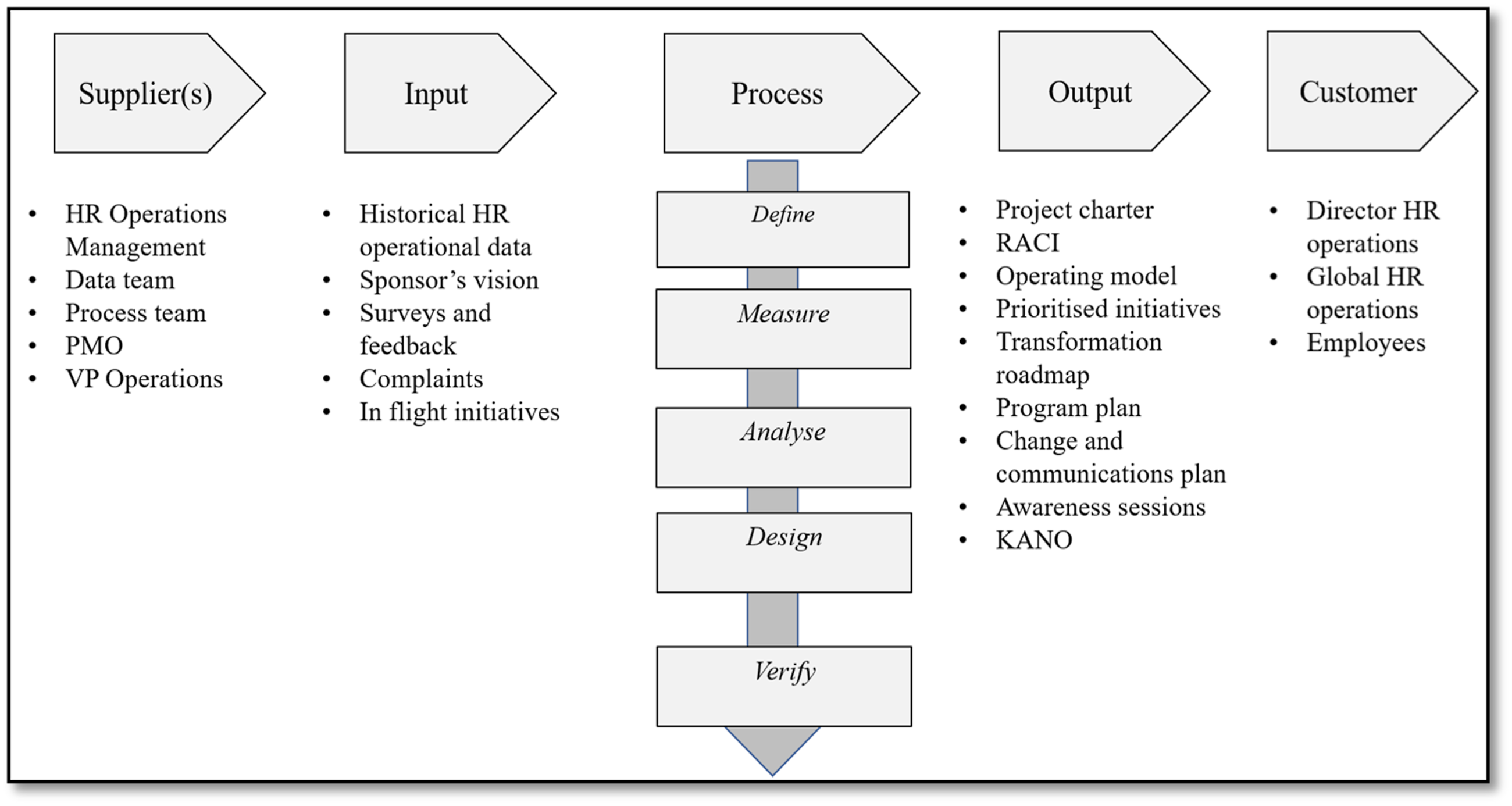
This initial define step was deemed essential as it assisted the team to develop a common understanding of the objectives necessary for transforming the HR operating model. It was agreed that a failure to describe the vision for transformation at the commencement of the project risked confusing the organisation and could inadvertently introduce scope creep further along in the transformation journey. In addition, this vision statement was embedded within the communications plan and used frequently to help enable employees and cross functional partners to understand how their operating environment would transform in the future.
Project charter
After several workshops were facilitated with the core team, the project charter was defined which detailed the business case, problem statement, scope, milestones, deliverables and overall DMADV timeline. The final step in the define phase required the charter to be presented to the sponsor for review, feedback and subsequent sign-off to progress to the measure phase of the DMADV project. Once the define phase concluded, the project team outlined the measure phase plan and organised several workshops with extended members of the HR leadership team to successfully determine the critical to quality characteristics of a successful transformation programme.
Measure phase
During the measure phase of the project, the project team aligned on the key objectives of this next phase which were to understand the critical to quality characteristics (CTQ’s) required for the creation of a transformation roadmap. A series of interviews and workshops were facilitated to understand what constituted a successful HR transformation. A ‘reverse thinking’ exercise helped the core team to think about the problem in a different way and to identify the factors which could impact the delivery of a successful transformation programme. The insights obtained from this exercise would be used to create a series of questions for a Kano survey.
Kano survey and analysis
The Kano model was developed by Professor Noriaki Kano in 1980 and has been applied in product as well as process development to categorise the importance of a particular component or feature from a customer’s perspective. The outcome of a Kano analysis can be used to rank a customer’s requirement for a particular aspect or feature of a new design. Furthermore, the Kano model can help to illustrate how the features of a product or a programme can vary in importance from the view of the customer. 37
Quality classifications. 42

Partial view of the survey completed by one of the global management team.

Quality classifications were determined using the Kano method based on the combinations of survey responses to various programme feature requirements. The survey responses were imported into a spreadsheet which was used to determine the Kano category for each feature as well as the functional/dysfunctional scores. Figure 2 provides an overview of the Kano evaluation model that was used to evaluate the survey responses. KANO characterisation evaluation matrix and classification legend.
Summary of customer (sponsor and core team) requirements, importance rating and Kano quality categorisation.

The Kano analysis enabled the researcher to measure and determine the expected levels of business satisfaction with the proposed features of the transformation programme prior to undertaking the detail design. It provided a summary of priority features which if implemented would contribute to the delivery of a successful transformation programme. The results of the Kano analysis are summarised in Table 4.
Figure 3 is a visualisation of the Kano model that was used to demonstrate the transformation programme features that would satisfy or delight the project customers. Having identified the various CTQ’s required for a successful transformation programme, the project team undertook to synthesise the insights during the next phase of the DMADV project. This required the team to present their findings and updated project plan to the sponsor who approved the project to progress into the analyse phase where a high-level programme design would be undertaken. KANO Model for a transformation programme.
Analyse phase
Transformation framework design
During this next phase of the DMADV project, insights from the Kano analysis were used as inputs into the development of a high-level transformation framework design. Figure 4 provides an overview of the transformation framework which was used to bring common understand and structure to the programme. A workshop was facilitated with the HR core team to discuss the results of the Kano analysis, and this led to the development of a blueprint to help guide the team in understanding the elements required to design the transformation programme. It was agreed that a successful programme required a clear vision from HR leadership as well as key drivers of change which would act as the catalyst to ignite the programme of transformation. In addition, strong programme governance, change management and effective communications were identified as key elements required to support the change. The next steps in the analyse phase required the core team to undertake an analysis of the HR operating model which would be used to help identify areas requiring transformation. Current state HR operating model overlayed with the key challenges.
Current-state operating model analysis
Having completed the Kano analysis which resulted in the creation of a high-level transformation framework, the team moved their attention to the analysis of the current state operating model to develop an agreed understanding of the key challenges facing operations. During a virtual workshop, the team analysed the current operating model to define at a high level the problems, risks and constraints impacting each element of HR operations. These issues were overlaid on top of the operating model blueprint as can be seen in Figure 4.
Partial view of the operating model analysis.

Transformation initiative identification and prioritisation
The next steps in the ‘analyse’ project phase required the team to brainstorm improvement activities and initiatives to address the gaps or problems identified in the current state operating model as illustrated in Figure 4. However, the core team were faced with an early challenge in the analyse phase related to prioritising which projects to include within the broader transformation programme. In addition, it was recognised that not every transformation project would be viable for inclusion within the broader transformation programme due to several factors including staffing availability, time to execute projects and budgetary constraints. Therefore, a method of project analysis and prioritisation decision-making was required.
To solve for this challenge, a prioritisation matrix was used by the project team comprising of a series of weighted business criteria to score transformation project proposals against. Figure 5 illustrates the priority matrix that was used to stack rank the different project proposals against one another. The top row of the matrix comprised of agreed business criteria with a defined scoring legend to assist the team in undertaking a prioritisation exercise. In addition, a weighting percentage for each business criteria were defined with a higher value allocated to criteria with a greater strategic importance. In total, eight business criteria were defined in the prioritisation matrix. The next steps required the project team to critically assess each project’s brief against the different criteria contained in the matrix and through rules established in the spreadsheet template, and the project team were able to dynamically stack rank each of the project proposals against one another. In addition, in-flight projects not directly related to the transformation programme were also identified and captured in a prioritisation matrix. In total, 12 projects were critically assessed in the prioritisation matrix and as can be seen in Figure 5, A ‘rank’ value of 1 represented the highest priority transformation initiative related to the HR Benefits ‘Lift’ projects. In contrast, projects with an increasing rank value denoted a progressively lower priority in terms of strategic importance for the transformation programme. Prioritization matrix used to identify top eight initiatives.
The prioritisation matrix proved to be a useful visual tool which had an added benefit of increasing the collaboration across the core team in pursuit of achieving a list of prioritised improvements. During the analyse phase toll gate, the sponsor agreed to focus on the top 8 transformation proposals. Furthermore, members of the core management team were nominated to lead the detailed scoping of the prioritised initiatives that were identified earlier and would later be responsible for leading the implementation of the changes during the transformation programme. The next phase of the DMADV project – known as the ‘Design’ phase required the team to undertake a detailed design for the top eight prioritised projects as well as programme governance in support of managing the transformation programme.
Design phase
Programme governance
Upon completion of the analyse phase toll gate review, the project team commenced the design phase of the project which required them to establish programme governance, undertake a detail design of the roadmap and complete an implementation plan for the launch of the transformation programme. A key factor in the success of any transformation is the application of strong programme governance and risk controls. The primary objectives of the programme governance included programme management, administration and oversight of the transformation roadmap to ensure progress to planned outcomes. Governance would also provide a centralised decision-making authority for scope changes and provide control over the evolution of the HR operations transformation programme. A success criterion for this project was the establishment of a roadmap and implementation plan containing a phased approach to transforming the current state HR operating model. The inputs for the roadmap were sourced from the managers and supervisors responsible for developing in detail their individual project scopes, capacity planning, timing and measures of success. Workshops were facilitated with the core team to understand the most optimal sequencing of project implementation.
Change Management
A risk assessment exercise was undertaken to identify and manage potential risks prior to the launch of the programme. Key risks associated with organisational change readiness were assessed which identified the requirement to apply proven change management techniques to counter any potential resistance to change. In addition, change and communication plans were completed and verified with the project team and sponsor prior to application in the next phase of the project. Having synthesised the literature research, the ADKAR® model was chosen to help the organisation through the transformation journey as it was assessed as being the most suitable change management model to meet the organisation’s needs.
A key deliverable of the design phase required the creation of a consolidated transformation roadmap which outlined the key change initiatives that were approved during the analyse phase of the project. The inputs, milestones and timelines for the roadmap were sourced from the managers and supervisors responsible for developing in detail their individual project scopes. Workshops were facilitated with the core team to understand the most optimal sequencing of programme implementation. Having a poorly thought-out programme plan may introduce risks avoidable risks concerning timelines and interdependencies. 43 To support the project team with the implementation of the programme, a Gantt chart was selected as the most suitable project management tool to plan and track tasks or deliverables.
A thorough risk assessment was completed prior to the launch of the transformation programme and key risks and mitigations were captured in the programme risk register. This ‘living’ document would be handed over to the programme manager for perusal upon completion of this DMADV project. In addition to completing a risk assessment, the change and communications plans were updated along with increased awareness and training of the transformation programme for the core project team. These team members would subsequently play the role of ‘change agents’ after the launch of the programme and would be responsible for communicating regular updates on the progress of the programme with their direct team members. The final step in the design phase required the development of a verification plan to ensure that team members would understand the vision of transformation. A survey was developed which would be used to gauge team members’ awareness and understanding of the transformation journey as well as assess their change readiness to embark on the transformation journey ahead.
Verify phase
Programme launch
During the ‘verify’ phase, the sponsor formally launched the transformation programme and several ‘town hall’ meetings were held with each of the global HR operations teams to explain the vision for change. Feedback or concerns raised by operational staff were addressed by their respective line manager or supervisor who was responsible for acting as ‘change agents’ throughout the lifecycle of the transformation. After launching and communicating the transformation programme, a survey was undertaken within the global HR operations function to ‘pulse’ check the current levels of awareness, understanding and willingness for change amongst the operational teams. The analysis obtained from the ‘pulse’ survey provides measures of success for the launch of the transformation programme. In total, there was an 85% participation rated out of 54 staff surveyed. The results of the transformation survey indicated that 73% of staff understood the scope of this year’s transformation programme but 27% of staff were either unaware or unsure of the proposed vision for change. Figure 6 shows two key responses evaluated during the verify phase and these will provide baseline metrics for future programme change surveys to compare against. Change management survey conducted after formal launch of the transformation program.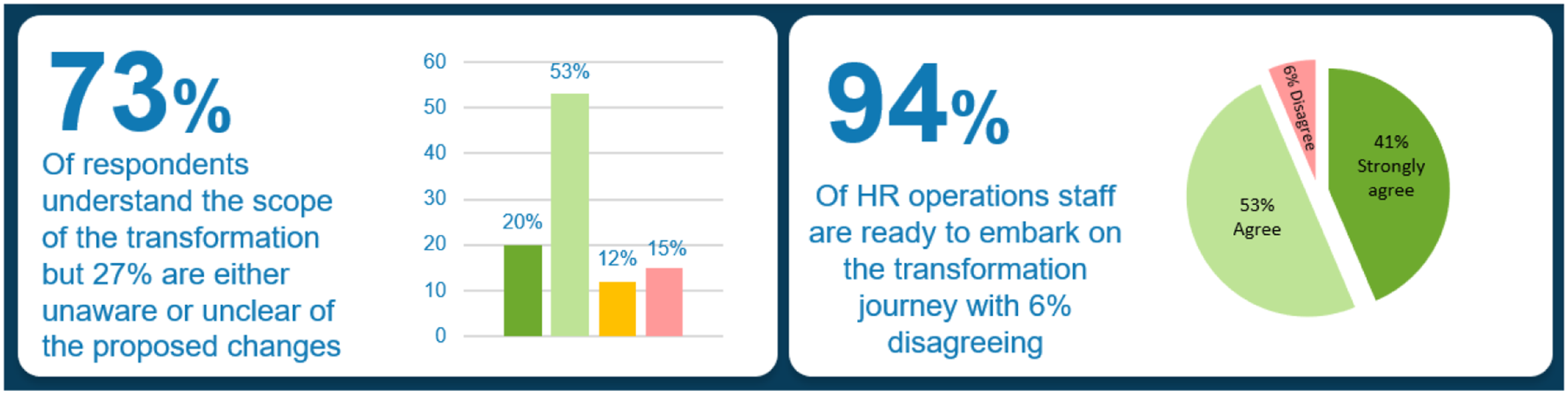
Further engagement sessions were subsequently held with the operations teams and smaller focused sessions allowed for more open and honest conversations to be facilitated. It was discovered that there were varying levels of trust amongst some of the more tenured staff towards leadership’s commitment to a successful transformation having experienced mixed attempts at implementing organisational change in the past. The key is understanding the natural tendency of people to resist new ways of working and implement strategies to successfully manage the transition through the change cycle.39,40 Nevertheless, 94% of HR operations staff surveyed agreed that they were ready to embark on the transformation journey indicating a strong level of change readiness amongst staff members.
The survey feedback will also provide data insights by which to measure the success or otherwise of this DMADV project as well as inform opportunities to improve awareness and understanding of the need for organisational transformation. In addition to validating the results internally within the researcher’s organisation, feedback was solicited from external industry peers who operate in a similar capacity within their HR departments. The purpose for doing so was to assess whether Six Sigma methodologies can be used by other organisations to develop future transformation programmes of change. Furthermore, the researcher sought to understand common drivers for HR transformation within the technology industry as well as ascertain if there are other methodologies being applied by peer organisations.
Verification of model using external feedback
Against this backdrop, the researcher sought to identify organisations operating in the technology industry who may be interested in applying a similar of model transformation as outlined in this work. Three leading technology multinationals were shortlisted, and several interviews were conducted with individuals who showed interest in exploring the use of the methodology within their organisation.
Characteristics of peer organisations in support of validating the DMADV transformation model.

Structured interviews were conducted in March 2021 where the respondents shared their opinions of HR transformations as well as the applicability of the Six Sigma DMADV methodology towards the development of a programme of change.
Industry insights and drivers of transformation
It was discovered that organisation A was actively pursuing HR transformation while organisation’s B and C had made a strategic decision not to pursue a major organisational change in 2021 due to the current COVID restrictions impacting their operations. Organisation B however recognised that recent external disruptions including the global pandemic had increased the desire amongst HR leadership to pursue a major transformation of their HR operating model. However, no formal transformation programme was under development. Furthermore, it was discovered that there were common drivers of transformation amongst the three organisations surveyed including: 1. Automation of manual processes and the need to integrate disparate HR technology systems. 2. Increased desire for self-service of HR applications forcing organisations to re-think HR policies and processes. 3. External events driving increased remote working arrangements as well as the expected return to office for organisations post pandemic.
Whilst each organisation described their own unique challenges in addition to the above drivers of change, the researcher explained how the transformation model described in this work could be used by any organisation to pursue a programme of major change.
Application of define, measure, analyse, design, verify in future transformations
When surveyed about the application of the DMADV methodology for use in future transformation, organisations B and C showed a strong interest in tailoring the approach for use in their organisation. They discussed the advantages of the model including its use of familiar Lean tools and techniques as well as the application of strong programme governance and controls in support of launching a transformation programme. In addition, the combination of HR operating model analysis and the application of the ADKAR® change model was welcomed as something novel in pursuit of designing a future programme of transformation. Organisation B suggested that they would like to undertake a small, localised pilot prior to applying the methodology in a broader context. The rationale for doing so would be to build trust in a new way of structuring their future transformation programmes before applying it towards a more complex organisational transformation. It was agreed that the transformation model outlined in this work which comprises of the DMADV methodology, tools and programme governance would act as an ideal blueprint for organisation B to pilot a small-scale transformation in early 2022.
In contrast, organisation A felt that the approach appeared rigid and there would be cultural challenges towards its adoption in future HR transformations. When asked further about the cultural barriers to its adoption, the researcher discovered that organisation A lacked the necessary leadership appetite for change as well as in house transformation capabilities to support future HR transformations. However, the representative from organisation A agreed that there was a need to improve their HR processes and consequently, recognised that Lean and Six Sigma could be an ideal strategy to support them.
Discussion
This research presents a new model for implementing HR transformation and details how to design and launch a programme of change using the DMADV methodology. It demonstrates the successful application of Lean Six Sigma principles and methodologies that enabled a world leading HR function to design and launch a 3-year transformation programme. Surprisingly, the present results of the DMADV model validation demonstrated that HR transformation will require a greater investment in time and energy towards creating trusting relationships between staff and leadership. Whilst change is inevitable for any organisation to thrive and survive, a certain level of resistance can be expected with the introduction of a major organisational transformation like this programme of work.
41
The findings indicate that the establishment of a trusting environment will support HR transformation in a smooth and pleasant pathway. Previous attempts to launch such a programme within the organisation had failed in part due to a lack of structured methodology or the application of proven change management methods towards organisational change. Moreover, the literature reports that HR transformation models have evolved independently overtime and have often failed to integrate the necessary tools, methodologies and change management practices towards achieving their intended outcome.
30
This work has led to the development of an integrated transformation model using the DMADV methodology in conjunction with the ADKAR® model as illustrated in Figure 7. The advantage of this new model includes its ability to be structured to address specific organisational challenges as well as its application of established Lean Six Sigma tools and methods. Change management survey conducted after formal launch of the transformation programme.
The drivers of change act as triggers of inspiration for leadership to form a vision of transformation. Programme, change and communications practices form key pillars in the model and provide the necessary tools, techniques and methodology to enable the development of a transformation roadmap. Transformation initiatives can be identified using the current state operating model and a prioritisation matrix can be used to stack rank projects as input into the roadmap. Although Cronemyr described limitations in the use of the DMADV methodology 43 , particularly the lack of consensus of its application across industries, the advantage of this model has been to demonstrate its flexibility in the application of a broad array of Lean Six Sigma tools used throughout the process. This will enable organisations to tailor the framework to meet the needs of their transformative objectives or specific cultural challenges inherent in their business.
Furthermore, current HR focused Lean or Six Sigma research tend to focus on the application of the DMAIC methodology towards improving existing HR processes such as reducing recruitment or onboarding cycle times 20 yet there lack real world examples of designing HR transformations using the DMADV methodology. In addition, Laureani and Anthony have described how HR have traditionally struggled to implement a Lean Six Sigma strategy towards delivering organisational improvement. 1 The reason for this may be due to a limited understanding of the methodologies or levels of organisational maturity and risk appetite required to apply the approach. However, this research has demonstrated DMADV has been successfully used by HR to design and launch a strategic priority such as operating model transformation over a 3-year period. This will enable the organisation to evolve its operating model and ensure that HR continues to deliver excellent services to its customers.
This study has several significant implications for the success of DMADV implementation in companies. When need for HR transformation is clearly identified, application of the DMADV methodology will ensure the design process will proceed smoothly and in a short timeline. Management will experience high returns on the investment of resources in these activities. In later stages of transformation, when problem (opportunity) delineation is less clearly defined, the integration of DMADV application will be more difficult compared to the initial process design stages. The results of the present study suggest starting the HR transformation change with the clear initial design objectives versus a later redesign of the process. Management will experience low returns on the investment of resources with the risk of longer implementation timelines. The present research demonstrates that it is imperative for management to understand the reason for this change as implementation can become difficult over time. Moreover, lessons learnt from the present study show that DMADV implementation is an expensive undertaking and without understanding this phenomenon, companies may abandon the implementation prematurely without realising optimum benefits resulting from such an implementation.
The present integrated model which incorporates DMADV with programme and change management practices represents the first attempt in academic literature to demonstrate its use towards the design of a HR transformation. Despite limitations in this model which include its lack of validation within external organisations pursuing a similar programme of transformation, further research is inspired towards the development of standard Lean Six Sigma tools during each of phase of the DMADV methodology. Moreover, the limitation of the present model is related to the selection of a single case study in industry, which potentially limits the general applicability of the proposal. However, this study can serve as a reference model not only for the industry but also for others interested in adopting LSS approaches in the public sector organisations, according to their specific needs.
The development of a maturity model which incorporates external industry benchmarking could be used to assess the effectiveness of the current design as well develop a roadmap of improvements to evolve the transformation model into the future. A more comprehensive framework model for the HR transformation can then be developed when the additional validation will be performed through surveys and interview at various geographical locations in both public and commercial enterprises.
Conclusion
This work provides a new approach towards structuring organisational transformation using Lean Six Sigma and could complement or indeed iterate on existing transformation methodologies. The findings of this study emphasise the adaptability of the DMADV methodology in pursuit of implementing a new strategy such as transformation and has the capability of being used by any organisation seeking to radically transform their operating model. The results indicate that organisations who apply the DMADV methodology in conjunction with the application of the ADKAR® change model can lead to a successful launch of a HR transformation programme. The present HR transformation model was validated by surveying industrial peer-review enterprises aiming to demonstrate how Lean Six Sigma can be used to increase the value of HR services within a commercial enterprise. Furthermore, given the increased adoption of digital technologies combined with the need for organisations to develop key technical skills in AI or robotics, we believe that now is the time to examine the integration of Lean and Six Sigma methodologies in conjunction with digital transformation towards achieving strategic business outcomes.
Footnotes
Declaration of conflicting interests
The author(s) declared no potential conflicts of interest with respect to the research, authorship, and/or publication of this article.
Funding
The author(s) received no financial support for the research, authorship, and/or publication of this article.
