



Abstract
Varying characteristics of developed and developing countries have resulted in different challenges and innovative solutions of city logistics. This study aimed to identify research clusters on city logistics between developed and developing economies and to systematically compare city logistics challenges and associated innovative solutions for both economies. Bibliometric analysis and a systematic literature review were applied to analyze 328 peer-reviewed publications, comprising 229 (70%) and 99 (30%) articles addressing case studies in developed and developing economies, respectively. We discovered six research clusters in city logistics literature for developed countries, compared with only four for developing economies in which public policy has not been addressed. Urban growth, environmental challenges, and traffic congestion are the three major city logistics challenges in both types of economies. Furthermore, fleet increment and inadequate loading/unloading spaces are the city logistics challenges analyzed in the literature on developing countries compared with the literature on developed economies that addresses the challenges of education deficiency, regulation, emergence of new business models, and network accessibility and capacity. Consequently, innovative solutions adopted by developed countries demonstrate varied processes involving technology, policy (including public policy and sustainability measures), infrastructure, and economic measures, while for developing countries, the focus remains on effective and efficient distribution operations using optimization and collaboration efforts.
Keywords
Introduction
The increasing movement of goods, particularly in metropolitan centers has created a challenge for city logistics which deals with a smooth and seamless flow of goods while minimizing negative environmental impacts and improving safety, security, and healthy living conditions. 1 The majority of city logistics initiatives were initially implemented in developed economies. Nevertheless, developing countries such as China, India, Mexico, Chile, and Brazil have an earlier stage in the development of urban logistics practices than developed countries such as France, the Netherlands, and Japan. 2 It appears that countries have different stages and successes in implementing solutions in urban logistics.
Urban population growth has become a challenge for city logistics in both developed and developing countries. By mid-2018, the urban population reached approximately 78.7% and 50.6% in developed and developing countries, respectively. 3 Nevertheless, the urban population density is higher in developing countries than the developed countries, which then leads to different city logistics solutions. The developing countries thus prioritize congestion prevention, air pollution, and smooth traffic to city centers, whereas developed countries extent the focus not only on minimizing traffic congestion and pollution but also protecting residents from noise, such as some cities in Northern Europe and preserving historic buildings in Italy. 4 Moreover, the developed countries have made use of technology advancements such as electric vehicles to deal with environmental issues 5 and intelligent systems for parking improvement. 6,7 The developed countries have shown a broader and more varied application of solutions than developing countries. 2
Furthermore, a city logistics solution that is effective in one country may not be suitable in another country. For instance, the construction of consolidation centers in several western countries has not found enough acceptance, even though it has been supported by the government, on the other hand, the urban logistics center appears to be promising solutions in developing countries. 4 Many of the initiatives that have proven applicable in developed countries are not suitable for developing countries and vice versa. This fact occurs because different environmental, socio-demographic, and economic issues colliding with each other, creating trade-offs, leads to different focus and approaches of city logistics. 8 The evidence indicates that the city logistics problems encountered by both developing and developed economies appear to vary. Meanwhile, city logistics initiatives or innovative solutions should be designed to fit encountered city logistics challenges. However, the lack of understanding of the type and complexity level of the city logistics problems in the two types of the economy can result in inaccuracies in initiatives. In addition, the unavailability of initiative comparisons in the two economies results in a misjudgment in the initiative’s adoption process. Therefore, an exploratory analysis of the existing city logistics literature, which compares the city logistics in developed countries and developing countries, is important to a holistic understanding of current research gaps between the two countries.
Review-based studies on city logistics have existed, such as investigation of city logistics topic from 104 studies during 2000–2015,
9
a systematic review of 370 city logistics literature from 2010 to 2016,
10
and a scientometrics review on city logistics literature.
8
Those reviews have made a significant contribution to mapping city logistics development and future trends of city logistics. Given the need to address the city logistics studies in the developing countries,
11
the present study, therefore, complements the previous studies to provide a detailed comparative analysis of the city logistics in the developed and developing countries concerning research clusters and the relationship between the experienced city logistics problems/issues and city logistics initiatives. This paper attempts to answer the following two research questions:
The first research question is to provide a visualized relationship of research clusters which reflects core content of the literature and long-term development of specific research field, whereas the second research question contributes to providing the visualized systematic relationship between the experienced city logistics problems and associated innovative solutions in both developed and developing economies. This study was based on a survey of 328 articles published from 1986 to 2019, which were examined using bibliometric analysis and a systematic literature review (SLR).
This paper is divided into four sections. The first emphasizes the differences in city logistics in developed and developing countries, while the second describes the search, selection, and analysis of the literature. Subsequent results and discussion form the basis for the third section, which is followed by a summary of the outcomes of the study and highlights of potential avenues for future research in the fourth section.
Methodology
Bibliometric analysis 8 and Systematic Literature Review (SLR) 12 were conducted to meet the research questions. The SLR has been widely used in previous review-based studies on city logistics to identify different aspects of city logistics, 10 to provide an accurate description of trends and gaps of city logistics, 8 and to identify gaps in promoting sustainability of urban logistics system. 13 The SLR appears to be useful owing to its transparent and systematic methodology which facilitates in-depth evaluation, reliable findings, and replicability of the study.
The bibliometric analysis used country data and keyword data for descriptive statistics and co-occurrence analysis. The co-occurrence analysis based on keyword data was to provide in-depth analysis and rapid understanding of meaningful research topics of city logistics in both countries.
SLR was implemented based on the framework, shown in Figure 1, to provide a more comprehensible structured process. The framework consisted of seven primary phases: problem definition, literature search, literature selection, bibliometric analysis, SLR, analysis, and output. Figure 1 shows the individual steps, which are explained in this section.
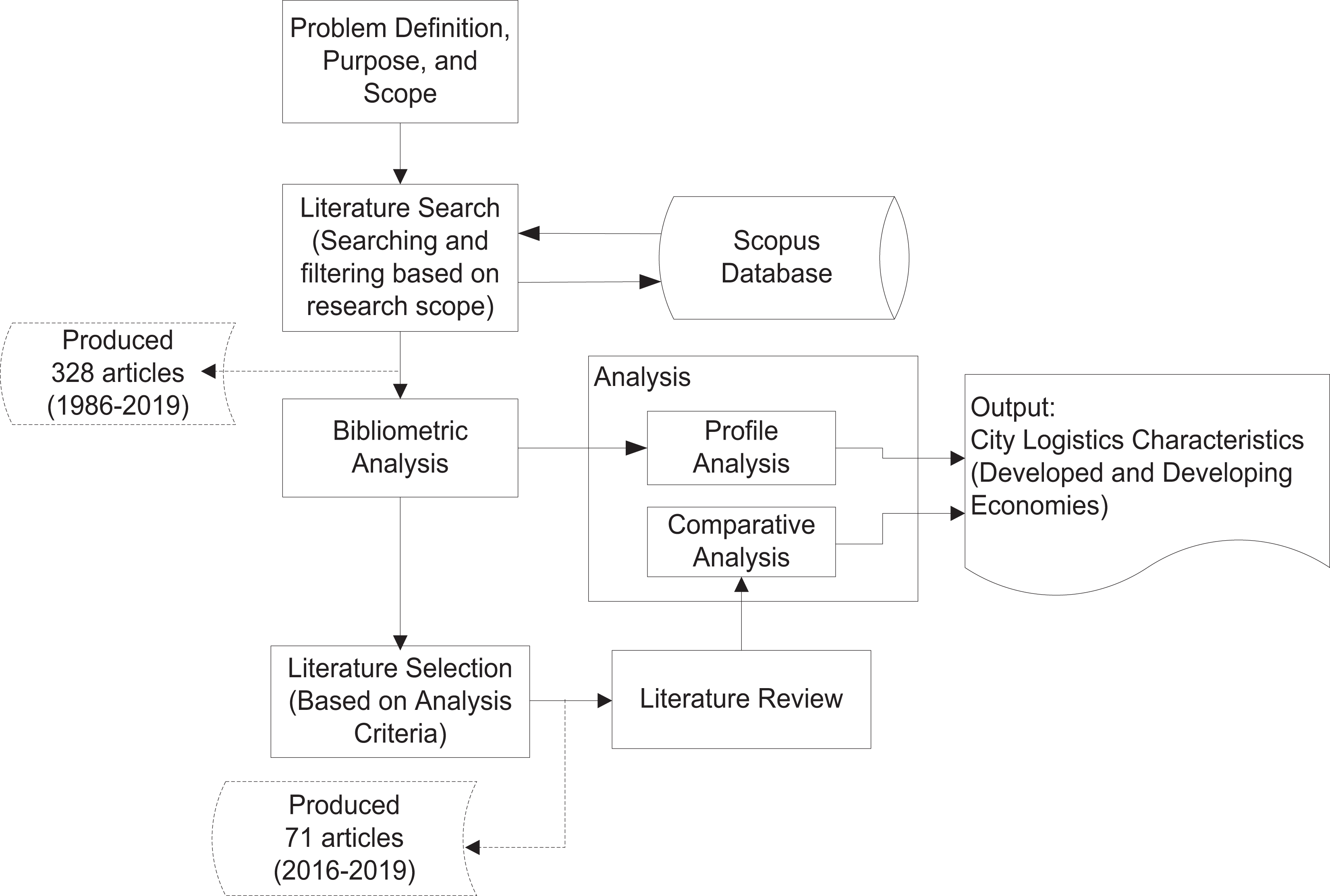
Stages of the systematic literature review.
Problem definition
The first stage defined research problems, objectives, and scope. We considered that the characteristics of the two economies result in different research clusters on city logistics, city logistics problems/challenges; therefore, the implemented initiatives differ. As studies comparing city logistics between the two types of economies are lacking, this paper contributes to the systematic analysis of existing scenarios with respect to problems and innovative solutions and attempts to comprehend the mechanism required to justify the accuracy of the solutions.
Literature search
The search for relevant literature involved the process of inquiring and filtering numerous articles based on the predetermined criteria shown in Table 1. The aim was to obtain samples directly related to the city or urban logistics. This stage commenced with the search process using city logistics, urban freight, and case as the keywords. Only peer-reviewed publications were included in this study. The literature sources were predominantly acquired from the Scopus indexed database (Elsevier, JSTOR, IEEE, Emerald, Taylor & Francis, Nature, and several other scientific bases). Subsequently, the collected articles were carefully screened and filtered to select the best fit according to Criteria 1–3 specified in Table 1. Overall, 328 journals related to city logistics from 1986 to 2019 were identified.
Criteria of systematic review.

Bibliometric analysis
A bibliometric analysis describes a quantitative evaluation of indexed data, including author, document source, citations, country, publication year, and keywords. A bibliometric analysis was conducted in two stages. The first involved the search for scientific contributions according to the country of origin and was generated using a descriptive bibliography. 14,15 When there was a difference between the country of origin and the empirical study location, the country underlying the empirical study was selected. This first stage produced two categories of articles from developed and developing countries, which were following the United Nations. 16 The second stage involved keyword mapping through co-occurrence analysis, which was used to reveal the clusters related to city logistics topics, based on the calculation of paired data. The co-occurrence method considers the frequency of a keyword text appearance using the VOSviewer software. Moreover, additional information related to scientific research, including the emergence of new keywords, is also provided. 17 Therefore, the analysis statistically revealed the fundamental concerns of the research field and adequately represented the trend of city logistics in both developed and developing countries to address the first research question (RQ1).
Literature selection
This process involved the selection of case studies conducted by examining empirical articles on the most recent city logistics development between 2016 and 2019. Subsequently, a classification process was performed (in both regions) based on Criteria 4 and 5 (specified in Table 1) as the basis for literature selection for the SLR. The selection produced 71 articles, which were subsequently used to address the second research question (RQ2).
Full-text review (quality assessment)
The full-text review was conducted on the selected corpus of the empirical articles. The review was conducted to ascertain logistics problems and associated innovative solutions in both developed and developing countries.
This process stage involved synthesizing publications based on the framework (Figure 2) and was initiated to identify problems or challenges associated with city logistics. The prevailing challenges were categorized into two types of factors: internal and external. 18 Internal factors are aspects of the implementation of carriage modes to reduce the negative effect of the urban transport system. 18,19 Conversely, the external factors are part of the development with a tendency to affect conventional urban transportation systems. Furthermore, internal factors are related to transportation functions of a city’s logistics involving the physical distribution process. This refers to problems associated with the distribution system and the movement of goods, such as the use of light or medium or heavy, and electric vehicles, motorbikes, or bicycles. External factors can affect and disrupt logistics processes in urban areas. Particular examples include population growth and distribution, traffic congestion policies, and gas emissions. External factors, also known as exogenous factors, tend to hinder effective logistics operations 18 ; therefore, they were further evaluated under impact analysis as they result from the interaction of multiple problems. Based on an impact analysis, losses were easily identified, and various aspects of city logistics were formulated. Consequently, an aspect was defined as relevant subjects, parts, or features considered in municipal logistics initiatives 20,21 and was categorized into four types: infrastructure, immaterial infrastructure, equipment, and policy. Infrastructure is a supporting section of the logistics process in urban areas related to basic physical needs and services, 20 e.g. road networks and logistics facilities. Immaterial infrastructure relates to research, learning, and training to improve the effectiveness of city logistics. The immaterial infrastructure also involves the processing of data and information with the aid of tools, including algorithms or technology (telematics elements). Equipment is described as a conveyance device for transporting goods, e.g. vehicles and loading units. This tool is applied to achieve optimal delivery conditions, including limited vehicles, capacity design, and new standards of equipment or handling units. Policy refers to the act of regulation, e.g. public policy. Based on these categories, innovative solutions in both developed and developing countries were systematically identified and compared.

Synthesis framework used to analyze the literature.
Analysis
This stage consisted of a literature profile assessment and comparative assessment. Profile analysis comprised descriptive statistics and co-occurrence evaluation by examining the relationships among articles based on keywords (nodes). These connections included links, link strength, and total link strength. Furthermore, link indicates the relationship between keywords, while link strength is the value of the correlation (frequency) between two keywords appearing simultaneously in a series of papers. The total link strength describes the overall value of link strength. The comparative analysis was a collation of empirical problems, impacts, aspects, and solutions related to city logistics in both developed and developing countries, using a synthesis process, as detailed in the SLR section.
Output
The expected output of literature analysis was research clusters in both economies and a systematic relationship between the experienced city logistics problems and associated innovative solutions of both economies.
Results
City logistics trend
This section outlines the results of the bibliometric analysis, which was based on 328 articles published between 1986 and 2019, where 229 emanated from developed countries, while the remaining 99 were from developing nations. The analysis included an evaluation of the literature profile and co-occurrence network to identify the research clusters between the two economies. Figure 3 shows that developed and developing economies contributed up to 70% and 30% of the overall city logistics literature, respectively.
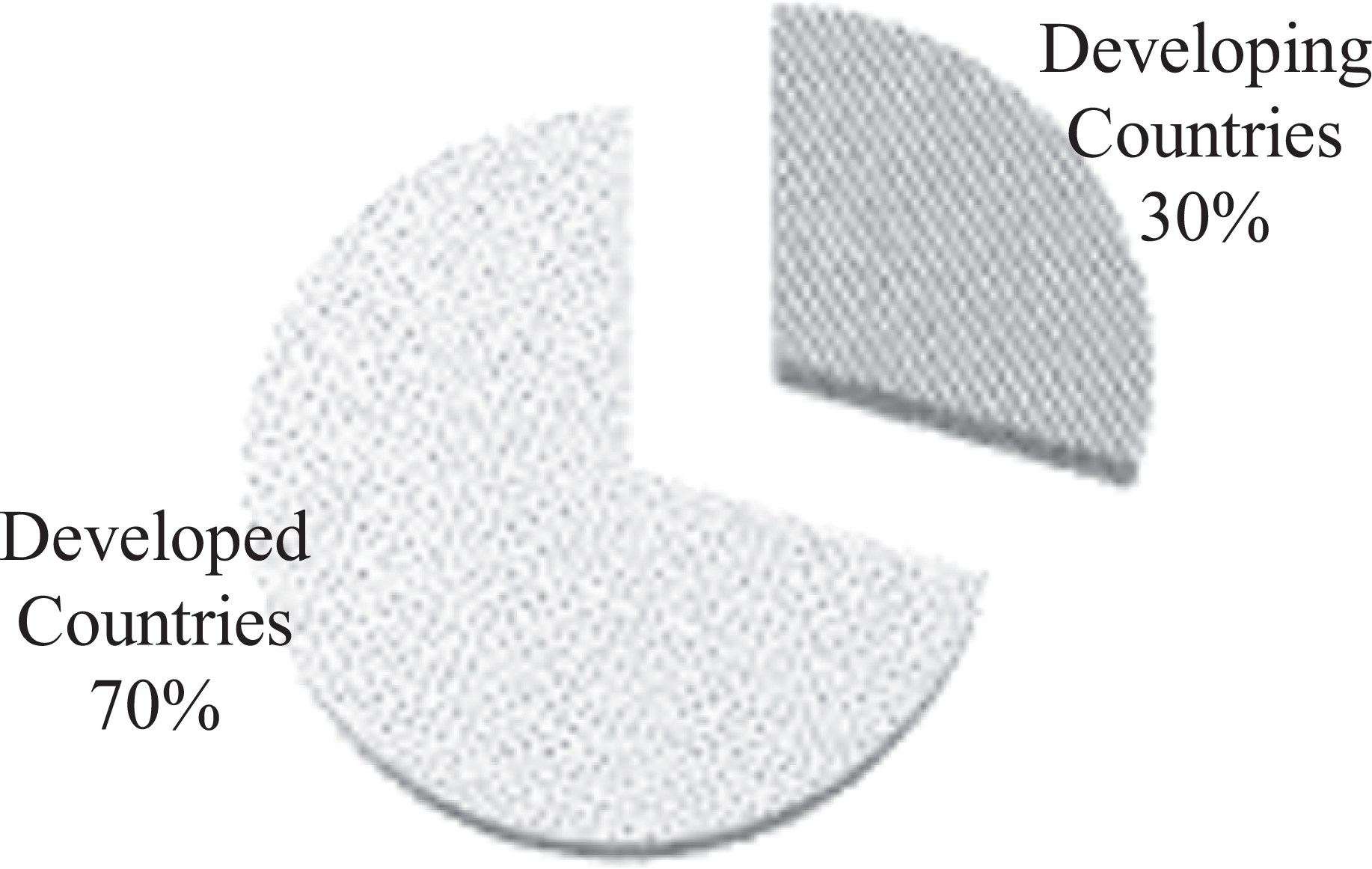
Developed vs. developing countries in city logistics literature.
Figure 4 shows a growing interest in city logistics studies in both types of countries. Detailed investigation on the collected corpus of the papers indicates that the dominating topic of the papers deals with the evaluation and comparison of various urban logistics solutions in terms of economic benefits, emissions, congestion, delivery time, etc. It implies that searching for best/practical solutions coping with urban logistics problems fitting the context seems to correspond to the noticeable increase of the literature, which is in line with the work of Lagorio et al. 9

The trend of the city logistics literature: (a) developed countries and (b) developing countries.
Figure 4(a) shows that the literature on city logistics has been published since 1986 in the developed region. However, the development of these studies was stagnant until 2009, when a significant increase in city logistics studies occurred. During the early phase, the studies focused on delivery operations, including mapping of coordinated distribution potential of goods in Uppsala, 22 implications of road pricing in New York and New Jersey, 23 as well as the optimization of routing challenges in Jyvaskyla, Finland. 24 Along with the dynamic surge of city logistics literature in 2010, the discussed challenges of city logistics have been more diverse, including consolidation centers, 25 –27 routing problems, 28 –30 emissions, 27,31,32 location of distribution facilities, 33 –35 city logistics regulations, 36,37 traffic management, 7,38,39 and delivery technology. 5,29,40
Figure 4(b) shows the positive trends in city logistics research in developing countries. Studies in developing countries have focused on infrastructure to overcome challenges relating to city logistics and urban transportation. 41,42 Some studies examined the shipping operation zone, 43 –52 urban transportation network, 53 –58 and distribution centers. 59 –61 Meanwhile, very few studies addressed vehicle routing, 62,63 traffic management, 64 and delivery technology. 65
Figure 5 shows the countries that contributed to the city logistics literature. The United States (36 articles), Italy (27), the United Kingdom (21), Spain (19), Belgium (14), and Germany (14) are the six most contributing countries in the city logistics literature of developed countries. Figure 5(b) shows the 14 countries contributing to city logistics literature in developing countries, in which China, Brazil, and Columbia are the 3 highest contributors.

City logistics literature by country: (a) developed countries and (b) developing countries.
Research clusters
A co-occurrence analysis based on keywords was conducted to evaluate the network of the literature (Figure 6). The threshold procedure for excluding keywords with fewer than five occurrences was applied. A node represented the keyword used in articles, in which the larger its size, the greater the weight value, indicating an extreme effect. However, the weight had three standard values: occurrence, links, and total link strength. Occurrence implies multiple appearances in other articles, while the value of links represents the number of links associated with a particular keyword compared to others, and the total link strength refers to the accumulation of values for a particular keyword’s link strength.
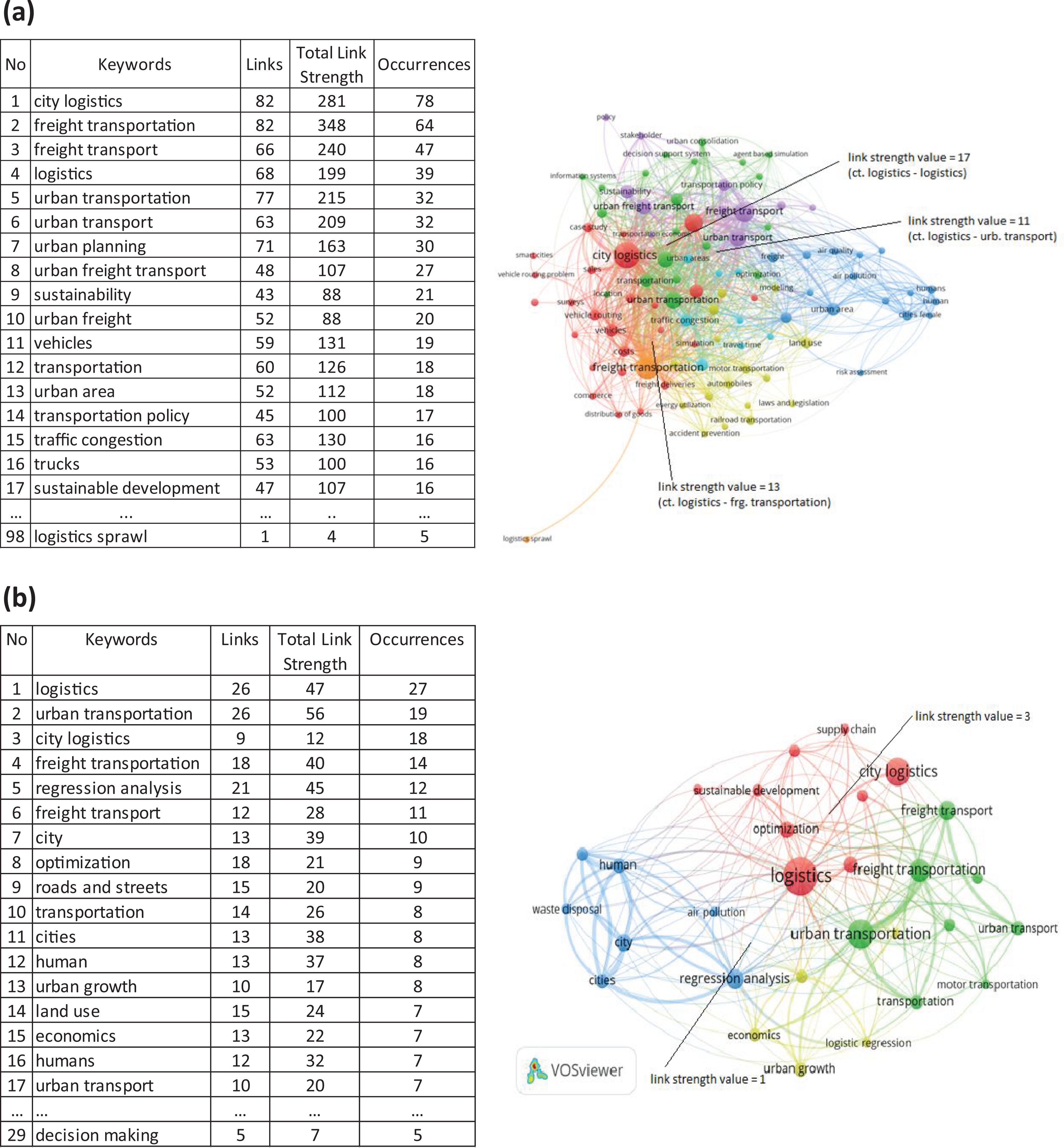
Co-occurrence networks: (a) developed countries and (b) developing countries.
The link (represented by a line) between nodes indicates that the two keywords appear together in a document. Each link has its strength value, representing the number of articles in which the two keywords appeared simultaneously (co-occurrence). A higher keyword co-occurrence reflects a higher link strength value and implies a stronger relationship, as represented by the thickness of the line in Figure 6. For example, the link strength value = 3 for logistics–city logistics (Figure 6(b)), denoting that the two keywords appeared simultaneously (co-occurrence) in three articles, and exhibited a firmer relation (thicker link), compared with freight transport–regression analysis (link strength value = 1), for which there was only one article appearance.
As shown in Figure 6(a), city logistics had the greatest occurrence (78). However, freight transportation had the highest total link strength (348), which implied that the concept has been established. Based on the network investigation, city logistics was observed to be closely related (keywords with a minimum link strength value of 10) to certain keywords, termed freight transportation, urban transport, and logistics. This indicated a positive match with the city logistics definition and subsequent interrelationship, owing to high co-occurrence. Meanwhile, a strength value between 5 and 9 indicated an important aspect of the primary keywords, including sustainability, transport policy, decision-making, traffic congestion, sales, costs, vehicles, vehicle routing, stakeholders, urban growth, and urban planning. In addition, many keywords had strength values between 1 and 4, e.g. smart cities, e-commerce, energy utilization, fleet operation, agent-based models, and air pollution. These were discussed in papers from developed countries, although the strength value was relatively low, and therefore requires further evaluation.
Based on co-occurrence analysis, six topic clusters were found in developed countries, as indicated by the color of the nodes (Figure 6(a)). The six clusters are city logistics, urban transportation and economics, urban growth and environmental development, public policy, freight transport sustainability, and traffic congestion and management.
The co-occurrence analysis for developing countries, which was based on 99 articles, is shown in Figure 6(b). The keyword of logistics (27) had the highest occurrence, compared with urban transportation (19), city logistics (18), and freight transportation (14). Based on the total strength value, urban transportation (56) had the highest ranking, indicating an established concept. Based on link strength, a close relationship exists between urban transportation and freight transportation (with a link strength value of 10), indicating that both keywords are associated. In contrast, urban transportation is poorly correlated with city logistics (with a link strength value of 2), implying that city logistics are still limited in urban transportation. Therefore, efforts to resolve urban distribution in developing countries should consider the principles of city logistics. This is also evident in the lesser number of links associated with city logistics (9) compared with urban transportation (26). The co-occurrence analysis resulted in the four topic clusters (i.e., city logistics, freight transportation, air pollution, and economics) for developing countries (Figure 6(b)).
A systematic relationship between the city logistics challenges and innovative solutions
This subsection presents the results of the comparative analysis using the framework specified in Figure 2. City logistics challenges for both countries, as shown in Figure 7, were identified from the collected corpus of the papers which were categorized into internal and external factors using the categorization based on the study of He and Haasis. 18 The three most common city logistics challenges were identified in the literature of both developed and developing economies: urban growth, traffic congestion, and environmental problems. However, the two economies encounter specific problems. Developed countries appear to exhibit greater complexity. In terms of internal factors, developing countries are yet to introduce the advancement of logistics operations, unlike developed countries with automated vehicles, 29 electric automobiles, 5,66 and robots. 40 However, developing countries focus on analyzing delivery operations using light or medium vehicles. 67,68 This implies a delay in embracing technological changes, such as the use of proper logistics distribution vehicles. With respect to external factors, the challenges discovered for developed countries are education deficiency, regulation, network accessibility and capacity, and the emergence of new business models. Depopulation was also found for a few developed countries, which is not relevant for developing countries. 69 Moreover, poor education has been discussed in developed countries but has not yet been explored in developing countries. 70 The increase in fleets and insufficient loading/unloading space are the logistics challenges commonly addressed in developing countries.
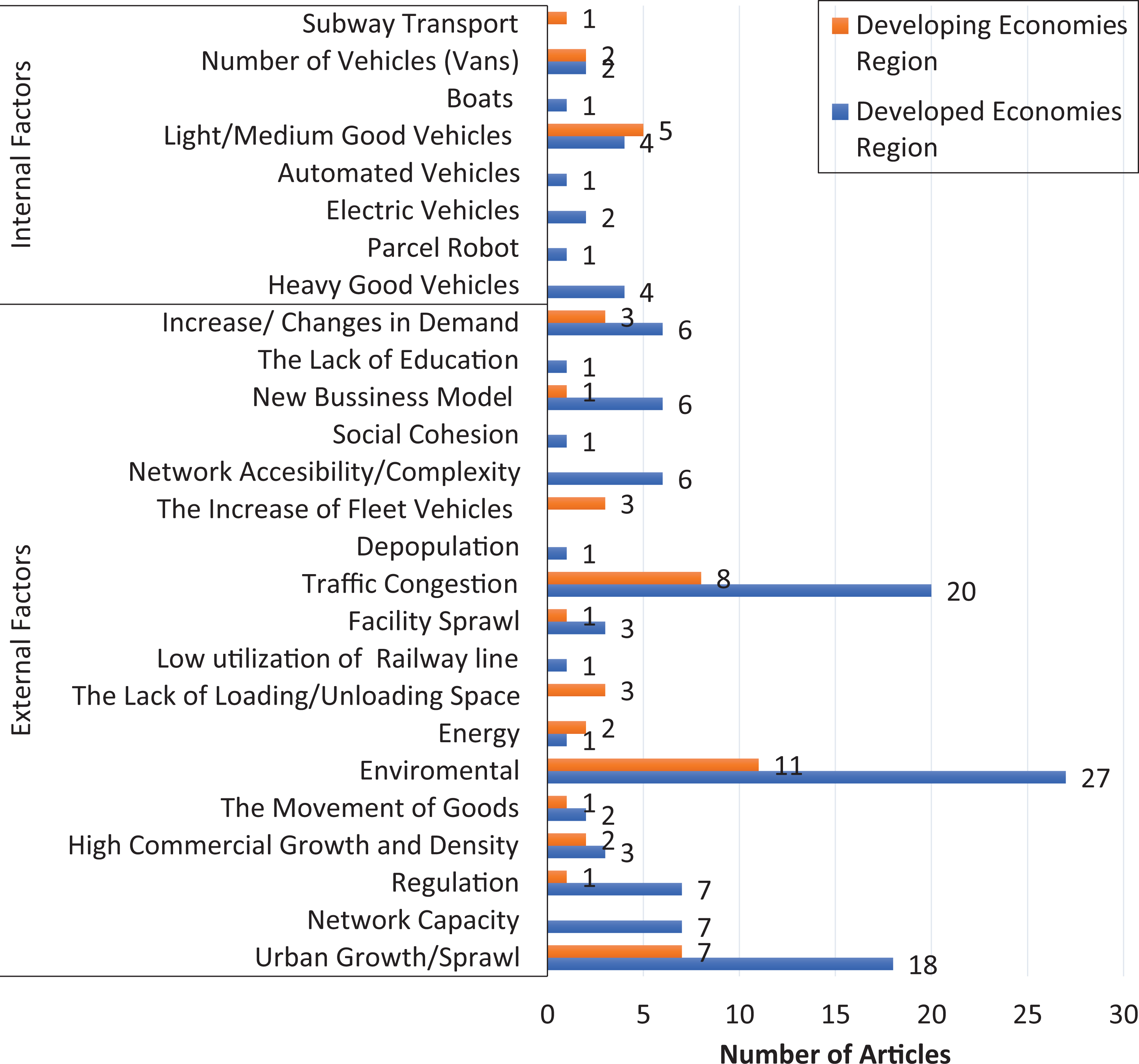
City logistics challenges in developed and developing countries.
Furthermore, based on the framework specified in Figure 2, the literature was further analyzed to understand the mechanism describing the aforementioned city logistics challenges resulting in the adoption of innovative solutions. Figure 8(a) and (b) show the mechanism of city logistics challenges/problems affecting business actors/private sector and local governments/public sector (impact analysis), instigate logistical concerns (aspects of concern), and consequently, the possible implementation of innovative solutions in both economies, respectively.

(a) Systematic analysis of challenges and innovative solutions for developed countries. References: 1. 40 ; 2. 33 ; 3. 80 ; 4. 75 ; 5. 71 ; 6. 81 ; 7. 69 ; 8. 82 ; 9. 5 ; 10. 32 ; 11. 36 ; 12. 83 ; 13. 47 ; 14. 76 ; 15. 84 ; 16. 70 ; 17. 6 ; 18. 7 ; 19. 30 ; 20. 72 ; 21. 85 ; 22. 86 ; 23. 87 ; 24. 66 ; 25. 29 ; 26. 88 ; 27. 38 ; 28. 89 ; 29. 77 ; 30. 90 ; 31. 34 ; 32. 79 ; 33. 91 ; 34. 92 ; 35. 93 ; 36. 94 ; 37. 73 ; 38. 95 ; 39. 78 40. 96 ; 41. 97 ; 42. 98 ; 43. 99 ; 44. 100 ; 45. 101 ; 46. 102 ; 47. 74 ; 48. 103 ; 49. 104 ; 50. 39 ; 51. 105 . (b) Systematic analysis of challenges and innovative solutions for developing countries. References: 1. 106 ; 2. 68 ; 3. 67 ; 4. 55 ; 5. 56 ; 6. 49 ; 7. 107 ; 8. 108 ; 9. 54 ; 10. 109 ; 11. 63 ; 12. 110 ; 13. 65 ; 14. 48 ; 15. 111 ; 16. 112 ; 17. 62 ; 18. 51 ; 19. 113 ; 20. 114 .
Figure 8(a) indicates that city logistics challenges in developed countries resulted in the disruption of urban delivery networks, increased urban freight capacity and frequency, difficulty in implementing regulations and enhanced urban delivery range, and traffic time. For instance, Bradford City experiences urban growth, limited network capacity, and disturbances in urban delivery networks, including parking space challenges. 71 In addition, several city logistics challenges related to the growth of commercial areas in the city of Seville, 6 movement of goods in Stuttgart, 72 traffic congestion, 73 and the growing demand in Singapore 74 were identified.
Urban growth increased urban freight capacity and frequency. 75 Environmental challenges have generated restrictions on transport vehicles in Swedish cities, 76 while traffic congestion was unable to bear the increasing demands, 77 resulting in high distribution costs.
Both environmental problems and urban growth had a significant effect on the implementation of city logistics regulations and urban delivery. The orientation of the policy changed from economic to sustainable efficiency owing to environmental challenges. 78 Rapid population growth also affected policies regulating the movement of logistics facilities to the suburbs of Melbourne. 79 Note that education deficiency, network capacity, and network complexity are among the logistics challenges hindering the implementation of regulatory policies.
With respect to range and delivery time, urban growth owing to the increasing population of car owners poses an obstacle that affects shipment. For instance, parking zones in Volos, Greece, are difficult to locate, thus affecting delivery time. 7 In another instance, urban growth has resulted in the movement of logistics facilities to the suburbs in Melbourne and increased the distribution range. 47 Furthermore, environmental pollution affects delivery times, causing them to be longer because the number of vehicles is reduced owing to restrictions on freight transport into the city. 39
New business models and advanced technology in delivery systems have also been identified as challenges that affect the innovation of operational distribution. A study in Cambridge demonstrated that the development of electric vehicles has affected logistical operations in which charging systems should also be provided. 5 Moreover, drones to support last-minute delivery have also affected distribution operations. 115
Based on the identified impact analysis and aspects of concerns, developed countries have subsequently developed innovative solutions. Concerning infrastructure, the innovative solutions involve parking facilities, schemes of urban consolidation centers (UCCs), urban fuel or charging systems, loading or unloading zones, location of logistics facilities, spatial network evaluation, infrastructure supply, intensive land use considerations, and collection and delivery point systems. These countries have also implemented several innovative solutions to these policies, including the improvement of facility regulations, pricing emission strategies, harmonized policy plans, monetary incentives, training activities, and access regulations. Innovative solutions to immaterial infrastructure include crowd shipping models, allocation and scheduling of delivery robots, a new freight landscape, train service increase, GPS trajectories, collaborative freight operations, parking enforcement, and signalization coordination, route planning or trip assignment, empty container management, intelligent transport, combined delivery systems, dynamic scheduling, and home delivery options. The development is strongly affected by the use of modern information technology, integration of transportation systems and resources, and cooperation and information exchange between the private and public sectors. The integration of transportation systems and resources generates the innovation of equipment, i.e. cargo hitching. This innovation utilizes all transportation capacities to carry passengers while accommodating the flow of goods. Examples of cargo hitching projects are found in Saint-Etienne, Zurich, and Dresden. The result is the optimization of the existing transport capacities and an increase in urban sustainability. 69
Furthermore, cooperation and information exchange between the private and public sectors (government) have created solutions, such as micro hubs in combination with cargo bikes and monetary incentives. In addition, support for harmonizing long-term visions tends to facilitate the adoption of micro hub policies, particularly for logistics providers. 82 Meanwhile, information exchange through actual data has succeeded in improving the behavior and motivation of own-account or third-party logistics. This milestone is used to determine the monetary incentives for the private sector. 84
Figure 8(b) shows the systematic analysis of developing countries. Several cities, including Can Tho in Vietnam, 55 Shenzhen, 68 and Tehran 54 are concerned with urban growth, whereas Shanghai 56 and Colombia 107 are addressing an increase in the number of vehicles. The city logistics challenges/problems shown in Figure 8(b) have affected the capacity and frequency of urban freight, urban delivery time, difficulty in regulation implementation, and distribution operation. No literature has seemingly discussed the disruption of network urban delivery networks in developing countries.
Optimal freight network and facility locations, e.g. determination of warehouse locations in Vietnam, 55 evaluation of distribution centers in Yogyakarta city, Indonesia 60,61 and regional distribution centers 116 and assessment of the best network using a candidate distribution center in Tehran, 54 are the solutions adopted to address infrastructural concerns. Fleet size management is used to address challenges related to logistics equipment. Note that developing countries have not adopted any innovations in delivery technology to actualize an effective and optimal distribution process. Concerning policies, facility regulation and off-hour delivery were identified as solutions. Innovative solutions to immaterial infrastructural concerns involve the introduction of green driving programs, 107 collaborative distribution, 63 route planning or trip assignment, 62,106 fleet management practices with the use of freight application, 111 and combined delivery. 56
Discussion
Table 2 summarizes the findings, based on the co-occurrence network shown in Figure 6, indicating that six and four research clusters are identified in city logistics literature of the developed and developing countries, respectively. It is worthy to note that some of the topic clusters found for developing countries, such as freight transportation and economics, have seemingly not yet been specifically related to “city” or “urban”; rather, these clusters are broad concepts. This implies that city logistics concepts are still in early development in developing countries. Similar clusters, i.e. urban logistics/freight transport, air pollution/environment, are observable in both countries. It is worth noting that public policy and sustainability of freight transport were missing in the literature on developing countries. It appears that the research clusters in the developing countries focus on resolving urban logistics problems with a short-term perspective. The result of co-occurrence analysis has also pointed out new topics. Based on the lowest strength values in the co-occurrences analysis, smart cities, e-commerce, energy utilization, fleet operation, agent-based models, and air pollution are the suggested topics for the developed countries, whereas city logistics is the suggested topic for the developing countries. It implies that public policy and sustainability for city logistics are the potential research clusters to be investigated in developing countries settings, which is supported by He and Haasis 18 who suggested applying long-term perspective in designing urban logistics strategies. Agent-based modeling approach, 116 which appears to be receiving increasing attention in studies for the developed countries, could also be used as a potential approach to evaluate the effectiveness of the formulated public policy and to assess the sustainability performances of the potential city logistics innovations in the developing countries.
Research clusters and main and specific city logistics problems.

Figure 8(a) and (b) show a more structured mechanism justifying the accuracy of these resolutions for city logistics challenges/problems. We observed that developed and developing countries encounter similar major problems, such as urban growth, traffic congestion, and environmental problems. Particular variations were observed. Developed countries focused on challenges of education deficiency, regulation, network accessibility and capacity, and new business models while developing countries encountered an increase in fleets and insufficient loading/unloading spaces. In terms of internal factor problems, developed countries have encountered problems owing to changes in physical distribution technology, including electric vehicles and robot technology. Meanwhile, developing economies have continued to rely on conventional vehicles. These differences instigate the development of solutions. In terms of infrastructure, cities in developed countries focus on road networks and warehouse locations as well as on parking facilities, loading/unloading zones, urban fuel/charging systems, spatial/land-use planning, and delivery point systems, which are unavailable in the literature on developing countries.
In addition, the considerations in the aspects of equipment and immaterial infrastructure instigate the use of technology such as cargo hitching (equipment aspect), allocation and scheduling of delivery robots, a new freight landscape, GPS trajectories, collaborative freight operations, parking enforcement, and signalization coordination, and intelligent transport systems (immaterial infrastructure aspect). Several solutions related to the regulation of city logistics in developed economies have encouraged pricing emission strategies, harmonized policy plans, monetary incentives, and training activities regulations while developing economies focused on regulating access (off-hour delivery). However, note that the literature on developed economies addresses city logistics challenges with significant effects on network disruption; therefore, appropriate solutions involving consolidation, access regulation, and last-mile delivery initiatives are implemented (Figure 8(a)). Meanwhile, none of the papers on developing economies has discussed network disruption or resilience. As a result of high uncertainty, particularly during the current Covid-19 pandemic, there is a significant demand to explore the network resilience of urban logistics in developing economies. Because a transportation system during an emergency involves multi-faceted aspects (e.g., human, infrastructure, vehicles, operation management), a transportation service system is needed to reduce extreme uncertainty. A domain modeling framework proposed by Wang et al. 117 which was used to model a service system including transportation system within the context of disaster can potentially be explored for future work.
Based on the results in Figure 8(a) and (b), Table 3 presents the ranking of innovative solutions based on the frequency of article appearance. The innovative solutions related to immaterial infrastructure appear the most dominant, with the largest percentages of 47% and 50% for developed and developing countries, respectively, while the innovation solution with respect to equipment is the least. Non-statistical differences with respect to the distribution of innovative solutions based on concerns between both countries indicate that both countries have similar proportions of innovative solutions to address infrastructure, equipment, policy, and immaterial infrastructure. However, Table 3 demonstrates that the implemented solutions are notably different. Developed countries have a wider approach than developing economies. The results are consistent with the co-occurrence analysis, indicating the presence of larger clusters in the literature of developed economies. Diverse city logistics problems generate more varying approaches and solutions. We can conclude that innovative solutions adopted by developed economies demonstrate varied processes involving technology, policy (including public policy and sustainability measures), infrastructural, and economic measures, while for developing economies, the focus remains on effective and efficient distribution operations using optimization and collaboration efforts.
Aspects of concern and associated innovative solutions.

Since both economies have encountered similar major challenges, certain innovation solutions are probably of mutual benefit. For instance, in addressing problems related to e-commerce expansion, a locker box station, serving as a collection and delivery point system, is potentially adopted to manage the delivery of smaller packages or parcels. Furthermore, the involvement of law enforcement in coordinating parking activities tends to reduce the rate of vehicular movement and subsequently enhance traffic conditions. Another potential future work is deploying an integrated approach. For both developed and developing nations, the integrated approach 118 should be taken whenever possible and appropriate. To a city, there are three primary activities: design and planning, construction, and management. According to Zhang et al., 118 different degrees of integration may be taken by tailoring to particular types of cities, including cities of developed and developing countries, respectively.
Moreover, note that public policies related to city logistics are very limited to developing countries. This implies that further research can explore this topic, along with the identification of stakeholders and the extent of involvement. The recognition process offers new insights into the ability to predict the implementation and impact of innovative solutions. In addition, other provisions, including infrastructure, technology (i.e., robots, drones, and information technology), and appropriate economic and environmental measures are also worth exploring for future city logistics research in developing economies.
There are implications regarding the analysis of the problems and innovative solutions. Developing countries may investigate and adopt solutions from developed countries as a city logistics development based on the similarity of problem characteristics. As for developed countries, it is possible to make an integrated solution as future work to address complex problems.
Conclusion
This paper highlights that managing city logistics is a global challenge in cities. The proper management of urban logistics poses an inevitable global challenge in cities. Population growth, increasing business, and logistics activities are the major contributors to city logistics challenges. Moreover, the social and economic characteristics of developed and developing countries contribute to the complexity of prevailing circumstances. This study accomplished the objectives of mapping city logistics research clusters and systematically comparing city logistics challenges and associated innovative solutions, based on empirical evidence from the related literature from 1986 to 2019.
However, the research on city logistics seems to be progressive. As developed countries encounter more complexities compared with developing countries, the clusters of the city logistics literature of developing countries become more advanced and specific. Six topic clusters in the literature on city logistics were discovered for developed countries, compared with only four in developing countries, in which public policy has not been addressed. Hence, public policies on city logistics and stakeholder analysis of developing economies are significant to comprehend, indicating the requirement for further studies.
Both developed and developing economies encounter three primary city logistics challenges: urban growth, traffic congestion, and environmental problems, although other specific problems also exist. Furthermore, the combinations of these problems instigate similar effects, except for the disruption of the urban delivery network, which is absent in the literature on developing countries. However, the implemented innovative solutions are notably different. The innovative solutions embraced by developed countries indicate a wider approach based on technology. Moreover, the solutions involve policy (including public policy and sustainability measures), infrastructure, and economic measures. Meanwhile, developing countries have focused on distribution operations, such as the optimization of transport networks and logistics facilities, fleet size management, improvement of facility regulation, routing, off-hour delivery, and combined delivery systems. Since both economies encounter similar major challenges, innovative solutions that have been successfully adopted in developed countries can be evaluated for possible implementation in developing countries.
Footnotes
Acknowledgments
The authors are grateful for the financial support provided by Deputi Bidang Penguatan Riset dan Pengembangan, Kementerian Riset dan Teknologi/Badan Inovasi Nasional, Indonesia.
Declaration of conflicting interests
The author(s) declared no potential conflicts of interest with respect to the research, authorship, and/or publication of this article.
Funding
The author(s) disclosed receipt of the following financial support for the research, authorship, and/or publication of this article: This work was supported by Deputi Bidang Penguatan Riset dan Pengembangan, Kementerian Riset dan Teknologi/Badan Inovasi Nasional through the PDD (Penelitian Disertasi Doktor) research grant.
