




Abstract
The purpose of this study is to avoid delays and cost changes that occur in emergency reconstruction projects especially in post disaster circumstances. This study is aimed to identify the factors that affect the real construction period and the real cost of a project against the estimated period of construction and the estimated cost of the project. The case study is related to the construction projects in Iraq. Thirty projects in different areas of construction in Iraq were selected as a sample for this study. Project participants from the projects authorities provided data about the projects through a data collection distributed survey made by the authors. Mathematical data analysis was used to construct a model to predict change in time and cost of the projects before the start of the construction. The artificial neural networks analysis was selected as a mathematical approach. The most important factors identified leading to schedule delays and cost increase were contractor failure, redesigning of designs/plans and change orders, security issues, selection of low-price bids, weather factors, and owner failures. The use of the ANN model for such a problem is expected to be an effective method for modeling this complicated phenomenon.
Keywords
Introduction
The usual practice in project construction is that a full set of design drawings, specifications, time schedule and cost estimate should be completed and approved. Hence, the estimated period of construction and the estimated cost will be available. Almost in all cases the real period for the completion of the project construction and the real cost will be different. These differences are attributed to many factors. The problem is when these differences in period of construction and the cost are too high. This will results in a bad construction planning besides social, economic complications. 1 Unfortunately, in the recent years in Iraq, this is the case due to additional bad circumstances of security issues and political conflicts.
Accordingly, we believe that developing a model that can be used in construction projects to predict changes in both time (delay) and cost (increase) will be of high beneficiary for the decision makers to use and hence have an estimate of these expected changes. The proposed model herein is to identify the factors contributing to these changes in construction period and cost, and to predict the corresponding changes. This will be accomplished by studying the existing documents of 30 projects in addition to a survey questionnaire, to develop a data base of these factors, converted to a numerical score as inputs and the resulting period and cost changes as outputs. Using this data base an ANN model is developed to relate these factors to the outputs. The model then can be used by the decision maker to estimate these changes prior of making decision of awarding the project to a certain construction company.
Delays in construction projects are the challenges often faced in the course of implementation, where delay is a common problem in construction industry all over the world that affects development of the construction industry particularly and of the overall economy of countries generally. To improve performance of project it is important to study the delay factors that affect the success of project. 2,3 The concept of resilience can be found from the literature. 4,5
As the model used in this research is the artificial neural network approach ANN, below is a review of the concepts of these models. These models simulate the learning behavior of human brain.
To explain that out we first need to imagine the basic neurobiology structure of the brain which consists of an estimated 1011 (100 billion) nerve cells or neurons, 6 Neurons are connected through electrical signals that are ephemeral impulses in the electrical current of the cell wall or membrane. Synapses are these interneuron connections, which they are arbitrated by electrochemical joints where they are located on branches of the cell called dendrites. Each neuron typically obtains thousands of nexuses from other neurons and therefore constantly accepting a huge amount of inward signals that reach the cell body eventually. They are also combined together in a certain way to develop a weighted signal of the inputs and when the resulting signal surpasses some threshold value then a voltage impulse will be fired or generated by the neuron in response. Then this signal is conveyed to other neurons via fibers branched off the neurons called the axon. 7
However, as the biological neural networks are casted afterward, artificial neural networks are modeled as a group of elementary computational entities represented by nodes, organized in a corresponding technique. The nature of brain is structured to have almost a numerous neurons while artificial neural networks have much less nodes than a brain has neurons. In addition, the nodes function much simpler than the neurons they represent. This, however, will not prevent artificial neural networks from unveiling the associated characteristics of the brain that include learning and memory in a different scale and amplitude. 6,8,9 Node is the main element of the artificial neural network. Okwu and Adetunji 10 have compared the artificial neural network (ANN) with the adaptive neuro-fuzzy inference system (ANFIS) models in distribution system with nondeterministic inputs to reduce the cost from the classical transshipment model, where they found that using ANN has reduced the cost at 34% while 36% of the cost was saved using the ANFIS model, besides the later model was capable of adjusting the values of input and output variables and parameters to obtain a more robust solution.
Further development of such an ANN model for the construction project management is possible in some different areas such as manufacturing and design similar ANN models were developed with success, e.g. apparel industry. 11
Methodology
As mentioned above the project documents were studied and the factors that contribute to the period and cost changes were identified with the aid of a developed questionnaire, distributed to related personnel.
After listing the main questions of the study then applying them to this paper work, there are some academic key questions that might float on the stage of delay factors as a specific questions that directly deal with the problem of the study. These questions could be listed as follows: What is the range of cooperation among the different parties of projects in construction industry? Are there priorities in project activities? And are they related to each other? Are there delay factors of the project that all parties agreed with? And are they controlling delay? Does the delay caused by specific factor affects another kind of delay and causing opinion conflict among project parties?
e.g. external factors (E.F), which include power shortage, water unavailability, sewage problems, high ground water level, pest breakouts, etc. might affect contractor works and lead to failure.
Artificial Neural Networks (ANN’s) have been used as a method to find a solution for complicated problems or no physical or mathematical based solution problems. As in this study, ANN’s based built model was used as a method to find a solution for a complicated problem which is predicting delay in construction projects and cost change under two different circumstances. Conventional conditions in Iraq as a case study which is suffering from stress of many kinds of conflicts, and the other one is under emergency conditions especially after the war against terror that forced people to depart and move to other areas. Before we show how that model was built, let us have a glance at what is the ANN’s itself in a theoretical view.
The definition of intelligent neural networks in an artificial endeavor ANN’s is to find the solution in the absence of problem solution. Neural networks are a computational tactic used in construction and other different research disciplines, which is built on a large compilation of data represented as neural units (artificial neurons), somehow imitating the way an organic brain answers questions of research and solving a problem with large clusters of biological neurons connected by axons. 12 ANN modeling was recently successfully applied to many engineering problems solving. 13 –20 For example, Al Suhili et al. 17 discussed on their book the application of ANN in management engineering, representing related applications that proved the success of the modeling. Al Suhili et al. 18 applied ANN modeling for dynamic analysis of Dam-reservoir-foundation and proved the suitability of the ANN modeling process through verification of the results with practical results. AL-Suhaili et al. 19 used ANN coupled with Genetic Algorithm model to optimize the foundation of hydraulic structures resting on anisotropic media. Al Suhili et al. 18 used the ANN modeling for modeling two-dimensional seepage under small hydraulic structures. Al-Suhaili et al. 20 used ANN modeling to predict the total cost of highways project in IRAQ.
Data collection
Data was collected using the questionnaire approach, and in particular, the form was built to be spread out and answered by different levels of employees and workers in construction industry, including consultants and experts. Data was collected for occurrence of the previous factors on yes/no basis and the corresponding cost overrun percentage and delay (dependent variables) for 30 construction projects and was divided into two sets. The first set contains 20 projects for model building, the other 10 project data was left for model verification. Data of this survey were put together to be tested under different methodologies. Methods were selected to reach up a solution to the problem of this study, which is finding solution to delay in time and increase in cost before they happen and putting them into consideration to avoid that kind of delay and cost change that could be caused by the listed delay factors in this study. Methodology of this study was also chosen to be varied than conventional, as the conventional method was chosen for comparison. Methodology selected was to build a delay-predicting model using the ANN’s approach. Selected projects were distributed in Baghdad city. Projects data was collected using 300 forms. These forms were distributed to be filled up by employees working in construction field. 250 forms were filled, and the other 50 where incomplete and they have been neglected, these 250 forms were representing 30 selected projects in Baghdad area that suffer from delay in conventional status.
The use of ANN in this study
Artificial Neural Networks (ANN’s) have been used as a method to find a solution for complicated problems or no solution problems. As in this study, ANN’s based built model was used as a method to find a solution for a complicated problem which is predicting delay and cost change in construction projects under two different circumstances.
In a simple artificial neural network, nodes are arranged in layers. A node in one layer is associated to every node in the next layer. The whole process of this analysis is laid usually in three layers: an input, a hidden (processing), and the output layers. In the input layer data being accepted as an array supplied to the network. Processing is carried on in the hidden and output layers. Solution and answers are activated as a result of calculations in the output node. 6
The first layer “Input” represented by input factors identified by the user (delay factors) to predict the third layer (Output) of an efficiency multiplier (Time and Cost) based where those multiplier is then used to adjust an average time and cost gradient (ΔT and ΔC) of implementation for use on a specific project. These predicts were processed in the second layer (Hidden layer) and the output layer.
Conventional conditions in Iraq as a case study which is suffering from stress of many kinds of conflicts (such as post war remains, sectarian and civil war, terror and violence activities, and insecure society), and the other one is under emergency conditions especially after the war against terror that forced people to depart and move to other areas, and hence affecting the project construction practice.
In the application of the ANN Model, the array of the input layer is of size n (number of nodes in the input layer), which is the number of inputs, which are the defined factors that expected to affect the period of the construction and the cost of the project. The output layer array size m (number of nodes in the output layer), is the number of the desired output which in this case the real period of construction and the real cost). The size of the array of the hidden layer will be the optimized number of nodes p.
Accordingly as the number of the defined factors expected to have effect on the project period and cost as listed in Table 1, n = 12, m = 2, while p was found to be 1. The following steps were used for the model application. Figure 1A in Appendix 1 shows a schematic representation of the used ANN, model.
Where,



Delay projects data information form (questionnaire) with example responses.

The first step after the input factors definition is to assign a weighting value for the each of the defined 12 factors (n = 12) as shown in (Tables 2 and 3) to be used for the next step. The factors of the input layer were assigned weights ranged from 0–1. These weights are assigned for each factor of the 12 factors for each of the 30 projects. Averages and standard deviations of the weighted delay factors (inputs).
Averages and standard deviations of the output variables.

The second step is to assign a constant of (0.5) to be added to each weight to avoid the zero values. After applying the computational process in this model, this constant value was empirically selected using a trial an error attempt.
The delay factors are defined as Xi

Calculating the averages (Xi′) and standard deviations
Xi′ and

Similarly the standardized values for the output variables is calculated as follows;
Finding difference in actual and planned cost of implementation, as ΔT and ΔC, where to find.
Y1 = ΔT/T and Y2 = ΔC/C
ΔT = difference in actual and planned time of implementation
T = planned time of implementation
ΔC = difference in actual and planned cost of implementation
C = planned cost of implementation.
Calculating the averages (Yi′) and standard deviations
Yi′ and

Since that n = 12, p = 3, m = 2
The ANN model equations are:

where

where


As the activation function of the output layer is linear,
To find Yi:

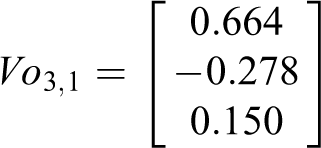
The ANN model matrices were found to be;



The suggested delay factors of this study were pre-reviewed and some factors were selected to be those ones that affect construction project implementation and management. Beside the survey, field samples were represented by questionnaire and have also suggested that the main delay factors are occurring frequently in the environment of this case study (Baghdad city, Iraq). They are as shown below.
The main factors of delay in samples of construction projects that have been examined in the study for the conventional status. Where they are repeated somewhat in most construction projects all over the world in different rates of importance due to the conditions of the country. The focus of this research is a major cause of 12 conventional construction projects factors explained in more details as follows: Security status as the case study being suffering from severe security issues at the time of this study being conducted (S.S). Lack of Contractor’s technical ‘administrative’ and financial efficiency (Contractor failure/Cont. F). Public holidays newly added after the war of 2003 (H.O). Weak project management that coming from different reasons of owner failure (Owner failure/O.F). Redesigning and upgrading the original designs, sketches and plans of the project frequently (R.D). Changing site location due to the different opinions of site selection (C.S.P). Conflicts over the land ownership and the lack of coordination between the owners of the project and the neighboring sites (D.P.P). Consultant engineer failure who works for the employer (Cons. F). Hauling business to lower prices (lower prices) (L.P). Laboratory tests delay (L.T.D). Weather factors (W.F) that include high temperature especially in summer and fall seasons, which reaches over 45°C in the shade, also rainfall in winter and spring time. External factors (E.F) Such as the national power source shortage as Iraq infrastructure was destroyed after the war of 2003, besides water unavailability that limits works in construction field.
The previous factors were chosen due to three important references, the first one was the literature reviews that suggested different kinds of factors, while the second one was the results of questionnaire that confirmed which factors to be chosen for this study by polls, and the third one is of reviewing and studying the project documents. Questionnaire form of that poll Table 3 were distributed to employees and workers in the field of construction industry of different sectors official directories and offices in Baghdad area, Iraq. Where they selected those 12 factors of delay as the most affecting factors in that field. These factors were also sorted due to their importance, where the first factor represents the most important factor while the last one was less important but still plays a big role in controlling construction projects workflow.
Figure 1 shows the frequency of delay factors that repeated in the information questionnaire of projects sample. Security status was repeated in most of these projects followed by redesigning. Also, contractor failure and lowest price bidding showed an important frequency in the sample of this study, followed by the rest of the delay factors owner failure, updated holidays, dispute over land position, external factors, changing site position, weather factor, laboratory tests delay and consultant failure respectively.

Percentage frequency of delay factors in sample projects.
Cost overrun
Planned and actual cost of the case projects.

30 binders of construction projects showed that they were varied in the nature of construction, distribution through the city of Baghdad and the various directories they belong to. The sample was aimed to be comprehensive and to include different sectors in construction field. Where it was including different beneficiaries of different ministries and sectors such as ministries of Industry, Education, Higher Education and scientific research, Science and Technology, Health, housing and rebuilding, Endowments, Displacement and Migration, Foreign Affairs, Interior, and Baghdad governorate. While the main purpose was to study what delays that these ministries and sectors are suffering from when they start a construction project by themselves or even on their behalves and generalize it in future for other projects and avoid such delays that might stop or suspend construction projects workflow. Costs of these projects were ranging between 95 million–120 billion Iraqi dinars, roughly $75,000 US–$100,000,000 US (assuming that $US = 1,250 IQD as an average for around 10 years (Baghdad Stock Exchange)).
Quality delay
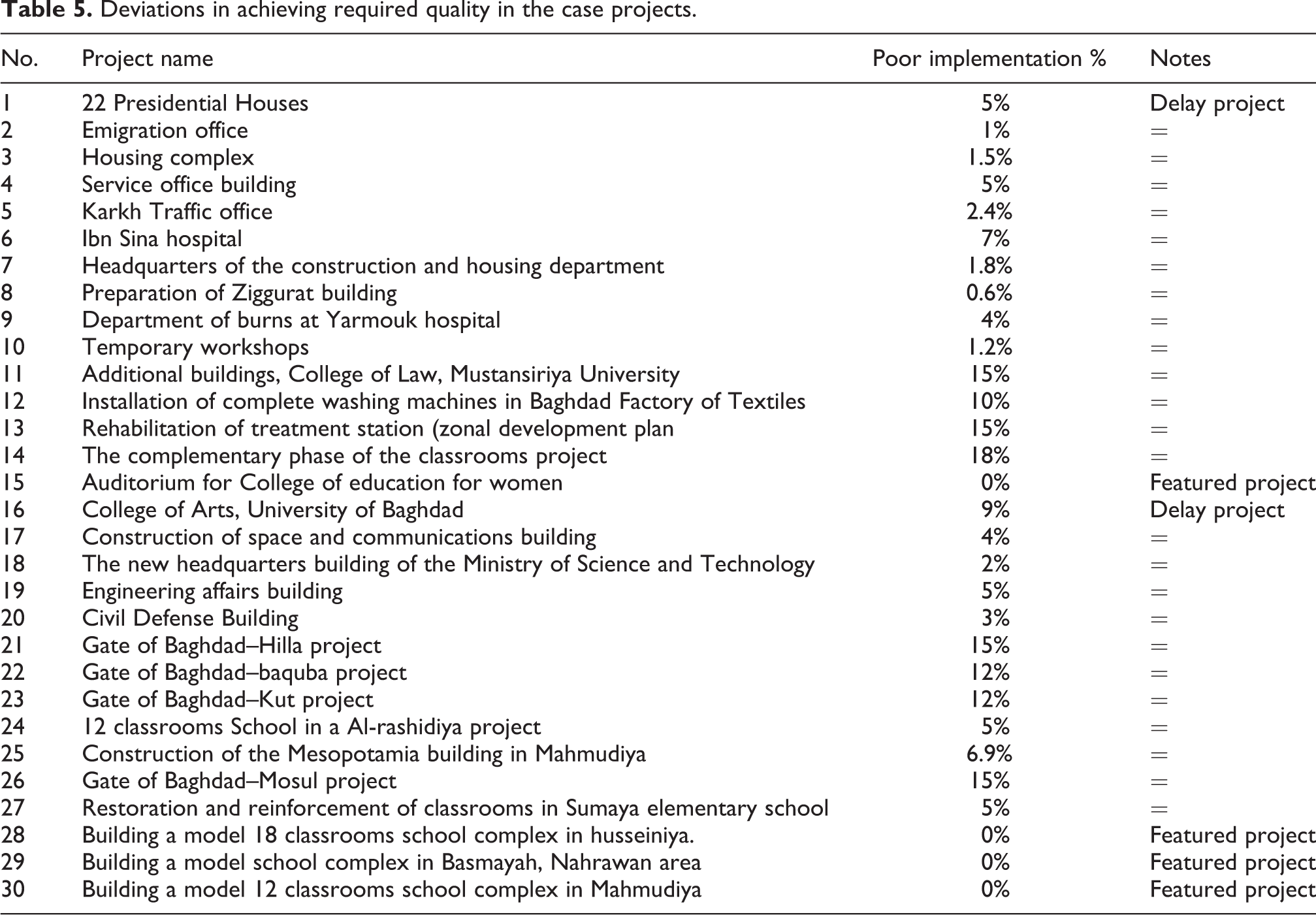
The aim of studying sample projects for the second stage is to study the deviation in project implementation to achieve the wanted quality that any contractor might take the responsibility of being not committed to accomplish it throughout not applying the general conditions of civil engineering works. Where that might lead the contractor to fail in implementing projects to this limit of quality due to the international organization for standardization (ISO) and the Iraqi standard specification (ISS). That could happen because of either the weak technical and managing staff or the lack of machinery and expertise to carry out such projects. Quality is calculated due to standard measures and parameters controlled by Iraqi standard specification and some other limitations of quality control for the whole package of the project including equations of construction works starting from the planning stage far to the stages of implementation and the final delivery as being documented in records. Thus, these values were taken from the final report of the studied projects where these values was determined by the quality control team as mentioned above. It is usually happens that failure in implementation and deviation from the standard quality is an expected result of delay in time and cost that leads contractors to a failure in the meanwhile (Table 5).
Deviations in achieving required quality in the case projects.
Time delay
The aim of this stage is to study the deviation in projects implementation for the planned duration (Time), where this duration includes time of beginning and implementation of any project and the planned end of it, in addition to the actual ending of implementation including the additional time offs granted to contractor due to authentic permission and work conditions. Table 6 shows the deviation between the planned and actual duration of accomplishment, where the later includes the additional periods granted to the contractor due to an administrative and changing order. Table 6 shows that the majority of projects have witnessed a delay in the planned duration of project accomplishment, also there was another group of projects showed no delay in time and they were conducted in the planned period, so that they were considered as a featured projects in Baghdad greater area. Randomization in selecting projects were followed to guarantee true and precise results. That is leading us to suggest a mechanism of application where conditions of those featured projects should be followed and generalized to other projects that might have witnessed some delay in a trial of avoiding these delays. In addition, another mechanism could be applied where a trusted list of contractors (individuals or companies) should be prepared and updated continuously making sure that bad implementers and failed contractors are enlisted in a black list to be avoided in future works. Moreover, we suggest that big projects or even small ones should be referenced to a well reputation contracting companies throughout direct invitations and remits.
Planned and actual time of the case projects.

In Table 6 above, the deviation percentage in the planned time of project accomplishment and the actual one was calculated, which represents delay in time of implementation. This percentage in the table was calculated from the difference between the actual time T4 used in implementation, which includes planned time (T1), additional time (T2), and delay periods (T3) divided by the planned time (T1).
Table 7 is a composite of the two previous tables with the weighting process that was carried on delay factors as it was made to represent in situ status. Where it shows both deviation in cost and time of implementation and the weighted delay factors. These weights were given to each factor affecting delay in the sample of this study, where it would be used next in the model that was built for this purpose. These weights were rated out of one degree, the more the value approaching to one, the more the delay factor affecting in this case. For example, project number 1 was a compound of 22 presidential houses, that delay was resulted from different factors namely, contractor failure weighted 0.7 while newly added holidays have caused 0.3 of the delay while low prices participated in 0.2 out of 1 then security situation was weighted at 0.1 out of 1. These delay factors caused 22% loss in cost and 300% of time wasting in achieving this project. Moreover, other projects follow the same weighting process and rating. In addition, this table shows that the most common delay factors were redesigning as a multiple modification on sketches and what follow of changing orders and issuing new letterhead of the original bids, besides the security situation fluctuation and their impact on the performance and implementation. Low price referral was also a common cause of delay, where this factor leads eventually to weak technical and financial efficiency. Other delay factors on the level of importance could be seen in Table 7 according to their importance and impact on the time, cost, and quality of a project.
Cost and time deviation, with weights of delay factors.

Analysis of normalized importance
Delay factors were weighted due to their importance of delay status and kind of delay in each project as in the previous paragraph. Hence, these weights were analyzed for their importance, and how they affect the process of implementation in construction projects. Importance analysis suggested to put these weights as a dependent factors that affect the time, cost, and the corresponding changes in time and cost as shown in Table 8. This table shows the normalized importance of each delay factor as it affects time, cost, and both time and cost together. Figures 2 and 3 visualize these importance analysis.
Normalized important analysis of time delays and cost overruns.


Normalized importance due time delay, sorted by decreasing importance.
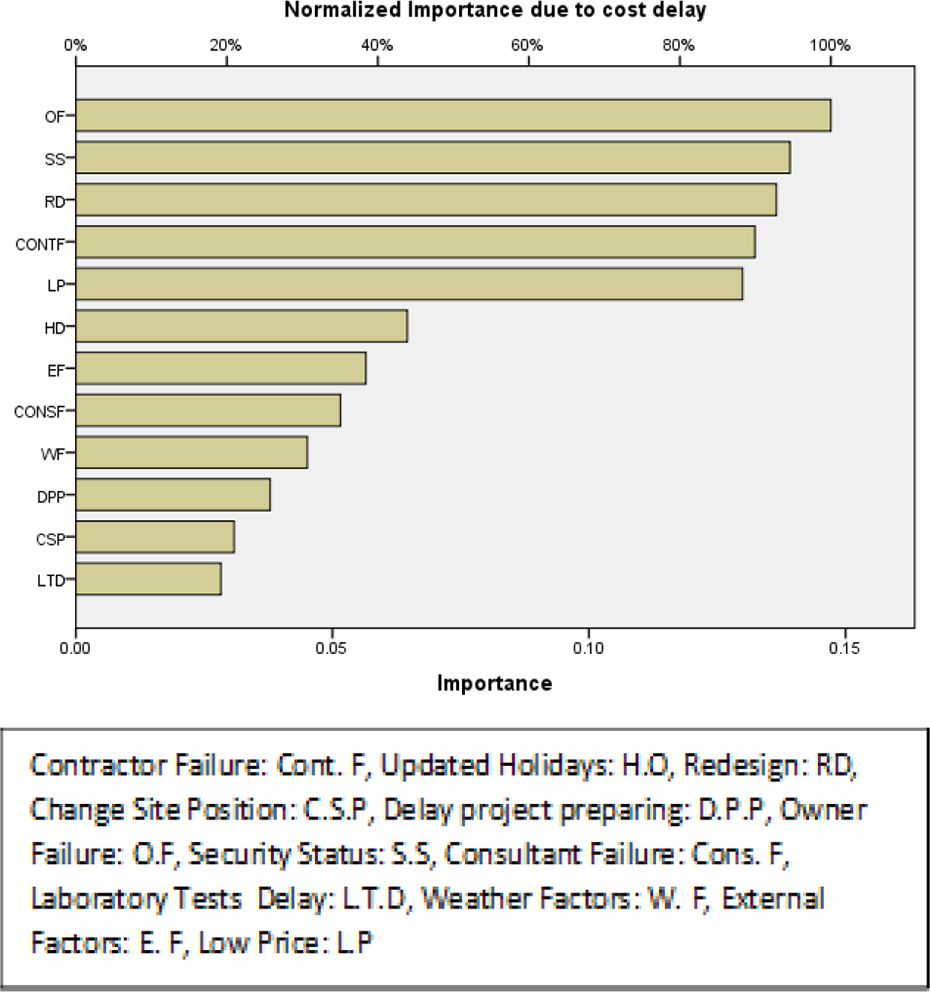
Normalized importance due cost overrun, sorted by decreasing importance.
Due to time (Figure 2), we can see that delay factors had different rates of importance. They were ranked as:
Cont. F > R.D > S.S > L.P > W.F > O.F > C.S.P > L.T.D > H.D > Cons. F > D.P.P > E.F at 100.00%, 95.50%, 68.20%, 67.20%, 55.60%, 47.40%, 44.50%, 38.90%, 34.60%, 34.20%, 18.10%, 16.30% respectively.
Contractor failure busied 100% of the importance, followed by redesigning then security status, low price, weather factor, owner failure, changing site location, laboratory tests delay, new added holidays, consultant failure, dispute over land possession, and external factors. Table 2 above shows the important percentages.
These results confirm that contractor failure is playing a major role in whole problem of time delay. It secured 100% of the importance as shown in the figure. Contractor failure might be resulted from many sub factors that will put him in most cases in a bad situation then project will be effected negatively. Many literature reviews also confirmed that contractor failure could be a major reason of delay in construction projects. 21 –25
On the other hand, redesigning and changing orders came in the second place affecting the process of project management. It busied 95.5% of the importance that delay factors affecting delay in time. Redesigning problem might not appear as a visible problem when implementation, but in fact, it is very important, because changing designs with new ones in sometimes will double the planned time for a construction project. Many reviews also referred this factor as an important factor that affect delays in construction projects especially time delay. 22,26,27
In spite of the fact that the executive company should support the project with the needed security in war affected zones, but it is hard sometimes to get an appropriate security situation because it’s either too expensive to provide this which is not put in the budgeting equation. Alternatively, security situation is too bad that no hand power can afford working and jeopardizing their lives. Therefore, it came in the third place of delay factors. Enshassi et al. 28 also found that security situation was one of the main four reasons of time delay in Gaza strip whereas this factor included strikes and border closures, material-related factors, lack of materials in markets, and delays in materials delivery to the site that all caused due to bad security situation.
Low price bidding is playing a major role in whole problem of delay where it busied 67.20% as an importance percentage. Accepting low price will put the contractor in most cases in a deficit after a while either because of market prices that change randomly, also the budgeting is not well planned for construction projects the matter that eventually leads to a failure. In fact, that factor could also lead to other delay factors, such as contractor or owner failure. Lowe et al. 29 confirmed that some of the lowest bidders may lack management skills and less attention is paid to contractor’s payment difficulties from agencies, material procurement, poor technical performances, escalation of material prices according to markets, etc.
Weather factor showed 55.60% of the normalized importance of this factor as affecting delay in time. This factor has shown this relatively high percentage of importance due to the sever climate of Iraq as a country and Baghdad as a case study because of the geographic location that this country busies (see Figure 2). Therefore, extremely high temperatures in summer will play active role on workflow causing delay in time. Al-Momani ranked the weather as a major delay-causing factor in their quantitative analysis of construction delay.
Other factors’ normalized importance were less than 50% where they were owner failure, changing site position or location, delay in laboratory tests, newly added holidays, consultant failure, dispute over lands, and the external factors at (47.40%, 44.50%, 38.90%, 34.60%, 34.20%, 18.10%, 16.30%) respectively.
Owner failure was not of those first factors because owners always want to finish work as soon as they could, although it showed moderate importance that affects delay in time and that could be related to the weak management, cooperation, and communication between owner and contractor, and/or other parties. Changing location of project is a main factor that influence time of the implementation because all works should be suspended until it starts in the new location. Besides, all machineries, equipment, materials should be displaced to the new location if the project has been already started. If not then making this decision is considered to take longer time, which leads to delay in time, especially when the new location needs new permissions and validation. Laboratory tests sometimes take longer time to be conducted for samples before starting the project the matter that cause delay in time. This case is frequently noticed when there are deficiency in laboratories examining samples before starting any project. Therefore, it is important to pay attention to starting new projects that encourages to open new laboratories and hasten the results. Newly added holidays as in religious or political occasions days off, it is considered as a big problem. Where official holidays that have been added after war of 2003 reached up to 150 days in a year due to Aljazeera report varied as religious, political, national, and emergency holidays. That will definitely affect the process of construction project implementation. Dispute over possession of land has shown another importance where this issue would need more time to be solved especially when this factor is being considered after starting the project works.
Figure 3 shows the factors ranking as their effect on cost change, as follows; O.F > S.S > R.D > Cont. F > L.P > H.O > E.F > Cons. F > W.F > D.P.P > C.S.P > L.T.D in a percentages of normalized importance at 100.00%, 94.60%, 92.80%, 90.00%, 88.30%, 43.90%, 38.40%, 35.00%, 30.70%, 25.70%, 21.00%, 19.20% respectively.
Owner failure showed the highest percentage of normalized importance due to cost because all fund is depending on the owner or the beneficiary. All other factors could affect the cost of any project, whereas, providing private security system to secure location of project means adding more cost to the total cost of the project. Redesigning and changing order, also means more time lasted to conduct new plan, design, or/and orders. Contractor failure showed 90.00% of importance where it carries high effect although it was not the highest because the contractor is not sponsoring the fund of the project as the owner should be responsible for funding it. At contrary this factor would affect time more than cost as it was found in the previous analysis part because the lack in fund from owner would affect the time that contractor consume to keep workflow on. Low price also affect the cost overrun because this factor will lead to week management and lessen the quality cost and funds overrun of the project where Assaf and Al-Hejji 22 found this factor exceptionally representing the third major factor causing cost overrun in construction project. Although this factor showed less than 50% of the importance that affecting delay in construction projects. Other factors also showed less than 50% of the normalized importance.
Figure 4 shows the factors importance analysis considering delay in both time and cost as they are affected by delay factors. Results showed that these factors were ranked due to their effects on time and cost as follow: S.S > Cont. F > R.D > L.P > O.F > C.S.P > H.O > L.T.D > E.F > W.F > D.P.P > Cons. F at percentages of normalized importance of 100.00%, 93.60%, 92.90%, 88.70%, 75.20%, 48.90%, 42.70%, 36.10%, 33.20%, 29.60%, 27.40%, 0.00% respectively.

Combined normalized importance due time delay and cost overrun, sorted by decreasing importance.
We can see that security situation showed the highest percentage of normalized importance. Iraq has gone through many actions of security turbulence such as wars, economical sanction, violence, sectarianism, terror and war against terrorism, and administrative corruption. That put the security situation as a major factor that affect time and cost together in Iraq. In addition, this factor has shown high percentage of normalized importance due to time and cost separately. Contractor failure, redesigning and changing orders, and low prices has shown above 50% of normalized importance and that was matching both delay in time and cost separately with some hitch up and down in ranking. The other factors has shown less than 50% of normalized importance due to time and cost, while consultant failure did not show any importance.
Consultant failure did not show any effect on this kind of delay. The reason could be related to the fact that consultant has less interfere to financial system and lesser to time table, where these two terms are more controlled by owner and contractor, and other factors.
Figure 5 shows that cost and time deviation in the process of construction projects 6 implementation was not significantly correlated, as the financial deficit and halting workflow will stope cost deviation to a certain point, while time deviation is still proceeding. The relationship between these two factors was very weak (R2 = 0.17). Although, the general trend of this relationship was positive for these two individuals, where the increase of time deviation will also increase the cost of implementation.

Cost and time deviations relationship by linear regression.
Data collected in previous stages and analyzed statistically, were also processed mathematically and a model was built to find solutions for delays to reduce losses in cost and time of implementation in construction project industry. That model happened to be built under ANN’s approach to find the optimal solution to certain issues. Where that mathematical model simulates the reality of tripping or winning in construction projects. This model was built and based on inputs, processing, and outputs.
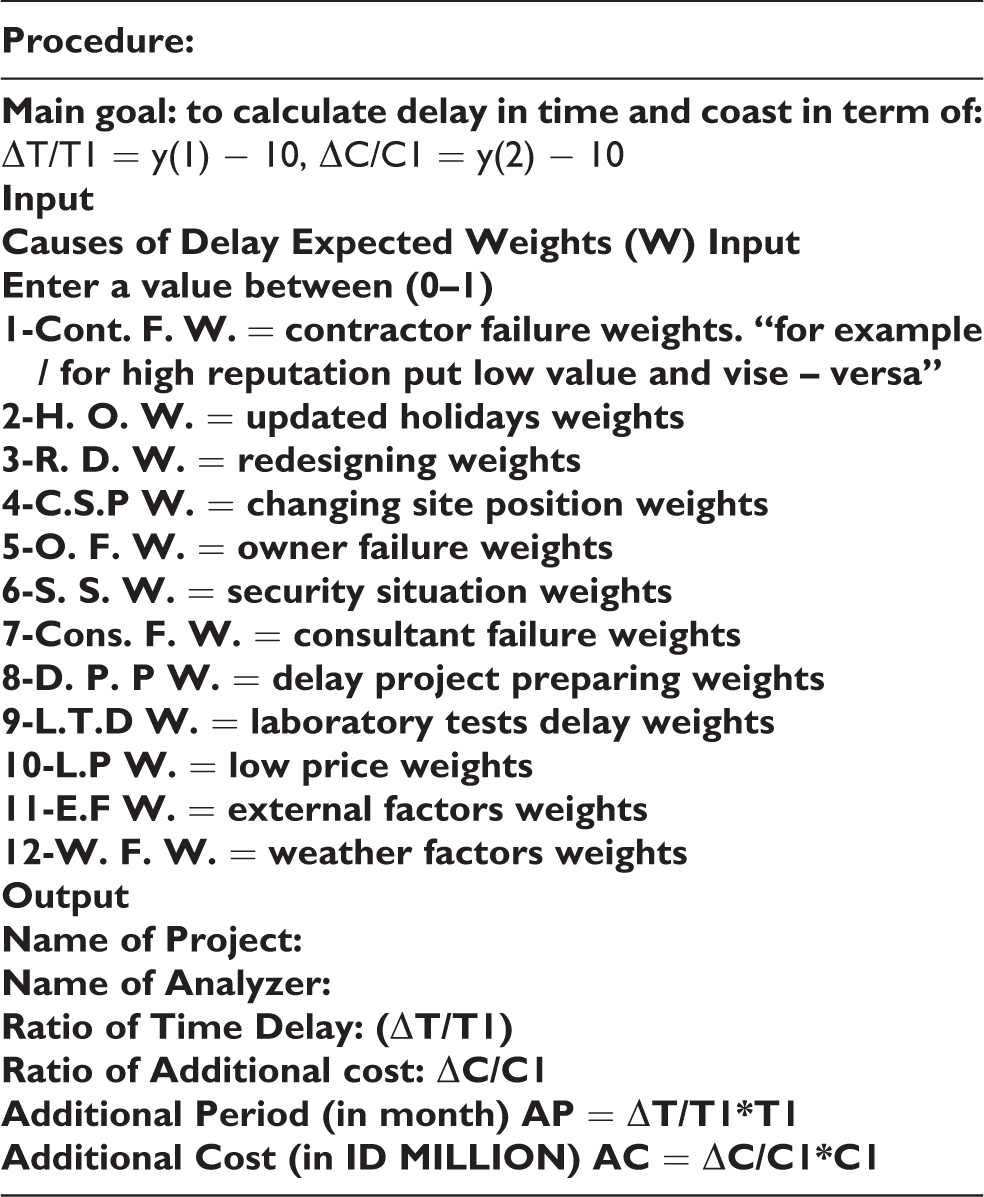
An application was then developed using JavaScript high-level dynamic language to be later used to predict delay in construction projects. Input parameters were delay factors weights that range from 0–1, where the highest value approaching to 1 means highest delay effect and the lowest value approaching to 0 means lowest delay effect. Delay factors used in this application are what exhibited earlier in Figure 1. The output then represented delay percentage in cost and time that could be predicted from weights of delay factors. Thus, this application can be used in construction projects to predict delay ratio and additional cost before the dead line of project in time and before approaching to the fund shortage in cost.
Using this application will give us the opportunity to determine the additional cost and time of implementation before starting the project and to avoid delay by controlling factors of delay in a hand or adding these additional time and cost to the planned ones in another hand. Therefore it is important to mention that weights of delay factors added here as input, will determine the additional time and cost periods which are considered the expected delay in time and cost.
Discussion of results
A glance at results will show how delay factors were playing on the cost and time delay. Hence, the statistical methodology has given results to arrange delay factors in a way as factors were studied to be affecting cost and time delay. If we look at the model that was built for this study, we can see that delay factors can affect cost and time delays directly.
This application can be used in construction projects to predict delay ratio and additional cost before the deadline of project in time and before approaching to the financial shortage. In this case, there will be two plans to put in consideration before starting the project itself. The first is to shift the cost of the project to approach the cost predicted by this model and in that case there will be no or less shortage in cost, also adjusting the time specified for the project and in this case, therefore, time delay could be eliminated. The second plan is to over control the factors causing delay as possible as the implementer could do, and here both cost and time shortages will be decreased too. This model can be used by both, the beneficiary (owner) and the implementers (contractor). Where contractors can use it to predict the additional cost and time that should be put in consideration when the bid would be assigned to him. Here he will put all possibilities in the plan before bidding, and he can also negotiate with the beneficiary for better results. This model is mainly built for the beneficiary before even assign the bid to any contractor and listing conditions of the contracts that includes estimating the right cost and time line for successful project at the end.
The main causes of delay in construction projects
Contractor failure
Importance analysis showed that contractor failure was the highest effective factor that affects changes in time and cost. This failure was related to the leading efficiency of the contracting companies where the following sub variables found to be the main causes of delay due to contractor failure:
Lack of leading capabilities and skills.
Lack of standard parameter of human resources pick up.
Lack of education of the integrated elements of performance.
Lack of dealing skills with time limitations and capabilities.
Lack of building a harmonic team of work.
Lack of a good vision of dealing with the owner, external parties, or the team spirit itself.
Lack of strategic planning of contracting companies in case it is existed.
Results showed that there are many projects suffering from contractor failure projects (26, 24, 21, 12, 1).
Owner failure
The owner is considered as the first beneficiary of the project, previous studies 23,24,30 found that owner failure is one of the factors that affect project workflow as the owner interference or the slow decision of the owner could strictly cause delay in project results. Thus, it was quite important to seek if this factor could cause a delay in the project itself. Results showed that:
The owner himself could be a main factor of delay when he is unclear in his goals therefore the project dimensions will not be defined well, especially when there is a gap of communication with the other parties of the project.
Documents of project are incomplete, mysterious, and foggy. Where that might belong to lack of skills and professionalism of the owner companies when bids being conducted by contractor companies.
Being uncooperative with other parties and none responsive to their demands, with terrible interferences.
Being inconsiderable to the project environment especially the cash flow issue, and making slow decisions about that.
Project (13, 16) showed delay in time and cost due to owner failure.
Consultant failure
At least in the case study, and maybe in other cases, one of the reasons of delay was found is the consultant of the owner to be failed in maintaining time and cost of implementation as a part of his job. The cultural view against the consultant is to be a chronic enemy to the contractor because the owner considers this as a positive point to his own side. 31 This culture is considered to be wrong, and causes delay in construction projects. The relationship among parties of the contract must be in its best conditions to reveal the objectives, acting as one team and finish the project. 32,33 Another factor that could participate in consultant failure as a delay factor is simultaneously affected by cost overrun where the owner becomes unable to pay consultant therefore the later is doing less in his job. 29 Although results showed that consultant failure was not a major delay factor, but when it occurs, it is just because of the un-commitment of the consultant to his responsibilities. Where no follow up and the extra trust in unskilled driving powers in the project will lead to this failure. In this study sample, this factor was not effective and did not show major delay caused due to it and that is a prove of the maturity of consultants appointed by owners to watch the workflow and give their consults where revealing the required specifications of the project. Project (14) showed fair delay due to this factor.
Low prices bidding
The importance of project life cycle should be considered since planning, hauling, and choosing contractor, because it is not enough to haul contract to the lower price as a matter of cost in spite of the efficiency of the contractor as an excuse of being parallel to the supplies of the institutional system. This case is considered as a big problem when the contract being hauled. Many contracts face failure due to the failure of contractor in implementation because some of the lowest bidders may lack management skills and less attention is paid to contractor’s plan, cost, time, and quality, 28,34 also mentioned that low bids could cause poor management and eventually delays in time cost and quality where the quality will go down due to avoiding losses.
Security status
Time and cost deviation was estimated and delay in them was calculated. The sign in minus refers to the condition of delay in cost and time. It was noticed that each project was different from the other due to the ratio of delay according to the circumstances of implementation process. There was too high rates of delay found where they warn the construction industry in the country, they ranged between 100–300% of delay. This rate is huge as for the considered properties depended when application of construction projects, where the main reason of this kind of delay is the security status (post war activities).
Project (5, 26) showed some delay in security status.
Laboratories tests
In some cases or projects, we noticed that delay would be related to laboratories tests.
Delay of laboratory tests will protract starting project and all other stages of project.
In some projects work start then a sudden break occurs for their reason which affect the total work flow that is what we found for this factor where many stops in work flow were happening and causing time delay and cost overrun in many project as what happened in project (18).
Changing site position (location)
One of problem happening in construction projects is the availability of land belongs to governmental sides or even when there is land to establish project, it happens that this land might be unsuitable for establishing specific project.
Also, it was found that some owners tend to change the project location because of some reasons related to the owner or to the environment that the project being established in, another reason was found that some lands were been under conflict, project (10) showed that.
Delay project preparing (lands under dispute)
Another reason was found that some lands have been under conflict of possession, where different owners appeared for one piece of land that project will be established on. Thus, there was a conflict on the possession of the property and these lands dispute.
Plan redesign (change orders)
In some cases, redesigning plans and sketches of project will lead to delay in time if not both changes in time and cost. Redesigning means postponing starting works due to upgrading designs, plans, or even sketches which definitely would add more time that has not been considered in time table of the project. It also could add more cost through implementation, where upgrading or adding more items to the new design or plan, besides, changing time might witness changing in market prices where most construction industry market tend to be increasing in prices. That is how change could be also happening in cost due to this factor.
Updated holidays
In Iraq, as a case study, and especially post war, it happened that new national or religious holidays been added to the schedule of holidays in Iraqi society. That would lead to a delay in time, which negatively will be reflected on the cost of the project, especially if most tools, machinery, and equipment are rented. Although this factor was not a major delay factor that floated in this study, but it happened in project, 12 that faced delay due to this factor because of long new added holiday.
Weather factors
As was shown in the results, projects (15, 18, and 20) showed some delays due to weather factor. These projects were implemented under bad weather conditions as heavy rainfall in winter season, and high temperature in summer season. Both high precipitation and temperature led to changes in time and cost by stopping workflow in a way or delaying the process of implementation in case workflow was continued.
External factors
Project (21, 22, and 25) showed delays in cost and time of implementation due to external factors, where any cause of delay that is not listed into the factors above would be considered as an external factor. Results showed that there was a power shortage, which affected the workflow, also there was a problem in the sewage system of a project caused delay when there was an urgent case that needs time and cost to treat it. Ground water level caused some delay in one of the project as well.
Conclusions
This study was featured through revealing some facts, it gives a brief for projects management stages and reflects an impression of what implementation processes might go through. The model that was built according to the research field study touches the reality of construction projects, finds practical solutions and exposes causes of delay. The application that was built using the model has a goal to represent the project before starting it starting from the early stage of preparing, such as the feasibility study and initial designs to help decision makers to control delays in time. Focusing on the work using the basis of the iron triangle of time, cost and quality that is considered as the first step and a reference to any project to begin.
Rehabilitation and re-evaluation for owners and contractors to guarantee the financial efficiency and specialization in implementing projects and withdrawing any permission fails in surpassing limitations and qualifications reported by the ministries of planning and housing and rebuilding. Also, the Ministry of planning has to review all rules, laws, and legislations that deal with implementation to prevent the growing high-rise funds of construction projects to be conducted by unqualified companies, besides following the direct invitation procedure and inviting the well known national and international companies to compete. Therefore, there should be a focus on rehabilitating contractors on different level because contractors are considered as the implementer and the real cause of delay in time and cost, by holding workshops and lectures to educate them in the field of bidding and implementing better contracts. Also, supporting and improving construction tests laboratories. Also, encouraging private sectors to open their own laboratories, and activating rules and legislations that guarantee the rights of engineers and project managers and granting them the confidence to support their decisions. Besides, letting monitoring and probity sponsors to investigate the cases of any inconvenience. Moreover, reporting and stating the cases of corruption and fraud in works of construction projects. And following precise steps toward selecting the proper designs and plans of the project before starting implementation.
Preparing an accurate and full bill of quantities (BOQ) to avoid falling in the delay corner. And legislating new law that obligates the implementing firms not to sell contracts to more than one subcontractor. Depending on low price bidding, if only these biddings were covering the real cost of construction project to avoid any expected delay while implementing project.
Putting in consideration the skills and qualifications of the executive engineer as to be more than 5 years to experience to be referred and registered as a dependent engineer that supervises projects implementation thoroughly. In addition, testing more factors and upgrading the model according to the time of conducting and the nature of construction projects. Power shortage was one of the most important external factors causing delay. Thus, power plants should be considered as one of the first projects to take care of, starting with ending investment contracts with bad reputation firms and hauling contracts to a good reputation firms.
Getting rid of administrative corruption spread in every joint in the country starting from school level and ending to all services facilities, social, health, residential. Establishing international council to supervise the Iraqi reconstruction projects that involves good reputation countries that fought and fighting administrative corruption in governmental and non-governmental organizations. Where Norway found to be one of the world’s least corrupt. 35
Answers of the academic questions
(1) What is the range of cooperation among the different parties of projects in construction industry?
There was weak cooperation between contractor, owner, and consultant. That is led to delay in time and consequently cost of different kinds of construction projects. Although, we have seen some projects that showed typical circumstances of implementation as in projects 29 and 30. Same problem was found in the study of Abd El-Razek et al. 36 where contractor and owner were found to have opposing views, mostly blaming one another for delays, while the consultant was seen as having a more intermediate view. Larson 37 found that empirically there was a limited support in collaborative work between contractor and owner in 291 projects when he studied the relationship between partnering activities and project success.
(2) Is there priorities in project activities? And are they related to each other?
Answering the first part of next question “the priorities of project activities” should be achieved by making goals and means of maintaining them visible to all the collaborative parties in the project. where running a project team without using a schedule that is accessible by everyone where it is a sure-fire way to set your team up for problems. 38,39 In addition, managing team was found to be a key solution to any project where a strong project management will make sure the continuity of the project in a neat level. 40,41 The second part of this question was if activities were related to each other. As known resource requirements should be usually estimated for each activity, and the hierarchal arrangement of activities are consequent, therefore they must be related to each other. 42 It was found in this study that the upper level activities of this hierarchy is related basically to the lower level activities where they are considered as a results of the whole connected system.
(3) Are there delay factors of the project that all parties agreed with? And are they controlling delay?
Delay factors were found to be the most common factor in time, cost and time cost analysis. It was found that contractor failure, redesigning and changing orders, security status, low prices and bids, and weather factor were the delay factors in time delay, while it was found that owner failure, security status, redesigning and changing orders, contractor failure, low prices and bids were the delay factors in cost overrun. In time delay and cost overrun, which is considered as an integrated delay factors in the case study of Baghdad/Iraq, the security status followed by contractor failure, redesigning and changing orders, low prices, and owner failure were the delay factors of both time and cost together delay.
(4) Does the delay caused by specific factor affect another kind of delay and causing opinion conflict among project parties?
This question is confirmed by the interaction among delay factors, where it was found that most delay factors are affecting other delay factor in a way or another. For instance, contractor failure sometimes is controlled by many other factors such as owner, consultant, low price, security status, and even weather factor. In addition, owner failure could be a reflection to the uncooperative team with other parties that produces no satisfaction and causing a conflict among the different parties of the project management team.
Table 9 represents the validation of the improvised model in this study. It shows how close were predicted values to the actual values n term of time and cost. In addition, the lift charts of the ANN’s models showed a high accuracy for the factors used in the input layer to predict the actual time and cost, where lift chart is a measure of the effectiveness of a predictive model calculated as the ratio between the results obtained with and without the predictive model. 43 Figures 6 and 7 show the accuracy of predictive model of the actual cost and actual time in term of coefficient of determination (R2) where it was = 0.654 in cost and = 0.655 in time.
Measured cost and time feedback.


Lift chart of actual cost predicts.
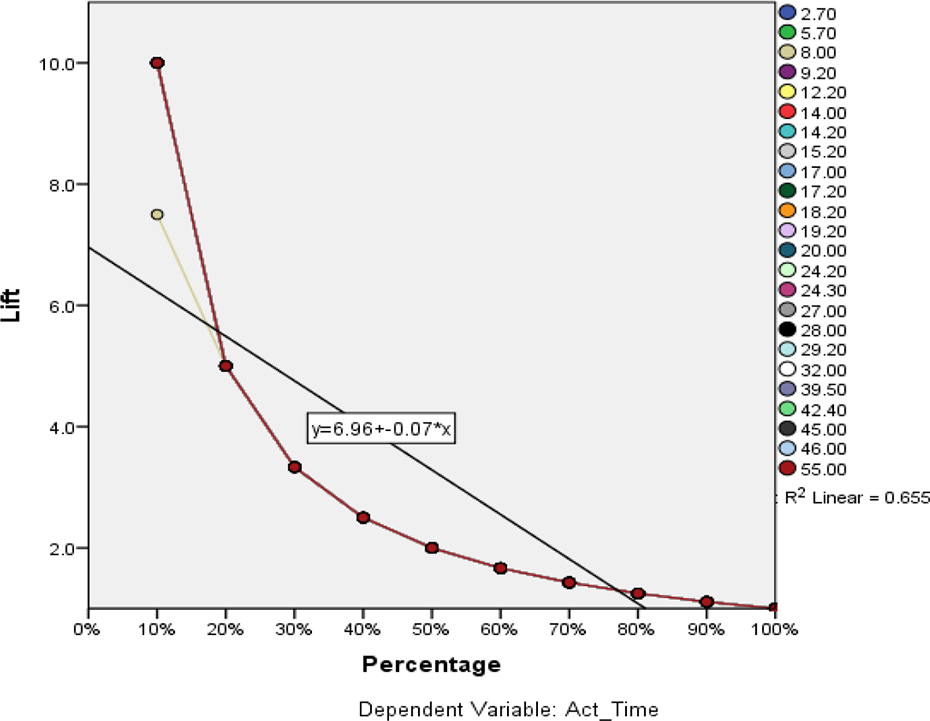
Lift chart of actual time predicts.
Future perspective
Large construction projects are notoriously complex. The robustness and resilience of these projects are extremely important, as in the world today, disturbances and disruptions are unpredictable. To achieve a satisfactory performance along with a robust and resilience project progress, an integrated design and production management approach is needed, 44 which is highly recommended as one of the future works. Noted that design here refers to both redesign (or design change) during the progress of a project and design. This integrated approach for project management means that first of all, a whole project will be viewed as an enterprise system 45 and the second, at the design stage, the behavior and performance of project process down the road will be predicted, analyzed and incorporated in the design. Another future work is to improve the accuracy of the model for prediction, see the recent effort in estimation of risk factors in software products, 46 which can be learned to construction project.
Contributions
Using ANN’s procedure to forecast and determine suitable solutions for delay problem in construction projects.
Using the model built under ANN’s in this study as a mean to avoid delays in time and cost as it has given precise estimates of delay, putting in consideration delay factors selected in this study.
Statistical analysis has also given a precise estimates of delay in time and cost therefore the model built under this methodology could also be used to forecast delay in time and cost.
Testing more factors and upgrading the model according to the time of conducting and the nature of construction projects.
Getting rid of administrative corruption spread in every joint in the country starting from school level and ending to all services facilities, social, health, residential.
Building human being before raising constructions. Where the latest happen to be better and easier when white and honest hands stand for it, in addition, to allocate the proper person to the proper workspace.
The necessity of activating the 5 or 10 years plans that match the future projects and specifying the whole environment for them including the proper location, also giving the owners enough time to work in a proper environment when the time of implementation is started.
Depending the scheduled plans in engineering projects managements in reconstruction practically as deeds more than words.
The necessity of reviewing channels that all projects pass through to screen them to keep quality control of time and cost because time is considered as money in the market and keeping the planned time is a goal for this study. Wasting time is wasting of general incomes of the any country.
Developing capabilities of the team, finding new legislations and rules to fit the current situations to keep the continuous evaluation and preparing programs to announce contracts in organized categories as the old categories are considered as unsuitable to the planned cost and time of implementation.
Training and qualifying the engineers and the teams of the project and strength the manager of projects in all governmental institutions. Also, training should cover the constants offices in the private sectors to make sure to each to the quality.
Finding solutions for the external factors such as the power and water shortages that control most activities of life. Where Baghdad and the whole country is suffering from the power shortage that causes most other kinds of shortages as an external factors since more than 15 years.
Power shortage was one of the most important external factors causing delay. Thus, power plants should be considered as one of the first projects to take care of, starting with ending investment contracts with bad reputation firms and hauling contracts to a good reputation firms.
Establishing international council to supervise the Iraqi reconstruction projects that involves good reputation countries that fought and fighting administrative corruption in governmental and non-governmental organizations. Where Norway found to be one of the world’s least corrupt. 30
Putting winds load and earthquakes in consolidations design in all kinds, as lately occurrence of earthquake in the case study Iraq, where this area has entered earthquakes zonally.
For emergency status projects, there should be a proper disaster management whether they were natural or manmade disasters especially in the last years as many earthquakes hit. Therefore, all construction project must contain disasters precautions as one of the necessary requirement and putting considerations for worse conditions might Iraq (case study) go through.
Footnotes
Declaration of conflicting interests
The author(s) declared no potential conflicts of interest with respect to the research, authorship, and/or publication of this article.
Funding
The author(s) received no financial support for the research, authorship, and/or publication of this article.

Appendix 1
This program can be used in construction projects to predict delay ratio and additional cost before the dead line of project in time, and before approaching to the fund shortage. Analysis by (Artificial Neural Networks/ANN)