




Abstract
One form of employee integrity can be seen from his desire to perform extra-role behavior. The purpose of this study is to analyze the influence of Organizational Trust to Organizational Learning Culture directly or indirectly through Organizational Justice, the influence of Organizational Trust and Organizational Justice to Extra-Role Behavior directly or indirectly through Organizational Learning Culture, and the influence of Organizational Learning Culture on Extra-Role Behavior for employees of government hospitals in Makassar. This research was conducted at 7 Government Hospitals in Makassar City, South Sulawesi, Indonesia with Proportional random sampling. The analysis method that is used to test the research hypothesis is Partial Least Square (PLS) by using SmartPLS. The results showed that Organizational Trust directly and indirectly through Organizational Justice had a positive and significant influence on the Organizational Learning Culture for employees of government hospitals in Makassar. The direct relationship of Organizational Justice, Organizational Trust, and Organizational Learning Culture toward Extra-Role Behavior is positive but specifically Organizational Trust is not significant. Organizational Trust and Organizational Justice indirectly through Organizational Learning Culture had a positive and significant influence on Extra-Role Behavior for employees of government hospitals in Makassar.
Keywords
Introduction
Nowadays organizations are required to improve their performance, not least in the hospital industry. Hospitals are no longer just social organizations but are beginning to be profit-oriented. More and more hospitals in the Makassar city have added to the intense competition. To deal with this condition, human resources should be the center of attention so that organizations can explore the potential of them.
Resource-Based View theory states that resources play a very important role in the overall success of the organization, in this case, human resources. 1,2 To get the optimal contribution from Human Resource, the integrity of every employee is very important, it will appear from their desire to behave not only in roles but also in extra roles. Organ in Podsakoff et al. 3 define Extra-Role Behavior or Organizational Citizenship Behavior (OCB) as flexible behavior, not directly valued by the organization’s formal reward system, but as a whole contributes to organizational effectiveness such as helping coworkers. This was stated in different terms but with the same meaning by Yaseen et al. 4 OCB as Extra Effort. Extra-Role Behavior is certainly very necessary in the hospital considering the hospital is always dealing with patients who need special services to feel comfortable and not getting sicker. Patient comfort and satisfaction will have an impact on the overall image and performance of the hospital. This is in line with the opinion of Kolade et al. 5 that OCB will increase service efficiency, patient satisfaction and patronage, enhancing hospital corporate image as well as the result of achievement of organizational performance.
The various problems faced by hospital patients are long queues, long time to get services, and sometimes even patients who feel they are not served well. Based on observations sometimes some people seem very busy and some people seem mediocre. This condition indicates that the employee is still focused on the job description.
One of the things that influence extra-role behavior is the perception of organizational justice. This perception can influence good and bad behaviors and attitudes, which in turn have an impact on employee performance and organizational success. The link between organizational justice and OCB is following research conducted by Jafari and Bidarian 6 that there is a positive and significant relationship between organizational justice and extra-role behavior (OCB). The same thing was found by Chien 7 employee perceptions of organizational justice had a significant positive effect on OCB.
Besides organizational justice, another thing that affects Extra-Role behavior is organizational trust. This is in line with the opinion of Staples and Webster 8 which says that Trust is related to behaviors such as OCB, future willingness, the interaction of team performance, sharing of knowledge and information. Organizational trust is mutual trust between management and employees without which it is unlikely even things that might not achieve the goal. Previous research conducted by Rezaeian et al. 9 which found that organizational trust had a positive influence on OCB.
Organizational trust in addition to influencing extra-role behavior also affects organizational justice. This is confirmed by Hoy and Tarter 10 that organizational justice cannot be achieved without trust. Motlagh 11 found the same thing that organizational justice is predicted by organizational trust.
Another thing that influences extra-role behavior is an organizational learning culture. A very dynamic organizational life requires organizations to always learn and keep learning. For this reason, learning should be made as a culture in the organization so that the daily activities and actions of all members of the organization reflect continuous learning. Usman et al. 12 states that a learning culture stimulates employees to maintain their performance and higher organizational performance. Usman said the majority of organizations used up resources and tried to change management by increasing productive capabilities and behavior under their culture.
Organizational learning culture allows extra-role behavior. This is in line with previous research conducted by Islam et al. 13 that organizational learning culture has a positive relationship with extra-role behavior (OCB).
Following the proposed approach, the article aims at investigating two main research questions:
RQ1: Does organizational trust influence directly or indirectly through organizational justice on organizational learning culture for employees of government hospitals in Makassar.
RQ2: whether organizational trust and organizational justice influence directly or indirectly through organizational learning culture on extra-role behavior for employees of government hospitals in Makassar.
Literature review
Organizational trust
Trust is very important in building stable social relations not only in relations with organizations but in broader community relations. Erden and Erden 14 even said that Trust is the root of human feelings.
McShane and Von Glinow 15 define Trust is positive expectations one person has toward another person in situations involving risk. However, Daly 16 is defined as the willingness to take that risk. Another opinion about Trust is stated by Mayer et al. 17 that trust is the willingness of one party to be vulnerable to another party’s actions based on the expectation that the other party will take certain actions that are important to the trustor, regardless of the ability to monitor or control another party. Trust defined in this way does not involve risk alone, but rather a willingness to engage in risk-taking with certain parties. These results can include cooperation, sharing sensitive information, and voluntarily allowing trustees to control matters that are important to trustees (i.e., trusted parties). 17
Trust is the basis of organizational trust. Organizational trust presents the importance of both individuals and groups in the operation of an organization. 17 Jiang and Chen 18 organizational trust refers to trust between employees working together or depends on each other, trust between supervisors and their subordinates, and trust to the organization as a whole. 19
Organizational justice
Cropanzano et al. 20 define justice as the conditions of employment that lead individuals to believe they are being treated fairly or unfairly. Further said justice is an important motivator for working people. When individuals perceive a lack of fairness, their morale declines, they become more likely to leave their jobs, and they may even retaliate against the organization.
Moorman 21 says organizational justice is a term used to describe the role of justice because it is directly related to the workplace. Specifically, organizational justice relates to the ways in which employees determine whether they have been treated fairly in their work and the ways in which such determinations affect other work-related variables. Cropanzano et al. 20 say organizational justice has the potential to create strong benefits for the organization and employees. Cropanzano et al. 20 further said there are two sides to the coin of justice. On the negative side, the absence of justice tends to give problems to the organization. There is strong evidence that injustice can lead to retaliation, lower performance, and harmony. On the positive side, justice can do more than prevent this unfavorable outcome. Justice acts as a kind of buffer, which allows employees to maintain respect and trust in an organization even when things don’t go the way they want. It can be said that organizational justice is a very important thing in an organization because of its extraordinary impact on employee behavior and will certainly affect the success of the organization.
Organizational learning culture
To discuss organizational learning culture, the terms organizational learning and learning organization need to be understood. Senge 22 learning organization is an organization that continues to increase its capacity to achieve the future. Whereas Tsang 23 said organizational learning is a concept to explain the forms of activities in organizations while learning organizations are a special type of organization. A simple relationship between two learning organizations is something where organizational learning takes place. Meanwhile Huber 24 states organizational learning as information processing with the aim to be stored in the form of knowledge in organizational memory. The same is stated by Tosi organizational learning is a reflective process carried out by all members of the organization at all levels relating to gathering information from the external and internal environment.
According to Marquardt, 25 organizational culture in learning organizations is an organization where learning is considered an important factor in business success, in this case, learning is habitual and integrated as part of the overall function of the organization. Kandemir and Hult 26 says organizational learning culture leads to various forms of values and behaviors that support learning. The same thing was said by Škerlavaj et al. 27 organizational learning culture is a set of norms and values about organizational functions that are supported by a systematic and in-depth approach to high achievement through double-loop learning, generative learning through information acquisition phases, information interpretation, cognitive change, and behavior. Usman et al. 12 said organizational learning culture is an advanced process that utilizes information and facilitates it further by developing, changing, and innovating. Meanwhile, Hung et al. 28 focus more on the importance of learning in organizations where it is said that organizational learning culture is something where learning is considered a critical factor for the success of an organization and learning becomes a habit and is integrated as part of the overall organization function.
It can be said that organizational learning culture is important to be used as an organizational success strategy. Organizational learning culture allows organizational members to learn as activities in their daily lives and the organization supports it. That way the organization will always be ready with various changes that will occur
Extra-role behavior
Daft 29 states that extra-role behavior is work behavior that exceeds work requirements that contribute to organizational success. An employee shows extra-role behavior by helping colleagues and customers, doing extra work if needed, and finding ways to improve products and procedures. The organ in Podsakoff et al. 3 define extra-role behavior as flexible individual behavior, not directly assessed by the organization’s formal reward system, but as a whole contributing to organizational effectiveness.
From some opinions, it is concluded that extra-role behavior is the contribution of workers “above and more than” formal job descriptions, which are voluntary, and are not recognized as a reward system but contribute to the effectiveness and efficiency of organizational functions.
The interrelationship between organizational trust, organizational justice, learning organization culture and extra-role behavior
Organizational trust is mutual trust between employees and management and without that organizational goals are impossible to achieve. The importance of trust was also stated by Akın 30 that trust is one of the variables that substantially influences the quality of interpersonal relationships and organizational processes as a social system. Trust is the basis of organizational trust. Organizational trust influences the emergence of organizational justice as stated by Hoy and Tarter 10 and even says that organizational justice is not possible without trust.
A good relationship between every element in the organization is based on one of them by the existence of the trust. High trust between employees and management will make both employees and management feel justice.
Proposition 1
Organizational trust has a positive effect on organizational justice.
Organizational trust is very important in ensuring the running of various activities in the organization. Moghadam et al. 31 said that trust is an essential element in the structure of employee and management relations. This also explains that there is a close relationship between trust and relationships between employees and management or between employees and other employees and various other relationships in the organization.
Organizations need to understand how organizational culture is very important for an organization. Organizational culture will influence and determine how individuals in the organization will behave or act in their daily lives. Organizational culture leads to how to do things in the organization, attitudes that apply, patterns of behavior that are accepted and expected as well as various habits in an organization. Because of the importance of culture, organizations often change the culture as a form of a differentiation strategy.
Demir and Akif 32 statement that trust facilitates the learning of individuals and organizations. The description above explains the organizational trust will enable a culture of organizational learning to run well. Jiang and Chen 18 in his research found the same thing that was found to be positive and significant organizational belief in organizational learning culture. Egan et al. 33 said that organizational learning culture can improve learning at the individual, group and organizational levels which will ultimately have an impact on organizational performance.
Proposition 2
Organizational trust positively influences organizational learning culture.
Organizational justice according to the literature 34 is an overall perception of what is fair in the workplace, composed of distributive, procedural, informational and interpersonal justice. When employees feel fairness in their work lives, they will be motivated to do more. This is in line with Motlagh 11 statement that justice is often the center of organizational attention because the implications of employee perceptions about injustice will have an impact on work behavior and behavior in the workplace. This is reinforced by Pan et al. 35 that organizational justice influences positive organizational behavior. The essence of organizational learning culture is a set of norms or values that support learning both individuals, groups, and organizations. Hung et al. 28 said organizational learning culture is something where learning is a critical factor for organizational success and it becomes a habit that is integrated as part of the overall organizational function. In addition Škerlavaj et al. 27 said that organizational learning culture (OLC) as a set of norms and values about the functioning of an organization that should support systematic, in-depth approaches aimed at achieving higher-level organizational learning. The elements of an organizational learning process that we use are information acquisition, information interpretation, and behavioral and cognitive changes. Based on these two opinions it can be said that organizational learning culture will place learning as a habit both at the individual, group and organizational level and one of them can be drawn from the desire to learn voluntarily and the organization also supports it. This is in line with the findings of Walumbwa et al. 36 that Theory social exchange and justice received additional support by establishing that fairness is related to voluntary learning.
Proposition 3
Organizational justice has a positive effect on organizational learning culture.
The organizational trust also influences extra-role behavior as stated by Staples and Webster 8 which says that Trust is related to behaviors such as OCB, future willingness, the interaction of team performance, sharing of knowledge and information. This was also stated by Mayer et al. 17 provide confidence as the most proximal predictor of risk-taking and related outcomes. Wong et al. 37 who found trust in organizations Aff OCB both state-owned enterprises and Joint Ventures. said that organizational trust is mutual trust between management and employees, and without that it is possible to even possible to achieve goals. The same thing was found by Rezaeian et al. 9 emphasized the relationship between organizational trust and OCB which found that organizational trust has a positive influence on OCB.
Proposition 4
Organizational trust positively influences extra-role behavior.
Organizational justice is an important element to make employees want to show extra-role behavior. This is consistent with the findings 38 that project participants’ organizational citizenship behavior are influenced by their perceived interpersonal justice in business transactions. Colquitt 39 illustrates the overall and unique relationships among distributive, procedural, interpersonal, and informational justice and several organizational outcomes (e.g., job satisfaction, organizational commitment, evaluation of authority, organizational citizenship behavior, withdrawal, performance). Williams et al. 40 found that organizational citizenship behavior (OCB) is increased when employee perceptions of fair treatment by supervisors become more positive. The same thing has been revealed by Duque et al.’s 41 perceptions of fairness influence employees decisions to behave as organizational citizens. Furthermore, it is said that fairness perceptions, particularly those derived from interactional justice, are instrumental in predicting the occurrence of citizenship. Research that also found the same thing is 6,7,42 that there is a positive and significant relationship between organizational justice and extra-role behavior (OCB)
Proposition 5
Organizational justice has a positive effect on extra-role behavior
Wahda 43 said that organizational learning culture is a set of norms, values that support individual, group or organizational learning and it is believed that learning is an important factor for organizational success. Organizational culture is believed to be a determinant of an organization’s high performance. This is in line with the opinion 44 which says that organizational culture as a system of shared values, beliefs and norms can affect organizational performance. The same thing was stated by Lee and Yu 45 who said that a strong organizational culture has a close relationship with the high performance of an organization.
One of the reasons culture and values have become famous in organizations 46 is because of the desired results of creating an involved workforce, which ultimately contributes to organizational performance. 46 define “engagement” as the extent to which employees are personally invested in their roles and in their organizations. For that the organization must develop the right culture as a vehicle to get the best things from its employees. The culture raised in this paper is the organizational learning culture.
Organizational learning culture according to Hung et al. 28 is a culture owned by organizations that places learning as an important factor for organizational success. From this statement, it is implied that the culture of organizational learning is a determining factor for organizational success in this case organizational performance. This is in line with the opinion of Malik and Danish 47 who said: “A good learning culture will not only help employees to show a high level of performance but also maintain good employees in the organization”.
According to Bates and Khasawneh, 48 organizational learning culture leads to innovation and long-term performance improvement, so the production and sharing of knowledge must be accompanied by efforts to apply or transfer that knowledge in ways that help the organization function more effectively. When the learning culture is firmly planted, the employee’s desire to always learn will also develop. Employees will want to perform not only in roles but also additional roles because when they do work that is not their job, their abilities will also improve. Furthermore, the more organizational learning culture, the higher OCB employees too. The same thing was stated by the literature. 49 –51 Thus it can be said that the culture of organizational learning will have an impact on extra-role behavior.
Proposition 6
Organizational Learning Culture positively influences extra-role behavior
The conceptual framework of the study are presented in Figure 1:

Conceptual framework.
Research methods
The study was conducted at seven Government General Hospitals in Makassar City (Labuang Baji, Haji, Tadjuddin Khalid, Wahidin Sudirohusodo, Lanal, Bhayangkara, and Makassar Regional Special Hospital) which was conducted for 1 year (March 2018–December 2018).
To measure each of the construct subject to study in this research measurement scale used in other studies. The four constructs making up this study are organization trust, organizational justice, organizational learning culture, and organizational citizenship behavior
The construct organizational trust has been measured based on a measurement instrument designed by Polat adopted by Celep and Yilmazturk. 52 This measurement consists of three dimensions that is trust to teamwork, trust to the work setting, and trust to management.
The construct organizational justice has been measured based on a measurement instrument designed by Cropanzano et al. 20 This measurement consists of three dimensions that are distributive justice, procedural justice, and interactional justice.
The construct organizational learning culture has been measured based on a measurement instrument designed by Marsick and Watkins. 53 This measurement consists of seven dimensions that are continuous learning, Dialogue and inquiry, team learning, embedded system, empowerment, system connection, and provide leadership.
The construct extra-role behavior has been measured based on a measurement instrument designed by Organ adopted by Cropanzano et al. 20 This measurement consists of five dimensions that are conscientiousness, altruism, civic virtue, courtesy, and sportsmanship. But the sportsmanship dimension was not valid, it was dropped. The method in this study was a survey using a Likert scale questionnaire.
The scale used is a 1- to 5-point Likert type one, with 1 being the lowest level and 5 the highest. The design used in this research is descriptive-verification.
The population in this study were employees of the medical and nursing section on outpatients in several government hospitals in Makassar with the status of civil servants and had a minimum service life of 1 (one) year. The target population in this study was taken purposively because the medical and nursing sections are characteristic of hospital organizations.
The sampling method is proportional random sampling. In this study, the sample size was 171 employees in the outpatient clinic of a government hospital in Makassar. The analysis method that is used to test the research hypothesis is Partial Least Square (PLS) by using SmartPLS.
Research results
Measurement model analysis must first be done to ensure that the research model used is valid and reliable.
Convergent Validity. Convergent validity test in PLS with reflective indicators is assessed based on the loading factor. The rule of thumb commonly used for examination of the factor matrix is ±0.3 which is considered to have met the minimum limit, for loading ±0.4 is considered better and for loading >0.5 is considered practically significant. 54 Based on Table 1 convergent validity test, it is known that all constructs have fulfilled the convergent validity requirements, which can be seen from the value >0.5 so that all constructs are valid.
Measurement model of organizational trust, organizational justice, organizational learning culture dan extra-role behavior (OCB).

Source: Data processing, 2018.
Based on Table 1, it can be explained that the construct of organizational trust in government hospitals in Makassar is largely reflected by the trust to work with the loading factor setting 0.913. This means that in order to improve the conditions of trust the organization of the organization must care more about the work arrangements of trust.
The construction of organizational justice in government hospitals in Makassar is largely reflected by the interactional justice with a loading factor of 0.899. This means that in order to improve the conditions of organizational justice, hospitals must be more concerned about interactional justice.
The construct of organizational learning culture in government hospitals in Makassar is largely reflected by dialogue and investigation with a loading factor of 0.864. this means that in an effort to make organizational learning culture a strong culture the most important thing to pay attention to is dialogue and inquiry.
The construct of extra-role behavior in government hospitals in Makassar is largely reflected by civilian morality with a loading factor of 0.762. This means that to improve conditions for extra-role behavior, hospitals must pay more attention to civil virtues.
Composite reliability. Rule of Thumb used for composite reliability test should be higher than 0.7 and in exploratory research, 0.6 to 0.7 is considered acceptable. 55 Based on Table 2 the composite reliability testing, we can see that the composite reliability value for each dimension is greater than 0.7. Thus the structural variable model meets composite reliability, so it can be concluded that all variables meet composite reliability.
Composite reliability.

Source: Data processing, 2018.
Structural Model Testing The Effect of Organizational Trust and Organizational Justice on Extra-Role Behavior (OCB) through Organizational Learning Culture
Based on data processing with PLS, the coefficient of determination (R-square) for Organizational Learning Culture and Extra-role behavior (OCB) variables can be shown in Table 3.
Table 3 shows that the R-square value of Extra-Role Behavior variable is 0.276, meaning that 27.6% of the variation of changes in extra-role behavior (OCB) can be explained by organizational trust, organizational justice, and organizational learning culture and 72.4% is explained by other variables were not included in this study. Based on the Redundancy value it is known that the Q-square value is a measure of the predictive value of the model. The Q-square criterion >0 indicates that the model has a relevant predictive model. Here are the results of the Q-square calculation from the structural model.
Q2 value is 0.716, this means that the predictive ability of the structural model is 71.6%, the remaining 28.4% is explained by other variables not contained in the model.
R-square value of structural models.

Source: Data processing, 2018.
The next step is to evaluate the inner weight. Inner weight evaluation in PLS is used as a basis for hypothesis testing. Figure 2 is a picture of the empiric model testing results.

Empirical testing model.
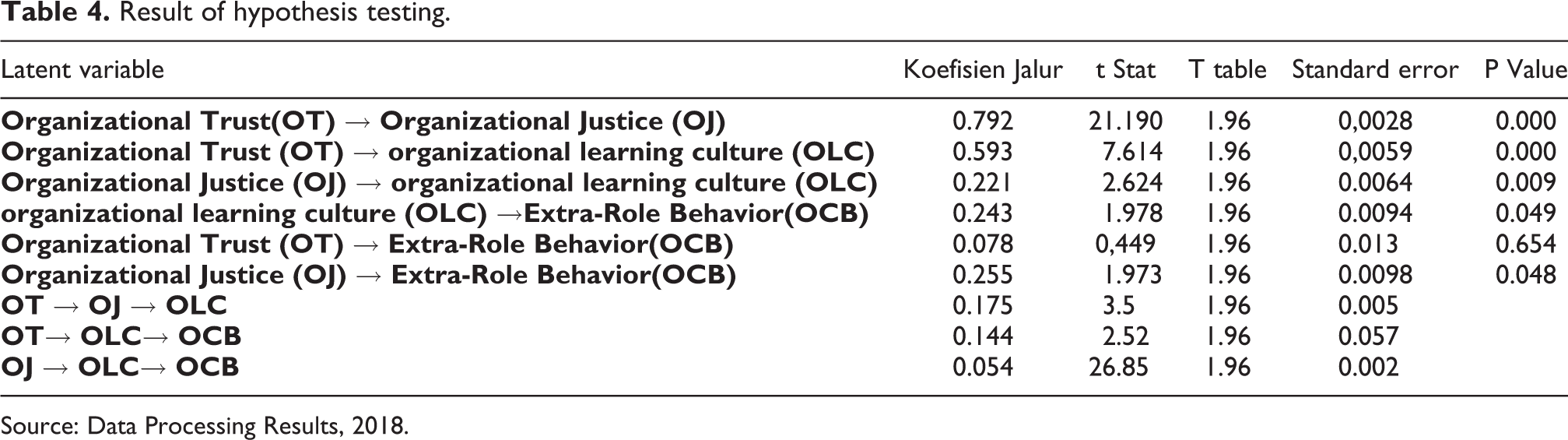
The results of hypothesis testing are presented in Table 4.
Result of hypothesis testing.
Source: Data Processing Results, 2018.
Based on Figure 2 and Table 4 the direct effect can be explained that: Organizational Trust (OT) effects to organizational justice (OJ) is 0.792. Based on t test, it found out that tStat > tCritical, therefore it can be concluded that organizational trust (OT) has positif significant effect to organizational justice (OJ) for employees government hospital in Makassar. Organizational Trust (OT) effects to organizational Learning Culture (OLC) is 0.593. Based on t test, it found out that tStat > tCritical, therefore it can be concluded that organizational trust (OT) has positif significant effect to organizational Learning Culture (OLC) for employees government hospital in Makassar. Organizational Justice (OJ) effects to organizational Learning Culture (OLC) is 0.221. Based on t test, it found out that tStat > tCritical, therefore it can be concluded that organizational Justice (OJ) has positif significant effect to organizational Learning Culture (OLC) for employees government hospital in Makassar. Organizational Trust (OT) effects to Extra-Role behavior (OCB) is 0.078. Based on t test, it found out that tStat > tCritical, therefore it can be concluded that organizational trust (OT) has positif but not significant effect to extra-role behavior (OCB) for employees government hospital in Makassar. Organizational Justice (OJ) effects to extra-role behavior (OCB) is 0.255. Based on t test, it found out that tStat > tCritical, therefore it can be concluded that organizational justice (OJ) has positif significant effect to extra-role behavior (OCB) for employees government hospital in Makassar. Organizational Learning Culture (OLC) effects to extra-role behavior (OCB) is 0.243. Based on t test, it found out that tStat > tCritical, therefore it can be concluded that organizational learning Culture (OLC) has positif significant effect to extra-role behavior (OCB) for employees government hospital in Makassar.
Apply the Sobel Test to test the mediating effect. The Sobel test results are listed in Table 2. Based on Figure 2 and Table 4 it can be explained that the mediating effect of organizational justice variables in the relationship between organizational trust and organizational learning culture is significant. These results are based on the t-test, found tStat = 3.5 > tCritical = 1.96. Similar results were found on the mediating effect of organizational learning culture on the relationship of organizational trust with extra-role behavior, where based on the t-test found tstat = 2.52 > tcritical = 1.96, therefore it can be concluded that the indirect influence of organizational trust for behavior extra-role through the organizational learning culture for employees of government hospitals in Makassar is significant. The same thing is also found in the mediating effect of organizational learning culture on the relationship of organizational justice with extra-role behavior. Based on the t-test, it was found tstat = 26.85 > tcritical = 1.96 so it can be concluded that the indirect effect of organizational justice on extra-role behavior through organizational learning culture for government hospital employees in Makassar is significant. Results of calculations of direct, indirect and the total effect for each variable in the model as follows. Table 5 shows that the variable with the greatest influence on organizational learning culture is organizational trust as seen from the total value of influence that is greater than the other variables. While the variable with the biggest influence on extra-role behavior (OCB) is organizational justice, the total effect value on the extra-role behavior is greater than the other variables.
Direct and indirect effects.

Source: Data Processing Results, 2018.
Discussion
This study proposes a structural equation model to analyze the impact of various variables related to employee extra-role behavior in organizations. The model builds on the literature review and previous research and shows the relationship between different variables that contribute to extra-role behavior. This study makes some specific contribution to the literature on extra-role behavior. First, the results of the study indicate that organizational trust directly has a positive influence but not significantly to extra-role behavior. The results of this research are in line with the literature. 8,9 Second, this study also found that organizational justice directly had a positive and significant effect on extra-role behavior. This result strengthens research that has been done by the literature. 7,6,21,38,39,42,56 Third, this study also revealed that organizational learning culture directly has a positive and significant influence on extra-role behavior. This is in line with research conducted by the literature. 13,49,50 Fifth, another important result of this study is that the mediating effect of organizational learning culture in the relationship between organizational trust and organizational justice on extra-role behavior is significant.
This means that organizations should be increasingly aware that organizational culture issues are very important because they can influence how each individual in the organization acts or behaves. The organizational culture recommended from this study is organizational learning culture. So it’s time for organizations to adopt learning organization culture so that extra-role behavior can increase. To make learning organization culture a strong culture, organizational trust needs to be improved. This is important because the results of this study indicate that organizational trust has a positive and significant effect on the running of organizational learning culture. These results are in line with the research conducted by Demir and Akif. 32 Another thing that can make organizational learning culture into a strong culture and is believed to be the majority of members of an organization is that organizational justice must be improved. This is because the results of this study found that organizational justice has a positive and significant effect on organizational learning. The results of this study are in line with research conducted by the literature. 11,35,36
The condition of organizational trust in government hospitals in Makassar, especially the outpatient department is already high category mainly because trust in teamwork is already high both related to trust in the distribution of work schedules, trust that colleagues can be relied upon, trust that colleagues will want to share information, trust that coworkers respect each other and trust that coworkers will uphold ethical values.
The condition of organizational justice that is felt by employees of government hospitals, especially in outpatient departments is already high category mainly because distributive justice is already in the high category, both related to the distribution of work schedules, job responsibilities, payment levels and the appropriate level of rewards. Nevertheless that there are still many things that should be improved, especially related to distributive justice. Another thing that also needs to be improved in the procedural justice section is that employees feel that they are still very limited in expressing their opinions regarding work decisions that have been made by the leadership. This means employees are still hoping for more opportunities and opportunities for opinion related to work decisions. This condition will certainly make them sometimes uncomfortable with various decisions made by the leadership. Employees also feel that in making decisions related to work, leaders do not care/are insensitive to the personal needs of employees.
Organizational learning culture in government hospitals has become a strong culture especially because the indicators of providing leadership and dialogue and inquery indicators are already in the high category. Nevertheless, there are some parts that still need to be considered by the hospital management, namely in the “continuous learning” section, especially related to the opportunity to get financial support and other resources to support the desire to learn and to give awards to encourage the desire to learn. In the Dialogue and Inquery section “the statement that everyone has been willing to give open and honest feedback to others and the statement that everyone wants to hear the views of others before speaking” has the lowest score compared to other statements. Furthermore, on the part of team learning, especially on employee statements, they have often been given awards for their performance and recommendations from experienced people are often used for consideration in making decisions. Embedded systems, especially in the case of hospital rumors, always maintain and update data bases about the abilities/expertise of their subordinates and hospitals always make all forms of knowledge easily accessible to everyone and the hospital has measured the output of every development activity undertaken. Furthermore, in the section on providing leadership, especially in the statement of leaders supporting the request to participate in learning and training opportunities. Furthermore, in the connection system section in particular the leadership’s statement supports learning and training opportunities. And in the empowerment section in particular the hospital statement builds a vision fit between all different levels and working groups.
The condition of extra-role behavior in government hospitals in Makassar is in the high category, mainly because courtesy and conscientiousness indicators are already in the high category. However, there are still some that must be considered by management, especially the altruism indicator.
Based on the results of the study the models that can be used to improve the behavior of Extra-Role Hospital Employees are as follows:
Voluntary behavior of employees beyond their responsibilities can be improved if the organizational culture that is believed by all entities in the organization leads to the culture of organizational learning. In this case, the organizational learning culture in question is the culture or values adopted in the organization that supports continuous learning to develop the overall organizational capacity. When the organizational learning culture is strongly held by the majority of members of the organization, in the daily work life of employees will be happy to do work outside of their formal responsibilities as a learning effort that is useful to increase their knowledge and abilities. The most important organizational learning culture of hospital employees is reflected in several things namely Dialogue and Inquiry, Embedded System, System Connection, Team learning, Provide Leadership, Empowerment and Continuous Learning
Making Organizational Learning Culture a strong culture is not easy because it is very dependent on employee perceptions, especially regarding perceptions of fairness and organizational trust. That way the hospital management must be able to build organizational trust and create and maintain an organization’s spirit of justice. Organizational justice that is important for hospital employees is sequentially reflected in several things, namely Interactional Justice, Distributive Justice and Procedural Justice.
How to create organizational justice for hospital employees, especially interactional justice is a decision made must show concern for the interests of employees and involve employees in the decision making process, for distributive justice management must understand and listen to employee concerns by collecting accurate data and information so that decisions which are made does not make employees feel ignored. After a decision has been made it should be well informed or communicated and applied consistently to all employees and for procedural justice, the hospital management must maintain that the compensation given is following the amount of the contribution of each employee, both financial and non-financial. Meanwhile, the most important thing regarding the organization’s trust in hospital employees is sequentially reflected in several things. To improve organizational trust in hospital employees, especially trust in work settings, is to respect any ideas that employees have so that they do not hesitate to convey their ideas, apply fair to all employees, value all actions and contributions of employees, respect and acknowledge employee achievement, provide support for employees so that they can work better, share information and knowledge with all employees, build a positive image of the hospital, create a comfortable work environment for patients and employees and create consistent strategic programs and plans. To increase trust in management, hospital management must always act according to what has been promised, for employees to believe in the leadership by the way the leader must always be there when needed and be ready to hear employee complaints, the leader must be consistent in behaving, the leader must maintain the confidentiality of personal decisions work-related employees, offer realistic solutions to any problems faced by employees, do not curb employees, respect employee performance. To increase trust in teamwork, all team members must care for each other and respect the ideas of other team members, respect the privacy of other team members, team members’ achievements are valued, be sincere in doing anything, always improve themselves, especially competencies so that they are always reliable and contribute to success the team and team members must support each other when there is a problem.
Conclusions
In government hospitals in Makassar, organizational trust, and organizational justice have a positive influence on extra-role behavior. The mediating effect of organizational learning culture in the relationship between organizational trust and organizational justice on significant extra-role behavior. This means that in order to increase the extra-role behavior of Makassar government hospital employees, organizational learning culture is important to serve as a strategy. The results also found that organizational trust and organizational justice have a significant effect on Organizational learning culture. This means that organizational trust and organizational justice will make employees want to run and make organizational learning culture a philosophy in their actions and daily lives in the organization.
Suggestions
The management of the hospitals should make the organizational trust as one of the things that are important to pay attention to especially trust in management through the leadership must always be there and ready when needed
The management of the hospitals must also maintain a fair attitude, especially procedural justice where employees are given an understanding of the right path to submit complaints if there are policies that are deemed inappropriate
The condition of organizational learning culture must also be considered in particular related to empowerment through periodic socialization of vision to all subordinates and pay attention to giving awards for employee performance. Equally important is that hospital management must always encourage continuous learning by rewarding employees who have the desire to learn and helping provide funds when there are employees who want to take part in a learning process.
Specifically for the extra-role behavior or Organizational Citizenship Behavior (OCB), the management must be able to encourage the active participation of employees in thinking of the organization as a whole by involving them in various meetings to discuss various matters related to the organization and involve them in the decision making the process. For the results of this study to be further tested, similar research is in other regions.
Extra-role behavior or Organizational Citizenship Behavior (OCB) is important, especially in hospital services, so it is necessary to examine more closely the various variables that can influence it.
Limitation
The number of samples in this research is still relatively small and only carried out in services organizations. Future research should be a larger sample size in manufacturing. It is important to do in future research by increasing the scope of research to expand the generalization area of research results. It is also important to add research subjects such as manufacturing companies to see the consistency of research results by comparing the results of both.
Footnotes
Declaration of conflicting interests
The author(s) declared no potential conflicts of interest with respect to the research, authorship, and/or publication of this article.
Funding
The author(s) received no financial support for the research, authorship, and/or publication of this article.
