




Abstract
This article examines the relationship between strategic human resource management (SHRM) practices, perceived organizational support (POS) and employee trust. Due to uncertainty in the business environment, the Libyan oil and gas companies have been unable to focus on their internal organizational strengths and weaknesses. It has been a challenge for the organizations to deal with their internal capabilities. Therefore, the proposed framework and its findings are expected to improve our understanding of the importance of human resources (HRs) to deal with an environment that is fraught with uncertainties. Some analysis of the work in this article was conducted and presented in 2015. This article is a part of large project and a quantitative survey approach was used, followed by a sample frame consisting of the Libyan oil and gas sector companies that employ at least 50 employees. Structural equation modelling techniques were used to analyse the data. The results indicate that oil and gas companies pursuing best SHRM practices along with POS achieve enhanced trust of employees. This provides better understanding about the importance of SHRM practices to assist HR practitioners to support and manage employees, subsequently leading to sustainable performance.
Introduction
Economic realities are forcing organizations to change constantly by reducing staff or by asking employees to deliver more with less due to the pressure to control costs in the organization. Organizations need employees who are willing to contribute beyond their job description (JD). It is a challenge for any organization to deal with its internal capabilities while monitoring various external challenges. Over the past few decades, the human resource management (HRM) department has been reported to have a greater importance in organizations. 1,2 Firms can improve their performance by adopting a set of best strategic HRM (SHRM) practices. 3 Furthermore, Sung et al. 4 stated that HRM practices were considered as a critical component for creating valuable resources and sustain competitive advantage of organization.
The insecure and uncertain situation of the local citizens in Libya has been further compounded by the uneven application of the regulatory standards in oil exploration. There is an inconsistent application of international regulations as different countries have different systems for allocating licenses for oil and gas exploration as well as different regulations for production. In order to generate a good and sound business strategy, firms need to first of all examine and understand their internal organizational strengths and weaknesses.
After the 2011 revolution ended, the Libyan oil industry, as well as the other industries, experienced a massive fall economically. Therefore, this research intends to identify the strategic management policies of the Libyan oil companies that have survived the war and continued to flourish after the war. The Libyan oil sector, which has long been the lifeblood of this desert nation, has made a positive recovery since the country’s 2011 revolution. Libya’s oil and gas industry accounts for about 90% of government revenue, and officials say a broad understanding of the sector’s importance has helped spare the country from episodes, like the deadly January attack by militants on a gas field just across the border in Algeria. Oil industry reserves in Libya were first developed in the 19th century when extracting was undertaken under the existing market conditions. Libya’s oil production was remarkably restored after months of conflict and insecurity. However, considerable uncertainty surrounds the future of the oil sector and the political regime that will govern it. Revolution is considered as a negative incident that causes the demise of an organization. Managers who fail to recognize the negative impact of a revolution and the risk exposure of their companies and do no crisis planning can find themselves in a very adverse situation. The economy of Libya relies mainly on revenue from the oil industry, which contributes almost all the export earnings and around one-quarter of the country’s gross domestic product. 5
Due to stiff competition and advancement in technology, companies are being urged to maintain their growth and competitive advantage through SHRM practices. 6 Human resources (HRs) act as alignment between organizational success and employees’ performance. This is the major role of HR managers and motivates the study to contribute to the understanding of the relevant literature. Many of the previous researchers have focused on the relationship between HRM practices and organizational performance, but very few studies have focused on the effect of SHRM practices on perceived organizational support (POS) and trust of employees. 7 Thus, the main purpose of this article is to examine the link between the best SHRM practices, POS and employee trust (ET). The proposed framework and findings intend to aid in the understanding of POS that mediates SHRM practices and ET.
SHRM and trust
Extant literature has suggested specific SHRM practices which are considered as being able to promote attributes in employees that can help organizations to gain competitive advantage. Trust, being a feeling, can be described as a psychological state. 8 Pneumatic reflects higher aspects of commitment that emerge from one’s being. For instance, Morgan and Hunt 9 suggest that trust is a precursor to relational commitment, the state of commitment having been achieved. 10 defines trust as expectancy held by an individual or a group that the word, promise, verbal or written statement of another individual or group can be relied upon. Accordingly, trust in a leader is generally defined as faith in and loyalty to the leader. 11
Employees’ trust of their organization is a prerequisite for long-term sustainable performance and sound relationship between an organization and its employees. A good and trust-based relationship can help reduce conflicts within the organization, improve job satisfaction and work efficiency and lower transaction and management costs. In addition, Morgan and Hunt 9 mention that the commitment trust theory highlights the concept of commitment and trust in order to maintain the relationship between two entities.
Organizations should pay attention to the design of HRM practices that could facilitate the building of trust. 12 In particular, it has been shown that HRM practices affect the existence and creation of trust in an organization. 13 Trust influences employee reactions and affects the success and effectiveness of HR activities. Although research on organizational trust has traditionally focused on its effect on the success of organizational activities, HR activities may also affect its development. In this sense, we follow the social exchange theory (SET), where Whitener 14 argues that trust is a consequence of the content and process of HR activities and a mediator of the impact of HR practices on important outcomes.
Decisions made by the organization must be communicated to the employees as part of the process of decision-making. Through this approach, a company not only gains the employees’ trust but also increases company benefits from the direct cooperation of the employees. A fair decision-making process influences the decision to trust. 15 When employees feel that the decision taken by the organization which affects them is fair, the trust towards the organization increases effectively. Hence, it is important to understand how organizations can gain trust of their employees when they do not have interactions on a daily basis with the downstream employees. Thus, HRM is an important factor in this case that can create and maintain trust through an effective communication process between managers and employees in generating the feelings of trust.
Research that has focused on enhancing trust as a desirable attribute among employees is not new and has been extensively investigated by several studies.
16
–20
Trust has also been linked to various other constructs, such as work behaviour,
21
employees’ performance,
20
intention to turnover,
22
problem-solving,
23
level of openness among the top management team members,
24
support for authorities,
25
satisfaction
26
and organizational commitment.
27,28
Traditional HRM practices and policies have focused on improving functions, such as training (TR), selection, health, safety, performance appraisal (PA), communicational skills, internal ladders, motivation, procedural justice and so on and these have been developed within the organization.
29,30
However, it has been argued that such practices may affect the climate of trust, thus reinforcing the validity of the psychological contract in the organization. Thus, it is logical to investigate the role of SHRM practices towards building and developing ET. The following hypothesis is therefore proposed:
POS as a mediator
POS as a mediator is well established in the literature and has been researched from various perspectives. These include the resource-based view (RBV), a knowledge management contingency approach, organizational learning theory and the SET. POS is defined as ‘the degree to which the employees believe that the organisation values their contribution and well-being and fulfil their socio-emotional needs’. There are three antecedents of POS: fairness, supervisor support and organizational rewards. POS plays the role of generating trust that would fulfil its exchange obligations of rewarding employees for contributing their efforts towards organizational success. 31
Furthermore, Rousseau’s 32 exchange relationship is based on the relationship between employees and the organization. There have been many studies on the exchange relationship potential within the organization, but the influence of POS that refers to the ‘global belief of the employees and to what extent the organisation values their contribution and cares about their well-being’ has not been extensively examined. 33
Exchange of employees’ efforts and loyalty for the organization has been examined by many organizational theorists. The characterization of the relationship between employee and employer can show how employees are treated. Employees, who are treated well, are known to display affective commitment in the organization by exceeding work responsibilities and being positively involved in both organizational problems and opportunities.
34
Consequently, the following hypothesis is proposed:
Theoretical framework and hypothesis development
A theoretical framework consists of concepts, together with the definitions and the existing theory that are used for the study. It demonstrates the theories and concepts that are relevant to the research and the broad field of knowledge. SET provides theoretical underpinning for the study, by predicting organizational support for ET, based on the quality of relationship exchange between managers and employees of oil and gas companies in Libya. HRM practices using SET approach signal benevolence of employers towards the workforce. 35 The employee–organization connection can be taken as a social exchange relationship between the employee and the organization, and organizational commitment is the employee’s psychological attribute and feelings after the establishment of such a relationship. Any kind of risk perceived by employees in the organization will affect their trust in the organization. This phenomenon can be explained using SET. If there is insufficient organizational investment in this aspect, what employees give back is affected. 36 Clearly, organizational management practices, such as staffing, TR, PA and reward systems, can influence an employee’s level of commitment to the organization. 37,38 A theoretical alignment between organizational support and organizational commitment can be determined by SET. According to SET, employees’ commitment to their organization is nurtured on the belief that the organization appreciates their contribution. 39 Gillis 40 acknowledges that interpersonal relations and social interaction are described through SET.
Following the previous discussions, the research model presented in Figure 1 perceives ET as emerging from the best SHRM practices, exercised at both operational and strategic levels in the company. The main value in this framework lies in the factors and their relationships that appear to play a unique role in the SHRM practices–trust relationship.

SHRM practices system. Source: Adresi and Ridzuan. 6 SHRM: strategic human resource management.
In this study, the field of SHRM practices research is discussed critically for the improvement and advancement of literature on HRM systems. HRM increases the quality of HR which consumes a source of sustainable competitive advantage, according to the RBV. In order to link organizational and employee goals, organizational commitment is considered as the main factor. 41 The best SHRM practices are expected to enhance ET by promoting inimitable attributes in HR.
Methodology
Sampling and data collection
The methodology of this article is extended from the published conference paper of Adresi and Ridzuan. 6 This article is more focused on employees and their trust towards the organization. Low- or middle-level managers were randomly approached to fill the survey questionnaire as they are more eligible to answer the questions in both management and employee perspectives. Unlike most previous studies on HRM, the data on SHRM implementation were gathered from low- or middle-level managers within the oil and gas industries of Libya.

Measurement model for the variables. Source: Adresi and Ridzuan. 6
In order to determine the model fit, various goodness-of-fit indices (GFIs) were considered for the study. An absolute fit index includes χ 2, GFI and root mean square error of approximation (RMSEA). Absolute fit indices measure how well the model accounts for observed covariance in the data. 42 The incremental fit indices include comparative fit index (CFI) and normed fit index. Incremental fit indices compare how well the proposed model fits the data in relation to a baseline model that assumes independence among all the variables. 43 Lastly, parsimonious fit indices can be measured by normed χ 2/df.
Results and discussion
The demographic characteristics of the respondents are shown in Table 1. According to Table 1, most of the respondents hold a bachelor’s degree. In addition, 48.9% are in the age range of 40–49 years. Furthermore, about 48% of the employees have at least 5 years of experience in the work field. This indicates that the respondents are familiar with company practices and policies.
Demographic characteristics of respondents.

Note: N = 331.
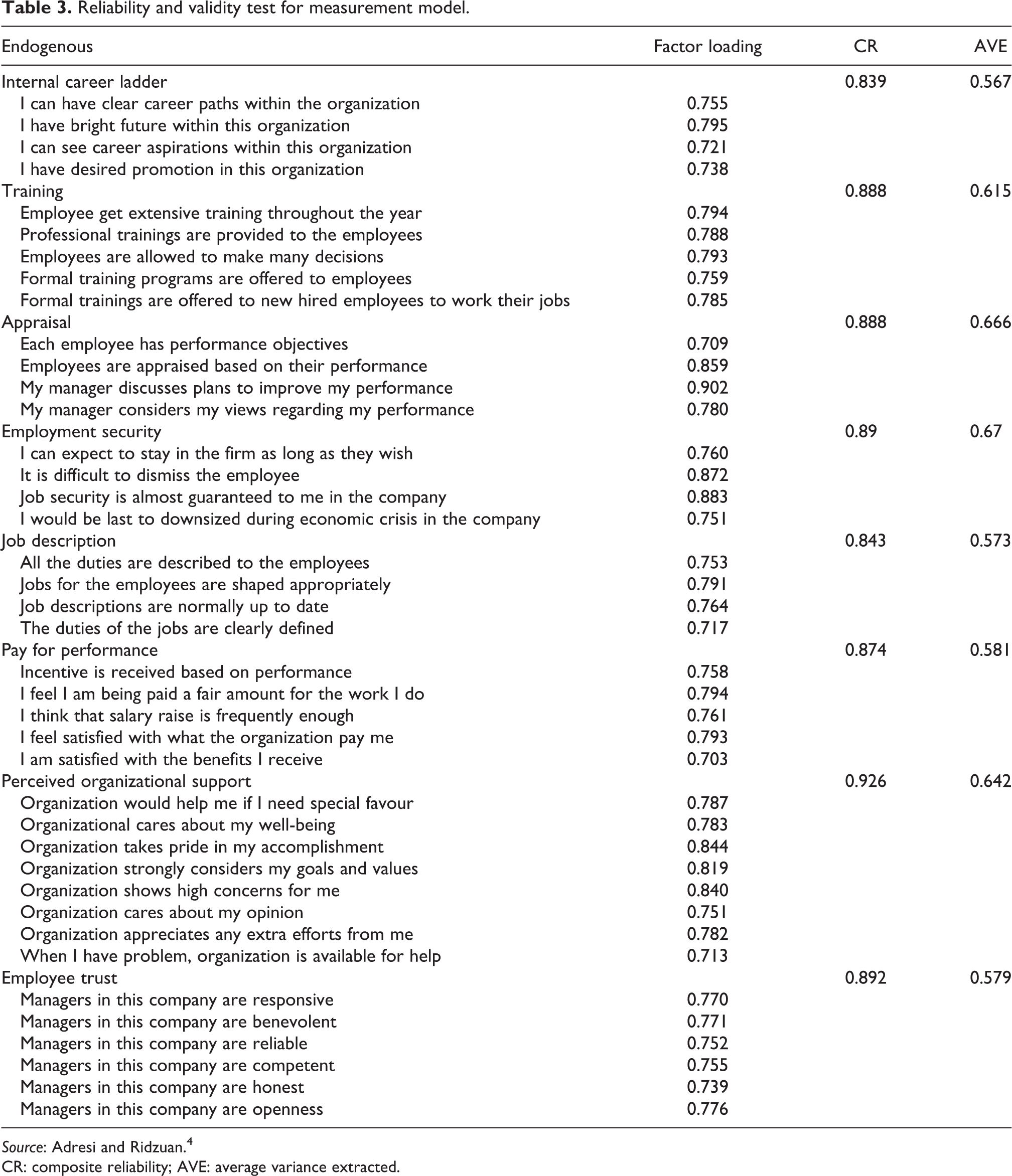
The descriptive statistics of the data and the bivariate correlations are presented in Table 2. The present study contributes to the understanding of the best SHRM practices on ET among low- or middle-level managers. However, this study finds that SHRM practices (internal career ladders (ICLs), PAs, TR, employee security, employee participation (EP), pay for performance (PP) and JD) have a positive relationship with ET (see Table 3).
M, SD and bivariate correlations of the variables.

M: mean; SD: standard deviation; ICL: internal career ladder; PA: performance appraisal; TR: training; ES: employment security; EP: employee participation; PP: pay-for-performance; JD: job description; ET: employee trust.
**Correlation is significant at the 0.01 level (two-tailed).
Reliability and validity test for measurement model.
Source: Adresi and Ridzuan. 4
CR: composite reliability; AVE: average variance extracted.
Although according to the previous studies, HRM practices are key elements for successful innovation and performance in the organization, not many empirical investigations have supported the SHRM practices–trust relationship. On the one hand, there is agreement on the relationship between HRM practices and performance; while on the other hand, there are inconsistencies in the literature about the contents of these practices.
Structural equation modelling analysis
Structural equation modelling (SEM) was used to confirm the hypothesized model. According to Byrne, 44 ‘SEM is particularly valuable in data analysis where the patterns of inter-relationships among the constructs are specified according to a prior established theory’. The SEM has the flexibility to model relationships among multiple criteria and predictors, and statistical testing is prioritized empirically through confirmatory factor analysis (CFA). 45 CFA was performed for SEM to test the provided hypothesis in the third chapter. Previous studies have claimed SEM to be more reliable and valid for social science studies. SEM methodology is claimed to be useful in the behavioural and social sciences where many constructs are unobservable. 46 SEM helps researchers to determine the unidimensionality, reliability and validity of each construct.
The measurement model for the underlying constructs is provided with the path diagram. In each of the measurement models, multiple items are used to measure each underlying factor. However, if items become redundant, the measurement model needs to be respecified by removing the redundant items. 47–49 Parsimonious unidimensional estimation can be achieved by removing the redundant items. 50 The discriminant validity is achieved when the model and its constructs are free from redundant items. Thus, AMOS 21 software was used to identify the pair of redundant items in the model in terms of high modification indices. In this study, the data set was validated using content validity, construct validity and convergent validity using SEM technique. The factor loadings for these measures were all above 0.60, indicating that standardized estimates for these measures are deemed to be statistically significant at p < 0.001. From the measurement model of the constructs, the discriminant validity criterion is confirmed as the correlation between the constructs does not exceeded 0.85.
In the measurement model, it is noticed that the average variance extracted (AVE) for all the variables are above the required level of 0.50. Thus, it is confirmed that the criteria of AVE are satisfied. The AVE result also provides additional support for convergent validity. It was also possible to provide the discriminant validity between the factors due to a positive and definite matrix. Construct validity is confirmed based on GFI as reported by Hsieh and Hiang. 51 Evidence of convergent validity is found based on high factor loadings (greater than 0.50) of all factors. 52
Structural model
In order to confirm that the structural model fits the data, the model was evaluated in terms of GFI. According to Cunningham, 53 a good fit to the sample data provides support for the hypothesized model. For hypotheses testing purposes, parameter estimates, together with coefficient values, were examined. Parameter estimates are used to generate the estimated population covariance matrix for the model. 54 Coefficient values are derived by dividing the variance estimate by its standard error. When the critical value (composite reliability) or z-value is greater than 1.96 for a regression weight (standardized estimates), the parameter is statistically significant at the 0.05 level. After the modification indices and removal of a few redundant measured items, Figure 3 shows that the fitness criteria are achieved.

Final respecified model. Source: Adresi and Ridzuan. 6
Figure 3 demonstrates the structural model with the path coefficients and the adjusted R 2, while Table 4 presents the overall findings as far as the hypotheses are concerned. Both hypotheses 1 and 2 are supported because a significantly positive relationship is shown between SHRM practices, POS and ET. Firms that invest on the best SHRM practices achieve higher level of trust from the employees than firms that do not invest in SHRM practices. The path between JD, POS, employee support and organizational commitment is not significant, and thus, JD was deleted from the model.
Standardized weights for structural model.

Source: Adresi and Ridzuan. 6
ICL: internal career ladder; TR: training; AP: appraisal; ES: employee security; PP: pay for performance; POS: perceived organizational support; ET: employee trust.
As shown in Figure 3, the overall respecified model is within the acceptance levels. The four major fitness indices, that is, GFI, TLI, RMSEA and CFI were used for evaluating the model fit. 55 The absolute values, like GFI and RMSEA, incremental values, including CFI and TLI, and parsimonious values, like χ 2/df, were used to confirm the model fit.
An examination of the Adjusted Goodness Fit Index (AGFI) shows that the model fits the data effectively (χ 2 = 741.824, df = 573 and p = 0.000). The GFI = 0.892, AGFI = 0.874, CFI = 0.978, TLI = 0.976, RMSEA = 0.030 and χ 2/df = 1.295. The results confirm that the SHRM practices have a significantly positive effect on ET. However, absolute fit index value of GFI is found to be very near to the acceptable value of greater than 0.90. According to previous studies performed by Chang and Chen 56 with GFI = 0.89 and AGFI = 0.86, they posited that AGFI must be greater than 0.80 and GFI greater than 0.90. Similarly, Chau and Hu 57 provide the cutoff value of AGFI as above 0.80. Tabachnick and Fidell 58 further add, ‘AGFI value adjusts the GFI based on the degree of freedom and AGFI tends to increase with sample size’.
The path estimates between SHRM components are found to be standardized path coefficients β = 0.217, t = 3.387 and p = 0.000 for TR on ET; β = 0.284, t = 3.496 and p = 0.000 for ICLs on ET; β = 0.138, t = 2.678 and p = 0.007 for pay-for-performance (PP) on ET; and β = 0.168, t = 2.548 and p = 0.011 for PAs on ET. ICL was having the high β coefficient with POS and ET. This confirmed that ICL is a more important factor that increases ET and POS of the employees. Employees who are not satisfied with their job are most likely to seek career opportunities outside the organization and are less willing to put in extra efforts in the organization. 59 In the Libyan context, 60 evaluated the trust mechanism and the way of HRM practices and found that HR managers are more likely to offer TR and shape the internal promotion when trust is high. Firms exhibit high organizational performance when trust is high. Unlike most previous studies of HRM, the data on SHRM implementation have been gathered from low- or middle-level managers within the oil and gas industries of Libya.
From the square multiple correlation result, it is noted that the model fit criteria are solved and there is a high correlation between the collaboration and networking with labour productivity. With the significant standardized regression weights of all the constructs and items, the overall square multiple correlation is found to be 0.83 (75%), which is considered a very active and important finding of the study.
Conclusion
This article is an extended review of the conference paper published by Adresi and Ridzuan. 6 The extended review in this article found that there is high correlation of ICLs (β = 0.717 and p < 0.05) with ET. The finding of the article also reveals that POS has a partial mediating effect on SHRM practices and ET. If managers are concerned with their employees in order to meet their need for approval, esteem and affiliation, there will be increase in work effort. POS will increase employees’ obligation to help the organization reach its objectives. Employees with the help of organizational support will be able to contribute to enhancing organizational performance. Libyan oil and gas companies must be able to motivate their employees by compensating them based on their performance. Superiors must be supportive of the employees and work together to meet organizational goals and objectives. Employees and managers must have good cooperative skills and work in the field as a team in order to overcome problems and increase trustworthiness. Furthermore, managers must consider SHRM as a strategy to get the work done in an effective manner without any conflicts among the employees. From the exploratory factor analysis (EFA) analysis, it was found that trust of the employees can be improved through the effective SHRM practices. Employee productivity is high when both ET and commitment are enhanced. We contribute to the growing theory of social exchange in the organization from both internal (SHRM and productivity) and external (competitive advantage) perspective. For example, through effective TR to the employees will help to achieve departmental objectives together with enhancing employee competencies. Furthermore, SHRM models emphasize on business strategies and compensate employees in order to remain creative and maintain market position.
Compatibility between SHRM practices is very important in order to increase trust of employees. Managers must understand the internal requirements for successful strategic implementation and they must insist that careful attention is paid to the requirement of first-rate execution of the chosen strategy. If the organization is to increase its performance at the highest level, it should emphasize more on TR, EP, employee motivation and description of jobs. Linking the motivation and reward structure directly to achieve results and initializing policies and procedures for proper implementation of strategies are crucial for the organization. Managers personally must be able to lead the process of strategic implementation and execution of SHRM practices.
From the proposed framework, it is obvious that all the HRM functions must be in accordance with increasing productivity as well as organizational objectives. Operating in a stable and dynamic environment, managers and employees should work as a team in order to develop new knowledge and complete tasks to increase productivity. Skills of the employees in the organization need to be developed on the foundation of traditional literacy and research as well as technical and analytical skills in order to interact meaningfully. It is very crucial for the managers to understand the estimated value of commitment and trust for the employees so as to identify and manage the cost and time allocation. Strategic and managerial actions in relation to SHRM practices could increase ET in the organization, thus providing continuously innovative solutions. Thus, supporting the organization with more HRM practices, including skills and abilities, will enhance the communication, negotiation and participation processes. The study makes meaningful contribution to the strategic literature on SHRM as well as internal and external contingencies. This empirical investigation beyond the SHRM trust connection should further advance managerial understanding on various employee outcomes and subsequent employee performance.
Footnotes
Author’s Note
Portions of this article were presented in the Academy for Global Business Advancement Conference, 16–19 November 2015, in the University Malaysia Pahang, Kuantan, Malaysia.
Acknowledgement
The authors wish to thank gratefully to the anonymous reviewers for their valuable and instrumental suggestions leading to the improvement of this article.
Declaration of Conflicting Interests
The author(s) declared no potential conflicts of interest with respect to the research, authorship, and/or publication of this article.
Funding
The author(s) received no financial support for the research, authorship, and/or publication of this article.